
NL East Notes: Realmuto, CarGo, Marlins, Braves, Vargas
Newly acquired catcher J.T. Realmuto and the Phillies have yet to discuss a contract extension, agent Jeff Berry said at this week’s news conference to introduce Realmuto to his new team (link via Jim Salisbury of NBC Sports Philadelphia). That doesn’t mean that the two sides won’t eventually sit down and try to work out a long-term arrangement, but Realmuto said at his introduction that he’s scarcely even had time to think about contractual matters on the heels of such a hectic week. “I’ve heard nothing but amazing things,” Realmuto said of the Phillies organization, “so we’ll see about that in the future.” The Phillies control the All-Star for another two seasons.
Here’s more from the division…
- The Marlins are open to signing another veteran position player, writes Joe Frisaro of MLB.com, who calls longtime Rockies outfielder and South Florida resident Carlos Gonzalez a “possible pick-up” for the team. The 33-year-old Gonzalez has seen his offensive numbers drop in recent seasons; while his combined .269/.334/.445 slash and 30 homers over his past 1038 plate appearances are solid at first glance, park-adjusted metrics like OPS+ and wRC+ feel his bat has been a bit below the league average when factoring in the positive effect of Coors Field. CarGo was an NL All-Star as recently as 2016 and ripped 40 homers for the Rockies in 2015. Lewis Brinson, Brian Anderson, Magneuris Sierra and Austin Dean are among Miami’s current outfield options on the 40-man roster, and the Marlins also recently inked Curtis Granderson to a minor league contract.
- Although the Braves have been quiet in terms of roster additions since signing Josh Donaldson and Brian McCann early in the offseason, David O’Brien of The Athletic tweets that the team expects payroll to increase over its year-end mark of $126MM, be it via spring additions or in-season player acquisition. Atlanta currently has a projected payroll of about $118MM, which would suggest there’s room for at least another $8-9MM to be added, though O’Brien notes that the organization is (unsurprisingly) not divulging a target number for the 2019 payroll. At the time of Nick Markakis‘ return to the organization last month, general manager Alex Anthopoulos spoke about how the relatively low guarantee on that contract could provide some additional flexibility down the line, though that has yet to manifest in the form of a roster move.
- Mets fans hoping for their club to add another starting pitcher don’t appear likely to have that wish granted, as skipper Mickey Callaway declared lefty Jason Vargas the team’s fifth starter yesterday (Twitter link via MLB.com’s Anthony DiComo). Further, that proclamation indicates that there won’t be a competition for the final rotation spot, which could’ve otherwise included apparently bullpen-bound righties such as Seth Lugo, Robert Gsellman or any of the team’s arms in the upper minors (e.g. Corey Oswalt). Certainly, a spring injury or two could change that reality, but for the time being, it appears the Mets are content not only with the arms they have on the 40-man roster but also with the expected roles for each of those pitchers.
Jacob deGrom Puts Opening Day Deadline On Contract Talks
Long-anticipated contract talks between the Mets and star right-hander Jacob deGrom have yet to get underway, though indications are that the sides will explore a new deal in camp. According to Mike Puma of the New York Post, the sides will need to work quickly if they are to reach agreement, as deGrom has informed the team he will not negotiate during the season.
This news means that the Mets and deGrom have only about six weeks to hammer out the details of what promises to be a monster new contract, if one is to be reached at all. While it’s common for extensions to be announced during camp, it seems in this case that deGrom and his agents at CAA had anticipated much more background dialogue in the months between the Winter Meetings (when they met with Mets officials) and Spring Training.
To be sure, there’s no mandate that the sides reach agreement. They already have agreed to a $17MM arbitration salary for 2019, which includes a record-setting raise befitting deGrom’s historically notable 2018 season. And with deGrom under team control for one more season, there’d still be time to negotiate in the future.
Getting something done now, however, may be the Mets’ best chance to secure deGrom’s future services at a relatively palatable rate. Otherwise, the 30-year-old could decide to take on the risk of health or performance decline with hopes of eventually striking it rich in free agency. His relatively advanced age is a factor, to be sure, but to this point deGrom has been a workhorse and he projects to enter the open market in advance of his age-33 season. If his ensuing two campaigns are anything like the one he just wrapped up, he’ll have no trouble commanding big numbers on the open market. That said, deGrom is plainly interested in capitalizing on his 2018 excellence, and is also surely aware of the risks that come with pitching through two full MLB seasons.
There are some other considerations here. Puma notes, as Andy Martino of SNY.tv has suggested previously, that deGrom’s current agent — Mets GM Brodie Van Wagenen’s former partner Jeff Berry — has suggested that players have on-field recourse to utilize against their employers to gain leverage in an increasingly unfriendly market setting. Specifically, he proposed that pitchers self-impose workload limits if they aren’t protected by long-term agreements. That path — sure to be highly controversial if implemented — seems to be on the table here. Public perception would be an important consideration in how that would play out, and also colors the present talks. The Mets had given fans (as well as deGrom) reason to believe that they’d make a big push to lock up the reigning NL Cy Young winner. Now, the onus seems to be on the organization to come forward with a significant offer.
Fallout From The J.T. Realmuto Trade
Following a merciful coda to the offseason’s most protracted soap opera – a fine Philly offer, agreed upon Thursday, that finally plucked former Marlin catcher J.T. Realmuto from the clutches of South Beach – each of the oft-snubbed clubs offered their final say.
We’ll start in Atlanta, in whose court the Realmuto ball seemed to linger longest – indeed, per Jon Heyman of MLB Network, the team needed only to surrender two from the group of Austin Riley, Cristian Pache, and one top pitching prospect (of which Atlanta has several: each of Mike Soroka, Ian Anderson, Touki Toussaint, Bryse Wilson, Kyle Wright, and Joey Wentz are top 100 prospects in at least one major outlet). Ozzie Albies, said to be an essential part of any Realmuto deal with Atlanta, was never a demanded centerpiece, per Ken Rosenthal of The Athletic. Though certainly a substantial return, it’s a package that can’t be said, by any reasonable analysis, to be one that would have stripped the farm of the suddenly-conservative Braves to the bone.
The ask of the Dodgers, ever-cautious themselves, was two from a group of Dustin May, Keibert Ruiz, Gavin Lux, and Will Smith, per Heyman, in the same tweet. Ruiz and Smith, both catchers, likely won’t ever be on the field together at Chavez Ravine, and some outlets ranked neither May nor Lux inside the top 100. Both Heyman and Rosenthal concede that Cody Bellinger was the prize on which Miami initially laid its eyes, but it appears the team quickly swiveled to less-established names in the weeks to follow.
Rosenthal confirms earlier reports that the Fish first coveted outfielder Michael Conforto or Amed Rosario from the Mets, and adds that the team also needed a “top shortstop prospect,” presumably Andres Gimenez, to be added to the deal. It doesn’t appear the club pivoted to other names after the Mets balked, likely owing to the thinned-out version of the late-offseason Mets farm.
From the Yankees, the club did seek Gary Sanchez and Miguel Andujar, per Rosenthal, but only part of a “larger deal” that would obviously have included additional pieces. The Bombers were understandably reluctant to trade either, and the wheat of the Yankee farm – stocked mostly with high-upside, low-level types – wouldn’t have been enough to secure Realmuto’s services. The reported three-team with the Mets that would have sent Noah Syndergaard to New York was bandied about, but a copacetic swap was “never close.”
Cincinnati was both late to the fore and hesitant to move any of its top three prospects, per Rosenthal, and it doesn’t appear a deal was close there, either. Perhaps surprisingly, given the intense scrutiny of the talks, both the Twins and White Sox were “in the mix,” though prospective returns and/or offers are still in the dark.
In the end, Miami seems more than content with its return. The Fish regarded Will Stewart, the trade’s third piece, as Philadelphia’s second-best pitching prospect, per Rosenthal, ahead of near-unanimous top-100 hurler Adonis Medina, righty Spencer Howard, who placed 52nd on Keith Law’s list, and lefty JoJo Romero (66th overall, per Law). Sixto Sanchez, of course, has a decent shot to be an ace, and it’s certainly true that the club could reap more value in Jorge Alfaro alone than it would in the next two seasons with Realmuto behind the dish. The oft-pilloried asks, long said to far outstrip the two-year value of the game’s premier offseason trade target, were, in most respects, perfectly reasonable, and may have quickly been met in eras bygone. This, though, is the time for prospect hoarding, an age in which the control is treasured above all else, and those with even the slightest chance to be stars are stashed deep away, brought out only for the most earnest of window shoppers.
NL Notes: D-Backs, Wheeler, Wacha, Dunn
The Diamondbacks‘ interesting offseason reflects GM Mike Hazen’s self-described effort to “thread the needle,” Nick Piecoro of the Arizona Republic writes in an excellent look at the Arizona organization and its top baseball executive. Despite trading away franchise cornerstone Paul Goldschmidt in what could turn out to be a highly consequential trade, the Snakes will enter the season with intentions of trying to contend — albeit with a realistic outlook and, it seems fair to presume, backup plans should things go south. Hazen says he’s committed to trying to put a winner on the field whenever possible, making clear he has no regret for pushing in chips at last summer’s trade deadline. It’s an interesting article that’s well worth a full read.
More from the National League:
- Mets righty Zack Wheeler has been noted as a potential extension target this spring, but it does not sound as if he’s anxious to discuss a new deal after previously agreeing to a $5.975MM contract for his final season of arbitration eligibility. As Tim Healey of Newsday writes, Wheeler declined to say that he’s interested in — or even thinking at all about — a long-term arrangement. “I’m here right now,” Wheeler says. “That’s all I’m worried about. All that stuff will figure itself out and I’ll worry about that later.” Those comments certainly don’t seem to rule out an extension, and Wheeler made clear he’s happy to be playing for the Mets, but they also leave little reason to think that he is anxious to secure a new deal. If the team was hoping it might find value by striking up negotiations this spring, then, it may be disappointed.
- Meanwhile, right-handed Cardinals starter Michael Wacha struck a similar tone, as Rick Hummel of the St. Louis Post-Dispatch reports, though he’s in a bit of a different situation than Wheeler. Though Wacha also turned in strong results last year, he ended the season on the shelf with an oblique injury. His own injury struggles are well-documented, albeit not as extensive as Wheeler’s, yet the situation is not one that’s obviously ripe for extension talks even as free agency beckons. Wacha made clear he has not been approached by the club to this point, saying he’s “not getting prepared for any talks” in camp.
- The Rockies are hopeful that southpaw Mike Dunn will be ready to head north with the club out of camp and have a full 2019 season, MLB.com’s Thomas Harding writes. That would be a boon to a relief unit that has not received the contributions it hoped for from multiple high-priced relief pitchers. The 33-year-old Dunn did not pitch to expectations in 2017 and had a dreadful 2018 showing before giong down to shoulder surgery. That creates quite a lot of uncertainty, though bullpen coach Darren Holmes says that the southpaw’s “arm is working as well as it did in 2016 or better” as camp approaches.
Mets Sign Danny Espinosa To Minor League Deal
The Mets announced Friday that they’ve signed infielder Danny Espinosa to a minor league contract and invited him to Major League Spring Training.
Espinosa joins a crowded Mets infield mix that currently includes Jed Lowrie, Todd Frazier, Amed Rosario, Robinson Cano, J.D. Davis and first basemen Dominic Smith and Peter Alonso. He’ll face an uphill battle in cracking the roster because of that depth, particularly considering the struggles Espinosa has endured in recent seasons.
Once a high-quality regular for the Nationals, Espinosa has bounced all over the league since 2016, spending time with the Nats, Angels, Mariners, Rays, Yankees, Blue Jays, Dodgers and Phillies (although not all in the Majors). Last year, in 80 games between the Triple-A affiliates for the Dodgers, Phillies and Jays, he hit a combined .229/.291/.356 in 315 plate appearances. If he doesn’t make the roster out of camp, the switch-hitting Espinosa will presumably head to the Mets’ new Triple-A affiliate in Syracuse and give them some depth in the event of an injury.
Minor MLB Transactions: 2/7/19
Here are Thursday’s minor moves from around the game…
- The Rays re-signed outfielder Jason Coats to a minor league pact and invited him to MLB Spring Training, tweets Marc Topkin of the Tampa Bay Times. Coats, who’ll turn 29 later this month, spent the 2018 season with Tampa Bay’s Triple-A affiliate, where he hit .247/.293/.448 with 15 home runs. Coats has a bit of big league time under his belt, having tallied 28 games with the White Sox in 2016. While he struggled to get on base last season, though, he has a stronger track record in Triple-A overall, where he’s a .277/.327/.462 hitter in nearly 1300 plate appearances.
- The Dodgers have signed righty J.D. Martin to a minor league pact, tweets Ken Rosenthal of The Athletic. A first-rounder way back in 2001, Martin never established himself in the Majors but has been working to reinvent himself as a knuckleballer over the past three seasons. Martin spent last year with the Rays’ Double-A affiliate, where he posted a 4.49 ERA with 5.1 K/9 against 4.3 BB/9 in 124 1/3 innings of work. Those numbers aren’t exactly encouraging, though the knuckleball is still fairly new to Martin. As Rosenthal notes, he’ll work with Dodgers adviser Charlie Hough on further refining his ability to utilize the increasingly rare pitch.
- The Dodgers have also signed veteran Cody Asche to a minor league deal, tweets J.P Hoornstra of Southern California News Group. Asche, 28, spent the entire 2018 season in AAA, hitting .220/.304/.399 across 368 plate appearances. He last appeared in the majors with the Chicago White Sox in 2017, where he played 19 games mostly as a DH. Hoornstra notes that Asche will not receive an invite to spring training with Los Angeles.
- The Mets have signed left-handed pitcher Sean Burnett to a minor league contract, tweets the New York Post’s Ken Davidoff. The deal, Davidoff notes, does not include an invite to MLB spring training. Burnett spent the 2018 season pitching primarily with the Marlins’ AAA affiliate, where he posted a 5.49 ERA, although he flashed more promising peripherals. He struck out 10.5 batters per nine innings while walking just 2.3, good for a 4.6 K/BB ratio. Burnett, 36, has not pitched in the majors since 2016. For his career, he has pitched to a 3.52 ERA in 378 1/3 major-league innings.
MLBTR Poll: NL East Hierarchy
In an offseason that will be remembered for teams’ reluctance to shell out big money for the Hot Stove season’s biggest names, the NL East has been an outlier. Three of its teams–the Mets, Nationals, and Phillies–have gone against the grain, employing aggressive strategies and eyeing a 2019 division title in what appears to be an open field. Certainly, the division projects to be one of baseball’s most competitive in the upcoming season, featuring four teams that have at least a fighter’s chance at seizing the NL East crown. After the Nationals’ dominating run atop the division in recent years, the club took a step back in 2018, all while the Braves and Phillies enjoyed seemingly premature success. And with the Nationals preparing to bid goodbye to their franchise player, there is no clear favorite to win the division as spring training draws near. Which team’s slate of offseason moves will lead to a postseason appearance?
The Mets turned heads with their blockbuster December trade to acquire Edwin Diaz and Robinson Cano from the rebuilding Mariners, loudly marking the arrival a new front office regime headed by general manager Brodie Van Wagenen. Van Wagenen has placed his club firmly in “win-now” territory, supplementing the Diaz deal with signings of solid regulars Wilson Ramos and Jed Lowrie, to say nothing of his efforts to shore up a lackluster bullpen with the additions of Jeurys Familia, Justin Wilson, and Luis Avilan. Van Wagenen has not been shy about making trades, swinging three separate deals that brought Keon Broxton and J.D. Davis to New York and shipped backstop Kevin Plawecki to Cleveland. The club was also rumored to have offered $64MM to Yasmani Grandal–who ultimately declined and signed with the Brewers–and has been linked to Gio Gonzalez to round out an already-stellar starting rotation. The Mets will also count on a contribution from first baseman Peter Alonso, who made a name for himself with his display of power in 2018, slugging 36 total home runs across two levels of the minors. It remains to be seen whether the revamped roster will be enough to carry the Mets into October, but the team’s aggressiveness this winter has certainly put them in position to compete.
Though it’s entirely possible that Bryce Harper has played his last game in a Nationals uniform, the team still appears well-equipped for another run at the postseason in 2019. Owner Ted Lerner, for his part, has exhibited a willingness to invest heavily in the current iteration of the Nationals: the team has already doled out the offseason’s single largest contract of the offseason, adding standout lefty Patrick Corbin to a pitching staff that already features Max Scherzer and Stephen Strasburg. Furthermore, the club was reported to have offered Bryce Harper at least $300MM to remain in the nation’s capital for the next decade. All that not to mention the additions of Brian Dozier, Kurt Suzuki, Trevor Rosenthal, Kyle Barraclough, Matt Adams, and Anibal Sanchez. Dozier, who was hamstrung by injuries in 2018, will look to return to form as a right-handed power bat who can play up the middle. Suzuki will work in tandem with trade acquisition Yan Gomes to stabilize the catcher position, where the Nationals sorely lacked for production in 2018. Sanchez, who enjoyed a career renaissance last season, will slot in behind the big names as the fourth starter. Even if Harper decides to play out his prime elsewhere, the Nats still feel comfortable with their outfield mix moving forward. Standout rookie Juan Soto will be joined by highly-touted prospect Victor Robles and veteran Adam Eaton, who has posted an impressive .816 OPS in his injury-shortened Nationals career.
With today’s acquisition of catcher J.T. Realmuto, one of the offseason’s most sought-after prizes, the Phillies have vaulted themselves into the conversation atop the NL East. Entering the offseason, the circumstances were clear: Phillies ownership was sitting on heaps of money, fully preparing to invest it into one, if not both, of the top available players. While Phillies fans have thus far had to settle for the likes of Andrew McCutchen, Jean Segura, David Robertson, and now Realmuto, both Harper and Manny Machado remain unsigned, and Philadelphia remains in play for the two megastars. Even without one of Harper or Machado, the Phillies can’t be discounted in the race to the top of the NL East. Though the team finished with an unimpressive 80 wins in 2018, Philadelphia kept pace with the Nationals and Braves for much of the season, until a late-season collapse took them out of the race. Gabe Kapler and his staff will lean on leadership from veterans Realmuto, McCutchen, and Robertson in an effort to prevent the club from running out of gas again in 2019. Considering the possibility that Philly’s biggest moves have yet to come, Phillies leadership must feel optimistic about their team’s chances moving forward.
The 2018 division winners, the Braves, have largely remained quiet in the winter. With their rebuild taking off seemingly a year ahead of schedule, team leadership, sitting on a farm system brimming with potential impact players, may be hesitant to commit fully to a win-now mentality. After inking 2015 AL MVP Josh Donaldson to a one-year deal early in the offseason, the team’s biggest move has been to bring back 2018 All-Star Nick Markakis on a one-year contract. Many onlookers have expressed frustration at the team’s hesitance to pursue big names, but Atlanta evidently feels content to bank on steps forward from its young core, including Ronald Acuna, Ozzie Albies, and Dansby Swanson, as well as contributions from its gaggle of young pitchers–Mike Soroka, Touki Toussaint, and Kyle Wright, among others. Meanwhile, in Miami, expectations are low. The trade of J.T. Realmuto is the latest in a series of trades that have gutted the major-league roster over the last two years. Other casualties of the offseason include Derek Dietrich, Nick Wittgren, and the aforementioned Barraclough. And while the club has made canny signings of Curtis Granderson and Neil Walker, the focus in Miami is firmly on the future. Although a growing crop of farmhands may make the Marlins a real threat in the 2020s, fans should prepare for another season in the cellar of the NL East.
(poll link for mobile users)
Which of the NL East teams is best positioned to win the division in 2019?
-
Atlanta Braves 30% (7,323)
-
Philadelphia Phillies 27% (6,643)
-
Washington Nationals 25% (5,956)
-
New York Mets 16% (3,819)
-
Miami Marlins 2% (545)
Total votes: 24,286
Mets Re-Sign Devin Mesoraco
The Mets have announced the re-signing of catcher Devin Mesoraco. He’ll receive a minor-league pact with an invitation to Spring Training. The deal includes a $1.75MM salary at the MLB level, Bob Nightengale of USA Today Sports tweets.
Mesoraco, 30, represents an important addition for the Mets. Wilson Ramos and Travis d’Arnaud presently sit atop the depth chart, but the latter (who has a non-guaranteed, $3,515,000 arbitration salary) remains a candidate to be traded or cut loose if the club sees an opportunity or prefers to save some cash.
Returning to the Mets makes sense for Mesoraco, though it’s surely a disappointment to do so without a roster spot. He suited up for 66 games with the club last year after coming over from the Reds in exchange for Matt Harvey — a swap that came together after both players ran out of chances with their original organizations.
Mesoraco turned things around at the plate upon landing in New York, though he didn’t sustain a hot start. Ultimately, he provided the Mets with 229 plate appearances of .222/.306/.409 hitting and swatted ten home runs. He turned in middling framing numbers and isn’t generally regarded as a standout defender, though Mesoraco did strike up a rapport with Cy Young winner Jacob deGrom.
Latest On Mets’ Pitching Staff
While the Mets seem to have largely built out their 2019 pitching staff, there’s still some potential offseason work to be done. That may not mean bringing in new arms, though, so much as looking into new deals with existing ones.
There had been a general expectation that the Mets would pursue another rotation piece, whether to compete with or displace Jason Vargas in the #5 spot. General manager Brodie Van Wagenen cast doubt on that concept in an interview today with Andy Martino of SNY.tv (video link).
The Mets will “still stay in touch” with free agents, says Van Wagenen, but the team presently has “no plans to sign an additional starting pitcher.” Rather, per the rookie GM, the plan is to head down to camp and evaluate from there.
Whether or not Spring Training will provide opportunities — or create needs — for the Mets to consider additional hurlers, it’s expected to serve as a stage for contract talks. In particular, indications are that the club still intends to explore a new deal with star pitcher Jacob deGrom.
That negotiations haven’t yet started “has left the deGrom camp, at a minimum, disappointed,” according to Joel Sherman of the New York Post. From the team’s perspective, Van Wagenen did not indicate that anything has changed. To the contrary, he says that he still “hope[s] Jacob deGrom is a lifelong Met.” There’s still ample time for talks to get started, of course — camp hasn’t opened, and deGrom is controlled for two more seasons — but it’s certainly interesting to hear that deGrom’s reps have been displeased at the lack of communication to this point.
Interestingly, Sherman also reports that the Mets have designs on holding talks with Zack Wheeler, who is earning $5.975MM in 2019 before reaching free agency. Wheeler is an interesting potential extension target, as he’s fresh off of an impressive season in which he re-emerged following a three-year run of injuries and struggles. He’s younger than deGrom and closer to free agency, but hasn’t reached his rotation mate’s successes on the mound and has a much more worrisome track record. Wheeler is a difficult player to value in a hypothetical extension scenario, so it’ll be interesting to see if the sides are able to line up on a deal.
Projecting Payrolls: New York Mets
As we continue to wait for the new homes of Bryce Harper and Manny Machado, let’s move on to the 13th team payroll projection. Below find the links to the earlier posts in this series.
Philadelphia Phillies
Los Angeles Dodgers
Los Angeles Angels
Atlanta Braves
New York Yankees
Chicago White Sox
Boston Red Sox
Minnesota Twins
Milwaukee Brewers
San Francisco Giants
St. Louis Cardinals
Chicago Cubs
If you have questions about financial information made available to the public and the assumptions used in this series, please refer to the Phillies piece linked above.
Today, we look into a club that has surprised the baseball world move after move this winter: the New York Mets.
Team Leadership
Despite having been around for 57 seasons, the Mets have really had only three owners. They were founded as an expansion franchise in 1962 by Joan Payson with her widower running the show for five years after her death before he sold the club to publisher Nelson Doubleday’s company in 1980. Doubleday individually grabbed the club along with Fred Wilpon in 1986 and Wilpon, along with his business partners, bought out Doubleday in August 2002 with the Wilpon ownership group assuming full control. To say that Wilpon ownership got off to a bad start is quite an understatement as the team made just one trip to the playoffs from 2003-14, memorably falling to St. Louis in a seven-game NLCS in 2006 before a pair of heartbreakingly close playoff misses in 2007 and 2008. The club was rejuvenated, fueled by elite young pitching, in 2015, reaching the World Series and following that up with another playoff trip in 2016, albeit just a Wild Card Game loss.
Following an eight-year run during which Sandy Alderson rebuilt the club into a true contender, Wilpon went outside the box — way outside the box — and hired former Creative Artists Agency player agent Brodie Van Wagenen to be the new general manager in October 2018. Although his hiring was initially met with some skepticism and questions about possible conflicts of interest, Van Wagenen has set the baseball world on fire with a series of marquee moves, as we’ll discuss below.
Historical Payrolls
Before hitting the numbers, please recall that we use data from Cot’s Baseball Contracts, we’ll use average annual value (“AAV”) on historical deals but actual cash for 2019 and beyond, and deferrals will be reflected where appropriate. And, of course, the value of examining historical payrolls is twofold: they show us either what type of payroll a team’s market can support or how significantly a given ownership group is willing to spend. In the most useful cases, they show us both. We’ll focus on a 15-year span for the Mets, covering 2005-18 for historical data as a means to understanding year 15: 2019. This period covers nearly the entirety of Wilpon’s sole ownership, so this provides an excellent window into what to expect from the club. We’ll also use Opening Day payrolls as those better approximate expected spending by ownership.
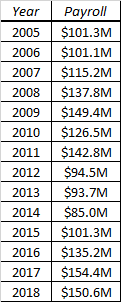
Wilpon kept spending largely consistent during the early days of his sole ownership, but payroll jumped in a big way to fuel the successful teams of the late 2000s. As that roster aged and faded, the payroll dipped substantially, including a massive one-year drop of nearly $50 million before the 2012 season. Payroll largely stagnated until a return to significant spending in the 2016 season as the Mets attempted to return to the World Series, followed by another jump before the 2017 year.
The Mets paid a $1.1 million luxury tax bill for the 1999 season under the previous tax regime, but that was the only year in club history during which they’ve incurred the tax. They came in narrowly under the threshold in 2003 by less than $1 million, but they haven’t come particularly close to the tax line over the past 15 seasons. The club has regularly played in the international amateur space, though they’re not known for the type of boundary-pushing spending that teams like the Yankees, Red Sox, Dodgers, and Cubs have employed.
Future Liabilities
Mets spending in 2019 is set to take a new leap, setting a new franchise high by a solid margin. Unsurprisingly, a bevy of guaranteed deals lead the way.
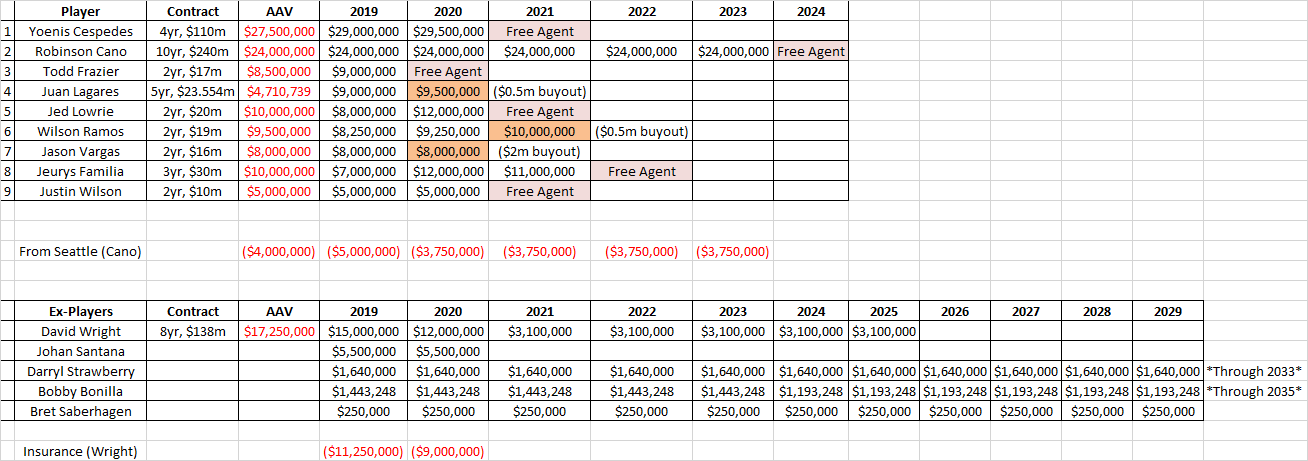
Despite some huge numbers for Cespedes and Cano, the club is far from hamstrung by its current deals as there is very little money committed beyond the 2020 season.
Speaking of Cespedes, he provides unquestioned offensive firepower…when he’s on the field. Since being acquired by the Mets at the 2015 trade deadline, signing a new deal with the club before the 2016 season, opting out, and securing a long-term deal covering the 2017-20 years, Cespedes has blasted his way to a powerful .282/.346/.543 batting line. However, Cespedes has seen his games played dwindle each year, tumbling from 159 in 2015 to 132 in 2016, 81 in 2017, and finally just 38 last season. The front office has given repeated indications that any contribution from Cespedes in 2019 will be gravy given his lengthy recovery timeline following heel surgery.
While Cespedes has struggled to stay on the field, new Met Cano has been a picture of consistency, playing at least 156 games each year from 2007-16 before dipping all the way to 150 games in 2017. However, Cano was slapped with an 80-game suspension last year after a test revealed the presence of a diuretic in his system before undergoing arthroscopic knee surgery in December. It’s likely Van Wagenen’s tenure will be defined in large part by how Cano performs in his new (old) city. Regardless, from a purely financial standpoint, Cano represents a fairly safe risk: whenever he plays, he has been remarkably productive and if he fails another drug test, Cano will be suspended for an entire season without pay. It’s also worth noting that the Mariners are subsidizing Cano’s deal both by sending cash to the Mets annually and by absorbing the remaining amounts due to Jay Bruce and Anthony Swarzak. It should be noted that the most sought-after player in the Cano deal was reliever Edwin Diaz, who fell 13 days short of Super Two status for 2019 and will therefore earn just $570,800 in his first year with the Mets.
Among the guaranteed deals for current players, longtime Met Juan Lagares is the sole remaining holdover who spent a significant chunk of time under the Alderson regime. Lagares plays a mean center field and runs well, but his bat never developed, so it figures that the Mets will pay his 2020 salary and wish him well nine months from now.
The remaining players are all middle class veterans on short-term deals. Frazier and Vargas both enter their walk years while Van Wagenen filled out the remainder of his roster by throwing modest sums of cash at solid, unspectacular veterans. Lowrie enters off of a stellar year but turns 35 shortly after Opening Day. Ramos, Familia, and Wilson each enjoyed success in 2018 and prior years, though each comes with a recent red flag: a knee injury for Ramos, a domestic violence suspension for Familia, and a nightmarish loss of command in recent years for Wilson.
Finally, we get to the payments to ex-players, and holy smokes, what a walk down memory lane this is. Wright has two years remaining on his eight-year contract, though insurance figures to pay about 75 percent of his guaranteed money, after which the team owes him $3.1 million annually through 2025. Santana’s deferred money carries just two years into the future.
But Strawberry, Bonilla, and Saberhagen? They basically define the risk of long-term deferrals. The team will spend over $3 million on that trio through the 2020s while owing nearly $2.8 million to the Strawberry-Bonilla duo for additional years. It’s true that those dollar figures aren’t astronomical when considering team budgets, but $3 million represents an annual flier on someone like Shelby Miller or a modest bullpen upgrade like Shawn Kelley. Instead, the Mets will continue to spend that cash on players through their 60s. Yikes.
Turning to the arbitration ranks, the Mets feature their best talent:
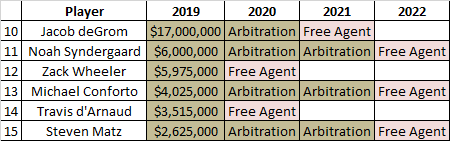
deGrom and Syndergaard are arguably the team’s two best players. Wheeler finally recovered from a slew of injuries to realize his promise as a strong rotation cog, and Matz still carries plenty of promise to do the same. Conforto played at an All-Star level in 2017 before slipping to be a merely plus regular in 2018; he just turned 25. Only d’Arnaud figures to play a less than prominent role as his sterling 2015 becomes a thing of distant past more so than a predictor of future stardom. Nevertheless, the arbitration table carries much of the intrigue for the Mets in 2019 and beyond.
What Does Team Leadership Have to Say?
Wilpon didn’t offer much insight as to what team spending would look like early on in the offseason, stating only that “Brodie knows what the parameters of what the payroll is and what we’re planning to do.”
Accordingly, this pushes us toward Van Wagenen for insight on the team’s expected spending…which also yields no useful information. Back in November, the general manager stated that the club was “open for sure to moving money off the roster” but “willing to add money as well” before deferring more specific questions to ownership.
It seems that franchise leadership has no interest in making their spending plans public knowledge. For competitive advantage purposes, I can’t say I blame them.
Are the Mets a Player for Bryce Harper or Manny Machado?
Probably not. They haven’t been mentioned as one of the clubs seeking a sit-down opportunity with either mid-20s star and that speaks volumes, especially now that we’ve reached February.
Furthermore, following his expensive forays into the marketplace to acquire Cano and Familia, sources indicated that Van Wagenen would be focusing his efforts on an outfield bat, rotation depth, or a lefty reliever, not exactly an indication that Harper or Machado would be meeting with Mets brain trust in the near future.
Still, it can’t be ignored that Mets play in a major metropolitan area and feature a fan base that supported attendance totals regularly in excess of three million annually, even eclipsing four million fans in 2008. They exceeded 2.6 million fans only twice since then. If ownership and the business operations folks believe that a contending Mets team can draw at least 3.1 million fans like they did each year from 2006-09, that extra revenue could surely support another marquee addition, though doing so would push the team into taxpayer status depending on how Wright’s insurance coverage is factored. They currently have a tax payroll of approximately $186.5 million, meaning they can only afford a $20 million addition before exceeding the tax line.
For now, assume that the Mets are out on both players while holding a tiny glimmer of possibility in the back of your mind. While you hold onto that thought, consider this idle, baseless speculation: in addition to Wright’s, Cespedes’ contract is insured as well, though the Mets were hazy on the specifics. If they truly think that he’ll be unable to play at all in 2019 and the policy covers roughly 75 percent of his salary after a disability period is reached, the club may recover something north of $10 million on the policy. The prospect of another big expenditure starts to look eminently more reasonable.
What Will the 2019 Payroll Be?
Well, it’ll be a new team record, that’s for sure. But just how high will it go?
Currently, team payroll comes in at $159.5 million including the substantial payments of deferred money. The luxury tax won’t be a factor unless the team adds $20 million or more to current payroll, so this number is a good approximation.
How much room is there for additional expenditures? It seems reasonable to assume that Van Wagenen took the job with the understanding that payroll would increase by some amount, even if that amount is more in the five-to-ten percent neighborhood than something more substantial. A ten percent increase fits the bill as the club seeks to contend in their final years of depressed-cost control over deGrom and Syndergaard. But don’t be stunned if the percentage increase is more like fifteen or twenty in the end. For now, we’ll estimate at the low number.
Projected 2019 Payroll: $165 million
Projected 2019 Payroll Space: $5.5 million