
Paul Skenes Named Starting Pitcher For National League All-Star Team
Two months and one day into his major league career, Pirates ace Paul Skenes has been named the starting pitcher for the National League All-Star team. NL All-Star manager Torey Lovullo of the Diamondbacks called into the Dan Patrick Show this morning during an interview with Skenes this morning and informed the 22-year-old of the decision live on the air (video link). Major League Baseball announced the decision shortly thereafter. Skenes becomes the first rookie since Hideo Nomo in 1995 to be tabbed as his league’s starting pitcher for the Midsummer Classic. Coincidentally, that year’s All-Star Game also took place in Arlington — as will be the case with next week’s event.
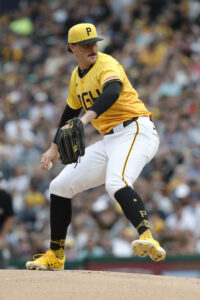
Skenes, the No. 1 overall pick in the 2023 draft, has emphatically announced himself as one of the game’s elite pitchers in short order. The term “meteoric rise” is thrown around perhaps too casually, but it’s appropriate — if not an understatement — when characterizing Skenes’ ascension to his current status. The 6’6″, 235-pound flamethrower was tagged for three runs in four innings in his MLB debut … and has since yielded all of 11 runs over a span of 10 starts and 62 1/3 innings pitched.
Since making his big league debut on May 11, Skenes leads all qualified NL pitchers with a 1.90 ERA and trails only White Sox ace Garrett Crochet (1.84) for the MLB lead in that regard. Skenes’ mammoth 34.9% strikeout rate also tops all NL pitchers in that span and also trails only Crochet (35.2%) for the big league lead.
Opponents have turned in a pitiful .202/.251/.319 batting line against the former LSU ace in 255 trips to the plate thus far in his big league career. Since making his debut, Skenes is 22nd in the majors in innings pitched, first in strikeouts, has the 10th-fewest walks, and has posted an unbeaten 6-0 record. Remarkably, he’s the only one of 77 qualified starting pitchers in baseball who has not taken a single loss since May 11.
Skenes was controversially pulled from yesterday’s outing in Milwaukee after firing seven no-hit innings and punching out 11 of the 23 hitters he faced along the way. The right-hander was at 99 pitches, and the Pirates opted to take a cautious approach with their burgeoning superstar rather than soar past his current career-high 107 pitches in pursuit of that potential personal milestone. Now, Skenes will make a different kind of history when he toes the rubber next week in the sport’s ultimate midseason showcase.
The dominant debuts of not only Skenes but teammate Jared Jones have transformed the Pirates’ rotation and long-term outlook. Pittsburgh controls both pitchers for more than a half-decade — Skenes through at least 2030 (pending Rookie of the Year voting), Jones through 2029 — adding a pair of high-octane arms to join Mitch Keller (3.40 ERA in 111 1/3 innings) atop the team’s rotation for the foreseeable future. Keller signed a five-year, $77MM contract spanning the 2024-28 seasons during spring training.
Phillies Release Whit Merrifield
The Phillies announced Friday that they’ve released veteran infielder/outfielder Whit Merrifield and recalled fellow infielder/outfielder Weston Wilson from Triple-A Lehigh Valley.
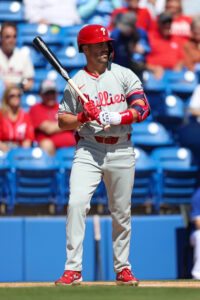
Merrifield signed a one-year, $8MM contract with the Phillies in free agency this past offseason. That guarantee came in the form of a $7MM salary for the current season and at least a $1MM buyout on an $8MM club option for the 2025 campaign.
Merrifield, who has struggled to a .199/.277/.295 batting line in 174 plate appearances this season, is still owed about $3.01MM of his salary plus that $1MM buyout. He’ll now be able to sign with any team, and a new club would only owe him the prorated league minimum for any time spent on the MLB roster or injured list. That amount would be subtracted from what the Phillies owe, but Philadelphia will remain on the hook for the majority of his remaining contract.
While things with the Phillies clearly didn’t pan out, the 35-year-old Merrifield was a decent hitter as recently as last season in Toronto, when he turned in a .272/.318/.382 slash with 11 homers, 28 doubles, a triple, 26 steals, a 6.1% walk rate and a 17.1% strikeout rate. His offense has tailed off since his peak seasons (age-29 and 30) when he led the American League in hits in consecutive seasons as a member of the Royals, but this level of decline was as unexpected as it was precipitous.
To his credit, Merrifield’s contact skills remain excellent. He’s fanned in only 10.9% of his plate appearances, and this year’s 8.6% walk rate actually ties a career-high mark for the three-time All-Star. He hasn’t hit the ball with any authority, however, turning in a bottom-of-the-barrel 83 mph average exit velocity and 17.4% hard-hit rate. Merrifield entered the 2024 season with a gaudy 24.8% line-drive rate in his career but has hit just 16.8% of his batted balls on a line this season.
The late-blooming Merrifield didn’t even reach the majors until his age-27 season in Kansas City, but he almost instantly became not just a fixture on the Royals’ roster but one of the most prolific hitters and base thieves in the league. From 2016-20, Merrifield batted .295/.342/.445 with 58 homers and 119 stolen bases. In addition to leading the majors in hits in 2018 and 2019, he also paced the American League in stolen bases in 2017, 2018 and 2021.
Between that track record, the now minimal price tag and his defensive versatility — he can play second base, third base and all around the outfield — Merrifield should find a new opportunity before long. Grim as his 2024 production (or lack thereof) has been, there are several teams around the league looking for a veteran righty bat and/or help at second base/left field.
The Yankees, Red Sox and Mariners are among the current postseason contenders who’ve received negligible production from second base this year and could speculate on Merrifield turning things around with a change of scenery. (WEEI’s Rob Bradford tweets that Boston did not have interest in Merrifield this offseason, but circumstances change.) And, Merrifield’s former Kansas City club has been on the hunt for a bat that can play both the infield and outfield, as noted last month by general manager J.J. Picollo himself.
Top 50 Trade Candidates For The 2024 MLB Trade Deadline
The 2024 MLB trade deadline is less than three weeks away! We’ve already seen a couple swaps in the past week — plus that out-of-the-blue early-May blockbuster — but the majority of the action will take place in the next 19 days. Today’s MLB front offices tend to wait until the last minute to make decisions of any note, be it with regard to the trade deadline, the non-tender deadline, the Rule 5 protection deadline, etc. Gone are the days of teams planting their flag in the ground in early July or late June — moving the draft to the All-Star break and thus pushing front offices to dedicate immense July resources to that event hasn’t helped — but that makes the final couple weeks of July all the more chaotic.
As is customary each year here at MLBTR, we’ll take multiple runs through the top names on the trade market. The ordering here is far from exact. To the contrary, it’s quite subjective. There’s no genuine way to place odds or determine the likelihood of an individual player being traded. Certainly, in some cases it’s quite clear that a deal is likely or borderline inevitable, but even in what look like blatantly obvious trade scenarios, sometimes a deal doesn’t come together. (Hey there, 2022 Willson Contreras and 2021 Jon Gray and Trevor Story!)
As such, the “ranking” here is more a blend of likelihood of a deal and impact of the player in question. The names atop the list are going to be those that both seem likeliest to move and carry the potential for significant impact on the acquiring team. We’ll have several relievers in the top 15 or so of the list — well ahead of Oakland’s Mason Miller, for instance. That doesn’t mean they’re better pitchers than Miller, just that they’re likelier to be traded than a 25-year-old who averages 101 mph and has five-plus seasons of club control remaining.
This list was a collaborative effort, so big thanks to both Anthony Franco and Darragh McDonald for helping to turn it out. All that preamble aside… onto the names!
1. Jack Flaherty, RHP, Tigers
Flaherty is the top rental arm, if not the top rental player entirely, on the 2024 trade market. The one-year, $14MM deal he signed in Detroit proved to be a jackpot addition for the Tigers, who’ve seen Flaherty turn the clock back to the dominant form he showed in the second half of the 2019 season and in the first half of the 2021 campaign. In 95 innings, he’s pitched to a 3.13 ERA with a scintillating 2.50 SIERA. Flaherty has an elite 32.1% strikeout rate and similarly dominant 4.3% walk rate. He’s been one of the best pitchers in MLB, and while some back discomfort served as a brief red flag, he avoided a trip to the IL and returned to the mound with six innings of two-run ball as this list was being finalized.
Flaherty is the type of playoff-caliber starter who should command a top-100 prospect (and then some) despite his rental status. The Tigers don’t need to feel obligated to move him, as Flaherty is an obvious qualifying offer candidate and could earn them a comp pick after the first round in 2025 after he rejects that QO and signs for more than $50MM — both of which feel inevitable.
2. Garrett Crochet, LHP, White Sox
There’s no trade candidate in recent memory like the unique case of Crochet. The former first-round pick skipped the minors entirely and debuted as a reliever late in the 2020 season, just months after being drafted 11th overall out of the University of Tennessee. He spent the 2021 season in Chicago’s bullpen, missed the 2022 season due to Tommy John surgery, pitched just 25 innings between the minors and big leagues combined last year while finishing off his rehab … and then broke out as the best pitcher on the planet atop an awful White Sox rotation in 2024.
Crochet’s long injury history gave him enough IL time to accrue enough service to reach arbitration this offseason — but his lack of innings limited him to a tiny $800K salary. That, paired with his jaw-dropping results and two remaining seasons of club control beyond the current season, make him one of the most appealing trade candidates in recent memory. However, Crochet has also already thrown more innings in 2024 than he did in his entire career prior to the current season. The Sox will price him like an ace — and rightly so. Interested teams may value him as such in 2025-26, but they’ll be wary of how many innings he can contribute down the stretch in ’24.
Still, the Sox broached the possibility of an extension with Crochet and were quickly rebuffed. They’re now reportedly focused on trading him. The unprecedented nature of Crochet’s career arc makes it impossible to forecast just what kind of return he’ll command, but it should be massive.
3. Carlos Estevez, RHP, Angels
Estevez should draw plenty of trade interest coming off his Reliever of the Month honors in June. The Angels closer is amidst a streak of 13 straight scoreless appearances. Aside from a rough couple weeks in mid-April, he’s been a force at the back of the Los Angeles bullpen. Estevez owns a personal-best 2.79 ERA across 29 innings. He’s striking out 26.2% of opponents while walking fewer than 4% of batters faced. After saving 31 games a year ago, he’s 16-19 in locking down the ninth inning this season. Estevez is playing on a $6.75MM salary and will head back to free agency next winter. He’s alongside Tanner Scott as the most appealing rental relievers available.
4. Tanner Scott, LHP, Marlins
Speaking of which: a flamethrowing closer who’s an impending free agent on a last place team? Scott might be the most quintessential trade candidate on the summer market. He’s not as good as his 1.42 ERA, as that belies a grisly 14.9% walk rate. Command has long been an issue for Scott, but he did walk a career-low 7.9% of hitters just last year while fanning more than a third of his opponents. Scott throws gas, keeps the ball on the ground and misses bats at a plus rate. His $5.7MM salary isn’t exorbitant. The Marlins are going to trade him, barring an injury. It’s just a question of where.
5. Jazz Chisholm Jr., OF/2B, Marlins
There’s reportedly a “growing belief” that Miami will move its infielder-turned-center fielder in the next few weeks. Chisholm has drawn plenty of national attention despite results that haven’t quite caught up to his reputation. He’s a collection of loud tools and big personality that give him star potential even if he’s more upside than results to this point. Chisholm has shown huge power and speed alike but also been too prone to strikeouts. He’s a .253/.317/.459 hitter dating back to 2022, and he’s clubbed 44 homers with 52 steals in that stretch of 996 plate appearances.
Injuries are a particularly big red flag, as Chisholm has only reached 100 games in a season once and has never topped 507 plate appearances in the majors. He learned center field on the fly out of necessity and hasn’t graded well there, but he was a plus defensive second baseman before that shift. Chisholm is earning just $2.625MM this season and has legitimate 30-homer, 30-steal upside if he can stay healthy. He’s never hit lefties particularly well but is still a potential everyday bat in the outfield or middle infield who’s controllable through 2026.
6. Erick Fedde, RHP, White Sox
It’s been quite the journey for Fedde, the 18th overall pick back in 2014. A longtime top prospect of the Nationals, his development was slowed by Tommy John surgery shortly after his draft selection. He reached the majors in 2017, pitched in parts of six seasons as a National while posting a mid-5.00s ERA, and went to reinvent himself in the Korea Baseball Organization. Reinvent himself he did. Fedde posted a flat 2.00 ERA in South Korea, won KBO MVP honors and returned to North American ball on a two-year, $15MM contract with the South Siders. It’s perhaps the best move of rookie GM Chris Getz‘s tenure to date.
Brandishing a new split-changeup and harder, more horizontal sweeper than the slider he used in D.C., Fedde has burst back onto the MLB scene as not just a serviceable back-end starter but a playoff-caliber arm. In 111 1/3 innings, he’s pitched to a 2.99 ERA with a 21.6% strikeout rate (just shy of league-average) and a terrific 6.6% walk rate. He’s kept the ball on the ground at a 46.5% clip, avoided hard contact very nicely, and left little doubt that he can help any contender down the stretch.
Fedde’s deal is evenly distributed. He’s earning an eminently affordable $7.5MM both this year and next. He’s gone from MLB afterthought to bona fide deadline trade chip who should net the White Sox a legitimate top prospect (plus some secondary pieces). Not much has gone right for the Pale Hose this season, but the Fedde signing has proven to be one of the best moves made by any team this past winter.
7-8. Zack Littell, & Zach Eflin, RHPs, Rays
The Rays already dealt one starter, sending Aaron Civale to the Brewers last week. That was partially to make way in the rotation for Shane Baz, who is back from Tommy John rehab. With Jeffrey Springs and Drew Rasmussen also potentially returning in the second half, Tampa Bay could move another starter. Littell and Eflin are the likeliest options.
Littell is the much more affordable of the duo. Another of the Rays’ reliever-to-starter success stories, he’s playing on a $1.85MM salary. Littell is under control for one more season and looks like a decent #4 starter. He’s sitting on a 4.44 ERA over 95 1/3 innings — already a career high in terms of MLB workload. Littell has fanned an average 22.1% of batters faced and has pristine control, walking around 4% of opponents in consecutive seasons.
Eflin, on the other hand, is in the second season of a three-year deal he signed with the Rays going into 2023. The $40MM guarantee is backloaded, with $11MM salaries in the first two seasons and $18MM in 2025.
He had a career year in 2023, with a 3.50 ERA, 26.5% strikeout rate, 3.4% walk rate and 49.8% ground ball rate. Most importantly, he stayed healthier than ever before, getting to career highs with 31 starts and 177 2/3 innings. This year has been a bit of a step back but not by much. He had a brief stopover on the IL due to lower back inflammation but has logged 99 1/3 innings over 17 starts with a 3.99 ERA. His strikeout rate has fallen to 18.9% and his grounder rate to 42.8% but he’s also dropped his walk rate to a miniscule 2.2%.
9-11. Danny Jansen (C), Yusei Kikuchi (LHP), Trevor Richards (RHP), Blue Jays
The Blue Jays’ trio of most appealing rental pieces could all be in play with Toronto buried in the AL East and now 9.5 games back in the Wild Card hunt. Any of Jansen ($5.2MM salary in ’24), Kikuchi ($10MM), Garcia ($6MM) or Richards ($2.15MM) would be both affordable and impactful for a new club.
Jansen stands as the top catching option on the market. He slumped at the plate after a hot start and entered play today at a league-average 100 wRC+, hitting .217/.315/.377. (He upped that line to .222/.319/.398 with a solo homer as this was being written.) The 29-year-old has plus power for a catcher and high-end defensive skills. He’s been injured too frequently in his career, but dating back to 2021 he’s a .233/.317/.464 hitter who’s averaged 27 homers per 162 games played. It’s rare for starting catchers to change hands at the deadline, as learning a new pitching staff on the fly midseason is no small feat, but Jansen should still garner plenty of interest.
Kikuchi is one of the top rental starters on the market. After a dominant showing in March/April/May, he hit a roadblock in June. He’s bounced back with four runs and an 18-to-2 K/BB ratio across 13 innings (two starts) in July. Kikuchi has a flat 4.00 ERA this season but a strong 26.1% strikeout rate and outstanding 5.4% walk rate. Since incorporating a new-look curveball into his arsenal last June, Kikuchi has a 3.77 ERA, 27.1% strikeout rate, 5.9% walk rate and 40.8% grounder rate in 212 1/3 innings. That’ll play in any rotation.
Richards has been inconsistent year-to-year but is affordable and has been highly effective in ’24. He owns a 3.40 earned run average, 25% strikeout rate and 9% walk rate. At 92.4 mph on average with his heater, he’s not overpowering — but he’s never struggled to miss bats, either (career 25.8 K%).
12. Luis Robert Jr., OF, White Sox
Robert hits the trade market with an enviable three years of control remaining beyond the current season. He produced MVP-caliber numbers a year ago when he hit 38 homers and swiped 20 bags while playing elite center field defense, but he’s also been injured as much as nearly any high-profile hitter in the sport in recent seasons. That continued when a hip flexor strain wiped out two months of Robert’s 2024 season.
He’s caught fire at the plate recently (.280/.345/.580 over his past 55 plate appearances), and there’s little doubting that Robert is one of the most talented players in the sport … when his body allows him to take the field. Add in that he’s being paid $12.5MM this season and $15MM next year before the Sox (or another club) hold a pair of $20MM club options, and the appeal only grows. Since 2021, Robert is a .280/.327/.509 hitter. He’s been worth just shy of 12 WAR in just over two full seasons’ worth of games. Controlling him for 3.5 seasons and a total of $59MM is an unmitigated bargain. That said, Robert’s injury history is a major red flag.
The Sox can rightly seek a king’s ransom in a trade, knowing they’ll have several opportunities to market him in the future when Robert still has two or even three full seasons of contractual control remaining. Will someone pony up a big enough offer to make them budge?
13. Brent Rooker, OF/DH, Athletics
Rooker was traded from the Twins to the Padres in the Taylor Rogers/Chris Paddack swap and then passed from San Diego to Kansas City to Oakland via a series of DFAs and waiver claims. The Twins, Padres and Royals are kicking themselves to varying extents, as he’s broken out as one of the top sluggers in the AL since donning green and gold. A .260/.348/.509 hitter with 48 bombs in 875 plate appearances for the A’s, Rooker is controllable through the 2027 season. He’s a poor defender who’s limited to left field, first base or designated hitter. He’s always going to strike out a lot and is doing so at a 32.6% clip this year. He’s also raking at a .282/.362/.544 clip and walking at a career-high 10.4% rate. The former No. 35 overall pick has a plus hard-hit rate, barrel rate and exit velocity. For teams looking to add a middle-of-the-order bat, he might be the top name on the market — and with three-plus seasons of club control remaining, the ask could be steep.
14-15. Kyle Finnegan & Hunter Harvey, RHPs, Nationals
Both Finnegan and Harvey are under club control through the 2025 season. Finnegan, the Nationals’ closer, is earning a $5.1MM salary to his top setup man Harvey’s $2.325MM. After struggling with walks early in the season, the hard-throwing Finnegan has reined in his command and pitched brilliantly. Over his past 32 innings, Finnegan touts a 1.69 ERA, 28.3% strikeout rate and 5.8% walk rate. He’s saved 23 games already this year (after saving 28 last year) and averaged 97.2 mph on his heater. Finnegan does have a propensity for pitch clock violations, one of which led to a lamentable walk-off loss to the Rockies this season when it occurred with the bases loaded. Be that as it may, he’s a viable leverage option based on his repertoire and results.
Harvey had better rate stats than Finnegan for much of the season but has hit a rough patch of late, yielding 10 earned runs over his past six innings. His 4.40 ERA looks rather pedestrian as a result, but Harvey’s 25.1% strikeout rate, 6.6% walk rate, 45.8% grounder rate and 97.9 mph average heater all make him highly appealing. He’s battled considerable injury troubles in his career and has just 166 2/3 career innings since debuting in 2019, but there’s little doubting the talent in Harvey’s arm.
16. Michael Kopech, RHP, White Sox
A closer with a 5.31 ERA isn’t exactly the quintessential trade candidate, but Kopech is a former elite prospect who’s averaging 98.6 mph on his heater and punching out 29.7% of his opponents. He’s earning just $3MM this year and is controllable via arbitration through 2025. The 13.1% walk rate and 1.85 HR/9 mark aren’t going to do his trade candidacy any favors, but Kopech is the type of power-armed 28-year-old that a rival club will be convinced it can “fix,” which should lead to ample bidding.
As recently as 2021-22, the flamethrowing righty posted a 3.53 ERA and 26.7% strikeout rate in 188 2/3 innings split between the bullpen and rotation. Kopech has the makings of an elite reliever, and while he won’t command an “elite reliever” prospect package, he’ll pique the interest of plenty bullpen-needy teams.
17. Pete Fairbanks, RHP, Rays
Fairbanks has been Tampa’s closer for a while now, with 25 saves last year and 15 so far this year. But his track record as an excellent reliever goes back farther than that. Since the start of 2020, he has tossed 170 1/3 innings with a 2.75 ERA, 33% strikeout rate and 10.1% walk rate. He and the Rays signed a modest extension in January of 2023, one that pays him $3.666MM over the 2023-25 seasons with a club option for 2026. That option has a $7MM base salary but incentives and escalators, as well as a $1MM buyout. The Rays don’t need to trade him with that extra control but it would be in their M.O. to make him available before the contract expires.
18. Jesse Winker, OF, Nationals
After quietly being one of the game’s most productive bats against righties for the first several seasons of his career in Cincinnati, Winker’s 2022 season in Seattle and 2023 season in Milwaukee were severe disappointments. He underwent neck and knee surgery following that ’22 campaign and was likely never fully healthy with the M’s. Perhaps those procedures carried some lingering effects into the ’23 season with the Brewers as well.
Whatever the reason, Winker is back in vintage form. He’s hitting .264/.379/.430 this season with 10 homers and a career-high 12 steals. He’s walked at a 13.6% clip. After signing a minor league deal in free agency, he’s on a modest $2MM salary. Any team needing a lefty bat in its outfield/DH mix should have interest in Winker, who’ll be a free agent at season’s end.
19. John Brebbia, RHP, White Sox
After an awful stretch in mid to late May, Brebbia has been the Sox’ best reliever and quietly been one of the best relievers in the game. That might generate a few eye rolls, but it’s not hyperbole. Since June 1, he’s posted a 0.98 ERA with a gaudy 37.5% strikeout rate and 5.6% walk rate. It’s only 18 1/3 innings, but Brebbia has his season ERA down to 4.38, and the K-BB profile is genuinely interesting (29.6 K%, 5.9 BB%). He’s on a one-year, $5.5MM deal with a mutual option for 2025. Mutual options are almost never exercised, so he’ll be treated as a pure rental and perhaps a deceptively attractive one.
20. Randy Arozarena, OF, Rays
Arozarena is having the worst season of his big league career, though that’s mostly due to a terrible March/April that he has put in the rearview mirror. He came into this season with a batting line of .265/.351/.451 and a 128 wRC+ but is currently at .203/.311/.360 for a 99 wRC+ in 2024. He had a dismal line of .143/.220/.241 at the end of April but has mostly been his old self since then, having slashed .236/.358/.427 for a wRC+ of 131.
The Rays don’t need to trade him, as he can still be retained for two more seasons via arbitration. But he’s already making $8.1MM this year and that number will only climb in the seasons to come. Tampa has a long track record of trading such players for younger, cheaper and less-established alternatives and it’s plausible to see the same thing happening here.
21. Lane Thomas, OF, Nationals
Controlled through the 2025 season, Thomas has been a fixture in Washington’s outfield for the past three seasons. His .243/.306/.400 line is down from last year’s career-best .268/.315/.468 showing, wherein he popped a career-high 28 homers. Though the Nats use Thomas in an everyday role, many contenders will view him as a platoon option. Thomas has pummeled lefties at a .329/.405/.548 clip in 2024 and a .306/.367/.524 pace in his career. However, he’s hitting just .207/.260/.341 against righties this season and carries only a .223/.288/.390 line in right-on-right matchups throughout his career. He’s one of the fastest players in the game (21 steals, 94th percentile sprint speed), but Thomas isn’t a great outfield defender. He’s a very useful player, but the Nats might value him more than other teams will.
22. Tommy Pham, OF, White Sox
Unlike many of the White Sox other trade chips, Pham is a pure rental. The entire point of signing him was to hope he’d hit his way into trade candidate status. He’s faded after a hot start, but the 36-year-old’s .259/.332/.355 line is still roughly league average. He’s sporting a .239/.375/.413 slash against lefties (129 wRC+). Pham has settled in as a mercenary of sorts late in his career, signing a series of one-year deals and frequently changing hands at the trade deadline. This year will be no exception.
23. Kevin Pillar, OF, Angels
Pillar has had a resurgent season. The veteran outfielder was released by the White Sox 17 games into the season. He latched on with the Angels after the Mike Trout injury opened a spot on the grass. Pillar has seized the opportunity, hitting .287/.340/.485 with six homers through 147 plate appearances. The 35-year-old recently told USA Today’s Bob Nightengale that this is likely to be his final season. He’s hitting well enough to get a fourth or fifth outfield role with a contender.
24-25. Elias Diaz & Jacob Stallings, C, Rockies
Colorado’s catching duo are both impending free agents. They’re having solid seasons that could attract interest from teams looking to shore up their depth behind the dish. Diaz is hitting .296/.340/.417 over 259 trips to the plate. While he’s not likely to maintain a .347 average on balls in another home park, he puts a decent number of balls in play and has double-digit home run power. Diaz is making $6MM in the final season of a three-year extension.
Stallings is playing on a $1.5MM salary and is due a $500K buyout on a ’25 mutual option. While Stallings struggled with the Marlins between 2022-23, he has turned in a .265/.365/.434 slash across 160 plate appearances in a backup role. Stallings no longer rates as the elite defender he was at his peak — he won a Gold Glove with Pittsburgh in 2021 — but he’s affordable and outperforming the backup catchers on some contenders.
26-27. Cal Quantrill (RHP) & Austin Gomber (LHP), Rockies
Quantrill and Gomber are each in their second-to-last seasons of arbitration. Colorado could hold both pitchers into 2025, but that’d arguably bypass a chance to capitalize on a thin rotation market. The Rox have generally been resistant to trading players under control for multiple seasons. They’re reportedly open to discussions on their pair of back-end starters, even if its an open question whether they’ll get the kind of offer that convinces them to pull the trigger.
Of this duo, Quantrill has higher trade value. The Rockies bought low on the former #8 overall pick in a trade with the Guardians last offseason. That has proven a nice acquisition for GM Bill Schmidt and his staff. Quantrill sports a 4.13 ERA across a team-leading 102 1/3 innings. He hasn’t had any issue acclimating to Coors Field, turning in an even 4.00 earned run average over eight home starts. Quantrill has never missed many bats, but he has strong control and is getting ground-balls at a 46.4% clip. He owns a 3.88 ERA in nearly 700 career innings. The Stanford product is playing on a $6.55MM salary.
Gomber is more affordable but hasn’t been as effective. The 30-year-old southpaw owns a 4.47 ERA through 94 2/3 innings. Gomber attacks the zone but doesn’t throw especially hard (90.4 MPH average fastball speed) and hasn’t recorded a strikeout rate better than 18% over the past three seasons. The pitch-to-contact approach has led to a decent amount of volatility over the years. It has been more of the same this year, as Gomber was blitzed for a 9.39 ERA in June around otherwise solid performances in April, May and to this point in July. He’s making $3.15MM.
28. Trevor Rogers, LHP, Marlins
One of two former Rookie of the Year runner-ups on this list (Miguel Andujar being the other), Rogers’ stock has diminished a great deal since his sensational 2021 campaign. He dealt with some horrific, harrowing family issues and multiple serious injuries along the way — including a lat strain, left biceps strain that required a 60-day IL stint, and back spasms.
Rogers’ fastball is now down about two miles per hour from his breakout showing. His strikeout rate has dipped 10 percentage points, from 28.5% to 18.3%. His current 10% walk rate is a career-high. But while all of that, coupled with a 4.82 ERA in 89 2/3 frames this season, is rather underwhelming, Rogers is a former first-round pick, top prospect and decorated rookie who is still only 26 years old. He’s controllable through 2026 at salaries that won’t be prohibitive, as he’s earning just $1.525MM in 2024 and owed two more arbitration raises. A team with a knack for maximizing pitching performance might view Rogers as an affordable buy-low candidate based on his pedigree.
29. Brendan Rodgers, 2B, Rockies
Partially because of injury, Rodgers has never developed into the star player the Rockies expected when they drafted him third overall in 2015. Park-adjusted metrics have pegged him as a below-average hitter in every season of his career. It’s a similar story in 2024, as Rodgers hasn’t drawn many walks or hit for a ton of power. He owns a .272/.313/.388 slash line over 294 plate appearances. Still, he’s a former Gold Glove winner who could draw some attention in a market light on middle infield talent. Rodgers is making $3.2MM this season and comes with one more season of arbitration control.
30. Austin Adams, RHP, Athletics
Adams’ slider-spamming tactics are back in full force this season — he’s throwing more than three-quarters sliders — and the results are interesting. A 4.60 ERA is pretty easy to gloss over, but Adams has 16 holds and a 26% strikeout rate. He’s walked nearly 13% of his opponents and plunked 12. Hitters aren’t ever going to be comfortable in the box against Adams, who’s hit 43 batters in 145 2/3 career innings. Those are every bit as much a red flag as his high walk rates, but Adams can miss bats in droves (career 31.5% strikeout rate) and can dominate opposing lineups when his command is at its best. Walks and hit batters will always be part of his game, but he has the stuff to succeed despite poor command … it’s just a frustrating ride for fans to watch at times. Adams won’t command a huge haul, but he’s only making $800K this season and is controllable through 2025.
31. Andrew Chafin, LHP, Tigers
Chafin is owed the balance of a $4.25MM salary plus at least a $500K buyout on a $6.25MM club option for 2025. He’s bounced back from an ugly 2023 season so far, pitching to a 3.72 ERA with a big 28.8% strikeout rate versus an inflated 10.6% walk rate. His walk and grounder rates were once both plus marks but now sit below average. Still, Chafin is an established, experienced lefty who can be controlled through next season.
32. Luis Garcia, RHP, Angels
Garcia has been the best of the Angels’ various free agent signings to overhaul their bullpen. The hard-throwing sinkerballer is getting grounders at a 50.5% clip. He’s striking out a solid 22.5% of batters faced against an 8.8% walk rate. An atypically low strand rate has led to a pedestrian 4.30 earned run average, but the peripherals point to a decent middle innings arm. The 37-year-old righty is an impending free agent who is playing on a $4.25MM salary.
33. Dylan Floro, RHP, Nationals
Rental relievers are always in demand, and Floro has both pitched well. The 33-year-old is earning $2.25MM and has pitched to a 2.06 ERA with a 20.5% strikeout rate and 6.4% walk rate. He’s not going to last the whole season without allowing a home run, as is currently the case, but even with some HR/FB regression, Floro has looked solid.
34. Jalen Beeks, LHP, Rockies
The Rockies grabbed Beeks off waivers from the Rays around the non-tender deadline. The southpaw agreed to a modest $1.675MM salary for his final year of arbitration. In 45 innings, Beeks carries a 4.40 ERA. His 17.8% strikeout rate is a personal low, which isn’t especially surprising for a pitcher during his first season in Coors Field. Beeks has decent walk and ground-ball numbers and can work multiple innings out of the bullpen.
35-36. Scott Alexander & T.J. McFarland, Athletics
Oakland’s rental lefties Alexander and McFarland are both cheap and have both been effective. Alexander is earning $2.25MM on a one-year deal and has turned in a 3.24 ERA in 16 2/3 innings since missing the early portion of the season with a ribcage injury. He’s never missed many bats (13.6% strikeout rate in 2024, 17.8% career), but Alexander has solid command and a mammoth 67.8% grounder rate in his career. McFarland is cut from a similar cloth. He’s fanned just 13.8% of his career opponents but has a 62.5% grounder rate in a dozen MLB seasons. He’s earning $850K and has a 4.24 ERA but a more palatable 3.51 SIERA. Neither will cost much. Both seem likely to move.
37. Derek Law, RHP, Nationals
Law doesn’t have the track record or huge power arsenal that teammates Finnegan and Harvey bring to the table. He’s pitching well and is controlled through the 2025 season via arbitration, however. Law’s track record is that of a true journeyman, bouncing around the league via a series of DFAs and minor league deals. But, he’s posted a 3.35 ERA, 21.2% strikeout rate and 6.2% walk rate in 53 2/3 innings of relief this season already. He’s on a $1.5MM deal, making him affordable for any team.
38. Paul DeJong, SS, White Sox
Another South Side rental, DeJong is hitting .229/.280/.438 on the season as Chicago’s primary shortstop. The average and OBP are characteristically unimpressive, but DeJong has belted 16 dingers and tallied a dozen doubles. His once-premium defensive grades have tanked, but he has a strong track record as a plus defender. That, plus this year’s power surge, should get the White Sox a modest return.
39. Gio Urshela, INF, Tigers
Urshela isn’t the solid, 20-homer regular he once was. He missed the bulk of the 2023 season following a pelvic fracture and is hitting just .257/.294/.335 in 231 plate appearances with Detroit. But, he’s also on a cheap one-year, $1.5MM deal and can play all around the infield while making plenty of contact at the plate. He’s a decent bench addition for a contender but isn’t likely to net the Tigers substantial prospect help.
40. Miguel Andujar, OF, Athletics
Andujar never matched the 27-homer pace he set in his Rookie of the Year runner-up campaign back in 2018, thanks in large part to shoulder surgery that ruined his 2019 season and pushed him down the depth chart with the Yankees. The Yanks only gave Andujar a combined 516 plate appearances in the four seasons following his second-place finish in ROY voting, and he didn’t do much in 130 plate appearances with the Pirates either. He’s settled into Oakland’s left field spot, though, slashing .299/.327/.408 (112 wRC+) with three homers in 165 plate appearances. Andujar has never walked much and isn’t a great defender, but he’s typically hit when healthy. He’s earning just $1.7MM this season and is controlled through 2025. Teams in need of right-handed corner bats could have interest.
41. Josh Bell, 1B, Marlins
Bell’s name will pop up on a lot of trade candidate lists, but he’s included here more because the Marlins will be trying to unload him than because other teams will be trying to pry him loose. The switch-hitting slugger has been a plus hitter at multiple times in his big league career, but his grounder-heavy approach in the box makes the plodding 6’4″, 261-pound Bell too inconsistent. He’s hitting only .227/.289/.350 in his first full season with Miami and is being paid $16.5MM this year. No one is touching that contract unless the Fish eat the majority of it or take back another bad contract. Still, Bell has enough track record that if Miami pays him down to league minimum (or close to it), another club might take him on as a change-of-scenery flier. Bell did rake following last year’s trade from Cleveland to Miami, so he’s hardly far removed from a productive stint.
42. Jason Adam, RHP, Rays
As has happened so often before, Adam bounced around the league before finally putting it all together in Tampa. After stints with the Royals, Blue Jays and Cubs, he signed with the Rays going into 2022 and has since tossed 157 1/3 innings with a 2.12 ERA, 29.7% strikeout rate, 8.4% walk rate and 44.8% ground ball rate. His $2.7MM salary is affordable even by Tampa standards and he has two seasons of club control remaining, but his late-bloomer trajectory means he will turn 33 next month. As time goes on, he’ll get older while his salary will grow and his window of club control will shrink, which could tempt the Rays to move him now.
43. Taylor Ward, OF, Angels
The Angels are reportedly hesitant to move players with multiple years of team control. That could lead them to hang onto Ward, who is eligible for arbitration for another two seasons. If the Halos more seriously consider moving controllable players, Ward should be a target for teams seeking outfield help. The former first-round pick has hit 14 home runs in 89 games. A diminished average on balls in play leads to a fairly modest .235/.320/.415 slash, but Ward has posted above-average offensive numbers in four straight seasons. Since the start of 2021, he’s a .258/.340/.440 hitter in more than 1400 plate appearances. Ward is a solid defender in left field who is playing on a $4.8M arbitration salary.
44. Tyler Anderson, LHP, Angels
Anderson is headed to his second All-Star Game at age 34. That’s largely a reflection of the veteran southpaw’s excellent 2.81 ERA over 112 innings. This is the kind of production the Halos envisioned when they signed him to a three-year, $39MM free agent deal over the 2022-23 offseason. Anderson’s first season in Orange County was much tougher, as he allowed well over five earned runs per nine. All 29 other teams passed on the chance to take on the remainder of Anderson’s contract via waivers last August.
While the run prevention and the All-Star nod have raised Anderson’s stock over the past few months, he probably has less trade value than fans might anticipate. Anderson has mediocre strikeout (16.8%) and walk (10.3%) rates. He’s averaging a career-low 89.2 MPH on his fastball. There’s certainly value in the kind of stability Anderson has provided, though teams aren’t likely to surrender much prospect capital if they’re also taking on his $13MM salaries for the next year and a half.
45. Griffin Canning, RHP, Angels
Canning is a potential buy-low target in the rotation market. The former second-round pick has struggled to a 4.84 ERA over 19 starts. His strikeout rate has plummeted from last season’s 25.9% clip to only 15.7% this season. He has lost a tick on his fastball as well, though his 93.7 MPH four-seam speed is still respectable.
The UCLA product is only one season removed from looking like a viable fourth/fifth starter. He’s a former top prospect who is still showing decent raw stuff. In a market light on healthy starters, Canning could still get some interest. He’s making $2.6MM and is under arbitration control for another season. The Angels may not want to sell low because of the extra year of control, but it wouldn’t be a complete surprise if he moves in a change-of-scenery deal.
46-47. Mason Miller & Lucas Erceg, RHPs, Athletics
Miller is the envy of every bullpen-hungry contender at this year’s trade deadline. Armed with a fastball that averages a comical 101.1 mph and a devastating slider, he’s punched out a ridiculous 46.5% of his opponents this season. Miller’s 9.9% walk rate is higher than average but not egregiously so, and he’s kept the ball on the ground at a 40.3% clip while yielding only 0.72 HR/9. He’s also controllable all the way through the 2029 season. This type of player just isn’t traded in today’s MLB, but the A’s are in circumstances unlike any other club in the sport. Demand for Miller could be so high they receive an offer they feel they can’t overlook.
Erceg draws less fanfare but is similarly interesting. Formerly an infield prospect with the Brewers, he only converted to the mound in 2021. The 6’3″ righty may be new to pitching in pro ball, but you wouldn’t know it by looking at his 3.09 ERA, 27.6% strikeout rate, 8.2% walk rate, 50% grounder rate and 0.84 HR/9. Erceg is averaging 98.4 mph on four-seamer and 98.5 mph on his sinker, coupling those fastballs with a mid-80s slider and low-90s “changeup.” At 29, he’s four years older than Miller despite having similar service time and identical windows of club control. The asking price won’t be as high as Miller, who’s simply been a more dominant reliever, but it’s also hard to believe the A’s plucked Erceg from Milwaukee in exchange for only cash last year. His trade value has exploded since then.
48-49. Vladimir Guerrero Jr. & Bo Bichette, INFs, Blue Jays
Toronto will be one of the most fascinating clubs to watch as the deadline draws nearer. Both Guerrero and Bichette have been core pieces during the Jays’ recent run of contending seasons, but both are now just a year and a half from free agency with no indication an extension is close on either front. Guerrero has recovered from a poor start to post a mammoth .327/.389/.508 line across his past 275 plate appearances. That’d be strong in any season but is extra-potent (55% better than average, per wRC+) in a season where the ball doesn’t appear to be traveling as far and where offense is down across the board.
Bichette, on the other hand, is still mired in a career-worst funk. He looked to be on the upswing in May when he hit .280/.321/.410 on the month, but his bat has cratered once again in the five weeks since. He’s hitting just .222/.275/.321 on the season. That said, Bichette was a star-caliber bat from 2019-23, slashing a combined .299/.340/.487. He’s never been a great defensive shortstop, making the offensive downturn all the more alarming. He’s also now dealing with a calf issue that’s left him day-to-day for the time being.
Guerrero is earning $19.9MM in 2024 and eligible for a raise — likely to the $25MM+ range — in 2025. Bichette is signed for $11MM this year and $16.5MM next year. Both will be free agents in the 2025-26 offseason. The Jays are reportedly likely to deal primarily rental players if they sell, but teams will come calling about their pair of star infielders — particularly Guerrero, given his elite production dating back to late April.
50. Tarik Skubal, LHP, Tigers
The odds of the Tigers trading the current AL Cy Young favorite are long, to say the least, but Detroit’s 2024 season hasn’t catapulted the team back into contention and they’re hungry for controllable, big league-ready bats. Skubal is earning an eminently affordable $2.65MM this season and is controlled two more years beyond the current season. As a Scott Boras client who’s emerged as one of the game’s elite names at his position, he’s unlikely to sign an extension.
The Tigers hope to be in the postseason mix in earnest next season, and Skubal should be a big part of that. In order for them to even consider parting ways with the dominant southpaw, they’d need a genuinely franchise-altering haul — if not on par with the Nationals’ Juan Soto bounty then something not too far below it. A win-now club that’s deep in high-end, MLB-ready hitting prospects (e.g. Orioles) could put together an offer that makes the Tigers think long and hard, but Detroit would likely need to feel the trade package is strong enough and carries enough immediate value that it doesn’t wholly derail their 2025 chances.
Ultimately, it’d be a shock to see someone offer enough to pry Skubal away. He is, after all, sitting on a 2.37 ERA with a huge 30.5% strikeout rate, a tiny 4.6% walk rate, a strong 46.7% grounder rate and just 0.74 HR/9. Still, teams are going to do their best to make president of baseball operations Scott Harris and his staff consider it, so buckle up for several weeks of Skubal chatter as teams take their best shot.
Others to watch if their teams drop in the standings
Cubs: Jameson Taillon, Nico Hoerner, Christopher Morel, Hector Neris, Drew Smyly
D-backs: Christian Walker, Paul Sewald, Joc Pederson, Randal Grichuk, Ryan Thompson
Giants: Michael Conforto, Taylor Rogers, Tyler Rogers, Mike Yastrzemski, LaMonte Wade Jr.,
Pirates: Aroldis Chapman, Martin Perez, Michael A. Taylor, Rowdy Tellez, Yasmani Grandal, Connor Joe
Rangers: Michael Lorenzen, Andrew Heaney, Nathan Eovaldi, David Robertson, Kirby Yates, Jon Gray, Jose Leclerc, Jose Urena
Reds: Frankie Montas, Nick Martinez, Jonathan India, Justin Wilson, Brent Suter, Buck Farmer, Lucas Sims, Austin Slater
Currently on the Injured List
David Bednar, Cody Bellinger, Paul Blackburn, Mike Clevinger, Alex Cobb, Joey Gallo, Yimi Garcia, Braxton Garrett, Trevor Gott, Merrill Kelly, Isiah Kiner-Falefa, Jesus Luzardo, Tyler Mahle, Jordan Montgomery, Luis Rengifo, Ross Stripling, Mike Tauchman, Abraham Toro, Trevor Williams, Alex Wood
Tigers Move Kenta Maeda To Bullpen
Tigers righty Kenta Maeda will not make his next scheduled start and will instead move to the bullpen “for the foreseeable future,” manager A.J. Hinch announced to the team’s beat this morning (X link via Evan Woodbery of MLive.com). Maeda is not currently expected to return to the rotation after the All-Star break. The Tigers will make a decision on what to do with that open rotation spot at a later date.
Maeda, 36, has struggled greatly in the first season of a two-year, $24MM deal signed over the winter. It appeared to be a highly reasonable signing at the time, as Maeda had shined over the final four months of the season with the division-rival Twins after returning from a triceps injury. In Maeda’a final 16 starts of the 2023 campaign, he pitched to a 3.36 ERA with an excellent 29% strikeout rate and strong 7% walk rate.
Things have gone the opposite direction in 2024. The longtime Dodgers and Twins righty has started 16 games but tallied just 65 2/3 innings with a grim 7.26 earned run average. His command remains solid (7.9% walk rate), but Maeda’s strikeout rate has plummeted to 17.1% and he’s lost close to a mile per hour off his fastball (averaging just 90.3 mph this season, per Statcast). Most problematically, Maeda has already yielded 15 homers on the year, just two shy of his 2023 total (in 104 1/3 innings) and one shy of his 2022 total (in 106 1/3 innings).
The Tigers’ other offseason rotation addition, righty Jack Flaherty, has enjoyed a brilliant rebound campaign. He and Cy Young candidate Tarik Skubal have formed a dynamic one-two punch atop the Detroit starting staff, and sophomore righty Reese Olson has stepped up to give Hinch three quality options with ERA of 3.30 or less. Former No. 1 pick Casey Mize returned from Tommy John surgery and back surgery to post a solid, if unspectacular 4.23 mark in 16 starts of his own.
That quartet gives the Tigers a quality slate of options in the top four spots, and righty Keider Montero has rattled off consecutive quality starts over the past week-plus. He might be the first up for a look in the fifth spot, but Detroit will likely need another starting option before long. Excellent as Flaherty has been, the Tigers as a whole have underwhelmed at 44-49. That leaves them 14 games out of the AL Central lead and seven back in the AL Wild Card hunt. A trade of Flaherty seems overwhelmingly likely between now and July 30, as the right-hander is playing on a one-year deal and is positioning himself for a potential nine-figure deal in free agency this winter.
The top internal option for the Tigers to take that spot, if and when it becomes necessary, is former first-round pick and top prospect Matt Manning. The 26-year-old has yet to establish himself as a consistent MLB rotation presence, working to a 4.43 ERA over 50 big league starts. That includes a 4.88 mark in five starts (27 2/3 innings) earlier this season. He’s yielded an unsightly 5.03 ERA in Triple-A this year but has far more promising strikeout and walk rates of 24.7% and 8.8%, respectively.
Speculatively speaking, Detroit could move forward with a rotation of Skubal, Olson, Mize, Manning and Montero while hoping that former top-40 pick Ty Madden (8.43 ERA in 12 Triple-A starts) turns things around in Toledo. It’s also feasible that their deadline dealings bring in some other rotation candidates of note. Of course, an ideal scenario would see a sojourn to the bullpen help Maeda rediscover his form, paving the way for him to rejoin the starting staff and create some optimism for better performance in 2025. There’s a long way to go before that’s a consideration right now, however.
Mets Acquire Phil Maton From Rays
The Mets have acquired right-hander Phil Maton from the Rays, per announcements from both clubs. The Rays will receive a player to be named later or cash considerations. Mets president of baseball operations David Stearns said the club is taking on all of Maton’s remaining salary, per Anthony DiComo of MLB.com on X. The Mets designated left-hander Joey Lucchesi for assignment to get Maton onto their 40-man roster. The Rays recalled right-hander Manuel Rodríguez to take Maton’s place on their active roster.
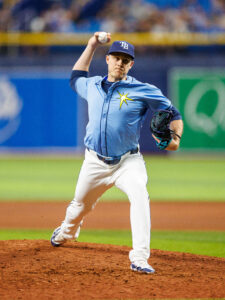
Maton, 31, signed with the Rays as a free agent in the offseason. The two sides agreed to a one-year deal with a $6.5MM guarantee, in the form of a $6.25MM salary and a $250K buyout on a $7.75MM club option for 2025.
Thus far, that deal hasn’t played out the way the Rays had hoped. Maton has tossed 35 1/3 innings, allowing 4.58 earned runs per nine. He has struck out just 19.7% of batters faced while giving out walks at an 11.8% clip. His 49.5% ground ball rate is strong but he’s also allowed six home runs on the year, a rate of 16.2% per fly ball.
That performance is significantly worse than what Maton provided in recent seasons. From 2020 through 2023, with Cleveland and Houston, he tossed 220 innings with a 3.93 ERA, 27.8% strikeout rate, 9.2% walk rate and 40.4% ground ball rate. He was also quite good at avoiding damage, with his average exit velocity being among the best in the league in his career.
The Mets are essentially buying low in this deal, getting a veteran reliever without giving up any prospect talent. Perhaps that will change if the PTBNL turns out to be a player of significance, but they may be effectively buying Maton.
The bullpen has been the biggest issue for the Mets this season. Their relievers have a collective 4.16 ERA, which is in the bottom half of the league. A couple of their better relievers have been lost to season-ending elbow surgeries, with Brooks Raley and Drew Smith both done for the year. Sean Reid-Foley and Shintaro Fujinami are also on the injured list due to shoulder issues.
Despite those bullpen struggles, the club has stayed in the playoff race. They are currently 44-45, just 2.5 games back of the Padres for the final Wild Card spot. It was reported last week that the club was going into the deadline with a buyer’s mentality and could focus on bullpen help, with this move fitting into that framing.
Obviously, the Mets will be banking on Maton’s struggles this year being a bit of a blip and he’s already shown some positive signs of a turnaround. After a four-run outing on June 9, he was sitting on an ERA of 6.56. But over the past month, he has only allowed one earned run in 12 innings, striking out 11 opponents while giving out just one walk. Even if he can’t fully maintain that level of dominance, it’s not unreasonable to expect something better than his season-long numbers.
For the Rays, they have been doing some modest selling of late, though nothing that would necessarily tank their chances of competing here in 2024. They flipped starter Aaron Civale to the Brewers, netting a prospect and some cost savings. But that didn’t really downgrade the rotation as they were able to call up Shane Baz to take Civale’s rotation spot. They are 44-46 and 5.5 games back in the playoff race, giving them a chance of climbing back into it.
Now they have been able to shed a bit more money, getting rid of a player that has largely been underperforming on the season, recent hot streak notwithstanding. The Rays are generally quite good at finding or developing relievers and Rodríguez could fill in for Maton, as he has a 2.79 ERA in the majors this year and a 1.09 mark in Triple-A.
Speaking of that money, the Mets will be taking on more than the Rays are saving, thanks to the competitive balance tax. Maton is still owed about $2.74MM on his salary, as well as the $250K buyout. The Rays will scrub that from their books but the Mets are a third-time CBT payor and well over the fourth and final tax threshold. That means they are paying a 110% tax on any additional spending, so will be actually paying around $6MM to get Maton on the club for the final few months of the season.
Under owner Steve Cohen, the Mets have been pretty unafraid of spending money and are once again flexing some financial muscle to upgrade the club. The Mets have been walking a fine line since about this time last year, looking to keep the big league club in contention without significantly harming the pipeline of young talent in the farm system and also trying to avoid adding long-term costs to their ledger. They still spent money in the offseason but limited themselves to short-term deals and this move is essentially a midseason version of that.

The cost is primarily financial but they also could lose Lucchesi. The lefty made one spot start for the big league club this year but has primarily been kept on optional assignment. He has made 15 Triple-A starts this year with a 4.20 earned run average, 17.9% strikeout rate, 9.7% walk rate and 53.6% ground ball rate.
Lucchesi is a decent depth option but he may have been on the road to getting squeezed off the roster anyway. He is in his final option year and will therefore be out of options next year. The Mets have also had improved rotation depth as the season has gone along. David Peterson and Kodai Senga each started the season on the injured list but Peterson has since returned and Senga recently started a rehab assignment. The Mets have also seen Christian Scott jump up from the minors and take hold of a rotation spot.
The current rotation consists of Scott, Peterson, Luis Severino, Jose Quintana and Sean Manaea, with Senga on his way back. José Buttó and Adrian Houser are currently in the big league bullpen but either could be considered rotation depth and the club also has Tylor Megill on optional assignment. That’s enough starting depth that the club is reportedly considering trading someone from that group while still trying to compete here in 2024, much like the Rays did with the aforementioned Civale deal.
Whether that comes to fruition or not, Lucchesi was largely buried in that rotation picture. The Mets have bumped him off the roster and will now have five days to see if they can work out a trade. DFA limbo can last for a week, but the waiver process takes 48 hours.
The lefty has some track record as a viable big league starter, as he posted an ERA just over 4.00 with the Padres in 2018 and 2019, logging 130 innings or more in both of those seasons. He then struggled in 2020 and got flipped to the Mets as part of the Joe Musgrove trade in January of 2021. He required Tommy John surgery that summer and missed most of the 2021-2022 seasons. He returned to the mound last year and his results were fairly comparable to this year. He was mostly kept on optional assignment and posted a 4.74 ERA in Triple-A.
Perhaps a club in need of some starting depth will take a flier on Lucchesi since he can be optioned for the remainder of this year and can also be retained beyond this season via arbitration. But as mentioned, he will be out of options next year and will have less roster flexibility going forward. If he were to clear waivers, he could reject an outright assignment by virtue of having more than three years of service time. But since he has less than five years, electing free agency would mean walking away from the rest of his $1.65MM salary. In that instance, he would likely accept an outright assignment and stick with the Mets as non-roster depth.
Giants Designate Nick Ahmed For Assignment
The Giants announced a series of roster moves today, with left-hander Blake Snell as well as infielders Wilmer Flores and Thairo Estrada all reinstated from the injured list. One spot on the active roster was already opened when they traded outfielder Austin Slater to the Reds. They opened two more by optioning left-hander Kolton Ingram and designating shortstop Nick Ahmed for assignment. The latter move drops the 40-man roster count to 39.
Ahmed signed with San Francisco on a minor league deal early in Spring Training. The longtime Diamondback essentially took over for Brandon Crawford as a glove-first veteran shortstop. Ahmed hit well during exhibition play and made the roster, locking in a reported $1.5MM base salary in the process. He picked up the Opening Day nod at shortstop — the first time a player other than Crawford got that honor since Miguel Tejada back in 2011 — and went on to start 50 games overall.
As is typically the case with Ahmed, virtually all of his contributions came on defense. Statcast credited him as four runs better than average across 426 innings. Defensive Runs Saved was less bullish, grading him one run below par. He hit in the bottom third of the batting order and ran a .232/.278/.303 slash line with one homer over 172 plate appearances.
Ahmed is a two-time Gold Glove winner who has been one of the sport’s preeminent defensive shortstops throughout his career. While he’s still a good defender, his numbers have taken a step back from elite levels as he has gotten into his mid 30s. Ahmed has never been much of an offensive threat and has particularly struggled over the past few seasons. Since the start of the 2021 campaign, he owns a .222/.273/.330 line in a little more than 900 trips.
Estrada’s return from the IL will likely push Brett Wisely from second base to shortstop, at least against right-handed pitching. Righty hitting Tyler Fitzgerald is in the lineup tonight against Toronto southpaw Yusei Kikuchi. While the 25-year-old Wisely is stretched defensively at shortstop, he provides a higher offensive ceiling than Ahmed brought. Wisely owns a decent .278/.313/.421 slash through 135 plate appearances in his second MLB campaign.
The Giants have five days to trade Ahmed or place him on waivers. He has well over five years of MLB service time and would retain his entire salary if he clears waivers and becomes a free agent. A release is the likeliest outcome. Once Ahmed clears waivers, he could sign with another team for the prorated portion of the $740K minimum.
Meanwhile, Snell returns for his first MLB action in nearly six weeks. San Francisco’s late signing could hardly have gone worse to this point. Snell has battled groin issues throughout the year and been limited to six starts. Opponents have teed off on the defending NL Cy Young winner for a 9.51 earned run average through 23 2/3 innings. Snell will try to get his season on track when he takes on the Blue Jays this evening.
Nationals Preparing To Be Deadline Sellers
The Nationals have been on the periphery of the postseason picture for much of the season but are preparing to approach the trade deadline as a seller, per Ken Rosenthal, Katie Woo and Patrick Mooney of The Athletic. Washington will be open to offers both on potential free agents and players signed/controlled for only one additional season, per the report. The Nats’ group of impending free agents include outfielder Jesse Winker, lefty Patrick Corbin, righty reliever Dylan Floro, struggling slugger Joey Gallo and the currently injured Trevor Williams. Of even more interest will be outfielder Lane Thomas, setup man Hunter Harvey and closer Kyle Finnegan, each of whom is controlled through the 2025 season via arbitration.
The vibe in D.C. is high at the moment following the debut of top-ranked prospect James Wood and the All-Star selection of shortstop CJ Abrams. But Washington has dropped 11 of its past 15 games to fall seven under .500. At 16.5 games back in the NL East, there’s no hope of surging back to the front of the division, and in the Wild Card chase, the Nats are 5.5 games back of the third spot with six teams to pass in order to get into the fray.
The Nationals are already three years into a rebuilding process that kicked off in 2021 with trades of Max Scherzer, Trea Turner and Kyle Schwarber (among many others) and continued into the summer of 2022 with the deadline blockbuster that shipped Juan Soto to San Diego in exchange for a package of five young players headlined by Abrams, Wood and current staff leader MacKenzie Gore. Selling off some short-term pieces at this year’s deadline isn’t a sign that said plan has faltered or a setback necessarily; for much of the season, the Nats appeared ahead of schedule but are now settling into the type of position most expected them to occupy heading into the 2024 campaign.
Among Washington’s slate of rental players, Winker stands as the most productive healthy option. He’s back in vintage form after a pair of seasons ruined by knee and neck injuries that both required surgery in the 2022-23 offseason. In 337 trips to the plate, the former Reds, Brewers and Mariners outfielder is hitting .268/.382/.436 with ten home runs and a career-high 12 steals. Winker’s 13.6% walk rate is more than five percentage points ahead of the league average, and he’s striking out at a manageable 22.3% clip.
Winker has long had platoon issues, but the Nats have given him 80 plate appearances against southpaws this season and he’s held his own, hitting .250/.344/.363. It should be noted that his small-sample production against lefties is aided by a bulky .358 average on balls in play and comes in spite of a huge 29% strikeout rate (10 points higher than his mark against righties). Winker probably can’t be expected to continue his output against lefties, but he’s punishing righties just as he always has when healthy: .275/.397/.465 with nine of his 10 home runs and six of his 17 doubles. Winker signed a minor league deal with a $2MM base salary, making him an ultra-affordable option for any team seeking a quality left-handed bat to add to its DH/outfield mix.
Floro, 33, is in the midst of a nice rebound season. He’s on a one-year, $2.25MM deal and has produced 43 2/3 innings of 2.06 ERA ball. His 20.5% strikeout rate is a couple percentage points shy of average, but his 6.4% walk rate is a couple points better than par. Floro sports a strong 50.4% grounder rate as well. However, he’s yet to allow even one home run this season, and it’s not sustainable for any pitcher to see every single one of his fly-balls stay in the park. Metrics like SIERA (3.50) and xFIP (3.45), which normalize homer-to-flyball rate, view Floro as a solid arm but not the dominant force his raw ERA might suggest. He should still draw plenty of interest as an affordable veteran with some track record.
Corbin’s $35MM salary is going to nullify any trade interest unless the Nats are willing to pay down almost the entire sum. The first season of his six-year, $140MM contract with the Nats went beautifully, as Corbin helped lead a deep rotation and stepped up as a key postseason arm en route to Washington’s Cinderella World Series run. He’s posted a 5.60 ERA since, including a 5.49 mark in 100 frames this year.
That said, the veteran has been pitching well of late. Corbin sports a 4.53 ERA dating back to Memorial Day weekend and has delivered a 3.81 ERA in 28 1/3 frames over his past five starts. A team just looking for some veteran innings in the five spot could look at Corbin as a cheap solution if the Nats eat most or all of the remaining salary.
If healthy, Williams might stand as the clearest and most coveted rental piece the Nats have to offer. He made 11 starts, and though he was averaging just five frames per appearances, Williams logged a pristine 2.22 ERA with a solid 21% strikeout rate and 7.1% walk rate. As with Floro, he’s been extremely fortunate with home runs (just two in 56 2/3 frames), and a solid but unspectacular K-BB profile points to some ERA regression if that home run trend doesn’t continue. But Williams is in the second season of a two-year, $13MM contract and would be an affordable rotation option. He’s been out since early June with a strained muscle in his forearm.
Also on the injured list is Gallo, who was struggling at career-worst levels prior to a hamstring strain. He’s hitting .164/.285/.321 with a glaring 43% strikeout rate and five homers in 165 plate appearances. Between that line and Gallo’s injury, it’s hard to envision any trade value even if he’s healthy enough to return before July 30. He’s more a DFA candidate than a trade candidate.
Looking to the Nationals’ more controllable pieces, Thomas and the bullpen duo of Finnegan and Harvey will draw wide-reaching interest. A deal for Thomas could be difficult to line up, depending on how the Nats price him. At last year’s deadline, Washington was valuing Thomas as an everyday outfielder, whereas many other clubs were viewing him more as a potential platoon piece.
That perception from other clubs won’t be different in 2024. Thomas has never hit righties much but is slashing a dismal .208/.262/.343 against them in 2024. Conversely, he’s always hit well against southpaws and is even better than his career line in 2024, hitting .338/.407/.563. Thomas is an absolute menace to southpaw pitchers, and he’s perhaps deceptively fast. Statcast ranks him in the 94th percentile of MLB players in average sprint speed, and Thomas has already swiped 21 bags — though he’s also been caught seven times. He’s making $5.45MM this season and will be owed one more raise in arbitration this winter before hitting free agency post-2025.
Both Finnegan and Harvey are on track for free agency in the 2025-26 offseason as well. Finnegan has saved 23 games and posted a tidy 2.17 ERA in 37 1/3 frames. He’s averaged a hefty 97.4 mph on his heater while recording a 26.5% strikeout rate, 8.2% walk rate and 42.7% ground-ball rate. After a rough start in terms of his command, Finnegan has reined in the walks, yielding only a 5.8% rate over his past 32 innings.
Harvey was arguably even more appealing for much of the season, though a recent rough patch could have altered that. His $2.325MM salary is less than half Finnegan’s $5.1MM mark, he throws even harder, and his strikeout/walk/ground-ball rates were the better of the two for the bulk of the current campaign.
Some recent struggles have ballooned Harvey’s ERA to 4.40 — more than two runs higher than the 2.08 mark he carried into the month of June. He’s been tagged for 14 runs in his past 12 2/3 innings. In that time, he’s walked 9.1% of his opponents (more than double his rate over the first two months) and been tagged for a grisly 2.13 homers per nine frames. For a pitcher with a lengthy injury history — Harvey still has just 166 2/3 career innings despite debuting in 2019 — that could be a particular concern among bullpen-needy clubs. But the affordable salary, extra year of control, 98.1 mph average heater and K-BB profile should all generate interest.
One other name to consider is journeyman righty Derek Law, who’s posted a 3.35 ERA in 53 2/3 innings of relief already and is controllable through 2025. Law has fanned 21.2% of opponents against a 6.2% walk rate but has been wildly inconsistent dating back to his 2016 debut campaign. He’s earning $1.5MM this season and could be a sensible middle-innings arm for a team looking at low-cost means of deepening the ‘pen.
Report: “Growing Belief” That Marlins Will Trade Jazz Chisholm Jr.
The Marlins announced their status as deadline sellers more than two months ago with their surprising early trade of Luis Arraez, and with the trade deadline now just 22 days away, their activity on that front should pick back up. While much of the focus has been on closer Tanner Scott, who’s a free agent at season’s end, Craig Mish of SportsGrid and the Miami Herald reports that there’s a “growing belief” Jazz Chisholm Jr. will also be traded. Mish lists the Mariners as a “club to watch” if Chisholm is moved and also suggests the Pirates and Royals could join the bidding.
Chisholm, 26, is enjoying a solid season at the plate, hitting .255/.326/.407 (105 wRC+) with ten homers and 17 steals (albeit in 25 tries). He’s struggled with strikeouts on the past, and while his 24.9% rate is still worse than average, it’s a notable improvement over the 29.2% clip he registered in the four prior seasons. He’s paired those improved contact skills with a career-best 8.8% walk rate.
There’s little doubting Chisholm’s raw tools and star-caliber upside. He’s averaged 26 homers and 32 steals per 162 games played in his career. However, he’s never topped 124 games in a season and has only reached 400 plate appearances once to this point in his major league career. Injuries have frequently hobbled Chisholm and caused him to miss significant time. Since establishing himself as a regular in 2021, Chisholm has missed time due to a shoulder injury, a back strain (which required a 60-day IL stint), turf toe and an oblique strain.
Chisholm is earning an affordable $2.625MM this season and is controlled for two more years following the current campaign. He’s been the Marlins’ primary center fielder over the past two seasons, though that move was borne out of necessity. Miami has been unable to develop a center fielder and has come up empty in its long-running attempts to acquire a controllable option at the position. Chisholm, a natural shortstop who slid over to second base early in his career, moved to center field last year and has drawn mixed reviews from most public defensive metrics. He was a plus defender in just over 1300 innings at second base before the move to the outfield.
All three of the potential teams listed in Mish’s report stand as clear fits in a theoretical Chisholm deal. Royals general manager J.J. Picollo has been open about his desire to add a bat capable of playing both the infield and the outfield — a need Chisholm would fill nicely. The Royals have fairly even platoon splits as a team, but the bulk of the team is right-handed — including Kansas City’s two best hitters, Bobby Witt Jr. and Salvador Perez. First baseman Vinnie Pasquantino and second baseman Michael Massey (who’s been limited to just 142 plate appearances due to injury) are the only left-handed bats on the roster who have turned in average or better production, by measure of wRC+.
The Pirates, meanwhile, have received sub-par offensive production from second base this season. Since being called up, former first-round pick Nick Gonzales has delivered roughly league-average offense (.269/.307/.414, 99 wRC+), but he’s been more productive against lefties than righties. Pittsburgh outfielders are also hitting just .227/.299/.352 as a collective unit this season. Chisholm could provide an offensive boost in either role or potentially split his time between the two positions based on matchups.
Both the outfield and second base have been weaknesses for the AL West-leading Mariners as well. The hope in Seattle was that the offseason acquisition of Jorge Polanco would have solidified second base, but the switch-hitter’s steady offensive output unexpectedly cratered this season; in 214 plate appearances, the former Twins infielder has slashed just .189/.280/.284 with a career-worst 33.6% strikeout rate. Their outfielders have combined for a .230/.285/.365 batting line.
With two and a half seasons of club control remaining, an affordable salary and another productive season highlighted by his typical blend of speed and power, Chisholm should come with a relatively steep cost of acquisition. Mish notes that a deal in the offseason is possible as well, if the Marlins don’t get an offer to their liking in the next three weeks, and suggests that even some current non-contenders could look into a deal for Chisholm (both now and in the offseason) as they look toward the 2025 campaign and beyond.
Reds Acquire Austin Slater
The Reds and Giants have swung a late night deal with just over three weeks to go until the trade deadline. Per an announcement from both clubs, the Reds have acquired outfielder Austin Slater from San Francisco in exchange for left-hander Alex Young. Cincinnati is also receiving cash considerations as part of the deal. The Giants optioned Young to Triple-A following the transaction.
Slater, 31, has been in the Giants organization for more than a decade. His professional career began when he was selected by the club out of Stanford in the eighth round of the 2014 draft, though he wouldn’t make his big league debut with the club until his age-24 season in 2017. Slater was largely a part-time player during his first few years in San Francisco, and he amassed just 544 plate appearances in the majors between 2017 and 2019. In that limited playing time, he posted a decent .254/.335/.368 slash line that was good for a 92 wRC+ while splitting time between all three outfield spots, first base, and even making brief cameos at both second and third base.
The shortened 2020 season saw Slater break out in a big way, as he posted an excellent 150 wRC+ for the Giants while appearing in 31 of the club’s 60 games that year while playing mostly right field and DH for the club. That offensive explosion earned Slater a larger role in the following years, and while most of his playing time still came against left-handed pitching he fashioned more of a proper platoon role for himself as opposed to the reserve outfield role he had been utilized in previously. Slater took to the increased responsibilities quite well, and between the 2020 and 2023 seasons the lefty masher hit a solid .259/.352/.421 (118 wRC+).

That line goes from solid to sensational when looking exclusively at his production against southpaws, against whom he mashed to the tune of a .285/.380/.486 line with a wRC+ of 141. That production against left-handed pitching was good for 17th-best in baseball during that four year period, on par with star hitters such as Jose Altuve and Xander Bogaerts.
While the Giants leaned heavily on Slater as a platoon partner for a primarily left-handed outfield featuring sluggers such as Mike Yastrzemski, Michael Conforto, and Joc Pederson during those years, Slater’s playing time was further cut down by injury woes. Since the start of the 2020 campaign, Slater has made seven trips to the injured list for groin, hamstring, wrist, and hand issues as well as multiple concussions. Slater also required elbow surgery last offseason to remove a bone spur and relieve nerve pain.
It’s possible that lengthy list of injury issues has helped to contribute to what has been a difficult 2024 season for the 31-year-old, as he’s hit just .200/.330/.244 in 112 trips to the plate this season surrounding a month-long stay on the IL due to a concussion earlier this year. Those struggles ultimately paved the way for youngsters Heliot Ramos and Luis Matos to squeeze Slater out of playing time in the Giants outfield, as Ramos has stepped up to become a regular fixture in center field while Matos serves as a righty complement off the bench for Yastrzemski and Conforto.
In acquiring Slater, the Reds are surely hoping they can coax some of that lefty-mashing ability he flashed in previous years out of him in order to make him a quality platoon partner for the club’s many left-handed hitting outfielders. Slater’s main competition for playing time in that role figures to be Stuart Fairchild, who has slashed a lackluster .224/.298/.347 (81 wRC+) in 189 trips to the plate this year. In the short term, however, both Fairchild and Slater figure to get plenty of reps alongside Will Benson and Spencer Steer in the club’s outfield mix thanks to the absences of Jake Fraley, TJ Friedl, and Nick Martini. Fraley is currently on the family medical emergency list and will likely return within a few days, but both Friedl and Martini are on the injured list and are facing potentially lengthy absences.
In exchange for parting ways with Slater, the Giants are receiving some left-handed bullpen help in the form of Young. Once a second-round pick by the Diamondbacks in the 2015 draft, the lefty made his big league debut back in 2019 and generally struggled at the major league level in a swing role with Arizona and Cleveland. That changed in 2022, when Young was acquired by San Francisco in a cash deal with the Guardians and began pitching in a short relief role full-time. The lefty performed quite well during his first stint with the Giants and posted a 2.39 ERA and 2.96 FIP across 26 1/3 innings of work before being non-tendered by San Francisco the following November.
Young eventually caught on with the Reds on a minor league deal prior to the 2023 season and has remained with the club ever since. He posted solid results in middle relief with the club last year, pitching to a 3.86 ERA despite a lackluster 4.99 FIP. While Young’s 21.2% strikeout rate and 8.5% walk rate were both perfectly solid, he allowed a whopping ten homers during his 53 2/3 innings of work with the Reds last year.
Young has spent most of the 2024 season at the Triple-A level for the Reds, although he’s posted impressive numbers both in his two scoreless innings at the big league level and in his larger body of work in the minors. In 23 appearances with the club’s affiliate in Louisville this year, Young has posted a sparkling 1.19 ERA while striking out a solid 25.3% of batters faced. Unfortunately, the lefty hasn’t been able to get much playing time in the majors with the Reds this year thanks to the club’s deep bullpen, which features each of Justin Wilson, Sam Moll, and Brent Suter as quality left-handed options.
That made Young expendable enough that the Reds were willing to part ways with him, and it’s easy to see how the lefty could impact a Giants bullpen that has leaned heavily on Erik Miller to act as a secondary lefty reliever behind high-leverage arm Taylor Rogers. Miller, a 26-year-old rookie with a 3.51 ERA and 4.49 FIP in 41 innings of work this year, features a much more pronounced platoon split than Young has in recent years, and the spacious outfield of Oracle Park should be a great fit for Young that helps to curtail his proclivity for giving up homers.
San Francisco is also sending cash to Cincinnati in the deal alongside Slater, a fact that could factor into the club’s final luxury tax calculation later this year. Prior to the swap, RosterResource indicated that the Giants have a luxury tax payroll of just under $254MM, or just over $3MM below the second threshold of the luxury tax. Slater is making $4MM this year, while Young is earning a salary of $1.16MM. Depending on the amount of cash the Giants are including in the deal, it’s possible that the trade provides the additional benefit of offering the club additional financial wiggle room below the second luxury tax threshold.
Image courtesy of USA Today Sports.
Rays Trade Aaron Civale To Brewers
The Brewers are kicking off their summer trade season with a deal to bring in some much-needed rotation help, announcing the acquisition of right-hander Aaron Civale from the Rays in exchange for infield prospect Gregory Barrios. Milwaukee designated righty Taylor Clarke for assignment in a corresponding move.
It’s one of the first notable trades of the 2024 season — one that addresses a key need for the Brewers (rotation depth) while netting some longer-term value for a Rays club that has multiple arms nearing a return from injury. Right-hander Shane Baz‘s rehab from 2022 Tommy John surgery is effectively wrapped up, while southpaw Jeffrey Springs is nearing a return from his own Tommy John procedure, performed last April. Righty Drew Rasmussen, who underwent an internal brace procedure last July, is further behind that pair but is now one year removed from his surgery.
With those arms nearing a return that’ll slot them in alongside Zach Eflin, Zack Littell, Taj Bradley and Ryan Pepiot, the Rays have reportedly been open to dealing some veteran rotation help — with Civale and Littell the primary names among the reported possibilities. It bears emphasizing that there is no indication Tampa Bay is prepared to embark on a full-scale rebuild or notable summer sell-off. The organization surely feels that moving Civale (and potentially still listening on Littell and Eflin) is a matter of trading from a position of strength. The Rays exist in a perpetual state of both “buyer” and “seller,” regularly flipping veterans with dwindling levels of club control (such as Civale) in exchange for younger and more controllable talent.
While the Rays are currently flush with viable rotation candidates, the same cannot be said for a Brewers squad that has been hammered by injuries in 2024. Wade Miley underwent Tommy John surgery early in the season, and well-regarded pitching prospect Robert Gasser followed suit last month after impressing through his first five big league starts (2.57 ERA). DL Hall, acquired from the Orioles in the offseason Corbin Burnes trade, has been out since April with a knee sprain. Righty Joe Ross is on the 60-day injured list with a back strain.
The Brewers, who recently acquired Dallas Keuchel in a cash swap with the Mariners (and have received one rough start and a second sharper outing from the former Cy Young winner), have already used 15 different starting pitchers this season. Civale will make 16. At the moment, Milwaukee has Freddy Peralta, Bryse Wilson, Colin Rea and Tobias Myers in the rotation alongside Keuchel. Rea and Myers have exceeded any expectations, combining for 25 starts (14 for Rea, 11 for Myers) while both sporting earned run averages well south of 4.00. They’ve been rotation saviors for first-year skipper Pat Murphy, but some reinforcements were known to be a target for Milwaukee general manager Matt Arnold and his staff with the trade deadline now just 27 days away.
While it feels like most pitchers thrive and unlock a new gear upon being traded to the Rays organization, that hasn’t been the case for Civale. Acquired late last July in a trade sending first base prospect Kyle Manzardo to Cleveland, Civale came to the Rays with two and a half years of club control remaining and a strong track record with the Guardians. The 2016 third-rounder had battled his share of injury troubles but typically been good to great when healthy. In parts of five seasons, he gave Cleveland 430 innings of 3.77 ERA ball, all coming out of the rotation. He averaged 5 2/3 innings per outing, punched out a slightly below-average 21.1% of his opponents and limited walks at an excellent 6.1% clip.
With Tampa Bay, Civale has struggled to keep his ERA down. He’s worked to a 5.17 ERA in 132 1/3 frames dating back to last year’s deadline. That unsightly mark comes despite the fact that Civale has notably improved his strikeout rate (24.7%) even as the league-average strikeout rate has declined. He’s generally maintained his strong command, too (6.5% walk rate).
However, Civale has become increasingly homer-prone, yielding an average of 1.56 round-trippers per nine innings pitched — a sizable uptick from the 1.19 HR/9 he averaged in Cleveland. He’s also been plagued by a spike in his average on balls in play (despite Tampa Bay’s strong defense). It’s all added up to tank Civale’s strand rate and lead to more runners crossing the plate, even as metrics like xFIP and SIERA feel he’s been a comparable pitcher to his Cleveland days from a skill standpoint.
Acquiring Civale is something of a roll of the dice by the Brewers. Adding any homer-prone pitcher and plugging him into the Brewers’ homer-happy American Family Field is not without risk. That said, Milwaukee also has a reputation for maximizing pitcher performance, just as the Rays and Guardians do. The Brewers likely have their own tweaks and slight changes to game-planning that they feel can help get Civale back into his Cleveland form. Failing that, he at least ought to provide some steady back-of-the-rotation innings.
For a budget-conscious team like the Brewers, Civale surely holds some extra appeal. He’s earning a reasonable $4.9MM in 2024, with about $2.34MM of that sum yet to be paid out. The Brewers will assume the remainder of that tab. They’ll also control Civale through the 2025 season via arbitration, making him a likely multi-year member of the rotation. He’ll be due one final raise, though with his slow start to the season, his earning power via that process will be relatively suppressed even if he engineers a turnaround with the Brew Crew.
Barrios will give the Rays yet another talented infield defender to plug into the system. The Venezuelan-born 20-year-old is already in High-A and has handled the level quite well despite facing older competition. In 60 games (252 plate appearances), Barrios is slashing .317/.361/.423 (121 wRC+) with a homer, 17 doubles, two triples, 16 steals (in 22 attempts), a 5.2% walk rate and a tiny 9.5% strikeout rate.
Entering the season, Baseball America pegged Barrios 26th in Milwaukee’s system. He sat No. 21 on MLB.com’s list of the top 30 Brewers prospects at the time of the swap, and Keith Law of The Athletic listed him just outside the Brewers’ top-20 farmhands heading into the season. Barrios’ strong defensive skills and potential to be a plus glove at shortstop have made him a prospect of some note in Milwaukee’ system even as he’s struggled offensively in his first three pro seasons.
That well-regarded glove now looks all the more intriguing with Barrios hitting well against more advanced pitching in High-A. He’ll likely slot into the middle of the Rays’ top 30 or so prospects moving forward. Barrios won’t do anything to improve the Rays’ chances in 2024 (unless he’s included in a subsequent trade for help in other areas), but by late 2025 or early 2026, he could push for a big league debut if he’s able to continue this offensive breakout. He won’t be eligible for the Rule 5 Draft until the 2025-26 offseason, so the Rays needn’t worry about adding him to the 40-man roster anytime soon.
While it’s the first notable trade of the season for both teams, it’s not likely to be the last. The Brewers could still use some rotation help and have an enviable stash of young outfielders that will continue to pique the interest of other clubs. The Rays opened one rotation spot, likely for Baz, but still have another prominent arm (Springs) on the mend with another on the horizon (Rasmussen). They’re currently three games back in the AL Wild Card race, so a full sell-off should not be expected (barring a protracted losing streak), but their stock of arms will draw interest and provide them the opportunity to either restock their farm (as they did in this deal) or add some big league help at another area of need as the deadline draws nearer.
Jon Heyman of the New York Post first reported that Civale had been traded to Milwaukee. The Athletic’s Ken Rosenthal reported that the Brewers were sending a minor league infielder to Tampa Bay. The Post’s Joel Sherman first reported that Barrios was the return in the 1-for-1 swap.