
Angels Fielding Trade Interest In Carlos Estevez
There are few more evident trade candidates than Carlos Estévez. Rental relievers on non-contenders are the likeliest players to move at the deadline. Estévez fits the bill, making it all but inevitable that he’ll be on the move barring injury over the next few weeks.
Robert Murray of FanSided wrote on Wednesday that the Angels are already gauging interest from contenders on their closer. Estévez is fresh off being named the American League’s reliever of the month in June. He tossed 10 scoreless innings while striking out 10 hitters. Estévez retired 26 consecutive batters at one point and allowed only two baserunners (both on singles) in 31 plate appearances.
That might have been the best month of the hard-throwing righty’s career. The 31-year-old isn’t a one-month wonder though. He has been a generally effective late-game arm throughout his time in Los Angeles. The Halos signed him to a two-year, $13.5MM free agent pact during the 2022-23 offseason. Estévez had spent the entirety of his career with the Rockies before hitting the market. He’d been inconsistent during his stint with the Rox, but he flashed closing stuff at his best.
The Halos plugged him into the ninth inning. Estévez saved 31 games in 35 attempts a season ago, working to a 3.90 ERA over 62 1/3 innings. He earned an All-Star nod with a 1.80 ERA during the first half. Estévez struggled down the stretch, posting a 6.59 mark through his final 27 1/3 frames.
Aside from a handful of rocky outings between the middle of April and early portion of May, Estévez has put that slow finish behind him. He carries an even 3.00 earned run average in 27 frames. He’s punching out 27% of opposing hitters while walking just 3% of batters faced, by far the lowest rate of his career. He is 16-19 in save opportunities.
Estévez probably won’t maintain this level of pristine command. He’d walked nearly 10% of opponents during his final season in Colorado and posted an 11% walk rate last year. Even if he hands out a few more free passes, he should remain a quality high-leverage arm. Estévez has fanned nearly 28% of batters faced as an Angel. He has gotten swinging strikes on more than 12% of his offerings in each of the past two seasons. He’s not going to rack up strikeouts at a Mason Miller or Josh Hader level, but Estévez has better than average bat-missing ability. He pairs a 96-97 MPH fastball with a slider that checks in around 89 MPH.
Signing Estévez has been one of the better moves of Perry Minasian’s GM tenure. It hasn’t stopped the Angels from falling towards the bottom of the American League, though. A terrible August killed their chances of competing for a playoff spot in 2023. After losing Shohei Ohtani in free agency and dealing with another extended Mike Trout absence, the Halos will be clear sellers at the deadline this time around. Tonight’s shutout loss to the A’s dropped them 13 games below .500.
Estévez is making $6.75MM before returning to free agency next winter. He’s owed just under $3MM for the rest of the season. That’d drop to roughly $2.18MM in remaining commitments by the deadline. Most teams should be able to accommodate that salary for arguably the best rental reliever available. Every contender could be a realistic suitor — even teams with an established closer could push Estévez into the seventh or eighth inning — but teams like the Yankees, Royals, Padres, Mets and Cardinals could be especially motivated to add late-inning help.
Jordan Romano Shut Down For Six Weeks Following Arthroscopic Elbow Surgery
Blue Jays right-hander Jordan Romano underwent arthroscopic surgery today to repair an impingement in his throwing elbow. Manager John Schneider relayed the news to the club’s beat, with Keegan Matheson of MLB.com among those to relay the news on X. The closer will be shut down from throwing for at least six weeks, with his potential return this season dependant on how things progress from that point.
Romano’s elbow has been an issue all year long. The 31-year-old was shut down during Spring Training due to some inflammation and began the season on the 15-day injured list. He was able to come off the IL by mid-April but struggled, with a 6.59 earned run average in 15 appearances. He was placed back on the IL at the start of June, again due to inflammation in that elbow. He seemed to be on the road to rejoining the club last month but was shut down due to some more soreness about two weeks ago.
On the weekend, there was an ominous update. Schneider told reporters that Romano was going to visit Dr. Keith Meister, who has been a key figure in developing the internal brace/Tommy John surgery hybrid.
Relative to the worst-case scenario evoked by that doctor visit, today’s update counts as good news. A Tommy John surgery comes with a timeline of more than a year, which would have definitely ended Romano’s 2024 and even made it difficult for him to pitch next year.
This procedure’s six-week no-throw timeline is far better than that but still not great for Romano or the Jays. Once he starts throwing again, it will be the middle of August and he will have to ramp things back up from there, which is why it’s still questionable whether he can return this season at all.
The Jays are currently 39-46 and on the fringes of contention, currently seven games back of a playoff spot. A disappointing bullpen has been a big part of their struggles, as the club’s relievers had a collective 3.68 ERA last year, a top ten mark in the majors. This year, the relief corps has a 4.73 ERA, better than just the Angels and Rockies. That’s been partly due to Romano, but also pitchers like Erik Swanson and Tim Mayza have struggled and Yimi García has been on the injured list for a while.
The Jays will have to make some tough decisions in the coming weeks about whether they are buyers or sellers, and the loss of Romano will be hurtful on either path. Over the 2021 to 2023 seasons, he racked up 95 saves, trailing only Emmanuel Clase, Kenley Jansen and Josh Hader. He had a 2.37 ERA, 30.3% strikeout rate and 9.2% walk rate in that stretch.
Getting Romano healthy and back in that form could have played a role in getting them back in the playoff race. Conversely, if the club eventually takes the seller path, Romano would have been an attractive trade candidate. He is making $7.75MM this year and has one year of arbitration control remaining. Now that he’s potentially out for the year, he won’t be able to help the Jays steady the ship nor will he be able to bring back young talent in a deadline deal. Players on the IL can be traded but the offers would surely be unpalatable to the Jays right now, given Romano’s current health status.
If the Jays can stay in the playoff race for the next few months, perhaps the return of Romano will be a key storyline to watch, as he could serve as a fresh arm in September and/or October. Or if the club is out of it, the club would surely like to see him back on the mound before deciding whether or not to tender him a contract for next year.
He won’t be able to command a huge arbitration raise since his work this year has been so limited and also ineffective. Having Romano back to genuine closer status at around $8MM for one year would still be a huge bargain, though if the elbow issues linger and there’s a chance of him missing any of 2025, that would obviously change the calculus there.
Twins Promote Brooks Lee
The Twins announced that they have selected the contract of prospect Brooks Lee. Infielder Royce Lewis has been placed on the 10-day injured list with a right adductor strain, opening an active roster spot for Lee. To get him onto the 40-man, right-hander Brock Stewart has been transferred to the 60-day IL. Declan Goff and Darren Wolfson of SKOR North first reported Lee’s promotion on X. The club’s president of baseball operations Derek Falvey says that Lewis has a Grade 2 strain and will be out at least through the All-Star break, per Betsy Helfand of the St. Paul Pioneer Press on X.

Lee, now 23, was selected with the eighth overall pick in 2022 and signed with an overslot bonus of $5.675MM. Since then, in short, he has mashed his way up the minor league ladder. That started right after he was drafted, as he got into 31 games in 2022, seeing time at the Complex League level, High-A and then Double-A. He produced a line of .303/.388/.451 in those games, walking at an 11.5% clip and striking out just 14.4% of the time.
He returned to Double-A last year and carried that kind of production over in his 87 games there in 2023. He had 11 home runs, a 10.3% walk rate, 15.8% strikeout rate and .292/.365/.476 batting line. He was promoted to Triple-A and his numbers dipped, though the rates were still good and his batting average on balls in play dropped from .325 at Double-A to .258 at the level above.
This year, a lower back strain put him on the minor league injured list to start the year. He didn’t make his season debut until May 20, getting some rehab games at the Complex League level and Single-A. He then was bumped to Triple-A and has hit seven homers in just 20 games there, walking 9.6% of the time and striking out at only a 13.8% clip. He currently sports a monster line of .329/.394/.635 in those 20 games for the Saints this year, which translates to a 159 wRC+.
That almost constant barrage of offense has him unsurprisingly ranked as one of the better prospects in the league. Baseball America currently lists him in the #28 spot, FanGraphs at #49 and MLB Pipeline at #13. ESPN put him 27th in their May update while Keith Law of The Athletic had him 31st coming into the year.
Lee has largely played shortstop in his career thus far, though there’s some disagreement about whether he’ll stick there. His speed is only average but he is considered to have a reliability at the position that makes him passable there. With Carlos Correa pretty firmly implanted at that spot for the Twins for now, it’s been speculated that Lee may be ticketed for a move to either second or third, with his arm considered strong enough for the hot corner.
For much of the recent past, the Twins have had too many infielders to find time for everyone, so much so that Jorge Polanco was flipped to the Mariners in the offseason. Even with him out of the picture, they’ve had Lewis, Carlos Santana, Alex Kirilloff, Edouard Julien, José Miranda, Willi Castro, Kyle Farmer and Austin Martin in the infield mix alongside Correa.
But that picture has gotten a bit less crowded as the season has gone along. Julien struggled and got himself optioned to Triple-A. Kirilloff is on the injured list. Farmer is a glove-first bench player who isn’t hitting much this year. Castro and Martin have been bouncing between the infield and outfield.
Lately, the club has been rolling with a primary alignment of Santana at first and Correa at short, while Lewis and Miranda have shared third base and the designated hitter slot, with second base duties rotating between Castro, Farmer and Martin.
Getting Lee into that mix is easier now that Lewis is headed for yet another stint on the injured list. The incredibly talented but oft-injured player has hit .303/.361/.584 since his May 2022 promotion, but with various injuries limiting him to just 94 big league contests. He was removed from last night’s game with some groin tightness and Dan Hayes of The Athletic relayed after the contest that Lewis was headed for an MRI.
Time will tell exactly how Lee is used, and whether or not this is a brief stint to cover for Lewis or if he is in the majors for good. In the long term, their infield logjam is likely to continue into the future. Of the aforementioned group, only Santana and Farmer are slated for free agency after this year. Farmer has a mutual option on his deal but those pacts are almost never triggered by both sides.
For now, Lee will get a shot against big league pitching and will try to cement himself as a key part of the long-term infield in Minnesota, as well as helping them return to the postseason this year. The club is currently 48-37 and in possession of a Wild Card spot in the American League. If Lee is up for good, he will qualify for arbitration after 2027 and free agency after 2030, though future optional assignments could alter those timelines.
As for Stewart, his transfer was a formality as he’s already been on the IL for 60 days at this point. He was placed there May 2 due to right shoulder tendinitis. He is scheduled for some upcoming bullpen sessions, per Bobby Nightengale of the Star Tribune on X, but will need some more time to ramp up.
Rockies Will Listen To Offers On Cal Quantrill, Austin Gomber
The Rockies have a reputation for hanging onto — and at times extending — veterans who would be likely trade candidates with other organizations. In recent years, they’ve declined to trade Trevor Story, Jon Gray, Daniel Bard, C.J. Cron, Brent Suter and others despite sitting near the bottom of the standings in the National League. (Bard and Cron were signed to ill-fated extensions.) Various reports have already indicated that the Rockies have zero inclination to listen to trade scenarios involving third baseman Ryan McMahon, but Will Sammon, Katie Woo and Patrick Mooney of The Athletic report that Colorado decision-makers “plan to consider” offers for some players who are controlled beyond the current season.
Right-hander Cal Quantrill and lefty Austin Gomber are the two most obvious trade candidates on the staff, and the team will indeed consider offers on each, per the report. Both are in their second season of arbitration eligibility, with Quantrill earning a $6.55MM salary and Gomber being paid just shy of half that at $3.15MM. Both are controlled through the 2025 season and are slated to become free agents in the 2025-26 offseason.
Of the two, the 29-year-old Quantrill likely has more value despite being the pricier arm. He’s posted a team-high 95 1/3 innings in 2024 and recorded a 3.78 ERA on the back of an 18% strikeout rate, 8.5% walk rate, 46.9% grounder rate and 1.13 HR/9. It’s been a nice rebound effort for Quantrill in a tough setting for any pitcher. The former No. 8 overall draft pick was torched for a 5.24 ERA last season in an injury-shortened year with the Guardians but is now in the midst of his third season of solid results in a big league rotation. Quantrill also pitched to a combined 3.16 ERA in 336 innings with Cleveland in 2021-22, showing the same blend of sub-par strikeout rates with an aversion to hard contact.
Quantrill isn’t without his flaws. His 18% strikeout rate is worse than the league-average, but right in line with his career 17.8% mark. He’s never missed bats at a high level, and his command is more good than great. Similarly, while he uses a sinker as his primary offering, his ground-ball rates are typically a bit above average but far from elite. Quantrill has in the past featured a changeup — he’s largely moved away from the pitch this season — but it hasn’t kept lefties in check as much as hoped when the pitch received plus grades back to his prospect days. Lefties have a career .241/.318/.404 slash against him, while righties are at a comparable .266/.313/.400. He’s been hittable by all opponents but also not overexposed in platoon settings.
Gomber, 30, has pitched 87 2/3 innings this season and turned in a 4.72 ERA. That number has climbed by nearly two runs since the calendar turned to June. At the end of May, Gomber was sporting a tidy 2.76 earned run average, but he’s been blasted for 28 earned runs with an 18-to-7 K/BB ratio over his past 29 frames, dating back to June 2.
Rough patches of this sort are all too familiar for the Rockies and Gomber, who came to Denver as part of the regrettable Nolan Arenado trade with St. Louis. The former fourth-round pick is second (to Kyle Freeland) on the Rockies in innings pitched dating back to his acquisition, having piled up 466 2/3 frames over 99 appearances (83 starts). He’s posted a tepid 5.13 ERA in that time and actually generated slightly better results at Coors Field (4.96 ERA) than on the road (5.31 ERA). Look back through Gomber’s month-to-month splits in any given season, and there’s typically a month or two like his April/May run in 2024, but they’re largely offset by pronounced struggles that mirror his current slump.
Gomber punched out a solid 23.2% of his opponents in his first season with the Rox, but he’s at 16.1% this year and has seen the average velocity on his fastball drop from 91.6 mph in ’21 to 90.3 mph this season, per Statcast. He’s also scaled back the usage of his slider in favor of more curveballs and changeups. Back in 2021, Statcast credited his slider with a hearty 35% whiff rate, but the pitch is down to 17.7% this season and has been hit increasingly hard over the past couple seasons, so it’s not a huge surprise to see him moving away from it.
While neither Quantrill nor Gomber would fetch the type of haul that would seismically improve the Colorado farm system, both should generate interest. That’s true not only due to their relatively affordable salaries and extra year of club control, but also due to the simple lack of alternatives on the market for teams seeking rotation help. Quantrill is a borderline playoff starter at best, and Gomber is likely seen as more of a fifth starter who can help eat innings before sliding into a bullpen role in the playoffs. For some clubs, that type of stability is all they’re seeking.
It’s far from a given that the Rockies will ultimately move either pitcher. Quantrill has spoken positively about the experience of pitching in Colorado and at Coors Field specifically. He’s exceeded expectations since being acquired from Cleveland and, historically speaking, is the type of veteran the Rockies have looked to sign for multiple years rather than trade. Their ostensible willingness to listen to offers on him would be something of a change of pace but arguably a welcome one for a club that has at multiple times passed on trade opportunities that would’ve bolstered their minor league system only to eventually lose said players for no return at all when they become free agents. Whether either pitcher drums up enough interest to warrant an offer that convinces the Rockies to move remains an open question, though.
Colorado does have other arms that are controlled/signed beyond the current season, though most are performing poorly. Dakota Hudson has an ERA just shy of 6.00 with nearly as many walks as strikeouts. He’s arbitration-eligible this winter. Kyle Freeland is signed through 2026 and will earn $16MM in each of the next two seasons. In a healthy season, he might’ve drawn interest, but he only returned from the 60-day IL a couple weeks back after a lengthy stint due to an elbow strain. He’s looked sharp since returning (two runs in 12 2/3 innings) but was clobbered for a 13.21 ERA in four starts prior to his IL trip.
The Athletic also cites righty Ryan Feltner as a name who could draw interest despite an ugly 5.60 ERA of his own. There’s some sense to that as a potential buy-low candidate. Feltner averages 95 mph on his heater and has turned in a career-low 6.2% walk rate in this year’s 91 2/3 innings. His 19.3% strikeout rate is below average by a couple percentage points, but his 10.5% swinging-strike rate isn’t far from par and he has solid spin rates on his breaking pitches.
Feltner, 27, will be arb-eligible as a Super Two player this offseason. He’s controllable for four more seasons and has a pair of minor league options remaining. A contending club might not want to plug him directly into their rotation — particularly if said team is in a tightly contested division/Wild Card race. Other clubs looking to 2025 and beyond — or perhaps those with comfortable division leads but still needing some rotation depth — could view him as a longer-term project with good raw stuff who could benefit from a change of scenery.
Marlins Designate Tim Anderson For Assignment
1:40pm: The Marlins have made it official, announcing Anderson’s DFA and the recall of Edwards, with the latter starting at shortstop tonight.
10:48am: Edwards will indeed be recalled to take Anderson’s spot on the roster, Christina De Nicola of MLB.com reports.
10:28am: The Marlins have designated infielder Tim Anderson for assignment, reports Craig Mish of SportsGrid and the Miami Herald. The team has not yet formally announced the move.
Anderson, 31, was Miami’s lone major league signing in free agency this past offseason. He inked a one-year, $5MM contract on the heels of what was then a career-worst .245/.286/.296 showing in his final season with the White Sox — the only organization he’s ever known. Both Anderson and the Marlins envisioned a rebound of some extent — if not to the outstanding .318/.347/.473 slash he posted in 2019-22, then at least to the point where he’d reclaim his status as a viable regular in a big league infield.
Instead, Anderson’s production has dipped even further. He’s posted career-worst marks in batting average, on-base percentage, slugging percentage and strikeout rate — all while delivering the second-worst walk rate of his career. In 241 plate appearances, Anderson is batting .214/.237/.226 with no home runs, a 28.2% strikeout rate and a 2.9% walk rate. Of the 230 hitters this season who’ve tallied at least 200 plate appearances, none has a lower wRC+ than Anderson’s mark of 31 (which indicates he’s been 69% worse than league-average at the plate).
While the Marlins technically have as many as five days to trade Anderson, the overwhelming likelihood is that he’ll simply be released. A team isn’t going to claim the remainder of this season’s salary if he’s placed on waivers, and that contract plus Anderson’s play over the past two seasons renders him without any trade value. Once he’s cleared release waivers, he’ll be free to sign with any club on a minor league or big league deal. A new team would owe Anderson only the prorated league minimum for any days spent on the MLB roster or injured list. That sum would be subtracted from what Miami is required to pay out, but the Fish are on the hook for the majority of his salary regardless.
Anderson’s departure for the roster will clear playing time for younger hitters like Vidal Brujan and perhaps Xavier Edwards. Brujan, once one of the game’s top prospects in Tampa Bay, is hitting .238/.306/.343 in 157 plate appearances with Miami but has received sparse playing time. Edwards, another former Rays prospect, has spent the bulk of the season in Triple-A Jacksonville and is hitting .330/.376/.450 in 119 trips to the plate. It’s a small sample that’s buoyed by a huge .361 average on balls in play, but Edwards is making tons of contact (9.2% strikeout rate). His bat-to-ball skills and speed have long been his calling cards, and at this juncture there’s little reason for a team in Miami’s situation not to take a look at someone like Edwards and/or Brujan over Anderson.
Nationals Promote James Wood, Designate Eddie Rosario For Assignment
The Nationals have made top prospect James Wood‘s previously reported promotion to the major leagues official, formally announcing the selection of his contract from Triple-A Rochester. In a corresponding move, veteran outfielder Eddie Rosario has been designated for assignment.
Wood’s promotion to the majors was reported last Friday, and MLBTR’s Darragh McDonald broke down the vaunted outfielder’s impending ascension to the majors at the time. The 21-year-old had laid waste to upper-minors pitching this season, delivering an outrageous .353/.463/.595 slash with 10 homers, 16 doubles and nearly as many walks (40) as strikeouts (42). Wood has drawn a free pass in a massive 17.3% of his trips to the plate and chipped in a 10-for-11 showing in stolen base attempts as well.
A second-round pick of the Padres back in 2021, Wood has elevated his status to the point that he’s widely regarded as the top yet-to-debut prospect in the sport. Baseball America and MLB.com both rank him as the game’s No. 3 prospect, but the players ahead of him between those two lists (Paul Skenes, Jackson Holliday, Junior Caminero) have all reached the majors at least briefly. Based on the timing of his promotion, Wood will now be under team control through at least the 2030 season and won’t be eligible for arbitration until the 2027-28 offseason.
Wood now joins top Nationals starter MacKenzie Gore and shortstop CJ Abrams as potential core pieces acquired by the Nationals in the blockbuster trade that sent Juan Soto to San Diego two summers ago. The Nats still have minor league outfielder Robert Hassell III and minor league lefty Jarlin Susana working their way through the system as well. Neither is viewed as having the type of ceiling Wood, Abrams and Gore have already shown, but Hassell is still just 22 and reached Double-A this year, while the 20-year-old Susana is in his second season at Low-A. Both players could yet reach the big leagues in the next few years.
Turning to the 32-year-old Rosario, he’s long been seen as a potential casualty of Wood’s big league promotion. The former Twins, Braves and Guardians outfielder signed a minor league deal with a $2MM base salary during spring training and made the team’s Opening Day roster despite a poor showing in nine spring contests. Rosario had an awful first month of the season (.088/.137/.162 through the end of April), followed by a blistering May (.253/.319/.530) before falling into another major swoon (.191/.200/.250 in June).
Overall, Rosario’s time with the Nats will draw to a close with a .183/.226/.329 batting line. That’s 46% worse than league-average production, by measure of wRC+ (54). Rosario’s 5.5% walk rate was his lowest since 2019, while his 23% strikeout rate is roughly in line with the 2022-23 rates he showed in Atlanta (but a far cry from the 16.1% mark he turned in from 2017-21).
The Braves acquired Rosario in a 2021 salary-dump deal with Cleveland and immediately saw him go on a magical run down the stretch, slashing .271/.330/.573 with seven homers in 106 plate appearances. He went on to deliver a legendary 14-for-25 performance with three home runs during the National League Championship Series, taking home NLCS MVP honors in the process, before slumping in the World Series.
Rosario’s late surge with Atlanta prompted the team to re-sign him on a two-year, $18MM contract that proved regrettable. He hit .212/.259/.328 in his first season of that contract, and while Rosario bounced back with 21 homers in 2023, his overall batting line was effectively league average (100 wRC+) while his defense continued to receive lackluster grades. Rosario was a productive everyday outfielder with the Twins from 2017-20 but in four seasons since that time he’s turned in a .236/.283/.403 batting line with poor defense and mounting strikeout rates.
The Nats will have five days to trade Rosario, release him or place him on outright waivers, though a veteran with Rosario’s service time would surely just reject an outright assignment to Triple-A anyhow. It’s unlikely that any team would claim even the modest remainder on Rosario’s contract. The likeliest outcome is a release, at which point Rosario will be free to sign with any team. A new club could owe him only the prorated league minimum for any time spent on the big league roster. That sum would be subtracted from what the Nats still owe him, but Washington will be on the hook for the majority of his contract at this point.
Orlando Cepeda Passes Away
Hall of Famer Orlando Cepeda has passed away at age 86, the Giants announced. Cepeda played nine of his 17 MLB campaigns in San Francisco and won the 1967 National League MVP award as a member of the Cardinals.
A native of Ponce, Puerto Rico, Cepeda secured a minor league contract with the Giants in 1955. He hit 22 home runs as a 17-year-old in his first minor league season, hinting at the power he’d eventually show in the big leagues. Cepeda quickly hit his way up the ladder, reaching the majors midway through April in 1958. His arrival coincided with the franchise’s move to San Francisco.
The first baseman wasted no time in cementing himself as one of the faces of the organization. He raked at a .312/.342/.512 clip with 25 homers and a National League-high 38 doubles at age 20. Cepeda was a unanimous choice as the Senior Circuit’s Rookie of the Year and finished ninth in MVP balloting. While he didn’t earn an All-Star selection in his first season, Cepeda would earn trips to the Midsummer Classic in the six seasons thereafter.
The 6’2″ slugger reached 35 doubles and topped 20 homers in his second and third years. He took his already excellent form to another level in his fourth season. Cepeda blasted a career-high 46 longballs to top the National League. He drove in a staggering 142 runs while hitting .311/.362/.609 over 152 contests. Cepeda led the majors in RBI and finished runner-up to Frank Robinson in MVP balloting.
While he didn’t quite match those numbers in 1962, Cepeda popped another 35 homers and drove in 114 runs. He finished 15th in MVP voting and helped the Giants capture the pennant. He didn’t have a great World Series as the Yankees dropped the Giants in a seven-game set, but he’d get another couple cracks at the Fall Classic later in the decade.
Those didn’t come in San Francisco. Cepeda remained a productive hitter for the next couple seasons, topping 30 homers while hitting over .300 in each of the next two years. He lost most of the ’65 campaign to injury, though, putting something of a sour end on an illustrious run with the organization. The Giants traded Cepeda to the Cardinals for left-hander Ray Sadecki in May 1966. While Sadecki was a solid starting pitcher for the next couple seasons, that blockbuster turned out squarely in the Cards’ favor.
Cepeda hit .303/.362/.469 in his first year with the Cardinals. He paced the NL with 111 RBI the following season, running a .325/.399/.524 line over 644 plate appearances. Cepeda helped the Cardinals to 101 wins and a trip to the World Series. He topped teammate Tim McCarver to win the MVP. While Cepeda only had three hits in the Series, the Cards triumphed over the Red Sox in seven games to claim the eighth title in franchise history.
The Cardinals won a second straight pennant the following season, though they fell to the Tigers in the ’68 World Series. St. Louis traded Cepeda to the Braves the following Spring Training in a one-for-one swap for Joe Torre. The star catcher and future Hall of Fame manager would win the ’71 MVP in St. Louis, so the Cardinals netted a future MVP on both ends of their respective Cepeda trades.
Cepeda was a key contributor for Atlanta over three and a half seasons in his own right. He remained a well above-average hitter, running a .281/.343/.486 line in 401 games as a Brave. Atlanta traded him to the A’s in 1972 for Denny McLain, a deal that didn’t work out for either team. Cepeda signed with the Red Sox as a full-time designated hitter in 1973 and hit .289/.350/.444 to earn a few more down-ballot MVP votes. He retired after a brief stint with the Royals the year after.
Over a career that spanned parts of 17 seasons, Cepeda hit .297/.350/.499 in more than 2100 games. He finished his playing days with 379 home runs, 2351 hits and 1365 runs batted in. He’s 74th on the all-time leaderboard in homers and tied with Garret Anderson for 87th in RBI. Cepeda spent 15 years on the Hall of Fame ballot, falling just shy of induction with 73.5% of the vote share in his final year (1994). Five years later, he was enshrined by the Veterans Committee.
While Cepeda had an accomplished run for three franchises, he’ll always be best remembered for his time with the Giants. He hit .308/.352/.535 in more than 4500 plate appearances in a San Francisco uniform. The franchise retired his #30 and unveiled a statue in his honor outside of Oracle Park back in 2008. His passing unfortunately comes only 10 days after the death of his longtime teammate and fellow Giants/MLB icon Willie Mays. MLBTR joins others throughout the sport in sending condolences to Cepeda’s family, loved ones, former teammates and the countless fans whose lives he touched over his excellent career.
Nationals Planning To Call Up James Wood On Monday
Nationals fan can circle Monday, July 1 as one of the most anticipated days in recent franchise history. They’re planning to promote top outfield prospect James Wood for his MLB debut when they return home for a series against the Mets that day, reports Grant Paulsen of 106.7 FM The Fan. Talk Nats recently suggested that could be a potential target date for the ballyhooed prospect’s debut, and it seems that is indeed the Nats’ plan. Washington will need to formally select Wood’s contract to get him onto the 40-man roster. The 21-year-old Wood, currently the game’s No. 3 overall prospect at Baseball America, was one of the centerpieces in the blockbuster trade sending Juan Soto from Washington to San Diego two years ago.
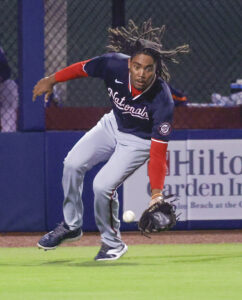
Wood, now 21, was selected by the Padres in the second round of the 2021 draft. Baseball America ranked him the #5 prospect in San Diego’s system going into 2022. He increased his prospect stock almost immediately, with a strong showing in 50 Single-A games that year. He hit ten home runs, stole 15 bases and drew a walk in 15.7% of his plate appearances, striking out just 17.8% of the time. His .337/.453/.601 batting line translated to a 168 wRC+.
As mentioned, Wood changed teams in the 2022 deal that sent Soto to the Padres, with the Nationals also getting CJ Abrams, MacKenzie Gore, Robert Hassell III, Jarlin Susana and Luke Voit. Wood continued at the Single-A level after that deal, slashing .293/.366/.463 for his new organization.
Going into 2023, Wood was generally considered to be one of the top 20 prospects around the league and he just kept hitting. He got into 129 games last year between High-A and Double-A, launching 26 homers and swiping 18 bags. His 31.5% strikeout rate was a bit high but he was still getting walked at a string 11.8% clip.
This year, Wood’s progression has continued with more amazing numbers, though with a slight injury hiccup. In late May, he suffered a hamstring injury and missed closed to a month, but he returned to the field and has looked no worse for wear. Through 51 Triple-A games this season, he currently sports a monster line of .346/.458/.578. That includes ten home runs, ten steals and a 17.3% walk rate. He’s also trimmed his strikeout rate to a tidy 18.2% level.
Wood is clearly ready for the next step and will try tackling major league pitching. Not all prospects find immediate success when brought up to the big leagues, so it shouldn’t be a massive surprise if he can’t keep putting up video game numbers like he has in the minors, but he has little left to prove and it’s time for the show.
For the Nationals, it’s a very interesting transition time for this promotion. They spent most of the previous decade in contention, with rosters featuring star players like Bryce Harper, Stephen Strasburg, Trea Turner, Max Scherzer, Soto and others, winning a title in 2019. But the bottom quickly fell out after they won that World Series, which led to trades of Scherzer, Turner and Soto.
Though dealing a generational talent like Soto may have been tough for the Washington front office and its fans, it has played a huge role in what seems to be a relatively quick return to respectable baseball. Abrams’ defense is still a work in progress but he’s putting up huge offensive numbers from the shortstop position and stealing bases as well, while Gore is having himself a very nice season on the mound.
The Nats came into this season clearly still in rebuild mode but they haven’t fallen completely out of the playoff picture in the weak National League race. Their 38-42 record is clearly subpar but they are only three games back of a Wild Card spot at the moment.
If Wood is able to succeed in the majors right away, that would obviously be a boost for their chances of hanging around that playoff race. Wood has experience at all three outfield spots but has been in left field since coming back from his injury, perhaps suggesting that is where the Nats plan to slot him in. Jesse Winker has been playing that spot and is having a nice season, but he’s not considered a strong defender and may be moved into a designated hitter role. Eddie Rosario has been serving as the DH for most of this month but is hitting just .181/.226/.330 for the year. If he’s going to be the one relinquishing the most playing time to Wood, it will be a low bar to clear for Wood in providing the Nats with an immediate upgrade.
Whether the Nats can be a surprise contender this year or not, Wood is still lined up to be a big part of a new core that has been gradually forming in Washington. As mentioned, Abrams and Gore are having good seasons. Jacob Young hasn’t hit much yet but has a strong floor in center field thanks to his speed and defense. Young and controllable pitchers like Jake Irvin, Mitchell Parker and DJ Herz have shown encouraging signs to various degrees. Cade Cavalli will be back in that mix after he finishes rehabbing from Tommy John surgery. And Wood won’t be the last exciting prospect promotion, with Dylan Crews, Brady House and others on the way.
The trade deadline is on July 30, just over a month away, so the club can take that time to decide if they want to try for something this year or just focus on putting the pieces together for the future. Either way, there’s plenty to like in the long-term view. In addition to the talent, the onerous Patrick Corbin contract is set to expire at the end of this season. That will leave the future payroll relatively clean, Keibert Ruiz and Strasburg the only notable deals on the books. The Ruiz deal has a fairly low average annual value while Strasburg’s deal was renegotiated to defer some money as part of his retirement. In short, the club has plenty of ability to build around their budding core going forward.
For Wood, he won’t be able to earn a full year of service time this year. Top prospects called up midseason can earn a full service year by finishing in the top two of Rookie of the Year voting, but that will be essentially impossible for him at this point. Even if he crushes the ball for the next three months, he won’t be able to catch guys like Yoshinobu Yamamoto, Paul Skenes, Joey Ortiz and the other rookies that have already had plenty of time to pull ahead.
He also won’t have enough time to get to Super Two status after 2026, based on where previous cutoffs have been. The earliest he could qualify for arbitration is after 2027 and his earliest free agency would be after 2030. Future optional assignments could push those timelines back but that won’t be a concern if he keeps mashing the way he has been on the farm.
Rays Could Make Multiple Starters Available On Trade Market
The 40-41 Rays are one of many key teams to keep an eye on as the trade deadline draws near. While they’re buried in the American League East and unlikely to close their current 10.5-game deficit, they’re also only four games out of the final American League Wild Card spot. At the same time, Tampa Bay could soon find itself with a growing number of big league starters — more than it has room to plug into its rotation.
Katie Woo, Patrick Mooney and Will Sammon of The Athletic report that Tampa Bay is anticipating righty Shane Baz and left-hander Jeffrey Springs will be ready to rejoin the rotation before long; both pitchers are on the mend from Tommy John surgery — Baz’s performed in late 2022 and Springs’ performed early last season. Baz already completed a minor league rehab assignment and has continued building up in Triple-A.
Once regarded as perhaps the top pitching prospect in the game, the 25-year-old Baz got out to a rough start during his rehab stint but has now rattled off five starts with a 1.57 ERA and 35-to-10 K/BB ratio in 23 innings. Springs has been on rehab for several weeks as well but has yet to pitch more than 2 1/3 innings in an outing. Prior to his Tommy John procedure, the now-31-year-old Springs had emerged as the latest in a long line of diamond-in-the-rough pitching finds for the Rays.
Tampa Bay acquired Springs and righty Chris Mazza in a trade that sent catching prospect Ronaldo Hernandez to Boston. At the time, Springs was a journeyman lefty who’d posted a 5.42 ERA over three partial big league seasons. With the Rays, he broke out to the tune of a 2.53 ERA, 29.5% strikeout rate and 6.3% walk rate in 196 innings. Tampa Bay rewarded that breakout with a four-year, $31MM extension — but Springs unfortunately went under the knife just three starts into the 2023 campaign.
With that pair of arms on the mend — to say nothing of righty Drew Rasmussen, who underwent an internal brace procedure just under one year ago — the Rays indeed have a mounting stock of arms. The Athletic trio notes in their report that of the team’s current starters — Zach Eflin, Aaron Civale, Zack Littell, Taj Bradley and Ryan Pepiot — Civale and Littell are the likeliest to be available in trades. Both pitchers are in their second year of arbitration eligibility and controlled through the 2025 season. Civale, whom the Rays acquired last summer in a trade sending first base prospect Kyle Manzardo to the Guardians, is earning $4.9MM this year. Littell, yet another product of the Rays’ almost comical hidden-gem factory (he was claimed off waivers from Boston), is earning just $1.8MM.
Of the two, Littell is enjoying the stronger season but also has the shorter track record. He’s pitched 86 1/3 innings of 4.17 ERA ball with a roughly average 22% strikeout rate against an exceptional 4.3% walk rate. Since the Rays took the former starter-turned-reliever and plugged him back into a rotation role last July, he’s given them 27 starts with a 3.98 earned run average, 20.2% strikeout rate and even more impressive 3.6% walk rate. (I profiled Littell’s breakout in depth earlier this season in a piece for MLBTR Front Office subscribers.)
Civale’s time with the Rays hasn’t gone as the team had hoped when acquiring him last year. He’s posted strong strikeout and walk rates alike, but his sharp K-BB profile has been undercut by a penchant for serving up home runs. The 29-year-old righty has started 26 games for Tampa Bay dating to last summer’s trade but logged a disappointing 5.26 ERA. Despite upping his strikeout rate from 21.1% with the Guards to 25.4% with the Rays and maintaining his terrific command (6.1% walk rate in Cleveland; 6.2% with Tampa Bay), Civale’s ERA has spiked from 3.77 with his former club to 5.26 with his current one. After yielding 1.19 homers per nine frames in five seasons with Cleveland, Civale has been tagged for a troubling 1.56 big flies per nine since heading to St. Petersburg.
There hasn’t been a major change in Civale’s repertoire that’s clearly prompted that flaw. He’s throwing more sliders this year at the expensive of his cutter, but it’s not an overwhelming change in usage rates and the righty is still using the same blend of six pitches (four-seam, cutter, sinker, slider, curveball and the very occasional splitter) that he used late in his Guardians tenure. His velocity has held up as well.
Despite Civale’s struggles this season, there’d be no shortage of teams interested in adding him and/or Littell to their staff for the next season and a half. Both arms are affordable — particularly for teams with CBT concerns — and there established rotation arms in general will be in short supply. That’s all the more true given recent injuries to trade candiates Jesus Luzardo, Braxton Garrett and Patrick Sandoval. The leaguewide arm shortage could position the Rays to deal from their current rotation and then replace whichever starter is traded with an in-house arm that’s returning from injury.
Darragh McDonald and I discussed this possibility with the Rays on this week’s episode of the MLBTR Podcast, also touching on the possibility of the Rays drawing interest in right-hander Zach Eflin. He’s arguably more important to the team’s staff than either Civale or Littell, but he’s also the most expensive starter on the roster. Eflin inked a three-year, $40MM deal in free agency prior to the 2023 season. It’s a heavily backloaded pact that will pay Eflin $18MM in 2025 — a hefty number by the Rays’ typically thrifty standards. With Springs, Baz and Rasmussen all on the mend and able to join young arms like Baz, Bradley and Pepiot in next year’s rotation, the always cost-conscious Rays will presumably be open to listen on Eflin while pondering a similar gamut to the Littell/Civale scenario laid out in The Athletic’s report.
It bears emphasizing that even if the Rays end up selling — or, as they often have in the past, operating on both the “buy” and “sell” side of the market — Sammon, Woo and Mooney report that the front office is not interested in a large-scale rebuild. Even if the Rays fall out of the 2024 race, the plan will be to reload and take aim and contending again in 2025. Given the wealth of young and/or cost-controlled pitching and a perennially deep farm system that keeps churning out interesting young hitters, the Rays likely feel they have the foundation of a contending club largely in place.
As is so often the case this time of year, the Rays appear positioned as one of the teams who will in many ways dictate a fair bit of the deadline’s dealings. Whether they rattle off several wins and thrust themselves into Wild Card position, maintain the status quo as a bubble team or drop further down the standings, their slate of rehabbing quality arms gives them the flexibility to shop current big league arms — be it for other big leaguers in areas of need or near-MLB prospects who can help in 2025.
Phillies To Place Bryce Harper, Kyle Schwarber On Injured List
The Phillies are taking two big hits today, announcing that both Bryce Harper and Kyle Schwarber are going on the 10-day injured list. Harper has a left hamstring strain while Schwarber has a left groin strain. They have reinstated infielder Kody Clemens from the injured list and recalled outfielder Johan Rojas in corresponding moves.

Schwarber exited last night’s game with left groin tightness. Harper was clearly injured on the final play of the game, as he limped to first base after attempting to run out a ground ball. Matt Gelb of The Athletic reported the IL placements for Harper and Schwarber prior to the official announcement, adding that both injuries are fairly mild, as Harper has a low-grade hamstring strain and could be back by July 9, but the Phils might also let him stay on the IL through the July 15-18 All-Star break for some extra rest. Schwarber’s left groin strain is mild enough that he could be back after the 10-day minimum.
The fact that both issues are fairly mild is undoubtedly good news, but the two absences will still be a challenge for the Phils. Schwarber is having yet another excellent season at the plate in his typical fashion, blending power and patience. He has a 16.1% walk rate and 17 home runs, leading to a .250/.373/.447 batting line and 133 wRC+. Harper has 20 homers, a 14% walk rate, .303/.399/.582 batting line, 169 wRC+ and the defensive metrics like his work at first base.
The Phillies have the best record in baseball at 53-28 but losing two of the better hitters in the game, even for a short time, is obviously less than ideal. It also adds to a growing injury problem, as J.T. Realmuto, Taijuan Walker, Spencer Turnbull and others are already on the IL.
Given the club’s strong record and the fact that the injuries aren’t too serious, it’s not a catastrophe, but the club will have to improvise for a little bit. Clemens was in good form before landing on the IL, as he currently has a .256/.293/.615 line on the year. But that was in a small sample size of 41 plate appearances, with all but six of those coming with the lefty swinger facing right-handed pitching. Perhaps he and Alec Bohm could share first base, with the right swinging Edmundo Sosa covering third base when a left-hander is on the mound. Sosa performed well when Trea Turner was on the IL but has had less playing time since Turner returned.
Schwarber’s IL placement does come with one silver lining, which is that the club will have more ability to rotate players into the DH slot. That could perhaps allow them to put Nick Castellanos in there fairly regularly, as he’s generally not considered to be an especially strong defender. Rojas is a strong defender but was optioned not too long ago as he struggled offensively. If Castellanos is in the DH slot, Rojas would be part of an outfield group that also includes Brandon Marsh, David Dahl, Cristian Pache and Whit Merrifield.