
Reds Trade Raisel Iglesias To Angels
DEC. 10: Infielder Leo Rivas is the PTBNL headed to the Reds, the Angels announced. The 23-year-old Rivas ranked as the Angels’ 25th-best prospect at MLB.com, which writes that the switch hitter has consistently “shown the ability to get on base, run and defend” throughout his minor league career. He owns a .252/.380/.362 line with 87 stolen bases in 1728 plate appearances in the minors. Rivas reached the High-A level in 2019. The Angels, meanwhile, are getting $900K in cash, Mark Feinsand of MLB.com tweets.
DEC. 7: In an out-of-the-blue move, the Angels have acquired closer Raisel Iglesias and cash from the Reds in exchange for right-hander Noe Ramirez and a player to be named later, per announcements from both teams.
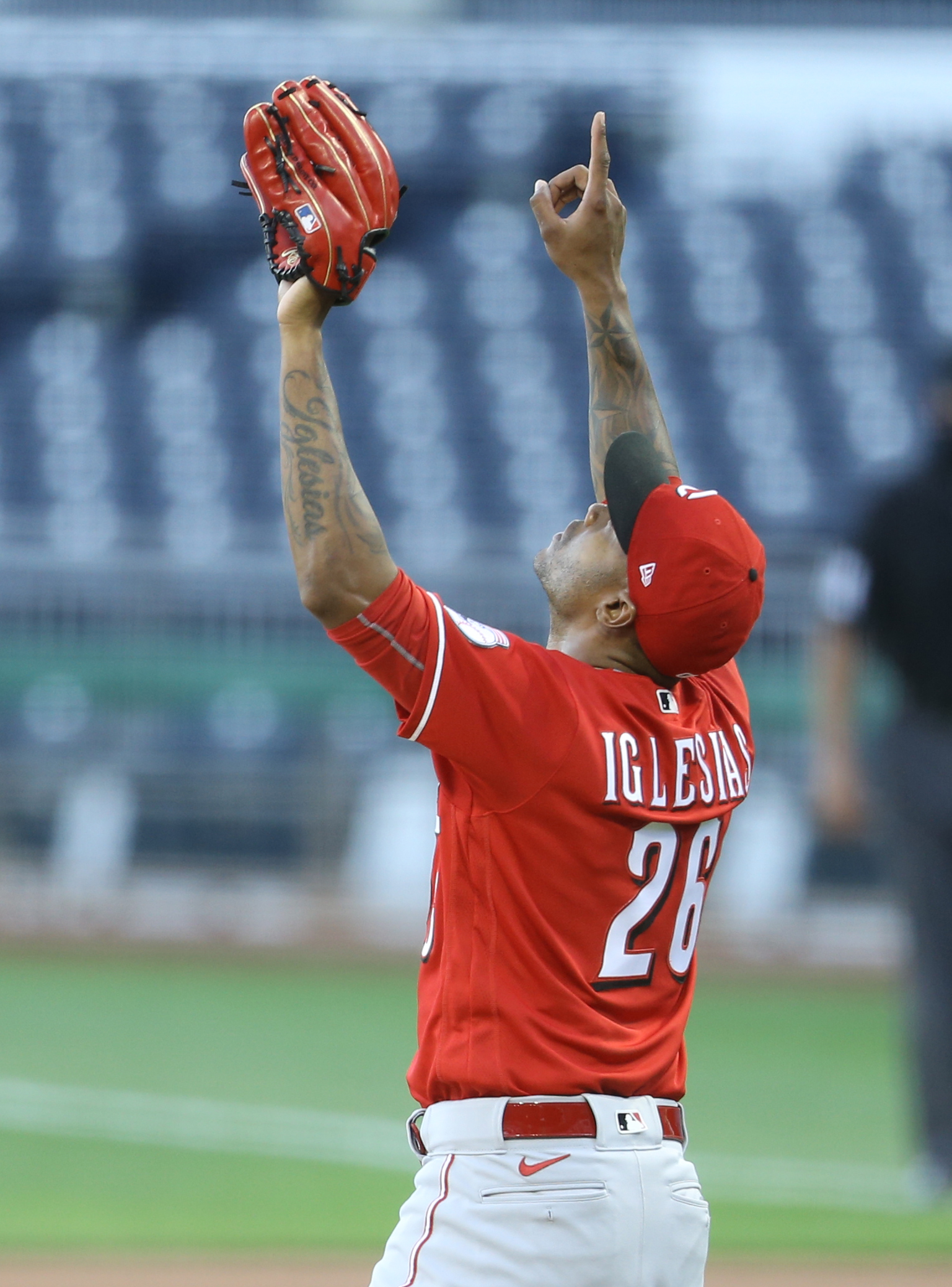
It’s the latest indication that the Reds are looking to cut costs. In addition to their surprising decision to non-tender Archie Bradley last week, the Reds have also reportedly been open to moving right-hander Sonny Gray, who is owed two years and $20MM on his contract. Iglesias is signed for $9.125MM this coming season and will be a free agent following the 2021 season.
This is the second notable trade for the Angels under new general manager Perry Minasian, who last week acquired shortstop Jose Iglesias from the Orioles in exchange for a pair of minor league pitchers. Iglesias will give the Halos a more clearly defined closing option after non-tendering a slate of five relievers, including Hansel Robles and Keynan Middleton, last Tuesday.
Iglesias, 31 in January, has been the Reds’ primary closer for the past four seasons. He had something of a down year in 2019 but saw both his velocity and his bottom-line results rebound in 2020. This past season, Iglesias tallied 23 innings of 2.74 ERA ball with a terrific 31-to-5 K/BB ratio, eight saves and a 41.5 percent grounder rate. Since taking over the ninth inning following countryman Aroldis Chapman‘s trade to the Yankees, Iglesias has been highly effective, pitching to a combined 2.95 ERA with 100 saves, 11.0 K/9, 3.0 BB/9, 1.13 HR/9 and a 37.5 percent ground-ball rate.
A return of Ramirez and a PTBNL suggests that from the Reds’ vantage point, this move was primarily a means of jettisoning Iglesias’ salary. Ramirez is two weeks older than Iglesias with a fraction of the track record. He’s pitched to a respectable 3.76 ERA over the past two seasons but done so with more questionable peripherals and primarily in low-leverage spots. Ramirez’s fastball sat at a career-low 88.8 mph in 2020 as his K/9 mark dropped to a career-low 6.0.
To his credit, Ramirez did have a nice year in 2019, when he gave the Angels 67 2/3 innings of 3.99 ERA and 3.72 FIP ball with averages of 10.5 K/9 and 2.7 BB/9. Statcast rated him in the 75th percentile or better in terms of average exit velocity, hard-hit rate, barrel rate, curveball spin and overall swinging-strike rate. It was a solid season, to be sure, but even that career-best year pales in comparison to the best efforts put forth by Iglesias.
Perhaps the Reds are hopeful that Ramirez can regain that form, and it’s certainly worth pointing out that he’s controllable through the 2023 season. However, Ramirez looked like a non-tender candidate just one week ago, and trading an established closer of Iglesias’ stature for a low-leverage reliever in need of a rebound looks like little more than a salary dump. If the PTBNL involved in the deal proves to unexpectedly be a prospect of note, the swap might look better, but the Reds have now jettisoned Iglesias and Bradley from an already problematic bullpen.
With Iglesias out of the picture, the Reds’ projected payroll drops from closer to $130MM to a bit more than $120MM. Lefty Amir Garrett and righty Lucas Sims are the in-house favorites to assume some of Iglesias’ high-leverage spots, particularly with Michael Lorenzen expected to move into the starting rotation. The Reds could still add some arms from outside the organization, but based on their activity to this point in the winter, it doesn’t seem likely that any additions will be especially high-profile in nature.
Rangers Acquire Nate Lowe From Rays
The Rangers are acquiring first baseman Nate Lowe from the Rays for catcher Heriberto Hernandez, infielder Osleivis Basabe and outfielder Alexander Ovalles. The Rays are sending first baseman Jake Guenther and a player to be named later to Texas along with Lowe. Tampa Bay has announced the deal.
Lowe, 25, is the only player in the deal with Major League service time, but he was unable to break into the first-string rotation with Tampa. The Rays have a plethora of options at first base and designated hitter, splitting time primarily between Ji-Man Choi and Yandy Diaz. Yoshi Tsutsugo also fits into the timeshare, while Mike Brosseau and Brandon Lowe are capable of handling the position. There simply wasn’t much room for Lowe to break into a regular role.
Ronald Guzman has kept one foot on the first base bag the last three seasons for the Rangers, but a triple slash of .230/.308/.417 leaves room for an upgrade. The 26-year-old has posted just 0.9 bWAR per 650 plate appearances over that time. Lowe is now in line to take over for Guzman as the Rangers’ primary first baseman, president of baseball operations Jon Daniels told TR Sullivan of MLB.com and other reporters. In 245 plate appearances in 71 games over the past two seasons, Lowe has slashed .251/.322/.447, good for a 106 wRC+. While that may not blow your hat away, conversely, Guzman owns a career 85 wRC+.
Texas fans might remember Guenther from his time at TCU. The Rays chose him in the seventh round of the 2019 draft, giving him time to get just one professional season under his belt. He raked in that time, slashing .320/.431/.423 in the Appalachian League. Despite his lack of professional time, Guenther might be closer to the big leagues than it may seem, as he’ll turn 24 years old in May.
Basabe (No. 20) and Hernandez (24) ranked among the Rangers’ top 30 prospects at MLB.com before the trade. The 20-year-old Basabe has so far topped out in Low-A ball, though he has only accrued 10 plate appearances there. MLB.com is bullish on Basabe, complimenting his contact-oriented skills at the plate and noting his “well-above-average speed” could help him turn into “a dynamic basestealer.”
Hernandez, also 20, has torn the cover off the ball between the rookie and Low-A levels since his professional career began in 2020. To this point, Hernandez has batted .320/.450/.635 with 23 home runs in 473 minor league plate appearances. FanGraphs’ Eric Longenhagen ranked Hernandez third in the Rangers’ system last April and argued he could “be a very special hitter,” though Longenhagen isn’t high on his defense behind the plate.
Ovalles, yet another 20-year-old, isn’t as highly regarded as Basabe or Hernandez. He does have the most experience among the three in Low-A (100 plate appearances), but Ovalles only put up a .187/.250/.319 line there in 2019.
Initial news of the trade came from MLB.com’s Mark Feinsand (via Twitter). Jeff Wilson of the Fort Worth Star Telegram (via Twitter) noted the inclusion of Basabe as part of the six-player deal. Rangers’ Executive Vice President of Communications John Blake filled in the rest of the deal (via Twitter).
2020 Rule 5 Draft Results
The Rule 5 draft marks the end of this year’s Virtual Winter Meetings. Those unfamiliar with how the draft works can check out MLBTR’s full primer on the event here, but the short version is that teams with open 40-man roster spots can select a player with four to five years of pro experience from other organizations if said player hasn’t been given a spot on the 40-man roster. Players who signed at 18 years of age or younger but have five years of experience can be selected, as can players signed at 19 or older who have four years of experience. Each selection costs $100K, but it’s not mandatory for teams to make picks. Clubs must carry chosen players on their active rosters (or the major league injured list) throughout the entire 2021 season. Otherwise, the player must be placed on waivers; if no other team steps into the Rule 5 rights, the player is offered back to his original club.
This year’s draft brings more uncertainty than usual as teams keep a close eye on their change purses following large-scale revenue losses due to the pandemic. What’s more, the players available in this year’s draft haven’t played organized baseball in more than a year because of the cancellation of the minor league season.
You can find Baseball America’s preview of the festivities right here (subscription required). The Rule 5 order is based on the reverse order of last season’s standings. Here are this year’s results:
First Round
1. Pittsburgh Pirates: Jose Soriano (Angels)
2. Texas Rangers: Brett de Geus (Dodgers)
3. Detroit Tigers: Akil Baddoo (Twins)
4. Boston Red Sox: Garrett Whitlock (Yankees)
5. Baltimore Orioles: Mac Sceroler (Reds)
6. Arizona Diamondbacks: Zach Pop (Royals)
7. Kansas City Royals: Pass
8. Colorado Rockies: Jordan Sheffield (Dodgers)
9. Los Angeles Angels: Jose Alberto Rivera (Astros)
10. New York Mets: Luis Oviedo (Indians), traded to Pirates for cash considerations, tweets MLB.com’s Anthony DiComo
11. Washington Nationals: Pass
12. Seattle Mariners: Will Vest (Tigers)
13. Philadelphia Phillies: Kyle Holder (Yankees)
14. San Francisco Giants: Dedniel Nunez (Mets)
15. Houston Astros: Pass
16. Milwaukee Brewers: Pass
17. Miami Marlins: Paul Campbell (Rays)
18. Cincinnati Reds: Pass
19. St. Louis Cardinals: Pass
20. Toronto Blue Jays: No 40-man roster space
21. New York Yankees: Pass
22. Chicago Cubs: Gray Fenter (Orioles)
23. Chicago White Sox: Pass
24. Cleveland Indians: Trevor Stephan (Yankees)
25. Atlanta Braves: Pass
26. Oakland Athletics: Ka’ai Tom (Indians)
27. Minnesota Twins: Pass
28. San Diego Padres: No 40-man roster space
29. Tampa Bay Rays: Pass
30. Los Angeles Dodgers: Pass
Second Round
5. Baltimore Orioles: Tyler Wells (Twins)
26. Oakland Athletics: Dany Jimenez (Blue Jays)
The full results, including the minor league phase, can be found here.
White Sox Sign Adam Eaton
Dec 10: The White Sox have formally announced the signing via a press release, tweets James Fegan of the Athletic.
Dec 8: The White Sox have brought a familiar face back to the South Side, as NBC Sports Chicago’s Chuck Garfien (Twitter link) reports that the Sox have signed outfielder Adam Eaton to a one-year, $7MM contract. The deal contains a club option worth $8.5MM for the 2022 season, with MLB.com’s Mark Feinsand reporting that the option has a $1MM buyout. Eaton is represented by Diamond Sports Management.
Eaton previously played for the White Sox from 2014-16, emerging as a reliable and productive everyday outfielder over those three seasons. With Chicago embarking on a rebuild, Eaton was traded to the Nationals almost exactly four years ago to the day in a very notable deal that brought the Sox a trio of young arms — Lucas Giolito, Dane Dunning, and Reynaldo Lopez.
Flash forward to today and Giolito is the ace of Chicago’s staff, Lopez is on the roster though perhaps looking at a move to the bullpen after struggling as a starter, and Dunning was just traded to the Rangers yesterday in the swap that brought Lance Lynn to Guaranteed Rate Field. Between adding Lynn and Eaton within 24 hours, the White Sox have now checked two notable items off their offseason to-do list.
After Nomar Mazara didn’t produce much in 2020, the White Sox were known to be looking at outfield help, with such names as Michael Brantley and Joc Pederson linked to the team. (USA Today’s Bob Nightengale also reported this morning that Eaton was “on their radar.”) With Eloy Jimenez in left field and Luis Robert in center, Eaton will be slated for right field, his regular position over the last three years in Washington. Adam Engel, coming off a strong 2020 season, now looks to be set for fourth outfielder duty, though the right-handed hitting Engel could spell the left-handed hitting Eaton when a southpaw is on the mound.
Eaton’s lefty bat will provide some balance to a White Sox lineup that leans to the right, though Eaton will be looking to rebound from his worst offensive season as a starter. He hit .226/.285/.384 over 176 plate appearances for the Nats last season, with his lowest walk rate (6.8%) since 2013. Between this lack of hitting and a tough year defensively (-6.1 UZR/150, -6 Defensive Runs Saved over 335 innings in right field), Eaton was a sub-replacement level player, with -0.5 fWAR. These numbers led the Nationals to decline their club option on Eaton’s services for 2021, instead buying him out for $1.5MM.
The White Sox are clearly hoping that Eaton’s struggles were due to the abbreviated and unusual nature of the 2020 season, and that he’ll produce something closer to his usual numbers (.289/.367/.423 over 3066 PA from 2014-19) under somewhat more normal circumstances next season. The one-year deal doesn’t represent a huge investment on Chicago’s part to see if the 32-year-old Eaton can bounce back, and by signing Eaton rather than investing in a more expensive option like Brantley or Pederson, the Sox now theoretically have more money to spend on other potential roster moves later in the winter.
Mets Nearing Deal With James McCann
12:02pm: The two sides do not yet have an agreement in place, tweets MLB.com’s Anthony DiComo. Martino tweets that the Mets have indicated they’re willing to go to four years, however, so the final haggling could be a matter of the exact dollar point associated with that term.
11:29am: The Mets and free-agent catcher James McCann are closing in on what is expected to be a four-year contract, reports Ken Rosenthal of The Athletic (via Twitter). SNY’s Andy Martino reported this morning that talks between the two sides had picked up steam. McCann is represented by the Ballengee Group.
A deal with McCann will obviously take the Mets out of the market for top free-agent catcher J.T. Realmuto, although indications over the past week have been that McCann was the team’s primary catching target — not Realmuto. McCann has long stood out as the No. 2 catcher on this market, and the Mets’ decision to sign him has been linked to their pursuit of higher-profile free agents at other positions, namely center fielder George Springer and right-hander Trevor Bauer.
A four-year pact for McCann would cap off a remarkable turnaround for the 30-year-old backstop, who just two offseasons ago was non-tendered by the Tigers on the heels of a disastrous year at the plate. McCann quickly hooked on with the White Sox, signing a modest one-year deal to serve as a backup, but he broke out both at the plate and behind the plate as a defender during his time on Chicago’s south side — so much that he’s established himself as a clear starting option.
Over the past two seasons in Chicago, McCann has raked at a .276/.334/.474 clip with 25 home runs, 29 doubles and a triple in 587 plate appearances. The uptick in production at the plate is supported by several underlying metrics; McCann’s average exit velocity sat at 87.8 mph in 2018 but jumped to 90.2 mph with the White Sox.
McCann also boosted his hard-hit rate from 37.1 percent with the Tigers in ’18 to 44.9 percent with the South Siders thanks in large part to nearly doubling the rate at which he barrels pitches. McCann’s line-drive rate has risen with the Sox, too, as his infield fly rate has dropped. McCann’s strikeout rate has trended upward a bit with the White Sox, but the extra whiffs have been more than offset by the improvement in the quality of the contact when he does put bat to ball.
Behind the plate, McCann has long been adept at controlling the running game. Even with the Tigers, he nabbed 37 percent of those who attempted to take a base against him. One knock on McCann, however, was on his receiving ability — or lack thereof. McCann ranked well below average in terms of framing metrics for much of his time with the Tigers and even early in his White Sox tenure — a flaw that likely influenced the White Sox’ decision to sign Yasmani Grandal to a four-year pact last winter.
Recognizing that shortcoming, McCann spent the bulk of his offseason working with catching guru Jerry Narron to improve his receiving and framing. The results paid off, as Statcast ranked McCann as much-improved in that regard, particularly with pitches at the bottom of the strike zone, which was where he’d struggled most. McCann went from garnering strike calls on just 44.1 percent of pitches at or slightly below the bottom of the zone to an excellent 61.8 percent. One can suggest that there’s some small-sample smoke and mirrors at play, but McCann’s improvement was pronounced enough that it can’t be entirely dismissed as small-sample noise. It would seem that the Mets agree.
There’s certainly some risk to the deal for the Mets, particularly given the four-year term. While McCann has been excellent since Opening Day 2019, his more limited role early in 2019 and this past season’s shortened slate of games leave us with only about one full season’s worth of data supporting his offensive gains. That said, Mets catchers hit just .239/.294/.403 in 2020, so the bar to clear for overall improvement isn’t a particularly high one.
If the deal with McCann does indeed come to fruition, he’ll be the second notable veteran in as many weeks to join the Mets on a multi-year deal. Longtime Twins setup man Trevor May, one of the market’s top relievers, inked a two-year deal worth a guaranteed $15.5MM last week. The Mets have yet to finalize their search for a new general manager, but former GM Sandy Alderson has returned to the club as team president and is calling the shots in the baseball operations department under new owner Steve Cohen.
Latest On James McCann, Mets
Dec. 9: Talks between the Mets and McCann have recently gained further momentum, per Martino.
Dec. 4: While the Mets have stepped up their efforts on the McCann front, there were still multiple other clubs negotiating with his camp as of last night, Jon Morosi reported on MLB Network this morning (video link).
Dec. 3, 12:44pm: While talks are ongoing, the two sides are not yet close to finalizing a deal, tweets Martino.
12:31pm: The Mets are in “active talks” with McCann, tweets Fansided’s Robert Murray, who adds that a four-year deal indeed looks possible. MLB Network’s Jon Heyman tweets that the Mets are making a “serious push” to land the former White Sox backstop.
12:28pm: While the Mets have been linked to J.T. Realmuto ever since news of Steve Cohen’s purchase of the franchise broke, reports surrounding the team’s pursuit of a catcher have pointed in other directions early in the offseason. SNY’s Andy Martino reported recently that James McCann was more firmly in the team’s crosshairs, and Joel Sherman of the New York Post now suggests the same, citing executives from two other teams involved in the free-agent catching market who believe the Mets’ pursuit of McCann is “intensifying.”
Certainly that doesn’t mean that a deal is close to fruition, and it’s eminently possible that McCann’s reps are broadcasting confidence to other clubs that does not quite align with New York’s actual level of aggression. Still, it’s worth noting that one of the execs to whom Sherman spoke suggested McCann could even command a four-year deal given the early activity on the second-tier market for catchers.
A four-year pact would be a surprise for even the most bullish projections. We oscillated between a two- and three-year deal for McCann when discussing predictions for our Top 50 Free Agent rankings, with majority ultimately leading to two-year prediction. Four years was never a real consideration. McCann’s 2019-20 run with the White Sox was quite strong, as he made considerable gains in his production at the plate (.276/.334/.474), the underlying metrics behind that output (career-high hard-hit rate, exit velocity, barrel rate) and in terms of his ability to frame pitches — particularly his ability to gain strike calls at the bottom of the zone. However, his 2018 season in Detroit led to a non-tender, and as good as he’s been with the South Siders across the past two seasons, it’s a sample size of 587 plate appearances.
If the Mets do indeed prefer a smaller-scale deal with McCann to the likely $100MM+ contract that Realmuto will command at some point this offseason, they’d have ample resources left to pursue other big-ticket items — be it free-agent pursuits of George Springer, Trevor Bauer and/or DJ LeMahieu or trade negotiations for a prominent name (Cleveland’s Francisco Lindor, Colorado’s Nolan Arenado, Chicago’s Kris Bryant, etc.). They’ve already crossed one item off their shopping list, having introduced righty Trevor May on a new two-year contract this afternoon.
Whether a deal ultimately comes together remains to be seen, though if the early weeks of the offseason have told us anything, it’s that if the reports on their increased interest in McCann aren’t accurate, Cohen himself may just make that known to the world on Twitter.
Royals Sign Carlos Santana
3:03PM: The Royals have officially announced the signing.
1:06PM: The Royals have agreed to a two-year deal with free agent first baseman Carlos Santana, MLB Network’s Jon Heyman reports (via Twitter). The contract is worth $17.5MM in guaranteed money, according to ESPN’s Jeff Passan (Twitter link), with another $1MM available in incentives. The majority of the money will come in 2022, as the New York Post’s Joel Sherman reports that Santana will earn $7MM in 2021 and then $10.5MM in the second year of the deal. Santana is represented by Octagon’s Ulises Cabrera and Brian Mejia.
The $17.5MM matches what Santana would have earned in 2021 had the Indians exercised their club option on his services. Instead, Cleveland declined the option and bought Santana out for $500K, sending him into free agency.
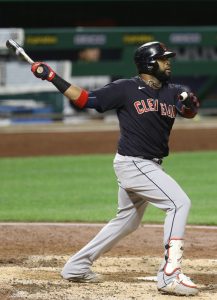 This is the Royals’ second notable two-year free agent contract in as many weeks, following their two-year pact with Mike Minor worth $19MM in guaranteed money. Kansas City had over $23.5MM coming off their books in the form of expired contracts for Ian Kennedy and Alex Gordon and Maikel Franco being non-tendered, and now just about all of that money has been reinvested in the form of Santana, Minor, and Michael A. Taylor.
As a smaller-market team facing a bigger financial hit than most clubs in 2020 given the lack of revenue-sharing funds, this type of aggressive spending from the Royals is a little surprising, yet it signals that owner John Sherman (who bought the team last offseason) is willing to green-light some significant roster upgrades. GM Dayton Moore openly said that he plans to field a competitive team in 2021, and while the Twins, White Sox and (even likely without Francisco Lindor) Indians still loom as powers in the AL Central, the organization clearly feels it is possible to contend.
Kansas City is very familiar with Santana over his years in Cleveland, and Santana has more career home runs (31) and RBI (93) against the Royals than any other opponent over his 11 Major League seasons. 2020, however, was a down year for veteran, as he hit .199/.349/.350 over 255 plate appearances for the Tribe — the lowest numbers Santana has ever posted in all three slash-line categories. While he still led the American League with 47 walks, Santana’s power numbers dropped significantly, and he posted his lowest hard-hit ball and barrel percentage (as per Statcast) of the last six seasons.
It isn’t what you want to see out of a player entering his age-35 season, making it somewhat surprising that Santana was able to land such a healthy two-year guarantee in free agency. (MLBTR projected Santana for a one-year, $6MM deal.) Still, Santana had only a .212 BABIP last season and his .360 xwOBA far outpaced his .311 wOBA, so some misfortune was baked into his lackluster results. Combine this lack of batted-ball luck with the small sample size of the shortened 2020 season, and there’s certainly reason to imagine Santana could look like his old self next year. It was just in 2019 that Santana hit .281/.397/.515 with 34 homers for Cleveland, earning the first All-Star and Silver Slugger nods of his long career.
Santana played all 60 games at first base last season, with somewhat mixed reviews (+5 Defensive Runs Saved, but -2.0 UZR./150 and -2 Outs Above Average) depending on the metric. Still, Santana has long been at least an average defender at first base, so he is likely to get the bulk of playing time at the position in 2021, with likely a fair number of DH days included to keep him fresh.
With Santana at first base and Franco gone, it now looks at if Hunter Dozier will slide back across the diamond to play third base. Dozier didn’t exactly shine defensively in his previous stints at third base, so there is some possible room for flexibility within the Royals’ lineups. Speculatively, Dozier could see some time in the outfield and Whit Merrifield could get some time at the hot corner, though Merrifield hasn’t played third base since 2017. If Bobby Witt Jr. is called up at some point in 2021, K.C. could also deploy the star prospect at third base.
Photo courtesy of USA Today Sports Images
White Sox Acquire Lance Lynn
TODAY: The White Sox and Rangers have officially announced the trade.
DECMEBER 7, 11:57pm: The Rangers will also acquire lefty Avery Weems, Ken Rosenthal of The Athletic relays.
10:59pm: The White Sox are acquiring right-hander Lance Lynn from the Rangers, Joel Sherman of the New York Post reports. Righty Dane Dunning is heading to Texas in the return, Jeff Passan of ESPN tweets. The Rangers will also receive a second player, per Evan Grant of the Dallas Morning News. It’ll be another young pitcher, according to Mark Feinsand of MLB.com.

This is a major pickup for the White Sox, who are landing one of the most coveted arms on the trade market. Lynn was an innings-eating stalwart with the Cardinals for a large portion of 2011-17. Lynn then signed a one-year, $12MM contract with the Twins, and though he didn’t fare especially well with the club, he rebounded after a second-half trade to the Yankees and has continued to hold his own since then.
Lynn signed a three-year, $30MM guarantee with the Rangers before 2019, and that deal worked out brilliantly for the club. He posted a terrific 3.57 ERA/3.43 FIP with 10.31 K/9 and 2.59 BB/9 in 292 1/3 innings as a member of the team. The 33-year-old could have continued to serve as an asset for the Rangers’ rotation next season, but with the Rangers in a rebuild, president of baseball operations Jon Daniels and new general manager Chris Young elected to go in a different direction.
At one year and $8MM, Lynn will give Chicago – which is coming off its first playoff berth since 2008 – an affordable and effective No. 3 to plug into its rotation behind Lucas Giolito and Dallas Keuchel. The White Sox also have Dylan Cease, Michael Kopech and Reynaldo Lopez in line to compete for starting spots next year.
Considering the Rangers appear unlikely to vie for a playoff spot next year, their return looks good for one season of Lynn’s services.
Dunning, who will turn 26 later this month, is a former first-round pick and an an ex-top 100 prospect who is coming off an encouraging debut with the White Sox. Chicago originally acquired Dunning (not to mention Giolito and Lopez) from the Nationals for outfielder Adam Eaton in December 2016.
Dunning underwent Tommy John surgery in 2019, but he garnered his first experience in the majors a year ago and posted a 3.97 ERA/3.99 FIP with 9.28 K/9 and 3.44 BB/9 in 34 innings. Texas is certainly hoping Dunning will build on that effort and become a long-term member of its rotation. He’ll have ample time to reach that goal, as he’s controllable through at least the 2026 season. Given Lynn’s status as a one-year rental, adding an immediate rotation replacement with some early big league success and a good bit of upside is a nice outcome for Texas.
The Rangers also have high hopes for the 23-year-old Weems, a 2019 sixth-rounder who threw 60 1/3 innings in rookie ball that year. While Weems posted stellar numbers then (2.09 ERA, 11.0 K/9 against 1.5 BB/9), albeit against much younger competition, he is not regarded as a premium prospect at this time. He’ll give the Rangers another fairly polished college arm to add to their ranks, however, which is important for a farm system that is thin on pitching.
Photo courtesy of USA Today Sports Images.
Yomiuri Giants Formally Post Tomoyuki Sugano For MLB Teams
The Yomiuri Giants of Japan’s Nippon Professional Baseball have formally posted right-hander Tomoyuki Sugano for Major League teams. His 30-day posting period will begin tomorrow morning at 8am and run through Jan. 7 at 5pm ET, tweets MLB.com’s Jon Morosi.
Sugano, 31, is one of the most prominent pitchers in Japan. A two-time winner of the Sawamura Award — Japan’s Cy Young equivalent — he’s viewed as one of the top talents on the market behind Trevor Bauer, who is still in a class of his own among free-agent hurlers.
After a down season (by his lofty standards) in which he posted a 3.89 ERA in 2019, Sugano rebounded in 2020 with 137 1/3 innings of 1.97 ERA ball, averaging 8.6 K/9 against 1.6 BB/9 along the way. Overall, dating back to the 2015 season, Sugano has thrown more than 1000 innings with a 2.19 ERA while averaging better than eight strikeouts and fewer than two walks per nine frames.
Some fans may remember Sugano from a strong showing in the 2017 World Baseball Classic. The right-hander shined in a strong outing against Team USA, allowing just an unearned run with six strikeouts and one walk over six innings and eliciting high praise from skipper Jim Leyland.
“I can’t tell you, for me, tonight, how impressed I was with their pitcher,” Leyland said at the time (link via MLB.com’s Joe Trezza). “I mean, I thought he was really good. Located on the ball on the outside corners, fastball. Threw 3-0 sliders. That’s pretty impressive.” Leyland plainly called Sugano a “big league pitcher” after that game. (Those interested can check out all 81 of Sugano’s pitches from that game in this YouTube clip.)
Sugano’s fastball averages 92-93 mph and, like his curveball, boasts a strong spin rate. Sports Info Solution’s Will Hoefer took a look at him last October, calling him at least a No. 4 starter in the big leagues, and that was after an injury-hindered campaign as opposed to the strong 2020 showing Sugano just authored. ESPN’s Kiley McDaniel also labels him a likely fourth starter, noting that he’d have a chance at three years with an annual value in excess of $10MM in a normal offseason but projecting a slightly more measured two-year, $24MM deal due to the sport’s revenue losses. Sugano would’ve been included on MLBTR’s own list of the game’s top 50 free agents had it been known for certain that he’d be posted at the time of publishing.
Major League teams will have the next 30 days to negotiate with Sugano, who is exempt from international bonus pools and free to sign a contract of any length and for any amount. In addition to the money paid to Sugano on his contract, the team that signs him will also owe a release fee to the Yomiuri Giants. That fee is equal to 20 percent of the contract’s first $25MM, plus 17.5 percent of the contract’s next $25MM in value, plus an additional 15 percent of any money guaranteed thereafter.
Rangers Hire Chris Young As General Manager
The Rangers have hired Chris Young as their new general manager, Ken Rosenthal and Levi Weaver of The Athletic report. Jon Daniels will stay on as the team’s president of baseball operations.
This is out-of-nowhere news, as there was no indication Daniels would step aside as the Rangers’ GM this offseason. It’s a role Daniels has held since 2005. While Daniels is now 43, he became the youngest GM in league history when he got the job at the age of 28. The Rangers have since earned five playoff berths and won two American League pennants, though they have fallen on hard times in recent years. The team hasn’t finished above .500 since 2016, and it will reduce payroll heading into 2021, making an immediate return to contention even more difficult.
The Rangers are hoping the addition of Young to their front office will make it easier to return to relevance sometime soon. The 41-year-old is a former major league right-hander and a Princeton alumnus who began his career with the Rangers from 2004-05 before Daniels traded him to the Padres. Since he hung up his spikes in 2017, Young has been working in the MLB office, first as the league’s vice president of on-field operations, initiatives and strategy. He took on an even bigger role this year after chief baseball officer Joe Torre moved into an advisory position.
Young recently interviewed for the Mets’ GM job, but he dropped out of the running because he did not want to relocate his family. The Dallas resident will now get an opportunity to help lead a local franchise.