
Twins Sign Marwin Gonzalez
The Twins have announced the signing of free-agent infielder/outfielder Marwin Gonzalez. Gonzalez, who is represented by the Boras Corporation, receives a two-year, $21MM deal that will pay him $12MM in 2019 and $9MM in 2020.

Gonzalez, 30 in March, emerged as one of MLB’s most versatile utility pieces over the past two seasons and played a major role in bringing the Astros to the 2017 World Series. The switch-hitter’s terrific .303/.377/.530 batting line that year regressed to .247/.324/.409 in 2018, though it’s worth noting that his 2018 results were weighed down by a sluggish start. Gonzalez carried a .612 OPS into June but rebounded to the tune of a .266/.343/.462 slash over the final four months, during which time he clubbed 12 of his 16 home runs. Overall, he’s posted a healthy .274/.349/.467 line with 39 homers, 59 doubles and three triples over his past 1067 plate appearances.
Known as much for his defensive versatility as anything else — agent Scott Boras dubbed him “Swiss G” early in the offseason — Gonzalez logged 150-plus innings at first base, second base, shortstop and in left field last year. He’s logged significant innings at all four infield spots over the past two seasons and has tallied more than 1000 innings in left field as well. He’s drawn plus marks for that work in left (+7 Defensive Runs Saved, +5.5 Ultimate Zone Rating, +2 Outs Above Average) and has generally drawn solid marks for his glovework at first base, second base and third base in recent years (with defensive metrics being less fond of his defense at shortstop).
While Gonzalez won’t be in line to man one singular position on a regular basis, it’s likely that the Twins will mix him into the lineup on a near-regular basis over the next couple of seasons. He’ll provide the club with a high-quality means of keeping first baseman C.J. Cron, second baseman Jonathan Schoop, shortstop Jorge Polanco and third baseman Miguel Sano fresh. Gonzalez also seems likely to log some time in the outfield, and given that all three of Minnesota’s current outfielders — Eddie Rosario, Byron Buxton and Max Kepler — can play all three outfield slots, Gonzalez could be the first in line to get some outfield work when any of that trio is out of the lineup. In short, he’ll provide rookie manager Rocco Baldelli with an enormous amount of flexibility when mapping out his daily lineups. And, with Schoop a free agent at season’t end, Marwin could potentially give the Twins a regular option in 2020 if prospect Nick Gordon doesn’t adequately rebuild his stock this year.
The addition of Gonzalez will cost one of Ehire Adrianza or Willians Astudillo a spot on the active roster and potentially puts Adrianza’s spot on the 40-man roster in jeopardy. Like Gonzalez, Adrianza is a switch-hitting utility piece who played all over the infield and in left field last year, though his bat has never approached Gonzalez’s 2017-18 levels. Minnesota also has Ronald Torreyes on the 40-man roster under a non-guaranteed, split contract, though Torreyes has one minor league option remaining.
Entering the offseason, MLBTR pegged Gonzalez as a candidate to receive a four-year contract (at a lower annual rate of $9MM) given the fact that his versatility figured to create no shortage of demand throughout the league. Many pundits at the time — myself included — were surprised that Houston didn’t issue a $17.9MM qualifying offer to Gonzalez; while that’d be a huge price to pay for one season of his services, the thinking at the time was that he’d comfortably out-earn that sum on a three- or four-year pact, thus making him a safe bet to reject the deal and net the Astros a compensatory draft pick. In retrospect, the Astros’ decision not to do so looks quite prudent.
From a broader perspective, Gonzalez’s contract is in some ways indicative of the changing market landscape that has served as a source of consternation for both players and agents this winter. While his $10.5MM annual salary is quite large for a super-utility player, to be sure, Gonzalez’s ultimate guarantee was for half the length and under 40 percent of the total dollars the Cubs pledged to Ben Zobrist as he entered his age-35 season just three years ago. While Zobrist was a more established hitter and predicting that type of money for Gonzalez seemed overly aggressive even at the outset of free agency, few would’ve predicted such great disparity between their contracts. Gonzalez is roughly a half decade younger than Zobrist was at the time of his deal, after all.
While Gonzalez’s contract falls shy of what virtually any publication predicted for him entering the winter, that $10.5MM annual value is nonetheless robust, and he’ll have the chance to re-enter free agency at a relatively youthful age. A four-term deal at that point will be even less likely, but he’d certainly be a candidate to receive another strong annual value on a two- or possibly three-year pact if he maintains his recent level of production.
For the Twins, Gonzalez will join offseason newcomers Schoop, Cron and Nelson Cruz to a revamped lineup that figures to be more productive than it was in 2018. If the Twins are able to coax bounceback seasons out of some combination of Schoop, Byron Buxton and Miguel Sano, their offense will be among the more formidable groups in the American League. The team’s pitching staff could certainly use further augmentation, and it’s worth noting that a pair of prominent free-agent arms — Dallas Keuchel and Craig Kimbrel — remain unsigned. The extent to which the Twins are interested in either at present isn’t known, though they’ve at least been linked to Kimbrel in the past month.
Whether they ultimately come to terms with either (or acquire another pitching upgrade), it’s clear that Minnesota at least has the financial means to do so. The Twins’ payroll will still be shy of last year’s $128MM Opening Day mark, and they have fewer than $25MM committed to the 2020 roster.
Jon Heyman of MLB Network (Twitter links) first had the deal and some contract terms. ESPN’s Jeff Passan reports (via Twitter) had the years and dollars. Dan Hayes of The Athletic first connected the two sides.
Photo courtesy of USA Today Sports Images.
“Optimism” Phillies, Bryce Harper Will Finalize 10-Year Deal By Monday
9:55pm: Harper’s camp actually negotiated with two teams in Las Vegas on Saturday, per Jon Heyman of MLB Network. It’s not clear who was vying against the Phillies, though, nor is it known whether the other club made any progress in talks.
9:41pm: Middleton is still in Vegas, and there’s “optimism” the Phillies and Harper will finalize a 10-year deal by Monday afternoon, Nightengale reports.
9:19pm: Middleton’s plane is returning to the East Coast, but the two sides had a “busy day of meetings” and talks will continue, Jim Salisbury of NBC Sports Philly tweets.
8:39pm: The Phillies are engaged in “deep and serious negotiations” with free-agent outfielder Bryce Harper, Bob Nightengale of USA Today reports. Team owner John Middleton, who’s meeting with Harper’s camp in Las Vegas, doesn’t want to leave without a deal in place, according to Nightengale.
The Vegas-based meeting between the Phillies and Team Harper, which also includes agent Scott Boras, is their second summit since Jan. 10. After the sides’ initial sitdown, Nightengale named Philadelphia as the favorite to sign Harper, which has remained the case in the ensuing weeks. Now, with the season fast approaching and the current class’ other elite free agent, Manny Machado, having come off the board this week, a resolution for Harper may finally be on the way.
Machado’s months-long stay on the open market came to an end when he accepted the Padres’ 10-year, $300MM offer. The Phillies also had interest in Machado, but they weren’t willing to approach the Padres’ proposal, leaving Harper as the clear-cut best free agent available. Having watched Machado come off the board, the Phillies “will be much more reluctant to walk away” from Harper, Matt Breen of the Philadelphia Inquirer relayed this week.
Whether with the Phillies or another team, Harper seemingly has a good chance to exceed Machado’s guarantee – the largest ever given to a free agent. However, the 26-year-old Harper’s market hasn’t quite come together as expected this offseason, evidenced in part by his unemployed status as March nears. Aside from the Phillies, who entered the offseason promising to spend (which they’ve done, albeit nowhere close to “stupid” amounts), the Nationals, White Sox, Padres and Giants have shown varying levels of interest in Harper. Among that group, Philly easily looks like the most aggressive team in the race. Although Harper has spent his entire career in Washington, where he has starred, team owner Mark Lerner painted a bleak picture Friday when asked if the Nationals would re-sign him. Meanwhile, the White Sox may not even bid on Harper, the Padres don’t appear to be serious suitors, and the Giants are shying away from a long-term commitment.
All things considered, it seems the stars are aligning for the Phillies to land their coveted target after months of chasing him. While the Phillies haven’t finished above .500 in a season since 2011 and are mired in a seven-year playoff drought, they’re making a strong push to contend in 2019. Regardless of what happens with Harper, Philadelphia has already made major improvements this offseason by acquiring catcher J.T. Realmuto, shortstop Jean Segura, outfielder Andrew McCutchen and reliever David Robertson. But there’s still plenty of room for Harper, a Hall of Fame-level talent who could help propel the franchise back to relevance.
Tigers Sign Josh Harrison
Feb. 23, 12:10pm: The Tigers have announced the deal via a press release. Harrison is officially a member of the Detroit Tigers.
8:33pm: Harrison will be guaranteed $2MM and can earn an additional $1MM worth of incentives, tweets Jon Heyman of the MLB Network.
Feb. 20, 2:40pm: The Tigers have struck a one-year deal with infielder Josh Harrison, per Ken Rosenthal of The Athletic (Twitter link). Harrison will step in as the regular at second base for Detroit, per the report, though he’ll need to pass a physical for the deal to be finalized.
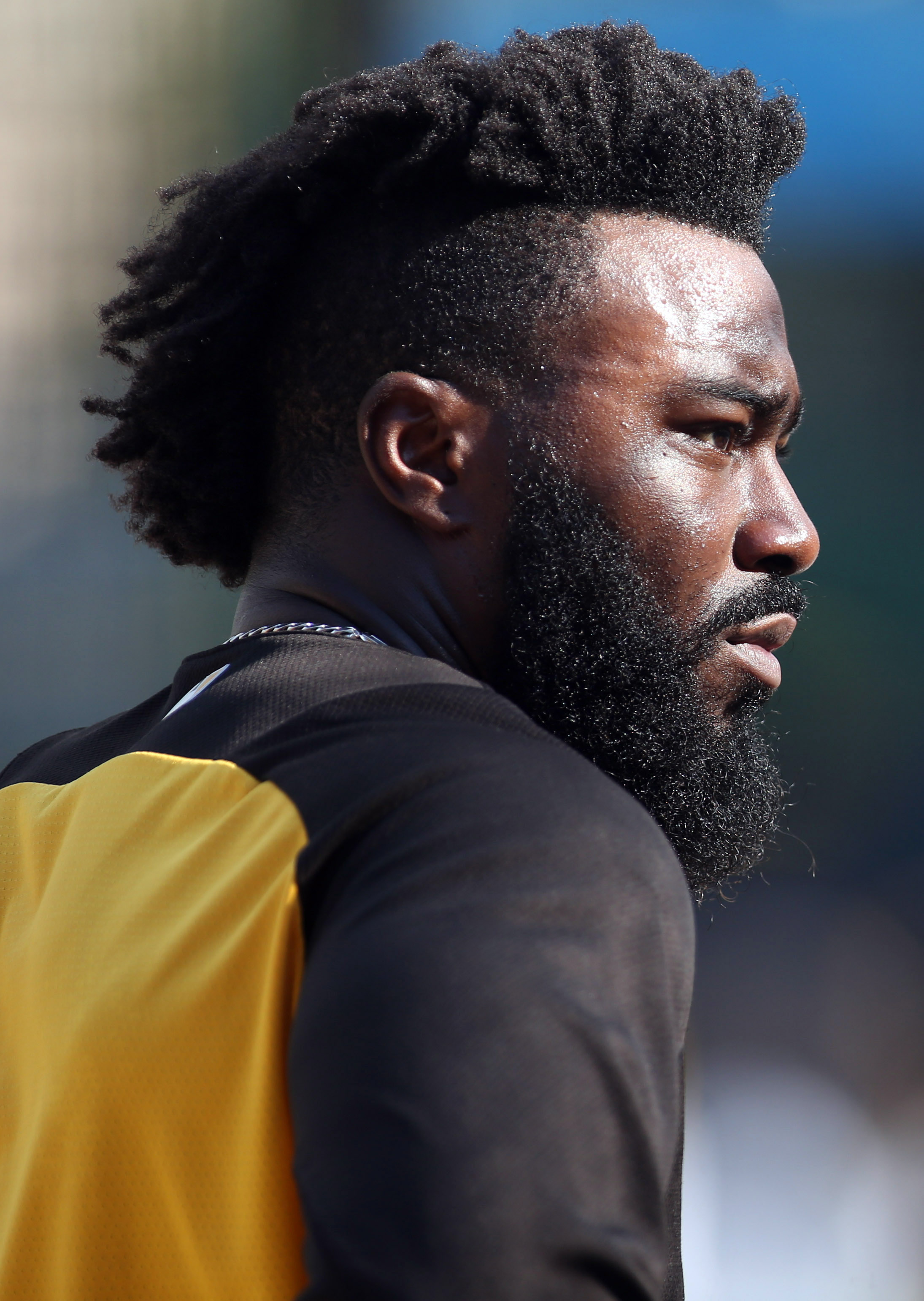
Harrison, 31, is a versatile defender and quality baserunner whose bat has seen its ups and downs in recent years. Defensive metrics have favorably reviewed his work at both second base and third base, and he also has ample experience in the outfield corners. He hit the open market when the Pirates declined a $10.5MM option at the end of the 2018 season in which he managed just a .250/.293/.363 batting line in 374 plate appearances.
While he has had one big season at the plate, back in 2014, Harrison hasn’t come close to replicating it. Since, he has alternated between league-average and lesser seasons, with a cumulative .274/.319/.396 slash line in the four subsequent seasons. That sort of slightly below-average offensive output seems a reasonable expectation moving forward. Statcast hasn’t seen cause to expect better results in Harrison’s batted-ball profile; last year, for instance, he was graded at a meager .275 xwOBA that lagged his .285 wOBA.
Harrison will follow former Pittsburgh teammate and double-play partner Jordy Mercer to Detroit. They’ll bring plenty of experience and familiarity with one another to the Tigers’ middle infield mix. That doesn’t leave a ton of room for young players to emerge, but there really aren’t any who seem ready to force their way up at those positions, as the bulk of the high-end talent acquired in the Detroit rebuild to this point has been of the pitching variety.
The short-term nature of the contract makes it likely that Harrison will emerge as a trade chip alongside Mercer, Nicholas Castellanos and other appealing short-term Tigers assets this summer as Detroit continues stockpiling youthful pieces with an eye toward a return to contention in the American League Central.
White Sox, Ervin Santana Agree To Minor League Deal
Feb 23: The deal is official and Santana is present in the Sox clubhouse today, per the Athletic’s James Fegan (via Twitter).
Feb 22, 1:15pm: Santana’s contract comes with a $4.3MM base salary if he makes the roster, Heyman tweets. That’s an abnormally large base salary for a minor league pact and likely speaks to the interest that Santana had elsewhere. In essence, the White Sox gave Santana the opportunity to be guaranteed a rate that many would’ve expected him to command on a big league deal, but did so while delaying the need to make an immediate 40-man move.
10:52am: The White Sox and free-agent right-hander Ervin Santana have agreed to a minor league contract, Jon Heyman of the MLB Network reports (via Twitter). The contract is pending a physical. Santana will head to Major League camp and compete for a spot in a thin rotation mix.
Santana, 36, has been a longtime divisional foe for the ChiSox, having spent the past four seasons leading the Twins’ rotation. The final season of his four-year, $55MM pact with Minnesota was almost entirely wiped out by surgery to repair a tendon in his right hand, however. That injury limited him to five starts and just 24 2/3 innings and led the Twins to decline a $14MM option over the righty.
Prior to the 2018 season, however, Santana was both a durable and high-quality workhorse. From 2016-17, Santana ranked 11th in the game in total innings pitched and also ranked 11th among qualified starters with a 3.32 ERA. In all, while his four-year deal with the Twins was marred by last year’s injury and a PED suspension in 2015, he worked to a 3.68 ERA with 7.1 K/9 against 2.1 BB/9 in 525 1/3 innings with Minnesota. When he was healthy and on the field, Santana was generally a quality option on the mound, making him a logical pick for the Sox — especially at this price point.
So long as he is healthy, it seems quite likely that Santana will break camp in Chicago’s rotation. Currently, the Sox are looking at Carlos Rodon, Ivan Nova, Reynaldo Lopez and Lucas Giolito as the top four in their rotation. Santana will compete with Manny Banuelos and Dylan Covey, among others, in trying to secure that final starting job. Given that slate of rotation options, it’d rank as a surprise if a healthy Santana didn’t secure a place on the roster this spring.
Santana becomes the latest but perhaps most surprising veteran player to settle for a non-guaranteed pact in a second consecutive winter that has been unkind to veterans in their 30s. While last season was obviously a nightmare for Santana, he’d averaged 182 innings of 3.52 ERA ball from 2013-17 with the Royals, Braves and Twins.
Cardinals Extend Jose Martinez Through 2020
Jose Martinez signed a two-year deal that will keep him in St. Louis through the 2020 season, the team announced (via Twitter). The team will pay the Octagon client $3.25MM guaranteed, plus incentives, per Fancred’s Jon Heyman (via Twitter).
Martinez, a late-bloomer, played his first full season in the big leagues in 2017 at the age of 28, so this deal, interestingly, protects Martinez against a possible non-tender next season, his first of arbitration eligibility. Martinez gets a little extra security, and the Cardinals send a message to the rest of the league that they’re not going to be giving up Martinez for free. The deal does not alter the Cardinals length of control over Martinez, who will be eligible for arbitration again in 2021 and 2022. Derrick Goold of the St. Louis Post-Dispatch adds further context to the deal (via Twitter), as Martinez had opportunities to make more money in Japan. The deal forestalls conversations of a transfer by rewarding Martinez’s strong 2018 with some early financial security.
Since the Cardinals acquired Paul Goldschmidt from the Diamondbacks, trade winds have howled around Martinez, who has long been pegged as a future DH. Martinez figures to get a few starts at first and a few at designated hitter when interleague play allows, but his playing time will be cut a year after the big right-hander received 84 starts at first base and established himself as a regular in the St. Louis lineup. Goldschmidt, of course, is a free agent at season’s end, so keeping Martinez under lock and key provides the Cardinals future security as well.
Though not a strong defender, Martinez does provide some versatility – he started 46 games in right field in 2018 and figures to have a chance at more regular playing time this year if he can outmuscle the competition. Tyler O’Neill, 23, will take his best shot after a promising 130 at-bats in 2019, as will veteran Dexter Fowler, who figures to have first dibs if he can rebound from a tough 2018.
Still, the Cardinals clearly value Martinez for his bat, even if his primary role this season will be as a pinch-hitter. After hitting .305/.365/.457 last season, the challenge this season comes in finding at-bats. Considering Martinez was already under team control, there’s little risk involved here for St. Louis, though it does perhaps change the expectations of trade partners looking to snag Martinez on the cheap.
MLB Announces Implementation Of Pitch Clock For Spring Training Games
Major League Baseball has formally announced the implementation of a 20-second pitch clock to be tested during Spring Training games. Jeff Passan of ESPN reported minutes prior to the announcement that it’d be made today. Per the league’s announcement, there has been no decision made regarding the potential implementation of the pitch clock during the upcoming regular season, though Passan tweeted that there is a “very real possibility” of that happening.
Early in Spring Training, as players adjust to the latest pace-of-play tactic put in place by commissioner Rob Manfred, there will not be any ball or strike penalties for pitch-clock violations. By the second week of games, umpires will begin to issue warnings, and eventually, umps “will be instructed to begin assessing ball-strike penalties for violations.”
Notably, the pitch clock comes with numerous restrictions. It does not apply to the first pitch of a plate appearance, and the pitcher need only start his motion before the clock expires rather than deliver the actual pitch. Hitters will be required to be in the batter’s box by the time there are five seconds remaining on the clock, and the clock will reset when the pitcher receives the ball back from the catcher.
On pickoff plays, the clock will reset when the pitcher once again receives the ball from the infielder to whom he threw. The clock will also reset if pitchers feint a pickoff motion or step off the rubber with a runner on base. Mound visits will also cause the clock to reset. If an umpire calls or grants time, the pitch clock will not be used on the following pitch (unless time was called to swap out a ball thrown in the dirt).
Manfred has the ability to unilaterally implement the pitch clock for the 2019 regular season even if he does not come to an agreement on its implementation with the players’ union. However, Passan notes — as does today’s release announcing the clock — that the league will continue to negotiate with the players in search of an agreement on the matter.
Whether the clock is implemented in 2019 or not, today’s announcement serves as a harbinger for change in 2020 and beyond. Manfred has made improving the pace-of-play one of the focal points of his tenure as the league’s commissioner and has regularly put initiatives into place — most recently limiting the number of mound visits allowed per game and instituting automatic intentional walks. The pitch clock would be a more dramatic measure — one with far greater potential to impact the outcome of games — than other recent changes, however.
That said, while it’d be a change requiring adjustment for many established big leaguers, a pitch clock has been in place in the minor leagues dating back to the 2015 season. Because of that, it’d be a familiar regulation to the next wave of prospects who make their way to the big leagues. In theory, the pitch clock should be largely unnoticed once the league grows accustomed to its existence — be it this coming season or in the future — though there’ll surely be some early growing pains with the new system. And, of course, the move will likely be unpopular among most longstanding baseball fans; while part of Manfred’s aim in accelerating the pace of play is to grow the general appeal of baseball, there is of course a sizable (and oft-vocal) portion of the existing fanbase that does not want to see any such changes put into place.
Lerner: No Recent Contact With Bryce Harper, Scott Boras
The Nationals have continued to be mentioned on the periphery of the Bryce Harper bidding, but in a Friday-morning interview with NBC Sports Washington, managing principal owner Mark Lerner again suggested that Harper will not be returning to Washington. Lerner originally stated back in early December that he was not expecting to re-sign Harper.
“Nothing’s really changed on our end,” said Lerner. “We’ve moved on, as I said [in December]. We had to. There was no way we could wait around. Bryce, I’m sure, will make his decision hopefully in the next few days. But we’ve filled out our roster, and we wish him nothing but the best. But, there’s always that — the door is cracked a little bit.”
The “moved on” portion of Lerner’s statement will assuredly generate headlines throughout the day, but it should be noted that his comment loses some teeth given the immediate followup about the door remaining “cracked a little bit.” Lerner adds that the Nats haven’t even heard from Harper and agent Scott Boras in quite some time and that he has “no clue at this point what they’re up to,” which is perhaps even more telling than his somewhat muddied declaration of “moving on.”
At this point, the Harper market is murky beyond the Phillies and the Giants, the latter of whom has reportedly only been interested on a shorter-term deal than Harper has been seeking this winter. MLB Network’s Jon Heyman reported last night that Padres ownership was holding a meeting today to determine if there was a feasible scenario in which the team could pursue Harper even after signing Manny Machado to a 10-year, $300MM contract, although that was characterized as a long shot and would seem more a matter of due diligence than anything else at this point. Multiple reports out of Chicago have indicated that the White Sox will not be placing a bid on Harper after losing out on Machado.
Padres Sign Manny Machado
Feb. 21: The Padres have formally announced the signing and confirmed the terms of the contract (10 years, $300MM). To clear room on the 40-man roster, right-hander Dinelson Lamet was transferred to the 60-day injured list.
Per Heyman, the deal will pay Machado $30MM annually and contain a six-team no-trade clause (Twitter links). Technically, the first season of the deal is paid out in the form of a $10MM salary and a $20MM signing bonus — that latter of which is not subject to the same level of taxation as Machado’s actual salary. Machado will play third base in San Diego.
Feb. 19, 10:20pm: Machado’s deal doesn’t contain any deferred money, USA Today’s Bob Nightengale tweets.
6:23pm: Machado’s deal will contain limited no-trade protection, Passan tweets. The contract should be formally announced Thursday or Friday, he adds.
12:58pm: There are some key elements of the deal still to be worked out, per Jon Heyman of MLB Network (Twitter link). Notably, the sides have yet to hammer out terms on trade protection. That said, it seems the final pieces are not expected to pose an obstacle to the contract’s completion. Machado will receive the $300MM on a fairly evenly spread basis, with the opt-out chance midway through the deal.
11:27am: The Padres have agreed to terms on a free agent contract with star infielder Manny Machado, according to ESPN.com’s Jeff Passan (via Twitter). It’s a ten-year, $300MM deal for the MVP Sports Group client, according to MLB.com’s Mark Feinsand (Twitter link). The contract includes an opt-out after the fifth season, per Tim Brown of Yahoo Sports (Twitter link).
Nothing is formally concluded here, it bears noting. If nothing else, it seems a physical will still need to be completed. Padres chairman Ron Fowler says a deal is not complete, per Dennis Lin of The Athletic (via Twitter), saying the sides are “continuing discussions.” Of course, that hardly means there isn’t an agreement in principle on the key terms.
Certainly, the White Sox believe they’ve lost their primary winter target. VP Kenny Williams expressed shock in comments to reporters. “We could not go to that $300MM level,” he said (via Daryl Van Schouwen of the Chicago Sun-Times, Twitter links). Williams indicated that he had believed the South Siders were the high bidders, and he maintains “there was more potential for him to make more here than that reported deal.” It seems, though, that Machado preferred the greater guaranteed money and other elements of his new deal to the structure proposed by a White Sox organization that had rolled out quite a welcome mat, including the acquisition of Machado’s comrades Yonder Alonso and Jon Jay.
It’s a stunning result for the 26-year-old Machado, whose long-running open-market saga has coincided with that of fellow star Bryce Harper. It took some time, but Machado will still spend the bulk of Spring Training with his new teammates.
Last year, the Friars shocked the baseball world by outbidding the market for first baseman Eric Hosmer. Now, they’ve followed up that move with a much bigger commitment to an even better and younger player.
The move plainly sets the Padres organization on a course to compete in the near-term, though the investment will hopefully coincide with a rather lengthy competitive window. It’s reasonable to wonder, though, whether this move sets the stage for further action this winter. The Padres have a fairly crowded outfield group, a ton of top prospect talent, and clear room to improve the MLB pitching staff. They could consider pursuing the top remaining open-market pitchers (Craig Kimbrel, Dallas Keuchel, Gio Gonzalez) while revisiting trade talks on other starters.
[RELATED: MLBTR Free Agent Tracker]
It’s not hard to see how this signing could have a ripple effect in the market, with the potential for a highly intriguing late-spring reignition of the hot stove. If nothing else, there’s now a clear mark for Harper to try to top, with several teams potentially interested in landing him after missing on Machado.
The 10/300 price is precisely where many anticipated Machado landing at the outset of the market. It sets a free agent record in terms of total guarantee, at least before adjusting for inflation, though falls shy of Giancarlo Stanton‘s extension and may soon be topped by Harper’s own deal.
Despite his excellence to this point of his career, and the promise of many more productive seasons to come, Machado entered the market with some questions. He raised eyebrows with some questionable acts and words during the postseason, leaving many fans — and perhaps some organizational leaders — with the sense that, as he himself put it, he’s “not the type of player that’s going to be ‘Johnny Hustle.'”
Clearly, those oft-cited comments didn’t cost Machado a chance at a massive contract. He also picked up support of several former teammates and coaches, so it’s not as if there weren’t countervailing facts. Clearly, though, the ill-advised words didn’t help his cause. We’ll never know the full extent of the impact, but reduced interest from even a single potential suitor could have changed the way the market took shape. The Yankees never fully engaged despite making sense on paper, while it seems the Phillies passed on a chance to outbid the more budget-conscious Padres, though those and other organizations were surely weighing other factors as well.
In truth, the hustle chatter held such attention in no small part due to Machado’s otherwise mostly impeccable resume. He has topped 6 fWAR in three of the past four seasons, owing to a combination of outstanding glovework and well-rounded offensive production. Despite some knee issues earlier in his career, Machado has played all 162 games in two seasons (2015, 2018) and missed just 11 total contests in the two intervening campaigns.
Over his seven seasons in the majors, Machado carries a .282/.335/.487 batting line with 175 home runs. That perhaps understates his present ability with the bat, though, as Machado has posted 130+ wRC+ campaigns in three of the past four years and has hit between 33 and 37 long balls in all four seasons. He has also successfully honed his plate discipline over the years, setting career-best marks in 2018 with a 9.9% walk rate and 14.7% strikeout rate.
It’s a more interesting question on the defensive side of things. Machado had long graded as an outstanding defender at third base, but drew negative reviews upon shifting back to his native shortstop in 2018. Of course, the numbers reversed somewhat after he landed with the Dodgers in a mid-season trade, perhaps indicating that he still has the potential to handle short at an average or better clip if surrounded by the appropriate analytical resources and adjacent defenders.
Regardless, the plan seems to be for Machado to slide back to the hot corner in San Diego. The club has been searching for a piece there all winter long. Indications are that Luis Urias (with an assist from Greg Garcia) will keep the seat warm at shortstop while uber prospect Fernando Tatis Jr. finishes his development. Urias could ultimately slide back to second, though that position is occupied for the time being by veteran Ian Kinsler. Of course, as noted above, it still seems premature to guess at the overall roster picture, as the Padres could explore a nearly endless variety of complementary moves.
Photo courtesy of USA Today Sports Images.
Latest Bryce Harper Rumors
If you’ve been away from the internet for the last 24 hours, you’ll want to catch up on the major free agent news that broke yesterday. If not, you can safely skip ahead to focusing on what’s next: the final stretch of bidding for Bryce Harper. Here’s the latest:
- The Phillies‘ “total focus” right now is on Harper, Heyman tweets. Another free agent, such as Dallas Keuchel and/or Craig Kimbrel could become a target once Harper signs (be it in Philadelphia or elsewhere), but at the moment, the organization’s efforts are zeroed in on landing Harper.
- Todd Zolecki, Mark Feinsand and Jamal Collier of MLB.com write that the Phillies are wary of bidding against themselves and overpaying for Harper. Notably, the MLB.com trio cite multiple sources in reporting that the Nationals “have no plans to give Harper a mega-deal comparable to Machado’s 10-year, $300 million contract.” If that’s the case, then it’s not clear exactly who’d pose a threat to the Phillies at present, as the Giants’ interest in Harper has repeatedly been reported to be on a shorter term deal with a significant annual value. The report also cites two sources indicating that approximately $100MM of the Nationals’ initial 10-year, $300MM offer to Harper (issued back in September) would have been deferred. Certainly, ownership could still decide to step up and retain the face of the franchise, but the fact that the initial offer was well shy of $300MM in actual, present-day value because of those deferrals doesn’t bode well for the Nats now deciding to top $300MM. Machado’s deal reportedly contains no deferrals.
- Giants president of baseball ops Farhan Zaidi didn’t speak with an increased urgency after the Padres landed Machado, as Henry Schulman of the San Francisco Chronicle writes. Specifically, Zaidi stated that he doesn’t think the Machado agreement “really changes how we’re viewing our team and what we might still do with it,” going on to emphasize the importance of making the “right decision” rather than acting “in a reactionary way.”
Indians To Sign Tyler Clippard
The Indians have a deal in place with righty reliever Tyler Clippard, per Jon Heyman of MLB Network (Twitter link). It’s a minor-league pact that would pay him $1.75MM in the majors with up to $1MM in incentives.
Clippard worked plenty of useful frames last year for the Blue Jays, compiling a 3.67 ERA in 68 2/3 innings. That’s well shy of his prime levels, when he was a late-inning stalwart for the Nationals, but still represents a productive campaign.
Interestingly, Clippard has become an even more extreme pitcher than he was in his heyday. The 34-year-old worked at a healthy 14.3% swinging-strike rate and carried 11.1 K/9 against 3.0 BB/9. He also carried a 19.2% groundball rate last year, the lowest rate in all of baseball. Clippard still knows how to get hitters to chase and whiff on his change-up. The question remains what happens with his high heaters.
In each of the past three seasons, more than 12 percent of the balls put in the air against Clippard have ended up leaving the yard, breaking a string of six-straight years with a HR/FB rate of less than ten percent. As a result, Clippard has surrendered 33 dingers over his past 192 innings — a boost in long ball frequency that maps to a reduction in his average four-seam velocity.
On the other hand, Clippard did still bounce back to a well-above-average 16.3% infield fly rate, allowing him to rack up easy outs. When he keeps the ball in the yard, Clippard remains awfully tough to touch. In fact, he allowed earned runs in only five contests last year in which he did not also surrender a home run.
All things considered, it seems like an easy risk for the Indians to take. Clippard wasn’t well-loved by FIP (4.24) and xFIP (4.28) last year, or in the prior few campaigns, but checked in with an appealing 3.42 SIERA number in 2018. He also fared well in the eyes of Statcast, which credited him with a .278 xwOBA (compared with a .309 wOBA). Clippard is also the game’s most durable reliever, easily topping the league in total innings over the past decade.