
Transaction Retrospection: A Washington-Oakland Blockbuster
It has been almost three full years since the Nationals and Athletics swung a noteworthy trade that has already made a big impact and could continue to have a sizable effect in the coming seasons. Leading up to the July 2017 trade deadline, the Nationals acquired relievers Sean Doolittle and Ryan Madson in exchange for fellow reliever Blake Treinen and a pair of prospects in left-hander Jesus Luzardo and third baseman Sheldon Neuse.
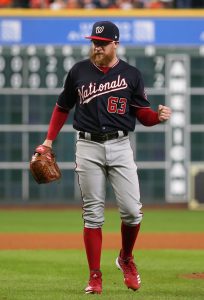
It was a bold strike for the Nationals, then way ahead of their competition in the NL East but aiming to patch up a poor bullpen. Doolittle and Madson did indeed continue to put up stellar numbers after the trade, helping the Nationals to a division title. The Nats then bowed out of the playoffs in the NLDS with a five-game defeat at the hands of the Cubs, though Doolittle and Madson were effective in that series.
Unfortunately for Washington, the 2017 campaign was the last good one of Madson’s career. He pitched to a 5.28 ERA over 44 1/3 innings in their uniform in 2018 – a non-playoff effort for the team. With the Nationals mired in mediocrity in late August of that year, they traded him to the Dodgers for righty Andrew Istler. Madson’s struggles continued in LA, and he hasn’t pitched since.
Doolittle, on the other hand, remains a valuable member of Washington’s roster. The southpaw has logged a stingy 2.87 ERA with 10.47 K/9, 1.93 BB/9 and 75 saves in 83 chances across 135 innings in a Nationals uniform. The 33-year-old’s regular-season output in 2019 was somewhat underwhelming, but he made up for it by serving as an instrumental piece in helping the franchise to its first-ever World Series title in the fall. Doolittle combined for 10 1/3 frames of two-run ball in series wins over the Dodgers, Cardinals and Astros. He’ll be a National for at least one more season (if there is one), as they picked up his $6.5MM club option after last year.
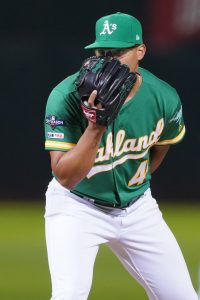
Flags fly forever, so in light of Doolittle’s contributions, the Nationals would probably make this trade again. The same goes for the Athletics. Sure, Madson and Doolittle impressed when they were part of the club, but the A’s have benefited quite a bit from selling high on those two. The A’s weren’t in contention when the trade went down, and nor did they make the playoffs that year, but Treinen helped key a postseason return in 2018 with one of the greatest campaigns a reliever has ever put forth. He recorded a ridiculous 0.78 ERA with 38 saves, thereby aiding in a 97-win season for the A’s. They posted the same record en route to another postseason berth last year, though Treinen’s production fell off a cliff, and he lost his job as their closer as a result. He’s now a member of the Dodgers after the A’s non-tendered him over the winter.
While Treinen’s success in Oakland was fleeting, the team could profit from Luzardo’s presence for a long time. Nineteen years old when the trade occurred, Luzardo entered 2017 as Baseball America’s 15th-best Nationals prospect. He’s now one of the premier prospects in all of baseball (BA ranks him ninth) and someone with front-of-the-rotation upside. For Luzardo to realize that potential, though, he’ll have to stay healthy.
Luzardo’s a former Tommy John surgery patient who missed most of last season with rotator cuff and lat troubles, but the results were scintillating when he was able to pitch. He made his major league debut late in the year out of the A’s bullpen and proceeded to fire 12 innings of two-run ball with 16 strikeouts, three walks and just five hits given up. The A’s will obviously hope for that dominance to carry over when he joins their rotation.
Neuse, 25, is not an elite farmhand, but there’s still hope for him to amount to something in the bigs. He had difficulty over his first 61 MLB plate appearances last year, though he was terrific in Triple-A ball, where he batted .317/.389/.550 (126 wRC+) with 27 home runs in 560 PA. MLB.com is bullish on Neuse, rating him sixth in the A’s system and writing that he “could be a big league regular in another organization, but for now looks like a very solid super-utility type whose bat will force its way into the lineup more often than not.”
Assessing this trade now, it looks like a win-win. The Nationals would love to have Luzardo vying for a spot in their already stacked rotation, and they probably wouldn’t mind having Neuse around to push for playing time. But you can’t take away the championship Doolittle helped them win. On the other side, the A’s received an unforgettable season from Treinen and could have one or two long-term contributors in Luzardo and Neuse.
Photos courtesy of USA Today Sports Images.
Latest News & Notes On MLB & Coronavirus
There’s renewed hope in the struggle of Athletics minor-league coach Webster Garrison against COVID-19, as Susan Slusser of the San Francisco Chronicle relays via Twitter. Garrison required the support of a ventilator for over three weeks before finally being extubated today. You can read more on his story from the outset of his hospitalization here. While Garrison obviously still faces a tough road to a full recovery, it’s much-welcomed good news. MLBTR extends its best wishes to his family, friends, and colleagues.
More notes on the coronavirus crisis relating to the baseball world …
- The state of Arizona is at least open to considering hosting the 2020 MLB season, as Nick Piecoro of the Arizona Republic reports. Whether that’ll prove feasible or desirable from the league and union perspective remains to be seen, but state willingness would certainly be one of many preconditions to making out a workable plan. Governor Doug Ducey says that Arizona is “very open-minded to hosting whatever Major League Baseball would like from the state,” though only at such time as it is “appropriate for public health if Arizona were in a position to reopen.”
- Maury Brown of Forbes examines the difficulties that Major League Baseball faces — and some of the possible financial solutions it could pursue. In particular, Brown posits that lost revenues — the full scope of which aren’t yet known but which are sure to be massive — could spur MLB commissioner Rob Manfred to press forward with long-pondered plans for expansion. That could also dovetail with the minor-league realignment efforts the league had already launched. Kevin Reichard of Ballpark Digest wrote recently about the fact that new MLB clubs would need additional minor-league clubs. As Brown explains it, MLB could clean house on certain existing affiliates and then “quickly whip around and expand into markets where state-of-the-art ballpark facilities could be built,” while also collecting “some form of expansion fees.”
Rebound Candidate: Khris Davis
Since joining the Athletics in 2016, Khris Davis has been a steady offensive force in the Oakland lineup, consistently finding his name near the top of yearly home run leaderboards. He hit more at least 42 homers in every year from 2016-2018 and played in at least 150 games each year. He even garnered MVP votes in 2017 and 2018, finishing eighth in the latter year when he slugged a league-leading 48 round-trippers. In April of last year, his reliability earned him a handsome two-year, $33.5MM extension that will keep him in an A’s uniform through at least 2021.
After that, however, things went south for Davis. All told, 2019 wound up being his worst year as a Major Leaguer, with his OPS dropping to just .679 and his wRC+ (81) dipping below league-average 100 for the first time in his career. And given that he doesn’t offer anything defensively, Davis’s value as a player is more sensitive to the fluctuations of his bat, and any slump becomes more pronounced. His value was always going to be limited to the offensive side—the A’s knew that when they signed him, but they couldn’t have foreseen such a sudden and steep fall from grace. But what was the root of his 2019 shortcomings, and what are the chances that Davis can right the ship in 2020 (whenever baseball does return) and be the slugger we’ve come to expect?
Beneath the surface, the striking difference between the 2019 version of Khris Davis and his previous years is that his exit velocity numbers slipped from elite to merely good. From 2016-2018, Davis’s first three years in Oakland, his average exit velocity ranked in the 94th percentile or better every year; in 2019, his 90.1 mph average placed him in only the top 30% of players. That’s still solid, no doubt, but for a player whose game is predicated almost entirely on power, that decline is considerably more significant. Davis has never been a batting average or OBP guy, so every tick off the exit velocity metric is important.
This worked against Davis in combination with a lessened ability to elevate the ball: along with the exit velocity numbers, Davis’s average launch angle on batted balls lowered from 18.1 to 13.2 degrees. Consequently, Davis saw his fly ball rate drop from 48.8% in 2018 to 37.4% last year, his lowest mark since 2013 when he was a Brewer. And of course, sacrificing fly balls comes with a corresponding jump in line drives and ground balls, which are markedly less valuable to a slugger like Davis—especially when he isn’t hitting the ball with as much authority as in years past.
Even when he did hit the ball in the air, he wasn’t doing as much damage as we’re used to seeing (which is even more unusual in 2019, given the league-wide power surge fueled by a jumpy baseball). And most of the drop-off came in a particular category: fly balls to the opposite field. Davis is a prolific opposite-field hitter, and it’s one of the traits that makes his power stand out; he hit 16 oppo homers in 2018 alone, more than anybody this side of J.D. Martinez. Last year, though, his wOBA on opposite-field fly balls was just .264, down from the astronomical .489 he posted the year prior. In essence, Khrush’s oppo power—a staple of his power game—became a non-factor, and anything in the air needed to be pulled.
As for his approach on a more micro scale, he swung the bat more than ever last year, especially at pitches in the zone: his 82.2% swing rate on pitches in the strike zone was the highest of his career, and his overall swing rate the second-highest. But Davis has lived in that neighborhood for his entire Athletics tenure, and it hasn’t stopped him from hitting in the past. Anyway, attacking hittable pitches is a good thing, and he doesn’t get exploited by going after too many bad pitches; his chase rate is just about league average. Moreover, that change hasn’t had any effect on his ability to make contact, and it hasn’t produced a precipitous change to either his walk or strikeout rate, which both sat right about where they were the year before.
So, what’s to blame for the sharp decline in production? It seems unlikely that a player in his early 30s, who just a year earlier mashed 48 home runs, could be sapped of his strength so suddenly. Career designated hitters like Nelson Cruz and Edwin Encarnación have maintained their pop into their late-30s; why should Davis be any different? It’d be more appropriate to chalk Davis’s struggles up to injuries: he was able to play in just 133 games for the A’s—the fewest in his Oakland tenure—and likely dealt with nagging consequences of oblique and hand injuries, both of which are notoriously troublesome for hitters. And it makes sense that with lingering hand problems, opposite field power would be one of the first things to go.
The oblique injury occurred in early May, while the hand issue dates to a HBP in late June. Sure enough, Davis’s three worst months in terms of OPS were July, August, and September. And trying to play through those injuries probably didn’t help things any. But with a full offseason (and more) to heal up the oblique and hand, the hope is that the Athletics will be able to count on a fully-healthy Davis to anchor the middle of their lineup for another postseason bid. The bet here is that Davis will be able to re-establish the consistent production he maintained for his first three years in Oakland.
The 2019 A’s were still able to succeed without much of the production they relied upon from Davis in 2018, thanks in part to the continued offensive maturation of Matt Chapman, Matt Olson, and Marcus Semien, as well as unexpected contributions from a host of low-profile hitters like Mark Canha. Their stout bullpen and patchwork rotation of misfits managed to prevent runs like the American League powerhouses, and with young guns A.J. Puk and Jesús Luzardo on hand and here to stay, they expect more of the same in 2020. Davis could be the missing ingredient to that equation, and another year of elite power output might make the difference between a third consecutive Wild Card exit and a deeper playoff run.
A.J. Puk Making Progress In Recovery From Shoulder Injury
Athletics lefty A.J. Puk was slowed by some shoulder trouble in early March, creating some unwelcome uncertainty for a player that just returned late last year from a major injury. Fortunately, Puk has been throwing throughout the COVID-19 shutdown and has progressed to long-tossing from 120 feet, he said in an appearance on Susan Slusser’s A’s Plus podcast (audio link).
Medical review had seemingly ruled out the most troubling potential scenarios. But Puk’s outlook was still a bit unclear when last we checked in. It seems he’s now firmly on the upswing/
“It’s probably the best my shoulder’s felt in awhile actually,” said Puk. “Coming back from Tommy John, a lot of people always seem to talk about how your shoulder kind of flares up and you’ve just got to work through it. I think I was at that stage.”
Puk, the former No. 6 overall pick, added that he has access to mounds from which to throw at nearby facilities. He and fellow top prospect Jesus Luzardo chatted with Slusser about the state of their workouts amid the current stoppage, detailed the ways they’ve kept busy and shared their thoughts on a potentially shortened season or playing in front of empty parks.
Prospect Faceoff: Gore v. Luzardo
It’s easy to dream on top prospects. Such players have not only exhibited great play and immense talent, but have been hyped up yet further by those who judge young players for a living. We tend to see the “top-of-the-rotation” (!!!) and ignore the “potential” … with its implicit acknowledgement of a downside scenario.
This is nothing new to MLBTR readers. All fans have tales of prospect heartbreak — the would-be great ones that weren’t. It’s usually not too tough to diagnose where things went wrong after the fact … but how about predicting in advance? Here’s your chance.
Today, we’ll take a brief look at two of the top pitching prospects in baseball — southpaws Jesus Luzardo (Athletics) and MacKenzie Gore (Padres) — and give you a chance to prognosticate.
We should note at the outset that prospect watchers have a clear preference for Gore. But it’s awfully close. Fangraphs ranks Gore third and Luzardo sixth among all prospects. MLB.com has them five and twelve. Baseball Prospectus: five and nine. Baseball America: six and nine.
Then again … Luzardo is the one that has already reached the majors. It was only a brief showing, but he sure did impress. In a dozen innings, he racked up 16 strikeouts while allowing just two earned runs on five hits and three walks. Luzardo generated an excellent 14.6% swinging-strike rate. He pumped 97 mph heat and showed a balanced, four-pitch arsenal. And he did all this at just 21 years of age (he turned 22 at the end of September) in the same season in which he worked back from a shoulder and lat injuries.
There doesn’t seem to be much of a ceiling on Luzardo. You might worry about the health risks, but the A’s were also surely exercising ample caution. Luzardo had already extended to over 100 frames in 2018. And he seems to have come through just fine. He was absurdly dominant in Cactus League action this spring. Luzardo carried a roughly 50 percent groundball rate in his minor-league career, so that’s another strength.
Whereas Luzardo was a third-round pick in 2016, Gore was the third overall choice in the ensuing draft. Does that added pedigree explain the fact that he’s seen as the better prospect? On the health front, Gore has had some blister problems, though like Luzardo he also passed the century mark in innings pitched in his second full professional season.
In terms of track record … well, Gore just hasn’t gone as far quite yet. That’s no surprise: he’s a year younger and a season behind. Gore annihilated High-A hitters last year, working to a ridiculous 1.02 ERA in 15 starts. But he did run into at least some headwind after a promotion to Double-A. Through 21 2/3 innings over five outings, Gore surrendered 4.15 earned runs per nine innings on twenty hits (three of which left the yard) with a 25:8 K/BB ratio.
Prospect watchers are looking at quite a bit more than short-sample results. And they see a future ace in Gore. Though he’s still fine-tuning some of his offerings and doesn’t throw quite as hard as Luzardo, Gore carries a highly promising four-pitch mix and is said to possess exceptional athleticism and command. If he can finish honing those offerings and figure out just how to use them, he could carve up MLB hitters for years to come.
This isn’t exactly the next Trout v. Harper debate. But it’s interesting to look at these two lefties. Luzardo arguably has a smidge more certainty having already shown his stuff at the game’s highest level. Evaluators credit Gore with a bit loftier ceiling, but he has a bit more finishing work left to do.
Which do you think will have the better career? (Poll link for app users.)
Who's the better prospect?
-
MacKenzie Gore 53% (2,421)
-
Jesus Luzardo 47% (2,133)
Total votes: 4,554
How The Delayed Season Impacts The Athletics
Every Major League Baseball team is facing some sort of impact from the coronavirus, which has delayed the start of the regular season and could wipe it out completely. Before the 2020 campaign begins (if it does), MLBTR will break down the ways that the pushed back campaign could affect each big league club. We’ve already handled the Yankees, Phillies and Angels. Let’s stay in the Angels’ division, the American League West, and turn our attention to the Athletics.
Last season was the second straight 97-win, playoff-bound effort for the Athletics. Their success in those years came in spite of tremendous adversity in their pitching staff, largely on account of injuries.
Left-hander A.J. Puk, one of the franchise’s prized young arms, has barely pitched since undergoing Tommy John surgery in April 2018. He sat out all of that season and the majority of last year, when he totaled the first 11 1/3 innings of his career from the A’s bullpen. The flamethrowing Puk showed well as a reliever then, but the hope remains that he’ll turn into a quality starter in the majors. Under normal circumstances, those hopes – at least for the early part of 2020 – may have taken a hit when Puk dealt with shoulder issues near the beginning of this month. Puk looked as if he’d begin the season on the injured list then, but with Opening Day a long way from happening, he seemingly now has a much better chance to crack an A’s rotation that should also feature Sean Manaea, Frankie Montas, Mike Fiers and Jesus Luzardo.
Like the 24-year-old Puk, Luzardo counts as one of the A’s high-end young southpaws. And injuries have also held back Luzardo, who sat out a significant portion of 2019 but did dominate over 12 innings from their bullpen. Luzardo, 22, has never even hit the 110-inning mark in a season (he threw 55 in 2019), so it stands to reason that he’ll benefit from a shortened season from a workload standpoint. The same applies to Puk, who amassed just 36 2/3 professional frames from 2018-19.
On the offensive side, the A’s could receive more contributions than expected from right fielder Stephen Piscotty. A little over a month ago, the 29-year-old was said to be questionable for Opening Day because of an intercostal strain. So, the longer this shutdown goes, the better his chances are of being available for a full season. Piscotty was an integral part of the A’s lineup two seasons ago, but numerous health woes held him to 93 games and limited his effectiveness a year ago. A healthy, bounce-back performance from Piscotty would be a boon for Oakland, which lacked a solid third outfield producer last season to complement Ramon Laureano and Mark Canha.
In a worst-case scenario, there won’t be any baseball this year. If that proves to be the case, it’s possible one of the A’s stars, shortstop Marcus Semien, has played his last game in their uniform. Semien went from good to great last year, a season in which he slashed .285/.369/.522 with 33 home runs and 10 stolen bases to finish fifth among position players in fWAR (7.6). That could wind up as a platform season for the soon-to-be 30-year-old Semien, who’s due to reach free agency next winter. There has been mutual interest in a long-term contract, but the league has halted extension talks for the time being. Furthermore, considering their low-budget ways, the A’s may not be in ideal position to keep Semien from testing the market and ultimately exiting.
The hope for everyone who follows baseball – especially those in Oakland – is that Semien will line up at short for the Athletics in the coming months. That would mean actually getting to watch baseball in 2020, after all, but it’s anyone’s guess whether Semien has donned an A’s uniform for the last time.
10 Players Switch Agencies
Agent Rafa Nieves’ newly-founded Republik Sports agency will represent several players formerly represented by Nieves at Wasserman. A video published earlier today on Republik’s official Twitter feed reveals the names of 11 players who will continue to be represented by Nieves at this new firm.
We already heard last night that Nationals outfielder Victor Robles (a Nieves client at Wasserman) was joining Republik, and the other ten names cited in the video include a mix of prominent veteran and up-and-coming stars. The list consists of Indians infielder Jose Ramirez, Reds right-hander Luis Castillo, Pirates outfielder Gregory Polanco, Athletics right-hander Frankie Montas, Blue Jays outfielder Teoscar Hernandez, Rockies righty Antonio Senzatela, Padres outfielder Franchy Cordero, Marlins catcher Francisco Cervelli, and White Sox relievers Alex Colome and Kelvin Herrera.
As we’ve seen in several past cases of representatives changing agencies or starting new agencies, it’s quite common for players to continue using the same agent even after that rep becomes part of another company. We saw this in 2017 with Nieves himself, as several of the aforementioned players (namely Ramirez, Robles, Herrera, Colome, Cervelli, Polanco, and Montas) all went with Nieves when the agent moved from the Beverly Hills Sports Council to Wasserman.
The 10 changes have all been updated in our Agency Database. If you see any notable errors or omissions within the database, please let us know via e-mail: mlbtrdatabase@gmail.com.
Extension Candidates: AL West
We don’t really know whether or to what extent extension talks will continue during the coronavirus hiatus. But as I wrote recently, it seems reasonable to think they’ll be explored. Some may already have advanced nearly to completion before the global pandemic intervened.
While we may have to wait to learn who the targets are and see what deals get done, there’s a silver lining: more time for rampant speculation! Okay, we’re not going to speculate here; rather, we’ll tick through some interesting possibilities on paper. Remember, we’ve seen an increasing prevalence of deals with less-experienced players (even some without any MLB service) and with new player types (early-career relievers and utilitymen).
In the present MLB environment, value is king and the old forms are fading. We’ve already checked in on the NL East, NL Central, NL West, and AL East. Here are some possible extension candidates from the AL West …
Angels
It seems the Halos have some level of interest in trying to keep peerless defensive shortstop Andrelton Simmons from reaching the open market. He’d be quite an interesting player to value after a down, injury-filled year. If he can continue producing otherworldly defensive work in 2020 while returning to league-average hitting, he’d be a fascinating player to watch in free agency.
There are a few other guys nearing free agency that could be considered. Tommy La Stella had a breakout in an injury-shortened 2019 season. He’s already 31 and there’ll be questions about sustainability. But perhaps the sides could share the risk and upside with a relatively modest accord. Reliever Hansel Robles and starter Andrew Heaney are both two years from free agency, though there’s no particular reason to rush into a commitment in either case.
Things get quite a bit more interesting when you look at players much further from the open market. Shohei Ohtani put a ton of faith in himself when he came to the majors for a pittance of a bonus. His two-way ability and near-limitless upside on the mound make him a highly intriguing extension candidate, though sorting out a fair value won’t be straightforward. There’s a clear map for a deal for elite outfield prospect Jo Adell, if both sides are interested, as the White Sox have reached successive pre-debut pacts with Eloy Jimenez ($43MM) and Luis Robert ($50MM). Beyond Ohtani and Adell, the Angels could consider much more modest pacts with utilityman David Fletcher and/or reliever Ty Buttrey.
Astros
There’s an abundance of star power to contemplate for a Houston organization in turmoil. Most pressing: outfielder George Springer, who’s entering his final year of arbitration. This is the final window to get a deal done; whether that’s a realistic possibility isn’t known. Not far behind him is shortstop Carlos Correa, who is two years from the open market. His huge ceiling and more modest recent play make this a suboptimal time to work out a deal, unless both sides are in the mood for compromise.
The ‘Stros have a pair of slugging young left-handed hitters that could conceivably be candidates for aggressive early extensions. Yordan Alvarez burst onto the scene last year, but he has had a balky knee this spring and is mostly viewed as a DH. Meanwhile, Kyle Tucker is a surefire big leaguer with star upside, but he’s rather less established. On the pitching side, the Astros could potentially chase value by holding talks with Jose Urquidy, Josh James, or even Bryan Abreu. It may be early in all of those cases, but this organization did reach a then-unprecedented deal with Jon Singleton.
Athletics
The Oakland org has a bunch of candidates that leap off of the page in just about every service class. After a monster 2019 season, shortstop Marcus Semien is slated to reach free agency at the end of 2020. It would probably take a franchise-record deal to keep him from testing the market. Perhaps there’s more room to work out a palatable price tag with reliever Liam Hendriks, who has emerged as one of the game’s most effective relievers since being designated for assignment and then called back up late in the 2018 season. Outfielder Mark Canha had his own recent breakout; perhaps he’s also a candidate with two years left until free agency.
What the A’s really hoped for was a pair of long-term pacts with corner infielders Matt Chapman and Matt Olson. But both were not wooed by prior efforts and they’re both now within a season of arbitration. There is certainly still a window, but the Oakland organization will really have to open the wallet. Striking major pacts with either or both (not to mention Semien) would mark a big vote of confidence in the team’s plans for a new ballpark.
Further down the line in terms of service class are a host of intriguing candidates. Outfielder Ramon Laureano, catcher Sean Murphy, and prized southpaws Jesus Luzardo and A.J. Puk all carry eyebrow-raising talent. They’re also already controlled for quite some time. But this may be the optimal point for the A’s to achieve big value with a few of those players.
Mariners
Having already inked lefty Marco Gonzales and pre-MLB first baseman Evan White, the M’s have already accounted for their most obvious candidates. And the best of the rest aren’t likely in consideration this winter. Mitch Haniger still needs to get back to full health; top prospects Jarred Kelenic and Julio Rodriguez are probably a bit too green for even an aggressive deal.
But there are a few more to consider. Shed Long and J.P. Crawford each had solid showings last year and could make sense at the right price. Perhaps the Mariners could even consider less-experienced outfielders Kyle Lewis and Jake Fraley, though that’d make for a surprise in either case. It’s frankly difficult even to suggest another candidate; reliever Austin Adams could’ve been of some interest but he’s rehabbing a major knee injury.
Rangers
You could make a case for a few guys here. Young slugger Willie Calhoun might be a worthwhile target after a strong 2019 showing, though it took the club some time to find him a spot in the majors and he’s now nursing a broken jaw. Veteran starters Mike Minor and Lance Lynn are nearing free agency, with the former entering his walk year, though the Texas org already took on some pitching risk this winter and may not want to over-extend itself with older hurlers.
Really, the Texas extension situation is all about one man: slugging outfielder/first baseman Joey Gallo. The game’s preeminent three-true-outcomes batter, Gallo is in his first of three arbitration-eligible campaigns, so he has entered the big earning stage of his career but hasn’t yet been paid huge money. He was limited by injury (oblique, hamate) in 2019 but put up monster numbers when available, with 22 long balls and a .253/.389/.598 slash over 297 plate appearances. It’s easy to forget that Gallo is a valuable outfield defender and baserunner, making him one of the higher-ceiling all-around players in the game.
Rookie Radar: AL West
The delayed start to the 2020 season will obviously have a wide range of massive effects on Major League Baseball. Among them: a totally different promotional timeline for some of the game’s most exciting young players. We will never know how things would’ve unfolded. And we don’t yet even know what the parameters are for an altered season. But there’s no doubting the impact.
Typically, opportunities open as rosters evolve over the course of a grueling, 162-game season. Some top prospects force their way up to the majors; others are called upon because a need arises. In a shorter campaign, there’ll be less attrition … though we may also see relaxed roster rules and changes to allocation of service time that could create opportunities.
Still, with more time to examine rosters and think about the state of the game, there’s an opportunity to stop and appreciate the young talent on the cusp of the majors. We’ll run through the most interesting prospects pressing for near-term MLB action, starting with the American League West:
Angels
There’s loads of excitement at the top of the farm. The Halos have one of the game’s very best overall prospects in Jo Adell. Perhaps their best chance of catching the Astros lies in Adell taking the league by storm and combining with Mike Trout and (a hopefully resurgent) Justin Upton to form one of the game’s best outfields. Another highly regarded young outfielder, Brandon Marsh, is also close. An elbow injury limited him this spring, but he’ll hopefully rehab through that while the game is on pause.
Otherwise, the Angels will certainly hope they get a significant contribution out of lefty Patrick Sandoval. The 23-year-old took some lumps last year but did put up a 13.5% swinging-strike rate in his first ten MLB outings.
Astros
The division’s dominant force enters the season facing a few questions in the MLB staff. Fortunately, there are a bunch of arms coming. Forrest Whitley still has immense upside despite a brutal 2019 season. He’ll be tasked with getting back on track in the upper minors. Having snuck past Whitley, Jose Urquidy will slot right back into the big league rotation. He’s not known for his high-powered arsenal, but he was highly effective late last year — even including a remarkable performance when pressed into postseason duties (one earned run, 12:2 K/BB in ten innings).
High-octane righty Bryan Abreu also got some playoff action after a strong relief showing late in the season. He could be a force in the pen. Fellow right-handers Christian Javier, Enoli Paredes, and Brandon Bielak are also on the rise.
Another well-regarded player who debuted in 2019 is third baseman Abraham Toro. He smashed minor-league pitching but didn’t thrive in a 25-game run in the majors. Toro had also struggled in Grapefruit League action this spring, but it’d be a surprise if he isn’t called upon at some point in 2020.
Athletics
There’s loads of talent ready to see action in Oakland. Lefties Jesus Luzardo and A.J. Puk recovered from injuries and hit the majors last year. They’ll draw loads of attention, and rightly so, but that’s just the start. Righties Daulton Jefferies and James Kaprielian could also push for their debuts.
There are names to watch on the position player side as well. The A’s have a bevy of youthful backstops who’ll be entrusted with holding down the catching duties. Sean Murphy put himself on everyone’s map last year. He could be joined by Austin Allen, but fellow young receiver Jonah Heim is also a factor. Infielders Sheldon Neuse will factor, though he hasn’t hit much this spring and didn’t impress in his 2019 debut. It remains to be seen how the club will handle the out-of-options Jorge Mateo with strong competition at second base. Outfielder Luis Barrera hasn’t yet debuted but earned a 40-man spot after a solid partial season at Double-A.
Mariners
On the pitching side, lefty Justus Sheffield has been on the map for some time and is in need of extended testing at the game’s highest level. Righty Justin Dunn had some struggles in his brief debut last year but is competing for a MLB job in camp. Recent first-rounder Logan Gilbert ran up to Double-A in his first professional season and now stands as a consensus top-100 prospect.
Several position players are sure to factor in the bigs as well. Recently extended first baseman Evan White is obviously slated for a big role. And the M’s may well go ahead and provide long looks to 24-year-old outfielders Jake Fraley and Kyle Lewis, each of whom cracked the bigs last year. The Seattle org will want to get a sense of their outlook. After all, there’s more talent coming up behind. It never seemed likely we’d see much-hyped outfield prospects Jarred Kelenic and Julio Rodriguez in 2020. With some or all of the minor-league season now gone, it’s even less likely.
Rangers
Most of the best-regarded Texas farmhands are still queuing up further down the system. But there are a few players vying for immediate playing time.
First and foremost, infielder/outfielder Nick Solak is almost sure to fit … well, somewhere. He has featured in the team’s planning all winter, even if the vision for where and how much he’d play has shifted as the Rangers pursued offseason additions. It’s plausible to imagine Solak appearing at first, second, third, and anywhere in the outfield as needs dictate.
Unless and until there’s an injury, the rotation doesn’t have any space. But lefty Joe Palumbo could be among the first names on call if a need arises, or he could slot into the pen. Righty DeMarcus Evans joined the 40-man after a lights-out 2019 season and seems likely to get a crack at the majors at some point.
AL West Notes: Rangers, Kiner-Falefa, A’s Camp Battles
Before spring training shut down, the Rangers’ Isiah Kiner-Falefa made his presence known while vying for the 26th roster spot. Kiner-Falefa, 25 on Monday, put up big numbers this spring after ditching a high leg kick – though his swing could use further simplification, per Evan Grant of the Dallas Morning News. Kiner-Falefa returned home to Hawaii for now, but when/if the season reboots, he’ll have a chance not only to crack the Rangers’ roster, but to play a significant role. Kiner-Falefa brings interesting upside to the Rangers’ roster because of his positional versatility. The past two seasons he has not only served as the Rangers’ backup catcher, appearing in 35 and 38 games behind the dish, respectively, but he’s also seen time at third base and in the middle infield. The bat has not been there over the course of his first two big-league seasons (.253/.315/.344, 71 wRC+), but given what they saw thus far in the spring, expectations are that Kiner-Falefa could push for additional playing time at third base where Todd Frazier is slated to sit first chair. Elsewhere out west…
- The Oakland Athletics have a few positions still up in the air after truncated spring training, per MLB.com’s Martin Gallegos. Second base remains likely in the hands of favorites Franklin Barreto and Tony Kemp. Presumably, Kemp could protect Barreto against tough right-handers while getting his feet wet in the big leagues. Kemp’s value largely comes as a clubhouse presence and versatile offensive contributor, to use the term loosely, as he has struggled at the dish with a .233/.314/.367 career line. Kemp, 28, has yet to produce a slugging percentage over .400 for a full season, and it’s hard to imagine his power playing up in the Coliseum.
- That said, Gallegos makes the argument that the more compelling battle was that of the two presumptive backups: Jorge Mateo and Vimael Machin. Mateo, 24, has more name recognition, and his speed and athleticism certainly make him worth watching. He’s out of options, and if he doesn’t make the team out of camp, Mateo is unlikely to make it through waivers given his bench-ready skillset. That’s extra incentive to keep him around, but they face the same issue with Machin, a Rule 5 pick from the Cubs. The A’s could try to work out a deal with Chicago to keep Machin, 26, in the organization. Otherwise, the roster crunch is real, as none of Mateo, Barreto, or Kemp have any options remaining. Chad Pinder is already entrenched as the primary utility option off the bench, leaving probably one spot max in the long-term for the runners-up in the battle for second base.