
Padres Sign Austin Davis, Zach Reks To Minor League Deals
The Padres recently agreed to minor league contracts with lefty reliever Austin Davis and outfielder Zach Reks, according to Matt Eddy of Baseball America. Reks returns after a stint in Korea, while Davis spent part of last season in Triple-A.
Davis, 31, has pitched in parts of five MLB seasons. The Cal-Bakersfield product got to the big leagues each year between 2018-22 and tallied 136 appearances between the Phillies, Pirates, Red Sox and Twins. Davis turned in a solid 4.15 ERA as a rookie with Philadelphia. He allowed more than five earned runs per nine in each of the following four seasons.
That includes a 5.79 mark over a career-high 56 innings two years ago. Davis spent the vast majority of that year in Boston before a late-season cameo with the Twins. He punched out a solid 24.2% of hitters but issued walks at a near-13% rate. That proved an ominous lead-up to a dreadful season in Triple-A.
Davis inked a minor league pact with the Astros. Assigned to Triple-A Sugar Land, he pitched in 20 games. Over 25 contests, he was tagged for 11.22 earned runs per nine. His control completely evaporated. Davis walked more than a quarter of batters faced and was released in June. He issued 11 more walks in 18 1/3 innings of winter ball in the Dominican Republic, although he nevertheless managed a 2.45 ERA there and impressed San Diego evaluators enough to get another non-roster look.
Reks, a left-handed hitter, logged brief MLB action with the Dodgers and Rangers between 2021-22. He signed with the KBO’s Lotte Giants midway through the ’22 campaign. Reks turned in an impressive .330/.410/.495 slash with Lotte, earning a new contract over the offseason. His follow-up KBO campaign didn’t go as well. Reks got out to a .246/.338/.345 start while battling a knee injury. Lotte released him in June.
The Padres will add him to the organization, likely sending him to Triple-A El Paso to open the season. Reks owns a .290/.388/.537 line over 902 plate appearances at the level. That’s partially a reflection of the hitter-friendly Pacific Coast League but is strong output in any case. Hitting at something approaching that level for El Paso could get him a midseason look in what currently projects as a thin San Diego outfield.
Kendrick, Hall Express Frustration With Absence Of Chase Field Renovation Deal
The Diamondbacks have been seeking a public funding agreement to upgrade Chase Field. With no deal agreed upon by the beginning of Spring Training, owner Ken Kendrick and team president Derrick Hall expressed their frustration this afternoon.
“We’re at the point where we’re just trying to figure out the best possible partnership, public-private, we can have that would keep us at Chase Field,” Hall told reporters (including Alex Weiner of Arizona Sports and Nick Piecoro of the Arizona Republic). “That’s been our preference, to stay at Chase and invest in Chase. … There’s a bit of frustration on my part because we thought we’d be at a position now where we could announce exactly what’s happening.”
Kendrick addressed speculation that the lack of progress has led the D-Backs to open conversations with cities outside Arizona. The owner acknowledged the number of municipalities that would welcome an MLB team but stated that the Diamondbacks are “not in dialogue with those communities” and that is “not where we are spending time or energy.” However, he added that the team “may run out of time in Phoenix. We hope that won’t happen. … We’re continuing to have meetings, we’ve ramped up the dialogue in every way that we know how.”
In a follow-up, Kendrick denied that comment was meant to threaten the state with relocation. “I don’t think, in the world that we live in, threats are the right way to do business. We’re community people. I’ve raised my family here; Derrick has raised his family here. We’re a part of the fabric,” he said. “Our franchise is part of the fabric of Arizona, and that’s where we want it to be for forever. … That is our hope at the moment, that we will have that and be able to announce that, and we’re still aggressively interested in making that happen.”
Chase Field opened in 1998 when the D-Backs entered the league as an expansion franchise. The team’s lease runs through the 2027 season. The organizational preference is to renovate the park as opposed to constructing a new stadium, which Kendrick categorized as too expensive.
The club’s renovation plans come with an estimated price tag between $400-500MM, the organization said. It’s unclear how much of that bill the D-Backs want to be publicly funded. Kendrick stated that his ownership group was prepared “to invest hundreds of millions of dollars of our money.”
According to Cot’s Baseball Contracts, the Diamondbacks opened the last three seasons with a player payroll in the bottom third of MLB. They’re up to 16th in projected spending for the upcoming campaign. On the heels of their surprising NL pennant, they’ve pushed spending to a franchise-record mark approaching $143MM.
A’s Re-Sign Francisco Perez To Minor League Deal
The A’s recently re-signed lefty Francisco Pérez on a minor league contract, according to Matt Eddy of Baseball America. Oakland also brought back right-hander Aaron Brooks on a non-roster pact.
Pérez has the more recent big league experience of the duo. He pitched in a career-high 17 games for Oakland late last season. Pérez allowed 12 runs (11 of them earned) over 16 2/3 innings. He punched out 14 while issuing eight walks. Oakland kept him on the 40-man roster for the majority of the winter but outrighted him a few weeks back to make room for the Alex Wood signing. Pérez chose minor league free agency before quickly circling back on a new contract.
The 6’2″ southpaw has appeared at the MLB level in each of the last three seasons. He suited up with Cleveland in 2021 and Washington two years ago before making the move to Oakland. The opportunities come largely on account of the swing-and-miss upside he has shown in the minors. Pérez has punched out nearly 30% of opponents over parts of three seasons in Triple-A. He nevertheless owns a pedestrian 4.42 ERA at that level, reflecting significant control issues. Pérez has issued free passes to more than 15% of batters faced in his Triple-A career.
Brooks, 34 in April, pitched parts of three seasons at the major league level in an Oakland uniform. He has appeared in five big league campaigns overall, throwing 180 innings with a 6.55 ERA. Brooks last pitched in the majors with the Cardinals in 2022. He spent the ’23 campaign in Triple-A with the Padres, working to a 4.95 ERA over 63 2/3 frames as a long reliever.
Cubs, Dominic Smith Agree To Minor League Deal
The Cubs are in agreement with free agent first baseman Dominic Smith on a minor league contract, reports Robert Murray of FanSided (X link). Joel Sherman of the New York Post reports that the deal contains a $1.75MM base salary if Smith makes the MLB roster (on X). Murray adds that it could max out at $3.5MM if he hits all the available incentives.
Smith hit free agency when he was non-tendered by the Nationals. Washington signed the former top prospect to a $2MM deal last winter, taking a buy-low flier after Smith’s tenure in Queens had fizzled out. The first baseman had flashed significant offensive upside in limited work between 2019-20, hitting .299/.366/.571 in just under 400 plate appearances over that stretch.
Not only has Smith not maintained that form, he has been a below-average hitter in each of the last three seasons. The Mets moved on after the 2022 season. Smith logged a career-high 586 plate appearances a year ago in Washington. He didn’t make a huge impact, running a .254/.326/.366 slash. Smith kept his strikeouts to a personal-low 15.5% clip but didn’t provide the kind of power expected of a first baseman. He hit 12 homers and tied with Ty France for the lowest slugging mark among primary first basemen (minimum 400 plate appearances).
Murray reports that Smith underwent surgery to address a hamate injury in his wrist in early January. It’s unclear precisely when he suffered the injury, although he didn’t require any time on the IL a year ago. Murray indicates that Smith is expected to be at full strength by the end of exhibition play.
As is the case with tonight’s agreement with David Peralta, Chicago adds an experienced left-handed hitter coming off a down year. Both players made contact at better than average rates a year ago, albeit with minimal power. Smith is limited to first base, where he’ll vie for a job behind offseason trade pickup Michael Busch.
Cubs To Sign David Peralta To Minor League Contract
The Cubs are in agreement with corner outfielder David Peralta on a deal, reports Robert Murray of FanSided (X link). It’s a minor league contract, reports Mark Feinsand of MLB.com (on X).
Peralta spent the 2023 season with the Dodgers. The veteran inked a $6.5MM free agent pact with Los Angeles last winter. He struggled through one of the worst seasons of his 10-year big league career. Peralta hit .259/.294/.381 through 422 plate appearances. He continued to make plenty of contact but hit only seven home runs, his lowest full-season tally since a 2016 injury-wrecked campaign. His on-base and slugging marks were each the lowest of his career.
Injuries presumably played a role in that diminished production. At season’s end, Peralta underwent surgery to repair a flexor tendon tear in his throwing arm. Reports at the time suggested he was expected to return to throwing and hitting by March. It’s possible Peralta will be behind in Spring Training. At the very least, he’s coming off an atypical offseason.
Between the middling offensive output, the injury and Peralta’s age (36), he was limited to minor league offers. He’s a quality depth pickup who was a solid contributor as recently as 2022. Peralta combined for a slightly above-average .251/.316/.415 batting line in 490 plate appearances with the D-Backs and Rays two years ago. He has garnered solid grades for his left field defense throughout his career and secured a Gold Glove in 2019. Assuming his arm strength is intact after recovering from the flexor surgery, he should be a stable outfield defender.
The Cubs don’t have a clear path to everyday playing time in the corner outfield. Seiya Suzuki and Ian Happ have those positions settled. Peralta isn’t a candidate for center field, where Mike Tauchman and top prospect Pete Crow-Armstrong are the projected top options (at least pending Cody Bellinger’s free agent resolution). If Peralta cracks the MLB team, he’d add a strong veteran presence to the bench and could log some outfield reps on days when Suzuki or Happ get a breather at designated hitter.
Orioles Acquire Kaleb Ort, Designate Peyton Burdick
The Orioles announced they’ve acquired reliever Kaleb Ort from the Phillies for cash considerations. Outfielder Peyton Burdick was designated for assignment to open space on the 40-man roster. Philadelphia had DFA Ort this morning as the corresponding move for the Whit Merrifield signing.
It’s another back-of-the-roster move for Baltimore. The O’s have been the sport’s most active team on the DFA market over the past few weeks. Ort himself has spent a decent chunk of time in DFA limbo. Since the 2023 season ended, he has gone from the Red Sox to the Mariners, Marlins, Phillies and now Baltimore via waivers or minor trade.
The 32-year-old righty has only ever pitched at the big league level in Boston. He appeared in parts of three seasons with the Red Sox, although all but one appearance came over the last two years. He owns a 6.27 ERA in 51 2/3 career innings, including a 6.26 mark over 23 frames a year ago.
While Ort hasn’t found much big league success, his various sojourns around the league suggest teams like him as a depth arm. He throws reasonably hard, averaging 95.8 MPH with his fastball at the MLB level last year. Ort’s arsenal has played at the Triple-A level. Over parts of four seasons there, he carries an impressive 3.09 ERA while striking out nearly 32% of opposing hitters. He still has a minor league option remaining. The O’s could send him to Triple-A Norfolk without putting him on waivers if they keep him on the 40-man roster.
Burdick, 27 next week, was one of the aforementioned recent DFA pickups by Baltimore. The O’s acquired from the Marlins in a cash trade last Wednesday. Within the next week, they’ll flip him themselves or try to run him through outright waivers.
The righty-hitting outfielder has appeared briefly at the MLB level in each of the past two seasons. Burdick has slumped to a .200/.281/.368 batting line while striking out nearly 40% of the time over his first 46 contests. Strikeouts have been an issue in the minors as well. The Wright State product fanned in an untenable 36.6% of Triple-A plate appearances last season. He has big raw power and has twice topped 20 homers in the minors — including 24 longballs in Triple-A a year ago — but he’ll need to take a significant step forward with his pure contact skills.
Trout: Asking For Trade Is “Easy Way Out”
The Angels have had two of the best players in the world on their roster for the past six years in Mike Trout and Shohei Ohtani. Their efforts to compete in that time came up short and Ohtani is now on the Dodgers. Many have wondered about the ripple effects of that change, whether it would lead the club to rebuild or perhaps Trout to ask to be traded.
Earlier in the offseason, general manager Perry Minasian addressed the former concern, making it clear that the club would not be in rebuilding. Today, Trout addressed his angle on things to members of the media, including Jeff Fletcher of the Orange County Register and Sam Blum of The Athletic. Notably, he said that he thinks “the easy way out is to ask for a trade.”
“When I signed that contract, I’m loyal,” Trout said. “I want to win a championship here. The overall picture of winning a championship or getting to the playoffs here is bigger satisfaction than bailing out and just taking the easy way out. So I think that’s been my mindset. Maybe down the road, if some things change, but that’s been my mindset ever since the trade speculation came up.”
Trout’s contract pays him $35.45MM annually through 2030 and he has full no-trade protection. Many have wondered if he would be willing to waive that clause in order to increase his chances at playing in the postseason or winning a title, but it seems as though that’s not where his head it at right now, but it also seems like maybe his mind will change at some point. “I can’t predict the future,” he said.
Despite having the Ohtani-Trout tandem, the club found no success over the past six years. It was rare that both were healthy and productive at the same time, but it’s nonetheless quite noteworthy how poor the club fared in that time frame. They didn’t even crack .500 in that stretch, as their last winning season was 2015. Their last playoff appearance was 2014 and their last playoff victory was 2009.
Now the team appears to be in a state of flux. Owner Arte Moreno recently spoke about how the club was planning to have a lower payroll this year. Meanwhile, Trout seems to have been doing his best to push against that, telling that media that he has continually encouraged Moreno to sign the top remaining free agents that are still available.
“There’s a few guys out there that I’ve talked to that want to be here for sure,” Trout said. “I’m competitive. The guys that are out there are great players and great people. It would be foolish to say I don’t want them to come here.” He didn’t name names but Blake Snell, Jordan Montgomery, Cody Bellinger and Matt Chapman remain unsigned here in mid-February. “I’m going to keep pushing as long as I can,” he added. “Until the season starts or until those guys sign. It’s just in my nature. I’m doing everything I can possible. It’s obviously Arte’s decision. I’m going to put my two cents in there.” When Trout was asked if he thought Moreno would actually get something done, he responded thusly: “Um, you know, it’s uh, yeah, no. You know how Arte is.”
The Halos had an Opening Day payroll of $212MM last year, per Cot’s Baseball Contracts. They are only slated for $173MM this year, per Roster Resource, along with a competitive balance tax figure of $188MM that’s well below this year’s base threshold of $237MM. There would be room for extra expenditures if they were even willing to meet last year’s levels, when they flirted with the CBT line. But with Moreno’s comments about lowering the payroll, it’s unknown how much extra room the club has for a big free agent splash, despite Trout’s lobbying.
Trout has remained an effective player in recent years, though his overall workload has diminished. A left hamate fracture limited him to 82 games last year, back problems capped him at 119 games in 2022 and a right calf strain in 2021 limited him to just 36 contests. Last year, his .263/.367/.490 batting line was still quite strong, translating to a wRC+ of 134. That means he was still 34% above league average, but that was his lowest such grade since his cup-of-coffee debut in 2011. He also hasn’t stolen more than two bases in a season since 2019.
He’s now 32 and turning 33 in August, so there will naturally be questions about his health and productivity going forward. Even if he were to ask for a trade in the future, the Angels would likely have to eat some money in order to make it work. Despite all his talent, his age and the injury questions would prevent him from getting $248.15MM over seven years, which is what currently remains on his deal.
For now, the Halos and Trout are still attached. Whether they can compete without Ohtani and with lower payrolls remains to be seen. They spent big on the bullpen this offseason, adding Robert Stephenson, Matt Moore, Luis García, Adam Cimber and José Cisnero, but they’ve done little to address their rotation or lineup. They face a tough division that features the reigning-champion Rangers, an Astros club that’s made the ALCS seven straight years and the well-rounded Mariners. If the Angels fall from contention again, as has happened so often in the past, the questions about the future of the Trout-Angels relationship will only get louder.
Cubs Chairman On Cody Bellinger: Some Discussions But Not A Negotiation
Cubs chairman Tom Ricketts spoke to members of the media today, including Jesse Rogers of ESPN, and addressed the topic of free agent Cody Bellinger. “There has been some discussions but it hasn’t become a negotiation yet,” he said.
“We’re just waiting,” Ricketts said. “Waiting for whenever he and his agent are going to engage. It could be any time now or it could be a few weeks. We’ll see where it goes.” Ricketts continued: “Until they are ready to negotiate, there’s not much we can do. We just have to wait for when it gets serious before talking about what the end money amounts are.”
When asked if he had spoken with Bellinger’s agent, Scott Boras, Ricketts said: “I don’t talk to Scott. One of his signature moves is to go talk to the owner. When you do that, you undermine the credibility of your GM. Inserting yourself into that negotiation, I don’t think that helps. I don’t talk to him.”
Boras disagreed with this framing of the relationship, saying that the Cubs called him about Bellinger last winter. “Free agency is about recruiting players,” Boras said. “It’s the normal owner’s signature move to be involved in the efforts of recruiting players and reaching out to me so I can convey to the player the ownership of the team covets them. That is the essence of free agency and it is a custom and practice for ownership to express commitment and involvement. When Cody was a free agent last year the Cubs engaged and were very aggressive in their pursuit. And their process is no different this year. So I am not clear as to what Tom is suggesting.”
Bellinger, 28, came into the offseason as one of the most exciting players available. He suffered through some rough injury-marred seasons in 2021 and 2022, ending up non-tendered by the Dodgers, but bounced back with the Cubs on a one-year deal. He hit 26 home runs last year and slashed .307/.356/.525 for a wRC+ of 134. He also stole 20 bases and provided solid defense in center field and at first base. Given his youth and previous MVP upside, he seemed like a strong candidate for a huge deal, with him and Boras reportedly looking for $200MM or more.
But there have also been factors working against that. One is the lack of belief in his bounceback campaign, with detractors pointing to his tepid Statcast data. His hard hit rate was only in the 10th percentile of qualified league hitters, with his average exit velocity 22nd and his barrel rate 27th. It’s possible that Bellinger chose to prioritize contact over power, as his 15.6% strikeout rate last year was a career low, but the lack of impact may be a concern regardless.
There’s also the prior two seasons to consider, as Bellinger hit a dismal .193/.256/.355 in that time. He required shoulder surgery after 2020 and it’s been suggested by some, including his agent, that he was never fully healthy in that time. Perhaps that’s true but it also could be playing a factor in the fact that he’s lingering on the market in the middle of February.
There are also external factors at play. Not all clubs in the league can plausibly be expected to give out the kind of deal Bellinger and Boras are looking for. Of the possible fits, some of those clubs are working with diminished spending capacity in relation to the ongoing saga surrounding Diamond Sports Group and the general loss of TV revenue from cord cutting. That’s also had domino effects, as the Padres were one of the clubs that had to cut costs, which led to them flipping Juan Soto and Trent Grisham to the Yankees. The Yanks were seen as one of the best landing spots for Bellinger coming into the winter but they were able to address their outfield via trade instead.
Other clubs that once seemed like viable landing spots have also become less likely. The Giants were alongside the Yankees as a strong fit back in the fall, but they signed Jung Hoo Lee to be their everyday center fielder. The Blue Jays re-signed Kevin Kiermaier. The Angels are apparently cutting payroll and also added Aaron Hicks to their outfield mix. The Mariners acquired Luke Raley and Mitch Haniger while Atlanta got Jarred Kelenic.
That’s led to speculation that Bellinger may need to pivot to a short-term deal with an eye on returning to the open market when the conditions have changed. Ideally, he will have had another strong seasons and silenced some of the doubters. MLBTR’s Steve Adams recently explored that possibility and took a look at where Bellinger might find such a deal.
A return to the Cubs has arguably remained his best landing spot. The club addressed first base by acquiring Michael Busch but center field could still be open between Ian Happ and Seiya Suzuki as the corner guys. Pete Crow-Armstrong is perhaps the club’s center fielder of the future but his first taste of the majors was a struggle and he also struck out in 29.7% of his Triple-A plate appearances last year. He’s considered a superlative defender and a threat on the bases, so he doesn’t need to hit a ton to be a viable regular, but there’s an argument to bringing back Bellinger and letting PCA earn his way into playing time. The club also doesn’t have a strict designated hitter so it’s theoretically possible for each of Bellinger, Happ, Suzuki and Crow-Armstrong to get regular playing time in the same lineup.
That doesn’t necessarily mean the Cubs will actually pull the trigger on a deal, but they should have the money to do it. “We’re right there at CBT (Competitive Balance Tax) levels,” Ricketts said today. “It’s kind of our natural place for us. That should be enough to win our division and be consistent every year.”
Roster Resource pegs the club’s CBT number at $208MM, almost $30MM below this year’s base threshold of $237MM. Based on the tenor of the comments from Ricketts, it seems they prefer to stay under that line. That still gives them the ability to make a notable deal, such as one for Bellinger, but the seeming low level of communication between the two sides suggests there hasn’t been too much urgency towards going down that path. It would also likely mean committing to a long-term deal, as any short-term discussions would surely lead to a higher AAV that would push them over the tax line, something Ricketts seemingly prefers not to do. Whether that’s brinkmanship or a genuine reflection of the club’s position remains to be seen, with Opening Day now just over a month away.
Pirates Claim Canaan Smith-Njigba From Mariners
The Pirates have claimed Canaan Smith-Njigba off waivers from the Mariners, per announcements from both clubs. The outfielder was designated for assignment by the M’s on the weekend. The Pirates placed right-hander JT Brubaker on the 60-day injured list in a corresponding move.
Smith-Njigba, 25 in April, returns to the Pirates after a brief uncoupling. He originally joined the club in the January 2021 trade that sent Jameson Taillon to the Yankees and was with the Bucs for about three years before being designated for assignment last month. He was claimed off waivers by the Mariners about two weeks ago, which briefly had him employed in the same city as his brother, Jaxon Smith-Njigba of the Seahawks. But the Mariners bumped Canaan off the roster when they claimed Levi Stoudt over the weekend.
The Bucs needed Smith-Njigba’s roster spot a couple of weeks ago to add Aroldis Chapman. At the time, the 60-day IL had not yet opened, as clubs can’t use it between the end of the World Series and the time when pitchers and catchers report to Spring Training. Now that they do have access to the 60-day IL, they were able to move Brubaker there and fit Smith-Njigba back onto the roster. Brubaker had Tommy John surgery in April of last year and it appears the club isn’t expecting him back soon. The “60 days” don’t start until Opening Day, so he won’t be eligible to return until late May.
If Smith-Njigba can stick on the Pirates’ roster this time, he’s likely to serve a depth role for the club this year. He’s hit just .135/.250/.243 in his 44 major league plate appearances thus far but still has an option remaining. He’s hit .279/.373/.452 in Triple-A over the past two years, leading to a 112 wRC+. He also stole 29 bases in those 157 games while playing all three outfield slots.
The Bucs are slated to have Bryan Reynolds in left and Jack Suwinski in center, but right field is a little bit more open. Players like Joshua Palacios, Edward Olivares, Connor Joe and Ji Hwan Bae are candidates to take some outfield playing time but Smith-Njigba will be in that mix as well, along with non-roster players like Billy McKinney and Gilberto Celestino. The designated hitter spot is likely to be taken by Andrew McCutchen on most days.
Lerner Family No Longer Pursuing Sale Of Nationals
The Lerner family is no longer pursuing a sale of the Nationals, Mark Lerner tells Andrew Golden of The Washington Post. “We have determined, our family has determined, that we are not going to sell the team,” Lerner said, adding that the decision was made “a while ago.”
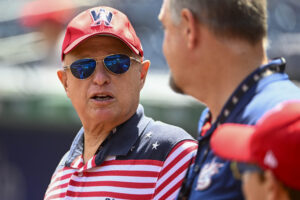
It was almost two years ago, in April of 2022, that Lerner first revealed that the club would be exploring the possibility of a sale. “Nothing has really changed,” Lerner said today. “We’ve just decided that it’s not the time or the place for it. We’re very happy owning the team and bringing us back a ring one day.”
In the interim, it seemed like little progress was made towards the club changing hands. In late 2022, it was reported that their dispute with the Orioles over the Mid-Atlantic Sports Network was something of an obstacle. When the Montreal Expos were moved to Washington and into the territory of the O’s, the former club’s TV rights were given to the latter club. The two clubs jointly own MASN but the O’s having a larger share.
TV revenue is a significant factor in the finances for a baseball club, as has been quite clear this winter. The ongoing bankruptcy of Diamond Sports Group has put a dent in the spending capacity of various clubs throughout this offseason. The Nats are at a disadvantage in that department as they don’t have control over their own rights and have been battling the O’s over MASN revenue for years.
As of about a year ago, the reporting still indicated that little progress was being made in terms of selling the Nats. The most likely buyer, Ted Leonsis, owns NBC Sports Washington and likely wanted to put the club on that channel. But the aforementioned complications would make that difficult and seemed to stall the possibility of anything getting done.
It recently seemed possible there was some light at the end of the tunnel with the developments surrounding the Orioles. The Angelos family, who have owned the O’s since 1993, recently agreed to sell the club to a group led by David Rubenstein. That group is going to also acquire the Orioles’ share of MASN if the deal is ultimately approved by Major League Baseball. Some observers speculated that Rubenstein might sell MASN to Leonsis. It was also reported that the league could make the O’s give up the Nationals’ TV rights as part of approving the sale, though it’s unclear if they had any intent to do so. That arguably opened a path for a sale of the Nats to become unclogged but it seems that won’t be coming to fruition, with the Lerner family deciding to hold on.
Now that the Lerners are sticking around, questions will be raised about the club’s path forward. Despite winning the World Series in 2019, the club’s fortunes turned after that and they have been in a deep rebuild for a while now. They traded Max Scherzer and Trea Turner at the 2021 deadline and then Juan Soto one year after that. That’s naturally led to modest activity in recent offseasons but they’ve been fairly quiet even by the standards of a rebuilding club.
Last year, they mostly gave out one-year pacts to bounceback candidates like Jeimer Candelario and Dominic Smith, though they did give a two-year pact to Trevor Williams. This winter, the activity has been even more muted, with their $5MM deal for Joey Gallo the biggest expenditure of the winter. General manager Mike Rizzo recently stated that the club was unlikely to make any more moves of significance.
It had been assumed by some observers that the lack of activity was a reflection of the fact that the club was for sale. The Lerner family could have used the fairly clean payroll outlook as an attractive feature to market to prospective buyers, offering interested parties a chance to put their own stamp on the future of the franchise. Now that the sale is not happening, the spotlight will turn back on the Lerner family and how they plan to get the Nats out of their recent slide. They have finished below .500 in the past four seasons and most projection systems calculate them as likely to be one of the worst clubs in the league in 2024.