
Marlins Sign Josh Rogers To Minor League Contract
The Marlins signed pitcher Josh Rogers to a minor league contract this afternoon, according to his transactions log at MLB.com. The southpaw wasted no time getting into action with his new club, as he took the ball this evening for Triple-A Jacksonville.
Rogers has appeared in the majors in four of the past five seasons. The Louisville product debuted with the Orioles in 2018 and ultimately made eight appearances with Baltimore between 2018-19. After not appearing in the majors in 2020, he resurfaced late last season with the Nationals. Rogers pitched to a 3.28 ERA in six starts down the stretch, earning himself a 40-man roster spot throughout the winter.
The 28-year-old didn’t replicate last year’s strong work, however. He allowed a 5.13 ERA over 26 1/3 innings, striking out only 10.6% of batters faced. He surrendered six home runs in his big league stint and gave up seven longballs in just 12 1/3 frames at Triple-A Rochester. The Nats designated Rogers for assignment amidst their roster shuffle at the trade deadline, and he elected minor league free agency after going unclaimed on waivers.
There’s no sugarcoating how rough Rogers’ numbers this year have been, but he’s only a year removed from a solid season. In addition to his quality work with the Nats last September, he posted a 3.70 ERA across 73 innings in Rochester in 2021. Rogers sits in the 89-90 MPH range with his fastball and doesn’t miss many bats, but he’s a quality strike-thrower who’s gotten a decent number of pop-ups. He adds an experienced depth option to the upper levels of the Miami farm system, one capable of working either out of the rotation or multi-inning relief.
MLBTR Poll: Justin Verlander’s Next Contract
Last winter, Max Scherzer hit the open market as one of the more unique free agents in recent memory. While most baseball players, and athletes of all kinds, generally decline in quality as they get farther from their 20s, Scherzer was 37 and still playing at an elite level. Though last year was his age-36 season, he turned 37 years old on July 27th. (A player’s age on July 1 is generally considered to be their age for the year.) In that year, he threw 179 1/3 innings and somehow registered a career-best 2.46 ERA. Though he got ground balls at a below-average 33.5% clip, his 34.1% strikeout rate and 5.2% walk rate were both much better than the mean. He also added 16 1/2 innings of 2.16 ERA ball in the postseason, just for a little icing on the cake.
So, how do you value an elite pitcher who is 37 years old? The answer from the market was high salary over a short term. Scherzer received a three-year deal covering his age-37 through age-39 seasons, with Scherzer turning 40 in the last year of the deal. The deal comes with a $130MM guarantee, spread out evenly with a $43.33MM salary in each year. That AAV shattered the previous record, which was Gerrit Cole’s $36MM. Scherzer can also opt out of the deal after the second year.
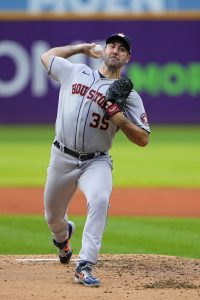
This winter might feature a similar but perhaps more extreme free agent. Justin Verlander threw only six innings in 2020 before Tommy John surgery wiped out the rest of that season and all of 2021. After returning to health, he held a showcase for interested teams, eventually re-signing for the Astros. The contract guaranteed him $25MM for 2022, despite having barely pitched for two years. It also came with a $25MM player option for 2023, conditional on Verlander reaching 130 innings pitched this year. Verlander has already surpassed that mark, allowing him to cash in another $25MM salary next year.
However, he’s pitching so well this season that he’s likely to decline his option and return to the open market in search of a larger payday. Through exactly 130 innings coming into tonight, he has a 1.73 ERA with a 25.5% strikeout rate, 4.6% walk rate and 37.4% ground ball rate. The strikeouts aren’t as high as Scherzer’s were last season, but his ERA is significantly better, with a lower walk rate and better ground ball rate.
Verlander is older than Scherzer, having turned 39 years old in February. However, if he got an annual average value of $25MM after two lost seasons, what would he get after a Cy Young-caliber campaign, even if he is one year older? It will be a fascinating and unprecedented experiment. Verlander could rightly ask for a similar AAV to Scherzer, in the $40-45MM range, depending on how strong he finishes. But how much term will teams be willing to commit to a player about to enter his age-40 season? How many teams will be willing to go to two years? Will any go to three like they did for Scherzer?
But then what does Verlander want? Would he prefer something like a one-year, $50MM deal or try to land around $40MM annually spread out over three years? Verlander has previously said he wants to pitch into his mid-40s, perhaps pointing towards the latter option, but we can’t really know.
MLBTR readers, what do you think? Below are two polls, one for what kind of term you think Verlander will get and another for what kind of guarantee. Let us know your thoughts.
How many years will Justin Verlander get on his next contract?
-
2 55% (1,499)
-
3 36% (971)
-
1 5% (137)
-
4 4% (101)
Total votes: 2,708
(link to poll for Trade Rumors iOS/Android app users)
What total guarantee will Justin Verlander get on his next contract?
-
Between $50MM and $100MM 65% (1,375)
-
Over $100MM 22% (459)
-
Less than $50MM 14% (297)
Total votes: 2,131
(link to poll for Trade Rumors iOS/Android app users)
Image courtesy of USA Today Sports.
Guardians To Promote Peyton Battenfield
The Guardians are planning to promote Peyton Battenfield on Friday, leading into a weekend series in Toronto, tweets Mandy Bell of MLB.com. He’ll take the roster spot of righty James Karinchak, who’ll go on the restricted list based on his vaccination status. Battenfield is not currently on the 40-man roster, but it’s likely he’ll be designated as a specific virus “substitute” and returned to the minor leagues after the weekend.
Even a brief call-up makes a nice birthday present for Battenfield, who turned 25 today. If he gets into a game, he’ll be making his MLB debut. A ninth-round draftee of the Astros in 2019, the right-hander was dealt to the Rays alongside outfielder Cal Stevenson (who coincidentally was called up for his first big league action by the A’s this afternoon) in exchange for righty Austin Pruitt. Tampa Bay flipped him to Cleveland for Jordan Luplow last summer.
An Oklahoma State product, the 6’4″ hurler has spent the entire 2022 season with Triple-A Columbus. Battenfield owns a 3.19 ERA through 121 1/3 innings, although he’s only striking out 16% of batters faced. Battenfield posted much stronger swing-and-miss numbers up through Double-A, and Baseball America recently slotted him as the organization’s #24 prospect. He’s credited with solid control and a bevy of serviceable offerings, headlined by his cutter and a low-mid 90s fastball.
While this is likely to be a temporary call, Battenfield could be closing in on a more lasting promotion. He’ll be eligible for the Rule 5 draft this offseason if Cleveland doesn’t add him to the 40-man roster at the end of the year.
Previewing Upcoming Club Option Decisions: American League
Yesterday, MLBTR checked in on the status of seven players who have vesting options in their contracts for the 2023 season. Each can (or already has) lock in some guaranteed money or the right to opt out of their current deal based on their workload or finish in awards voting this year.
Over the next two days, we’ll turn our attention to players with less of a say over their contractual status. A host of contracts around the league contain club options for 2023. Some of them will be easy decisions one way or the other, while there are others that’ll be more borderline calls. With teams having to make these calls a little over two months from now, it’s worth taking a look at how these players are performing in 2022.
Today, we’ll start with the American League. We’ll follow up with a look at the Senior Circuit tomorrow.
Orioles
- Jordan Lyles, SP ($11MM option, $1MM buyout)
Baltimore signed Lyles to a $7MM guarantee last winter, taking the form of a $6MM salary for 2022 and at least a $1MM buyout on next year’s option. He’s been a fine back-end starter, working to a 4.35 ERA across 130 1/3 innings. Lyles has below-average strikeout, swinging strike and ground-ball rates, but he leads the club in innings pitched and is throwing plenty of strikes. He’s also drawn strong reviews for his work in the clubhouse with the team’s younger arms. A $10MM call is borderline for a 4th/5th starter type, but the Orioles have almost nothing on the books next season and could keep him around as a veteran stabilizer.
Red Sox
- James Paxton, SP (team must decide on consecutive $13MM options this offseason; Paxton would have $4MM player option for 2023 if club declines)
Paxton signed a convoluted deal last winter that reflected his atypical situation. A mid-rotation caliber starter when healthy, he’s made just six starts over the past three years and hasn’t pitched in an MLB game since undergoing Tommy John surgery last April. He’s making $6MM this season and could be a rotation option for a team that’ll see each of Nathan Eovaldi, Michael Wacha and Rich Hill hit free agency. The club will have to decide whether to trigger consecutive $13MM options (essentially a two-year, $26MM pact) this winter. If they decline, Paxton could opt in to a $4MM salary for 2023 or test free agency. How things play out largely depends on how Paxton looks down the stretch. Manager Alex Cora recently told reporters the southpaw will throw a simulated game on Friday and could soon head out on a minor league rehab appearance (link via Chris Cotillo of MassLive).
- Hirokazu Sawamura, RP (team holds option currently valued at $3.6MM; Sawamura holds player option for 2023 currently valued at $1.8MM if club declines)
Sawamura signed a two-year, $3MM guarantee with the Red Sox over the 2020-21 offseason. The deal also included a club option for 2023 valued anywhere between $3-4MM, depending on whether Sawamura held his roster spot and based on his number of appearances. MLBTR has confirmed that escalators have already pushed the value of the club option to $3.6MM; that price escalates by an additional $100K for reaching each of 45, 50 and 60 appearances this season. (He’s presently at 43 games). If the team declines, Sawamura would have the right to trigger a player option currently valued at $1.8MM. As with the club option, the player option price escalates by $100K for reaching 45, 50 and 60 appearances. If both sides bypass their respective options, Sawamura would receive a $1MM buyout.
It seems likely that Sawamura’s team option price will fall somewhere in the $3.8MM – 3.9MM range, with a $1.8MM gap between the value of the club and player options. That’s an acceptable price to pay for a solid reliever, albeit one who’s been relied upon more in lower-leverage innings. Sawamura has a 3.14 ERA in 97 1/3 innings since coming stateside, striking out a decent 23% of opponents with a strong 51.7% ground-ball rate. He’s had issues throwing strikes consistently, but he’s an affordable power arm for a middle innings group that has been one of the team’s biggest weaknesses. That the Red Sox haven’t given Sawamura much high-leverage work in spite of their bullpen struggles is enough of a red flag to put this one in some doubt, but it seems likelier they’ll keep him around.
Yankees
- Luis Severino, SP ($15MM option, $2.75MM buyout)
Severino barely pitched between 2019-21 because of injuries, including a Tommy John recovery. He returned to the rotation this season and pitched to an impressive 3.45 ERA through 16 starts before suffering a lat injury that’ll cost him at least two months. The injury history is a real concern, but Severino still looks like an above-average starter when healthy. He’s averaged around 96 MPH on his fastball, struck out 27.2% of opposing hitters and has a tiny 7.2% walk rate. The Yankees would have to be very pessimistic about his health outlook to buy out his age-29 season, particularly since it’s only a $12.25MM decision once the buyout price is taken into account.
Rays
- Kevin Kiermaier, CF ($13MM option, $2.5MM buyout)
Kiermaier hit .228/.281/.369 over 221 plate appearances before suffering a season-ending left hip injury. It’s the latest in a long line of major health issues for the 32-year-old, and the Rays are planning to buy out the three-time Gold Glove winner. It’s possible the team tries to circle back at a lower price point, but the career-long Ray is likely to hit the open market for the first time in his career.
Blue Jays
- Anthony Bass, RP ($3MM option, $1MM buyout)
The Jays just acquired Bass from the Marlins at the trade deadline, fortifying their bullpen with a productive middle-innings arm. Bass has an excellent 1.49 ERA through 48 1/3 innings on the year, striking out 26.2% of opponents against just a 5.9% walk rate. It’s a career-best season at age 34, but Bass has a sub-4.00 ERA for five years running. He’s an underrated bullpen piece, and the Jays are sure to bring him back for what amounts to a $2MM decision.
White Sox
- Tim Anderson, SS ($12.5MM option, $1MM buyout)
This is as easy a call as any team will have to make this winter. Anderson has been one of the game’s better players four years running. He’s an elite contact hitter and baserunner, and he’s cemented himself as the Sox’s franchise shortstop. His 2022 season has been dinged by injuries, including a recent hand ligament tear that’ll cost him most of the remaining schedule. Frustrating year aside, Anderson has hit at a quality .301/.339/.395 clip this season and been an All-Star caliber performer in prior years. The White Sox are keeping him around next year, and they can do the same in 2024 via $14MM option.
- Josh Harrison, 2B ($5.5MM option, $1.5MM buyout)
Harrison signed a one-year deal in Spring Training and got off to a dreadful start. The veteran utilityman has turned things on since the calendar flipped to June, though, and he now carries a roughly league average .242/.312/.385 line through 281 plate appearances. The Sox will have to make a $4MM call this offseason on whether to bring him back for 2023. They’ll probably look for an upgrade at second base, but that’s a reasonable enough sum to dedicate to a quality infielder off the bench. Chicago already has Leury García making decent money in that role, and they might prefer to focus their finances on adding to the back of the rotation and bringing back star first baseman José Abreu.
Guardians
- Bryan Shaw, RP ($4MM option, $500K buyout)
Shaw is a longtime member of the Cleveland organization, having spent seven of his 11 MLB seasons there. He’s a durable bullpen workhorse who’s clearly a favorite of the coaching staff and front office, but his 2022 results have not been good. The 34-year-old righty owns a 5.36 ERA across 40 1/3 innings. He’s only striking out 17.7% of opponents, walking batters at an elevated 11.6% clip and has had some home run issues. The Guardians seem likely to go in another direction this offseason.
Twins
- Miguel Sanó, 1B ($14MM option, $3MM buyout)
Sanó is a longtime member of the organization who’s capable of carrying a lineup with his power at his best. His platform season has been a disaster, though, and the Twins are sure to buy out his option. The 29-year-old underwent surgery to repair a meniscus tear in his knee in May. He returned briefly but went back on the 60-day injured list last week with additional knee concerns. It’s not clear whether he’ll make it back this season. Sanó has an .083/.211/.133 line in 20 games this year after slightly above-average offensive performances in 2020-21.
- Sonny Gray, SP ($13.1MM option, no buyout)
Just as Sanó’s option is certain to be bought out, Gray’s is a no-brainer to exercise. Minnesota acquired the right-hander from the Reds in Spring Training, sending last year’s first-round pick Chase Petty to Cincinnati. Gray lost some time on the injured list, but he’s posted an impressive 3.19 ERA with slightly above-average peripherals through his first 16 starts in a Twins uniform. A mid-rotation starter of his caliber is a solid bargain at the cost of his option, which played into the fairly high asking price the Twins had to relinquish in the trade.
- Dylan Bundy, SP ($11MM option, $1MM buyout)
The Twins bought low on Bundy on a one-year free agent deal, hoping he’d rebound from a dismal 2021 and look more like the mid-rotation arm he resembled in 2020. That hasn’t really transpired, as the right-hander has a 5.01 ERA through 93 1/3 innings. He’s averaging a personal-low 89.2 MPH on his fastball, and while he’s throwing plenty of strikes, that lack of velocity has been reflected in both his 18.6% strikeout rate and higher than average home run rate. It seems likely the Twins will decline the option and reallocate that $10MM elsewhere, particularly with the recent acquisition of Tyler Mahle and Kenta Maeda’s expected return reducing the urgency to add to the rotation next season.
Astros
- Will Smith, RP ($13MM option, $1MM buyout)
Acquired in a one-for-one deadline swap that sent Jake Odorizzi to Atlanta, Smith is having a generally disappointing year. He has a 4.17 ERA through 41 innings, striking out a personal-worst 24.1% of batters faced with a career-high 11.2% walk rate. Smith was an effective late-game arm as recently as a season ago and is still generating swinging strikes at a quality 14.2% clip, but the $12MM price tag seems likely to be too hefty given the mediocre strikeout and walk numbers.
Athletics
- Stephen Piscotty, RF ($15MM option, $1MM buyout)
Piscotty has spent five seasons in Oakland after being acquired from the Cardinals heading into the 2018 campaign. He had an excellent first season in green and gold, but he’s been a well below-average hitter fours years running now. Going back to the start of 2019, Piscotty has a .231/.288/.380 line in just under 900 trips to the plate. He’s sure to be bought out and could be looking at minor league offers next winter.
Mariners
- Ken Giles, RP ($9.5MM option, $500K buyout)
Seattle signed Giles to a two-year deal knowing he’d miss all of 2021 recovering from Tommy John surgery. Unfortunately, hopes of a year two payout have been largely derailed by a finger issue that delayed his season debut and some shoulder tightness that has kept him out of action for the past month. Giles has thrown just 4 1/3 innings in a Seattle uniform, surrendering only one hit but four walks with six strikeouts. He’s averaged 94.8 MPH on his fastball, still solid but down from the 96.9 MPH range he showed during his incredible 2019 season with the Blue Jays. There’s a non-zero chance Giles returns — he’s currently on a rehab assignment in Triple-A — and dominates down the stretch to make Seattle think about the option. For the moment, though, it’s trending towards a buyout.
Rangers
- Garrett Richards, RP ($9MM option, $1MM buyout)
Texas signed the 34-year-old Richards to a one-year guarantee over the offseason, hoping he’d build off the promise he showed in a late-season bullpen stint with the Red Sox. That hasn’t panned out, as he has a 5.35 ERA across 38 2/3 innings of relief. Richards has an excellent 52.1% ground-ball rate, but he’s not missing as many bats as one would like and he’s giving up a lot of hard contact. Texas seems likely to buy him out.
- José Leclerc, RP ($6MM option, $750K buyout)
Texas signed Leclerc to an early-career extension in 2019, locking him in after a 1.56 ERA season the year before. He struggled with his control the following season, then missed virtually all of 2020-21 battling elbow issues that eventually culminated in Tommy John surgery. Leclerc returned to the mound in June but has a 4.01 ERA with a personal-low 20.4% strikeout percentage in 24 2/3 innings of generally low-leverage work. He’s still throwing hard and missing plenty of bats with his slider, so there’s a chance Texas takes an optimistic view and keeps him around. His deal also contains a $6.25MM option for 2024, so he’d be under control for multiple seasons if the Rangers are willing to give him a bit of a longer leash. This feels like it could go either way depending on how he performs down the stretch.
- Kole Calhoun, RF ($5.5MM option, no buyout)
The Rangers signing of Calhoun to a one-year deal over the winter hasn’t panned out. He’s hitting .211/.269/.363 through 350 plate appearances and is currently on the injured list with a heel issue. It’s a second straight below-average season for the veteran outfielder, who’ll be 35 in October. The Rangers will almost assuredly decline the option and look elsewhere in right field as they aim for legitimate competitiveness in 2023.
MLBTR Chat Transcript
Click here to view the transcript of today’s chat with MLBTR’s Anthony Franco.
Matt Carpenter Expected To Miss 6-8 Weeks With Foot Fracture
Aug. 10: Carpenter will not require surgery, tweets Marly Rivera of ESPN. He’ll be reevaluated in a month, with the club hopeful he could be back to action in six-to-eight weeks. That gives Carpenter a shot of returning for the stretch run and/or postseason play.
Aug. 9: The Yankees placed Carpenter on the 10-day injured list today, recalling Miguel Andujar to take his spot on the active roster.
Aug. 8: Yankees utilityman Matt Carpenter fractured his left foot during tonight’s game against the Mariners, the club announced. He fouled a ball off his foot in the third inning and was immediately replaced by Tim Locastro.
The club will provide more specifics and a timetable for his recovery in the coming days. He’ll certainly require an injured list stint, and whether his season is in jeopardy should be known shortly. Braves second baseman Ozzie Albies fractured his foot in mid-June and has yet to embark on a rehab assignment, with the club estimating his recovery in the two-to-three month range. Dodgers outfielder Chris Taylor suffered a less devastating fracture in early July and returned to action over the weekend, missing exactly one month of action. That’s not to say either player offers a definite comparison point for Carpenter. His recovery timeline surely depends on the placement and severity of the fracture.
The injury interrupts what has been one of the more remarkable stories of the 2022 season. A three-time All-Star, Carpenter seemed to be nearing the end of his career after three years of well below-average play to close out his tenure with the Cardinals. The 36-year-old overhauled his swing path over the offseason but was still limited to minor league offers. He signed a non-roster pact with his hometown Rangers, and while he played well in Triple-A, he didn’t have a path to playing time in Texas.
After being granted his release from his minor league deal with the Rangers, Carpenter received an immediate MLB opportunity with the Yankees. Brought on as a bench bat, he’s played his way into an increasingly larger role with an unbelievable bounceback season. Carpenter has connected on 15 home runs in 154 plate appearances, posting an otherworldly .305/.412/.727 line. He’s forced his way into the lineup, with manager Aaron Boone rotating him between designated hitter and all four corner positions.
New York is already without primary DH Giancarlo Stanton, who has been on the shelf for a couple weeks due to Achilles tendinitis. First baseman Anthony Rizzo has dealt with a nagging back issue in recent days, although he’s not required a stint on the injured list to this point.
Red Sox Notes: Paxton, Wacha, Houck, Sale
Red Sox lefty James Paxton, who underwent Tommy John surgery last year, seems to finally be healthy enough to start ramping things up. Chris Cotillo of MassLive reports that the southpaw recently faced lived hitters and is expected to throw in a simulated game this Friday. The next step after that will be for him to start a rehab assignment, which would be followed by a return to the big league club.
“He’s in such a good spot now that it’s not about the arm,” manager Alex Cora said about Paxton. “It’s about the pitch mix, the breaking ball, all that. When those guys start talking about that, you know they’re over the hump.”
Paxton’s form down the stretch will be very significant both for him and the club, regardless of where they are in the standings. Boston signed him to a unique contract over the offseason, knowing that he was rehabbing from TJS and unlikely to contribute over a full season. Paxton is making a $6MM salary this year and then the club will have to decide whether or not to trigger two $13MM options for 2023-2024 at the end of the season. If the team declines to pick up what is effectively a two-year, $26MM deal, Paxton can decide to trigger a $4MM player option for 2023 or decline it and return to free agency. Those decisions will surely depend upon what Paxton shows in the coming weeks.
The Red Sox could use some contributions from Paxton, both in this season and in the future, given the tumult of their rotation. Just about every starter in Boston’s rotation has either landed on the IL or been optioned to the minors at some point, with Nick Pivetta being the only constant. Michael Wacha has only made 13 starts this year due to a pair of IL stints, one for an intercostal strain and the other for shoulder inflammation. However, Cotillo reports that he threw 4 1/3 innings in a rehab start last night and should return to the big league club for his next outing. That should give the club a boost, as they look to finish strong in the AL Wild Card race. They are currently five games behind the Rays for the last spot.
Looking farther into the future, each of Wacha, Nathan Eovaldi and Rich Hill are slated to reach free agency this offseason, which is part of the reason why those Paxton options might seem alluring, even if he only returns for a brief period of time. The 2023 Boston rotation might also take a hit from the uncertainty surrounding Chris Sale. The lefty was once one of the most dominant arms in the game but has hardly pitched in recent years due to a cavalcade of injuries. Tommy John surgery wiped out his 2020 and limited him to nine starts last year. He began this year on the IL due to a stress fracture in rib cage, returning to throw one five-inning start before his second start was cut short after less than an inning when a comebacker broke his finger. While on the IL, he managed to get hurt again, falling off a bicycle near his home and breaking his wrist, eliminating any hopes of his return this year.
Due to all that, Sale will go into the offseason having thrown just 48 1/3 total innings over the past three seasons, which raises questions about how much the Red Sox can rely on him for the rotation next year. “We obviously need to think through what that means as far as planning out a full season with him not having carried very much of a workload the last few years,” chief baseball officer Chaim Bloom tells Jen McCaffrey of The Athletic. “If we want to play 162-plus we have to build our team to have a lot of starting pitching depth,” he added. With Hill, Wacha and Eovaldi headed to the open market and Sale and Paxton unknown wild cards at this point, there’s plenty of uncertainty hanging over Boston’s future rotation.
Turning back to the present season, the Sox placed reliever Tanner Houck on the 15-day injured list with back inflammation yesterday, Cotillo relays, which will deliver a hit to the bullpen. Houck has a 3.15 ERA on the year, with a 22.7% strikeout rate, 8.9% walk rate and 50.9% ground ball rate. That’s included many high-leverage spots, as Houck as eight saves and one hold on the year. He’ll join Tyler Danish, Matt Strahm and Josh Taylor among Boston relievers currently on the injured list. The bullpen is so banged up that Cora told reporters, including Alex Speier of the Boston Globe, that Hill might see some action out of the ‘pen, despite having just started yesterday’s game.
Cardinals Designate T.J. McFarland For Assignment
The Cardinals announced that they have recalled right-hander Jake Woodford from Memphis, with lefty T.J. McFarland being designated for assignment in a corresponding move.
McFarland, 33, is a veteran playing in his tenth MLB season, having previously suited up for the Orioles, Diamondbacks and Athletics. Last year, he signed a minor league deal with the Nationals but was granted his release in order to pursue an opportunity with the Cardinals. That ended up working out very well for McFarland and the Cards, as he registered an ERA of 2.56 over 38 2/3 innings with the club. McFarland was always a low-strikeout, high-grounder guy, which he continued with a 14.6% strikeout rate and 63.7% ground ball rate.
It seems both sides were quite happy with the arrangement, as the Cardinals quickly re-signed McFarland on the first day of free agency last year. The southpaw is making a salary of $2.5MM this year, with $500K of incentives also in the deal. Unfortunately, things have taken a sour turn here in 2022, with McFarland currently wearing an ERA of 6.61. His ground ball rate, while still above average, has slid to 53%. His strikeout rate has slid even further below average, coming in at 11% on the season. He’s also seen his BABIP jump up to .333 after being at .261 last year and his HR/FB jump from 12% to 16.7%. Based on the poor results, the Cardinals have decided to go in a different direction.
With the trade deadline now in the rearview mirror, the Cardinals will only be able to choose between placing McFarland on outright waivers or release waivers. It’s effectively a moot point, as McFarland has enough service time to reject an outright assignment and return to free agency. Though his salary isn’t exorbitant, he’s likely to go unclaimed on waivers and become a free agent again. Once that happens, he could garner interest from teams around the league, despite his down year. Left-handed relief is always in demand and many teams are lacking in that department. Both the Mariners and the Blue Jays, for instance, are currently without even a single southpaw in their respective bullpens.
Tigers To Select Kerry Carpenter
Aug. 10: The Tigers have announced Carpenter’s selection to reporters, including Woodbery, with righty Beau Brieske being transferred to the 60-day IL in a corresponding move. He will be ineligible to return until 60 days from his initial IL placement, which was due to forearm soreness on July 21. He could technically return in late September, though with the Tigers well out of contention, it seems possible that his season may be finished.
Aug. 9: The Tigers are bringing up corner outfield prospect Kerry Carpenter to make his major league debut, the team informed reporters (including Evan Woodbery of MLive.com). Daz Cameron is being optioned to Triple-A Toledo in a corresponding move. The club will need to clear a spot on the 40-man roster before tomorrow’s game to formally select Carpenter’s contract.
Carpenter, 25 next month, entered pro ball as a 19th-round draft choice back in 2019. The Virginia Tech product wasn’t regarded as a draft prospect of much note and lost his first full professional season to the pandemic cancelation of the minor leagues. He spent last year with Double-A Erie, hitting at a roughly league average level. Few would’ve anticipated he was on the verge of a breakout, but Carpenter has torn the cover off the ball in 2022.
The left-handed hitter started this season back in Erie. He played there through late June, blasting 22 home runs in 63 games. Carpenter’s strikeout and walk rates weren’t great, but his power output was so overwhelming the Tigers bumped him up to Toledo. He’s played 33 games with the Mud Hens and hit even better there than he had in Erie. Carpenter is hitting .342/.433/.667 through 134 Triple-A plate appearances, connecting on eight homers and 11 doubles with matching strikeout and walk rates (12.7% apiece).
Carpenter doesn’t offer much defensive value, so he’ll have to hit at an above-average level to be productive. Baseball America credited him with plus power in ranking him the #12 prospect in the Detroit system midseason, writing that he made some swing changes last offseason that appear to have paid off. He’d have been eligible for the Rule 5 draft if not added to the 40-man roster at the start of the offseason. As they turn their attention to 2023, the Tigers will get their first look at a player they hope can carve out a regular corner outfield role in the coming years.
Mariners Option Kyle Lewis
The Mariners announced a series of roster moves prior to today’s game, with utility player Dylan Moore and right-hander Diego Castillo each being reinstated from the injured list. To make room on the active roster, the club has optioned both left-hander Brennan Bernardino and outfielder Kyle Lewis to Triple-A Tacoma.
The optioning of Lewis is arguably the most significant detail here, as he is a former Rookie of the Year and once seemed a lock to be part of the next great Mariners team. Now 27, he burst onto the scene in 2019, making his MLB debut and getting into 18 games. He hit six homers in that small sample and slashed .268/.293/.592 for a wRC+ of 128. He carried that over into the shortened 2020 campaign, hitting 11 homers, stealing five bags and producing a batting line of .262/.364/.437, wRC+ of 127. He was unanimously voted the American League Rookie of the Year that season.
Unfortunately, Lewis has been having a miserable time over the past two years. He suffered a meniscus tear in 2021, which ended his season after just 36 games. His recovery even lingered into 2022, with Lewis beginning the season on the injured list and not getting activated until May 24. Just five days later, his misfortune continued, as he landed on the concussion IL. The M’s sent him out on a rehab assignment over a month later, in early July, returning to the big league club in late July.
Lewis has hit very well in the minors during his various rehab assignments, putting up a batting line of .293/.408/.741 this year for a wRC+ 177. However, his MLB playing time has been much less successful, as he’s hit .143/.226/.304, striking out in 30.6% of his plate appearances in that 18-game sample.
With Mitch Haniger recently returning from the injured list, it seems Lewis got squeezed out of the outfield picture, as Haniger will take regular playing time next to Jesse Winker and Jarred Kelenic, with Moore, Sam Haggerty and Jake Lamb also capable of seeing some time on the grass. Julio Rodriguez is also expected to return from the IL later this week, which will only crowd things further.
The option could potentially have repercussions for Lewis from a service time perspective, as he came into this season with his service time clock sitting at two years and 20 days. Since 172 days is considered a full season, Lewis would need to accumulate 152 days on the active roster this season to cross the three-year mark. The season is about 125 days old at this point by my unofficial count, meaning Lewis is about 27 days shy of crossing over that barrier. If he gets recalled later in the season and makes up that difference, he would qualify for free agency after the 2025 season, but it would be pushed back by a year if he comes up short. He would almost certainly still qualify for arbitration as a Super Two player regardless, as he should finish the season at 2.145 even if he never returns to the big league club. The Super Two cutoff moves from year to year, as it includes the top 22% of players between two and three years of service time. The most recent cutoff was 2.116, with the highest of the past decade-plus being the 2.146 in 2011.
The option of Bernardino is also a notable development as he was the only lefty in the club’s bullpen, with Ryan Borucki getting placed on the IL recently. For the time being, it seems the club will operate with an entirely right-handed relief corps.
That relief corps will evidently include Chris Flexen, as Ryan Divish of the Seattle Times notes that he has been moved to the bullpen. With the acquisition of Luis Castillo at the trade deadline, the M’s are suddenly dealing with an abundance of starting pitching, as Castillo joins Robbie Ray, Marco Gonzales, Logan Gilbert and George Kirby in the rotation. It seems Flexen has been edged out for the time being and will work out of the ‘pen. Flexen is just 3 1/3 innings away from securing himself an $8MM guarantee for next year, as MLBTR’s Anthony Franco recently examined. Moving to the bullpen will delay Flexen vesting that salary for next year, though he should still have plenty of time to get over the line.