
Explaining The Pitching Stats Used At MLBTR
MLBTR has been around for 15 years, and in that time the statistics we use to evaluate players have continually evolved. Today we’re going to discuss the pitching stats we’ll be using moving forward.
I’ve been contemplating moving away from K/9 and BB/9 to K% and BB% for a while now, a switch you might have noticed in my Top 50 Free Agents post. As many have noted in recent years, it just makes more sense to look at strikeouts as a percentage of batters faced rather than use innings as the denominator.
The problem with strikeouts per nine innings (K/9) is its interaction with the pitcher’s hits and walks allowed. Imagine a reliever who goes three innings, giving up six hits and six walks while also striking out three batters. Because of all the hits and walks, he faces 15 batters in total. His K/9 is 9.0. Every hit and walk extended the inning and gave him a fresh opportunity for a strikeout. His K% is 20% (three strikeouts out of 15 batters), which is subpar.
Imagine a different reliever who goes three innings, strikes out three, and retires the other six batters. His K/9 is 9.0. His K% is 33.3 (three strikeouts per nine batters), which is good.
K/9, BB/9, and K/BB served us well for a long time. They are by no means terrible, and most of us know the benchmarks better. But when something better comes along that isn’t difficult to understand and makes more intuitive sense to use, then it’s time to rip off the Band-Aid and start using it. That’s why we’ll be using K%, BB%, and K-BB% at MLBTR moving forward. To get a feel for the benchmarks, check out this handy chart, reprinted with permission from our friends at Baseball HQ.
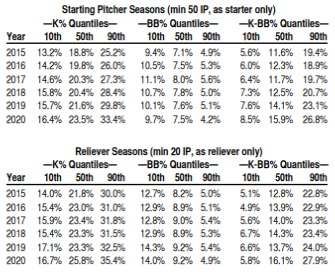
In 2020, the top-20 starting pitchers had a K% of at least 25, a BB% below about 7, and a K-BB% above about 18. Check out the starting pitcher leaderboard here. The top relievers strike out about 35% of batters faced, walk fewer than 5%, and have a K-BB% of at least 27. Play around with the reliever leaderboard here.
Notes on other pitching stats you’ll see at MLBTR:
- SIERA (Skill-Interactive ERA), developed by MLBTR contributor Matt Swartz, is my preference over FIP or xFIP. From what I’ve read, SIERA is the best at predicting future performance. Check out the 2020 SIERA leaderboard here.
- SwStr% (Swinging Strike Rate) is the ratio of swings and misses per pitches thrown. It can be used to help back up strikeout rate. Check out the leaderboard here.
- BABIP (Batting Average On Balls In Play)
- Groundball rate
- We’ll be using Statcast metrics at times, which are explained at the bottom of this page.
- I’m not a huge fan of WAR, especially in smaller samples, but it’s useful at times, widely recognized, and can be hard to ignore. It’s something I hope to unpack and reconsider when time allows.
- Don’t worry. We’re not going to abandon ERA.
Pitching stats you probably won’t see at MLBTR:
- K/9, BB/9, and K/BB for the aforementioned reasons.
- A pitcher’s win-loss record, with the possible exception of a salary arbitration discussion.
- WHIP, unless we’re writing about fantasy baseball.
2021 Season Expected To Start On Time
In the time of COVID-19, no schedule is complete without caveats to consult and confirm with health officials. Cases of coronavirus may surge further, breakouts and hot spots remain possible even as vaccines begin to make their way into circulation. And despite ubiquitous uncertainty, as well as owners advocating for delay, it appears the 2021 season will start on time, per The Athletic’s Evan Drellich. MLB and the MLBPA have each announced their intentions to stick to the CBA and provide regularly-scheduled kick-offs for spring training and opening day.
The presumption has been that any potential delay would come from the urging of the league office, but Drellich provides this statement from MLB, “We have announced the dates for the start of Spring Training and the Championship Season. As we get closer we will, in consultation with public health authorities, our medical experts, and the Players Association, determine whether any modifications should be considered in light of the current surge in COVID-19 cases and the challenges we faced in 2020 completing a 60-game season in a sport that plays every day.”
Owners would prefer to delay the start of the season in order to get more people vaccinated and generally provide a safer playing environment. But they also want to limit the number of games played without fans in attendance. With the CBA in place, however, MLB has little recourse but to start the season on time. Considering the success of the NFL and NBA to operate under the present circumstances, it would likely take a significant degradation of our present circumstances to seriously derail the season.
This is good news for the players, who have continually advocated for a full 162-game season. The logistics of said season remain as complicated as ever, and the schedule itself is likely to be a dynamic document. Still, it does seem likelier than ever that there will be a full season in 2021.
On This Date A Year Ago, Rivals Joined Forces
When Howie Kendrick faced off against Will Harris in game seven of the 2019 World Series, the two players presented as natural rivals.
Harris had been one of the best setup arms in all of baseball that season with a ridiculous 1.50 ERA over 68 appearances. Though his peripherals (3.15 FIP, 21% K-BB%) cast some doubt on the peerless nature of his performance, he’d been spotless in the playoffs. Just the night before, Harris surrendered a run for the first time that postseason after ten consecutive scoreless outings and an 11-to-1 strikeout-to-walk ratio. And while public sentiment wasn’t yet presenting full-throated animosity towards the AL Champs, the Astros were a towering presence in the league on the verge of dynastic achievement – and success always breeds contempt.
Conversely, Kendrick was a 35-year-old veteran recently returned from an Achilles injury. He was so close to retiring, that he picked up photography in preparation for his life after baseball. He played for the Nationals, a team who before that season had never won a postseason series. Kendrick ended that drought with an extra-inning grand slam in the division series, and in the sequel, he earned MVP honors in Washington’s second-ever postseason series win. The Nationals weren’t the ultimate underdog, but they proved themselves the ‘it’ team of 2019, and they were having a moment.
In the vacuum of those few weeks of postseason baseball, Kendrick and Harris were titans.
The rest is history. Kendrick clanked a home run off the right field foul pole, immortalizing himself in Washington DC. The Kendrick/Harris showdown proved the fourth most impactful playoff at-bat of the Wild Card Era by championship win probability added. It will be replayed in highlight reels ad infinitum.
But on this date last year, January 3rd, 2020, the Nationals announced a three-year, $24MM pact with Harris. Kendrick had already agreed to a victory tour season in Washington, giving these two rivals – like many nemeses over time – an opportunity to join forces.
It was a year to forget in Washington, however, as 2020 brought a stark contrast to the soaring highs of 2019. Harris hit the injured list with a groin injury after just two appearances, and by the time he’d make his next appearance, the champs had already fallen to 7-10, well on their way to a last place finish in the NL East. Kendrick fared no better, twice spending time on the injured list and finishing the year with a .275/.320/.375 line, a year-over-year drop from 146 wRC+ to 82 wRC+. Kendrick chose to retire this winter, and hard as this would be to imagine when the Nationals stormed the field at Minute Maid Park to celebrate the 2019 World Series, it’s Harris – not Kendrick – who will don the Curly W in 2021.
Ultimately, Harris hasn’t yet had the opportunity to prove himself the vital bullpen cog the Nationals expected when they signed him a year ago. Like many Nats, his numbers were down in 2020: 5.22 xERA, 4.55 FIP, a ballooned 10.7 BB%, 46.3 HardHit%, and 91.7 mph exit velocity, all three of which were easily career-worst marks. Much of 2020, however, can be chalked up to the bizarre circumstances of the coronavirus-affected, truncated season. He’ll have a clean slate in 2021 and the opportunity to once again flip the script in his eventful history with the Nationals.
Quick Hits: Reds, Akiyama, Rays, Hess
The new year is upon us, and baseball is set to return to something resembling its pre-coronavirus self, but our time for reflection is not yet at an end. Let’s check in with a couple players looking back on (very) recent touchstones in their respective careers…
- Shogo Akiyama had to make major adjustments to his swing during his first season with the Cincinnati Reds. The Japanese import explains the changes he made in this video linked to by Bobby Nightengale of The Enquirer (via Twitter). Essentially, Akiyama attributes his struggles at the plate to a timing issue, something he remedied by delaying his front leg lift. The change appeared to work. After producing just a 46 wRC+ with a triple slash of .192/.280/.247 in 83 plate appearances across 24 games in August, Akiyama rebounded with a 135 wRC+ over the rest of the regular season. Over 79 plate appearances in September and October, Akiyama slashed .317/.456/.365, helping the Reds into the playoffs.
- As a minor league free agent this winter, former Orioles’ right-hander David Hess jumped quickly at the opportunity to join the Tampa Bay Rays, signing a minors deal early in December. The Rays made their pitch to Hess on the first day of free agency, writes Roch Kubatko of MASNsports.com. Said Hess, “One thing the Rays have built a track record of is developing guys and being specific in who they’re looking for, and so when they came in that quickly, we right away knew how serious they were. That meant a lot to us. That was just something, them being the first team and how interested they were, that tipped the scales in their favor in a pretty good way.” Hess owns a 5.96 ERA/6.41 FIP in 190 1/3 innings spanning three seasons in his career.
Phil Hughes Announces Retirement
Phil Hughes officially announced his retirement from baseball today via Twitter. Hughes last pitched in the Majors in 2018 as a member of the San Diego Padres. While his final 16 appearances came out of the Padres bullpen, the No. 23 overall pick of the 2004 draft spent most of his 12-year career split between the Yankees and Twins.
In his own words, Hughes begins his announcement by saying, “While it’s been fairly apparent to most over these last couple years, I’d like to officially announce my retirement from baseball. Through many ups and downs over 12 years, I look back and am incredibly proud of what I was able to accomplish.”
Hughes took some time finding his way, and he ultimately leaves the game as an underrated hurler. After debuting in pinstripes during the 2007 season, he became linked in many minds to Joba Chamberlain as a pair of promising arms that didn’t pan out quite as intended for the Yankees. That said, Hughes has plenty to be proud of after carving out a successful big league career.
He was prematurely crowned a future ace for the Yankees, but he nevertheless developed as a significant contributor setting up games for Mariano Rivera during New York’s 2009 title run. Hughes posted a 3.03 ERA/3.22 FIP over 86 innings that season, including nine appearances in the postseason.
Hughes would settle in as a starter during a four-year run from 2012 to 2015. His best year came in 2014, his first with the Twins in which he logged 209 2/3 frames with a 3.52 ERA/2.65 FIP and an ML-leading 11.63 K/BB rate and a 7th-place Cy Young finish. Injuries and circumstances may have altered Hughes’ ultimate trajectory, but his emergence in Minnesota became a feel-good story for as long as his health allowed.
In total, the 34-year-ol Hughes retires with 11.2 bWAR, but 17.7 fWAR, indicating his ultimate work level might have been underappreciated at the time. He spent seven seasons with the Yankees and five with the Twins, with one All-Star appearances in 2010. Congrats to Hughes on a long and successful career.
Red Sox Notes: Kim, Hernández, Arroyo, Bradley Jr.
Before making San Diego his new baseball home, Ha-Seong Kim was courted by the Red Sox, per Peter Abraham of the Boston Globe. The South Korean infielder ultimately signed with the Padres for four-years, $28MM, in part because he preferred the weather of a west coast team, writes Abraham. Blue skies and sunshine are a clear tiebreak in the Friars’ favor, not to mention the current competitive advantage the Padres hold over the Red Sox. He’ll have a shorter leash in San Diego with Jake Cronenworth pushing for reps, but with their rebuilt rotation, the Padres figure to be an exciting franchise for which to suit up in 2021, even on days when he has to watch from the bench.
For Boston, Kim would have fit nicely into their rebuilding efforts given his youth, versatility, and short-term fit at second base. They have been active in the international market thus far this winter, but without much to show for it. Kim would have found himself among peers by age in Boston, with Rafael Devers, Alex Verdugo, Michael Chavis, Bobby Dalbec, and Marcus Wilson all within a year of Kim’s 25.2 years of age. Alas, Chavis remains the likeliest volume producer at the keystone for Alex Cora‘s squad, at least until Jeter Downs or someone else proves ready. Elsewhere…
- Speaking of the Red Sox, they continue to make broad inroads into the free agent market, looking primarily for pitchers and a second baseman. Kiké Hernández is one target that remains a possibility, said Masslive’s Chris Cotillo on the IV The Love Of Sports podcast. Internally, Christian Arroyo continues to be a name of interest, notes Cotillo, but he’s unlikely to be the full-stop, number-one option at second base entering the season. On the pitching side, Cotillo suggests Boston could add two starters for the rotation before opening day.
- They remain in contact with long-time centerfielder Jackie Bradley Jr., per Steve Hewitt of the Boston Herald. The Red Sox have filled their dance card in the outfield, at least in terms of name recognition with Alex Verdugo, Andrew Benintendi, and Hunter Renfroe on the roster, but all three carry some uncertainty – and none of the three are true centerfielders. Jarren Duran also figures to push for a big league role this season. Chief Baseball Officer Chaim Bloom indicated that a resolution on this front probably isn’t coming in the near-term. A relative dearth of centerfield options on the open market gives JBJ a potentially robust collection of suitors to consider.
Pirates, Indians Showed Past Trade Interest In Alejandro Kirk
Alejandro Kirk‘s bat has drawn a lot of attention over his three pro seasons, including a 2020 MLB debut that saw the Blue Jays catcher post a .983 OPS over his first 25 plate appearances as a big leaguer. As one might expect, rival teams have taken notice of Kirk, with TSN’s Scott Mitchell reporting that the Pirates and Indians have both tried to acquire the catcher within the last 14 months.
Cleveland wanted Kirk in a potential Corey Kluber trade with the Jays last offseason, prior to the deal that saw Kluber sent to Texas for Delino DeShields Jr., Emmanuel Clase and the Rangers agreeing to absorb all of Kluber’s $17.5MM salary for the 2020 season. The Pirates’ interest was more recent, as Mitchell notes that the Bucs “tried to pry him away” from Toronto just this past summer.
The Blue Jays and Pirates were known to be in discussions over such pitchers as Trevor Williams, Chad Kuhl, and Joe Musgrove prior to the trade deadline, with a trade for Musgrove reportedly falling through at the veritable last minute. Since Pittsburgh GM Ben Cherington came to the job after working in Toronto’s front office, it isn’t surprising that the rebuilding Pirates and the aggressive Blue Jays are often mentioned as potential trade partners. Musgrove is still a hot commodity on the trade market, and with the Jays still looking to add pitching, a deal could certainly still come together between the two sides before the offseason is through.
Likewise, the past Cleveland ties of Jays president Mark Shapiro and GM Ross Atkins have seemingly put the Blue Jays in mind when discussing any potential Indians trade chip. To name one prominent example, Toronto has had interest in Francisco Lindor for well over a year, and Lindor still looms as a potential acquisition given the widespread expectation that the Tribe will deal the shortstop prior to Opening Day.
Whether Kirk could be part of a future deal to Cleveland or Pittsburgh remains in question, however. Mitchell believes the Jays will hang onto Kirk to see if he could be a reliable regular in 2021, both catching and as a DH against left-handed pitching. Danny Jansen is Toronto’s incumbent starter behind the plate, with Reese McGuire and prospects Gabriel Moreno and Riley Adams also on hand to give the Blue Jays quite a bit of major and minor league depth at the position — as Mitchell writes, one of the catchers “will be traded this year, it just won’t be Kirk.” Of course, should the Jays make the big splash to sign free agent target J.T. Realmuto, it would seem likely that multiple catchers (perhaps including Kirk) would be shopped.
MLBTR Poll: Who Will Sign Tomoyuki Sugano?
Tomoyuki Sugano arrived in the United States two days ago, according to The Hochi News (Japanese language link), as the right-hander and his agent Joel Wolfe plan for the final few days of Sugano’s 30-day posting window. January 7 is the final day of that posting period, and with at least six MLB teams known to have interest in Sugano’s services, the odds seem to be in favor of Sugano pitching in the big leagues in 2021.
A move to North America is not guaranteed, however. As noted in that Hochi News item, Sugano said earlier this month that he hadn’t yet fully decided on whether or not to make the jump to Major League Baseball, with the COVID-19 pandemic weighing as a factor in his decision. As we just saw yesterday with outfielder Haruki Nishikawa, it isn’t uncommon for Japanese players to reach the end of their 30-day posting period without having reached a deal with any MLB teams.
Beyond that uncertainty, it’s also possible that Sugano’s market has been somewhat reduced in number. Of the six teams linked to Sugano in rumors, two have made other significant pitching additions that may have removed them from the running. The Rangers already made one foray into the Japanese pitching market by signing Kohei Arihara to a two-year, $6.2MM contract. The Padres, of course, dominated headlines by swinging a pair of blockbuster trades for Yu Darvish and Blake Snell, and now headlines a rotation mix that also includes Dinelson Lamet, Chris Paddack, Adrian Morejon, Joey Lucchesi, and several impressive younger arms.
This isn’t to say that Texas or San Diego wouldn’t still have interest in Sugano, of course. Even with Arihara’s signing, the Rangers could still conceivably add to their rotation considering that Kyle Gibson, Jordan Lyles, and Kolby Allard all struggled in 2020. As for the Padres, they’re so clearly in win-now mode that they might see Sugano as another key piece for what they hope is a World Series contender. Adding another starting candidate serves as a further guard should Lamet have an injury setback, and it could allow the Padres to potentially float one of their younger arms as a trade chip in another trade.
The Red Sox also made a recent pitching addition in Matt Andriese, but while Andriese will be given a crack at a starting job, he might end up as a reliever or perhaps a swingman. Boston has enough questions in its rotation that signing Sugano would make sense even if Andriese did end up as a starter. Likewise, the Giants have retained Kevin Gausman via the qualifying offer and signed Anthony DeSclafani since the start of the offseason, but San Francisco’s pitching staff would certainly still use further reinforcement.
The Blue Jays and Mets have respectively been linked to almost every free agent this offseason, so it isn’t surprising that they’re both in on Sugano. Whether Sugano would be either team’s final major pitching addition is the question, as a case could be made that both Toronto and New York have enough arms on hand, or that another notable hurler (perhaps even Trevor Bauer) is required to really turn either rotation into a big plus.
With these options in mind, it’s time to open the floor to the MLBTR readership. Where do you think Sugano will pitch in 2021? (poll link for app users)
Who will sign Tomoyuki Sugano?
-
Mets 22% (4,036)
-
Giants 15% (2,768)
-
Blue Jays 15% (2,710)
-
Another MLB team 13% (2,425)
-
Red Sox 12% (2,198)
-
Nobody --- Sugano will remain in Japan 11% (2,030)
-
Padres 8% (1,455)
-
Rangers 4% (728)
Total votes: 18,350
Marlins Sign Ross Detwiler To Major League Contract
TODAY: Detwiler will earn $850K in guaranteed money, Craig Mish reports (via Twitter), with another $100K available in potential incentives.
JANUARY 1: The Marlins have signed left-hander Ross Detwiler to a major league contract, Craig Mish of Sportsgrid tweets. It’s a one-year deal for the CAA Sports client.
Detwiler was the sixth overall pick of the Nationals in 2007, and while he did stick with the organization through 2014, he has bounced around since then. He spent parts of 2015-20 with the Rangers, Braves, Cleveland, Athletics, Mariners and White Sox, and there were multiple independent league stints mixed in there.
Although Detwiler has seldom posted impressive production in the majors, he did perform well out of the White Sox’s bullpen last season, finishing with a 3.20 ERA/3.90 FIP with 6.86 K/9, 2.29 BB/9 and an excellent 58.3 percent groundball rate in 19 2/3 innings of work. Detwiler spent all of 2020 as a reliever, and if that’s his role in Miami, he could help a bullpen that ranked last in the National League in ERA (5.50) and FIP (5.65) a season ago.
Marlins Designate Stephen Tarpley For Assignment
The Marlins have announced that left-hander Stephen Tarpley has been designated for assignment. The move creates roster space for Ross Detwiler, whose signing is now official.
Acquired from the Yankees just shy of a year ago, Tarpley missed a month of the 2020 season due to an oblique strain and otherwise struggled over 11 innings with Miami. The southpaw posted a 9.00 ERA while allowing two homers and eight walks during his small sample size of work. While Tarpley has a 5.8 BB/9 and 1.6 HR/9 over his 44 2/3 career MLB innings with the Marlins and Yankees, he has been almost an entirely different hurler over his 450 2/3 minor league innings — he owns a modest 3.0 BB/9 and only an 0.4 HR/9, while posting often extreme groundball numbers.
With this intriguing resume, it isn’t out of the question that Tarpley is claimed by another team during his DFA period in the hope that another change of scenery could unlock some late-career (Tarpley turns 28 in February) potential. A third-round pick for the Orioles in the 2013 draft, Tarpley also spent some time in the Pirates’ farm system during his career.