
Latest On Braves’ Rotation
The Braves’ rotation has been a talking point in the early days of spring training, with a few injuries already popping up, leading to speculation about the club looking for an external addition. Atlanta has been connected to pitchers like Lucas Giolito and Chris Bassitt this offseason but Gabriel Burns of the Atlanta Journal-Constitution reports that the club’s interest in those two pitchers was overstated. Burns says they did not seriously pursue Bassitt before he signed with the Orioles and have not been involved with Giolito, who remains a free agent.
It’s a curious spot for the club to be in. Injuries to the starting rotation played a huge role in tanking the 2025 season. They went into the campaign as contenders but ended up at 76-86. Just about every starter got hurt, so that the only guy to surpass 126 innings was Bryce Elder, who posted a 5.30 earned run average.
Going into the winter, general manager Alex Anthopoulos said that bolstering the rotation would be a “point of emphasis” but he hasn’t made any significant changes there. He clearly had some money to spend but has invested it elsewhere, having signed outfielder Mike Yastrzemski, infielder Ha-Seong Kim, as well as relievers Robert Suarez and Raisel Iglesias to eight-figure deals.
That left the rotation looking vulnerable coming into camp and the picture has only gotten worse since then. Spencer Schwellenbach was placed on the 60-day injured list last week due to elbow inflammation. Hurston Waldrep is now getting checked out due to his own elbow soreness.
The rotation still has some upside, in theory, but with question marks everywhere. Chris Sale is the ace but he’s about to turn 37 years old and has been very injury prone in recent years. Spencer Strider missed most of 2024 due to elbow surgery and had lackluster results when he was back on the mound last year. Reynaldo López only made one start last year due to shoulder surgery. Grant Holmes was diagnosed with a partial tear of his ulnar collateral ligament last year and is currently trying to return while avoiding surgery.
That group could be a strong front four if everyone is healthy and pitching well but that’s a massive if. The depth beyond that group is also questionable. Martín Pérez and Carlos Carrasco are in the organization on minor league deals but neither inspires a ton of confidence. Didier Fuentes is a notable prospect but he’s only 20 years old and got shelled when called up in emergency fashion last year. Jhancarlos Lara and José Suarez are on the roster but seem to be depth/swing types. JR Ritchie is another of the club’s top prospects but he has only 11 Triple-A starts under his belt.
There’s an argument for adding a reliable veteran to strengthen the back of the rotation, even if it doesn’t raise the ceiling much, but Anthopoulos recently said the club is looking for a playoff-caliber starter. Up until fairly recently, the starting pitching market still had a lot of attractive names on it but Atlanta has not pounced on that opportunity. Guys like Bassitt, Zac Gallen, Nick Martinez, Justin Verlander, Jose Quintana, Chris Paddack, José Urquidy, Tomoyuki Sugano, Aaron Civale, Miles Mikolas, Erick Fedde, Griffin Canning and Germán Márquez have agreed to modest one-year deals in the past week or so.
Perhaps the club will still pivot to add some reliable innings. If they don’t like Giolito, the market still features Zack Littell, Max Scherzer, Patrick Corbin, Tyler Anderson, Marcus Stroman and others.
It’s also possible the club is out of dry powder. RosterResource projects them for a $264MM payroll and $260MM competitive balance tax number. That payroll is about $50MM above where they finished last year and the CBT number puts them within $4MM of the second tier of the tax, which they may not want to cross.
If it’s the case that there’s no spending capacity left, it looks like a strange offseason for the club. They invested in several areas of the roster but didn’t target the area that was supposed to be a primary focus. Perhaps Anthopoulos can line up a trade of a young pitcher who is cheap and controllable, but the price on such pitchers will be high. Maybe they’ll get lucky and their guys will stay healthier than last year but the injury bug is already biting before spring games have even begun.
Photo courtesy of James A. Pittman, Imagn Images
Padres, Walker Buehler Agree To Minor League Deal
February 17th: According to Kevin Acee of the San Diego Union-Tribune, Buehler will make $1.5MM if added to the roster and could also access performance bonuses worth $2.5MM on the deal.
February 16th: The Padres are adding Walker Buehler on a minor league contract, reports Kevin Acee of The San Diego Union-Tribune. The Excel Sports Management client will aim to win a rotation job during Spring Training.
San Diego continues to stockpile potential back-end starters. The Padres agreed to big league deals with Griffin Canning and Germán Márquez over the weekend. Buehler settles for a non-roster invitation, which seemingly puts him behind the other two veteran righties as camp gets underway. Canning is coming back from a June Achilles tear. He might begin the season on the injured list but should be in the rotation once he’s healthy.
The Friars have three locks for the Opening Day rotation: Nick Pivetta, Michael King and Joe Musgrove. First-year skipper Craig Stammen implied last week that righty Randy Vásquez has a leg up on the fourth starter role after a solid finish last year. Márquez, Canning (if healthy) and JP Sears are the top options on the 40-man roster for the fifth starter job. Matt Waldron also remains on the 40-man but is out of options and coming off a rough season in Triple-A. Buehler joins Triston McKenzie and Marco Gonzales among the non-roster invitees.
A two-time All-Star, Buehler was a borderline ace for most of his time with the Dodgers. He hasn’t been the same since undergoing the second Tommy John surgery of his career in 2022. The surgery cost him the entire ’23 season, and he returned with a 5.38 ERA across 16 regular season starts the following year. Buehler pitched well in the postseason and wound up closing out the 2024 World Series. The Red Sox bet that was the beginning of a return to form, but his $21.05MM free agent deal with Boston was a disappointment.
Buehler was rocked for a 5.45 ERA across 23 appearances with the Red Sox. They flirted with a move to the bullpen before pulling the plug altogether, releasing him at the end of August. Buehler latched on with the Phillies and made three appearances to close the regular season. While he tossed 13 2/3 innings of one-run ball in Philadelphia, he only struck out eight of 57 batters faced (14%).
Opponents destroyed his four-seam fastball, hitting .277 with a .553 slugging percentage against the pitch. Buehler’s 94 mph average velocity was down a tick from the previous season and almost three miles per hour below where it had been between 2019-20. The spin rates on his four-seam fastball and knuckle-curve have dropped precipitously since his peak. He has had a much more difficult time missing bats, both within and outside the strike zone. Hitters have done a better job laying off stuff outside the zone, leading to a career-high 10.8% walk rate last season.
Although the trend lines aren’t encouraging, Buehler is only 31 and still has league average velocity. The Padres aren’t committed to a roster spot or a guaranteed salary, so there’s no harm in gauging his form during Spring Training. It should be mostly an open competition for at least one rotation spot.
Buehler might not begin the season in Triple-A if he doesn’t win the job. He was an Article XX(b) free agent — a player with six years of service time who finished last season on an MLB roster. Those players who sign minor league deals at least 10 days before Opening Day have a trio of opt-out dates under the collective bargaining agreement: five days before Opening Day, May 1, and June 1. Buehler can trigger an out clause and explore other opportunities during the final week of Spring Training if the Padres don’t commit to carrying him on the active roster.
Padres Sign Germán Márquez
February 17th: According to Kevin Acee of the San Diego Union-Tribune, Marquez gets a $1MM salary followed by a $750K buyout on the mutual option. Marquez will also have the chance to unlock an extra $3.25MM in performance bonuses.
February 16th: The Padres announced Monday that they’ve signed right-hander Germán Márquez to a one-year deal with a mutual option for 2027. The L.A. Sports Management client is reportedly guaranteed $1.75MM. San Diego placed righty Jhony Brito, who underwent internal brace surgery last May, on the 60-day injured list to open a spot on the 40-man roster.
The team was known to be looking for low-cost rotation pieces and a complementary bat, per comments from president of baseball operations A.J. Preller a few days ago. They achieved the latter by bringing in Nick Castellanos on a one-year deal upon his release from the Phillies. Now, they’ve addressed the rotation side through one-year-deals for Márquez and fellow right-hander Griffin Canning. Canning is coming off an Achilles injury and projects as a back-end starter once he is healthy enough to return. Márquez figures to serve as back-of-the-rotation depth as well.
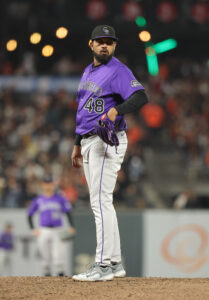
The 30-year-old (31 later this month) is coming off a ten-year major-league run with the Rockies. After a brief debut in 2016, he settled in as one of the team’s most reliable starters from 2017-21. In that span, he totaled 793 2/3 innings over 135 starts and posted a 4.25 ERA, a 24.0% strikeout rate, and a 6.9% walk rate. Márquez excelled through a combination of control and strong groundball tendencies. He was worth 15.5 fWAR in those five years and continually posted groundball rates in the mid-40s and low-50s, including a career-high 51.6% in 180 innings in 2021.
His performance began to wane from 2022 onward. He still made 31 starts in 2022, but his strikeout rate fell below 20% for the first time since his 20 2/3-inning sample in 2016. His run prevention slipped as well, with Márquez posting a below-average 4.95 ERA and elevated peripheral stats. He then underwent Tommy John surgery in May 2023, costing him the rest of that year and the first few months of 2024. His return in July 2024 only lasted one start, and he spent the rest of the season on the injured list with elbow inflammation, although his UCL was reportedly fine.
In 2025, Márquez pitched 126 1/3 innings over 26 starts but was clearly working with diminished stuff. His four-seamer was down to 94.8 MPH after averaging 95.6 MPH in his most recent healthy season in 2022. His sinker, which used over 20% of the time, also slipped from 95.1 MPH to 94.3 MPH. Statcast graded his fastballs in just the first percentile by run value, while his knuckle curve, formerly his best pitch, also earned career-worst grades. The strikeouts dried up even further, with Márquez’s 14.0% strikeout rate ranking third-worst among starters with at least 100 innings. The Rockies decided to move on as Márquez reached free agency.
Perhaps a change of scenery will help Márquez recover some of his strikeout and groundball tendencies as he moves further from injury. He’ll get that chance with the Padres, who now have a decent amount of rotation depth. The team saw Dylan Cease depart for the Blue Jays but re-signed Michael King on a three-year deal in December. Yu Darvish will miss 2026 while recovering from an internal brace procedure, and he is reportedly contemplating retirement. Joe Musgrove is returning from Tommy John surgery and will be guaranteed a spot if healthy. That leaves King, Nick Pivetta, and Musgrove in the top three spots, with some combination of Márquez, Canning (when healthy), Randy Vásquez, and JP Sears taking the last two spots.
Each of King, Musgrove, Márquez and Canning comes with injury risk, though the Padres always seemed likelier to stockpile depth than bring a big-name starter at this stage in the offseason. Zac Gallen was the last impact starter in free agency before re-signing with the Diamondbacks. Either way, his $18.7MM luxury tax number might have been too much given the team’s reported payroll constraints. Low-cost signings like Canning and Márquez seem easier to accommodate, barring a potential buyout agreement for Darvish.
RosterResource has the team at a $264.7MM luxury tax payroll for 2026, putting them in the second tier of penalization. The Padres paid the luxury tax in 2025 and would count as second-time payors in 2026. Thus, any money guaranteed to Canning and Márquez would come with an additional 42% surcharge.
Alden González of ESPN first reported the Padres were signing Márquez to a one-year deal. Ken Rosenthal of The Athletic reported the mutual option. The Associated Press reported the $1.75MM guarantee. Photo courtesy of Kelley Cox, Imagn Images
Padres Sign Griffin Canning
February 17th: The Padres made it official today, announcing that they have signed Canning to a one-year deal with a mutual option for 2027. Mutual options are almost never picked up by both sides, so that provision just allows the Padres to kick part of the payment into the future in the form of a buyout. Kevin Acee of the San Diego Union-Tribune reports that Canning is guaranteed $2.5MM in the form of a $1MM salary and $1.5MM buyout on that option, with another $1.5MM available via performance bonuses. Outfielder Tirso Ornelas has been designated for assignment as the corresponding move for Canning.
February 14th: The Padres have signed right-hander Griffin Canning, as initially reported overnight by the Divine Sports Gospel. Canning’s deal will be official once he passes a physical, according to FanSided’s Robert Murray. San Diego has a full 40-man roster in the wake of the Nick Castellanos signing, so the Padres will have to make another move to open up 40-man space for Canning, who is represented by Wasserman.
It’s something of a SoCal homecoming for Canning, who was born in Mission Viejo and played his college ball at UCLA. The 29-year-old also spent his first first Major League seasons with the Angels, posting a 4.78 ERA over 508 innings (starting 94 of 99 games). This was less than was expected of a pitcher who was once viewed as a top-100 prospect, and the Angels parted ways with Canning via a trade with the Braves last offseason for Jorge Soler. Atlanta then chose to non-tender Canning, since the Braves’ chief goal of the trade was to unload Soler’s contract.
Canning then signed a one-year, $4.25MM contract with the Mets that initially looked like it was going to be a steal, as the righty posted a 2.47 ERA over his first nine starts in New York. Some struggles over his next seven outings boosted his ERA to 3.77, yet that’s unfortunately where Canning’s story ended, as he suffered a season-ending ruptured Achilles tendon in late June.
Reports from earlier this offseason suggested that Canning is hoping to be ready for Opening Day, or at least relatively early in April. He was feeling good enough to throw for scouts in a showcase last week, and his velocity was up to 93mph even at this relatively early stage in the preseason ramp-up process. The Mets, Cardinals, and White Sox were all linked to Canning earlier this winter, but he’ll now be part of San Diego’s rotation mix.
The Padres’ starting pitching situation has been a key issue for the team all winter, as Dylan Cease left for the Blue Jays in free agency and Yu Darvish will miss all of 2026 while recovering from an internal brace procedure. Re-signing Michael King helped the Padres restore some stability, and Canning joins a list of arms that consists of King, Nick Pivetta, Randy Vasquez, JP Sears, and Joe Musgrove in his return from Tommy John surgery. Assuming everyone is healthy, Canning will probably push Vasquez or Sears into a relief or depth role once Canning is ready to pitch.
While 76 1/3 innings isn’t the largest of sample sizes, Canning’s 2025 season saw him post a 50.9% grounder rate, in a marked change for a pitcher who had only a 39.5% groundball rate during his time in Anaheim. Keeping the ball out of the air helped somewhat counter-act all of the hard contact Canning was allowing, as his 45.7% hard-hit ball rate was only in the 11th percentile of all pitchers. Canning’s 10.7% walk rate was the highest of his career, and his 21.3% strikeout rate was nothing special.
Pivetta’s breakout in 2025 is evidence that the Padres can help pitchers unlock their potential, but for now, Canning projects as a back-end starter with some upside. How Canning responds to his Achilles injury is another x-factor, and his health history also includes a stress fracture in his back that cost him the entire 2022 season.
Terms of Canning’s deal aren’t yet known, though it is fair to assume he’ll earn something close to the $4.5MM he received from New York in 2025. The price tag was surely attractive to the Padres, who have been operating within a seemingly limited budget this offseason. Not counting Canning’s deal, San Diego is projected (by RosterResource) for roughly a $220.9MM payroll and a $265.48MM luxury tax number — both are slightly up from 2025, when the Padres had a $211.1MM payroll in 2025 and a $263MM tax number. The addition of Canning’s contract now puts San Diego over the second tier ($264MM) of tax penalization.
Poll: Will Six-Man Rotations Be More Common This Year?
In MLB, the five-man rotation has been the standard for more than 50 years. Things have slowly begun to shift in that regard, however. Several teams have experimented with a six-man rotation over the years, and it’s virtually a requirement for the Dodgers thanks to the presence of Shohei Ohtani and his unique needs as a two-way player. It’s become increasingly common for teams aside from the one that employs Ohtani, however. MLB.com’s Mike Petriello wrote prior to the 2025 campaign that starts on five days of rest have become more common than the traditional four days of rest associated with a standard five-man rotation.
Of course, a start can happen on five days of rest for more reasons than the use of a six-man rotation. A team’s off-days, the deployment of bullpen games, and even something like a starter returning from the IL or being promoted from the minors can push a pitcher’s regularly scheduled start back organically without there being a long-term plan to use a six-man rotation. Regardless of how it’s done, extra rest for pitchers can generally only be a good thing.
The vast majority of pitchers perform better and have an easier time pitching deeper into games when they get extra rest. For teams carrying pitchers used to the schedule used in Nippon Professional Baseball, a six-man rotation comes with the added benefit of keeping those players on a schedule they’re familiar with. That extra rest could also help prevent against injury and late-season fatigue, helping teams confident in their chances of making it to October enter the playoffs in tip-top shape.
The main arguments against using a six-man rotation in the past have mainly been about volume. The greater the size of the rotation, the less often your best pitchers are out there. It’s difficult for some teams to find even five quality starters, much less six. Even those that do have six decent starters would have to be willing to cut into their bullpen, due to the 13-pitcher roster limit. Despite the drawbacks, the tide may be turning regardless.
The 2025 campaign saw teams like the Red Sox and Mets enter the season with more starters than they could fit into the rotation on paper, though injuries left those teams to use six-man rotations only sparingly throughout the year. They have just as much (if not more) starting depth this year, however, and other teams have begun to follow suit. Looking at the depth charts of certain teams, some would struggle not to use a six-man rotation if everyone is healthy concurrently. The Cubs and Orioles both added more starters to their roster this offseason than will fit into a fully-healthy rotation, while the aforementioned Red Sox have an on-paper starting five that fails to include two consensus top-50 prospects in the sport (Payton Tolle and Connelly Early) plus two starters expected to return from injuries early in the year (Patrick Sandoval and Kutter Crawford).
These aren’t the only teams facing a potential surplus of arms. Even with Shane Bieber set to start the year on the injured list, the Blue Jays will be pushing one of Jose Berrios or Eric Lauer to the bullpen—and that’s before considering longtime top prospect Ricky Tiedemann. Gerrit Cole and Carlos Rodon could push impressive young arms like Will Warren and Luis Gil out of the Yankees’ rotation before the end of the first half if the injury bug doesn’t do so before then. The Mets currently figure to use a six-man rotation even with Tobias Myers in a relief role and Jonah Tong at Triple-A. Even a team like the Astros that struggled to field a healthy rotation at all last year currently has upwards of ten arms in the conversation for starts headed into Opening Day, with reinforcements from the injured list likely at some point.
Of course, it should be remembered that pitching injuries have always been inevitable and have only become increasingly common over the years. Some of these teams will struggle to field even a five-man rotation at one point or another this year, and a few will likely never have enough healthy starting depth that a six-man rotation becomes a realistic possibility for more than a couple of weeks at a time. With so many clubs loaded in pitching depth, however, it becomes easier and easier to see rival front offices looking towards the example of the reigning back-to-back World Series champions and adopting some of their tactics.
If the Dodgers open the season with Yoshinobu Yamamoto, Tyler Glasnow, Blake Snell, Ohtani, Emmet Sheehan, and Roki Sasaki all ready to start games, that group of six will be backed up by an incredibly deep group that also includes Ben Casparius, River Ryan, Kyle Hurt, Justin Wrobleski, Gavin Stone, Landon Knack, and Bobby Miller (not to mention non-roster invitees like Cole Irvin and Nick Frasso). That’s the sort of depth that would make it easy to field a six-man rotation all throughout the year even in spite of injuries, and while no team quite matches that level of depth, teams like those in Boston, Queens, and on the north side of Chicago do come close.
For those clubs, the biggest hangup might end up being the risk of wearing out their bullpens. While the Dodgers have three spots available in their projected bullpen for optionable relievers, the Mets and Cubs both only have two (one of which, in the case of Chicago, belongs to closer Daniel Palencia). Teams with such minimal flexibility in the bullpen can struggle to keep their relief corps fresh throughout the season, and that would surely only get harder with seven spots instead of eight.
How do MLBTR readers think the six-man rotation will fare around the league in 2026? Will we see more teams than just the Dodgers utilize one for most or all of the season? Or will it be more of the same where teams prefer to find other ways to get their starters extra rest, such as occasional spot starts and bullpen games? Have your say in the poll below:
Will more teams use six-man rotations this year?
Latest On Kris Bryant
Kris Bryant‘s status with the Rockies remains up in the air, at best. The former NL Rookie of the Year and Most Valuable Player signed a seven-year free agent contract four offseasons ago but has thus far managed to play in only 170 games due to a cascade of injuries — the most notable among them being a degenerative lumbar condition in his lower back that continues to cause him pain. The Rox already placed Bryant on the 60-day injured list (upon signing right-hander Tomoyuki Sugano shortly after camp opened), and Bryant told the team’s beat he’s unsure as to when or whether he’ll be able to resume playing (video links via Kevin Henry of the Denver Gazette).
Bryant noted that he’s been “waking up in pain every day” and been unable to progress beyond relatively minor physical activity, let alone baseball activities. The 34-year-old acknowledged that even jogging “is giving me a big problem right now.”
There’s no timetable for Bryant’s return at present. He played in only 11 games last season and 37 the year prior. He’s reached 200 plate appearances only once in his four seasons with Colorado. Asked whether it was worth it for him to continue trying to put his body through the rigors of rehabbing, Bryant replied (via Thomas Harding of MLB.com):
“I honestly try not to let myself get there, just because, when you’re going through it every single day, you just try to make it day to day. I think people out there with chronic pain, you don’t want to think about so far in the future, because you’re trying to get through the day. So I haven’t let myself get there.”
Bryant’s physical decline has been ongoing for some time, but it came about in abrupt fashion. In 2021, he played 144 games between the Cubs and Giants, turning in a combined .265/.353/.481 slash (24% better than league average) with 25 home runs in 586 plate appearances. His debut season with the Rockies was shortened by a monthlong absence due to a lower back strain, but it was a bout of plantar fasciitis that really limited his time on the field. He appeared in only 42 games but was at least excellent when healthy, hitting .306/.376/.475 in 181 plate appearances.
Since that time, Bryant has been placed on the IL due to a heel injury, a broken finger and a ribcage injury. He’s now had four IL stints (including the current one) due to lower back troubles dating back to Opening Day 2024. Last year’s IL placement on April 14 proved to be season-ending in nature.
On a purely baseball level, Bryant’s repeated injury struggles are understandably maddening for Rockies fans, who see the albatross contract as emblematic of a former leadership regime that far too often put the Rockies on a negative trajectory.
From a purely human level, it’s unfortunate to see anyone’s career so aggressively derailed by a chronic, degenerative condition that could have lasting implications for Bryant well beyond his playing days. To already be facing such a debilitating physical condition at a young age — Bryant turned 34 on Jan. 7 — must be grueling from a mental and emotional standpoint, particularly for someone whose career began with such promise. Regardless of what happens with Bryant’s baseball career, one would hope that doctors are able to find a means to simply allow him to live his life in a a state of relative comfort — which does not sound to have been the case for quite some time now.
Happ, Suzuki: No Recent Extension Talks With Cubs
It’s common for baseball teams to spend the winter focusing on new acquisitions and then pivot to extensions during spring training. Nothing seems urgent with a couple of Cubs, as outfielders Ian Happ and Seiya Suzuki both tell Maddie Lee of the Chicago Sun-Times that they have not yet heard from the club on the extension front.
It’s possible that a big pivot is coming up in the club’s position player mix. Kyle Tucker just departed via free agency. After the 2026 season, the Cubs are slated to see Happ, Suzuki and second baseman Nico Hoerner hit the open market. Carson Kelly‘s deal has a 2027 mutual option but those provisions are almost never picked up by both sides, so he should be considered an impending free agent as well.
That gives the Cubs a good amount of future spending capacity. Dansby Swanson and Alex Bregman are the only players guaranteed more than $6MM next year. RosterResource projects them for just $76.25MM in spending next year. That number will come up with arbitration-eligible and pre-arb players but there’s a big gap between that figure and the $231MM they’re spending on the 2026 squad.
The flipside is that there are holes. The outfield has a lot of long-term uncertainty with Happ and Suzuki slated to depart. Pete Crow-Armstrong should be a fixture in center field since he remains under club control through 2030 but the corners would need to be addressed.
That could happen internally, in theory. Matt Shaw could get some outfield work this year and could be a potential factor. His most logical long-term fit would be second base, with Hoerner’s potential departure, though a Hoerner extension is another thing the Cubs could consider. Owen Caissie once looked like a long-term outfield solution but he was dealt to the Marlins in the Edward Cabrera trade. Kevin Alcántara is still in the mix but has struck out in almost 30% of his Triple-A plate appearances thus far, lowering his stock a bit. Justin Dean is on the roster but profiles more as a speed-and-defense depth outfielder. James Triantos and Pedro Ramírez are on the 40-man and have some minor league outfield experience but have mostly played the infield and neither has cracked the majors yet.
If the Cubs don’t believe in that internal group, there would be sense in pursuing extension talks with Happ or Suzuki. They already got one extension done with Happ. Back in 2023, Happ and the Cubs agreed to a three-year deal worth $61MM. That was a bit of a surprising deal at the time, with Happ just a few months from hitting free agency as a 29-year-old. Instead, he locked in some guaranteed money and is now slated to hit the open market shortly after his 32nd birthday in August.
The switch-hitter has been remarkably consistent at the plate. He has appeared in nine big league seasons now. In the seven campaigns where he played at least 60 games, his wRC+ finished between 105 and 122. He’s generally good for 15 to 25 home runs with solid on-base marks thanks to strong walk rates. The defensive grades have been mixed but he can steal a few bags and FanGraphs has considered him to basically be worth three-to-four wins above replacement in recent years.
Suzuki has been more of a bat-first player. He has a .269/.346/.472 line and 127 wRC+ over his four seasons with the Cubs. Defensive metrics have considered him to be subpar in the field and he saw a lot of time as the designated hitter last year. Tucker’s departure seemingly opens the door for him to be a more regular outfielder, with Moisés Ballesteros perhaps taking up a decent chunk of the DH at-bats.
External solutions could also be considered, as always. Next year’s free agent class doesn’t have a superstar outfielder. Happ and Suzuki should be two of the top options, alongside guys like Randy Arozarena, Daulton Varsho, Trent Grisham and others. The Cubs could perhaps wait and issue qualifying offers to Happ and/or Suzuki and try to lure them back that way, a situation which recently played out with left-hander Shota Imanaga. There could also be trade opportunities that develop in the next year or so.
The fact that no talks have taken place doesn’t mean they won’t in the future, so it will be interesting to see if the Cubs pick up the phone in the coming weeks or if they’d prefer to play the waiting game. As mentioned, the club has long-term spending capacity, meaning they could get something done now if they wanted to. The two players are in the same boat age-wise, as they were born within a week of each other in 1994, Happ on August 12th and Suzuki on August 18th.
Photo courtesy of Charles LeClaire, Imagn Images
Orioles Hire Robinson Chirinos As Special Assistant
Former player Robinson Chirinos will return to the Orioles but in a new role. The club announced that he will be working as a special assistant in the baseball operations and player development department. Roch Kubatko of MASNsports.com was among those to relay the news, adding that Chirinos will “support players, coaches, and staff across our lower levels, providing leadership, mentorship, and reinforcement of organizational philosophies.”
Chirinos, 41, played in the majors from 2011 to 2022. He announced his retirement as a player in May of 2023. He quickly pivoted to the next stage of his career, getting hired as Baltimore’s bench coach in November of 2024, working under skipper Brandon Hyde.
His first year as a coach turned out to be a tumultuous one. The Orioles fell short of expectations in 2025, which led to a shake-up in the dugout, as Hyde was fired in the middle of May. When a manager is fired mid-season, the bench coach will sometimes takes over, but Chirinos was only a few months into his coaching career at that point. The Orioles instead went with third base coach Tony Mansolino, who had a few more years of coaching experience, as interim manager.
Mansolino held the job through the end of the 2025 season but the O’s made further changes after the campaign. Craig Albernaz was hired as the new skipper in late October. A new manager often leads to some coaching changes and it was reported a few days after Albernaz’s hiring that Chirinos would not be back in the bench coach role. Donnie Ecker was hired for that job a few weeks later.
Chirinos took a few months to pursue other opportunities but will now return to the Orioles in this player development role. He won’t be back in the dugout but it seems he will still be able to impact the franchise by working with younger prospects who will hopefully make it to the majors in the years to come.
Photo courtesy of Mitch Stringer, Imagn Images
MLBTR Chat Transcript
Steve Adams
- Good afternoon! I’ll get going in a few minutes, but opening the queue now to let people start asking questions.
- Let’s begin!
Bernie Brewer
- Luis Rengifo signed with the brewers the other day. How do you view this fit?
Steve Adams
- I think the fit is fine. I’d have liked to have seen a bigger swing via the trade market, but I have little doubt that the Brewers will find a way to get Rengifo back to decent-ish form. There aren’t many guys who’ve gone there recently and gotten worse, and they’ve helped plenty of players restore their stock in recent years.It’s a cheap deal, and Rengifo was a solid 1.5 to 2 WAR guy for a few years until this past season. They’re probably a win or so better, maybe two, with improved depth and without spending much.
Jays Fan
- Jays could use a righty bat. Mountcastle rumoured to be on the block. Rare inter-division trade perhaps?
Steve Adams
- Don’t know that I’d feel all that confident that he’d outperform Davis Schneider, who has more defensive utility. Plus, Mountcastle would cost Toronto more than $12MM after the luxury tax. I don’t think it’s a great fit.
Mayo
- Would you be willing to trade a prospect like Mayo for an injured prospect with more of a track record? Like Jones from the Pirates
Steve Adams
- I’m a Jared Jones guy and not as bullish on Mayo as a lot of people in general, so I would absolutely give Mayo up to get Jones.I wouldn’t make that swap if I were the Pirates unless they have some reason to think the stuff won’t come all the way back or that Jones is just going to be constantly injured.
Bounty
- QO for Happ after 2026? Suzuki? Both? Neither? I can see an extension for Happ and the Cubs let Suzuki go for the QO
Steve Adams
- Both are easy QO guys for me if their 2026 season looks like their past few years have
James
- Why woild the Dodgers risk losing both Ibánez and Rortvedt while keeping a player like Ward who they wouldnt even give a cup of coffee to last yr when they had injuries? Seems like they dont trust him.
Steve Adams
- The Dodgers only ever wanted Ibanez/Rortvedt to try to pass them through waivers. Signing them both to one-year deals worth just over $1MM apiece was designed expressly to help each guy pass through waivers, knowing he wouldn’t reject an outright assignment upon clearing because doing so would mean forfeiting the guaranteed salary.
- Ward has options and is thus seen as flexible depth, which they don’t want to give up
Cute Lady
- But is Rengfio really that much better than Durbin?
Steve Adams
- He might be worse, but that’s not the point. Milwaukee clearly wanted to get its hands on Harrison and/or Drohan (and probably feels Hamilton’s floor isn’t that far removed from what they expect from Durbin after some ’26 regression)
Bob Casey
- Does the UCL injury to Pablo Lopez get the Twins to make a move and sign pitcher?
Pablo López Diagnosed With UCL Tear
The Twins received brutal injury news this morning, as right-hander Pablo López has been diagnosed with tearing in his right elbow’s ulnar collateral ligament, general manager Jeremy Zoll announced to reporters (via Dan Hayes of The Athletic). He’s going for a second opinion, but season-ending surgery is on the table for López.
López felt some elbow discomfort following a recent bullpen session. The Twins sent him for imaging but framed that as a precautionary measure. The situation has obviously taken a dramatic turn for the worse. The vast majority of UCL tears require surgical repair, whether it’s an internal brace to repair/strengthen the existing ligament or a full reconstruction (“Tommy John”) procedure. Either situation would end López’s season before it begins.
The 29-year-old López missed considerable time with injury in 2025, making it into only 14 games and pitching 75 2/3 innings. A Grade 2 strain of López’s teres major muscle was the primary issue, but he finished the 2025 campaign on the shelf due to a forearm strain. He was excellent when on the field, working to a 2.74 ERA with a 23.4% strikeout rate and 6.4% walk rate in 75 2/3 frames.
Now-former president of baseball operations Derek Falvey said early in the offseason that López could have kept pitching through what the team described as a mild forearm strain had the club been in postseason contention. The veteran righty, who’ll be 30 early next month, had a normal offseason. It seems the UCL tear is a new injury that popped up in camp (although even if there was a quiet inkling of a UCL issue late last season, the timing would remain largely unchanged; López would’ve been expected to miss the 2026 season regardless).
López’s injury is a gut-punch to an already thin Twins roster. Starting pitching depth is an organizational strength, but many of the options in camp are well-regarded young hurlers who’ve not yet established themselves in the big leagues. The López injury puts righty Joe Ryan in line as Minnesota’s Opening Day starter. He’ll be followed by bounceback hopeful Bailey Ober (who was hobbled by a hip injury last year) and out-of-options righty Simeon Woods Richardson — a former top prospect who had a nice 14-start finish to his 2025 season after being optioned earlier in the year.
The Twins are deep in rotation upside beyond that trio. Right-handers David Festa, Zebby Matthews, Taj Bradley (acquired at the deadline for Griffin Jax) and Mick Abel (acquired at the deadline for Jhoan Duran) ranked as top-100 prospects prior to their big league debuts. Left-hander Connor Prielipp is currently on a handful of top-100 lists himself. Righty Andrew Morris (the Twins’ fourth-rounder in 2022) and southpaw Kendry Rojas (the headliner in the Twins’ trade of Louis Varland) are both well-regarded arms who rank among the top 15 or so of the team’s prospects and aren’t terribly far from MLB readiness.
Any of those younger arms could step up as a contributor in one of the final two spots in Minnesota’s rotation, but it’s unlikely any of the bunch can replace what a healthy López would bring to the table. The right-hander has a solid 3.61 ERA over his past 141 major league starts (795 innings) and has fanned 26% of opponents against a 6.3% walk rate in that time. López’s blend of plus strikeout, walk and ground-ball rates with the Twins has led to slightly better marks from metrics like SIERA (3.41) and FIP (3.44). The 2023 All-Star hasn’t put everything together for a truly dominant ace-caliber season yet, but most fans and pundits believed him to be capable of doing so; he finished seventh in AL Cy Young voting during that ’23 campaign.
The Twins signed López to a four-year, $73.5MM extension shortly after acquiring him. That deal covered the 2024-27 seasons. López is signed for 2026 and 2027 at $21.75MM apiece, making him the highest-paid player on a stripped-down Twins roster that traded 11 players at last year’s deadline and has only made modest (at best) additions to the roster this winter. The Twins have signed Josh Bell, Victor Caratini and Taylor Rogers to big league deals and also added relievers Anthony Banda and Eric Orze via trade. They have a long list of recognizable veterans in camp on non-roster deals: Gio Urshela, Orlando Arcia, Andrew Chafin, Liam Hendriks, Dan Altavilla, Matt Bowman and Julian Merryweather.
Newly installed executive chair Tom Pohlad, who took over for his younger brother Joe earlier in the winter, has recently spoken openly about the Twins’ ability to further add to the payroll. He recently confirmed to The Athletic’s Aaron Gleeman that his club took a late run at Framber Valdez after the lefty lingered on the market and put forth a multi-year offer that was outbid by the division-favorite Tigers.
That certainly doesn’t mean the Twins will go out and make an external addition, but there are still some options if they hope to do so. Right-handers Lucas Giolito and former Twin Zack Littell are among the more notable names who do not yet have a home for the upcoming 2026 season. The Twins are deep in lefty-swinging outfielders and could try to strike up a deal with an Astros club that has long been trying to acquire just that, and there’s a handful of other veteran starters whose names have at least loosely surfaced in trade chatter throughout the winter (e.g. Brady Singer, Patrick Sandoval).
It’s not clear how high the newest Pohlad family member holding the executive chair position is willing to bump the team’s payroll, but the late run at Valdez at least suggests some openness. That should only be natural, however, as the Twins’ payroll is down more than $30MM from last season and more than $50MM from its 2023 peak, when they approached $160MM. There ought to be room to add someone like Giolito, Littell, Sandoval, etc. without breaking the bank. If the team doesn’t stay afloat in the standings through the first few months, that player could be marketed ahead of the trade deadline alongside other veteran trade options.