
Padres Have Shown Interest In Freddy Peralta
Brewers right-hander Freddy Peralta is not a lock to be traded but plenty of other clubs are interested. He’s already been connected to the Astros, Giants, Mets, Orioles, Red Sox, Yankees, Dodgers and Braves this offseason. Today, Ken Rosenthal of The Athletic writes that the Padres have checked in with the Brewers while Katie Woo of The Athletic reports that the Dodgers remain engaged.
The widespread appeal is understandable as Peralta is both good and cheap. Dating back to the start of 2021, he has given the Brewers 738 1/3 innings, allowing 3.30 earned runs per nine. His 9% walk rate in that time was close to league average while he struck out a big 29.6% of batters faced. He just wrapped up a 2025 season in which he posted a 2.70 ERA with a 28.2% strikeout rate and 9.1% walk rate.
Milwaukee signed Peralta back in 2020, before he was established as a viable big league starter. That deal turned into a massive win for the Brewers, as it was only a $15.5MM guarantee over five years. It also included $8MM club options for 2025 and 2026. By the time those options rolled around, they were obvious bargains and picked up without hesitation.
That salary on a one-year commitment is very appealing for all teams. The top starting pitchers often make in the range of $25MM to $45MM annually on multi-year deals. This offseason has seen Dylan Cease, Ranger Suárez and Michael King land average annual values in the $25-30MM range. In short, Peralta’s deal is a steal.
That makes him very appealing to all clubs. For big spending teams, Peralta is a theoretical rotation upgrade without the big contract. Most of the top spenders are also facing huge tax bills, in many cases more than doubling the cost of signing any free agent. For teams with payroll crunches, it’s also obviously helpful to be able to get a top arm without a big price.
It also makes Peralta valuable for the Brewers, who are never big spenders. But the fact that Peralta is nearing free agency puts them in a tricky spot. Their low payrolls usually make it hard for them to sign their players for the long term, which can lead to them being traded as free agency nears.
In recent years, players like Corbin Burnes and Josh Hader have been traded as their respective windows of control were shrinking. But with Willy Adames, Milwaukee decided to hold onto him until he hit the open market. They collected compensation in the form of an extra draft pick after he rejected a qualifying offer and then signed with the Giants.
Peralta could go either way. President of baseball operations Matt Arnold downplayed the trade possibility back in November but the club is also reportedly concerned about its payroll. Earlier this month, they were one of nine teams who terminated broadcast deals with Main Street Sports. It’s possible they could negotiate a new deal or pivot to having MLB handle things but they will almost certainly bring in less broadcast revenue in 2026 compared to the year prior.
Trading Peralta wouldn’t save the Brewers a ton of money but it would allow them to theoretically bolster other areas of the roster without having to spend on free agents. However, no offer has compelled them to pull the trigger yet, with pitchers and catchers set to report to spring training in less than three weeks.
The Padres make a lot of sense as a landing spot for Peralta. Rotation depth was a concern for them throughout 2025 and then they lost Cease and King to free agency at season’s end. Shortly thereafter, Yu Darvish underwent UCL surgery, ruling him out for the entire 2026 campaign.
They have since brought back King but further bolstering the rotation would make sense. Currently, they project to have King, Nick Pivetta and Joe Musgrove in three spots, followed by a cluster of potential depth options including Randy Vásquez, JP Sears, Kyle Hart and Matt Waldron.
Even within that group, there are notable questions. King is coming off a season impacted by injuries. Pivetta has been in some trade rumors due to his back-loaded contract. Musgrove will be coming back from missing 2025 recovering from Tommy John surgery. Vásquez had a nice 3.84 ERA last year but just a 13.7% strikeout rate. Sears, Waldron and Hart all had poor seasons.
Adding to that group makes sense but the Friars have seemingly been walking a financial tightrope for a few years. Their payroll peaked in 2023 but the offseasons since then have seen them trying to work around an apparent lack of spending capacity. That seemed to motivate the Juan Soto trade two offseasons ago. Last winter, they were able to sign Pivetta but with an unusual structure. It was $55MM over four years but with just a $3MM signing bonus and $1MM signing bonus in the first year.
RosterResource projects the payroll for $220MM next year, which is a bit above last year’s spending. The competitive balance tax figure is pegged at $262MM, above the base threshold of $244MM. The Padres reset their tax status in 2024 but paid the tax last year. That means they would be second-time payors in 2026, which leads to a 30% base tax rate. Going above $264MM would increase the tax rate to 42% on spending beyond that line.
That presumably makes the Padres at least somewhat unwilling to spend big on a free agent like Framber Valdez, Zac Gallen or Chris Bassitt. Rosenthal writes that their preferred spending range is $8MM to $12MM and he floats Nick Martinez, Lucas Giolito and Justin Verlander as guys who could theoretically fall to that range.
Though Peralta’s $8MM salary would undoubtedly be appealing, especially if they move Pivetta and his $19MM salary in 2026, the Brewers would want something notable in return. Subtracting from the big league roster would be counterproductive and the Padres have also traded away a large number of prospects in recent years, including sending top prospect Leo De Vries to the Athletics in last year’s Mason Miller deal. Lining up on a deal with Milwaukee may be tricky.
Turning to the Dodgers, Woo notes that their interest presumably indicates at least some level of concern from the club in relation to the current rotation mix. The Dodgers have a great starting group on paper but questions with most of the individuals. Yoshinobu Yamamoto is only guy still on the roster who topped 91 innings pitched last year. Tyler Glasnow, Blake Snell, Emmet Sheehan, Shohei Ohtani and Roki Sasaki all came in under that line due to various different health situations. The Dodgers presumably don’t expect the whole group to stay healthy for 2026.
They also seem better positioned than the Padres to offer the Brewers the kind of young, controllable pitching they would probably want in return. Sheehan and Sasaki are both still in their pre-arb years. The same is true of guys like Ben Casparius, River Ryan, Kyle Hurt, Justin Wrobleski, Gavin Stone, Landon Knack and others.
Woo also floats outfielder Ryan Ward as a possibility, with the recent Kyle Tucker signing blocking his path. She writes that the Dodgers were considering a platoon of the lefty-swinging Ward and righty Alex Call before landing Tucker, so Ward may now be expendable. The Brewers subtracted from their outfield this offseason when they traded Isaac Collins to the Royals alongside Nick Mears to acquire left-hander Ángel Zerpa. They still have a decent group including Christian Yelich, Sal Frelick, Jackson Chourio, Garrett Mitchell, Blake Perkins and others.
Whether the Brewers can be compelled to complete a trade remains to be seen. Without Peralta, their rotation would still consist of a pretty good group including Brandon Woodruff, Jacob Misiorowski, Quinn Priester, Chad Patrick, Logan Henderson, Robert Gasser, Tobias Myers and others, plus whatever they can get in return in the Peralta trade. But they could also just hold Peralta to make another run in 2026. If Peralta is healthy a season from now, he would be a lock to reject a QO, netting the Brewers a compensatory draft pick if he signs elsewhere.
Photo courtesy of Michael McLoone, Imagn Images
Latest On Yankees’ Pitching Search
The Yankees were known to be one of the teams talking with the Marlins about a possible Edward Cabrera trade, but with Cabrera now in a Cubs uniform, the New York Post’s Joel Sherman reports that the Bronx Bombers are looking elsewhere for rotation help. The NY Post’s Jon Heyman reiterates that the Yankees continue to have trade interest in the Brewers’ Freddy Peralta and the Nationals’ MacKenzie Gore, and the chances of a Tarik Skubal trade with the Tigers seems remote due to Detroit’s huge asking price.
As per offseason norms, the Yankees have been routinely connected to several major players on the free agent and trade markets, though the club has yet to swing a big transaction. New York did bolster its pitching depth by re-signing Ryan Yarbrough and Paul Blackburn, but those aren’t the types of arms that would provide the certainty or the upside of a true front-of-the-rotation arm.
Sherman outlines the situation facing the Yankees’ rotation, as technically the team has enough starters between Max Fried, Luis Gil, Cam Schlittler, Will Warren, and Yarbrough to cover innings until Carlos Rodon is back from elbow surgery (in late April or early May), and Gerrit Cole and Clarke Schmidt are back from Tommy John surgery. Of course, any injuries to the healthy pitchers or setbacks for the injured pitchers could throw this entire plan awry, and Schmidt’s availability for any of the 2026 season isn’t a sure thing since he underwent his TJ procedure last July.
Bringing in not just a depth starter, but a pitcher that could conceivably start a playoff game would naturally be a nice boost to the rotation picture. Such an addition provides cover against not just injuries, but (as Sherman notes) the possibility that Schlittler might struggle in his first full Major League season, or that Fried might feel some wear after a career-high 195 1/3 innings pitched in 2025.
Interestingly, almost all of the starting pitchers linked to the Yankees on the hot stove this offseason have been trade targets, rather than free agents. Given how Cody Bellinger seemingly remains New York’s top overall priority, it would seem like the Yankees are allocating their free agent dollars in that direction….or perhaps towards another top-tier option like Bo Bichette if a deal can’t be reached with Bellinger.
While the Yankees were reportedly interested in Tatsuya Imai earlier this winter, Heyman writes that the team was looking at Imai more as a reliever than as a starting pitcher. As such, the Yankees didn’t make Imai an offer, since presumably the bidding got beyond New York’s comfort range for a relief pitcher. Imai’s market ended up being narrower than initially thought, and the righty ended up signing with the Astros on a three-year, $54MM deal that includes opt-outs after each of the first two seasons.
Heyman also provides some details on the Cabrera negotiations, as such New York prospects as right-hander Ben Hess and outfielder Dillon Lewis were mentioned, along with “a third lower-level prospect.” It isn’t specified if these three players were all included in one offer to Miami, but the Marlins instead opted for the Cubs’ three-prospect mix of Owen Caissie, Cristian Hernandez and Edgardo De Leon. The highly-regarded Caissie is the highest-ranked prospect of the group and he has already made his MLB debut, so he could be in Miami’s outfield as soon as Opening Day. It is easy to see why the hitting-needy Marlins might’ve preferred Chicago’s offer, especially since the Yankees weren’t willing to include their own top hitting prospect in George Lombard Jr.
In what might be an interesting tidbit to file away for any future Yankees/Marlins trade talks, Heyman writes that “Miami loves the super talented Lewis,” a 13th-round pick in the 2024 draft who finished his first full season of pro ball at high-A Hudson Valley. Baseball America ranks Lewis as the eighth-best prospect in New York’s farm system, with Hess clocking in fifth place.
Dodgers, Braves Among Teams To Show Interest In Freddy Peralta
Though the Brewers have continually downplayed the possibility of actually trading him, ace right-hander Freddy Peralta continues to draw a wide array of interest. Ken Rosenthal and Will Sammon of The Athletic include the Dodgers and Braves among a list of teams to inquire with the Brewers, joining a group of previously reported clubs that includes the Yankees, Mets and Red Sox. All of those clubs are still believed to have interest in the righty.
Peralta’s appeal is obvious. He’s a durable 29-year-old righty with a 3.30 ERA over his past five seasons, including a career-low 2.70 earned run average this past season (albeit with rate stats and fielding-independent marks that suggest it’s more reasonable to expect a low-3.00s ERA than another sub-3.00 mark). Peralta averages nearly 95 mph on his heater, misses bats at a high level, has only slightly worse-than-average command and, crucially, is earning just $8MM next season. That’s his final year before free agency, but even as a one-year rental, a team surrendering young talent to acquire Peralta would know that he’ll likely net a 2027 draft pick, as he’s a virtual lock to receive and reject a qualifying offer.
For luxury-paying clubs, Peralta’s modest salary is particularly enticing. That’s all the truer for teams like the Yankees, Mets and Dodgers, who figure to be in the top penalty tier for at least a third consecutive season. Those clubs are effectively paying double for any subsequent additions to the payroll. The Dodgers are already in the top tax bracket and thus would pay a 110% tax on any new additions to the payroll. The two New York clubs are just shy of the top tax bracket, but even while sitting in the third penalty tier, they’d be subject to a 95% tax. And both are close enough to the fourth-tier threshold that Peralta would put them right up against it or push them over.
For the Braves and Red Sox, the penalties would be far less severe. Atlanta didn’t pay the tax at all last year and is currently in the first penalty tier. They’d receive only a 20% ($1.6MM) slap on the wrist for adding Peralta’s salary to the ledger. The Red Sox would be crossing the tax line for just the second straight season, as they were under the threshold in 2024. They’re currently about $3MM shy of the tax cutoff, per RosterResource. As a second-time offender they’d pay a 30% tax on the first $20MM by which they exceed the limit. For Peralta, that’d be only a hair over $1.5MM.
In terms of roster fit, it’s pretty easy to see how Peralta would fit onto any of the listed clubs. Atlanta currently has Chris Sale, Spencer Strider, Spencer Schwellenbach, Reynaldo Lopez and Hurston Waldrep lined up as its likely top five. Each of Sale, Strider, Schwellenbach and Lopez missed time with injuries in 2025. Lopez started only one game. Sale missed more than two months with fractures in his ribcage. Schwellenbach’s season ended in late June when he suffered a fracture in his right elbow. Strider posted a 4.45 ERA in his first season back from UCL surgery. Waldrep was impressive as a rookie but tossed only 56 1/3 innings in the majors.
The Dodgers certainly don’t “need” more starting pitching, but the old “no such thing as too much pitching” adage applies to veritably any club. Adding Peralta would be about further deepening the club’s October options. Yoshinobu Yamamoto, Blake Snell, Shohei Ohtani, Tyler Glasnow, Roki Sasaki, Emmet Sheehan and Justin Wrobleski give the Dodgers an embarrassment of riches, and high-upside younger arms like River Ryan, Gavin Stone and Kyle Hurt are all on the mend from 2024 surgeries. Top prospect Jackson Ferris isn’t far from MLB readiness. It’s a deep group, but the Dodgers probably don’t want to simply presume that all of their more established arms will be healthy for the postseason. Bringing in another top-tier arm to join the group would further bolster their choices as they pursue an elusive threepeat.
The Yankees have yet to make an addition to the big league roster, beyond re-signing Ryan Yarbrough on a cheap one-year deal and selecting righty Cade Winquest from the Cardinals in the Rule 5 Draft. With Carlos Rodon, Gerrit Cole and Clarke Schmidt all ticketed to open the season on the injured list, they could use some rotation help. The Mets, meanwhile, have subtracted more big names than they’ve added this winter. President of baseball ops David Stearns knows Peralta well from his Milwaukee days. The current Mets rotation is heavily reliant on rebounds from Kodai Senga and Sean Manaea as well as notable steps forward from prospects like Jonah Tong and Brandon Sproat. The Red Sox have added Sonny Gray and Johan Oviedo to what was already a pretty deep mix, but Peralta would be a clearer No. 2 option behind ace Garrett Crochet than Gray or right-hander Brayan Bello.
Other teams have surely shown interest in Peralta. Earlier in the offseason, it was reported that the Astros had looked into him, but they’ve since added Mike Burrows in a trade and Tatsuya Imai in free agency. The Orioles have shown interest as well, though Baltimore acquired Shane Baz and re-signed Zach Eflin, at least reducing some urgency. (Peralta would still be a notable and needed upgrade to the top end of the staff.) The Athletic’s report notes that some lower-payroll clubs are also looking into Peralta, given that his $8MM price point is affordable for any team.
Broadly speaking, it stands to reason that any 2026 postseason hopeful in the sport has probably at least gauged the asking price on Peralta. Rosenthal and Sammon suggest that a major league-ready starting pitcher is very likely to be a starting point in any talks regarding Peralta. Milwaukee won an MLB-best 97 games in 2025 and is seen as a favorite in the NL Central as a result. The Brewers know they could also get a compensatory pick in the 2027 draft if and when Peralta departs via free agency. They’re a revenue sharing recipient who doesn’t pay the luxury tax, so that pick would come at the end of the first round. That establishes a pretty reasonable base line that needs to be exceeded in any trade talks, and targeting MLB-ready help for a win-now club is only natural.
A Peralta trade shouldn’t be seen as likely. Milwaukee brass has publicly downplayed the possibility, but the Brewers will never fully close themselves off to trades of any notable stars as they approach free agency. Milwaukee traded Corbin Burnes, Devin Williams and Josh Hader near the end of their original windows of club control, after all. However, the Brewers also held onto Willy Adames for the 2024 season, knowing he’d likely reject a qualifying offer and depart via free agency, which is precisely how things played out. Keeping Peralta would give Milwaukee a deep and talented rotation, as he’d be joined by Brandon Woodruff, Jacob Misiorowski, Quinn Priester and Chad Patrick, with depth options including Logan Henderson, Tobias Myers and former top prospect Robert Gasser, who’ll be returning from Tommy John surgery.
Giants, Yankees, Mets, Cubs Interested In Edward Cabrera
9:55PM: The Giants are “also believed [to be] interested” in Cabrera, Jon Heyman of the New York Post writes. San Francisco has already signed Tyler Mahle and Adrian Houser to join Logan Webb, Robbie Ray and Landen Roupp in the rotation, but a more controllable pitcher like Cabrera would be useful since Ray and Mahle will be free agents next winter. Beyond that starting five, the Giants have several younger arms but not a lot of experience, and conceivably one or two of these pitchers could be moved to Miami in a hypothetical Cabrera trade package.
12:54PM: The Yankees are discussing the possibility of a trade for right-hander Edward Cabrera with the Marlins, according to a report from Chris Kirschner and Ken Rosenthal of The Athletic. The report also adds that the Yankees remain involved in the market for Brewers right-hander Freddy Peralta after their involvement was first reported at the Winter Meetings last month. Meanwhile, Barry Jackson of the Miami Herald reports that the Mets and Cubs have also shown interest in Cabrera.
Cabrera, 27, is an exciting young arm with considerable upside. The righty enjoyed a breakout season last year with Miami, pitching to a 3.53 ERA with a 3.83 FIP in 137 innings of work across 26 starts. That’s decent mid-rotation production already, but what makes Cabrera an especially enticing trade candidate is the possibility he’ll take a step forward in the future. The youngster averaged a career-best 97.0 mph on his fastball this past season despite throwing a career-high in terms of innings, and paired a strong 25.8% strikeout rate with a career-best 8.3% walk rate.
With a solid 47.9% ground ball rate for his career in addition to those strong strikeout and walk numbers, it’s not hard to imagine Cabrera building on his 2025 season to emerge as a dominant starter. The righty is also controlled through the end of the 2028 season, meaning that an acquiring club would have plenty of time to work with him before he reaches free agency.
Of course, that’s not to say there aren’t causes for concern. 2025 was the first year Cabrera crossed the 100 inning threshold at the big league level due to an assortment of injury woes. The most significant of were shoulder problems that limited him in both 2023 and ’24, but even last season saw Cabrera make two trips to the injured list. His second trip to the shelf, which occurred back in September, saw him sidelined due to a right elbow sprain. Elbow injuries are always worrisome for pitchers given that UCL injuries wipe out at least a year of a pitcher’s career when they require surgery, though it’s worth noting that Cabrera still struck out 26.3% of his opponents over his final two starts of the season after he returned from the shelf.
The Yankees, for their part, are seeking at least one starter to add to their rotation with both Gerrit Cole and Carlos Rodon poised to start the season on the injured list, while Clarke Schmidt figures to miss most if not all of the 2026 campaign. Max Fried, Luis Gil, Cam Schlittler, and Will Warren all figure to be part of the Opening Day rotation at this point, but additional injuries could crop up and it makes plenty of sense for the Yankees to add another starter to the mix ahead of depth options like Paul Blackburn and Ryan Yarbrough.
Cabrera could be a particularly appealing addition for New York given that MLBTR contributor Matt Swartz projects him to earn just $3.7MM in arbitration this year. While the Yankees certainly have the budget to afford someone pricier, their primary focus seems to be retaining Cody Bellinger at this point and it’s unclear if the team has the stomach for a second nine-figure deal on top of the one Bellinger is reportedly seeking. That would leave bids of players like Ranger Suarez and Framber Valdez unrealistic, and Cabrera projects to be better than most other starters in free agency at this point.
That affordability also figures to be attractive to the Cubs, who have long been known to be searching for a player to add to the front of their rotation this winter. The club appeared to finish second in the Tatsuya Imai sweepstakes behind the Astros earlier this week, so it’s possible that missing out on Imai could spur the team to more aggressively pursue Cabrera or other starting pitcher.
Cabrera’s affordable salary would be particularly attractive for the Cubs given their reported interest in the infield market. They’ve been connected to each of Kazuma Okamoto, Alex Bregman, Eugenio Suarez, and Bo Bichette on one level or another throughout the offseason, and while Okamoto is off the market the other three remain available. Swinging a deal for Cabrera could allow the Cubs to sign one of those big bats without going over the luxury tax, something they’ve been loath to do in recent years, and that signing of an infielder could lessen the blow to the team’s offense a trade for Cabrera might create.
As for the Mets, the team has made adding to the front-of-their-rotation a stated priority as well but so far have been focused on reworking their position player mix and bullpen. Pete Alonso and Edwin Diaz both walked in free agency, while Jorge Polanco, Devin Williams, and Luke Weaver have signed to help make up for those losses. Meanwhile, they’ve shipped out Brandon Nimmo and Jeff McNeil while bringing Marcus Semien into the fold via the trade market.
All that maneuvering has left the starting rotation virtually untouched, and the Mets have made clear that they’re willing to deal from their collection of young infield talent (including Ronny Mauricio, Mark Vientos, and Luisangel Acuna) this winter as they look to improve the rest of their roster. They also have plenty of young pitching of their own, which could be attractive to the Marlins as a way to keep their deep rotation well-stocked with talent even after dealing Cabrera.
Yankees, Astros Among Various Clubs Interested In Freddy Peralta Trade
There hasn’t been much movement at the top of the free agent rotation market. Most of the focus on starting pitching has been on the trade front, though we didn’t see any major deals at the Winter Meetings.
Most of the top trade candidates are questionable to move at all. Brewers star Freddy Peralta is among that group. Milwaukee isn’t motivated to trade the All-Star righty on the heels of a 97-win season, but they’re not going to shut down conversations entirely. They’ve heard from no shortage of teams with interest. Ken Rosenthal and Will Sammon of The Athletic report that the Astros, Giants, Mets, Orioles, Red Sox and Yankees are among the clubs that have reached out about Peralta.
The wide range of suitors is to be expected. Houston, San Francisco, Baltimore and the Mets all have starting pitching at or near the top of the priority list. The Astros are focusing on the trade market as they try to stay below the luxury tax line. The Giants and Mets have ample payroll flexibility but have downplayed their desire to make long-term commitments to a starter. The Orioles are casting a wide net to find an impact arm who can slot in the upper half of the rotation. They’ve been tied to Framber Valdez and Ranger Suárez in free agency, as well as trade possibilities like Edward Cabrera and MacKenzie Gore.
The Yankees will begin the season without Gerrit Cole and Carlos Rodón due to injury. Clarke Schmidt may miss the entire season rehabbing Tommy John surgery. They’re set to open the season with Max Fried and Cam Schlittler in the top two spots. Will Warren and Luis Gil project as the third and fourth arms for now, and they don’t have a fifth starter lined up. Warren had a solid rookie season but struggled with the home run ball. Gil was the Rookie of the Year in 2024. This year, he was limited to 57 innings with mediocre strikeout and walk numbers after missing a few months with a lat strain.
Boston isn’t as clearly in need of starting pitching. They entered the offseason pursuing a #2 starter. They’ve acquired Sonny Gray to fill that role and brought in Johan Oviedo as a back-end option. The focus is on adding a big bat or two, but they’ve been tied to virtually every free agent or trade candidate of significance.
Peralta fits on every contender. He’ll make $8MM in the final season of what turned out to be a dramatically team-friendly extension. He’s coming off a career-low 2.70 ERA and finished fifth in NL Cy Young balloting. This was the third straight season in which he reached 200 strikeouts and started 30+ games. The Brewers fully expect to compete for another division title themselves. They’ve pulled the trigger on trades of stars with dwindling club control windows (e.g. Josh Hader, Corbin Burnes) to remain consistently competitive, though that’s not an absolute. They were happy to hold Willy Adames all the way to free agency.
Adames rejected a qualifying offer and netted a compensatory draft pick when he signed with the Giants. Barring injury, Peralta would be a near lock to do the same if Milwaukee holds him all year. That’d net them a compensatory pick after the first round of the 2027 draft — assuming he signs for at least $50MM. Milwaukee would be entitled to the highest level of compensation as a revenue sharing recipient.
Obviously, the Brewers could extract a far greater return for even one year of Peralta’s services on the trade market. They’re balancing that against the hit it’d deal to the 2026 team. Brandon Woodruff is back to join Quinn Priester, Jacob Misiorowski and Chad Patrick in what would still be a high-upside rotation. Every club would be better with Peralta on it, though.
President of baseball operations Matt Arnold addressed the Peralta rumors shortly before the Winter Meetings. “I’m not sure that there’s a scenario that’s been presented that would make any sense for us,” Arnold said last week (link via Adam McCalvy of MLB.com). “We obviously get hits on him all the time. He’s a very popular target, certainly. But he’s also a huge part of our team and we want to be competitive in 2026. A big part of this is bringing back the core that we had last year.”
Mets, Yankees Among Teams Inquiring On Brewers’ Trevor Megill
Though much of the trade chatter surrounding the Brewers will focus on ace Freddy Peralta, who’s a free agent following the season, Joel Sherman of the New York Post reports that closer Trevor Megill is drawing interest from an even wider number of clubs. That includes the Yankees and Mets, per the report.
Megill, 32, popped up as a speculative trade candidate last month after Brandon Woodruff accepted his one-year, $22.025MM qualifying offer. That decision pushed the Brewers’ payroll up to its currently projected $135.5MM, per RosterResource, which would stand as the highest Opening Day total in franchise history.
There’s no indication that Milwaukee needs to shed salary now — they wouldn’t have made the QO to Woodruff had they been wholly unwilling to risk him accepting — but the budget has obviously tightened since he decided to forgo the open market. In the aftermath of that trade, both president of baseball operations Matt Arnold and owner Mark Attanasio publicly indicated that Woodruff accepting his QO and any decision on whether to trade Peralta (or other veterans on notable salaries) were separate issues. The fact that Milwaukee tendered contracts to its entire arbitration class, including a borderline non-tender candidate in Jake Bauers, supports that thinking.
Still, the Brewers are perennially open-minded when it comes to trading established veterans as they inch closer to free agency. They traded Josh Hader when he had one and a half seasons of club control left. Corbin Burnes and Devin Williams were traded in the offseason prior to their final years of club control. Stretching further back, the Brewers traded Jonathan Lucroy when he was a year and a half from free agency, too. Listening on someone like Megill, who’ll be a free agent after the 2027 season and is projected by MLBTR contributor Matt Swartz to earn $4.2MM in 2026, is par for the course.
It’s also plenty understandable that the flamethrowing Megill would be drawing widespread interest. Not only is he controllable for two more seasons and projected for a relatively bargain salary — he’s also quietly established himself as one of the more overpowering relievers in the game.
The Brewers acquired Megill in a heist of a deal with the Twins early in the 2023 season, sending a player to be named later to Minnesota, who’d designated Megill for assignment after one season. The Twins had claimed him off waivers following a DFA by the Cubs the offseason prior. Chicago had previously selected him from the Padres in the Rule 5 Draft. Suffice it to say, Megill’s path to being a high-end reliever was anything but direct.
That’s precisely where he finds himself now, though. Since landing in Milwaukee, Megill has bumped what was already plus-plus velocity, climbing from an average of 98.1 mph on his four-seamer to 99.2 mph this past season. He’s dropped his earned run average in four consecutive seasons, culminating in last year’s sterling 2.49 mark.
In 128 innings with the Brewers, Megill touts a 2.88 ERA (2.99 SIERA, 2.62 FIP). He’s fanned an outstanding 31% of his opponents and done so while showing average command, evidenced by an 8.2% walk rate. He’s prone to hard contact in the air when opponents do connect — 91 mph average exit velocity (93.6 mph in the air), 40.2% hard-hit rate, 44.4% fly-ball rate — but Megill also boasts a big 14% swinging-strike rate and an opponents’ contact rate of just 71.5% in three years as a Brewer. (League average is just under 77%.) He’s also saved 50 games, including 30 in 2025.
Megill missed time late in 2025 with a flexor strain, which could complicate trade talks, but he returned prior to the end of the season and then fired four sharp innings in the playoffs (one run on three hits and a walk with five strikeouts). He’s allowed one run in 7 1/3 playoff innings over three seasons in Milwaukee, totaling a 12-to-1 K/BB ratio along the way.
Two years of Megill at what would amount to something in the $10-11MM range (depending on the scope of next winter’s arbitration raise) would be a raucous bargain. In free agency, he’d command more than that total per year — likely over three or four years. It’s the sort of surplus value and the general price range that should command interest from all walks of postseason hopefuls.
The Mets are an obvious fit, given president of baseball operations David Stearns’ ties to the Brewers organization. Stearns had already stepped aside as president of baseball operations at the time Megill was acquired, but he was still serving as an advisor to the aforementioned Arnold, who’d been his top lieutenant prior to that advisor shift. The Mets have already signed Williams — another former Brewer — on a three-year, $51MM contract. The bullpen remains a work in progress, however. Each of Tyler Rogers, Ryne Stanek, Gregory Soto and Ryan Helsley became a free agent at season’s end. Lefty A.J. Minter is on the mend from lat surgery. Reed Garrett and Tylor Megill — Trevor’s younger brother — will miss all of 2026 after undergoing UCL surgery (the former in October, the latter in September).
It’s a similar story across town in the Bronx. The Yankees lost Clay Holmes to free agency last offseason and saw Williams and Luke Weaver hit the open market this winter. Mark Leiter Jr. and Ian Hamilton were non-tendered. The top end of Aaron Boone’s bullpen is a bit more established than that of counterpart Carlos Mendoza over in Queens, but the Yankees are surely in the market for multiple bullpen arms to complement David Bednar, Fernando Cruz, Camilo Doval and Tim Hill.
For clubs like the Mets, Yankees and other luxury-tax payors, Megill ought to hold extra interest. Both New York clubs are perennial residents in the top bracket of luxury penalization. They’re paying anywhere from 95% to 110% taxes on incoming additions. Getting Megill would “only” cost them a total of $8-9MM — plus whatever prospects are deemed necessary for the Brewers to part with him.
To emphasize once more, there’s no clear indication Megill (or Peralta) will actually change hands. The Brewers will understandably set a high asking price for either. They just tallied the best record in the National League and lost very few players in free agency. They’ll also get a full year out of the new-and-improved Andrew Vaughn (.308/.375/.493 in 64 games with Milwaukee) and can count on more innings from Woodruff (64 2/3 innings in 2025). Milwaukee has to be considered the division front-runner and a threat to make a deep playoff run. If they part with Megill and/or Peralta, it’ll very likely be for younger, affordable big leaguers who can be controlled for a much longer term — or at the very least for high-end prospects who could be subsequently spun into more controllable big league help.
Brewers Reportedly Concerned About Payroll
The Brewers are concerned about their 2026 payroll, according to reporting from Will Sammon, Ken Rosenthal and Katie Woo of The Athletic. The reporters then wonder if this will lead the Brewers to more seriously consider trading right-hander Freddy Peralta.
Milwaukee extended a $22.025MM qualifying offer to Brandon Woodruff at the end of the season. Even though he had big health questions marks, MLBTR predicted he could land a three-year, $66MM deal in free agency, even with the QO attached. However, Woodruff decided to accept.
That’s a bit of a double-edged sword for the Brewers. On the one hand, it strengthens their 2026 rotation. Woodruff missed all of 2024 and most of 2025 but was fantastic when on the bump this year. He made 12 starts, pitching 64 2/3 innings with a 3.20 earned run average, 32.3% strikeout rate and 5.4% walk rate. He finished the season on the injured list with a lat strain but is expected to be healthy for the start of 2026.
The downside is that Woodruff is now taking up a huge chunk of the budget and puts the Brewers in an unusual spot. Woodruff becomes just the second Brewer in franchise history to be making at least $20MM annually. The other is Christian Yelich, who is making $26MM annually through 2028, in addition to a $6.5MM buyout on a 2029 mutual option.
Milwaukee generally runs a payroll a bit north of the century mark. RosterResource estimated that they finished last year at $123MM. With Woodruff’s new deal on the books, they are projected for $136MM next year.
The roster is already in pretty good shape, considering this is a team that led the majors with 97 wins in 2025. With Woodruff’s return, they haven’t lost any major contributors to free agency. Still, all teams want flexibility to make offseason moves and it’s possible the Brewers are too rigid at the moment. Trading Woodruff isn’t an option as players who accept a QO can’t be dealt without their consent until June 15th.
Even before Woodruff accepted the QO, Peralta was a speculative trade candidate. That’s because the Brewers have a history of trading their best players before they become free agents. Recent examples include Josh Hader, Corbin Burnes and Devin Williams. Peralta is slated for free agency after 2026. However, the Brewers don’t always go down that road. They held Willy Adames until he became a free agent, for instance. Peralta is only owed $8MM next year, so it’s not like trading him could lead to massive cost savings.
But that $8MM figure would at least get the Brewers closer to last year’s payroll. On top of that, Peralta has enough value to bring back usable players to upgrade other parts of the roster. Arguably, Peralta is not as good as Burnes was when the latter was dealt. However, Burnes was going to make almost twice as much in his final year before free agency. He and the Brewers agreed to a salary just north of $15.6MM before he was traded to the Orioles. The financial difference could lead to Peralta having roughly the same trade value now as Burnes did at that time.
Flipping Burnes to Baltimore allowed the Brewers to receive Joey Ortiz, DL Hall and a Competitive Balance Round A draft pick. Ortiz and Hall were borderline top 100 prospects at the time and both had already reached the majors. It’s therefore possible to imagine the Brewers looking to flip Peralta to save a bit of money while also simultaneously allowing them to address other parts of the roster without having to spend on free agents.
In that scenario, the Brewers could theoretically still have a good rotation, even without Peralta. If healthy, it would be fronted by Woodruff. It’s possible that Jacob Misiorowski takes a step forward and becomes a front-of-rotation guy. Quinn Priester, Chad Patrick, Logan Henderson, Robert Gasser, Tobias Myers and others would be in the mix as well.
For what it’s worth, Brewers owner Mark Attanasio and president of baseball operations Matt Arnold both downplayed the idea that Woodruff’s signing would lead to a Peralta trade. Per Sammon and Rosenthal last week, both Attanasio and Arnold said the two things were “independent decisions” and expressed excitement about the rotation with Woodruff in it. Of course, if the Brewers were thinking about trading Peralta, it wouldn’t help their leverage to publicly admit it.
If Peralta is out there, it’s possible that the Brewers could benefit from the market conditions. It was generally expected that Joe Ryan and Pablo López would be available this winter but Twins president of baseball operations Derek Falvey downplayed the idea earlier this month. The Marlins were also expected to make Sandy Alcantara and Edward Cabrera available but the Fish reportedly need to add payroll rather than subtract. Sonny Gray has already been traded to the Red Sox and one prominent free agent has already come off the board with the Blue Jays agreeing to a deal with Dylan Cease. There are still some good arms out there but Peralta is far cheaper than the best free agents, which could make him attractive to big spenders and lower-payroll clubs alike.
Photo courtesy of Michael McLoone, Imagn Images
Poll: Should The Brewers Trade Freddy Peralta?
Seemingly every season, one of the Brewers’ top players is involved in the rumor mill. Whether it’s Corbin Burnes or Devin Williams, the Brewers’ consistent ability to compete combined with a shoestring budget leave them with an assortment of quality players who will naturally pop up in trade rumors as they near the end of their windows of team control with the club. This year, the next star up to be discussed is right-hander Freddy Peralta.
Peralta, 29, may not be on the same level of star power as someone like Burnes but he’s still an exciting pitcher in his own right. Since joining Milwaukee’s rotation full time in 2021, Peralta has been among the game’s most reliable starters with a 3.30 ERA and 3.65 FIP across 738 1/3 innings of work. He’s struck out an impressive 29.6% of his opponents in that time while walking 9.0%, and he actually enjoyed a career year this season as he posted a 2.70 ERA in 176 2/3 frames and finished fifth in NL Cy Young award voting.
It goes without saying that Peralta is the sort of pitcher that literally any rotation in baseball could benefit from adding, even if he isn’t a “true ace” on the level of Burnes or someone like Tarik Skubal of the Tigers. The quality of Peralta’s arm is already enough to make him an attractive trade candidate by himself, and with teams like the Red Sox and Mets known to be in the market for pitching help this winter, there’s plenty of enticing young talent the Brewers could try to land in exchange for the right-hander’s services.
The fact that he’ll make just $8MM in 2026 should only serve to increase his market, with teams like the Padres facing financial constraints and clubs that typically put together lower overall budgets like the Orioles and Rays not necessarily being forced out of the bidding by financial considerations. The Giants, Braves, and Blue Jays are among a number of clubs known to be on the hunt for starting pitching help this winter as well, so it’s easy to see a robust market forming if Milwaukee decides to dangle Peralta.
All of that makes it very easy to see why the rumor mill has suggested a Peralta trade could be on the horizon this winter. Between the Burnes (Joey Ortiz) and Williams (Caleb Durbin) trades, the entire left side of the infield that took Milwaukee to the NLCS this year as acquired by shipping a talented pitcher on an expiring contract to the AL East during the offseason. The argument can very easily be made for the team to try to repeat history, locking down a controllable piece or two who could fill a hole somewhere on the roster while leaning on the team’s ever-expanding group of young arms to make up for the gap left by Peralta’s departure. Jacob Misiorowski, Quinn Priester, Chad Patrick, Logan Henderson, Tobias Myers, and Robert Gasser could all be in the mix to start games for the Brew Crew next year, to say nothing of players like Aaron Ashby and DL Hall who currently pitch out of the bullpen.
With all that being said, the Brewers’ front office has thrown some cold water on the trade rumors for the time being. President of baseball operations Matt Arnold recently indicated that he expects Peralta to remain a Brewer in 2026. While it would be a bit of a departure from their usual model to keep Peralta, it wouldn’t be totally unprecedented. The club kept Willy Adames in the fold until he walked in free agency last winter and simply issued him a qualifying offer to recoup draft capital when he signed in San Francisco. They could certainly look to take a similar path with Peralta, particularly given the fact that they no longer have another proven high-end arm to fall back the way they did when they traded Burnes.
Additionally, Peralta’s $8MM salary wouldn’t open up new possibilities financially the way a trade of someone making more money like Burnes did, as $8MM is often the sort of money second-division hitters and bullpen pieces make in today’s free agent market. There’s also nothing stopping Milwaukee from reversing course at the deadline if the team doesn’t meet expectations in the first half. Though after a year where they posted the best record in baseball, that outcome seems fairly unlikely.
Arguably, this all means that the decision on whether or not to trade Peralta should come entirely down to the sort of return the Brewers can get for him. If multiple big-league ready and potentially impactful pieces are available, as was the case when they landed Ortiz and Hall from the Orioles in exchange for Burnes, then perhaps that’s worth weakening the front of the rotation. If the right-hander isn’t valued that highly by the market, however, it could be the case that Milwaukee is better off going the same route they did with Adames and keeping their star player in the fold for his walk year.
How do MLBTR readers view Peralta’s trade candidacy? Should Milwaukee trade him this winter to keep their perennial contention machine well-stocked? Or should they hold onto him and try to build on one of the best seasons in franchise history with him in the fold? Have your say in the poll below:
How Should The Brewers Handle Freddy Peralta This Winter?
-
Listen to offers, but only trade him for a haul of impact talent. 55% (2,890)
-
Trade him to improve the offense and lean on younger arms. 23% (1,243)
-
Keep him to maximize the odds of a World Series in 2026. 22% (1,164)
Total votes: 5,297
Brewers President Downplays Possibility Of Freddy Peralta Trade
Brewers right-hander Freddy Peralta is a speculative trade candidate since he’s now just a year away from free agency. However, president of baseball operations Matt Arnold downplayed the possibility in speaking to Robert Murray of FanSided. “I anticipate him being part of our team moving forward,” Arnold said.
Arnold didn’t completely wipe a trade from the table, acknowledging the reality of Peralta’s situation. “We’ve had to make tough decisions on the (Josh) Hader’s and Corbin Burnes’ of the world,” Arnold said. “Freddy is certainly in that conversation.” He noted that the Brewers have to listen to offers because “we’re the smallest market in the league” but it seems they would prefer to keep Peralta in blue and yellow.
One can’t always take baseball executives at their word, as it’s usually in their best interest to hide their true intentions. If Arnold were shopping Peralta, admitting it publicly would only diminish his leverage in trade talks. However, Andy Martino of SNY reports that rival teams are expecting Peralta to stay. Perhaps some club can bowl the Brewers over with an overwhelming offer, but it seems the winds are blowing Peralta back to Milwaukee for the moment.
The reason it’s a discussion comes from the club’s history, as Arnold alluded to. The Brewers have traded key players as they have neared free agency, with Hader and Burnes two notable examples. Devin Williams is another. A trade seemed plausible enough that MLBTR gave Peralta the #8 spot on the list of Top 40 Trade Candidates for this offseason. However, it doesn’t always play out that way, as Milwaukee held Willy Adames until he reached free agency. They received draft pick compensation after he rejected a qualifying offer and signed with the Giants.
Peralta is only going to make $8MM this year, as part of the extension he signed back in 2020, which has worked out brilliantly for the club. Peralta wasn’t fully established as a big league starter at that time, as he also worked out of the bullpen earlier in his career. He took over a rotation gig in 2021 and logged 738 1/3 innings over the past five seasons with a 3.30 earned run average, 29.6% strikeout rate and 9% walk rate.
The $8MM salary is far less onerous than when the Brewers have been in this situation before. Burnes was going to make $15.6375MM in 2024 when he was flipped to the Orioles. Hader was making $11MM when he was traded at the deadline in 2022 and was going to get another raise in 2023. Adames made $12.25MM with the Brewers in his final season before free agency. Williams made $8.6MM with the Yankees in 2025. Even for a low-spending club like the Brewers, $8MM for a front-of-rotation starter is very affordable.
There could still be an argument for trading Peralta to upgrade other parts of the roster, but it would weaken the rotation. When the Brewers traded Burnes, they knew they could still count on Peralta to step up and take over as the ace. The succession plan wouldn’t be as smooth now. It’s theoretically possible for someone like Jacob Misiorowski to inherit that crown but he isn’t fully established yet. He has great stuff and made his big league debut this year but posted a 5.36 ERA in the second half and doesn’t turn 24 until April.
It’s possible something changes in the coming months but perhaps the Brewers will again have Peralta anchoring the rotation in 2026. He’ll be followed by some combination of Misiorowski, Quinn Priester, Chad Patrick, Logan Henderson, Robert Gasser and Tobias Myers.
Arnold added to Murray that the Brewers would love to bring Brandon Woodruff back. That’s not a surprising admission, as Woodruff has thus far spent his entire career with the Brewers. Milwaukee made him a $22.025MM qualifying offer even though he has some health question marks. He just came back from a lengthy absence due to shoulder surgery and also finished the 2025 season back on the injured list with a lat strain.
In between those IL stints, he was excellent. His velocity was down relative to his pre-surgery work but he still managed to post a 3.20 ERA over 12 starts. His 32.3% strikeout rate and 5.4% walk rate were both excellent numbers.
Even with the question marks and the QO attached, MLBTR predicted he could still secure a three-year, $66MM deal. It would be pretty surprising if the Brewers gave out a deal like that. They have only once gone beyond $50MM for a free agent, which was their $80MM deal for Lorenzo Cain back in 2018. If Woodruff signs elsewhere, the Brewers would be entitled to draft pick compensation.
Photo courtesy of Michael McLoone, Imagn Images
Paul Skenes Wins NL Cy Young Award
Paul Skenes has won his first career Cy Young award. The Pirates righty is named the National League’s best pitcher one year after winning Rookie of the Year and finishing third in Cy Young balloting. He beat out Cristopher Sánchez and Yoshinobu Yamamoto for the honors. The vote was unanimous, as he received all 30 first-place votes. Sánchez was second on every ballot, so it wasn’t until third that voters began to diverge.
Skenes is the third pitcher in franchise history to win the Cy Young, joining Vernon Law (1960) and Doug Drabek (1990). He turned in an MLB-best 1.97 earned run average over his first full season in the big leagues. He’d posted a 1.96 mark across 23 starts as a rookie. He’s the only starting pitcher in the majors with a sub-2.00 ERA over the past two seasons. Skenes ranked fourth in the NL with 187 2/3 innings pitched and tied Jesús Luzardo for second with 216 strikeouts.
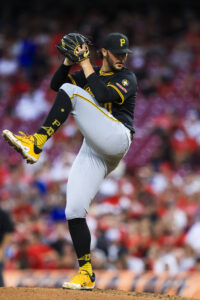
Only Logan Webb recorded more strikeouts. Skenes ranked fifth in strikeout rate (minimum 100 innings) and third behind Webb and Sánchez with 20 quality starts. He led the Senior Circuit with a 2.36 FIP and placed fifth with a 3.10 SIERA. FanGraphs and Baseball Reference each had him in essentially a dead heat with Sánchez for the Wins Above Replacement lead.
The 2023 first overall pick is widely considered one of the two best pitchers in the sport. There’s a fair debate between him and two-time AL Cy Young winner Tarik Skubal, but they’re almost certainly 1-2 in some order. Fans of other teams may dream about prying Skenes out of Pittsburgh, but that’s not happening anytime soon. General manager Ben Cherington stated in no uncertain terms yesterday that their ace would remain a Pirate in 2026. He’s under club control for another four seasons, and while a trade may be in the cards down the line, the immediate focus for player and team is getting the Bucs to the postseason. Skenes is the most important player on a team trying to break a decade-long playoff drought.
Sánchez had a breakout season to establish himself as a true ace for the Phillies. He fired 202 innings of 2.50 ERA ball across 32 starts. He finished fourth in the NL with 212 strikeouts. Sánchez had been a borderline top-of-the-rotation starter between 2023-24, earning a top 10 Cy Young finish in the second of those seasons. This was his first time posting a sub-3.00 ERA or topping 200 innings and strikeouts, so he certainly leveled up in his age-28 season. He’s signed through 2028 and under control through ’30 via a pair of club options on one of the most team-friendly contracts in the game.
Yamamoto’s World Series heroics weren’t a factor in the voting, which takes place at the end of the regular season. He earned his first All-Star nod and first Cy Young votes by turning in a 2.49 ERA across 30 starts. Yamamoto managed 201 strikeouts across 173 2/3 innings while leading the NL with fewer than six hits allowed per nine innings. Yamamoto had flashed ace potential in his first MLB season, but he was limited to 18 starts by a rotator cuff strain in 2024. He showed what he’s capable of in a full season in year two, and the Dodgers have won consecutive World Series in the first two seasons of his record-setting $325MM free agent contract.
Just over half of voters placed Yamamoto third. Webb received 10 third-place votes and finished fourth overall. Freddy Peralta picked up the four remaining third-place nods and landed in fifth place. Skenes and Sánchez were the only pitchers who appeared on every ballot. Nick Pivetta, Jesús Luzardo, Andrew Abbott and Zack Wheeler also received votes.
Image courtesy of Katie Stratman, Imagn Images. Full vote tally available courtesy of BBWAA.