
Yankees Interested In Luis Rengifo, Kyle Finnegan, Lucas Erceg
11:53am: Jorge Castillo of ESPN reports that the Yanks are more focused on pitching and acquiring Díaz is unlikely, which could perhaps apply to Rengifo as well.
11:49am: The trade deadline is just a few hours away now but teams are still scouring the market for upgrades. Per Jon Heyman of The New York Post on X, the Yankees have infielders Yandy Díaz and Luis Rengifo on their radar, as well as relievers Tanner Scott, Pete Fairbanks, Kyle Finnegan and Lucas Erceg. He adds that they could also look to add a starting pitching but might not meet the asking prices.
Some of those guys have already been connected to the Yankees in rumors. The connections with Rengifo, Finnegan and Erceg are new but also in line with their previously-reported pursuits. Even after adding Jazz Chisholm Jr. to the roster, they have seemingly still been looking for more infield help, which Rengifo could certainly help with.
The 27-year-old is in his third straight above-average offensive season. Since the start of the 2022 campaign, he’s hit .272/.323/.433 for a wRC+ of 110. He’s also stolen 35 bases in that time while bouncing to all three outfield spots and three infield positions to the left of first base. He’s not considered a strong defender at any one position but the ability to move all around is certainly attractive.
The Yanks are still trying to figure out their best alignment at the moment. Chisholm’s first game as a Yankee was in center field, where he has been spending most of his time in recent years. But then the Yanks moved him to third base last night, a position he had never played before. Now that Giancarlo Stanton is back and in the designated hitter slot, Aaron Judge moved to center field, flanked by Juan Soto and Alex Verdugo. Acquiring another infielder could result in Chisholm moving to second and bumping out Gleyber Torres, or perhaps Verdugo will get nudged out of the outfield mix.
Rengifo is making a modest $4.4MM this year, with roughly $1.5MM left to be paid out. That’s likely attractive to the Yankees as they are slated to be a third-time payor of the competitive balance tax and well above the top tier, meaning they will pay a 110% tax on anything they add to the ledger. He can also be retained via arbitration for 2025 and could perhaps slide into next year’s second base job with Torres slated for free agency after the current season. Verdugo is also an impending free agent, so perhaps Chisholm could be in the outfield with Rengifo on the infield. There’s also the looming Soto free agency to consider, though the Yanks are expected to be aggressive in trying to re-sign him. Rengifo has also been connected to clubs such as the Red Sox, Dodgers and Royals in recent weeks.
The extra year of control means that the Angels don’t have to move on from Rengifo but there would be logic in doing so as they haven’t been meaningfully competitive for quite some time. Now that Shohei Ohtani is gone and Mike Trout is having annual trouble staying on the field, the odds of them turning things around between now and the end of 2025 seem long.
Bullpen adds are generally on the radar of all contending teams and the Yanks are surely exploring all options there. Finnegan has been the Nationals’ closer for quite some time but is nearing the end of his window of club control, with one year remaining after this one. The Nats have already traded Hunter Harvey and Lane Thomas, two players that were also controllable through 2025, and Finnegan seems likely to move today as well.
He has a career 3.52 earned run average in 272 appearances. He has struck out 23.9% of batters faced, given out walks at a 9.4% rate and kept the ball on the ground at a 46.8% clip. That includes racking up 28 saves this year with a 3.48 ERA, 24.6% strikeout rate, 7.8% walk rate and 40.5% ground ball rate. He’s making $5.1MM this year.
Erceg can still be retained by the Athletics for five seasons beyond this one, but he’s a late bloomer who is now 29 years old despite his limited experience, which could tempt them to sell high. He has a 3.68 ERA this year, 26.3% strikeout rate, 8.3% walk rate and 50.5% ground ball rate. The fact that he’s pre-arbitration and therefore making a modest salary is surely appealing to the Yankees but the cost might be high. Even rental relievers are netting big returns at this year’s deadline so getting Erceg might take an uncomfortable haul.
Nationals To Select Travis Blankenhorn
The Nationals are calling up Travis Blankenhorn, reports Andrew Golden of the Washington Post (X link). They’ll need to select his contract but have a pair of openings on the 40-man roster after the Jesse Winker and Lane Thomas trades.
Blankenhorn, 28 next week, appeared in 10 games for the Nats last season. It was his fourth straight year reaching the majors, albeit without ever topping last season’s 37 plate appearances. Washington ran him through outright waivers at year’s end. The former third-round pick returned to the organization on a minor league deal in January.
The lefty-swinging Blankenhorn has spent the entire season with Triple-A Rochester. He’s hitting at a slightly above-average level, running a .246/.328/.518 line with 24 homers across 401 plate appearances. Blankenhorn also popped 23 homers in 108 Triple-A contests a year ago, so he clearly has decent power potential.
That has generally come with a fair amount of strikeouts and a fringy defensive profile. Blankenhorn has split his time between the corner outfield spots, first base and designated hitter. Considering the Nats just subtracted two of their corner outfielders, he could get his most extended look at MLB pitching over the season’s final couple months.
11 Long Shot Trade Candidates
We're less than 24 hours from the deadline. There has been a flurry of activity dating back to Thursday night, taking a few of the top names (e.g Randy Arozarena, Jazz Chisholm Jr., Carlos Estévez, Isaac Paredes) off the board. We've devoted ample attention to the likes of Garrett Crochet, Jack Flaherty and Yusei Kikuchi.
Every deadline features some late surprises. Talks don't always get over the line, but we're likely to hear about discussions on marquee names who are less clear trade candidates than are the good players with limited contractual control on bad teams. None of the following players are likely to be traded. They've probably each got less than a 20% chance of changing uniforms. There's an argument for teams to listen on these players, though they're of varying ability and trade value.
Skubal might be the best pitcher in baseball. If the Tigers trade him, it'd be the biggest transaction of the summer. He's probably the frontrunner for the American League Cy Young award behind a 2.35 earned run average with a 30% strikeout rate over 130 innings. Detroit is three games below .500 and 5.5 out in the Wild Card race. Last night's Carson Kelly trade shows they're willing to move rentals. Needless to say, a Skubal trade would be in another stratosphere of significance.

Unlock Subscriber-Exclusive Articles Like This One With a Trade Rumors Front Office Subscription
- Access weekly subscriber-only articles by Tim Dierkes, Steve Adams, and Anthony Franco.
- Join exclusive weekly live chats with Anthony.
- Remove ads and support our writers.
- Access GM-caliber tools like our MLB Contract Tracker
Guardians Acquire Lane Thomas
The Guardians have landed outfielder Lane Thomas in a trade with the Nationals, both teams announced. A trio of prospects — left-hander Alex Clemmey and infielders Jose Tena and Rafael Ramirez — are going back to Washington.
It was almost exactly three years ago that Thomas was part of another prominent deadline trade, coming to Washington from the Cardinals in exchange for Jon Lester. The move to the Nats and more consistent playing time unlocked something in Thomas, who performed brilliantly over the remainder of the 2021 season and then settled into a regular role in the Nationals’ outfield over the last three years. This season, Thomas has hit .253/.331/.407 with eight homers and 28 steals (out of 40 attempts) over 341 plate appearances, despite missing about a month of action with a sprained MCL.
Thomas’ emergence in Washington was soon followed by more trade speculation, as it wasn’t clear whether or not the Nationals would view this newfound breakout player as a building block, or as a trade asset to aid in their rebuild. Today’s move answers that question, as the Nats have dealt Thomas (who turns 29 next month) in the second of his three arbitration-eligible seasons. Thomas is earning $5.45MM this season and will be in for a raise next year before hitting the free agency market in the 2025-26 offseason.
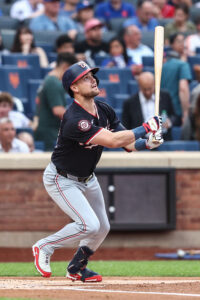
This extra year of control added to Thomas’ trade value, and ironically, the Guards themselves have traditionally looked to deal such increasingly-pricey players as they approach the end of their team control. With Cleveland in first place in the AL Central, the Guardians have instead looked to bolster their roster in major fashion, as Thomas can step right in as the team’s new regular right fielder. The left-handed hitting Will Brennan should still get a decent chunk of at-bats since Thomas has been much better against southpaws than against right-handed pitchers this season, but Thomas brings a needed right-handed bat to a Cleveland lineup perhaps a bit overloaded with lefty-swingers and switch-hitters.
The Guardians are opting for extra hitting over defense here, as Thomas’ public defensive metrics (-9 Defensive Runs Saved, -8.1 UZR/150, -7 Outs Above Average) have been very lacking. Cleveland has traditionally prioritized glovework in the outfield, yet while the lineup’s production has been better in 2024 than in recent seasons, Guards hitters have provided roughly average numbers league-wide. It seems quite possible the Guardians might still address their bigger need for rotation help before tomorrow’s deadline, but the Thomas trade is a key first step towards upgrading the roster for the stretch run.
From Washington’s perspective, the three-player package is a nice return for a season and two months’ worth of Thomas’ services. The Nationals have added one MLB-ready player in Tena who has already gotten some time in the Show, and two longer-term assets, including a noteworthy pitching prospect in Clemmey.
Cleveland’s second-round pick in the 2023 draft, Clemmey is just 11 days removed from his 19th birthday, and he has a 4.67 ERA over 69 1/3 innings at A-level Lynchburg this season. Clemmey has struck out batters at an impressive 32.6% rate, but his 15.8% walk rate is evidence of some control issues early in his pro career.
Baseball America ranked Clemmey seventh among Guardians prospects and MLB Pipeline had him eighth on their list, with both outlets wowed by his high-90s fastball. The fastball earned a 70 grade from both scouting reports and his curveball received a 60, giving him some impressive upside for rotation work if he can develop at least one more quality offering. While projections might be a bit difficult for such a young pitcher, Clemmey already looks like he could be a quality reliever, though obviously the Nationals will fully explore his potential as a starter.
Ramirez was ranked 20th in BA’s list of Guardians prospects and 22nd by MLB Pipeline. He is the son of former Braves/Astros infielder Rafael Ramirez Sr., and while the elder Ramirez spent most of his 13 Major League seasons at shortstop, the 19-year-old Ramirez might eventually end up as a third baseman or second baseman, as per the scouting reports. Ramirez is in his third year of pro ball and hasn’t hit much in A-ball this season after posting much bigger numbers in rookie ball in 2023.
Tena made his big league debut in the form of 18 games and 34 PA for Cleveland last season, and he has appeared in three games for the Guards in 2024. An international signing in 2017, Tena has spent his whole career in Cleveland’s farm system, and he has an eye-popping .308/.365/.522 slash line and 22 homers in 494 career PA at the Triple-A level.
Despite these big numbers, the 23-year-old Tena always seemed to be a bit of an odd man out amidst the Guards’ infield picture, especially with Jose Ramirez and Andres Gimenez locking down two positions. Tena’s big strikeout numbers probably didn’t play well within a Cleveland organization that prizes contact hitting, but he’ll now get another opportunity in the District. The Nationals have an infield cornerstone of their own in CJ Abrams and Luis Garcia Jr. has done well to re-establish himself as a regular second baseman, though Tena could potentially look to make an impact at third base or in a utility role.
The Athletic’s Ken Rosenthal (X link) was the first to report that Cleveland acquired Thomas, and FanSided’s Robert Murray (via X) reported that Clemmey was part of the trade package. ESPN’s Jeff Passan specified that the Nationals would be receiving three players in return for Thomas, and USA Today’s Bob Nightengale was the first to report on the inclusion of Tena and Ramirez.
Photo courtesy of USA Today Sports Images
Angels, Nationals Interested In Dylan Carlson
The Cardinals are exploring trades of outfielder Dylan Carlson and right-hander Giovanny Gallegos, reports Derrick Goold of the St. Louis Post-Dispatch. The club is set to add Erick Fedde and Tommy Pham in a trade that will subtract Tommy Edman, leaving them needing to open some active roster spots. Gallegos was already removed from the roster as he was designated for assignment yesterday. Jack Harris of the Los Angeles Times reports that the Dodgers are interested in Gallegos while John Denton of MLB.com relays on X that the Guardians, Angels and Nationals are interested in Carlson, though the Guardians just acquired Lane Thomas from the Nationals, which presumably lowers their interest in Carlson.
Carlson, 25, has been getting squeezed out of playing time this year as guys like Michael Siani, Brendan Donovan, Lars Nootbaar and Alec Burleson have been out on the grass more than he has. The crunch will be even tighter whenever Pham officially reports to the club. As mentioned, the club will have to open a couple of roster spots, so perhaps a trade of Carlson will come together between now and tomorrow’s deadline.
“Right now, he’s still one of our outfielders, but clearly we’re gonna have a roster crunch at some point,” president of baseball operations John Mozeliak said of Carlson today, per Jeff Jones of the Belleville News-Democrat on X. “So we’ll use the next 24 hours to see what happens, but he’s still a part of our organization right now and we’ll see where that goes.”
Sending out Carlson now would definitely be a sell-low move for the Cards. Not too long ago, he was the club’s first-round pick and one of their top prospects. He also seemed to be establishing himself as a solid regular in the major leagues when he first arrived. In 2021, he got into 149 games and hit 18 home runs while drawing walks at a 9.2% rate. He also received close to league average grades for his outfield glovework and was considered to be worth 2.4 wins above replacement on the year, per the calculations of FanGraphs.
That was only his age-22 season, so it seemed fair to expect better results going forward, but the opposite has happened. In 2022, Carlson went on the injured list a couple of times, first due to a left hamstring strain and then a left thumb sprain. He got into 128 games with his production slipping a bit, finishing that year with a line of .236/.316/.380 and a 99 wRC+.
Last year, left ankle issues sent him to the IL multiple times, limiting him to just 76 games and ultimately requiring surgery. He hit .219/.318/.333 on the year for a wRC+ of 84, another dip in his production but perhaps one connected to his health.
Coming into 2024, he seemed to have a chance to engineer a rebound. Both Edman and Nootbaar were slated to start the season on the IL, which should have opened up plenty of playing time for Carlson. Unfortunately, just at the end of Spring Training, Carlson and Jordan Walker collided while trying to make a catch in the outfield. Carlson was diagnosed with a sprained AC joint in his left shoulder and also had to start the season on the IL.
He was back by early May but, as mentioned, hasn’t been able to earn much playing time this year. When in the lineup, he hasn’t done much to earn a longer leash, having hit .198/.275/.240 here in 2024.
Perhaps some clubs will be eyeing Carlson as a change-of-scenery candidate. He’s been trending downwards for three straight years now but mostly due to injuries. It’s feasible that with some health luck and regular playing time somewhere, he could return to the form he showed a few years back. He is making a modest $2.35MM salary this year and has two more years of control left. He’ll be due raises in arbitration but won’t be able to push his salary up much based on his recent results and injury absences. Carlson also has options and doesn’t necessarily need to be traded, though the Cardinals may prefer to just cash him in for something now as he may no longer be in their future plans.
The Nationals have moved on from a few veteran outfielders already this year. Eddie Rosario and Víctor Robles were released and Jesse Winker was traded to the Mets. As mentioned, Thomas was just flipped to the Guardians. Perhaps they could slot Carlson in there next to James Wood and Jacob Young.
The Angels would be in a somewhat similar position. They are giving outfield playing time to guys who could be traded like Taylor Ward and Kevin Pillar. If they pull the trigger on a deal for either of those guys, they could grab Carlson in a buy-low move and give him some run for the rest of this year or perhaps next year.
Gallegos would also be a sell-low move, but the Cards don’t have much choice there. He’s an impending free agent and they already sent him off the roster and into DFA limbo. He was one of the better relievers in the league not so long ago, tossing 228 1/3 innings over the 2019-22 seasons with a 2.84 ERA. He struck out 32% of batters faced in that time and only gave out walks at a 6.6% rate, earning 33 saves and 56 holds in the process.
But his ERA jumped to 4.42 last year as his strikeout rate fell to 25.8%. Here in 2024, his punchouts have fallen to a rate of 22.3% as his ERA has climbed to 6.53. That got him nudged off the roster but the Dodgers have a solid reputation of getting good results from pitchers and perhaps see a way to get Gallegos back on track. He is making $5.5MM this year, with roughly $1.8MM still to be paid out. The Dodgers are slated to be third-time payors of the competitive balance tax and well over the top tier, meaning they face a 110% tax rate on anything they add to their payroll at this point.
Dodgers Trade Rumors: Flaherty, Finnegan, Paredes, Hoerner, Rengifo
The Dodgers are expected to be very active prior to the July 30 trade deadline, as while Los Angeles still has the fourth-best winning percentage (.585) in baseball, the team is just 10-12 in its last 22 games. Injuries all over the roster have left L.A. with plenty of holes to fill, and the Dodgers are therefore casting a wide berth in exploring possible deadline pickups.
With starting pitching a particular need, Tigers right-hander Jack Flaherty is a Dodgers target, according to Evan Petzold of the Detroit Free Press. Nationals reliever Kyle Finnegan, Rays third baseman Isaac Paredes, Cubs second baseman Nico Hoerner, and Angels infielder Luis Rengifo have also received consideration, as per USA Today’s Bob Nightengale, since the Dodgers are trying to shore up both their bullpen and the infield.
Since Flaherty is a free agent after the season, he is one of the more obvious rental candidates available considering that the Tigers (despite some good recent play) are still only 52-54 and more on the outskirts of the AL wild card race. As noted by both Petzold and Nightengale, Detroit’s asking price for Flaherty is both high and somewhat straight-forward — teams will have to offer the Tigers something they deem more valuable than the compensatory draft pick the Tigers would receive this winter if Flaherty rejects the team’s inevitable qualifying offer and signs elsewhere.
The Dodgers’ rotation needs have somewhat lessened now that Tyler Glasnow is back from the injured list and Clayton Kershaw has made his season debut, but L.A. still has a whopping nine pitchers on the IL. Walker Buehler is on a Triple-A rehab assignment, though Yoshinobu Yamamoto‘s timetable is still unclear, and Yamamoto will be out until late August at the earliest as he recovers from a triceps injury. Los Angeles did feel comfortable enough in its pitching depth to deal James Paxton to the Red Sox, but Flaherty is more of a front-of-the-rotation type that could conceivably start a playoff game.
Likewise, Finnegan could slot right into what has become something of a fluid late-game mix. Evan Phillips is still ostensibly the Dodgers’ top choice as closer, though his recent struggles have brought Daniel Hudson and Blake Treinen into the picture as save candidates. Manager Dave Roberts recently stated that Phillips could be deployed in any high-leverage situation late in games rather than specifically just the ninth inning, which opens the door for L.A. to solidify things by landing another experienced closer like Finnegan.
Since Finnegan is arbitration-controlled through 2025, he’d also be able to help Los Angeles next season in addition to this year’s playoff run. This extra year of control means that the Nationals would get an even nicer return by moving him at the deadline, though D.C. might consider waiting until the offseason to gauge offers if nobody steps up with an acceptable enough trade package by Tuesday. The Nats already got a good score in moving Hunter Harvey to the Royals earlier this month, and between the Harvey deal and yesterday’s trade of Jesse Winker to the Mets, Washington is clearly in sell mode.
The infield targets all come with varying degrees of control beyond just the 2024 season. Rengifo is arb-controlled through 2025, Paredes is arb-controlled through 2027 as a Super Two player, and Hoerner is signed through 2026 via the three-year, $35MM deal he inked prior to the 2023 season. That extension started this year, so Hoerner is owed roughly $3.9MM in salary for the rest of 2024, as well as $11.5MM in 2025 and $12MM in 2026.
Sticking with Hoerner, that is a decent-sized price tag for a Dodgers team already far over the highest tier of luxury tax penalization. In terms of both the actual salary and the added tax hit, Hoerner’s dollar value would come at more than double the size of his contract, as the Dodgers have an additional repeater penalty for exceeding the Competitive Balance Tax in each of the previous three seasons. This cost could be reduced if Los Angeles sent another contract to Chicago in return, or the Cubs could absorb more of Hoerner’s deal if the Dodgers improved the value of the trade package.
The latter scenario could involve better prospects, or perhaps more win-now types of players for a Cubs team that is still aiming to contend in 2025, even if 2024 is looking like a wash. Moving a reliable everyday player like Hoerner would be a bold move for the Cubs, yet for a team that has a good amount of middle infield depth, trading Hoerner could allow Chicago to upgrade in other areas.
A defensive standout at either middle infield position, Hoerner could give the Dodgers an answer to their shortstop woes, as both Mookie Betts and Miguel Rojas are injured. Installing Hoerner at short would allow Betts to play second base (or even move back to the outfield) when he is healthy, and Rojas and Gavin Lux would then assume depth roles. With Hoerner locked up through 2026, the Dodgers could then explore returning Betts back to right field altogether, or perhaps at least limit him to second base when he does get infield work.
Rengifo is a utility player who can play all over the diamond, though he doesn’t offer strong glovework at any position. The switch-hitter does bring more offense than Hoerner, and Rengifo has returned in seemingly good health after a three-week absence due to wrist inflammation. Perhaps the biggest obstacle to a Rengifo trade for the Dodgers would be the fact that the two L.A. teams are infrequent trade partners. Ironically, Rengifo was part of an infamously scuttled trade between the Angels and Dodgers in February 2020, which reportedly left Halos owner Arte Moreno upset at the idea of ever again doing business with his local rivals.
Conversely, the Rays and Dodgers have lined up on several trades over the years, including the blockbuster deal that sent Glasnow to Los Angeles just this past offseason. This could help the Dodgers in working out a Paredes trade, who would likely play third base with Max Muncy‘s recovery from an oblique strain still up in the air. Since Muncy is signed through at least 2025 and Paredes would be a longer-term addition, one of the two could likely be moved to second base in 2025, which also helps the Dodgers’ middle infield picture to some extent. The Rangers, Astros, and Mariners are among the other teams who have been linked to Paredes in recent rumors, though intriguingly, Nightengale writes that the Yankees and Dodgers are in a “bidding war” over the All-Star infielder.
Mets Acquire Jesse Winker
7:47AM: The trade has been officially announced.
TODAY, 7:25AM: The Nationals will be acquiring right-handed pitching prospect Tyler Stuart in the trade, The Athletic’s Will Sammon reports (via X). Stuart was a sixth-round pick in the 2022 draft, and he has a 3.96 ERA, 25.4% strikeout rate, and 5.6% walk rate in 84 innings for Double-A Binghampton this season. The 6’9″ righty was a reliever at Southern Miss but has worked almost exclusively as a starter in his pro career, and MLB Pipeline (which ranks Stuart 17th in the Mets’ farm system) feels he’ll need to develop a third pitch beyond his solid slider and 94mph fastball in order to stick as a starting pitcher.
YESTERDAY: The Mets are poised to acquire outfielder Jesse Winker from the Nationals, according to ESPN’s Jeff Passan. As noted by Andrew Golden of The Washington Post, the deal is currently in place pending a physical. The return headed to D.C. in exchange for Winker’s services is not yet known.
Winker, 31 next month, was a first-round pick by the Reds back in 2012 and posted excellent numbers across five seasons with the club. From 2017 through 2021, Winker slashed .288/.385/.504 with a 132 wRC+ as the club’s regular left fielder, though he was generally protected from left-handed pitching during his years in Cincinnati. Even as he typically sat against southpaws, however, Winker’s ability to mash right-handed pitching earned him an All-Star nod back in 2021 when he posted a 148 wRC+ in 485 trips to the plate. Following the 2021 season, Winker found himself dealt to Seattle alongside Eugenio Suarez in a blockbuster that sent Justin Dunn, Jake Fraley, and Brandon Williamson to Cincinnati.
Upon departing the Reds, however, Winker began to struggle. A down season in Seattle where he posted a wRC+ of just 108 alongside a career-low isolated slugging percentage led the Mariners to deal Winker back to the NL Central following the 2022 campaign, this time alongside Abraham Toro in order to land second baseman Kolten Wong from the Brewers. Winker’s time in Milwaukee represented a low point for him, as he battled neck injuries and struggled badly when healthy enough to take the field. While Winker walked at his typically strong 13.2% clip with the Brewers, he hit .198 while mustering just one home run in 197 trips to the plate, leaving him with a 65 wRC+ that was 35% worse than league average last year.
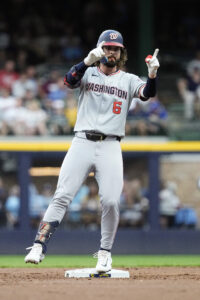 That disastrous 2023 campaign led Winker to sign with the rebuilding Nationals on a minor league deal in his first trip through free agency last winter, and Winker found himself selected to the club’s Opening Day roster. While splitting time between left field and DH for the Nationals, Winker has rebounded back to the level of offense that was standard for him in his days with the Reds. In 100 games with Washington this year, he’s hit an impressive .253/.372/.417 with 11 home runs, 14 stolen bases, and a fantastic 14.1% walk rate in 376 trips to the plate this year.
Winker’s production still comes predominantly against right-handed pitching, against whom he sports a 138 wRC+ on the year, but he’s improved substantially against southpaws this year to post a roughly average 93 wRC+ against them. That’s a major step up from his career year in 2021 when he posted a wRC+ of just 57 against lefties.
For the Mets, Winker appears unlikely to be an everyday player given the presence of J.D. Martinez as the club’s regular DH and Brandon Nimmo patrolling left field on an everyday basis. With usual center fielder Harrison Bader currently dealing with an ankle injury, it’s possible that Winker could see some starts in left field with Nimmo sliding over to center while Bader is injured. Both Nimmo and Winker also have sporadic experience in right field through their careers as well, meaning the Mets could look to install each into an outfield corner on either side of Bader while Starling Marte is on the injured list in a move that would likely push Jeff McNeil either out of the lineup or back onto the infield dirt.
Regardless of how often Winker figures to be in the Mets lineup, he’s sure to provide a boost to the club’s offense. DJ Stewart is currently being utilized as a defensively-limited bat off the bench in Queens but has delivered a wRC+ of just 95 with a .674 OPS against right-handed pitching. Winker’s 128 wRC+ and .834 OPS against right-handers both clear those marks easily, and it’s easy to imagine Winker being used in a similar role to the one Stewart has accumulated 184 trips to the plate in this year while bouncing between DH, the outfield corners, and even first base as needed.
Photo courtesy of USA Today Sports Images
Royals Interested In Luis Rengifo, Taylor Ward
The Royals are looking to add a right-handed hitter, reports Jayson Stark of the Athletic (via Ken Rosenthal’s latest column). The Angels’ Luis Rengifo and Taylor Ward are under consideration, as is Washington’s Lane Thomas.
Rengifo is a switch-hitter who does more damage from the right side. Ward and Thomas are strictly right-handed bats. Rengifo is the most valuable of the trio. He’s having the best season of the group and provides the most defensive flexibility. Rengifo isn’t a great defender but he can bounce between second and third base and moonlight at shortstop. He wouldn’t need to worry about the latter position in Kansas City. The Royals have gotten very little offense out of Maikel Garcia at the hot corner. Lefty-swinging second baseman Michael Massey was playing well early in the season before slumping this month.
The 27-year-old Rengifo would be a significant offensive upgrade. He goes into play tonight with a .308/.352/.432 slash across 285 plate appearances. It’s his second straight above-average offensive performance. Rengifo makes a ton of contact, fitting the Royals’ general style of hitter. He topped 15 homers in both 2022 and ’23. This year’s production has been more OBP-oriented as he has cut his strikeout rate to a personal-low 13% clip. Over the past two and a half seasons, he owns a massive .328/.368/.555 slash against left-handed pitching.
Thomas and Ward have a more limited defensive profile as corner outfielders. The Royals could certainly look to upgrade in left field, where MJ Melendez was underperforming before landing on the injured list. Thomas might be more of a platoon target. He mashes southpaws but posts below-average numbers against same-handed pitching. Since landing in Washington at the 2021 trade deadline, he has tattooed lefties at a .310/.371/.525 clip. He’s hitting .231/.294/.398 versus righties in that time. Thomas has had similarly stark splits this season and has a league average .247/.323/.397 slash in aggregate.
Ward has looked like an All-Star caliber player at his best, highlighted by a .281/.360/.473 season two years ago. His production has been more pedestrian over the past season and a half, as his line has hovered around league average. Over 424 plate appearances this year, the former first-round pick has a .226/.309/.396 line. As with Thomas, Ward does an inordinate amount of his damage with the platoon advantage. He’s hitting .294/.365/.468 against lefties since the start of 2022. His .243/.328/.423 slash versus right-handed pitching over that stretch is more solid than elite.
All three players are under team control beyond this season. (Anne Rogers of MLB.com tweeted this afternoon that the Royals would be reluctant to relinquish players at the top of their thin farm system for rentals.) Rengifo and Thomas are eligible for arbitration through next year, while Ward is controllable until the 2026-27 offseason. They’re each similarly costly from a financial perspective. Rengifo’s the lowest-paid of the group at $4.4MM, while Thomas is most expensive at $5.45MM. The prospect cost should be highest for Rengifo, who’ll have broad appeal in a market that’s very light on infield talent.
Notable Draft Signings: 7/25/24
Pre-draft rankings and scouting reports are provided by Keith Law of the Athletic, Baseball America, FanGraphs and ESPN’s Kiley McDaniel. A round-up of today’s draft signings for upwards of $2MM:
- The Mets agreed to terms with 19th overall pick Carson Benge on a $3.9975MM bonus, reports Jim Callis of MLB Pipeline (X link). That’s narrowly below the approximate $4.22MM slot value. Benge was generally regarded as a mid-late first round talent and ultimately landed there in the draft. He was a two-way player at Oklahoma State but is viewed as an outfield prospect in pro ball. A left-handed hitter, Benge draws praise from evaluators for his contact skills and power projection. He’s generally viewed as a right field prospect. McDaniel likens his profile to that of Orioles rookie outfielder Colton Cowser. Benge hit .335/.444/.665 with 18 homers and 24 doubles over 61 games as a draft-eligible sophomore.
- Nationals second-round pick Luke Dickerson agreed to a $3.8MM deal, Callis reports (on X). That’s well above the $2.12MM value for the 44th overall pick. Callis notes that it’s the largest deal for a player selected after the supplemental round in the bonus pool era. The bonus aligns with what would be expected for a player drafted in the early 20s. That’s a bit of a surprise, as Dickerson rated as a late second-round talent on most pre-draft lists. The Nats are evidently higher on the righty-swinging middle infielder and were motivated to keep him from attending the University of Virginia. A New Jersey high schooler, he’s viewed as a hit-first infielder who probably projects to second base.
- The Pirates announced the signing of competitive balance draftee Levi Sterling. Jonathan Mayo of MLB Pipeline reports (X link) that the high school righty landed a $2.5114MM bonus to match the 37th pick’s slot value. A Texas commit, Sterling is a 6’5″ righty with advanced control. Law writes that his changeup is the headlining pitch in his arsenal. Sterling doesn’t throw especially hard right now but could add velocity given his frame. He’s regarded as a potential back-end starter.
Phillies Showing Interest In Lane Thomas, Kyle Finnegan
The Phillies are about as well-positioned as any team with the deadline approaching. While Philadelphia has tailed off lately and is playing at a .500 pace this month, they’re nine games clear of the Braves in the NL East. They hold a three-game edge on the Dodgers for the top record in the National League and have arguably the most well-rounded roster in MLB.
They’re obviously positioned as buyers and should at least make some additions around the margins. They’ve been seeking a right-handed hitting outfielder for the last couple weeks. The bullpen has fallen on hard times this month, making that another obvious area for potential upgrade.
One of Philadelphia’s division rivals would make for a natural trade partner. Matt Gelb of the Athletic reports that the Phils have expressed interest in Nationals’ outfielder Lane Thomas and closer Kyle Finnegan. Washington could market both players, each of whom is under arbitration control for one more season. The Nats are considering offers on players they control for this season and next. They already dealt one such player, setup man Hunter Harvey, to the Royals in one of the more impactful moves in what has been a slow-moving deadline season.
Thomas is a right-handed hitter who does the vast majority of his damage in favorable platoon situations. He is destroying lefties at a .329/.414/.518 clip over 99 plate appearances this season. While a half-season platoon split is an extremely small sample, Thomas has been a lefty masher throughout his career. He’s a .307/.369/.520 hitter against southpaws. Thomas has produced below-average numbers versus righties. That has again been the case this year, as he’s hitting .211/.269/.347 without the platoon advantage.
The Nats have maintained they view Thomas as more than a short-side platoon bat. He has been in the starting lineup for 73 of the team’s 102 games. That includes a couple starts in center field, but Thomas is best served in a corner. He’s a middling defender even in right field.
Thomas isn’t the answer if the Phils are looking to upgrade over Johan Rojas in center field. Philadelphia would like a lefty-hitting complement for Brandon Marsh in left. Marsh has been an above-average bat (.274/.350/.448) against righties over his career. He hasn’t done anything against left-handers, striking out more than 40% of the time en route to a .211/.268/.289 slash.
Gelb writes that the Phillies aren’t exclusively looking at right-handed hitters in their outfield search. They could upgrade on either Rojas or Nick Castellanos in right if they landed an everyday player. A Thomas-Marsh platoon in left would yield excellent results, although it remains to be seen if the Phils are willing to meet Washington’s asking price to immediately curtail Thomas’ playing time. The 28-year-old outfielder is playing on a $5.45MM salary.
Finnegan is a more valuable trade asset. He was a first-time All-Star this summer after a few seasons of quietly strong work at the back of the Washington ‘pen. Finnegan has worked as their closer for most of the past four years. After three straight seasons allowing between three and four earned runs per nine, he carries a 2.32 mark over 42 2/3 frames. Finnegan is 28 of 32 in save chances and has solid peripherals.
The righty has fanned 26% of batters faced against an 8.3% walk percentage. He’s sitting north of 97 MPH with his fastball and is getting swinging strikes at a decent 11.8% clip. Finnegan’s stuff is probably a tick below that of the top handful of relievers in the game, but he’s a consistently effective presence with ample ninth inning experience.
Philadelphia’s closing situation has been in flux with José Alvarado scuffling lately. Gregory Soto took the ninth in a tied game today against Minnesota. He hit a batter and allowed a walk-off single after a sacrifice bunt. Soto has been prone to bouts of wildness throughout his career, making him an imperfect fit for the ninth. Finnegan, who is making $5.1MM, has been a much more consistent strike-thrower.
Thomas and Finnegan may be obvious fits for the Phillies’ needs, but they’re surely two of many players the front office is considering. Acquiring either player (or both, in a package deal) could be complicated by the difficulty of trading within the division. Detroit’s Mark Canha, Oakland’s Brent Rooker and the Angels’ Kevin Pillar are among other righty-hitting outfielders who’d make sense as speculative targets. (USA Today’s Bob Nightengale tied the Phils to Rooker earlier this month.) There are no shortage of relievers who’ll move in the next few days, with Miami’s Tanner Scott and the Halos’ Carlos Estévez clear candidates as rental closers on bad teams.
One area which is evidently not a priority: the rotation. Gelb writes that the Phils are not emphasizing the starting staff and remain reluctant to part with their top prospects. Jon Morosi of MLB.com tweeted yesterday that the Phils were discussing Garrett Crochet and Jack Flaherty. Philadelphia already has a strong starting five, so it’d be very surprising to see them beat offers by other teams that much more desperately need rotation help for those top-of-the-market starters.