
Stewart: D’Backs Won’t Sacrifice Another Draft Pick
After giving up the 13th overall pick in this summer’s draft to sign Zack Greinke, the Diamondbacks are not interested in parting with another choice, GM Dave Stewart tells MLB.com’s Steve Gilbert. That would appear to take Arizona out of the running for any of the remaining free agents who would require draft picks to sign since they rejected qualifying offers earlier at the outset of the offseason.
The D’Backs’ top remaining selection is a Competitive Balance Round A choice that currently rates as the 37th overall choice, though that number will change as QO-bound free agents pick their destinations. “We’re not going to give up the pick,” Stewart said. “It’s just tough after we’ve already given up our first pick. To give up our top two picks, that would be difficult for us to do.”
That stance would appear to put a damper on a report earlier today suggesting that the club was still in talks with infielder Howie Kendrick, who rejected a qualifying offer from the Dodgers. Stewart said there was appeal to adding a veteran infielder, “only just for the security of it,” but noted that the team still feels good about what it well get out of its younger position players. Notably, though he made clear that the team has no inclination to punt a pick, he did not rule out other avenues to acquiring an established player from that mold.
While it is not surprising to hear that the club values the draft pick, it is frankly somewhat surprising to hear Stewart rule out its sacrifice so conclusively. After all, that choice is far less valuable than the one already parted with. And while any other free agent would likely pale in comparison to Greinke in terms of expectations, Arizona has already sought to push up its competitiveness timetable by signing him and giving up a big haul for fellow righty Shelby Miller. There’s always a place to draw a line, of course, but this does seem like a somewhat curious place to make a firm stand.
It’s worth noting, in that regard, that this is the same team that arguably did not maximize its draft and international spending capacity last year. Arizona also traded its first-round choices from 2014 (Touki Toussaint) and 2015 (Dansby Swanson) in recent months. Of course, the organization has gone against the grain in numerous ways, and seen many of its decisions called into question, yet certainly looks to be in a stronger overall position than many would have anticipated this time last year.
Stewart went on to add that the Snakes are still looking for relievers, though he said there are some intriguing young in-house options that could compete for a spot. The Diamondbacks have been connected to a variety of names in trade scenarios, but it appears that the current asking prices are too high. “I can tell you it will be difficult to do it by a trade,” Stewart said. “So we’re going to look through the free-agent market and see what else is left. I think that’s the way it’s going to have to happen if we’re going to do it at all.”
NL Central Notes: Engel, Cervelli, Rodriguez, Bruce
Former Blue Jays scouting director Bob Engel is heading to the Reds organization as the new international cross-checker, according to reports from Jonathan Mayo of MLB.com (via Twitter) and Bob Elliott of the Toronto Sun (on Twitter). Cincinnati has made some notable international signings in recent years with Raisel Iglesias and Aroldis Chapman.
Here are a few more notes from the NL Central:
- Pirates catcher Francisco Cervelli is coming off of a breakout campaign in which he contributed in all facets and stayed on the field, as MLB.com’s Adam Berry writes. Cervelli says he’d love to stay with Pittsburgh for the long term, though he added that he has not been contacted by the front office regarding extension talks and would let his agent handle any such matters. Certainly, it would be interesting to see how negotiations would progress if they do occur, as Cervelli could be a highly sought-after free agent if he can repeat his 2015 campaign. But there’s also plenty of downside, as that was the first time he put it all together over a full season.
- Young outfielder Yorman Rodriguez could find a chance with the Reds this spring, MLB.com’s Mark Sheldon writes. The out-of-options 23-year-old will likely compete with other inexperienced players like Scott Schebler and Adam Duvall. Rodriguez put up a .269/.308/.429 slash last year over 326 Triple-A plate appearances.
- All of those outfielders would benefit, of course, if the Reds end up trading Jay Bruce, of course, although it would stand to reason that the organization will bring in some low-cost veterans once the market shakes out. As for Bruce, Sheldon reports that the Indians have replaced the Blue Jays on his limited no-trade list — likely a reflection of the fact that Cleveland has been pursuing outfield help this winter. The other clubs to which Bruce can block a deal are the Yankees, Red Sox, Athletics, Rays, Marlins, Twins, and Diamondbacks. Sheldon breaks down the possible suitors for the left-handed hitting veteran.
Padres, Ian Desmond Having Ongoing Discussions
TODAY: Discussions between the two sides are “very preliminary,” according to Jon Heyman (via Twitter). While there is an expectation that the Pads will have talks this week with Desmond’s camp, Heyman says the purpose will be “to see if there’s anything to talk about.”
YESTERDAY: The Padres and free agent shortstop Ian Desmond are having ongoing discussions, according to major league sources who spoke with Jon Paul Morosi of FOX Sports. Even though that match would make a lot of sense, no deal appears to be imminent between Desmond and San Diego, Morosi adds.
Morosi notes that Desmond hit 88 home runs over the past four seasons and in that same span the Padres scored the second-fewest runs in the majors. Meanwhile, their 2015 shortstop Alexi Amarista had the worst OPS (.544) of any National League player with at least 300 at-bats last season. Financials and, perhaps, their timeline for contention aside, the Padres sound like the perfect landing spot for Desmond.
Desmond picked up three straight Silver Slugger awards from 2012 through 2014, and owns a .264/.317/.443 since he began his breakout in 2012. While that line was down overall in 2015, his .307 BABIP did fall shy of his career .322 mark and he showed more life at the plate at times later in the season. The 30-year-old’s calling card is his ability to deliver power from a middle infield position, but his reps have also been highlighting his defensive ability when meeting with teams. The Padres would slot Desmond in as their starting shortstop without hesitation, but Desmond appears to be open to playing other positions in an effort to broaden his market.
Desmond declined his qualifying offer from the Nationals back in November, but San Diego’s top pick (8th overall) is protected. The team also stands to add two compensatory picks if and when Justin Upton and Ian Kennedy land elsewhere. At the outset of the offseason, MLBTR’s Tim Dierkes predicted that Desmond would land a five-year, $80MM deal.
Minor MLB Transactions: 1/4/16
Here are the day’s minor moves:
- The Angels have agreed to a minor league deal with infielder Gregorio Petit, MLB.com’s Alden Gonzalez reports on Twitter. He’ll receive an invitation to major league camp this spring. Petit, 31, has appeared in 82 big league games in parts of four seasons, including a brief stint last year with the Yankees. He’s spent quite a bit of time at Triple-A, compiling a .267/.320/.370 batting line in 3,029 plate appearances spread over eight years. Petit has mostly played shortstop, but has also compiled over 1,000 frames at second and third. He figures to provide some depth and a possible utility option for a Halos club that is still looking to fill out its infield.
Free Agent Notes: Orioles, Gallardo, Marlins, Pearce
The Orioles appear poised to once again do quite a bit of their offseason shopping after the New Year, tweets ESPN’s Buster Olney. According to Olney, the Orioles remain engaged on a number of free agents, which isn’t a surprise given the holes permeating the roster. While the O’s have addressed catcher (perhaps unexpectedly in the form of Matt Wieters accepting the qualifying offer), one corner outfield spot (Hyun-soo Kim) and first base/DH (Mark Trumbo), the team still has needs in the rotation and in right field, to say nothing of a potential reunion with Chris Davis (which would move Trumbo to DH or right field).
Here are a few notes on the market’s remaining free agents…
- One of those free agents appears to be Yovani Gallardo, as SB Nation’s Chris Cotillo tweets that the the Orioles, Astros and Royals remain the primary suitors for the right-hander. All three of those teams, of course, have been prominently linked to Gallardo in the past, so this isn’t necessarily a new development in his market. However, it’s been awhile since we’ve heard much on the Gallardo front, and the news that all three remain interested is still noteworthy. Any of the three clubs would have to part with a draft pick to sign Gallardo, which might make Kansas City the best fit, as their current pick, No. 24, is the worst of the three teams said to have interest. Additionally, the Royals will gain a draft pick if Alex Gordon signs elsewhere, as many expect, thus softening the blow of parting with the 24th overall selection. The O’s could conceivably land two picks in the event that Davis and Wei-Yin Chen sign with new clubs, but parting with the No. 14 pick would still sting, even if they could recoup much of that slot value via the potential comp picks.
- If and when the Marlins finalize their near-agreement with right-hander Edwin Jackson, the team will continue its search for starting pitching, writes MLB.com’s Joe Frisaro. Among the names that could interest the Marlins are Cliff Lee, Doug Fister, Ian Kennedy and Cuban right-hander Yaisel Sierra, writes Frisaro. However, he notes that the draft pick compensation attached to Kennedy could prevent the Marlins from a strong pursuit of Kennedy. That would seem an odd hold-up for Miami — an organization that has been perfectly willing to trade its Competitive Balance draft selections for seemingly underwhelming returns in past seasons (although their addition of right-hander Bryan Morris in such a trade does now appear to have been a shrewd one). It should also be noted that Kennedy is represented by Scott Boras, with whom Marlins owner Jeffrey Loria and Marlins president David Samson have clashed on numerous occasions over the past year (most notably regarding Boras-represented Marlins players Marcell Ozuna and Jose Fernandez).
- Infielder/outfielder Steve Pearce is seeking a two-year deal, Rich Dubroff of CSN Mid-Atlantic tweets. He still looks like an interesting bat, and his market remains an interesting one to watch, but Pearce could be forced to wait for more action at the higher end before things clear up for his own outlook. MLBTR’s Tim Dierkes predicted that Pearce would ultimately get a two-year deal with $14MM in guaranteed money.
D-Backs Having “Ongoing Discussions” With Howie Kendrick
Last week, GM Dave Stewart told the Arizona Republic’s Nick Piecoro that his Diamondbacks have been in contact with second baseman Howie Kendrick, and today, FOX’s Jon Morosi characterizes discussions between the two sides to be “ongoing.” Nothing is close between the two sides, per Morosi, and it should be noted that Piecoro wrote last week that the D-backs seem reluctant to sign a player that would require draft pick forfeiture, as Kendrick would.
Arizona has a number of infield options already, though presumed starter Chris Owings certainly doesn’t have Kendrick’s track record and is, in fact, coming off a dreadful season that was submarined by shoulder problems. Other internal options for the Diamondbacks at second base include prospect Brandon Drury (though he can also play third base) and struggling veteran Aaron Hill, who has one season remaining on his deal.
Despite the presence of in-house alternatives — at least one of whom, Owings, was recently viewed as a core player in the future — this isn’t the first instance of the D-backs being connected to second base upgrades. Arizona was also said to have discussed a swap of Hill and Reds second baseman Brandon Phillips. While that may appear curious at first glance, such a move would’ve saved the Reds quite a bit in terms of salary and relieved some burden from their payroll in the nearer future; Arizona, in turn, would reallocate Hill’s salary to a more productive veteran player. Ultimately, Piecoro reported last week that the D-backs weren’t comfortable with the salary that the Reds wanted them to assume in a Phillips/Hill swap. (And, of course, there’s the question of the trade veto ability that comes with Phillips’ 10-and-5 rights.)
Digression aside, Kendrick would seem to represent an upgrade over what the D-backs have in house. The 32-year-old has batted .295/.340/.414 over the past three seasons despite playing in considerably more pitcher-friendly environments than Arizona’s Chase Field. Kendrick has been remarkably consistent throughout his Major League tenure, providing offense that rates anywhere from a shade below to considerably above the league average when looking at league- and park-adjust metrics such as OPS+ and wRC+. Kendrick has never batted lower than .279 in a full season and never posted an OBP south of .313. His career .293/.333/.423 batting line is impressive and a reflection of his repeated seasons of quality at-bats.
However, Kendrick isn’t without his red flags, either. Much of his value has come from his quality defense over the years, and he took a significant step backwards in that regard last season. Ultimate Zone Rating and Defensive Runs Saved pegged Kendrick at -4.5 and -12 runs, respectively, despite his longstanding history of solid glovework. Kendrick, who has also been highly durable, missed more than a month on the disabled list due to a hamstring strain as well. While that incident could very well be isolated in nature, one can’t blame any team for hesitating to surrender a draft pick in order to sign a 32-year-old second baseman with a good-but-not-great bat and possibly deteriorating defensive skills to a long-term pact.
Morosi also notes that the Angels could potentially fit the description of a contending team with a need at second base, though I’d add that owner Arte Moreno’s aversion to the luxury tax would make that a tough fit. If the Angels were to sign Kendrick, from my view, they may as well sign an impact left field bat to upgrade the lineup at that point, shifting Craig Gentry and/or Daniel Nava into backup roles.
Doug Fister Has Received One- And Two-Year Offers
Doug Fister is one of many intriguing names still available on the free-agent market, and according to ESPN’s Buster Olney, the right-hander has received offers of one and two years in length from multiple clubs (Twitter link). To this point, it’s been a quiet offseason in terms of rumors pertaining to the PSI Sports client, although the Tigers, Phillies and, more recently, the Marlins have all been connected to Fister in media reports. (Detroit’s interest was mentioned in November, so he’s probably off the Tigers’ radar now. The same may be true of the Phillies, who were linked to Fister in early December.)
Entering the 2015 season, Fister was part of what looked to be a star-studded class of elite and second-tier arms that were slated to hit the open market this winter. However, the 2015 campaign was the worst of his career by nearly any measure. Fister, of course, began the season in one of the game’s deepest rotations (Nationals), but he surprisingly struggled to the point where he lost his starting job and was moved to the bullpen. While he’s never thrown hard in the past, Fister opened the season averaging just over 86 mph on his fastball and eventually landed on the disabled list in mid-May with a bout of forearm tightness. He returned about a month later but didn’t see much in the way of improved results. All told, the 31-year-old (32 in February) recorded an uncharacteristic 4.60 ERA across 15 starts in his second (and presumably final) season with the Nats. In those 15 starts, Fister logged 86 innings (about 5 2/3 innings per outing) and struck out just 48 hitters — an average of 5.01 per nine innings. Fister’s 4.63 FIP, 4.60 xFIP and 4.70 SIERA all matched his unsightly ERA, and his 42 percent ground-ball rate out of the rotation this season was the lowest of his career.
While there’s clearly a long list of red flags surrounding Fister, the upside he brings to the table is also tantalizing. From 2011-14, Fister was one of baseball’s most underrated player, recording a pristine 3.11 ERA with 6.5 K/9, 1.7 BB/9 and a 50.5 percent ground-ball rate across 750 2/3 innings. He landed on the DL a few times in that stretch for a strained lat muscle and a pair of strained muscles in his side — nothing arm-related — and averaged 188 innings per season in that time (201 per season when factoring in the playoffs, where he owns a 2.60 ERA in 55 1/3 innings).
Fister is entering his age-32 season, and the significant drop in his velocity could be the beginning of a decline phase for the right-hander. However, it’s also worth noting that he handled relief work exceptionally well (2.12 ERA, 15-to-6 K/BB ratio in 17 2/3 innings) and maintained his usual brand of strong control in 2015 (2.1 BB/9). If Fister can reestablish some velocity or learn to alter his style to succeed with diminished heat, he could prove to be an excellent value on a one- or two-year contract. And, if he goes the one-year route, he could re-enter the free-agent market next winter in a definitively thinner starting pitching class.
Arbitration Breakdown: Jake Arrieta
Over the next few weeks, I will be discussing some of the high-profile upcoming arbitration cases. I will rely partly on my arbitration model developed exclusively for MLB Trade Rumors, but I will also break out some interesting comparables and determine where the model might be wrong.
Jake Arrieta enters his second year of arbitration coming off a Cy Young Award and is due to get a large raise from his 2015 salary of $3.63MM. Our model technically has him projected to receive $10.9MM next season — a $7.27MM raise — but due to our “Kimbrel Rule,” this has been revised down to $10.4MM. The Kimbrel Rule states that no player can receive a raise more than $1MM larger than the current record raise for a player in his service class. The rule was named after Craig Kimbrel a couple of years ago when his track record entering arbitration so far outdid potential comparables that we did not believe the result the model produced. Given that there are generally limits to the extent by which players break existing arbitration records, we have adjusted the model to reflect this and come up with a number of around $1MM.
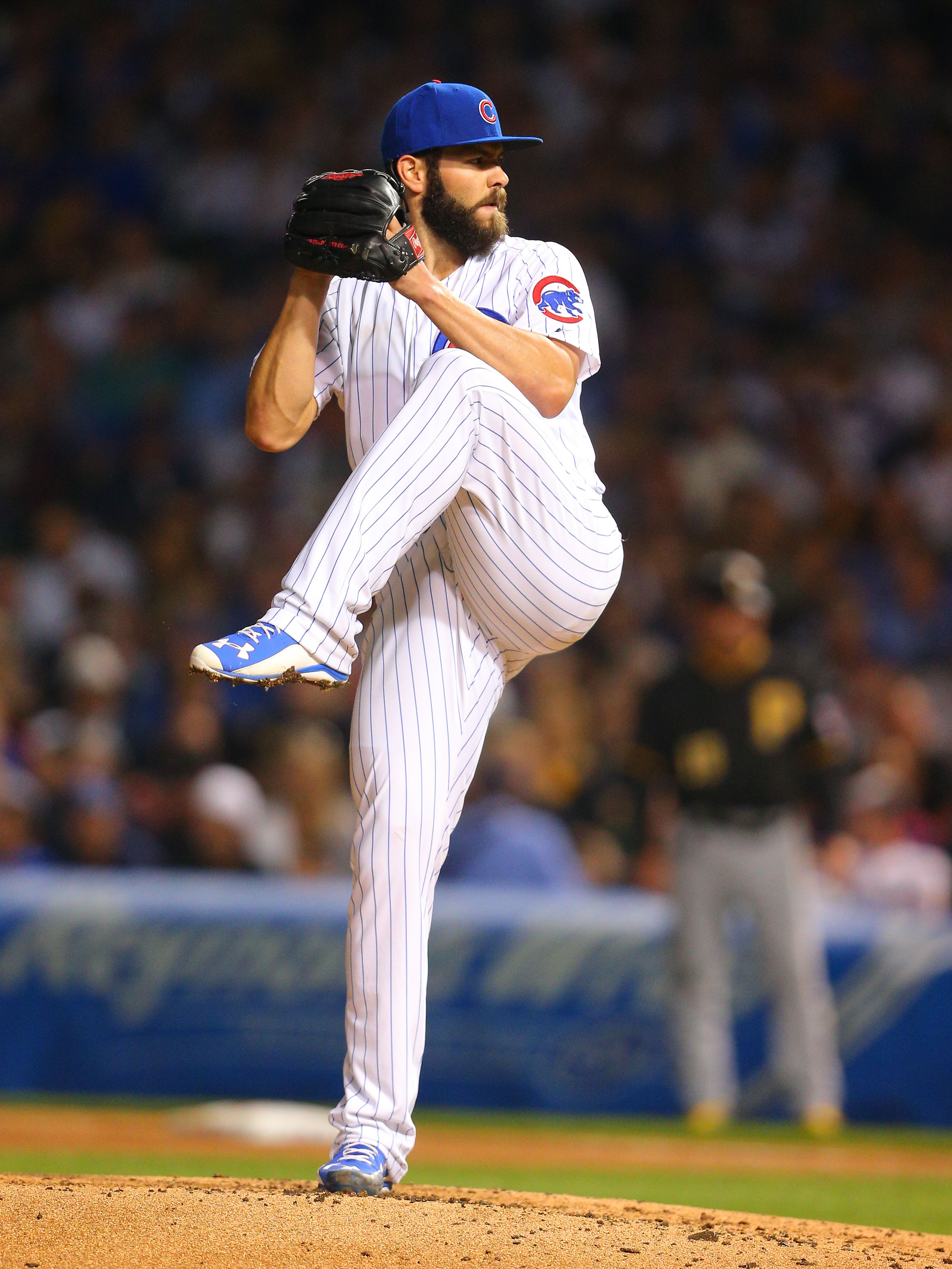
Arrieta’s case is a good application of the Kimbrel Rule, considering the fact that no player in recent years has matched Arrieta’s achievements heading into his second year of arbitration eligibility. The only recent player to win a Cy Young in Arrieta’s service class was David Price three years ago, who went 20-5 with a 2.56 ERA. Comparatively, Arrieta won a couple of extra games and recorded a far superior ERA: he was 22-6 with a 1.77 ERA. Additionally, Arrieta’s 229 innings and 236 strikeouts surpassed Price’s respective totals of 211 and 205 by a significant margin. Price received a $5.76MM raise, so the Kimbrel Rule gives Arrieta projected $6.76MM raise — good for a $10.4MM salary projected for 2016.
Another potential comparable that could come up in a hearing is Felix Hernandez‘s 2010 season. Although Hernandez ultimately signed a multi-year deal, he initially exchanged figures with the Mariners after going 19-5 with a 2.49 ERA. The Mariners offered a $3.4MM raise, while he asked for a $7.7MM raise. Since Price ended up roughly between these two numbers three years later and had won a Cy Young, though, it would be tough for the Cubs to argue that the Hernandez case is more applicable than the case of Price. Hernandez did have the lowest ERA of any pitcher entering his second year of arbitration eligibility in recent seasons, however, but even this was nearly three quarters of a run greater than Arrieta’s 1.77 mark.
Although Price did not and Arrieta has not yet, pitchers get multi-year deals in most cases like these. The downside risk of injury for a pitcher usually encourages them to hedge and cash in on their success, and the risk for the team to have to bid against other teams in the free agent market encourages them to cut a deal as well. As a result, it is difficult to find many elite pitchers who go year-to-year in arbitration. Price was the only pitcher in recent years entering his second year of arbitration eligibility as a 20-game winner, in addition to being the only Cy Young winner. However, Arrieta’s far superior ERA makes Price a weak potential comparable, certainly more of a floor than a ceiling.
If Arrieta does not sign a multi-year deal, he is likely to set a record for second-year arbitration-eligible raises for starting pitchers that will set the baseline going forward. Where he lands will be an excellent test of the Kimbrel Rule, since he perfectly fits the example of pitchers who outperformed their service class in recent years on all arbitration-relevant statistics.
Photo courtesy of USA Today Sports Images.
How Have 2015’s Worst Bullpens Improved Thus Far?
Over the weekend, MLBTR’s Charlie Wilmoth broke down the improvements (or lack thereof) that have been made to the five worst offenses from 2015 thus far. While there’s still a good deal of time remaining this offseason — we can revisit these examinations again come Opening Day — many teams have completed the bulk of their offseason lifting. Perhaps most notably, when it comes to the bullpen, many of the top-flight free agents and trade candidates are off the board. There are still some quality relievers to be had on the free-agent market — Antonio Bastardo and Tyler Clippard stand out as two of MLBTR’s Top 50 free agents that remain unsigned — but the bulk of the relief arms on the market appear headed for one-year commitments or minor league deals.
By ERA, the Rockies, Braves, Athletics, Tigers and Red Sox had the five worst bullpens in baseball in 2015. When sorting the Fangraphs team leaderboards by either FIP or xFIP, we see the bottom five results include four of those teams, though in various orders and combinations. So, while there are obviously many ways to categorize the collective efforts of teams’ relief corps, those five seem a reasonable enough starting point for this exercise.
Rockies (4.70 ERA, 4.09 FIP, 4.23 xFIP): Colorado’s offseason began with the somewhat surprising decision to designate John Axford for assignment, though the mustachioed closer came out ahead in the ordeal. Projected to earn $6.5MM this winter, Axford elected free agency following his DFA and scored a two-year, $10MM guarantee with the A’s that includes additional incentives. Colorado also cut ties with former closer of the future Rex Brothers and right-hander Tommy Kahnle. That pair of decisions was less surprising, as the two relievers combined to issue 36 walks in 43 2/3 innings. In their places, Colorado has signed veteran right-handers Jason Motte and Chad Qualls to two-year deals worth $10MM and $6MM, respectively. One can argue that Motte is a curious fit, to be sure, as a pitcher that neither misses bats nor induces grounders, but Qualls’ 60 percent ground-ball rate and K-BB% of 18.3 percent is appealing even if his ERA was more troublesome in 2015. Colorado will also probably benefit from Adam Ottavino‘s eventual return. The 30-year-old was excellent from 2013-15 before undergoing Tommy John surgery after 10 1/3 brilliant innings last season. The Rox felt confident enough in Ottavino to give him what was to many an eyebrow-raising $10.4MM extension spanning 2016-18, but if he returns anywhere near his 2013-15 form, that price will be more than acceptable. Increased usage from intriguing righties Jairo Diaz and Miguel Castro could also yield better results, but it does appear, on paper, that there’s room for further additions here.
Braves (4.69 ERA, 4.37 FIP, 4.29 xFIP): The Braves have added a slew of minor league arms in trades over the past 12 to 15 months, many of whom will eventually figure into the team’s bullpen, even if some are presently viewed as starters. This winter, the team has brought back Jim Johnson on a one-year deal with the hopes that he’ll recreate the success he found in Atlanta last season while avoiding the type of meltdown he had following his trade to the Dodgers. Also returning to the club is right-hander David Carpenter, who signed a minor league pact after a down season in 2015 following a trade from Atlanta to the Yankees last winter. (That trade netted Manny Banuelos, though the Braves also parted with Chasen Shreve.) Alexi Ogando serves as another notable right-hander to land a minor league deal with Atlanta, and he’ll presumably compete for a bullpen role this spring. Right-hander Jose Ramirez also joined the Braves in a trade with the Mariners, giving the team a high-upside arm, albeit it one with some question marks (durability, control). Also coming by way of trade is lefty Ian Krol, though he had a down season in Detroit before being included in the Cameron Maybin trade. Right-hander Shae Simmons will be returning from Tommy John surgery, and fallen closer Jason Grilli should make his way back from a season-ending Achillies injury in the early portion of next season as well. Ultimately, however, the Braves are looking more to the collection of young arms they’ve stockpiled the past two winters than flashy moves to bolster their bullpen — not a surprising tactic for a club that is in the middle of rebuilding. It’s possible that Atlanta will make further one-year additions, as such players could become trade chips this winter.
Athletics (4.63 ERA, 4.36 FIP, 4.21 xFIP): Oakland has been one of the most active clubs in adding bullpen help this winter, shelling out a combined $32MM for Axford (two years, $10MM) and Ryan Madson (three years, $22MM). Madson’s contract was something of a shock, considering the fact that he’s 35 years old and 2015 was the first time he’d been healthy enough to throw in a Major League game since 2011. However, his track record prior to his lengthy injury layoff and last year’s results were outstanding. Axford’s season was bizarrely segmented, as he yielded 19 runs in just 17 2/3 innings across the middle two months of the season but sandwiched those ugly results between 38 other innings in which he allowed just seven total runs. A move to a far better pitchers’ park figures to help Axford, though it seems that control will always be an issue for him. Oakland also added lefty Marc Rzepczynski in a trade with the Padres that sent Drew Pomeranz to San Diego. Closer Sean Doolittle should be in better health this season, and if he’s back to form, he represents one of the game’s better lefty relievers. Also new to the green and gold is Australian hurler Liam Hendriks, added in a trade that sent Jesse Chavez to Toronto. Hendriks never panned out as a starter despite promising minor league numbers with Minnesota, but he flourished as a relief pitcher last year with a 2.92 ERA, 9.9 K/9 and 1.5 BB/9 in 64 2/3 innings with the Jays.
Tigers (4.38 ERA, 4.37 FIP, 4.38 xFIP): Detroit’s nearly identical ERA/FIP/xFIP is rather remarkable in terms of similarity, but it also speaks to the underwhelming relief pitching that has now plagued the team for several years. New GM Al Avila has acted decisively in seeking to upgrade the ‘pen, shedding Krol and right-hander Al Alburquerque (via trade and non-tender, respectively). Francisco Rodriguez will serve as the new closer in Detroit after coming over in a trade from the Brewers (minor leaguer Javier Betancourt was the primary piece sent to Milwaukee). Avila added right-hander Mark Lowe on a two-year, $11MM deal that reflects Detroit’s confidence in the hard-thrower’s 2015 resurgence. The Tigers also landed southpaw Justin Wilson from the Yankees by sending a pair of pitching prospects to New York. The Tigers will hope that the combination of K-Rod, Lowe and Wilson will pair with an improved Bruce Rondon to give the team the quality relief contingent it has so often lacked. They’ll also again look to Alex Wilson to play an important role, although the right-hander’s middling strikeout rate is something of a concern.
Red Sox (4.24 ERA, 4.64 FIP, 4.35 xFIP): The expectation when Dave Dombrowski came on board as president of baseball operations was that he’d shake up the bullpen and show no fear in trading prospects, and that exact scenario manifested with the acquisition of Craig Kimbrel. The Sox paid an exorbitant price to land three years of Kimbrel, parting with Javier Guerra, Manuel Margot, Carlos Asuaje and Logan Allen. However, pairing Kimbrel with Koji Uehara (who will move back to a setup role) wasn’t where Dombrowski stopped; the new Boston exec also added right-hander Carson Smith in a trade that sent Wade Miley to the Mariners. Smith is far from a household name but quietly enjoyed one of the more dominant rookie seasons in recent memory last year, posting a 2.31 ERA with 11.8 K/9, 2.8 BB/9 and a 64.8 percent ground-ball rate. Roenis Elias, also acquired in that trade, could serve as starting depth but would also be intriguing in a left-handed relief role, based on his career splits.
NL East Notes: Nova, Marlins, Taylor, Mets
The Marlins are known to be seeking starting pitching, and the Boston Globe’s Nick Cafardo reported over the weekend that “Miami has had interest” in a trade for Yankees right-hander Ivan Nova this winter. The match makes some sense on paper, as Nova, who is reportedly being shopped by the Yankees, will be affordable at a projected $4.4MM (via MLBTR contributor Matt Swartz), which would come in well within Miami’s budget. The Marlins have been linked to starters and said to be comfortable in the range of a $12MM annual value, so Nova’s relatively modest salary shouldn’t be a problem. The link to Nova continues somewhat of a recent shift in reports pertaining to Miami’s search for rotation upgrades; the Marlins have now been connected to Nova, Doug Fister, Cliff Lee and Edwin Jackson within the past week — all likely one-year commitments. Previously, the team was linked to multi-year deals for starting pitchers and was also said to be eyeing young starting pitching in trade scenarios with a variety of teams, including the Indians and Mariners. Outfielder Marcell Ozuna could yet return a notable starting pitcher, but Miami’s asking price on the 24-year-old has been high (he certainly wouldn’t be in play in any talks for Nova).
A few more notes from the NL East…
- “We’re still talking with players and looking for ways to add to our overall depth,” Marlins president of baseball operations Michael Hill told MLB.com’s Joe Frisaro yesterday when asked about the team’s starting pitching. As things currently stand, Frisaro lists Jarred Cosart, Tom Koehler, Adam Conley and either Justin Nicolino or David Phelps as the four starters that would follow Jose Fernandez in the rotation. Clearly, there’s a good deal of uncertainty there, and Frisaro runs down some other internal options that are either MLB-ready or close to earning that distinction, including right-hander Jose Urena, right-hander Kendry Flores and left-hander Jarlin Garcia.
- Michael A. Taylor‘s role with the Nationals in 2016 is up in the air at this time, writes Chelsea Janes of the Washington Post. While Taylor, who is entering his age-25 season, showed impressive defense and a nice blend of speed/power last season in an unexpectedly regular role (necessitated by injuries to Denard Span and Jayson Werth), he also struck out in nearly 31 percent of his plate appearances and displayed a lack of plate discipline, thereby yielding OBP questions. As things stand right now, Taylor is penciled in as Washington’s opening day center fielder. However, the team’s reported interest in names like Jason Heyward, Carlos Gonzalez and Gerardo Parra seems to indicate some discontent with the current outfield trio, Janes notes. Interestingly, she doesn’t seem to think that Taylor would head to Triple-A for regular at-bats even in the event of a significant outfield addition, instead writing that Taylor “would likely slide into the role of superutility outfielder,” spelling the aging, injury-prone Werth and others as needed.
- The Mets are still open to signing a veteran arm for their bullpen, writes MLB.com’s Anthony DiComo in his latest Inbox column. Jeurys Familia, Addison Reed and Jerry Blevins are locks to fit in, and at least three of Sean Gilmartin, Erik Goeddel, Carlos Torres, Logan Verrett and Hansel Robles should end up in the ‘pen as well, DiComo writes (or, presumably, four of the five, in absence of the aforementioned veteran addition). With lefties Josh Smoker and Dario Alvarez as well as righties Jim Henderson and Rafael Montero also serving as possibilities, the team does have quite a bit of depth, DiComo notes.