
Valuing A Chris Sale Extension
As he closes in on his 30th birthday and the start of his tenth season of action in the big leagues, Chris Sale (through his reps at Jet Sports Management) is engaged in at least some level of discussion with the Red Sox regarding an extension. The upcoming season is the final year of control under the deal Sale originally signed with the White Sox, adding some impetus to discussions.
It’s a fascinating situation to consider, owing to a variety of considerations. From a narrative perspective, the club’s whiff on Jon Lester years ago provides obvious fodder for comparisons. And an otherwise quiet winter from the defending World Series champs also makes for an intriguing backdrop.
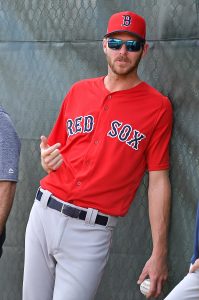
The really interesting part, though, is the valuation itself. Starting pitchers have found a fair bit of success at prying monster deals from clubs entering a walk year. Clayton Kershaw‘s original extension (seven years, $215MM plus opt-out) is the largest, but Stephen Strasburg‘s recent $175MM deal also makes for a notable recent data point. Both of those pitchers were more youthful than Sale, but Justin Verlander‘s second extension (which added five years and $140MM to his existing deal) was signed at a comparable age point (and two seasons in advance of his free agency).
That’s not to say that any of those particular deals really looks to be a perfect comp for Sale. Rather, they go to show that Sale can and should be looking for a contract that values his would-be free agent seasons at their anticipated market value.
On the other hand, there’s also no small amount of risk to be priced in here. That was the case with those other contracts, to be sure, but in this case the team will no doubt be particularly wary. After all, Sale missed five starts last year with still-mysterious shoulder issues. Though he’s said not to have exhibited structural problems, he showed some potentially worrisome velocity changes (with a correspondingly wandering release point) last year.
Both the team and Sale himself surely know quite a bit more than we do about his health. Certainly, his overall track record is one of excellent durability. While Sale’s funky delivery and big velocity readings have long led to predictions of physical ailments, he averaged 30 starts and 205 frames annually from 2012 through 2017.
Whatever the health risk may be relative to other pitchers, there’s little denying that Sale’s recent performance track record is quite free of red flags. All told, Sale has a 2.89 ERA in nearly 1500 career MLB innings and currently sits as the all-time leader in K/9 and K/BB ratio.
Importantly, too, he was in top form last year. Sale was deployed judiciously in the 2018 postseason but did record 24 strikeouts in 15 1/3 frames. Before that, he handled 158 regular-season innings, over which he allowed just 37 earned runs on 102 hits and 34 walks while racking up a whopping 237 strikeouts. When you smooth out the ups and downs in the radar readings, Sale threw harder overall last year than he ever has as a starter (95.7 mph average four-seamer). He also generated more swinging strikes than ever before (15.8%).
Those facts seem to distinguish Sale from Kershaw, who recently provided another notable contractual point to consider. The Dodger star’s new deal was hammered out in a near-open-market scenario, in the window before he had to decide whether to opt out of the final two years and $65MM of the aforementioned contract. The sides came up with a rather unique arrangement: three years, $93MM, with $12MM in total incentives that are achievable in full if Kershaw is at full health throughout the deal. Kershaw turns 31 in March, just before his new deal begins, so that contract covers almost the exact same age period as Sale’s next contract will. Not unlike Sale, Kershaw missed a few outings last year but still generated impressive results. Unlike Sale, Kershaw has exhibited more significant and long-lasting concerns in terms of his stuff and peripherals. The Dodger stalwart averaged 162 innings annually in the three seasons preceding his deal, with a series of back issues limiting his availability, tamping down his velocity, and reducing him from the game’s best pitcher to “merely” one of its best.
In the Kershaw scenario, it seems fair to say that the Dodgers mostly took a health discount by limiting the length of the commitment and including a hefty, easily achievable, but health-dependent incentives structure. It’s the kind of contract we might have expected, in the not-so-distant past, for an outstanding pitcher of an older age. That Kershaw took it at a relatively youthful stage is testament both to the level of concern with his long-term outlook and perhaps also the newfound market commitment of many teams to avoid obligating payroll space too far into the future (particularly for players in their mid-30s).
It seems easy to say that Sale won’t need to settle for the Kershaw deal to get something done. The latter has had the more impressive overall career, but his recent red flags are impossible to ignore. Still, it’s an interesting general scenario to contemplate when imagining what a deal could look like.
How’s it look for players who hit free agency under more favorable circumstances? The approach long has been to chase the biggest and lengthiest deal on the open market. David Price ($217MM) and Max Scherzer ($210MM) were each a bit younger when they secured their seven-year mega-deals — both turned 31 during the first seasons of their new contracts — than Sale will be when he hits the open market. Zack Greinke, the only other pitcher to top $200MM, turned 32 just before reaching free agency, so he was a fair bit older. He got six years and $206.5MM, easily setting a Major League record (which he still holds) with an average annual value north of $34MM.
There’s little question that Sale could position himself for massive earnings in the 2019-20 offseason with a performance that mirrors his 2018 in quality and his prior career in durability. Sale could be joined by some big names on the open market, but he almost surely possesses the greatest earning upside of any possible free-agent starter. Price’s total guarantee and Greinke’s AAV marks both seem theoretically achievable, though it’s arguable whether that kind of coin will still be available in today’s market. Even if we could accurately gauge Sale’s true earning ceiling, which would depend upon quite a few market factors, reaching it represents only one of several conceivable scenarios. With something less than full health, or declines in velocity and/or effectiveness, Sale’s earning power would obviously begin to slide.
So, where might we anticipate the price tag landing in extension talks? Sale will earn $15MM in 2019 regardless of any new deal, so we’ll consider only the future seasons. Presumably, the Red Sox will look for some kind of discount (in salary, years, or both) to account for the health uncertainty — both that of any pitcher separated from free agency by a full season and whatever added questions come with Sale. Might the Boston organization seek to cabin the length of the contract? Or would it be amenable to a lengthier deal that spreads the guarantee over a longer span, thus reducing the annual luxury tax hit? And what about Sale’s own preferences?
Supposing the Sox are willing to go to Greinke levels on the AAV but not on the term, it’s possible to imagine a five-year extension in the range of $175MM. That figure would also match the recent Strasburg deal, albeit over a shorter duration (his was for seven years) — arguably a fair result for a more accomplished and consistent, but also less youthful starter. But is that really the most sensible approach? Perhaps the team would rather stretch things out, even if it means committing to additional seasons. Adding six years at $190MM would not greatly expand the Red Sox’ overall commitment. For one thing, it’s reasonable to anticipate that Sale will still be a useful-enough pitcher at the end of that deal to warrant his salary. There’s a risk he won’t be, certainly, but there’s also real upside (see, e.g., Verlander) as well as the promise of continued inflation driving down the effective price.
Interestingly, the club’s luxury tax situation also increases the value of spreading the AAV. Let’s do a bit of math to see how this looks. Sale’s original extension, signed before the 2013 season, will have paid him a total of $59MM over seven seasons, but option years are treated as one-off seasons for purposes of the competitive balance tax calculation. That means that Sale’s hit to the Sox’ books this year will be his current salary of $15MM. Modifying his forward-looking contract rights, though, would change that number by adding the new years and dollars and then re-running the AAV. As MLBTR’s Steve Adams examined recently with regard to a hypothetical re-signing of Craig Kimbrel, any new money added to the Boston luxury ledger is going to be taxed at a hefty rate. A new deal for Sale would not only trigger a drop in draft placement but would also mean a big tax bill increase. You can find the details there; for our purposes, since a new deal would certainly be of sufficient magnitude to push the club into the top tax bracket, the Red Sox would pay 75 cents for every additional dollar of AAV they take on. And that’s just for the 2019 season. If the organization continues to exceed the luxury line, it’ll keep getting hit with bills — every one of which will be impacted by Sale’s AAV.
It’s not hard to see how adding a season or even two at a relatively lesser salary might begin to make sense, particularly when one includes the concept of the time-value of money. Here are a few scenarios to kick around (all dollars in millions):
| Extension Years | Extension Money | Extension AAV | Cumulative AAV | 2019 Tax Increase |
| 5 | $150 | $30.00 | $27.50 | $7.83 |
| 5 | $175 | $35.00 | $31.67 | $10.96 |
| 6 | $160 | $26.67 | $25.00 | $5.96 |
| 6 | $180 | $30.00 | $27.86 | $8.10 |
| 6 | $192 | $32.00 | $29.57 | $9.39 |
| 6 | $207 | $34.42 | $31.64 | $10.94 |
| 7 | $175 | $25.00 | $23.75 | $5.02 |
| 7 | $200 | $28.57 | $26.88 | $7.37 |
| 7 | $217 | $31.00 | $29.00 | $8.96 |
These are, of course, largely random price points (some of which connect to contract comps noted above, others of which are simply round numbers). But they serve to show how much cash the Red Sox could in theory be forced to take on right now if they really want to avoid paying Sale past his mid-30s. That hit, as noted already, would potentially be repeated in future seasons in which the club nears or passes the luxury line. Those considerations may well factor into the organization’s approach, whatever level of health-related discount is deemed necessary to make a contract appealing.
If a lengthier, more spread-out deal might make greater sense for the ballclub, what about Sale? As my colleague Steve Adams reminded me, the southpaw hinted recently that he could go looking to set new high-water marks of some kind. As Sale put it: “You want to do right by the guys who are coming next year, two years, 10 years down the road because you kind of set the bar and the next guy who comes along either gets to that bar or sets it a little more.”
If he intends to raise the bar in an extension scenario, one full season removed from the open market, there’s no realistic way he’s going to top the line set by Price. Breaking the overall guarantee record (seven years, $217MM) would almost certainly mean pitching in 2019 before negotiating his next contract. On the other hand, Sale could take aim at Greinke’s AAV mark. In that case, though, it’s awfully tough to see the Red Sox making a commitment past five additional seasons (if they’re willing to make such a deal in the first place).
Perhaps Sale’s bar-raising sentiments shouldn’t be taken too literally. He no doubt appreciates that an extension situation necessarily involves other considerations (and lacks competitive bidding). A hurler of his age reaching the $200MM mark in new money, say, would represent a notable achievement even if it came with a relatively less-impressive AAV and didn’t really set any recognizable records. In terms of maximizing his own career earnings (without taking the risk of first pitching another season), there’s not a whole lot of downside to going for the biggest total guarantee possible at this stage, even if it effectively means taking a cheaper valuation for the last season or two of the new contract. Even if Sale were to hit the open market on the upswing in his later years — as may well occur next winter for Verlander — the additional earning ceiling at that point would be fairly limited, at least in terms of contract length.
If there’s a deal to be made here, then, the sweet spot could actually be on a longer term than might be anticipated at first glance. As the foregoing discussion shows, though, there’s also quite a lot for both sides to think about — and quite a lot we don’t know. The major wild card, perhaps, is the sides’ respective levels of concern with Sale’s shoulder. It’ll be fascinating to see how things proceed if Sale and the Red Sox end up making a concerted effort over the coming weeks to work out a deal.
Photo courtesy of USA Today Sports Images.
Red Sox Have Discussed Extensions With Sale, Bogaerts
1:17pm: Werner and principal owner John Henry met with the Boston media today and indicated that they’ve not only discussed a long-term deal with Sale but also with Xander Bogaerts (link via the Globe’s Peter Abraham). Like Sale, Bogaerts is slated to become a free agent at the end of the 2019 season. The ownership reps noted that while they’d love to be able to keep each of Sale, Bogaerts and Mookie Betts in Red Sox uniform for the long haul, such a scenario probably isn’t realistic.
Perhaps of note, when asked about the last top-tier lefty the Sox had on the cusp of free agency, Henry candidly acknowledged that the Red Sox “blew it” when trying to work out an extension with Jon Lester prior to 2014 — Lester’s last in Boston.
8:38am: The Red Sox and ace Chris Sale have had “private” discussions about a contract extension, chairman Tom Werner said in an appearance on WEEI’s Mut & Callahan show this morning (Twitter link, with audio). Sale is currently slated to earn $15MM in 2019 and will become a free agent next offseason. He said last week that the Red Sox had not yet initiated extension negotiations.
Clearly, whether it’s in the form of an extension or in an open-market setting, Sale is in position to command a substantial raise — likely one that would at least double his salary. The seven-time All-Star, who will turn 30 years old in March, has finished in the top five in American League Cy Young voting in each of the past six seasons and has never turned in an ERA higher than 2015’s mark of 3.41. It’s somewhat surprising that Sale has never actually taken home the Cy Young hardware, though his excellence and consistency still make him a solid bet to do so at some point in his career; Sale’s 10.88 K/9 and 5.31 K/BB ratio are both the best all-time marks for any pitcher to ever have thrown 1000 MLB innings.
A new contract for Sale would begin in his age-31 season, so the length of the pact could be a potential sticking point in talks. Teams throughout the league have shown increasing resistance to guaranteeing money to players into their late 30s, and it’s been fairly rare to see five-, six- and seven-year deals that guarantee pitchers into their age-37 seasons. That said, assuming a healthy year from Sale, he could have a case to to top Zack Greinke‘s current $34.4MM annual salary record. While he hasn’t previously called that a goal, Sale did recently express the importance of furthering the market for future players.
“You want to do right by the guys who are coming next year, two years, 10 years down the road because you kind of set the bar and the next guy who comes along either gets to that bar or sets it a little more,” Sale said in his own appearance on Mut & Callahan last week. “That’s kind of the brotherhood of being a Major League Baseball player.”
A healthy 2019 season will be of particular importance for Sale in 2019. While he’s long been a consistent force in the rotation with both the White Sox and Red Sox, he was limited to 27 starts last year — his fewest since 2015 — and went through a pair of stints on the disabled list as a result of inflammation in his left shoulder. Sale certainly looked healthy when striking out the side to close out Boston’s World Series win over the Dodgers. though, and he’s now had the benefit of a full offseason to rest that mildly problematic shoulder.
It’s worth noting that an extension for Sale would push the Red Sox into the top luxury tax penalization bracket. As I explored recently when looking at what it’d actually cost the Sox to re-sign Craig Kimbrel — the taxes on any such signing could top $10MM — Boston is only about $6MM south of that $246MM barrier. Viewed through that lens, the Sox may actually prefer to wait until the end of the season, although in doing so they’d also be running the risk of allowing Sale to test the open market.
Quick Hits: Owens, Stroman, Wright, Beckham, Rookie
Athletics assistant GM/director of player personnel Billy Owens has been rumored as “a strong candidate” to become the next Giants general manager, Susan Slusser of the San Francisco Chronicle writes. Farhan Zaidi, the Giants’ newly-hired president of baseball operations, knows Owens well from their time together in Oakland’s front office, and Zaidi is one of several voices in Slusser’s piece who praise Owens’ ability to scout and identify talent (not to mention describe that talent in legendarily elaborate scouting reports). If there is one flaw in Owens’ resume, it could be his love of scouting prevents him from amassing the type of executive experience necessary to run a front office. That said, Owens has been sought after by other organizations, and he interviewed for the Phillies’ GM job in 2015, leading to speculation that he could eventually leave Oakland for a higher-profile job — perhaps even reuniting with Zaidi in the Bay Area.
Here’s more from around the baseball world…
- Marcus Stroman‘s blunt comments about the Blue Jays‘ offseason seem to hint at an eventual parting of the ways between the team and the right-hander, Sportsnet.ca’s Shi Davidi opines. Stroman’s frankness probably didn’t help his chances at either a contract extension or a trade, though if he has a good first half and erases any question marks lingering from his mediocre 2018 season, Stroman will surely become an intriguing trade chip for the Jays at the deadline.
- The Red Sox plan to use Steven Wright as a full-time reliever this season, MLB.com’s Ian Browne writes, with manager Alex Cora casting Wright as a potential multi-inning threat. At first glance, a knuckleballer would seem like an unusually durable option to relegate to the bullpen, though Wright is just happy to be pitching in any capacity after two injury-plagued seasons. There is also the possibility for higher-profile assignments within Boston’s pen, given the team’s lack of an established closer.
- Gordon Beckham chose to sign the Tigers over some offers from other teams because they offered the best shot at regular Major League at-bats, the veteran infielder told Chris McCosky of the Detroit News and other reporters. The idea of more time in the minors isn’t appealing to Beckham, to the point that “if it doesn’t work out here, I might be done” with his ten-year MLB career, though he also noted that better health and a revamped swing have him feeling optimistic about the coming season.
- Right-hander Rookie Davis is close to a new minor league contract and Spring Training invite with an unknown team, The Athletic’s Emily Waldon reports (Twitter link), adding that the Pirates have been in touch with Davis. Perhaps best known as one of the prospects sent by the Yankees to the Reds as part of the Aroldis Chapman trade in December 2015, Davis tossed 27 innings for Cincinnati in 2017 and then underwent hip surgery that October. He pitched only 26 1/3 innings in the Reds’ farm system last season and became a free agent in November.
East Notes: Stroman, Phils, Moustakas, BoSox, JDM, Mets, Alonso
Right-hander Marcus Stroman expressed frustration toward the Blue Jays on Sunday for not offering him a contract extension during the offseason. However, Stroman’s claim was refuted by an industry source, Shi Davidi of Sportsnet reports. Whether or not the team did submit an offer(s), no deal has come to fruition, leaving Stroman in his penultimate year of club control. While Stroman generally thrived in Toronto from 2014-17, last season was a different story as the 27-year-old battled injuries and a downturn in production. This offseason may not have been the ideal for Stroman to ink an extension, then, though he insisted Sunday he “embodies the city of Toronto” more than anyone and wants to be there “for a long time.”
Here’s more on the game’s East divisions:
- Philadelphia has been chasing free agent Manny Machado for months, but if the team doesn’t sign him, it appears it’ll go forward with Maikel Franco and Scott Kingery at third base. The Phillies “seem cool” on the possibility of signing Mike Moustakas or another non-Machado free agent to man the position, Todd Zolecki of MLB.com writes. The club’s of the belief that Franco and Kingery are “two really good options,” according to general manager Matt Klentak. The 26-year-old Franco wasn’t much different offensively than Moustakas in 2018, though the latter trumped the former as a defender. Kingery had a disastrous rookie season at the plate, but the Phillies remain high on the 24-year-old, whom they signed to a long-term deal last March before he ever accrued a major league at-bat.
- Red Sox designated hitter J.D. Martinez is only a year removed from a protracted trip to free agency – one that culminated in late February with a five-year, $110MM guarantee. While the open market has frustrated many players over the past 16 months, Martinez may head back to free agency as early as next winter if he opts out of his contract after the season. The 31-year-old said Sunday that the cases of still-unemployed superstars Machado and Bryce Harper won’t play much of a role in his forthcoming decision, per Christopher Smith of MassLive.com. “At the end of the day, I know my value and I know what I bring to the table,” said Martinez – who, like Harper, is a Scott Boras client. “I really don’t look at that. I really judge me on me.” Regardless of whether Martinez does vacate his current contract next offseason, the offensive dynamo noted he’d “love” to continue his career in Boston, which he helped lead to a World Series title in 2018.
- First baseman Peter Alonso, MLB.com‘s 51st-ranked prospect, may be able to help the Mets as early as Opening Day, though whether he’ll make the team’s roster is in question. The Mets would gain an extra year of control over Alonso, 24, by keeping him in the minors until at least mid-April, after all. However, New York – led by general manager Brodie Van Wagenen – insists having seven years of control over Alonso instead of six won’t factor into whether he cracks its season-opening roster in 2019, Anthony DiComo of MLB.com relays. “Our management’s going to fight for [Alonso],” said manager Mickey Callaway. “I think Brodie’s made it clear that he’s a players’ guy. And if he deserves it, he’s going to be on the team.” The main player standing in Alonso’s way appears to be Todd Frazier – the Mets’ projected starter at first – but the 33-year-old is coming off a poor year. Alonso, on the other hand, was highly productive in Double-A and Triple-A stints last season.
East Notes: Yankees, Phils, Herrera, Red Sox, Blue Jays
The Yankees signed right-hander Luis Severino to a four-year, $40MM extension shortly before they were scheduled to face off against him in arbitration Friday. General manager Brian Cashman spoke about the buzzer-beating agreement Saturday, saying (via George A. King III of the New York Post): “We circled back 30 minutes before the hearing and I asked [agent Nelson Montes de Oca] if he wanted to circle back to my room again. The atmosphere was better, different. We both said we would rather not walk into this hearing and do what we have to do. We gave a little, they gave a little. The Severino extension may not be the last one the Yankees dole out before the season, as Cashman revealed that the club has “had conversations with some” unidentified players regarding new deals. Speculatively, center fielder Aaron Hicks, shortstop Didi Gregorius and reliever Dellin Betances – integral Yankees slated to reach free agency next winter – look like logical candidates.
Here’s the latest on a few other East Coast franchises:
- Manager Gabe Kapler claims the Phillies aren’t guaranteeing a No. 1 job to center fielder Odubel Herrera, Scott Lauber of the Philadelphia Inquirer reports. Herrera’s a four-year starter in Philly who still has three guaranteed seasons left on the $30.5MM extension he signed in 2016, but he turned in an underwhelming showing in 2018. He’ll now compete for a place in center and right this spring with Roman Quinn, Nick Williams and Aaron Altherr, according to Kapler. Although, if the Phillies add superstar right fielder Bryce Harper in free agency, it’ll give the Herrera-Quinn-Williams-Altherr quartet one fewer position to fight over. Herrera, for his part, has worked hard in recent months to get himself into better shape, as Lauber details, and Kapler expects the 27-year-old to benefit from the Phillies’ hiring of first base/outfield/baserunning coach Paco Figueroa.
- The Red Sox are expected to trade a catcher – be it Christian Vazquez, Sandy Leon or Blake Swihart – before the season. If that happens, they’ll likely be left with minor league signing Juan Centeno as their No. 3 backstop. Manager Alex Cora said Saturday he’d be “comfortable” in that scenario, pointing out he’s familiar with the veteran Centeno from their time with the World Series-winning Houston organization in 2017, per Christopher Smith of MassLive.com. Centeno’s contract does not include an opt-out clause, president of baseball operations Dave Dombrowski confirmed to Smith, so the Red Sox aren’t in danger of losing him before the season. However, as Smith notes, if Boston adds Centeno to its 40-man roster at some point and then tries to send him to the minors, it’ll need to pass him through waivers because he’s out of options.
- Left-hander Ryan Borucki was one of the few bright spots on the Blue Jays’ pitching staff in 2018, a rookie year in which he turned in a 3.87 ERA/3.80 FIP over 97 2/3 innings and 17 starts. Nevertheless, while it appears the Jays are guaranteeing starting spots to Marcus Stroman, Aaron Sanchez and newcomers Matt Shoemaker and Clayton Richard heading into the season, general manager Ross Atkins indicated this week that Borucki will have to battle for a role in their rotation this spring, Gregor Chisholm of MLB.com relays. The soon-to-be 25-year-old Borucki still looks to be the front-runner for the Jays’ No. 5 spot, though, as he’s clearly the most proven 40-man option left on their staff.
AL Notes: Vlad Jr., Bogaerts, Twins, Castellanos
It has long seemed obvious that the Blue Jays would prefer to hold top prospect Vladimir Guerrero Jr. at Triple-A to open the 2019 season. After all, the team decided not to call him up late last season and can push back his potential free agency by one season if they keep him down for at least a brief stretch to begin the new campaign. GM Ross Atkins declined yesterday to provide any kind of hint as to the anticipated timing, as Keegan Matheson of the Score tweets, though he did so in a manner that seemingly suggests the club is indeed preparing to hold off on a call-up. “There’s no firm timeline on when [Guerrero] arrives or when he is playing in Toronto for the first time,” said Atkins, “but we want to make sure he’s the best possible third baseman and the best possible hitter he can be.”
Let’s take a look at some other notes from the American League …
- The Red Sox and shortstop Xander Bogaerts reportedly failed to gain traction in extension talks earlier this winter. Perhaps it’s still possible, though, that the pending free agent could line up with the organization on a new deal. As John Tomase of WEEI.com writes, Bogaerts acknowledged that the slow-developing free agent market provides cause for him to consider extension scenarios — “you obviously have to think about that,” he said — though he also did not exactly hint that he’s particularly inclined to forego the risks and upside of the open market. The 26-year-old called this winter’s market developments “weird.” As for the possibility of a future in Boston, he ultimately would say only that he likes playing with the team and that “we’ll see what happens.”
- While the Twins have looked into extensions with multiple young players, and recently locked up both Max Kepler and Jorge Polanco, all is quiet on that front at this point, per LaVelle E. Neal III off the Star Tribune (via Twitter). Players such as outfielder Eddie Rosario and righty Jose Berrios would seem to represent highly appealing targets, though both also have added leverage due to their strong 2018 seasons.
- The Tigers, meanwhile, do not appear to have anything in the works with outfielder Nicholas Castellanos, who seems to be more of a mid-season trade candidate than extension candidate. Anthony Fenech of the Detroit Free Press writes that skipper Ron Gardenhire would prefer Castellanos stick around. He just might get his wish, at least for the first half of the season, as it still seems there’s insufficient market interest in the defensively challenged slugger to pique the Detroit organization’s interest.
AL Notes: Harper, Betts, Severino, Baldelli, Harvey, Kennedy
It’s mostly of historical interest now, but Astros GM Jeff Luhnow acknowledged that the club had a deal all but locked down to land Bryce Harper last summer. (Via Mark Berman of FOX 26, on Twitter.) Reports indicated that the Nationals would have received a strong haul of talent had they agreed to give up Harper at the non-waiver deadline; instead, the club announced on deadline day that it would not part with its star, who is now (still) a free agent. Lest anyone get the wrong idea, the Houston organization’s prior interest certainly doesn’t indicate that Harper is of interest presently. There has been no such connection this winter. Luhnow did suggest, though, that the pursuit is evidence of the team’s commitment to “look at all alternatives” and possibly swing major deals at the trade deadline.
Those who enjoy concocting wild trade scenarios will also take note of Luhnow’s intriguing aside: “I think fans would be surprised at the types of players at times that we’ve gone after and how close we’ve come on some of them.” Here’s more from the American League:
- Star Red Sox outfielder Mookie Betts discussed his approach to handling the business side of the sport, as Jason Mastrodonato of the Boston Herald reports. Betts says he believes in staying patient. “When you start rushing into things, that’s when you get some deals that may not be the right ones,” he said. Of course, Betts has to this point set himself up for a potentially record-setting run through arbitration by not only going year-to-year, but by also increasing his performance level in successive seasons. He just settled for a whopping $20MM, setting a record for a second-time arb-eligible player. Whether he’ll consider a long-term deal in the future isn’t clear; Betts would allow only that he enjoys playing in Boston and would “have to see how it goes.”
- In other AL East contractual matters, the Yankees‘ reported chatter about a long-term deal with staff ace Luis Severino does not seem to be gaining traction, per Jon Heyman of MLB Network (via Twitter). It seems that the sides will instead focus on preparing for an upcoming arbitration hearing, though that can always change at the last minute — whether due to agreement on a single-season salary or something more significant. If the case goes to a panel, the arbitrators will need to decide between Severino’s proposed $5.25MM payout and the club’s $4.4MM counter. There’s added significance given that the Super Two qualifier still has three more potential arb years to come, making his starting salary quite important.
- While terms of his contract weren’t announced or reported at the time, Twins skipper Rocco Baldelli inked a four-year contract when being hired for his managerial debut, Dan Hayes of The Athletic reports (subscription required). The deal also has multiple club options. It’s a show of faith in the rookie manager and a departure from the manner in which Minnesota has previously operated, as Aaron Gleeman of Baseball Prospectus notes (Twitter link). Under previous management, the Twins typically only issued two-year pacts to skipper Ron Gardenhire, who was one of the game’s longest-tenured managers when he was dismissed from the organization. And Paul Molitor, whom the the Twins ousted to make way for Baldelli, was one season into a three-year contract when the Twins ultimately changed course.
- Angels right-hander Matt Harvey will be out for the next week to 10 days due to a strained glute muscle, tweets Jeff Fletcher of the Orange County Register. It’s a minor injury and one that isn’t expected to hinder Harvey’s readiness for Opening Day, but it nonetheless bears some monitoring as Harvey looks to rebuild stock in Anaheim on a one-year, $11MM contract. The injury is all the more notable given the Halos’ rash of pitching maladies in recent seasons. The team is already expecting to be without right-hander Nick Tropeano to open the season.
- The Royals are considering utilizing veteran starter Ian Kennedy as a bullpen piece this season, and the righty spoke with Rustin Dodd of The Athletic about the potential role change (subscription required). Kennedy took a team-first attitude and said he’s willing to pitch for the Royals in any role, so long as it helps the team win more games. Looking elsewhere on the roster, Dodd writes that Danny Duffy, Brad Keller and Jakob Junis are likely locks for the rotation, while non-roster invitee Homer Bailey will compete for a starter job but likely not a bullpen role (per Yost). The Kansas City Star’s Lynn Worthy also addressed the situation, speaking with newly signed Brad Boxberger about pitching roles. While Boxberger would “love” the opportunity to close, it doesn’t seem as though any such promises were made to him. Ultimately, Yost declined to discuss specific roles and stressed the importance of having multiple options who can be trusted to close out games and thrive in high-leverage spots.
Doug Fister Retires
Veteran right-hander Doug Fister has elected to call it a career after spending parts of 10 seasons in the Majors, agent Page Odle tells Jon Morosi of MLB.com. Fister, 35, received multiple Major League contract offers this winter, according to Odle, but is instead making a “100 percent family-driven” decision to spend time with his wife and two children.
A seventh-round pick of the Mariners back in 2006, Fister ascended to the Majors as a largely unheralded prospect with the Mariners in 2009. After establishing himself as a quality starter over his first 378 frames with the Mariners, Fister was flipped to the Tigers in a 2011 trade deadline deal, where he’d go on to thrive over another three seasons. Fister, in fact, was somewhat quietly one of the game’s better starters from 2011-14, pitching to a 3.11 ERA (129 ERA+) with 6.5 K/9, 1.7 BB/9 and 0.7 HR/9.
A 2015 forearm strain led to diminished velocity and diminished results for Fister, though he managed to make 32 starts for the 2016 Astros and served as a stabilizing force in their rotation. Hip and knee injuries slowed Fister in his most recent run with the Rangers, with the latter of the two issues ultimately ending his season after 66 innings.
All in all, Fister will walk away from his baseball career with a lifetime 83-92 record, a 3.72 ERA, 6.1 K/9 and 2.1 BB/9 in 1422 1/3 big league innings. The towering 6’8″ righty also amassed an impressive postseason resume, tallying 56 2/3 innings of 3.02 ERA ball with a 41-to-17 K/BB ratio in five separate postseasons runs (three with the Tigers, one with the Nats and one with the Red Sox). He made one World Series start, with the Tigers in ’12, where he tossed six innings of one-run ball against the Giants.
Fister earned more than $36MM in player salaries over the life of a career that both Baseball-Reference and Fangraphs value at 20 wins above replacement. Best wishes to the former Tigers, Mariners, Nationals, Astros, Red Sox and Rangers righty in his life beyond baseball.
Red Sox Still Shopping Catchers, Seeking Rotation Depth
As pitchers and catchers report, the Red Sox are still looking to swing some deals to tweak their personnel mix in those areas. According to Sean McAdam of the Boston Sports Journal (subscription link), the organization is dangling its three backstops in trade talks while hoping to find rotation depth in return.
It’s hardly surprising to hear that president of baseball operations Dave Dombrowski is looking to move a catcher. After all, he made clear weeks ago that the team had little interest in carrying Christian Vazquez, Sandy Leon, and Blake Swihart on the Opening Day roster.
Nevertheless, this news is worth noting. For one thing, it’s interesting that the Boston organization is still actively engaged even with camp opening. It could instead have decided to let the situation play out before considering options just before the start of the season.
Of somewhat greater import, though, is the concept that the Red Sox are looking to boost their stockpile of starters. That’s the aim of any organization, generally speaking. But that same fact makes it rather difficult to imagine that a rival team will be particularly inclined to move passable arms — particularly given the meager output of the Boston catching trio last year and the fact that the Red Sox have already broadcast their roster intentions.
Some might argue that the club ought to focus instead on its bullpen, which seems a notably risky area of an obviously talented roster. That’s perhaps a bit of a red herring, though, as any rotation depth asset could also help (directly or indirectly) with the relief unit and the club surely knows it won’t be able to swap any of its three catchers for anything approaching a premium reliever.
It’s far from clear which of those three backstops the Sox are most inclined to move. Perhaps the market will still dictate the decision to an extent, though now the club is watching the three in uniform once again and surely has its own ideas. Dombrowski said in January that Swihart would “come to camp trying to compete to be our starting catcher,” while the team previously showed its belief in Vazquez by inking him to an extension. Perhaps that makes Leon the odd man out, but he wouldn’t likely draw significant interest in trade talks and he’s also considered a much more reliable defender than Swihart.
It’ll be interesting to see how this all plays out. Perhaps it would not be entirely surprising if the Red Sox simply end up designating one of these out-of-options players for assignment when the time comes. Then again, Dombrowski said previously that the club was waiting to “mak[e] a trade we feel good about,” seemingly indicating he believed there would be sufficient interest from other organizations to reap at least some kind of return.
Red Sox To Sign Brian Ellington
In yet another item on what has turned into Boston bullpen night here at MLBTR, the Red Sox have reportedly struck a deal with flamethrowing righty Brian Ellington. Per Alex Speier of the Boston Globe (Twitter link), the 28-year-old receives a minors pact; it’s unknown whether it includes a spring invite.
Like several of the team’s other recent, low-cost pen additions, Ellington is long on tools but lacks an established track record of success at the MLB level. He owns a 4.65 ERA in 102 2/3 career frames in the majors. Ellington was dropped early in 2018 by the Marlins and didn’t last long with the Diamondbacks organization after being added on a minors deal.
Ellington has averaged a whopping 98.5 mph with his average fastball in those innings, helping him to generate an 11.4% swinging-strike rate despite infrequent use of offspeed offerings. But he has also handed out free passes like candy in the majors (5.6 per nine). Both player and team will surely enter camp hoping to find a way to harness Ellington’s arm strength.