
NL Notes: Realmuto, Dodgers, Braves, Markakis, Cardinals, Gray
The Dodgers‘ recent acquisition of Russell Martin hasn’t taken them out of the running for Marlins star J.T. Realmuto, reports Joe Frisaro of MLB.com. To the contrary, the Dodgers are still discussing a potential Realmuto deal with Miami, and catching prospect Keibert Ruiz is among the names Miami is targeting. Although he opened the 2018 season at just 19 years of age, Ruiz spent the entire season with the Dodgers’ Double-A affiliate. Ruiz was nearly five years younger than the average player in the Double-A Texas League, but the switch-hitter nevertheless held his own, hitting .268/.328/.401 with a dozen home runs and 14 doubles in a career-high 415 plate appearances. Ruiz also demonstrated preternatural bat-to-ball abilities, striking out in only eight percent of his plate appearances. He currently ranks 36th among all MLB prospects on the latest rankings from Eric Longenhagen and Kiley McDaniel of Fangraphs.
Here’s more from the Senior Circuit…
- Nick Markakis told reporters on today’s conference call that he had larger offers in both overall value and in guaranteed length but felt strongly about returning to the Braves for a fifth season (link via Gabe Burns of the Atlanta Journal-Constitution). Markakis re-upped with Atlanta on a one-year deal worth a guaranteed $6MM — a $4MM salary in 2019 and a $2MM buyout on a $6MM option for the 2020 season — and general manager Alex Anthopoulos indicated that the unexpectedly affordable rate could help the Braves accomplish some other offseason goals. “Nick coming back on these terms allow us to pursue other things, have financial flexibility to improve the club in other ways,” said Anthopoulos. (David O’Brien of The Athletic tweets that the team’s next move may not occur until Spring Training is underway, though.) Burns notes that Markakis won’t suit up for all 162 games next season, as he did in 2018, which the club believes will help the 35-year-old to stay fresher and to avoid a second-half slump.
- Signing Paul Goldschmidt to an extension could be a bit more complicated for the Cardinals than many would think, as Mark Saxon of The Athletic explores in his latest column (subscription required). Goldschmidt has already signed what turned out to be one exceptionally team-friendly extension, and as the former union representative for the D-backs, he takes particular umbrage with team owners’ increasing reluctance toward spending in free agency. Saxon wonders whether Goldschmidt will feel obligated to push for a maximum-value contract given his views, though he emphasizes that Goldschmidt himself has declined to discuss his feelings about a new contract. And, as Saxon further writes, there are no indications that talks between the Cardinals and Goldschmidt’s agent, Casey Close, have begun.
- Sonny Gray spoke with reporters about his decision to sign an extension with the Reds before ever suiting up for a single game with the team (link via Bobby Nightengale Jr. of the Cincinnati Enquirer). Gray noted that his relationship with newly hired pitching coach Derek Johnson, who previously was his pitching coach at Vanderbilt, played a significant role in the decision. The Reds also have one of Gray’s college battery-mates, Curt Casali, on the roster as a backup to starter Tucker Barnhart. Gray also explained that his late father was a Reds fan, adding that the first MLB game he ever attended as a child was at Great American Ball Park. As to what prompted his struggles in New York this past season, Gray was uncertain but said he feels stronger having endured the struggles. “I honestly think you can go through some hardships at times and come out the other end better than you ever were,” Gray said.
Braves Re-Sign Nick Markakis
The Braves have officially announced a one-year, $6MM deal to re-sign outfielder Nick Markakis, as first reported by Ken Rosenthal of The Athletic (Twitter links). That amount includes a $4MM salary for the coming season as well as a $2MM buyout on a 2020 club option that’s valued at $6MM. Markakis is a client of TWC Sports.
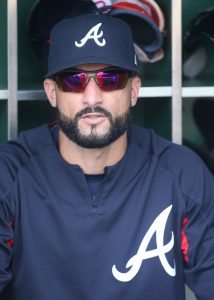
With the move, the Braves have evidently resolved their right field opening by returning to a known commodity. The 35-year-old Markakis just wrapped up a four-year, $44MM deal with the Atlanta organization, during which he appeared in all but a dozen of the team’s contests.
The last season of that pact was easily the best for Markakis, at least from an offensive perspective, as he posted his most productive campaign at the plate since way back in 2012. Ultimately, he slashed a healthy .297/.366/.440 through 705 plate appearances.
Despite the boost in output, Markakis will secure a good bit less than MLBTR had predicted (two years, $16MM). As Gabriel Burns of the Atlanta Journal-Constitution tweets, though, GM Alex Anthopoulos said that other teams put more years and dollars on the table. Markakis simply preferred to come back to Atlanta.
Regardless, the market was obviously well aware of the various qualifiers to the offensive numbers that Markakis put up in 2018. Most notably, he failed to sustain the eye-popping power surge he displayed to open the season, hitting just seven long balls over his final 545 plate appearances. Markakis finished with a .143 ISO that steadily topped his output over his first three seasons in Atlanta. It seems fair to say there’s good reason to question whether he’ll sustain that; odds are, he’ll regress back toward the league-average-ish overall batting productivity levels he had settled in at over the prior half-decade.
To be sure, a significant portion of Markakis’s reputation has been built on his abilities in the field (as well as his durability). Though metrics haven’t seen him as an extraordinary fielder of late, he did pick up his third Gold Glove award last year.
In the aggregate, though, Markakis seems to be more of a candidate to function as a platoon piece than a true regular — at least for a team that has designs on a repeat division title. He has a lifetime .808 OPS against right-handed pitching, 83 points higher than his output against southpaws.
That would line up nicely with Adam Duvall, supposing the right-handed hitter can rebound from a dreadful second-half run with the Braves. With the team also intending to utilize switch-hitter Johan Camargo at times in the outfield, and center fielder Ender Inciarte also perhaps a candidate to sit at times against southpaws, there should be plenty of mix-and-match opportunities — supposing, at least, that Markakis is asked to play a reduced role for the first time in his 13-year career.
Photo courtesy of USA Today Sports Images.
Dodgers Have Discussed Joc Pederson With Multiple Clubs
Jan. 21: The Braves have also “checked on” a trade involving Pederson, tweets Jon Heyman of Fancred. It’s still not clear how many teams have been in contact with L.A., nor is it clear whether there’s any momentum surrounding a potential Pederson deal. However, the connection with Atlanta is only logical. The Braves have an obvious corner-outfield vacancy at the moment, and Braves general manager Alex Anthopoulos spent the 2016-17 seasons as the Dodgers’ vice president of baseball operations before accepting his current position.
Jan. 20: The Dodgers are discussing outfielder Joc Pederson in potential deals, and the White Sox are among the teams they’re talking to, Ken Rosenthal of The Athletic reports. It’s unclear, though, whether the two sides are making progress in those conversations.
Speculatively, trading Pederson could further open up room in LA for free-agent center fielder A.J. Pollock, whom the team is pursuing. And essentially swapping the lefty-swinging Pederson for the right-handed Pollock would enable the Dodgers’ lineup to become more balanced, which is reportedly among their offseason objectives. At the same time, though, waving goodbye to Pederson would mean losing a productive, affordable player who’s under arbitration control through the 2020 season. He’ll earn a reasonable $5MM this year after avoiding arbitration earlier this month.
While the 26-year-old Pederson has never been effective versus left-handed pitchers, who have held him to a woeful .181/.266/.317 line since he debuted in 2014, it has been a different story against righties. Most recently, Pederson posted an overall .248/.321/.522 line (126 wRC+) in 2018 with 25 home runs and 2.7 fWAR over 443 plate appearances. Despite his limitations against same-handed hurlers, Pederson has approached or exceeded 3.0 fWAR in three of the past four seasons. That type of production would be welcome in Chicago, whose outfield ranked dead last in fWAR (minus-1.2) in 2018. The unit has since lost one of its regulars, now-Ray Avisail Garcia, who was merely a replacement-level player last season, though it did add Jon Jay in free agency. Jay had a subpar 2018 in his own right, however, and hasn’t offered particularly strong production over the past few years.
Jay’s now part of a group which also includes Daniel Palka, Adam Engel and Leury Garcia, though all three of those outfielders registered underwhelming results last year. Fortunately for the White Sox, they do have a premier outfield prospect in Eloy Jimenez, whom they figure to promote early in the season and who could make a significant impact from the get-go. But Jimenez’s presence isn’t going to prevent the White Sox from trying to upgrade elsewhere in the grass, evidenced by their interest in Pederson and their pursuit of free-agent standout Bryce Harper.
NL Notes: Cubs, Reds, Pederson, Bourgeois
The Cubs have struggled to develop homegrown pitchers during Theo Epstein’s regime, though senior VP of player development and amateur scouting Jason McLeod told Gordon Wittenmyer of the Chicago Sun-Times that “this is probably the first year I can confidently sit here and feel like we have the guys that can help this team in the major leagues this year, if needed.” The Cubs are already overloaded with veteran rotation options on the 25-man roster, with Jon Lester, Cole Hamels, Kyle Hendricks, Jose Quintana, Yu Darvish, swingman Mike Montgomery, and Tyler Chatwood all on hand to make starts. Of course, those seven account for over $100MM in salary next season, as the Cubs have been forced to spend big on starting pitching to account for a lack of help from the farm.
Jen-Ho Tseng and Duane Underwood Jr. are Triple-A arms who cracked the big leagues in 2018, plus a variety of 2016 draft picks (Thomas Hatch, Michael Rucker, Duncan Robinson) could potentially make the MLB level this season, possibly in the bullpen if not the rotation. The 2016 class is noteworthy, as McLeod said the player development staff has been “more aggressive” with how it brings along its pitchers given the lack of results in earlier years. “We tried to fit everyone neatly into a box,” McLeod said. “Do these mechanics lead to what we think is going to be long-term health? And has he thrown enough strikes that we think prior performance is going to equal this type of performance going forward? We put so many checks on guys…that probably hamstrung us a little bit.”
More from around the National League…
- The Reds have been linked to the center field market since parting ways with Billy Hamilton, though Bobby Nightengale of the Cincinnati Enquirer (Twitter link) suggests the team could like its internal options enough that “a late-inning defensive specialist” could be acquired. None of Scott Schebler, Yasiel Puig, or Nick Senzel profile as anything more than an average defender in center, so it makes sense that the Reds could aim for a glove-first bench player that would allow the team to keep those bigger bats in the lineup for the bulk of a game. A defensive specialist, additionally, would also come at a much lower cost than an everyday-type of center fielder.
- Reports from earlier today suggested the White Sox had interest in Dodgers outfielder Joc Pederson, and The Athletic’s David O’Brien (Twitter link) opines that the Braves also make sense as a Pederson suitor. Atlanta is in need of an outfielder to line up next to Ronald Acuna and Ender Inciarte, and Pederson offers some power and two years of team control. The Braves also have right-handed hitting bench options (Charlie Culberson, Adam Duvall, Johan Camargo) to platoon with Pederson, who struggles against left-handed pitching.
- The Dodgers announced their minor league coaching staffs earlier this week, including the item that former outfielder Jason Bourgeois was joining the staff of the team’s A-ball level Great Lakes Loons. This would seem to indicate that Bourgeois is calling it a career after 19 professional seasons. A second-round pick for the Rangers in the 2000 draft, Bourgeois appeared in 317 MLB games with the White Sox, Brewers, Astros, Royals, Rays, and Reds from 2008-15, hitting .253/.300/.326 over 761 career plate appearances. Since last appearing in the Show, Bourgeois played for the White Sox and Diamondbacks at the Triple-A level, and he spent last season in the Mexican League. We at MLBTR wish Bourgeois all the best in this next stage of his baseball career.
East Notes: Rays, LeMahieu, Realmuto, Braves, Mets
Count the Rays among the teams that chased second baseman DJ LeMahieu during his trip to the open market, according to Marc Topkin of the Tampa Bay Times. Before LeMahieu joined the division-rival Yankees on a two-year, $24MM guarantee, Tampa Bay was “very much in on” him, Topkin writes. Now, with spring training approaching, it’s possible the Rays’ roster may be set, suggests Topkin, who runs down the team’s options at each position. However, Topkin still doesn’t rule out further moves, including a trade for Marlins catcher J.T. Realmuto, who has garnered serious interest this month from the Rays and several other teams.
More from the East Coast…
- With the Braves looking for help in the grass, general manager Alex Anthopoulos revealed Saturday that there are “probably” three outfielders available who fit what the club is seeking, David O’Brien of The Athletic tweets. Anthopoulos added one or more of those players has been in trade discussions but has not made it into the rumor mill, per O’Brien, who surmises that free agents A.J. Pollock and Nick Markakis and Diamondbacks outfielder David Peralta could make up at least a couple of the Braves’ targets. The Braves have been connected to all three throughout the winter, and the easiest to acquire would likely be Markakis, who capped off a four-year run in Atlanta with a solid showing in 2018. But as a 35-year-old corner outfielder with an unspectacular resume, it’s obvious Markakis – unlike Pollock – is not a candidate to land a long-term contract.
- Before he agreed to sign with the Twins on Saturday, left-hander Martin Perez drew interest from the Mets, Jon Heyman of Fancred relays. However, the Mets wanted Perez as a depth piece, which helped point him to a better opportunity in Minnesota, Heyman reports. Coming off a miserable 2018 in Texas, Perez wouldn’t have been a clear upgrade over anyone in the Mets’ rotation – a group that features reigning NL Cy Young winner Jacob deGrom, Noah Syndergaard, Zack Wheeler, Steven Matz and Jason Vargas. The Mets’ top depth starting possibilities include Seth Lugo, though he may be too important to their bullpen to move to the rotation if a need arises, and recent minor league pickup Hector Santiago.
- Back to the Braves, who should get back a couple of their own key pitchers in time for spring training. Both starter Mike Soroka and reliever Darren O’Day are on track to return after injury-shortened seasons, Gabe Burns of the Atlanta Journal-Constitution details. The 21-year-old Soroka was terrific during a five-start, 25 2/3-inning major league debut in 2018, but he last took the mound June 19 on account of shoulder inflammation. He’s now a favorite to win a starting spot in Atlanta heading into 2019, Burns observes. O’Day, meanwhile, underwent season-ending hamstring surgery in late June, but the Braves nonetheless took him from the Orioles a month later in a deal headlined by Kevin Gausman. The 36-year-old O’Day had been amid another quality season before he went down, continuing a long run of effectiveness. With a $9MM salary, he’s currently the Braves’ most expensive reliever.
NL Notes: Rockies, Cardinals, Ozuna, Gregerson, Braves
The latest from the National League . . .
- Following Thursday’s departure of reliever Adam Ottavino to New York, the Denver Post’s Patrick Saunders spoke with GM Jeff Bridich about the state of affairs in the team’s bullpen. On the heels of last offseason’s months-long reliever binge, which saw the club devote nearly a third of its payroll space to the most fickle asset in the game, Colorado apparently couldn’t save room for dessert. The club didn’t offer Ottavino a contract, preferring instead to take its chances with the current crop: “We need last year’s decisions to pitch better than they did in 2018,” said Bridich. “It’s not a lack of talent or a sudden inability to perform well. But they need to do a better job.” Bryan Shaw, Mike Dunn, and Jake McGee, though, did exhibit a sudden inability to perform well, as the trio combined for an ugly -0.7 fWAR in 118 combined IP. Wade Davis, too, was hardly himself in ’18, stranding just 66.9% of baserunners – down from an MLB-best 87.5% from 2014-17 – en route to his lowest career output. Scott Oberg, who began the year in AAA despite being arguably being the team’s most effective pre-spree reliever, again paced the returning bunch, limiting homers at an elite rate and continuing to maintain a stellar walk rate.
- President of baseball operations John Mozeliak provided injury updates on two key Cardinals during a Saturday chat with Derrick Goold of the St. Louis Post-Dispatch. Outfielder Marcell Ozuna, who was bothered all season by a nagging shoulder injury that ultimately required surgery, hasn’t yet begun throwing, and the club “isn’t sure” if he’s taken hacks in the cage, either. Ozuna has spurned treatment at the club’s spring facility in favor of offseason rehab in his native Dominican Republic, which Mozeliak deemed “not ideal,” but the 28-year-old outfielder, who heavily regressed toward his established mean last season after a breakout 2017, has expressed no reservations about his outlook for the upcoming season. Reliever Luke Gregerson, who was limited to just 12 1/3 IP last season after a shoulder injury of his own, “hasn’t felt right” in offseason workouts, and the club isn’t anticipating much from him in Spring Training. The soon-to-be 35-year-old Gregerson has endured one of the game’s heaviest reliever workloads since debuting in 2009, accruing a staggering 611 IP over that span, and appearing in an MLB-high 623 games from 2009-17.
- Per GM Alex Anthopoulos (h/t to the Atlanta Journal Constitution’s Gabe Burns on Twitter), the Braves have made an outfield acquisition their top priority at current, and a move “may be resolved soon.” The club, of course, has been linked to still-available A.J. Pollock (who would cost the team a second-round draft pick if signed) and the recently-departed Nick Markakis to fill its vacancy at one outfield spot. With an overflow of starting pitching talent in the upper minors, the team seems better positioned than almost any to fill its hole via trade, but has thus far shown little interest in doing so. The Blue Jay version of Anthopoulos was an ardent mover of minor-league assets, shuffling talent in all directions when circumstances dictated, but has been far more cautious in his short time with Atlanta. With a still-unsettled rotation mix, perhaps this strategy is prudent, but distancing his club from the ravenous NL East pack will almost surely require a return to old ways for the young Braves GM.
Minor MLB Transactions: 1/18/19
Here are the day’s minor moves from around the league…
- The Pirates have outrighted righty Dario Agrazal to Triple-A after he cleared waivers, MLB.com’s Adam Berry tweets. A control-and-groundball-oriented hurler, the 24-year-old Agrazal has yet to move past the Double-A level. In his 85 2/3 innings at Altoona last year, he pitched to a 3.99 ERA with 5.5 K/9 and 1.4 BB/9 along with a 49.6% groundball rate. Agrazal had been designated for assignment recently to open up a 40-man roster spot.
Earlier Transactions
- Per a team announcement, catcher Andrew Susac cleared waivers and has been assigned outright to Triple-A Norfolk after being designated for assignment by the Orioles. Set to turn 29 in March, Susac was once one of baseball’s premier catching prospects but has only managed a .221/.283/.373 slash in 300 plate appearances at the MLB level to date. He did hit .256/.405/.456 in a smallish sample of 158 plate appearances in Triple-A last year and has a career .248/.350/.438 line through 927 PAs at that level. He’ll remain on hand in the O’s organization as a depth option.
- The Nationals announced that infielder Matt Reynolds has cleared waivers after being designated for assignment. He was sent outright to Triple-A Fresno. Reynolds made just 14 plate appearances with Washington last season and has spent the bulk of his career with the Mets, for whom he batted .228/.300/.351 in 226 PAs from 2016-17. The 28-year-old Reynolds can handle shortstop, second base and third base, and he’s a career .283/.350/.420 hitter in nearly 1600 Triple-A plate appearances (although most of those came in an extremely hitter-friendly setting with the Mets’ former Las Vegas affiliate in the Pacific Coast League).
- Right-hander Jonathan Aro is headed to the Braves on a minor league contract, Anthony Fenech of the Detroit Free Press reports (via Twitter). The 28-year-old hasn’t cracked a big league roster since 2016 and has only 11 MLB frames under his belt in all. However, Aro does have a career 3.14 ERA with 8.3 K/9, 2.6 BB/9 and 0.6 HR/9 in 174 2/3 innings at the Triple-A level. He’s spent the past two seasons with the Triple-A affiliates for the Mariners (2017) and the Padres (2018).
NL East Notes: McNeil, Marlins, Braves
The Mets‘ additions of Robinson Cano and Jed Lowrie have eaten up most of the infield at-bats that would’ve otherwise gone to breakout 2018 rookie Jeff McNeil, writes Anthony DiComo in his latest inbox column. As such, McNeil now looks outfield bound in 2019 — a role he’s only played in a total of nine minor league games. While Brandon Nimmo and Michael Conforto are locked into outfield spots — likely in center and right field — McNeil will join Juan Lagares and Keon Broxton in the mix for additional outfield playing time. (Yoenis Cespedes‘ status for the 2019 season is uncertain following surgery on both heels.) It’s curious to see McNeil to a more limited role after the 26-year-old burst onto the scene with a .329/.381/.471 slash in 248 plate appearances, though surely the organization feels its depth on the position player side is formidable. For those wondering, DiComo notes that Todd Frazier isn’t likely to be moved coming off a career-worst year, adding that GM Brodie Van Wagenen indicated Frazier is expected to receive regular at-bats at the infield corners. It’s somewhat curious, then, that the Mets chose to deepen their infield mix with Lowrie rather than add a reliever like Adam Ottavino, who agreed to a $9MM annual salary on a three-year deal with the Yankees yesterday.
Here’s more from the National League East…
- Barry Jackson of the Miami Herald provides an update on a sleepy Marlins offseason, explaining that the club is still waiting for some bigger things to fall into place before adding to its roster. Beyond the obvious fact that the rebuilding club is waiting to see what players might fall through the cracks in free agency, the Marlins are not particularly interested in making moves before lining up a hopeful trade involving star catcher J.T. Realmuto. That deal could return some MLB pieces, which would dictate the team’s further needs. Jackson also reports that Miami would like to add a lefty bat who can play both the infield and the outfield — a perplexing target considering the fact that the Marlins cut Derek Dietrich, who fits that description to a tee, rather than pay him a projected $4.8MM salary. Jackson again notes that right-hander Dan Straily is available, though Miami isn’t shopping him and would be happy to have him in the rotation in 2019 if a solid offer doesn’t materialize.
- The Braves likely wouldn’t offer Craig Kimbrel more than three years to bring him back to Atlanta, writes Mark Bowman of MLB.com, and even then, the average annual value Kimbrel figures to seek could prove prohibitive. The outfield and the rotation, it seems, are still larger priorities for Atlanta decision-makers. Bowman notes that the Braves have not pursued Adam Jones in free agency despite a clear corner outfield opening, instead citing Nick Markakis as the likeliest free agent for the team to pursue.
Braves Notes: Anthopoulos, Catching, Markakis, Relief Pitching, Pollock, Gray
The Braves burst out of the gates this winter with the signings of Josh Donaldson and Brian McCann, but it has been crickets in Atlanta ever since. Here’s the latest …
- Appearing at a team-sponsored event, GM Alex Anthopoulos discussed the status of the team’s roster-building efforts, as attendee and SB Nation contributor Stacy Marlow documented (Twitter links). Unsurprisingly, he did not divulge much in the way of specifics, but did provide some worthwhile snippets. Anthopoulos suggested the team was not heavily engaged on a “quiet” catching market, but would not rule out a move if the right opportunity comes along. He also seemingly reiterated a familiar stance on free agent outfielder Nick Markakis, indicating that the sides are still keeping an open line and weighing a reunion.
- The Braves relief unit is certainly an area of potential improvement, but Anthopoulos’s comments suggest he has been lying in wait in hopes of securing good value in that area. He says that he only just spoke with a free agent reliever for the first time recently, indicating that the club has not been in on the quality pitchers that have already signed — many of them for fairly hefty salaries. Anthopoulos added that his expectation is that contract demands will begin to drop as Spring Training approaches. As we’ve often discussed over the past two years, teams are exhibiting much greater patience in free agency. Whether players and their agents can match that discipline and regain some leverage remains to be seen.
- Most tantalizing, however, were Anthopoulos’s comments regarding one possible swap that’s evidently in the works. “There’s one trade concept right now that 70% of the deal we would agree to, the 30% is probably where we are going back and forth,” he said. “I don’t know if we are going to get it done, but the main piece of the deal I think we ultimately would be ok, it’s the add on.” Certainly, this not-yet-completed arrangement could involve any number of possible players, but it’s at least notable to learn that there could soon be some action.
- One significant factor in the development of the offseason for the Braves, according to Ken Rosenthal of The Athletic (subscription link), is the team’s hesitation to part with a draft selection to sign a player who declined a qualifying offer. There were six such players, only two of whom have signed to this point. Several are at least hypothetical targets for Atlanta, with the team reportedly showing real interest in outfielder A.J. Pollock. Rosenthal writes that the Braves are worried about the draft compensation that would be required to land Pollock — in their case, a second-round pick that’ll end up being sixty-something overall. Specifically, he says, the Braves “value the selection more than most clubs” because of the amateur talent penalties the team was slapped with in late 2017. If that is indeed a position the team itself holds, it’s somewhat less than compelling. The Braves certainly aren’t alone in valuing draft selections. Like their competitors, they must consider the future talent pipeline. It’s especially tough to see the club as uniquely situated when it still possesses a bounty of young talent at the major and minor league levels.
- One possibility that’s seemingly still on the table for the Braves is a move to land Sonny Gray of the Yankees. Gabriel Burns of the Atlanta Journal-Constitution recently discussed the concept, on the heels of a report from Jon Heyman of Fancred (Twitter link) that suggested the Braves could still be pursuer as the New York org again tries to make a deal on the veteran righty. As Burns explains, it’s not exactly a perfect fit, given Gray’s recent struggles and the Braves’ own needs, but it’s possible to imagine a match and the org has clearly shown prior interest. What’s most interesting, perhaps, is what a hypothetical acquisition of Gray would mean for Julio Teheran — another still-youthful, not-inexpensive starter who is looking to regain his prior form. Understandably, the Braves do not appear to view the rotation as the first order of business. The opening in right field no doubt remains the top priority, with some of the other possibilities discussed above arguably also rating as greater needs. All said, there’s still quite a bit of work to do this winter for Anthopoulos and co.
Market Notes: Machado, White Sox, Mystery Team, Kipnis, Marwin
Despite recent reports that the White Sox have made an eight-year offer to Manny Machado, a parade of others are reporting that the team has not moved off of its previous seven-year offer. Bob Nightengale of USA Today tweeted that the ChiSox have not made any alterations to their original seven-year offer, which was put on the table about two weeks back. Bruce Levine of 670 The Score/CBS Chicago suggests the same, via Twitter, adding that the offer presently on the table to Machado is valued between $25-30MM annually. That’d peg Chicago’s offer somewhere in the $175-210MM range — well shy of Machado’s reported $325MM+ target.
- While the White Sox have gone to some unique measures to make Chicago a bit more appealing for Machado — acquiring his brother-in-law, Yonder Alonso, and signing close friend Jon Jay — SNY’s Andy Martino writes that Machado won’t be wooed by anything other than the largest offer (which goes without saying for the majority of free agents). More interesting from Martino’s report is the possibility of some dark-horse teams in the mix on Machado. While Martino acknowledges that the “mystery team” trope is overplayed and is “often mocked for good reason, we hear reliably that it’s true in this case.”
- The Indians are still dabbling in trade talks, but it doesn’t sound as if the team has much hope of moving Jason Kipnis. According to Paul Hoynes of the Plain Dealer, there was an effort to do so previously. But while an improved second half helped the Cleveland cause, the crowded second base market made it hard to find any traction. The 31-year-old has turned in below-average offensive seasons for two years running, but he’s still a useful player and has a significant established ceiling. The recent showing isn’t enough to justify his $14.5MM salary, particularly with another $2.5MM promised as a buyout on a 2020 option, but the Indians surely feel they can make good use of Kipnis in the season to come. For now, he’s penciled in at second base but his ability to play the outfield could give the Indians some added flexibility as they seek a means of improving their lineup.
- While a rumor sprang up this evening that the Braves had a deal with Marwin Gonzalez, that doesn’t seem to have any legs. Enrique Rojas of ESPN Deports tweets that the Atlanta organization has not made any offers to the free agent, though it has shown interest in him. Presumably, the Braves see Gonzalez as a potential option in the corner outfield for the coming season. His versatility would be an asset, too, as he’d be capable of covering in the infield if a need arose in the near or long term. Of course, it remains unclear whether the Braves will pursue a multi-year deal with Gonzalez or another free agent, or whether they’ll try to wait out the market in hopes of securing a quality player on a short-term deal.