
Latest On Mitch Haniger’s Market
Next week’s Winter Meetings are expected to open the floodgates for some hot stove activity, and among the free agents drawing substantial interest leading up to those meetings is longtime Mariners outfielder Mitch Haniger. The 31-year-old (32 next month) has a “robust” market, per ESPN’s Jeff Passan, and colleague Buster Olney tweets that there’s a growing belief he’ll be able to secure a three-year contract — perhaps in the vicinity of $15MM per year.
Haniger has, to this point in the offseason, been linked to each of the Red Sox, Dodgers, Angels, Giants, Rangers and the Mariners, who are open to adding another outfielder even after acquiring Teoscar Hernandez from the Blue Jays last month. The Halos’ interest, it should be noted, was reported prior to their acquisition of Hunter Renfroe. It seems likely that move probably put an end to their pursuit of Haniger; the Angels also have Mike Trout and Taylor Ward locked into outfield spots and Shohei Ohtani at DH, of course.
Even presuming the Angels are out of the running, that’d leave at least five teams — and quite likely a few more — in the mix for Haniger, who missed substantial time this season due to a high ankle sprain but has generally been an above-average to excellent hitter when healthy enough to take the field. Dating back to 2017, Haniger boasts a .263/.337/.480 batting line — 24% better than league average by measure of wRC+, which weights for his pitcher-friendly home park. Haniger belted 39 home runs in a season as recently as 2021 and is one of the few outfielders on this offseason’s market who can be viewed as a viable 30-homer threat.
Of course, the knock on Haniger has been his ability to remain on the field — or rather, his lack thereof. Haniger’s 2019 season was cut short when he sustained a ruptured testicle after a poorly placed foul ball off his own bat. Just two months later, while rehabbing from the subsequent surgery, Haniger experienced back discomfort and learned that he’d torn an adductor muscle off the bone. The fallout from that second injury snowballed and ultimately saw Haniger require core muscle/hernia surgery and a microdiscectomy operation.
It was one of the more bizarre and also fluky sequences of injuries for any player in recent memory, but the end result was still a 22-month absence from the playing field for Haniger. He returned with that aforementioned 39-homer campaign, however, and has posted a combined .251/.316/.47o slash with 50 homers in 938 trips to the plate since coming back from that nightmarish run of health troubles. Haniger’s once-premium defensive ratings dipped in 2021, but he posted positive marks in both Defensive Runs Saved (3) and Outs Above Average (2) in this year’s small sample of 396 innings.
Heading into the offseason, MLBTR ranked Haniger 20th on our Top 50 Free Agent list, predicting a three-year contract at an annual rate of $13MM. Olney’s report suggests that Haniger’s market could be reaching if not pushing a bit beyond that level. If interest is indeed ramping up to that extent, it stands to reason that Haniger could be one of many free agents to come off the board during next week’s Winter Meetings or shortly thereafter.
Red Sox Outright Ronaldo Hernandez
The Red Sox announced to reporters, including Pete Abraham of The Boston Globe, that catcher Ronaldo Hernandez has been outrighted to Triple-A Worcester. Their 40-man roster is now at 39.
Hernandez, 25, was a Rays prospect who they added to their 40-man roster prior to the Rule 5 draft in November of 2019. He was acquired by the Red Sox prior to the 2021 season in the deal that sent Jeffrey Springs to Tampa. In his first year in Boston’s system, things went quite well for Hernandez. In 99 games split between Double-A and Triple-A, he hit .284/.326/.501 for a wRC+ of 122. However, he took a step back in 2022, hitting .261/.297/.451 for a wRC+ of 93.
Prospect reports on Hernandez have indicated that his blocking and receiving need some work but his power at the plate continued to draw strong marks. He did still hit 17 long balls this year, but he’s never really been able to draw many walks, as indicated by this year’s 4.8% rate. The Red Sox have long had Christian Vázquez as their primary backstop but traded him to the Astros this year and he’s now a free agent. With the outright of Hernandez, they’re left with Reese McGuire and Connor Wong as the two catchers on their 40-man roster at present.
There had been no public indication that Hernandez had been designated for assignment or placed on waivers but he evidently was passed through in recent days. Hernandez will stick in the organization as depth but without taking up a roster spot. With a spot open, the Sox could potentially be lining up a signing but it also could be with an eye towards next week’s Rule 5 draft. Boston grabbed Garrett Whitlock from the Yankees in the 2020 version of the Rule 5.
Rays To Sign Zach Eflin To Three-Year Deal
The Rays are dipping into the free agent pitching market, agreeing to terms with right-hander Zach Eflin on a three-year deal. It’s reportedly a $40MM guarantee for the O’Connell Sports Management client. Eflin will make $11MM in each of the next two seasons, followed by an $18MM salary in 2025. The deal is pending a physical.
Eflin had spent his entire big league career with the Phillies. Originally drafted by the Padres, the Orlando native was dealt to the Dodgers and Phils during his time as a minor leaguer. He reached the majors by the middle of the 2016 campaign, bouncing on and off the MLB roster for the first couple seasons. Eflin struggled during his early big league looks, but he’d settled in as a capable mid-rotation arm by 2018.
That season, he made 24 starts and worked to a 4.36 ERA across 128 innings. That kicked off a remarkably consistent stretch of results. In each of the five seasons between 2018-22, Eflin posted an ERA between 3.97 and 4.36. Aside from a spike in strikeouts during the abbreviated 2020 season, he achieved those 3rd/4th starter results in a similar manner every year. He’s proven an excellent strike-thrower who misses bats at a slightly below-average level but keeps the ball on the ground at a solid clip.
Between 2019-21, Eflin worked to a 4.12 ERA with a slightly below-average 21.4% strikeout rate but a stellar 5.7% walk percentage. He’d been on a similar path to begin this season, posting a 4.37 ERA with a 19.6% strikeout percentage and a 5.3% walk rate through his first 13 starts. At the end of June, he landed on the injured list with a right knee contusion. That cost him over two months. By the time he was ready for reinstatement in early September, the Phils had limited time to build him back to a starter’s workload before year’s end. They expedited his return to the majors by plugging him in short relief. Eflin made seven appearances out of the bullpen during the regular season, then tossed 10 2/3 frames over 10 outings as a high-leverage arm during the Phils’ run to a National League pennant.
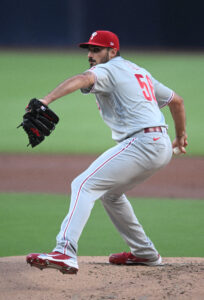
While Eflin doesn’t miss many bats, his blend of stellar control and a solid five-pitch mix allowed him to find a fair amount of success in Philadelphia’s hitter-friendly home environment. Against right-handed hitters, he leans primarily on a sinker in the 92-93 MPH range, but he turned to a four-seam fastball more often against lefties. Eflin mixes in a cutter and curveball as his usual secondary offerings, occasionally deploying a slider against righties as well. He rarely turns to a changeup, however, and he’s had his share of issues with left-handed batters. Southpaws have hit Eflin at a .274/.335/.492 clip since the start of 2018, but he’s stifled same-handed hitters to a .255/.291/.398 mark.
Tampa Bay surely has designs on plugging him back into the rotation after a healthy offseason. He’ll step in behind Shane McClanahan and Tyler Glasnow in the pecking order, joining Drew Rasmussen and Jeffrey Springs in what looks to be the season-opening starting five. The Rays have one of the sport’s top pitching prospects, Taj Bradley, waiting in the wings after a great season in the upper minors. Shane Baz was expected to seize a rotation job himself, but he’s likely to miss all of next season after undergoing Tommy John surgery in September. Luis Patiño, Yonny Chirinos and Josh Fleming are on hand as rotation or multi-inning relief options for what should again be a strong Tampa Bay pitching staff.
If healthy, Eflin fits nicely into the middle of that group. At the same time, the Rays are placing a bet on a pitcher with a concerning injury history. The knee contusion that cost Eflin a couple months this year was the latest in a line of joint issues that have plagued him since before he began his career. He underwent a pair of surgeries to repair the patellar tendons in both his knees in the summer of 2016. At the time, Eflin acknowledged he’d battled chronic knee pain dating back to adolescence (link via Todd Zolecki of MLB.com). He avoided any worrisome injuries for the next few seasons, but he went back under the knife in September 2021 to again repair the patellar tendon in his right knee. That cut his year short, meaning he’s lost chunks of three of the past six seasons to knee issues. There’s real risk in investing in a pitcher who has only once topped 130 MLB innings in a season.
The Rays were willing to look past that to add a pitcher who’s typically effective when healthy. Eflin’s also one of the younger arms available in free agency. He won’t turn 29 until next April, and a pitcher with his age and statistical track record may well have found four years on the open market if not for injury concerns. Tampa Bay wasn’t the only team that valued Eflin in this range, as Bob Nightengale of USA Today tweets the Red Sox had made him the same offer. Eflin elected to join the Rays instead, signing closer to home and avoiding state income tax.
With an $11MM salary for next season, Eflin becomes the highest-paid player on the Tampa Bay roster. He’ll lose that title in 2024, when Glasnow’s salary spikes to $25MM, but he’ll count for a significant portion of a Rays payroll that typically ranks among the league’s lowest. The Rays are now up to around $78MM in projected commitments for 2023, not far off their franchise-record $83MM mark from this past season. The overall $40MM guarantee represents the largest free agent investment in Rays history.
It also easily tops MLBTR’s pre-offseason projection of two years and $22MM for Eflin. The deal narrowly beats the three-year, $39MM guarantee Tyler Anderson received from the Angels last month. Anderson had rejected a qualifying offer and cost the Halos a draft choice. The Phils elected not to qualify Eflin. Philadelphia won’t receive any compensation for his departure, while the Rays won’t lose any picks to add him. To find Eflin’s replacement, Philadelphia can dip into a free agent rotation market that offers a number of options beyond the top trio of Jacob deGrom, Carlos Rodón and Justin Verlander. Players like Chris Bassitt, Kodai Senga, Jameson Taillon, Nathan Eovaldi, Noah Syndergaard, Andrew Heaney, Taijuan Walker and Sean Manaea all remain on the market as strong candidates for multi-year deals.
Jeff Passan of ESPN was first to report the Rays and Eflin had agreed to a three-year deal. Joel Sherman of the New York Post first reported the guarantee at $40MM. Marc Topkin of the Tampa Bay Times reported the specific financial breakdown.
Image courtesy of USA Today Sports.
Red Sox Interested In Mitch Haniger
The Red Sox have expressed interest in free agent outfielder Mitch Haniger, reports Jon Morosi of MLB.com (Twitter link). Boston joins the Dodgers, Rangers, Giants, Angels and incumbent Mariners among the clubs known to have checked in with his representatives.
Haniger is one of a handful of mid-tier corner outfielders available in free agency. The outfield market is topped by Aaron Judge and, after a significant gap, Brandon Nimmo. There’s another drop to the third tier, a mix that includes Andrew Benintendi, Jurickson Profar and bounceback types like Cody Bellinger and Michael Conforto alongside Haniger.
While Haniger isn’t in the same boat as Bellinger or Conforto, he’s also looking to rebound from a relatively down year to match pre-2022 heights. He lost a good chunk of this past season with a high ankle sprain. That kept him to 57 contests and 247 plate appearances, in which he hit .246/.308/.429 with 11 home runs. That’s still above-average offensive production once one accounts for the pitcher-friendly nature of Seattle’s T-Mobile Park, but it marked a somewhat disappointing follow-up to a 2021 campaign that saw him land some down-ballot MVP votes. Haniger connected on 39 homers with a .253/.318/.485 line over 157 games that year.
Various injuries have nagged the Cal Poly product throughout his MLB tenure, and he’s only twice exceeded 100 games in a season. When healthy, however, he’s typically provided a strong source of power from the righty batter’s box. Haniger owns a .244/.315/.469 line dating back to the start of 2019, and he’s mashed opposing left-handed pitchers to the tune of a .274/.355/.536 showing. His production against same-handed arms is closer to average, but he’s certainly playable against pitchers of either handedness. He typically rates as a solid defender in the corner outfield but isn’t an option for work in center.
The Red Sox have a fairly clear use for corner outfield help. Jarren Duran hasn’t performed at the major league level the way many had expected after he broke out as a prospect. He’s now 26 years old and owns a career .219/.269/.354 line at the MLB level. Duran hasn’t earned much consistent work against big league pitching and a win-now Boston club would be hard-pressed to rely on him for an everyday role. Alex Verdugo has played well at times but posted overall numbers around league average for the past two seasons. Haniger would be an upgrade on either player, and Boston also has an uncertain DH mix with the free agency of J.D. Martinez.
Padres, Diamondbacks Among Teams Interested In Xander Bogaerts
11:40am: The Athletic’s Peter Gammons cites front office officials from three other teams who are of the belief that Bogaerts will not return to Boston (Twitter link). As he did with regard to Bogaerts playing another position, however, Boras outwardly denied the report, telling Alex Speier of the Boston Globe that Bogaerts is “open to any and all voices in the free agent market” and adding that he and Bogaerts “have not closed any doors on anyone.”
10:04am: Next week’s Winter Meetings are generally expected to serve as a catalyst for what’s been a slow-moving free agent market. As the league’s biggest offseason convention approaches, the interest for some of the top players available is beginning to come into focus.
Xander Bogaerts is part of a loaded shortstop class, and a number of teams have checked in with his representatives at the Boras Corporation. Jeff Passan of ESPN reports the Diamondbacks and Cubs have expressed interest, while adding that previously-reported suitors like the Phillies and Dodgers are in the mix. Meanwhile, Ken Rosenthal of the Athletic reports Padres president of baseball operations A.J. Preller recently checked in with Scott Boras about Bogaerts’ willingness to play a position other than shortstop. Boras, however, flatly rejected the possibility; the agent tells Rosenthal “Xander is playing shortstop” and denied that San Diego would prefer to move him off the position.
San Diego’s interest in Bogaerts isn’t a new development. Marino Pepén listed the Padres as a suitor last week, while Jon Heyman of the New York Post has suggested they’re involved in the top of the shortstop market more generally. The Friars are seemingly serious enough in their pursuit to gauge Bogaerts’ amenability to move off the position.
The infield mix at Petco Park is already crowded, although there are a number of multi-positional options who can move around. Manny Machado is locked in at third base, while the rest of the current infield figures to be made up by some combination of Fernando Tatis Jr., Ha-Seong Kim and Jake Cronenworth. Kim has proven himself an excellent defensive shortstop and earned an everyday role with a .251/.325/.383 showing this past season. Tatis was expected to be the franchise shortstop after a brilliant start to his career earned him a $340MM extension, but he’s now under consideration for a move to second base or the outfield after missing all of 2022 due to injury and a performance-enhancing drug ban. Cronenworth is a quality defender at the keystone, but the Friars have floated the possibility of kicking him over to first base with Josh Bell and Brandon Drury hitting free agency.
Adding a first base/designated hitter type might be the most straightforward path to building out the offense, but there’s no harm for Preller and his staff in considering other avenues. Adding another middle infielder while kicking Cronenworth to first base would give San Diego an elite defensive infield, while Bogaerts is among the top offensive players available regardless of position. He’s long been mentioned as a candidate to move off shortstop towards the end of a free agent deal after years of subpar defensive marks, but he quieted those concerns (at least in the short term) with arguably the best season of his career with the glove. Bogaerts rated as four runs above average in more than 1200 shortstop innings by both Defensive Runs Saved and Statcast this past season. He hasn’t played anywhere else since 2014 and while there’s little question he could handle a less demanding position like second or third base, it doesn’t seem he’s willing to do so.
There are a number of other teams with worse internal options than the Padres that’d surely be willing to plug Bogaerts in at his longtime position. The Diamondbacks relied on rookie Geraldo Perdomo this year, and he looked overmatched to the tune of a .195/.285/.262 line in 500 plate appearances. Nick Ahmed is under contract and can play excellent defense, but he’s always been a below-average hitter and lost almost all of this past season to surgery on his throwing shoulder.
Arizona general manager Mike Hazen is plenty familiar with Bogaerts from his previous work in the Red Sox’s front office, so it’s little surprise they’re interested in adding him given the uncertain shortstop outlook. The question is whether a Diamondbacks team that has had a payroll south of $100MM in each of the past two seasons would be willing to commit a deal of that magnitude. MLBTR predicts a seven-year, $189MM contract for Bogaerts. The D-Backs already have roughly $98MM in salary commitments for next season, per Roster Resource, so adding a salary in the realm of $27MM annually would require owner Ken Kendrick signing off on a major spending hike relative to recent levels.
The Cubs have a cleaner long-term payroll outlook that makes them a viable fit for any of the top shortstops. Nico Hoerner is a quality incumbent, but he’s already expressed a willingness to move to second base to accommodate a big-ticket acquisition. Roster Resource projects Chicago’s 2023 commitments around $127MM, and they’ve opened each of the past two seasons with payrolls in the $140MM to $150MM range. Chicago has pushed spending north of $200MM in the past. There’s room for an aggressive offseason, but president of baseball ops Jed Hoyer and his front office have to weigh whether to invest in the middle infield against other weak points on the roster like center field, first base, catcher and the back of the rotation.
Bogaerts rejected a qualifying offer from the Red Sox, so any signing team will have to forfeit draft choice(s) and/or international bonus pool space to sign him. Boston has consistently maintained retaining him is their top priority, though extension talks dating back at least to Spring Training haven’t gotten anywhere. The Phils are widely expected to be in play for a top shortstop, but reports suggest they’re more dialed in on Trea Turner at the moment. The Dodgers could certainly turn to any of the other shortstops if Turner walks, while the Twins reportedly have Bogaerts as their top fallback if they can’t retain Carlos Correa.
Guardians Made Three-Year Offer To Jose Abreu
Yesterday, the Astros and first baseman Jose Abreu agreed to a three-year, $58.5MM contract, but it seems a surprising club was close to Houston in the bidding for Abreu’s services. Paul Hoynes of the Cleveland Plain Dealer reports that the Guardians made a three-year offer, but that the $60MM range was “beyond their reach.”
The Guardians are usually one of the lowest-spending clubs in the league, so the fact that they didn’t sign a costly free agent isn’t exactly shocking. However, it could perhaps be an indication that they have a greater willingness to spend this offseason than usual. The largest free agent contract in the history of the franchise is the $60MM over three years given to Edwin Encarnacion prior to the 2017 season, coincidentally very similar to the deal Abreu just signed. The Guardians did give José Ramírez $129MM over seven years, though that was an extension and not a free agent deal.
Though many fans will remain skeptical of “at least we tried” reports of teams just missing on free agents, there are reasons to think the Guards might actually have some money to work with this winter. The club ran out a roster full of rookies and other young players in 2022, and it worked tremendously. They went 92-70 and finished atop the American League Central despite a very modest payroll. Roster Resource currently pegs their 2023 spending around $72MM, with no individual player set to earn more than the $14MM Ramírez will get. $9MM of that number is the projected arbitration salary of shortstop Amed Rosario, a name frequently mentioned in trade rumors. That $72MM figure is already a slight upgrade over last year’s Opening Day figure of $68MM, per Cot’s Baseball Contracts, but they got as high as $135MM in 2018.
Now that the club is a few years removed from the lost revenues of the pandemic and just got a boost from a surprise postseason run, it’s possible that they are willing to push spending back up near their pre-pandemic levels. It would also make sense from an on-field perspective to build around their bevy of young and talented players while they are still paid at arbitration or pre-arb levels.
If there is some money to be spent, the first base/designated hitter part of the roster is a sensible place to put it. The club has Josh Naylor penciled in as their first baseman but Franmil Reyes flamed out as the designated hitter in 2022 and eventually got put on waivers, going to the Cubs. There would have been an opening for Abreu to step in and split the first base and designated hitter duties with Naylor. It also would make sense to add some extra thump to a lineup that succeeded in 2022 largely by making contact and avoiding strikeouts. The club hit 127 home runs this year, which was 29th in the majors, ahead of only the Tigers. Abreu’s power actually took a step back in 2022, but he still hit 15 home runs and has frequently been a 30-homer bat in the past.
If the Guardians are still willing to pursue this market, there are other options available to them. There are some part-time or role players available such as Trey Mancini or Yuli Gurriel, but the top option is Josh Bell. On MLBTR’s Top 50, he was projected for a $64MM contract over four years. That guarantee is beyond what Abreu got, but at a lower average annual value of $16MM. Since Bell is only 30 years old compared to Abreu’s 36, he will likely require a lengthier commitment, but that lower salary might better suit the Cleveland checkbook. Like Abreu, he would add some thump to the lineup, having hit 17 home runs last year and getting as high as 37 in previous seasons. He also isn’t likely to throw off the club’s low-strikeout style either, as he’s never posted a rate above 19.2% outside of the shortened 2020 season. For context, this year’s league average rate was 22.4% and the Guardians struck out at a collective 18.2% clip.
The Guardians will surely have competition in a pursuit of Bell or any other first basemen they decide to go after. The Padres, Cubs and Marlins were all reported to have been interested in Abreu and they will likely start thinking about the next options on their lists. One other team on that list is the Red Sox, as Jon Heyman of The New York Post reports that Abreu was their top free agent target and they met with him as soon as free agency began.
The Red Sox already have something of a cluttered mix of players for their first base and designated hitter spots. Youngsters Triston Casas and Bobby Dalbec are on the 40-man roster along with veteran Eric Hosmer, picked up in a deadline deal with the Padres last year. However, there’s no real reason for them to be especially committed to Hosmer, as the Padres agreed to pay down all of his remaining contract except for the league minimum. Since joining the Padres prior to 2018, he’s been essentially a replacement level player, producing a wRC+ of 100 and 0.3 fWAR. As for Dalbec, he showed some potential in 2020 and 2021 but struggled greatly in 2022, hitting just .215/.283/.369 for a wRC+ of 80 while striking out in 33.4% of his plate appearances.
We can’t know for sure what subsequent moves the Red Sox would have made if they had signed Abreu, but it seems possible they could have looked to trade Hosmer or simply released him if he used his no-trade clause to block a deal. Dalbec could have also found himself on the trading block but he also has options and could have been retained as minor league depth in case Casas, who has just 27 MLB games under his belt, struggled in 2023. He hit five homers in that short sample and walked a bunch but didn’t hit for much average, leading to a lopsided batting line of .197/.358/.408.
The first base market has been quite robust in the early days of the offseason, as Anthony Rizzo already re-signed with the Yankees, the Pirates traded for Ji-Man Choi and Carlos Santana, followed by Abreu signing with the Astros. With several teams seemingly still interested in upgrading their rosters at first, the remaining free agents might see their phones lighting up very soon.
Red Sox Promote Ramon Vazquez To Bench Coach
Red Sox first base coach Ramon Vazquez is getting a new assignment, as reporter Edwin Hernandez Jr. tweets that Vazquez will take over from Will Venable as Boston’s new bench coach. Venable joined the Rangers earlier this month to take an associate manager role under Bruce Bochy.
The 46-year-old Vazquez has been a member of Boston’s coaching staff since 2018, first working as a statistical analysis coordinator and then moving into a role as a quality control coach. Vazquez saw some fill-in work as the first base coach in 2021 before taking over the job entirely for the 2022 season.
Before joining the Red Sox, Vazquez worked as a coach on the Padres’ staff in 2017, and previously as a coach in the Astros’ farm system. Fans may remember Vazquez from his lengthy and well-traveled playing career, as he suited up for six different MLB teams (including the Red Sox) from 2001-09. In an interesting tidbit, Vazquez and Alex Cora were actually traded for each other back in July 2005, with Vazquez going to Cleveland and Cora going to the Red Sox — this started Cora’s history in Boston, which has continued into his current role as the team’s manager.
Pitching Notes: Brash, Lugo, Red Sox, Raley
Matt Brash‘s debut in the majors resulted in a 4.44 ERA over 50 2/3 innings, with pronounced splits as a starter (7.65 ERA) and as a reliever (2.35), since returning from a minor league demotion in a relief role worked wonders for Brash’s effectiveness. Unsurprisingly, “Brash has generated a ton of [trade] interest after his rookie season,” Ryan Divish of The Seattle Times writes, “but it would take a lot” for the Mariners to consider moving the 24-year-old. If anything, the M’s have faith that Brash could still be part of a rotation, given the club’s plan to stretch him out for Spring Training.
Brash’s 14.9% walk rate was the third-highest of any pitcher in baseball with at least 50 innings pitched in 2022, and he also allowed a lot of hard contact. On the plus side, the hard-throwing Brash had an above-average 27.9% strikeout rate, and elite curveball spin to go along with excellent whiff and barrel rates. There’s a lot to like about a young pitcher who still has only 179 1/3 combined innings on his record at the Major and minor league levels, and rival teams are naturally seeing if the win-now Mariners might be open to moving a younger pitcher for a more established MLB-level player. Nothing can truly be ruled out given the aggressiveness of Seattle GM Jerry Dipoto, yet it’s probably likelier that one of Marco Gonzales or Chris Flexen are dealt from the Mariners’ pitching mix.
More pitching-related items from around baseball….
- Back on November 14, The Athletic’s Will Sammon reported that the Mets weren’t one of the many teams who had checked in with free agent righty Seth Lugo. Almost two weeks later, the two sides still haven’t been in touch, and “the Mets do not view Lugo as a starter,” Mike Puma of the New York Post reports. Lugo is reportedly open to signing as either a starter or as a reliever, and at least some of the other suitors have some interest in Lugo’s potential as a rotation piece. Speculatively, this could translate to at least an incentive-heavy contract for Lugo, with more bonus money available if he ends up making more starts than relief appearances. It could be that the Mets simply don’t value Lugo at this price, and are ready to look elsewhere in their search for bullpen help.
- The Red Sox pursued left-hander Brooks Raley in free agency last year, and offered Raley a two-year deal worth roughly $8MM, according to The Boston Globe’s Alex Speier. Raley ended up signing a two-year, $10MM contract with the Rays, and then had a strong season for Boston’s division rival (Raley’s year included a 0.00 ERA over six innings against the Sox). Between missing out on Raley and the general lack of quality in Boston’s 2022 bullpen, Speier writes that the Red Sox “came to regret not pursuing relief help more aggressively,” and opines whether or not the team might put more emphasis on relievers this winter. Chaim Bloom hasn’t spent much on relief pitching in his first three offseasons as the Red Sox chief baseball officer, and thus far this winter, Speier notes that the Sox haven’t yet paid much attention to the relief market, with a larger (and understandable) focus on starting pitching and re-signing Xander Bogaerts.
Latest On Carlos Correa, Xander Bogaerts
Shortstop Carlos Correa is one of the top free agent available and he is unsurprisingly drawing plenty of interest. Jon Heyman of The New York Post reports that eight teams are interested in his services, but the Twins are expected to “go hard” in their attempts to retain him.
Heyman doesn’t mention any teams by name other than the Twins, who are already known to be making a concerted effort to keep Correa in Minnesota. It was reported earlier this week that they have made multiple offers to him, with varying lengths between six and ten years, presumably with higher salaries on the shorter deals and lower salaries on the longer deals. In addition to the Twins, Correa has already been publicly linked in some way to the Giants, Dodgers and Cubs. Since Heyman says eight teams are involved, it appears there are four “mystery teams” at the table.
As to who those mystery teams are, we can only guess, though there would be some logical fits. Mariners’ president of baseball operations Jerry Dipoto has said the club is planning to pursue shortstops to play second base in deference to J.P. Crawford. The Phillies are known to be looking for a shortstop this winter. The Braves will need to replace Dansby Swanson if they can’t re-sign him but they might not have the financial ability to go after Correa. The Orioles have been speculated as a fit given that general manager Mike Elias was working for the Astros when Correa was drafted and developed, though they don’t have a track record that would suggest they’d give out the type of contract it would require to land him.
One surprising team that could be in the mix is the Padres. Heyman doesn’t directly connect the club to Correa but he does say they are considering the free agent shortstops. The Padres have been extremely aggressive in recent years and president of baseball operations A.J. Preller shouldn’t really be counted out on anyone, but it’s still unexpected to see the club connected to this market. The Friars got by without Fernando Tatis Jr. in 2022, who missed the first half of the season due to a wrist injury and the second half due to a suspension for a positive test for performance-enhancing drugs.
In his absence, Ha-Seong Kim stepped up and had an excellent season. He hit .251/.325/.383 for a wRC+ of 105 while stealing 12 bases and providing excellent defense. All of Defensive Runs Saved, Ultimate Zone Rating and Outs Above Average gave him positive grades, allowing him to produce 3.7 wins above replacement, according to FanGraphs. With Tatis set to return in 2023 once he serves the final 20 games of his suspension, it would seem the position is already crowded enough as it is. However, Heyman’s report indicates the club is open to the idea of moving Tatis to the outfield, something he’s dabbled with in the past, while bumping Kim into a utility role.
It had been previously reported that the club was considering an alignment of Kim at short, Tatis at second and Jake Cronenworth at first. It seems that this new plan would be somewhat similar but with Tatis going to the outfield, perhaps replacing Jurickson Profar, who is now a free agent, in left. Regardless of how it would eventually play out, Heyman lists Xander Bogaerts as their preferred option for this plan. Marino Pepén also connects the Padres to Bogaerts, though he says they are behind the Phillies and the Red Sox in the bidding.
Payroll might be a factor for the Friars, as Roster Resource currently pegs their payroll at $210MM and their competitive balance tax number at $230MM, just under the first CBT threshold of $233MM. The club has nudged over the CBT line in the past two years, but signing a marquee shortstop would surely mean blowing past the first threshold and flirting with the second, which is $253MM. As a third-time payor, the Padres are already facing a 50% tax on all spending over the first the first threshold plus a 12% surcharge on spending over the second. That means every dollar they go over $253MM would be taxed at a 62% rate. The club has continually surprised onlookers with their aggression in recent seasons, meaning it shouldn’t be completely ruled out. But it would be quite a noteworthy escalation, especially with the club connected to other big free agents like José Abreu and Kodai Senga.
As for the Giants, who have been connected to the free agent shortstops for some time, they will have to answer the Brandon Crawford question if they succeed in signing a new shortstop. He’s been with the club since being drafted back in 2008 and has been a mainstay at shortstop for them since 2011. He turns 36 in January, has one year remaining on his extension and is coming off a down year in 2022. He made multiple trips to the injured list and posted a batting line of .231/.308/.344, wRC+ of 87. DRS and UZR were down on his work in the field, but he did earn 7 OAA.
As to how the club would handle a new shortstop with Crawford on the roster, it seems that it would depend who the shortstop is. According to Susan Slusser of the San Francisco Chronicle, Crawford would move to third base if they signed Correa, but Trea Turner or Dansby Swanson would be installed at second base. That’s likely a reflection of the fact that Turner and Swanson have lesser throwing arms than the other two. According to the Statcast arm strength leaderboard among shortstops, Swanson comes 48th out of 50 while Turner is 26th. Crawford is a bit higher at 19 while Correa is at #6. Correa’s excellent arm strength arguably makes him a fit for third base, but his overall defense is superior to Crawford’s at this stage of their careers. Regardless of how sensible the arguments may be, it’s at least a bit surprising that the Giants are apparently willing to supplant Crawford at shortstop under the right conditions.
Red Sox, Narciso Crook Agree To Minor League Deal
The Red Sox have inked outfielder Narciso Crook to a minor league contract, according to the transactions log at MLB.com. The 27-year-old had elected minor league free agency after being waived by the Cubs two weeks ago.
Crook, a 2013 draftee of the Reds, is headed into his 10th year in the professional ranks. That includes three seasons and just under 1000 plate appearances of Triple-A work. Crook was rewarded for his extended climb up the minor league ladder with his first big league call from the Cubs at the end of June. He only appeared in four games but picked up his first two MLB hits before being optioned back to Triple-A Iowa.
In 101 games with Iowa, Crook put together a .260/.345/.492 showing. He connected on 19 home runs and 21 doubles, with that plus power translating to solid overall numbers. He punched out at an elevated 30.3% clip, however, the continuation of career-long strikeout issues that have thus far prevented him from getting a real look against big league pitching.
Crook spent most of the year in right field, logging 539 innings there and 156 1/3 frames in left while starting just three games in center. He’s spent vastly more time in the corners than up the middle throughout his career, putting extra pressure on him to perform offensively.
The Red Sox have a fair bit of uncertainty in their outfield mix heading into 2023. Enrique Hernández and Alex Verdugo look like the favorites for playing time, with Rob Refsnyder, Jarren Duran and the recently-selected Wilyer Abreu making up the rest of the options on the 40-man roster. Hernández is an option for the middle infield as well, while Verdugo has been the subject of loose trade speculation this offseason. Boston’s sure to address the outfield in the coming months. Crook seems a long shot to crack the Opening Day roster given his lack of MLB experience but could play his way into the mix with a strong start for Triple-A Worcester.