
The Downside Of Being The 26th Man
In theory, the “26th man” doubleheader rule that MLB implemented in the 2012-16 wave of collective bargaining should work for all parties involved. Teams get an extra player, frequently a pitcher, to help manage the workload of the day’s pair of games. The player promoted to the big leagues gets a day of MLB service time and picks up a day of big league pay, in addition to the opportunity to make a nice impression on his organization. If the player in question is a pitcher, other members of the staff are spared from having to pitch on short rest and/or in extended outings.

It all sounds good! Well, it sounds good to most players. But what about the rare instances in which a player promoted to the Major Leagues as a 26th man ends up incurring an injury during that game? As Reds left-hander Cody Reed demonstrated this week, the rule isn’t exactly perfect.
Reed was summoned to serve as Cincinnati’s 26th man in a Monday twin bill with the Pirates and performed well, giving the Reds a pair of scoreless relief innings in the second game of the day. In doing so, he continued an impressive year that has seen him pitch 20 2/3 innings of 2.61 ERA ball in Triple-A and another 6 1/3 innings of one-run ball in the Majors. Unfortunately, he also sustained a strained medial collateral ligament in his left knee. The Reds announced that Reed won’t throw for the next 10 to 14 days, which obviously meant a trip to the injured list.
The problem for Reed, though, is that because he was not technically on the 25-man roster as the 26th man in a doubleheader, he’ll recover from that injury on the minor league injured list rather than the Major League injured list. Logic would seemingly dictate that a player injured while performing in a Major League game would rehab that injury while receiving the benefits of the MLB IL — that is, service time and MLB pay. That won’t be the case for Reed or future players who are injured while serving as the 26th man, though.
It may not seem like a major distinction, but consider the discrepancy between the prorated Major League minimum salary and the monthly salaries that a players make in Triple-A. Reed is fortunate in the sense that he has enough big league service time to be on a decent split contract; he’ll earn $145K in the minors this season versus $565K in the Majors. (A player with less big league time or no big league time would not be earning as much.)
That’s a fairly sizable difference between what he’d earn in the Majors versus the minors — particularly for a player who has yet to establish himself as a big leaguer. If he requires a couple of throwing sessions after his shutdown period, he could be out for three weeks or upwards of a month. At that point, the prorated MLB salary would top his prorated Triple-A salary by anywhere from $40-60K.
To be clear, the Reds aren’t doing anything wrong by placing him on the minor league injured list and actually didn’t have a choice. That’s the way the rules were bargained. As a concession for allowing a 26th player to be brought up for a doubleheader and earn a day of service and big league pay, it was agreed that there would be no technical transaction associated with the move:
(dd) Any Club that expands its roster for these purposes must return to a 25-man Active Roster immediately after the conclusion of the second game (i.e., a post-game roster adjustment). The recall and waiver requirements and limitations contained in these Rules shall not apply to the 26th Player if returned to his previous Minor League club for these purposes. Moreover, a player’s addition to the 25-man Active roster for these purposes shall not affect the expiration of any 10-day period that may be required by Rule 11(b)(1). The return of the player to his previous Minor League club shall not be considered an assignment (i.e., to a Minor League club, an optional assignment under these Rules, or otherwise). A Club may return to a 25-man Active Roster by removing a player other than the 26th Player only if the Club’s addition of the 26th Player complied with all applicable Rules and the Basic Agreement, and the Club’s subsequent removal of the other player from its roster complied with all applicable Rules and the Basic Agreement (and both of those transactions will not be covered by the exception created by this Rule 2(c)(2)(A)(ii)).
(ee) The 26th Player shall be paid one day of Major League salary and shall receive one day of Major League service. Such day shall not be counted for purposes of counting days on option pursuant to the Articles XIX(E) and XXI(B) of the Basic Agreement or Rule 11(c).
In essence, the rules stipulate that a player must be on the 40-man roster to serve as the 26th man but is not technically recalled from the minors when he does so. That’s important to note; were it not for that distinction, Reed would not even have been eligible to pitch in the Majors that day. He’d been optioned down just eight days prior and, as such, wasn’t eligible for recall under normal circumstances. The Reds couldn’t even have sent someone else down if they’d wanted to, as keeping Reed up would not have “complied with all applicable Rules and the Basic Agreement.” In that regard, the quirks of this rule both benefited Reed by allowing him to be in the Majors on Monday and hurt him by disallowing him from rehabbing on the Major League injured list.
This is likely the precise type of scenario that concerned owners when pushing for these stipulations during negotiations. A more extreme example could see a player called up to make a one-off start in the nightcap of a doubleheader only to blow out his arm and require Tommy John surgery. That’d turn what might’ve been a roughly $3K spot start for ownership into a $500K+ salary on the injured list for the majority of the season (in addition to the accompanying service time).
That owners sought protection against these injury scenarios is understandable, but it’s still counter-intuitive that a player injured in a Major League game would be deprived of the benefits afforded to those on a big league roster. Had Reed simply been called up to the 25-man roster for a one day to lengthen the ‘pen in a normal game and incurred this exact same injury, he’d go on the MLB IL and receive that service time and salary. That’s a risk that clubs run any other time they dip into their farm system for a one-day depth move, but it strangely doesn’t apply when playing multiple games in the same day.
Perhaps this is much ado about something that occurs so rarely that it’s not worth fretting over, but Cody Reed probably doesn’t think so.
Derek Dietrich Turns On The Power
Reds second baseman Derek Dietrich has seemingly been on a mission to torture the NL Central rival Pirates so far this season. The brash 29-year-old homered off the Pirates on Opening Day and continued his onslaught just over a week later, mashing a pair of HRs and helping spark a brawl in Pittsburgh on April 7. Not content to stop there, Dietrich victimized the Pirates this week for another four HRs in a four-game series, giving him seven in nine appearances against the Buccos.
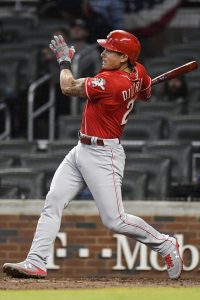
Dietrich’s most publicized moments have come at Pittsburgh’s expense this season, but the Pirates aren’t the only team he has frustrated. As a .262/.368/.713 hitter through 144 plate appearances, Dietrich owns the majors’ seventh-highest wRC+ (171) among batters who have accrued at least 140 PA. He also leads the league in isolated power (.451) by 51 points over second-place Christian Yelich on the strength of 17 home runs. That’s already a career-best mark for Dietrich, who hadn’t amassed more than 16 in a season since he made his major league debut with the Marlins in 2013.
Dietrich was typically a useful player in Miami across six seasons and 2,132 PA, combining respectable offense (.254/.335/.422 – good for a 109 wRC+) with an ability to line up at several positions. Despite that, the Marlins – unwilling to pay Dietrich a projected $4.8MM in arbitration – designated him for assignment in November. While Dietrich now looks like yet another one who got away for the down-and-out Marlins, it’s worth noting the rest of the league didn’t really want him either during the offseason. Finally, almost three full months after Miami cut Dietrich, he joined the Reds on a minor league deal in February.
Baseball slept on Dietrich over the winter, but he has since burst forth as one of the game’s shrewdest offseason signings. For the Reds, his emergence has been all the more fortuitous given that they have gone all season without injured second baseman Scooter Gennett. Like Gennett, whom the Reds claimed off waivers from Milwaukee entering the 2017 season, it appears Dietrich has gone from under-the-radar pickup to star in their uniform.
The question is: How is Dietrich suddenly one of the league’s most powerful and productive hitters? It seems to stem from a change in approach. Dietrich is pulling the ball more than ever, which is conducive to hitting for power, and looks like the latest beneficiary of the sport’s fly ball revolution. Although he never posted a fly ball rate better than 43.3 percent in a season with the Marlins, he’s currently at 52.2 percent – the sixth-highest mark in the league. As you’d expect from his stat line, Dietrich has made his fly balls count. He’s averaging 348 feet on his flies, a 38-foot increase from last year’s 310, and has significantly upped his exit velocity while putting the ball in the air. Dietrich’s fly balls and line drives have traveled at a 96.7 mph mean after clocking in at 90.8 in 2018, according to Statcast.
In theory, the fact that Dietrich is running a ridiculously low batting average on balls in play (.176, compared to .308 in Miami) makes his success all the more amazing. That said, fly ball-heavy hitters aren’t usually candidates for high BABIPs; beyond that, the stat doesn’t factor in homers – which make up more than half of Dietrich’s 32 hits this season. Though there’s a strong likelihood Dietrich’s BABIP will rise closer to career norms as the season progresses, his overall production will inevitably go backward to some degree.
The reality is that Dietrich’s not going to continue hitting dingers on 36.5 percent of fly balls, as only the MVP-winning Yelich broke the 30 percent plateau last season. Dietrich also isn’t some plate discipline savant who controls the zone at an elite level. To his credit, Dietrich’s walking at a career-high 9.3 percent clip and has slashed his strikeout rate by almost 5 percent since 2018 (from 25.4 to 20.8). However, those figures are still just a bit above average. And the left-handed Dietrich has continued a career-long trend of slumping against same-handed pitchers, who have held him to a meek .154/.273/.300 line this year. So it’s righties who are going to have to figure out how to handle him. Here’s a tip for them: Dietrich hasn’t done much against inside pitches, as these charts from Baseball Savant show, but has dominated versus most offerings in the middle or outer half. And yet, pitchers have largely lived in Dietrich’s hot zones, evidenced by this heat map via FanGraphs.
Dietrich is unlikely to keep this up (not many could), but that’s not to say his offense will careen off a cliff. True, there’s a 46-point gap between his weighted on-base average (.442) and expected wOBA (.396), yet he still ranks in the top 91st percentile of the majors in xwOBA, per Statcast. If Dietrich manages to produce at anywhere near his xwOBA for the rest of the season, the Reds would surely be ecstatic. They’re paying Dietrich a relative pittance this year ($2MM) and can control him through arbitration in 2020. That could help make Dietrich a valuable summer trade chip if Cincinnati’s out of contention by then. For now, though, the Reds appear to have another Gennett-esque steal in their lineup.
Photo courtesy of USA Today Sports Images.
Minor MLB Transactions: Reds, Orioles
A couple minor moves from around baseball…
- The Reds have released outfielder Zeek White, according to Doug Gray of RedsMinorLeagues.com and RedlegNation.com. White had been with the Reds since they acquired him (and a right-hander named Luis Castillo) in a package for righty Dan Straily in January 2017. Two years before that, the Marlins used a third-round pick (No. 85) on White. Although he was a fairly high pick in his draft class, the 22-year-old White hasn’t been able to work his way past the Single-A level.
- The Orioles have signed Cuban infielder Yorkislandy Alvarez, Francys Romero of Las Mayores tweets. Alvarez, who’s now 20, left the under-18 Cuban team in Montreal in 2017 and later moved on to Costa Rica and the Dominican Republic, per Romero. Other than that, there is little to no information available on him.
Sonny Gray Looks Reborn
Two years after the Athletics chose Sonny Gray 18th overall in the 2011 draft, the right-hander made his major league debut at the age of 23 and quickly became one of the game’s premier young hurlers. From 2013-15, a 491-inning span, Gray posted the majors’ 10th-lowest ERA (2.88), 11th-best groundball percentage (54.2) and 31st-ranked FIP (3.36) among starters. Gray was a front-end rotation piece at that point, but injury issues helped knock him off the rails in 2016. Gray rebounded a season later, but the Athletics elected to cash him and his remaining year and a half of control in at that July’s trade deadline.
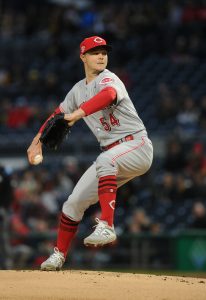
The A’s sent Gray to the Yankees in what became a failed union between him and New York. In 2018 – Gray’s lone full season with the club – he produced abysmal results at the hitter-friendly Yankee Stadium, where he ran up a 6.98 ERA as batters teed off on him for a .318/.406/.527 line. Gray’s struggles convinced the Yankees to pull him from their rotation during the summer and then leave him off their playoff roster in the fall.
It quickly became obvious in the offseason the Yankees would move on from Gray, who general manager Brian Cashman admitted needed a change of scenery. In January, three-plus months after Cashman telegraphed Gray’s exit, he traded the 29-year-old to the starter-starved Reds.
Before Gray ever threw a pitch in a Cincinnati uniform, the team signed him to a three-year, $30.5MM extension to prevent him from testing free agency during the upcoming winter. Well, two months into the season, that contract looks like a steal. Gray has come back with a vengeance as a member of the Reds, with whom he has posted a 3.54 ERA/2.99 FIP through 56 innings. Along the way, Gray has registered career bests in strikeout rate (10.29 per nine), groundball percentage (55.9), infield fly percentage (10.8) and contact rate (73.7 percent). Furthermore, even though Gray ranks near the bottom of the league in strike percentage for the second straight year, he has decreased his walk rate 2018 (from 3.94 to 3.54). He has also given up home runs on just 10.8 percent of fly balls, down from a combined 15.3 percent from 2016-18.
It’s probably fair to credit some of Gray’s revival to Reds pitching coach Derek Johnson, who was also Gray’s pitching coach at Vanderbilt, though his impact is difficult to quantify. It seems to have helped that Gray has moved back to his high-spin four-seam fastball, a pitch the Yankees discouraged from throwing. Gray has gone to the pitch 37.7 percent of the time this year after throwing it at a 26.5 percent clip in 2018. But it’s Gray’s slider and sinker – offerings he has used at a combined 38.1 percent rate – that have been his most effective pitches this year, per Statcast. Hitters have mustered a horrid .102 weighted on-base average against Gray’s slider and a weak .260 mark off his sinker. All told, Gray’s expansive repertoire has limited batters to a .278 wOBA, which is right in line with his .272 xwOBA. Both of those figures are roughly 50-point improvements from the numbers Gray recorded in those categories during his forgettable 2018 as a Yankee.
Thanks in no small part to Gray’s resurgence, the Reds’ rotation has leapt from horrid to good in a year. Last season’s staff hung out at the bottom of the league’s pitching leaderboard, whereas Gray & Co. entered Tuesday fourth in ERA and fWAR. If not for the Reds’ disappointing offense, albeit one that’s throttling the Pirates at the moment, perhaps they’d be serious playoff contenders.
Photo courtesy of USA Today Sports Images.
Alex Wood Says Rehab Progressing “Really Well”
Reds lefty Alex Wood is finally pain-free after struggling with back issues all spring, as Bobby Nightengale of the Cincinnati Enquirer writes. He expressed optimism that he has turned the corner and is ready to move back towards the MLB roster.
Though Wood has still yet to throw off of a mound since a setback prompted a long layoff, there’s now some forward momentum — as well as a loose timeline. Now a week into a throwing program, Wood estimates that he’s “probably 2 ½ weeks” away from a rehab assignment. At last look, this kind of general rehab framework wasn’t yet clear.
Since he’ll likely need a few minor-league outings to build up a pitch count, it seems unrealistic to expect a return before the month of July. Nightengale suggests the All-Star break as a loose target, which seems reasonable.
That’s still a ways off. And hurdles remain, particularly since setbacks have thwarted prior attempts to overcome the back issues that cropped up this spring.
Wood thinks this time is different. “I feel really good,” he says. “Things have been going really, really well.” Though he acknowledged that he still doesn’t “want to get too far ahead of myself” given the course the injury has taken, he says he’s “definitely on the way” back to the MLB mound.
The Reds rotation has been a pleasant surprise even without Wood, an offseason acquisition who is earning $9.65MM in his final season of arbitration eligibility. But that doesn’t mean the 28-year-old southpaw isn’t needed back.
For one thing, it would be unwise to assume that the club will continue to enjoy such phenomenal good health from its existing unit. The Reds have yet to hand the ball to a pitcher other than Luis Castillo, Sonny Gray, Tanner Roark, Tyler Mahle, or Anthony DeSclafani to open a game. There’s also room to improve in the fifth slot, as DeSclafani has struggled.
If the Cincinnati organization is to make a charge this summer, it’ll need every advantage it can get. Wood could also be a trade or even a qualifying offer candidate if he returns to good form in a timely manner. And there’s obviously plenty on the line for the pitcher himself, who is slated to reach the open market at the end of the season.
Reds Acquire Tristan Archer From Brewers
The Reds have acquired righty Tristan Archer from the Brewers, per a club announcement. Cash considerations will go to Milwaukee in return.
Archer, 28, had been working at the Triple-A level in the Brewers organization, as he has for most of the past three seasons. This year, he carries a 4.32 ERA with 14 strikeouts and six walks in 16 2/3 innings.
Still No Timetable For Alex Wood’s Return
Left-hander Alex Wood was one of the Reds’ key acquisitions during an eventful offseason for the club, but he still hasn’t made his Cincinnati debut two months into the campaign. Unfortunately, a return isn’t imminent for Wood, who has been dealing with back issues since late February. There remains no timetable for a comeback, Mark Sheldon of MLB.com reports, though manager David Bell said Saturday the Reds are hopeful Wood will begin a rehab assignment sometime soon.
The Reds’ rotation finished 25th in the majors in ERA and 26th in fWAR last year, spurring executives Dick Williams and Nick Krall to take action over the winter. Along with adding Wood, who joined the Reds in a December blockbuster with the Dodgers that also delivered outfielders Yasiel Puig and the since-released Matt Kemp to Cincy, the club picked up ex-Yankee Sonny Gray and former National Tanner Roark in trades with those franchises. The Gray and Roark acquisitions have worked out thus far, while Luis Castillo has blossomed into a front-line starter and fellow holdover Tyler Mahle has held his own. Consequently, the Reds boast a much-improved starting staff that sits fourth in the game in ERA and fifth in fWAR.
While it’s obvious the Reds’ rotation has made enormous strides this year, it’s fair to believe the unit would be even more formidable with Wood. Righty Anthony DeSclafani been a merely replacement-level option so far in 2019, whereas the 28-year-old Wood has been a quality performer since his career began with the Braves in 2011. He concluded his three-plus-year Dodgers tenure in 2018 with 151 2/3 innings of 3.68 ERA/3.53 FIP ball, 8.01 K/9 against 2.37 BB/9, and a 48.9 percent groundball rate.
Given Wood’s showing last year and his general track record, a healthy version could have helped the Reds push for a playoff spot this season (they’re 23-28, five games back of a wild-card spot and 7 1/2 out in the uber-competitive National League Central race). Wood also could have vied for a sizable payday going into the upcoming winter, given that he’s in his last season of team control. However, if Wood doesn’t come back strong sometime over the next couple months, he may be in for a disappointing trip to the open market.
Minor MLB Transactions: 5/22/19
The latest minor moves from around baseball…
- The Mariners have outrighted Nick Rumbelow and Mike Wright to Triple-A after both relievers cleared waivers, as per a team announcement. The two right-handers were each designated for assignment last week. Wright was acquired from the Orioles last month and made seven appearances (a 9.00 ERA over 11 innings) before being designated, while Rumbelow tossed 1 1/3 innings for Seattle over three appearances.
- The Reds have released third baseman Taylor Sparks, according to Roster Roundup (Twitter link). Sparks was a second-round draft pick for Cincinnati in 2014, selected 58th overall out of UC Irvine. Heralded for his speed, athleticism, and third base glovework, Sparks didn’t generate consistent results at the plate over six seasons in the Reds’ farm system, with just a .217/.291/.389 slash line over 1940 career plate appearances in the minors.
Injury Notes: McHugh, Davis, Tepera, Zunino, Duke
The Astros announced today that right-hander Collin McHugh is headed to the 10-day injured list due to discomfort in his right elbow. It’s an ominous-sounding injury but the cause for concern doesn’t appear to be great; McHugh told reporters after the move that an MRI has already been performed and did not reveal any structural damage (link via the Houston Chronicle’s Chandler Rome). He’ll spend two or three days resting the arm before playing catch, and the 31-year-old (32 next month) believes he’s only in line for a brief stay on the IL. Any injury for a free-agent-to-be is at least somewhat notable, of course, and McHugh’s stock is particularly worth watching now that he’s been dropped from the rotation to the bullpen. Right-hander Brady Rodgers will return to the Majors for the first time since 2016 to replace McHugh in the bullpen. Rodgers, a third-rounder in 2012, has had a long road back from 2017 Tommy John surgery to post a solid 3.22 ERA in 44 2/3 innings in Triple-A so far.
More injury updates of note…
- Athletics slugger Khris Davis exited tonight’s game after one plate appearance due to what the team announced to be “lingering effects from a left hip contusion suffered earlier this season.” It’s not clear if this’ll be another day-to-day situation for Davis or whether he might finally require a trip to the injured list to allow what has been a long-nagging injury time to heal up. Davis, king of the .247 batting average, is remarkably just a hair off that number, hitting .248/.318/.497 with a dozen homers through 179 plate appearances after making an out in the one at-bat he did have Tuesday.
- A right elbow impingement has landed Blue Jays righty Ryan Tepera on the 10-day injured list, per an announcement from the team. Right-hander Jimmy Cordero is up from Triple-A Buffalo in his place. The outlook on Tepera is of at least some concern, as Sportsnet’s Shi Davidi tweets that Tepera says he’s been unable to get the proper level of extension on his release of his pitches. He’s headed to see a specialist for further evaluation. The 31-year-old Tepera had quietly emerged as a very solid setup piece for the Jays over the past few seasons but has been torched for a 6.55 ERA with nine strikeouts against six walks (two intentional) through 11 innings this season. His average fastball has dipped from 95 mph in 2017-18 to 93.7 mph this season. A healthy Tepera would make for a nice trade chip for the Jays this summer, given that he’s controlled through 2021, so his diagnosis and recovery timetable are well worth monitoring despite the fact that the Jays are on pace for nearly 100 losses.
- Rays catcher Mike Zunino feels he’s making good progress on his return from a quad strain, tweets Marc Topkin of the Tampa Bay Times. Zunino, who was given a four- to six-week recovery timeline is optimistic that he can return toward the front end of that projection. That’s welcome news for a Rays organization that has cycled through various combinations of Nick Ciuffo, Anthony Bemboom, Travis d’Arnaud and Erik Kratz since seeing both Zunino and Michael Perez land on the injured list. Both d’Arnaud and Kratz were trade acquisitions prompted by the loss of the organization’s top two catchers. Once Zunino and/or Perez is ready to return, there’ll likely be further roster juggling.
- Lefty Zach Duke was placed on the injured list by the Reds due to a calf strain earlier today. Cincinnati will operate with a slightly shorter ‘pen for at least a day or two, as they recalled infielder Josh VanMeter in his place. The Reds still have a pair of lefties in the bullpen in Amir Garrett and Wandy Peralta. For Duke, who inked a one-year deal worth $2MM this offseason, the trip to the IL could give him an opportunity for a mental breather on the heels of an ugly start to the year. Through 15 2/3 innings, the 36-year-old Duke has a 6.32 ERA with more walks (11) than strikeouts (9). Duke’s ground-ball rate, which sat at a hefty 59.4 percent in 2018, is down to 49 percent to begin the year.
Mariners Expected To Sign Anthony Bass
The Mariners are “expected” to secure a deal with righty Anthony Bass, according to Jeff Passan of ESPN.com (Twitter link). The 31-year-old had been pitching in the Reds organization but is said to have triggered an opt-out clause.
Bass has seen sporadic MLB action in parts of seven seasons, compiling a 4.51 ERA in 299 1/3 total frames. He performed well last year in a 16-appearance stint with the Cubs but settled for a minors deal with the Reds.
After failing to win a MLB job in camp, Bass ended up at Triple-A Louisville to open the current campaign. Through 20 1/3 innings, he owns a 2.21 ERA with 19 strikeouts against six walks and 13 hits.
Whether the Mariners will bring Bass onto the MLB roster as part of the arrangement isn’t yet clear. Regardless, he seems well positioned to get a shot with a bullpen that has already hosted quite a few different hurlers at this early stage of the season.