
Giants Have Shown Interest In Paul DeJong, Nicky Lopez
The Giants are known to be in search of middle infield help. Two names under consideration: Cardinals shortstop Paul DeJong and Royals second baseman Nicky Lopez, reports Mark Feinsand of MLB.com.
DeJong seems very likely to be dealt within the next few days. The Cards are preparing to move a number of short-term pieces as they regroup for 2024. DeJong is in the final guaranteed season of his contract; the club holds a $12.5MM option for next season but seems unlikely to exercise it.
After a pair of dismal offensive seasons, DeJong has had something of a return to form in 2023. The right-handed hitter owns a .237/.303/.422 line over 297 plate appearances. He’s striking out at a lofty 29% clip but has connected on 13 home runs in roughly half a season of playing time.
That’s exactly league average offense by measure of wRC+. The scope of the production could lend itself particularly well to more matchup usage. DeJong entered play tonight hitting only .227/.279/.411 against same-handed pitching, but he’s teed off on lefties at a .274/.378/.468 clip.
The Giants are as aggressive as any team in leveraging platoon matchups. They haven’t had to do so at shortstop in recent years. Brandon Crawford has had a hold on the everyday job there. Yet the lefty-swinging Crawford is hitting only .207/.285/.333 in 65 contests this season. He’s not hitting well against pitchers of either handedness. He also landed on the injured list with left knee inflammation 10 days ago, his second IL stint of the year.
Crawford joined Thairo Estrada on the shelf. San Francisco’s second baseman has been down for three weeks after breaking his hand on a hit-by-pitch. Estrada recently began baseball activities and could make it back before too long, but the Giants are presently relying on a rookie rotation of Brett Wisely, Marco Luciano and Casey Schmitt up the middle without much success.
DeJong would bring above-average shortstop defense and some pop against left-handed pitching. Lopez would strictly be a defensive target. The lefty-swinging infielder hasn’t hit a home run in two years and carries a .223/.292/.276 batting line since the start of 2022. Yet he has drawn strong marks for his second base defense and is capable of manning shortstop or third base effectively as well.
Lopez would be easier to accommodate financially. The 28-year-old is playing this season on a $3.7MM arbitration salary, around $1.3MM of which is still to be paid out. He’s controllable for another two years after this but seems to be trending towards a non-tender. DeJong is making $9MM this year and still due around $3.2MM in salary, plus a $2MM buyout on next year’s option.
Both Kansas City and St. Louis have alternatives who could take on a larger middle infield role if they were to push across a deal with San Francisco. The Royals have already curtailed Lopez’s playing time in favor of a longer look at Michael Massey. DeJong is playing every day in St. Louis, but the Cards have Tommy Edman as a potential immediate replacement and top shortstop prospect Masyn Winn in Triple-A.
St. Louis also has depth on the other side of the second base bag. Brendan Donovan and Nolan Gorman are quality bat-first second basemen with extended control windows. With that middle infield strength in mind, Feinsand writes that St. Louis has also gotten interest from various clubs (not necessarily San Francisco) on Donovan and Edman.
Of course, the asking price on Edman or Donovan would be far higher. They’re a lot less likely to move than DeJong. Not only do they have extended control windows (Edman through 2025, Donovan past ’28), neither is fully healthy right now.
Edman is on the injured list with wrist inflammation. Jeff Jones of the Belleville News-Democrat relayed this afternoon (on Twitter) that he’ll begin a minor league rehab stint over the weekend. Donovan is healthy enough to hit but playing through a flexor tendon injury in his right arm. He’s unable to throw and relegated to DH duty for now. Derrick Goold of the St. Louis Post-Dispatch wrote earlier in the week that Donovan was hoping to avoid surgery and return to defensive work at some point this season. Even if that proves to be the case, he wouldn’t be a middle infield option for anyone in the immediate future.
Royals Release Brooks Kriske To Pursue NPB Opportunity
The Royals announced this morning they’ve placed reliever Brooks Kriske on unconditional release waivers. According to Kansas City, he’s pursuing an opportunity with a Japanese club. The move drops the Royals’ 40-man roster count to 39. While the Royals didn’t announce which team Kriske will be joining, a Japanese-language Yahoo! Japan report suggests he has agreed to terms with the Seibu Lions.
Kriske spent the 2022 campaign in Japan. The right-hander first signed with the Yokohama DeNA BayStars. He posted a 2.57 ERA through 21 innings, striking out 29.2% of batters faced. He walked opponents at a lofty 14.6% clip, though, and bounced between NPB and their farm team.
Last winter, the 29-year-old returned to the affiliated ranks on a non-roster pact with K.C. He pitched to a 5.52 ERA across 29 1/3 frames with Triple-A Omaha. The Royals selected his contract in mid-June, plugging him into four games. Over 6 2/3 innings, he allowed three runs with six strikeouts and four walks.
Kriske was optioned back to Omaha two weeks ago. While he remained on the 40-man roster, he presumably received a stronger financial package from the Lions than he’d have made bouncing on and off the K.C. active roster. His hold on a 40-man spot might have been tenuous as a low-leverage reliever, so it’s understandable he’d prefer the guaranteed deal to return to Japan for a second season.
Notable Draft Signings: 7/18/23
The first overall pick signed for a record bonus with the Pirates this afternoon. Meanwhile, Arizona signed their first-round selection for a $4.4MM figure. The other $2MM+ signees from Tuesday (scouting reports from Baseball America, MLB Pipeline, ESPN and The Athletic):
- The Phillies announced a deal with 27th overall pick Aidan Miller. The club didn’t specify the signing figure, but Jim Callis of MLB Pipeline reports it at $3.1MM (Twitter link). That’s a little north of the $2.97MM slot value. A high school infielder out of Florida, Miller appeared on the top 25 players on each of the referenced pre-draft rankings. The 6’2″ third baseman is credited with some of the highest offensive upside in the high school class, though he had a relatively down draft year after injuring the hamate bone in his hand. He’s already 19 — older than the typical high schooler — but has significant power potential and a chance to stick at the hot corner. Miller bypasses a commitment to Arkansas to enter the pro ranks.
- The Padres agreed to terms with 25th selection Dillon Head, Callis reports (on Twitter). The Illinois high schooler gets a $2.8MM bonus, a little below the pick’s $3.17MM slot value. Head ranked 27th on MLB Pipeline’s pre-draft list but as low as 50th on Keith Law’s ranking at The Athletic. The lefty-hitting outfielder is an elite runner and a potential quality defensive center fielder. Evaluators are split on how much offensive upside he possesses in a 5’11” or 6’0″ frame. Head was a Clemson commit.
- The Royals went well overslot to sign second-round draftee Blake Wolters, according to Callis (Twitter link). A high school right-hander from Illinois, he lands a $2.8MM bonus that beats the $1.95MM value of the 44th pick. The 6’4″ hurler had a velocity bump into the mid-90s during his draft year. He’s credited with a quality slider and intriguing athleticism but faces questions about his third pitch. It’s a fairly common refrain for an upside flier on a high school pitcher. Kansas City liked Wolters enough to sign him away from the University of Arizona.
The Royals’ Breakout Reliever Should Draw Trade Interest
Heading into deadline season, the Royals’ stance as sellers was obvious — painfully so, for Kansas City faithful. Confirmation of that fact was hardly needed, but the Royals’ early trade of Aroldis Chapman to the Rangers cemented their already obvious status. The widespread expectation is that closer Scott Barlow will be marketed to other clubs over the next couple weeks, and even in something of a down season (by his high standards), his track record and affordable price tag should place him in demand.
The Royals aren’t exactly deep in straightforward trade candidates elsewhere on the roster. Zack Greinke is on the injured list at the moment and seems content to wind down his career in the place where it all began. Offseason signees Jordan Lyles and Ryan Yarbrough haven’t performed well. Last year’s breakout starter, Brady Singer, has regressed significantly. Infielder Nicky Lopez could change hands but would be viewed as a light-hitting utilityman by most contending clubs. He’s not likely to fetch a big return. Royals GM J.J. Picollo has made clear he has no intention of trading Salvador Perez, and Perez has full no-trade rights anyway. Kansas City just released Amir Garrett, who might’ve been an appealing rental trade candidate were it not for a sky-high 17.9% walk rate.
There’s at least one other reliever in the Royals’ bullpen who deserves some attention, however, even if he’s far from a household name. After three seasons floundering while bouncing between the rotation and bullpen, right-hander Carlos Hernandez has stepped up as a setup man to Barlow (now that Chapman’s been traded anyway) and looks the part of an impact late-inning arm.
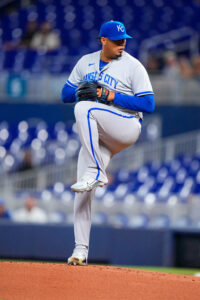
Hernandez, 26, doesn’t exactly have numbers that leap out at first glance. His 3.86 ERA is a bit better than the league-average 4.13 ERA for relievers. His 28.5% strikeout rate is well above-average but isn’t quite elite. Ditto for his 7% walk rate.
A closer look at Hernandez, however, reveals quite a bit more to like. After sitting 97.1 mph with his fastball from 2020-22, he’s up to a massive 99.2 mph in 2023. That places him fifth among all relievers, trailing only Jhoan Duran, Jordan Hicks, Felix Bautista and the aforementioned Chapman. Hernandez is sitting on a 14.5% swinging-strike rate and huge 36% opponents’ chase rate on pitches off the plate — both considerably better than the respective league averages of 11.1% and 31.7%. He’s also excelled at keeping the ball in the yard, yielding just three homers in 46 2/3 innings — and none since April 22.
That’s not the only reason that Hernandez’s April game log is worth taking a closer look at. Five of the 20 earned runs he’s allowed this season came in a single outing that month — a brutal drubbing at the hands of the Rangers on the 18th. Hernandez used his curveball at a season-high 21.4% that day. Since that time, he’s largely shelved the pitch, instead leaning more on his improved fastball, his slider and his splitter.
Through April 18, Hernandez was throwing his curve a bit less than 15% of the time. Since then, he’s thrown the pitch at just a 5.1% clip — including a lowly 2.8% rate dating back to mid-June. Since narrowing his arsenal and ramping up the usage of his heater in mid-April, he’s sporting a 3.12 ERA with a 1.90 FIP, 31% strikeout rate and 5.8% walk rate.
That’s not to say the curveball was necessarily the source of his early struggles in and of itself, but the more focused arsenal and elevated use of his fastball have clearly paid dividends. In general, a reliever scrapping his fourth-best pitch to lean more heavily into his best offering is good practice. And, Hernandez still has an effective splitter to keep lefties off balance and a quality slider he uses against righties. It’s a nice recipe for success, evidenced by southpaws hitting just .195/.247/.276 against him and righties hitting only .202/.258/.345. Handedness hasn’t mattered much for Hernandez this year; he’s been good against everyone.
The Royals don’t need to feel any pressure to trade Hernandez. Beyond the fact that he’s just 26 years of age, he entered the year with one year, 145 days of Major League service time. He’ll pass two years this season and finish out the year at 2.145 years of service. That’ll put him in line as a surefire Super Two player, making him arbitration-eligible four times rather than three, but his salary in 2024 will be minimal — likely in the $1MM range. Furthermore, that limited service time means he’s under team control all the way through the 2027 season.
That said, reliever performance is volatile on a year-to-year basis, and pitchers in general carry greater risk of major injury than their position-player counterparts. And, the four-plus years of club control and minimal salary commitment required in the short-term only makes Hernandez more intriguing to clubs looking for bullpen help not only this year but beyond.
It’s rare but not unheard of for teams to trade relievers with this type of club control; the Cubs traded five years of righty Scott Effross to the Yankees just last summer and received a largely MLB-ready starting pitcher, Hayden Wesneski, in return. Granted Wesneski hasn’t exactly cemented himself in the Chicago rotation, but getting six-plus years of control over a generally well-regarded, MLB-ready prospect was still a strong return for a controllable reliever.
Hernandez has one less year of club control but is arguably equally or even more desirable. He’s two years younger now than Effross was last year and has the type of power arsenal that tends to tantalize modern front offices. Effross did not (91 mph average fastball). It’s certainly plausible that a team would be willing to part with potentially impactful, near-MLB talent to secure four-plus seasons of a 26-year-old with baseball’s fifth-hardest fastball, minimal platoon concern and rapidly improving results.
Broadly speaking, this is the type of trade the Royals have been unwilling to make in recent years. They’ve held onto the majority of their controllable talent even through ongoing rebuilding efforts. For instance, Whit Merrifield drew trade interest for years before the Royals finally traded him last summer, only to command a much lesser return than he otherwise might have had they pulled the trigger a couple seasons prior. The Royals waited until Danny Duffy was a rental player on the injured list to move him at the deadline. They’ve frequently preferred to keep controllable players they feel can contribute to the next contending club, but that contending season has yet to come around (arguably in large part because they’ve opted not to sell controllable pieces at peak value).
That trend, however, was a hallmark of the Dayton Moore-led Royals, and Moore was dismissed from his position as president of baseball operations last year. The Royals stayed in house to replace him, elevating Picollo to the top spot in the baseball operations department, so perhaps he’s philosophically cut from the same cloth as his predecessor and longtime colleague. But we’ve yet to see a full deadline of Picollo at the helm in Kansas City, and it’s at least possible he’ll run things a bit differently.
Even if the Royals don’t want to trade Hernandez, they ought to listen to what other clubs have to say. There’s little doubt that he’ll draw considerable interest, given his breakout and the wide swath of teams in search of bullpen help. For a Royals club with needs all around the diamond and little in the way of meaningful trade chips to peddle on a flawed roster, Hernandez’s well-timed breakout could be an unexpected means of addressing at least one of those needs sooner than later.
Image courtesy of USA Today Sports.
Central Notes: Perez, Tellez, Jimenez, Kelly, O’Neill, Knizner
Salvador Perez suffered a left hamstring strain while scoring a run in today’s 8-4 Royals victory over the Rays. Perez scored from first base on a MJ Melendez double, but the extra effort was costly for the veteran catcher, and a trip to the injured list now seems likely. The time lost will depend on the grade of Perez’s strain, and manager Matt Quartraro told MLB.com’s Anne Rogers and other reporters that the club will have more information on Monday.
An injury to Perez just adds to a nightmare of a season for the Royals, as they are a measly 27-67 after today’s win. Perez is hitting .258/.299/.444 with 15 home runs over 345 plate apperances, translating to below-average (97 wRC+) overall offense for the 33-year-old backstop. It represents a dropoff from Perez’s usual production, yet he remains one of the best bats on a Royals team that has almost entirely underachieved. Melendez and Freddy Fermin seem likely to take over catching duties in the event of Perez hitting the IL, and if you’re wondering if the injury might impact Perez’s trade value, Kansas City general manager J.J. Picollo already stated last month that Perez isn’t going anywhere.
More from the two Central divisions…
- The Brewers were expecting Rowdy Tellez back from the 10-day IL this coming Tuesday, but the first baseman suffered another injury while shagging fly balls prior to today’s game. As manager Craig Counsell told the Milwaukee Journal-Sentinel’s Todd Rosiak and other reporters, Tellez was trying to make a catch when he caught his left ring finger between the seams of the outfield wall padding. The result was a broken fingertip, a torn nail, and an estimated 3-4 more weeks on the injured list. Tellez had been sidelined with forearm inflammation, and he was looking to rebound from a nasty slump that had dropped his numbers to .213/.285/.388 over 288 PA. First base/DH was already expected to be a target area for the Brewers heading into the trade deadline, and Tellez’s extended absence now only increases the club’s need for some extra corner power.
- Eloy Jimenez will be out of the White Sox lineup for at least “the next few days” due to a groin injury, manager Pedro Grifol told MLB.com and other media. Jimenez had to make an early exit from today’s game due to the injury, and testing will determine the severity or if Jimenez might be headed for the 10-day IL. The slugger already missed around three weeks earlier this season while recovering from an appendectomy, and a variety of injuries have limited Jimenez’s playing time over his five Major League seasons. Over 259 PA for Chicago this season, Jimenez has 12 home runs and a .269/.313/.463 slash line.
- In better injury news for the White Sox, Joe Kelly threw a bullpen session today and plans to return from the 15-day IL during the Sox/Mets series that begins on Tuesday, Daryl Van Schouwen of the Chicago Sun-Times tweets. Kelly was placed on the IL due to elbow inflammation on July 5, so he’ll return after a minimal stint. Secondary metrics indicate that Kelly is drastically outperforming his uninspiring 4.82 ERA, so some better bottom-line numbers over the next couple of weeks might turn Kelly into a trade chip for the White Sox at the deadline.
- The Cardinals activated catcher Andrew Knizner off the 10-day IL today, and manager Oli Marmol told reporters (including Daniel Guerrero of the St. Louis Post-Dispatch) that the club will continue to carry three catchers on the roster since it wants to see more of youngster Ivan Herrera. It remains to be seen how the Cardinals will split the playing time between Willson Contreras, Knizner, and Herrera, but Knizner was the only member of the trio to see action in the Cards’ 8-4 win over the Nationals today. In other St. Louis injury news, Tyler O’Neill might return from the IL on Tuesday if he emerges in good form after a Triple-A rehab game today.
Royals Place Amir Garrett On Release Waivers
The Royals announced today that they have requested unconditional release waivers on left-hander Amir Garrett. The lefty had been designated for assignment last week, and will now officially become a free agent upon clearing.
Garrett struggled badly during his tenure with Kansas City, which began when he was traded to the Royals by the Reds in exchange for fellow lefty Mike Minor. Since then, Garrett has been a roughly league average reliever by the numbers, with a 4.39 ERA (96 ERA+) and a 4.16 FIP 87 appearances with the Royals. Garrett has been held back from being a stronger set-up option in these past two seasons thanks to serious control problems, with a 16.9% walk rate during his Royals tenure. Those issues have been magnified across 24 1/3 innings of work this season, as Garrett has allowed free passes at an even higher 17.9% rate. If not for an unsustainable 85.2% strand rate this season, Garrett’s strong 3.33 ERA this season would surely be significantly higher, as illustrated by his concerning peripherals (5.58 FIP, 5.05 SIERA).
Garrett had just over five years of major league service time entering the 2023 campaign, and any player with at least five years of service time has the right to reject an outright assignment without forgoing the remainder of his salary. Additionally, no club would have had interest in taking on the remainder of Garrett’s $2.65MM salary for the 2023 campaign when he could be had for no more than the prorated major league minimum if signed after he hits the open market. As such, the Royals’ decision to forgo outright waivers and simply release Garrett was little more than a formality.
Once Garrett officially clears waivers, he’ll be free to sign with any of the other 29 organizations in the league, which would only have to pay him a prorated portion of the major league minimum for the rest of the season, leaving the Royals on the hook for the remainder of his 2023 salary. While Garrett’s control problems are certainly glaring, as a lefty bullpen arm who had success back in 2019 and 2020 with the Reds, when he posted a 3.03 ERA in 90 appearances, he certainly could draw interest from rival clubs on a no-risk minor league deal with a club that thinks it can help Garrett reclaim his previous form.
Royals’ Josh Staumont To Undergo Thoracic Outlet Syndrome Surgery
TODAY: Staumont will undergo thoracic outlet syndrome surgery, according to Anne Rogers (Twitter link). It’s a big setback for Staumont, who will miss the rest of the season and face something of an uncertain recovery timeline, given the still-new nature of TOS procedures. Jesse Dougherty of the Washington Post recently wrote about the two different kinds (vascular and neurogenic) of TOS, and how vascular cases are by far the less-serious of the two, while neurogenic TOS surgery could be career-threatening.
JULY 14: The Royals announced today that left-hander Ángel Zerpa was reinstated from the 60-day injured list and optioned to Triple-A Omaha. To open a spot on the 40-man roster, right-hander Josh Staumont was sent the other way, transferred to the 60-day IL.
Staumont, 29, has been on the injured list since June 6 due to a neck strain. A couple of weeks ago, Anne Rogers of MLB.com reported that he suffered a setback and would require further testing. His current timeline isn’t known, but he’ll now be officially ineligible to return until 60 days from his initial IL placement, which rules him out until early August. He’s yet to begin a rehab assignment, so it doesn’t seem like he’s especially close to returning anyhow. The righty has an ERA of 4.01 in his career, striking out 26.2% of batters faced but walking 13%.
Zerpa, 23, suffered a shoulder injury during Spring Training and has been on the injured list for the entire season until this point. He was able to collect major league pay and service time for the past few months, crossing over the one-year mark in the process, but that will stop for the time being. He has 16 innings of major league experience from the previous two seasons with a 1.13 ERA in that small sample.
He was stretched out as a starter during his recent rehab assignment and will provide the club with some rotation depth. He has just one option year remaining and will burn that last option as soon as he spends 20 days on optional assignment here in 2023. If he’s not quickly recalled in the next few weeks, he’ll be out of options in 2024.
Royals Sign First-Round Pick Blake Mitchell
The Royals have agreed to a deal with eighth overall pick Blake Mitchell, according to MLB Pipeline’s Jim Callis (via Twitter). Mitchell will receive a $4.9MM bonus, below the $5,980,100 slot price attached to the eighth overall selection.
The 18-year-old Mitchell is a high schooler from Texas who had committed to LSU, but he’ll now forego college ball and start his pro career. Mitchell and Kyle Teel (from the University of Virginia) were considered the two best catching prospects of this year’s draft class, and Mitchell was taken ahead of Teel on draft night, as Teel lasted until the Red Sox selected him with the 14th overall pick. Mitchell was rated as the 14th-best prospect of the overall draft class by Pipeline, with Baseball America (15th), Keith Law (20th), Fangraphs (20th), and ESPN’s Kiley McDaniel (29th) all giving somewhat varied first-round evaluations.
The pundits feel Mitchell needs to cut down on his strikeouts and improve his contact hitting in general, but his left-handed swing and approach hints at some quality power potential. Defensively, Mitchell’s natural athleticism lends itself to pitch-blocking, and he has an outstanding throwing arm that will give pause to would-be basestealers. The arm strength is no surprise since Mitchell was also an intriguing pitching prospect, and Pipeline’s scouting report felt he could have been selected as a pitcher alone before the end of the second round. However, Mitchell will stick to catching, and he now projects as Kansas City’s long-term successor to Salvador Perez behind the plate.
The Most Alarming Aspect Of Royals’ Disappointing Season
The Royals are much closer to the worst team in baseball than a playoff spot. While Kansas City wasn’t expected to make the postseason, there’s no question the organization envisioned better results than they had in the first half.
There are a number of reasons for the club’s underperformance. The most concerning theme for the organization has been the down years and/or injury issues for most of their top young talent. Kansas City expected to be further along in the rebuild by now. Instead, a lot of the players they’ve envisioned as a developing core have plateaued or gone backwards.
That’s not unanimously true. Bobby Witt Jr. has stolen 27 bases, connected on 14 home runs and taken a huge step defensively. Even with a modest .300 on-base percentage, he looks like the franchise shortstop the Royals wanted when selecting him with the 2nd overall pick in 2019. Rookie Maikel Garcia has taken over third base with plus exit velocities and strong defense.
Aside from the left side of the infield, the Royals’ young players have mostly underwhelmed, however.
- MJ Melendez, RF/LF/C
Melendez, a 2nd-round selection in 2017, emerged as one of the sport’s top prospects with a 41-homer showing in the upper minors two years ago. The left-handed hitter connected on 18 longballs with a roughly average .217/.313/.393 line as a rookie in 2022. His power production has fallen off this year; he carries a meager .206/.289/.333 mark with six homers in 346 trips to the plate.
While Melendez walks a fair amount, he offsets that with big strikeout totals. He has gone down on strikes nearly 30% of the time this season. That puts a lot of pressure on him to hit for power, no small feat in one of the sport’s most pitcher-friendly home parks. Melendez has a huge 93 MPH average exit velocity and is making hard contact (95+ MPH) on over half his batted balls. There’s clearly power upside in there. He’s not in a great environment to maximize it and is striking out too frequently though.
Were Melendez catching every day, that offensive profile would be more acceptable. With Salvador Perez behind the dish, the Royals have deployed the youngster mostly in the corner outfield. Well below-average offense at a bat-first position means he’s playing at a worse than replacement level rate.
- Brady Singer, RHP
The Royals invested heavily in college pitching in the 2018 draft. Singer was the only member of the group who put together mid-rotation results, seemingly breaking out with a 3.23 ERA over 27 appearances last season. He’s gone in the opposite direction this year.
Over 18 starts, the Florida product is allowing 5.80 earned runs per nine across 94 2/3 innings. His strikeouts and grounders are both at career-worst levels. Singer’s strikeout rate has dropped over six percentage points to a modest 18.1% clip. His swinging strikes are down to a below-average 8.5% of his offerings.
Singer’s arsenal has backed up. His sinker is averaging 92.3 MPH, down a tick and a half from last year’s level. His career-long struggle to find a changeup is still showing up in his results against left-handed hitters. Southpaws have a .292/.373/.489 line in 250 trips to the plate this year.
- Daniel Lynch, LHP
Lynch, the 34th overall selection in the aforementioned college-heavy ’18 draft, has started 50 games in his MLB career. The 6’6″ southpaw has yet to find much success, posting a 5.10 ERA over parts of three seasons. His 4.18 mark through eight starts is a personal low, though he’s paired it with a few alarming underlying indicators.
Most notably, Lynch’s velocity has taken a step back. He’s averaging 92.7 MPH on his heater, down from the 94 MPH range in which he sat in 2021-22. A Spring Training rotator cuff strain could explain that dip, although Lynch’s velocity has fallen even as he’s gotten further removed from the season-opening injured list stint. He averaged a season-low 91.6 MPH on his four-seam during his final start headed into the All-Star Break.
With the drop in speed has come a corresponding hit to his strikeouts. The Virginia product has fanned under 16% of opposing hitters. It’s the lowest rate of his career, down nearly five points from last season. Lynch’s 11.7% swinging strike percentage is still solid, so he’s not losing whiffs on a per-pitch basis, but he’s had a tougher time finishing off at-bats.
Pasquantino’s disappointing year has been more about health than performance. His .247/.324/.437 line was down markedly from a huge .295/.383/.450 rookie showing, but even the diminished version of Pasquantino was one of Kansas City’s top hitters. Unfortunately, the 25-year-old tore the labrum in his right shoulder and underwent surgery last month. His season is finished after just 61 games.
- Nick Pratto, 1B
Pasquantino’s injury has opened regular playing time for the 24-year-old Pratto. Like Melendez, the lefty-hitting first baseman emerged as a top prospect based on huge power production in the upper minors. His profile also comes with significant swing-and-miss concerns, which have resurfaced at the MLB level.
Pratto is hitting .246/.331/.388 with six homers in a career-high 257 plate appearances. That’s better than the bulk of the Kansas City lineup, league average offense by measure of wRC+. Yet he’s needed a .395 average on balls in play to keep that production respectable. He’s striking out at a 37.7% clip, the highest rate among players with 250+ trips to the plate. If he’s to be a long-term regular, especially at a bat-first position, he’ll need to put the ball in play more frequently.
- Drew Waters, CF
By the time the Royals acquired Waters from the Braves almost exactly one year ago, the outfielder’s stock was well down from its peak level. The switch-hitter had been a borderline Top 50 prospect at one point in the Atlanta farm system, but mounting strikeout issues in the upper minors raised questions about his offense. The Royals were buying low to some extent, though they still relinquished the 35th overall pick in last year’s draft (which Atlanta subsequently used on high school righty JR Ritchie) for Waters.
Kansas City wouldn’t have given up a pick that high if they didn’t believe Waters still had a chance to be an everyday player. An offseason trade of Michael A. Taylor cleared a path to center field reps. Waters’ hopes of starting on Opening Day were dashed by a left oblique strain that cost him the first two months of the season.
Since returning, the 24-year-old has put up a .239/.293/.354 line over 37 games. He’s striking out an untenable 37.4% rate. Perhaps there’s some rust to be shaken off after the extended absence, but Waters’ early results aren’t offering much hope he’s on the verge of a breakthrough. Whether he’ll make enough contact to be a regular is still in question.
- Kyle Isbel, CF
With Waters opening the season on the shelf, the 26-year-old Isbel got the Opening Day nod in center field. He has just a .210/.258/.355 line in 37 contests. Isbel is making the most contact of his career but not hitting many line drives, and his overall production closely matches last year’s .211/.264/.340 slash. The former 3rd-round selection has been viewed by most evaluators as a fringe regular, although he still ranked among K.C.’s top ten prospects at Baseball America each season from 2019-22. He looks better suited for fourth/fifth outfield duty than a starting role.
- Michael Massey, 2B
Massey, 25, showed some promise with a .243/.307/.376 line as a rookie late last season. He got the Opening Day nod at second base this year but hasn’t seized the job. The left-handed hitter has a .220/.277/.320 mark with four homers over 220 plate appearances. Opposing pitchers have punched him out 28.2% of the time. Massey is hitting the ball reasonably hard but chasing too many pitches outside the strike zone to post a decent on-base mark.
———————————————
Without much progress from most of their young players, the Royals haven’t had many silver linings. A 26-65 record would be an obvious disappointment regardless of how it was happening, but it’s made more so by the scarcity of controllable players asserting themselves as key pieces for the future. Aside from Witt and arguably Garcia, none of Kansas City’s early-mid 20s talent is staking a firm claim to an important role for next season.
The primary focus for the next few weeks will be which veteran players get moved at the deadline, with closer Scott Barlow standing out as their top trade chip. Once August 1 passes, the final couple months will be about evaluation. Can any of their currently scuffling controllable players turn things around to head into the offseason with positive momentum to build upon?
White Sox Acquire Mike Mayers From Royals
The White Sox have acquired right-hander Mike Mayers from the Royals, per Daryl Van Schouwen of the Chicago Sun-Times, with cash considerations heading in the other direction.
Mayers, 31, signed a minor league deal with the Royals in the winter and was deployed as a starter in Triple-A. He took the ball eight times for the Storm Chasers through the middle of May and posted a 6.88 ERA in 34 innings. He was selected to the Royals’ roster at that time and made six appearances, including two starts, for the big league club. He registered a 6.15 ERA through 26 1/3 innings before getting designated for assignment in the middle of June. He cleared waivers and accepted an outright assignment and has been back with Omaha in a relief role in recent weeks.
The Sox are 38-54 and seem destined to do some selling prior to the August 1 trade deadline. They’re only eight games back in the weak American League Central but they would have to leapfrog three different clubs to get to the top and are even further back in the Wild Card race. It’s been speculated by many observers that impending free agents will be shopped and Lucas Giolito was recently ranked the #1 trade candidate by MLBTR for that very reason. Other pitchers like Lance Lynn, Joe Kelly, Keynan Middleton, Mike Clevinger and Reynaldo López make some sense as trade candidates to varying degrees, with the club reportedly willing to deal just about any pitcher except for Dylan Cease.
If that indeed comes to fruition and the Sox ship out a few arms from their big league staff, they may need to turn to a few of their depth pitchers in the final months of the season. Mayers has mostly served as a reliever in his career but has also made a handful of starts, including this year, allowing him to potentially fill either role in the months to come. He has a career ERA of 5.21 in 262 2/3 innings dating back to 2016. If he gets selected back to the roster at any point, he is out of options but could be retained for 2024 via arbitration if the club so chooses.