
Dodgers Sign Kyle Tucker
The two-time defending champions have done it again. The Dodgers officially announced their four-year, $240MM contract with Kyle Tucker on Wednesday afternoon. The deal includes $30MM in deferrals and will come with an approximate $57.1MM annual value for luxury tax purposes. Tucker, a client of Excel Sports Management, receives a $64MM signing bonus — all but $10MM of which is paid upfront — and can opt out after the second or third seasons. Outfielder Michael Siani was designated for assignment in a corresponding move.
Los Angeles will pay the first $54MM signing bonus next month. They’ll owe the remaining $10MM in February 2027, and the signing bonus is guaranteed even in the event of a work stoppage. Tucker will make a $1MM salary this year, followed by a $55MM salary in ’27 and $60MM annually for the final two years if he doesn’t opt out. The team is deferring $10MM annually in the final three years, which will be paid in installments between 2036-45.
Tucker, who turns 29 on Saturday, is the latest superstar addition to what was already MLB’s most feared offense. He slots into a lineup alongside Shohei Ohtani, Freddie Freeman, Mookie Betts, Will Smith, Max Muncy, Teoscar Hernández and Tommy Edman. He’ll join Hernández and Andy Pages as the primary outfielders, with Edman capable of logging center field action when he’s not at second base.
Los Angeles has four outfield prospects who rank prominently near the top of their farm system. They reportedly wanted to avoid locking in long-term commitments as a result. They’ve accomplished that with arguably the biggest annual value in the sport’s history.
It’s a $60MM average on the surface. Without adjusting for deferrals, Tucker’s deal would be the second-highest AAV ever. Ohtani landed a $70MM AAV on his 10-year, $700MM guarantee, though the massive deferrals meant it had a “true” annual value closer to $46MM. One should therefore view the $51MM annual salary on Juan Soto’s 15-year, $765M deal as the more accurate record holder until tonight. Tucker’s adjusted AAV beats that by more than $6MM.
Although Tucker was this offseason’s top free agent, he’s a clear step below the likes of Aaron Judge, Ohtani and Soto of the previous three winters. Tucker has been a consistent All-Star who’s a little outside the top tier of superstars. The fifth overall pick by the Astros in 2015, he broke out in the shortened 2020 season after logging limited big league action in the two preceding years. He connected on 29 or 30 home runs in each of his first three full campaigns, improving his approach along the way.
Tucker was already a great hitter and seemed to be on his way to pulling closer to Judge, Soto and Ohtani with a monster start to the 2024 season. He was out to a .266/.395/.584 slash with more walks than strikeouts through the first two months. He fouled a ball off his right leg and was placed on the injured list with what the Astros initially termed a shin contusion. It turned out to be more serious, as subsequent testing revealed a fracture that kept him out for three months.
The four-time All-Star returned no worse for wear and had a fantastic September. The Astros nevertheless decided to field trade calls after the season. They were never going to meet Tucker’s asking price on an extension and felt they could cash him in for help elsewhere on the roster. They lined up a deal with the Cubs around the Winter Meetings that sent Isaac Paredes, Hayden Wesneski, and prospect Cam Smith to Houston for Tucker’s final year of arbitration.
Tucker’s lone season in Chicago had its ups and downs. He got out to another blistering start, running a .284/.359/.524 slash with 12 homers through the first day of June. He jammed his right thumb diving into second on a stolen base attempt that day. He avoided the injured list, but subsequent testing revealed that he sustained a tiny fracture at the top of his hand between his ring finger and pinky.
The hand injury wasn’t viewed as a serious issue until Tucker’s performance began to suffer. That didn’t occur right away. His next few weeks were the finest of the season, in fact. Tucker slashed .311/.404/.578 across 25 games that month. Things went off the rails in July, as he batted .189/.325/.235 with just one home run over the next six weeks.
The existence of the hairline fracture wasn’t reported until the middle of August. Cubs officials acknowledged that Tucker had been injured in June but said that he was fully healthy by the time the injury was revealed publicly. Maybe the thumb became a retroactive explanation for what was actually a simple slump, though it’s possible he developed some subtle bad habits in June as he tried to mitigate the pain of hitting through the break. Manager Craig Counsell gave Tucker a three-game mental reset towards the end of August before plugging him back into the middle of the order.
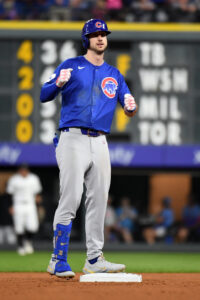
Tucker appeared to be getting back into a groove when he hit another speed bump. He strained his left calf in early September and landed on the injured list, costing him three weeks in the season’s final month. He finished the regular season with a .266/.377/.464 slash line in a little under 600 trips to the plate. He hit .259 with one homer in eight postseason games as the Cubs advanced to the NL Division Series.
The uneven second half soured some Cubs fans on the Tucker acquisition. His overall numbers were in line with his career marks. The offense was 36 percentage points better than league average by wRC+. His lifetime .273/.358/.507 batting line is 38 points above par. Tucker has been in that range in four of the past five seasons. The only exception is his .289/.408/.585 showing over 78 games two years ago.
The ’24 season is probably an outlier, but the Dodgers should feel they’re adding one of the top 10-15 hitters in MLB. He doesn’t expand the strike zone and has a rare blend of plus contact skills and above-average power. Tucker has no issue hitting pitchers of either handedness. He doesn’t have the huge exit velocities of the sport’s premier sluggers, yet he’s a safe bet for 25-30 homers in a healthy season.
Tucker’s glove isn’t as strong at this stage of his career. He won a Gold Glove with Houston in 2022. His defensive grades and sprint speed have declined as he’s gotten into his late-20s. That presumably gave teams pause when considering a long-term investment. Tucker’s defense should remain serviceable in the short term. The Dodgers can comfortably plug him into right field and kick Hernández over to left if they don’t trade him.
The Cubs issued Tucker a qualifying offer but made little effort to retain him. The bidding seemingly came down to the Dodgers, Mets and Blue Jays. New York was similarly hesitant to make a long-term commitment, as they reportedly offered a four-year deal at $55MM per season. Toronto was seemingly willing to entertain a longer term at a lower annual value.
Tucker is L.A.’s second qualified free agent signing of the offseason. They added Edwin Díaz on a three-year, $69MM deal around the Winter Meetings. They surrendered their second- and fifth-round draft choices this summer, plus $1MM from their 2027 international bonus pool, to sign Díaz. They’ll forfeit their third- and sixth-round picks for Tucker. The Cubs receive a compensatory pick between Competitive Balance Round B and the start of the third round (currently slated to land 77th overall).
MLBTR had predicted an 11-year, $400MM deal for Tucker at the beginning of the offseason. It’s unclear if any team would have been willing to go to those lengths. He’s giving up some measure of long-term security in exchange for massive salaries over the next couple seasons and the chance to return to free agency at the tail end of his prime.
He’ll have the option of retesting the market before his age-31 and age-32 campaigns — and without being attached to draft compensation barring a change to the qualifying offer rules in the intervening CBA. A five- or six-year guarantee could be well within range at that point. He’ll collect a huge signing bonus, essentially shatter the record for average annual value, and join the team with the best chance to win the World Series in the interim.
While the specific salary breakdown hasn’t been reported, the Dodgers are reportedly paying $54MM of the signing bonus right away. RosterResource estimates their cash payroll obligations close to $428MM for the upcoming season. Tucker’s $57.1MM AAV will push their competitive balance tax projection north of $395MM.
They’re taxed at a 110% rate on spending above $304MM, so Tucker’s deal comes with a staggering $62.81MM tax hit in the first season. The Dodgers are essentially valuing Tucker’s 2026 season alone at $120MM. L.A. ended last season with a luxury tax payroll of $417MM, costing them another $169.4MM in taxes. Their tax bill alone was higher than the final payroll calculations of 12 teams. They’re trending towards a similar or potentially even greater amount in 2026 depending on what else they do this offseason and at the trade deadline. The aggressiveness continues as they aim for the first three-peat in MLB since the 1998-2000 Yankees.
Tucker’s deal is going to be the latest example for many fans and smaller-market owners who will argue for a salary cap in the upcoming round of collective bargaining negotiations. This level of spending also reaffirms why the MLB Players Association has steadfastly maintained that a cap is a non-starter. Next offseason’s CBA talks are expected to be similarly or even more contentious than those that froze the sport for 99 days during the 2022-23 lockout.
That’s not the concern of the Dodgers or their fans, who’ll be thrilled to add another star as they try to cement their dynastic run. They’ll be heavy favorites in the NL West, and it’s difficult to imagine a scenario in which this team doesn’t make the playoffs. A championship is far from guaranteed, however. The Jays were one swing away from beating them in Games 6 and 7 of last year’s World Series. An extra quarter-second on Isiah Kiner-Falefa’s dash home or another few feet on Ernie Clement’s fly ball in the bottom of the ninth would have flipped the outcome. L.A. ownership and the front office aren’t getting complacent.
After missing on Tucker, the Jays seem likely to reengage with Bo Bichette. Their longtime shortstop is now the top unsigned player. He has reportedly had a productive meeting with the Phillies, but the Jays and Bichette have long expressed mutual interest in a reunion. Bichette wouldn’t be a great fit for the Mets, but they could conceivably pivot to challenging the Yankees for Cody Bellinger. The Mets still don’t have a left fielder after swapping Brandon Nimmo for Marcus Semien. Their reported offer to Tucker demonstrates there’s plenty of room for short-term spending, but president of baseball operations David Stearns has shied away from lengthy commitments this winter.
Jeff Passan of ESPN first reported that Tucker was signing with the Dodgers. Jon Heyman of the New York Post had it as a short-term contract, while Robert Murray of FanSided was first on the four-year, $240MM guarantee. Murray reported the opt-out after the second season, and Passan had the third-year out. Heyman reported the $30MM in deferrals. Ari Alexander of Boston 7 News was first on the $57.1MM post-deferral AAV. ESPN’s Jesse Rogers had the signing bonus details. The Associated Press had the salary breakdown and deferral specifics.
Image courtesy of Christopher Hanewinckel, Imagn Images.
Dodgers Outright Ryan Fitzgerald
The Dodgers sent infielder Ryan Fitzgerald outright to Triple-A Oklahoma City, according to the MLB.com transaction log. He cleared waivers after being designated for assignment last week when they finalized their one-year deal with Andy Ibáñez. The Dodgers still need to make a 40-man roster move once they announce the Kyle Tucker contract.
Los Angeles will keep Fitzgerald around as non-roster depth. The lefty-hitting utilityman hadn’t cleared outright waivers before, nor does he have the three years of MLB service to elect free agency. This was probably the planned sequence for the Dodgers, who only claimed Fitzgerald from Minnesota a week earlier.
Fitzgerald debuted last season as a 31-year-old rookie. He played in 24 games, hitting .196 but popping four homers and stealing a base. The Creighton product had a nice year with Minnesota’s top affiliate, batting .277/.367/.469 across 245 plate appearances. Fitzgerald has a more modest .245/.333/.440 batting line over five Triple-A seasons divided between the Boston, Kansas City and Twins’ systems.
The Dodgers will presumably give Fitzgerald a look in big league camp as a non-roster invitee. He’s unlikely to win an Opening Day spot but will provide multi-positional depth in the upper minors. Fitzgerald can play anywhere on the dirt and has experience at all three outfield positions as well, though he has been a full-time infielder for the past two seasons.
Rich Hill Not Planning To Play In 2026
Left-hander Rich Hill doesn’t want to use the word but it seems to be leaning towards retirement. Appearing on the Baseball Isn’t Boring podcast, Hill was asked by host Rob Bradford if he was retiring and said “I don’t have any plans on playing next year.” The situation is somewhat analogous to that of Joe Kelly, who announced on the same podcast last month that he didn’t want to use the word “retire” but wasn’t planning on playing anymore.
“I’m looking for open possibilities to stay in the game of baseball and be a contributory factor,” Hill continued. “I enjoy the work aspect of whatever it might be that’s next. I think that’s one thing that… why athletes get hired in other positions and other… outside of sports is because they are highly-driven people that want to succeed. And that’s something that I’m looking forward to.”
It’s not shocking that Hill is slowly wafting into the next stage of his career. Though he did pitch in the 2025 season, he was easily the oldest player in the league. He was 45 years old when he suited up for the Royals and will turn 46 in March. Though he has continued pitching to an age when most other players have called it quits long ago, he did so with some unconventional approaches. He waited until midseason to sign in 2024 in a deliberate attempt to be more fresh for a stretch run.
If this is indeed the end, it will wrap up one of the more unique arcs of a player in recent history. Hill was drafted by the Cubs way back in 2002 and made his major league debut in 2005. He didn’t find immediate success but had a really good season in 2007, posting a 3.92 earned run average over 32 starts.
But from there, he went into a really challenging period of his career. He struggled with results and health for many years, leading him to be bounced between the majors and minors and between various different organizations. From 2008 to 2014, he tossed a total of 153 innings split between the Cubs, Baltimore, Boston, Cleveland, the Angels and Yankees. He posted a 5.41 ERA over that stretch.
2015 would turn out to be an incredible comeback season. He started the year on a minor league deal with the Nationals. He opted out of that contract in June and signed with the Long Island Ducks of the independent Atlantic League. He made just two starts for that club but struck out 21 opponents in 11 innings. That was enough to get him back into affiliated baseball via a minor league deal with the Red Sox.
Boston called him up in September and he made four starts as the season was winding down. In those, he logged 29 innings with a 1.55 ERA. He had a mammoth 34% strikeout rate, a tiny 4.7% walk rate and a strong 48.4% ground ball rate. That was a tiny sample size but the Athletics made a bet on it, signing Hill to a one-year, $6MM deal for 2016. That wager paid off handsomely, with Hill giving the A’s 14 starts with a 2.25 ERA.
At that year’s deadline, he was traded to the Dodgers alongside Josh Reddick, with the A’s getting Frankie Montas, Grant Holmes, and Jharel Cotton in return. Hill gave the Dodgers six starts with an ERA of 1.83 and then three postseason starts with a 3.46 ERA.
The Dodgers were happy enough with that showing to bring Hill back via a three-year, $48MM contract. That was a pretty staggering deal for a 37-year-old who was not too far removed from being in indy ball but it worked out well. He logged 327 innings over those three seasons with a 3.30 ERA, plus 37 postseason innings with a 2.43 ERA.
After that deal ran its course, Hill went into his 40s and mercenary mode. He signed a series of one-year deal with the Twins, Rays, Red Sox and Pirates. In 2023, he seemed to wear down as the season went along, not surprising for a 43-year-old. His 4.76 ERA with Pittsburgh was still respectable but he collapsed after a deadline deal to the Padres, posting an 8.23 ERA after the swap.
As mentioned, he then tried to think outside the box to continue as an effective big league pitcher. He planned to intentionally sign at midseason in 2024 in order to spend more time with his family and also save his bullets for the second half and postseason. He stayed unsigned until inking a minor league deal with the Red Sox in August. He did get called up but only for four relief appearances before being released. In 2025, he signed a minor league deal with the Royals in May. He got called up in July but was designated for assignment after just two starts.
Given the unusual shape of his career and his willingness to buck conventions, it’s possible he’ll change his mind and find his way back to the mound. But if Hill doesn’t make it back to the majors, he will finish with 1,418 innings tossed over 388 games for 14 different clubs. In that time, he posted a 4.02 ERA but will likely be best remembered for the 2015-2021 run which saw him post a 3.15 ERA in his late 30s and early 40s. Baseball Reference pegs his career earnings over $75MM, most of that coming to Hill in his late-career surge. We at MLB Trade Rumors salute him on a fine career, which may or may not be done, and wish him the best on whatever is next.
Photo courtesy of Peter Aiken, Imagn Images
Padres Have Shown Interest In Freddy Peralta
Brewers right-hander Freddy Peralta is not a lock to be traded but plenty of other clubs are interested. He’s already been connected to the Astros, Giants, Mets, Orioles, Red Sox, Yankees, Dodgers and Braves this offseason. Today, Ken Rosenthal of The Athletic writes that the Padres have checked in with the Brewers while Katie Woo of The Athletic reports that the Dodgers remain engaged.
The widespread appeal is understandable as Peralta is both good and cheap. Dating back to the start of 2021, he has given the Brewers 738 1/3 innings, allowing 3.30 earned runs per nine. His 9% walk rate in that time was close to league average while he struck out a big 29.6% of batters faced. He just wrapped up a 2025 season in which he posted a 2.70 ERA with a 28.2% strikeout rate and 9.1% walk rate.
Milwaukee signed Peralta back in 2020, before he was established as a viable big league starter. That deal turned into a massive win for the Brewers, as it was only a $15.5MM guarantee over five years. It also included $8MM club options for 2025 and 2026. By the time those options rolled around, they were obvious bargains and picked up without hesitation.
That salary on a one-year commitment is very appealing for all teams. The top starting pitchers often make in the range of $25MM to $45MM annually on multi-year deals. This offseason has seen Dylan Cease, Ranger Suárez and Michael King land average annual values in the $25-30MM range. In short, Peralta’s deal is a steal.
That makes him very appealing to all clubs. For big spending teams, Peralta is a theoretical rotation upgrade without the big contract. Most of the top spenders are also facing huge tax bills, in many cases more than doubling the cost of signing any free agent. For teams with payroll crunches, it’s also obviously helpful to be able to get a top arm without a big price.
It also makes Peralta valuable for the Brewers, who are never big spenders. But the fact that Peralta is nearing free agency puts them in a tricky spot. Their low payrolls usually make it hard for them to sign their players for the long term, which can lead to them being traded as free agency nears.
In recent years, players like Corbin Burnes and Josh Hader have been traded as their respective windows of control were shrinking. But with Willy Adames, Milwaukee decided to hold onto him until he hit the open market. They collected compensation in the form of an extra draft pick after he rejected a qualifying offer and then signed with the Giants.
Peralta could go either way. President of baseball operations Matt Arnold downplayed the trade possibility back in November but the club is also reportedly concerned about its payroll. Earlier this month, they were one of nine teams who terminated broadcast deals with Main Street Sports. It’s possible they could negotiate a new deal or pivot to having MLB handle things but they will almost certainly bring in less broadcast revenue in 2026 compared to the year prior.
Trading Peralta wouldn’t save the Brewers a ton of money but it would allow them to theoretically bolster other areas of the roster without having to spend on free agents. However, no offer has compelled them to pull the trigger yet, with pitchers and catchers set to report to spring training in less than three weeks.
The Padres make a lot of sense as a landing spot for Peralta. Rotation depth was a concern for them throughout 2025 and then they lost Cease and King to free agency at season’s end. Shortly thereafter, Yu Darvish underwent UCL surgery, ruling him out for the entire 2026 campaign.
They have since brought back King but further bolstering the rotation would make sense. Currently, they project to have King, Nick Pivetta and Joe Musgrove in three spots, followed by a cluster of potential depth options including Randy Vásquez, JP Sears, Kyle Hart and Matt Waldron.
Even within that group, there are notable questions. King is coming off a season impacted by injuries. Pivetta has been in some trade rumors due to his back-loaded contract. Musgrove will be coming back from missing 2025 recovering from Tommy John surgery. Vásquez had a nice 3.84 ERA last year but just a 13.7% strikeout rate. Sears, Waldron and Hart all had poor seasons.
Adding to that group makes sense but the Friars have seemingly been walking a financial tightrope for a few years. Their payroll peaked in 2023 but the offseasons since then have seen them trying to work around an apparent lack of spending capacity. That seemed to motivate the Juan Soto trade two offseasons ago. Last winter, they were able to sign Pivetta but with an unusual structure. It was $55MM over four years but with just a $3MM signing bonus and $1MM signing bonus in the first year.
RosterResource projects the payroll for $220MM next year, which is a bit above last year’s spending. The competitive balance tax figure is pegged at $262MM, above the base threshold of $244MM. The Padres reset their tax status in 2024 but paid the tax last year. That means they would be second-time payors in 2026, which leads to a 30% base tax rate. Going above $264MM would increase the tax rate to 42% on spending beyond that line.
That presumably makes the Padres at least somewhat unwilling to spend big on a free agent like Framber Valdez, Zac Gallen or Chris Bassitt. Rosenthal writes that their preferred spending range is $8MM to $12MM and he floats Nick Martinez, Lucas Giolito and Justin Verlander as guys who could theoretically fall to that range.
Though Peralta’s $8MM salary would undoubtedly be appealing, especially if they move Pivetta and his $19MM salary in 2026, the Brewers would want something notable in return. Subtracting from the big league roster would be counterproductive and the Padres have also traded away a large number of prospects in recent years, including sending top prospect Leo De Vries to the Athletics in last year’s Mason Miller deal. Lining up on a deal with Milwaukee may be tricky.
Turning to the Dodgers, Woo notes that their interest presumably indicates at least some level of concern from the club in relation to the current rotation mix. The Dodgers have a great starting group on paper but questions with most of the individuals. Yoshinobu Yamamoto is only guy still on the roster who topped 91 innings pitched last year. Tyler Glasnow, Blake Snell, Emmet Sheehan, Shohei Ohtani and Roki Sasaki all came in under that line due to various different health situations. The Dodgers presumably don’t expect the whole group to stay healthy for 2026.
They also seem better positioned than the Padres to offer the Brewers the kind of young, controllable pitching they would probably want in return. Sheehan and Sasaki are both still in their pre-arb years. The same is true of guys like Ben Casparius, River Ryan, Kyle Hurt, Justin Wrobleski, Gavin Stone, Landon Knack and others.
Woo also floats outfielder Ryan Ward as a possibility, with the recent Kyle Tucker signing blocking his path. She writes that the Dodgers were considering a platoon of the lefty-swinging Ward and righty Alex Call before landing Tucker, so Ward may now be expendable. The Brewers subtracted from their outfield this offseason when they traded Isaac Collins to the Royals alongside Nick Mears to acquire left-hander Ángel Zerpa. They still have a decent group including Christian Yelich, Sal Frelick, Jackson Chourio, Garrett Mitchell, Blake Perkins and others.
Whether the Brewers can be compelled to complete a trade remains to be seen. Without Peralta, their rotation would still consist of a pretty good group including Brandon Woodruff, Jacob Misiorowski, Quinn Priester, Chad Patrick, Logan Henderson, Robert Gasser, Tobias Myers and others, plus whatever they can get in return in the Peralta trade. But they could also just hold Peralta to make another run in 2026. If Peralta is healthy a season from now, he would be a lock to reject a QO, netting the Brewers a compensatory draft pick if he signs elsewhere.
Photo courtesy of Michael McLoone, Imagn Images
Dodgers Likely To Keep Teoscar Hernandez
Teoscar Hernandez‘s name surfaced in trade rumors earlier this winter, and now that Kyle Tucker is joining the Los Angeles outfield, it created some natural speculation that the Dodgers could clear room by moving Hernandez elsewhere. Even with Tucker in the fold, however, it is more likely than not that Hernandez will still be a Dodger on Opening Day, according to both The Athletic’s Ken Rosenthal and ESPN’s Alden Gonzalez.
The Dodgers’ plan is likely to move Hernandez over to left field, with Tucker taking his customary right field position. Andy Pages and Tommy Edman would be the primary center field options with Alex Call in a reserve outfield role, and Edman is also perhaps the top option within an unsettled second base mix that also includes Miguel Rojas, Hyeseong Kim, Alex Freeland, and new acquisition Andy Ibanez. A reunion with Enrique Hernandez at some point this offseason also can’t be ruled out.
Los Angeles manager Dave Roberts and GM Brandon Gomes both downplayed the idea of a Hernandez trade back in December, and even Rosenthal’s initial report about the trade talks indicated that it was “unlikely” the Dodgers would move on just a year after signing Hernandez to a three-year, $66MM free agent contract. The remaining money on that deal is broken down as $12MM in 2026, $14.5MM in 2027, and a $6.5MM buyout of a $15MM club option for the 2028 season.
Half of that $66MM guaranteed has already covered in the form of a $23MM signing bonus and a $10MM salary for 2025, plus $23.5MM of the total $66MM is deferred until 2031. A team trading for Hernandez would therefore be taking on only $33MM over a two-year period, with the remaining deferrals reducing that overall price tag.
This modest remaining cost likely led a few outfield-needy teams to at least float the idea of a Hernandez deal with Los Angeles, and the Royals were cited as one of the interested clubs. While money isn’t exactly an object for the free-spending Dodgers, moving Hernandez would’ve provided the team with some luxury tax relief, and opened up some more room in the outfield for other players. Call or Edman could get more playing time on the grass, which then removes Edman from the second base battle. Several of the Dodgers’ top prospects are outfielders, so the likes of Josue De Paula could’ve had more room for a Major League debut in 2026.
In keeping Hernandez, the Dodgers avoid any potential pitfalls with depth or untested players as L.A. tries to win its third consecutive World Series title. There’s also the possibility that Hernandez’s trade market was a little thin in the wake of a so-so year for the veteran. Hernandez still hit 25 homers, but his .247/.284/.454 slash line over 546 plate appearances translated to only a 102 wRC+, and his walk rate plunged to a career-low 4.8%.
Hernandez also had only a 107 wRC+ in 2023, though he bounced back from that season to hit more like his old self in his first year with the Dodgers in 2024. Another rebound performance shouldn’t be ruled out as Hernandez enters his age-33 season, but his subpar defense means that his value is limited if he isn’t hitting.
While trading a proven big leaguer like Hernandez might not be in the cards for the Dodgers, the champs have enough depth all over the diamond that they could turn to any number of less-established players as trade chips. Rosenthal suggests that right-hander Bobby Miller or minor league outfielder Ryan Ward could be players Los Angeles is more open to trading.
Just a few years removed from being one of the game’s top pitching prospects, Miller performed well in his 2023 rookie season but has struggled to an 8.85 ERA over 61 MLB innings since Opening Day 2024. He appeared in only two Major League games in 2025 while continuing to battle control problems at the Triple-A level. Ward is an eighth-round pick from the 2019 draft who crushed Triple-A pitching in 2025, and while he likely would’ve already gotten a chance in the Show in a less star-studded organization, Ward is entering his age-28 season and probably isn’t in the Dodgers’ long-term plans.
Blue Jays Reportedly Offered 10-Year, $350MM Deal To Kyle Tucker
Kyle Tucker‘s four-year, $240MM contract with the Dodgers ended an intriguing trip through free agency for the outfielder, as Tucker opted for a shorter-term deal with an extremely high average annual value and some built-in flexibility (opt-outs after the 2027 and 2028 seasons) over a longer-term pact. Multiple reports suggested that Tucker’s only true long-term offer on the table came from the Blue Jays, and the New York Post’s Jon Heyman writes that the terms of Toronto’s offer were $350MM over ten years.
This is more in line with the 11-year, $400MM projection that MLB Trade Rumors predicted for Tucker at the start of the offseason. That price tag was naturally going to keep many teams out of the bidding from the onset, but even among the larger-market teams, there seemed to be a reluctance to give Tucker a long-term commitment — perhaps due to the injuries that cost him time over the last two seasons, and contributed to his second-half slump with the Cubs last year. The Mets were Tucker’s other primary suitor but New York was reportedly only willing to offer a frontloaded four-year deal worth $220MM with multiple opt-outs.
In terms of pure dollars, the $350MM would’ve tied for the seventh-priciest deal in baseball history, and only 15 contracts have ever topped a $35MM average annual value. It would’ve been the largest free agent deal in Blue Jays history but not their largest contract altogether, as Vladimir Guerrero Jr.‘s 14-year, $500MM extension from last spring takes that title. The Jays have gone bigger in the past, however, as they made Shohei Ohtani an offer similar to the heavily-deferred ten-year, $700MM pact that the superstar took from the Dodgers during the 2023-24 offseason.
This now marks the fourth time in three offseasons that the Jays have made a huge push for a player who eventually signed with the Dodgers, between Tucker, Ohtani, Yoshinobu Yamamoto, and Roki Sasaki. Given how the latter three played major roles in Los Angeles’ World Series triumph over Toronto last fall, missing out on Tucker as well adds some sting to the Blue Jays’ unsuccessful pursuit. It also didn’t help that longtime shortstop Bo Bichette then signed with the Mets on a three-year, $126MM deal that also included two opt-outs, leaving Toronto coming up short on seemingly their top two position-player targets of the offseason.
That being said, the Kazuma Okamoto signing filled a hole in the Blue Jays’ infield, and led to some speculation that signing Tucker for the outfield was more of priority for the Jays than reuniting with Bichette. There’s also the fact that Toronto had years to discuss long-term extensions with Bichette when he was under team control, and the acquisition of Andres Gimenez from the Guardians last winter seemed to hint that the Jays were preparing for a post-Bichette era at shortstop.
Had Tucker accepted the Blue Jays’ offer, he would’ve joined Guerrero as the team’s lineup cornerstones for the next decade. He also would’ve solidified a Jays outfield that has George Springer and Daulton Varsho both scheduled to hit free agency next winter, even though Springer primarily worked as a DH in 2025. The Jays are certainly hoping that Anthony Santander (their biggest signing from last offseason) can rebound from what was essentially a lost 2025 campaign, and Okamoto’s signing probably means that breakout star Addison Barger may be utilized more as a right fielder than as a third baseman.
For now, Toronto’s regular outfield looks pretty similar to their 2025 plan — Varsho in center field, Springer and Santander perhaps splitting time between DH and one corner slot, and some combination of Barger, Nathan Lukes, and Davis Schneider all getting time in the other corner spot. Barger figures to play some third base and Schneider can play second base, further aiding manager John Schneider’s ability to find at-bats for everyone.
Of course, it is also possible that the Blue Jays might still bolster their outfield picture with another new face. Cody Bellinger has been on the Jays’ radar both this winter and in past offseasons, and he is reportedly looking for a longer-term deal than the five-year deal in the $155MM range the Yankees have apparently put on the table. The Mets have also been linked to Bellinger’s market, though that could change now that the Amazins have splurged on Bichette. The Jays’ willingness to offer Tucker 10 years obviously doesn’t mean they’ll readily offer Bellinger anything beyond five years, but Toronto has been so aggressive in free agency that it wouldn’t be a surprise if the team pivoted to the best outfielder remaining on the open market.
Landing Tucker would’ve been another coup in what has already been an expensive offseason in Toronto. Dylan Cease‘s seven-year, $210MM contract is the biggest free agent deal in franchise history, and the Jays have also invested heavily in Okamoto (four years/$60MM), Tyler Rogers (three years/$37MM), and Cody Ponce (three years/$30MM). The Blue Jays’ payroll has already soared to record heights, with RosterResource‘s projection of a $310.5MM luxury tax number already putting the Jays over the maximum penalty line of $304MM. This comes with a 90 percent surcharge for the Jays as a penalty for their second consecutive year as tax payors, so Tucker’s $35MM AAV for 2026 would’ve come with a big tax hit of $31.5MM.
As much as ownership is clearly willing to spend in pursuit of a championship, one wonders if Tucker (or Bichette) represented a special circumstance, and the Jays aren’t willing to spend to such a huge extent for Bellinger or any other prominent free agents remaining. Toronto could look to lower-cost free agents or to the trade market to address any other roster holes.
Dodgers, Nick Robertson Agree To Minor League Deal
The Dodgers agreed to a minor league deal with reliever Nick Robertson, reports Ari Alexander of Boston 7 News. The righty returns to the organization that drafted him in the seventh round in 2019.
Robertson briefly reached the majors with Los Angeles. He made nine appearances before being traded to the Red Sox alongside minor league pitcher Justin Hagenman in the deal that brought Kiké Hernández back to the Dodgers. Robertson didn’t spend much time in Boston, as he only pitched for them at the big league level on nine occasions. The Sox dealt him to St. Louis in the Tyler O’Neill deal over the 2023-24 offseason.
The James Madison product then bounced around the league via a series of waiver transactions. He spent time with the Angels, Blue Jays (a claim that was met with some fanfare because the Maple Leafs have a player of the same name), and Astros. Robertson made one MLB appearance with Toronto and did not get to the highest level with Los Angeles or Houston. The Astros released him in August, and he closed the season on a minor league contract with the Royals.
Robertson has logged 35 2/3 major league innings overall. He carries a 5.30 earned run average despite better than average strikeout and walk numbers. He has allowed 4.46 earned runs per nine over parts of four Triple-A seasons. Robertson has punched out 26.2% of hitters at the top minor league level, but that comes alongside a lofty 11.3% walk percentage. He has a three-pitch mix (four-seam, slider and changeup) and averaged 93.4 MPH on the fastball in Triple-A last year. That’s down a couple ticks from the velocity he showed during his first stint in the L.A. organization.
Mets Reportedly Offered Tucker Four Years, $220MM
The Mets’ final offer to Kyle Tucker was for four years and $220MM, reports Jim Duquette of MLB Network on Sirius XM Radio. Jon Heyman of The New York Post adds that the offer included no deferred money and would have been slightly frontloaded, paying $120MM over the first two seasons. Will Sammon of The Athletic adds that it included a $75MM signing bonus and allowed Tucker to opt out after the second and third season.
It’s a very similar structure to the four-year, $240MM deal which Tucker accepted from the Dodgers. The opt-out provisions were identical. New York offered a higher signing bonus and the absence of deferred money, while the Dodgers went the extra $20MM on overall guarantee. The Mets’ offer would have come with a $55MM average annual value. Tucker’s agreement with L.A. will be calculated a little north of $57MM annually after adjusting the net present value to account for $30MM in deferrals.
Tucker and his camp opted for the higher guarantee and slightly stronger adjusted annual value. The four-time All-Star also joins a team that is coming off consecutive championships and will enter the 2026 season as the likeliest team to win it all again. The Mets certainly have the high-end talent to compete in the National League, but they’re coming off a second half collapse and have probably downgraded this offseason. They swapped Brandon Nimmo for Marcus Semien, signed Jorge Polanco to replace Pete Alonso, traded Jeff McNeil, and added Devin Williams and Luke Weaver to a bullpen that lost Edwin Díaz, Tyler Rogers and Ryan Helsley.
The Nimmo trade leaves the Mets in obvious need of a left fielder. Bob Nightengale of USA Today suggests they’re likely to more seriously pursue Cody Bellinger at this point. That’d probably require them to reverse course on this winter’s aversion to long-term commitments. The Yankees reportedly have a five-year offer out to Bellinger in the $155-160MM range. That’s already a hefty annual value and a decent term, though his camp at the Boras Corporation is seemingly shooting for seven years.
Harrison Bader may be the only other everyday outfielder remaining in free agency. He’s a glove-first center fielder who had a middling season for the Mets just two years ago. They might not feel he’s a significant enough upgrade over Tyrone Taylor, and he’s certainly not an approximation for the middle-of-the-order bat they were trying to land in Tucker. They could be more aggressive on the trade front for someone like Jarren Duran or Lars Nootbaar. Getting the Red Sox to deal the former would likely require parting with one of their talented starting pitchers alongside immediate infield help (i.e. Brett Baty or Mark Vientos).
Mets Reportedly Offer Kyle Tucker Short-Term Deal With $50MM AAV; Jays Have Made Long-Term Offer
5:15pm: The Jays have made Tucker a long-term offer, reports Jesse Rogers of ESPN, though no details on that offer have been reported.
1:35pm: The Mets have made Tucker an offer with a $50MM AAV, per reports from John Mincone as well as Robert Murray of FanSided.
11:37am: The top free agent of the offseason is still unsigned with about a month to go until pitchers and catchers report to spring training. Some recent reporting, including from Jim Duquette of MLB Network Radio, has suggested the Blue Jays, Dodgers and Mets are the top suitors for Kyle Tucker at this point. All three have recently met with Tucker, either in person or over Zoom, per Duquette. Will Sammon of The Athletic reports today that the Mets are in the range of offering him $120MM to $140MM on a three-year deal. Sammon says the Mets could go higher and that Tucker could make his decision as soon as this week.
At the start of the offseason, MLBTR predicted Tucker for a $400MM guarantee on an 11-year deal. That would be $36.36MM in terms of average annual value, paying him from his age-29 through age-39 seasons. That would be in line with other big deals for star-caliber position players.
In the past decade, eight position players have signed for nine years or longer: Juan Soto, Shohei Ohtani, Aaron Judge, Bryce Harper, Corey Seager, Manny Machado, Trea Turner and Xander Bogaerts. Ohtani got a $70MM AAV but with significant deferrals, knocking the net present value closer to the $45MM range. Soto got $51MM and Judge $40MM. The others were in the $25-35MM range.
It’s unknown what the Blue Jays or Dodgers are willing to offer Tucker but he remains unsigned into mid-January, meaning he hasn’t yet received an offer compelling enough for him to have put pen to paper.
In recent years, it’s become a standard move for a free agent with an underwhelming market to pivot to a short-term pact with high AAVs and opt-outs. Alex Bregman, Carlos Correa, Cody Bellinger, Matt Chapman and Pete Alonso have gone down this road in recent years. Everyone in that group apart from Alonso took a three-year deal. Bregman’s was technically for $40MM annually but with deferrals knocking the NPV to the $30MM range. Correa had a $35.1MM AAV, Bellinger $26.7MM and Chapman $18MM. Alonso’s two-year deal had a $27MM AAV.
The plan in that case is to bank a decent amount of money before taking another crack at free agency. The hope would be to then have more luck finding a long-term deal with a better platform season and no longer being tied to qualifying offer penalties. A player can only receive a qualifying offer once in his career. Tucker just rejected a QO from the Cubs and whoever signs him now will be subject to the associated penalties.
This doesn’t always work out but has in many cases. Chapman eventually signed a $151MM extension with the Giants just before returning to free agency. Correa was going to get a $325MM deal from the Giants. Concerns about his physical put the kibosh on that but he still got a $200MM guarantee from the Twins. This winter, Alonso got $155MM from the Orioles. Bregman just got $175MM from the Cubs, though with deferrals knocking the NPV to somewhere in the $150MM range.
There’s also appeal for the team. They have to pay a premium salary and usually forfeit a draft pick or two, and maybe some international bonus pool space as well, but they avoid a long-term commitment. Since players generally decline in productivity as they push through their 30s, it’s understandable for a team to look to avoid length.
Sammon doesn’t mention opt-outs in his piece on the Mets’ offer but that would presumably be a component. From Tucker’s perspective, he’s coming off a couple of seasons undercut by injuries but is still relatively young, going into his age-29 season. A three-year deal with no opt-outs would see him return to free agency ahead of his age-32 season, whereas opt-outs would allow him to try the market again quicker.
Whether he and his representatives have any appetite for that kind of path is unknown. It’s perhaps worth mentioning that the five aforementioned guys who took short-term deals were all Boras Corporation clients. He’s also gone down that road with pitchers such as Blake Snell, Carlos Rodón and Jordan Montgomery. Tucker is not a Boras guy, as he’s represented by Excel Sports Management.
Perhaps Tucker would consider a short-term pact but that also depends what the other offers are. It has been speculated that the Dodgers would also prefer a short-term deal. They could use an outfield upgrade but their roster is one of the older ones in the league and they have a batch of top outfield prospects. Those prospects don’t offer immediate help, as most of them have only recently reached the Double-A level or haven’t even hit that run at all. A short-term deal for Tucker could allow them to upgrade on the grass until those younger guys become more viable big leaguers.
It’s been speculated that the Jays would be more willing to go a long-term deal. They recently signed Kazuma Okamoto but it was reported a week ago that they are still aggressively pursuing Tucker even after landing Okamoto. Toronto has spent aggressively this winter after making it to the World Series in 2025. They gave a nine-figure deal to Dylan Cease, then eight-figure deals to Cody Ponce, Tyler Rogers and Okamoto. That has pushed their payroll to new heights but that could be a byproduct of their deep run last year.
They also have a lot of money coming off the books after 2026, as George Springer, Kevin Gausman, Shane Bieber, Yimi García, Daulton Varsho and Eric Lauer are impending free agents. Myles Straw would also depart if his club option is turned down and José Berríos can opt out of his deal. That could prompt the Jays to be doubly aggressive now, while they still have all of that talent on the roster.
Next winter doesn’t really have a Tucker-level talent and is also likely to be disrupted by the lockout. If Tucker were to sign a short-term deal, he could again be the top free agent a year from now but would also throw himself into the lockout winter. A long-term pact would keep him away from whatever disruptions are coming a year from now.
For the Mets, they seemingly prefer to avoid long-term pacts at the moment. Since David Stearns has become president of baseball operations, they made an exception for the 26-year-old Soto but have otherwise not signed any deal longer than three years.
They certainly need help in the outfield though. They traded Brandon Nimmo to the Rangers for Marcus Semien. They currently have Soto in one corner and Tyrone Taylor in center. Prospect Carson Benge could seize an Opening Day job but he can play center. If Tucker were brought in to take one corner with Soto in the other, Benge and Taylor could have a spring battle for the center field gig. If Taylor were to win, Benge could get more Triple-A reps. If Benge were to win, Taylor could become a fourth outfielder.
Financially, there’s no real limit to what they could do. Owner Steve Cohen has shown himself willing to run the Mets up to having the top payroll in the league. They’ve had a fairly modest offseason, defined more by subtraction than addition. They sent out Nimmo and Jeff McNeil while also letting Alonso and Edwin Díaz sign elsewhere.
RosterResource projects them for a payroll of $295MM and a competitive balance tax number of $296MM. Those are big figures but the Mets finished 2025 at $340MM and $337MM in those categories, respectively. Paying Tucker something between $40MM and $47MM annually would get them right back around to last year’s range.
It would also presumably do a lot to quell the fan base, who are currently not thrilled by the familiar faces who have departed in the past few months. It would also prevent them from adding another big salary to the long-term books, as they are already set to pay Soto and Francisco Lindor huge annual sums through 2039 and 2031 respectively.
Photo courtesy of David Banks, Imagn Images
Dodgers Designate Ryan Fitzgerald For Assignment
The Dodgers announced that they have designated infielder/outfielder Ryan Fitzgerald for assignment. That’s the corresponding 40-man move to make their signing of infielder Andy Ibáñez official.
Fitzgerald, 32, has never played for the Dodgers. He was just claimed off waivers from the Twins last week. After years of grinding his way through indy ball and the minor leagues, Minnesota gave him a chance to make his major league debut last year. He stepped to the plate 53 times in 24 games, producing a .196/.302/.457 batting line. He played all four infield spots and flashed 79th percentile sprint speed. He also stepped to the plate 245 times in Triple-A and slashed .277/.367/.469 at that level.
That was enough for the Dodgers to grab him while they had an open roster spot but they have now bumped him off. It’s possible that this was by design. Fitzgerald has less than three years of big league service time and doesn’t have a previous career outright, meaning he wouldn’t have the right to elect free agency if he were passed through waivers unclaimed.
Now that he has been designated for assignment, the Dodgers will have to either trade him or put him back on the waiver wire in the next five days. Given his defensive versatility and solid year with the bat, it’s possible he draws interest from a club in need of some extra depth. If not, the Dodgers will keep him as non-roster depth.
Photo courtesy of Jesse Johnson, Imagn Images