
10 NL Central Hitters Looking For Bounce-Back Years
Our series focusing on notable players looking for bounce-back seasons in 2020 rolls on with the National League Central. We’ll start with 10 of the division’s hitters who hope to return to form this year…
Joey Votto, 1B, Reds:
Votto is one of the greatest hitters who has ever lived, so it was rather surprising – even at the age of 35 – to see him turn in such pedestrian numbers in 2019. He ended up with what was essentially a league-average line of .261/.357/.411 with 15 home runs in 608 plate appearances, mustering just 0.7 fWAR during that span. Compared to 2018, the ever-patient Votto saw his walk rate fall by almost 5 percent, his out-of-zone swing rate jump by nearly 5 percent and his strikeout rate climb by 4 percent. Regarding his performance last year, Votto admitted in February (via Mark Sheldon of MLB.com): “It’s the worst season I’ve had in my career, pretty clearly. I don’t think it’s close. Everything went the wrong way.” Now, the six-time All-Star and former MVP is “motivated” to turn things around as part of what could be the Reds’ first contending team in several years.
Lorenzo Cain, CF, Brewers:
Cain joined Votto in logging uncharacteristically mediocre numbers last season. But Cain, a 5.7-fWAR player as recently as 2018, was clearly hampered by a right thumb injury. That issue played a part in limiting the 33-year-old to 1.5 fWAR and a .260/.325/.372 line across 623 trips to the plate. From 2018-19, his walk rate fell by 3.5 percent, his wRC+ plummeted by 41 points (124 to 83) and he stole 12 fewer bases (30 to 18).
Justin Smoak, 1B, Brewers:
One of the Brewers’ offseason free-agent pickups, Smoak is coming off a year in which he matched Votto in wRC+. That’s normally a good thing, but at 101, that wasn’t the case last season. In his final campaign with the Blue Jays, the switch-hitting Smoak only put together a .208/.342/.406 line in his 500 PA. But his hard-hit rate increased by almost 9 percent, according to FanGraphs, and Statcast was a fan of his work. Notably, the 33-year-old’s expected weighted on-base average (.366) far outpaced his real wOBA (.323).
Jedd Gyorko, INF, Brewers:
Another of Milwaukee’s offseason signings, Gyorko is on the heels of a brutal and injury-wrecked 2019 spent with the Cardinals and Dodgers. He accounted for minus-0.7 fWAR in just 101 PA, thanks in large part to an unsightly .174/.248/.250 line. Before that, Gyorko totaled three straight seasons of above-average offensive production. For an affordable $2MM, Milwaukee’s hoping a healthy version of the 31-year-old will return to his 2016-18 days.
Paul Goldschmidt, 1B, Cardinals:
There was nothing wrong with Goldschmidt’s output in 2019, per se; it just didn’t match up to the brilliance we’ve come to expect from him. A middling start to the six-time All-Star’s first season as a Cardinal tamped down his overall numbers, helping limit him to a .260/.346/.476 showing and 2.9 fWAR (though he did hit 34 home runs). Remember, Goldschmidt entered the year as a lifetime .297/.398/.532 hitter with six consecutive seasons of between 4.0 and 7.2 fWAR.
Matt Carpenter, 3B, Cardinals:
Carpenter, like Goldschmidt, was a star in the several seasons preceding 2019. But last year went awry for Carpenter, who – for the first time in his career – failed to record even average offensive production. The 34-year-old finished the season as a .226/.334/.392 hitter in 492 PA, notching a career-worst 1.2 fWAR in the process. Compared to 2018, Carpenter’s walk and strikeout rates went in the wrong direction by about 3 percent apiece, his ISO plummeted by a stunning 100 points, and his hard-hit percentage fell by eight points.
Yadier Molina, C, Cardinals:
The Cardinals are currently working to extend the 37-year-old Molina, one of the best players in franchise history, though the potential Hall of Famer wasn’t his usual self in 2019. He produced his lowest fWAR (1.2) since 2006 and batted a powerless .270/.312/.399 in 452 PA. On the other side, Molina’s caught-stealing rate went down by a few points to 27 percent (still a bit better than average), and his pitch-framing output also dropped.
Harrison Bader, CF, Cardinals:
With this many Cardinals on the list, it’s a wonder they took the division last season. Anyhow, Bader was a major contributor to the team in 2018 – his first full season – but couldn’t come close to replicating that performance in ’19. His fWAR was cut in half by 50 percent (3.6 to 1.8), largely because of a disappointing .205/.314/.366 line over 406 trips to the plate. A 4 percent increase in strikeout rate was among the culprits. To Bader’s credit, though, he did slash his soft-contact rate and continue to thrive in the outfield, where he tallied 14 Defensive Runs Saved and a 12.9 Ultimate Zone Rating.
Gregory Polanco, OF, Pirates:
It would be fair to give Polanco a mulligan for his poor year, as he underwent left shoulder surgery in September 2018 and dealt with problems in that area throughout last season. He only appeared in 42 games and amassed 167 PA, batting .242/.301/.425.
Daniel Descalso, INF, Cubs:
The typically light-hitting Descalso was so effective as a Diamondback in 2018 that it convinced the Cubs to give him a two-year, $5MM contract heading into last season. That decision has not paid off at all so far. The 33-year-old Descalso’s initial season in Chicago couldn’t have gone much worse, as he batted .173/.241/.250 over 194 PA and accounted for minus-0.8 fWAR. Among 411 hitters who racked up at least 150 PA, Descalso ranked seventh worst in wRC+ (42) and 14th from the bottom in ISO (.077). If you’re skeptical that he’ll turn back into a decent contributor this year, you’re not alone, but there’s really nowhere to go but up.
Eric Lauer To Open Season On Injured List
Brewers lefty Eric Lauer will open the season on the injured list, manager Craig Counsell told reporters including Jake Rill of MLB.com (via Twitter). He’s dealing with an impingement in his pitching shoulder.
Fortunately, it seems there’s not much worry within the Milwaukee organization. The specifics of Lauer’s potential timeline aren’t yet evident, but there’s no indication he will be sidelined for a significant stretch of the season.
It’s still a shame to see Lauer hit the shelf just now. He had run up nine strikeouts against just one walk and one earned run in his 5 1/3 innings in camp. The recently acquired southpaw has thrown 261 2/3 innings of 4.40 ERA ball to this point in his MLB career.
Having prioritized depth and flexibility in constructing their pitching staff, the Brewers have options on hand. Recently extended hurler Freddy Peralta is a candidate, as is Corbin Burnes. Veterans Jake Faria and Shelby Miller are in camp on non-roster deals, though neither seems likely to command a rotation spot. Trey Supak is the other possibility on the 40-man roster.
Just what will happen when Lauer is ready to return isn’t yet clear, but the Brewers surely aren’t all that concerned. No doubt the southpaw will have ample chances to log innings so long as he’s up to the task. Under Counsell and GM David Stearns, the club has deployed its staff as circumstances warrant, without much regard to formal roles.
Brewers Extend Christian Yelich
The Brewers have locked up the face of their franchise for the better part of the decade, announcing a nine-year contract with outfielder and 2018 NL MVP Christian Yelich that runs through the 2028 season and includes a mutual option for the 2029 season. Yelich, a client of Paragon Sports International’s Joe Longo, will reportedly be promised seven years and $188.5MM on top of what he was already owed through the 2021 season.
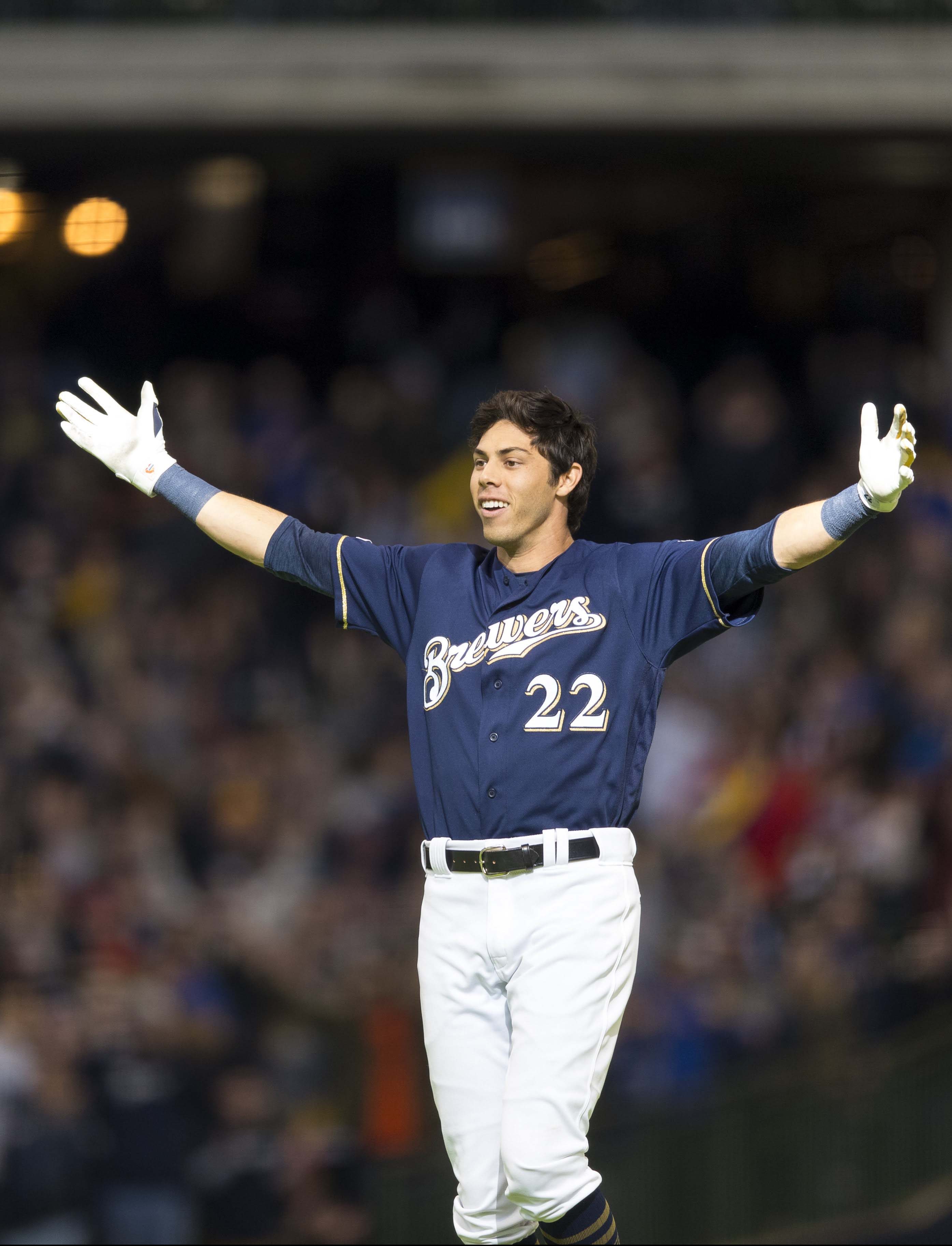
The 28-year-old Yelich was already under club control for $12.5MM in 2020 and $14MM in 2021 — plus a $15MM club option ($1.25MM buyout) for the 2022 season. Those salaries came under the terms of Yelich’s previous seven-year, $49.57MM deal, though; the newly proposed arrangement would obviously catapult him into the game’s elite in terms of annual rate of compensation.
Under the terms of the new contract, those 2020-21 salaries will remain in place, while Yelich will reportedly be guaranteed $26MM annually (with $4MM in deferrals) from 2022-28. The option is said to be valued at $20MM with a $6.5MM buyout. He also receives a full no-trade clause. The contract doesn’t have any opt-outs. In all, he’ll be paid a hefty $215MM over the next nine seasons thanks to today’s extension.
Of course, Yelich has more than proven worthy of that level of investment since being traded over from Miami in a lopsided deal that sent Lewis Brinson, Isan Diaz, Jordan Yamamoto and Monte Harrison to the Marlins. Yelich had cemented himself as a well above-average player in Miami, but the former No. 23 overall pick and top prospect erupted with an MVP season in 2018 and an MVP runner-up in 2019. In two years with the Brewers, Yelich has won a pair of batting titles, posting a combined .327/.415/.631 slash with 80 home runs, 63 doubles, 10 triples and 52 steals (in 58 tries). The 2019 season saw Yelich lead the league not only in batting average but also in on-base percentage and slugging percentage.
That outstanding 2019 campaign ended with an injury — specifically a fractured kneecap suffered when Yelich fouled a pitch into his shin. That might’ve cost him a second consecutive MVP Award — he and eventual winner Cody Bellinger were neck-and-neck at the time of the fracture — but the Brewers clearly don’t have much in the way of concern on potential lingering complications.
In looking for recent comparables, there are some definite parallels with Mike Trout, who also signed what amounts to a career-spanning contract when he was already signed for another two seasons. Yelich’s deal falls well shy of the 10 years and $360MM in new money secured by Trout a year ago, although that’s not really a surprise. Great as Yelich has become, Trout had a superior track record (as he does to everyone else in the game). He was also entering his age-27 season when he put pen to paper, and he didn’t have an option on the contract that his new arrangement was overwriting. Had Yelich played out the remainder of his deal, he’d have needed to wait three years to reach market in advance of his age-31 campaign.
Nolan Arenado, too, bears a quick mention. Like Yelich, he’s an elite talent who inked a mammoth extension in advance of his age-28 campaign, tacking seven years and $234MM onto his previous one-year, $26MM deal. Arenado, however, was only a season away from reaching the open market, so it’s not surprising that his annual value handily tops that of Yelich.
From the Brewers’ vantage point, the Yelich extension should buy some good will with a fan base that grew frustrated by the departures of Yasmani Grandal and Mike Moustakas. Milwaukee spent at a generally conservative rate this winter, eschewing lengthy free-agent deals and high annual salaries alike; the Brewers didn’t give out a free-agent deal longer than Josh Lindblom‘s three-year pact and didn’t promise a larger annual salary than the $10MM rate on Avisail Garcia‘s two-year, $20MM deal.
That aversion to long-term spending surely helped to pave the way for the impending Yelich mega-deal. It’s probably not a coincidence that the Brewers are making a commitment of this magnitude right as the previous franchise-record contract — Ryan Braun‘s $105MM extension — comes off the books. In fact, prior to the Yelich news, the Brewers only had $26.8MM in guarantees on the books in 2022, which will be the first newly guaranteed season on Yelich’s contact. Milwaukee didn’t have a single guaranteed salary on the books for the 2023 season prior to this deal, either. The contract should be manageable in terms of their long-term budget outlook, even if it’s a level of spending which we’ve never seen the Brewers commit to in the past. In that regard, though, it’s clear that the organization views him as a special commodity:
“Christian is everything you could want as the face of a franchise – from his incredible performance on the field, to his leadership as a teammate, to his dedication to the community,” owner Mark Attanasio said in a press release announcing the extension. “This is an exciting day for everyone connected to the organization as we continue our commitment to be a highly competitive franchise and a place that players want to call home.”
The Athletic’s Ken Rosenthal broke the news that the two sides were closing in on a franchise-record deal. ESPN’s Jeff Passan and the New York Post’s Joel Sherman tweeted various aspects of the contract’s structure. MLB Network’s Jon Heyman reported the yearly breakdown. USA Today’s Bob Nightengale reported the no-trade clause and lack of opt-outs. MLB.com’s Adam McCalvy reported on the deferrals in the pact.
NL Central Notes: Flaherty, Urias, Reds, Williams
Cardinals right-hander Jack Flaherty may be headed for a contract renewal for the second straight offseason since he has yet to agree to his 2020 contract, Derrick Goold of the St. Louis Post-Dispatch writes. The Cards use a strict formula for giving salary raises for pre-arbitration players and Flaherty didn’t agree to his deal last year, leaving $10K in salary on the table and forcing the Cards to renew his 2019 contract for $562.1K, just $7.1K over the league minimum salary. “Flaherty wanted his disagreement with the Cardinals’ valuation of his salary noted, and that was worth the $10,000 penalty,” Goold wrotes.
As per the Cardinals’ formula, Goold reports that Flaherty is now in line for a salary close to $605K for the 2020 season — a 7.3 percent increase over the minimum salary, which is a new record raise since St. Louis adopted its formula. Still, such a raise is still very small potatoes considering Flaherty’s great 2019 numbers, and also indicative of how little leverage pre-arbitration players have in earning any extra money for outstanding performance. Flaherty is in line for a big raise once he enters the arbitration process next winter, though (barring an extension) the real big money won’t come until he hits free agency following the 2023 season.
More from the NL Central…
- Luis Urias has already “been doing pretty much everything” in preparation to get back onto the field, the Brewers infielder told MLB.com’s Adam McCalvy and other reporters, including full infield drills, taking batting practice from coaches, and tracking live pitches in the batter’s box. Urias had surgery on his left hamate bone at the end of January, so he is just shy of the short end of the projected six-to-eight week timeline for a return to action. The next step will come tomorrow, when Urias visits his hand surgeon and could potentially be cleared to start facing live pitching that same day. Manager Craig Counsell said Urias could potentially see some game action in roughly a week’s time, if all goes well. Acquired by the Padres in November, Urias will be competing with Orlando Arcia for the shortstop job once healthy, and it certainly seems like there’s a chance Urias will be able to avoid starting the season on the injured list.
- After a big offseason, Reds president of baseball operations Dick Williams is being no less bold in his expectations for the 2020 season. “We are going to say World Series is our goal because now you look around the room and you see the talent is there and it’s just not fair to limit yourselves,” Williams told The Athletic’s Paul Dehner Jr. (subscription required). “You can’t reach that goal if you don’t set it. It has been a few years since we have openly and brazenly said, ‘The ring is within our reach’ and it’s up to us to go and get it. That’s only fair to these players. I wouldn’t put the goal of anything less in front of them because I think they can do it.” Williams welcomes the pressure of these extra expectations, noting that the team had been building towards being a contender by undergoing “a massive culture shift” that extends from the front office through both the major and minor league coaching ranks “getting everybody top to bottom feeling that this is a championship-level organization.” Spending over $164MM on free agent talent this winter was “terrifying, but…exciting,” Williams said, since the Reds had so much belief in their pre-existing core group of players that “it was the right time to spend. It makes it easier to make that decision to go out on a limb.“
MLBTR Poll: The Christian Yelich Extension
By now you’ve surely seen the news: the Brewers are closing in on a new deal with superstar Christian Yelich. We’ll presume it’s completed for purposes of this post.
This contract arises even as the Brewers reach the final guaranteed year of their deal with long-time star Ryan Braun. Yelich had already supplanted him as the face of the franchis. Now, the younger outfielder will step into the top salary slot for the team.
Things can always change — lest we forget, the Brewers have at various points dangled Braun in trade talks in recent years — but Yelich seems destined to play in those sweet new Milwaukee unis for much of the rest of his career.
How to understand this deal? The 28-year-old Yelich was already under team control for three remaining seasons under the prior extension he inked as a member of the Marlins, so there wasn’t a huge rush. But the Brewers obviously felt now was the time to act if they were going to keep him around at a palatable price tag.
With seven years and (approximately) $187.25MM in new money, this deal provides Yelich with an eye-popping salary by any reasonable standard. But it’s a clear discount as compared to the values we saw in the free-agent market this winter. Consider that Anthony Rendon just sold the same portion of his career (age 30-36 seasons) for $245MM.
Great as Rendon is, he hasn’t matched Yelich in productivity. But the Brewers earned their discount by promising the money in advance — thus taking on quite a bit more risk. The most direct comparable, perhaps, is the early 2018 deal reached between the Astros and Jose Altuve when he was still two years away from the open market. Altuve only received five additional guaranteed years but got a heftier annual salary in his agreement (five years, $151MM).
It isn’t hard to understand the math for the team. On the player side, it’s hard to resist the temptation of a potential future bonanza. But Yelich was a long ways from the open market and quite a lot can change in the interim, as his freak late-2019 knee injury shows. There’s also some off-field value for both sides in striking this sort of bargain in advance. Yelich gets the comfort and assurance of knowing where he’ll play. No doubt he’ll also find it easy to strike whatever marketing deals he might like. And the club gets to promote the player as one of the franchise’s all-time greats while plotting its long-term roster moves around his presence.
So … win-win? Or is there a different way we ought to view this pact? (Poll link for app users.)
How would you characterize the Yelich-Brewers contract?
-
It's a win-win. 58% (8,019)
-
Bargain for the Brewers; Yelich should've held out for more. 31% (4,255)
-
Nice security for Yelich; Brewers should've waited before committing. 12% (1,602)
Total votes: 13,876
Quick Hits: Camargo, Riley, LoMo, Melville, Russell
Johan Camargo and Austin Riley are competing for not only the Braves‘ starting third base job, but also potentially a spot on the 26-man roster altogether. Manager Brian Snitker told reporters (including The Athletic’s David O’Brien) that he feels both Camargo and Riley are best served by everyday playing time, rather than splitting third base in a platoon or one player working in a backup role. Sending one of the duo down to Triple-A is “not out of the question,” Snitker said. “They’ve got (minor-league) options, and if long term, for the health of our ballclub that’s (what) we see fit, that could happen.”
Plans could change in case of an injury, of course, and both players have experience at other positions. Riley played mostly left field in his rookie season and only four games at third base, as Atlanta had Josh Donaldson at the hot corner last year. Camargo, meanwhile, has a lot of experience at shortstop, second base, and both corner outfield positions in addition to third base, though Snitker felt that bouncing Camargo around the diamond last season hurt his productivity at the plate. After hitting .281/.343/.455 in 780 PA over his first two MLB seasons, Camargo struggled to a .233/.279/.384 slash line in 248 plate appearances in 2019.
More from around the baseball world…
- After signing a minor league deal with the Brewers this winter, Logan Morrison has no intention of actually playing in the minors if he doesn’t crack Milwaukee’s roster, the veteran told the Milwaukee Journal Sentinel’s Tom Haudricourt and other media. “Triple-A is not an option. That’s not going to happen. I have nothing to prove there. If they try to send me down, I can get out,” Morrison said, referring to the opt-out clause in his contract as an Article XX(B) free agent. Since Morrison has at least six years of MLB experience and finished last season on a 40-man roster (the Phillies’ roster) or 60-day injured list, he can ask to be released by the Brewers if they don’t put him on their 26-man roster or the injured list five days prior to Opening Day. Morrison would also be in line for a $100K retention bonus if the Brewers didn’t put him on the roster but wanted to keep him in the minors, but clearly that isn’t on Morrison’s mind. “I’m not worried about it because whatever happens, wherever I go, whatever they decide, I’ll be at peace with it,” he said.
- Tim Melville is recovering from a broken rib and will be sidelined for at least three weeks, Kyle Newman of the Denver Post writes. After pitching 33 1/3 innings for the Rockies last season, Melville signed a new minor league deal with Colorado earlier this month, though he thinks his rib injury might have taken place at the end of last season. The discomfort didn’t resurface until Melville began throwing in camp. The injury obviously lessens Melville’s shot at winning a roster spot, though the Rockies could place the right-hander on the IL and let him ramp up in the minors.
- Royals pitching prospect Ashe Russell underwent Tommy John surgery last year and is still recovering, MLB.com’s Jeffrey Flanagan reports (Twitter links). The exact date of Russell’s procedure isn’t known, though Flanagan said it took place “awhile” before last June. That would put Russell roughly on pace to return to the mound sometime before the end of the season. Russell has tossed only 38 1/3 professional innings since being selected 21st overall in the 2015 draft, and hasn’t pitched at all since the 2016 season. Back in July 2017, we learned that Russell had taken a “mental break” from baseball, in the words of Royals assistant GM J.J. Picollo. Russell’s agent described the issue as somewhat more pitching-related in nature, saying Russell was “having trouble with his pitching mechanics” and “needed a change of scenery” from the Royals’ training facilities. The 23-year-old righty is currently at the Royals’ Spring Training camp.
Quick Hits: Peralta, Brewers, Mariners, Wallace
Happy birthday to Diamondbacks right-hander Stefan Crichton, who turns seven years…er, make that 28 years old on this Leap Day. As you might expect, there haven’t been too many big leaguers born on February 29, though the date has produced a pair of very notable figures from baseball history. Pepper Martin (born in 1904) was a four-time All-Star who won two World Series titles as a member of the Cardinals’ legendary Gashouse Gang teams of the 1930’s. While the World Series MVP Award wasn’t instituted until 1955, it’s safe to consider Martin a retroactive winner for his performance in the 1931 Fall Classic, as he posted a 1.330 OPS over 26 plate appearances to lead St. Louis to victory.
Al Rosen (born in 1924) was also a four-time All-Star, as well as the American League’s MVP in 1953. Rosen hit .285/.384/.495 over ten outstanding seasons with the Indians in a career cut short by injuries, though he got to the Show in time to earn a ring with the 1948 Tribe, the last Cleveland team to win a World Series. After his playing career was over, Rosen served as the president/CEO of the Yankees (winning another Series in 1978), then president/general manager of the Astros (1980-85) and Giants (1985-92).
More from around baseball as we hit the last February 29 until 2024…
- Freddy Peralta‘s representatives “weren’t too happy” with the right-hander’s decision to sign a five-year extension with the Brewers, Peralta told Tom Haudricourt of the Milwaukee Journal Sentinel and other reporters. Peralta is guaranteed $15.5MM over the next five seasons, plus as much as $14.5MM more if club options for 2025 and 2026 are both exercised. The contract gives the Brewers a lot of control over a pitcher who only has slightly more than one year of service time to his name, and Peralta said his agents at Rep 1 Baseball “didn’t really want to take it. At the end of the day, I know they wanted to wait a little longer.” Still, Peralta was focused on locking in a life-changing amount of money, calling the contract “something I’ve been working for my whole life….It was a chance to help my family, to help myself, and be in a position where I can play relaxed. My family can be a little more happy and relaxed. It definitely changes my mind going into every season, knowing that I have a little bit of security.”
- While Peralta could be leaving a lot of potential money on the table if he blossoms into a reliable pitcher, taking the extension could ultimately prove to be a wise choice considering that Peralta isn’t yet proven at the big league level. These types of early-career extensions involve “a risk tolerance for both sides,” Brewers GM David Stearns told Haudricourt and company, and “in this case, there was a clear desire from the player and a clear desire from the club” to get a deal done. Rather than specify a a specific starting or relieving job for Peralta, Stearns indicated “we think he could potentially have success in both roles, and as the game continues to evolve, as the use of pitching continues to evolve, there are probably going to be a whole bunch of pitchers who are asked to do both. And it wouldn’t shock me if Freddy is one of those guys.“
- The Mariners won’t use a set closer this season “unless somebody jumps up and grabs the position,” manager Scott Servais told reporters (including Ryan Divish of the Seattle Times). Barring a breakout performance from one of the many save candidates, the M’s will instead rotate between the likes of Yoshihisa Hirano, Carl Edwards Jr., Matt Magill, Dan Altavilla, Sam Tuivailala, and perhaps others in ninth-inning situations.
- Special assistant Dave Wallace and the Braves have “mutually agreed to part ways” after three seasons, USA Today’s Bob Nightengale tweets. This was Wallace’s second stint in Atlanta’s organization, after working as a minor league pitching coordinator from 2010-13. The 72-year-old Wallace is known for his many years as a pitching coach with five different teams, most recently working with Orioles pitchers from 2014-16.
Brewers Extend Freddy Peralta
February 28: The Brewers have officially announced the deal, which covers the 2020-24 seasons and contains club options for 2025 and 2026.
February 26: The Brewers are closing in on an extension with righty Freddy Peralta, according to Ken Rosenthal of The Athletic (Twitter links). It’ll be worth a guaranteed $15.5MM over a five-year term. Peralta, a client of Rep 1 Baseball, will also give the Milwaukee organization a pair of club options in the pact. They could tack on another $14.5MM in total value if exercised.
As Rosenthal notes, this is nearly the same contract as that reached recently between Aaron Bummer and the White Sox. But there are some notable distinctions.
Peralta wouldn’t have qualified for arbitration until 2022 at the earliest. (Bummer was on track to be a Super Two at the end of the season.) And Peralta owns only a 4.79 ERA through 163 1/3 career innings. (Bummer had a highly productive 2019 effort.)
At the same time, there’s arguably even greater upside here for the Milwaukee organization. Peralta is capable of working as a starter — or, perhaps, as a provider of bulk innings or roving high-leverage arm. He may not yet have ironed out all the kinks, but he was a well-regarded prospect who now owns a flashy 11.6 K/9 (versus 4.2 BB/9) in his young MLB career. Oh, and he is still just 23 years of age.
Peralta’s earned-run numbers dipped in 2019 when compared to his 2018 debut. Like many other hurlers, he struggled to contain the long ball in a season that produced record home-run levels due to the altered composition of the baseball itself.
In other ways, though, he made clear strides. Peralta upped his average fastball to the 94 mph level on the year; notably, it trended steadily up to the point that he was sitting 96 by season’s end. That primary offering continues to exhibit excellent spin rate. Peralta boosted his swinging-strike rate to 13.0%. He was also fairly stingy in terms of hard contact; Statcast credited opposing hitters with a .333 wOBA but only a .309 xwOBA.
For the Brewers, the downside in such an extension is minimal given the low cost of the deal. It’s always possible that Peralta simply doesn’t piece everything together and remains a fringe big league option, but the financial risk is negligible. If Peralta is able to emerge as even a serviceable fifth starter or reliever, the deal will be well worth it; anything more could turn the pact into a downright bargain for president of baseball operations David Stearns and his staff. That’s not to say that Peralta shouldn’t have signed the deal — turning down life-changing money at any point is extraordinarily difficult — but the upside outweighs the risk rather notably.
As for how Peralta will factor into the immediate plans, that remains to be seen. He’s battling offseason acquisition Eric Lauer and right-hander Corbin Burnes for the final spot in Milwaukee’s rotation this spring. Even if he doesn’t win the job off the bat, injuries always arise, and the Brewers’ rotation has enough uncertain names that it seems likely we’ll see Peralta make some starts in 2020. If not, the aforementioned bullpen role always remains a possibility.
It’s also worth highlighting the extent to which Peralta’s deal enhances the long-term potential for a cost-efficient rotation in Milwaukee. Josh Lindblom‘s three-year, $9.125MM deal spans the 2020-22 seasons. Brandon Woodruff and Burnes are controlled through 2024 and Adrian Houser through 2025. Obviously, not all five members of that quintet are going to pan out as viable big league starters. But some combination of those arms should comprise a notable chunk of the rotation for the foreseeable future — and they’ll likely do so while combining to earn less than $20MM annually as far into the future as 2022.
Peralta is now under control longer than any of his teammates, though Milwaukee’s affinity for precisely this type of value-focused contract structure suggests that similar arrangements will be pursued in the coming weeks and in subsequent offseasons.
Photo courtesy of USA Today Sports Images.
MLBTR Video: Giancarlo Stanton Out With Calf Strain; Brewers Finalizing Deal With Freddy Peralta
Yankees slugger Giancarlo Stanton is dealing with a calf strain, while the Brewers are finalizing a five-year deal with righty Freddy Peralta. MLBTR’s Jeff Todd explains what it all means in today’s video:
Assessing The Brewers’ Rotation
As seems to be the case every spring, there’s a fair bit of uncertainty surrounding the Brewers’ rotation. Milwaukee eschewed a splashy trade or a potentially cumbersome long-term pact in free agencu, instead opting for lower-cost deals with righty Josh Lindblom (three years, $9.125MM) and Brett Anderson (one year, $5MM) As things currently stand, that duo will likely join holdovers Brandon Woodruff and Adrian Houser in comprising four of the top five spots.
As for the fifth spot in the rotation, Brewers manager Craig Counsell told reporters yesterday that the competition will likely boil down to left-hander Eric Lauer and right-hander Freddy Peralta (Twitter link via Adam McCalvy of MLB.com). Righty Corbin Burnes isn’t entirely out of the race, but Counsell did indicate that veteran right-hander Shelby Miller won’t be considered just yet. While Miller was invited to MLB camp and will presumably get some innings there, he’s working to reestablish himself after several lost seasons.
The competition between Lauer and Peralta will be a key one for Brewers fans to follow this spring. The former, a 24-year-old lefty picked up alongside Luis Urias in the trade that sent Zach Davies and Trent Grisham to San Diego, already has nearly two full seasons of MLB experience under his belt despite his relative youth. Lauer started 29 games for the Padres last season, pitching to a 4.45 ERA with 8.3 K/9, 3.1 BB/9, 1.20 HR/9 and a 39.9 percent ground-ball rate in 149 2/3 innings.
Lauer pitched into the seventh and eighth inning on a few occasions but ultimately averaged about five frames per start — a concept that should be plenty familiar to Brewers fans at this point. Milwaukee regularly limited the aforementioned Davies and right-hander Chase Anderson to two trips through the opponents’ batting order, leveraging a deep bullpen thereafter. If he wins the fifth spot in the rotation, Lauer could be deployed in similar fashion.
Peralta, meanwhile, is still just 23 year of age. Like Lauer, he’s racked up a fair bit of big league experience in his early 20s, pitching to a combined 4.79 ERA in 163 1/3 Major League innings to this point. Peralta spent most of the 2019 season in a multi-inning relief role — showing better in that capacity than he did as a starting pitcher. But Peralta has added a new pitch to his repertoire this winter, as Tom Haudricourt and Todd Rosiak of the Milwaukee Journal-Sentinel recently highlighted, which could change his fortunes. A chat with former big league righty and current Brewers special assistant Carlos Villanueva led to Peralta trying out a slider in the Dominican Winter League, and he responded with a 34-to-3 K/BB ratio in 20 innings with los Toros del Este.
The 25-year-old Burnes could be something of a wild card as camp progresses. A consensus top 100 prospect heading into 2018, Burnes debuted in dominant fashion with the ’18 club when he tossed 38 innings of 2.61 ERA ball with a 35-to-11 K/BB ratio. He made 30 total relief appearances, allowing just 27 hits (four homers); of his 11 walks, two were of the intentional variety. Burnes posted elite spin rates on his curve and heater while flashing high-end velocity. He looked like a potential cornerstone for the pitching staff.
The 2019 season was an unmitigated disaster for Burnes, however. The hitter-friendly nature of the 2019 ball likely didn’t help matters, nor did a sky-high .414 average on balls in play. But Burnes’ poor showing can’t be solely blamed on a juiced ball or poor luck; he was absolutely torched for 48 runs in 49 innings of work — yielding a stunning 17 home runs in that time. The right-hander showed a clear knack for missing bats (12.9 K/9, 17.2 percent swinging-strike rate) but struggled with location both in and out of the zone far. Burnes’ walk rate increased, and his inability to command the ball within the zone contributed to that barrage of long balls.
Regardless of how it shakes out, the Milwaukee rotation will enter the season facing its share of scrutiny. That’s been the case in both of the past two seasons, however, and the team reached the postseason in both instances. A year ago. The 2019 season saw Jhoulys Chacin, Chase Anderson, Woodruff, Davies, Houser and Gio Gonzalez make the majority of its starts. A year prior, the Brewers entered the season with Chacin, Anderson, Davies, Junior Guerra, Brent Suter and Wade Miley (then on a minor league reclamation deal) heading up its rotation mix.
There may not be a surefire ace among Milwaukee’s starting staff, but both Woodruff and Houser posted sub-4.00 ERAs with strong peripheral marks in more than 100 innings in 2019. Lindblom is an undeniably interesting flier coming off a dominant run in the Korea Baseball Organization, thanks in part to a new splitter. Brett Anderson has a 4.07 ERA and a 55 percent ground-ball rate over the past two seasons (256 1/3 innings). It’s not the most outwardly impressive group of arms, but the Brewers have begun to make a habit of compiling serviceable staffs that are light on name value. They’ll be looking for more of the same in 2020.