
Out Of Options Players: NL Central
The following 40-man roster players have less than five years service time and are out of minor league options. That means they must clear waivers before being sent to the minors, so the team would be at risk of losing them in attempting to do so. I've included players on multiyear deals. This list was compiled through MLBTR's sources. Today, we'll take a look at the NL Central.
Brewers: Juan Francisco, Jeff Bianchi
Francisco is competing with Mark Reynolds and Lyle Overbay for the Brewers' first base job. It's hard to imagine a scenario where all three make the team, wrote Tom Haudricourt of the Milwaukee Journal-Sentinel last week. Reynolds and Overbay signed minor league deals, but it seems likely at least one of them will make the team. When Reynolds signed in January, it was said the Brewers told him he'll almost certainly make the team, so Overbay might have to beat out Francisco, who has the advantage of already being on the 40-man roster.
Back in February, Curt Hogg of Disciples of Uecker dissected the Brewers' reserve infielder situation, explaining that while they may need to carry seven infielders, Bianchi still seems needed as the only one capable of backing up Jean Segura at shortstop.
Cardinals: None
Cubs: George Kottaras, Wesley Wright, Justin Ruggiano, James McDonald, Pedro Strop, Welington Castillo, Jeff Samardzija, Luis Valbuena, Travis Wood, Donnie Murphy, Alberto Cabrera
McDonald is competing with Chris Rusin for the Cubs' fifth starter job, at least until Jake Arrieta's shoulder is deemed ready. Meanwhile, Cabrera is battling for the final bullpen spot with about a half-dozen others.
Pirates: Chris Stewart, Jeanmar Gomez, Mark Melancon, Travis Snider, Jose Tabata, Bryan Morris, Andy Oliver, Stolmy Pimentel, Pedro Alvarez, Vin Mazzaro
The Bucs' seven primary relievers last year were Jason Grilli, Melancon, Justin Wilson, Tony Watson, Gomez, Mazzaro, and Morris, and indeed, that was their bullpen for the NLDS. It would be difficult for Oliver to break into that group, but surely the Pirates don't want to lose the hard-throwing Pimentel. Tim Williams of Pirates Prospects thinks they'll find a place for him. Some kind of trade makes sense to clear the logjam, barring injury.
Reds: Alfredo Simon
Simon is in good standing as a member of the Reds' pen.
Offseason In Review: Arizona Diamondbacks
One would be hard-pressed to offer a better description of this year’s Diamondbacks offseason than that written at the same time last year by MLBTR’s Steve Adams: “The Diamondbacks made a number of moves that raised eyebrows and invited skepticism this offseason, and they’ll have to improve on last year’s .500 record to silence those naysayers.”
Major League Signings
- Bronson Arroyo, RHP: Two years, $23.5MM. Club option for 2016.
- Eric Chavez, 3B: One year, $3.5MM.
- Total spend: $27MM.
- Henry Blanco, Daniel Hudson (non-tendered and re-signed), Mike Jacobs, Blake Lalli, Tommy Manzella, Andy Marte, Ryan Rowland-Smith, Adam Russell, Jess Todd
- Acquired RHP Justin Choate and OF Todd Glaesmann from the Rays in exchange for RHP Heath Bell (to Rays) and LHP David Holmberg (to Reds).
- Acquired OF Mark Trumbo and RHP A.J. Schugel from the Angels and OF Brandon Jacobs from the White Sox in exchange for LHP Tyler Skaggs (to Angels) and OF Adam Eaton (to White Sox).
- Acquired RHP Addison Reed from the White Sox in exchange for 3B Matt Davidson.
- Claimed Alex Sanabia, Matt Tuiasosopo, Santos Rodriguez, Marcos Mateo (Rule 5)
- Josh Collmenter, RHP: two years, $2.425MM. Club option for 2016 and mutual option for 2017.
- Brad Ziegler, RHP: two years, $10.5MM. Club option for 2016.
- Willie Bloomquist, Wil Nieves, Davidson, Bell, Holmberg, Skaggs, Eaton, Patrick Schuster (Rule 5), Kevin Munson (Rule 5)
What Might James Shields Earn In Free Agency?
We heard earlier today that the Royals have no intentions of making a run at extending ace hurler James Shields. That would seem to confirm what has long been expected: namely, barring a surprising change of circumstances, Shields will hit the market next year looking to sell his services for age-33 and beyond.
As Andy McCullough of the Kansas City Star noted earlier today, Shields and his camp have rejected rumors that he is seeking to land a deal in the realm of Zack Greinke's six-year, $147MM pact. (Note that Greinke did not require draft compensation to sign, as Shields almost certainly will unless he too is dealt mid-season.)
But, as McCullough notes, Shields compares well to Greinke — indeed, he compares well to just about anyone not named Clayton Kershaw — in terms of recent production. He has pitched at least 200 innings (and often quite a bit more) for each of the last seven seasons, and has logged ERA totals of between 2.82 and 3.52 over the last three. Shields has been among the 20 or so most valuable pitchers since he cracked the league, and has looked more like a top-ten guy more recently.
So, can Shields earn Greinke money? Though his numbers make that contract look like a solid comp, another major factor speaks firmly against it: namely, age. At the time Greinke inked with the Dodgers, he was just over 29 years old, and threw at that age for the entire season in the first year of his deal. Shields will be four years older when he faces the open market for the first time.
This series of observations led MLBTR's Tim Dierkes to suggest that, perhaps, it would be worthwhile to look at the historical results of top-level, slightly older hurlers. The results of that research, and my discussions on the topic with both Tim and fellow MLBTR writer Steve Adams, make up what you'll read below.
Unsurprisingly, it turns out that slightly older pitchers have not readily landed huge contracts. That makes sense, for at least two major reasons. First is simply the factor of selection bias. Most really good pitchers accrue service time early in their careers and thus hit the open market slightly earlier than will Shields, who did not crack the bigs until age 24 and then gave up two years of free agency in an early-career extension. Likewise, as age increases, the likelihood of significant injury goes up, further attriting the possibly worthy arms. The second reason is even easier: older pitchers have less near-peak years left to sell.
Let's take a look at all pitchers to have signed deals with at least a $60MM guarantee at a $15MM or greater average annual value — after having turned 31 years of age. (The last column represents the player's age at Opening Day of the first season of their deal).
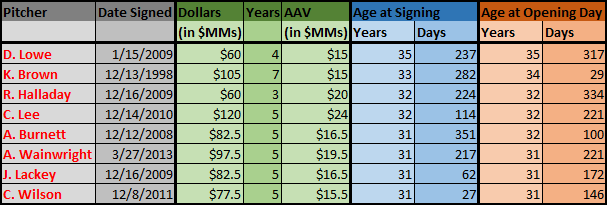
Among these potential comps, we can reject several out of hand. First, Brown and Lowe were both significantly older and signed deals in quite a different market. (Frankly, I only kept them on the chart to show how remarkable their contracts were.) Wainwright signed an under-market extension, while Halladay was also probably on a different performance/perception level and signed his own deal under somewhat odd circumstances.
That leaves us with four potential free agent comps, all of whom are near in age to where Shields will be when he hits the market. All signed five-year deals in early-to-mid-March of their free agent year. (If Shields signs before his birthday on December 20th, he'd be just shy of 33 years of age, making him slightly older than the other four were.)
How does Shields stack up to that quartet? Let's look at both three-year averages and walk-year performances to get an idea, and look at the salary numbers through the lens of inflation (present dollar value estimated via US Inflation Calculator). I have used ERA and fWAR not to suggest that those are the proper means by which to value pitchers, but to represent two sides of the overall picture: the former captures pure results, while the latter incorporates FIP as its baseline and thereby captures some of the underlying talent and rate-based results that teams surely examine closely when signing deals of this magnitude.
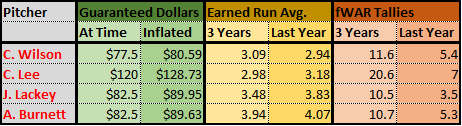
Needless to say, Lee paced the grouping — at least in the eyes of advanced metrics and in dollars achieved. He still fell well short of Greinke's guarantee, though of course he inked his deal a few years back and reportedly could have signed for seven years and $148MM.
As for Shields, his current three-year and last-year ERA both stand at 3.15. He has been worth 12.9 fWAR over the last three seasons, and earned 4.5 wins in 2013. Assuming he hits the market with approximately the same profile — i.e., he logs another 200+ innings of pitching in the low-to-mid-3.00 ERA range and has underlying metrics to support a 4-5 fWAR season — where might he land?
The answer, probably, is not in the realm of Greinke's contract (or the commensurate offer that Lee could have signed). Even accepting that baseball inflation has outpaced that of the general economy — or, at least, understanding that MLB salary levels are subject to wide variation due to the league's comparatively tiny player market, small sample of transactions, and range of non-market-based influences — the Wilson-Lackey-Burnett line of arms equate at most to a five-year, $100MM present-day value.
Importantly, Dierkes noted, those three were clearly the best available arms in their free agent years. While it is still conceivable that Shields will ultimately be the most attractive starter available when the market opens, odds are he will slot in behind Max Scherzer and possibly Jon Lester. (Of course, if Scherzer repeats his 2013 season, he might be on another plane altogether.) And if Justin Masterson hits the market, he might be more appealing to some clubs because of his significantly younger age. Regardless, unless each of those arms is extended off the market or takes a large value hit, Shields will not be the sole target for clubs looking to add an impact starter.
Moreover, as I recently noted in discussing extensions, teams have evinced an increasing willingness to value age. That attention to the aging curve probably also implies a corresponding unwillingness to roll the dice on continued production on its downside. Still-excellent pitchers Hiroki Kuroda (age 39) and A.J. Burnett (age 37) just signed one-year deals that will pay them $16MM. Can Shields really beat that AAV on a five-year pact that would buy out his age 33-37 campaigns, especially if there are alternative arms on the market? As Adams noted, Shields' slightly more advanced age means that a fifth year would push his guarantee into somewhat uncharted territory as compared with his most direct comps. It is worth wondering whether clubs would be willing to guarantee another year at such an elevated rate.
In the aggregate, it looks as though Shields could reasonably expect to top out at five years, with a $20MM AAV a seeming longshot at that term. On a four-year deal, Shields might land in the $75MM to $80MM range, perhaps with a vesting/club option of some kind attached on the end. But barring a massive jolt to the market that leaves Shields as the unquestioned prize with multiple suitors, it is somewhat difficult to imagine him reaching the $100MM threshold — if he is able to get a guaranteed fifth year at all.
One possible twist would be the inclusion of an opt-out clause. As Dierkes notes on Twitter, Lee actually had one offer that included an opt-out before he signed on with the Phillies. In his excellent piece on the use of opt-out clauses, Dierkes wrote that such provisions may not be that onerous to the team since, if exercised, the club is able to re-assess whether to take on further obligations (and, I would note, can do so with the advantage of insider knowledge on that pitcher). If clubs are unwilling to guarantee as much cash as Shields hopes for, he could potentially press instead for a deal that includes an opt-out, allowing him to re-enter the market if he carries his production into his mid-30's. And at that point, perhaps the Lowe contract would take on increasing relevance.
Offseason In Review: Milwaukee Brewers
The Brewers are hoping that a pair of late free agent signings and the return of two key bats will help them improve upon their fourth-place finish in a stacked NL Central division.
Major League Signings
- Matt Garza, RHP: Four years, $50MM. Club/vesting option for 2018.
- Francisco Rodriguez, RHP: One year, $3.25MM.
- Total Spend: $53.25MM
Notable Minor League Signings
- Mark Reynolds ($2MM base if he makes team), Lyle Overbay ($1.5MM base if he makes team), Zach Duke, Pete Orr, Matt Pagnozzi, Irving Falu
Trades and Claims
- Acquired LHP Will Smith from the Royals in exchange for OF Norichika Aoki.
- Acquired LHP Luis Ortega from the Red Sox in exchange for RHP Burke Badenhop.
- Claimed IF Elian Herrera off waivers from the Dodgers.
- Claimed LHP Wei-Chung Wang from the Pirates in the Rule 5 Draft.
Extensions
- None
Notable Losses
Needs Addressed
Though Milwaukee’s starters finished the season well, the team’s first-half struggles were pronounced. Even after the addition of Kyle Lohse — who pitched well in his debut season with the team — the Brewers’ rotation combined for a 4.86 ERA prior to the All-Star break (third-worst in all of baseball). That mark dropped to a stellar 3.36 in the second half thanks to turnarounds from Yovani Gallardo, Wily Peralta and Marco Estrada.
However, Milwaukee lacked a clear fifth starter, as 12 different pitchers started games for the team in 2013. That’s no longer an issue, as the addition of Garza not only improves the team’s chances of sustaining its second-half surge, it gives manager Ron Roenicke no questions about which five pitchers will be taking the hill on a regular basis. Garza, Lohse, Gallardo, Estrada and Peralta form a solid quintet that could be one of the better rotations in the National League.
The Brewers also entered the offseason with a good deal of uncertainty in the bullpen, which made the decision to trade Badenhop for a low-level minor league arm a bit puzzling. Nonetheless, the additions of Smith and Rodriguez give Roenicke two arms to bolster his relief corps. Smith broke out in Kansas City last season, posting a strong 3.24 ERA with 11.6 K/9 and 1.9 BB/9 in 33 2/3 innings (he was even better as a reliever, as he yielded four runs in four innings in his lone start of 2013). Smith held opposing lefties to a .557 OPS, and even righties managed just a .684 OPS against him. He could also be deployed as a starting pitcher should the club see some injuries in the rotation. Or, the club could prefer to Smith him in his best role to date and turn to Tyler Thornburg or Mike Fiers should a starter go down.
Rodriguez, the club’s only other Major League signing besides Garza, signed his third separate one-year deal with the Brewers this offseason and provides a nice fallback option should Jim Henderson falter as the club’s closer. K-Rod was outstanding for the Brewers in 24 2/3 innings before being traded to Baltimore for Nick Delmonico last year. Milwaukee now gets to keep Delmonico and deploy Rodriguez from its bullpen once again.
Questions Remaining
The biggest need for Milwaukee may simply have been to make sure the starters are able to take the field. Aramis Ramirez missed much of 2013 with injury, Ryan Braun was suspended for the season’s second half and Corey Hart never played a game at first base after undergoing a pair of knee surgeries.
The club now is faced with questions surrounding those players. Will Ramirez, who turns 36 in June, be able to stay healthy? How will Braun respond to the media attention that he will undoubtedly receive all season and the negative reactions in visiting parks (and potentially his own home park as well)?
Perhaps the biggest question facing Milwaukee, though, is its first base situation. The Brewers were very interested in a reunion with Hart, but they neglected to match Seattle’s price. The Mariners guaranteed Hart $6MM with the chance to earn up to $13MM total after incentives. Milwaukee’s best offer to Hart, reportedly, allowed him to max out at $8MM. The Brewers were also connected to James Loney, though they balked at his asking price as well, and Loney returned to the Rays on a three-year, $21MM deal. Another possibility would have been Ike Davis, but GM Doug Melvin was unwilling to part with right-hander Tyler Thornburg to make a trade happen.
In the end, Reynolds was signed with the promise that he was a virtual lock to make the club out of Spring Training. The 30-year-old possesses light-tower power but also strikes out at a prolific rate and found himself released by the Indians last year. Reynolds got off to one of the hottest starts in recent memory but fell into what could be the worst slump of his career prior to being let go. He could platoon with Overbay or Juan Francisco, but each member of that trio comes with more red flags and question marks than guarantees.
The Brewers will soon learn if Khris Davis can be their everyday left fielder, or if that will be something they need to address in future offseasons. Davis posted a whopping .279/.353/.596 batting line with 11 homers in just 153 plate appearances last season, indicating that he has the potential to hit 25 or maybe even 30-plus homers in the Major Leagues. However, he’s also never been too highly regarded as a prospect and comes with some defensive limitations. Already 26 years old, this will be somewhat of a make-or-break year for Davis.
Lastly, Jean Segura is penciled in as the everyday shortstop, but he will need to prove that he’s capable of producing over a full season. The one-time Rookie of the Year candidate finished with strong overall numbers but batted a mere .241/.268/.315 in the season’s second half.
Deal Of Note
Brewers GM Doug Melvin had drawn plenty of ire from fans and media alike for his lack of activity on the free agent market prior to signing Garza in late January. Milwaukee was the only club not to have signed a Major League free agent at that point, but Melvin’s patience paid off, as he was able to get Garza for roughly the same price that netted the Twins Ricky Nolasco more than two months earlier.
There was some uncertainty regarding Garza’s status, as after initial reports that the agreement was reached, pending a physical, the Brewers issued a statement to say that no deal was in place. While teams often refuse to comment on signings that are reported prior to completion of the physical, it’s highly uncommon for a club to actually deny the deal and say the two sides are still in discussion.
Eventually, the deal was announced with a unique and complex fifth-year option that 1) was likely the cause for the delay and 2) demonstrates just how wary teams were of Garza’s health issues. The Brewers have a very cheap $5MM option on Garza for the 2018 season that drops to just $1MM if he is on the DL for 130 days during any of the previous four seasons. However, it can vest at $13MM if he pitches 110 games over the first four years of the deal, is not on the disabled list at the end of the 2017 season and throws at least 115 innings in 2017. With $1MM available in incentives each season, Garza can earn up to $67MM over five years. His $50MM guarantee marks the largest free-agent expenditure in team history.
Overview
Melvin continued a trend we’ve seen from his team in recent years by waiting out the market in order to secure a couple of solid values on late-signing free agents. Milwaukee’s rotation should be improved and will be a strength for this team. Full seasons of Ramirez and Braun will go a long way toward improving the offense, but the production of Davis and Segura loom as uncertainties. If even one of those two performs at a high level, it may be enough to overshadow what seems likely to be a first-base deficiency. Milwaukee plays in an exceptionally difficult division, with three teams coming off a season of 90 or more wins. Despite that, there’s enough talent on the team to contend for a Wild Card spot if everything breaks their way.
Photo courtesy of USA Today Sports Images.
Offseason In Review: Chicago Cubs
The Cubs added flippable veteran arms, assembled a center field platoon, and brought in a new backup catcher.
Major League Signings
- Jason Hammel, SP: one year, $6MM.
- Jose Veras, RP: one year, $4MM. $5.5MM club option for 2015 with a $150K buyout.
- Ryan Sweeney, OF: two years, $3.5MM. $2.5MM club option for 2016 with a $500K buyout.
- Wesley Wright, RP: one year, $1.425MM. Under team control for 2015 as an arbitration eligible player.
- James McDonald, SP: one year, $1MM. Under team control for 2015 as an arbitration eligible player.
- Total spend: $15.925MM.
Notable Minor League Signings
- Emilio Bonifacio, Chris Coghlan, Darnell McDonald, Ryan Roberts, Chris Valaika, Tsuyoshi Wada, Casper Wells, Tommy Hottovy, Jonathan Sanchez, John Baker, Eli Whiteside, Aaron Cunningham, Ryan Kalish, Mitch Maier, Lars Anderson
Trades and Claims
- Acquired C George Kottaras from Royals for cash.
- Acquired OF Justin Ruggiano from Marlins for OF Brian Bogusevic.
Notable Losses
- Dioner Navarro, Brian Bogusevic, Dave Sappelt, Kevin Gregg, Scott Baker, Marcos Mateo, Daniel Bard, Brooks Raley
Needs Addressed
In an alternate universe, the Cubs' 2013-14 offseason could have been very exciting. They fired manager Dale Sveum in late September, and for about a week there was talk of a big-money run at Joe Girardi, who would have marked a return to the team's "name" managers. Instead, Girardi re-upped with the Yankees. The Cubs interviewed A.J. Hinch, Manny Acta, Dave Martinez, Eric Wedge, and Brad Ausmus for their managerial position but ended up hiring someone less famous than any of them in former big league infielder Rick Renteria. Renteria has no MLB managing experience, but did manage eight seasons in the Marlins' and Padres' farm systems before becoming a Padres bench coach. The Cubs would probably admit they missed the mark on Sveum, making Renteria the fourth Cubs manager in the last five years. He signed a three-year deal with two options, and hopefully the Cubs will be satisfied with his handling of young players and find managerial stability.
Having traded Matt Garza and Scott Feldman during the 2013 season, the Cubs were in need of veteran rotation depth for 2014. They decided not to revisit the Scott Baker idea, letting him walk as a free agent. Though last summer's Feldman trade netted a rotation candidate in the form of Arrieta, he encountered shoulder tightness in the offseason.
Cubs president Theo Epstein and GM Jed Hoyer have been on the job for three offseasons now, and Hammel is their fourth potential sign-and-flip starting pitcher. The key return in the Paul Maholm deal, Arodys Vizcaino, is still trying to come back from the Tommy John procedure he had two full years ago. He could still become an impact reliever, according to Baseball America, which ranked him tenth among Cubs prospects. Feldman brought Arrieta and reliever Pedro Strop from the Orioles last summer, as well as international bonus pool slots 3 and 4. The Cubs ultimately went nearly 50% over their international bonus pool, so the slots acquired from Baltimore can be considered nothing more than $58K in overage tax savings.
Having gotten nothing in return for Baker, the Cubs spent close than $12MM in salary on the three flipped starters. Vizcaino, Arrieta, and Strop are all under team control through 2017, and if the Cubs walk away with multiple seasons of solid cheap relief work, the whole thing was worthwhile, if not spectacular.
When McDonald posted a 3.56 ERA in his first 331 innings with the Pirates, it looked as though they had found something in their 2010 trade with the Dodgers. The wheels fell off in July 2012, however, and he posted a 6.28 ERA in 104 2/3 frames thereafter, plus time spent in the minors on 2013. A shoulder injury surfaced in May last year, and by September, McDonald was a free agent. There's no telling whether the Cubs can get him back to usefulness, but they didn't risk much to try.
The Cubs stumbled into a reunion with Kevin Gregg last year, and although they didn't manage to flip the closer in a trade, he did provide a few months of stability at the back end of their bullpen. Veras, 33, was signed in December 2012 to be the Astros' closer and was quite good at the job in 43 innings. The Astros flipped Veras to the Tigers for a pair of far-off prospects in Danry Vasquez and David Paulino, and it stands to reason the Cubs will consider doing the same with Veras if he succeeds in the first half. Veras apparently wasn't the Cubs' first or only choice in right-handed relief this offseason, as reports linked them to Edward Mujica, John Axford, Joba Chamberlain, and Jesse Crain.
The Cubs signed Wesley Wright to an affordable deal to bolster their left-handed relief. In a world where Boone Logan, Javier Lopez, and J.P. Howell garner eight-figure commitments and even a 38-year-old Scott Downs costs $4MM, the $1.425MM commitment to Wright has a chance to return profit. The Cubs also took some long shots in this area, signing Jonathan Sanchez, Tsuyoshi Wada, and Tommy Hottovy to minor league deals.
Catcher Dioner Navarro wound up signing a two-year, $8MM free agent deal with Toronto on the strength of 266 strong plate appearances with the 2013 Cubs. With Welington Castillo's solid play, the Cubs had no need to pony up to retain Navarro, who they had signed as a backup for $1.75MM. I am curious as to whether the Cubs received any decent offers on Navarro during the summer, however. Regardless, they acquired three reasonable options to back up Castillo this year in Kottaras, Baker, and Whiteside, the last two on minor league deals. The Cubs reportedly had looked into a more established backup in Kurt Suzuki. However, the walk-happy Kottaras, a former Epstein acquisition for the Red Sox, will caddy for Castillo to start the season.
Junior Lake, 24 later this month, hit a respectable .284/.332/.428 in 254 plate appearances for the Cubs last year while learning to play left field. While the Cubs might be happy to see Lake establish himself as a second-division regular, their entire current outfield seems comprised of placeholders for Albert Almora, Jorge Soler, and perhaps Kris Bryant if he moves off third base. Schierholtz endured some trade talk but is back as the Cubs' right fielder against right-handed pitching for his walk year. Ryan Sweeney could take a similar platoon role as the team's primary center fielder, though in last year's limited sample the left-handed hitter handled same-side pitching well. Kudos to the Cubs for re-signing Sweeney for just $3.5MM plus a club option in October, before the market for good fourth outfielder types was established at two years and $10-12MM by Rajai Davis, David DeJesus, Nate McLouth, and David Murphy.
The Cubs reached out to Chris Young early in the offseason, but he ended up signing a one-year, $7.25MM deal with the Mets. Plan B for a right-handed hitting outfielder in Young's mold appears to have been Justin Ruggiano, who Hoyer described as "a better fit for our roster" than Bogusevic. Ruggiano, a power/speed guy, has hit .270/.347/.544 in 305 plate appearances against southpaws over the last three years and will likely spell Schierholtz and Sweeney.
Questions Remaining
The Cubs' biggest question mark is the future of 29-year-old righty Jeff Samardzija, their nominal ace. With two years of team control remaining, the Cubs have tried to extend him but have found a gap between the valuations of each side. Rather than further reset the extension market and give Samardzija a $100MM deal, the Cubs explored trades this offseason. The Diamondbacks, Nationals, Blue Jays, Orioles, Yankees, and Braves were among the reported suitors, but by the Winter Meetings the trade barometer had gone from likely to unlikely. On December 11th, Bob Elliott of the Toronto Sun wrote that the Cubs wanted Aaron Sanchez, Marcus Stroman, and a third player from the Blue Jays. Prospect gurus suggest Sanchez is around the 30th best prospect in the game, and Stroman around the 60th.
Though teams are rightfully veering well away from ERA in decision-making, Samardzija's marks of 4.34 last year and 5.47 in the season's final three months certainly don't help his trade value. Though a third of Samardzija's team control will have evaporated by the trade deadline and the pitcher finds an extension with a new team unlikely, the Cubs are gambling he can raise his stock with a big first half in 2014 (barring a surprise trade this month).
The Cubs wound up adding Hammel and McDonald, though they were thinking much bigger with a pursuit of the offseason's top prize, Masahiro Tanaka. The Japanese ace signed a seven-year, $155MM deal with the Yankees with an opt-out clause after the fourth year, and required a $20MM release fee as well. If speculation as to the Cubs' six-year, $120MM offer with no opt-out clause is accurate, then the Yankees were offering nearly 11% more in AAV, an extra year, and the extremely valuable opt-out. That suggests the Cubs were not close on Tanaka. Of the ten MLB contracts signed with true opt-out clauses, only Tanaka's allows for the player to join a new team before age 30. The Cubs will compete in 2015 if we're being optimistic. Burning his first year on a rebuilding season could be acceptable as part of a six-year deal, but potentially paying Tanaka $108MM for the next four years didn't work for this team. The Cubs had also been an early offseason speculative suitor for David Price, whose two-year window of control and huge prospect cost also fit poorly for the Cubs unless they had reason to expect a below-market extension.
The Cubs' bid for Tanaka and speculative connection to Price stems from the question of who their future mound ace will be when all of their hitting prospects reach the Majors, especially if Samardzija is not extended or does not take the next step. Slender but well-regarded prospect C.J. Edwards could become that ace, and maybe the Cubs will take a close-to-the-Majors pitcher with their fourth overall pick in the June draft. Though Bryant projects as a future All-Star, perhaps Jonathan Gray would have been a better pick for the Cubs with their #2 overall choice in the last draft. There's a good chance the Cubs' next ace pitcher will have to come from outside the organization.
The Cubs also face questions at every infield position. First baseman Anthony Rizzo is signed through 2019, but hasn't hit lefties in his big league career and batted .217/.325/.374 from June onward last season. 27-year-old power righty Andrew Cashner, who the Cubs sent to the Padres for Rizzo, has developed into a more valuable pitcher than anyone in the Cubs' current rotation. Second baseman Darwin Barney didn't hit enough in 2013 to justify regular playing time, and figures to be challenged by prospects this year. Shortstop Starlin Castro, signed through 2019, was surprisingly below replacement level last season. A lawsuit with a baseball school in the Dominican may have affected his play, but he'll be pushed by top prospect Javier Baez in 2014. The Cubs' ragtag group of third basemen showed surprising pop last year, and they have good organizational depth beyond stopgap veterans Luis Valbuena and Donnie Murphy.
Deal of Note
The Cubs made a run at Roberto Hernandez during the Winter Meetings, but wound up reaching an agreement with Hammel in late January. The 31-year-old Hammel had surprised with a strong partial season in 2012 with the Orioles, bumping his average fastball velocity to almost 94 miles per hour and posting career-best strikeout and groundball rates. Hammel earned the Orioles' Opening Day nod but came back to Earth in 2013, posting a 4.97 ERA and hitting the DL with inflammation around the ulnar nerve in his elbow. If both Hammel and Samardzija are dealt this summer, it will mark the third consecutive season of the Cubs trading 40% of their rotation.
Overview
After a new front office came in and on punted on their first two seasons, the Cubs have assembled the fourth-best farm system in baseball, according to ESPN's Keith Law as well as Baseball America. Ideally, 2014 will be the team's final consolidation year before contending. If you think about it, three concession seasons in a market of this size is remarkable, the Mets notwithstanding. After this year, Epstein will have only two years left on his contract and even the Cubs' fanbase will start getting antsy.
The Cubs certainly tried to make some big statements this offseason. Imagine how the conversation would have changed had they hired Girardi, extended Samardzija, and signed Tanaka. The big moves didn't materialize, leaving Epstein and company with money kept in reserve for the first time. In the bigger picture, the Cubs seem to be holding off on embracing their status as a large market team until their $500MM Wrigley Field renovation project begins, potentially after this season if the dispute with rooftop owners can be resolved. Brighter times are ahead, but until then the world's most patient fanbase continues to be tested.
Photo courtesy of USA Today Sports Images.
MLBTR Originals
A look back at the original reporting and analysis found on MLBTR this past week:
- Tim Dierkes, in a follow-up to his feature post examining the opt-out clause, analyzed the cost-benefit impact on teams agreeing to include an opt-out in a player's contract. Using the five players who secured a new deal or extension by exercising their opt-out, Tim opined four of the five teams were better off losing the player and the back end of his original pact.
- Zach Links spoke with agents and club executives to determine how pre-arbitration salaries are set. An experienced agent told Zach "about two-thirds of baseball is using some kind of formula" with one baseball official adding "The [Collective Bargaining Agreement] dictates a minimum, now $500K, for these guys. The philosophical question is, what benefit do you get from paying them significantly above that, or even a dollar above that?"
- Agent Dave Pepe told MLBTR right-hander Carl Pavano has decided to end his comeback attempt and will retire after a 14-year career with the Expos, Marlins, Yankees, Indians, and Twins.
- Jeff Todd asked MLBTR readers which four-year, $50MM free agent pitcher is the better value. Nearly half of you rate the Brewers' investment in Matt Garza as the best.
- Steve Adams asked MLBTR readers if Justin Masterson will sign an extension with the Indians. Just under 56% of you predict the right-hander will become a free agent next offseason.
- Aaron Steen asked MLBTR readers whether the qualifying offer should be eliminated. Only 25% of you believe the QO should be discarded while almost 47% of you say it should be tweaked.
- Steve hosted the MLBTR live chat this week.
- Zach put together the best of the baseball blogosphere in Baseball Blogs Weigh In.
Analyzing The Five Players Who Opted Out
As I mentioned in my opt-out feature article last week, five players have used an opt-out to secure a new contract or extension: Alex Rodriguez, J.D. Drew, A.J. Burnett, C.C. Sabathia, and Rafael Soriano. A-Rod and Sabathia stayed with the Yankees, with Sabathia getting a year added to his contract just before the point of opting out. Drew, Burnett, and Soriano signed with new teams.
One negative often associated with opt-out clauses is that if a player has two or three good years, he'll just opt out and his former team will miss out. But what if the five players above had not opted out? Would their teams have come out ahead?
For this exercise, we'll use FanGraphs' dollar valuations, which were explained here by Dave Cameron. My definition of an opt-out clause is a provision where the player can become a free agent midway through a multiyear deal, at a point where he has multiple guaranteed years remaining.
- Alex Rodriguez: Opted out of 2008-10 seasons, for which the Yankees would have paid him $72MM. A-Rod produced 13.7 WAR during that time, which was worth $60.1MM. He was a very good player from 2008-10, averaging about 4.6 WAR per year, but he didn't provide great value for the price.
- J.D. Drew: Opted out of 2007-09 seasons, for which the Dodgers would have paid him $33MM. Drew produced 10.5 WAR during that time, which was worth $46.8MM. This opt out hurts in that regard, though the Dodgers paid $22MM for Drew's 6.8 WAR in 2005-06, which is valued at $24.2MM. While it would have been excellent value to have Drew for the duration of his five-year, $55MM contract, the Dodgers didn't do poorly in getting the first two years.
- A.J. Burnett: Opted out of 2009-10 seasons, for which the Blue Jays would have paid him $24MM. He was worth 4.3 WAR during that time, valued at $19.2MM. The Jays wound up paying $31MM for 10.7 WAR from 2006-08, which is valued at $45.2MM. As former Blue Jays GM J.P. Ricciardi put it in our interview, "We put the opt-out in there and in all honesty, it ended up working out great for us."
- C.C. Sabathia: Would have opted out of 2012-15 seasons, for which the Yankees owed him $92MM. Sabathia's 7.3 WAR from 2012-13 was worth $34.3MM, and it's difficult to picture him producing $57.7MM worth of value for his age 33-34 seasons. Had the Yankees allowed Sabathia to opt out and leave after 2011, they would have missed out on a strong 2012 season. Still, the case can be made that they should have let him go after paying $69MM for 17.5 WAR from 2009-11, which is valued at $76.8MM.
- Rafael Soriano: Opted out of 2013 season, for which the Yankees owed him $14MM. I'm not a big fan of using WAR to evaluate reliever salaries, but I am comfortable saying Soriano's 2013 season was nothing special and not worth his salary. I should note that Soriano's post-2012 opt-out doesn't fit neatly into our definition of the clause — with one year left at that point, it resembled a player option, which is more common.
Take a look at the following table, which shows each player's age in the season immediately following his opt-out:
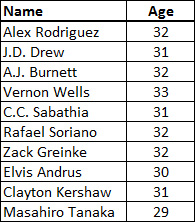
Of the ten opt-out clauses in baseball history, only Tanaka could opt out and sign a new contract that begins on the right side of 30. Even Kershaw could be mortal by his age 31 season. With an average age of 31 after the opt out, it's not surprising that with four of the five opt-outs that have been employed, the team was better off losing the player and the back end of his original contract.
MLBTR Originals
A look back at the original reporting and analysis found on MLBTR the last seven days:
- Tim Dierkes spoke with agents Darek Braunecker and Greg Genske and ex-Blue Jays GM J.P. Ricciardi about the pros and cons of opt-out clauses (all three have negotiated contracts containing opt-outs) and how "another bite at the apple" has become part of every agent's arsenal for premium clients.
- Tim was the first to report reliever Andrew Bailey was close to signing with the Yankees.
- Tim learned some of the remaining free agents tied to draft pick compensation would rather wait until after the June amateur draft to sign rather than agree to a below market deal now.
- Steve Adams sees risk for both sides in the Homer Bailey extension: the Reds paying market value one year early and Bailey leaving tens of millions of dollars on the table, if he continues the improvement he's shown over the past two seasons.
- Tim opined the Braves subverted the arbitration system with the Craig Kimbrel extension and found a way to keep an elite reliever for more than one or two additional years, but the star closer can rest easy in the knowledge his family has financial security for generations to come.
- Jeff Todd asked MLBTR readers about the parameters of a Mike Trout extension with the Angels. The consensus (as measured by the median of responses) was the Angels should be willing to give Trout a 10-year, $300MM deal, but a nine-year, $250MM contract is more likely to be reached.
- Zach Links was the first to learn Manny Ramirez switched agents: leaving Praver/Shapiro for Alex Esteban of Miami Sports Management.
- Steve hosted this week's chat.
- Zach compiled the latest edition of Baseball Blogs Weigh In.
Another Bite At The Apple: Opt-Out Clauses In MLB
An opt-out clause is the ultimate safety net for an MLB player. Typically employed with deals of least five guaranteed years, an opt-out clause is inserted in the middle of the term and allows the player to abandon the rest of his contract and become a free agent.
Alex Rodriguez started the opt-out trend with his monster free agent deal with the Rangers in December 2000, and in total, ten players have received opt-out clauses. Six of those clauses have come due, and only one of those players, Vernon Wells, didn't secure additional money at the time. C.C. Sabathia leveraged his ability to opt out to add one year and $30MM to an already record-setting deal. The others — A-Rod, J.D. Drew, A.J. Burnett, and Rafael Soriano — got to take another lucrative bite at the apple of free agency.
A Deal-Making Idea
On the night before the 2005 Winter Meetings in Las Vegas, agent Darek Braunecker had a client in A.J. Burnett who he felt was on an island in terms of being the best pitcher available. It was at that point Braunecker conceived of the idea of asking for an opt-out clause in Burnett's deal. "I wanted to create something that might add additional value to the deal as opposed to just the monetary component of it," explained Braunecker in a January conversation.
Burnett's five-year, $55MM deal with the Blue Jays came together quickly once the team agreed to include an opt-out clause after the third year. "Quite honestly, it was a deal-maker for us," said Braunecker. "I presented the idea to [Blue Jays GM] J.P. [Ricciardi] and told him that we had another club that had already agreed to that provision, and that if he was willing to do it that he would have a deal. So, really, no pushback to speak of. He obviously had to get approval from [club president] Paul Godfrey, and Paul gave his blessing on it almost immediately and that's essentially what concluded those negotiations." Braunecker added, "It really wasn't much of a challenge, to be honest with you."
Three years later, agent Greg Genske had the enjoyment of negotiating on behalf of the offseason's best available starting pitcher, C.C. Sabathia, and eventually landed a record-setting seven-year, $161MM deal with an opt-out clause after the third year. There seems to be some disagreement about who proposed the clause. Back in 2008, Matt Gagne of the New York Daily News quoted Yankees GM Brian Cashman saying, "I offered it. They never asked for it. They never said they were afraid of New York, I never heard that….Just in case it was an issue, I went to their house and I said, 'I think you're going to love it here. But let me just throw this out there.'" Genske disputed Cashman's account, telling me in January this year, "That's not true at all. That was a negotiated item that was difficult to get the Yankees to agree to. It was the last item agreed to."
The sheer rarity of opt-out clauses suggests they're not something teams are readily offering up. Only ten opt-out clauses have been given out in total, though two of them came in January this year for Excel Sports Management clients Clayton Kershaw and Masahiro Tanaka. According to Cot's Baseball Contracts, 52 MLB contracts have been worth $100MM or more. Only seven of those included opt-out clauses. Asked if he's surprised we've seen so many top of the market deals without opt-out clauses, Genske replied, "I don't think I'm surprised. It certainly is a big deal for a club. If a club's going to commit themselves to those kinds of dollars, then they don't get the benefit of the upside fully if the player has the right to opt out. I certainly understand clubs' resistance to do it."
How Much Would Kimbrel Have Earned In Arbitration?
Back in October, MLBTR contributor Matt Swartz explained that Braves closer Craig Kimbrel has been so good in his first three seasons, he broke our arbitration projection model. We eventually decided to create a special rule because of Kimbrel, which limits a player's raise to $1MM beyond the previous record for his player type. Since Jonathan Papelbon had set a $6.25MM first-time arbitration record for closers in 2009, we capped Kimbrel's 2014 projection at $7.25MM.
Without the rule, our system had assigned a $10.2MM projection to Kimbrel, so we lopped off about $3MM more for which he at least had a statistical argument, if not a precedent. With such a wide spread of possibilities, it was no surprise when Kimbrel and the Braves ended up exchanging arbitration figures. Kimbrel and his agent David Meter submitted a $9MM figure, a number reflective of the attitude, "We don't just deserve to beat Papelbon's record, we should crush it." The Braves went with $6.55MM, which would have thrown Kimbrel just $300K beyond Papelbon's record despite this potential hearing coming five years later and Kimbrel's far superior statistical record.
With a midpoint of $7.775MM, Meter would only have had to convince an arbitration panel his client deserved a dollar more than that, meaning that Kimbrel should get $1,525,001 more than Papelbon did. You always hear that arbitration hearings are a crapshoot, but if I were a betting man, I would have bet on Kimbrel's side. It's not just Meter putting together the argument; they would have had the knowledge of a motivated players' union behind them.
Once the two sides reached the point of exchanging figures, a one-year deal went off the board because of the Braves' file-to-go stance. But the two sides still discussed a multiyear deal and were able to get it done. Kimbrel signed a four-year, $42MM deal with a club option for 2018. The deal bought out all three of Kimbrel's arbitration years and one free agent year, with the option for a second free agent year.
For Meter and the Braves, one key question that had to be explored before agreeing to this deal was how much Kimbrel stood to earn in arbitration going year-to-year. I asked Matt Swartz to show me a few scenarios. Initially, Matt used what I considered to be fairly conservative stat projections for 2014 and 2015. He used Steamer's 65 innings, 28 saves, and 1.88 ERA for Kimbrel's 2014 season, and then regressed to the mean a bit on 2015 with 55 innings, 22 saves, and a 2.20 ERA.
Using these stats and assuming Kimbrel lost this month's arbitration hearing, he'd have salaries of $6.55MM, $9.9MM, and $12.9MM for a total of $29.35MM over his three arbitration years. In his actual multiyear deal, Kimbrel will earn $28MM over his three arbitration years. In this scenario, Kimbrel left just $1.35MM in arbitration money on the table. In his multiyear deal he still conceded up to two free agent years, and of course the younger a free agent is, the better he does.
Using the same stats and assuming Kimbrel won this month's arbitration hearing, he'd have salaries of $9MM, $12MM, and $14.7MM for a total of $35.7MM. It's interesting to note that there was a lot more at stake in the 2014 hearing than the $2.45MM spread — losing this one hearing would have lost Kimbrel a projected $6.35MM in total arbitration earnings. Comparing the $35.7MM projection to the $28MM his contract pays, Kimbrel gave a discount of more than 21% for his arbitration years.
As I mentioned above, I felt that Matt's statistical projections for Kimbrel were pretty conservative. The 50 saves Matt projected for 2014-15 is equal to his 2013 total. In three years as a closer, he's averaged 46 saves per year. Still, great closers fall short of the 40 save plateau all the time. I asked Matt to plug in 35 saves for each of the 2014 and '15 seasons and run the numbers. With the pair of 35-save seasons, Kimbrel projected to earn $33.65MM for 2014-16 if he lost his 2014 arbitration hearing and $40.1MM if he won it.
It's clear that the Braves feel Kimbrel has a good chance to reel off quality 35 save seasons in his next two years, with a reasonable chance of more than 70 overall. Let's say, then, that the team might estimate his arbitration earnings in the $34-42MM range. Compared to the actual contract, they might consider their arbitration savings anywhere from 18 to 33%. In the scenario where Kimbrel wins his 2014 arbitration hearing and then reels off a pair of 35 save seasons, which I find quite plausible, the Braves essentially secured his first free agent year for free, plus an option on a second.
Keeping with the 35 save scenario, Kimbrel's 2016 salary projected at $16.1MM if he won lost his 2014 hearing and $17.9MM if he won it. Since more than 35 saves a year is certainly possible, I'd widen that range and just say Kimbrel could have earned $16-20MM in 2016 alone. Whatever the exact number, even the free agent market is not paying that much for elite relievers. The Braves were likely picturing not being able to keep Kimbrel on the team in 2016, a point at which he'd have reduced trade value with an arbitration salary outstripping his potential free market salary. Furthermore, if you take a more aggressive 40 save projection for Kimbrel for 2014 and assume he would have won the upcoming hearing, a $14MM salary for 2015 appeared possible. Even that might have been untenable for Atlanta, reducing their Kimbrel window to one more year.
Since Kimbrel could have potentially earned all $42MM through arbitration and then gone to free agency as a 28-year-old, you might ask why he signed this multiyear deal. As with most multiyear deals, Kimbrel chose to leave some potential earnings on the table for guaranteed money now. Eric Gagne is a cautionary tale. The former Dodgers closer was invincible from 2002-04 and then pitched 15 1/3 innings from 2005-06 due to elbow issues. If something like that happens to Kimbrel, he's still got all $42MM coming to him, which is not the case if he had decided to go year-to-year through arbitration.
The arbitration pay scale for closers is just wacky, even more so in a time where teams are backing away from huge contracts for relievers. With this deal, the Braves subverted the arbitration system and found a way to keep an elite reliever for more than one or two additional years. If Kimbrel stays healthy and reasonably effective, they'll save significant money compared to arbitration, too. Kimbrel can rest easy, having secured his family for generations three years prior to when he would have reached free agency.