
Anthony Rizzo Diagnosed With Arm Fracture
Yankees first baseman Anthony Rizzo has been diagnosed with a fractured radial neck in his right arm, report Ken Rosenthal, Brendan Kuty and Chris Kirschner of the Athletic. The Athletic writes that Rizzo will not require surgery but is likely to miss around 4-6 weeks. Though the Yankees haven’t announced the diagnosis, they’ll certainly place the first baseman on the 10-day injured list before tomorrow’s series opener against the Orioles.
Rizzo was injured in last night’s loss to the Red Sox. The veteran hit a slow grounder to Boston first baseman Dominic Smith. Smith flipped to pitcher Brennan Bernardino, who was covering the bag, but Rizzo collided with Bernardino when Smith’s throw was behind him. Rizzo landed awkwardly on his right hand and had to come out of the game.
Oswaldo Cabrera came off the bench to play third base with DJ LeMahieu kicking across the diamond. That’ll likely be the corner infield tandem for the next couple weeks. It’s not a great pairing for a team trying to hold off the Orioles in what should be an extremely competitive division race.
LeMahieu lost a good chunk of the season himself. He fractured his right foot in Spring Training and wasn’t able to make his season debut until May 28. The two-time batting champ hasn’t gotten into a groove. He’s hitting .188 with no extra-base hits through his first 15 games. While LeMahieu certainly won’t continue to perform that poorly, he has only been a slightly above-average hitter over the last three seasons. Between 2021-23, he hit .258/.345/.375 in nearly 1800 trips to the plate.
That’s not the level of power production typically associated with the first base position. Of course, Rizzo hadn’t provided much of an offensive impact this year either. His .223/.289/.341 batting line over 291 plate appearances would easily be his worst pace since his abbreviated rookie season more than a decade ago. LeMahieu should be able to top that production, though the Yankees will now need to turn back to Cabrera for a significant role.
The switch-hitting Cabrera had a great first couple weeks before falling into a major slump. He’s hitting .237/.275/.350 in 56 games overall. LeMahieu’s return had pushed him to a utility role, but he’ll step back into the starting lineup for the time being. The Yanks don’t have much in the way of experienced first base depth in the minors, but former 12th-round pick T.J. Rumfield is hitting .303/.358/.454 in 47 Triple-A contests. Jon Heyman of the New York Post notes (on X) that catcher/first baseman Ben Rice — owner of a .275/.393/.532 slash in 60 games between the top two minor league levels — may soon hit his way to the majors.
Infield help could be a summer priority for GM Brian Cashman and his front office. Rizzo’s reported timeline leaves open the possibility of a return before the July 30 deadline, but he won’t have much time to demonstrate he has turned a corner offensively. The combination of LeMahieu, Cabrera and the currently injured Jon Berti haven’t provided much at third base, while Gleyber Torres is amidst a rough year at the keystone. There aren’t a ton of obvious trade candidates on the infield, particularly if the Rockies hold Ryan McMahon. More opportunities could open up if teams drop out of the playoff picture over the next month and a half.
Yankees To Reinstate Gerrit Cole On Wednesday
The Yankees are getting their ace back. Right-hander Gerrit Cole is going to be reinstated from the injured list on Wednesday, per manager Aaron Boone, relayed by Talkin’ Yanks on X.
The Yanks and their fans got a big scare back in the spring when Cole was shut down with his throwing elbow having difficulty recovering between starts and throwing sessions. That naturally led to concerns that he would require some sort of surgery and miss the entire season on the heels of winning the American League Cy Young in 2023.
Thankfully, those worst-case scenarios have not come to pass. Cole was recommended for non-surgical rehab and has been slowly working his way through that process over the past few months. He was able to begin a rehab assignment at the start of this month, making three starts in the minor leagues over the past few weeks. His most recent outing was in Triple-A on Friday, during which he tossed 70 pitches over 4 1/3 shutout innings with ten strikeouts.
Despite not having Cole all year, the Yanks have been dominating. Their rotation has a 2.90 earned run average, the best in the majors. In Cole’s absence, Carlos Rodón, Nestor Cortes, Marcus Stroman and Luis Gil have all engineered fantastic bounceback seasons after they each were injured and/or struggling in 2023. Cortes had the highest ERA of those four at 3.59. Clarke Schmidt was also a big part of the rotation success until recently. He has a 2.52 ERA on the year but has been on the IL for about three weeks with a lat strain. Cody Poteet has stepped up to make four good starts in Schmidt’s absence but is now likely to get optioned or sent to the bullpen with Cole’s return.
Cole is one of the best pitchers in the league and, as mentioned, won the Cy last year. He took the ball 33 times in 2023 and tossed 209 innings with a 2.63 ERA, 27% strikeout rate and 5.8% walk rate. Even if he has a bit of post-injury rust and can’t quite get back to that elite peak, he will still strengthen and lengthen a team that has the best record in the league.
The Yankees are 50-24 and have the best winning percentage in the majors, though they are in a tough divisional battle. The Orioles are tied with the Phillies for the second-best record in baseball behind the Yanks, meaning there’s a small gap of 1.5 games between the top two teams in the American League East.
Getting Cole back could also impact how the Yankees assemble their rotation going forward. Gil pitched less than 30 innings over 2022 and 2023 due to Tommy John surgery and may need to face workload limitations at some point, perhaps when Schmidt is back in the picture.
The other long-term factor is Cole’s contract. He will have four years and $144MM left on his deal at the end of this season when he can decide to trigger an opt-out. If he does so, the club can void that opt-out by triggering a $36MM club option for 2029. Before this injury, the industry expectation was that he would trigger his opt-out and the Yanks would void it by triggering the option, though those decision are now at least somewhat up in the air due to his absence. His performance in the coming months will gradually shed more light on the likely outcome of that scenario.
Dodgers Place Yoshinobu Yamamoto, Michael Grove On 15-Day Injured List
5:49PM: Further tests revealed Yamamoto has a strained rotator cuff, manager Dave Roberts told DiGiovanna and other reporters today. No timeline was given, as Roberts indicated that the injury is “not season ending, but it’s going to be some time.”
2:15PM: The Dodgers announced this afternoon that they’ve placed right-hander Yoshinobu Yamamoto on the 15-day injured list with triceps tightness. The club also placed right-hander Michael Grove on the 15-day injured list due to lat tightness. In corresponding moves, the club has recalled right-hander J.P. Feyereisen and selected the contract of right-hander Michael Petersen. To make room for Petersen on the 40-man roster, the Dodgers transferred right-hander Joe Kelly to the 60-day injured list.
That Yamamoto is headed for the injured list is hardly a surprise, as manager David Roberts indicated last night that a trip to the IL was likely for the righty after he exited his start last night after just two innings. Yamamoto’s departure from the rotation won’t require the Dodgers to turn to a spot starter, as right-hander Bobby Miller was already slated to return from the injured list and retake a spot in the starting rotation on Wednesday. That will allow him to seamlessly slide into the starting five alongside Tyler Glasnow, James Paxton, Walker Buehler, and Gavin Stone while Yamamoto is on the shelf.
What remains unclear, however, is just how long Yamamoto will be out. Mike DiGiovanna of the Los Angeles Times indicated earlier this afternoon that the Dodgers plan to send Yamamoto for further testing beyond what had already been scheduled for him in the aftermath of his start last night, and it’s possible the specifics of the right-hander’s injury as well as his timetable for return will remain uncertain until the results come back from those tests. Of course, an absence of any length for Yamamoto is a frustrating turn of events for the Dodgers. The club’s $325MM man has been more or less exactly as advertised this year, with a 2.41 ERA and a 28.5% strikeout rate across his past 12 starts.
As for Grove, Bill Plunkett of the Orange County Register reports that his injury is expected to be a relatively short-term one. The right-hander has served in multi-inning relief for the Dodgers throughout the year to this point and has struggled in terms of results with a 5.06 ERA in 37 1/3 innings of work, although it’s worth noting that the righty sports a strong 28.7% strikeout rate and a 3.14 FIP that suggests some of his struggles could be due to a deflated 62.5% strand rate. Interestngly, Grove struggled badly at the very start of the year with an 11.74 ERA across his first four outings, and has again begun to struggle lately with a 9.00 ERA in his last three appearances. In 21 appearances between April 10 and June 7, however, the right-hander was dominant with a 2.45 ERA, and incredible 37.1% strikeout rate, and a 2.75 FIP in 25 2/3 innings of work. If a trip to the IL allows Grove to rediscover that form going forward, it would surely provide the Dodgers bullpen with a massive boost headed as the calendar flips to July.
Joining the roster in the duo’s place are Feyreisen and Petersen. Feyreisen rejoins the club after missing the entire 2023 season due to injury and struggling somewhat in his first games back this year, with a 6.00 ERA and 4.81 FIP in nine appearances. Those struggles have continued at the Triple-A level, where he’s posted a 7.47 ERA in 15 2/3 frames thanks in part to a deflated 16.7% strikeout rate and four home runs allowed in that time. There is some room for optimism regarding the 31-year-old, however; the righty looked excellent in his seven appearances with the Dodgers at the big league level during the month of May prior to his demotion, where he struck out 26.9% of batters faced in 7 1/3 scoreless frames. If Feyreisen can return to the form he showed in the majors last month, he could be an asset for the club alongside fellow middle relief arms Yohan Ramirez and Anthony Banda.
As for Petersen, the 30-year-old is in his first year as a member of the Dodgers organization and will make his MLB debut when he first gets into a game. The right-hander was selected in the late rounds of the 2012, ’13, and ’14 drafts before finally signing with the Brewers after being selected in the 17th round of the 2015 draft. He spent five years in the lower levels of the minors with Milwaukee before joining the Rockies prior to the 2020 campaign, although he didn’t pitch during the 2021 campaign and made just one appearance in 2022.
Petersen had his first full season since 2019 last year and pitched quite well between the Double- and Triple-A levels, with a combined 3.46 ERA in 41 2/3 innings of work with a 26.3% strikeout rate. That performance was enough to get Petersen a minor league deal with the Dodgers this past winter, and he continued to show solid results at the highest level of the minors during his time with the club at the Triple-A level. This year’s results were even better than the last, as he posted a sterling 1.61 ERA while striking out a whopping 36.9% of batters faced. Those exciting results were enough to get Petersen his first look at the big league level, where he’ll join Feyreisen in the middle of the L.A. bullpen.
As for Kelly, the move to the 60-day IL appears to be more or less procedural for the right-hander. He’s been on the injured list with a shoulder strain since the beginning of May and has not yet begun a rehab assignment, suggesting that the 36-year-old was already likely to spend at least the next couple of weeks on the shelf. He’ll now be eligible to be activated for the first time on July 5.
Yoshinobu Yamamoto Exits Start With Triceps Tightness
11:58pm: There is a “high probability” that the Dodgers will place Yamamoto on the 15-day injured list, Roberts told reporters (including DiGiovanna) after the game. Roberts went on to note that he “wasn’t part of that conversation” if Yamamoto spoke to the coaching staff about tightness during warmups prior to the game, adding that there was “no point in time” where Dodgers brass felt he wouldn’t be able to make his start.
11:09pm: Yamamoto told reporters (including Mike DiGiovanna of the Los Angeles Times) that his start was pushed back due to the tightness in his triceps. He felt it again while warming up for his start and mentioned it to Dodgers coaches but didn’t think it was “serious enough” to be scratched from his start. DiGiovanna adds that Yamamoto does not believe the issue to be a serious one, although he’s likely to undergo an MRI tomorrow.
8:57pm: Dodgers right-hander Yoshinobu Yamamoto exited his start against the Royals tonight after just two innings with what the club referred to as triceps tightness. He was replaced by right-hander Michael Grove to start the third inning. As noted by MLB.com’s Juan Toribio, Yamamoto’s velocity was down throughout his abbreviated outing. The righty’s fastball bottomed out at just 92.9 mph, nearly three ticks below his 95.7 mph average to this point in the season.
The shortened start is particularly notable given the fact that the Dodgers pushed Yamamoto’s start back earlier this week. He was initially scheduled to take the ball against the Rangers on Thursday before his start was moved to tonight’s game against Kansas City. Manager Dave Roberts did not indicate at the time of that announcement that the club had any concerns regarding a possible injury for Yamamoto, instead noting that they were building additional rest into his schedule as he makes the transition from pitching once a week in Nippon Professional Baseball to every five days in MLB.
While the severity of Yamamoto’s injury is not yet clear, it would hardly be a surprise to see the Dodgers opt to place Yamamoto on the 15-day injured list following the game. The 25-year-old hurler was the second most coveted free agent of the past offseason behind only teammate Shohei Ohtani thanks to his youth and immense talent. The sweepstakes for his services ended in late December of last year when he inked a 12-year deal with the Dodgers worth $325MM—a record total for any full-time pitcher. Given L.A.’s significant investment in Yamamoto, it would be understandable for the club to act with an abundance of caution and prioritize the right-hander’s long term health.
Fortunately for the Dodgers, replacing Yamamoto in the rotation should be a relatively seamless endeavor for the club if it ends up being necessary. Right-hander Bobby Miller is scheduled to be reinstated from the injured list this coming Wednesday after missing the past two months with shoulder inflammation. Miller, who sports a 3.90 ERA and 3.54 FIP in 25 starts since he made his big league debut last May, could slot into the club’s rotation alongside Tyler Glasnow, James Paxton, Walker Buehler, and Gavin Stone without any significant hiccups.
Even so, the loss of Yamamoto for any amount of time would be a noteworthy blow. After a difficult start to his major league career against the Padres during the Korea Series where he surrendered five runs while recording just three outs, the right-hander has been nothing short of spectacular. In 71 innings of work across his past 12 starts, Yamamoto has posted a 2.41 ERA with an excellent 28.5% strikeout rate and a walk rate of just 5.3%. Yamamoto has paired those strong ratios with a strong 48.7% groundball rate as well. That type of dominant production is difficult to replace, even for a club that has the second best rotation by ERA in the National League behind only the Phillies.
While details regarding Yamamoto’s injury are currently scarce, it’s worth noting that a significant elbow injury could trigger a clause in his contract that alters the dates of his opt-out opportunities. Yamamoto’s contract reportedly includes opt-out opportunities following the 2029 and ’31 seasons, but if he either undergoes Tommy John surgery or spends at least 134 consecutive days on the IL due to an issue with his right elbow prior to that first opt out in 2029, his chances to opt-out would be delayed until after the 2031 and ’33 seasons.
Braves Place Michael Harris On IL With Grade 2 Hamstring Strain, Select Ramon Laureano
6:15pm: Harris has been diagnosed with a Grade 2 strain in his hamstring, Snitker told reporters (including MLB.com’s Mark Bowman) this afternoon. Snitker noted that there is no clear timeline for Harris’s return to action beyond the fact that he will be out for “a long time.”
JUNE 15, 9:26am: The Braves officially placed Harris on the 10-day IL, with the injury termed a left hamstring strain. Laureano’s contract was selected to the 26-man roster, and Strider was moved to the 60-day IL to open up a 40-man roster spot.
JUNE 14: The Braves will place Michael Harris II on the 10-day injured list tomorrow, manager Brian Snitker told reporters (X link via Gabe Burns of the Atlanta Journal-Constitution). Atlanta’s center fielder came up lame while running the bases in tonight’s win over the Rays. He left the game with what the team called left hamstring tightness.
Harris will go for an MRI on Saturday to determine the extent of the injury. It is evidently serious enough for the Braves to rule Harris out for at least 10 days before the imaging. It seems likely he’ll be diagnosed with a strain of some degree, though that’ll be clearer over the weekend.
The former Rookie of the Year has started all 67 games in center field. J.P. Martínez came off the bench to handle the position tonight, the first time anyone other than Harris has played a single center field inning for Atlanta this year. Harris hasn’t had a great third MLB season, turning in a .250/.295/.358 batting line through 278 trips to the plate. He’d been an above-average hitter in each of his first two campaigns, rebounding from a slow start last season with a massive .325/.356/.522 showing in the second half.
Even with Harris struggling at the plate, he’s a tough player to replace. He’s an anchor in the outfield as one of the sport’s top defensive center fielders. The Braves don’t have a clear option to step into center field in his stead. Martínez will probably get the first crack at it, but he’s a 28-year-old rookie with 53 MLB plate appearances under his belt. Atlanta acquired the Cuban-born outfielder in a minor trade with the Rangers over the winter. Martínez has spent the bulk of the season at Triple-A Gwinnett, hitting .265/.337/.394 with a 25.8% strikeout rate across 190 plate appearances.
Snitker didn’t announce who would replace Harris on the roster. David O’Brien of the Athletic observes (on X) that Ramón Laureano was pulled midway through tonight’s game for Gwinnett. Laureano signed a minor league deal a couple weeks ago, shortly after he was released by the Guardians. He has plenty of center field experience and could see some action there, but he has primarily been a corner outfielder over the last three seasons.
Laureano didn’t hit at all for Cleveland early in the season. The right-handed hitter fanned in 38.6% of his plate appearances en route to a .143/.265/.229 slash line over 31 games. Laureano has been on a tear in Gwinnett, carrying a .333/.403/.593 line with a trio of homers into tonight’s action. Atlanta would need to add him to the 40-man roster to bring him up. That’s not much of an issue, as the Braves can move Spencer Strider to the 60-day injured list whenever they need to open a 40-man spot.
If Harris is out for an extended stretch, that would only increase the urgency for the Braves to acquire outfield help at the deadline. That already looked like a priority once Atlanta lost Ronald Acuña Jr. to another ACL tear. They’ve been forced to rely on both Adam Duvall and Jarred Kelenic as everyday players (instead of their planned left field platoon) since Acuña went down.
Orioles Place Kyle Bradish On 15-Day IL With Right UCL Sprain
1:56PM: Hyde told Roch Kubatko and other reporters that Bradish is undergoing further tests and will visit multiple doctors before determining his next course of action, whether it’s surgery or another attempt at a non-surgical recovery.
12:20PM: Bradish has been placed on the 15-day injured list due to a right UCL sprain, the Orioles announced. In the best case scenario, this would represent 2.5 months on the shelf for Bradish, replicating his absence in the early part of the season. However, the pretty quick decision to return Bradish to the IL after last night’s game is an ominous sign towards a longer-term absence. Left-hander Nick Vespi was called up from Triple-A in the corresponding roster move.
10:35AM: Kyle Bradish left yesterday’s game after five innings due to soreness in his right elbow, and Orioles manager Brandon Hyde told reporters (including MASNsports.com’s Roch Kubatko) that more will be known once Bradish undergoes examination. Bradish had allowed two earned runs over five innings and 74 pitches against the Phillies, but “he came to us and said his elbow was bothering him, so we’re going to get further tests on that….He had to come out of the game after that inning,” Hyde said.
Any type of elbow injury is cause for concern, though Bradish’s situation is particularly troublesome since he was already sidelined with a sprained UCL earlier this year. That past injury developed early in Spring Training, so Bradish’s season debut was delayed until May 2 since he had to both get healthy and then start his spring ramp-up work from scratch.
Considering that there were initial concerns that Bradish might need a Tommy John surgery, an early-May return was a huge relief for both the right-hander and the Orioles, and Bradish’s strong performance on the mound further allayed any fears prior to last night. Bradish has a 2.75 ERA over eight starts and 39 1/3 innings, and is among the league’s elite in such key categories as strikeout rate (32.5%), hard-hit ball rate (28.6%) and grounder rate (56%). While his walk rate had dropped below average, Bradish looked like he was continuing the front-of-the-rotation form that he displayed during his 2023 breakout season.
It could be that Bradish has again dodged a bullet if his elbow is simply sore, and some discomfort might’ve been inevitable given the circumstances behind his start to the season. That said, the O’s have taken a conservative approach to Bradish’s deployment — he has received the traditional four days of rest between starts only once, and otherwise had five or more days of rest between all of his other starts. Before yesterday, Bradish’s previous start was on June 8, so he had five full days to rest before taking on the Phillies.
Even if the tests come back clean, the Orioles might consider placing Bradish on the 15-day injured list anyway simply as a precautionary measure. Baltimore has an off-day on Monday, but then enters a stretch of 13 games in as many days, so Bradish’s absence would further stretch a rotation that has already been thinned by injuries. John Means (Tommy John surgery) and Tyler Wells (UCL surgery) have both been lost for the season, while Dean Kremer has been on the IL for about four weeks with a strained triceps. Kremer is set to begin a Triple-A rehab assignment on Sunday, so he could be an option to return to the rotation in the next week or two.
Even amidst all of these injuries, the Orioles have still fielded one of the sport’s better rotations, and have even had enough depth to use a six-man rotation to help manage everyone’s innings. If Bradish will miss time, Baltimore still has a starting five of Corbin Burnes, Grayson Rodriguez, Cole Irvin, Albert Suarez, and Cade Povich, plus some extra depth in the upper minors. (The team added to that depth with its acquisition of Levi Stoudt two days ago.)
Of course, losing Bradish for even a short amount of time is a blow to a Baltimore team that is fighting the Yankees for first place in the AL East, and a longer-term injury will hamper the Orioles’ World Series aspirations. The O’s were already expected to be looking for both rotation and bullpen help at the trade deadline, and a greater need for starters might result in more of prospect cost in deals.
Season-Ending Surgeries Possible For Christian Encarnacion-Strand, Brandon Williamson
TODAY: Williamson will forego surgery for now, Bell told Mark Sheldon (X link) and other reporters, and has instead received injections in his ailing shoulder. The southpaw will be shut down for at least three weeks to see how his shoulder responds to the treatment, and will then resume throwing if improvement is shown.
JUNE 11: Two players on the Reds may need to go under the knife, according to David Bell, as relayed by Mark Sheldon of MLB.com (X link) and Gordon Wittenmyer of the Cincinnati Enquirer (X link). Infielder Christian Encarnacion-Strand has ligament damage in his fractured hand while left-hander Brandon Williamson has a lesion in his shoulder. Both players will be evaluated in the coming days with season-ending surgery possible for each of them.
Encarnacion-Strand debuted with a splash last year, hitting 13 home runs in his first 63 major league games. He slashed .270/.328/.477 for a wRC+ of 112 while playing first and third base, as well as a brief stint in right field.
That showing got him the everyday first base gig coming into 2024, though the season hasn’t played out the way he or the club hoped. He produced a tepid line of .190/.220/.293 this year before landing on the injured list in early May. He had been hit on the hand by a pitch at the end of April. X-rays after that HBP were negative but revealed an “old fracture” in one of his bones, per Wittenmyer. He continued playing for a little bit longer before eventually being placed on the IL.
He’s been on the IL for over a month now and it seems some further testing discovered some ligament damage. “Surgery is an option,” Bell said today, per Charlie Goldsmith of the Cincinnati Enquirer on X. “We’re hopeful he can start progressing. If that’s what he and the specialist decide.”
As for Williamson, he’s been on the injured list all year due to a shoulder strain that was diagnosed in spring training. He had been on a rehab assignment of late but that was shut down last week due to continued discomfort.
Once a top 100 prospect, Williamson went from the Mariners to the Reds as part of the March 2022 trade that sent Eugenio Suárez and Jesse Winker to Seattle. Williamson made his major league debut last year with a 4.46 earned run average that obviously isn’t too exciting, but it’s perhaps notable that his results improved as he got acclimated to the majors. He had a5.82 ERA in his first eight outings but then a 3.79 ERA in his final 15.
The Reds’ season has been significantly affected by absences of potential contributors so far this year. Noelvi Marté received an 80-game PED suspension and has been away from the team all year, while players like Encarnacion-Strand, Williamson, Matt McLain, Nick Lodolo, TJ Friedl and others have missed time due to injuries.
Lodolo and Friedl have since returned to the club and McLain could perhaps rejoin the club in August. If either Encarnacion-Strand or Williamson or both end up requiring surgery, it will deprive the club of another such return later in the year.
The club slumped badly in May but have been quite hot of late, with seven wins in their past eight games. Their 32-34 record isn’t especially impressive but it puts them just half a game back of a playoff spot in the relatively weak National League playoff race. Assuming they hang around the postseason picture in the coming weeks, they may be able to address these issues, if the surgeries are eventually deemed necessary.
For now, Lodolo, Hunter Greene, Andrew Abbott and Frankie Montas are in four rotation spots with one opening due to the recent optioning of Graham Ashcraft. Internal options to fill the spot include Nick Martinez and Carson Spiers. Williamson would be in that mix if healthy but he would naturally be subtracted if he ends up undergoing the surgery.
On the infield, Spencer Steer has been the regular first baseman lately, with Jonathan India at second, Jeimer Candelario at third and Elly De La Cruz at shortstop, while the designated hitter spot has largely been used to rotate the club’s many outfielders into the lineup. If Encarnacion-Strand were healthy, Steer could have been moved to third or DH or a corner outfield spot, though that possibility is clearly not an option at the moment and may not come into the play at all for the remainder of 2024.
Astros Release Jose Abreu
The Astros announced Friday that they’ve released first baseman Jose Abreu. The former American League Rookie of the Year and Most Valuable Player is in the second season of a three-year, $58.5MM contract. Houston will eat the remainder of the money still owed to Abreu on that deal.
Houston selected the contract of catcher/outfielder Cooper Hummel from Triple-A Sugar Land, reports KPRC-2’s Ari Alexander. In 201 plate appearances in Triple-A this season, Hummel boasts a .301/.423/.509 slash (135 wRC+) with seven homers, 13 doubles, eight steals (in nine tries), a 17.4% strikeout rate and a massive 16.4% walk rate. The Astros acquired the 29-year-old from the Giants via an April waiver claim and later succeeded in passing him through outright waivers.
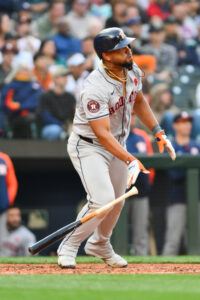
While Abreu generally exceeded expectations in landing that sizable three-year deal, few could’ve predicted that the contract would go this poorly. Abreu hit .237/.296/.383 with Houston last season and began the 2024 season in such a calamitous funk that the veteran agreed to be optioned at a point when he was 7-for-71 on the season. Since returning, Abreu hasn’t looked any better, hitting .167/.186/.333 in 43 trips to the plate.
Overall, Abreu’s tenure with the team will come to an end with a shocking .217/.275/.351 batting line in 714 plate appearances. That’s about 28% worse than league-average, by measure of wRC+. When coupled with below-average defense at first base, Abreu was 1.6 wins below replacement level, per Baseball-Reference, and a full two wins below replacement per FanGraphs.
Although there were some signs of decline in 2022, Abreu still hit .304/.378/.446 that season. A good portion of his power had eroded (hence the pedestrian .141 ISO and career-low 15 homers), and a fair bit of his production was propped up by a .350 average on balls in play that the plodding Abreu was never going to sustain over the long run. The Astros, operating without a general manager for the first portion of the offseason, still paid a hefty per-year price to sign Abreu into his late 30s, with owner Jim Crane spearheading negotiations on that deal and on Rafael Montero‘s own surprising three-year pact. Though the length of the pact was a modest surprise, it pales in comparison to how surprising the extent of Abreu’s decline has been.
Between Abreu and Jon Singleton, Houston’s lack of production at first base has been near the bottom of all Major League Baseball. Only the Rockies — Kris Bryant, Elehuris Montero, Michael Toglia and Hunter Goodman — have seen their first basemen combine to deliver a lesser output than the Astros’ miserable .181/.262/.291 batting line. That dearth of offense from a typically bat-heavy position in the lineup has been one of many reasons for the Astros’ disappointing 31-38 record. Houston sits eight games back of the division-leading Mariners and six games out in the AL Wild Card hunt (with six teams to leapfrog in order to claim one of those three spots).
Abreu’s contract will now be dead money on the Astros’ payroll both this year and next. It still counts toward the luxury tax as well, even though he’s no longer on the roster. That dead money only further adds to a troubling long-term outlook that raises legitimate questions about the team’s ability to continue putting a perennial contender on the field. Despite their questionable long-term outlook and their 2024 struggles, however, general manager Dana Brown — hired after the signing of Abreu — has insisted that his team will not be a seller and that he expects to operate as a buyer in the run-up to next month’s trade deadline. The Astros reportedly have interest in adding multiple starting pitchers.
As for Abreu himself, he’ll now head to the open market and be able to field interest from other clubs. It’s unlikely that any team will place him directly onto the big league roster in light of his recent struggles, so he’d very likely need to settle for a minor league deal.
Whether Abreu is amenable to that sort of arrangement isn’t clear, but players often want to go out on their own terms rather than be forced from the game they love due to declining performance. Abreu’s willingness to be optioned earlier this season and the constant praise he’s received from teammates both in Chicago and in Houston regarding his work ethic and passion for the game could point a willingness to keep going. Teammates Mauricio Dubon, Jeremy Pena and Kendall Graveman all lauded Abreu’s work ethic last September when discussing his late-season hot streak with Chandler Rome of The Athletic, as well as his impact in the clubhouse. That drive, combined with his sterling clubhouse reputation and outstanding track record in Chicago, could lead to interest on what amounts to a no-risk flier from a team with a need for help at first base and/or against left-handed pitching.
Rays Release Harold Ramirez
The Rays have released designated hitter/outfielder Harold Ramirez following last week’s DFA, per Marc Topkin of the Tampa Bay Times. He’s now a free agent who can sign with any club.
Ramirez always seemed likely to end up on the open market after his DFA. As we noted when he was designated for assignment, the 29-year-old’s combination of offensive struggles and relatively notable salary obligation made him a virtual lock to pass through either outright waivers or release waivers. And since he surpassed five years of major league service time earlier this season (and thus gained the right to retain his salary even upon rejecting an outright assignment), there was no real distinction between the two types of waivers in his case.
The Rays will remain on the hook for the balance of Ramirez’s $3.8MM salary. There’s about $2.19MM of that sum left to be paid out as of this writing. A new team would only owe Ramirez the prorated league minimum for any time spent on the big league roster (about $426K from now through season’s end, or just shy of $4K per day). That sum would be subtracted from what Tampa Bay owes Ramirez, but the Rays are stuck with the significant majority of his salary regardless.
Tampa Bay explored trades involving Ramirez both at the offseason’s non-tender deadline and again during spring training but didn’t find a deal to their liking. That came in spite of a big 2022-23 showing that saw Ramirez slash .306/.348/.432 in 869 trips to the plate, with a particular knack for pummeling left-handed pitching. Strong as that offensive output was, Ramirez lacks defensive value — he’s a poor defender in the outfield corners and at first base — and is a free-swinger who rarely draws a walk. He’s been primarily a designated hitter with the Rays.
The 2024 season has been a challenge for Ramirez. He’s hitting .268, a perfectly fine mark, but has coupled that with an ugly .284 on-base percentage and a punchless .305 slugging percentage. He’s hitting .310 in a small sample of 58 plate appearances against lefties but has only one walk and a .379 slugging percentage in those matchups. Effectively, Ramirez has been a singles-hitting, short-side platoon designated hitter. Because of his lack of walks and power, his overall offensive output has been 27% worse than league-average, by measure of wRC+.
Given those struggles, it’s not at all surprising that no team wanted to commit nearly $2.2MM to Ramirez by placing a waiver claim. But now that he’s a free agent who’d cost the prorated minimum, Ramirez becomes a far more interesting flier who should draw broad-reaching interest — especially from teams who have been lacking production against left-handed pitching. Speculatively speaking, each of the Reds, Nationals, Rangers and Cardinals rank in the bottom-third of the league in terms of both DH production and production against left-handers. But, given the low cost of acquisition now associated with Ramirez — who can be controlled through the 2025 season via arbitration — it’s easy to make a case for the majority of teams taking a no-risk roll of the dice on his right-handed bat.
Michael Kopech Drawing Interest From Several Teams
The White Sox are one of the game’s few clear sellers with the trade deadline still six weeks out, and teams have been showing recent interest in closer Michael Kopech, reports Bruce Levine of 670 The Score. Among the interested clubs are the Royals, Phillies and Yankees, each of whom has sent scouts to watch the hard-throwing righty in the past few weeks. Levine adds that rival clubs believe the Sox are seeking controllable pitching in return.
Kopech, 28, is in his first season as a full-time reliever after making a combined 52 starts with the ChiSox in 2022-23. He’s taken up the role of the team’s primary closer, though given Chicago’s dismal results this season, he’s only picked up five saves on the year. Kopech’s bullpen tenure got out to a strong start, but he’s hit a rough patch of late, yielding eight earned runs over his past 6 1/3 frames. That rocky stretch has ballooned his ERA from 3.18 to 4.91.
Despite that lackluster mark, there’s plenty to like about Kopech. Once touted as one of the game’s elite pitching prospects — he and Yoan Moncada headlined the White Sox’ return for Chris Sale during their last rebuild — Kopech boasts a power arsenal that helps him miss bats in droves. He’s averaged a blazing 98.7 mph on his heater this season and punched out a gaudy 32.3% of his opponents. Kopech’s 14.1% swinging-strike rate is well north of the league average. That power arsenal, as is often the case, comes with notable command issues; Kopech has walked 13.5% of his opponents in 2024 and sports an unsightly 13.6% mark dating back to 2022.
Beyond his bat-missing ability, Kopech is both affordable and controllable. He’s earning $3MM in 2024 and would be arbitration-eligible once more this winter before reaching free agency following the 2025 season. Adding Kopech for a pair of pennant chases would give any contending club a power arm with an often triple-digit heater, bat-missing slider and a newly implemented cutter that’s been a plus pitch thus far.
With regard to the interested parties, none of the three teams listed by Levine comes as a surprise. The Royals have already been canvassing the bullpen market in early June, though their status as a division rival to the White Sox might make it tougher to complete a deal with Kansas City than with Philadelphia, New York or any of the surely yet-unnamed clubs who have interest in prying Kopech from the South Siders. That said, the Royals rank 22nd in the majors with a 4.32 ERA from their relievers. Their bullpen’s collective 93.5 mph average fastball velocity (per Statcast) is 27th in the majors, while its 17.7% strikeout rate is the worst in MLB. Kopech would add the type of power, bat-missing repertoire the Royals currently lack.
The Phillies (3.55, ninth) and Yankees (3.19, third) both rank among MLB’s ten best teams in terms of bullpen earned run average. They’ve gotten there in slightly different ways, with the Phillies focusing on strikeouts (26.5%, third in MLB) while the Yankees have a below-average 21.9% strikeout rate but also possess the third-best ground-ball rate of any team (46.8%). Both teams are among the three best in baseball at limiting home runs, with the Philly bullpen sitting at 0.68 HR/9 and the Yankees narrowly trailing at 0.74 HR/9. Both clubs are luxury-tax payors in 2024, making Kopech’s relatively modest $3MM salary all the more appealing.
It stands to reason that the Royals, Phillies and Yankees are just three of many clubs looking at Kopech as the trade deadline looms next month. Bullpen help is on every postseason hopeful’s deadline wishlist every summer, and Kopech is the type of power arm that any team would love to try to maximize. While velocity is up throughout the game, and triple-digit fastballs are no longer the rarities they once were, that doesn’t take away from Kopech’s impressive repertoire. The only pitchers in MLB (min. 10 innings) who throw harder on average are Oakland’s Mason Miller, Minnesota’s Jhoan Duran, Milwaukee’s Abner Uribe, Arizona’s Justin Martinez and St. Louis’ Ryan Helsley. Kopech’s bottom-line run prevention numbers may not stand out, but other teams surely covet the upside and feel there’s a potentially elite reliever to be unlocked with a few tweaks.