
Rangers Sign Andrew McCutchen To Minor League Deal
March 6: McCutchen passed his physical, and the Rangers have formally announced his signing.
March 5: The Rangers are bringing veteran outfielder Andrew McCutchen aboard on a minor league contract with an invitation to big league camp, reports Evan Grant of the Dallas Morning News. The Aegis Sports client’s base salary would be $1.25MM if he makes the team, per Grant. It can max out around $2.5MM if he makes the roster and hits his full slate of incentives, per Jeff Wilson of DLLS Sports.
McCutchen, 39, is years removed from peak form but still turned in a .239/.333/.367 slash (95 wRC+) last year in what now looks like his final season with the Pirates. His .267/.353/.389 output against left-handed pitching was a bit above average, and he knocked lefties around at a heftier .261/.383/.410 clip as recently as 2023.
For the past three years, McCutchen has suited back up for his original club in Pittsburgh, where he was a first-round pick who broke out as a star and eventually won National League MVP honors. The hope for both McCutchen and the Pirates was that he’d return to play out his final seasons where it all began, leading a more competitive Bucs club back to the playoffs in the twilight of his career.
That storybook ending never came to be. Pittsburgh struggled in each of the past three seasons, finishing under .500 each year along the way. The Bucs fired manager Derek Shelton last May and took a more urgent and aggressive approach to building up their offense this winter. Pittsburgh acquired Brandon Lowe via trade and signed free agents Ryan O’Hearn and Marcell Ozuna. They had even bigger targets throughout the winter (e.g. Kyle Schwarber, Josh Naylor, Kazuma Okamoto, Eugenio Suárez). All those pursuits cast doubt on whether there was room for one more go-around with McCutchen on what’d have been a more nostalgic/sentimental reunion. Last month’s signing of Ozuna all but confirmed that the book on the three-year reunion with McCutchen had been closed.
McCutchen now heads to the Rangers in hopes of grabbing a bench spot. His right-handed bat makes for a natural platoon complement alongside designated hitter Joc Pederson. Cutch could also see some time in the outfield corners when Texas faces off against left-handed starters, with Wyatt Langford shifting over to center field in place of lefty-swinging Evan Carter, who has just five hits in 68 career plate appearances against southpaws.
There’s little sense citing McCutchen’s career .289/.387/.514 slash against lefties, since so much of that is influenced by otherworldly production during his MVP peak. However, even over the three seasons in his late-career return to PNC Park, McCutchen hit .244/.353/.392 in 435 plate appearances. That sort of production is more solid than eye-catching, but it’d still mark an upgrade over the awful .225/.290/.363 batting line the Rangers turned in versus left-handed pitching in 2025.
Pirates, Reds Swap Tyler Callihan For Kyle Nicolas
The Pirates announced they’ve traded relief pitcher Kyle Nicolas to the Reds for left fielder/second baseman Tyler Callihan. Both players were on the 40-man roster, so there’s no corresponding move.
It’s a swap of talented but largely unproven players between the NL Central rivals. Nicolas, 27, has the more significant MLB experience of the two. A second-round pick by the Marlins in 2020, he was traded to Pittsburgh as one of two prospects the following year for Gold Glove catcher Jacob Stallings. Nicolas was a starting pitcher at the time but always projected to a bullpen future because of spotty command.
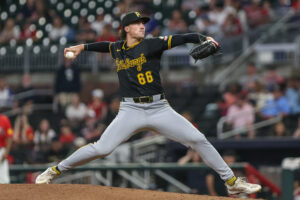
Nicolas debuted as a September call-up in 2023. The Ball State product has opened each of the following two seasons on optional assignment to Triple-A Indianapolis. Nicolas has posted below-average numbers at the MLB level but remains an intriguing depth piece with big stuff.
In 98 MLB innings, Nicolas carries a 4.68 earned run average. He has struck out a league average 22% of opponents while issuing walks at a lofty 12.2% rate. He split his time evenly between the majors and Triple-A last year. While he allowed nearly five earned runs per nine at the MLB level, he posted a 3.79 ERA with an excellent 31% strikeout rate against minor league opposition. Nicolas walked more than 12% of Triple-A opponents and has posted double digit walk rates at almost every stop of his professional career.
The command will probably keep Nicolas in middle relief. He’d have the raw stuff to pitch at the back of a bullpen if he can find a way to throw more strikes. Nicolas sits in the 97-98 mph range with his heater and has a pair of power breaking balls: a 90-91 mph slider and mid-80s curveball.
He also uses his 6’3″ frame to get down the mound and generate a lot of extension, though the long levers have also seemingly held him back from finding consistency in his delivery. Nicolas commanded the ball better down the stretch last season. He walked only 8.4% of opponents while posting a 3.46 ERA in 26 innings after the All-Star Break. It’s a small sample but perhaps something to build off as he tries to earn a permanent bullpen spot.
Nicolas has a little over one year of service time. He’s at least two years away from arbitration and five years from reaching free agency. He has one minor league option remaining, so the Reds can send him to Triple-A Louisville without exposing him to waivers. Nicolas tossed two scoreless innings this spring before joining Team Italy for the World Baseball Classic. (He’s from Ohio but has a family link to Italy that made him eligible to participate.)
Cincinnati doesn’t have a ton of roster flexibility in the bullpen, where six of their relievers cannot be optioned. Graham Ashcraft has options but is a lock to begin the season in the late innings. Unless the Reds move on from Sam Moll, they’d only have one bullpen spot available between Nicolas, Luis Mey, Connor Phillips and Zach Maxwell. The latter four pitchers all have big arms but come with strike-throwing questions.
The Pirates subtract from their bullpen depth to take a flier on an intriguing hitter who hasn’t found a position. The 25-year-old Callihan was an overslot third-round signee out of high school in 2019. Scouts have praised the lefty hitter’s offensive aptitude while panning his defense. The Jacksonville native has a career .262/.332/.417 batting line over six minor league seasons.
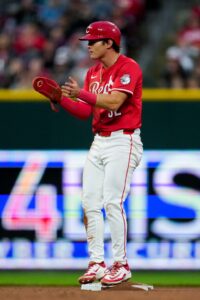
Callihan’s performance in the low minors was a little inconsistent. He has posted better numbers as he’s climbed the minor league ladder. Callihan hit .271/.345/.413 in Double-A two seasons ago and was out to a .303/.410/.528 start over 24 Triple-A contests last year. The Reds called him up at the end of April.
Unfortunately, Callihan didn’t get a chance to establish himself as a rookie. He suffered a gruesome injury just six days into his big league career.
Callihan was playing left field against the Braves on May 5. Matt Olson hit a line drive that sliced away from him down the left field line. Callihan slid to try to catch the ball and was unable to brace himself before hitting the wall with his outstretched glove hand. The collision broke his arm and forced him to undergo season-ending surgery. (Adding insult to injury, Olson trotted around for an inside-the-park home run because Callihan had touched the ball in fair territory.)
That ended his debut campaign after six at-bats, in which he collected his first career hit and run batted in. Callihan entered Spring Training without any restrictions and has gotten into seven exhibition contests, going 2-9 with a home run.
Baseball America ranked Callihan the #20 prospect in the Cincinnati system over the offseason, while Eric Longenhagen of FanGraphs slotted him 29th in the organization. Callihan has improved his plate discipline and has above-average raw power, but his strikeout rate has climbed in the upper minors.
He’s a below-average defender at second base who probably fits better in left field or at first base. There are some similarities to last winter’s Spencer Horwitz pickup in that regard, though Horwitz had a much longer track record of hitting in Triple-A than Callihan does.
Callihan has less than one year of service and has two minor league options remaining. He’ll battle for a bench job in camp but seems likelier to begin the season in Indy. He can factor in as a bat-first utility type throughout the season if he’s hitting well in the minors.
Respective images via Jordan Godfree and Sam Greene, Imagn Images.
Hunter Greene To Undergo MRI On Right Elbow
Reds ace Hunter Greene is heading for an MRI after experiencing stiffness in his right elbow, manager Terry Francona tells reporters at Reds camp this morning. Greene himself says the injury dates back to late last season (link via Charlie Goldsmith). He was recommended for an injection and had a normal offseason but tells the Reds beat that the discomfort has crept back up recently. Greene will be examined by longtime team physician Timothy Kremchek and have a second opinion from Dr. Neal ElAttrache. He says his ulnar collateral ligament was intact at a recent check, but news of a new round of imaging will inherently lead to some concern until the results are known.
Greene acknowledged in his comments that, like many big league pitchers, he’s aware of some bone spurs in his elbow. He’s navigated that issue in the past, it seems, and surgery has not been recommended as an option to this point. The right-hander wouldn’t commit to whether he’ll be able to make his first start of the season.
“If something has to be done, it’s early and we’ll get it out of the way quick and can have the big chunk of the season,” Greene said this morning. “If we have a playoff push, I’ll be ready to go.”
Even a brief absence for Greene is a bitter pill for the Reds to swallow. The former No. 2 overall draft pick has been one of the game’s best pitchers on a rate basis over the past two seasons but has missed considerable time due to a pair of groin strains in 2025 and some elbow discomfort in 2024. He’s started 45 games across the past two seasons and worked to a 2.76 ERA with a 29.2% strikeout rate, 8.1% walk rate and 33.5% ground-ball rate. Last season’s 15.4% swinging-strike rate was fourth-best in MLB (min. 100 innings pitched), trailing only Tarik Skubal, Dylan Cease and Logan Gilbert.
Greene is entering the fourth season of a six-year, $53MM extension. The 26-year-old is being paid $8MM this season before making $15MM and $16MM in 2027-28. The Reds hold a $21MM club option (with a $2MM buyout) over his 2029 season.
With Greene’s status up in the air, one of the stronger-looking rotations in the sport takes a big hit. Cincinnati can still trot out Andrew Abbott, Nick Lodolo, Brady Singer and top prospects Chase Burns (the No. 2 pick in 2024) and Rhett Lowder (the No. 7 pick in 2023), but neither Burns nor Lowder has fully established himself in the majors yet. Lowder pitched only 9 1/3 minor league frames last year due to forearm, oblique and shoulder issues.
Depth options on Cincinnati’s 40-man roster include another former first-rounder, Chase Petty, and a pair of formerly touted prospects returning from injury: righty Julian Aguiar and lefty Brandon Williamson. The Reds also selected righty Jose Franco to the 40-man roster this past November to protect him from the 2025 Rule 5 Draft; he tossed 110 innings of 3.11 ERA ball between Double-A (2.76 ERA) and Triple-A (3.51 ERA) last season.
There are, of course, some notable starters remaining in free agency. Lucas Giolito and fellow righty Zack Littell — the latter of whom finished the 2026 season with Cincinnati — remain unsigned. Veterans like Tyler Anderson, Patrick Corbin and old friend Anthony DeSclafani would be more affordable depth pursuits.
However, president of baseball operations Nick Krall told Goldsmith that even if Greene misses time, he doesn’t anticipate engaging with any free agents to fill that void. That perhaps leaves the door cracked for waiver and trade activity to replenish some depth, but the Reds’ 2026 payroll is already expected to be higher than in 2025, so the team may not have much budget space with which to tinker after spending more than $47MM in free agency already.
MLB Issues 162-Game PED Suspension To Jurickson Profar
Major League Baseball announced that Braves outfielder Jurickson Profar has been suspended for 162 games after testing positive for exogenous testosterone, a performance-enhancing substance. The ban goes into effect on Friday and will cost him the entire 2026 season, including the playoffs. It’s the second career PED suspension for Profar, who missed 80 games last year after testing positive for Chorionic Gonadotropin.
Ken Rosenthal of The Athletic reports that the Players Association plans to file a grievance challenging this suspension. MLB generally does not announce violations of the drug policy until after the appeal process plays out, as the player is usually allowed to continue playing pending that appeal. Rosenthal writes that Profar’s suspension, by contrast, is not stayed because it’s his second career PED ban. However, the process will be expedited to quickly reach a final resolution.
It’s rare for a player’s PED suspension to be overturned on appeal. Assuming the suspension stands, Profar will not be paid his $15MM salary this season. The Curacao native is also barred from representing the Netherlands in the upcoming World Baseball Classic.
“We were incredibly disappointed to learn that Jurickson tested positive for a performance-enhancing substance and is in violation of MLB’s Drug Prevention and Treatment Program,” the Braves said in a press release. “Our players are consistently educated about the Program and the consequences if they are found to be in violation.”
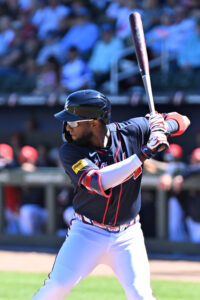
Profar, who turned 33 a couple weeks ago, was entering the second season of a three-year, $42MM contract. Last year’s suspension cost him just under $6MM of his $12MM salary in year one of that free agent deal. He’s signed through the 2027 season and is owed a $15MM salary again in the contract’s final year. If he incurs a third positive test in his career, he would receive a lifetime ban.
As a teenager, Profar was ranked as the top prospect in the entire sport. A switch-hitting shortstop with a tantalizing blend of power, speed and defensive aptitude, he was hailed as a future star but saw his career derailed by multiple shoulder injuries. He missed nearly the entire 2014 and 2015 campaigns due to shoulder surgery.
The version of Profar that returned looked far different. He hit .227/.316/.315 in 377 MLB plate appearances from 2016-17 before turning in a solid offensive season in 2018. His defense at shortstop had become untenable following the shoulder troubles. Profar spent time at second base and first base before being traded to the A’s, who had him for only one disappointing year before trading him to the Padres.
Profar had an up-and-down run in San Diego. He had an awful start in the shortened 2020 season before a torrid three-week finish to the 60-game season salvaged his batting line. A clear favorite of Padres GM A.J. Preller — who signed him as an international amateur during his days as a Rangers assistant GM — Profar inked a three-year deal following that season but flopped with a .227/.329/.320 slash in year one of the contract. He chose to forgo an opt-out opportunity, returned to San Diego for the 2022 season, turned in a better offensive performance opted out of a net $6.5MM to again test the open market.
Free agency was cold to Profar that winter. He wound up signing with the Rockies just prior to Opening Day 2023 on a $7.75MM deal. Colorado released Profar after he hit just .236/.316/.364 in 111 games. He re-signed in San Diego for the remainder of the season and hit well in 14 games late that year. Profar spent the entire offseason twisting in the winds of free agency before the Padres brought him aboard on a one-year, $1MM deal that looked like the steal of the offseason when he erupted with a .280/.380/.459 batting line in a career-best showing.
That performance prompted the Braves’ three-year, $42MM deal, but it will now forever be met with a healthy dose of skepticism. Profar missed 80 games last year, hit .248/.358/.446 in 355 plate appearances upon returning, and now won’t take another plate appearance until at least 2027. Of course, it remains to be seen whether the Braves will welcome him back or look to move on entirely.
That question doesn’t need to be answered for the time being. Profar can and will be placed on the restricted list, where he won’t be paid or count against Atlanta’s 40-man roster. The Braves will not only save on Profar’s $15MM salary — they’ll also dodge the 20% tax they’d been paying for him as a team that was over the luxury threshold. It amounts to an overall $18MM in savings for Atlanta, which gives the Braves some intriguing possibilities late in the offseason.
Atlanta has incurred a pair of notable injuries in the rotation. Righties Spencer Schwellenbach and Hurston Waldrep both underwent elbow surgery to remove loose bodies/bone spurs. It’s not yet clear when they’ll return, but Schwellenbach is already on the 60-day IL and Waldrep will surely follow.
That’s left the Braves with Chris Sale, Spencer Strider, Reynaldo Lopez (who made just one start last year due to shoulder surgery) and Grant Holmes (who had a UCL tear last summer and rehabbed without surgery) in the top four spots of the rotation. Bryce Elder, Joey Wentz, Didier Fuentes and Jose Suarez are the fifth starter options on the 40-man roster. Non-roster invitees include veterans Martin Perez, Carlos Carrasco and Elieser Hernandez, as well as top prospect JR Ritchie.
Notable veterans like Lucas Giolito, Zack Littell and Tyler Anderson remain unsigned in free agency. Atlanta’s outfield group, of course, takes a hit following the Profar suspension, although the team’s November signing of Mike Yastrzemski means the Braves won’t necessarily need to add another outfielder. Yastrzemski, Michael Harris II and Ronald Acuña Jr. can start on most days, though Acuña has had his share of recent injury troubles and Yastrzemski has long-running platoon issues. Righty hitters Eli White and Jorge Mateo are already on the roster as potential complements, but neither has even average career numbers against left-handed pitching.
Atlanta still projects to be just north of the $244MM luxury threshold, but the front office suddenly has an influx of cash that could be used to acquire additional help, be it another starting pitcher or a veteran right-handed bat to plug into the lineup. Time will tell whether those funds are put to immediate use or saved for in-season additions to the roster, but the Braves immediately become a team to watch with regard to a potential late-offseason addition.
Jeff Passan of ESPN first reported Profar was facing a 162-game PED ban. Image courtesy of Jonathan Dyer, Imagn Images.
Out Of Options 2026
Every spring at MLBTR, we publish a list of players who are out of minor league options and cannot be sent to the minor leagues without first clearing outright waivers. Option status is particularly relevant as teams set their rosters prior to Opening Day. A lack of minor league options is often a key reason a certain player will make the roster over another who had a superior spring performance, and it’s a frequent factor in March trades.
The following is a list of all 40-man players throughout the league with fewer than five years of service time — players with more than five years of service can refuse an optional assignment — and no minor league options remaining. We’ve included players who have signed extensions or multi-year deals, even though they’re often less likely to be optioned.
Angels
- Jo Adell, OF
- Vaughn Grissom, IF
- Oswald Peraza, IF
- Chase Silseth, SP/RP
Astros
- Nick Allen, IF
- Roddery Muñoz, RP
- Isaac Paredes, IF
- Nate Pearson, SP/RP
- César Salazar, C
Athletics
- Andy Ibáñez, IF
- Luis Medina, SP/RP
Blue Jays
- Ernie Clement, IF
- Tyler Heineman, C
- Leo Jiménez, IF
- Tommy Nance, RP
- Jesús Sánchez, OF
Braves
- Bryce Elder, SP
- Ian Hamilton, RP
- Grant Holmes, SP
- Joel Payamps, RP
- José Suarez, SP/RP
- Joey Wentz, SP/RP
- Eli White, OF
- Brett Wisely, IF/OF
- Danny Young, RP
Brewers
- Rob Zastryzny, RP
Cardinals
- Justin Bruihl, RP
- José Fermín, IF/OF
- Iván Herrera, C
- Riley O’Brien, RP
- George Soriano, RP
Cubs
- Miguel Amaya, C
- Tyler Austin, 1B
- Edward Cabrera, SP
- Justin Steele, SP
Diamondbacks
- Jorge Barrosa, OF
- Pavin Smith, 1B/OF
Dodgers
- Brock Stewart, RP
Giants
- José Buttó, RP
- Jerar Encarnación, 1B/OF
- Matt Gage, RP
- Sam Hentges, RP
- Luis Matos, OF
- Heliot Ramos, OF
- Randy Rodríguez, RP
Guardians
- Gabriel Arias, IF
- Connor Brogdon, RP
- Joey Cantillo, SP/RP
- Matt Festa, RP
- Nolan Jones, OF
- Brayan Rocchio, IF
Mariners
- Eduard Bazardo, RP
- Cooper Criswell, RP
- Casey Legumina, RP
- Miles Mastrobuoni, IF/OF
- Luke Raley, 1B/OF
- Gabe Speier, RP
- Carlos Vargas, RP
Marlins
- Ronny Henriquez, RP
- Janson Junk, SP/RP
- Otto López, IF
- Christopher Morel, IF
- Tyler Phillips, RP
Mets
- Vidal Bruján, IF/OF
- Bryan Hudson, RP
- Ben Rortvedt, C
- Mark Vientos, IF
Nationals
- Luis García Jr., IF
- Richard Lovelady, RP
- Keibert Ruiz, C
- José Tena, IF
Orioles
- Blaze Alexander, IF
- Dietrich Enns, RP
- Rico Garcia, RP
- Jackson Kowar, RP
- Bryan Ramos, IF
- Colin Selby, RP
- Leody Taveras, OF
Padres
- Luis Campusano, C
- Bryce Johnson, OF
- Ron Marinaccio, RP
- Randy Vásquez, SP
- Matt Waldron, SP
Phillies
- Jonathan Bowlan, RP
- Rafael Marchán, C
- Zach Pop, RP
- Cristopher Sánchez, SP
- Garrett Stubbs, C
Pirates
- Joey Bart, C
- Oneil Cruz, OF
- Justin Lawrence, RP
- Yohan Ramírez, RP
Rangers
- Cole Winn, RP
Rays
- Jonathan Aranda, 1B
- Bryan Baker, RP
- Garrett Cleavinger, RP
- Yoendrys Gómez, SP/RP
- Manuel Rodríguez, RP
- Cole Sulser, RP
- Edwin Uceta, RP
- Ryan Vilade, IF/OF
Red Sox
- Jovani Morán, RP
Reds
- Sam Moll, RP
- Tony Santillan, RP
Rockies
- Jimmy Herget, SP/RP
- Edouard Julien, IF
- Jake McCarthy, OF
- Mickey Moniak, OF
- Keegan Thompson, SP/RP
Royals
- Bailey Falter, SP/RP
- Alex Lange, RP
- Nick Mears, RP
- Drew Waters, OF
Tigers
- Drew Anderson, SP/RP
- Jahmai Jones, IF/OF
- Zach McKinstry, IF/OF
Twins
- Anthony Banda, RP
- Kody Clemens, IF/OF
- Alex Jackson, C
- James Outman, OF
- Simeon Woods Richardson, SP
White Sox
- Luisangel Acuña, IF/OF
- Derek Hill, OF
- Anthony Kay, SP
- Korey Lee, C
- Curtis Mead, IF
- Everson Pereira, OF
- Lenyn Sosa, IF
- Miguel Vargas, IF
Yankees
- Osvaldo Bido, SP/RP
- Jorbit Vivas, IF
Photo courtesy of Brad Mills, Imagn Images
Johan Rojas Reportedly Tests Positive For Performance-Enhancing Drug
Phillies outfielder Johan Rojas has tested positive for a performance-enhancing drug, according to reporter Wilber Sánchez as well as Jon Heyman of The New York Post. Heyman says Rojas will be appealing the ruling. Players face an 80-game suspension for a first-time positive test for PEDs. There has not yet been any formal announcement regarding Rojas from Major League Baseball or the Phillies.
Rojas, 25, has played for the Phillies at the major league level in each of the past three seasons. Broadly speaking, he has been a speed-and-defense guy who doesn’t provide much value from the batter’s box.
He has appeared in 250 games with 51 steals in 58 attempts. He has logged 1,714 innings in center field and has been credited with 22 Defensive Runs Saved and 18 Outs Above Average. But in 699 plate appearances, he has just six home runs and a .252/.294/.340 batting line. That translates to a 74 wRC+, indicating he has been 26% below league average as a hitter in his career overall.
Despite his skills, the lack of offense cut into his playing time with the Phillies. He was essentially an everyday center fielder in 2024, appearing in 120 contests. He held that job for part of the 2025 season but the Phils acquired Harrison Bader at the deadline, which led to Rojas getting optioned to the minors for the final two months of the schedule.
Bader became a free agent at season’s end and eventually signed with the Giants but it didn’t seem as though the Phillies had Rojas as a prominent piece of their 2026 plans. It was reported pretty early in the offseason that he was available in trade talks as the Phils planned to give prospect Justin Crawford a shot at the center field job.
Rojas was likely going to be relegated to a fourth outfielder role. He also has an option remaining and could have been sent down for regular playing time at the Triple-A level. A suspension would cut into his ability to serve in either role. He can continue to play during the appeals process but it’s unclear if the Phils will keep using him in spring games, per Charlotte Varnes and Matt Gelb of The Athletic. He was going to participate in the World Baseball Classic with the Dominican Republic team but dropped out last week.
Although Rojas had fallen down the depth chart, it would be a notable loss for the Phillies if Rojas is ultimately suspended. Their roster is quite strong but the outfield looks like one of the weaker points. As mentioned, Crawford is going to get a shot at the center field job, despite having no major league experience yet. The Phils have plugged Adolis García into right field, hoping for a bounceback after two down years. Brandon Marsh is a decent left fielder but needs a platoon partner since he’s awful against lefties. Otto Kemp could be Marsh’s platoon partner, though he has far more experience as an infielder than as an outfielder.
Gabriel Rincones Jr. and Pedro León are also on the 40-man roster. Both have options and are lined up to start the season in the minors. Rincones hasn’t yet made his major league debut and The Athletic notes that he is currently not playing due to ongoing knee problems. León is a waiver claimee who has just seven big league games under his belt. Bryan De La Cruz, who slashed .191/.240/.213 in limited action last year, is in camp as a non-roster invitee.
It’s not an especially strong group on the whole and losing Rojas would thin it out further. If the Phils want to add before Opening Day, guys like Tommy Pham and Andrew McCutchen are currently free agents. Some other guys will also shake loose in the coming weeks as teams make their final roster decisions when spring training winds down.
Photo courtesy of Kelley L Cox, Imagn Images
Royals Sign Starling Marte
March 2: Kansas City has officially announced Marte’s one-year contract. It’s a $1MM guarantee that comes with another $2MM in bonuses, reports Anne Rogers of MLB.com. Half of that money comes with roster bonuses and the other half through incentives.
February 28: Starling Marte and the Royals have agreed to a one-year, Major League contract. Financial terms of the agreement aren’t yet known. The deal will be finalized once Marte passes a physical, and the Royals will have to make another transaction to clear space on their 40-man roster for the Klutch Sports client.
2025 was the last season of Marte’s four-year, $78MM contract with the Mets, and while Marte was hopeful of playing for multiple more years, there hadn’t been any public buzz about his free agent market over the winter. Now, the 37-year-old has landed with a Kansas City club whose interest in the former two-time All-Star dates back to last winter, when the Royals had some talks with the Mets about a possible trade.
Marte’s tenure in New York was defined by injuries, as he played in only 396 games during his four-year stint. Groin problems were the source of most of Marte’s issues, as surgery on both his left and right groin muscles following the 2022 season didn’t entirely correct the problem, as the injury resurfaced in 2023. Marte also missed time due to a neck strain, migraines, and a bone bruise in his right knee, and the Mets responded to Marte’s lower-body injuries by making him essentially a full-time DH in 2025.
Marte still made 12 appearances in the outfield last year, and given the Royals’ need for outfield help, Kansas City could consider giving him slightly more time on the grass in 2026. After acquiring both the switch-hitting Isaac Collins and the right-handed hitting Lane Thomas this winter, the Royals’ primary outfield looks like Collins in left field, defensive specialist Kyle Isbel in center, and Thomas and lefty-swinging Jac Caglianone perhaps in a platoon situation in right field. Salvador Perez and top prospect Carter Jensen will handle the catching duties, and whomever isn’t behind the plate will likely get plenty of DH at-bats.
It would add up to another part-time role for Marte, though there’s value in having a veteran bat on the roster. Caglianone struggled badly in his first exposure to big league pitching in 2025, and Thomas is coming off essentially a lost year due to injuries in 2025. Thomas’ top season was his 28-homer campaign with the Nationals in 2023, but he has posted just a 98 wRC+ over 1900 plate appearances over the last four seasons. Collins is also far from a sure thing, as his impressive 2025 rookie season with the Brewers came despite some hard-contact issues that were perhaps obscured by a .326 BABIP.
Marte hasn’t looked like a true top-tier hitter since 2022, but he still managed a respectable .269/.331/.398 slash line and 16 homers over 699 PA during the 2024-25 seasons, translating to a 108 wRC+. Marte is still making hard contact at an above-average rate, even if his power (and his Statcast metrics on the whole) have fallen off.
Whether or not Marte can maintain even this decent production into his 15th Major League season remains to be seen, of course. It can be argued that Collins, Thomas, and Marte couldn’t help but be upgrades for K.C. given how little the Royals have gotten from their outfield mix in the last few years, plus Caglianone is still a highly-touted prospect with breakout potential.
Marte’s next contract will surely be worth only a few million dollars in guaranteed money, with probably some bonus clauses built in based on plate appearances. The Royals’ payroll currently sits at around $149.2MM (as per RosterResource‘s estimates), which represents a modest increase over their $139.8MM figure from 2025. This tracks with owner John Sherman’s comments from October about the payroll likely staying in the same general range, which naturally left the front office a little limited in what they could do in pursuing needed lineup help.
Reporter Yancen Pujols first broke the news that Marte and the Royals were in contract talks. MLB.com’s Mark Feinsand (multiple links) reported that the deal was in place, and that Marte had inked a guaranteed contract.
Cardinals Extend Oli Marmol
The Cardinals and manager Oli Marmol have agreed to a two-year contract extension, according to a report from Derrick Goold of the St. Louis Post-Dispatch. Marmol was entering the final year of his contract but is now set to remain in St. Louis for the 2027 and ’28 seasons, with a club option for 2029. The Cardinals have subsequently announced Marmol’s new deal.
It’s the second extension Marmol has signed with the Cardinals. The 39-year-old initially took over as manager in St. Louis following Mike Shildt’s dismissal in October of 2021. Marmol’s first season as manager saw the Cardinals romp to a division title with a 93-win season thanks primarily to MVP-caliber performances from both Paul Goldschmidt (who won the award in the NL) and Nolan Arenado (who finished third). Unfortunately, the Cardinals were delivered a quick exit by the Phillies in the Wild Card round that year and went home that October without winning a single playoff game.
The end of the 2022 campaign also marked the end of longtime franchise face Yadier Molina‘s playing career, and Molina’s departure ushered in a transitory period in Cardinals baseball. While the club added an impactful bat behind the plate in Willson Contreras, pitchers in St. Louis struggled to adapt to life after getting so used to working with the nine-time Gold Glover. Meanwhile, both Goldschmidt and Arenado regressed in a big way, and injuries to key players like Brendan Donovan and Tyler O’Neill left the Cardinals tumbling from the top of the NL Central all the way to the bottom with a 91-loss campaign. 2024 saw the franchise get just barely back over .500 with an 83-79 record that left them tied for second place in the NL Central standings, but the team fell right back below .500 in 2025.
Difficult as Marmol’s tenure in St. Louis has been, management and ownership clearly do not lay the organization’s struggles at his feet. They signed him to a two-year extension prior to the 2024 campaign, and even after John Mozeliak retired and new president of baseball operations Chaim Bloom took over, both Bloom and team ownership have expressed confidence in Marmol in the run-up to today’s extension.
It’s understandable why the team would choose to stick with Marmol despite a lack of on-field success. The Cardinals have saddled Marmol with a stagnant and aging roster for the majority of his time with the organization. Outside of deals for Contreras and Sonny Gray (both traded to the Red Sox this offseason), St. Louis has made relatively minimal efforts to improve the roster via trades and free agency in recent years, instead banking on internal developments that haven’t come to fruition. That lack of internal development has been attributed to the organization by the team’s decision to reallocate funds that once were used for player development into fortifying the big league payroll, and over the past two years the team has started to move towards a rebuilding phase where they plan to scale back spending and return their focus to building from within.
Given the current state of the organization, it’s understandable that the Cardinals would look to keep someone they had enough confidence in to install as MLB’s youngest manager at the time of his hire. Now headed into his fifth season as a big league manager (with a decade of coaching experience prior to that), Marmol has plenty of experience handling young players and veterans alike. His work with last year’s Cardinals team, which lacked the win-now expectations of most seasons in St. Louis, will surely prove informative for the difficult task of rebuilding into a contender that the organization now faces.
Pablo López Undergoes Internal Brace Procedure
Feb. 26: López wound up “only” requiring an internal brace procedure rather than a full Tommy John surgery/ligament reconstruction, Bobby Nightengale of the Minnesota Star Tribune writes. López will still miss the entire 2026 season, but the internal brace route comes with a slightly shorter timeline than a full reconstruction. López now has a better chance of being available for Opening Day 2027.
Feb. 20: Twins right-hander Pablo López will have Tommy John surgery on Wednesday, per Aaron Gleeman of The Athletic. Earlier this week, the Twins revealed that he had tearing in his right elbow’s ulnar collateral ligament. He took a few days to explore a second opinion but it seems there was no avoiding the worst-case scenario.
It’ll be the second Tommy John procedure for López. His first was more than a decade ago. He’ll miss the entire 2026 season and hope to be ready early in the 2027 campaign, which will be the final season of his four-year, $73.5MM contract with the Twins. López is being paid $21.75MM both this season and next.
The Twins acquired López and a pair of prospects from the Marlins in the Jan. 2023 trade that sent Luis Arraez to Miami. He’s been a rocksteady performer near the top of Minnesota’s rotation for the past three seasons, pitching to a combined 3.68 ERA with even more impressive rate stats (26.8 K%, 5.8 BB%, 43.1 GB%). Metrics like SIERA (3.48) and FIP (3.44) feel he’s been a hair better than his already solid earned run average would indicate.
In 2025, López raced out of the gates with a 2.82 ERA and his typically strong rate stats through his first 11 starts (60 2/3 innings). A Grade 2 strain of his teres major suffered in early June wound up costing him about three months, however. López returned with three sharp starts in September, allowing four runs in 15 innings, before ending the season on the injured list due to a minor forearm strain.
The Twins said after the season that López could have pitched through the injury had the team been in the playoff hunt but opted to shut him down with their season already lost. He received a clean bill of health not long after and had a generally normal offseason. The UCL tear seemingly popped up during his first bullpen session this spring.
Although Minnesota tore the bullpen down last summer at the deadline and sold off several impending free agents (a total of 11 players), they opted not to completely rebuild this winter. After some early uncertainty about how they’d approach the offseason, the team’s sale of a minority stake to three new shareholders gave the front office the necessary space to make some modest additions. Victor Caratini, Josh Bell and Taylor Rogers all signed as free agents, and the Twins opted not to trade López, rotationmate Joe Ryan, catcher Ryan Jeffers (a free agent next winter) or franchise center fielder Byron Buxton.
New executive chair Tom Pohlad has been vocal about his desire to compete and his belief that the roster has a better chance at doing so than those outside the organization think. The Twins made a late run at Framber Valdez and also jumped into the Freddy Peralta bidding, with both of those late-offseason overtures coming after the ownership situation had gained some clarity. Obviously, neither came to fruition, but it stands to reason based on those two efforts that the Twins could at least consider going outside the organization, where Lucas Giolito and old friend Zack Littell are among the notable veterans who’ve yet to sign a contract.
With López formally out for the year, it’ll almost certainly fall to fellow right-hander Joe Ryan to take the mound on Opening Day. Right-hander Bailey Ober will look to bounce back from a season that was torched by an awful June (after which he went on the injured list due to a hip injury). Simeon Woods Richardson is out of minor league options and logged a 4.04 ERA in 111 1/3 innings last year (including a flat 3.00 ERA over his final 14 starts). He should be all but assured a rotation spot as well.
Homegrown former top prospects Zebby Matthews and David Festa will join deadline pickups Taj Bradley and Mick Abel in competing for Opening Day rotation spots, while prospects like Connor Prielipp, Kendry Rojas and Andrew Morris could challenge for innings as the season wears on, depending on health and performance in Triple-A.
Braves Extend Chris Sale
The Braves announced Tuesday that they’ve signed veteran left-hander Chris Sale to a one-year, $27MM contract extension with a $30MM club option for the 2028 season. (Atlanta is one of the few teams that publicly discloses contract terms itself.) The Wasserman client was slated to reach free agency this coming winter but will instead stick with Atlanta through at least 2027.
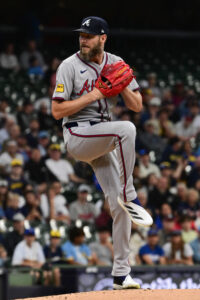
Sale, 37 next month, is entering his late thirties but remains as effective as ever. Atlanta acquired the southpaw prior to the 2024 season in exchange for Vaughn Grissom in a deal with the Red Sox that turned out to be a coup. Since joining the organization, Sale has pitched to an otherworldly 2.46 ERA (2.84 SIERA, 2.38 FIP), with a strikeout rate of 32.2% and a walk rate of 5.9%. Those elite rate stats earned him his first career Cy Young Award in 2024, although a ribcage fracture in 2025 has limited his overall workload in Georgia to a total of 303 1/3 innings.
Injuries were the story of Sale’s career for several years prior to his arrival in Atlanta. For the first nine years of his big league tenure, the lefty was utterly elite with seven All-Star appearances and six top-five finishes in Cy Young voting for the White Sox and Red Sox.
That portion of his career ended in emphatic fashion as Sale struck out then-Dodger Manny Machado to secure the 2018 World Series for Boston, but come 2019 Sale struggled for the first time in his career. While his peripherals remained elite, he posted a pedestrian 4.40 ERA and was limited to just 25 starts due to injuries. He’d go on to make just nine starts between 2020 and 2022 before returning to the mound for most of the 2023 season with a 4.30 ERA in 20 starts.
Sale may not be a true workhorse, but he’s been more durable in recent seasons and will now look to continue the high note he’s found in Atlanta as his career begins to wind down. Both Sale himself and president of baseball operations Alex Anthopoulos recently indicated to reporters (including MLB.com’s Mark Bowman) that they hoped the remainder of the 2024 Cy Young winner’s career would be spent in Atlanta, and now he’ll remain under club control until the end of his age-39 campaign. Sale told reporters (including Chad Bishop of the Atlanta Journal-Constitution) after news of the extension broke this morning that the deal came together quickly after those comments were made early in camp.
“[Anthopoulos] said what he said, I said what I said, and we just kind of looked at each other like, ‘Are we serious?'” Sale said, as relayed by Bishop. “And I called [my agent] and was like ‘Hey, call Alex, figure something out.’ You know, we made our pitch, they made their pitch, and we just kind of met in the middle. I mean, I feel like this was [done in] like, a week.”
Sale will be looking to not only put the finishing touches on a compelling Hall of Fame case but also lead the Braves back into the postseason after a rough 2025 season. He’s the undisputed ace of an Atlanta staff that looks very intimidating when at full strength but now figures to enter the season without either Spencer Schwellenbach or Hurston Waldrep. Both young righties had surgery to remove bone spurs/loose bodies from their right elbows earlier this month, and neither has a clear timetable for his return.
Instead, Sale will be joined by Spencer Strider, Grant Holmes, and Reynaldo Lopez in the rotation as things stand, with a handful of depth arms in competition for the fifth starter job. It’s a group that could clearly use an additional quality arm, but it remains to be seen if Anthopoulos will manage to add someone like that to the mix before the season begins. Whatever may happen with the rotation in 2025, however, the Braves can now move forward with the assurance that one of the game’s most elite hurlers will be staying in town for the foreseeable future.
From a payroll vantage point, there doesn’t appear to be any immediate impact on the 2026 season. The contract is structured as a new deal beginning in 2027, so it doesn’t change Atlanta’s baseline cash payroll or its luxury tax payroll for the upcoming season.
Sale’s deal does tack on $27MM of luxury considerations to the 2027 budget, although the Braves already had substantial money coming off the books at season’s end. Ha-Seong Kim ($20MM), Raisel Iglesias ($16MM), Joe Jimenez ($9MM), Aaron Bummer ($9.5MM), Mauricio Dubón ($6.1MM), Jonah Heim ($1.25MM) and Jorge Mateo ($1MM) are all free agents at season’s end, and the only notable arbitration raise Atlanta faces will be Schwellenbach’s first trip through the process. As things stand, RosterResource projects a $176MM luxury payroll for Atlanta in 2027 — about $84MM shy of their current mark.
ESPN’s Jeff Passan first reported the extension and the 2027 salary.