
Astros, Kyle Tucker Have Discussed Extension
The new Astros general manager Dana Brown recently chatted with Brian McTaggart of MLB.com and was asked whether they have begun extension talks with some of their younger players such as Kyle Tucker. “Tucker, we’ve been in conversation,” Brown said. “Some of the stuff was started prior to me coming. We had some talks with Tucker, of course, because it’s coming up on the arbitration hearing.”
The fact that the club is interested in extending Tucker is hardly shocking. For one thing, it was reported back in May that the club had reached out to Tucker’s camp but didn’t get very far at that time. That they are still interested in such an arrangement makes perfect sense as Tucker has only continued to cement himself as one of the league’s best all-around players in the interim. He launched 30 home runs last year and stole 25 bases. His 9.7% walk rate and 15.6% strikeout rate were both better than league average, leading to a .257/.330/.478 batting line and 129 wRC+. His outfield glovework was ranked as above average by all three of Defensive Runs Saved, Outs Above Average and Ultimate Zone Rating.
All of that taken together allowed Tucker to produce 4.7 wins above replacement on the season, per the calculations of FanGraphs. That was a slight improvement over the 4.6 he posted the year before. When combined with his 1.7 fWAR from the shortened 2020 season, he’s tallied 11.1 over the past three years, placing him 16th among all position players in that time.
Of course, that excellent production means that he’s likely set himself up for some strong earnings. He qualified for arbitration for the first time this offseason, with MLBTR contributor Matt Swartz projecting him for a raise to a $5.6MM salary for 2023. He and the club didn’t agree to terms prior to the filing deadline, with Tucker submitting a figure of $7.5MM and the team at $5MM. The 26-year-old will be eligible for two further passes through the arb system in 2024 and 2025 before he’s slated to become a free agent, just a couple of months prior to his 29th birthday.
There haven’t been many lengthy extensions recently signed by position players in the 3-4 year service bracket, though there is one recent comparable in Sean Murphy. He is a catcher and two years older than Tucker, so it’s not an apple-to-apples comparison. However, he did produce 10.0 fWAR in the three seasons prior to agreeing to a six-year, $73MM deal with Atlanta in December, within range of Tucker’s 11.1 fWAR tally in that time. Moving up to the 4-5 year service class and we find another interesting comparison in Matt Olson. He produced 9.7 fWAR in the three seasons from 2019 to 2021 before signing an eight-year, $168MM extension with Atlanta prior to the 2022 campaign. He had earned $5MM in his first arbitration season with the A’s in 2021, which Tucker could potentially do as well, depending on the results of his hearing. Olson was two years older at that time than Tucker is now, as he was going into his age-28 campaign. Given Tucker’s youth and stronger overall results, he could plausibly ask for something topping Murphy’s guarantee right now and perhaps go beyond Olson next year. The huge gaps between those two deals highlights why Houston might want a deal done sooner rather than later.
For the Astros, their recent track record is mixed when it comes to their homegrown stars. George Springer and Carlos Correa reached free agency and signed elsewhere while Jose Altuve, Alex Bregman and Yordan Alvarez signed lengthy contracts to stick around. Brown, of course, just came over to the club from Atlanta, a club that has famously given out more extensions recently than any other. In addition to Olson and Murphy, they’ve also locked up Ronald Acuña Jr., Ozzie Albies, Austin Riley, Spencer Strider and Michael Harris II over the past few years. Perhaps Brown can bring that playbook with him to Houston, but it’s unclear if any of the recent talks have got the two sides close to any kind of agreement.
Astros Sign Bryan Garcia To Minor League Deal
The Astros announced to reporters, including Mark Berman of Fox 26, that they have signed right-hander Bryan Garcia to a minor league deal with an invitation to major league Spring Training.
Garcia, 28 in April, joins just his second organization, as he’s spent his entire career with the Tigers up until this point. He got solid results in the shortened 2020 season, posting a 1.66 ERA over 26 relief appearances. However, his fortunes completely flipped the next year, with his ERA shooting up to 7.55 over 39 games in 2021.
2022 was a strange season for Garcia, as he started working in longer stints after previously working primarily as a single-inning reliever. In Triple-A, he made 11 starts and 28 relief appearances, logging 85 1/3 innings in that time with a 3.80 ERA. He also made four starts in the majors with a 3.54 ERA. He might have been quite fortunate to keep earned runs off the board in both cases. He struck out 19.4% of hitters in the minors and 20.2% in the majors, while walking opponents at a 9.6% clip in Triple-A and 11.9% rate in the bigs. His batting average on balls in play was .276 in the minors and .216 in the majors, while his strand rate was 78.9% in Triple-A and 83.3% in the show, with all of those numbers being on the fortunate side of average. That’s borne out by his 4.83 FIP with the Mud Hens and 5.28 mark with the Tigers.
It’s unclear if the Astros view him as a starter or a reliever, though he’ll serve as pitching depth either way. He’ll be competing with other experienced hurlers that will be in camp as non-roster invitees, such as Austin Davis and Ty Buttrey.
Extension Candidate: Pete Alonso
The Mets hammered out a multi-year deal with one of their top arbitration-eligible players two weeks ago, guaranteeing Jeff McNeil $50MM to extend their window of control by as much as three seasons. General manager Billy Eppler predictably expressed openness to more deals of that nature. Of the other players on the roster, slugger Pete Alonso stands out as the most obvious candidate.
Alonso would certainly cost more than McNeil. He’s already racked up far greater earnings via the arbitration process and he’s nearly three years younger than his infield mate. While they’re each in the same service window — between four and five years of MLB time — Alonso’s in position to cash in to a much greater extent. If discussions between the Mets and his representatives at Apex Baseball get underway, there’s one obvious recent precedent to kick off discussions: division rival Matt Olson.
Within one day of acquiring Olson from the Athletics last spring, the Braves signed him to an eight-year, $162MM guarantee. The deal also came with what looks to be an affordable club option for a ninth season, an almost universal feature in Atlanta’s pre-free agency extensions. Olson’s nine months older than Alonso; he was entering his age-28 campaign last spring, as the Met is now. They obviously play the same position. Olson was in the same 4-5 year service bucket in which Alonso now finds himself, making for a direct comparison.
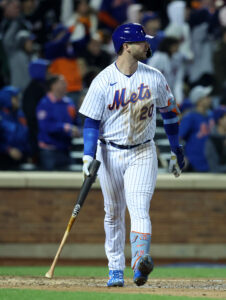
How do they align as players? Olson had a down season by his standards during his first year with Atlanta. The Braves couldn’t have known that at the time of his extension, however, so any comparison between the two has to isolate Olson’s production through 2021. At that time, he carried a career .252/.348/.511 line in just under 2400 plate appearances — offense that wRC+ calculated as 32 percentage points above league average after accounting for Oakland’s cavernous ballpark. Alonso has a bit under 2300 career trips to the dish and owns a .261/.349/.535 mark, with that production measured 38 points above par. The latter has a slight edge in power production, hitting home runs in around 6.47% of his career plate appearances against Olson’s nearly even 6% rate through 2021.
The power gap probably isn’t as significant as one might expect given Alonso’s status as a two-time Home Run Derby champion and his MLB-best 53 longballs as a rookie, though. Olson makes hard contact more consistently and hits the ball harder on average than Alonso does. Alonso has been a little better at translating his hard contact into home runs, though they’re each clearly elite power threats.
Both hitters have roughly average bat-to-ball skills. Olson carried a career 23.4% strikeout rate into the 2022 season; Alonso has fanned in 22.1% of his trips to the plate. Olson has a patient approach that gives him a slight edge in walks but it’s again a small gap. There’s also very little difference in their performance the year before hypothetical extension talks. Olson hit .271/.371/.540 with 39 homers and a 16.8% strikeout rate in 2021. Alonso’s coming off a .271/.352/.518 showing with 40 longballs and an 18.7% strikeout percentage. His on-base and slugging marks are a little behind Olson’s from the previous season, though that’s largely explainable by the league drop in offense last year. As measured by wRC+, Alonso’s offensive production was 43 points above par while Olson was 47 points better than average in ’21 — again, a minimal distinction.
Given their similarities as hitters, the Olson deal works as a strong starting point for gauging the terms it might take to keep Alonso. Olson has the advantage as a defender. He’s a two-time Gold Glove winner who’d gotten above-average grades from public metrics throughout his career, with Defensive Runs Saved crediting him as +34 runs compared to an average first base defender throughout his time in Oakland. Alonso’s glove isn’t as poor as some evaluators had worried during his prospect days, though public metrics paint him as a slightly below-average first baseman. He’s playable but doesn’t add the kind of value there Olson does.
There’s a reasonable debate as to whether Olson’s superior glove negates Alonso’s slight advantage as a power bat and makes him the better overall player. Alonso has a few financial advantages that might tip the scale in his favor in extension negotiations, however.
Alonso was in a better spot with regards to his final two arbitration years. He and the Mets have already agreed to a $14.5MM salary for the upcoming season; Olson had been projected by MLBTR contributor Matt Swartz for a $12MM salary for his second-to-last arbitration year. Considering those salaries escalate year-over-year based in large part on a player’s previous salary, Alonso likely would’ve had a similar edge for their final arbitration seasons. It’s not a huge difference but Alonso would likely have earned around $5-6MM more over his final two arbitration campaigns than Olson would have.
That’s not a factor for the would-be free agent years. Olson will be paid $22MM annually for the six free agent seasons he signed away. Considering Alonso’s a comparatively valuable all-around player, that’s a reasonable starting point. However, Alonso’s camp could get an edge from the spike in spending on star talent from this offseason. The best free agents generally surpassed market expectations. Rafael Devers, meanwhile, signed an extension that pays him $31.35MM for ten free agent seasons (though deferrals knocked its actual value to around $29.15MM).
Alonso isn’t likely to get to Devers money. The Red Sox slugger is two years younger, was a season closer to free agency and has more defensive value in his ability to play third base, at least in the short term. Still, the Devers deal is illustrative of the top of the market pushing up in the past 12 months — last spring, the Red Sox were reportedly pointing to Olson money as a comparable factor in talks with Devers but eventually went way beyond that — and Alonso’s camp could reasonably look for something a bit above the Olson average annual value in talks this spring.
It’s also at least worth considering how hard a bargain the Mets might try to drive in negotiations. Owner Steve Cohen and the front office have shown more willingness than any team the past two years to meet lofty asking prices to add star talent. That’s not universal (see: Jacob deGrom) but the Mets haven’t shown much fear of spending, even in the face of an astronomical luxury tax bill. The Braves have a high payroll but not one wildly different from the rest of the league, and this Atlanta front office has shown a knack for extending players at rates many outside observers find at or below market.
There’s room to tinker on the margins, likely to give Alonso the edge, though the Olson deal should be a starting point in any negotiations. Speculatively speaking, perhaps something in the range of eight years and $180.5MM (including this season’s $14.5MM salary) could be mutually agreeable. That’d tack on $166MM in new money for Alonso’s final arbitration season and six free agent years, running through his age-35 campaign. Estimating his final arbitration year around $22MM, it’d represent a $24MM average annual value for the six would-be free agent seasons. Alonso would move the extension market past a similar player in Olson, while the Mets would be able to keep another star in Queens for the foreseeable future.
Image courtesy of USA Today Sports.
The White Sox’ Right Field Options
The White Sox have shaken up their outfield picture from last year, a fairly sensible move given their weak results during the 2022 season. The club’s outfielders collectively hit .254/.301/.393 last year for a wRC+ of 97, placing them 18th in the majors. Defensively, the results were even worse, with the club posting -22 Defensive Runs Saved and -16 Outs Above Average on the grass, both of those numbers coming in 27th in the league, while their -28.6 Ultimate Zone Rating among outfielders was dead last. At least part of those results could attributed to both Luis Robert and Eloy Jiménez missing significant time due to injuries, but it was clear that some change was needed.
The club’s first move was letting José Abreu depart, thus allowing Andrew Vaughn to come in off the grass and take over at first base. Reports emerged in October that this was the course the club was considering, and Abreu signed with the Astros the following month. Vaughn was a huge part of those terrible defensive numbers, as he personally posted a -14 DRS, -16 OAA and -10.5 UZR last year. Now that he can return to his natural position, that could allow the club to deploy a more traditional outfielder in his place, depending how the situation plays out.
The other move the club made was signing Andrew Benintendi to a five-year, $75MM deal. Defensive metrics are somewhat split on his glovework, with OAA considering him subpar while both DRS and UZR are much kinder. Despite that disagreement, it still seems fair to expect the Sox to get better defensive results this year. Vaughn will be on the infield while Jiménez, who is also graded poorly on the grass, seems to be lined up to be the club’s primary designated hitter this year. With Benintendi in left and Robert in center, the club should at least have two competent everyday players in the mix. The question left to be resolved is who will be in right field. The club also lost AJ Pollock when he turned down a player option and signed with the Mariners, in addition to non-tendering Adam Engel, who then signed with the Padres. The right field job has been left open as a battle this spring, so let’s take a look at the candidates.
“Oscar Colas is going to be given every opportunity to see if he can become our right fielder on a daily basis,” manager Pedro Grifol said in an interview a few weeks ago. The prospect has a short track record in affiliated ball and is not yet on the 40-man roster, but it seems the team wants to leave a path open for him to seize a job once he proves himself ready for it.
Now 24 years old, Colas played in Cuba when he was younger, serving as both a hitter and a pitcher. Though some liked to call him the “Cuban Ohtani,” he only logged 3 1/3 innings in Cuba when he was 19 and the comparison never seemed truly appropriate. After spending some time in Japan, Colas was eventually declared a free agent and agreed to terms with the White Sox in 2021. That deal didn’t become official until January of 2022 when a new international signing period began, delaying his debut in affiliated ball until last year. Colas now has one season in the minors under his belt and there’s no denying that it was impressive. He began in High-A before jumping to Double-A and Triple-A, getting 526 plate appearances in 117 total games. He hit 23 home runs in that time and produced a batting line of .314/.371/.524 for a wRC+ of 137.
Those results certainly suggest Colas has earned a shot in the big leagues, but there are also concerns. His work at Triple-A was only a seven-game stint as the season was winding down, and though he hit .387 in that time, he also struck out at a 36.4% rate while walking just 6.1% of the time. It’s a small sample, but plate discipline is the primary red flag on his profile. His strikeout rate wasn’t quite as drastic at the lower levels but increased as he moved up the ranks. Scouting reports from both Baseball America and FanGraphs raise concerns about his propensity for chasing.
He’s not considered a strong enough defender for center field or a burner on the basepaths, with scouts agreeing he makes more sense in right field. He could still be an above-average fielder there, especially because his arm is considered an asset. But corner outfielders are generally expected to produce more offense than center fielders, putting a bit more pressure on his bat. Though the power seems to be legit, the strikeouts could potentially be an Achilles heel. It seems the Sox are open to letting him take a job with a hot spring but he could also warrant a bit more time on the farm after not playing in 2021 and a quick run through the minors last year.
Sheets, 27 in April, has shown some solid work at the plate in his career so far. He debuted in 2021 and launched 11 home runs in 54 games, leading to a .250/.324/.506 slash line and a 124 wRC+. He got his first extended stretch of playing time last year but couldn’t quite maintain that torrid pace. He hit 15 home runs over 410 plate appearances and hit .241/.295/.411 overall for a wRC+ of 100, or exactly league average.
The defensive side of his game hasn’t been graded well, however, as Sheets has a -10 DRS, -7 OAA and -6.0 UZR in the outfield so far. He’s only been in the majors a short time but the profile appears limited, supplying power but not much else since he doesn’t run well or get on base at an especially high rate. He seems like the frontrunner to hold down the job until Colas is deemed ready.
Jiménez, 26, certainly provides value with his bat. Despite missing over two months with a hamstring strain last year, he still hit 16 home runs and finished the season with a .295/.358/.500 batting line for a wRC+ of 144. But his defense has been a liability in his career, leading to tallies of -15 DRS, -17 OAA and -8.2 UZR. It seems the club will try to utilize him as a DH for the most part, though not entirely.
“I’m really looking forward to seeing Eloy in right field,” Grifol said recently. “I’m not talking about seeing him there every day, but I’m talking about maybe seeing him there a day or two a week if possible and keeping him athletic and keeping him working on the defensive side, because I know that helps on the offensive side as well.”
Regardless of who’s getting the regular right field reps, it seems Jiménez will be rotated in there a bit. That’s a fine enough plan but situations could always arise where he has to jog out there more often. Last year, for example, Bryce Harper was diagnosed with a torn UCL that kept him from taking the field but allowed him to continue hitting. That forced the Phillies to put Kyle Schwarber and Nick Castellanos out on the grass more often than they initially planned. That’s an extreme example in the sense that Harper was such a good hitter that the Phils had little choice but to allow him to clog up their DH slot for most of the year. However, it still shows that an injury can sometimes throw off a club’s designs for its ideal alignment, and it’s possible such a scenario arises and leads to an extended stretch in the field for Jiménez.
Garcia, 32 in March, is a candidate to help out with Chicago’s unsettled second base position as well as here in right. In his many years with the club, he’s served a super utility role, playing everywhere except first base and catcher. His glovework in the outfield is considered to be around average, though he doesn’t provide much at the plate, with a career batting line of .253/.293/.350. That amounts to a wRC+ of 74, indicating he’s been 26% below league average for his career. He was well off that pace last year, getting into 97 games but hitting just .210/.233/.267 for a wRC+ of just 39. He’s likely to be bouncing around the diamond to fill in wherever he’s needed. That could include some time in right field, but if he’s getting an extended run here it likely means something has gone terribly wrong.
Victor Reyes/Jake Marisnick/Billy Hamilton/Adam Haseley
None of these outfielders are currently on the roster, but they will be in camp as non-roster invitees. In the case of Haseley, he was outrighted in November while the other three were brought aboard on minor league deals. Marisnick and Hamilton are both glove-first veterans who will be 32 years old this year. They could make their way onto the roster as a fourth outfielder at some point, but it will be difficult to earn an everyday role unless there’s a cascade of injuries to other players. Haseley, 27 in April, was once a top-100 prospect with the Phillies, but his bat seems to have stalled out once he got to the game’s upper levels. He has a .262/.323/.364 batting line in 380 MLB plate appearances for a wRC+ of 82. His Triple-A work isn’t impressive either, coming in at .241/.308/.389. His defense is well-regarded and he’s yet to reach arbitration, so he could theoretically carve out a meaningful role if he can take a step forward at the plate. Reyes, 28, is fairly similar, having hit .264/.294/.379 in his career for an 83 wRC+. He has over four years of service time but still has an option remaining.
External Addition
There are still some names available in free agency, such as Jurickson Profar, David Peralta, Tyler Naquin, Ben Gamel, Robbie Grossman and others. Convincing any of them to sign as a placeholder or a part-time player could be difficult, though an injury during Spring Training or the World Baseball Classic could quickly change the whole picture. The club isn’t close to the $233MM competitive balance tax threshold, with Roster Resource currently pegging their number at $205MM. They are, however, getting pretty close to their franchise spending record. Per Cot’s Baseball Contracts, the club ran a $193MM figure on Opening Day last year, smashing their previous record of $129MM. Roster Resource has them at $187MM right now, just shy of last year. They could seemingly afford to make an addition if they wanted, but it’s possible they simply don’t want to block Colas and the remaining free agents feel they could probably find better opportunities elsewhere.
____
Though the Sox seem capable of having a better outfield this year, the overall depth does seem to be lacking at the moment. If Colas comes into spring and looks great, then things are probably in good shape. But if he looks a little shaky and goes back to the minors, then Sheets and Jiménez are likely handling things, with both of those guys being defensive liabilities. One injury would suddenly vault Garcia or one of the non-roster guys into an everyday role. More than one injury would really create a problem.
Phillies To Sign Kyle Hart To Minor League Deal
The Phillies are in agreement with left-hander Kyle Hart on a minor league deal, reports Chris Cotillo of MassLive. The southpaw will presumably receive an invitation to major league Spring Training.
Hart, 30, will join just his second organization, as he was drafted by the Red Sox and has spent his entire career with them up until this point. Working primarily as a starter in the minors, he had a solid showing in 2019, splitting his time between Double-A and Triple-A. He made 24 starts and three relief appearances that year between those two levels, tossing 156 innings with a 3.52 ERA, 22% strikeout rate and 8.3% walk rate.
That season was strong enough that the Sox added him to their 40-man roster to protect him from being selected in the Rule 5 draft. In 2020, Hart made his major league debut but registered a 15.55 ERA in 11 innings. He was outrighted off the club’s roster in November of that year and has continued pitching in the minors, but not quite reaching that form he showed in 2019. In 2021, he had a 4.22 ERA in 106 2/3 Triple-A innings. Last year, he posted a 5.25 ERA in 82 1/3 innings between Double-A and Triple-A.
Hart reached free agency for the first time after the 2022 campaign wrapped and has used it to find a new opportunity. The Phillies will see if a change of scenery can help Hart get back on track after a few disappointing years. The club’s rotation will consist of Aaron Nola, Zack Wheeler, Ranger Suárez and Taijuan Walker, with the final spot open for a battle between guys like Bailey Falter, Christopher Sánchez, Andrew Painter and Mick Abel. In the bullpen, the Phils will have a few lefty options in José Alvarado, Gregory Soto, Matt Strahm and Andrew Vasquez. It’s unclear if the Phils view Hart as a starter or reliever exclusively, but he could perhaps provide some depth in either area. If he makes it onto the club’s roster at any point, he still has a couple of option seasons and less than one year of service time.
MLBTR Chat Transcript
Click here to read a transcript of Tuesday’s chat with MLBTR’s Steve Adams.
Guardians, Phillip Diehl Agree To Minor League Contract
The Guardians and left-hander Phillip Diehl are in agreement on a minor league contract, tweets Robert Murray of FanSided. The Dynamic Sports Group client will be in big league camp this spring.
Diehl, 28, has appeared in parts of three minor league seasons but tallied just 19 innings. He most recently spent time with the Reds in 2022, though he was tagged for seven runs in 5 2/3 innings in that brief stint. Diehl has never had an extended look in the big leagues and has been quite homer-prone in his brief looks with Colorado and Cincinnati, ultimately serving up 20 runs in his 19 MLB frames.
A 27th-round pick by the Yankees back in 2016, Diehl has fared much better in the minor leagues, where he carries a 3.50 ERA with plus strikeout and walk rates of 29.8% and 7.3%, respectively. The 2022 season was a struggle for him at all levels (5.90 ERA in 39 2/3 Triple-A innings), but as recently as 2021 he turned in 54 2/3 innings of 2.47 ERA ball with a hefty 33% strikeout rate and an excellent 5.6% walk rate for the Reds’ Triple-A affiliate in Louisville.
As things stand, Sam Hentges is the only lefty who’s considered a lock in the Cleveland bullpen. Other options on the 40-man roster include Konnor Pilkington, Joey Cantillo and Tim Herrin — although Pilkington and Cantillo have both been developed as starting pitchers. Former Giants and D-backs southpaw Caleb Baragar was signed to a minor league deal and invited to spring training earlier in the offseason, and the Guards also invited 2019 32nd-rounder Andrew Misiaszek to camp. Diehl will join that group when pitchers and catchers report later this month, and if he doesn’t make the roster out of camp, he’ll give Cleveland a lefty with a bit more experience than many of their in-house options.
The Opener: Arbitration Hearings, 1B Market, MLBTR Chat
With the start of Spring Training just one week away, here are three things we’ll be keeping an eye on around the baseball world throughout the day today:
1. Decisions on recent arbitration hearings loom:
According to the Associated Press, two arbitration hearings have been completed, with decisions pending: the case between the Rays and right-hander Ryan Thompson, and the case between the Angels and outfielder Hunter Renfroe. While Thompson’s hearing was just yesterday, Renfroe’s hearing was over a week ago, with no decision announced as of yet despite more recent hearings having decisions handed down. Thompson followed up an excellent 2021 campaign where he posted a 2.38 ERA (3.11 FIP) with a more pedestrian 2022 where he posted a roughly league average ERA of 3.80 (3.42 FIP). His career mark is a 3.50 ERA with a nearly identical 3.55 FIP across 103 innings. Thompson’s camp filed for arbitration at a figure of $1.2MM, while the Rays countered with a figure of $1MM. Colin Poche, Jason Adam, and Harold Ramirez all also have unsettled arbitration salaries with the Rays.
As for Renfroe, he was traded in November by the Brewers to the Angels, who become his fifth club in as many seasons. Renfroe’s .255/.315/.492 (124 wRC+) line in 2022 was his best in any full season. Following the trade, Renfroe’s camp filed at a figure of $11.9MM, while the Angels countered at $11.25MM.
2. Sano working out for teams today
Today, former Twins first baseman Miguel Sano is set to participate in a showcase for clubs after an injury-plagued season where he struggled to a line of just .083/.211/.133 (9 wRC+) in 20 games before a knee injury ended his season. If the showcase goes well, Sano represents an interesting alternative to Luke Voit and Yuli Gurriel for clubs looking for a right-handed hitter to man first base. Voit’s 102 wRC+ was the only above average season line among the trio last year, making him perhaps the safest bet for any club looking to make an addition, while Sano and Gurriel both come with their own separate risks; Sano’s prodigious power has frequently been undercut by his staggering penchant for strikeouts, while Gurriel is looking for a rebound from one of his worst seasons as he heads into his age-39 campaign.
3. MLBTR Chat Today
Do you have any questions regarding your favorite team or the larger baseball world as the 30 clubs gear up for Spring Training and make their last minute offseason moves? MLBTR’s Steve Adams will be fielding questions from readers today during a live chat at 1pm CT. If you would like to ask questions in advance, you can do so here. That same link will also take you to the chat when it begins if you would like to participate live.
Ronald Guzmán Attempting To Become Two-Way Player
A couple of weeks ago, it showed up in the transaction logs that the Giants had signed first baseman Ronald Guzmán to a minor league deal. The club today announced to reporters, including Grant Brisbee of The Athletic, a batch of players that would be in camp as non-roster invitees. Among them was Guzmán, though he was listed as both a pitcher and an infielder. Video of Guzmán pitching recently appeared on social media, with the Instagram account Dominican Baseball Solutions sharing some footage back in December.
The fact that the Giants are announcing Guzmán as a pitcher suggests that they are at least somewhat willing to give him a real shot to prove himself in that capacity. He doesn’t yet have any professional experience as a pitcher, though the Instagram post linked above says that he was hitting 96 mph on his fastball, as well as throwing a slider at 82 mph and a changeup at 84.
Guzmán is now 28 years old, so making a transition to pitching will be difficult but the switch is not totally unheard of. Perhaps the best recent example is Anthony Gose, who spent many years as an outfielder but struggled at the plate and converted to pitching in 2017 at the age of 26. He eventually made his way back to the big leagues with Cleveland in 2021 and tossed 27 2/3 MLB innings over the past couple of years. Unfortunately, he required Tommy John surgery late last year and will likely miss the entire 2023 season.
It doesn’t seem like Guzmán is done with the other part of his game, however, since he was also announced as an infielder. He got into just three MLB games with the Yankees last year but hit .255/.344/.478 across 105 Triple-A contests for a wRC+ of 116. The first base position in San Francisco has some uncertainty with Brandon Belt joining the Blue Jays. It seems like LaMonte Wade Jr. will come in from the outfield and see significant time at the cold corner with right-hander J.D. Davis perhaps also involved in a platoon capacity. Guzmán can be in Triple-A to provide some veteran depth while also trying to jumpstart his late-career move to the mound.
Players attempting to play on both sides of the ball have been popping up a few places lately, but with little success outside of Shohei Ohtani. The Rays allowed Brendan McKay to develop as a two-way player for a while though he’s been severely hamstrung by injuries in recent years. Michael Lorenzen dabbled with being a two-way player but has found far more success as a pitcher, while Christian Bethancourt and Matt Davidson were in the opposite camp. White Sox prospect Oscar Colás did some pitching in Cuba but has given that up to be a full-time hitter in recent years. Alex Verdugo has expressed an interest in becoming a two-way player in the future but has been kept as outfielder in his career thus far.
Mike Montgomery Signs With Mexican League’s Acereros De Monclova
The Acereros de Monclova of the Mexican League announced last week that left-hander Mike Montgomery has signed for the 2023 season (Spanish-language link). The Acereros also announced a deal with reliever R.J. Alaniz (on Twitter).
Montgomery, now 33, pitched in the majors in each season from 2015-20. A top prospect between 2010-12 while in the Royals’ system, he was involved in a pair of trades before breaking into the majors with the Mariners. Montgomery had a career-best showing in 2016, working primarily as a multi-inning reliever between the M’s and Cubs. He threw 100 innings of 2.52 ERA ball across 49 regular season appearances and famously earned the save in the tenth inning of that year’s classic World Series Game 7.
While that was obviously the highlight of Montgomery’s time in the Windy City, he remained a productive member of the pitching staff through 2018. He worked to a 3.68 ERA across 254 2/3 frames between 2017-18. Montgomery got off to a tough start in 2019, though, and Chicago flipped him to the Royals for Martín Maldonado at that year’s deadline. The southpaw’s return to K.C. was mostly tarnished by a lat strain that cost him virtually all of the shortened 2020 campaign.
After a brief stint in South Korea, Montgomery returned to the affiliated ranks last year. Signed to a minor league contract with the Mets, he spent the 2022 season with their top affiliate in Syracuse. He worked 69 2/3 innings through 22 outings (17 starts) and was hit hard to the tune of a 6.72 ERA. Montgomery induced grounders at a quality 50.9% clip but struck out fewer than 17% of opponents. He’ll try to put that season behind him and get back on track in Monclova.
Alaniz, 31, has pitched in 15 MLB games dating back to 2019. The bulk of that time has come as a member of the Reds. He spent last year on a minor league deal with the Braves. Injuries limited the righty to 20 appearances and 26 innings for Triple-A Gwinnett. Alaniz had strong numbers in that time, posting a 3.81 ERA with a massive 37.2% strikeout percentage against a reasonable 8.2% walk rate. Nevertheless, he never got a big league look in Atlanta and now heads to the Mexican League.