
Rangers Unlikely To Have Payroll Room For J.T. Realmuto
The Rangers non-tendered catcher Jonah Heim, which means they are on the lookout for more catching. The top free agent available is J.T. Realmuto but columns today from Ken Rosenthal and Patrick Mooney of The Athletic as well as Evan Grant of the Dallas Morning News both suggest the club doesn’t have the payroll space to sign him.
Without Heim, the Rangers are down to two catchers on their 40-man roster. Kyle Higashioka is a solid player but he turns 36 years old in April. He has started between 68 and 77 games in four straight seasons. He can be part of the club’s catching corps next year but should have someone to share the workload. The other catcher on the roster is Willie MacIver, a 29-year-old waiver claimee with 33 games of big league experience. He is still optionable and would ideally be in Triple-A as depth.
Realmuto would certainly be a nice addition. He has been arguably the best catcher in baseball over the past decade. He is now about to turn 35 years old and isn’t at his peak but he’s still a solid contributor. In 2025, he had average-ish offense, stole eight bases and got mixed reviews for his glovework. All together, it was worth 2.1 wins above replacement, according to FanGraphs. He’s averaged a bit above two wins per year for the past three years.
Though he’s the top free agent out there, his earning power is capped by his age. MLBTR predicted him for a $30MM guarantee over two years. It’s possible he can secure himself a third year at a similar average annual value. The fact that a deal like that is too rich for the Rangers’ blood doesn’t bode especially well but they will have other options.
Both of the columns linked above mention Victor Caratini and Danny Jansen is more realistic free agent targets. MLBTR predicted Caratini for a two-year, $14MM deal and had Jansen as an honorable mention on the Top 50 Free Agents list. The 32-year-old Caratini has spent the past two years with the Astros. The switch-hitter was above average from both sides of the plate in those years, though his defense was more questionable. Jansen, a righty swinger, was also decent at the plate in 2025 but with some shaky defensive metrics.
There’s also the trade market. Both aforementioned columns speculate on various possible trading partners. Grant specifically calls out Carter Jensen of the Royals as a player the Rangers have long been interested in. Jensen is one of the top Royals’ prospects and one of the top catching prospects in the game. He hit .290/.377/.501 in the minors this year and then .300/.391/.550 in a 20-game major league debut. He just turned 22 in July.
The Royals probably don’t have a ton of interest in trading him, though there’s at least a case for them to consider it. They have Salvador Perez signed through 2027. He has been spending more time as a first baseman and designated hitter in recent years but has still been catching about 90 games per year for Kansas City. Jensen could share the catching duties with Perez but the Royals also have another strong catching prospect lurking. Blake Mitchell was the eighth overall pick in 2023 and will likely start 2026 at Double-A.
Since the Royals need upgrades and don’t appear to have a ton of spending power, perhaps they would consider trading from a position of relative depth, but that doesn’t mean they’d give Jensen away. Grant speculates that the Rangers might have to give up a prospect of similar value such as Sebastian Walcott.
There are a few other options available to the Rangers. Grant also speculates that they could go after a short-term solution, such as Ryan Jeffers of the Twins or Joey Bart of the Pirates. The Rangers used their 2024 first-round pick to nab Malcolm Moore but he has struggled at the plate and hasn’t climbed higher than High-A, so won’t be helpful for a while. Jeffers is controlled for just one more year and Bart two, so a player like that could serve as a bridge to Moore or at least buy the Rangers some time.
Time will tell how the Rangers play the catching situation specifically but the larger takeaway about the budget is perhaps not great for fans. For a few months now, the signs have been piling up that the club won’t have a ton of spending capacity for building out the 2026 roster. Back in September, the club parted ways with manager Bruce Bochy. At the time, president of baseball operations Chris Young stated that part of the cause of that split was that they didn’t have a clear plan for 2026 due to financial uncertainty. Pitching coach Mike Maddux departed for the Angels and it’s been speculated that might have been motivated by similar circumstances. The Rangers non-tendered Heim but also Adolis García, Josh Sborz and Jacob Webb. García was expected but Sborz and Webb were projected for salaries barely above the league minimum. Then the club traded Marcus Semien to the Mets for Brandon Nimmo, a move that involved taking on more money overall but saved them a few million annually.
After the deal, Nimmo said he was assured by the Rangers that they are not rebuilding and plan to compete, but it appears they will be trying to do that while spending less. RosterResource projects them for about $169MM in spending next year. That’s well below last year’s $224MM. In addition to bolstering their catching group, they need to rebuild the bullpen and shake up the lineup. Their apparently inability to go after Realmuto may be a bit of a moot point in a sense, since many expect him to re-sign in Philadelphia regardless, but it appears to be yet another sign of a tight budget in Texas going into 2026.
Photo courtesy of Kyle Ross, Imagn Images
Cubs, Phillies, Yankees Among Teams Interested In Tatsuya Imai
The Seibu Lions of Japan’s Nippon Professional Baseball posted ace Tatsuya Imai for major league teams back on Nov. 19. The flamethrowing 27-year-old has until Jan. 2 to negotiate a deal with interested MLB clubs. The Mets, Cubs and Orioles have each been linked to the right-hander so far. The Cubs, in particular, are expected to be a “strong” player in Imai’s market, per Bruce Levine of 670 The Score. They also made an offer to Dylan Cease before the former Cy Young runner-up (and former Cubs draftee) signed with the Blue Jays last week, according to Levine.
Jon Heyman of the New York Post adds the Phillies and Yankees as another pair of teams in the running for Imai. He adds that Imai’s camp could schedule in-person visits with interested teams following next week’s Winter Meetings — if he hasn’t already agreed to a deal by that point.
The Cubs make a sensible fit for Imai, even after countryman Shota Imanaga accepted Chicago’s $22.025MM qualifying offer, opting to forgo free agency in the process. Manager Craig Counsell‘s rotation currently includes Imanaga, Cade Horton, Matthew Boyd, Jameson Taillon and Colin Rea. Ace Justin Steele is still on the mend from UCL surgery performed last April. He won’t be ready for Opening Day. Javier Assad and Ben Brown could both factor in, too, but both have bullpen experience and minor league options remaining.
Chicago’s interest in bolstering the rotation is well-known. Even after Imanaga opted to return, the Cubs have reportedly been seeking a playoff-caliber starter to add to the top portion of their staff. Imai isn’t necessarily a slam-dunk to fit that description, but his electric stuff and recent performance in NPB suggest he has that ceiling.
Imai, who’ll turn 28 next May, has posted a sub-3.00 ERA in each of the past four NPB seasons — headlined by a career-low 1.92 mark in 163 innings in 2025. Along the way, he’s steadily increased his strikeout rate while at the same time lowering his walk rate. Those improvements culminated in last year’s dominant season, wherein Imai punched out 27.8% of the batters he faced and cut his walk rate to a tidy 7%. He’s one of NPB’s hardest throwers, topping out around 99 mph and sitting more comfortably in the mid-90s. Imai complements that pitch with a slider, splitter and changeup.
Signing Imai would push Rea back into his familiar swingman role and could even create a logjam if everyone is healthy once Steele finishes off his rehab from surgery. That’s wishful thinking, however, given the proliferation of pitching injuries throughout the sport. And if the Cubs do manage to have a full contingent of healthy rotation arms at that point, it’d fall under the “good problem to have” cliche. A playoff rotation including a healthy Steele, Horton and Imai could be formidable.
The Phillies, meanwhile, haven’t been big players in free agency for pitchers — at least not to the extent they have with hitters — outside of retaining homegrown Aaron Nola on a seven-year contract. However, that decision is now one of many contributing to a far shakier outlook than we’re used to seeing with the Philadelphia rotation.
Left-hander Cristopher Sanchez broke out as a top-tier arm with this year’s runner-up finish in Cy Young voting, but the rest of the staff has more questions and/or dwindling club control. Ranger Suarez is already a free agent. Zack Wheeler underwent thoracic outlet surgery late in the season. He’s owed $84MM over the next two seasons. Nola struggled to the worst extent of his career, posting an ERA north of 6.00 in 2025. Jesus Luzardo is a quality mid-rotation arm but will be a free agent next winter. Taijuan Walker is also entering the final season of a four-year deal. He rebounded to an extent in 2025, but the first two seasons of that $72MM pact were a disaster. Andrew Painter has long been one of the game’s top pitching prospects, but he was hit hard in Triple-A during his return from 2024 Tommy John surgery.
Obviously, the Phillies already have a lot of money on the long-term books — but perhaps not to the extent some might think. Nola, Trea Turner and Bryce Harper are the only players signed beyond the 2027 season. A backloaded deal for Imai — likely one including at least one opt-out opportunity — could make his salary more manageable in years one and two. Those seasons would dovetail with the remaining years on the contracts of Wheeler (through 2027) as well as Walker (through 2026), Nick Castellanos (through ’26), Jose Alvarado (through ’26) and Matt Strahm (through ’26).
Signing Imai would give the Phillies another large contract on the books but also offers protection against a potentially thinned-out starting group come 2027. Luzardo and Walker are free agents at that point. Painter hasn’t pitched in the majors yet. It’s hard to know what to expect from Wheeler and Nola in 2026 — let alone 2027. Imai (or another multi-year rotation acquisition) could provide some protection, although he’s obviously an untested commodity himself (at least against MLB opposition).
On paper, the Yankees’ rotation need is the least acute of this group. Gerrit Cole could be back relatively early in 2026. Max Fried was dominant in his first season in Yankee Pinstripes. Carlos Rodon was outstanding in 33 starts. Luis Gil, Cam Schlittler and Will Warren are all impressive-looking young starters. Clarke Schmidt could be back late in the season after July Tommy John surgery.
The Yankees already have three pitchers on contracts valued at $162MM or more. Imai would very likely require a fourth commitment of over $100MM and do so at a time when the team is facing questions in the infield and in the outfield. If the Yankees believe Imai can pitch at or near the top of a major league rotation, however, they could sign him and use some of their young pitching and/or prospect depth to make compelling offers for bats on the trade market. It’s a thin offseason with regard to free-agent hitters, after all.
Whoever signs Imai will need to do so within the next four weeks. His posting window closes Jan. 2. The team to sign him will also owe a separate release fee to the Lions in NPB. That fee will equal 20% of the contract’s first $25MM, plus 17.5% of the next $25MM and 15% of any guaranteed money thereafter. Additional earnings unlocked via incentives, escalators and club option years would also be subject to that 15% rate once they become guaranteed.
Latest On Mariners’ Bullpen Targets
Mariners general manager Justin Hollander publicly admitted a few weeks back that the club would be looking for bullpen upgrades. Adam Jude of The Seattle Times reports that Seattle plans to add two relievers and hopes to have one locked down by the end of the Winter Meetings next week. Adding a lefty is a priority and Jude lists five names they are considering, with four of them being southpaws. They are Matt Strahm of the Phillies, JoJo Romero of the Cardinals, Jose A. Ferrer of the Nationals, as well as free agents Tyler Rogers and Hoby Milner. Rogers is the lone right-hander in that group. Jude also mentions that the Mariners had interest in right-hander Phil Maton before he signed with the Cubs.
Seattle had a decent bullpen group in 2025. Their relievers had a collective 3.72 earned run average, which was ninth in the majors. Andrés Muñoz is one of the better closers in the game. But just about any club can add an extra leverage arm or two and bump other guys down a peg. That’s particularly true for the Mariners from the left side, as Gabe Speier is their only established southpaw reliever at the moment. Robinson Ortiz is the other lefty reliever on the 40-man but he hasn’t yet made his major league debut.
It’s unlikely that the club will spend a lot on the relief group. President of baseball operations Jerry Dipoto suggested that the M’s will likely begin 2026 with a similar payroll to where they were at the end of 2025. RosterResource estimates that they are currently about $15MM shy of that target. They already re-signed Josh Naylor but could look to further bolster the infield by re-signing Jorge Polanco or Eugenio Suárez. Jude unsurprisingly suggests the M’s aren’t likely to go after a big name reliever like Edwin Díaz or Robert Suarez.
Strahm, 34, is the most established of the bunch. He now has ten big league seasons under his belt. Though he has pushed into his mid-30s, he has remained effective. He just tossed 62 1/3 innings for the Phils this year, allowing 2.74 earned runs per nine. His 7.8% walk rate was a bit better than average and his 27.3% strikeout rate was quite strong. He triggered a vesting option in his contract and will make $7.5MM next year.
All that makes him attractive for the Mariners but also valuable for the Phillies. It’s possible the Phils may be willing to move a lefty due to a relative surplus. They have reportedly received some trade interest since they have Strahm, José Alvarado and Tanner Banks. The Phils have a lot they want to accomplish this winter, including re-signing Kyle Schwarber and J.T. Realmuto while also remaking their outfield and perhaps bolstering the rotation. They have some money to spend but perhaps trading one of their lefties could leave them less reliant on spending their cash.
Romero, 29, is a much more straightforward trade candidate. The Cardinals are rebuilding and he is just one year away from free agency. MLBTR contributor Matt Swartz projects him for a salary of $4.4MM next year. Over the past three years, he has tossed 156 2/3 innings for the Cards with a 2.93 ERA, 22.9% strikeout rate, 8.5% walk rate and 53.3% ground ball rate.
Ferrer, 26 in March, is also on a rebuilding club. However, he’s under club control for four more years and hasn’t yet qualified for arbitration, so the Nats don’t really need to trade him anytime soon. They are surely hoping to return to contention within his window of control but they may be open to a trade anyway, given that a pitcher can get hurt at any time and reliever performance tends to be volatile.
In Ferrer’s career, he has an unimpressive 4.36 ERA but that might mask his true skills. He is a ground ball guy and the Nats have been one of the worst defensive clubs in recent years, so perhaps a change of scenery would help him unlock a new gear in terms of run prevention. In 76 1/3 innings for the Nats this year, his 21.9% strikeout rate was just shy of league average. His 4.9% walk rate and 62.6% ground ball rate were both excellent. His 4.48 ERA doesn’t look great but his 3.03 FIP and 2.85 SIERA provide more optimism about him thriving in a different environment.
Milner, 35 in January, has a somewhat similar grounder-heavy profile to Ferrer. He has logged at least 64 innings in four straight seasons now. Over that 2022-25 span, he has thrown 264 frames with a 3.55 ERA, 22.6% strikeout rate, 5.8% walk rate and 51.1% ground ball rate. Despite the solid track record, he was only able to secure a one-year, $2.5MM deal from Texas last winter. Perhaps he’ll have some extra earning power after finishing another solid season but he’s also a year older.
Rogers, 35 this month, is one of the most unique pitchers in the game. Not to be confused with his lefty brother Taylor, Tyler is the submarining righty. He doesn’t rack up strikeouts but he is one of the best in the game when it comes to staying healthy, avoiding walks and inducing grounders as well as soft contact. He has logged at least 70 innings in five straight campaigns. Dating back to the start of 2021, he has 378 1/3 innings with a 2.71 ERA, 17% strikeout rate, 4.4% walk rate, 56.3% ground ball rate and consistently strong numbers in terms of exit velocity allowed. He is a free agent for the first time and should be in high demand but some teams may be scared off by his age and lack of velocity, as he can barely even get into the 80s with his fastballs.
Photo courtesy of Jayne Kamin, Oncea-Imagn Images
Mets Interested In Joe Ryan
The Mets have been perusing the trade market in hopes of bolstering their rotation and have their eye on Twins right-hander Joe Ryan as one of several targets, Jon Heyman of the New York Post reports. He adds that the Twins like young Mets righty Jonah Tong — hardly a surprise, given that Tong is widely regarded as one of the sport’s top pitching prospects.
As recently as the All-Star break, the idea of the Twins trading Ryan seemed far-fetched. Minnesota spent the entirety of the first half hovering around .500 and keeping themselves in the AL Central/Wild Card races. The Twins cratered coming out of the Midsummer Classic enough to push ownership and the front office into sell mode. What was originally thought to be a soft sale of primarily rental players instead turned into a staggering dismantle of the roster. The Twins traded 11 players in the final week of July.
Notably absent from that swath of trades was the 29-year-old Ryan. He drew plenty of interest, with the Red Sox, Blue Jays and Dodgers among those reported to be in pursuit. But given his affordable salary and multiple years of remaining club control, the asking price was understandably steep. No deal materialized.
Ryan is projected by MLBTR contributor Matt Swartz to earn an eminently affordable $5.8MM in 2026 — his penultimate season of club control. He’d be owed one more raise next winter before reaching free agency post-2027. It’s an unequivocal bargain for a pitcher who’s logged a 3.50 ERA with a 27.8% strikeout rate and just a 5.1% walk rate across the past two seasons (3.79, 27.6% and 5.7% in his career, respectively).
What’s not yet clear, however, is how aggressively the Twins will explore trades for Ryan — if they do at all. President of baseball operations Derek Falvey suggested earlier in the offseason that he’d yet to be given a firm budget by ownership. That seems hard to believe, but the Twins have ostensibly been in the process of finalizing the addition of two significant minority investors for months now. To this point, there’s been no firm indication that the addition of those partial stakeholders — and any influx of cash they might bring to the table — has been finalized.
Falvey plainly stated that unless or until he hears otherwise, his offseason focus will be on adding pieces to help the 2026 Twins — not further subtracting from the roster. It’s been quiet for the Twins all offseason with the exception of some small-scale moves leading up to the non-tender deadline and Rule 5 protection deadline. Minnesota acquired Alex Jackson from the Orioles, giving them a backup to starting catcher Ryan Jeffers, and they also nabbed reliever Eric Orze in another small trade with the Rays.
That’s the extent of the Twins’ activity thus far, making it tough to get a read on whether Falvey & Co. might genuinely be given the green light to add to the club or whether a further teardown will take place. If Ryan and/or Pablo Lopez (owed $43.5MM through 2027) are traded this winter, then it’s only logical that Jeffers (entering his final year of club control) would be on the table as well. And though star center fielder Byron Buxton said on record in August (even after the deadline sell-off) that he wanted to stay in Minnesota and had no desire to waive his no-trade clause, offseason reporting has suggested that if the Twins further subtract from the roster, he may change his tune.
Ultimately, Ryan’s availability (or lack thereof) will come down to the Pohlad family’s willingness to invest some of those deadline cost-savings back into the roster. The Twins’ current payroll projection ($95MM, per RosterResource) is nearly $50MM south of last season’s Opening Day figure. In theory, there’s room for Falvey to turn around and spend a fair bit of money, even if payroll won’t climb back into the $140-145MM range, but he doesn’t have final say over the budget.
If the Twins do make Ryan available, Tong is a sensible target as a potential headliner in the trade. The 22-year-old righty was hit hard in his first 18 2/3 MLB frames late in the season, but Tong’s blazing ascension up the Mets’ minor league ranks in 2024-25 catapulted him into the game’s top 50 overall prospects at Baseball America, MLB.com and FanGraphs.
Tong, a 2022 seventh-rounder, has laid waste to minor league lineups in each of the past two seasons, climbing from Low-A in early ’24 to the Mets’ big league rotation this past September. In 2024, the wiry right-hander pitched 131 innings with a 3.03 ERA, 34.2% strikeout rate and 10% walk rate as he climbed to Double-A. Tong returned to Double-A to begin the ’25 campaign and was bumped to Triple-A late in the season. He pitched a combined 113 2/3 minor league frames and recorded an immaculate 1.43 ERA with an eye-popping 40.5% strikeout rate against a 10.6% walk rate.
One way or another, next week’s Winter Meetings figure to bring some clarity on the Twins’ direction. No one is expecting them to dive headlong into the deep end of free agency, but if ownership is comfortable with even a diminished $120-125MM payroll, that might be enough to spur the front office into some midlevel additions in hopes that with some steps forward from a deluge of young big leaguers, a return to Wild Card contention is possible. If payroll is mandated to be kept under $100MM or pared back even further, however, then the prospect of trades involving Ryan, Lopez, Jeffers and even Buxton become far more realistic — if not likely.
Dodgers Have Discussed Teoscar Hernandez In Trade Talks
Though the Dodgers are in the market for an outfielder, they’ve also discussed the possibility of dealing from their current group. Ken Rosenthal of The Athletic reports that Teoscar Hernandez‘s name has popped up in some of the front office’s trade talks with other clubs, though the team doesn’t feel a deal is likely.
Hernandez, who turned 33 in October, is coming off a down season at the plate. His .247/.284/.454 batting line (102 wRC+) was his weakest since establishing himself as a major leaguer. He bounced back somewhat with a nice overall postseason showing, though, and Hernandez still ripped 25 home runs during 134 regular season games (546 plate appearances). This year’s 24.5% strikeout rate, while higher than league average, was the lowest of Hernandez’s career. Then again — that’s also true of his lowly 4.8% walk rate.
Hernandez’s batted-ball profile is still solid; his average exit velocity, hard-hit rate and barrel rate are all better than league average. However, he’s seen noticeable dips in each area over the past two seasons, which corresponds with a decline in his bat speed, as measured by Statcast. As someone who’s practically an all-bat player at this point in his career, the trend lines are fairly concerning.
That’s particularly true for a Dodgers club that can’t transition Hernandez to designated hitter, due to the presence of Shohei Ohtani. Hernandez drew roughly average marks for his right field glovework in the eyes of Defensive Runs Saved, but Statcast was far more bearish, dinging him for negative-9 Outs Above Average. Statcast pegged Hernandez’s range in just the third percentile of MLB outfielders. He’s never had a positive OAA mark dating back to his 2016 MLB debut, nor has he ever topped a +1 DRS mark in his ten big league seasons.
Hernandez is entering the second season of a three-year, $66MM contract signed in free agency last winter. He’s still owed $33MM over the next two seasons — $12MM in ’26, $14.5MM in ’27 and a $6.5MM buyout on a 2028 club option — though $16MM of that sum is deferred and will not begin to be paid out until 2031.
Home runs notwithstanding, Hernandez is a questionable corner-only defender whose OBP flatlined at a career-worst .284 in 2025. By measure of wRC+, he was only 2% better than the average big league hitter in 2025. It’s fair to wonder whether he could match that $33MM guarantee if he were a free agent at the moment. Hernandez is a prominent name, and the five dingers he smacked in the playoffs are fresh in everyone’s memory, but his stock isn’t exactly at a high point. In terms of WAR, both FanGraphs (0.6) and Baseball-Reference (1.5) felt this was his worst or second-worst performance in a full season.
Trading Hernandez would create a bevy of possibilities for Los Angeles as they look to improve their defense. With so many versatile players on the roster (e.g. Mookie Betts, Tommy Edman, Andy Pages, the recently re-signed Miguel Rojas), the Dodgers boast innumerable potential defensive alignment and could thus pursue a wide range of free agent and trade targets.
Notably, Rosenthal echoes previous reporting from colleague Fabian Ardaya, ESPN’s Jeff Passan and others in suggesting that Kyle Tucker will likely command more than the Dodgers prefer to spend; they’d reportedly be amenable to a shorter-than-expected deal, but Tucker still seems likely to command a significant long-term pact.
Even if a (still very hypothetical) Hernandez trade wouldn’t pave the way for an earnest pursuit of Tucker, shedding his salary and freeing up roster space would bring about ample room for creativity. Speculatively speaking, the Dodgers could rekindle their deadline interest in Guardians left fielder Steven Kwan, make a run at one of the Red Sox’ likely available outfielders (Jarren Duran, Wilyer Abreu) or once again jump into the fray for a versatile Cardinals utilityman (Brendan Donovan). If they’re open to shifting Betts back to the outfield, the possibilities expand even further.
Diamondbacks Interested In Pete Fairbanks
Diamondbacks general manager Mike Hazen has admitted that upgrading the bullpen is a priority this offseason. One specific name on their list of targets is Pete Fairbanks, as Nick Piecoro of the Arizona Republic reports that the Snakes have engaged in discussions with the right-hander.
The relief market has been the hottest section of the offseason so far and Fairbanks has been a popular part of it. Devin Williams, Ryan Helsley, Phil Maton, Raisel Iglesias, Emilio Pagán and other relievers have already come off the board. Fairbanks is still out there but he has been connected to the Blue Jays, Dodgers, Marlins and Tigers, with the Diamondbacks now added to the list. Presumably, there are several other clubs on that list who have not been publicly named.
There are likely varying opinions on what Fairbanks can provide going forward. A few years ago, his results were elite but he was often injury prone. More recently, he has been healthier but less dominant. From 2020 to 2023, he posted a 2.66 earned run average. His 10.1% walk rate was a bit high but he struck out 34.8% of batters faced and got grounders on 46.9% of balls in play.
Over the past two seasons, he has still posted a strong 3.15 ERA and his walk rate improved to 8.2%. His 60 1/3 innings pitched in 2025 were a career high by 15 frames. However, he only punched out 24% of batters faced over the 2024 and 2025 seasons. That’s slightly above average but a big drop from his previous campaigns. He averaged 97.3 miles per hour on his fastball in each of the past two seasons. That’s still good zip but he averaged 99 mph in 2022.
Fairbanks is clearly still capable of good results but he’s about to turn 32 years old and there’s enough uncertainty to have impacted his market. The Rays could have retained him for 2026 via an $11MM club option but they instead opted for the $1MM buyout, sending him to free agency. Presumably, the Rays tried trading Fairbanks before making that call. Perhaps there were some teams willing to pay Fairbanks at that price but Tampa couldn’t find one willing to both pick up the option and also give them a meaningful trade return.
Now that Fairbanks is a free agent, he will cost only cash and has plenty of suitors. The Diamondbacks are a sensible one. Their bullpen fell apart in 2025. A.J. Puk and Justin Martínez were supposed to be the top two guys in the relief corps. Both required UCL surgery in the summer and other arms hit the injured list as well. Arizona relievers finished the year with a collective 4.82 ERA. The Nationals, Rockies and Angels were the only three big league teams who finished worse in that department.
Puk and Martínez could perhaps return in the summer of 2026 but the bullpen is clearly a weak spot for now. Fairbanks is presumably just one of many relievers the Snakes are pursuing. What’s unclear is how much spending capacity the club has.
Owner Ken Kendrick has said the payroll might drop a bit relative to 2025, but Hazen has downplayed how much that will impact his ability to build out the roster. RosterResource currently projects their 2026 payroll about $40MM shy of 2025. It’s unclear where they plan to end up, as they try to address needs in the rotation, bullpen and position player group.
Instead of free agency, they could try to deal with those needs via the trade market. Piecoro notes that the Snakes are open to trading young position players and/or prospects, including Jordan Lawlar.
Lawlar is an interesting case as he has been and still is one of the top prospects in the league. Teams normally cling tightly to those players but there are some signs suggesting the Snakes and Lawlar may be a special case. As a prospect, he has destroyed minor league pitching but hasn’t been able to carve out a big league role in Arizona. He climbed the minor league ladder as a shortstop but the Diamondbacks have Geraldo Perdomo locked in there and Ketel Marte at second. Until recently, third base was also blocked by the presence of Eugenio Suárez.
Lawlar hit so much in Triple-A to start 2025, slashing .336/.413/.579 in 37 games, that the Diamondbacks called him up anyway. But they didn’t find much playing time for him and optioned him back down a few weeks later. He then suffered a hamstring strain in June which sidelined him for weeks. Arizona traded Suárez to Seattle at the deadline but Lawlar was still recovering at that time.
He was eventually healthy enough to be recalled at the end of August, which could have finally been the big league runway he needed, but it didn’t play out as hoped. He committed several throwing errors from third base in the first half of September. In the latter half of the month, the club mostly used him as a pinch-hitter and designated hitter. It was reported about a month ago that the Diamondbacks would have him take center field reps in winter ball. Playing for Tigres del Licey in the Dominican Republic, he has logged 58 innings at short, 27 in center and nine at third while slashing .167/.217/.214 over 12 games.
Put it all together and it’s possible that the Snakes don’t have as tight a grip on Lawlar as maybe some other clubs would with a top prospect. He is still just 23 years old and could still be a star but he might make more sense for a rebuilding club who can afford to be patient with him and his defensive uncertainty. Since the Snakes have a number of needs on the roster and a bit of a payroll squeeze, perhaps they could use Lawlar in a trade to bring back some affordable big leaguers.
Being willing to make a trade doesn’t mean it’s going to happen or is even likely. With the Marte situation, Hazen has been clear that it’s his job to listen to offers but that doesn’t mean he’s likely to move his star second baseman. The situation with Lawlar is surely similar but he will be an interesting name to watch in the coming weeks and months as there are undoubtedly teams who would love to take a chance on him.
Photo courtesy of Vincent Carchietta, Imagn Images
Giants To Hire Ron Washington As Infield Coach
The Giants are hiring former Rangers/Angels manager and former Athletics/Braves coach Ron Washington as their infield coach for the upcoming season, USA Today’s Bob Nightengale reports.
Washington, 73, was a first base coach, third base coach and infield coach with the Athletics from 1996 to 2006. He left the A’s for an eight-year stint as the manager for the division-rival Rangers, guiding Texas to consecutive World Series appearances in 2010-11 — though the Rangers ultimately fell short in both instances. The Giants won a 4-1 World Series in 2010, and Washington’s Rangers fell to the Cardinals in a seven-game classic in 2011. One of the key factors in that 2010 World Series was then-rookie catcher Buster Posey, who’s now San Francisco’s president of baseball operations.
After his run as the Rangers’ skipper, Washington returned to Oakland for the 2015-16 seasons, stepping back into his old role of third base coach. The Braves interviewed Washington for their managerial vacancy in the 2016-17 offseason and were impressed enough to hire Washington to the coaching staff despite ultimately giving the skipper’s role to Brian Snitker. Washington spent seven seasons in Atlanta as third base and infield coach, winning a World Series ring in 2021, before being hired as the new Angels manager in the 2023-24 offseason.
Washington’s time in Anaheim would only last one-plus seasons. The 2024 Halos lost 99 games and finished in last place in the AL West. In 2025, Washington only managed 74 of the team’s 162 games. He stepped away from the club due to health reasons in mid-June and revealed a couple months later that he’d undergone a quadruple bypass procedure. Bench coach Ray Montgomery took over for him on an interim basis. Washington had said he hoped to return to his managerial post with the Angels in 2026, but the team opted to make a change and hire someone from the opposite end of the experience spectrum: former big league catcher Kurt Suzuki, who’ll be in his first year as a coach or manager next season.
This will be Washington’s 21st overall as a major league coach. Add in his decade of managerial experience, and Washington has spent more than 30 years as one of the game’s most respected coaching/managerial minds. He’ll inherit a pair of talented defenders on the left side of the infield in Matt Chapman and Willy Adames, but Washington will be a vital piece of the puzzle as the Giants continue familiarizing Rafael Devers and young slugger Bryce Eldridge with the intricacies of first base. He’ll also give new skipper Tony Vitello an experienced ear on which to rely as he makes the transition from college ball to managing at the professional level.
The Opener: Tucker Market, Rays Roster, Signings
Here are three things we’ll be keeping an eye on around the baseball world today:
1. Movement in Tucker’s market?
It’s been a fairly active week on the free agent market, but things have mostly been quiet surrounding star outfielder Kyle Tucker. That changed yesterday, however, when a report emerged that Tucker had visited the Blue Jays’ spring training facility in Dunedin, Florida. It’s the first known meeting between the winter’s top free agent and a team, and the news continues a trend of Toronto being by far the most aggressive team in baseball to this point in the offseason. Adding Dylan Cease to the rotation and Kyle Tucker to the lineup would be enough for a banner offseason by itself, to say nothing of the Jays’ deal with Cody Ponce or their reported pursuits of players like Bo Bichette and Pete Fairbanks, who are still on the market.
Does Tucker have other in-person visits lined up? Are the Jays preparing a formal offer? More details on his market could emerge in the near future.
2. Rays 40-man roster move incoming:
The Rays reached an agreement with outfielder Cedric Mullins on a one-year deal yesterday, adding to an outfield that was in desperate need of reinforcements beyond re-signing Jake Fraley shortly after his non-tender. Tampa Bay will need to clear a spot on their 40-man roster to accommodate Mullins. The most common way to accomplish that is simply by designating a player for assignment, but it’s also possible the Rays could look to work out a trade that clears 40-man roster space instead. Tampa Bay is hardly a stranger to the trade market, and players on the roster like Brandon Lowe are already garnering attention as potential trade pieces this winter.
3. Other signings to be made official:
Mullins isn’t the only reported deal that has yet to be made official. Deals between the Dodgers and Miguel Rojas, the Blue Jays and Cody Ponce, the White Sox and Anthony Kay, as well as the Reds and Emilio Pagan are all still pending physicals and will need to be formalized in the coming days. That’s in addition to the deal between the Astros and Ryan Weiss, which has still yet to be made official and (unlike Rojas, Ponce, Kay, and Pagan) will require a 40-man roster move on the part of Houston. With the Winter Meetings fast approaching, signings and the subsequently required 40-man roster maintenance necessary to accommodate those fresh deals will surely continue to pile up.
MLB Mailbag: Mets, Red Sox, Murakami, Expansion, Cubs, Tatis
This week's mailbag gets into the Mets' offseason thus far, Craig Breslow's tenure atop Boston's front office, the Munetaka Murakami situation, how an expansion draft works, the Cubs' anti-deferral policy, Fernando Tatis Jr.'s trade value, and much more.
Ed asks:
I'm finding it hard to understand the Mets thinking. I'm scratching my head about the Marcus Semien/ Brandon Nimmo trade. I asked my friend who's a big Mets fan (his last name is Metz) what he thought and he responded that it depends on what outfielder they replace Nimmo with. I told him that unless they break the bank on Kyle Tucker its not going to be a clear upgrade. I'd say Cody Bellinger is an slight upgrade but after looking at their numbers its amazing how similar Bellinger and Nimmo are offensively and I don't see Cody putting up as good numbers in Citi Field.
Then I heard they are shopping Senga, instead of signing Framber Valdez or Ranger Suarez to compliment Senga they are looking to move on all together. Again I think both Framber and Ranger are probably a little better than Senga but if you sign one of them and keep Senga he becomes your # 2 which he is much better suited for.
I believe last year was more of a fluke for Devin Williams than the new norm, but would rather have Diaz, especially since William's problem might have been that he just can't handle the New York limelight. The Mets are now going with Williams as closer unless they resign Diaz and yes it probably closes the door on Diaz unless they want to invest over $100 million on two back end of the bullpen guys.
Just curious what you think of these moves. Do you feel the Mets will be stronger in the OF, Starting and Relief pitching in 2026?
Abner asks:
As a NY Mets fan I would love to see a late innings duo of Edwin Díaz & Devin Williams. But knowing how does David Stearns operate, how realistic is the Mets signing Díaz with Williams already in the fold? Will they look for cheaper options getting a guy like Tyler Rogers and/or Emilio Pagán to be the setup man while Williams is the closer? If they decide to invest heavily in Williams and Díaz, does that mean that they will not invest in an ace for the starting rotation this offseason? Thanks in advance.
On the Nimmo/Semien trade, I agree with Ed's friend. So far, we've seen a portion of the Mets' offseason puzzle. It's not close to being complete.
At age 33, Nimmo projects as roughly a 2.5 WAR player next year. It's true that the free agent market is light on outfielders who are capable of that, beyond Tucker and Bellinger. But it's also true that 34 MLB outfielders were worth 2.5+ WAR this year, including several few saw coming. And that doesn't account for platoons that combined for 2.5 WAR-type value.
There's also collapse risk with the 33-year-old Nimmo, who is under contract through 2030. Let's take a quick look at the last five years and see how many 33-year-old outfielders were worth 2.5+ WAR:
- 2025: 2 (Aaron Judge at 33, George Springer at 35)
- 2024: 0
- 2023: 1 (Kevin Kiermaier at 33)
- 2022: 2 (Starling Marte and Mark Canha at 33 - both Mets!)
- 2021: 2 (AJ Pollock at 33, Darin Ruf at 34)
Nimmo's track record is very good, and a projection system is not going to project him to fall off a cliff after a 3-WAR season. But outfield is a young man's game, and you can see how rare good seasons are at 33+. With Nimmo, this could be a case of the old adage about trading a player a year too early rather than a year too late. So I don't mind subtracting a player who probably won't age well, saving some money long-term and bringing in a second baseman with strong defense. That's not to say Semien doesn't have his own collapse risk at 35, but his speed and defense are holding strong.

Unlock Subscriber-Exclusive Articles Like This One With a Trade Rumors Front Office Subscription
- Access weekly subscriber-only articles by Tim Dierkes, Steve Adams, and Anthony Franco.
- Join exclusive weekly live chats with Anthony.
- Remove ads and support our writers.
- Access GM-caliber tools like our MLB Contract Tracker
Dodgers To Re-Sign Miguel Rojas
Miguel Rojas will play his final season as a Dodger. The World Series hero is reportedly in agreement with Los Angeles on a one-year, $5.5MM contract. Rojas, a client of Beverly Hills Sports Council, announced in October that he would retire after the 2026 season. He’ll reportedly jump right into a player development position with the Dodgers once his playing career is finished. That’ll push the team’s 40-man roster count to 38 once it’s official.
It’ll be Rojas’ fourth consecutive season in L.A. and his fifth as a Dodger overall. He broke into the majors with the team in 2014 but was traded to the Marlins after his rookie year. Rojas spent eight seasons in Miami, much of it as an everyday shortstop, until the Fish traded him back to the Dodgers over the 2022-23 offseason. He has worked in a utility role for the past three seasons and has been a strong contributor off the bench for Dave Roberts in the most recent two years.
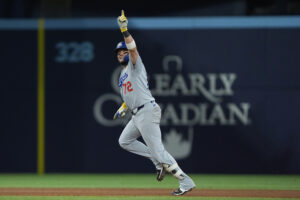
Rojas owns a .273/.328/.404 batting line across 654 plate appearances in the past two seasons. He remains one of the toughest players in the league to strike out. Rojas is no longer an everyday shortstop but can back up Mookie Betts while logging more time between second and third base. He remains a quality utility piece who has also been regarded as a clubhouse leader in Miami and Los Angeles. The Dodgers intend to keep him in the organization beyond his playing days, which reflects his clearly strong relationship with the coaching staff and front office.
That all made it likely that the Dodgers would bring Rojas back regardless of what happened in the postseason. He then cemented himself in franchise lore and baseball history with one of the most dramatic, improbable home runs of all time.
Roberts penciled Rojas into the starting lineup for Games 6 and 7 of the World Series. He came up with one out in the ninth inning of the decider against Jeff Hoffman. With the Dodgers trailing by one, Rojas (who has never hit more than 11 home runs in a season) took Hoffman deep to left field to tie the game. It was one of the most impactful single plays ever, and the Dodgers went on to win in extras when Will Smith homered off Shane Bieber.
That one swing probably doesn’t have much bearing on Rojas’ contract. His $5.5MM salary is narrowly above the $5MM that he made in both 2024 and ’25. The Dodgers were very likely to bring him back to continue playing a utility role regardless. He’ll offer a right-handed complement to lefty hitting Max Muncy and Hyeseong Kim around the infield. The Dodgers could look to re-sign Kiké Hernández for a similar job, though that again wouldn’t leave much playing time for well-regarded prospect Alex Freeland.
The Dodgers have a projected payroll of $337MM for next season, according to RosterResource. A good portion of that money is deferred, of course. Their competitive balance tax number — which adjusts for contracts’ post-deferral values — sits at an estimated $319MM. They’re already in the top tax bracket and pay the highest fees as three-time repeat payors, meaning they’re hit with a 110% tax on any additions. They’ll pay $6.05MM in taxes on this deal, bringing the overall investment to $11.55MM. That’s not much by Dodgers standards, and they’ll hope Rojas plays a role in becoming the first team to win three straight titles since the 1998-2000 Yankees.
Daniel Álvarez-Montes of El Extrabase first reported the signing and terms. Image courtesy of John E. Sokolowski, Imagn Images.