
Brett Gardner, Darren O’Day Reach Free Agency
The Yankees announced this evening that both outfielder Brett Gardner and reliever Darren O’Day have reached free agency. Both players had contracts with player options that they each declined. Their respective deals allowed the Yankees to bring back either player by then exercising a pricier club option, but the team decided not to do so in either case.
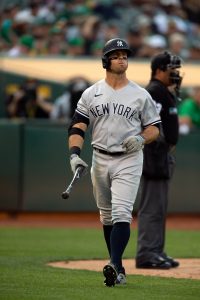
It’s the second consecutive offseason in which the Yankees have declined an option on Gardner. Last winter, the club opted to buy the veteran out rather than bring him back for $10MM. After a few months on the open market, the career-long Yankee returned to the Bronx on a complex deal that paid him a $2.85MM salary in 2021. The contract contained a $2.3MM player option for 2022. Were Gardner to decline, the Yankees were left to decide between exercising a $7.15MM club option or buying him out for $1.15MM.
Both sides have chosen to decline their end, meaning Gardner will collect the buyout figure and hit the open market. This again raises the possibility that Gardner could land elsewhere after spending the past fourteen seasons in a Yankee uniform. It’s certainly still possible New York and Gardner’s reps at Meister Sports Management look to hammer out a new agreement that lands somewhere in between the respective values of the player and club options, but he’ll now be free to explore opportunities with other teams as well.
The 2021 campaign was something of a mixed bag for Gardner, who likely wound up thrust into a bigger role than the team had envisioned. With Aaron Hicks suffering a season-ending injury in May, the 38-year-old Gardner stepped in as the Yankees’ primary center fielder. Both Statcast’s Outs Above Average and Defensive Runs Saved tabbed him as a roughly average center fielder, no small feat for a player his age.
Gardner’s production on the other side of the ball dipped, though, as he posted his worst hitting numbers since 2018. Over 461 plate appearances, the left-handed batter put up a .222/.327/.362 line with 10 homers. Gardner still walked in a fantastic 13% of his trips and struck out less often than average, but he’s posted low batting averages on balls in play for the last few seasons and the 28 homers he popped in 2019 looks like an outlier after back-to-back down power years.

While Gardner has spent his entire career in pinstripes, O’Day’s time in the Bronx might last just one season. The veteran submariner signed a free agent deal with a similar structure as Gardner’s last winter, albeit at a lesser sum. His contract paid a $1.75MM salary in 2021 and came with a $1.4MM player option for 2022. Once O’Day declined his end, the Yankees were left to decide whether to bring him back for $3.15MM or buy him out for $700K.
O’Day’s time with the Yankees didn’t go according to plan, as he was limited to 10 2/3 innings by injuries, including a left hamstring strain that ended his season in early July. Now 39 years old and coming off an injury-wrecked season, O’Day is looking at another low-cost deal this winter. Still, he seems likely to top the $700K gap between his buyout figure and the player option salary, so he’ll hit the open market in search of other opportunities. When healthy, O’Day has consistently been productive, posting a sub-4.00 ERA in every year since 2011.
Astros To Exercise 2022 Option On Yuli Gurriel
The Astros are set to exercise their $8MM club option to bring Yuli Gurriel back for 2022, the first baseman himself announced on Twitter. That’s hardly an unexpected development, as that option has looked like a mere formality for months given how well Gurriel played in 2021.
Gurriel returns for what’ll be a seventh season in Houston. A productive hitter over his first few seasons, he scuffled through an uncharacteristically poor 2020 campaign. Despite those struggles, the Astros struck early to keep him from reaching free agency last winter, signing him for a guaranteed $7.5MM in September with the 2022 option. It seemed a bit of a puzzling move at the time, but it turned out to be a fantastic decision by general manager James Click and his staff.
Not only did Gurriel return to form this past season, he posted a career year. Over 605 plate appearances, the right-handed hitter put up a .319/.383/.462 line with 15 home runs. That .319 mark won Gurriel his first batting title, and his overall offensive output was 34 percentage points above the league average by measure of wRC+. While he doesn’t hit for the kind of power typically found at the position, Gurriel is one of the game’s hardest players to strike out and walked in a career-high 9.8% of his plate appearances this past season.
With Gurriel’s option taken care of, he’ll return to again assume the everyday first base job. The move brings the Astros’ guaranteed 2022 commitments just north of $114MM, in the estimation of Jason Martinez of Roster Resource. An arbitration class collectively projected to earn around $14.5MM will push that total near $130MM before considering outside additions. That’s about $60MM shy of their season-opening outlay in 2021, so Click and his staff should have some flexibility in trying to retain or replace a free agent group that includes Carlos Correa, Justin Verlander,Kendall Graveman and Zack Greinke.
Zack Greinke Not Expected To Re-Sign With Astros
The Astros have one of the more significant crop of free agents around the league, as the team is facing the potential departures of Carlos Correa, Justin Verlander, Kendall Graveman and Zack Greinke, among others. Houston may make an effort to retain some of that group, but Bob Nightengale of USA Today reports (on Twitter) that Greinke is not expected to return to the Astros this winter.
Assuming he indeed signs elsewhere, Greinke will wrap up his Astros tenure after two and a half seasons. Acquired from the D-Backs in a surprise 2019 deadline day blockbuster, the six-time All-Star worked 62 2/3 innings with a pristine 3.02 ERA down the stretch. While he was knocked around in one start during the Division Series, Greinke had strong showings in both the AL Championship Series and World Series that year.
Over the past two seasons, Greinke has offered more steady mid-rotation production than the ace-caliber numbers he consistently posted for the bulk of his career. He worked 67 frames of 4.03 ERA ball in 2020, and put up a similar 4.16 mark over 171 innings this past season. His underlying numbers this year took a worrying downturn, though, which contributed to the team curtailing his postseason workload. Greinke’s strikeout rate dropped from 24.5% in 2020 to 17.2% this past season, while his home run rate doubled. During this year’s run to the World Series, skipper Dusty Baker relied more heavily on the team’s younger arms, with Greinke working just 6 1/3 innings of two-run ball in three playoff outings.
The dip in swing-and-miss should have some impact on Greinke’s offseason market, but the 38-year-old will no doubt still find plenty of interest. His 4.16 ERA, while his highest mark since 2016, was nevertheless a bit better than the leaguewide 4.34 showing for starting pitchers. Greinke remains one of the sport’s preeminent control artists, with this year’s 5.2% walk percentage checking in 11th-lowest among the 129 hurlers with 100+ innings. And that’s before considering the intangible value teams could expect from the 18-year big league veteran, who is regarded as one of the league’s most cerebral pitchers.
Nightengale suggests Greinke would prefer an opportunity with a National League team. That’s something of an odd distinction on the surface, since it’s widely expected that this offseason’s collective bargaining talks could result in the introduction of the designated hitter to the NL (thereby removing the biggest differentiator between the two leagues). Still, it’s possible Greinke — who played the bulk of the 2011-19 seasons playing for NL clubs — might broadly prefer the accommodations or ballparks in the NL to those of the American League.
Buster Posey Announces Retirement
After 12 Major League seasons, Buster Posey has called it a career. Alongside his wife Kristen, the longtime Giants catcher announced his retirement in a press conference Thursday afternoon.
Going into the offseason, the only question surrounding Posey seemed to be whether the Giants would simply exercise their $22MM club option on the catcher for next season, or if the two sides would work out a longer-term extension. Posey hit .304/.390/.499 with 18 home runs in 454 plate appearances in 2021, rebounding to prime form after opting out of the 2020 season, and struggling through a 2019 season in the aftermath of hip surgery.
 Instead, Posey will now hang up his cleats, ending an outstanding run as a Bay Area icon. Drafted with the fifth overall pick of the 2008 draft, Posey made his big league debut in 2009 and then won Rookie Of The Year honors in 2010, helping lead the Giants to their first World Series title since 1954.
That was the first of three championship rings for Posey, as he became the face of this era of Giants baseball. Posey’s long list of achievements includes the 2012 NL MVP Award, seven All-Star selections, four Silver Slugger Awards, and a Gold Glove in 2016. He retires with 158 home runs and a career slash line of .302/.372/.460 over 5607 plate appearances, and is likely heading for a Hall Of Fame induction in five years’ time.
While Posey’s outstanding 2021 leaves the impression that he has plenty left in the tank, it shouldn’t be ignored that at this time last year, a retirement following the 2021 campaign seemed quite plausible, or even likely. The hip surgery was the latest in a series of notable injuries for Posey throughout his career, including leg and ankle injuries suffered in a collision with Scott Cousins in 2011 (the impetus for MLB changing its rules about baserunners can make contact with catchers while trying to score). Most troubling, Posey also suffered multiple concussions over the course of his 12 years, and there was long speculation that the Giants would eventually move him over to a semi-permanent first base role.
Posey is only 34 years old, but with all of his accumulated wear-and-tear, it could be that he simply preferred to leave on the high note of a great personal season and the Giants’ 107-win campaign. Posey and his wife are also the parents of four children, including adopted twin girls born prematurely last summer (which Posey said factored into his decision to opt out of the 2020 season). There is certainly nothing left to prove for Posey, and he can now enjoy a well-deserved retirement and more time with his family.
While Posey’s role in Giants history can’t truly be replaced, the team hopes it already has a worthy heir apparent in Joey Bart, the second overall pick of the 2018 draft. Posey’s return to form created some questions about how exactly San Francisco would juggle playing time behind the plate, yet now the catching situation looks like it will consist of Bart and incumbent veteran Curt Casali. The Giants could quite possibly target another veteran to compete with Casali in Spring Training and provide more backing in case Bart (who has played in only 35 Major League games) needs more time to get acclimated.
San Francisco also now has at least $22MM in extra payroll space next season, not that the team didn’t already have plenty of spending capacity. The Giants’ surprising 107-win year has left the team well ahead of schedule in their rebuild, and the focus will squarely be on contending for a World Series title in 2022. While truly big expenditures haven’t been part of the strategy thus far for president of baseball operations Farhan Zaidi, he will have every avenue open to him this winter, whether it be major free agent signings, big-ticket trade acquisitions, re-signing notable in-house free agents like Brandon Belt, or all of the above.
Andrew Baggarly of the Athletic first reported Posey’s decision to retire.
Photo courtesy of USA Today Sports Images
D-backs Decline Option On Tyler Clippard
6:19 pm: Arizona confirmed (Twitter link) that they declined their end of Clippard’s mutual option for the 2022 season.
11:34 am: Diamondbacks right-hander Tyler Clippard has been formally declared a free agent, per an announcement from the MLBPA. Clippard’s contract with Arizona had a $3.5MM mutual option for the 2022 season that came with a $500K buyout.
D-backs general manager Mike Hazen told the Arizona Republic’s Nick Piecoro yesterday that he could not yet say whether Clippard’s option would be picked up or bought out. It’s not immediately clear which side declined the option — Clippard had the right to decline before the D-backs made their intent known — but the result is the same: Clippard will receive that $500K buyout and return to the free-agent market in search of a new opportunity.
Clippard, 37 in February, is a perennially effective and perennially underrated reliever who’ll now likely look to sign what would be a fifth consecutive one-year deal. The veteran changeup specialist signed a one-year pact in Arizona last year, suffered a shoulder strain during Spring Training, and spent nearly four months on the injured list. However, when healthy, Clippard had another generally productive run. In 25 1/3 innings, he yielded a solid 3.20 ERA with just three home runs allowed.
That said, Clippard’s 2021 season wasn’t without its red flags — even beyond the injury. This year’s 18.9% strikeout rate was his lowest since 2008, while his 9.9% walk rate was his highest since 2017. Clippard has never been a flamethrower, but his 89.1 mph average fastball this season was also a career-low and ranked as the 16th-lowest mark among 344 relievers with at least 20 innings pitched.
It should also be pointed out that while Clippard and that signature changeup have historically dominated opposing left-handed batters, that was far from the case in 2021. Rather, Clippard was clubbed for a .279/.354/.581 line by opposing lefties. Clippard’s dominance over lefties and similarly (and more expected) sharp results against right-handers has long been one of his most desirable assets, so this year’s struggles in that regard could further dampen his market.
Athletics Sign Dany Jimenez
The A’s have agreed to a minor league contract with right-hander Dany Jiménez, reports Martín Gallegos of MLB.com (Twitter link). It’s unclear whether he’ll receive an invitation to big league Spring Training.
Jiménez was a part of the Oakland organization last offseason as well. The A’s selected him out of the Blue Jays’ system in the Rule 5 draft. He didn’t stick on the roster, though, as Oakland returned him to the Jays in mid-March. Jiménez spent the entire 2021 season with Toronto’s Triple-A affiliate, tossing 44 2/3 innings of 2.22 ERA ball there but never getting a major league look despite the Jays’ persistent bullpen troubles.
The 27-year-old punched out an incredible 39% of batters faced in the minors, the highest strikeout percentage among the 207 Triple-A East pitchers with 40+ frames. But Jiménez also struggled to throw strikes, issuing free passes at a huge 13.4% clip. Those control issues no doubt played into the Jays’ decision to keep him in the minors all season.
At the conclusion of the season, Jiménez elected minor league free agency. That set the stage for him to land back with the A’s, where he’ll try to get back to the big league level for the first time in two years. His major league experience to date consists of two relief appearances with the 2020 Giants, who’d selected him in the Rule 5 draft over the 2019-20 offseason but also returned him to Toronto rather than keep him in the majors all year.
Mets, Kevin Pillar Decline 2022 Option
Veteran outfielder Kevin Pillar is headed back to the open market after both he and the Mets declined the dual options on his contract, per MLB Network’s Jon Heyman (Twitter link).
Pillar held a $2.9MM player option for the 2022 season, which did not carry a buyout, while the Mets held a $6.4MM club option with a $1.4MM buyout. Pillar’s decision was due first, and he opted to decline his end knowing that he had least the $1.4MM buyout of the Mets’ club option waiting for him. It’s a bit of a bet on himself, but so long as he tops $1.5MM in 2022 earnings, he’ll come out ahead in the gambit.
It was a rather unconventional contract that essentially boiled down to one of three outcomes: two years and $6.5MM (if Pillar exercised his end); two years and $10MM (if the Mets exercised their end); or one year and $5MM (both parties declining).
It was a convoluted way to get there, but the Mets effectively were able to sign Pillar for a year and $5MM while utilizing a player option (which counts as “guaranteed” money for luxury-tax purposes) to reduce the luxury hit to $3.25MM. The Mets wound up a good bit shy of the luxury threshold anyhow, but Pillar’s unique contract structure would’ve provided some additional in-season flexibility had they sought to add some payroll at the deadline.
Pillar’s 2021 season was disrupted by a grisly injury that saw him sustain multiple nasal fractures when an errant Jacob Webb fastball hit him in the face. Down on the field for several minutes following that frightening hit-by-pitch, Pillar was eventually able to walk off the field under his own power. Remarkably, Pillar missed only two weeks of action — a welcome outcome after what carried the potential for a far more severe injury.
With the Mets, Pillar tallied 327 plate appearances and turned in a .231/.277/.415 batting line with 15 home runs, 11 doubles, a pair of triples and four stolen bases. His 3.2% walk rate was the lowest in baseball for any player with at least 300 trips to the plate — an ongoing theme throughout Pillar’s career that has continually curbed his on-base percentage. Defensively, Pillar clocked in below average by most measures. Although he was once an otherworldly defender in center, he hasn’t turned in a positive mark in Defensive Runs Saved since 2017.
It’s a thin market for free-agent center fielders, though, and Pillar’s extensive experience there (and ability to play both corners) ought to generate some interest. He’s also a career .280/.312/.459 hitter against left-handed pitching (104 wRC+), so he could land a spot as a part-time outfielder on a contender’s bench next year or perhaps a larger role on a rebuilding team in search of an affordable veteran option.
Andrew Chafin Declines Mutual Option
Athletics left-hander Andrew Chafin is declining his half of a $5.25MM mutual option and will become a free agent, tweets MLB Network’s Jon Heyman. He’ll be paid a $500K buyout and return to the open market as one of the more appealing left-handed relievers available in free agency. Oakland has since announced that Chafin declined his portion of the option and that the team exercised its own half (although Chafin’s decision was due first).
The 31-year-old Chafin was nothing short of excellent for both the A’s and the Cubs in 2021, pitching to a combined 1.83 ERA with a 24.1% strikeout rate and a 7.1% walk rate through 68 2/3 innings. Chafin held left-handed hitters to a laughable .170/.250/.233 batting line and was only marginally more vulnerable against right-handed opponents, who mustered just a .196/.247/.304 slash against the southpaw.
Chafin yielded an average exit velocity of just 87.7 mph in 2021, ranking in the 78th percentile of big league hurlers, and Statcast placed him in the 85th percentile or better in hard-hit rate, opponents’ chase rate, expected ERA, expected opponents’ average and expected opponents’ slugging — all based on the quality of the contact he allowed and his K-BB tendencies.
That terrific season marked not only a rebound from a poor showing in 9 2/3 frames during the shortened 2020 season but also a career year on the mound. Chafin was a strong lefty option with the D-backs from 2015-19, pitching to a combined 3.55 ERA in 251 innings of relief, but the 2021 campaign is far and away the best work of his career to date.
Given the relatively thin market for left-handed relievers and the outstanding work he delivered this season, Chafin should command interest on multi-year deals from contending clubs looking to add some southpaw firepower to the back of their relief corps.
Adam Duvall Declines Mutual Option, Will Be Arbitration-Eligible
Braves outfielder Adam Duvall has declined his half of his $7MM mutual option, reports Craig Mish of SportsGrid and the Miami Herald (via Twitter). He’ll receive a $3MM buyout. However, because Duvall has fewer than six years of Major League service time, he’ll remain with the Braves as an arbitration-eligible player — should they wish to tender him a contract. MLBTR contributor Matt Swartz projects a $9.1MM salary for the veteran slugger.
Duvall signed that one-year deal with the Marlins last winter, after being non-tendered by a Braves team that ultimately reacquired him prior to the trade deadline. The 33-year-old Duvall has long been a strong defender with a perilously low OBP and plenty of power, but he dialed that skill set up to new heights in 2021. Duvall slugged a career-best 38 home runs and posted a whopping 19 Defensive Runs Saved (in addition to a 9.9 UZR and 5 Outs Above Average), but he also turned in a .281 OBP that tied him for the second-worst mark among all qualified hitters in Major League Baseball. The bottom-of-the-barrel OBP was enough for weighted metrics like wRC+ and OPS+ to peg his overall offense at just two to three percent better than the league average.
Still, a 30-homer bat with plus defense in the outfield corners is a plenty useful player, even if Duvall perennially ranks near the bottom of the league in on-base percentage. The projected $9.1MM price point is plenty reasonable for a player who posted 3.1 bWAR and 2.4 fWAR on the season, but it bears repeating that the Braves non-tendered Duvall not even one year ago, when he carried a smaller arbitration projection and was coming off a similar season. In 209 plate appearances with Atlanta in 2020, Duvall hit .237/.301/.532 with 16 home runs — a pace that falls pretty closely in line with this year’s .228/.281/.491 output.
Of course, the Braves have less certainty in their outfield than they did last year — and their World Series win likely gives them some additional resources. A good chunk of that extra cash has to be earmarked for a hopeful Freddie Freeman extension, but the Braves can clearly afford to keep Duvall in the fold if they so choose. And with each of Eddie Rosario, Jorge Soler and Joc Pederson set to hit free agency, plus Ronald Acuna Jr. on the mend from an ACL tear and Marcell Ozuna‘s status up in the air following an alleged domestic assault, Atlanta could well decide place a premium on the certainty that’d come from tendering a contract to Duvall.
They’ll have until Dec. 2 to make that call, although with the collective bargaining agreement set to expire one day earlier, on Dec. 1, it’s best not to assume anything transaction-wise from that point forth.
Avisail Garcia Declines Mutual Option, Becomes Free Agent
Brewers outfielder Avisail Garcia has declined his half of a $12MM mutual option for the 2022 season, reports MLB Network’s Jon Heyman (Twitter link). He’ll instead receive a $2MM buyout and head out into the free agent market in search of another multi-year deal.
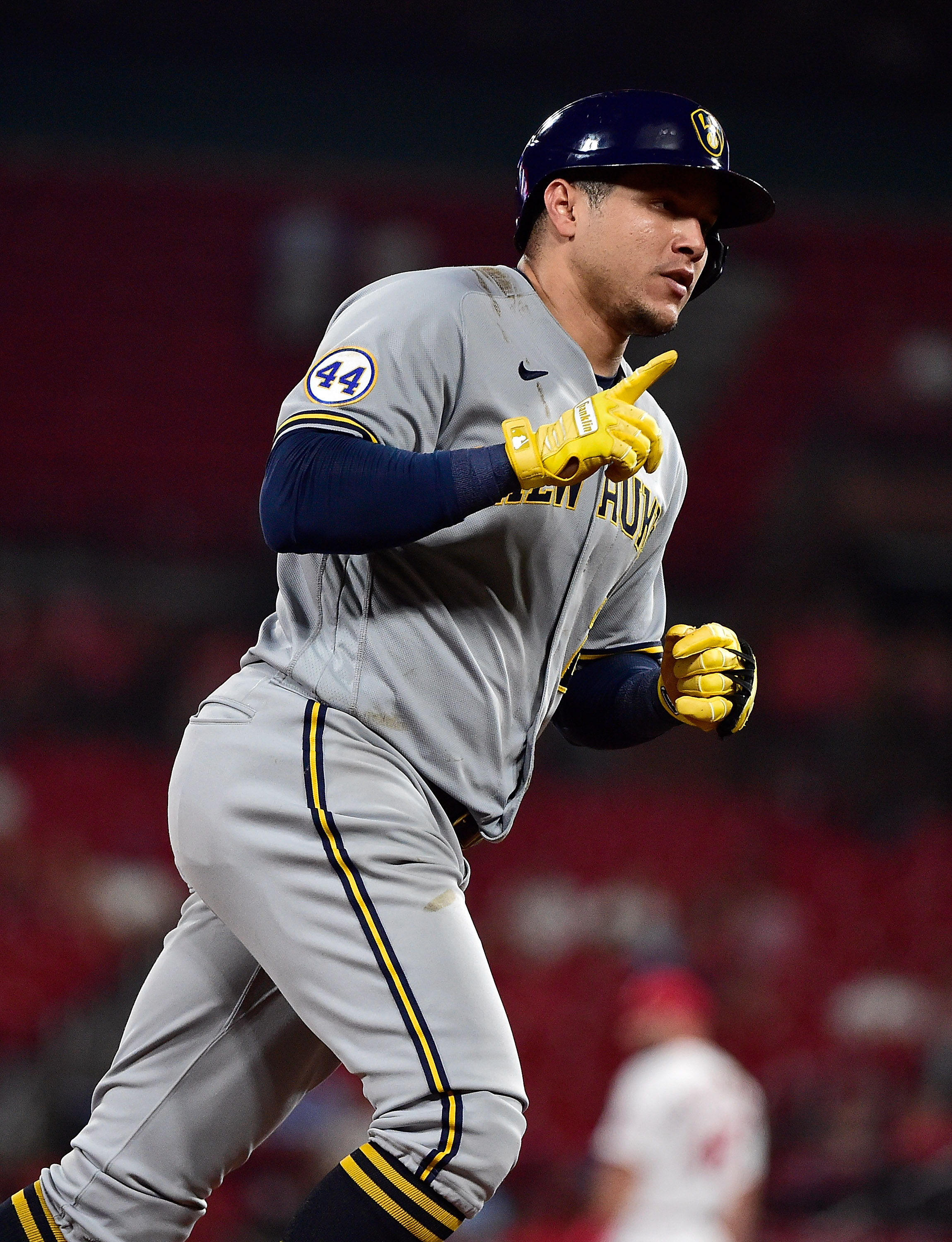
Garcia, 31 next June, struggled through the 2020 season in Milwaukee but enjoyed one of the finest seasons of his career in a rebound 2021 showing. The former Tigers, White Sox and Rays slugger swatted a career-best 29 home runs this season while posting a strong .262/.330/.490 batting line — about 15 percent better than league-average production, by measure of wRC+. His original two-year, $20MM deal with the Brewers came with a $12MM club option that the team could very well have exercised. However, the contract also contained a provision that converted that option into a mutual option with enough plate appearances, and Garcia reached that threshold back in September, earning the right to return to the free-agent market.
This will be the second foray into the free-agent market for Garcia, who posted a similar 113 wRC+ mark in his last platform year (2019). However, Garcia hit for more power in ’21 than he did in ’19 and also drew better defensive grades for his outfield work this year (in part because the 2019 Rays occasionally deployed him in center, to sub-par results).
Another multi-year deal for Garcia seems quite likely, as he’s wrapped up a strong season and further solidified the notion that he’s capable of being a team’s everyday right fielder. Garcia crushed lefties in 2021 (.279/.406/.529), as he is wont to do, and delivered league-average output against right-handed opponents. The question for him in free agency will be the extent by which he can eclipse his prior contract.
The improved power output and defensive ratings are obvious points in Garcia’s favor, but he’s now also two years older than last time around. His 2021 Statcast profile is quite appealing, as Garcia ranked in the 73rd percentile of MLB hitters in average exit velocity and had strong percentile showings in hard-hit rate (78th), expected batting average (83rd), expected slugging (87th), expected wOBA (85th) and sprint speed (88th). Then again, much of that was true in 2019 (albeit not quite to this extent).
Garcia has long shown a knack for hard contact and far more speed than one would expect from a player listed at 6’4″ and 250 pounds. The 2021 season, however, is the first that he’s delivered truly high-end power output with the type of plus defensive ratings that align with his tantalizing tool set. The Brewers technically have the right to make him an $18.4MM qualifying offer, but that’d register as something of a surprise given the typically tight payroll in Milwaukee.