
Baseball Blogs Weigh In: Blue Jays, Giants, A-Rod
Here’s this week’s look at the baseball blogosphere:
- Vavel has a model for predicting free agent salaries based off of MLBTR’s rankings.
- Baseball Hot Corner is worried about the Blue Jays.
- BASTA wonders what the Giants should do about their outfield.
- Baseball Essential evaluated the Giants’ rotation.
- Gardy Goes Yardy explored comps for A-Rod’s remaining seasons.
- Redbird Rants is pining for a big Freddie Freeman blockbuster.
- Pirates Breakdown pitted the Bucs’ homegrown talent vs. everyone else’s.
- World Series Dreaming talks Cubs contingency plans.
- Fansided pairs top free agents with teams.
- MLB Reports checked in on the Yankees.
- Roto Professor discussed the potential of the Rays’ Taylor Guerrieri.
- Outside Pitch MLB wonders if the Tigers are done shopping.
- TPOP wonders if the Pirates are going to lean on prospects instead of free agents.
- Matthew Musico compared the Mets and Cubs.
- Pinstriped Prospects is excited about the Yanks’ farm system.
- Brew Crew Ball sized up Wily Peralta as a trade chip.
- Think Blue weighed the Dodgers’ options with Carl Crawford.
- Wayniac Nation wonders what’s next for Brett Gardner.
- MLB Reports checked in on the Yankees.
Please send submissions to Zach at ZachBBWI@gmail.com.
Quick Hits: Ruth, Davis, Nationals, Yankees
It was on this day in 1919 that probably the single most influential trade in baseball history was settled, as Red Sox owner Harry Frazee agreed to sell Babe Ruth to the Yankees for a price of $100K (plus a $350K loan from Yankees owner Jacob Ruppert that included Fenway Park’s mortgage put up as collateral). The trade was officially announced a week later once Ruth had agreed to a new contract. The rest, as they say, was history. Ruth’s presence began the Yankees’ historic dominance and “cursed” the Red Sox to a World Series drought that lasted until 2004.
Here’s more from around baseball…
- The latest subscription-only column from ESPN’s Buster Olney lists the top roster holes left on contending teams, with the Dodgers’ rotation leading the way followed by the Orioles‘ need for a power hitter. Since the O’s pulled their $150MM offer to Chris Davis, some within the organization are asking if that offer should be put back onto the table if Davis revisits talks, given that no other teams are seemingly jumping in to pay Davis $150MM or more.
- Also from Olney’s column, he wonders if signing Daniel Murphy could make the Nationals more likely to sign another qualifying offer free agent. The Nats surrendered their first-rounder to sign Murphy, so they’d only be giving up a second-rounder for another QO player. I’d add that the Nats’ decision could be made even easier by the fact that they at least one and probably two bonus sandwich round picks from their own QO free agents (Jordan Zimmermann and Ian Desmond). Olney suggests that Dexter Fowler could be the best fit for Washington among the remaining qualifying offer free agents, with Wei-Yin Chen and Ian Kennedy also possibilities as Scott Boras clients.
- The Phillies serve as a cautionary tale to the Yankees, Joel Sherman of the New York Post writes, as a team that fell apart due to a thin farm system and little production from veterans on big contracts. With New York already committing millions to aging veterans, the club is trying to manage the tricky task of getting younger while still remaining a contender, even if that means eschewing adding another big contract in free agency this winter.
Central Notes: Warren, Francona, Tigers, Salty
Adam Warren found out about his trade to the Cubs in a somewhat unusual fashion, as he explained in an interview with MLB Network Radio on SiriusXM (hat tip to CBS Sports’ Mike Axisa). Warren and his wife were on vacation in St. Lucia and “our biggest rule when we go out of the country is to turn your phone off, put them into the safe in the room, and basically get away from technology.” This meant that the Warrens discovered that the right-hander had been dealt to Chicago as part of the Starlin Castro trade only by watching a TV screen’s sports ticker while at dinner. Here’s some more from around the Central divisions…
- Indians manager Terry Francona touched on such topics as his relationship with the front office, the Tribe’s reluctance to trade its starting pitching, and the club’s winter moves in a wide-ranging interview with Terry Pluto of the Cleveland Plain Dealer. Francona stressed the importance of pitching depth, saying he’d rather “take his chances” with having one less bat in the lineup than giving up a rotation member. He and the front office “were all in agreement that we were not going to trade one of our (top) starters unless we were overwhelmed with an offer.”
- Francona said Rajai Davis was “the first name out of my mouth” in postseason discussions about what outfielders the Indians could sign within their price range. He noted that Davis “has always been such a thorn when we’ve played against him” as a member of the Tigers. Francona also praised new first baseman Mike Napoli‘s power and clubhouse presence, saying that after Cleveland signed Napoli, his “phone about blew up” with texts “from guys who had played with Mike and really liked him.”
- The Tigers have long been plagued with bullpen issues, yet Anthony Fenech of the Detroit Free Press writes that the club has quickly and seemingly solidly addressed its relief needs before the end of 2015 in adding Francisco Rodriguez, Justin Wilson and Mark Lowe. “I can’t say I’m surprised, but I will tell you that I didn’t know if we were ever really going to be able to do the whole thing,” GM Al Avila said. “But it was a methodically laid out plan and you don’t know if you’re going to be able to do it, you don’t know if you’re going to have some bumps along the road, you don’t know if it’s going to take longer or shorter.”
- In another piece from Fenech, Jarrod Saltalamacchia said he decided to join the Tigers due to their commitment to winning. Though several other teams were interesting in signing the catcher, it was “an easy decision” for Saltalamacchia since “it’s an organization that every year is trying to compete for the World Series.”
- In other Central division news from earlier today, the Cardinals‘ deal with Mike Leake became official, and CBS Sports’ Jon Heyman reported on the five-year, $80MM contract’s rather unusual annual salary breakdown.
Poll: Who Will Be The Next Of These Top-10 Free Agents To Sign?
In our last MLBTR poll, over 38.6% of MLBTR readers surveyed felt that Alex Gordon would be the next to sign out of a group consisting of the top five players left on MLBTR’s list of this offseason’s Top 50 Free Agents. Fast-forward a week and, unsurprisingly, all five players (Gordon, Justin Upton, Chris Davis, Yoenis Cespedes and Ian Desmond) are all still on the board.
Earlier today, Charlie Wilmoth examined the situations surrounding not just those five, but also the next five remaining from MLBTR’s original list — Wei-Yin Chen, Kenta Maeda, Dexter Fowler, Scott Kazmir and Ian Kennedy. These five may not carry the high price tags of the top-rated quintet, so it’s possible any of them could come off the board before Gordon and company. (Then again, it wouldn’t shock me if Chen or Maeda both sign for more than Desmond given how badly Desmond struggled in 2015. In fact, with the other top free agent pitchers all signed, it’s possible Chen or Maeda could even best Gordon’s eventual contract.)
Also, given the intertwined free agent market, some of the big names may need to be signed before attention can be turned to the next five names. As Charlie noted, for instance, Fowler’s market may not come into focus until the top-tier outfielders find new homes. Conversely, Fowler offers a different skillset than Upton, Cespedes or Gordon, so it’s also possible he could be signed before any of them.
The qualifying offer also looms large in this tier of free agents. Chen, Fowler and Kennedy all rejected the QO, so any new team that signs them will have to give up a draft pick as compensation. Maeda, obviously, doesn’t have the qualifying offer to worry about coming from Japan, though he has two more obstacles — the extra $20MM posting fee his MLB team will have to pay to the Hiroshima Carp, and the simple fact that Maeda is the most unknown quantity in Major League play. Kazmir doesn’t have a qualifying offer attached, yet that actually may be what’s holding up his signing since multiple teams are showing interest; Kazmir reportedly has several three-year offers in hand but he may be holding out for a team that gives him that guaranteed fourth year.
With these factors in mind, which of the “next five” do you think will be the first to sign a contract? (MLBTR app users can weigh in here)
Which Of These Free Agents Will Sign First?
-
Scott Kazmir 48% (4,593)
-
Kenta Maeda 23% (2,197)
-
Wei-Yin Chen 13% (1,234)
-
Dexter Fowler 12% (1,112)
-
Ian Kennedy 4% (369)
Total votes: 9,505
Managers And GMs On Expiring Contracts
If a team is intent on shaking up its front office or dugout, contract length is usually not a great concern. For example, when the Mariners decided to part ways with GM Jack Zduriencik last summer, the club didn’t hesitate even though Zduriencik signed a multi-year extension in August 2014. Likewise, former manager Lloyd McClendon’s guaranteed contact through 2016 didn’t stop new GM Jerry Dipoto from making a change after the season.
This being said, everyone obviously wants more security than less when going into a season. It’s usually rather unusual for a team to let its manager or top baseball executive be a “lame duck” for optics purposes if nothing else, though there are some extenuating circumstances. Some executives or managers are so entrenched that they’ve already been given unwritten assurances that they’ll eventually receive new deals, or some skippers prefer to work on one-year deals (i.e. Walt Weiss’ original contract with the Rockies) since they’re unsure as to how long they wish to remain on the job.
Here’s the rundown of managers and GMs who could be facing a bit of extra pressure in 2016 as they’re entering the final guaranteed year of their contracts. (Much thanks to Cot’s Baseball Contracts for many of these details.) While we’re focusing mostly on GMs, there’s also one very prominent example on this list of a president of baseball operations entering a contract year. One caveat: some teams don’t make front office contract details public, so it’s possible that some of these executives may have already quietly agreed to extensions.
White Sox: Team owner Jerry Reinsdorf is a big fan of Ventura, so the skipper’s contract status (he’s entering the last season of a two-year extension) may not be a big factor. Of larger import, of course, could be Chicago’s performance given how the Sox underachieved in 2015. Another rough season could also lead to some speculation about the status of GM Rick Hahn; his contract terms aren’t known, though he was promoted to his current role after the 2012 season.
Twins: The details of Terry Ryan’s contract aren’t known, though given his long history in Minnesota and the Twins’ return to winning baseball last year, it’s hard to imagine Ryan leaving as GM unless he chooses to do so himself.
Tigers: Brad Ausmus was reportedly almost fired last season before former GM Dave Dombrowski fought to keep the manager. Reports then emerged in September that the club was planning to let Ausmus go at season’s end, though when ownership let new GM Al Avila make the decision, Avila opted to keep Ausmus in place. Avila’s support notwithstanding, it still seems like Ausmus is on thin ice given how badly owner Mike Ilitch wants to win; even a slow start next season could raise new rumors about a managerial change. Ausmus is signed through 2016 and Detroit has a club option on his services for 2017.
Royals: GM Dayton Moore and manager Ned Yost are both entering the last year of their contracts, so they clearly have a lot of negotiating power in the wake of Kansas City’s World Series championship. Yost, however, signed just a one-year extension last winter and said at the time that he only wanted to manage two or three more seasons. If he still feels this way, Yost may sign another one-year extension at most or he could just ride his current deal out before retiring. Yost and Moore both expressed no doubts that ownership would work out extensions with both men, so it’s likely just a matter of time before those new deals are finalized.
Rockies: Walt Weiss is entering the last season of the three-year extension he signed after the 2013 season and he’s yet to top even the 74-win plateau as Colorado’s manager, posting an overall 208-278 record. It’s rather hard to blame Weiss, however, given how the Rockies have suffered through injuries, consistently poor pitching and a change in front office mentality (as evidenced by the hiring of GM Jeff Bridich and the trade of Troy Tulowitzki) since he became manager. As such, it’s hard to judge exactly how much or little job security Weiss has, though if the Rockies struggle again in 2016, Bridich could quite possibly get the green light to hire his own manager.
Reds: Bryan Price is entering the final year of his original three-year contract, and there was some question as to whether he’d return for that third year in the wake of a tough season on and off for the field for the skipper. With Cincinnati going into a rebuild, however, the club’s expectations for its manager may have changed; rather than wins and losses, Price may now be judged on how he handles the development of an overall younger roster.
Phillies: The team was impressed enough by Pete Mackanin as an interim manager that they gave him the full-time job in September, signing him through 2016 with a club option for 2017. It’s fair to say that Mackanin is quite safe as he leads the rebuilding young Phillies.
Nationals: After Washington grossly underachieved from their preseason favorite status, GM Mike Rizzo may just have a “tenuous” grip on his job. Rizzo is under contract through 2016 and the Nats have a club option on him for 2017, and it’s quite possible Rizzo will need a major rebound season for his team in order to keep his job.
Diamondbacks: Chip Hale signed a two-year contract with a club option for 2017, and his first season as manager saw the D’Backs make a 15-win improvement from 2014. It was a good first step in leading the Snakes back to respectability, but expectations are now sky-high following Arizona’s acquisitions of Zack Greinke and Shelby Miller. Barring a disaster season, however, I’d think Hale’s job is fairly safe. It also wouldn’t surprise me if the D’Backs extended Hale this winter, at least in the form of guaranteeing that club option year.
Cubs: Theo Epstein’s contract as Chicago’s president of baseball operations is up after this season. While GM Jed Hoyer’s contractual status isn’t public, given that he was hired just a week after Epstein in October 2011, it’s safe to assume that his deal is probably also set to expire at the same time as his boss and longtime co-worker. Epstein didn’t sound too concerned about his contract status when asked about it in October, and he hinted that extensions for other front office members would be more of a priority. It’s difficult to imagine Epstein leaving just as the Cubs have become contenders again, especially given the historic significance of a Cubs World Series victory. Given his track record and how the Cubs have rebounded, Epstein is already in position to command the largest contract ever given to a baseball executive in his next contract, whether it’s in Chicago or elsewhere.
Braves: The club extended Fredi Gonzalez’s contract last summer, guaranteeing his 2016 year and adding a club option for 2017. The Braves are now in such full-fledged rebuild mode that firing Gonzalez now would seem unusual given how they had arguably more reason to do so prior to his extension, such as after the team’s late-season collapse in 2014. Atlanta has targeted 2017 and the opening of its new ballpark for a return to respectability, so it wouldn’t be a shock if a change was made next winter if the team feels its rebuild is over and a dugout upgrade is needed to take the next step into contention.
Blue Jays: John Gibbons is only technically on this list for another few days given his rolling contract. If Gibbons is still the Jays’ manager on January 1, Toronto’s club option on his services for 2017 will become guaranteed and another club option will be generated for 2018. Despite the Jays’ AL East title last year, Gibbons (who had a close relationship with former Toronto GM Alex Anthopoulos) may still be under extra pressure in 2016 with Mark Shapiro and Ross Atkins now atop the Blue Jays’ baseball operations pyramid.
Astros: The terms of Jeff Luhnow’s original deal to serve as Houston’s GM weren’t revealed when he was hired in the 2011-12 offseason, nor were the terms of his extension during the 2013-14 offseason (in fact, news of that extension didn’t even break until roughly a year after the fact). Looking at the timeline of these deals, it’s possible 2016 could be Luhnow’s last year under contract, though this all could be a moot point — given how his extensive and sometimes controversial rebuild paid off in the form of a playoff berth, Luhnow likely isn’t going anywhere.
Cafardo’s Latest: Gallardo, Dunn, Gordon, Maeda, Rays, Hill
Nick Cafardo shares his Cooperstown ballot and some hot stove items in his latest column for the Boston Globe…
- Alan Nero, Yovani Gallardo‘s agent, said he had talked with teams over the last week but nothing has moved forward with his client’s situation. The Royals, Astros and Orioles were all linked to Gallardo two weeks ago, and since those teams are also finalists for Scott Kazmir‘s services, Cafardo figures the two pitchers have somewhat shared markets at the moment.
- It’s looking as if the Marlins may trade lefty Mike Dunn, as Miami has received interest in the reliever. Dunn posted a 4.50 ERA, 10.8 K/9 and 2.24 K/BB rate over 54 innings in 2015, a bit of a down year following very good seasons in 2013-14. ERA indicators and advanced metrics, however, don’t show too much of a difference between Dunn in 2014 and 2015 aside from an increase in home run rate (6% to 11.1%) and walk rate (3.47 to 4.83). Dunn battled severe control problems early in his career, and Cafardo says that Dunn’s rise in walk rate has scared a few teams away. The southpaw is entering the last year of a two-year extension that will pay him $3.45MM in 2016.
- Alex Gordon “prefers to stay in Kansas City, though that dream may be fading.” According to reports earlier in the week, the Royals offered Gordon a four-year deal worth around $12MM-$13MM per season, and Gordon’s agents told the club that it has “no chance” of re-signing him at the moment.
- The Dodgers are seen as the favorites for Kenta Maeda given their need for pitching, though Cafardo also says L.A. is looking at trading for Jake Odorizzi “and/or” Alex Cobb from the Rays. Odorizzi has already been linked to the Dodgers in rumors and I would have to think that Los Angeles would just target one Rays pitcher since the prospect cost for both would be overwhelming (even if Cobb will miss at least half of 2016 recovering from Tommy John surgery).
- Rich Hill tells Cafardo that the Athletics‘ “immediate” and persistent interest, pitcher-friendly O.co Coliseum and the presence of pitching coach Curt Young (Hill’s former pitching coach in Boston) all factored into his decision to sign a one-year, $6MM contract with Oakland. Hill also noted that the A’s are “giving me a chance to make those 32 starts,” and according to Yahoo’s Jeff Passan at the time of the signing, Hill turned down a larger offer from another team due to Oakland’s promise of a regular rotation spot.
Dodgers To Sign Elian Herrera
The Dodgers and utilityman Elian Herrera have agreed to a contract, as revealed by Herrera himself via his Twitter account. It’s a minor league deal and Herrera will be invited to the Dodgers’ big league Spring Training camp, J.P. Hoornstra of the Los Angeles News Group reports.
Herrera, who turns 31 in February, is back with the club that originally signed him as an amateur free agent out of the Dominican Republic in 2003. He spent his first two MLB seasons with L.A. before being claimed off waivers by Milwaukee following the 2013 campaign. Though Herrera is still a season away from arbitration eligibility, he was non-tendered by the Brewers earlier this month in a move to create roster space.
Over four seasons and 639 plate appearances in the bigs, Herrera has a .253/.306/.360 slash line and eight career homers. Seven of those home runs came last year as Herrera received some significant playing time (277 PA in 83 games) with the Brewers and he posted a .684 OPS. The switch-hitter has generally even career splits from both sides of the plate, though he performed significantly better against righties than lefties in 2015. Herrera also delivered a big .904 OPS in 233 for the Brewers’ Triple-A affiliate last year and has put up solid hitting numbers over 3050 minor league PA.
Herrera’s calling card has been his versatility, as he’s made at least 10 starts at second, third, short and all three outfield spots in his Major League career. Most of his playing time has come at second and third, so Herrera could join Micah Johnson as depth behind Chase Utley, or he could be an insurance policy if Justin Turner isn’t fully recovered from knee surgery.
Quick Hits: Red Sox, Relievers, Pirates
The acquisitions of Craig Kimbrel and Carson Smith should improve the Red Sox in high-leverage situations, helping them win one-run games, Brian MacPherson of the Providence Journal writes. Three of the four teams that had the best results in high-leverage situations last season were nine or more games above .500 in one-run games. The Red Sox already had two good late-inning relievers in Koji Uehara and Junichi Tazawa, and there was perhaps some danger of there just not being enough high-leverage opportunities for Uehara, Tazawa, Kimbrel and Smith. But with Uehara vulnerable to aging and Tazawa vulnerable to injury, Kimbrel and Smith should provide the Red Sox with needed reinforcements. Here are more quick notes from around the league.
- This offseason has been notable for the large contracts pitchers like Zack Greinke and David Price have received. Meanwhile, wages for relievers have remained flat, MacPherson writes. Greinke and Price’s deals are now the highest and second-highest ever in average annual value among contracts for pitchers, while the largest deal for relievers this offseason has been Darren O’Day‘s four-year, $31MM deal. Admittedly, this offseason’s market hasn’t been heavy on top-flight closers, and new contracts for Ryan Madson (three years, $22MM) and Tony Sipp (three years, $18MM) do perhaps suggest some wage growth for talented middle relievers. Overall, though, as MacPherson points out, the market for elite relievers does not appear to have grown much in the many years since Jonathan Papelbon, Francisco Cordero and B.J. Ryan signed long-term contracts in the $46MM-$50MM range.
- The Pirates took a slight gamble with their signing of C/DH John Jaso, in that they signed him to play first base, Jeff Sullivan of FanGraphs writes. The Pirates themselves have seen the downside of gambling that a player can make an easy transition to first base — Pedro Alvarez‘s defense there in 2015 was disastrous. As Sullivan points out, though, catchers from Buster Posey to Carlos Santana to Joe Mauer to Jason Phillips have generally done well in transitioning to first base. (I’d add Pickin’ Machine Scott Hatteberg to the mix as well.) Offensively, Sullivan writes, Jaso needs to be platooned, but he can be very effective against righties.
NL Notes: Phillies, Dodgers, Rockies, Cardinals
The Phillies only hired new GM Matt Klentak in late October, but he’s already been through a Winter Meetings and executed a big trade (that of Ken Giles to the Astros). In a Q+A, he tells MLB.com’s Todd Zolecki that he’s happy with the Giles deal (in which the Phillies received Vincent Velasquez and Mark Appel), and says that as the Phillies continue their rebuild, they’re confident that they’ll be able to supplement their growing collection of young pitching with hitters acquired from outside the organization. “Hitters generally regard our park as a good place to play,” he says. “I know that our ownership is very committed — and will be in the future — to bringing in the right players and the top-caliber players to help us.” Here’s more from the National League.
- The Dodgers still haven’t added any top-flight starting pitching to offset the loss of Zack Greinke, but president of baseball operations Andrew Friedman says he is now happy with the organization’s depth, Bill Plunkett writes for Baseball America. “This offseason is different than last in that going into next year, we feel much better about our pitching depth that will be in (Triple-A) Oklahoma City,” says Friedman. “We have a number of guys that we like that will be there and that is a big difference for us next year compared to this year just in terms of the depth that we’ll have on hand.” Oklahoma City’s rotation will likely feature top prospects Julio Urias and Jose De Leon, along with 40-man members Jharel Cotton and Ross Stripling.
- As FOX Sports’ Jon Morosi tweeted earlier this week, the Cardinals have spoken with the Rockies about a possible trade involving at least one Rockies outfielder. Benjamin Hochman of the St. Louis Post-Dispatch (and formerly of the Denver Post) writes that it’s probably more realistic that the Cardinals could pursue Corey Dickerson or Charlie Blackmon rather than Carlos Gonzalez, even though both Dickerson and Blackmon have negatives (for Dickerson, a weak arm; for Blackmon, poor numbers away from Coors Field). Hochman guesses that the Rockies’ end of a potential deal would likely begin with first baseman Matt Adams.
Cardinals Sign Mike Leake
After spending much of the offseason searching for a rotation upgrade, the Cardinals on Tuesday added a much-needed arm to the equation, announcing the signing of right-hander Mike Leake to a five-year deal. Leake, a client of the Beverly Hills Sports Council, will reportedly take home a guarantee of $80MM. His contract also includes a mutual option that can escalate the deal to $93MM and a full no-trade clause. Via CBS Sports’ Jon Heyman (on Twitter), Leake’s contract has a somewhat unusual sloped structure — he will receive $12MM in 2016, $15MM in 2017, $17MM in 2018, $16MM in 2019, $15MM in 2020, then an $18MM option or a $5MM buyout in 2021.
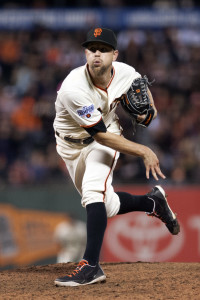
Having lost right-hander John Lackey to free agency — specifically, to the division-rival Cubs — and right-hander Lance Lynn to Tommy John surgery, St. Louis’ need for starting pitching was clear. The Cardinals began their search with a high-profile pursuit of David Price and even made the second-best offer to ace left-hander. But, while their seven-year offer edged out the rival Cubs, it was still worth $30MM less than that of the Red Sox.
Over the last few weeks, the Cardinals have continued to scan the market, though they were known to be averse to signing any player who had rejected the qualifying offer. Quality pitchers like Yovani Gallardo, Ian Kennedy, and Wei-Yin Chen are still available as of this writing, but the Cardinals were not terribly interested in sacrificing a draft pick in order to sign any of them. The Cardinals were also keeping an eye on Scott Kazmir, but he almost certainly will not be signing in St. Louis now.
In 2015, for the second consecutive year, Leake posted a 3.70 ERA, marking three straight seasons with a sub-3.75 ERA and at least 190 innings. All but two months of those three years came while pitching his home games at an extremely hitter-friendly home venue: Cincinnati’s Great American Ball Park. Leake was able to thrive in large part due to his excellent control (2.3 BB/9 for his career) and his strong ground-ball rate. Leake’s 50.2 percent career mark in that regard is impressive, and it’s ticked upwards over the past two seasons, now siting closer to 53 percent. And, though he has just one season of 200-plus innings, Leake has been virtually injury free throughout his career.
However, in an age where velocity and strikeouts are being emphasized more than ever, Leake doesn’t bring either to the table. His career-best K/9 rate is 2014’s 6.9, and he averaged just 5.6 K/9 in 2015. Leake has added some life to his fastball each year, but this season’s 90.9 mph average still rated below the 91.7 mph league average for starting pitchers.
Leake has owned right-handed hitters over the past two seasons, but he’s had less success against lefties, and that’s been a trend throughout his career. He’s yielded a .274/.324/.444 batting line to lefties throughout his big league tenure. Some of that should be taken with a grain of salt, as those numbers aren’t park-adjusted, but that’s still the rough equivalent of Evan Longoria’s 2015 batting line — hardly an ideal result.
Nevertheless, Leake’s addition to the rotation will give the Cardinals stability that they previously lacked. While young arms such as Michael Wacha, Carlos Martinez and Marco Gonzales each possess undeniable upside — Martinez and Wacha have displayed much of that potential in the Majors already — each comes with some injury concerns. Another highly talented arm, Jaime Garcia, has proven to be injury prone. While the Cardinals exercised his $11.5MM club option for the 2016 season earlier this winter, the team still can’t rely on him for 200-plus innings. In Leake, the Cardinals will solidify one of the middle spots in their rotation by adding a pitcher that has proven to be a consistent source of 30-plus starts and 190-plus innings each season.
As an added means of value, Leake was a noted two-way player in college, and his experience as an infielder makes him a solid defender on the mound and an above-average bat, relative to his mound peers. In 411 career plate appearances, Leake is a .212/.235/.310 hitter. Those numbers are unsightly when compared to the rest of the league but dwarf the 2015 league-average batting line for pitchers: .131/.158/.168. Because Leake was traded from the Reds to the Giants midway through the 2015 season, he won’t cost the Cardinals a draft pick. St. Louis will preserve its first-rounder and, in fact, have three picks in the top 40 or so selections next year thanks to the picks acquired as compensation for losing Lackey and Jason Heyward to the Cubs.
Depending on the yearly breakdown, Leake’s contract — which is an exact match with MLBTR’s predictions on our Top 50 free agent list and Leake’s free agent profile — should bring the Cardinals’ Opening Day payroll to about $122MM, which would match last year’s Opening Day mark. The Cardinals are well-positioned to add a long-term commitment to the ledger, as the team has just three players — Adam Wainwright, Matt Carpenter and Jedd Gyorko — under guaranteed contracts beyond the 2017 season.
Ken Rosenthal of FOX Sports first reported the agreement and the financial details (links to Twitter).
Photo courtesy of USA Today Sports Images.