
Quick Hits: Padres, Weathers, Cardinals, Blue Jays
Left-hander Ryan Weathers was something of a surprise inclusion on the Padres’ NLDS roster, as the 20-year-old had yet to pitch in even a Double-A game, let alone a Major League contest. Still, Weather made his MLB debut in tonight’s Game 1 and impressed, tossing 1 1/3 scoreless innings and allowing two walks but no hits.
Earlier today, general manager A.J. Preller told MLB.com’s AJ Cassavell and other reporters that Weathers has “always been a strike thrower, and he’s continued to get better over the last few months….Honestly, it’s just giving another quality arm to [manager Jayce Tingler] and see how he wants to use him.” The seventh overall pick in the 2018 draft, Weathers has a 3.78 ERA, 4.91 K/BB rate, and 8.5 K/9 over his 114 1/3 pro innings. Working out at the Padres’ alternate training site, Weathers has seen his fastball velocity jump from 91mph last season to the 96-97mph range this year. He topped out at 96.4mph tonight, working a steady array of fastballs, sliders, and sinkers to six members of the fearsome Dodgers lineup.
More from around the majors…
- The Cardinals rank 23rd of 30 teams in home runs since the start of the 2017 season, and their 51 homers in 2020 was a league low. There’s no easy way to correct this power shortage, leaving The Athletic’s Mark Saxon to speculate that St. Louis might need to make some tough choices to get some more pop into the lineup without drastically (or at all) increasing payroll. For instance, could the Cards again trade from their depth of pitching prospects for a bat, even while their need for additional arms might be greater in 2021? Or, a more drastic option could be to decline Kolten Wong‘s $12.5MM option for 2021 and install Tommy Edman at second base, freeing up some money to land a slugger.
- The Blue Jays face a lot of possibilities as they look to upgrade their roster this offseason, and the Toronto Star’s Gregor Chisholm explores several of those options as part of a reader mailbag piece. In Chisholm’s opinion, the Jays should consider trying to move Randal Grichuk in order to improve the outfield defense and to get some of Grichuk’s contract off the books — Grichuk is owed $29MM through the 2023 season. Grichuk is an imperfect fit as a center fielder but he did rebound from a tough 2019 to hit .273/.312/.481 with 12 homers (112 wRC+, 114 OPS+) over 231 PA this season, so that offensive production could attract some trade suitors.
The Blue Jays’ Uncertain Outfield Mix
When the Blue Jays were at their peak in 2015-16, the outfield wasn’t much of an issue. Jose Bautista was holding down right field as one of MLB’s most feared hitters — the brash owner of a .243/.372/.499 slash line that underscored his patience at the plate and his thunderous power. In center field, Kevin Pillar was a staple on highlight reels thanks to a superhuman defensive prowess that led to his gaudy 38 Defensive Runs Saved in that two-year stretch. Pillar’s .272/.309/.388 slash wasn’t particularly impressive, but paired with his world-beating defense, that made him a plenty valuable player on the whole.
Left field was a bit shakier, if only because of persistent injury troubles for the since-retired Michael Saunders. More often than not, Saunders was in the lineup, though the Jays also trotted out Ben Revere, Ezequiel Carrera and Danny Valencia at times. That was the closest they’ve come to any real inconsistency in that time.
That continuity feels like a distant memory now, as the Jays have since turned over their entire outfield mix on multiple occasions and yet still don’t have much certainty. It appears likely that 2019 breakout slugger Lourdes Gurriel Jr. will get the first look in left field whenever play resumes. His 2019 season at the plate was undeniably impressive — .277/.327/.541, 20 homers in 343 PAs — but it also came in a season that was skewed by a juiced ball. Gurriel’s glovework didn’t rate well, either, though he’s a converted infielder so perhaps there’ll be an uptick with more experience.
Center field seems likely to go to Randal Grichuk, though at this point that’s because of his contract more than his recent play. The Jays signed Grichuk to a surprising extension last spring, and Grichuk responded with a career-worst .232/.280/.457 slash. That .280 OBP was the worst in baseball among qualified hitters. Even without a 2020 season, Grichuk would still be owed $29MM from 2021-23, so he’s sure to get a chance (or multiple chances) at redemption — but a replacement-level showing in year one of the deal isn’t what the Jays had in mind.
The remaining outfield options (in alphabetical order):
- Anthony Alford, drafted in third round (2012): A two-sport star who could’ve pursued a career in football as well, Alford has received just 59 plate appearances in the past three seasons and now finds himself out of minor league options. Alford was a top 100 prospect each year from 2016-18, but he’s yet to even hit in Triple-A and now has no clear path to playing time in such a crowded mix.
- Jonathan Davis, drafted in the 15th round (2013): Davis will turn 28 in a few weeks and has just 122 MLB plate appearances to his credit (with a .185/.264/.259 slash). Davis runs well and has shown a patient eye at the plate in the upper minors, but he’s been a roughly average bat in Triple-A and seems more like a fourth outfielder than a big league regular.
- Brandon Drury, acquired from Yankees in exchange for J.A. Happ: As recently as 2016-17, Drury looked like a solid multi-positional piece with the D-backs. Since hitting .275/.323/.453 in that stretch, though, he’s been traded to the Yankees and then the Jays, hitting just .210/.261/.362 in 533 plate appearances along the way. Drury popped up an astonishing 21 times in just 447 plate appearances this past season, and his strikeout rate has risen from 20 percent in ’16 to 25.3 percent in ’19.
- Derek Fisher, acquired from the Astros in exchange for Aaron Sanchez, Joe Biagini: With George Springer, Josh Reddick, Michael Brantley, Jake Marisnick and Kyle Tucker all ahead of him during his time with Houston, Fisher never got much of a chance. Like McKinney, he’s not fooled by Triple-A pitching (career .289/.379/.520), but Fisher has whiffed in nearly 37 percent of his 419 Major League plate appearances — including a 40.2 percent mark in 107 PAs with Toronto. He, too, is out of minor league options.
- Teoscar Hernandez, acquired from the Astros in exchange for Francisco Liriano: Hernandez came to the Jays as an exit-velocity darling and still makes plenty of good contact, but his hard-hit rate and average exit velo did trend in the wrong direction last year. His strikeout issues aren’t as pronounced as those of Fisher, but Hernandez has punched out at a 32 percent clip in just shy of 1000 Blue Jays plate appearances.
- Billy McKinney, acquired from Yankees in exchange for J.A. Happ: A former first-round pick (Athletics, 2013), McKinney has been traded from Oakland to Chicago to New York to Toronto — never receiving a real big league opportunity prior to Toronto. He’s since appeared in 120 games and taken 404 plate appearances with the Jays, but he’s mustered a tepid .227/.289/.437 slash in that stretch. McKinney has consistently hit Triple-A pitching, but that hasn’t stopped the Jays from acquiring new outfield options to join the competition.
The Jays have a potential breakout candidate in left field (Gurriel), a rebound candidate in center (Grichuk) and what seems competition brewing in a make-or-break year for many of their remaining players. The DH spot will give them some extra opportunities to evaluate all of their options from an offensive standpoint, but they’ll also want to get a look at Rowdy Tellez in that spot.
Both Alford and Fisher need to remain on the big league roster or else be exposed to waiver, while Hernandez and McKinney each have just one option year remaining. Drury is more of a utility option than an everyday piece in the outfield, but he was already in danger of being non-tendered this winter and is down to his final option year as well.
On the whole, it’s a rather underwhelming cast of characters despite the club’s considerable efforts to bring together a mix of intriguing, often post-hype outfield candidates. Between this group’s eroding minor league options and talk of Cavan Biggio eventually moving to the outfield — although defensive metrics thought his work at second base was plenty good in ’19 — it’s possible that no one from this set of players will be a part of the next contending outfield unit in Toronto.
The Jays already made one aggressive, win-now move this winter when they signed Hyun-Jin Ryu, and team president Mark Shapiro recently indicated that the Jays could use a center field upgrade. If this group can’t get it done whenever play resumes, it seems likely that Shapiro, GM Ross Atkins and the rest of the front office will be left with little choice other than pursuing more established options now that the club is moving away from its rebuilding phase.
Quick Hits: Shapiro, Blue Jays, Ryu, Draft, Payrolls
It was on this day in 1916 that one of the biggest trades in early baseball history was finalized, as the Indians acquired superstar center fielder Tris Speaker from the Red Sox for right-hander “Sad” Sam Jones, minor leaguer Fred Thomas, and $55K in cash considerations. A salary dispute prompted the move, as the Sox wanted Speaker to take a pay cut following something of a down year (.322/.416/411 over 653 PA) by his huge standards in 1915. While the two teams agreed to the swap a few days prior to April 12, it wasn’t officially completed until Speaker received a reported $10K bonus to agree to play for Cleveland, a bonus Speaker demanded be personally paid by Red Sox owner Joseph Lannin.
While the Sox were criticized for the trade, they weren’t exactly hurt in the short term, as Boston went on to win the World Series in both 1916 and 1918 — Jones posting a 2.25 ERA in the latter season to play a big role in the championship run. Speaker, meanwhile, had plenty of great baseball left in him, as he hit .354/.444/.520 over 6634 plate appearances with the Tribe from 1916-26, and also served as Cleveland’s manager for the last eight of those seasons. Speaker’s time with the Indians was highlighted by a World Series victory in 1920, the first title in franchise history.
Some notes from around the modern baseball world…
- Though the Blue Jays loaded up on arms this offseason, team president/CEO Mark Shapiro still feels “pitching, pitching and more pitching” is his club’s biggest need. In a Q&A conversation with The Athletic’s Jim Bowden (subscription required), Shapiro noted that Toronto’s splashy $80MM signing of Hyun-Jin Ryu was partially based on that need, since “we have more position players than pitchers that are major-league ready to impact and we needed more balance.” Another factor, however, was the internal confidence amongst the Jays’ current core roster “that they are closer to winning than people think.” This is one of many topics addressed during the interview, as Shapiro also discussed issues as rule changes, how baseball could adapt to a shortened season, and how he is coping with trying to run an organization with everyone staying at home.
- Also of note was Shapiro’s mention that “more of a traditional center fielder” was the Blue Jays‘ second-biggest need, though “we have lots of outfielders and we would like to give them an opportunity before adding to that mix.” Randal Grichuk is slated for the bulk of center field duty, though Teoscar Hernandez, Derek Fisher, Anthony Alford, and perhaps even Cavan Biggio could all get some time up the middle. While Grichuk is mostly thought of as a right fielder, he has actually amassed almost as many innings in center (1988 1/3) as he has in right (2196 2/3) over his MLB career, though defensive metrics are somewhat split on which is his better position. UZR/150 and Statcast’s Outs Above Average favor Grichuk’s work in right field, while the Defensive Runs Saved metric prefers his glovework in center field.
- With this year’s amateur draft slated for only between 5-10 rounds, many top high school prospects could opt to attend college or junior college, while some college seniors could take their renewed year of NCAA eligibility and instead enter the 2021 draft. Other youngsters, however, will opt to begin their pro careers, which MassLive.com’s Chris Cotillo notes will likely lead to a huge free agent market of available amateur talent. Teams can’t spend more than $20K to sign any undrafted amateur, so a host of other factors could impact whether or not a player chooses one particular team over others offering the same dollar figure, as executives, agents, and players tell Cotillo. These factors range from the relationship between a team’s scout and the player, a player choosing a team close to his hometown and family, or perhaps even a club strategically drafting one prospect in order to draft another. As one scouting director put it, “If we draft a kid in the fourth round, do we have a better shot at signing his buddy?“
- “Team officials and player agents are bracing for what they expect to be a dramatic shift in the financial landscape if the sport is shut down for the season,” ESPN.com’s Buster Olney writes (subscription required), which could mean particular concern for teams with major long-term salary commitments on their books. Clubs like the Angels, Padres, and Rockies are in this camp, while teams with less money committed beyond the next season or two — such as the Giants, Rangers, Mariners, or Dodgers — are in a bit better position. Of course, the coming Collective Bargaining Agreement negotiations are “the industry X factor” in all financial forecasts.
AL East Notes: Grichuk, McKay, Bleier
We’ll kick off the weekend with a few notes from the AL East:
- The Blue Jays are likely to enter 2020 with Randal Grichuk as their top option in center field, GM Ross Atkins confirmed (via Shi Davidi of Sportsnet). That’s not terribly surprising, as the always-sparse free agent market for center fielders has been almost completely picked over. Grichuk is coming off a disappointing 2019, the first season of a five-year extension he inked last April. Despite a career-high 31 home runs, he managed only a .232/.280/.457 line (90 wRC+) over 628 plate appearances. That at least seemed to open the door for an outside addition for the Jays, who have made some improvements around the roster this offseason. Between Grichuk’s right-handed pop and favorable Statcast ratings defensively, it seems he’s earned another opportunity to improve upon his lackluster plate discipline.
- Brendan McKay is entering 2020 with a slightly more aggressive pitching plan than he had previously, reports Juan Toribio of MLB.com. McKay will work every fifth day this spring in hopes of carrying that schedule into the regular season, Toribio notes. Last season, he was limited to mound work every six days as he worked up to a career-high 122.2 innings across three levels. A two-way star at the University of Louisville, McKay will continue to see some action at DH and perhaps at first base, Toribio notes, although that’ll be worked in judiciously around his pitching schedule to keep him fresh. From the outside, Tampa’s rotation looks to be spoken for by Charlie Morton, Blake Snell, Tyler Glasnow, Yonny Chirinos and Ryan Yarbrough. Teams can’t rely on the same five starters to take them through an entire season, of course. So while an initial bullpen role or demotion to Triple-A Durham is still on the table for McKay, Toribio notes, the southpaw seems a good bet to start for manager Kevin Cash at some point next season.
- Orioles reliever Richard Bleier is at full strength entering spring training, reports Roch Kubatko of MASN. The 32-year-old was sidelined by shoulder soreness early in 2019, perhaps contributing to his career-worst 5.37 ERA in 53 appearances last year. Kubatko unsurprisingly characterizes the soft-tossing ground-ball specialist as an essential lock to make Baltimore’s Opening Day roster. If Bleier can regain the form that saw him post a sub-2.00 ERA in both 2017 and 2018 (albeit with less inspiring peripherals), he’d be a solid trade chip for the rebuilding club. Bleier is making just $915K this season and comes with two additional years of team control.
AL East Notes: Lowe, Mancini, Fisher
The Rays‘ decision to option Nate Lowe back to Triple-A Durham following the trade deadline was a “very tough call,” manager Kevin Cash tells Marc Topkin of the Tampa Bay Times. With the acquisition of Jesus Aguilar, however, the Rays had three first basemen on the roster and Ji-Man Choi‘s lack of minor league options once again came into play. Tampa Bay seems loath to risk losing Choi on waivers, but Lowe has handily outperformed him at the plate so far, hitting .294/.362/.510 to Choi’s .265/.361/.423. Choi has shown better knowledge of the strike zone, but Lowe nevertheless appears to be the better offensive option between the two (even if he’s had some good fortune in terms of a .362 average on balls in play). Cash expects that Lowe will be back up with the club “soon,” but that redundancy will eventually be an issue the Rays need to address.
More out of the AL East…
- Trey Mancini remains in Baltimore after the trade deadline, but the decision not to move him doesn’t mean an extension is the next step for the slugger. “Looking at contract extensions is just not at the forefront of my plate right now,” Orioles general manager Mike Elias tells MASNsports.com’s Roch Kubatko, “but certainly he’s an attractive guy to have here for a while.” It’s not the first time that Elias, hired to spearhead the Orioles’ rebuild this offseason, has suggested that he views Mancini as a potential long-term piece. But Mancini is already controlled through 2022 — his age-30 season. Given that he won’t even reach arbitration until this winter, there’s simply not much urgency to extend Mancini, even if he’s in the midst of the best season of his young career. Through 443 plate appearances, Mancini has posted a robust .282/.343/.539 slash (130 OPS+) with a career-high 25 home runs. Elias also praised the recent play of outfielder Anthony Santander the manner in which he has begun to establish himself as a viable big league hitter.
- The Blue Jays have a crowded outfield mix, but newly acquired Derek Fisher is going to get regular playing time and an opportunity to establish himself as a fixture in the Toronto outfield, Shi Davidi of Sportsnet writes. Most of Fisher’s reps will come in center or right field, as Toronto doesn’t want to disrupt Lourdes Gurriel Jr.‘s transition to left field (or his offensive breakout). That leaves Fisher, Teoscar Hernandez, Randal Grichuk and Billy McKinney vying for playing time between center, right and occasional reps at DH. Hernandez has been on an otherworldly tear, clubbing seven homers and three doubles in his past 15 games, which should help to keep him in the lineup. If there’s to be an odd man out, McKinney seems the likeliest candidate, given that he has minor league options remaining. But the semi logjam also serves as a reminder that Randal Grichuk hasn’t performed anywhere near as well as hoped in the first season of the head-scratching extension to which the Jays signed him back in April. He’s played solid defense, but Grichuk hasn’t exactly seized an everyday role with his .232/.290/.418 batting line.
Blue Jays Extend Randal Grichuk
8:20pm: USA Today’s Bob Nightengale tweets that there are some escalators in the contract as well. Grichuk’s 2023 salary would jump by $1MM if he makes a combined 1200 plate appearances from 2021-22. It’ll increase by $1.5MM if Grichuk makes 1250 PAs over that same time period and by $2MM if he tallies 1300 PAs between those two seasons.
6:12pm: The Blue Jays and outfielder Randal Grichuk are in agreement on a five-year contract worth a guaranteed $52MM, Shi Davidi of Sportsnet reports. Toronto announced the extension shortly after that report. The deal increases Grichuk’s current salary from $5MM to $7MM and pays him a $5MM signing bonus as well. The 27-year-old will then earn $12MM in 2020 before scaling back to a $9.333MM annual salary from 2021-23. Grichuk is a client of Excel Sports Management.
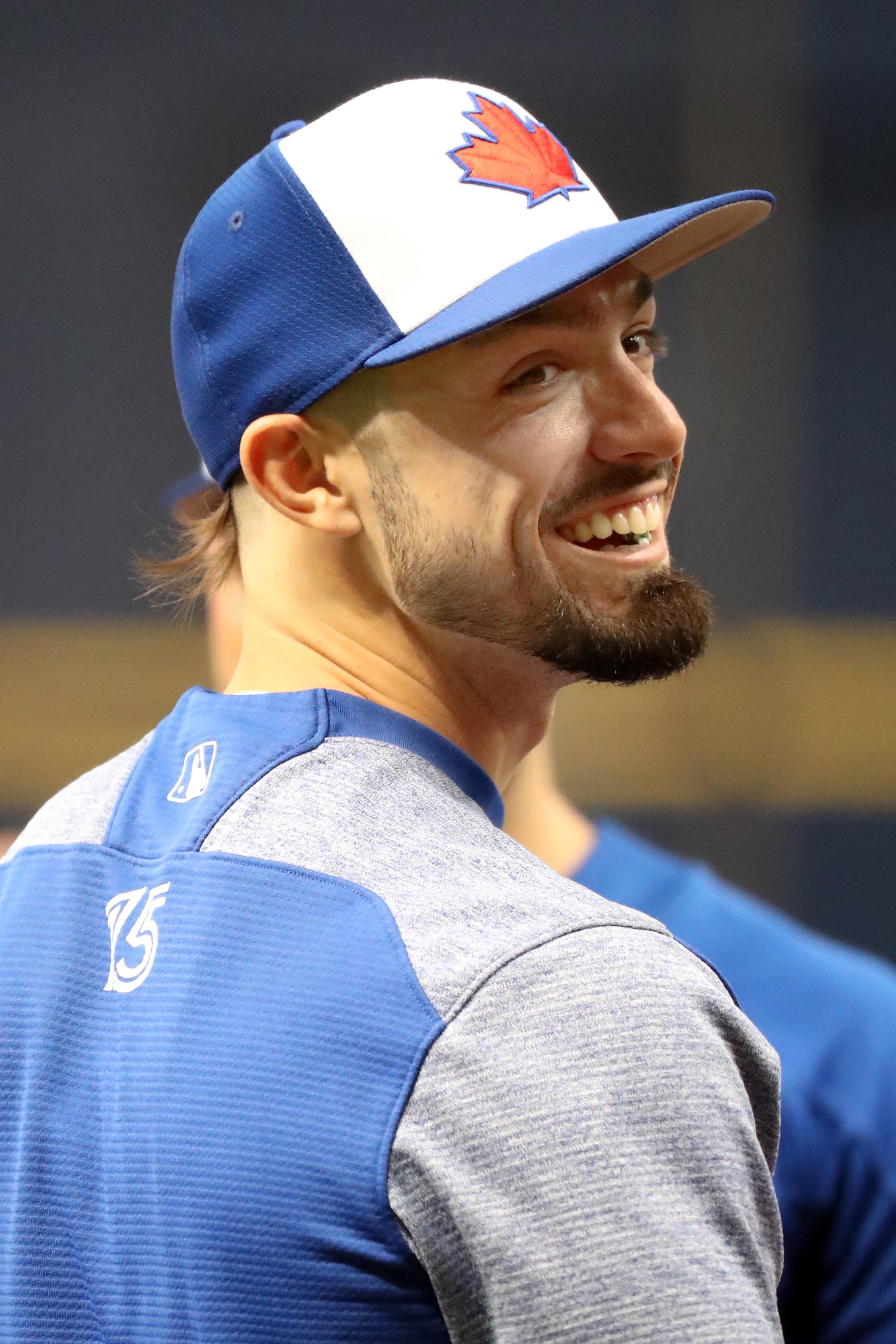
In all, Grichuk is securing a additional four years and $47MM in guaranteed money with the new arrangement. And while it’s impossible to know precisely what he’d have earned in his final season of arbitration eligibility in 2020, the $5MM base at which he was slated to play this season provides a reasonable window into what he might’ve earned.
If we put down a theoretical $3MM raise for what would’ve been Grichuk’s final arb year, the Blue Jays are effectively valuing his trio of free-agent seasons at about $39MM — a rough contract template that has been common among free agents in recent years (e.g. Jay Bruce, Zack Cozart, Mark Trumbo, Daniel Murphy pre-2016).
Grichuk would’ve been a free agent upon conclusion of his age-28 campaign in 2020 but will instead be signed through his age-31 season. He’ll presumably take over as Toronto’s primary center fielder for the next half decade now that the Jays have traded Kevin Pillar to the Giants (though he’s certainly capable of playing a corner as well). Other potential long-term pieces in the Toronto outfield include Teoscar Hernandez and Anthony Alford.
As a career .247/.297/.490 hitter, Grichuk may not immediately stand out as an extension candidate, but the Jays feel they have reason to be optimistic regarding his long-term value. Grichuk has a strong defensive track record according to each of Defensive Runs Saved, Ultimate Zone Rating and Outs Above Average, and he belted a career-best 25 home runs in just 462 plate appearances last season. Statcast ranks his sprint speed in the 88th percentile of active players, so Toronto surely feels that while Grichuk may never be an on-base threat, he’ll provide quality defense and plenty of power over the next five seasons.
That said, the deal carries more risk than some of the other extensions we’ve seen for players with less service time. Grichuk’s walk rate has hovered between 5.8 percent and 6.3 percent in each of his full MLB seasons, and his strikeout rate has never dipped lower than last year’s 26.4 percent. It’s possible that that mark was a prelude to future improvement, but it’s also worth noting that the improved contact rate didn’t necessarily lead to improved contact all the time; Grichuk popped up at a career-high rate in 2018, which largely counteracted the dropoff in strikeouts.
Unless he can find a way to boost his on-base percentage into league-average territory, Grichuk will have less margin for error with regards to his power and defensive proficiency. A step back in either of those categories at any point over the five-year deal would make it difficult for him to provide adequate value. Similarly, because his on-base skills lag well below the league average, his ceiling is curbed to the point that it’s difficult to envision this contract looking like a true bargain at any point.
The approximately $13MM rate at which this contract appears to value Grichuk’s would-be free-agent seasons has been the going rate for players older than him for awhile now. In addition to Bruce, Josh Reddick, Shane Victorino, Chase Headley and A.J. Pollock were all valued in that range on an annual basis on their own free-agent deals. It seems like the Blue Jays believe Grichuk to be capable of elevating his value beyond that $13MM price point in the coming two seasons, otherwise they wouldn’t have felt it necessary to commit this far in advance. If he can continue to barrel 14.4 percent of the balls he puts in play (as measured by Statcast), perhaps that is indeed the case.
However, the possibility also exists that the Blue Jays paid market prices for a player whose earning power isn’t likely to increase dramatically, and did so two seasons before they’d have been contractually forced to make the call. Having already made a trade to acquire Grichuk from the Cardinals, the Ross Atkins/Mark Shapiro-led Toronto front office clearly believes in the player, and today’s extension underscores that faith.
Grichuk’s contract, remarkably, is the 26th extension of the calendar year and the 25th that buys out what would have been free-agent seasons for the player signing the pact. He’ll now join Lourdes Gurriel Jr. as the only player on the Blue Jays’ roster who is guaranteed any money beyond the 2019 season. The Jays have as much payroll flexibility as anyone in the game moving forward, and the manner in which they leverage that advantage will help to determine how quickly they’re able to return to contention in a stacked American League East division.
Players Avoiding Arbitration: American League
The deadline for players and teams to exchange arbitration figures passed at 1pm ET yesterday, meaning over the next few hours, there will be a landslide of settlements on one-year deals to avoid an arbitration hearing. We’ll track today’s minor settlements from the American League in this post. Once all of the day’s settlements have filtered in, I’ll organize them by division to make them a bit easier to parse.
It’s worth mentioning that the vast majority of teams have adopted a “file and trial” approach to arbitration, meaning that once arbitration figures are exchanged with a player, negotiations on a one-year deal will cease. The two parties may still discuss a multi-year deal after that point, but the majority of players who exchange figures with their team today will head to an arbitration hearing.
As always, all salary projections referenced within this post are courtesy of MLBTR contributor Matt Swartz, and we’ll also be updating our 2019 Arbitration Tracker throughout the day…
Today’s Updates
- Yankees 1B Greg Bird will make $1.2 MM next season, per Bob Nightengale on Twitter.
- The controversial Roberto Osuna will make $6.5MM next season, per Feinsand. Teammate Jake Marisnick, who again scuffled in ’18 after a promising 2017, will make $2.2125MM.
- Per Mark Feinsand on Twitter, A’s lefty Sean Manaea $3.15MM in what’s sure to be an injury-marred 2019.
- Hard-throwing reliever Mychal Givens will make $2.15MM, per Eduardo A. Encina of the Tampa Bay Times (via Twitter), with additional incentives for making the All-Star team or placing in the Top-3 for the Rivera/Hoffman Reliever of the Year Awards, added MLB.com’s Mark Feinsand (via Twitter).
- The Mariners agreed on a $1.95MM deal with outfielder Domingo Santana, per MLB.com’s Greg Johns (via Twitter). Santana is the second and last of the Mariners’ arbitration-eligible players.
- The Angels agreed to contracts with a pair of players yesterday, per Maria Torres of the LA Times (via Twitter). Reliever Hansel Robles signed for $1.4MM. Robles threw 36 1/3 innings of 2.97 ERA baseball after the Angels claimed him off waivers from the Mets in June. Luis Garcia, acquired via trade from the Phillies this winter, signed for $1.675MM.
- The Tigers and reliever Shane Greene settled on $4MM, per USA Today’s Bob Nightengale (via Twitter).
- The Yankees reached an agreement with Sonny Gray for $7.5MM, per Nightengale. Gray, of course, has been involved trade rumors most of the winter, but for the time being, he stands to play a role in the Yankee pen while providing insurance for the rotation.
- Didi Gregorius has also come to an agreement with the Yankees on a one-year, $11.75MM deal in his final season before free agency, per USA Today’s Bob Nightengale (Twitter links).
- New Yankee James Paxton signed for $8.575, per Nightengale (via Twitter). Paxton is under contract for the 2020 season as well.
- The Houston Astros came to an agreement with Collin McHugh for $5.8MM, per Nightengale (via Twitter). McHugh could be moving back into the rotation after a stellar season in the pen, either way this will be his final season of arb eligibility before hitting the open market.
- Jonathan Villar comes away with $4.825MM for what will be his first full season in Baltimore, per Nightengale (via Twitter).
Earlier Updates
Blue Jays Notes: Vlad Jr., Outfield Corners, Gaviglio
Blue Jays fans have been anxiously anticipating the arrival of Vladimir Guerrero Jr., but they’ll have to wait a bit longer, as the 19-year-old phenom was placed on the minor league disabled list today after incurring a leg injury (link via Chris Bumbaca of MiLB.com). Guerrero went from first to second on a single, slid into the bag and immediately signaled for a trainer’s assistance before exiting the contest, though Fisher Cats manager John Schneider called the placement “cautious.” The team didn’t disclose further details on Guerrero’s injury, though all indications from the organization to this point seem to be that it’s minor.
Here’s more out of Toronto…
- While the Jays have played Teoscar Hernandez more in right field than it left, it seems that he’ll move to left field on a largely permanent basis moving forward. As MLB.com’s Gregor Chisholm writes, the team feels that Hernandez has the arm for right field but that his range and instincts are better suited for the other corner slot. Randal Grichuk will likely get another shot to take the reins in right field, where he comes with a history of strong defensive ratings (career +9.1 UZR/150). Grichuk has gotten off to a disastrous start to his Blue Jays career, hitting .115/.202/.269 in 89 plate appearances, though Statcast gives some reason to be optimistic; Grichuk’s 99.1 mph average exit velocity on balls in the air and knack for barreling the ball have translated to a .318 xwOBA that dwarfs his current .209 wOBA.
- Right-hander Sam Gaviglio has been a rare bright spot in an otherwise dreadful season for the Jays, writes Arden Zwelling of Sportsnet. Acquired in a forgettable spring trade in which the Jays sent only cash considerations to the Royals, Gaviglio has stepped up as one of the club’s most consistent starters and has earned a longer look in the rotation. Through 28 2/3 innings thus far, he’s pitched to a 2.51 ERA with 8.2 K/9, 2.2 BB/9, 1.26 HR/9 and a 54.4 percent ground-ball rate. While it’s obviously a small sample and Gaviglio shouldn’t be expected to continue sporting a sub-3.00 ERA, fielding-independent metrics in that small sample are encouraging. Zwelling takes a look at the manner in which Gaviglio has found his early success. Of course, he also notes that the very fact that Gaviglio is poised to get any type of notable look in the rotation is a testament to the team’s struggles this season and the fact that things have hardly gone as planned. As the Jays struggle, trade chatter surrounding veterans on the club will only increase. J.A. Happ‘s name has already begun to pop up on the rumor mill (FanRag’s Jon Heyman took a look at that earlier today), and if the Jays do deal from their rotation it could open the door for Gaviglio to get an even lengthier audition.
Blue Jays Place Randal Grichuk On 10-Day DL
The Blue Jays have placed outfielder Randal Grichuk on the 10-day DL, per a club announcement. He’s dealing with a knee sprain that is likely to cost him at least three weeks or so, as MLB.com’s Gregor Chisholm notes on Twitter.
Toronto will promote infielder Gift Ngoepe to take the open spot on the active roster. That’ll likely be a temporary measure, as Josh Donaldson could soon be ready to return to the majors.
The move comes as Grichuk, who was acquired over the winter, has struggled badly out of the gates. The out-of-options 26-year-old is carrying a hard-to-fathom .106/.208/.227 slash through 77 plate appearances.
With Teoscar Hernandez emerging in recent weeks, Grichuk has increasingly found himself on the bench. Presuming Grichuk ends up on a rehab assignment, he’ll have a chance to try to find a groove in the minors before returning to the MLB roster.
Blue Jays Acquire Randal Grichuk From Cardinals For Dominic Leone, Conner Greene
The Blue Jays have agreed to acquire outfielder Randal Grichuk from the Cardinals, per a Toronto announcement. Righties Dominic Leone and Conner Greene will go to St. Louis in return.
Grichuk becomes the second St. Louis player to move to the Jays via trade this winter, joining infielder Aledmys Diaz. Grichuk also joins Stephen Piscotty as young outfielders who have been swapped out in recent months. This time last year, that trio of departures would have registered as quite a surprise. As things developed, though, those players appeared quite likely to depart.
The Cardinals entered the current offseason determined to upgrade a position-player mix that included quite a few useful pieces but relatively few high-level performers. With the acquisition of Marcell Ozuna, the Cards added a player they feel will take them to the next level. With Dexter Fowler and Tommy Pham also expected to command near-everyday time, the move for Ozuna left Grichuk and Piscotty without obvious roles.
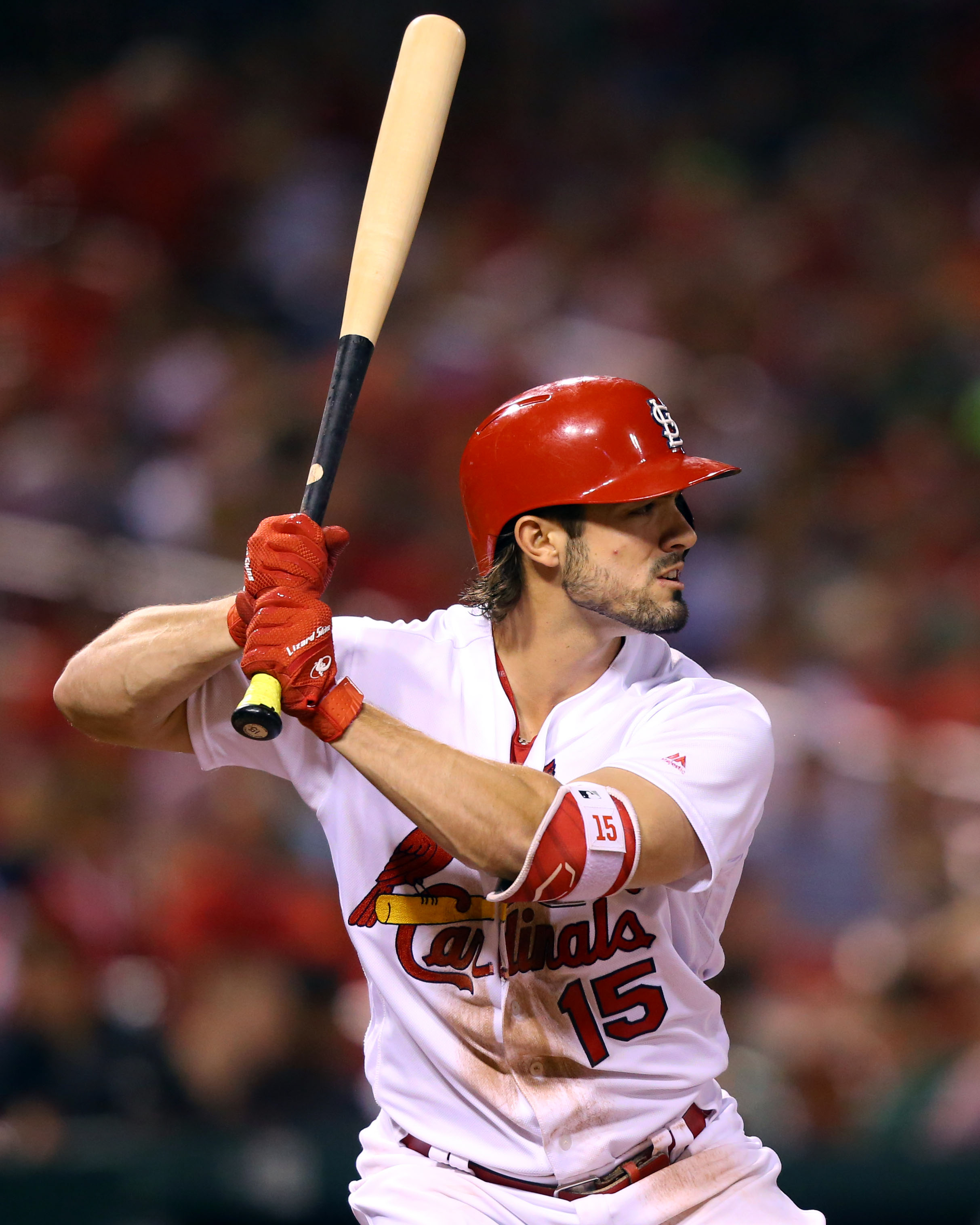
Grichuk turned in a highly promising 2015 season, racking up 17 home runs and a .276/.329/.548 slash in 350 plate appearances. Even then, though, there were some signs of worry — in particular, a 110:22 K/BB ratio.
Since that effort, Grichuk has faded. The right-handed-hitting outfielder is still putting the ball out of the yard at a strong rate. But he has only a .287 on-base percentage and league-average overall offensive output in his 920 plate appearances since the start of the 2016 season.
That said, perhaps there’s still some upside in the bat; he’s still only 26 years of age, after all. And Grichuk continues to provide good value with his glove, generally grading as a slightly above-average performer in center and in the corners. While he’s not much of a stolen-base threat, Grichuk has also rated as a quality overall baserunner.
[RELATED: Updated Blue Jays Depth Chart]
Toronto will pick up three years of control over Grichuk, who’s slated to earn $2.6MM in his first season of arbitration eligibility. He’ll join an outfield mix that already includes a right-handed-hitting center fielder in Kevin Pillar, a corner righty in Steve Pearce, and two left-handed-hitting pieces in Ezequiel Carrera and newly-signed veteran Curtis Granderson. Some platoon matches are to be expected from this group; in that regard, it’s worth noting that Grichuk has carried fairly notable reverse splits in the majors. Of course, it’s still possible the Blue Jays’ outfield unit will undergo some changes before all is said and done.
In return, the Cardinals will add some useful assets. Leone, a 26-year-old righty, has bounced around the league some but is fresh off of an excellent 2017 season. In 70 1/3 innings, he posted a 2.56 ERA with 10.4 K/9 and 2.9 BB/9. He’ll join an increasingly deep relief corps that perhaps will still be boosted by another late-inning arm.
[RELATED: Updated Cardinals Depth Chart]
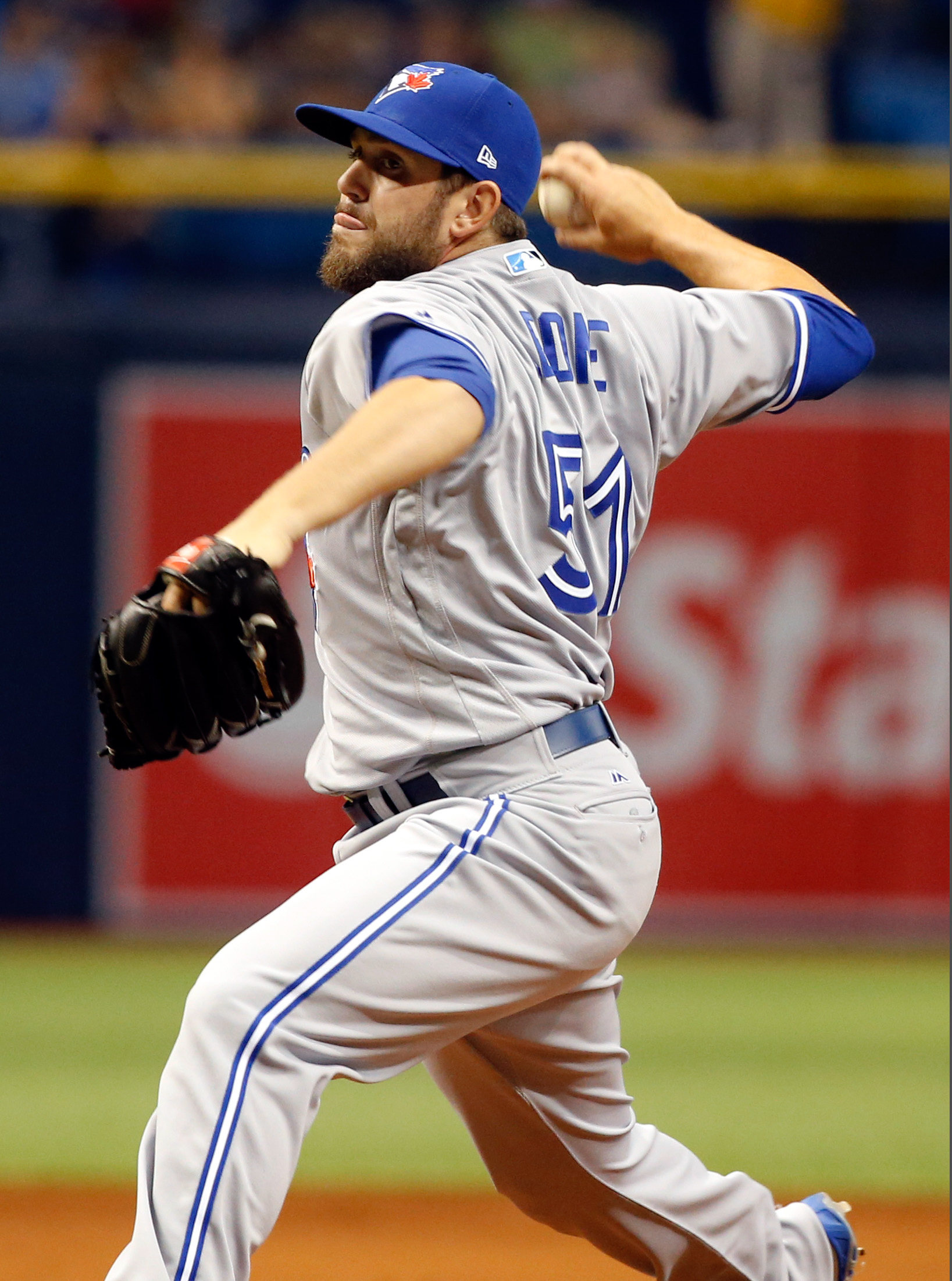
Leone has had similar success previously — in his 2014 debut with the Mariners — but struggled notably in the ensuing two seasons. All said, though, there’s plenty of reason to think he’ll continue to represent a quality asset. In 2017, he delivered his average fastball at 94.9 mph, recorded a personal-high 14.5% swinging-strike rate, and tamped down on the homers that had come to plague him.
Better still, the cutter-heavy Leone was equally effective against both righty (.208/.267/.357) and lefty (.181/.261/.366) hitters. The Cards will have the ability to control him for four more seasons. Leone reached arbitration as a Super Two, agreeing earlier this winter to a $1.085MM salary for the 2018 season.
Greene is a notable part of the deal as well. Still just 22 years of age, Greene has long been credited with interesting tools. He is said to possess a big heater, quality change, and useful slider. That said, there’s still quite a bit of polish needed and questions persist as to whether Greene will make it as a starter.
Last year, Greene struggled to a 5.29 ERA in his 132 2/3 innings at Double-A, managing only 6.2 K/9 against 5.6 BB/9 on the year. That showing obviously did not help his stock. Still, the Jays placed him on the 40-man roster at the end of the season in order to protect him from the Rule 5 draft.
It seems reasonable to expect that Greene will be given another chance to work out the kinks as a starter in the upper minor. But he might also take up a place on the Cards’ relief depth chart.
Photo courtesy of USA Today Sports Images.