
AL East Notes: Swisher, Gomez, Orioles
Although the always-energetic Nick Swisher never made it back to the majors after signing a minors pact with the Yankees in 2016, he’ll end up contributing to the team in a different way. Mark Feinsand of MLB.com writes in the second half of a piece for MLB.com. “Swish” will now serve as a special advisor to GM Brian Cashman. Though the terms of that job are typically pretty broad, Cashman envisions Swisher spending a lot of his time with minor leaguers in the organization. “He had a huge impact on that crew in Scranton when he was playing with [Aaron] Judge, [Greg] Bird, [Gary] Sanchez and all those guys,” said Cashman. “He brought the joy of playing the game on a daily basis, and it was infectious throughout that locker room. The opportunity to bring him into the fold and sprinkle him throughout our farm system was attractive.” On the field, Swisher was a .249/.351/.447 lifetime hitter; his playing career came to an abrupt end after a pair of rough seasons spent with the Indians and Braves from 2014-2015.
Other items out of the AL East…
- Rays outfielder Carlos Gomez is being met with a lot of excitement from his new teammates, writes Marc Topkin of the Tampa Bay Times. In particular, Denard Span says that, “you’d rather have him on your team than playing against him. Because he’s a headache when you’re playing against him.” There are a lot of reasons for that, Topkin writes. Gomez likes to “mix it up” with bat flips and sometimes even instigates brawls. He’s also the type to play hard in every moment of every game, according to new teammate Kevin Kiermaier. “He’s a guy who just loves baseball,” says Kiermaier. “Every time he takes the field, it doesn’t matter if you’re up eight runs or down eight, he’s going to go and play with that intensity.” One of the most interesting points Topkin makes about Gomez is that he can be a little bit misunderstood. Although he appears animated and aggressive, Rays reliever Sergio Romo describes him as someone who “always means well” and that some of the things he’s done have simply taken the wrong way on occasion. Gomez is set to replace the recently-traded Steven Souza Jr. in the Rays’ outfield this season.
- Looking for a bit of insight into how players are cut from major league spring training camp? Eduardo A. Encina of the Baltimore Sun helps shed some light on the subject by way of some words from Orioles manager Buck Showalter. Notably, Showalter is committed to spending time meeting with players prior to cuts. “I’m not going to rush through anything,” he said. “I want to hear from them as much as I want to tell them [some things], because I don’t want a month or two or three months to pass, and all of a sudden our success depends on them being able to come up and do something and we didn’t have those proper conversations.” Showalter also believes player feedback is an equally important part of those conversations.
Market Notes: Upton, Archer, Realmuto, Holland, Lynn
Over at The Athletic, Pedro Moura held a fascinating conversation with Angels slugger Justin Upton. (Subscription link.) There’s plenty of interest in the chat, though Upton’s comments on free agency are of particular interest and relevance. The thrust of his sentiment is that teams seem to be looking to score free-agent value rather than identifying and “courting” players they actively wish to employ. “Teams don’t value players as people anymore,” says Upton. “They value them as a number on a sheet of paper.”
Of course, Upton forewent a chance at returning to the open market by agreeing to a deal with an organization he was comfortable with. Here’s the latest on the unusually high number of quality free agents still not in camp and other market notes:
- The likelihood remains that the Rays will enter the season with Chris Archer on the staff, Jon Heyman of Fan Rag reports among other notes. That’s due in no small part to the team’s lofty asking price; one rival executive suggests that the Tampa Bay front office “wanted our whole farm system” to move Archer. The club has given that impression publicly, too. Senior VP of baseball ops Chaim Bloom reiterated that the expectation is to hang onto Archer and others in an appearance on MLB Network Radio on Sirius XM (Twitter link). He added that the internal expectation is that it will begin to reap the rewards of an effort over recent years to bolster the farm depth while still trying to compete at the MLB level.
- It has remained interesting to consider whether the Nationals might pry catcher J.T. Realmuto from the Marlins. But there isn’t much recent indication of serious talks, and Heyman indicates that’s due to what seems to be a big gulf in the sides’ valuations. Washington won’t give top prospects Victor Robles and Juan Soto, per the report; while the club might part with young infielder Carter Kieboom or outfielder Michael Taylor, it seems Miami was asking for too much additional talent to be included in a package.
- The outfield market has certainly delivered some surprises thus far. Heyman says Jarrod Dyson spurned an early two-year, $14MM offer, though a source tells MLBTR that is not accurate. Dyson ultimately signed for $7.5MM with the Diamondbacks. It remains to be seen what’ll happen with players such as Carlos Gonzalez and Jon Jay, each of whom were rated among the fifty best free agents this winter by MLBTR. Heyman says the Indians are still looking at right-handed outfield bats, though it would surely be a surprise for the team to plunk down any meaningful money to make an addition. Perhaps the trade route could still hold some surprises, though that’s pure speculation on my part.
- Veteran reliever Greg Holland might have overplayed his hand in spurning the Rockies earlier in the winter. Colorado was willing to give him something approaching the three-year, $51MM deal the team ultimately inked with Wade Davis, Bob Nightengale of USA Today suggests in an appearance on the podcast of Patrick Saunders of the Denver Post. It’s premature, perhaps, to declare that Holland won’t be able to top that number, though it’s frankly difficult to see where that level of interest might come from — as MLBTR’s Steve Adams has recently explained.
- Holland’s list of suitors is in question at the moment. One thing that seems clear, per Heyman, is that the Cubs aren’t planning on making a surprise run at the closer. Rather, Chicago seems largely committed to utilizing Brandon Morrow in the ninth inning and is likely to hold back its remaining payroll reserves for potential mid-season additions.
- So, how low could the remaining pitchers go? Presumably there’s a point at which some bidding would occur. But it’s notable that, per ESPN 1500’s Darren Wolfson (podcast link), the Twins expressed interest in Lance Lynn in the range of just $10MM to $12MM over two seasons. Just how that level of interest came about and was expressed isn’t clear. The team has also made some fairly notable recent commitments and may just not have much more payroll flexibility. And it certainly shouldn’t be taken as evidence of Lynn’s current market value. Still, it’s interesting to learn that’s the current extent of Minnesota’s interest.
AL East Notes: Walker, Rays, Red Sox
Neil Walker tells Billy Witz of the New York Times that his camp held fairly extensive talks with the Yankees before they acquired Brandon Drury (all links to Twitter). Walker said he and his agents felt that they were “fairly close” to hammering out a deal with the Yanks, who instead swung a trade to bring in Drury for added infield depth. The 32-year-old switch-hitter felt the Yankees were a strong fit, as he knows the rigors of playing in the New York media market and was “certainly willing” to bounce around the infield and play multiple positions. Walker was hoping for a multi-year deal with the Yankees, though, and suggests that the team ultimately “decided to hang onto money for midseason,” when they could be in the market for adding veterans via trade.
More from the division…
- The Rays have taken plenty of heat for their offseason moves, though Travis Sawchick of Fangraphs observes one common thread among the hitters they’ve let go: a susceptibility to whiffs against four-seam fastballs. Corey Dickerson swung through more four-seamers than anyone in Major League Baseball last season by a wide margin, Sawchik notes, while Steven Souza was third on that list and Logan Morrison tied for seventh. Sawchik also notes that each of the three had declines in the season’s second half (though Morrison maintained above-average production). Replacements such as Carlos Gomez and especially C.J. Cron had fewer struggles against the fastball, he adds. Sawchik has written in the past about how the Tampa Bay organization emphasizes utilizing elevated fastballs as a weapon more than most other clubs, so perhaps that trend applies to both sides of the ball.
- The Boston Globe’s Alex Speier runs through some troubling numbers for the Red Sox‘ offense from 2017, observing that the team’s lineup was startlingly ineffective in hitters’ counts. Boston took an abnormally passive approach at the plate last season, per Speier, and while they were among the game’s more productive clubs in 0-2, 1-2 and 2-2 counts, they ranked in the bottom third of baseball in 3-1, 2-0, 2-1, 1-0, 0-0, 1-1 and 0-1 counts (by measure of OPS). The Red Sox ranked last in the American League in batting average, on-base percentage and slugging percentage in 0-0 counts, he adds. Speier spoke at length with principal owner John Henry about the trends, which did not go unnoticed by ownership or the front office and may have played a notable role in the organization’s coaching overhaul. Notably, Speier adds that new skipper Alex Cora saw his Astros pounce on the first pitch with regularity and with great success in 2017.
AL East Notes: Rays, Pedroia, JDM, Lee
Rays owner Stuart Sternberg weighed in on the MLBPA’s grievance against the Rays and three other clubs regarding concerns over the reallocation of revenue-sharing funds, as Marc Topkin of the Tampa Bay Times writes. The Rays, according to Sternberg, are “beyond” compliant with the rules. “We’re very judicious in how we spend our money, but it’s spent in a lot of forms, and payroll is one of them,” said Sternberg, going on to point out that the Rays’ Opening Day payroll in 2018 will be higher than it was in 2017. Of course, the Rays still rank near the bottom of the league in that regard, as they do every year. Chris Archer, the Rays’ union representative, also spoke with Topkin on the matter. “I have no clue what it costs to run the Dominican academy,” said Archer. “I know just from my perspective, not a whole lot has changed with the spring training facility, not a whole lot has changed at the Trop, and our payroll has not increased significantly.”
- Veteran Red Sox star Dustin Pedroia had a bit more done to his knee than had previous been known, Pete Abraham of the Boston Globe reports on Twitter. In addition to cartilage restoration work, Pedroia underwent a microfracture procedure to his tibia. Regardless, it seems that the hard-nosed veteran is progressing well given that he has now advanced to taking batting practice. Meanwhile, fellow infielder Marco Hernandez is still six weeks away from resuming baseball activities, Rob Bradford of WEEI.com tweets. Hernandez underwent shoulder surgery last May and only just had screws removed, but at least he now seems to be in sight of returning to the field.
- In other Red Sox coverage, Bradford discusses new signee J.D. Martinez‘s unique relationship with his personal hitting coach. As it turns out, new Boston hitting coach Tim Hyers is well acquainted with Martinez’s guru Robert Van Scoyoc, who’ll be allowed to continue consulting with Martinez even though he has been hired by the Diamondbacks. It’s a deep and interesting look at how Martinez’s unique approach will fit with the organization.
- Orioles hurler Chris Lee will miss at least a month with an oblique injury, Roch Kubatko of MASNsports.com was among those to tweet. The southpaw had been viewed as one of a variety of hurlers competing for one rotation spot, a long-relief role in the pen, and/or a place in the organizational depth chart. Instead, he’ll have to work back to health before he’s able to begin pressing for his first MLB opportunity. The 25-year-old reached Triple-A for the first time last year, pitching to a 5.11 ERA with 6.4 K/9 and 4.2 BB/9 over 116 1/3 innings.
Rays’ Brent Honeywell Undergoes Tommy John Surgery
FEBRUARY 27: Honeywell underwent surgery today, Topkin tweets.
FEBRUARY 23: Rays top pitching prospect Brent Honeywell has been diagnosed with a torn ulnar collateral ligament in his right elbow, tweets Marc Topkin of the Tampa Bay Times. Tommy John surgery has been recommended for the promising 22-year-old.
The diagnosis represents a worst-case scenario for the Rays in the wake of yesterday’s ominous arm injury for Honeywell. The early diagnosis was a forearm strain, though that’s often a precursor to a UCL tear upon further testing. Topkin noted yesterday that the injury was of “major concern” to the Rays. Honeywell reportedly threw roughly 10 pitches in a batting practice session before loudly shouting after his final pitch and eventually walking off the mound with a trainer.
The likely loss of Honeywell for the season is a brutal hit to the Rays’ depth. Even though Tampa Bay is hardly lacking for rotation alternatives, Honeywell ranks as not just one of the best pitching prospects in baseball but one of the top overall prospects in the game. Each of Baseball America, MLB.com, ESPN, Fangraphs and Baseball Prospectus ranked Honeywell within the top 15 overall prospects on their respective top 100 lists heading into the 2018 season.
Honeywell, the No. 72 overall draft pick in the 2014 draft, enjoyed a terrific season in Triple-A against older competition in 2017, tossing 123 2/3 innings with 11.1 K/9, 2.3 BB/9, 0.8 HR/9 and a 41.2 percent ground-ball rate en route to a 3.64 ERA, a 2.84 FIP and a 2.77 xFIP.
Topkin had previously reported that Honeywell was likely ticketed for Triple-A to open the season, as the Rays are prepared to open the year with a four-man rotation of Chris Archer, Nathan Eovaldi, Jake Faria and Blake Snell. Matt Andriese will begin the season as a multi-inning reliever, but the extra off-days early in the 2018 schedule mean the Rays won’t need a fifth starter for several weeks. Andriese seems likely to eventually step into that role. Honeywell could’ve been called up early this summer to avoid Super Two status or, at the very least, called up at some point in May once the team had secured another year of club control over the highly touted righty.
That, of course, won’t be the case at all now at any point in the 2018 season. The Rays have alternatives to eventually step into the rotation as needed, though none comes with an upside that matches Honeywell. Nonetheless, the Rays have an enviable stock of young pitching in the upper minors and already on the 40-man roster, led by Anthony Banda, Jose De Leon, Ryan Yarbrough and Yonny Chirinos.
MLBPA Files Grievance Against Four Teams Over Revenue Sharing Funds
The Major League Baseball Player’s Association has initiated a grievance proceeding against the Athletics, Marlins, Pirates, and Rays regarding those teams’ spending of revenue sharing dollars, according to a report from Marc Topkin of the Tampa Bay Times.
This general issue has been percolating for some time, even as additional concerns have arisen as to the pace of free-agent signings over the 2017-18 offseason. The MLBPA reportedly engaged with the league office over the Miami and Pittsburgh organizations’ spending earlier this year.
At the time, MLB and the teams at issue rejected the idea that there was any issue worth exploring further. Clearly, the union disagrees and also feels that two other organizations’ practices merit examination. Per Topkin, the complaint relates to spending both last year and over the present offseason.
Revenue-sharing dollars — which will be phased out for the A’s under the current Basic Agreement — are required to be spent for improving the MLB performance of recipient clubs. That doesn’t necessarily mean it all must go to player salaries, but though teams are required to report on how they use the money. And as JJ Cooper of Baseball America notes on Twitter, successive collective bargaining agreements have tightened the permissible uses.
Enforcing the provisions relating to these funds falls in the domain of commissioner Rob Manfred. He can issue penalties, require the submission of a two-year plan, and even order changes with that plan (“after consultation with the Players Association”).
As Topkin notes, it is not immediately clear what the MLBPA is seeking in relief. The collectively bargained provisions do seem to give the union an interest in ensuring the provisions are followed, though, and perhaps the situation is seen as drastic enough to merit a test of their meaning before an arbitrator.
In a statement to the Times, the league confirmed receipt of the grievance but stated that MLB “believe[s] it has no merit.” Pirates president Frank Coonelly responded with a combative tone, issuing a statement labeling the action “patently baseless” (via MLB.com’s Adam Berry, on Twitter). Rays owner Stuart Sternberg defended his own organization in less strident terms (via Topkin, on Twitter).
Rays Negotiating New Television Contract
The Rays are discussing a new long-term television contract with FOX Sports Net that would run through the 2033 season, John Ourand and Daniel Kaplan of Sports Business Journal report. According to Ourand and Kaplan, the contract still has some “hurdles the two sides have to overcome” but could come with an annual payout “around” $82MM per year.
It’s important to note that that’s an average payout and wouldn’t kick in immediately; as is typically the case with newly structured television contracts, annual revenue increases are gradual in nature. Ourand and Kaplan note that the Rays are receiving “close to” $35MM from FOX Sports Sun in 2018, which is the final year of their current contract. The contract presently being negotiated would up that sum to somewhere in the neighborhood of $50MM in 2019, per the report. Yearly revenues would then escalate over the remaining 14 years of the contract.
Obviously, a substantial increase in television revenue for any team is of note. But it’s particularly worth monitoring with regard to the Rays, who were recently under an ownership directive to cut payroll and drew the ire of fans and their own player. Cost-cutting moves that sent Jake Odorizzi to the Twins and Corey Dickerson to the Pirates didn’t bring much in the way of long-term value to the organization.
The Rays also traded longtime face of the franchise Evan Longoria to the Giants in a move that saved them at least $60MM, though in doing so they added a largely MLB-ready infield replacement in the form of Christian Arroyo and also avoided losing leverage with Longoria, who is set to earn 10-and-5 rights (i.e. full no-trade protection) shortly after Opening Day 2018. Steven Souza, too, was traded to the D-backs last week, though that swap brought the Rays more prospect value, and the team quickly signed Carlos Gomez for a sum that was actually slightly greater than Souza’s salary to fill the void.
That the Rays mandated even a moderate level of payroll-slashing with a $50MM BAMTech payout (received by all 30 teams) coming their way this offseason as well as an expected increase of ~$15MM in television revenue next winter won’t do anything to cushion the blow for those who were disheartened by the team’s slate of offseason moves. But television rights, at present, are a decidedly lesser source of revenue for the Rays than much of the league. Paired with some recent promising, albeit preliminary developments in the team’s quest to build a new stadium in the Ybor City neighborhood of Tampa, Rays fans have some reason for cautious optimism when it comes to the team’s long-term payroll outlook. (Or, at least, they have more cause for optimism than they have in quite some time.)
A 15-year deal covering the 2019-33 seasons at an average annual value of roughly $82MM would place the total value of the new television contract at more than $1.2 billion. Certainly, given that the two sides haven’t yet pushed negotiations across the finish line and reportedly still face some “hurdles,” it’s worth keeping in mind that those numbers are not set in stone. Negotiations should continue in March, Ourand and Kaplan report, adding that one complicating factor is 21st Century Fox’s sale of its regional sports network group to Disney — a transaction believed to be valued at a whopping $52.4 billion.
AL East Notes: Bautista, Rays, Orioles, Red Sox
Although the Rays have picked up a pair of right-handed hitters in Carlos Gomez and C.J. Cron since last weekend, they could add another outfield-capable righty-swinger, per Marc Topkin of the Tampa Bay Times. One free agent who might draw their attention is Jose Bautista, who’s “keenly interested in playing for the Rays, presumably knowing it would be for a low salary,” Topkin writes. The 37-year-old Tampa Bay resident has long been a rival of the Rays, having played with the Blue Jays from 2009-17. While Bautista was a terror for opposing pitchers for the majority of that run, he’s now coming off his worst year in nearly a decade, which helps explain why he remains on the market. Bautista took 686 trips to the plate in 2017 and batted a subpar .203/.308/.366, albeit with 23 home runs.
More on Tampa Bay and two of its AL East rivals:
- The Rays have recently parted with several notable veterans, including Evan Longoria, Steven Souza Jr., Corey Dickerson and Jake Odorizzi, but their front office insists they’re not tanking and never have, as Topkin details in a separate piece. Rather, according to general manager Erik Neander: “This is a season, as things stand now, where on paper we’re somewhere in that middle territory yet again. But what’s been building underneath is getting awfully close to colliding with what’s a middle-of-the-pack team. And when those things come together, you’ve got a chance for something special.” And even though the Rays finished under .500 in each season from 2014-17, Neander believes there was serious progress behind the scenes. “As our teams have been kind of treading water, there’s been that wave that’s really building, really coming together, probably even better than I think we expect it,” Neander said. “It’s about there.”
- In-house issues prevented the Orioles from signing free agent infielders Ryan Flaherty and Ryan Goins during the offseason, Eduardo A. Encina of the Baltimore Sun reports. Flaherty was with the Orioles from 2012-17 and wanted to re-sign with the club, even showing a willingness to take less money than he did to join the Phillies. Philadelphia made Flaherty an offer with a three-week deadline to accept it, but he wanted to hear from the Orioles before taking it. The O’s then submitted a counteroffer, though it “didn’t get club-wide approval in time to meet the Phillies’ deadline,” Encina writes. As a result, he said yes to the Phillies’ minor league proposal. Given that Flaherty has a late-March opt-out in his deal, it’s possible he’ll hit the market again and rejoin the Orioles before the season, Encina notes. Like Flaherty, Goins also settled for a minor league pact (with the Royals). However, he actually was set to sign a major league contract with the Orioles beforehand, according to Encina. Orioles ownership didn’t approve it in time, though, leading the former Toronto utilityman to head to Kansas City.
- Red Sox reliever Robby Scott has changed representation and is now a client of Meister Sports Management, Rob Bradford of WEEI tweets. The 28-year-old, who’s currently vying to open the season as Boston’s top left-handed bullpen option, tossed 35 innings of 3.79 ERA ball and notched 7.82 K/9, 3.28 BB/9 and a 42.6 percent groundball rate in 2017. He won’t be eligible for arbitration until after the 2019 campaign.
AL East Notes: Hernandez, Swihart, Dickerson, Orioles
The Red Sox told reporters today that infielder Marco Hernandez will miss the remainder of Spring Training after incurring a setback in his rehab from last year’s shoulder surgery (via MassLive.com’s Jen McCaffrey). Hernandez, who initially went under the knife late last May, went back to Boston for a second procedure this week after doctors determined that he needed to have the pins that were inserted into his shoulder during that initial operation removed. Manager Alex Cora said that Hernandez’s shoulder was feeling abnormally weak and sore following his spring workouts, which prompted the followup exam. There’s no timetable on his return at present.
- Evan Drellich of NBC Sports Boston argues that while the Red Sox could benefit from a year of carrying the out-of-options Blake Swihart as a utility player, they may not ever get a higher return for him in a trade than they would this spring. Other clubs still view Swihart as a viable catching option, he notes, whereas a year of scarce opportunities behind the plate thanks to the presence of Christian Vazquez and Sandy Leon could change that. The Sox seem to have three players for two bench spots — Brock Holt, Deven Marrero and Swihart, with the latter each being out of minor league options. On the flip side of the coin, one could also argue that a full year of production at the big league level, even in a part-time role. It also seems feasible that Sandy Leon could see his role diminish if his 2017 struggles at the plate carry over into the 2018 season.
- Rays GM Erik Neander admitted to Marc Topkin of the Tampa Bay Times that the decision to designate Corey Dickerson for assignment was “very difficult and something he didn’t deserve in that way.” However, the presence of so many corner options on the market were dragging out the Rays’ efforts to trade him, and the DFA served as a means of putting a clock on the process for interested trade parties, which ultimately accelerated the process. “With the market and how many guys were out there, we felt that the best way to try to accomplish something was to put a timer on it and expedite the process,” said Neander.
- The Orioles are dealing with some early injuries in camp, writes MASNsports.com’s Roch Kubatko. Most notable is that of Jonathan Schoop, who was scratched from today’s lineup due to bursitis in his left elbow and is listed as day-to-day. The injury isn’t characterized as serious, but Kubatko notes that it underscores the team’s need to have a strong utility infielder on hand. With that in mind, Kubatko notes that Baltimore still plans to monitor the waiver wire and could continue to be active in picking up infield options in that manner. Kubatko also writes that righty Miguel Castro is suffering from patellar tendinitis in both knees and possibly some back soreness. He won’t make his first scheduled start of the spring. Castro is among the many internal candidates to fill in the fifth spot in the Baltimore rotation.
Pirates Acquire Corey Dickerson From Rays
1:17pm: The Pirates are sending the Rays $1MM as part of the trade, reports Rob Biertempfel of The Athletic (Twitter link). In essence, then, they’ll spend an additional $1.45MM to turn Hudson into Dickerson, while the Rays will add a reliever to their ‘pen, a prospect to the lower levels of their farm system, and trim $1.45MM from their 2018 payroll.
12:24pm: The Pirates announced that they’ve acquired outfielder Corey Dickerson from the Rays in exchange for reliever Daniel Hudson, minor league infielder Tristan Gray and cash.
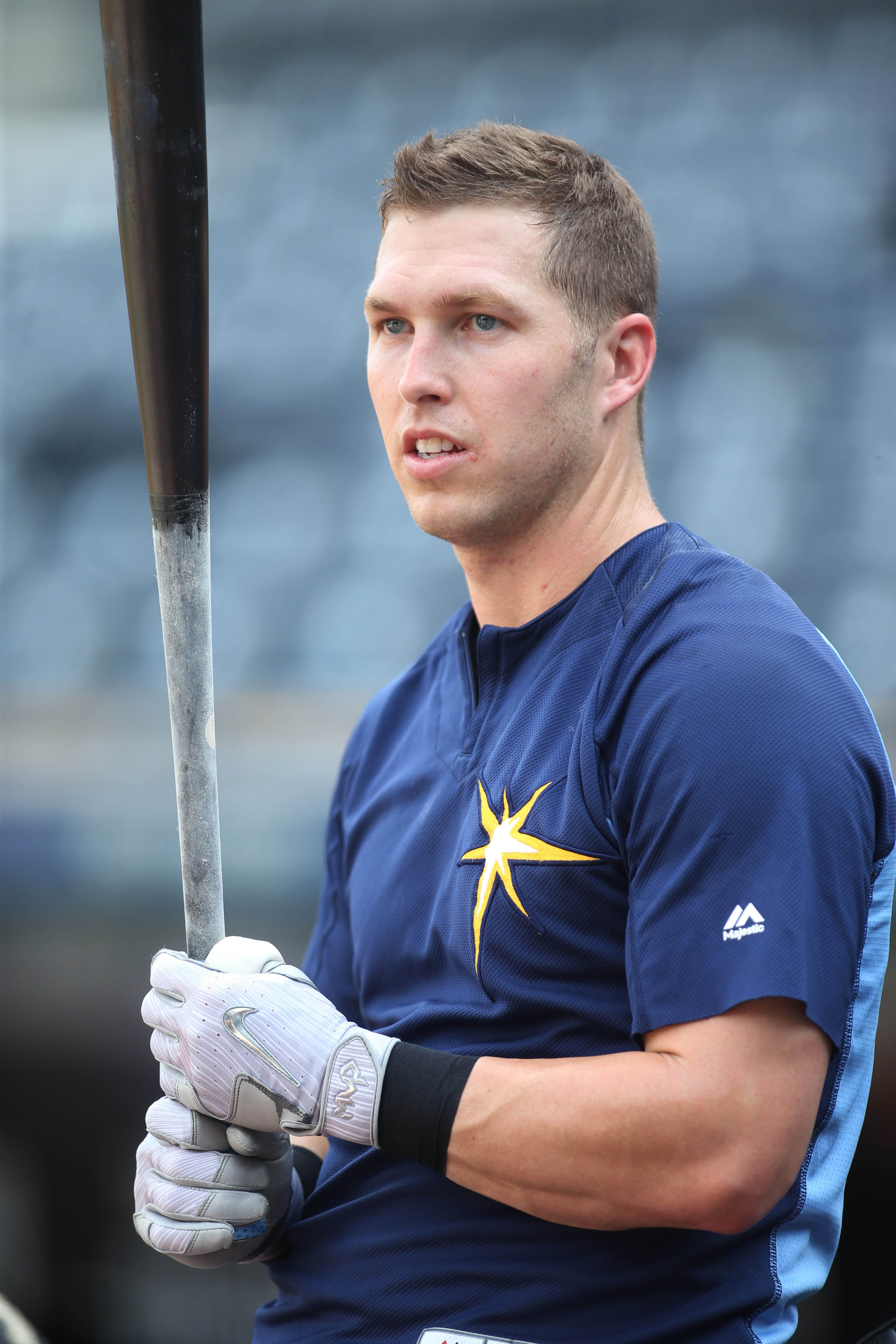
Tampa Bay recently designated Dickerson, 28, for assignment in a move that came as a surprise to many. Dickerson posted solid overall numbers in 2017, hitting .282/.325/.490 with 27 homers in 629 trips to the plate. Dickerson, though, faded badly after a strong start to the season.
Though Dickerson hit .326/.369/.570 with 17 homers through the season’s first three months, that production was supported by a .374 BABIP that he didn’t seem especially likely to maintain. That number came back down to earth from July through season’s end as Dickerson’s strikeout rate rose to nearly 29 percent, and he batted just .232/.273/.397 with 10 homers and an 82-to-16 K/BB ratio in the final three months of the season.
That said, Dickerson still has an overall track record as a quality bat, as evidenced by a lifetime .280/.325/.504 slash and 119 OPS+. He’ll earn $5.95MM in 2018 and is controllable for one more year via arbitration before he can reach free agency.
The Pirates desperately needed some outfield help following this offseason’s trade of former face of the franchise Andrew McCutchen, and Dickerson should slot into the organization as the team’s new everyday left fielder. Defensive metrics aren’t exactly bullish on his glovework in the outfield, though he’s graded out as generally average or slightly above-average in left field over the past two seasons after drawing poor marks early in his career with the Rockies. He’ll be joined in the outfield by Starling Marte and Gregory Polanco, each of whom is looking to bounce back from a disappointing 2017 season.
[Related: Updated Pittsburgh Pirates depth chart]
Though Dickerson isn’t likely to recreate the massive performance he rode to his first career All-Star appearance in the first half last season, he should nonetheless serve as an offensive upgrade over the Pirates’ internal options in left field. Adam Frazier and Jordan Luplow were two of the main candidates for that gig on the 40-man roster, while veterans Michael Saunders and Daniel Nava are in camp as non-roster invitees to Spring Training. Certainly, the Dickerson pickup places a significant roadblock to either veteran making the roster, and it’s fair to wonder if they’ll ultimately be allowed to seek other opportunities.

In Hudson, the Rays will pick up a hard-throwing veteran reliever looking for a rebound season of his own. Hudson’s contract calls for him to earn $5.5MM this season, so the two contracts nearly cancel each other out. However, the Pirates are also sending cash to the Rays in the deal, so it appears that Tampa Bay will come out ahead, financially speaking, in the swap.
Hudson, 31 early next month, posted a 4.38 ERA with 9.6 K/9, 4.8 BB/9, 1.02 HR/9 and a 43.3 percent ground-ball rate while averaging 95.6 mph on his fastball through 61 2/3 innings last year. A converted starter that has twice undergone Tommy John surgery in his career, Hudson has a 4.59 ERA in the ‘pen over the past three-plus seasons since making the switch, but secondary metrics have been considerably more optimistic based on his strikeout rates and, outside of last season, his control. In 192 1/3 frames as a reliever, Hudson has a 3.84 FIP and 3.78 SIERA.
Tampa Bay executives Erik Neander and Chaim Bloom recently downplayed the possibility of the Rays trading closer Alex Colome before the season begins, so it seems that Hudson will pair with recently re-signed Sergio Romo to give the Rays another experienced arm in their setup corps.
The addition of that pair of veteran arms will allow the Rays to lean less heavily on what had looked to be a largely inexperienced group of relievers outside of Colome and southpaw Dan Jennings. Andrew Kittredge, Chaz Roe, Austin Pruitt, Ryne Stanek, Jose Alvarado and Chih-Wei Hu wiill be among the names vying for the remaining bullpen spots with the Rays this spring now that Hudson is on board.
[Related: Updated Tampa Bay Rays depth chart]
Gray, meanwhile, was Pittsburgh’s 13th-round pick in last year’s draft and posted a .269/.329/.486 slash with seven homers and five steals in 53 games for the Pirates’ short-season Class-A affiliate last year. The second baseman was an honorable mention on Fangraphs’ list of the Pirates’ Top 25 prospects, with Eric Longenhagen pointing to a long track record of production as an amateur but also labeling his overall offensive profile as “middling.”
All told, it’s a fairly underwhelming return for Dickerson, though that’s largely indicative of the manner in which bat-first corner outfielders have been devalued in the current economic climate of baseball. The Rays surely tried to trade Dickerson for much of the winter but seemingly found no takers before designating him for assignment, and even in this swap it seems that Tampa Bay had to agree to take on some salary to work out a deal. Jay Bruce managed to score a three-year, $39MM pact with a similar, albeit superior overall profile at the plate, but both the trade and free-agent markets for good-not-great corner outfielders have been rather tepid over the past couple of seasons.
It seems plausible that the Rays simply felt they could utilize a full season of Mallex Smith in a corner outfield spot without losing much in the way of overall value, and elected to turn Dickerson into an alternative Major League asset. The surprising trade of Steven Souza that followed Dickerson’s DFA, as the Rays’ front office told it recently, was more or less a function of an unexpected and aggressive pursuit of Souza by the Diamondbacks, who promised a prospect package the Rays felt they could not afford to turn away. The Rays were then able to capitalize on a weak free-agent market and bring in Carlos Gomez at a bargain rate — a move that further reflects the dwindling value of above-average offensive outfielders that aren’t premium defensive assets.
Photos courtesy of USA Today Sports Images.