
Rangers, Athletics Swap Elvis Andrus, Khris Davis As Part Of Five-Player Deal
In a rather stunning swap of veterans, prospects, and cash between divisional rivals, the Rangers are sending long-time shortstop Elvis Andrus, catching prospect Aramis Garcia, and $13.5MM in cash to the Athletics for outfielder/designated hitter Khris Davis, catcher Jonah Heim, and right-handed pitcher Dane Acker. In announcing the deal, the Rangers note that Andrus leaves as one of just five players to spend 12 seasons in Texas.
While the roster implications are significant for both teams, the financial aspect is no less fascinating. Andrus is owed $14MM in each of the 2021 and 2022 seasons. Per the original terms of the deal, Andrus also has a vesting option for $15MM in 2023 that, because of the trade, will now become a player option. Still, to make that player option vest, he’ll still need to either accrue 550 plate appearances in 2022 or 1,100 appearances combined in 2021 and 2022. Previously the plate appearance threshold would have triggered a mutual option instead of a player option.
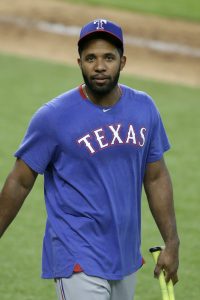 Andrus has only reached that marker in one of the previous three seasons, so there’s at least a reasonable chance he reaches free agency after the 2022 season. If that proves to be the case, the A’s will have freed themselves from the $16.75MM owed to Davis, while essentially remaining on the hook for about $7.25MM in each of 2021 and 2022. Andrus is also getting an $800K assignment bonus, per MLB Network’s Jon Heyman (via Twitter), though it’s unclear which side will be responsible for it.
In terms of the Rangers’ financial motivations, they take on more money up front for later payroll flexibility. Davis will be a free agent after the season, so instead of paying out $14MM in each of the next two seasons, they’ll either pay $30.50MM this season and be totally free the future payroll commitment, or perhaps at least lessen it if the money paid to Oakland is given in installments.
On the field, this ends Andrus’ 12-year run as the Rangers’ starting shortstop. The last remaining connection to their back-to-back pennant-winning teams in 2010 and 2011, the two-time All-Star leaves as the franchise’s all-time leader with 305 stolen bases, second all-time with 1,652 game played, and third all-time in both hits (1,743 hits) and runs (893 runs scored). Though he came to be seen as an albatross contract in recent years, Andrus more than earned his keep over the years, producing $205.8MM worth of value through 28.1 fWAR — a full $100MM over the $105.67MM of actual pay he has thus far banked.
Nevertheless, he was set to lose his starting shortstop job to Isiah Kiner-Falefa this season. Andrus admits to some hard-hardheadedness when it comes to changing his approach at the plate, which may have held him back in recent seasons. He will now have the opportunity to re-boot his career in Marcus Semien‘s vacated seat as Oakland’s primary shortstop. Consider the challenge accepted, as Andrus waived the no-trade protection attached to his 10-and-5 status to make the trade happen.
As for the other piece heading to Oakland, Garcia hit .229/.270/.419 over 111 plate appearances with the Giants between 2018 and 2019. The Rangers claimed the former second-round pick off waivers from San Francisco this past November. His inclusion doesn’t likely move the needle much in terms of the overall value of the deal, though he does give the A’s a cheap option to take over as for Heim as Sean Murphy‘s backup. Though A’s fans may bristle at seeing Heim included in the deal given his success last season, if the A’s are committed to Murphy as their regular backstop, then including a backup catcher to achieve their goal of moving off the money owed to Davis this season would seem a calculated risk on their part. Notably, the A’s have another fairly well-regarded backstop in Austin Allen who could also step in to back up Murphy.
With Semien and Tommy La Stella already moving on to new teams this season, it’s hard to view the acquisition of Andrus as a significant win for the A’s. Never much of a slugger, Andrus has only twice exceeded 100 wRC+ and hasn’t topped 76 wRC+ since 2017. A three-year slash line of .260/.306/.378 won’t go far in trying to replace Semien, who was, after all, a legitimate MVP candidate as recently as 2019.
Andrus’ glovework should be his selling point, but he’s scored -7 defensive runs saved in 1,521 innings since 2019 and -3 outs above average in 2020. Statcast credits him with 5 outs above average in 2019, however, and a total 0.5 UZR over the past two years suggest Andrus can at least provide average defense for the A’s at short.
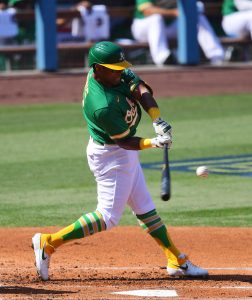
The Rangers take on Davis, famed for his preternatural consistency in batting exactly .247 for four season in a row, which he followed up with matching 82 wRC+ seasons in 2019 and 2020. Davis’ power significantly dissipated these past two seasons, as the A’s saw his isolated power drop from .302 ISO in 2018 to .166 ISO and .1229 ISO the past two seasons. Davis hasn’t played much outfield in recent seasons, but the Rangers are fairly set in that regard anyhow with David Dahl and Joey Gallo expected to start regularly in the corners. Davis could steal some at-bats from Willie Calhoun at designated hitter, specifically against southpaws, whom Davis has continued to hit well with 135 wRC+ in 2020 (though his power saw an even more precipitous drop against lefties than righties in 2020).
The Rangers’ long-term value in this deal will come from Heim and Acker. The latter was a fourth round pick in 2020, and because of the pandemic, the 21-year-old has yet to make his professional debut.
Heim, meanwhile, has the potential to develop into a regular catcher for the Rangers. He made just 41 plate appearances last season, but earned rave reviews from the pitching staff for his ability to manage a game, per the Athletic’s Eno Sarris (via Twitter). Heim was the A’s No. 9 ranked prospect per MLB.com in 2020, No. 13 by Fangraphs, and No. 8 by Baseball America. Because of Oakland’s depth, Heim’s addition should mean more to the Rangers than his subtraction will for Oakland.
The Athletic’s Ken Rosenthal broke the initial news of the deal, as well as the inclusion of Heim and Acker. Evan Grant of the Dallas Morning News tweeted news of Garcia’s inclusion in the deal, initially reported to be David Garcia instead of Aramis Garcia. ESPN’s Jeff Passan had the deal expanding beyond the initial framework of Andrus for Davis. Jeff Wilson of the Fort Worth Star-Telegram added the exact amount of cash heading to Oakland.
Photo courtesy of USA Today Sports Images
Diamondbacks Designate Taylor Guilbeau For Assignment
The Diamondbacks have designated southpaw Taylor Guilbeau for assignment, as per a team announcement. The move creates roster space for Joakim Soria, whose deal with the club is now official. Guilbeau has only been a member of the D’Backs organization for a few months, after Arizona claimed him off waivers from the Mariners in October.
The 27-year-old has pitched in each of the last two seasons, posting a 2.70 ERA over 20 innings out of Seattle’s bullpen despite only recording 10 strikeouts and almost matching that total with nine walks. However, Guilbeau did deal with a shoulder problem last season, which could have limited his effectiveness.
Originally a 10th-round pick for the Nationals in 2015, Guilbeau posted much better strikeout totals (20.33K%) and control (6.33BB%) over 347 career minor league innings, while continually posting grounder rates well above the 50 percent threshold. Guilbeau has been a full-time reliever since the start of the 2018 season, so with this intriguing skillset, it’s possible the Diamondbacks could lose him on a DFA claim. If no rival team jumps, Guilbeau can remain in the system as a potential option for a D’Backs bullpen that is short on lefty hurlers.
Diamondbacks Sign Joakim Soria
The Diamondbacks have agreed to terms with free-agent reliever Joakim Soria, reports Ken Rosenthal of The Athletic (via Twitter). Soria, a client of agent Oscar Suarez, will receive a one-year deal. He’ll earn a $3.5MM salary and can earn an additional $500K worth of bonuses based on his total number of appearances, Nick Piecoro of the Arizona Republic tweets.

Soria, 36, is a two-time All-Star and 13-year big league veteran who spent the past two seasons with the A’s under a two-year, $15MM contract. He fared well for the most part in Oakland, working to a combined 3.94 ERA, a 3.46 FIP and a 3.69 SIERA. Soria’s strikeout and walk rates went the wrong direction in 2020, but he managed a 2.82 ERA in 22 1/3 innings due largely to the fact that he held opponents to just one home run.
While many pitchers see their velocity erode as the move into their mid-30s, Soria’s 92.4 mph average heater in 2020 was right in line with his career marks. He’s not a flamethrower and never has been — his career-high average fastball in a season is 92.7 mph — but that hasn’t stopped Soria from missing bats at a high level. He’s faced 2987 batters in his Major League career and punched out 26.5 percent of that group despite average or slightly below-average velocity.
Arizona lacks a set closer at the moment, having traded Archie Bradley to the Reds back at the 2020 trade deadline. Soria becomes the most experienced member of manager Torey Lovullo’s bullpen and, at least for now, would appear to be the favorite to close games. He’s handled ninth-inning work for multiple teams in his career — most recently for the 2018 White Sox, where he saved 16 games. Soria has piled up 223 saves over his decade-plus in the big leagues.
Soria is the first player of much note added by a D-backs club that has been in a dormant state throughout the offseason. Questions about how much the team would be willing to spend have dated back to the trade deadline, when Arizona shipped Starling Marte to the Marlins — a trade reportedly fueled by the team’s uncertainty regarding an eminently reasonable $12.5MM club option. D-backs owner Ken Kendrick has been among the most vocal owners in lamenting lost revenue from 2020, however, and the team’s actions (or lack thereof) so far this offseason are reflective of that.
A’s Re-Sign Mike Fiers
Having freed up some money in today’s earlier trade, the A’s put some of that money immediately to use by bringing starter Mike Fiers back into the fold. Fiers and the A’s have agreed to a one-year, $3.5MM deal, per the Athletic’s Ken Rosenthal (via Twitter). Fiers is a client of BASH Baseball.
The A’s were the only team to make an offer to Fiers, notes Susan Slusser of the San Francisco Chronicle, though Fiers had also made clear his desire to return to Oakland. Given Fiers’ notoriety as the whistleblower of the Astros sign-stealing scandal, it’s interesting to note the lack of league-wide interest, though Fiers also doesn’t own the pitching profile that typically generates bidding wars in free agency.
The 35-year-old righty is coming off a 4.58 ERA/5.41 SIERA season over 59 innings for the A’s with a 35 percent groundball rate, a very low 14.4 strikeout rate, and an above-average 6.2 percent walk rate. As a contact-friendly flyball artist, Fiers’ game is particularly well-suited for the spacious confines of the Coliseum in Oakland. Since joining the A’s mid-season in 2018, Fiers’ raw run prevention numbers have routinely outperformed SIERA and fielding independent pitching metrics, thanks largely to low BABIP numbers.
At his best, Fiers can bedevil opponents with his arsenal, as evidenced by two career no-hitters. But overall, the Athletics will be pleased if Fiers can continue his 2019-20 performance level, and especially if Fiers can eat up some innings at the back of the rotation. Averaging 172 innings per season from 2015-19, Fiers offers some durability to an Oakland pitching staff that has been hit by a lot of injuries in recent years.
Astros, Carlos Correa Avoid Arbitration
The Astros and star shortstop Carlos Correa agreed on a one-year, $11.7MM deal for 2021, per MLB Network’s Jon Heyman (via Twitter). The two sides avoid a potentially contentious arbitration hearing in the process. The Astros ultimately gave some ground after submitting a $9.75MM arbitration figure as counter to Correa’s own $12.5MM submission. Correa is rpresented by Jon Rosen of WME.
Coming in above the midpoint may be a small concession on the Astros’ part, especially if it keeps relations cordial heading into Correa’s final season before free agency. Correa has expressed a desire to stay in Houston long-term, though the club has shown a willingness to let superstars walk. They have, after all, watched Gerrit Cole and George Springer leave in free agency in consecutive seasons. If Correa does not sign a long-term extension, he’s set to join stacked free agent class of shortstops next winter that could also feature Francisco Lindor, Trevor Story, Javier Baez, Andrelton Simmons, Marcus Semien, and Corey Seager.
Even among that stellar group of shortstops, Correa stands out as a two-way superstar with 6.6 bWAR per 600 plate appearances and 10.4 defensive runs saved per 1,300 innings over his career. Those numbers in a single season would indeed place Correa in the highest echelon of stud shortstops, a potential he has flashed at times both in the regular season and playoffs. The 26-year-old has struggled to stay healthy over the course of a full season, however. He has appeared in more than 110 games just one time through his first six seasons.
Reds, Jonathan Villar Discussing Contract
The Reds are in discussions with free agent infielder Jonathan Villar, per MLB Network’s Jon Heyman (via Twitter). Yancen Pujols initially reported that Villar and the Reds had a deal for $2MM plus incentives, but it now appears as if discussions are ongoing. Villar, one of the last free agent infielders on the market with extended experience in a starting role, could end up settling for a minor league deal before it’s all said and done, per Bobby Nightengale of the Cincinnati Enquirer (via Twitter).
It seemed at the outset of the offseason that the Reds would be players in the shortstop market, and though they dipped their toes in the free agent market, ultimately, they stood idly by as Marcus Semien, Andrelton Simmons, Ha-Seong Kim, and Didi Gregorius found homes outside Cincinnati. New GM Nick Krall has stayed in cost-cutting mode for the majority of the offseason, however.
Villar and his representation at Wasserman might pitch Villar’s potential dynamism as his market advantage. His ability to play both middle infield positions as well as centerfield, on the surface, would provide the Reds with yet another flexible defender. Of course, Villar’s defensive metrics have been subpar pretty much across the board, and if they consummate the deal, he’d be expected to be full-timer at short. He’s flashed enough leather at short in the past to make him a viable option there, though he’ll represent a downgrade defensively from the duo of Freddy Galvis and José García. García remains on hand, of course, and the Reds are high enough on him that he could push Villar for playing time at some point in 2021.
Villar has, at times, been a well above-average option in the infield, most recently in 2019 when he appeared in all 162 games for the Orioles. He put up a triple slash line of .274/.339/.453 with 24 home runs and 40 stolen bases while splitting his time between second and short. Villar runs well, walks at an acceptable 8.8 percent rate for his career, and his bat carries enough thunder to boost the Reds lineup. That is, if he presents closer to the 2019 version of himself (.179 ISO) than the 2020 version (.059 ISO). Generally speaking, that’s the biggest question facing Villar ahead of 2021. As he approaches his age-30 season, Villar boasts a 96 wRC+ for his career, but he could use a season of reputation rehabilitation after struggling to a 66 wRC+ in 207 plate appearances split between the Marlins and Blue Jays in 2020.
Braves Re-Sign Marcell Ozuna
7:56pm: The Braves have designated outfielder Kyle Garlick for assignment to make room on the 40-man roster for Ozuna’s re-signing, according to David O’Brien of The Athletic. Formerly a Dodger and Phillie, Garlick joined the Braves as a waiver claim on Jan. 23.
7:27pm: The Braves are re-signing outfielder Marcell Ozuna to a four-year deal, Joel Sherman of the New York Post tweets. The club has announced the move, and it’s a $65MM guarantee that could reach $80MM if the Braves pick up an option in Year 5, per Robert Murray of Fansided. Hector Gomez reported earlier Friday that Ozuna was close to returning to Atlanta. The buyout in 2025 is worth $1MM, Craig Mish of SportsGrid relays. Ozuna is a client of CAA Sports.
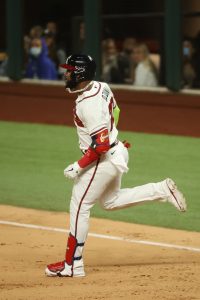
This is an enormous raise for Ozuna, a former Marlin and Cardinal who parlayed a history of above-average production into an $18MM guarantee with the Braves last winter. It ended up as a great move by Atlanta, as Ozuna slashed a monstrous .338/.431/.636 with 18 home runs in 60 games and 267 plate appearances. Along with his stellar bottom-line numbers, Ozuna ranked as an elite hitter by Statcast’s standards.
If there’s any criticism of Ozuna’s 2020, it’s that he didn’t play much defense, only lining up in the outfield 21 times during a year in which the National League featured the universal designated hitter. It remains unclear whether the NL will keep the DH around in 2021, but even if it doesn’t, the Braves will bank on the 30-year-old Ozuna’s offensive abilities remaining intact. The back-to-back-to-back NL East champions clearly needed to either re-sign Ozuna or pick up another big bat to replace him this offseason, and now they have succeeded in retaining one of MLB’s premier hitters.
Braves general manager Alex Anthopoulos isn’t known for signing players to long-term deals, but he made an exception in this case to keep together an offense built around Ozuna, 2020 NL MVP Freddie Freeman and Ronald Acuna Jr. The Braves made earlier notable free-agent signings when they added starters Charlie Morton and Drew Smyly on shorter pacts. Considering what the Braves have done this offseason, they ought to be a force again in the NL East next season, though the Mets, Nationals, Phillies and Marlins should make it difficult on them to win the division yet again.
The MLB offseason got off to an incredibly slow start, but high-end free agents have come flying off the board in the past few weeks. Ozuna’s re-signing means none of MLBTR’s top 10 free agents from the beginning of the winter are left without jobs. MLBTR ranked Ozuna fourth among available players and predicted he would earn a four-year, $72MM deal.
Cubs Designate Max Schrock
The Cubs have designated infielder Max Schrock for assignment, Russell Dorsey of the Chicago Sun-Times tweets. The DFA helps clear room for Joc Pederson, Trevor Williams and Andrew Chafin, whom the Cubs recently agreed to sign.
Schrock had a short stay on the Cubs’ 40-man roster, as they claimed him off waivers from the Cardinals at the end of October. The 26-year-old has limited major league experience (17 plate appearances, all of which came in 2o20) and hasn’t posted impressive production at the Triple-A level. Over 760 PA there, Schrock has batted .260/.324/.350 with six home runs.
Tigers Designate Travis Demeritte
The Tigers announced that they have designated outfielder Travis Demeritte for assignment. His 40-man roster spot will go to second baseman Jonathan Schoop, whom the team agreed to re-sign Friday.
Demeritte was a first-round pick (No. 3o) of the Rangers in 2013 who became a member of the Braves organization in 2016. The Braves wound up trading Demeritte to the Tigers in a 2019 deal centering on reliever Shane Greene, though Demeritte never made much of a mark in the Motor City. Between 2019-20, Demeritte batted just .217/.284/.323 with three home runs in 219 plate appearances.
Despite his issues in the bigs, Demeritte may appeal to other teams. Still just 26 years old, Demeritte has slashed .286/.387/.558 in 399 trips to the plate at the Triple-A level. He also has two minor league options remaining.
Cubs To Sign Joc Pederson
FEB. 5: The mutual option includes a $10MM salary or a $2.5MM buyout, Jon Heyman of MLB Network tweets. Pederson could also earn an extra $125K for 500, 525, 550 or 575 plate appearances.
JAN. 29, 9:05am: There’s a mutual option for the 2022 season on the contract as well, Sherman tweets. As with many mutual options, it comes with a notable buyout, so Pederson’s actual 2021 salary will come in a ways south of that $7MM sum. (Option buyouts are always included in the “guaranteed” portion of a contract.)
Mutual options are typically used as accounting measures more than anything else. A player who overperforms his contract will generally decline his half of the option in favor of a return to market in search of a more lucrative deal; similarly, a player who underperforms may opt into his side of the deal, but the team will turn down its half in those settings. It’s not unprecedented for both sides to exercise a mutual option, but it is quite rare. In other words, the overwhelming likelihood is that Pederson will again be on the open market next winter.
8:30am: It’s a one-year, $7MM deal for Pederson, tweets ESPN’s Jeff Passan. The contract carries an additional $500K of available incentives, tweets Joel Sherman of the New York Post. Passan suggests that the Cubs will give Pederson an opportunity to play on an everyday basis rather than platooning him — a component of the deal that was particularly appealing for Pederson.
7:24am: The Cubs are in agreement on a deal with free-agent outfielder Joc Pederson, reports Ken Rosenthal of The Athletic (via Twitter). The Excel Sports Management client’s contract is still pending the completion of a physical.
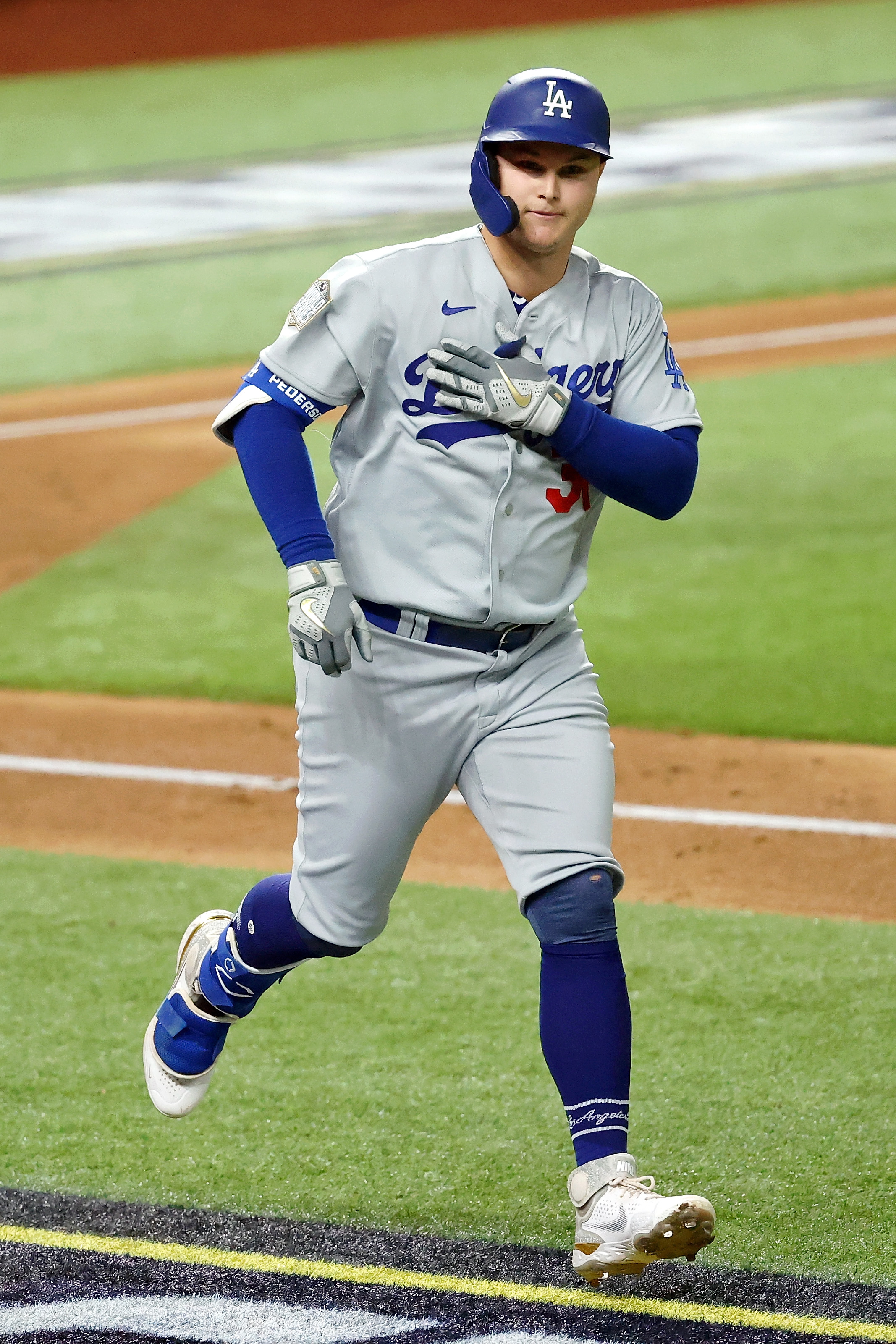
Pederson, 28, represents the first notable addition of the offseason for a Cubs team that has otherwise been quiet on the free-agent front this winter (small deals with Austin Romine and Kohl Stewart notwithstanding). Pederson, in fact, will become the most prominent name to sign a free-agent deal with the Cubs since Craig Kimbrel. The team has generally eschewed the pursuit of notable free agents in each offseason since signing Yu Darvish to a six-year deal, as owner Tom Ricketts has openly lamented a lack of resources and declared 2020’s revenue losses to be “biblical” in proportion.
Chicago, of course, traded Darvish and Victor Caratini to the Padres earlier this season and non-tendered Kyle Schwarber as well. They’ll reinvest some of those savings into this deal with Pederson, though it’s at least something of an odd fit given the vast similarities he has to Schwarber. Pederson is a career .230/.336/.470 hitter to Schwarber’s .230/.336/.480 batting line, though Pederson has put up that nearly identical line in a more pitcher-friendly setting (hence the gap in their respective 118 and 113 wRC+ marks).
Both left-handed hitters are largely considered to be platoon bats, and as is the case with their overall numbers, their splits against righties are nearly identical: .238/.349/.501 for Pederson against .239/.345/.514 for Schwarber. The same five-point gap in wRC+ (128 vs. 123) leans in favor of Pederson because of his home park. The primary difference seemingly comes down to defense, where Pederson has a solid track record in left field and Schwarber has been consistently below average. Still, it’s rather surprising to see the Cubs go out and sign a player whose offense is a near-mirror image of an established clubhouse presence they cast aside not two months ago.
With Pederson on board, the Cubs’ projected payroll jumps to about $152MM for the upcoming season, although future dealings could still impact that number. Both Willson Contreras and Kris Bryant are still candidates to be moved prior to Opening Day, with Bryant in particular standing out as a candidate given his lone remaining year of club control (at a hefty $19.5MM salary). The Cubs also figure to explore extensions with Anthony Rizzo and Javier Baez as the season approaches.