
Latest On Asian Baseball Leagues’ Attempts To Resume Play
If Asia’s top professional baseball leagues represent a preview of what MLB can expect when it tries to get back to play, then the results are mixed — and remain largely indeterminate. Let’s catch up on the latest …
Japan’s Nippon Professional Baseball is back on ice, as Jason Coskrey of the Japan Times writes. It’s a reflection of renewed measures to tamp down on the spread of COVID-19 in the island nation, which recently declared a state of emergency in Tokyo and other areas.
The league’s timeline is now again uncertain. With the new restrictions on activities already set to extend for about a month, a mid-May start to the 2020 NPB campaign would seem to be the best-case scenario.
Even still, Japanese clubs remain able to do quite a bit more than is presently possible for their MLB peers. As Coskrey explains, teams are now backing away from full-squad workouts but are still holding individual or small-group practices at team facilities.
The situation is more promising at the moment in Korea. Per an Associated Press report, the Korea Baseball Organization is currently hoping for an early May launch.
Pre-season KBO contests could occur as soon as April 21, according to the report. There’s already baseball of some sort available, as the Lotte Giants have plans to broadcast intrasquad contests (via MyKBO, on Twitter) as they prepare for spring tilts later this month.
Most promising of all? Taiwan’s top league, the Chinese Professional Baseball League. It’s still scheduled to launch its season — without any fans (real ones, anyway) — on April 11. While it doesn’t carry the reputation of the other two major Asian professional circuits, the CPBL stages a five-team league that spans the island and typically draws reasonably sizable crowds. It’s a much simpler and smaller operation than the majors, to be sure, but it could be a good bellwether for whether and how baseball can resume.
The Mets’ Disastrous Trade For Edwin Diaz & Robinson Cano
The Mets’ trade for Edwin Diaz and Robinson Cano could hardly have gone worse in the first year. But how was the blockbuster deal viewed at the time? MLBTR’s Jeff Todd explores this huge Mets-Mariners swap in today’s video.
These Players Can Exit Their Contracts After 2020
No matter if a Major League Baseball season takes place in 2020, there are certain players who will be in position to decide whether to exit their current contracts next winter. Whether it be by way of an opt-out clause or a mutual option, here’s a look at the players who will be able to choose to take their chances in free agency…
Opt-Outs
Back when the Marlins extended outfielder Giancarlo Stanton on a historic pact worth $325MM over 13 years in 2014, they included a one-time opt-out for next winter. Stanton has put up at least one phenomenal season since he signed that deal – he won the NL MVP and hit 59 home runs in 2017 – but injuries have hampered him on a regular basis. He’s now a member of the Yankees, who acquired him in a December 2017 deal, but Stanton played in just 18 games last season. He’ll still be owed $218MM for seven years after this season, and for at least the time being, it’s very tough to think of Stanton leaving that money on the table to test free agency.
Designated hitter J.D. Martinez, a member of the Yankees’ archrival in Boston, will have two years and $38.75MM remaining on his contract after this season. He’ll be 33 then, and will continue to be someone who’s known as a defensive liability, so should be opt out? It’s up for debate. The big-hitting Martinez remains an offensive standout, but his production last season fell (granted, he did still slash .304/.383/.557 with 36 home runs in 657 plate appearances). He subsequently chose not to opt out after last season, as doing so would have cost him his $23.75MM salary for this year.
One of Martinez’s former Tigers teammates, outfielder Nicholas Castellanos, will also have to choose whether to revisit free agency next offseason. Castellanos is another defensively challenged slugger, one whom the Reds guaranteed $64MM over four years this past winter. He’ll be 29 by the time the 2021 season rolls around, and by saying goodbye to his Reds pact, he’d be leaving $48MM on the table (including a $2MM buyout in 2024). It’s not easy to determine whether that will happen; some of it depends on how well Castellanos fares in 2020, if a season occurs. Carrying over the tremendous production he posted late last season after the Cubs acquired him from the Tigers may make Castellanos more inclined to try his luck on the market again, but his output at the plate has been more good than great throughout his career.
Mutual Options
For the most part, mutual options don’t get picked up. Either a player’s so effective that he opts for free agency or he’s not useful enough for his team to exercise the option. Rockies first baseman Daniel Murphy and reliever Wade Davis are among those who have mutual option decisions waiting after the season, but they’ve struggled in the club’s uniform so far. With that in mind, Murphy’s on track for a $6MM buyout (as opposed to a $12MM salary), while Davis figures to receive a $1MM buyout instead of a $15MM payday.
Brewers outfielder Ryan Braun ($15MM mutual option, $4MM buyout), Diamondbacks right-hander Mike Leake ($18MM mutual option, $5MM buyout) and Cubs lefty Jon Lester ($25MM mutual option, $10MM buyout) could also find themselves looking for new contracts next winter. The same goes for Mets reliever Dellin Betances, though it’s tougher to say in his case. The former Yankee barely pitched at all season on account of injuries, and if there isn’t a season in 2020, would he turn down a guaranteed $6MM in 2021? And would the Mets buy him out for $3MM? That’s one of the many interesting questions we could face next offseason.
How The Angels Discovered Mike Trout
This article by Chuck Wasserstrom was originally published in 2017. For all the entries in Chuck’s Inside the Draft Room series for MLBTR, click here.
The way things are shaping up, the 2009 Los Angeles Angels of Anaheim draft would have to be considered a good one even if the 25th pick belonged to somebody else. When three starting pitchers (including two southpaws) and a power-hitting position player reach and produce at the major league level, it makes for a nice haul.
The team’s first selection, Randal Grichuk, is now a starting outfielder for the Cardinals – and is coming off a 24-homer season as a 24-year-old.
Supplemental first-rounders Tyler Skaggs and Garrett Richards were members of the Angels’ season-opening starting rotation. Second-round pick Patrick Corbin is the Diamondbacks’ No. 2 starter.
[Editor’s note: More recently, Grichuk was a regular in the Blue Jays’ outfield, Richards is penciled in as a key member of the Padres’ rotation, and Corbin excelled in his first season with the Nationals. Skaggs tragically passed away in July last year.]
But then, of course, there is the matter of the Angels having the 25th pick that year. And you can very easily picture Commissioner Bud Selig walking to the podium and making his announcement: “With the 25th selection in the first round of the 2009 First-Year Player Draft, the Los Angeles Angels of Anaheim select Michael Trout.”
“I’ve never seen a team walk out of a draft and think they had a bad draft,” said Eddie Bane, the Angels’ scouting director from 2004-2010 and now a special assignment scout for the Boston Red Sox. “Everybody thinks that their draft was the greatest of all-time every year. Sure, we were guilty of the same thing. I don’t know if guilty is the right word; you just love scouting so much that you think the players you picked are just awesome. That’s the way it works. You think you’re going to help stack the organization; that’s the way everybody thinks. But we actually did. It’s kind of a rarity.”
In 2008, the Angels won a major league-best 100 games and went to the postseason for the fifth time in seven years.
Success on the field was mirrored by the Angels’ frequent forays into free agency, which directly impacted the team’s amateur draft capabilities. Over their previous five drafts, the team gave up seven high-round picks as free agent compensation, losing either a first- or second-round pick every year.
The 2009 draft, from that standpoint, was no different; the Angels surrendered their own No. 1 (No. 32 overall) as compensation for the signing of free agent closer Brian Fuentes.
However, the Angels lost several key players to free agency – closer Francisco Rodriguez (to the Mets), first baseman Mark Teixeira (to the Yankees) and starting pitcher Jon Garland (to the Diamondbacks). Lo and behold, the team had a glut of high-round picks – back-to-back at 24-25, followed swiftly by supplemental selections at 40, 42 and 48.
(Have you forgotten how the old Type A/Type B free agent compensation system worked? Take a trip down memory lane.)
“I started with the Angels in 2004, and we had a pick at 12 and got Jered Weaver. But other than that, we never had anything in the first 25 because we were pretty good and we were more in the shopping business,” said Bane – a no-nonsense, tell-it-like-it-is type whose previous Angels drafts included the selection of future big leaguers Weaver, Nick Adenhart, Mark Trumbo, Peter Bourjos, Hank Conger, Jordan Walden, Tyler Chatwood and Will Smith. “We never thought once about not having a really high pick; that was normal. So we were really excited because we had five picks. We thought that was awesome.”
If you recall, 2009 was the “Year of Strasburg.” The chances of Stephen Strasburg getting past Washington and falling all the way to No. 2 in the draft were largely nonexistent.
“I saw him pitch one time for about 2.0 innings and said, ‘This is a waste of time,’” Bane recalled. “I told the area scout to just make sure he does a good job on Strasburg’s makeup and everything else. You don’t spend a lot of time on Stephen Strasburg when you’re picking 24-25.”
Bane started ruling out others he knew would be gone by the middle of the first round and started focusing on players who he thought could be there for him. One player he was immediately drawn to was a prep outfielder out of Lamar Consolidated High School in Rosenberg, Texas, named Randal Grichuk.
“Jeff Malinoff, one of my national cross-checkers who was as good of a hitting scouting guy as there’s ever been … he loved Randal, as did Kevin Ham, the area scout,” Bane said. “Randal could hit his home runs a long way to right-center and left-center. Obvious power. Good athlete. All that stuff. We thought there would be a chance that he would get there.
“It’s hard to describe to people the excitement you get when you see somebody that not every scout loves, and you see the passion they have for the game, and you file that away. I still remember batting practice; I was there with Jeff, and Randal was hitting rockets out to right-center. With Randal, the body has improved with maturity, but it’s not dramatically different than he was in high school. He was a strong, good athlete that could go get a ball in centerfield. His arm was fine. To me, he looked like a lock first rounder. That’s when you start thinking immediately, ‘Well, he won’t be there when we pick’ – because you think other teams see it exactly the way you do. Fortunately, they don’t.”
And then, of course, there was another prep outfielder that Bane locked in on – this one out of Millville Senior High School in New Jersey. Two MVP seasons and three MVP runner-up campaigns later, it’s still hard to believe that Mike Trout would be available that deep in the draft.
– – –Read more
Prospect Faceoff: Pick An Outfielder
We at MLBTR have been doing head-to-head comparisons of some of baseball’s elite prospects in recent weeks. Let’s keep it going with a pair of the minors’ top young outfielders, the Mariners’ Jarred Kelenic and the Braves’ Cristian Pache. The two would have been National League East rivals had the Mets not traded Kelenic (we’ve covered their 2018 blockbuster with the Mariners extensively of late; see: here, here and here), but it wasn’t to be. Kelenic now looks like a tremendous building block for the long-suffering Mariners, while Pache could amount to the latest homegrown Braves great.
Kelenic was the sixth overall pick in the 2018 draft, and there now seems to be an almost unanimous belief that he is the game’s 11th-best prospect. Each of MLB.com, Baseball America and FanGraphs place him in that position, after all. The power-hitting 20-year-old climbed to the Double-A level for the first time last season, his debut campaign in the Seattle organization, and batted .253/.315/.542 with six home runs in 92 plate appearances. Not necessarily extraordinary numbers on paper, nor was it a huge sample size, but that line was an impressive 33 percent better than the league average, according to FanGraphs’ wRC+ metric. Speaking of FanGraphs, their own Eric Longenhagen wrote just two weeks ago of Kelenic, “He’s much more stick than glove, but Kelenic looks like an All-Star center fielder who’s rapidly approaching Seattle.” The upside’s definitely there for Kelenic, like fellow Mariners outfield prospect Julio Rodriguez, to help the Mariners escape the mire in the coming years.
Unlike the M’s, the Braves have enjoyed quite a bit of success in recent years. They’re back-to-back NL East champions who probably aren’t going away in the near future, considering the vast amount of talent they possess. And it appears to be only a matter of time before they get a look at Pache, who just turned 21 a few months ago and could someday join the amazing Ronald Acuna Jr. (and maybe fellow prospect Drew Waters) as an indispensable part of the Braves’ outfield. For now, the experts at Baseball America (No. 12), MLB.com (No. 13) and FanGraphs (No. 20) say Pache is among baseball’s 20 premier prospects. Pache was terrific last year in Double-A, where he hit .278/.340/.474 (134 wRC+) with 11 homers in 433 PA, but wasn’t quite as powerful in his initial taste of Triple-A action (.274/.337/.411 with a single HR over 105 PA). However, as Longenhagen suggested a couple months back, Pache won’t need to post all-world offensive numbers to make a notable impact in the bigs, as he possesses tremendous upside as a defender.
Kelenic and Pache could eventually turn into two of the top center fielders in the game, but their styles are different. Kelenic seems to be more of a force at the plate, while defense looks like Pache’s forte. Which one would you rather have? (Poll link for app users)
Choose a prospect
-
Jarred Kelenic 54% (3,115)
-
Cristian Pache 46% (2,698)
Total votes: 5,813
This Date In Transactions History: Give The Padres A Hand
In terms of on-field results, it hasn’t been a fruitful tenure in San Diego for general manager A.J. Preller, who hasn’t even overseen a .500 team since his hiring in 2014. But it was on this day four years ago that Preller made one of his best moves as the head of the club’s baseball department. On April 8, 2016, Preller’s Padres claimed left-handed reliever Brad Hand from the Marlins via waivers. It’s now fair to say the decision counts as one of the biggest steals of the past several years.
When the Padres put in their claim, Hand – a 2008 second-round pick and a then-26-year-old – had failed to distinguish himself as either a quality starter or a solid reliever. As a member of the Marlins, he totaled 90 appearances (43 starts) and 288 2/3 innings of 4.71 ERA/4.54 FIP ball with just 5.9 K/9 against 3.7 BB/9. The Marlins designated him for assignment as a result, but the light bulb immediately went on in San Diego in 2016, when he switched to a full-time relief role.
Owing in part to an increased reliance on his slider, Hand notched a 2.92 ERA/3.07 FIP with 11.18 K/9 and 3.63 BB/9 in 89 1/3 innings during his initial Padres season. The good times have kept rolling since then for Hand, who has earned three straight All-Star nods. Since the Marlins cut ties with him, Hand has logged a 2.75 ERA/3.04 FIP and 12.23 K/9 against 3.08 BB/9 across 298 frames. And he has cashed in along the way, having inked a three-year, $19.75MM guarantee in advance of the 2018 season. Odds are that Hand will collect another $10MM in 2021, as it’s difficult to see his employer turning down that reasonably priced option in favor of a $1MM buyout.
While the Padres were the ones who made that financial commitment to Hand, he’s no longer on their roster. After Hand generated significant trade interest from around the game, the Padres sold high on him in in July 2018. They sent him and fellow reliever Adam Cimber to Cleveland for catcher/outfielder Francisco Mejia, then one of the highest-ranked prospects in baseball.
Hand has been an effective closer for the Indians (Cimber struggled somewhat last year), whereas Mejia hasn’t quite lived up to the hype he drew in his younger days. However, that’s not to say Mejia is a lost cause by any means. The switch-hitting 24-year-old is coming off his first extensive action in the majors, where he batted a decent .265/.316/.438 (96 wRC+) with eight home runs in 244 plate appearances last season. Mejia did have difficulty behind the plate, throwing out only 17 percent of would-be base stealers and earning a below-average pitch-framing grade, though the Padres are no doubt still hopeful that he’ll emerge as their long-term solution at catcher. Even if he doesn’t, it’s hard to argue with the value they received in the Hand trade, and it never would have happened had they not made the wise decision to grab him off the waiver wire four years back.
Don’t Give Up On The Blue Jays’ Other Top Prospect After A Rough Rookie Year
With Bo Bichette, Vladimir Guerrero Jr. and Cavan Biggio bursting onto the scene in Toronto and right-hander Nate Pearson looming in Triple-A as a potential top-of-the-rotation arm, the Blue Jays have the makings of a strong young core. But the debuts of those three bats and the hype surrounding Pearson have overshadowed the arrival of another of Toronto’s top prospects: catcher Danny Jansen.
Jansen, 25 next week, didn’t exactly help his own cause with a tepid showing at the plate in his rookie season. The former 16th-round pick posted an ugly .207/.279/.360 batting line in 384 plate appearances — not exactly a scintillating followup to the .247/.347/.432 slash he compiled through 95 plate appearances as a late-season call-up in 2018. It’s understandable that such a forgettable performance would lead him to be overlooked, but there’s still reason to believe that Jansen can be an important piece of the Jays’ next contending club.
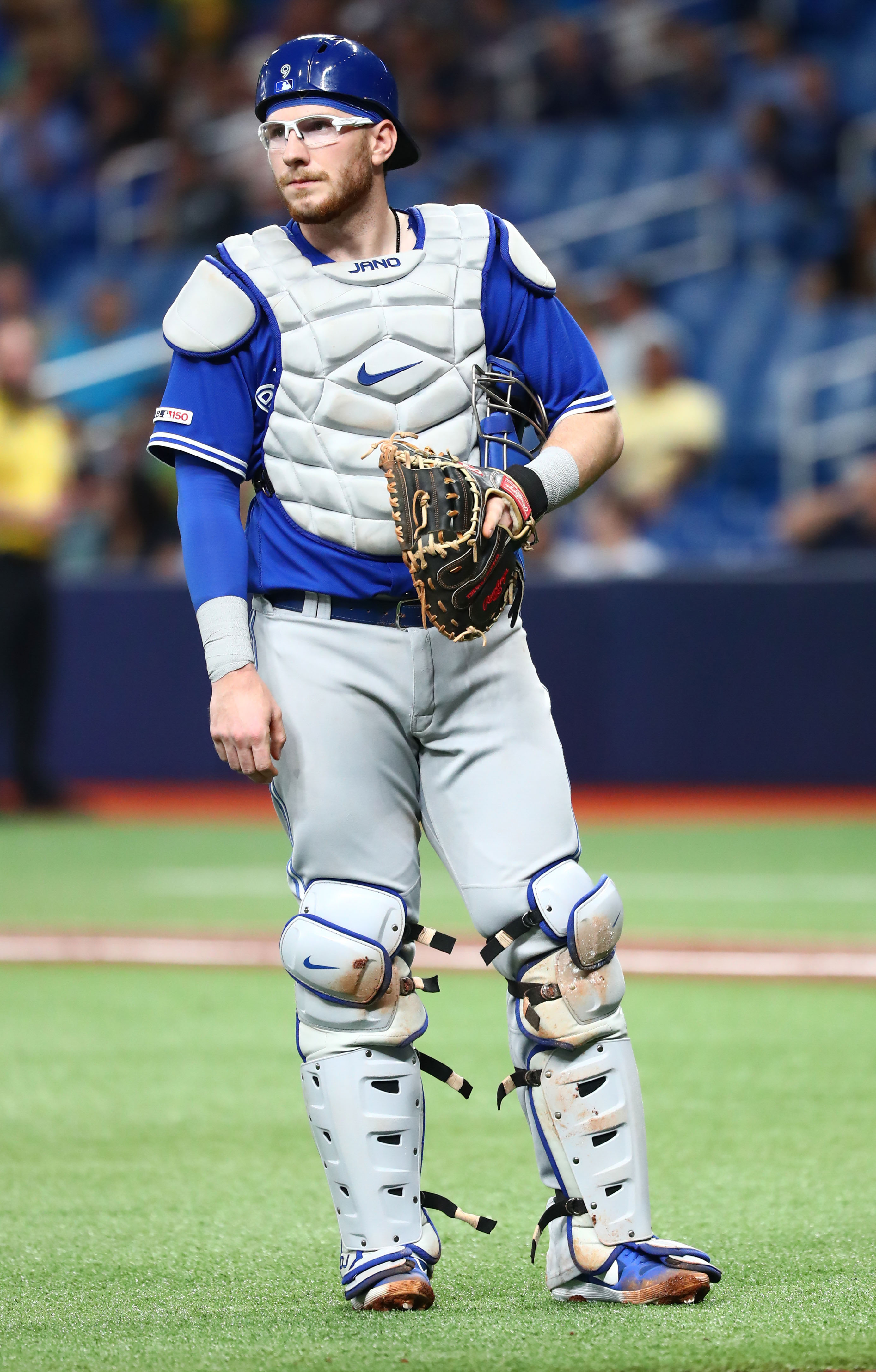
Firstly, it’s worth noting that despite his middling draft status, Jansen emerged as a prospect of considerable note. Prior to the 2019 campaign, Jansen ranked comfortably inside the game’s top 100 prospects according to each of Baseball America (No. 42), FanGraphs (No. 47), MLB.com (No. 65) and Baseball Prospectus (No. 89). He ranked just outside the top 100 (No. 107) on the ESPN’ rankings. During his final full season in Triple-A, Jansen hit .275/.390/.473 with a dozen homers and a 12.2 percent walk rate that only marginally trailed his 13.6 percent strikeout rate. There’s enough pedigree here to suggest improvement based on that alone.
But Jansen’s work at the plate likely wasn’t as bad as it would appear upon first glance. While he doesn’t run well enough to ever be likely to post a particularly high average on balls in play, Jansen’s .230 mark in 2019 still seems ripe for some positive regression. He’d only posted a mark lower than that once in his career — back in 2015 in a 46-game sample in Class-A. During Jansen’s final two seasons in the upper minors, his BABIP hovered around .300.
According to Statcast, Jansen made hard contact (95 mph or better in terms of exit velocity) at a 40 percent clip that, while not elite, was above the league average. Of the 406 hitters who put at least 100 balls into play last season, Jansen ranked 148th. His bottom-line results at the plate (.275 wOBA) were along the lines of what one might expect from a defensive specialist like Austin Hedges (.266 expected wOBA) or Jarrod Dyson (.273 xwOBA), but Jansen’s .314 xwOBA was markedly higher. The 39-point gap between his actual wOBA and expected wOBA was the fourth-largest of any player who underperformed his xwOBA in 2019, trailing only Marcell Ozuna, Justin Smoak and C.J. Cron.
Put another way: based on the quality of his contact and his K/BB tendencies, Statcast felt that Jansen should’ve been within striking distance of league average at the plate. Instead, he was one of the game’s least-productive hitters.
But even that generalization shrouds some positives that Jansen displayed. While he struggled through miserable months in April and May to begin the season, Jansen heated up with the weather and found himself as one of the game’s more productive catchers from June through August. In that stretch, he notched a respectable .243/.310/.459 batting line in 205 plate appearances — good for a 101 wRC+. League-average production out of a catcher is rare — catchers posted a collective 85 wRC+ in 2019 — so Jansen demonstrating that type of ability over a three-month stretch is heartening. And if he can drop his 20.9 percent strikeout rate such that it more closely mirrors his excellent marks in the upper minors, Jansen’s profile becomes all the more interesting.
Defensively, Jansen shined in 2019, which is a bit odd given that most scouting reports on him cast him as a bat-first catcher and a mediocre defender. His 2.05 second average pop time was well below average — 58th of 78 qualified catchers — but Jansen still threw out 31 percent of those who attempted to run on him. In terms of framing, Jansen ranked among the game’s best according to each of Statcast, FanGraphs and Baseball Prospectus. He was also strong in terms of blocking pitches in the dirt per Baseball Prospectus, which ranked Jansen seventh among all MLB catchers in terms of adjusted fielding runs above average.
Jansen might not possess the superstar upside of current teammates like Bichette and Guerrero or his soon-to-be battery-mate Pearson. But he clearly has the makings of an average or better hitter moving forward, and the 2019 season suggests that his defense might be far more valuable than many had hoped of him as a prospect. An above-average defensive catcher with a competent (or better) bat is the type of talent clubs spend years trying to get their hands on — there’s a reason Jansen drew trade interest early in the offseason — and Jansen could be just that for an increasingly interesting Blue Jays club. It’s easy for Jansen to get lost in the shuffle when looking at the Jays’ young core, but a breakout when play resumes shouldn’t surprise anyone.
Rockies Provide Timetable On Peter Lambert Injury
Rockies right-hander Peter Lambert, diagnosed with a forearm strain a month ago, is progressing through a rehab program but is still three to four weeks from being cleared to throw, pitching coach Steve Foster tells reporters (Twitter link via Kyle Newman of the Denver Post).
At the time of Lambert’s injury, Colorado declined to put a timetable on his recovery, with reports indicating that he was expected to miss “significant” time. Today’s news from Foster doesn’t provide an expected return to game readiness, but the fact that he’s close to a month from even beginning a throwing program suggests that he’s multiple months away from that point. Any early throwing Lambert does would of course be limited, and he’d need time to ramp up to long toss, throwing off a mound, facing live hitters, etc.
Lambert, 23 next week, is hardly a household name but is a young hurler of some note within the organization’s ranks. He was the club’s second-round pick (44th overall) back in 2015 and steadily rose through the minor league system, ultimately making his big league debut in 2019. He started 19 games for the Rox with woeful results (7.25 ERA, 5.97 FIP), but this time last year, Lambert was considered one of the organization’s best overall prospects. On a national scale, Eric Longenhagen and Kiley McDaniel ranked him as the game’s No. 120 overall prospect heading into the season. At that point, he was fresh off a 2018 season that saw him toss 148 innings of 3.28 ERA ball with a 106-to-27 K/BB ratio and a grounder rate just shy of 50 percent between Double-A and Triple-A.
Even a healthy Lambert wouldn’t have been a lock to begin the year in Colorado’s rotation. Jon Gray, German Marquez and Kyle Freeland seemed like locks, while out-of-options hurlers Antonio Senzatela and Jeff Hoffman were slated to vie for rotation spots along with Lambert, Chi Chi Gonzalez and others (including non-roster invitee Ubaldo Jimenez). The delayed start to the year could conceivably give Lambert enough time to reenter that mix, depending on when (or if) a second training camp is able to come together.
Offseason In Review: Arizona Diamondbacks
The D-Backs spent significant sums in free agency for the first time since GM Mike Hazen came aboard and pulled off an interesting trade for a key veteran. But is it enough to mount a real challenge to the dominant division force?
Major League Signings
- Madison Bumgarner, SP: five years, $85MM
- Kole Calhoun, OF: two years, $16MM (includes $2MM buyout on $9MM club option)
- Stephen Vogt, C: one year, $3MM (includes $500K buyout of $3MM vesting/club option)
- Hector Rondon, RP: one year, $3MM (includes $500K buyout of $4MM club option)
- Junior Guerra, RP: one year, $2.65MM (includes $100K buyout of club option)
- Total spend: $109.65MM
Trades and Claims
- Acquired OF Starling Marte (with $1.5MM salary offset) from Pirates in exchange for SS Liover Peguero, RHP Brennan Malone and $250K of international bonus availability
- Acquired RHP Jeremy Beasley from Angels in exchange for RHP Matt Andriese
- Claimed INF Pat Valaika off waivers from Orioles (Baltimore later reacquired Valaika via waivers)
Extensions
Notable Minor League Signings
- Aaron Blair, John Hicks, David Huff, Edwin Jackson, Jon Jay, Mark Leiter Jr., Joe Mantiply, Dalton Pompey, Travis Snider, Trayce Thompson
Notable Losses
- Wilmer Flores, Taijuan Walker, Steven Souza Jr., Adam Jones, Jarrod Dyson, Yoshihisa Hirano, Alex Avila, Caleb Joseph, Abraham Almonte, Blake Swihart
Hazen has rightly drawn plaudits — including from us at MLBTR! — for his work since coming aboard in 2016. The organization has managed to stay competitive and build up an increasingly deep and well-regarded farm system.
It’s tough to do both of those things at the same time. Entering the winter, it was hardly clear exactly what direction the Arizona organization would take — if it would move one way or the other at all. There’s a danger of stasis and bland mediocrity in the middle as well.
From the outset, there was talk of the D-Backs trading Robbie Ray. Having already sent out a number of other shorter-term veterans in recent years — most prominently, Paul Goldschmidt and Zack Greinke — it seemed possible or even likely that the club would again look to increase its long-term talent pool while back-filling with younger MLB talent. That has worked out exceedingly well in both of the above cases. Luke Weaver and Carson Kelly came over in the Goldy swap. The Snakes snagged Zac Gallen in a separate deal even as they moved Greinke for some MLB-ready talent (including Corbin Martin and Josh Rojas).
It’s important to remember just how little Hazen had done in free agency. Before this offseason, he had never inked an open-market deal worth even $10MM — though he had done a few such extensions. As it turned out, the Diamondbacks moved in a decidedly win-now direction, though they did so in a far less splashy manner than when they acquired Greinke and Shelby Miller in that memorable winter under the prior regime.
With an ever-flexible, opportunistic approach to roster-building, Hazen may well have set his course when he learned of a fairly unique opportunity. Madison Bumgarner, a legitimate franchise legend of the division-rival Giants, had keen interest in playing for Arizona. The club sorted out a back-loaded contract that could make MadBum a D-Back for the rest of his career. It’s not a zero-risk proposition, and he probably isn’t going to return to his prior levels of dominance, but it was a nice price for a veteran performer who’s a clear rotation upgrade.
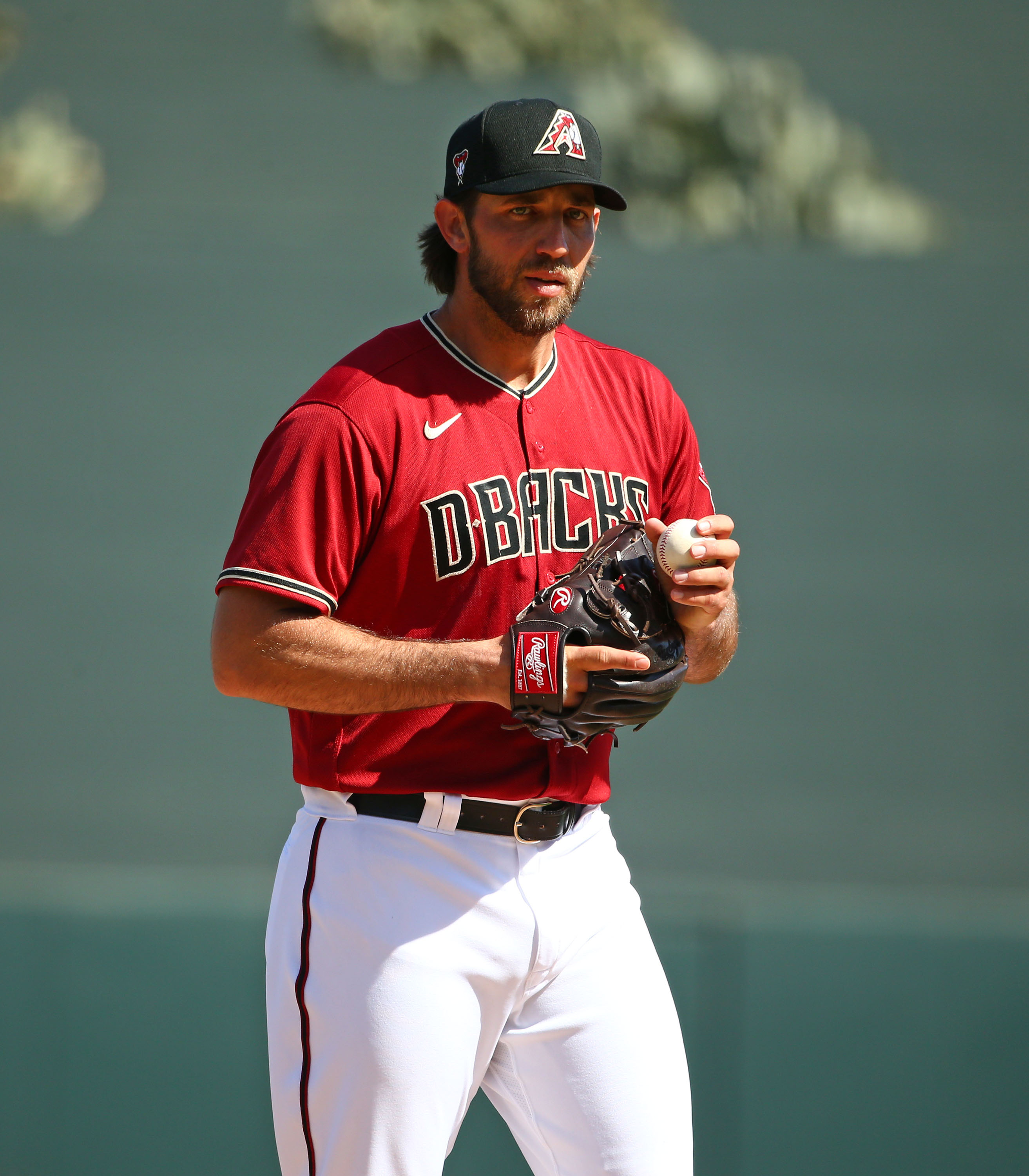
It was settled: Ray would stay, pairing with Bumgarner as a veteran 1-2 southpaw punch. The rotation was set with the steady Mike Leake and aforementioned Weaver and Gallen, with swingman Merrill Kelly ready to step in where needed. There was already a series of quality upper-level arms available — Jon Duplantier, Alex Young, Taylor Clarke, Taylor Widener — which left the team without need of Taijuan Walker. Rather than taking a roll of the dice on Walker, the D-Backs non-tendered him.
The Snakes also non-tendered outfielder Steven Souza, who joined Walker as a disappointing prior trade acquisition. That left the team with another outfield slot to be filled — to go with the potential opening in center field that would allow emergent star Ketel Marte to move back into the infield, as the club preferred.
There were loads of possibilities for adding the requisite outfield pieces. The D-Backs ultimately grabbed two veterans, both on reasonable salaries — one via free agency and the other via trade. Kole Calhoun forms a lefty-lefty corner duo with David Peralta, who also inked an affordable three-year extension. Calhoun isn’t likely to be a star-level performer, but he’s sure to be a grinder and fills a need at a palatable rate of pay.
Of greater interest: the D-Backs cashed in two of their far-off farmhands to land talented center fielder Starling Marte. He’ll cost the team $11.5MM this year and $12.5MM next, less the $1.5MM the Bucs chipped in. As I wrote in previewing the offseason for this club, “there’s an argument to be made that [Marte] fits in just the right space (two years of affordable but not cheap control) for the D-Backs.” That’s obviously how the team saw it.
(Starling) Marte should offer a nice blend of floor and upside for the Snakes, who could still pivot and deal him if circumstances warrant. It’s much the same approach Hazen has taken time and again when he sees solid value in quality, established players. The team has now done so several times in the extension context — first with infielder Eduardo Escobar, this winter with Peralta and shortstop Nick Ahmed.
Now that (Ketel) Marte is back in the infield, the club has extended players occupying the 4-5-6 positions. Christian Walker and Jake Lamb will handle first base (with the latter also appearing at the hot corner), rounding out the chief needs. There are a variety of reserve and depth options already on the 40-man roster, including utility infielder Ildemaro Vargas, first baseman Kevin Cron, and second/third base candidate in Rojas.
Behind the dish, the Snakes will hope that Carson Kelly can keep things moving in a positive direction. They replaced Alex Avila with another left-handed-hitting bat-first receiver in Stephen Vogt.
As with the addition of Vogt, the D-Backs decided on some modest veteran spending to bolster the relief unit. Junior Guerra and Hector Rondon will each occupy setup slots in front of returning closer Archie Bradley. It’s tough to project this unit as a marked strength, but the Arizona org will be aided by its collection of 40-man pitching depth (which includes some of the aforementioned players and a host of others with no or little MLB experience).
2020 Season Outlook
This is a strong overall roster that doesn’t really have holes … but still doesn’t seem near the overall talent level of the Dodgers. Even if the double-Marte combination stars and all of the solid veterans play well, it’s going to be awfully tough to prevent the L.A. behemoth from an eighth-straight NL West crown.
Still, the Diamondbacks are good enough that they could yet surprise if the Dodgers falter — especially in a short-season format. And a Wild Card spot is firmly in play. The club obviously feels it has set itself up for continued competitiveness in the near-term without sacrificing its long-term ability to contend — either by mortgaging the farm or bogging down the payroll. That’s the general approach that most mid-market teams have tried to find, but the current Diamondbacks regime is looking particularly adept at striking that balance.
How would you grade the club’s offseason efforts? (Link to poll for Trade Rumors mobile app users.)
Grade the Diamondbacks' offseason:
-
B 43% (931)
-
A 42% (905)
-
C 11% (245)
-
F 2% (45)
-
D 1% (30)
Total votes: 2,156
The Padres’ Interesting Rotation
We’ve heard an awful lot of chatter over the years about the Padres trying to acquire premium MLB rotation pieces — Noah Syndergaard, etc. They’ve yet to swing such a deal, but nevertheless have managed to compile rather an interesting slate of starters.
While much of the excitement has remained focused on the future — MacKenzie Gore, Luis Patino, and more — that tends to obscure the present. There’s an intriguing blend of reasonable expectations and soaring upside in the unit on hand.
Let’s start with a few projections …
The composite expectations of ZiPS & Steamer present rather a favorable view of the Friars’ starting unit, predicting ~3 WAR performances from Chris Paddack, Garrett Richards, and Dinelson Lamet. That system likes Paddack a bit more than the other two, due mostly to an expectation that he’ll make three more starts. ZiPS sees Joey Lucchesi as a sturdy 2.5 WAR hurler and likes Zach Davies to deliver in the range of 1.5 WAR. It’s less than enthused about Cal Quantrill as the top depth piece.
PECOTA tells a broadly similar tale of possibilities, but bakes in added padding for the long-term health questions facing Richards and Lamet. The Baseball Prospectus computers are also significantly less optimistic when it comes to the quality of Lucchesi and Davies.
This is a good time to pause and consider the context. Getting ~13 WAR out of a rotation would mean having one of the ten or so best staffs in baseball. In terms of projections, the Fangraphs numbers put the San Diego starting group behind the Dodgers but slightly ahead of the Diamondbacks on paper. 13 is a pretty strong number as mean expectations go. Even with superstar Jacob deGrom, but sans Noah Syndergaard, the Mets sit at a ~15 WAR projection.
Of course, that PECOTA projection hints at the real downside concern here. Both Richards and Lamet returned last year from Tommy John surgery. We’ve seen plenty of hurlers put that procedure in the rearview mirror, but some can run into difficulties — sometimes as other, potentially connected health problems arise — after showing initial promise. (Matt Harvey, anyone?) The hope is to unleash Paddack fully after keeping him on a leash last year, but he’s also a fairly recent TJ recipient.
And what of the other members of the staff? Davies has mostly produced very solid numbers, but he struggled quite a lot in 2018 and his peripherals didn’t excite in 2019. Davies logged a 3.55 ERA last year but FIP (4.56), xFIP (5.20) and SIERA (5.43) were decidedly unimpressed. Lucchesi was steadier in 2019 but doesn’t have as long of a track record. These are solid and useful pitchers, but they’re unlikely to lead the way if the top trio falters.
Depth isn’t necessarily a strong suit, either. Quantrill hasn’t really shown a spark to this stage of his career. Luis Perdomo and Matt Strahm seem likelier to work out in the bullpen. Other 40-man members — Adrian Morejon, Michael Baez, Ronald Bolanos — are quite speculative as immediate-term MLB starters. There are some non-roster players with experience in Jerad Eickhoff (looking to bounce back after washing out with the Phillies), Seth Frankoff (back from a successful KBO stint), Jacob Nix and Brett Kennedy (outrighted after struggling in 2018 debuts with the Pads). But it’s tough to rely much upon that slate of players.
Frankly, though, the reasonably anticipated scenario and the downside scenario aren’t the interesting ones. This is a season in which the Friars face long odds — if indeed it gets underway at all. Upside is where it’s at.
When it comes to ceiling, there’s a lot to like about this staff. Let’s start with Paddack, who faded as he got deep into a personal-high workload of 140 2/3 innings. He has now handled a full season in the majors and can build off of that without restraint. Last year, as a 23-year-old rookie, he pitched to a 3.33 ERA with 9.8 K/9 and 2.0 BB/9 over 26 starts. With further growth, he could blossom into a legitimate #1 starter.
And hang on … are we underestimating Richards and Lamet? The former didn’t exactly return to top form in the results department late in 2019, but the fact he was able to get back to competitive action was quite promising. If he can work anywhere near his career norm (3.60 ERA) he’d be a huge piece for the Pads. The flamethrowing former Angels ace arguably has ceiling beyond that.
Lamet is perhaps even more interesting. He not only was able to make it through 14 starts in 2019, working to a solid 4.07 ERA, but generated an eye-popping 12.9 K/9. Lamet showed bigger velocity (96+ mph average fastball) and swinging-strike ability (14.0% SwStr) than he did in his rookie season.
It isn’t altogether impossible to imagine a three-headed monster forming at the top of this Padres staff … if everything breaks right. Combined with the two other quality starters — not to mention a similarly intriguing relief mix fronted by Kirby Yates, Emilio Pagan, and Drew Pomeranz — you can begin to see the possibilities for a pitching-led Padres breakout. This is all the more interesting since we’re looking at a short-season format where depth may not matter to quite the same extent (or, at least, not in quite the same way) as usual.
Is that likely to happen? Not so much. And any hopes of Gore and/or Patino streaking to the majors in 2020 likely went out the window when the coronavirus arrived, eliminating the potential for a typical minor-league season. That robs another upside scenario. Still, the Padres’ rotation is a particularly interesting one to watch … or, it will be if and when we finally get ballgames rolling.