
The Brewers’ Infield Picture
Those following the Brewers at a distance may not have paid much attention to their tempered approach to the offseason. It’s easy to look at their winter and see a modest collection of stopgaps to stanch the roster bleed of departing vets like Yasmani Grandal and Mike Moustakas. Look a littler closer, however, and you’ll find President of Baseball Ops and GM David Stearns created a two-year window of flexible and affordable contracts to keep Craig Counsell‘s squad in contention, writes Tom Haudricourt of the Milwaukee Journal Sentinel.
With Christian Yelich and Josh Hader, the Brew Crew have some of the best high-end talent in the game, but they’ve done a nice job filling out the infield with one-and-one contracts for Brock Holt, Eric Sogard, Justin Smoak, and Jedd Gyorko. Along with trade acquisition Luis Urias, the Brewers found a grab bag of roster pieces to power their infield engine in a wide-open NL Central. Holdovers Keston Hiura and Orlando Arcia join the extensive group of infielders vying for playing time.
Though Arcia is still just 25-years-old and has notched some big performances for the Brewers in recent seasons, his grip on everyday at-bats is loosening. Urias’ injury has provided Arcia with a last-ditch opportunity to prove his mettle. He certainly brings attitude and flair to the diamond, but two seasons of a .228/.277/.333 line dims the outlook on Arcia’s offensive potential for sure. Still, of the newcomers in the clubhouse, only Urias really threatens Arcia’s everyday status at short.
Of all rostered Brewers not named Yelich, Hiura has the highest ceiling. Thus, the onus lies largely (if unfairly) on his shoulders to make up the offensive production left behind by Grandal and Moustakas (who put up a combined 7 oWAR last season per baseball-reference). He put up a robust .303/.368/.570 line in just 84 games as a 22-year-old after being called up last season (139 wRC+). His power numbers have fluctuated throughout his professional career, but the hit tool has consistently played, and the Brewers are counting on Hiura to do some damage from the middle of their order.
The final piece of the infield puzzle for Counsell is long-time face-of-the-franchise Ryan Braun. Braun could see a majority of his time at first base with Avisail Garcia and Ben Gamel lining up with Yelich and Lorenzo Cain in the outfield. The exact formula for the rest of the lineup has no shortage of variables, but Counsell has proven himself an adept engineer. Importantly for Milwaukee, if any of the newly-acquired pieces fail to meld, they’ve maintained the flexibility, financially and structurally, to pivot.
Quick Hits: Puig, Arbitration Process, Royals, Montgomery
The status of top remaining free agent Yasiel Puig remains up in the air as Spring Training baseball kicks off today. The mercurial and ever-entertaining pugilist got everyday at-bats in 2019 after a couple years of more judicious playing time with the Dodgers – but the results don’t have teams lined up with contract offers. Puig hit .267/.327/.458 across 611 plate appearances with the Reds and Indians with 24 home runs and 84 RBIs. Puig’s singular personality makes his on-field contributions just a part of the overall package, but even after a year of modest production (101 wRC+), Puig ought to be able to find a job somewhere. Latest reports have the White Sox and Rockies as potential landing spots for Puig, per Hector Gomez of Deportivo Z 101. The Athletic’s Nick Groke downplays the Rockies interest (via Twitter), however.
- CAA agent Jeff Berry lost two arbitration cases this week. Arbitration panels chose the team award amount in cases for J.T. Realmuto and Josh Hader, two transformative performers trying to make their cases to earn beyond the scope of their positional historical comps, per The Athletic’s Ken Rosenthal. Said Berry of the proceedings, “This was about two guys (Hader and Realmuto) willing to go to the mat to fight for what’s right, and hopefully other players take notice.” It’s possible to look at the results and presume that Berry overestimated his cases for both superstars (within the confines of the current system). It’s surely a fine line between fighting for the best result in an uneven system and politicking for change. Either way, the arbitration panel could use some work. Rosenthal brought a particularly interesting point to the foreground, noting that either the players’ union or MLB “can unilaterally fire any arbitrator at any time.” That’s certainly an inflection point for turning a supposedly unbiased system into one rife for manipulation.
- After trading for Cubs’ swingman Mike Montgomery in July, the Royals believe he can reach another gear when settled into a starting role, per Lynn Worthy of the Kansas City Star. The Cubs thought the same thing when they acquired Montgomery in the middle of 2016. Though the Cubs never found consistent work for Montgomery in the rotation, he played an important role as a swingman for Chicago. And of course, never forget, he earned the save in game seven of the 2016 World Series. Not for nothing, but Montgomery has desired a rotation slot for some time now, and it could be that the consistency and trust the Royals plan on giving him in his role will have the desired effect – but only time will tell. In 13 starts after the trade last season, Montgomery went 2-7 with a 4.64 ERA/5.23 FIP while striking out 7.2 batters per nine innings.
Twins Acquire Kenta Maeda
FEBRUARY 10, 7:36pm: This deal is now official.
6:36pm: Young catcher Jair Camargo represents the last piece of the puzzle going to Minnesota, per Dan Hayes of The Athletic (via Twitter).
FEBRUARY 9, 6:35pm: The Twins are sending outfielder Luke Raley to the Dodgers as the final piece of the package heading to California, per MLB Insider Jeff Passan (via Twitter). Interestingly, Raley was originally drafted by the Dodgers. He was traded to Minnesota as part of the Brian Dozier deadline deal in 2018. Raley, 25, rejoins the Dodgers organization after hitting .302/.362/.516 in 33 games at Triple-A Rochester in 2019.
5:32pm: Interestingly enough, now that the Mookie Betts to the Dodgers deal is again near completion, the rest of the baseball world can move on. That includes the Minnesota Twins, who are completing their leg of this mega-deal in a new iteration.
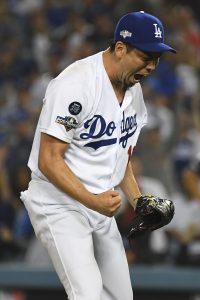
The Twins will now receive right-handed pitcher Kenta Maeda, along with $10MM cash from the Dodgers, per The Athletic’s Ken Rosenthal (Twitter links). They are also likely to receive a lower level prospect from the Dodgers, per Rosenthal, though the name of that prospect has not yet been revealed. Another report has the Twins sending an additional prospect to the Dodgers, per The Athletic’s Dan Hayes. That player is said to be an outfielder, per MLB Networks Jon Heyman.
If your head is spinning at this point, that’s okay. In total, Maeda, $10MM cash and a prospect is headed to the Twins for Brusdar Graterol, a draft pick (#67 overall) and another prospect. Deals are still pending physicals, which of course, is no small caveat, though expectations are that the deal will go through. We’ll keep this post updated as the names of those final prospects come rolling in.
The Dodgers will now keep Graterol, presumably making him a part of their bullpen picture in 2020. It’s certainly an interesting gambit for the Dodgers to take on Graterol after the Red Sox passed. Regardless, he becomes another weapon for the Dodgers to use in their quest to return to the World Series. He may even be the perfect candidate to take on the multi-inning fireman role that Maeda had played for the Dodgers over the past few postseasons. Alternatively, if Kenley Jansen‘s struggles continue, Graterol could step into a finishing role. However they plan on using him, the Dodgers not only added one of the best player’s in the game today, but also a high-risk, high-reward young hurler.
For the Twins, they get a reliable arm for their rotation at little financial investment to slot in with Jose Berrios and Jake Odorizzi at the top of their rotation. Even Maeda wins here, as he gets the security of starting for a playoff contender, something he’s long desired, per MLB Network’s Jon Heyman. Maeda has a fairly complex contract, but given the money being sent Minnesota’s way, the Twinkies have Maeda for the next four seasons at very reasonable rates. Maeda is only really assured of earning $3.15MM in each of the next four seasons by way of a $3MM base contact and $150K bonus for making the opening day roster. Of course, with Maeda in the rotation, there’s room for him to raise his worth on an annual basis with up to $6.5MM in potential bonuses.
Photo courtesy of USA Today Sports Images.
NL Notes: Dodgers, Cubs, Giants
The Mookie Betts trade is in the books, but now that Joc Pederson is no longer headed to the Angels, the Dodgers will have to sort out their 40-man roster, tweets Bill Plunkett of the Orange County Register. The Dodgers have 42 players on their 40-man roster at present. Finding a new trade partner for Pederson and/or Ross Stripling might be the most obvious answer, but the Dodgers may prefer not to rush a transaction of that magnitude. Speculatively speaking, Tyler White could find himself on the chopping block, with Kyle Garlick, Zach McKinstry and Edwin Rios other non-established big leaguers whom the Dodgers may need to consider moving or exposing to waivers. While we wait for the final confirmation of this deal to go through, let’s check in elsewhere around the National League…
- Theo Epstein saw the writing was on the wall long before the Cubs’ current financial strictures so severely limited their transactional flexibility, per Gordon Wittenmyer of the Chicago Sun Times. Epstein references a pattern – the Cubs, Astros, Red Sox – of teams reckoning with their young stars graduating into the arbitration process. After years of supporting homegrown cores with free agent additions in efforts to win a World Series, the Red Sox, Astros and Cubs, for differing reasons, have entered new phases. Sure enough, the Astros had to let Gerrit Cole walk in free agency, the Red Sox just shipped Mookie Betts to the Dodgers, and the Cubs are said to have been shopping Kris Bryant for most of the winter. Of course, the Cubs haven’t yet moved their young stars, but their value has declined. Epstein and company are stuck choosing between trading the stars from the cursebreaking Cubs at lower than peak value and watching them depreciate into a mediocre ballclub. Of course, there’s always the possibility of a bounceback for this Cubs core, but even a return to prominence in the NL Central would not provide the answers Epstein needs when it comes to the futures of Anthony Rizzo, Kris Bryant, Javier Baez, Willson Contreras, Kyle Schwarber and company.
- The Giants have extended a non-roster spring training invitation to catcher Ricardo Genoves, per Kerry Crowley of the Bay Area News Group. Given the timing, it’s safe to assume Genoves inclusion in the spring cohort comes as a result of the injury that will keep Aramis Garcia out for most of next season. That said, his inclusion is more about gaining a learning experience, and he’s not actually in the running for the Giants’ backup catching spot, per The Athletic’s Andrew Baggarly. Still, it seems a good opportunity for the 20-year-old Venezuelan backstop, and perhaps one that will put him on the radar of league officials league-wide. He was signed by the Giants at the open of the international signing period in 2015, but he tapped into real power at the dish for the first time this past season. Genoves managed a .265/.335/.469 line with 9 home runs in 51 games with Salem-Keizer of the Northwest League and Augusta in Low-A.
Pitcher Notes: Rays, Glasnow, Mets, Wacha, Cardinals, Flaherty
While recovering from November wrist surgery, Tyler Glasnow is tinkering with his arsenal. The big right-hander plans on ditching his changeup and replacing it with a splitter, tweets MLB.com’s Juan Toribio . Glasnow’s changeup has never been a primary feature of his arsenal, topping at a 10.3% usage rate in 2017. It also hasn’t been a particularly effective pitch, save for in 2019 when hitters managed to slug just .125 against it, albeit in very limited usage (3.5%). It’s certainly intriguing to dream on a splitter to compliment Glasnow’s two lockdown offerings, but the pitch will have to survive spring training before taking on much (if any) significance. On a night of high drama, let’s check in on a couple other pitchers…
- Michael Wacha recognizes the starting depth he will be contending against in Mets camp this spring, but he’s undaunted, per Newsday’s Tim Healey. After all, as Healey points out, Wacha twice fought his way back into the Cardinals rotation last season after time in the bullpen. Of course, that might also be a sign that he’s the likeliest of the Mets’ six rotation candidates to start the year out of the money (both literally and figuratively, given the incentives in Wacha’s contract for games started). Wacha finished last season with a 4.76 ERA/5.61 FIP across 126 2/3 innings, and he’s only twice crossed the 150 inning threshold. It’ll be an uphill climb for Wacha to make the rotation by opening day, but it’s not impossible. Given the injury rate, there’s a decent chance he finds his way into the rotation at some point in 2020 regardless.
- Jack Flaherty isn’t eligible for arbitration until after the 2020 season, which means he can’t test free agency until following 2023, but the Cardinals ought to do their due diligence in locking him up now, writes Ben Frederickson of the St. Louis Post-Dispatch. Easier said than done of course, especially with a player who has already shown signs of understanding his tremendous value. Frederickson recounts Flaherty’s rejection of the Cardinals salary offer before last season, which cost him $10,000, though the penalty was worth it from Flaherty’s perspective. The statement he was able to make about the current system was of bigger importance to the Cardinals’ ace. That’s a good sign in terms of Flaherty’s character and competitive spirit, but perhaps less so for Cardinals fans hoping for news of an early extension. Flaherty’s displeasure with the arbitration system has little to do with the Cardinals, of course, but after a dominant 2019 in which he posted a 2.75 ERA/3.46 FIP, including a mind-boggling 0.91 ERA in the second half, it’s understandable for Flaherty to be at least a little displeased at making close to the league minimum.
MLBTR Poll: Did The Red Sox Improve Their Return For Mookie Betts?
Five days ago, the Boston Red Sox almost traded 2018 MVP Mookie Betts to the Los Angeles Dodgers in a three-team deal. As we now know, that trade fell apart. Today, it was replaced by a new deal. This time, the Red Sox and Dodgers took matters into their own hands while Los Angeles satisfied their other agreements in a separate deal with the Twins (while yet another portion of the deal was scrapped altogether).
The earth-shattering move here is Boston dealing a former MVP in his prime. Though the Dodgers are only acquiring one season at $27MM, their books are relatively clean, and if nothing else, they are the prohibitive favorite to sign him long-term sometime next winter. But whether the Red Sox were wise to deal their young star – a player with 42 bWAR already on his resume – is not up for debate in this space. There’s clearly lots to sort out in cataloguing the pieces brought in by Dodgers’ President of Baseball Ops Andrew Friedman. But this isn’t the venue for that discussion either.
The financial aspect of this deal is difficult to process for many reasons. It’s no small feat to rid $75MM from the ledger in one fell swoop as the Red Sox did today. And yet, that the Boston Red Sox would be financially motivated to move one of the best players in the sport is beyond comprehension. Still, the financial numbers stayed relatively the same from version one to version two of this deal, so that can be tabled as well for now.
This space is all about parsing the Red Sox’ return. Let’s quickly review the specifics.
In version one, the Red Sox were to receive two players: Alex Verdugo from the Dodgers and Brusdar Graterol from the Twins. This time around, prospects Jeter Downs and Connor Wong are heading to Boston with Verdugo. Without seeing the medical reports that gave the Red Sox pause over Graterol, the two frameworks provide a fun what-if for the rest of us to ponder. The question here is obvious: should the Red Sox have stuck with Graterol? Or did they improve their return by swapping in Downs and Wong?
Graterol surged through the Twins’ system last season, reaching the majors less than a week after his 21st birthday. The hard-throwing righty earned his keep in a small sample, striking out 10 batters in 9 2/3 innings and finishing with a 4.66 ERA/3.42 FIP. MLB.com put him at #83 on their top 100 prospects list, while Baseball America came in a little more bullish with a #60 overall ranking. His talent isn’t in doubt – not with a sinker and four-seamer both clocked at 99 mph – but questions about his long-term health drove the the Red Sox to check behind door number two. If Graterol’s ceiling is that of a bullpen fireman, that’s a valuable asset – especially come playoff time. But even a move to the bullpen doesn’t guarantee the long-term viability of his right arm. Still, pitchers with Graterol’s stuff are rare birds and valuable commodities – even with one arm surgery already on the books.
Then there’s door number two. Downs had a big season at High-A last year after the Dodgers acquired him as the tax for taking on Homer Bailey in the Alex Wood/Yasiel Puig trade with the Reds. The 21-year-old Downs hit .269/.354/.507 in High-A before earning a promotion to Double-A in 2019. He showed well there, too, though only in a 12-game sample. He is likely to begin the year at Double-A for the Red Sox, but he’s climbing prospect boards. MLB.com put him at #44 overall, while Baseball America has him at #86. Most outlets peg him as the second baseman of the future, though he’s played more shortstop than second to this point.
Wong, 23, started the year at High-A last season as well. He finished exceptionally strong, however, putting up an impressive .349/.393/.604 line through 40 games in Double-A. Despite those gaudy numbers, he’s not as highly ranked. His power is legit, but he does strike out nearly 30% of the time, and he’s not yet walking at an average rate. Fangraphs’ had him as the Dodger’s #13 ranked prospect last season with a future value score of 40+, talent level appropriate for a bench role. For contract, Fangraphs has both Downs and Grateral with a 50 FV score. Were those ratings to come to fruition, Downs would project as an average regular, while Graterol could project as a back-end starter or potential late-inning reliever.
The debate largely centers on how much one wants to gamble on a high-end pitcher. But even the aerial view minimizes how much this deal really hinges upon the specific players involved.
To add one final wrinkle to this question, let me add this tweet from The Athletic’s Ken Rosenthal. He says, “A number of baseball people saying #RedSox did well. Verdugo, Downs, project as regulars; Wong has good arm, power. Also moved half Price’s money. Deal at least comparable to what #DBacks got for Goldy, who cost less than Betts in walk year and had no other contracts attached.”
Whether you agree with Rosenthal’s people or not, the Paul Goldschmidt deal is certainly an interesting touchstone. Just a year ago, the Diamondbacks received Carson Kelly, Luke Weaver, Andy Young and a competitive balance round B draft selection in exchange for one season of Goldy. For simplified context, Betts is a 27-year-old stellar defensive right fielder coming off a 6.8 bWAR season, while Goldschmidt was a 31-year-old first baseman coming off a 5.4 bWAR season.
Of course, the dollar savings factor into a comparison to the Goldschmidt trade, as Goldy made just $14.5MM last season. The Diamondbacks trade was motivated more about returning value for a player they weren’t likely to extend. The Red Sox motivations are similar, though they’re also getting out from under David Price’s contract. Not for nothing, but Price remains a viable major league starter.
Also muddying the waters here is how one views Verdugo‘s future. He’s long been a player projected for stardom, though a deep player pool and injuries slowed his ascent in Los Angeles. And there remain questions about his overall makeup as well. Still, he’ll turn just 24-years-old in May, and it wasn’t long ago that he was the top prospect in a Dodgers’ system that has continued to churn out big league players.
Last season was his first with regular playing time, and he made good with a .294/.342/.475 line with 12 home runs in 106 games before an oblique strain cost him most of the rest of the year. He’s got great bat-to-ball skills, and his defense is solid enough that he can man centerfield for a time if that’s a need. He’s a promising young player, but he’ll have big shoes to fill in Boston.
I’m giving you the chance to overrule Boston’s Chief Baseball Office Chaim Bloom. Which return would you prefer?
(Poll link for app users)
Which return do you prefer?
-
Version 2 (Verdugo, Downs, Wong) 70% (17,654)
-
Version 1 (Verdugo, Graterol) 30% (7,686)
Total votes: 25,340
(Poll link for app users)
Which star netted the better return?
-
Betts (Verdugo, Downs, Wong, $75MM in savings) 60% (12,778)
-
Goldschmidt (Kelly, Weaver, Young, Draft Pick, $14.5MM in savings) 40% (8,600)
Total votes: 21,378
Joc Pederson To Angels Trade Falls Through
At least one leg of the Mookie Betts marathon trade has fallen through. The Dodgers and Angels will not complete their previously agreed upon deal, per The Athletic’s Ken Rosenthal. The nails of the deal would have sent Joc Pederson , Ross Stripling and prospect Andy Pages to the Angels in exchange for Luis Rengifo.
Angels owner Arte Moreno was reportedly unhappy with the delay of the original deal, but it’s unclear if that’s the driving factor in the breakdown of this deal. Per MLB Network’s Jon Heyman, the terms of the original deal were dependent upon the original Betts trade. The final iteration of the deal that landed Betts in Los Angeles made this subsequent trade “unnecessary.” It’s entirely unclear at this time if the Dodgers or Angels are putting the kibosh on the deal at this stage, per Rosenthal.
It doesn’t make a lot of intuitive sense that the newest iteration of the Betts trade would make the Pederson leg moot. The new trade actually sends an additional outfielder to the Dodgers (Luke Raley from Minnesota), as well as an additional pitcher in Brusdar Graterol who could fill much the same role that Stripling has in years past. They are also sending money to Minnesota, which would presumably encourage the egress of player payroll in the form of Pederson and/or Stripling. With Betts, Cody Bellinger, and some collection of A.J. Pollock, Chris Taylor, Matt Beaty and Enrique Hernandez on hand to man the outfield (before dipping into their depth in Triple-A), Pederson certainly represents a moveable piece.
He should be an attractive trade chip at that, given his affordable $7.75MM expiring contract this season and ~127 wRC+ over the past two seasons. The Dodgers shouldn’t struggle to find a trade partner for Stripling either, should they reengage on that front. Stripling is owed just $2.1MM this season and he’s controllable for another two beyond. The Dodgers have been able to somewhat protect the 30-year-old because of their depth, but he has nonetheless put up solid numbers: 3.51 ERA/3.60 FIP across 387 innings over the past four seasons with an All-Star appearance to his credit. It certainly makes sense for somebody to give Stripling the opportunity to start full-time, should the Dodgers look to move him again.
Astros Rotation Status
The Astros have lots on their plate after a difficult couple of weeks in the public eye, but they have on-field issues at hand as well. Now that the manager and GM are in place, the focus can soon return to the field. Justin Verlander and Zack Greinke make for an enviable top of the rotation, but there’s uncertainty beyond their veteran aces, writes MLB.com’s Brian McTaggart.
Lance McCullers Jr. will return from elbow surgery to man the third spot in the rotation, and after his strong performance in the postseason, Jose Urquidy has a good chance of claiming one of the two remaining slots. But with a new GM and manager stepping in, there’s a potential clean slate working against the otherwise favored.
A host of candidates are on hand to push Urquidy and contend for the final rotation role. Brad Peacock and Austin Pruitt are the veterans with rotation experience on hand, with either one capable of taking turns in the rotation.
Beyond the vets, there are a host of young arms capable of proving their readiness and stepping into the rotation. Josh James, Bryan Abreu, Framber Valdez, Forrest Whitley, Austin Pruitt, Cy Sneed and Francis Martes. There’s more at stake in this arms race, as there are three to four bullpen spots available for those left out of the dugout.
Mets Notes: Nimmo, Coaching Changes
The Mets never entertained the idea of trading centerfielder Brandon Nimmo this winter, despite the rumors, and they’re excited about what he can do under new manager Luis Rojas, per Kevin Kernan of the New York Post (who notes that Nimmo played under Rojas thrice before on his way to the major leagues). An injury limited Nimmo’s effectiveness last season, sapping him of power and limiting him to just 43 games in the first half. Nimmo hit just .200/.344/.323 before the break while playing through injuries. The Mets look forward to a healthy season from Nimmo, especially after his return produced a .261/.430/.565 bounceback in September. Centerfield is a difficult position to fill league-wide, and Nimmo’s infectious personality and exceptional eye at the plate make him a valuable performer for the Mets and a key to their 2020 season. Let’s check in on some coaching changes within the Mets’ organization…
- Former big league catcher Brian Schneider will join the Mets’ staff as a quality control coach, per MLB.com’s Anthony DiComo. Schneider joined the organization this winter as the new manager of the Triple-A Syracuse Mets, though he’ll never actually take over in that role. Schneider assumes the role vacated by new manager Luis Rojas, presumably completing Rojas’ staff.
- The ripple effects of Carlos Beltran stepping down from his post as manager of the Mets continue throughout the organization as Chad Kreuter takes over Schneider’s post as the manager in Triple-A, per Tim Healey of Newsday. Kreuter, like Schneider, is a former big league catcher. He spent the past three seasons managing the Mets’ High-A affiliate in St. Lucie. His replacement has not yet been named. 2020 will be Kreuter’s fourth season with the Mets’ organization.
Padres Acquire Emilio Pagan From Rays For Manuel Margot And Prospect Logan Driscoll
The San Diego Padres have acquired reliever Emilio Pagan from the Tampa Bay Rays. In exchange, they’re sending centerfielder Manuel Margot and prospect Logan Driscoll to Tampa Bay, per The Athletic’s Josh Tolentino (via Twitter). The deal is official, per MLB.com’s Juan Toribio.
Both teams add strength to strength here. The Rays get an elite defensive centerfielder to back up one one of the league’s best in that department, while the Padres give their already-strong bullpen another weapon to lock down the ends of ballgames. Both teams, interestingly, are addressing an area with this trade to which they’ve already devoted resources this winter.
Turning to the players, Pagan departs one strong bullpen to join another in San Diego, where he’ll team up with incumbent closer Kirby Yates and 21-year-old flamethrower Andres Munoz. The Padres will be his fourth team in as many seasons after year-long stints with the Mariners, A’s, and Rays. Last season was his most successful to date, however, as he notched a 12.3 K/9 versus 1.7 BB/9 in his 70 innings as a Ray. San Diego seems to value his ability to retire both right and left-handed hitters, citing Pagan’s matching .179 BAA in their press release.
The Friars have dedicated quite a bit of resources to a bullpen that now looks like a genuine asset. They earlier re-signed Craig Stammen to a two-year, $9MM deal and convinced Drew Pomeranz to give San Diego a second go-round with a surprising four-year, $34MM commitment. The Padres also brought in former San Francisco Giant Pierce Johnson after a successful stint overseas.
Pagan’s one season in Tampa Bay came after being acquired from Oakland in the three-way deal that landed Jurickson Profar in Oakland and sent Brock Burke, Yoel Espinal, Kyle Bird, Eli White, and international draft pool money to the Rangers. The Rays also received a draft pick in that deal. Pagan served as the Rays de facto closer last season, notching 20 saves in 66 games with a 2.31 ERA/3.30 FIP.
For their part, Tampa adds an elite defensive centerfielder in Margot who may yet have another offensive gear in him as he nears his age-25 season. Margot hit an underwhelming .234/.304/.387 last year, in line with his career mark of .248/.301/.394 – but by just about any measure, Margot ranks among the game’s very best at traversing the centerfield grass. Last season, he scored 6 DRS, 5.8 UZR, and 11 Outs Above Average. Margot provides the Rays with defensive certainty up the middle should Kevin Kiermaier again struggle to stay healthy.
The Rays have made of a winter of adding outfielders by way of relatively surprising multi-player deals. Margot joins Hunter Renfroe as San Diego expats now based in Tampa. The Rays also dealt top pitching prospect Matthew Liberatore to St. Louis for Jose Martinez and Randy Arozarena, who now figures to start the year in Triple-A. Austin Meadows, of course, remains on hand as an everyday player in the outfield.
For the Rays in particular, the move represents another somewhat disorienting instance of doubling down on a particular area. Their earlier trade for Martinez, who figures to spend much of his time at designated hitter, came shortly after the signing of Yoshi Tsutsugo, another prospective candidate to spend time at designated hitter.
Here again, the addition of Margot could be seen as an over-saturation of Tampa’s centerfield pool, where they’ve already added Arozarena. The Rays have reportedly been after Margot for some time, however, and though Kiermaier remains the unequivocal starter in center, they view Margot as an “impact defender,” per Marc Topkin of the Tampa Bay Times.
Driscoll was the 73rd overall pick of the Padres in the 2019 draft. His ability to play both catcher and outfield certainly marks him as a prospect of some intrigue. In 39 games at Low-A in 2019, Driscoll hit .268/.340/.458.