
Diamond Sports Planning To File For Bankruptcy; MLB Planning To Stream Games For Free Temporarily
Diamond Sports Group, the corporation that owns 14 Bally Sports regional sports networks, is expected to file for bankruptcy March 17, according to a report from Josh Kosman of The New York Post. The timeline will be awkward for Major League Baseball since the 2023 season opens on March 30, but the league plans to step in and broadcast the games themselves.
It had been reported for some time that Diamond is in financial trouble and they forewent interest payments worth roughly $140MM to creditors last month. MLB Commissioner Rob Manfred said at that time that the league was monitoring the situation, hoping that Diamond would make its payments but also drawing up contingency plans. It was subsequently reported that the league had hired multiple former RSN executives for a newly-created Local Media department, seemingly to get in position to take over broadcasting duties where necessary.
The problem stems from continued cord-cutting as fewer customers are paying for cable bundles these days, opting instead to use streaming services. That leads to decreased revenue from ad sales and cable contracts, creating situations where RSNs are paying teams more for rights fees than they are able to make back from those revenue streams. Per Kosman’s report, there are at least four teams where Diamond plans to reject the contracts via the bankruptcy proceedings. The teams in question are the Reds, Diamondbacks, Guardians and Padres, with the San Diego deal currently $20MM in the red on an annual basis.
The report goes on to state that MLB’s plan is to take over the local TV broadcasts of those teams, as well as streaming them for free in those local markets as they negotiate lower deals with cable companies. It’s not yet clear if fans in blacked-out markets would be able to access those streams in the short-term. If deals are reached, the league plans to offer over-the-top service for around $15 per month. As Kosman notes, that’s lower than some other streaming deals, with the Red Sox charging $29.99 per month. The league also already tried to acquire the rights to all 14 teams currently controlled by Diamond but were turned down. Those clubs are the Angels, Braves, Brewers, Cardinals, Diamondbacks, Guardians, Marlins, Padres, Rangers, Rays, Reds, Royals, Tigers, and Twins.
A similar situation has arisen with Warner Bros. Discovery, which owns AT&T SportsNet and is a minority owner of Root Sports. It was reported last month that Warner was planning to get out of the RSN business, which would have implications for the Rockies, Astros and Pirates, though not the Mariners. Warner only owns 40% of Root Sports Seattle with the Mariners owning the other 60%. Kosman’s report indicates the league plans to take over those broadcasts eventually as well, though not by Opening Day.
This is a fluid situation and many of the details are still being worked out, but it’s possible there is a sea change approaching in how Major League Baseball delivers its broadcasts to its fans. Most out-of-market games are available to paying subscribers via MLB TV, though these RSN deals have always taken precedent, leading to blackouts that prevent fans from watching their local club on the platform. Many fans have been critical of the way these blackouts are applied, with some subscribers saying that their home is covered by various overlapping blackout areas. The people of Iowa, for instance, have often complained that they can’t watch games featuring the Cubs, White Sox, Cardinals, Twins, Royals or Brewers. That’s an extreme example but highlights the sorts of issues with the current system. Manfred has expressed a desire to move to a new system that would allow customers to purchase broadcasts regardless of where they are, though it’s unclear how long it would take to get such a model in place.
Whenever that new system is in place, it will also have implications for the finances for teams. These RSN deals have long been a significant source of club revenue that seems to now be drying up. Streaming will present new revenues sources, of course, and already has. The league has previously agreed to lucrative deals with streaming platforms like Apple and NBC and may strike other deals in the future.
For now, it seems the immediate concern is making sure that the broadcasts for the 2023 season are maintained. Kosman reports that the league plans to retain current local announcers for any broadcasts that it takes over and it doesn’t seem as though there are any current concerns of games being missed. Assuming the league is successful in all of these plans, it’s possible that fans won’t notice much difference in their baseball consumption here this year, but the field may be wide open for changes down the line.
Diamondbacks, Corbin Carroll Agree To Eight-Year Deal
The Diamondbacks and outfielder Corbin Carroll are in agreement on an eight-year extension worth at least $111MM in guaranteed money. The deal also contains a $28MM club option for the 2031 season, and an additional $20MM is available in escalators covering the 2029-31 seasons. Carroll is represented by CAA Sports.
The deal begins with a $5MM signing bonus for Carroll and a $1MM salary this season. Carroll will then earn $3MM in 2024, $5MM in 2025, $10MM in 2026, $12MM in 2027, $14MM in 2028, and then $28MM in each of the 2029 and 2030 seasons. The $28MM club option for 2031 contains a $5MM buyout. The $20MM in escalator clauses are mostly related to Carroll’s finishes in awards voting during the course of the deal.
The extension will buy out the remainder of Carroll’s club-controlled years, as well as at least two of Carroll’s free agent years, depending on whether or not the option is exercised. Since Carroll is only 22 years old, he’ll still be able to hit free agency at age 31 even if the D’Backs to pick up that option year.
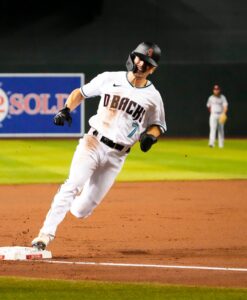 It’s an aggressive move from Arizona to lock up the future face of their franchise, as Carroll is the centerpiece of what the D’backs hope is a new wave of young talent to their big league roster. The team has also made history with this deal, as this is the largest contract ever signed for a player with fewer than 100 days of Major League service time (and no experience in foreign leagues), comfortably eclipsing the $70MM Atlanta gave Michael Harris last year.
Carroll debuted for the Diamondbacks last season and hit .260/.330/.500 with four home runs over 115 plate appearances. He also provided plenty of value in the field, earning five Outs Above Average in his small amount of work in the outfield. Crucially, Carroll fell 15 plate appearances short of reaching 130 last season, which means he’ll still be eligible for Rookie of the Year honors in 2023.
The 16th overall pick, Carroll quickly made a name for himself as an exciting young prospect coming through the Diamondbacks’ system. He hit .299/.409/.487 in his first year of pro ball as a 19-year-old in 2019, then missed the 2020 minor league season due to the pandemic. A dislocated shoulder saw him miss significant time in 2021, but he made up for it in 2022, belting 24 home runs and hitting .307/.425/.611 across three minor league levels to earn his first call up to the big leagues.
The Athletic’s Keith Law ranked Carroll as his top overall prospect in the sport recently, citing his “plus power” and “advanced plate discipline” while labeling him a “true center fielder”. There’s no question Carroll is one of the game’s brightest stars, and the type of player teams dream of building a roster around.
Carroll’s name did come up in trade chatter earlier this winter as the Diamondbacks looked to ease a bit of an outfield logjam, but it always seemed he was off-limits and the team ultimately wound up sending Daulton Varsho to Toronto for Gabriel Moreno and Lourdes Gurriel Jr.
Law ranked the Diamondbacks as having the fourth best farm system in the game, and indeed the team is well setup to contend in the future with a bevy of young talent on the way. Carroll is the big name there, but Moreno, Jordan Lawlar, Druw Jones and co will mean the team has plenty of talent arriving over the next few seasons.
As far as the financials go, the D’Backs have placed a big bet on a player with only 32 MLB games under his belt. However, if Carroll comes anywhere close to living up to the hype, the extension will become a very good piece of business from GM Mike Hazen. It’s unclear yet how the contract will be distributed, but it comes with a $13.875MM AAV. Arizona has a lot of money coming off the books this year, and with only $32MM in guaranteed payroll for 2025 (Carroll accounts for almost half of that). While the Diamondbacks have traditionally been a mid-range spender at best, they still have a good deal of payroll flexibility for the team to make external additions, or perhaps to sign other extensions with members of their young core.
Steve Gilbert of MLB.com was the first to report that the two sides had reached an agreement. Nick Piecoro of the Arizona Republic reported earlier in the day that Carroll and the Diamondbacks were “making progress” on an extension, and Piecoro also had (Twitter links) details on the escalator clauses and the year-to-year salary breakdown.
Photo courtesy of USA Today Sports Images
View The Transcript Of Today’s Chat With Former MLB All-Star Pitcher Dan Haren
Dan Haren joined MLBTR readers for a chat Wednesday evening. Click here to view the transcript. If you’re a current or former MLB player who would like to do a chat here, contact us!
Dan Haren was drafted in the second round in 2001 by the Cardinals out of Pepperdine. He reached the Majors in June of 2003, throwing a quality start against Barry Bonds and the Giants.
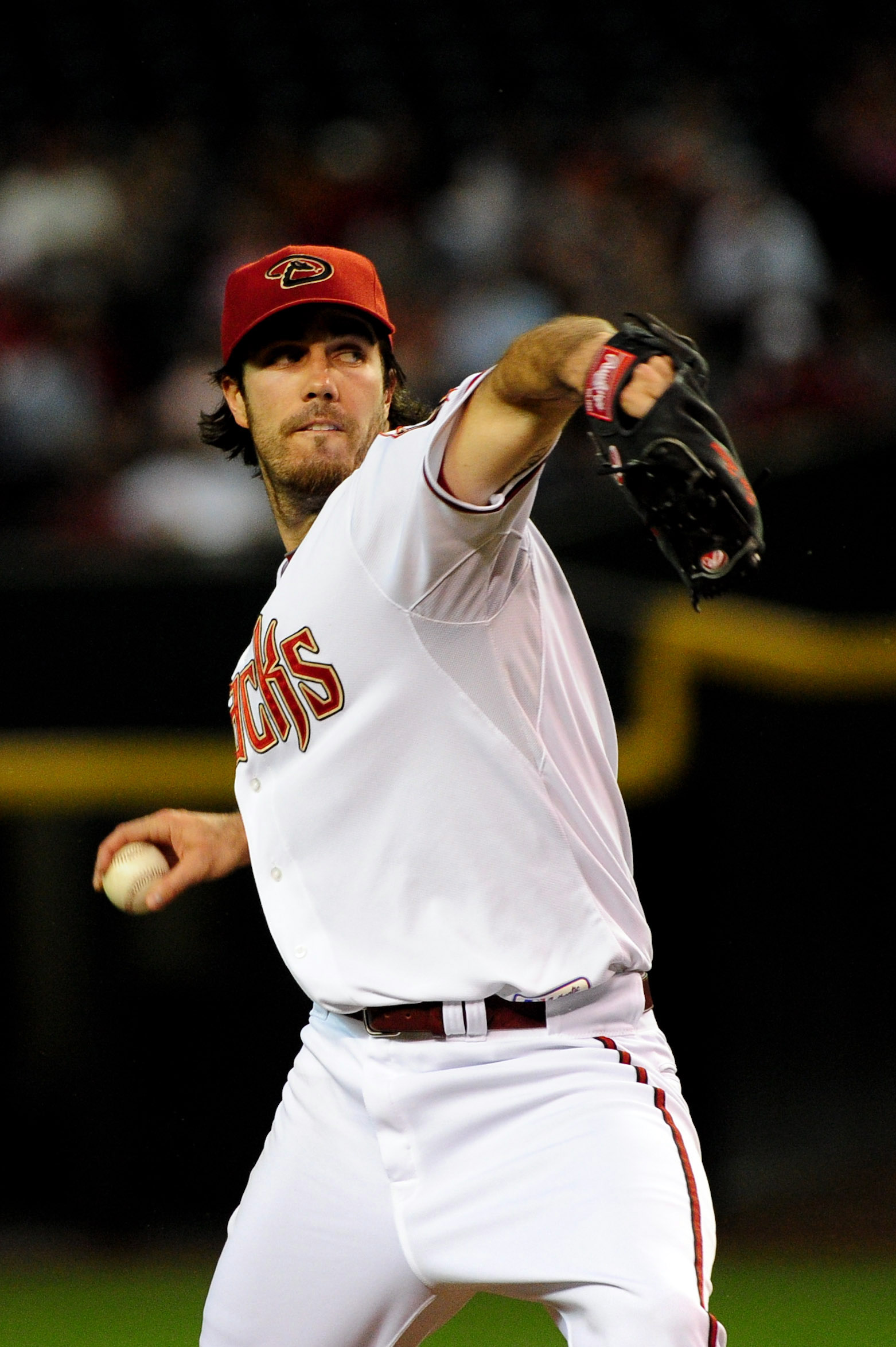
Haren spent the bulk of the following season at Triple-A, rejoining the big league club late in the season and moving in and out of the rotation. He wound up pitching in five games during the postseason that year, including two scoreless outings in the World Series.
After the ’04 season, the Cardinals traded Haren, Daric Barton, and Kiko Calero to the A’s for Mark Mulder. Haren quickly became a horse in Oakland’s rotation, and by the end of his first season with the A’s he signed a four-year extension covering his arbitration years worth $12.65MM. From 2005-07 with the A’s, Haren made 34 starts each year and totaled 662 2/3 innings. The 2006 A’s won the AL West and made it to the ALCS, with Haren making two postseason starts and winning one of them.
In 2007, Haren stepped into the leadership void left by Barry Zito’s departure, getting the Opening Day nod and starting for the AL All-Star team. However, after that season the A’s and GM Billy Beane went into a rebuild, shipping Haren to the Diamondbacks for Brett Anderson, Carlos Gonzalez, Chris Carter, Aaron Cunningham, Dana Eveland, and Greg Smith. Haren joined a D-backs rotation that already had Brandon Webb and Randy Johnson.
2008 was another excellent All-Star season for Haren, in which he led the NL in strikeout to walk ratio. Before that season ended, Haren signed a new extension with Arizona potentially running through 2013. His excellence continued in ’09, as Haren finished fifth in the Cy Young voting and again led the league in strikeout to walk ratio.
However, at the 2010 trade deadline, Haren was on the move in a blockbuster trade for the third time in his career. This time he was headed to the Angels for Patrick Corbin, Joe Saunders, Rafael Rodriguez, and Tyler Skaggs. He continued his dominance in 2011, leading the league in strikeout to walk ratio yet again and finishing seventh in the Cy Young voting.
After the 2012 season, Haren was nearly traded to the Cubs for Carlos Marmol, but Chicago balked and the Angels declined his club option. Reaching free agency for the first time in his career, MLBTR ranked Haren eighth on our top 50 list. He inked a one-year deal with the Nationals that winter. After a difficult season in D.C. (by his lofty standards), Haren landed closer to home with another one-year deal, this time with the Dodgers. Upon reaching 180 innings for the Dodgers, a $10MM player option vested for 2015, and Haren exercised it.
Another season with the Dodgers was not in the cards for Haren, however, and he landed with the Marlins as part of blockbuster trade number four. That was hardly Haren’s preference, but the Marlins hung onto him until they shipped him to the Cubs at the ’15 trade deadline. Rather than explore free agency again, Haren chose to hang up his cleats at the age of 35.
Over the seven-year span from 2005-11, Haren was one of the very best starting pitchers in Major League Baseball. His WAR total of 33.2 during that time ranked fourth in baseball, and his innings total ranked second. Though he typically topped out around 92 miles per hour in his prime, Haren was a master of command and an old-school horse. He pitched at least 216 innings in each of those seven seasons, and his total of 1,581 1/3 was topped only by CC Sabathia. Haren finished his career with three All-Star appearances, two top-seven Cy Young finishes, 153 wins, and a 3.75 ERA.
In recent years, Haren has served as a “pitching strategist” for the Diamondbacks, in which he “provides advance scouting reports and guidance to the club’s pitchers to maximize results on the mound.” You can find him on Twitter @ithrow88. That’s exactly what we did, and Dan graciously accepted our invitation to chat with MLBTR readers. Click here to join in!
Big Hype Prospects: Walker, Baty, Volpe, Colas, Jameson
The hype is real this week on Big Hype Prospects. Numerous notable youngsters are among the top performers in the Grapefruit and Cactus Leagues.
Five BHPs In The News
Jordan Walker, 20, OF, STL (AA)
536 PA, 19 HR, 22 SB, .306/.388/.510
Walker is fourth among qualified spring hitters with a 1.429 OPS across 28 plate appearances. He’s already popped three doubles and three home runs. This column has covered Walker’s scouting traits many times. His hot play is putting him in the picture for an Opening Day role, though such an assignment is unlikely for numerous reasons. The sad truth is club control is an important consideration for teams when choosing a debut date. While new rules offer some consolation, the terms* are rather difficult to achieve. Additionally, the Cardinals have a deep roster. Nolan Arenado covers Walker’s natural position of third base. He’s converted to outfield where Dylan Carlson, Tyler O’Neill, Lars Nootbaar, Alec Burleson, and Juan Yepez are also in the mix. In addition to competition and control incentives, Walker isn’t on the 40-man roster nor does he have any experience in Triple-A.
*Namely, two new rules. A player is awarded a full year of service if they finish top two in Rookie of the Year voting. A team can gain extra draft picks if a “top prospect” makes the Opening Day roster and later finishes top three in rookie voting or top five in MVP/Cy Young voting.
Brett Baty, 23, 3B, NYM (MLB)
(AA) 394 PA, 19 HR, 2 SB, .312/.406/.544
Another frequent guest of BHP, Baty is currently sixth-best among qualified hitters with a 1.208 OPS. He has one double and one home run. He spent most of 2022 in Double-A, though he had brief trials in Triple-A and the Majors. He didn’t look overmatched in his debut even though the end results weren’t impressive. An uncharacteristic .179 BABIP entirely explains his modest 71 wRC+. Baty is competing with Eduardo Escobar who could find himself in a utility role if Baty wins the third base job. There’s also room in the designated hitter competition where Daniel Vogelbach, Darin Ruf, and Tommy Pham are expected to see the bulk of the action. None of those veterans should be considered a lock to make the Mets roster.
Anthony Volpe, 21, SS, NYY (AAA)
(AAA) 427 PA, 24 HR, .280/.358/.519
Yet another player who has been covered ad nauseum by this column, Volpe is on the cusp of his big league debut. His 1.097 OPS looks strong in the early going. In addition to a home run and two doubles, he also has three stolen bases. Volpe’s path to the starting shortstop role should be viewed as an uphill battle if only because the Yankees have given themselves a number of difficult decisions to make this spring. Volpe is plagued by the same criteria that could give the Cardinals pause regarding Walker. Additionally, Volpe has identifiable flaws as a hitter – most notably, a fly ball-oriented swing. He could find himself with a low BABIP in the Majors, especially since many pitchers have become adept at attacking this hitting profile.
Oscar Colas, 24, OF, CWS (AAA)
(AA) 225 PA, 14 HR, 1 SB, .306/.364/.563
Colas surged through the White Sox system last season, making stops in High-, Double-, and Triple-A. His time in Double-A was his most meaningful performance. He only accrued 33 plate appearances in Triple-A. Colas has a bead on Chicago’s right field job where first baseman Gavin Sheets is seen as the main competition. Colas is batting .429/.455/.476 in 22 spring plate appearances. He is known for making impactful contact. Like many products of the White Sox farm system over the years, he has a detrimentally aggressive plate approach. His first test in the Majors will be laying off competitive pitches outside of the zone. Many a prospect with comparable tools and discipline to Colas failed to stick in the Majors.
Drey Jameson, 25, SP, ARI (MLB)
(AAA) 114 IP, 8.61 K/9, 3.32 BB/9, 6.95 ERA
Jameson is competing with Ryne Nelson and others for the Diamondbacks fifth starter job. He mostly relies on two fastballs and a plus slider, though he also features a curve and changeup. In three spring outings, he’s tossed 6.2 innings with eight strikeouts, five hits, two walks, a home run, and three runs allowed. Although he’s proven a tad homer prone throughout his development, a high ground ball rate helps to salve the sting. He has the raw traits of a future workhorse. Within the next couple seasons, he could click in much the way Logan Webb clicked between his 2020 and 2021 campaigns. For those concerned about his Triple-A numbers, those are at least partly an artifact of circumstance. Reno’s starters combined for a 5.24 ERA which ranked fifth out of 10 clubs in the PCL.
Three More
Cole Ragans, TEX (25): Ragans averaged 92.1-mph with his heater last season so it raised a few eyebrows when he hit 99-mph the other day. With a number of Rangers starters banged up, there’s a decent chance Ragans will nab a start or two early in the season. I’m withholding enthusiasm until he maintains velocity in longer outings. At a minimum, the southpaw could really play up out of the bullpen.
Masyn Winn, STL (20): Though he has almost no chance of playing his way to an Opening Day assignment, Winn is making a favorable impression this spring. He has a 1.071 OPS in 17 plate appearances with a homer and two steals. Scouts want to see him adjust against competitive breaking balls but are otherwise enamored with the young shortstop. Defensively, he has an 80-grade arm but closer to 40-grade range and footwork. The arm ensures he’ll stick on the left side of the infield.
Christian Encarnacion-Strand, CIN (23): Acquired in the Tyler Mahle trade, Encarnacion-Strand has slugged at every stop along the ladder. He’s expected to reach Triple-A early this season if not right out of the gate. In 18 spring plate appearances, he has 11 hits including a double and three home runs. The profile reads like a more compactly built Franmil Reyes.
Offseason In Review Chat Transcript: Arizona Diamondbacks
MLBTR is hosting team-specific chats in conjunction with our Offseason In Review series this spring. Click here to view the transcript of the chat with MLBTR’s Anthony Franco regarding the Diamondbacks’ entry in the series.
Offseason In Review: Arizona Diamondbacks
The Diamondbacks went into the offseason marketing a surplus of left-handed hitting outfielders. After a few months of rumors, they pulled off their anticipated massive swap, landing one of the sport’s best catching prospects in the process. That was the biggest move, though the Snakes also supplemented their position player mix and made a trio of additions to the relief corps as they push for legitimate playoff contention.
Major League Signings
- LHP Andrew Chafin: One year, $6.25MM (including buyout of 2024 club option)
- RHP Scott McGough: Two years, $6.25MM (including buyout of 2025 mutual option)
- 3B Evan Longoria: One year, $4MM
- RHP Zach Davies: One year, $4MM (including buyout of 2024 mutual option)
- RHP Miguel Castro: One year, $3.25MM (deal includes vesting/player option for 2024)
Option Decisions
- Team declined $4MM option on RHP Ian Kennedy in favor of $250K buyout
Trades and Claims
- Claimed RHP Tyler Zuber off waivers from Royals (later outrighted to Triple-A)
- Claimed RHP Cole Sulser off waivers from Marlins
- Acquired RHP Carlos Vargas from Guardians for minor league RHP Ross Carver
- Acquired DH Kyle Lewis from Mariners for LF Cooper Hummel
- Claimed C Ali Sánchez off waivers from Pirates (later outrighted to Triple-A)
- Acquired SS Diego Castillo from Pirates for minor league RHP Scott Randall
- Acquired C Gabriel Moreno and LF Lourdes Gurriel Jr. from Blue Jays for RF Daulton Varsho
Notable Minor League Signings
- Austin Adams, Jesse Biddle, Austin Brice, Sam Clay, Phillip Evans, Ryan Hendrix, Jeurys Familia, Jandel Gustave, Jake Hager, P.J. Higgins, Zach McAllister, Yairo Muñoz, Eric Yardley
Extensions
- None
Notable Losses
- Varsho, Caleb Smith, Jordan Luplow, Kennedy, Hummel, Sergio Alcántara, Sean Poppen, Taylor Widener, Stone Garrett, Keynan Middleton, Edwin Uceta, Reyes Moronta, Tyler Holton, Yonny Hernández, J.B. Bukauskas
The past few seasons haven’t gone well for the Diamondbacks. Arizona limped to last-place finishes in 2020-21, followed by a fourth-place showing last year. They partially compensated with a run of what appear to be strong draft classes. They never intended to enter a rebuild but the past few seasons have essentially functioned as such.
Over the final few months of last season, the young talent the organization had built in the pipeline began to translate to improved MLB results. Arizona was a roughly league average team in the second half, still shy of contention but quite a bit better than their previous few seasons. General manager Mike Hazen and his front office headed into the offseason with more clarity about the team’s strengths and weaknesses.
No spot on the roster was a more obvious plus than the outfield. Arizona had seen Daulton Varsho emerge as a productive regular. Top prospect Corbin Carroll debuted in late August and hit the ground running against MLB pitching. Jake McCarthy posted an impressive .283/.342/.427 showing in 99 games during his first extended big league action. Alek Thomas didn’t have the same level of success, though he’s highly regarded by prospect evaluators for his contact skills and center field defense.
Hazen indicated the team would field offers on that outfield glut, with four interesting and controllable left-handed bats who could appeal to other teams. Adding right-handed balance to the lineup and potentially upgrading over Carson Kelly at catcher were highlighted as priorities, while the front office implied they’d scour numerous avenues to upgrade a bullpen that was again among the league’s worst.
By and large, Arizona eventually checked off every item on that to-do list. The most straightforward path to achieving their position player ends would be to bring in a right-handed catcher with plus offensive upside. Arizona was unsurprisingly connected to Sean Murphy before the A’s sent him to Atlanta. While they missed out on Murphy, the Snakes eventually pulled off their catching addition in that long-awaited trade of an outfielder.
Varsho was the player who ended up the odd man out. A Gold Glove caliber defender who hit 27 home runs in 2022, he was one of the most appealing targets on this offseason’s trade market considering his four remaining seasons of arbitration control. The outfield-needy Blue Jays always looked like a strong on-paper fit considering their surplus of right-handed hitting catchers. Toronto had seemed likely to move one of Danny Jansen, Alejandro Kirk or top prospect Gabriel Moreno for some time, and things finally coalesced just before Christmas.
The D-Backs sent Varsho to Toronto for Moreno and corner outfielder Lourdes Gurriel Jr. Controllable for six seasons, Moreno is one of the game’s top young catching talents. He hit .315/.386/.420 with a meager 16.9% strikeout rate in 267 Triple-A plate appearances at age 22 last season. That earned him a brief MLB look, in which he posted a .319/.356/.377 line with only eight strikeouts in 73 trips to the dish.
There’s some question about how much power impact Moreno will make, but he’s an elite contact hitter with no concerns about his ability to stick behind the plate. Even if he only hits 10 home runs annually, his high batting averages and on-base numbers should make him one of the game’s best offensive catchers. He’ll push Kelly into a reserve role.
While Moreno was the key piece of the deal on Arizona’s end, they somewhat backfilled the outfield subtraction with Gurriel’s inclusion. While he’s certainly a downgrade from Varsho — particularly on defense — Gurriel is a low-variance everyday player. He’s coming off a .291/.343/.400 showing in 121 games. He only connected on five home runs during his final season in Toronto but has twice reached the 20-homer plateau in his career.
Gurriel offers above-average contact skills and typically shows decent power. He rarely walks and is limited to the corner outfield or DH after an early-career experiment in the infield didn’t pan out. While he’s a flawed player, Gurriel can hit and adds another right-handed presence to the lineup. He’s headed into the final season of his contract and will be a free agent at year’s end, meaning he’d be a straightforward trade candidate if the D-Backs aren’t contending midseason.
He’s not the only right-handed hitting outfielder the Snakes brought in via trade. Before the Varsho swap, Arizona rolled the dice on 2020 AL Rookie of the Year Kyle Lewis. It was a one-for-one deal that sent catcher/outfielder Cooper Hummel to Seattle. Lewis has had a disastrous past couple seasons, with persistent right knee issues keeping him to just 54 combined games since the start of 2021. A former first-round pick and top prospect, Lewis hit .262/.364/.437 for Seattle during the shortened season. His health has been a question mark since he tore his ACL in a home plate collision within months of being drafted. Still, Lewis remains just 27 years old and won’t be counted upon for everyday work in the Arizona outfield.
Gurriel and Lewis provide matchup options in right field and at DH. Left field belongs to Carroll, who is a consensus top three prospect. Arizona has already looked into the possibility of extending him beyond his allotted six seasons of control in what could be one of the club’s more interesting storylines this spring. Thomas and McCarthy can each play center field, with the latter assured of regular run somewhere after his quality debut campaign.
The D-Backs added another righty-swinging designated hitter option via free agency. 15-year MLB veteran Evan Longoria signed a $4MM deal to split time between third base and DH. He’s obviously no longer the star he was at his peak, but Longoria has continued to hit at an above-average level into his late-30s. Injuries have cost him almost half the last two seasons. He’s best suited for a part-time or platoon role at this stage of his career and that’s likely to be the capacity in which he operates.
Left-handed hitting Josh Rojas should get the lion’s share of at-bats at the hot corner. Rojas is a good hitter with some defensive flexibility but isn’t a great gloveman anywhere. He’s an adequate if below-average third baseman, and his contact and baserunning skills make him a solid player overall.
He’ll presumably be playing alongside Nick Ahmed on most days. A two-time Gold Glove winner, Ahmed is still one of the sport’s preeminent defensive infielders. He’s never contributed much offensively and lost virtually all of 2022 to shoulder surgery. Arizona at least monitored the market for shortstop upgrades — including a loose link to Xander Bogaerts that always felt like a long shot — but ultimately completed the offseason without an addition there. Ahmed will be back and should take the job from Geraldo Perdomo, who didn’t perform well over a long look with Ahmed out last season. Still just 23, Perdomo could be in line for more time at Triple-A.
The other side of the second base bag is clearly defined. Ketel Marte will be back at the keystone. Christian Walker had a massive second half performance to seize hold of first base. Arizona brought in Diego Castillo in a minor trade with Pittsburgh to add some insurance in the middle infield. He figures to start the season in a utility role or in the minors.
Arizona took a volume approach to address their other offseason priority: the bullpen. They eschewed the top of the free agent market and brought in half of what figures to be their Opening Day group via lower-cost means. They started by claiming Cole Sulser off waivers from the Marlins, taking a buy-low flier on a pitcher who’d found success with Baltimore in 2021 before a disappointing year in South Florida.
That was followed by a series of value plays in free agency. Veteran righty Miguel Castro inked a one-year, $3.75MM guarantee with a ’24 vesting/player option. He’s a generally stable middle relief option, a pitcher who typically works to an ERA around 4.00 with solid strikeout and grounder rates but wobbly control. A couple weeks later, Arizona took a more unexpected dice roll on 33-year-old Scott McGough. The right-hander has just six MLB appearances — all of which came with the 2015 Marlins — and has spent the last four years in Japan. He posted a 2.94 ERA in 232 2/3 innings over four seasons with NPB’s Yakult Swallows and evidently impressed Arizona evaluators along the way.
McGough proved to be the organization’s only multi-year free agent signee of the offseason. His two-year, $6.25MM pact is still a relatively low-risk move, though it’s tough to project whether he can take on high-leverage innings in Torey Lovullo’s bullpen until seeing him against big league competition for the first time in almost a decade.
There shouldn’t be any such questions regarding Arizona’s final bullpen addition. Old friend Andrew Chafin looked like one of the top left-handed relief arms on the free agent market. He opted out of the final $6.5MM on his contract with the Tigers and seemed likely to find a strong multi-year pact after a second straight excellent season. For whatever reason, that apparently never materialized. Chafin lingered alongside a handful of other quality southpaws deep into the offseason until Arizona swooped in with a $6.25MM guarantee. The D-Backs also secured a 2024 option on what looks like a strong deal for the club, one that reinstalls a familiar face into key late-inning work.
Chafin, Castro, Sulser and McGough are presumably all going to open the season in the MLB bullpen. They’ll join left-hander Joe Mantiply, who had a breakout 2022 showing. Righty Kevin Ginkel presumably has a middle innings job secured after a quietly strong finish to the ’22 season. Mark Melancon is headed into the second season of a two-year free agent deal that didn’t pan out as hoped in year one. He’s no longer assured of the closer’s role; Lovullo has already indicated he could take a committee approach to the ninth inning early in the season (link via Steve Gilbert of MLB.com). Still, Melancon will presumably be on the roster in some capacity as the team looks for a bounceback from the four-time All-Star.
That only leaves a spot or two in the early going for depth types like Kyle Nelson, Corbin Martin, trade acquisition Carlos Vargas or non-roster Spring Training invitees like Jeurys Familia, Austin Brice, Austin Adams, Jandel Gustave, Ryan Hendrix and Sam Clay. There’ll obviously be some attrition in that group — injuries, workload management or underperformance will necessitate changes to the bullpen mix throughout the coming months — but the organization has stockpiled a little more relief depth than they’ve had in prior seasons.
The D-Backs didn’t need to do as much to build out the starting staff. Zac Gallen is a legitimate #1 starter. There’s no indication the sides have discussed an extension. It wouldn’t be surprising if the front office gauged his interest in signing beyond his remaining three years of arbitration control at some point. Merrill Kelly is a solid mid-rotation type behind him, even if his lack of swing-and-miss stuff could make it difficult to sustain a 3.37 ERA. There’s not a ton of certainty behind that duo, though the Snakes have a handful of options who could fill out the back of the staff. Zach Davies had a fine if unexciting season at the back of the rotation last year. He’s back after re-signing on a modest $4MM free agent deal and will hold one of the season-opening rotation spots.
Madison Bumgarner had similar production as Davies last season, albeit at a much higher price point. His five-year, $85MM free agent contract has been a major disappointment. Bumgarner has been a durable source of innings but hasn’t come close to reestablishing himself as the top-of-the-rotation starter he was throughout his time in San Francisco. In October, Hazen implied that Bumgarner’s veteran status would get him another shot in the rotation but indicated the club could eventually go in another direction as performance dictates.
Whether that happens might depend as much on Arizona’s younger pitchers than on Bumgarner himself. Righties Ryne Nelson and Drey Jameson look set to battle for the fifth spot this spring after each debuted late last season. Brandon Pfaadt has yet to reach the majors but is arguably more highly-regarded by evaluators than either Nelson or Jameson are. He pitched very well over ten Triple-A starts to close out last season and could be on the radar for a big league call early in the upcoming campaign. Tommy Henry and former high draft choices Blake Walston and Slade Cecconi headline the depth options behind that group.
There’s room for the club to still look into a veteran on a minor league deal to add some stability to the upper levels. Clearly, the main organizational hope is that higher-upside hurlers like Nelson and Pfaadt will perform well enough in the early going to cement themselves in the rotation. Should they do so, that could lead the organization to consider bumping Bumgarner or Davies from the group. Early on, however, Arizona figures to retain as much depth as they can given the inherent risk in counting on any pitching prospect to assume a large role on a team with playoff aspirations.
Whether the Diamondbacks have legitimate reason to hope for a postseason spot is debatable. The pitching staff, while improved, still looks a little light relative to those of most contenders. The club has question marks on the left side of the infield, particularly at shortstop. They’re in a gauntlet of a division, one where the ever-competitive Dodgers and ultra aggressive Padres will be projected 1-2 in some order by most observers. Arizona looks to have clearly pulled away from Colorado at the bottom of the division. It remains to be seen whether they can both leapfrog the Giants and hang in the Wild Card mix for a full season.
Even if a playoff berth looks like a long shot, there’s more reason for immediate optimism than has existed in some time. The core of the next competitive Arizona team is beginning to take shape, and the farm system should remain among the league’s best even after Moreno and Carroll graduate. Top prospects like Jordan Lawlar and Druw Jones are still a few seasons out, but it’s easy for the organization and its fans to dream about them eventually joining Moreno, Carroll, Marte and perhaps a young pitcher or two in comprising a group that can annually battle the behemoths at the top of the division.
In conjunction with the D-Backs’ Offseason In Review, Anthony Franco held a team-specific chat on March 2. Click here to view the transcript.
How would you grade the D-Backs offseason? (poll link for app users)
How would you grade the Diamondbacks' offseason?
-
B 42% (488)
-
C 33% (380)
-
D 11% (126)
-
A 10% (121)
-
F 4% (51)
Total votes: 1,166
Stefan Crichton Retires
Reliever Stefan Crichton informed the Diamondbacks last week that he’s decided to retire, manager Torey Lovullo told reporters this afternoon (link via Nick Piecoro of the Arizona Republic). The right-hander had been in camp with the D-Backs as a non-roster invitee to Spring Training.
Crichton, 31 this week, pitched in parts of four major league campaigns. Drafted by the Orioles in the 23rd round in 2013 out of TCU, he reached the majors with Baltimore four years later. Crichton pitched in eight games for the O’s in 2017. Designated for assignment just before Opening Day the following year, he was dealt to the D-Backs. He lost most of the 2018 campaign to shoulder issues but reached the majors with Arizona again the next season.
In each season between 2019-21, Crichton would make between 26 and 31 MLB appearances for the Snakes. He posted a 3.56 ERA with a 26.8% strikeout rate in the first year and managed a 2.42 ERA (albeit with a diminished 21.1% strikeout percentage) during the 2020 abbreviated schedule. Crichton was tagged for over seven earned runs per nine innings in 2021, however, and he lost his spot on the 40-man roster that June. He returned briefly later in the season as a COVID-19 substitute but didn’t reclaim a permanent spot on the roster.
The 2022 campaign will go down as Crichton’s final as a professional player. He was limited to four minor league appearances late in the year after rehabbing from Tommy John surgery. While he could’ve vied for a bullpen depth role this spring, the Houston native has elected to move on to his post-playing endeavors. “He came in and just explained to me that it was time for him to turn the page and take the next part of his journey away from baseball. It was something he had felt in his heart for a long time,” Lovullo told reporters of Crichton’s decision.
Crichton steps away after 93 big league outings. He pitched to a 4.79 ERA through 92 innings, striking out 81 hitters against 33 walks. Crichton held 11 leads and tallied nine saves. MLBTR wishes him the best in his future endeavors.
Injury Notes: Whitlock, Ahmed, Vargas, Reynolds
Right-hander Garrett Whitlock is still on the mend from September hip surgery, though Red Sox skipper Alex Cora indicated this morning there’s a possibility he won’t be ready for Opening Day (Twitter link via Ian Browne of MLB.com). Whitlock has been throwing off a mound but is not yet performing pitchers’ fielding practice, and Cora stated that if the right-hander isn’t ready for the start of the season, “he’s not going to lose too much time.”
One of the best Rule 5 selections in recent memory, the 26-year-old Whitlock has pitched 151 2/3 innings for Boston over the past two seasons, logging a sharp 2.73 ERA with a strong 26.8% strikeout rate against a brilliant 5.3% walk rate. The Red Sox have used him far more out of the bullpen than the rotation, but he’s slated to get a look as a starter in 2023, joining the likes of Chris Sale, Corey Kluber, James Paxton and Nick Pivetta in the mix for rotation work. Fellow righty Tanner Houck and top prospect Brayan Bello are both options to step into the rotation, should Whitlock need to miss any time early in the season.
A few more health situations to monitor as spring camps continue to ramp up…
- D-backs shortstop Nick Ahmed received a cortisone injection in his right forearm and will be shut down for at least five days, writes Steve Gilbert of MLB.com. The 32-year-old Ahmed (33 next month) was dealing with inflammation and tightness in his forearm, and the hope is that the injection and some downtime will clear it up and avoid a lengthy absence. Ahmed was limited to 129 games in 2021 and just 17 games in 2022 thanks to a shoulder injury that ultimately required surgery last year. If healthy, he’ll be back in line for regular reps at shortstop, where he’s ranked among the game’s best defenders at any position. A healthy 2023 campaign is of particular importance for Ahmed, as he’s entering the final season of a four-year, $32MM contract and is slated to become a free agent for the first time next offseason.
- Infielder Miguel Vargas, who suffered a hairline fracture of his pinkie finger earlier this spring, has resumed swinging a bat, writes Jack Harris of the L.A. Times. The 23-year-old Vargas, widely considered to be one of the sport’s 100 best prospects, scuffled through a 50-plate appearance MLB debut in 2022 (.170/.200/.255) but ripped through Triple-A pitching at a torrid .304/.404/.511 pace (129 wRC+). He’s the favorite for everyday work at second base to begin the season, though obviously the health of his finger will determine his readiness for the season. Vargas is in the Dodgers’ lineup for the second time in three spring games today, but he’s batting ninth and isn’t expected to swing during any plate appearances today (he walked and struck out on Saturday). He’ll still get some work at second base and use today’s game to work on tracking pitches in the batter’s box. It’s not clear yet when he’ll begin swinging the bat in a game setting.
- Reds infielder Matt Reynolds is headed for an MRI after exiting Saturday’s Cactus League game with a quadriceps injury, tweets Bobby Nightengale of the Cincinnati Enquirer. The 31-year-old Reynolds, in camp as a non-roster invitee, logged a career-high 272 plate appearances with Cincinnati in 2022, slashing .246/.320/.332 while appearing at every position other than catcher. Reynolds is competing with fellow non-roster invitees like Chad Pinder, Alejo Lopez and Jason Vosler for a spot on manager David Bell‘s bench to begin the 2023 season.
Diamondbacks Notes: Spending, Ballpark, Martin, Jones
Diamondbacks managing general partner Ken Kendrick and team president/CEO Derrick Hall spoke with MLB.com’s Steve Gilbert and other reporters earlier this week, discussing several topics about the club’s offseason and future plans. In regards to the biggest-picture topic of the Diamondbacks’ quest for a new ballpark, Hall said that “nothing has really changed yet….We’re still looking at what other options there might be in Maricopa County, not outside of Maricopa County,” and that “we’ll start accelerating that process again” now that the MLB lockout and the pandemic delayed the process. The club’s lease at Chase Field is up after the 2027 season, and while the D’Backs have been in talks with Phoenix officials, there were some reports in 2019 that the Diamondbacks had possibly considered Las Vegas and Henderson, Nevada as alternate sites. Hall said that the team would likely prefer to remain in the downtown Phoenix area, and Kendrick added that “whether it be the downtown setting or perhaps a ballpark somewhere in the Valley that would be a brand new one,” the D’Backs are “prepared to spend hundreds of millions of dollars” to help fund the construction of a new home.
Speaking of finances, the Diamondbacks have had an active offseason as the team looks to improve on its 74-88 record from 2022. The Snakes’ current payroll sits at around $118.9MM, which Kendrick noted was almost a 30 percent increase from last year’s figure. While this spending still puts the D’Backs in the bottom half of all MLB payrolls, Kendrick said that ownership was prepared to reinvest at the deadline if necessary: “If the team is competitive and has the chance to play in October is there, we’re going to spend more money to get there.”
More from Arizona…
- Corbin Martin has worked mostly as a starter over his pro career, but Nick Piecoro of the Arizona Republic writes that the D’Backs are transitioning Martin into a full-time relief role. The hope is that the new bullpen role will help Martin achieve some consistency (after posting a 6.71 ERA over his first 57 2/3 innings in the majors) and also help keep him healthy — the righty missed most of 2019 and the entire 2020 season while recovering from Tommy John surgery and a follow-up oblique strain, and Martin also had IL trips in each of the last two seasons. As Piecoro noted in another piece, those injuries meant that the D’Backs were awarded a fourth option year on Martin, giving the team additional control over their ability to move Martin between the majors and minors. “So far, I feel like health-wise, it might be the best decision. Not overtaxing, being able to go out there and focus on the three outs to get every inning…Being able to build off that is going to be able to help me in the long run,” Martin said. Martin has averaged 94.5 mph on his fastball at the big league level, but D’Backs manager Torey Lovullo said that Martin hit the 97mph mark during a live batting practice session on Thursday.
- After undergoing shoulder surgery last year, Druw Jones should be ready for action around the start of the minor league season, Diamondbacks GM Mike Hazen told Piecoro and other reporters. Jones’ first minor league game will be his official pro debut, as he suffered a torn left posterior labrum during a workout just three days after signing his post-draft deal. Arizona selected Jones with the second overall pick in last summer’s draft, and injury notwithstanding, Jones is still a consensus top-35 prospect in baseball even before he has taken the field.
Diamondbacks Re-Sign Jake Hager To Minor League Deal
The Diamondbacks have re-signed infielder Jake Hager to a minor league deal, according to the MILB transaction log.
Hager, 30 in a week, slashed .240/.345/.280 for the Diamondbacks over 59 plate appearances last year. He spent the bulk of the year at Triple-A, where he picked up five home runs as part of a .261/.342/.391 line across 303 plate appearances. That was the second stint Hager had had with the Diamondbacks. After being claimed off waivers from the Mets, Arizona released him at the end of the 2021 season before bringing him back on a minor league deal.
Originally drafted 32nd overall by the Rays back in 2011, Hager toiled away in the minors for Tampa Bay, Milwaukee and Seattle before the Mets finally gave him his first taste of the majors in 2021. He didn’t hit much across a brief spell with the Mets and Diamondbacks in 2021, and all told Hager’s put together a .197/.307/.224 line across 89 career MLB plate appearances.
Hager came through the minors as a shortstop, but has bounced around the field in his short time in the majors, logging time at second, third and shortstop as well as both corner outfield spots. For the third-straight season, Hager will provide the Snakes with some infield depth in the upper minors.