
Matt Quatraro Interviews With Athletics; Interview With Mets Likely To Follow
The A’s have interviewed Rays bench coach Matt Quatraro within the past few days as part of their search for a new manager, reports Marc Topkin of the Tampa Bay Times. He becomes the first known candidate to sit down with Oakland brass.
Quatraro, 48, has been regarded as a potential manager of the future for the past few years. Kevin Cash’s top lieutenant over the last three seasons in Tampa Bay, he interviewed with the Pirates and Giants over the 2019-20 offseason and sat down with the Tigers last fall. Quatraro, who played professionally for seven seasons and topped out at Triple-A, has never managed in the majors. He does have nearly two decades of coaching experience in the Rays’ organization (in addition to a 2014 stint as Indians’ assistant hitting coach). That includes four years managing in the low minors in the Tampa Bay system.
Oakland is on the hunt for a new manager after Bob Melvin’s surprising departure to take over the dugout in San Diego. For the first time in more than a decade, the A’s will go into a season without Melvin leading the charge. Former bench coach Ryan Christenson is departing to assume the same role under Melvin with the Padres, removing one potential in-house option from the mix.
The A’s are one of two teams in search of a new skipper. The other club, the Mets, has also expressed interest in Quatraro. Buster Olney of ESPN reported this morning (on Twitter) that New York was requesting permission from the Rays to interview him. Topkin reports that Tampa Bay has granted that request, writing that Quatraro could sit down with members of the New York front office as soon as tomorrow.
Latest On Mets’ Managerial Search
10:04 pm: Martino tweets that while Granderson’s name had come up in initial discussions, he is not expected to interview for the position.
9:49 pm: Robert Murray of FanSided reports (on Twitter) that longtime big league outfielder Curtis Granderson is also under consideration for the Mets. The 40-year-old announced his retirement from playing in 2020 following a 16-year big league career that included a trio of All-Star appearances and a Silver Slugger Award.
Granderson had emerged as a respected veteran presence in clubhouses over the course of his career. He currently serves as the president of the Players Alliance, a nonprofit organization aimed at increasing accessibility within the sport for Black athletes. Granderson played four seasons with the Mets during team president Sandy Alderson’s time as the club’s GM. Prior to that, he spent four years with the Yankees — a stint that overlapped with Eppler’s time in the club’s front office.
6:35 pm: The Mets declined an option to bring back skipper Luis Rojas shortly after the end of the 2021 season. Two months later, they remain without a manager. After spending a significant chunk of the early offseason in the search for a new GM that eventually landed Billy Eppler, the Mets turned their attention to the player market last week in advance of the lockout. With clubs barred from making major league transactions for the duration of the work stoppage, the Mets and the Athletics, the other team currently without a manager, figure to zero in on those respective searches in short order.
Andy Martino of SNY reports some preliminary candidates, naming Astros bench coach Joe Espada, Rays bench coach Matt Quatraro, Pirates bench coach Don Kelly and former MLB managers Buck Showalter and Brad Ausmus among those under early consideration. Martino cautions that’s not an exhaustive list, and it’s not clear whether everyone in that group will get an interview.
No one from that group registers as much of a surprise. None of Espada, Quatraro or Kelly has managed at the big league level, but they’ve all been rumored as part of searches elsewhere. Espada, 46, has been the bench coach in Houston for the past four seasons, working underneath both A.J. Hinch and Dusty Baker. He’s interviewed for a few different managerial openings in recent years and at one point even looked to be the favorite for the Giants job that eventually went to Gabe Kapler.
Quatraro’s name has come up a few times over the past couple offseasons. Kevin Cash’s top lieutenant over the last three years in Tampa Bay, the 48-year-old Quatraro has interviewed with the Giants, Pirates and Tigers in winters past and was reportedly a finalist for the Pittsburgh job that went to Derek Shelton. Kelly has worked underneath Shelton in the Steel City over the past two seasons. The 41-year-old interviewed with the Tigers and Red Sox last offseason and was reported to be among the top handful under consideration for the job that went to Alex Cora.
Showalter and Ausmus, meanwhile, come with significant managerial experience. The former has been one of the more accomplished skippers of the past couple decades. Showalter, now 65, landed his first big league managerial job with the Yankees in 1992. He spent four years in the Bronx, managed the D-Backs from 1998-2000, the Rangers from 2003-06 and the Orioles from 2010-18.
Over his career, Showalter won Manager of the Year Awards at three of those four stops. He’s overseen five playoff clubs (including three division winners), taking the 2014 Orioles to the AL Championship Series. Showalter hasn’t managed since being dismissed by Baltimore after the 2018 campaign, but he’s continued to express openness to a return to the dugout.
Ausmus, meanwhile, has managed at two separate stints. He spent the 2014-17 campaigns at the helm of the Tigers, then managed the Angels in 2019. That stint in Anaheim overlapped with Eppler’s tenure as Angels’ GM, fueling immediate speculation upon the latter’s hiring with the Mets that he could look to bring Ausmus to Queens.
Prior to that stint as skipper, Ausmus spent the 2018 season as a member of the Los Angeles front office. Eppler’s Angels fired Ausmus after just one season in the managerial chair, but it was reported at the time that call was made by owner Arte Moreno (perhaps not coincidentally just one day after it was announced Joe Maddon was leaving the Cubs).
Tender Deadline Signings: 11/30/21
With the deadline to tender contracts to arbitration-eligible players looming tonight at 8pm ET — the MLBPA and MLB jointly agreed to move the deadline up a couple days due to the looming expiration of the collective bargaining agreement — we’ll likely see a slew of arbitration-eligible players signing one-year deals.
It’s commonplace for a large batch of players to sign deals in the hours leading up to the tender deadline. “Pre-tender” deals of this nature often fall shy of projections due to the fact that teams use the looming threat of a non-tender to enhance their leverage. Arbitration contracts at this juncture are often take-it-or-leave-it propositions, with the “leave it” end of that arrangement resulting in the player being cut loose. Given the widely expected lockout, there could be more incentive than usual for borderline non-tender candidates to take those offers rather than being cast out into free agency just hours before a transaction freeze is implemented.
As a reminder, arbitration contracts are not fully guaranteed. In a typical year, a team can cut a player on an arb contract at any point before the halfway point in Spring Training and only be responsible for 30 days’ termination pay (about one-sixth of the contract). Releasing a player in the second half of Spring Training bumps the termination pay to 45 days of his prorated salary.
MLBTR contributor Matt Swartz projected salaries for each team’s arbitration-eligible players last month, although for many of the players listed below, this isn’t so much avoiding arbitration as it is avoiding a non-tender. Here’s a look at today’s agreements…
- The Yankees have agreed to deals with infielder Gio Urshela and right-hander Domingo German, reports Mark Feinsand of MLB.com (Twitter links). Urshela will make $6.55MM, while German has agreed to a $1.75MM deal. Urshela has two seasons of control remaining; German is controllable for three years. Urshela is coming off a .267/.301/.419 showing while playing third base and shortstop. German tossed 98 1/3 innings of 4.58 ERA ball.
- The Twins have signed three arbitration-eligible pitchers, per reports from Feinsand and Darren Wolfson of SKOR North (on Twitter). Right-hander Jharel Cotton signed for $700K, reliever Caleb Thielbar lands $1.3MM and reliever Tyler Duffey signs for $3.8MM. Thielbar and Duffey were both productive members of the Minnesota relief corps in 2021. Cotton was recently claimed off waivers from the Rangers.
- The Giants have agreed to terms with outfielder Austin Slater on a $1.85MM deal, reports Ken Rosenthal of the Athletic (Twitter link). The 28-year-old (29 next month) appeared at all three spots on the grass while hitting .241/.320/.423 over 306 plate appearances in 2021.
- Reliever Emilio Pagan and the Padres have agreed on a $2.3MM deal, reports Rosenthal (on Twitter). The 30-year-old worked 63 1/3 innings of 4.83 ERA/3.93 SIERA ball this past season.
- The Diamondbacks agreed to a $2MM deal with left-hander Caleb Smith, reports Zach Buchanan of the Athletic (via Twitter). The 30-year-old posted a 4.83 ERA/4.68 SIERA across 113 2/3 innings in a swing capacity in 2021.
Rays Trade Joey Wendle To Marlins
A busy offseason for the Marlins continued Tuesday, as Miami has announced the acquisition of infielder Joey Wendle from the Rays in exchange for outfield prospect Kameron Misner.
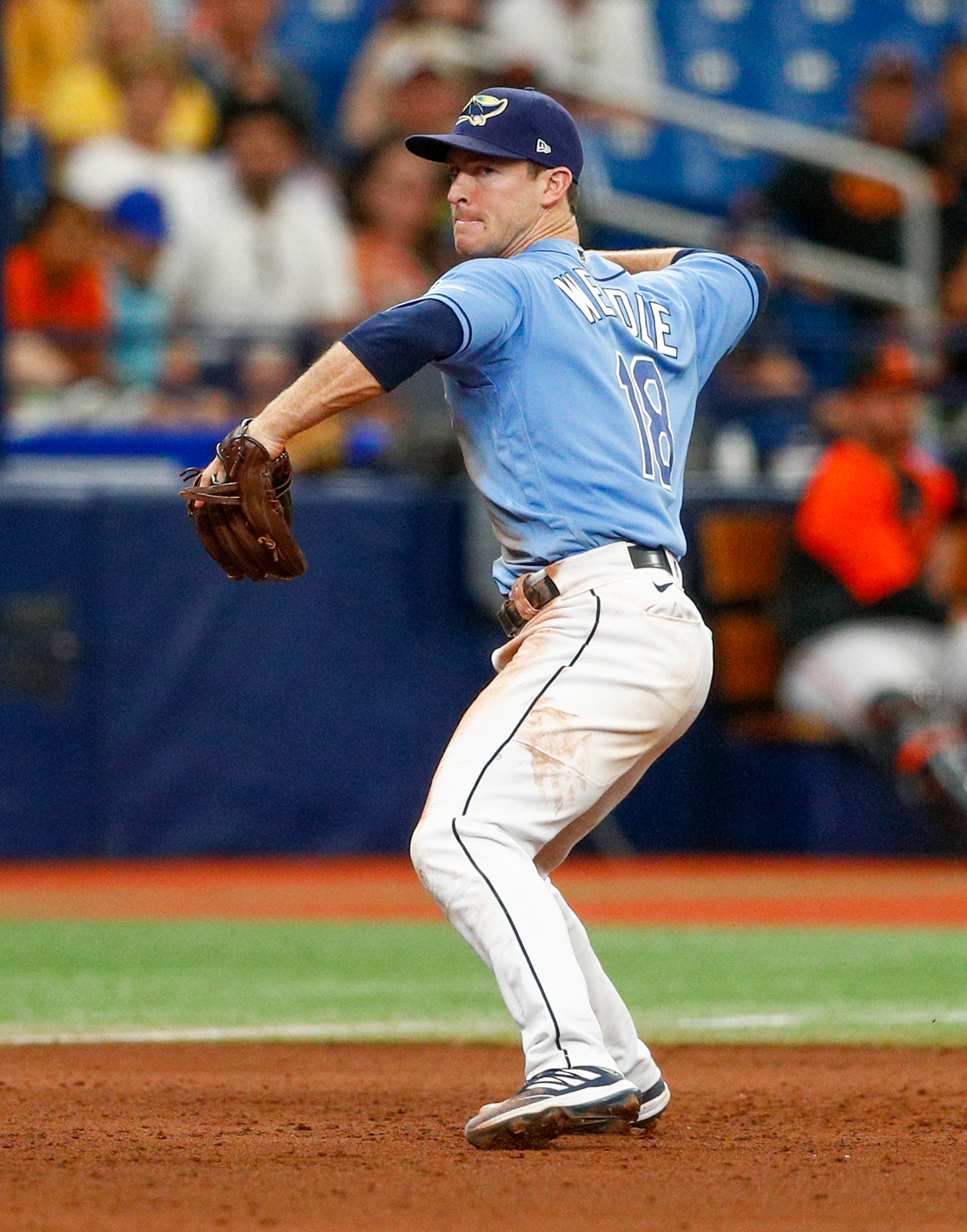
Wendle, 31, gives the Marlins an option at any of second base, shortstop or third base both in 2022 and in 2023, as he’s controlled another two seasons via arbitration. The lefty-swinging Wendle provides quality defense at all three of those positions and will bring a largely contact-driven offensive approach to the plate for Miami. He’s spent the past four seasons with the Rays, hitting at a combined .274/.330/.414 clip — six percent better than the league average, by measure of wRC+ — with 25 home runs, 86 doubles, 14 triples and 40 stolen bases (in 55 tries) through just shy of 1500 plate appearances.
The Marlins, according to SportsGrid’s Craig Mish (Twitter link), plan to utilize Wendle as a super-utility player who’ll bounce between second, short, third and perhaps the outfield or first base. Jazz Chisholm and Miguel Rojas have second base and shortstop largely locked down (respectively), while Brian Anderson has been the team’s primary third baseman in recent years. Anderson, however, has been beset by shoulder troubles and spent considerable time on the injured list. He’s also capable of playing in the outfield corners, so it’s at least feasible he could move to the grass in order to accommodate Wendle at the hot corner at times. The advent of a designated hitter in the National League could also lead to some reps for Anderson (or Wendle) there.
The good news for Miami is that they don’t have to set anything in stone just yet. Adding Wendle unquestionably improves the roster but does so while creating enough agility for general manager Kim Ng and her staff to cast a wide net in their further offseason pursuits. The Marlins are still seeking a center field option but could also pivot to add a corner bat if there’s a chance for an opportunistic strike in left field or at third base.
Wendle’s addition is the latest in an increasingly active offseason for the Marlins, who in the past week have signed Avisail Garcia to a four-year contract, acquired catcher Jacob Stallings from the Pirates, and signed rotation leader Sandy Alcantara to a five-year contract extension with a team option for a sixth season.
On the other side of the deal, Tampa Bay has reportedly been exploring the trade market for Wendle in advance of tonight’s deadline to tender contracts to arbitration-eligible players. Wendle is projected by MLBTR contributor Matt Swartz to earn $4MM in 2022, and the Rays needed to open a spot on the roster to accommodate their recent one-year, $8MM agreement with veteran right-hander Corey Kluber. The Rays are also deep in terms of infield options; Brandon Lowe, Wander Franco, Yandy Diaz and prospects Taylor Walls and Vidal Brujan give them ample cover at second, third and short.
The addition of Misner, who’ll turn 24 in January, is nothing to scoff at from the Rays’ vantage point, either. The No. 35 overall draft pick back in 2019, Misner split the 2021 campaign betweenthe Class-A Advanced and Double-A levels, hitting a combined .253/.355/.433 with a dozen homers, 29 doubles, three triples and 26 steals (in 30 tries).
Scouting reports on Misner tout the lefty hitter’s plus raw power, plus speed and solid defensive tools — which make for a tantalizing package were it not for a substandard hit tool. Misner fanned at a 29.4% clip in 462 of his minor league plate appearances this season, and while he offsets those punchouts (to an extent) with a stout 12.3% walk rate, more advanced pitchers will carry greater potential to expose holes in his swing.
The blend of power, speed and defense makes Misner a relatively high-upside name to add to an already deep stockpile of prospects. Misner ranked 10th among Marlins farmhands at FanGraphs, 15th on Baseball America’s midseason list and 21st on MLB.com’s midseason rankings. The fact that Misner briefly reached Double-A this past season at least opens the door for a potential MLB debut at some point in 2022, though it seems likelier that he’d make an impact in 2023 — assuming he continues to produce in the upper minors.
Craig Mish of SportsGrid and the Miami Herald first reported (via Twitter) that Wendle was headed to Miami. Marc Topkin of the Tampa Bay Times reported that Misner was going back to Tampa Bay in return.
Photo courtesy of Imagn/USA Today Sports.
Rays Discussing Joey Wendle, Kevin Kiermaier In Trade Talks
The Rays are exploring the trade markets for both infielder Joey Wendle and center fielder Kevin Kiermaier, tweets Ken Rosenthal of The Athletic. Earlier today, Matt Gelb of The Athletic reported that the Phillies have had trade talks surrounding Kiermaier as they continue to search for an option in center field.
Wendle, 31, was one of the Rays’ whopping 19 arbitration-eligible players entering the offseason, and teams have until 8pm ET tonight to determine whether to tender contracts to those players. MLBTR contributor Matt Swartz projects a $4MM salary for Wendle next season, but the Rays are deep in infield talent with the likes of Wander Franco, Brandon Lowe, Yandy Diaz and prospects Vidal Brujan and Taylor Walls.
There’s little chance the Rays would simply non-tender Wendle. He’s coming off a solid .265/.319/.422 batting line (106 wRC+) through 501 plate appearances in 2021, and beyond his contribution with the bat, he played above-average defense at each of second base, third base and shortstop. He’s also controlled another two seasons via arbitration, so a team in need of help at second and/or third base would surely be intrigued by the possibility of swinging a deal with the Rays.
Kiermaier is in an entirely different situation. The 31-year-old is entering the final guaranteed season of a six-year, $53.5MM contract extension and is due to earn $12MM next season (plus at least a $2.5MM buyout on a $13MM option for the 2023 campaign). His name has been kicked about the rumor mill for years now, largely on account of his salary naturally increasing in the latter stages of that extension.
Though Kiermaier has struggled to remain healthy throughout his MLB career, it’s obvious why a Phillies club that has been defensively inept for several years would have interest in adding him to the mix. When healthy, Kiermaier is among the best defensive players on the planet, regardless of position. And while he’s been inconsistent with the bat, his composite .243/.321/.401 batting line dating back to 2016 is only about five percent below average, by measure of wRC+. Kiermaier also provides ample value on the basepaths, evidenced in part by a 77% success rate in stolen-base attempts during that time.
The Phillies have about $171MM in payroll commitments for the 2022 season and a near identical mark in luxury-tax obligations, per Roster Resource’s Jason Martinez. Kiermaier would add $12MM to their bottom-line payroll but only about $8.91MM to their luxury ledger, thanks to the backloaded nature of his contract extension.
Philadelphia has been seeking an upgrade in center field for several years now and has already missed out on top free agent Starling Marte this winter. The Phils also held interest in Minnesota’s Byron Buxton, but the Twins signed him to a seven-year extension with a full no-trade clause, firmly closing the book on any such possibility.
It’s at least plausible that the Phils could have interest in a combo deal with the Rays that would send both Kiermaier and Wendle to the City of Brotherly Love. The Phillies have been loosely tied to infield upgrades, and while it’s not reported to be a top priority for them, Wendle would give them some cover on the left side of the infield where both Didi Gregorius and Alec Bohm are coming off lackluster seasons.
The Rays have a full 40-man roster and still need to make room for the formal addition of right-hander Corey Kluber, who agreed to a one-year, $8MM deal with Tampa Bay on Sunday.
Rays To Sign Brooks Raley
The Rays have agreed to a deal with free-agent lefty Brooks Raley, tweets Ken Rosenthal of The Athletic. The deal will be finalized once Raley, a client of Vanguard Sports, passes a physical. It’s a two-year, $10MM deal with a club option, according to Marc Topkin of the Tampa Bay Times.
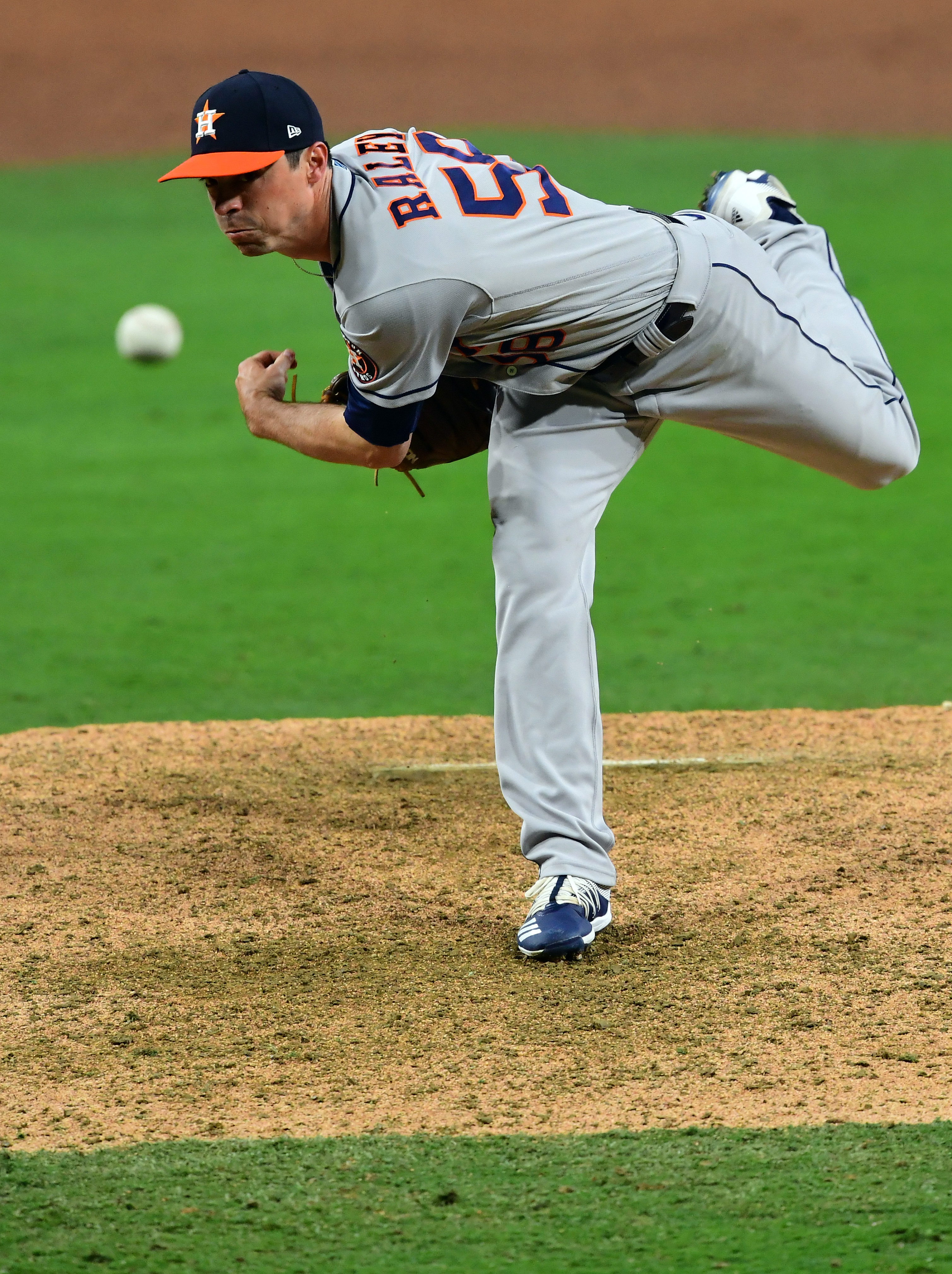
Raley, 33, was one of the top lefty relievers on the market this winter. Since 2020, he’s posted a 31.8 K% and 7.6 BB% in 69 innings for the Reds and Astros. That strikeout rate ranks 22nd among all relievers during that time among those with at least 60 innings pitched.
As you’d expect, Raley has been devastating against lefty batters, with a 40.5 K% against them in that time. Though Raley isn’t a hard-thrower, he boasts excellent fastball and curveball spin rates. He also had the second-lowest average exit velocity in all of baseball this year among those with at least 100 batters faced, as well as the game’s best hard-hit percentage. He’s an extremely tough at-bat for lefty batters.
Excellent as Raley has been against same-handed opponents, he’s struggled to tame righties, allowing six home runs against the 120 hitters he faced from that side this year. That’s a large part of his 4.83 ERA since 2020, and something the Rays will have to navigate carefully with the three-batter minimum expected to stay in effect. Still, given Raley’s massive strikeout rates and terrific batted-ball profile, it’s not a surprise that a particularly analytically inclined club was more than willing to look beyond his pedestrian ERA — even on a two-year contract arrangement.
Raley joins what should be a strong Tampa Bay bullpen, slotting in alongside Andrew Kittredge, Pete Fairbanks, J.P. Feyereisen and Matt Wisler, among others. It’s not a collection of household names by any means, but the Rays coaxed a 3.24 ERA out of their relievers despite the perennial churn on bullpen arms in St. Petersburg. They’ll look for ways to improve his numbers against righties and also advantageous opportunities to utilize his mastery against lefties, and their prior success in achieving those goals on mid-level additions of this nature has earned them the benefit of the doubt in their ability to succeed again.
For Raley, the $10MM guarantee is an especially satisfying achievement when considering the path he took to get here. A sixth-round pick by the Cubs back in 2009, Raley made his MLB debut with Chicago in 2012 and was rocked for a 7.04 ERA in 38 1/3 frames over the next two seasons. That led to a DFA and a pair of waiver claims from the Twins and the Angels, but Raley never pitched in the Majors for either team. The Halos released him in 2014, allowing him to sign a deal with the Lotte Giants in the Korea Baseball Organization.
Raley spent the next half decade as a starter in South Korea, generally pitching to an ERA in the upper-3.00s or low-4.00s. He accumulated a hefty 910 2/3 innings in the KBO, though the 4.13 ERA he posted with South Korea’s Giants didn’t exactly stand out. Raley returned to the U.S. on a one-year deal (plus a club option) with the Reds in 2020 but barely got a look in Cincinnati before being designated for assignment. The Astros picked him up in a trade that sent minor league reliever Fredy Medina to Cincinnati, and Raley’s career took off from there.
Given the frantic pace of transactions and the nine-figure contracts being slung left and right over the past week, it’s easy to move past a deal in this range without giving it much of a second thought. Given Raley’s career arc, it’s worth taking a moment to appreciate the perseverance and the payoff.
Photo courtesy of Imagn/USA Today Sports.
Rays To Sign Corey Kluber
3:16PM: MLB Network’s Jon Heyman (Twitter link) has the breakdown of Kluber’s incentives. The righty will earn $500K bonuses for hitting the 10-start and 15-start thresholds, $1MM if he makes 20 starts, and $1.5MM for making 25 starts and 30 starts. While the Rays are known for using openers and bulk pitchers, this contract structure would seem to imply that Kluber will be normally deployed as a starting pitcher.
10:44AM: The Rays have signed Corey Kluber to a one-year deal, pending a physical. It’s an $8MM contract, plus incentives, which could take the value of the deal as high as $13MM. MLBTR had predicted a one-year, $12MM contract for Kluber, which is right in line with his earnings window, based on those incentives. Kluber is represented by Jet Sports Management.
This is yet another domino to fall in what has been an incredibly fast-moving starting pitcher market this year, as Eduardo Rodriguez, Anthony DeSclafani, Justin Verlander, Steven Matz, Noah Syndergaard, Andrew Heaney and Michael Wacha have all signed in the past two weeks.
This is the second consecutive one-year deal for Kluber, after being signed by the Yankees in January. At the time, Kluber had been limited to less than 40 total innings over the previous two seasons due to various injuries. Regardless, he was still able to earn himself a guarantee of $11MM from the Yanks after demonstrating his health in a showcase. The righty was again held back by injuries in 2021, although his 80 innings pitched still were the most he’s tallied since 2018. Although he couldn’t live up to his previous Cy Young-winning form, he did manage an ERA of 3.83 with a strikeout rate of 24%.
Prior to his recent injury woes, Kluber was one of the best pitchers in all of baseball. From 2014 to 2018, he had five straight campaigns of at least 200 innings and never had an ERA above 3.50. In total, he threw 1091 1/3 innings during that time frame, second only to Max Scherzer across the league. His 1,228 strikeouts put him third, behind only Scherzer and Chris Sale. His 30.3 fWAR in that span trailed only Scherzer and Clayton Kershaw. He won the AL Cy Young in 2014 and 2017 and made the All-Star team in three straight seasons, beginning in 2016.
For the Rays, this marks another in short-term deal given to a veteran starter, in what has become something of a pattern for the low-spending organization, who signed Rich Hill, Michael Wacha and Chris Archer to one-year deals last winter. Kluber has a much higher ceiling than any of those three, based on his previous track record, but also comes with a high degree of uncertainty based on his recent injuries. The rotation is currently composed of young, highly-touted but inexperienced hurlers, such as Shane McClanahan, Drew Rasmussen, Ryan Yarbrough, Luis Patino, Shane Baz and Josh Fleming. Yarbrough is the only one of that group older than 27 years old or with more than two years’ service time. Tyler Glasnow is likely out for the entirety of 2022 after undergoing Tommy John surgery in August. Yonny Chirinos, also recovering from Tommy John, isn’t expected back until April or May. Brendan McKay just recently underwent thoracic outlet surgery but could potentially be ready by spring training. Kluber, if healthy, adds some steady veteran presence and experience into this mix.
From a financial perspective, the $8MM owed to Kluber pushes the club’s 2022 payroll close to $84MM, in the estimation of Jason Martinez of Roster Resource. This has the potential to be record-setting, as the Rays have never had an opening day payroll higher than $77MM, per Cot’s Baseball Contracts. However, it’s also possible that number comes down after the team subtracts from their substantial arbitration class, either by non-tenders or trades. They already made one such move when they recently traded Jordan Luplow and his projected $1.5MM arbitration salary to the Diamondbacks.
Ken Rosenthal of The Athletic first reported that the Rays had signed Kluber. Joel Sherman of The New York Post first added the $8MM base plus incentives framework. Marc Topkin of the Tampa Bay Times first relayed that the incentives could push the deal as high as $13MM.
Image courtesy of USA Today Sports.
Rays Sign Wander Franco To 11-Year Extension
Seventy games into his Major League career, Rays shortstop Wander Franco has agreed to an 11-year, $182MM contract extension. The contract also comes with a $25MM club option for the 2033 season (with a $2MM buyout) and a series of $3MM escalators based on MVP voting, so the deal’s maximum value sits at $223MM over 12 years. Franco is represented by agent Manny Paula.
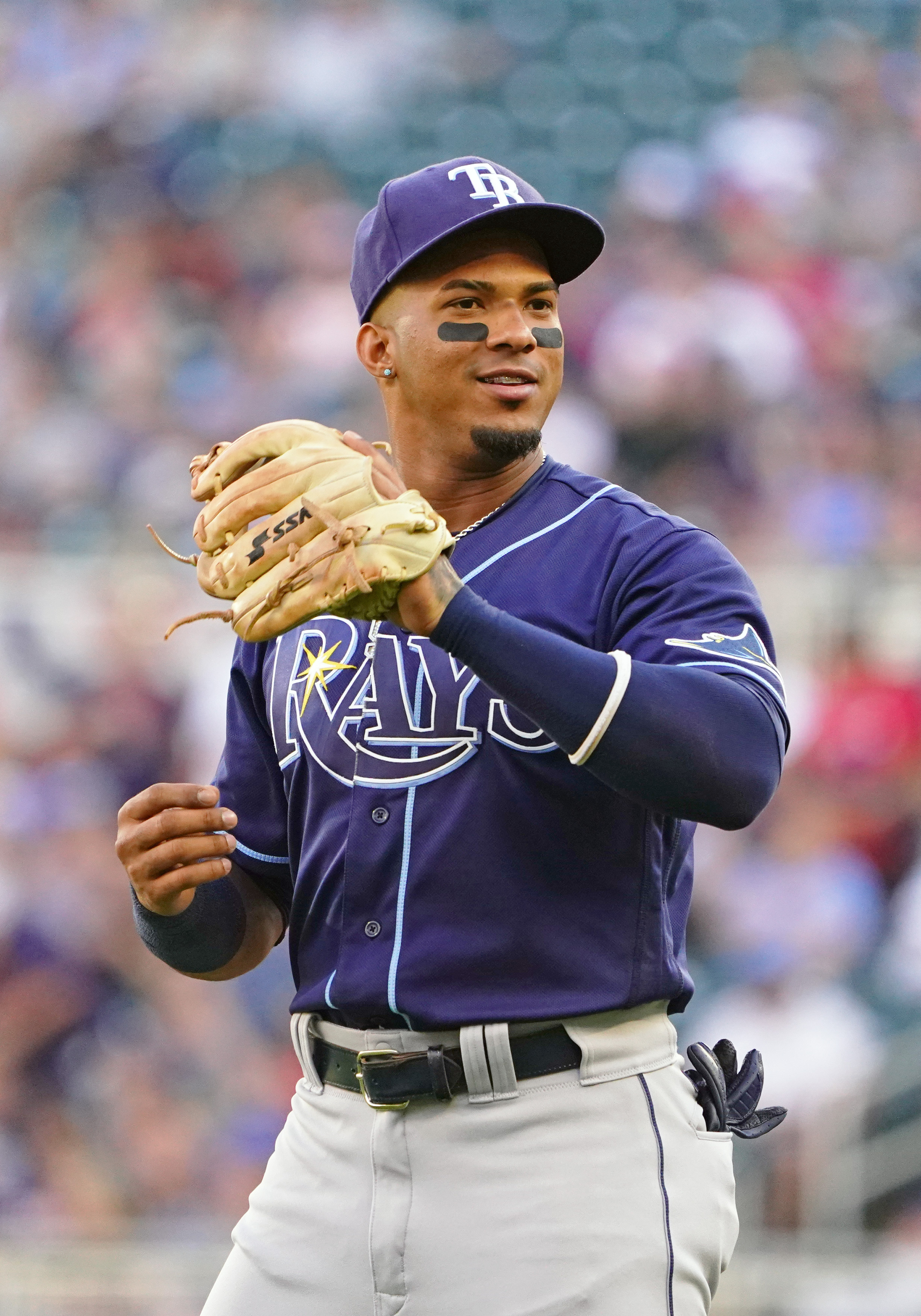
Franco’s contract is both a franchise record for the Rays, topping Evan Longoria‘s previous $100MM guarantee, and also a record for any player with less than one year of Major League service time. Ronald Acuna Jr.‘s eight-year, $100MM contract had been the largest ever signed by a player with less than a year of service, but Franco will nearly double that sum with today’s precedent-shattering agreement.
In terms of financial breakdown, Franco will receive a $5MM bonus right off the bat. The shortstop will earn $1MM in 2022, $2MM in both 2023 and 2024, $8MM in 2025, $15MM in 2016, $22MM in 2027, and then $25MM in each of the 2028-32 seasons.
Franco would receive an extra $3MM in the event of a trade, but there isn’t any no-trade protection involved in the extension. There also aren’t any provisions related to the Rays’ plan to split time between Tampa and Montreal once the team’s lease at Tropicana Field is up after the 2027 season.
Franco, who won’t turn 21 until March, ranked as the sport’s No. 1 overall prospect in each of the past three offseasons and largely justified that hype when he debuted just months after his 20th birthday. The switch-hitter slashed .288/.347/.463 with seven home runs, 18 doubles, five triples and a pair of stolen bases through 308 plate appearances.
From July 25 to Sept. 29, Franco embarked on one of the more remarkable stretches in recent memory, reaching base in a staggering 43 consecutive games in spite of his youth. During that time, he posted a combined .329/.398/.545 batting line with more walks (9.1%) than strikeouts (8.1%). Franco only appeared in 70 games this season but was impressive enough to finish third in AL Rookie of the Year voting.
Defensively, Franco received split marks for his work at shortstop, putting up six Defensive Runs Saved, average marks per Ultimate Zone Rating and a minus-3 mark in Statcast’s Outs Above Average. However, scouting reports on him have pegged him as at least an average shortstop — if not better — in addition to touting his elite hit tool, plus power and plus speed. That generally aligns with the .331/.399./535 slash he posted in his meteoric rise through 215 minor league games. Prior to Franco’s promotion, FanGraphs’ Eric Longenhagen wrote that he’d been “the best player his age on the planet since he was 14 years old” and touted him as a perennial MVP candidate. ESPN’s Kiley McDaniel, meanwhile, called him “plus at basically everything on a baseball field.” Take your pick of Franco scouting reports from the 2020-21 offseason and they’ll all generally be filled similar superlatives.
Because the Rays waited until late June to promote Franco, he was a veritable lock to fall shy of Super Two status under the current arbitration system (which could potentially change, depending on how collective bargaining talks play out). Franco wouldn’t have been arbitration-eligible until after the 2024 season and would’ve had to wait until the 2027-28 offseason to reach free agency. The 11-year length of the contract buys out all three of Franco’s pre-arbitration seasons — during which he’d likely have made under $1MM apiece — and all three arbitration years. He’s also surrendering control of six would-be free-agent seasons (though only five are fully guaranteed).
Some fans will recoil at the notion of guaranteeing $182MM to a player with just 70 big league games under his belt, but those 70 games largely confirmed what the industry has expected from Franco since he signed for a bonus of nearly $4MM as a 16-year-old: he looks the part of a budding superstar. And, a westward look toward San Diego shows what could happen by waiting to allow the player to further establish himself. Fernando Tatis Jr. didn’t sign an extension until he had accrued two years of Major League service, and his price tag ballooned to 14 years and $340MM. Franco’s price tag upon waiting would likely have extended even beyond that point and may well have become too sizable for the Rays’ typically frugal ownership.
It’s tempting to ponder just how much Franco might be “leaving on the table,” so to speak; free agent Carlos Correa has already pocketed $27MM in career salaries and is reportedly seeking a contract worth more than $300MM at the same age Franco would’ve been upon reaching free agency. Extension rumblings surrounding Juan Soto have elicited speculation of $400MM or even $500MM in total guaranteed money; Soto is 23 and has three-plus years of MLB service.
Franco would have found himself on a similar trajectory had he gone the year-to-year route, and one could certainly argue that betting on himself in hopes of setting an even more dramatic record was the more prudent path forward. That said, it’s difficult to fault anyone for accepting this type of guarantee — particularly at such a young age. Generations of Franco’s family will be financially secure because of it, and he can still take heart in knowing that he’s nearly doubled the previous precedent, thus further advancing the market for future players. Beyond that, because of his youth, Franco can still reach free agency as a 32-year-old, which is young enough to command a second substantial contract.
The possibility of “leaving money on the table” also assumes good health and continued production from Franco moving forward. Taking the extension now mitigates much of the risk associated with a career-altering injury or injuries — a danger that exists for any player. It also safeguards against Franco “merely” becoming a solid regular rather than a bona fide superstar (or, less likely, declining into a sub-par player). Promising as his beginnings were, he’d hardly be the first player to impress as a rookie before taking a few years to reach his ceiling or even stalling out entirely.
Ongoing labor talks also have to be considered. While the next collective bargaining agreement could have improved Franco’s earning power, it’s also feasible that a new CBA might have hurt him to an extent; ownership has already proposed an age-based free-agent threshold of 29.5 years, for instance, and although that particular number was a nonstarter for the players association (due to just this type of situation), the league could explore various permutations of such mechanisms. Regardless of how labor talks between MLB and the MLBPA play out, Rays president of baseball operations Erik Neander and Franco can both rest easy knowing that perhaps the most critical negotiation either will ever personally take part in has been resolved.
Any and all instances of the Rays spending money bring about the typical comments wondering how long until the player on the receiving end of the deal is traded. Such barbs are admittedly somewhat justified due to the Rays’ history of trading players — e.g. Longoria, Blake Snell, Chris Archer — in the latter stages of their extensions. But, even if that’s Franco’s ultimate fate, it’s unlikely to happen anytime soon. Extensions of this nature tend to mirror what the player would have earned absent the long-term contract; in other words, Franco may receive an up-front signing bonus, but his yearly salaries through the first six years figure are considerably lighter than they will be in the portion of his contract covering what would have been free-agent years.
In the short term, then, the Franco extension will have only minimal impact on club payroll. Tampa Bay was projected by Roster Resource’s Jason Martinez to field a payroll of around $76MM in 2021, and the Franco contract probably won’t push that mark up to even $80MM. That number still figures to drop a bit in the near future as the Rays contemplate potential trades and non-tenders related to an abnormally large arbitration class, but any trades or non-tenders of arb-eligible players in the coming days will be unrelated to Franco’s long-term pact.
At the end of the day, any contract of this magnitude involves some give and take for both sides. Any number of things could’ve gone wrong for Franco in the years to come, and the looming possibility of those pitfalls underscores the fact that the typically small-payroll Rays are taking on what is, by their standards, an unprecedented risk.
While many will be quick to declare “winners” and “losers” in Hot Stove transactions — be they trades, free-agent signings or contract extensions — there are also instances where a deal simply appears sensible for all sides. Franco receives a generational amount of money and retains the ability to reach free agency in his early 30s. The Rays secure control of a franchise cornerstone whom they hope and believe can be an all-time great. The players union surely approves of the precedent for players with under a year of service being moved forward so substantially.
Ultimately, Franco’s new contract contains positives for all parties involved — perhaps with the exception of Tampa Bay’s division rivals in the AL East who now have to wonder how to combat the emerging superstar into the 2030s.
Yancen Pujols of El Caribe reported last week that the Rays had offered a record-setting extension worth between $150-200MM. Marc Topkin of the Tampa Bay Times reported on Nov. 23 that an agreement was close, and he also had the year-to-year salary breakdown. Joel Sherman of the New York Post (Twitter link) and Hector Gomez of Z101 Sports (Twitter link) reported general parameters, and ESPN’s Jeff Passan eventually reported the specific terms of the contract (Twitter thread).
Diamondbacks Acquire Jordan Luplow From Rays
The Rays have traded outfielder/first baseman Jordan Luplow to the D-Backs for infield prospect Ronny Simon, the teams announced. Arizona designated right-hander Brett de Geus for assignment to open space on the 40-man roster. Tampa Bay’s 40-man roster now sits at 39.
Luplow is a five-year big league veteran, although he’s spent the bulk of his time in a platoon capacity. The right-handed hitter has never tallied more than 261 plate appearances in any given campaign, as he’s instead been leveraged heavily against lefty pitching. That’s a role in which he’s had great success, as Luplow has a massive .245/.360/.539 showing against southpaws. While that batting average isn’t eye-catching, Luplow’s combination of a huge 14.3% walk rate and 23 home runs in 378 plate appearances (essentially a little less than two-thirds of a full season’s workload) when holding the platoon advantage has made him an impact player in those situations.
Yet Luplow’s struggles against same-handed hurlers have kept him from being an everyday regular. He’s a career .205/.291/.369 hitter in 358 trips to the dish against righties. The 28-year-old actually had reverse splits in fairly limited playing time this past season, but it’s likely the D-Backs put more stock in his career-long track record of mashing against southpaws and will continue to use in a platoon capacity next season.
Luplow has between three and four years of major league service, so he remains controllable through 2024 via arbitration (barring changes to the service time structure in the next collective bargaining agreement). MLBTR contributor Matt Swartz projects him to receive a salary in the $1.5MM range next year. That’s certainly not an onerous sum, but it might be more than the cost-conscious Rays would have been willing to spend since they’re already fairly deep in outfield options.
The D-Backs’ outfield is far less settled, particularly if the club tries to trade David Peralta this winter. Young options like Pavin Smith, Stuart Fairchild, Jake McCarthy and Daulton Varsho could all get some run in 2022, but Fairchild’s the only right-handed hitter of that bunch. Adding Luplow gives the D-Backs an affordable, proven righty bat to help balance out the group.
In exchange, the D-Backs will send back a switch-hitting infield prospect. Simon spent most of the 2021 campaign with Low-A Visalia, where he hit .249/.343/.475 with fifteen homers and twelve steals across 349 plate appearances as a 21-year-old. Simon, who was acquired from the Cubs last November as the player to be named later in the teams’ Andrew Chafin deal, spent the bulk of his time in the middle infield, in addition to a handful of starts at third base. He’ll need to be added to the 40-man roster next offseason or be made available in the 2022 Rule 5 draft.
de Geus split the 2021 campaign between the Rangers and D-Backs. Selected out of the Dodgers’ organization in last year’s Rule 5, the 24-year-old worked 47 innings across 50 outings. He posted just a 7.56 ERA with worse than average strikeout and walk rates (17.2% and 10.5%, respectively). de Geus’ 7% swinging strike rate was the second-lowest mark among the 255 relievers with 20+ innings pitched, but he did rack up ground-balls at a strong 52.1% clip on the strength of his low-mid 90s sinker. Arizona will have a week to trade de Geus or try to pass him through waivers.
Brian O’Grady Signs With NPB’s Seibu Lions
Former Padres, Rays and Reds first baseman/outfielder Brian O’Grady has signed with the Seibu Lions of Nippon Professional Baseball, per announcements from both the Lions and from O’Grady himself (Twitter link).
O’Grady, 29, became a free agent after being outrighted off San Diego’s roster at season’s end. The 2014 eighth-round pick (Reds) saw a career-high 61 plate appearances with the Friars in 2021, frequently operating as a pinch-hitter but also drawing a handful of starts in right field. O’Grady hit .157/.267/.333 with a pair of homers, three doubles and eight walks (13.1%).
The limited role wasn’t entirely new for O’Grady, who also saw action with the Reds in 2019 and Rays in 2020 without ever receiving an opportunity at consistent playing time. He’s a career .184/.283/.388 hitter in 114 Major League plate appearances — but those plate appearances have come over the course of 62 games.
O’Grady figures to be afforded far more opportunities in Japan, and given his career .284/.362/.551 batting line in 978 plate appearances at the Triple-A level, there’s good reason to believe he’ll find success overseas. Regardless of how he performs, he’ll quite likely be paid a guaranteed salary that handily eclipses what he’d have made in another season split between Triple-A and the big leagues. A strong season in Japan could either position O’Grady for a raise on a new contract in NPB or the KBO, and success in a foreign professional league could also prime him to return to MLB on a guaranteed contract at some point down the line.