
Rockies, Daniel Bard Agree To Extension
1:05pm: Bard’s contract will guarantee him “about $19MM,” Feinsand tweets.
12:52pm: The Rockies and closer Daniel Bard are finalizing a contract extension, reports Mark Feinsand of MLB.com (Twitter link). Jon Heyman of the New York Post, meanwhile, reports that the Rockies have already reached an agreement on a two-year extension for Bard, a client of ISE Baseball (Twitter links).
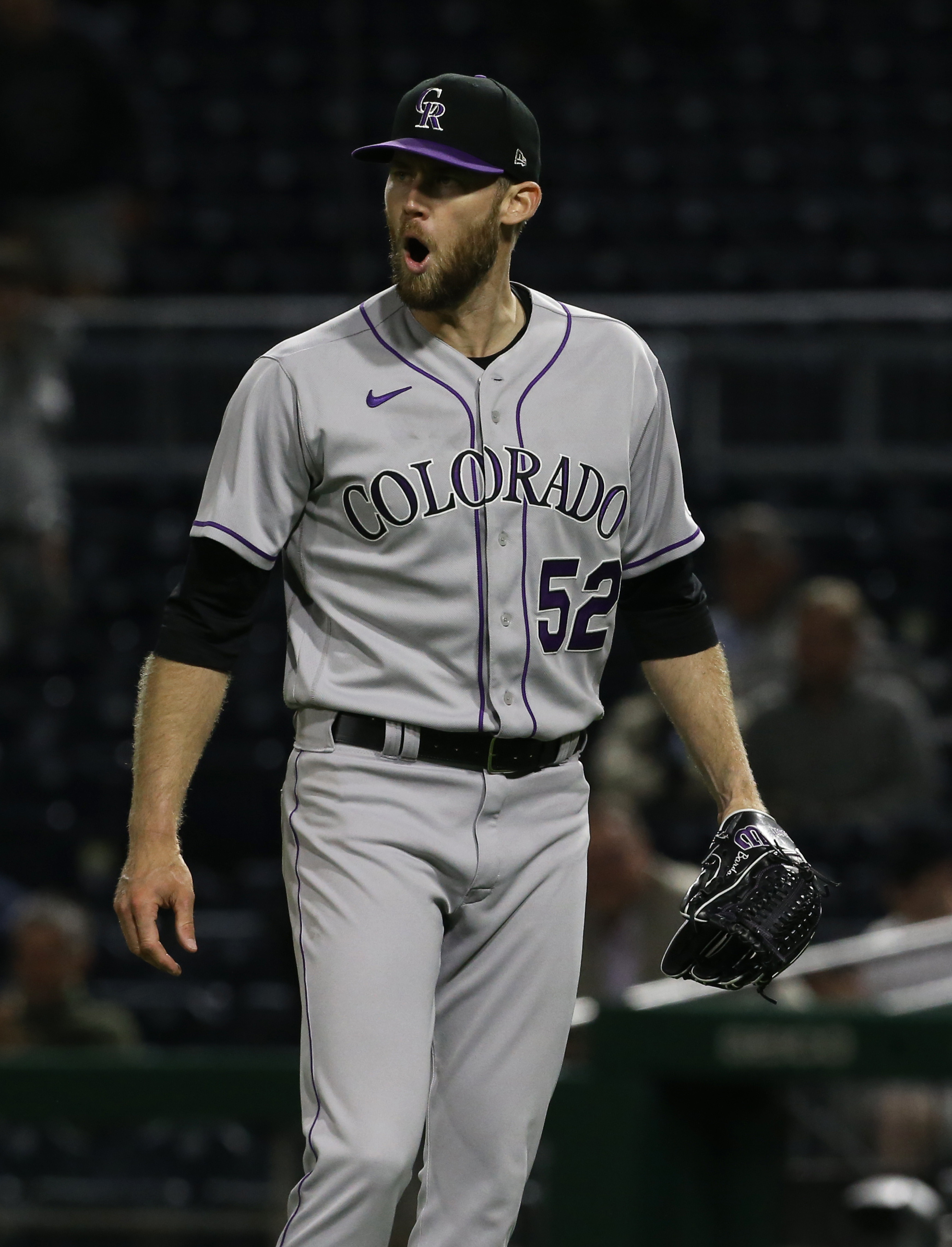
All indications throughout the summer have been that the Rockies aren’t interested in trading the 37-year-old Bard and rather hoped to keep him beyond the current season. It now appears they’ve succeeded in that goal.
On paper, Bard seemed like the optimal trade candidate: a 37-year-old reliever on an expiring contract and in the midst of a dominant season for a last-place team. The Rockies, however, march to the beat of their own drum perhaps more than any team in the sport and have made a habit of hanging onto conventional trade candidates, even if it means losing key players for nothing, as they did last summer when declining to trade Jon Gray and surprisingly choosing not to issue him a qualifying offer.
Rockies owner Dick Monfort has outwardly spoken about his belief that the team has the makings of a winning club, even if the on-field results have overwhelmingly suggested otherwise in recent seasons. General manager Bill Schmidt, who was elevated from scouting director to the GM’s chair last year after GM Jeff Bridich’s dismissal, plainly told Danielle Allentuck of the Denver Gazette earlier this month that he did not envision being a major seller at this year’s deadline because the organization believes in the talent on the roster. Manager Bud Black has echoed similar sentiments in recent days, rhetorically questioning why the team would trade a “Range Rover” (Bard) for a “Honda Accord” (a package of minor league prospects, presumably).
While it’s certainly fair to question the inherently risky decision to extend a 37-year-old reliever, it’s simultaneously easy to see how the Rockies have become enamored of Bard in the ninth inning. Merely making it back to the Majors after a seven-year absence would’ve been a feel-good story on its own, but Bard not only engineered one of the most improbable comebacks in recent memory — he’s quickly ascended to the ranks of the elite in MLB.
A late-season swoon sent Bard’s 2021 ERA soaring to 5.21 following the trade deadline, but he’s been an absolute powerhouse in Black’s bullpen this year, pitching to a 1.91 ERA with a 27.6% strikeout rate and a 53.8% ground-ball rate. Bard’s 12.2% walk rate is noticeably higher than the league-average mark of 9.1% among relievers, but his penchant for grounders and inducing generally weak contact (87.2 mph average exit velocity) has helped him to mitigate any damage that might arise from at-times spotty control. Bard is also averaging a blistering 98.1 mph on a sinker that can reach triple-digits and make hitters look downright foolish at times.
Relievers are volatile, as Bard himself has shown with his 2021 and 2022 results, so there’s plenty of risk that this deal turns out poorly for the Rockies. The current version of Bard, though, is about as good a reliever as you’ll find anywhere in the league — and the Rockies are clearly confident in his ability to sustain this output even as he approaches his 40th birthday.
From a payroll vantage point, Bard will add another notable salary to a 2023 roster that could well set a new franchise-record in payroll before the front office makes a single roster move. The Rox had $110MM on next year’s books already, and that was before factoring in Bard’s new extension and an $18MM player option that Charlie Blackmon seems likely to exercise. Colorado will also owe arbitration raises to each of Robert Stephenson, Garrett Hampson, Tyler Kinley, Peter Lambert, Austin Gomber and Brendan Rodgers. All of that should push the team right up against or somewhere beyond the current franchise-record mark of $145MM. Further additions this winter could send the Rockies into entirely new payroll territory.
The Rockies will take– and, based on social media reaction, already have taken — plenty of flak for their commitment to retaining a core of players that has generated only a .445 winning percentage dating back to the 2019 season. And while the team’s resistance to rebuilding and staunch belief that the makings of a contender are present can both fairly be questioned, it’s also somewhat refreshing to see a club continue to try to put together a winning club rather than lean into the type of arduous, multi-year rebuilds that have proliferated the sport in recent years. Even if this group never breaks through and emerges as a true postseason contender in future seasons, the Rockies are at least trying — and that’s more than several teams can say each season.
Rockies Remain Unlikely To Trade Daniel Bard, C.J. Cron
The Rockies have dropped seven of their last ten games, falling into last place in the NL West. They’re set to miss the postseason for the fourth consecutive year, but they remain opposed to any kind of dramatic overhaul. General manager Bill Schmidt flatly rejected the idea of a rebuild earlier this month, and it seems likely they’ll hold onto most or all of their shorter-term players as well.
Closer Daniel Bard and first baseman C.J. Cron have drawn reported interest over the past few weeks, but the Rox haven’t seemed especially urgent to move either player. That remains the case, as both Danielle Allentuck of the Colorado Spring Gazette and Nick Groke of the Athletic relay that neither is likely to be dealt. Both Allentuck and Groke write that Colorado is optimistic about its chances of signing the 37-year-old Bard to a contract extension that’d keep him from hitting the open market this winter as scheduled. Cron, meanwhile, is already under contract for next season at a modest $7.5MM salary.
Speaking with reporters yesterday, Colorado manager Bud Black metaphorically suggested the Rockies have been underwhelmed with the trade offers they’ve received on their veteran players. “We’re fielding calls. We’ve got some players who are desirable,” Black said. “And I can’t speak to it, but I’ll give you some perspective. Team A might call on one of our players and their front office might say, ‘We like this guy.’ And our front office will say, ‘Well, yeah, he’s a good player, you should be on that player. … But this happens a little bit, too. Hey, you guys have a Range Rover. We’ll take your Range Rover and we’ll give you our Honda Accord.’ And teams expect you to do that. Why would we do that? ‘How could you not trade your Range Rover?’ Because we might try to keep our Range Rover! Rather than trade it for your Subaru!”
The Rockies actions in recent seasons have reflected a similar sentiment. While most non-contenders are happy to take the best offer on the table for the bulk of their impending free agents, Colorado declined to trade any of Cron, Jon Gray or Trevor Story at last year’s deadline. It paid off in Cron’s case, as they eventually agreed to a two-year extension and have been rewarded with the slugger’s .280/.335/.521 showing this season. Gray and Story departed in free agency, however, and Colorado received no compensation for the former after surprisingly deciding against issuing him a qualifying offer.
They’re set to adopt a similar approach to this summer’s deadline. Groke writes that Colorado is also hoping to extend starter Chad Kuhl, who’s slated for free agency this winter himself. The righty has expressed openness to staying in Denver, and the organization shares the desire to keep him around. The 29-year-old signed a $3MM guarantee over the winter after being non-tendered by the Pirates. He’s made 19 starts and soaked up 98 innings with mixed results.
Kuhl had excellent numbers early on, carrying a 3.56 ERA through the end of May. He’s hit a major rough patch of late, though, allowing five-plus runs in three of his last five starts while failing to work into the sixth inning on any occasion. Since tossing a complete game shutout against the Dodgers on June 27, he’s allowed 22 runs in 20 2/3 innings. That has brought his season line up to a 4.78 ERA with a personal-low 16.6% strikeout rate.
Spotty recent run notwithstanding, there’s some merit to the Rox’s desire to hold onto Kuhl beyond this season. He’s handled himself well at Coors Field, pitching to a 4.17 ERA while holding opponents to a manageable .258/.313/.428 line through nine home starts. Largely thanks to a quality slider, he’s mostly done well against right-handed batters. Kuhl’s lack of a trustworthy changeup has always contributed to marked platoon concerns, but his sinker-slider mix generally aligns with those of pitchers (i.e. Gray, Kyle Freeland, Antonio Senzatela) whom the Rockies have relied upon in recent years. Depending on the price point, keeping Kuhl around as a lower-cost option at the back of the rotation is defensible — particularly since the trade demand from other clubs figures to be modest given his numbers this month.
Shortstop José Iglesias and right-hander Alex Colomé are each ticketed for free agency as well. Igleias, as a contact-oriented infielder, could hold modest appeal to contenders looking for utility depth. Colomé doesn’t miss many bats, but he’s a solid strike-thrower and ground-ball specialist in the middle innings. Whether Colorado will deal either for a lower-level prospect or two remains to be seen, although both Allentuck and Groke posit that Colomé is the likeliest player on the roster to be traded.
NL West Notes: Ohtani, Padres, Walker, Rodon, Giants, Bard
The Angels reportedly don’t have any interest in trading Shohei Ohtani, but that hasn’t stopped the team from at least listening to offers out of due diligence, Jon Heyman and Joel Sherman of the New York Post write. The Padres are one of those teams who have called about Ohtani, according to The Athletic’s Ken Rosenthal, who adds that this is the type of aggressive move that has become typical of San Diego president of baseball operations A.J. Preller. There doesn’t seem to be any indication that the Padres have caught the Halos’ attention, except in the broader sense that the Padres have the depth of premium young talent that the Angels would undoubtedly want if they actually did considering sending Ohtani elsewhere.
Frankie Montas and Luis Castillo have also been linked to the Padres in trade rumors, and as Rosenthal notes, it is noteworthy in itself that San Diego is looking at pitchers despite having plenty of rotation depth on paper. However, MacKenzie Gore was recently placed on the injured list, Sean Manaea has struggled as of late, and the Padres could be trying to land a pitcher controlled through at least 2023 considering that Manaea, Joe Musgrove, Mike Clevinger, and Nick Martinez could all potentially enter the free agent market this winter. Furthermore, someone like Blake Snell could be dealt to try and stay under the luxury tax threshold, as avoiding another tax payment is another consideration for Preller to manage as the deadline approaches.
More from around the NL West…
- Also from Rosenthal, Diamondbacks officials are “doubtful” that Christian Walker will be traded. The first baseman’s name has been mentioned in trade speculation, but the D’Backs understandably have a high asking price for an all-around productive player who is under team control through the 2024 season.
- A seven-game losing streak has dropped the Giants to 48-50, but as of last night, the team wasn’t planning on selling at the deadline, ESPN’s Buster Olney tweets. Chasing down the Dodgers for first place is probably out of the question, but San Francisco is still only 3.5 games out of the final wild card spot, and a +26 run differential argues that the Giants are at least a little better than their losing record indicates. That said, the Giants have several intriguing trade options, including Carlos Rodon (who can opt out of his deal after the season) as a rental piece. SKOR North’s Darren Wolfson speculates that the Twins would be one of many interested parties if the Giants did shop Rodon, as Minnesota “were right there” in trying to sign Rodon last winter.
- Rockies closer Daniel Bard is drawing interest from more than one team, MLB.com’s Mark Feinsand reports. Bard (who turned 37 last month) is enjoying a career revival as the Rockies’ ninth-inning man, recording 21 saves and posting a 1.91 ERA over 37 2/3 innings. Despite these numbers and the fact that Bard is a free agent after the year, however, most of the buzz around Bard has focused on Colorado’s efforts to extend him, rather than shop him at the deadline.
Rockies Agree To Terms With Top Three Draft Choices
The Rockies are in agreement with first-round pick Gabriel Hughes, reports Jim Callis of MLB.com (Twitter link). He receives a $4MM signing bonus that’s well below the $4.98MM slot value that accompanies the #10 overall pick.
The underslot terms somewhat reflect Hughes’ pre-draft reputation as more of a mid-late first-round talent. He checked in between 22nd and 33rd on prospect lists at Baseball America, The Athletic, FanGraphs, ESPN and MLB Pipeline. Evaluators praise his low-mid 90s fastball and above-average or better slider while suggesting his seldom-used changeup has nevertheless shown some potential in limited usage. The 6’4″ hurler is also credited with capable control and an old-school workhorse build that could make him a quick-moving rotation piece.
One of the younger college pitchers in the class, Hughes won’t turn 21 until next month. He nevertheless had no problem excelling during his final season at Gonzaga University, working to a 3.21 ERA with a 34.1% strikeout rate and a 9.1% walk percentage through 98 innings.
Colorado has also come to terms with their two supplemental first-rounders, per reports from Callis (Twitter links). Sterlin Thompson receives a $2.4305MM bonus that matches the slot value associated with the #31 pick. A left-handed hitter out of the University of Florida, Thompson broke out with a .354/.443/.563 showing over 305 plate appearances during his final season in Gainesville. Baseball America placed the 6’4″ Thompson as the #29 prospect in the class, writing that he’s likely to move to the corner outfield full-time as a pro. Both BA and Callis credit him with an advanced feel for the strike zone and the chance to grow into a bit of power as he fills out his frame.
Meanwhile, Jordan Beck will take home a $2.2MM bonus that comes in a bit above the $2.1MM slot value tied to the #38 pick. A right-handed power bat from the University of Tennessee, Beck checked in at #36 on BA’s pre-draft rankings. He hit .298/.391/.595 with 18 homers during his junior season in Knoxville, although he also struck out at an elevated 20.9% clip. That leads to some hit tool questions, but Beck has a strong power and athleticism combination.
Mets Rumors: Bell, Mancini, Szapucki
There’s not much traction at present between the Nationals and Mets on a potential Josh Bell swap, reports SNY’s Andy Martino. Bell is one of several designated hitter candidates in whom the Mets are known to have interest, but it seems as though talks between the two parties haven’t proved fruitful. Pat Ragazzo and Michael Marino of Sports Illustrated/Fan Nation report that the Mets put forth an offer for Bell and a Nationals reliever that included an upper-level minor league starter and outfielder.
The Mets moved last week to begin augmenting their DH rotation, flipping reliever Colin Holderman to the Pirates in a trade that brought Daniel Vogelbach back to Queens. Vogelbach, however, figures to be a pure platoon option, whereas the switch-hitting Bell would be an everyday option who’d push Vogelbach into a bench role. The Mets have continued to look for potential DH upgrades even in the wake of the Voeglbach deal, Martino writes, with Trey Mancini, C.J. Cron and Willson Contreras among those who might still be under consideration.
They won’t have the opportunity to evaluate Mancini today, as he’ll take a seat on the heels of an 0-for-22 swoon at the plate. That offensive freefall has dropped Mancini’s batting line from a robust .285/.359/.429 (124 wRC+) to .268/.345/.404 (113 wRC+). Mancini has still been better than a league-average hitter on the whole, but it’s a poor time for him to struggle through his toughest patch of the season, particularly from a team vantage point.
The Orioles won 10 games in a row to thrust themselves onto the fringes of the American Wild Card chase prior to the deadline, but they’ve since gone 2-4 against the Rays and Yankees in a pair of road series. Mancini’s slump obviously isn’t the sole cause of the team’s momentum slowing down, but it was a contributing factor as Baltimore dropped a few close games. It’s also suboptimal for a club that could still move Mancini prior to next Tuesday’s trade deadline; an 0-for-22 doesn’t wipe out all of Mancini’s trade value, of course, but it’s tougher for a rival front office to give up a prospect of note for a hitter in such a pronounced slump.
Cron has a robust .292/.347/.546 line on the year, but it’s questionable whether the Rockies would consider moving him when he’s cheaply signed for 2023, particularly since Colorado GM Bill Schmidt has already pushed back against a major sell-off. Contreras seems a virtual lock to move in the next eight days, but the Mets reluctance to deal from the top of the farm system would make landing perhaps the top rental bat available a challenge.
Bell, Mancini and Vogelbach were just a handful of the Mets’ reported targets as they look to bolster the lineup, and Martino reported last week that GM Billy Eppler and his team were exploring trade scenarios involving both Dominic Smith and J.D. Davis. Clearly, there’s some turnover to be expected. Martino even floats the possibility of the Mets dealing Vogelbach if they land an impact bat, although there’s no indication that’s especially likely.
The exact return the Mets might surrender in order to bolster the lineup is, of course, wholly dependent on the caliber of player on which they settle — but Mike Puma of the New York Post reports (Twitter link) that minor league lefty Thomas Szapucki has drawn some interest from other teams as New York has poked around the trade market. The 26-year-old lefty has yielded a staggering 15 runs in just five Major League innings across the past two seasons, but Szapucki has had a nice year in Triple-A Syracuse, pitching to a 3.48 ERA with a huge 31.9% strikeout rate against an 11% walk rate in 62 innings.
Those 62 frames have been scattered over 16 starts, which comes out to an average of under four innings per outing. That’s a bit of a strange phenomenon, even in today’s game, but the Mets have been cautious with Szapucki’s workload after he underwent Tommy John surgery in 2018 and season-ending surgery on his ulnar nerve last summer. He began the year throwing just two to three innings per start but has continued to build up his pitch count over the course of the year, peaking with a season-high 93 pitches back on July 6.
The Mets and other clubs may want to be cautious with his overall innings total and his pitch count on a game-to-game basis, but he’s a reasonably youthful lefty who can be controlled at least six years beyond the current campaign. Even if there’s some injury risk, he has three average or better pitches and could certainly operate as a multi-inning reliever down the road if his arm doesn’t prove capable of a starter’s workload. Speculatively, Szapucki would fit the billing of the “upper-level starting pitcher” the Mets are said to have offered to Washington in Bell talks, though there’s no specific indication that Szapucki was part of that offer.
Mets Exploring Trade Market For DH Options
The Mets are exploring the market for a number of bats as they look to upgrade over what has been a generally unproductive tandem of Dominic Smith and J.D. Davis at designated hitter, reports Andy Martino of SNY. Nationals sluggers Josh Bell and Nelson Cruz, Colorado’s C.J. Cron and Baltimore’s Trey Mancini (as previously reported) are among the names in play.
Metsmerized’s Michael Mayer reported this week that the Mets have also had talks with the Pirates about left-handed-hitting Daniel Vogelbach, who is signed to a highly affordable $1MM contract with a $1.5MM option for the 2023 season. FanSided’s Robert Murray hears the same, though Murray notes that there are multiple teams inquiring about Vogelbach’s availability (as is surely the case with the Mets’ other reported targets). Martino describes conversations with the Pirates regarding Vogelbach as “active.”
The 29-year-old Vogelbach would surely be viewed as a platoon option in Queens, as he’s never hit lefties well and has again posted an inept .141/.267/.156 batting line against them. However, he’s crushed righties to the tune of a .260/.365/.532 batting line, swatting a dozen homers, nine doubles and a triple in just 203 trips to the plate when holding the platoon advantage this year. Vogelbach’s has long been a productive hitter against righties, and he’s not all that far removed from a smashing a career-high 30 homers with the 2019 Mariners.
There’s some appeal to Vogelbach beyond the strong platoon work and next year’s affordable club option, too. He entered the year with three-plus years of Major League service time, meaning that even after a club exercises next year’s option — which seems likely, whether it’s the Pirates, Mets or another trade partner — he’s still controllable through the 2024 season. Vogelbach would be arbitration-eligible in the 2023-24 offseason before reaching free agency in the 2024-25 offseason.
The 29-year-old Bell is hitting .311/.390/.504 with 13 home runs this season, striking out at a career-low 13.5% and drawing walks at a hearty 10.7% pace. He’s earning $10MM this season, and while the Nationals might be wary of sending long-term pieces to the division-rival Mets (e.g. Juan Soto), Bell is a free agent at the end of the year, which probably eliminates any such concerns from Washington’s vantage point.
It’s a similar story for the 42-year-old Cruz, who’s earning $15MM this season and has a mutual option for the 2023 campaign. Those are rarely exercised by both parties, however, and players with mutual options are generally considered rentals for this reason. Cruz got out to an awful start in 2022 but has produced a solid .283/.362/.425 batting line in his past 247 plate appearances. He’s only homered six times in that span, showing a decidedly uncharacteristic lack of power, but Cruz has still been a productive hitter if you’re willing to set aside a slow start to the year.
As for Cron, it’s understandable that the Mets would harbor interest, but a deal seems unlikely to come together. Although the Rockies are 19 games out of the NL West lead and six and a half games back of the NL’s third Wild Card spot, the organization has opted not to deal what look to be on-paper trade candidates for years now. Ownership in Denver steadfastly believes the foundation of a contending club is in place, as evidenced by the glut of extensions doled out over the past year (as well as the surprising signing of Kris Bryant to a seven-year deal).
One need look no further than last year’s deadline to see that Cron isn’t likely to be moved. The Rockies were in this position a year ago, when Cron was playing on a cheap one-year deal and looked like a slam-dunk candidate to be flipped to a contender. The Rockies instead kept him and inked Cron to a two-year, $14.5MM extension. To their credit, Cron has been overwhelming bargain, hitting .298/.350/.552 with 21 homers this year. That’s outstanding production, but if the Rox balked at moving him a year ago when he was a free-agent-to-be, it only stands to reason that they’d be further dissuaded from trading him now (even though the contract likely makes him more appealing to potential suitors). General manager Bill Schmidt said just last week that he does not expect to be a major seller this summer.
Any of the names listed here would likely serve as an upgrade over the combined .219/.300/.368 batting line that Mets designated hitters have put together this season. That production includes 90 very productive plate appearances by Pete Alonso as DH, which only underscores how rough the non-Alonso DH options have been at Citi Field this season.
As for what would happen with the current DH options the Mets have in-house, it somewhat unsurprisingly seems as though a change of scenery may be in the fold. Smith was just placed on the injured list due to an ankle sprain but could return by the middle of next week. The Cubs and Red Sox are among the teams to have talked to the Mets about a potential trade. Martino writes that the Mets are “working to trade Smith,” adding that Davis could be moved as well.
Smith has struggled in 2021-22 after a hugely productive 2019-20 showing, while Davis’ power numbers have tumbled this year despite eye-popping exit velocity and hard-hit numbers. Both are controllable for two years beyond the current campaign, which might make them appealing to a club that’s not a current contender but can afford to give Smith or Davis consistent playing time while showing a bit more patience than the Mets have the luxury of doing in a competitive setting atop the NL East.
The Market For Rental Starters Is On Shaky Ground
The starting pitchers that have received, and surely will continue to receive, the most attention in trade rumors are Luis Castillo, Frankie Montas and Tyler Mahle. It’s not surprising, given that they’re all quality pitchers, have been in rumors for a long time and are currently playing for obvious sellers. They also each come with an extra year of control, making them doubly enticing. Why add an exciting new pitcher for just one postseason push when you can do it for two? MLBTR recently ranked the trade candidates and placed them #4, 5 and 6, respectively.
However, with upwards of a dozen teams looking to bolster their pitching staffs in the coming weeks, not all of them will succeed in grabbing one of that trio. In fact, with their extra control, there’s no guarantee any of them will be traded. Montas and Mahle are both dealing with minor injuries right now, and though both are expected to be well enough to pitch before the deadline, there’s always the possibility of the injury getting worse and scuttling trade hopes. Regardless, some teams are going to have to look farther down the list of trade candidates, which is where things get murky.
The top 50 list linked above featured six starters who are set to reach free agency at the end of the year: José Quintana at #7, Martín Pérez at #12, Chad Kuhl at #17, Jordan Lyles at #18, Noah Syndergaard at #21 and Mike Clevinger at #38. (Lyles isn’t a rental in the strictest sense, as he has an $11MM club option for next year with a $1MM buyout. But since the odds seem to be against that getting picked up, I’ve included him here.) That makes them a little less desired on the market, but also means the acquisition cost should be lower. Although that list was published less than two weeks ago, the sand has already started to shift a bit under this market, and could potentially do so again in the weeks to come.
Quintana was having an excellent start to his season but has slipped recently. When he landed that #7 spot on the list a couple of weeks ago, he had a 3.33 ERA. However, he’s had two miserable starts since then, allowing four earned runs in 4 1/3 innings on July 1o, followed by six earned runs in five innings on July 15. His ERA has jumped up to 3.99 just from those two outings. Teams aren’t likely to radically alter their evaluation of a pitcher based on just two starts, especially with the latter taking place in Coors Field. But then again, Quintana’s strong first half was also a small sample, coming after a few years of ineffective work. He had a 4.68 ERA in 2019, then was limited to just ten innings in 2020 due to injury. Last year, he worked mostly as a reliever and put up a 6.43 ERA. He’s made 18 starts this year and two bad ones won’t completely undo the rest, but how much will a team value those 16 decent ones after years of mediocrity? Were those last two starts flukes or regression to the mean?
Pérez is in a similar boat, as he was out-pitching his track record in the early going but has come back down to earth of late. At the end of his start on June 5th, he had a 1.56 ERA but has a 4.54 since. He still has an excellent 2.68 mark on the season overall based on that strong start, but the recent rough patch raises questions. After eight straight seasons with an ERA between 4.38 and 6.22, has he suddenly turned a corner at the age of 31? Or was it a mirage that’s now fading from view? Either way, there’s also the extra complication that the Rangers might just hang onto Pérez and extend him.
Kuhl’s situation has some parallels as well, as he had a 3.17 ERA through his June 3 start but a 5.45 over his last seven outings. Further complicating matters is the fact that the Rockies seem to be leaning towards doing their thing that they do, holding onto obvious trade candidates and hoping to work out extensions. Last year, they didn’t trade Trevor Story, Jon Gray or C.J. Cron, despite all three heading towards free agency. They recouped a draft pick when Story rejected the qualifying offer and signed with the Red Sox, extended Cron but came up short in trying to hang onto Gray. This year, it seems like Kuhl might be this year’s Cron, as he’s apparently comfortable in Colorado and willing to stay beyond this season. Any team that wanted to acquire him would probably have to blow away the Rockies with an overpay.
As for Lyles, his situation has changed not so much because of his performance, but the rest of the team. When that list was published, the Orioles were 41-44. They were on a six-game win streak, but that seemed to be a flash in the pan of what would surely go down as another miserable season in Baltimore. Well, that six-game win streak eventually turned in a ten-gamer, and the O’s are now 46-46, just 2 1/2 games out of a playoff spot. Does that make them change their deadline approach? Perhaps, perhaps not. The odds of a postseason berth are still low, with FanGraphs giving them a 1.4% chance. But with excited fans turning out to Camden Yards for the first time in years, would the club still pull the plug on deadline selling? Lyles was just signed this offseason and isn’t a fan favorite like Trey Mancini. But with his 4.76 ERA, he’s not likely to bring back much more than a lottery ticket prospect anyway. Perhaps the O’s would be better served to just hang onto those innings and hope that 1.4% number grows.
Unlike the Orioles, the Angels have only dug themselves into a deeper hole. At the time MLBTR’s rankings came out, they were seven games out of a playoff spot, theoretically one hot streak away from jumping right back into the mix. However, they’ve unfortunately gone the other way, slipping to 10 1/2 back. That should only solidify Syndergaard as a guaranteed trade chip. But like many of the other pitchers highlighted here, he hasn’t been at his best lately. He had a 3.53 ERA through mid-June but a 5.01 over his last four starts. That’s a small sample, but he hasn’t looked like himself this season. After only throwing two innings over 2020-2021 due to Tommy John surgery and with his velocity down from his pre-surgery form, it’s fair to wonder if there might be some fatigue setting in.
Clevinger is a unique case, compared to the other names on this list. The Padres aren’t looking to sell because they’re not competitive, quite the opposite. It’s because they are competitive that they are looking to use their rotation surplus to create payroll space in order to upgrade elsewhere without going over the luxury tax. Moving Clevinger would be one way to do it, though his $5.75MM CBT hit is much less than Blake Snell‘s $10MM. From San Diego’s perspective, moving Snell is probably preferable for the extra breathing space. A team could certainly try to work out a Clevinger deal, but you’d be competing with whatever teams are offering for Snell, as well as any other Clevinger suitors.
There are a few other names to consider, of course, but all come with similar question marks. Arizona’s Zach Davies is on the injured list with shoulder inflammation. Detroit’s Michael Pineda only recently returned from a broken finger and had his worst start of a generally underwhelming season just before the break. Mike Minor has an ERA north of 6.00 with the Reds.
All in all, there’s not a ton to bank on here. Any team that doesn’t pony up for Castillo, Montas or Mahle is going to be left with these options, all of whom come with question marks. There are other controllable starters who could be available, such as Oakland’s Paul Blackburn. But with three extra years of control, the A’s surely won’t just give him away. And he, too, has seen a downturn in performance over the last month (7.46 ERA over past five starts). We’re now less than two weeks until the August 2 trade deadline, so the remaining games for these pitchers will be magnified. With the expanded playoffs, there are still 17 teams that have at least a 29.7% chance to make the postseason, per FanGraphs. That has the potential for a situation with high demand and low supply in the days to come, bad news for those who need pitching but good news for those selling it.
Rockies Unlikely To Be Major Deadline Sellers
At 39-49, the Rockies are tied with the D-backs for last place in the National League West, sitting 18 games back from the division-leading Dodgers. Only eight teams in baseball have a worse winning percentage than Colorado, and several of those eight came into the 2022 season with no intention of competing as they progressed through rebuilds. The Rockies, as has become par for the course, seem to feel their club is underperforming and don’t envision a major sell-off. General manager Bill Schmidt replied with a simple “no” when asked by Danielle Allentuck of the Denver Gazette if he expects to be a big seller at this year’s deadline.
It’s a familiar refrain for a Rockies club that has enjoyed just two winning seasons in the past decade and appears well on its way to a tenth sub-.500 finish in the past dozen seasons. The Rockies are 171-212 dating back to 2019 but have nevertheless generally eschewed even the trades of veterans on expiring contracts. They added Kevin Pillar and Mychal Givens at the 2020 deadline, for instance. The Rox eventually traded Givens last summer, but that was the sole deadline deal for a club that had Jon Gray, Trevor Story and C.J. Cron on expiring contracts — plus righty Daniel Bard, who is a free agent at the end of the current season.
On the one hand, it’s refreshing to see a team continue to try to turn its fortunes and win in the here-and-now without embarking on an arduous multi-year rebuild (which, in itself, is not the panacea it’s often framed to be). On the other, the Rox have continually expressed ardent belief that this core can be the nucleus of a winning club but have yet to see that faith manifest in the form of consistent wins on the field.
Zealous confidence in the core has been demonstrated through far more than just words. Colorado extended Cron, infielder Ryan McMahon, lefty Kyle Freeland, righty Antonio Senzatela and catcher Elias Diaz, traded for Randal Grichuk and signed Kris Bryant to an eye-popping seven-year deal in an effort to finally turn the corner this year. Smaller deals for Jose Iglesias, Alex Colome and Chad Kuhl were meant to further bolster the roster. But at with just 20 days until the trade deadline, they find themselves in a familiar spot, and the only names among those extensions and new acquisitions who’ve performed up to expectation are Cron, Kuhl, Colome and perhaps Iglesias.
Despite the lackluster results, Schmidt tells Allentuck that he “believe[s] in these guys,” adding confidence that the farm system will soon bring about some reinforcements. The Rox indeed have some nearly MLB-ready talent on the cusp of the Majors, but the system as a whole is ranked between 23rd and 25th among all 30 teams at each of Baseball America, MLB.com, The Athletic and ESPN. Schmidt, the scouting director-turned-GM, surely views his group more favorably, but as Allentuck explores in greater detail, nearly every one of the organization’s most promising pitching prospects has dealt with injuries of varying severity this winter.
Conventional wisdom would suggest that the Rockies should, at the very least, be open-minded about deals involving veterans who are set to be free agents at season’s end. That would include Bard, who’s been one of the better closers in the NL this season, as well as Kuhl, Colome, Iglesias and hard-throwing but mercurial righty Carlos Estevez.
However, USA Today’s Bob Nightengale reported over the weekend that the Rox hope to sign the 37-year-old Bard to an extension rather than trade him. Allentuck notes that a deal between the two parties isn’t close but similarly suggests that an extension is likelier than a trade. While Nightengale wrote the Rockies could listen to offers on Kuhl, the right-hander himself tells Allentuck that he’s also open to an extension and would prefer to stay in one place rather than bounce around the league. Schmidt seemingly hinted at this when noting that the most commonly speculated trade candidates in Colorado “are the guys that want to stay here.” Based on the team’s recent rash of extensions, it’s certainly possible Kuhl re-signs on a new multi-year deal rather than changing hands in the next three weeks.
There’d obviously be plenty of risk associated with extending Bard or Kuhl. Bard is already 37, and although he’s whiffed 29.5% of opponents, limited hard contact and notched a career-best 56.4% ground-ball rate en route to a 2.14 ERA, his 2021 campaign (5.21 ERA in 65 2/3 innings) is a reminder of the overall volatility of relief pitching. Add in Bard’s age and still-ugly 12.2% walk rate, and there’s definite downside, strong as his results to date have been.
Kuhl, meanwhile, has a 4.02 ERA through 87 1/3 innings — a total that’s already the second-highest mark of the oft-injured righty’s career. The 29-year-old’s 16.9% strikeout rate ranks 71st of the 79 pitchers in MLB with at least 80 innings so far, and his 29.4% opponents’ chase rate on pitches outside the strike zone ranks 73rd. His 41.7% hard-hit rate is the highest mark he’s ever yielded. Perhaps the return wouldn’t be enough to justify a trade, and it can’t be ignored that it’s rare for free-agent pitchers to voice a willingness (or in this case, even a preference) to call Coors Field home.
Still, keeping Kuhl would effectively lock the 2023 Rockies into relying on the same rotation that has produced a 28th-ranked 5.06 ERA in 2022 (plus a 24th-ranked 4.47 FIP and 28th-ranked 4.58 SIERA). In doing so, they’d be betting heavily on improvements from German Marquez, Freeland and Senzatela — although with all three now signed to lucrative multi-year deals, there’s little choice but for the organization to hope for just that.
Last year’s deadline was Schmidt’s first in the GM chair after more than 20 years in other front office roles with the Rockies, so there was no precedent for how he’d approach the trade market. Now, between what we saw last summer and the latest comments to Allentuck, it seems likely to expect a conservative approach that’ll leave the bulk of the roster intact.
That would ostensibly set the stage for another offseason of win-now transactions for the Rockies, but there are payroll considerations to keep in mind as well. Assuming Charlie Blackmon picks up next year’s $10MM player option, they’ll already have $120.5MM in guarantees on the books. That doesn’t include potential salaries for extension candidates Bard and Kuhl, nor does it include arbitration raises for Austin Gomber, Brendan Rodgers, Tyler Kinley, Garrett Hampson and Robert Stephenson. All of that will push the Rockies much closer to their franchise-record $145MM payroll, meaning it’ll be incumbent for the current group to right the ship if they’re to truly turn their fortunes in future seasons.
Rockies Reportedly Open To Trading Chad Kuhl, Alex Colome
With the August 2 trade deadline just over three weeks away, the Rockies are considering selling some short-term assets, according to Bob Nightengale of USA Today. He relays that the Rox are shopping reliever Alex Colome and starter Chad Kuhl, but not closer Daniel Bard. Despite Bard’s impending free agency, the Rockies will apparently try to extend him in the coming weeks instead of working on a trade.
As things currently stand, the Rockies are 38-48, tied with the Diamondbacks at the bottom of the NL West and eight games out of a playoff spot. Unless they can gain some ground in the coming weeks, they make on-paper sense as a team that could trade some players that are approaching free agency.
However, it’s worth considering that the Rockies haven’t allowed followed the obvious playbook in this regard. Last year, the club was in a similar situation and had a number of impending free agents, such as Trevor Story, Jon Gray, C.J. Cron and Mychal Givens. In the end, only Givens was traded, with Colorado hanging onto the other three. In Story’s case, the club evidently thought that they would be better served by making him a qualifying offer and collecting a compensatory draft pick, as opposed to whatever trade offers they received. As for Cron and Gray, the club tried to work out contracts to keep them around, succeeding in the case of Cron but not Gray. All three of Kuhl, Bard and Colome are impending free agents this year and came in at #17, 22 and 27 respectively on MLBTR’s list of top trade candidates.
Colome, 33, was signed in the offseason to a one-year, $4.1MM deal. A veteran reliever with closing experience, he’s gradually transitioned from a strikeout guy to a ground ball guy in recent seasons. From 2016 to 2019, he threw 252 1/3 innings with a 2.78 ERA, 24.7% strikeout rate, 7.9% walk rate and 46.9% ground ball rate. Over 2020 and 2021, he logged another 87 1/3 frames with a 3.30 ERA, 19.5% strikeout rate, 8.2% walk rate and got grounders at a 53.4% clip. This year, he’s continued those recent trends, throwing 33 innings for Colorado with a 2.73 ERA, 16.8% strikeout rate and 54.6% ground ball rate. He has 159 career saves, including four this season. Just about every team in baseball will be looking to bolster their bullpen at the deadline, meaning Colome shoulder garner plenty of interest.
Kuhl, 29, spent the first five years of his career as a Pirate, throwing 439 2/3 innings with a 4.44 ERA, 20.8% strikeout rate, 10.3% walk rate and 41.7% ground ball rate. After being non-tendered by the Bucs, he signed with the Rockies on a one-year deal worth $3MM plus incentives. Through 16 starts and 87 1/3 innings this year, he’s put up a 4.02 ERA, which would be a career best. However, his strikeout rate has dipped to 16.9% and his grounder rate has also dropped to 36.5%. The key thing helping Kuhl seems to be an 8.9% HR/FB rate, well below the 13.2% mark he had in previous seasons, despite moving to Coors Field. Kuhl surprisingly has a 3.27 ERA at Coors and a 4.70 ERA on the road this year. His barrel rate has dropped to 6.9% this year after being at 13.1% in 2020, so perhaps it’s not entirely just batted ball luck at play. Still, the advanced metrics place his work this season closer to his career norms, with SIERA giving him a 4.85 and FIP a 4.28.
Whether he’s taken a real step forward or not, many contenders will be looking for starting pitching this year and not all of them can acquire Luis Castillo. If the Rockies make Kuhl available, they will surely get interest. However, in a recent piece, Ken Rosenthal of The Athletic notes that Kuhl is willing to stick with the Rockies and that the club generally tries to keep any pitcher that’s comfortable in their hitter-friendly environment.
As for Bard, he’s the most unusual of the bunch, having played with the Red Sox from 2009 to 2013 before a case of the yips cut him off from major league action. After several years in the wilderness, he incredibly made it back to the big leagues with the Rockies in 2020 as a 34-year-old. Since then, he’s become the closer in Colorado, racking up 44 saves over the past three seasons. Now 37 years old, Bard has thrown 32 2/3 innings this year with a 2.20 ERA, 29.4% strikeout rate, 12.5% walk rate and 55.3% ground ball rate. Despite his age, the Rockies evidently think he still has something left in the tank, as Nightengale reports that they want to work out a contract that prevents him from reaching free agency.
Giants Claim Colton Welker From Rockies
The Giants announced to reporters, including Maria I. Guardado of MLB.com, that they have claimed infielder Colton Welker off waivers from the Rockies. Welker was designated for assignment by the Rockies on the heels of season-ending shoulder surgery. The Giants have recalled him from the minors and placed him on the 60-day injured list.
Welker was in the minors at the time of his injury but was occupying a spot on the 40-man roster. The Rockies could have opened that roster spot by recalling Welker and placing him on the 60-day IL. However, doing so would have entitled Welker to MLB pay and service time. The Rockies evidently preferred to clear up that roster spot without paying Welker and designated him for assignment.
The Giants, on the other hand, were willing to pay Welker in exchange for adding him to their system, something that has become a pattern of theirs in recent years. They added Luis Gonzalez and Darien Nunez in similar situations, making this the third such occasion in the past year. Welker will now collect MLB pay and service time but won’t take up a spot on the Giants’ roster.
Selected in the fourth round of the 2016 draft, Welker didn’t take long to be noticed by prospect evaluators. Baseball America placed him on their list of top 30 farmhands in the Rockies’ system in 2017 and he’s been there ever since. However, he’s been slowed in recent years, as he was hit with an 80-game suspension in May of 2021 after testing positive for a banned substance. Between the pandemic wiping out the minor leagues in 2020, last year’s suspension and this year’s injury, he’s only played 62 games over the past three years.
The Giants are apparently still high on Welker, despite those setbacks. The last extended stretch of play he had was in Double-A in 2019. In 98 games there, he hit .252/.313/.408 for a wRC+ of 109. This year, he only got into ten Triple-A games but was excellent in that small sample, hitting .324/.422/.514, 135 wRC+.