
MLBTR Podcast: Kevin McGonigle, The Padres’ Franchise Valuation, And Edwin Díaz To Miss Time
The latest episode of the MLB Trade Rumors Podcast is now live on Spotify, Apple Podcasts, and wherever you get your podcasts! Make sure you subscribe as well! You can also use the player at this link to listen, if you don’t use Spotify or Apple for podcasts.
This week, host Darragh McDonald is joined by Anthony Franco of MLB Trade Rumors to discuss…
- The Tigers signing Kevin McGonigle to an eight-year extension (1:30)
- José E. Feliciano and Kwanza Jones reportedly having an agreement in place to buy the Padres (13:10)
- Dodgers right-hander Edwin Díaz requiring elbow surgery (27:20)
Plus, we answer your questions, including…
- Are the Braves for real? And what do they do once their injured guys get healthy? (32:20)
- If a salary cap is theoretically implemented, how would it work with the teams currently over the cap? (40:50)
- Can Michael Wacha of the Royals keep up his dominance? (45:50)
- What are the Reds going to do with Matt McLain and TJ Friedl? (48:15)
- Can the Nationals keep up this level of offense? And if so, should they have invested more in this year’s pitching staff? (52:10)
Check out our past episodes!
- Lenyn Sosa Traded, And Injury Concerns For The Astros, Cubs And Orioles – listen here
- Previewing The 2026-27 Free-Agent Class – listen here
- Lots Of Extensions And Big-Picture Topics – listen here
The podcast intro and outro song “So Long” is provided courtesy of the band Showoff. Check out their Facebook page here!
Photo courtesy of Rick Osentoski, Imagn Images
Dodgers Notes: Snell, Sasaki, Bullpen
The Dodgers are cruising along with an MLB-best 16-7 record (tied with the Padres) and a share of first in a competitive NL West. Still, more pitching help should be on the way soon. Lefty Blake Snell is slated to start for Single-A Ontario Tower Buzzers tonight as he builds up for his season debut, according to Sonja Chen of MLB.com.
Shoulder fatigue in his throwing arm dates back to last year. While Snell was able to toss an excellent 95 1/3 innings between the regular season and postseason last year, the Dodgers erred on the side of caution and placed the left-hander on the IL to open the season. Snell is tabbed for three innings tonight and will need four starts to build up to the five-inning/75-pitch MLB level, placing his earliest big league return timeline as late May.
Even in Snell’s absence, the Dodgers rotation hasn’t missed a beat. Their 14 quality starts lead all of MLB entering play today. Yoshinobu Yamamoto, Tyler Glasnow, and Shohei Ohtani have been typically excellent, but Justin Wrobleski has offered some surprising stability at the back of the rotation (despite a lack of strikeouts). Between Wrobleski, Emmet Sheehan, and Roki Sasaki, the Dodgers will have a rotation decision to make in the coming weeks upon Snell’s return.
Sasaki has recorded outs in the fifth inning in only two of his four starts this season. Given his excellence operating out of the bullpen in last year’s championship run, it’s natural to wonder if Sasaki could be ticketed for relief. At least for now, Sasaki’s role appears to be safe. In response to a hypothetical Sasaki in relief, Dodgers GM Brandon Gomes gave Fabian Ardaya and Katie Woo of The Athletic a flat “No.” Reading between the lines, it appears the final rotation spot will fall to Wrobleski or Sheehan, with Wrobleski currently occupying the inside track. Performance in the coming weeks could shift this assessment (and injuries to the rest of the rotation could upend it entirely).
It’s an interesting position by Gomes and the organization, given Sasaki’s struggles, but it reflects the Dodgers’ long-term belief in his potential. Sasaki surrendered only a single run in 10 2/3 innings last postseason, but wasn’t dominant by any means. His 2.3 K-BB% was lackluster, and ERA models like xFIP (5.72) and SIERA (5.35) didn’t love his work in an admittedly small sample. However, Sasaki was able to corral the long ball issues (again, small sample size) that have plagued his MLB work up to this point. In all likelihood, Sasaki’s gutsy October performance had little bearing on the organization’s long-term vision for him.
Sasaki’s 2026 starting work looks largely similar to 2025, with a marginal improvement in strikeouts and more fly balls leaving the yard on a rate basis. But if the Dodgers remain committed to locking him into rotation, one of Wrobleski or Sheehan will be squeezed off the roster or the bullpen. Fortunately, both Wrobleski and Sheehan have options remaining, meaning either of them can be freely moved between the major league club and its minor league affiliates them being exposed to waivers. Sasaki also has options remaining, meaning the Dodgers could theoretically allow him to continue working as a starter in the minors if they want to keep him stretched out as a starter, though this route seems unlikely.
LA’s bullpen pecking order is also currently under evaluation after closer Edwin Diaz went under the knife to remove loose bodies in his throwing elbow. While manager Dave Roberts acknowledged top lefty Tanner Scott could receive the majority of the save opportunities, he stopped short of anointing him interim closer, plainly stating (via Bill Plunkett of The Orange County Register) the approach as “…the closer-by-committee way of doing it.” High-leverage righty Brock Stewart, currently rehabbing with Triple-A Oklahoma City Dodgers, is also nearing a return. Between lefties (Scott and Alex Vesia) and righties (Blake Treinen and Stewart), Roberts should have a multitude of options at his disposal to attack hitters in the late innings until Diaz’s reinstatement.
Edwin Díaz To Undergo Surgery For Loose Bodies In Elbow
The Dodgers announced that right-hander Edwin Díaz has been placed on the 15-day injured list with right elbow loose bodies. A subsequent announcement said that he will have surgery to address the issue and is expected to return in the second half of the season. Reportedly, he’ll miss about three months, which will put him in line for a return sometime around the All-Star break. Left-hander Jake Eder has been recalled to take Díaz’s spot on the active roster.
The status of Díaz has been a bit of a mystery for a while now, as he has struggled for the Dodgers while pitching with diminished velocity. His fastball has averaged 95.7 miles per hour so far this year, a notable drop from his 97.2 mph average last year. His results were fine through five outings but his sixth, on April 10th, was rough. He entered a 7-4 game in the ninth and surrendered three runs, allowing the Rangers to tie it up.
The Dodgers were able to walk that game off in the bottom of the ninth but Díaz became a question mark. He didn’t pitch in official game action for over a week after that, even though the Dodgers had some save situations. He was finally back on the mound last night but the results were again poor. He entered in the bottom of the eighth at Coors Field, with the Dodgers down 6-4. He faced four batters, allowing three hits and a walk, then was removed without recording an out.
On the one hand, it’s nice to have a diagnosis that explains his struggles, but any elbow issue for a pitcher is going to be worrisome. Losing him for three months is going to be a blow. He has been one of the best closers in recent history and was just signed to a huge contract in the offseason. The Dodgers gave him a three-year, $69MM deal to scoop him away from the Mets.
The Dodgers have won the past two World Series but their 2025 title came despite a shaky bullpen. Manager Dave Roberts relied more and more on his starters as the postseason went along and the Dodgers just barely held on, as they almost lost to the Jays on a few occasions, going into extra innings in Game Seven.
The Díaz signing was supposed to patch over one of the club’s few weak spots as they look for a three-peat. Though Díaz isn’t quite as ridiculously dominant as he was a few years ago, he still had a great 2025 season, tossing 66 1/3 innings with a 1.63 earned run average 38% strikeout rate, 8% walk rate and 48.4% ground ball rate.
The Dodgers generally approach injuries with a long view. Their team is strong enough that they can feel quite good about their chances of making the postseason. They can have their players, particularly the pitchers, take their time to ensure they are healthy for the postseason. Given the three-month timeline, they can take that approach with Díaz. Ideally, he will be back in time to shake off some rust down the stretch and be in peak form for October.
Time will tell how that goes. If Díaz experiences any kind of setback or struggles to get in form once he is healthy, it could potentially impact how the Dodgers approach the trade deadline, which is on August 3rd this year.
For now, they will have to proceed without their big offseason bullpen investment. Tanner Scott, Alex Vesia and Blake Treinen could be candidates for picking up some save opportunities now. Scott is back in good form so far this year after a rough 2025. Vesia has picked up a few scattered saves over the years and has started 2026 with ten scoreless appearances. Treinen has past closing experience but isn’t out to a great start this year, with a 4.05 ERA thus far.
Alden González of ESPN reported that he would undergo surgery and be out about three months. Fabian Ardaya of The Athletic first reported that some kind of procedure would take place. Jack Harris of the California Post first reported that the Dodgers would expect him to be back from that procedure during this season. Photo courtesy of Jayne Kamin-Oncea, Imagn Images
Dodgers Notes: Hernandez, Phillips, Diaz
Enrique Hernandez played through most of the 2025 season with a torn muscle in his left (non-throwing) arm, and he underwent surgery to address the problem back in November. Hernandez suggested during an offseason interview with Adam Ottavino (hat tip to MLB.com’s Sonja Chen) that his recovery process would cost him “a month or two” of the regular season, but Dodgers GM Brandon Gomes suggested a slightly longer timeline, telling The Athletic’s Fabian Ardaya and other reporters today that the team expected Hernandez closer to midseason.
The status of Hernandez’s elbow didn’t stop Los Angeles from re-signing the utilityman to a one-year, $4.5MM free agent contract. Hernandez hasn’t yet been placed on the 60-day injured list, so the Dodgers may think there is still some chance he might be able to return within the first two months of regular-season action. Gomes noted that Hernandez will soon start swinging, which should provide some data on the 34-year-old’s progress.
Some might argue that Hernandez only needs to be ready for October, given his history as a postseason performer. The veteran has a modest .236/.305/.403 slash line over 4152 plate appearances and 12 Major League seasons, but his postseason numbers (.272/.339/.486 in 328 PA) have made Hernandez a key part of the Dodgers’ three championship teams over the last six years.
Gomes also touched on Evan Phillips‘ recovery from Tommy John surgery, and his comparison to Phillips’ return as akin to a trade deadline acquisition suggests that the reliever should be back around late July. Since Phillips had his surgery in late May 2025, the timeline tracks with the usual TJ rehab period. Phillips himself told Jack Harris of the Los Angeles Times that he is aiming to be back with the Dodgers by August at the latest, with an eye towards being fully ready for playoff baseball.
L.A. non-tendered Phillips in November, but re-signed the former closer to a one-year, $6.5MM deal earlier this week. It’s a fairly steep price for a pitcher who may pitch around a third of the regular season, yet the Dodgers can obviously afford it, and are counting on Phillips to regain his past status as a key leverage reliever. Phillips posted a 2.14 ERA over 184 2/3 innings for Los Angeles from 2022-25, recording 45 saves during his time as the team’s closer.
Unsurprisingly for a pitcher coming off a Tommy John procedure, Phillips’ market was pretty quiet, as the Red Sox were the only team publicly known to have interest this winter. Phillips told Harris that he had “plenty of teams kick the tires and check in” during the offseason, and talks with the Dodgers only started to reignite in early February.
Phillips won’t be returning to the closer role upon his return, both due to his long layoff and the fact that the Dodgers have now signed Edwin Diaz to handle ninth-inning duties. The three-time All-Star became yet another marquee Dodgers signing when he inked a three-year, $69MM deal back in December, and the $23MM average annual value of his contract is a new record for a relief pitcher.
Diaz headed to Los Angeles after a successful six-year run with the Mets, and many expected New York to again re-sign the closer. The Mets reportedly made Diaz a three-year, $66MM offer, but Diaz accepted the Dodgers’ offer without giving the Mets “a chance to counter,” MLB.com’s Anthony DiComo writes. A source tells DiComo that New York was open to spending beyond $66MM to retain Diaz, but another source “said Diaz’s camp didn’t expect the Mets to increase their offer in a meaningful way,” which is why the closer settled on the Dodgers’ $69MM contract.
Diaz’s decision struck Mets owner Steve Cohen as “perplexing,” as he told team broadcaster Howie Rose in an interview earlier this week. “Obviously, it’s a personal decision on his part, and I thought we made a pretty respectable bid.” Diaz didn’t directly respond to Cohen’s statement, but told reporters yesterday that “I think the Dodgers did a great job recruiting me. At the end of the day, I chose to be here. I have a lot of respect for the Mets organization, players, staff, ownership. They treated me really good. I don’t have anything bad to say about them. But at the end of the day, I’m here.”
Braves Reportedly Made Five-Year Offer To Edwin Diaz
The Dodgers landed free agency’s top reliever on a three-year, $69MM contract last week. It wasn’t the reported five-year, $100MM deal which Edwin Díaz had sought going into the offseason, but the $23MM average annual value allowed him to break his own record for tops among relief pitchers.
The incumbent Mets reportedly weren’t keen on going beyond three years either. However, Díaz evidently had at least one team that was willing to pay him for his ages 32-36 seasons. ESPN’s Jorge Castillo reported this week that the Braves made a five-year proposal. Salary details and the contract structure aren’t known. In any case, whatever the Braves offered wasn’t enough for Díaz to prefer it to the (presumably much higher) annual value that the Dodgers put on the table.
Details on a team’s unsuccessful free agent pursuit can sometimes provide a hint for where they’ll go next. This one is probably little more than a footnote, as the Braves moved quickly once Díaz came off the board. They signed Robert Suarez to a three-year, $45MM contract two days later. Atlanta spent another $20MM to bring back Ha-Seong Kim on a one-year deal this week. They’re now projected above the $244MM luxury tax threshold, with RosterResource estimating their CBT commitments around $256MM. The Braves paid the luxury tax in 2023 and ’24 but dipped below the line this year.
The Díaz offer at least confirms that the Braves aren’t opposed to giving up draft capital. The three-time All-Star had rejected a qualifying offer from the Mets. Atlanta would forfeit the 26th overall pick in next year’s draft to sign a qualified free agent. That’s the bonus selection they received from the Prospect Promotion Incentive thanks to Drake Baldwin winning Rookie of the Year. The Braves would have also surrendered $500K from their international amateur bonus pool in 2027. They did not lose a pick for Suarez, who did not receive a QO from the Padres.
That may also be a moot point if the Suarez and Kim signings took up the remainder of the budget. If they’re willing to continue spending, there are still six qualified free agents. The Braves aren’t signing Kyle Tucker or Bo Bichette, but any of the four starting pitchers — Framber Valdez, Ranger Suárez, Zac Gallen or Michael King — would be a sensible fit on paper.
The Braves have made four big free agent signings and one notable trade but have yet to do anything to solidify a rotation that was wrecked by injuries. They can’t assume that their top five of Chris Sale, Spencer Strider, Spencer Schwellenbach, Hurston Waldrep and Reynaldo López are going to stay healthy. A depth group led by Bryce Elder and Didier Fuentes isn’t sufficient. Adding a mid-rotation arm should be the priority now that they’ve addressed the bullpen and shortstop.
Dodgers Sign Edwin Diaz
December 15th: The deal also contains a condition club option for 2029, reports Jon Heyman of The New York Post. That option has a $6.5MM base, with Diaz able to earn an extra $750K for 45 games finished and 50 games finished, plus another $1MM for 55 games finished. The specific conditions for the option aren’t known but Alden González of ESPN reports that it would be available to the Dodgers if Diaz spends a certain amount of time on the injured list.
December 12th: The Dodgers officially announced the signing today.
December 9th: For the second straight offseason, the Dodgers are signing the top relief arm on the market. They’ve reportedly agreed to a three-year, $69MM contract with now-former Mets closer Edwin Diaz. It’s a record-setting annual value for a reliever, breaking the $20.4MM record that Diaz himself already held. Diaz’s contract with the Dodgers contains $4.5MM in deferred salary annually. The net-present value, for luxury tax purposes, is roughly $21.1MM.
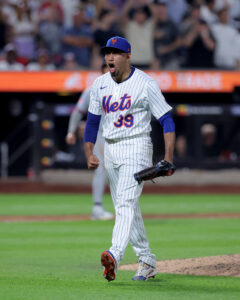
Diaz, a Wasserman client, returned to the open market this winter when he opted out of the final two seasons of the precedent-setting five-year, $102MM contract he signed with the Mets the last time he was a free agent. The right-hander had been guaranteed $38MM over the final two seasons of that contract, so by opting out and testing the market, he secured himself an additional one year and $31MM in guarantees. The Mets, according to Joel Sherman of the New York Post, offered Diaz a three-year, $66MM deal with “slight” deferrals.
The 31-year-old Diaz (32 in March) has spent the past seven years in Queens and, after a rocky first campaign, has turned in a collective 2.36 ERA (2.12 SIERA, 2.15 FIP) with a mammoth 40.8% strikeout rate and 8.9% walk rate. He’s piled up 144 saves in 332 appearances as a Met.
For the Dodgers, Diaz represents the most on-the-nose means of addressing a problem that nearly doomed them in the postseason: a lack of reliable bullpen help. Injuries to Evan Phillips, Tanner Scott, Brusdar Graterol and others left the Dodgers with a thin enough stock of trustworthy relievers that L.A. turned to Blake Snell, Tyler Glasnow and Yoshinobu Yamamoto (one day after he threw nearly 100 pitches) in pivotal high-leverage settings during their World Series run. That they even progressed to the World Series was largely attributable to historic performances from starters Yamamoto, Snell, Glasnow and Shohei Ohtani in the postseason’s earlier rounds.
The Dodgers have now signed the top reliever on the market in consecutive offseasons. They inked Tanner Scott to a four-year, $72MM pact last winter, though that deal contained $21MM worth of deferred money, thus knocking down the present value. Scott’s first year in L.A. didn’t go at all as hoped; he limped to a 4.74 ERA with improved command but lesser velocity and strikeout rates. After yielding 11 home runs in the 2022-24 seasons combined, Scott served up 11 round-trippers in his first season as a Dodger.
Certainly, they’ll hope for better results with Diaz, whose track record is lengthier and steadier than that of Scott. While he’s naturally had some year-to-year variance in his earned run averages — as is the case for any reliever — Diaz has been at 3.52 or better in each of the past five seasons, including three sub-2.00 campaigns. He’s punched out at least 34.6% of his opponents each season along the way, and since a shaky walk rate in 2021, he’s sat between 7.7% and 9.3% in that regard for four straight seasons.
That’s not to say there aren’t any red flags at all with regard to Diaz. His average fastball velocity has dipped in two consecutive seasons. While this past season’s average of 97.2 mph was still well above average, it’s also two miles per hour shy of Diaz’s 2022 peak. He also gave up considerably more hard contact. Diaz’s 88.5 mph average exit velocity and 39.7% hard-hit rate were both the second-highest marks of his career, trailing only his disastrous 2019 season (his first as a Met). Neither is a glaring issue, particularly considering Diaz maintained elite strikeout and swinging-strike rates (38% and 18%, respectively), but he’ll want to avoid allowing those negative trends to continue, however slight they may currently be.
Diaz will slot into the ninth inning, pushing Scott to a setup role alongside Alex Vesia, Blake Treinen, Anthony Banda, Brock Stewart and Graterol. Will Klein, Ben Casparius and Jack Dreyer all had solid or better seasons in 2025, but if everyone is healthy — far from a given — there’s only room for one of that trio in the final bullpen spot. Of course, injuries will inevitably create opportunities for many of the Dodgers’ overqualified depth arms, and each of Klein, Casparius, Dreyer and Edgardo Henriquez have minor league options remaining.
The Dodgers have paid the luxury tax in (more than) three consecutive seasons and are more than $60MM over the $244MM first-tier luxury threshold, meaning they’ll pay a 110% tax on the AAV on Diaz’s contract. However the annual salaries break down, he’ll cost them an additional $25.3MM in taxes alone. Assuming an evenly distributed $23MM per season, RosterResource, now projects next year’s Dodgers payroll at just over $359MM (although that does not account for substantial deferrals to Ohtani, Scott, Freddie Freeman, etc.).
The Mets would have been subject to those same penalties had they matched or topped this offer. Diaz reportedly entered the market seeking a five-year contract. When that didn’t materialize, he clearly pivoted to a record-setting, shorter-term arrangement. The extent of the deferrals in New York’s offer aren’t yet clear, but there’s no indication (yet, anyway) that the Dodgers’ offer includes any deferred money.
While New York couldn’t have known when signing Devin Williams to a three-year, $51MM pact that Diaz would also sign for three years and a total of $18MM more, the results from those two high-end relievers will now be carefully watched by Mets fans for the next three seasons. If Williams returns to form, it’ll look like a savvy pivot to get a comparable reliever at a lesser rate. If not, there will be plenty of second-guessing and criticism from the fan base.
Of course, owner Steve Cohen also clearly has the resources to have simply won the bidding on both relievers, but that’s ultimately not the route the front office chose. They’ll now look to other avenues as they seek to continue adding to the bullpen. The Mets were open to re-signing Diaz even after adding Williams, and while this deal clearly went past their comfort zone, there are other high-end arms still available — Robert Suarez, most notably. Choosing to let Diaz walk also frees up further resources for a potential re-signing of Pete Alonso or perhaps a run at another target of note.
The Mets bid farewell to Diaz, who rejected a $22.025MM qualifying offer, with only minimal compensation for his departure. Due to their status as luxury tax payors, they’ll receive a compensatory draft pick after the fourth round of next summer’s draft. The Dodgers, meanwhile, will surrender their second- and fifth-highest selections in next year’s draft. The league-allotted cap on their personal spending pool for international amateur free agents will also be reduced by $1MM.
Such considerations tend to be ancillary for the market’s top-spending clubs. Perennial luxury payors consider them the cost of doing business in the deepest waters of the free agent pool. The Dodgers have punted draft picks to sign Shohei Ohtani and Freddie Freeman (among others) in recent seasons. For them, the allure of adding a closer with nearly unrivaled dominance takes precedence as they try to assemble a roster capable of winning three consecutive World Series for the first time since the 1998-2000 Yankees.
The Athletic’s Will Sammon first reported the agreement. Sammon and colleague Ken Rosenthal were also the first to report the three-year term. ESPN’s Jeff Passan broke the total guarantee. Joel Sherman and Jon Heyman of the New York Post reported the Dodgers’ emerging interest in Diaz shortly before the agreement became public. Sherman reported on the deferrals.
MLBTR Podcast: Winter Meetings Recap
The latest episode of the MLB Trade Rumors Podcast is now live on Spotify, Apple Podcasts, and wherever you get your podcasts! Make sure you subscribe as well! You can also use the player at this link to listen, if you don’t use Spotify or Apple for podcasts.
This week, host Darragh McDonald is joined by Anthony Franco of MLB Trade Rumors to discuss…
- The Phillies bringing back Kyle Schwarber on a five-year deal (1:35)
- The Orioles signing Pete Alonso to a five-year deal (8:10)
- The Pirates and Reds reportedly coming close to signing Schwarber (14:25)
- The Dodgers agreeing to a three-year deal with Edwin Díaz (19:45)
- The Mets losing Alonso, Díaz and Brandon Nimmo in the span of a few weeks (23:50)
- The Mariners trading Harry Ford and Isaac Lyon to the Nationals for Jose A. Ferrer (29:10)
- The Twins reportedly planning to hold their candidates and compete in 2026 (41:55)
Check out our past episodes!
- An Agent’s Perspective with B.B. Abbott – Also, Cease, Williams, Helsley, And Gray – listen here
- Some “Classic Baseball Trades,” Nimmo For Semien, And Ward For Rodriguez – listen here
- Offseason Preview Megapod: Top 50 Free Agents – listen here
The podcast intro and outro song “So Long” is provided courtesy of the band Showoff. Check out their Facebook page here!
Photo courtesy of Jim Rassol, Imagn Images
Mets Not Ruling Out Edwin Diaz Reunion Despite Williams Signing
Dec. 2: While the Mets do still hope to re-sign Díaz, there’s been a gap in talks. Will Sammon of The Athletic reports that while Díaz has indeed been seeking a five-year pact, the Mets’ preference has been to limit the commitment to a three-year term (presumably at a top-of-the-market annual value).
Dec. 1: The Mets are adding Devin Williams to the back of their bullpen on a three-year contract. That gives them an established closer if Edwin Díaz signs elsewhere, but it apparently won’t completely shut the door on Díaz staying in Queens.
Anthony DiComo of MLB.com was among those to report that the Mets still have interest in re-signing Díaz. It seems Williams is on board with that plan, as DiComo writes that the new signee is open to pitching in a setup capacity if the Mets bring back their incumbent closer. Díaz rejected a qualifying offer and is reportedly seeking a deal in the five-year, $100MM range. At last month’s award ceremony, the three-time All-Star put the chance of a reunion around 50-50. “If they came with the best deal for me, I’d enjoy to stay with them,” Díaz told reporters at the time, “but at the end of the day, I don’t know what they’re thinking.”
The Williams signing presumably reduces the odds of a Díaz return. The Mets might feel more comfortable walking away and collecting a compensatory draft pick now that they no longer need a closer. Yet they certainly still need to add in the late innings. Tyler Rogers, Ryan Helsley, Gregory Soto and Ryne Stanek also all hit free agency. If Williams were penciled into the ninth, Huascar Brazoban would be their most established right-handed setup man. They should bring in another two high-leverage relievers at least.
Díaz is also simply an upgrade over Williams in the ninth inning. While there’s reason for optimism in the latter’s track record and underlying metrics, he’s a bit of a gamble coming off an uneven year with the Yankees. Díaz has no such concerns, as he posted a 1.63 earned run average while striking out 38% of opponents across 66 1/3 innings last season. He went 28-31 in save chances. That’ll be reflected in their respective contracts, but the bullpen would look a lot more formidable with Williams in the eighth and Díaz back in the ninth.
The Blue Jays are the only other team that has been publicly linked to Díaz this offseason. Teams like the Dodgers, Giants, Yankees, Tigers, Red Sox, Cubs, Diamondbacks and Angels could also be in the mix for high-leverage bullpen help.
Nimmo, Stearns, Young Discuss Semien Trade
The Mets and Rangers lined up on a surprising one-for-one swap over the weekend, with outfielder Brandon Nimmo heading to Texas and infielder Marcus Semien to Queens. Today, members of the media got to speak with many of the parties involved. Arguably, the most notable comment came from Nimmo himself, who waived his no-trade clause to become a Ranger. “I would not have waived that no-trade clause if I didn’t think I could come here and win,” Nimmo said, per Shawn McFarland of the Dallas Morning News.
It has been fair to wonder about the direction of the Rangers recently, as they’ve clearly been trying to dial back their spending. They pushed their competitive balance tax a bit over the line in 2023 and 2024. In 2025, they hoped to duck under the line but may have gone over with in-season trades, such as acquiring Merrill Kelly from the Diamondbacks. Their 2025 status won’t be official until MLB releases the final calculations, likely in December, but it’s possible the Rangers will be tax payors for a third straight season.
Even if they did go over the line, it was surely by a narrow margin, so the tax bill won’t be huge. Regardless, it seems they are going to be extra motivated to pinch pennies in 2026. The club parted ways with manager Bruce Bochy at the end of the regular season. President of baseball operations Chris Young admitted that the club didn’t have a lot of financial certainty, which played a role in that separation. Esteemed pitching coach Mike Maddux also left, heading to the Angels, which prompted speculation that was financially motivated as well.
In terms of the roster construction, the Rangers were recently trying to trade outfielder Adolis García and catcher Jonah Heim, despite both players being part of the 2023 championship club. Each could have been retained via arbitration for 2026 but the Rangers clearly didn’t want to pay them at their projected prices. Ultimately, no trade came together. On Friday, the Rangers non-tendered both, along with relievers Jacob Webb and Josh Sborz.
Amid all of that, rumors have swirled that the Rangers could trade a more expensive franchise players such as Corey Seager or Semien as part of a larger step back. Now Semien has indeed been traded but the Rangers have taken on another sizable contract by getting Nimmo in return. The remaining contracts are somewhat analogous, with Nimmo making less annually, but signed for two extra years. The Rangers are therefore taking on more money overall but less per year.
It seems that Nimmo has been assured that the club is still planning to compete and isn’t doing a big teardown. That’s somewhat encouraging for fans in Texas but the club will probably still have some tight parameters to deal with. RosterResource estimates the club has a pure payroll of $169MM next year and a competitive balance tax figure of $187MM. Last year, those numbers were $224MM and $237MM.
Getting back up to those levels would give the Rangers roughly $50MM to work with but the signs are pointing to them setting a lower target. They have a number of things on the to-do list this winter. The rotation could use some shoring up. Almost the entire bullpen reached free agency, meaning there’s work to do there. Replacing Heim behind the plate and potentially Semien at second are other potential areas to target, though it’s possible the Rangers are happy with Willie MacIver as a backup to Kyle Higashioka behind the plate. It’s also possible they feel Josh Smith and/or Sebastian Walcott can take over at the keystone.
President of baseball operations Chris Young also spoke today and echoed Nimmo’s comments that the Rangers want to win. “I do think we are focused on winning moving forward,” Young said, per Kennedi Landry of MLB.com. “The last two years have been very difficult as we feel like we have not lived up to our expectations, and when you don’t meet expectations, you have to make tough calls, and that’s part of this.”
Young also said Nimmo will likely end up in right field, per McFarland, but there are still conversations to be had there. Nimmo has primarily been a left fielder in recent years, with Statcast ranking him as having 48th percentile arm strength. The Rangers could perhaps keep Nimmo in left while moving Wyatt Langford to right. Langford’s arm strength was slightly ahead of Nimmo in 2025, with Statcast giving him 59th percentile arm strength. However, Langford has no professional experience in right, while Nimmo has over 600 big league innings at that spot.
Turning to the other side of the trade, Mets president of baseball operations David Stearns also spoke to the media today, complimenting his new second baseman. “It’s notable that this is a player that can contribute to winning baseball in a variety of different ways,” Stearns said, per Deesha Thosar of Fox Sports, “and the bat may not actually lead the way at this point in his career. We think there’s likely some bounce back in his offensive profile and his offensive game. But what we’re counting on at the top of his skillset is the contributions he can make for us defensively, how he can perform on the bases, and we think those are going to help us win games.” Stearns has highlighted a desire to improve the Mets’ run prevention, so it’s understandable he would focus on Semien’s defense.
Naturally, Stearns was asked about what’s next for the Mets. While the story in Texas might be scaled-back spending, that doesn’t appear to be a concern with the Mets. “Sure,” Stearns said, when asked if it’s possible for the Mets to re-sign Pete Alonso and Edwin Díaz and a notable free agent outfielder. “I think anything would be realistic right now.”
Under owner Steve Cohen, the Mets have been one of the top-spending clubs in the majors. Per RosterResource, they had a $340MM payroll and $337MM CBT number in 2025. For 2026, those numbers are at $263MM and $264MM. That gives the Mets something like $70MM in wiggle room if they are willing to get to the same level and it’s entirely possible they could be willing to go even higher.
MLBTR predicted Díaz to secure an $82MM deal over four years. He is reportedly setting his sights higher than that, targeting a deal in the same range as his last one, which was a $102MM guarantee over five years. Either way, a deal worth roughly $20MM annually is probably likely. MLBTR predicted Alonso for $110MM over four years, which would be $27.5MM in terms of average annual value.
Put together, those two would likely eat up something near $50MM of next year’s payroll. If the Mets do have $70MM of space right now, that would leave them another $20MM to spend on an outfielder, though they also presumably want to make additions to the rotation as well. The Mets have already been connected to Cody Bellinger and the Nimmo deal opens a corner, raising immediate speculation about a run at Kyle Tucker. MLBTR predicted Bellinger for $140MM over five years and Tucker for $400MM over 11 years, respective AAVs of $28MM and $36.36MM.
There are other moving pieces at play. With Semien now at second base, it’s possible Jeff McNeil‘s chances of getting traded have increased. He can play other positions, such as left or center field, but it’s possible the Mets would rather ship him out the way they did with Nimmo. Even before the Nimmo deal, McNeil’s name was in trade rumors. McNeil is owed $15.75MM next year, plus a $2MM buyout on a $15.75MM club option for 2027. There’s also a $500K assignment bonus if he’s traded. Then there’s also Kodai Senga, who is owed $14MM annually over the next two years and has been in trade rumors as well.
If the Mets can find a taker for McNeil and/or Senga, they could free up some more money for their other pursuits, or perhaps address another area of need by taking back another veteran player, like they did by grabbing Semien. Stearns also mentioned today that McNeil could also play some first base, expanding his versatility, per Mike Puma of The New York Post. McNeil has played every position on the diamond outside the battery but has just three innings of first base experience. If Alonso isn’t coming back, McNeil could be part of the solution there, alongside guys like Mark Vientos. Though it’s also possible the Mets aren’t done shaking up their roster by trading out long-time mainstays.
Photo courtesy of Kyle Ross, Imagn Images
Nine Players Reject Qualifying Offer
The deadline to accept the qualifying offer has passed. Four players — Trent Grisham, Gleyber Torres, Brandon Woodruff, and Shota Imanaga — chose to accept the one-year, $22.025MM deal and remain with their current clubs. The remaining nine players rejected the deal. They are: Cubs outfielder Kyle Tucker, Phillies DH Kyle Schwarber, Blue Jays infielder Bo Bichette, Astros lefty Framber Valdez, Padres righty Dylan Cease, Phillies lefty Ranger Suarez, Mets closer Edwin Diaz, Diamondbacks righty Zac Gallen, and Padres righty Michael King. All nine are now free agents.
There’s not much surprise in any of the nine players who rejected. Tucker, Schwarber, Bichette, Valdez, Cease, Suarez and Diaz were all locks. Gallen may have given some brief thought to accepting after a rough showing in 2025, but he finished strong and has a track record as a high-end starter who’s garnered multiple top-five finishes in NL Cy Young balloting. King was hobbled by nerve and knee injuries in an odd season but was dominant in 2023-24 and through the first two months of the current season. He was healthy late in the year and fanned three in his lone inning of postseason work. He’ll test the waters in search of a multi-year deal as well.
Now that this nonet has rejected qualifying offers, they’ll all be subject to draft compensation. Interested teams will need to surrender a draft pick (or multiple picks) and, in some cases, space from their bonus pool for international amateurs in order to sign any of this group. The extent of that draft compensation depends on the revenue-sharing and luxury tax status of the new team. MLBTR broke down which pick(s) each club would forfeit by signing a “qualified” free agent last month.
Similarly, the compensation for each player’s former club is dependent on revenue-sharing and luxury tax status — as well as the size of the contract signed by the player in question. MLBTR also ran through the compensation each team would receive if their qualified free agents turned down the offer and signed elsewhere.