
Latest On Dallas Keuchel
The Astros haven’t been engaged on Dallas Keuchel in recent weeks, ESPN’s Buster Olney writes in his latest look at the free-agent left-hander’s apparently stagnant market (subscription required). The Phillies, he adds, still have interest only in a “very” short-term deal, as was reported last week. Meanwhile, La Velle E. Neal III of the Minneapolis Star Tribune reports that unless Keuchel or free-agent closer Craig Kimbrel is suddenly willing to take a one-year deal, the Twins aren’t likely to sign either pitcher three weeks into Spring Training. As for the Braves, MLB.com’s Mark Bowman wrote late last week that spring ailments for Mike Foltynewicz and Kevin Gausman haven’t been deemed concerning enough for Atlanta to pursue Keuchel.
It’s hardly an encouraging set of updates for either free agent, particularly Keuchel, whom Olney suggests is being harmed to an extent by the fact that he doesn’t fit today’s mold of hard throwers that permeate the game. Olney notes that Keuchel’s average fastball (89.3 mph) ranked 55th of 57 starters who qualified for the ERA title in 2018.
While perhaps some teams would prefer harder-throwing options, that stat doesn’t seem especially concerning when presented with further context. Keuchel’s average fastball last season was actually improved over a pair of seasons in which he was slowed by back and neck injuries in 2016-17. In fact, in Keuchel’s Cy Young-winning 2015 season, he averaged just 89.6 mph on his heater, so it’d be puzzling to see significant level of concern over that fastball velocity. Furthermore, a look at the names around Keuchel near the bottom of the fastball velocity leaderboard includes quality arms such as Marco Gonzales, Zack Greinke and Kyle Hendricks. Patrick Corbin, meanwhile, ranked only 43rd among those 57 qualified starters at 90.8 mph, and he secured a six-year contract that promises him $140MM. That deal came at a younger age and on the heels of a better season, clearly, but the contract still runs counter to the idea that teams will only pay for premium velocity.
None of that is to say that Keuchel isn’t without red flags, of course. The lefty’s strikeout percentage dipped from 21.4 percent in 2017 to 17.5 percent in 2018 (7.7 K/9 vs. 6.7), and his swinging-strike rate fell from 10.9 percent to 8.3 percent. His ground-ball rate of 53.7 percent, while well north of the league average, also represented a substantial step back from 2017’s 66.8 percent mark and from his overall career mark of 58.8 percent. All of that surely sets off some alarms for interested teams, but Keuchel was nevertheless a quality starter in 2018, as has been the case for several years. Both Fangraphs and Baseball-Reference suggest he’s been worth 18 wins above replacement over the past five seasons — including a combined six or more WAR over his past two campaigns.
It’s not a stretch to suggest that virtually any team in baseball would be improved by swapping out Keuchel for its current weakest starter, but as is always the case in free agency, the financial element plays a significant role. It seems quite likely that some clubs that had interest in Keuchel and Kimbrel early this winter balked at the duo’s reported nine-figure asking prices and went on to spend their money elsewhere. Now, even if those asking prices have come down, some previously interested teams may simply not have ownership permission to spend significant dollars on another free agent. Both pitchers also rejected qualifying offers, meaning a team signing either former All-Star would be subject to the forfeiture of at least one draft pick (and potentially some international bonus pool space).
It’ll be worth keeping an eye on injuries to prominent pitchers throughout the league in the coming days to see if a new window opens. Clayton Kershaw has been battling a shoulder issue, for instance. The Braves, as previously mentioned, have multiple starters who have been dealing with injuries thus far in camp. The Cardinals may be without Carlos Martinez to open the season. Further injuries will surely arise elsewhere, although the longer Keuchel and Kimbrel wait, the more questionable it is whether either will be ready to pitch in a big league game come Opening Day.
AL West Notes: Volquez, Astros, Mariners
Rangers righty Edinson Volquez pitched in a game setting for the first time in nearly 20 months Wednesday, and while he was tagged for four runs in an inning of work against the Cubs, there were nonetheless signs of encouragement, writes Jeff Wilson of the Fort Worth Star-Telegram. Volquez’s first pitch clocked in at 95 mph, and he immediately followed it with a 96 mph heater before eventually running that fastball up to 97 mph. “That’s about as happy as I’ve ever been after a four spot,” new manager Chris Woodward said in reference to Volquez’s day.
The Rangers originally inked Volquez to a two-year minor league contract following the 2017 season, knowing full well that he’d miss all of the 2018 campaign due to Tommy John surgery. Texas selected his contract in advance of the deadline to protect players from the Rule 5 Draft this season and will be counting on him, along with holdover Mike Minor and new additions Drew Smyly, Lance Lynn and Shelby Miller, to comprise the team’s rotation early in the season.
Here’s a look at some spring scenarios around the AL West…
- With the out-of-options Tony Kemp and Tyler White in line to make the Astros‘ Opening Day roster, Houston seems likely to carry 13 position players and 12 pitchers, writes Brian McTaggart of MLB.com. That’s a departure from the norm for the organization in recent years but likely a necessity, as the ‘Stros would need to risk exposing one of Kemp or White to waivers in order to send either player to the minor leagues. Neither player’s performance in 2018 merits a trip back to Triple-A anyhow. The 27-year-old Kemp hit .263/.351/.392 in just shy of 300 plate appearances with the Astros last season, seeing action at all three outfield spots and at second base. White, meanwhile, turned in a massive .276/.354/.533 line with 12 homers, 12 doubles and three triples in 237 trips to the plate. Currently, White figures to get the lion’s share of plate appearances in the Astros’ designated hitter role, though he can also fill in at either corner-infield position.
- Mariners camp in 2019 is filled with veterans who know they could be shipped out in trades at any moment, writes Larry Stone of the Seattle Times, who spoke to general manager Jerry Dipoto about how he manages a roster that is fully cognizant of that uncertainty. “Players generally do well when you tell them the truth,” said Dipoto in emphasizing that he’s been as up front as possible with veterans like Edwin Encarnacion and Jay Bruce (among others). Stone not only spoke with Dipoto, but Encarnacion, Bruce and Kyle Seager about the looming possibility of a trade to another club (be it now or during the regular season) and the manner in which they balance dealing with that knowledge and prepping for the 2019 season.
Latest On Astros’ Rotation Battle
Astros righty Josh James has been diagnosed with a strained right quad, skipper A.J. Hinch told reporters including Chandler Rome of the Houston Chronicle (links to Twitter). The injury “probably takes [James] out of the conversation” for the club’s final rotation spot, per Hinch.
Fortunately, there’s no reason to believe this injury is of long-term concern. To the contrary, James will remain a candidate to break camp on the MLB roster in a relief role. James, who is days away from his 26th birthday, showed eye-popping stuff in both capacities during a brief but exciting 2018 debut.
So, how will the club fill out its rotation? Hinch specifically ruled out some of the club’s most-hyped young arms, making clear that Forrest Whitley, Corbin Martin, and J.B. Bukauskas are still not prepared to jump up to the MLB level (at least as starters).
Rome suggests that there is still a fair bit of competition. Brad Peacock is certainly the most experienced option. He’ll try to fend off younger hurlers Framber Valdez, Brady Rodgers, Cionel Perez, and Rogelio Armenteros.
Until he signs elsewhere, of course, southpaw Dallas Keuchel remains at least a hypothetical possibility. The veteran starter and the Astros’ brass have kept the door open to a return in their public comments, though it seems he’s still hoping to secure a larger commitment from another club.
Projecting Payrolls: Houston Astros
Though Spring Training is underway, let’s move on to our 15th team payroll projection. Below find the links to the earlier posts in this series.
Philadelphia Phillies
Los Angeles Dodgers
Los Angeles Angels
Atlanta Braves
New York Yankees
Chicago White Sox
Boston Red Sox
Minnesota Twins
Milwaukee Brewers
San Francisco Giants
St. Louis Cardinals
Chicago Cubs
New York Mets
San Diego Padres
If you have questions about financial information made available to the public and the assumptions used in this series, please refer to the Phillies piece linked above.
Today, we look into a club whose rebuild earned a World Series win, yet who finds itself with a rotation in flux: the Houston Astros.
Team Leadership
The Astros franchise got off to a bit of a rough start, beginning play in 1962 as the Colt .45s, but the team was obtained by GE Credit and Ford Motor Credit just over a decade later in 1975 as a result of crippling debt related to the building of the Astrodome. Thankfully for the future of baseball in Houston, former Yankees minority owner John McMullen purchased the club in 1979 and oversaw a period of relative stability before selling to Drayton McLane in 1993. McLane’s period of ownership was filled was success, from the Killer Bs to the 2005 National League pennant winners, Astros fans became accustomed to winning. Fans could have been understandably concerned when McLane sold the club at the end of 2011 to Houston businessman Jim Crane. While Crane’s ownership tenure got off to a rocky start, losing 218 games over his first two seasons, the results have been stellar over the past four seasons, particularly the team’s 2017 championship.
This year’s team has been assembled by general manager Jeff Luhnow, who took the reins in Houston in December 2011, shortly after Crane’s purchase was finalized, after nearly a decade running the Cardinals’ scouting department. Luhnow utilized his drafting prowess over his first few drafts to add stars like Carlos Correa, Lance McCullers Jr., and Alex Bregman, with others such as Forrest Whitley and Kyle Tucker close to contributing. Infamously, Luhnow also whiffed on a pair of number one overall picks in right-hander Mark Appel and left-hander Brady Aiken, though Luhnow salvaged his losses by flipping Appel to Philadelphia as a minor piece in the Ken Giles trade and recouping a compensation pick for Aiken going unsigned that became Bregman.
On the whole, it’s difficult to argue with the results that Crane and Luhnow have compiled: they tanked their way to a miserable 176-310 (36.2 percent winning percentage) over their first three years followed by a stellar 374-274 (57.7 percent winning percentage) mark over the last four years.
Historical Payrolls
Before hitting the numbers, please recall that we use data from Cot’s Baseball Contracts, we’ll use average annual value (“AAV”) on historical deals but actual cash for 2019 and beyond, and deferrals will be reflected where appropriate. And, of course, the value of examining historical payrolls is twofold: they show us either what type of payroll a team’s market can support or how significantly a given ownership group is willing to spend. In the most useful cases, they show us both. We’ll focus on a 15-year span for the Astros, covering 2005-18 for historical data as a means to understanding year 15: 2019. This period covers the transition from McLane to Crane ownership and includes a tank for the ages with winning teams on either side, so this provides an excellent window into what to expect from the club as they rev up to contend again. We’ll also use Opening Day payrolls as those better approximate expected spending by ownership.
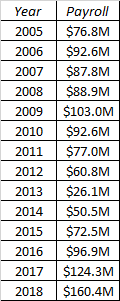
The Astros were in the top half of leaguewide spenders each year from 2005 through 2010 before their 2011 dip. Then Crane tore the whole operation down to the studs, reaching a comical low in 2013. The 2013 Astros began the year with just five players earning north of $1 million — Bud Norris, Carlos Pena, Jose Veras, Erik Bedard, and Wesley Wright — yet Norris, Pena, and Veras were jettisoned in July while Wright was shipped out in mid-August.
The Astros understandably came under fire for their extremely low payroll at the time, but the low spending was justified by the fact that Crane incurred $275 million in debt to purchase the team and by Crane’s own promise that “once our minor league system is filled in, we’ll move up into the top five or 10 in payroll.” It took a few years for the payroll to reach such lofty heights, but by 2018, Houston found themselves with the seventh-highest end-of-season payroll.
Like most teams, the Astros haven’t been that close to the luxury tax threshold, but that changed in 2018 and figures to be a relevant consideration in 2019 as well. While the Astros never blew past their international amateur bonus pools to the extent that some other teams did, they did incur the top penalties and restrictions in 2016, showing a willingness to spend internationally. Nevertheless, their Major League payrolls present a good picture of baseball operations spending.
Future Liabilities
Get ready for Jose Altuve and a whole bunch of soon-to-be free agents.
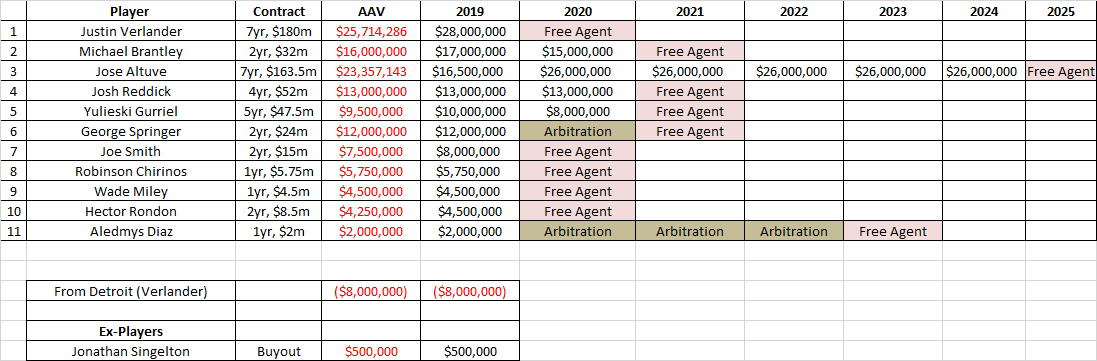
We’ll start with Altuve, the 2017 American League Most Valuable Player and heart and soul of the franchise. His contract features one more discounted year before leaving $130 million on the books from 2020-24. As long as Altuve continues to produce like an MVP, I suspect that Houston won’t complain.
Moving to the top of the list, Houston has just one more year with Justin Verlander under contract. The team’s marquee trade acquisition in August 2017 after a period of struggles with the Tigers, Verlander was reinvigorated and returned to Cy Young caliber form. Owed a net of $20 million thanks to a contribution from Detroit, Verlander represents a good bargain in 2019 in advance of his first-ever walk year. He did originally have a vesting option for the 2020 season, but Verlander waived the option to facilitate the trade.
Next we find a trio of outfielders with two remaining years of control. 2018 provided a great, and timely, reminder of Michael Brantley‘s offensive prowess when healthy, and he figures to set the table near the top of the lineup for the next two seasons. Joining him will be Josh Reddick, whose average power and above-average on-base ability had been a given for years before his BABIP against right-handed pitching surprisingly cratered in 2018. He’s no star, but he’s a good bet to rebound to be an average starter in 2019. Finally, George Springer slipped in the power department in 2019, but his ability to get on base and play a solid defensive outfield kept him valuable. If the power returns, he’ll be a star once again as he nears free agency.
Yuli Gurriel has underwhelmed somewhat since arriving from Cuba, and at 34, there’s not much reason to think he’ll improve dramatically going forward. He’s solid as a regular, though Tyler White‘s offensive prowess could render Gurriel susceptible to losing some playing time.
The majority of the remaining guaranteed contracts are one-year commitments. Smith unfortunately ruptured his Achilles in December 2018, so he won’t be expected back until late summer, if at all. At this point, it’s fair to wonder if he’ll be able to contribute to the 2019 team. Chirinos, Miley, and Rondon should each play a role on the 2019 squadChirinos may get a crack to take the everyday job, but Houston would probably prefer it if Max Stassi‘s 2018 breakout — he posted the second highest framing runs added per Baseball Prospectus despite playing a part-time gig — was a harbinger of things to come. Miley could find himself in the rotation’s fifth spot if Verlander and Gerrit Cole stay healthy while Collin McHugh and Josh James make successful returns to starting. And Rondon remains best-suited for a setup role rather than closing, a job he should stick with provided that Roberto Osuna remains entrenched.
The final contract offers some forward-looking control. New Astro Aledmys Diaz will head to arbitration should the team elect to keep him, although he’ll need to prove his health after spending time on the disabled list in each of his first three Major League seasons.
Houston has done well in avoiding dead money with only the final buyout payment for Singleton allocated to this year’s payroll.
Lest you find yourself wondering why the Astros are such a powerful ball club, let’s take a look at one of the most robust arbitration tables in the game:
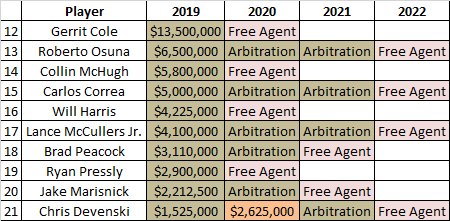
There’s some serious star power here.
We’ll start with the starting pitchers. Much like Verlander before him, Cole appears to have been invigorated by his move to Houston. He pitched like an ace in Pittsburgh in 2015, then pitched well but not nearly as well in 2016-17. With the Astros in 2018, Cole was an ace once again. McHugh lost most of his 2017 to injury, then found his rotation job claimed by Cole last year. With Charlie Morton (surely) and Dallas Keuchel (presumably) out the door, McHugh figures to have first dibs on a starting job after excelling in relief last season. Unfortunately, McCullers won’t help his case in 2019 as he’ll spend the year recovering from November 2018 Tommy John surgery.
The majority of the Houston bullpen is listed in the table above. It all starts with Osuna, who starred after arriving via trade from Toronto at the end of his 75-game suspension for violating Major League Baseball’s policy on domestic violence. His baseball abilities are indisputable. His off-the-field activities present the club with significant risk, both with regards to public relations and roster construction. Even in his mid-30s, Harris represents superb value, especially given his ability to stifle batters of both handedness. He is likely in line for a big contract next offseason. Peacock and Pressly both figure to pitch a lot, with Houston hoping to get a lot of innings out of Peacock and high-leverage innings from Pressly. Finally, Devenski starred in long role in 2016, excelled in 2017 — though to a lesser degree than the prior year — then floundered in 2018. He still has some time to kill before free agency.
We close the arbitration table with the two position players. Correa, the 2015 American League Rookie of the Year, produced three nearly identical excellent seasons from 2015-17 before an injury-marred 2018. Just 24, Correa likely has years of stardom ahead of him. Marisnick, on the other hand, seems destined for a part-time gig that accents his defensive and baserunning skills. Outside of 2017, he hasn’t shown enough with his bat to warrant a more significant share of time, especially against same-sided pitching.
What Does Team Leadership Have to Say?
To Crane’s credit, when he stripped the club down to next to nothing, he promised that he’d spend when it made sense…and then he did. But what about pushing payroll even higher? Crane has shown a willingness here, too, commenting in December that, “I’d say if the right situation came long — certainly we’re not going over [the luxury-tax threshold] — but we could move closer to that. We were pretty high up in the food chain last year. A lot of teams realize the penalty is pretty severe if you go over. We’ll stay within the strike zone.” Luhnow hasn’t been as open about the team’s spending plans, but Crane provided plenty of guidance.
After living through a miserable rebuild, Crane seems keenly aware of the value of contending seasons and willing to spend to supplement his winning teams.
Are the Astros a Player for Bryce Harper?
I think that the Astros could be lurking in the shadows for Harper.
The team is smack in the middle of their window of contention, but having just lost Morton and (presumably) Keuchel from their rotation, they could use a boost. They currently have Brantley and Reddick manning the corner outfield spots, but Reddick is eminently tradeable. And that’s why Harper could fit so easily. If Houston offloaded Reddick and a portion of his $13 million annual salary for 2019 and 2020, the cost of Harper would be mitigated. With Harper likely obtaining a contract with opt-out clauses starting in the early 2020s, signing him allows the team to maximize their current window without seriously jeopardizing their ability to keep Altuve, Correa, and Bregman together for a decade or more.
The luxury tax is a serious consideration, but it should be avoidable. I currently have the team’s luxury tax payroll at $181.2 million. If the Astros followed the blueprint above, jettisoning Reddick and signing Harper for, say, $30 million per year, they still might be able to stay south of the tax line.
The Astros have looming rotation questions with the free agencies of Verlander and Cole coming, but building around an offensive core of Altuve, Correa, Bregman, Brantley, Springer, White, and Harper…whew.
What Will the 2019 Payroll Be?
How high is Crane willing to go?
As of now, I have the Astros at $164.9 million with the aforementioned $181.2 tax number. After sporting a $160.4 million payroll in 2018 and mentioning that the books have room to expand, there’s surely room for more.
Projecting just how high that number goes is tricky. The 2018 payroll was achieved by the age-old formula of 2013 payroll times five plus $4 million. What does that tell us for 2019?
All kidding aside, Houston is primed to take another step. Harper represents approximately three additional wins over what Houston figures to get out of right field in 2019, and if Reddick could be unloaded, it makes tons of sense. However, Houston has made such a move yet, so it stands to reason that perhaps Crane isn’t interest in pushing payroll quite this high.
So let’s split the difference here between what it would take to add Harper and where payroll currently stands. This represents a 9.2 percent increase of 2018 spending, a sensible amount for a team in the midst of their best-ever window of contention.
Projected 2019 Payroll: $175 million
Projected 2019 Payroll Space: $10.1 million
AL West Notes: Astros, Mariners, Swarzak, Tropeano, Choo
Astros owner Jim Crane spoke with reporters Wednesday and addressed a number of topics, including his thoughts on potential rule changes throughout the game, Manny Machado‘s recent agreement with the Padres and the potential for some Astros moves (link via Chandler Rome of the Houston Chronicle). Crane acknowledged that the Astros “certainly are going to look at” the possibility of a contract extension with Justin Verlander and/or Gerrit Cole. However, he didn’t put a timeline on those talks and was generally vague, suggesting they could take place anytime between now and at the end of the season. “…[I]t just all depends on what they want to do and whether they want to stick here and for what number they want to stick here,” Crane said of his top two starters.
Crane wouldn’t comment much on former Astros Dallas Keuchel and Marwin Gonzalez, both of whom remain unsigned, though he didn’t expressly rule out a reunion. “Hopefully they’ll land in the right spot and certainly it could be one or two of them might be back here,” said Crane, though he declined to say whether Houston has made an actual offer to either player (beyond the qualifying offer which Keuchel rejected back in November).
Here’s more from the division…
- The Mariners could be active in their efforts to pick up some bullpen depth over the course of Spring Training, per Ryan Divish of the Seattle Times. Divish notes that right-hander Anthony Swarzak, acquired to help balance out the financial component of the Robinson Cano/Edwin Diaz blockbuster, isn’t likely to be ready for Opening Day (due to shoulder discomfort). With that in mind, Seattle is likely to take to the waiver wire in an effort to bolster its depth, though it doesn’t sound as if the club is intent on spending significantly in order to bolster its ‘pen at this point.
- Angels righty Nick Tropeano is still two and a half weeks from throwing a full bullpen session and is roughly five to seven weeks from being ready to pitch in a game setting, writes Rhett Bollinger of MLB.com. Tropeano experienced a December setback in his rehab from shoulder issues that dogged him throughout the 2018 season, which has him behind schedule this spring. Tonight’s update provides a clearer timetable than was previously available. Tropeano tells Bollinger that he’s been doing increased video work with new pitching coach Doug White (formerly the Astros’ bullpen coach) to make adjustments to his delivery that’ll hopefully lessen the stress he places on his shoulder.
- In a Q&A with Jeff Wilson of the Fort Worth Star-Telegram, Rangers designated hitter Shin-Soo Choo addressed a number of topics, including Adrian Beltre‘s retirement, the atmosphere under new skipper Chris Woodward and his own future in baseball. Choo, who is signed for another two seasons, empathized with Beltre’s desire to spend more time with his family but also voiced a desire to continue playing so long as he is physically able to do so. “Baseball, sports, is a short career,” said the veteran slugger. “If you’re healthy and can perform on the field, I definitely can play. At the same time, I have a family. My wife has been a single mom for eight months for 16 years.” Choo’s bat cratered in the second half last season, but he was slashing a robust .293/.405/.506 at the All-Star break. He’s owed $21MM in each of the next two seasons.
AL Notes: Harper, Betts, Severino, Baldelli, Harvey, Kennedy
It’s mostly of historical interest now, but Astros GM Jeff Luhnow acknowledged that the club had a deal all but locked down to land Bryce Harper last summer. (Via Mark Berman of FOX 26, on Twitter.) Reports indicated that the Nationals would have received a strong haul of talent had they agreed to give up Harper at the non-waiver deadline; instead, the club announced on deadline day that it would not part with its star, who is now (still) a free agent. Lest anyone get the wrong idea, the Houston organization’s prior interest certainly doesn’t indicate that Harper is of interest presently. There has been no such connection this winter. Luhnow did suggest, though, that the pursuit is evidence of the team’s commitment to “look at all alternatives” and possibly swing major deals at the trade deadline.
Those who enjoy concocting wild trade scenarios will also take note of Luhnow’s intriguing aside: “I think fans would be surprised at the types of players at times that we’ve gone after and how close we’ve come on some of them.” Here’s more from the American League:
- Star Red Sox outfielder Mookie Betts discussed his approach to handling the business side of the sport, as Jason Mastrodonato of the Boston Herald reports. Betts says he believes in staying patient. “When you start rushing into things, that’s when you get some deals that may not be the right ones,” he said. Of course, Betts has to this point set himself up for a potentially record-setting run through arbitration by not only going year-to-year, but by also increasing his performance level in successive seasons. He just settled for a whopping $20MM, setting a record for a second-time arb-eligible player. Whether he’ll consider a long-term deal in the future isn’t clear; Betts would allow only that he enjoys playing in Boston and would “have to see how it goes.”
- In other AL East contractual matters, the Yankees‘ reported chatter about a long-term deal with staff ace Luis Severino does not seem to be gaining traction, per Jon Heyman of MLB Network (via Twitter). It seems that the sides will instead focus on preparing for an upcoming arbitration hearing, though that can always change at the last minute — whether due to agreement on a single-season salary or something more significant. If the case goes to a panel, the arbitrators will need to decide between Severino’s proposed $5.25MM payout and the club’s $4.4MM counter. There’s added significance given that the Super Two qualifier still has three more potential arb years to come, making his starting salary quite important.
- While terms of his contract weren’t announced or reported at the time, Twins skipper Rocco Baldelli inked a four-year contract when being hired for his managerial debut, Dan Hayes of The Athletic reports (subscription required). The deal also has multiple club options. It’s a show of faith in the rookie manager and a departure from the manner in which Minnesota has previously operated, as Aaron Gleeman of Baseball Prospectus notes (Twitter link). Under previous management, the Twins typically only issued two-year pacts to skipper Ron Gardenhire, who was one of the game’s longest-tenured managers when he was dismissed from the organization. And Paul Molitor, whom the the Twins ousted to make way for Baldelli, was one season into a three-year contract when the Twins ultimately changed course.
- Angels right-hander Matt Harvey will be out for the next week to 10 days due to a strained glute muscle, tweets Jeff Fletcher of the Orange County Register. It’s a minor injury and one that isn’t expected to hinder Harvey’s readiness for Opening Day, but it nonetheless bears some monitoring as Harvey looks to rebuild stock in Anaheim on a one-year, $11MM contract. The injury is all the more notable given the Halos’ rash of pitching maladies in recent seasons. The team is already expecting to be without right-hander Nick Tropeano to open the season.
- The Royals are considering utilizing veteran starter Ian Kennedy as a bullpen piece this season, and the righty spoke with Rustin Dodd of The Athletic about the potential role change (subscription required). Kennedy took a team-first attitude and said he’s willing to pitch for the Royals in any role, so long as it helps the team win more games. Looking elsewhere on the roster, Dodd writes that Danny Duffy, Brad Keller and Jakob Junis are likely locks for the rotation, while non-roster invitee Homer Bailey will compete for a starter job but likely not a bullpen role (per Yost). The Kansas City Star’s Lynn Worthy also addressed the situation, speaking with newly signed Brad Boxberger about pitching roles. While Boxberger would “love” the opportunity to close, it doesn’t seem as though any such promises were made to him. Ultimately, Yost declined to discuss specific roles and stressed the importance of having multiple options who can be trusted to close out games and thrive in high-leverage spots.
Agency Changes: Gurriels, Calhoun
Here are the latest agency changes from around the game. As always, you can find updated representation information in MLBTR’s Agency Database.
- Both of the Gurriel brothers — Yuli Gurriel of the Astros and Lourdes Gurriel Jr. of the Blue Jays — have hired Magnus Sports, according to Shi Davidi of Sportsnet.ca (via Twitter). The elder Gurriel is closest to free agency, though he still has two full seasons to go on his five-year contract with the Houston organization. He’s also already 34 years of age. His little brother is still just 25 years old and cracked the bigs for the first time last year, turning in a promising initial showing with the Jays. His contract takes him through the 2023 campaign, with at least one year of arbitration eligibility remaining thereafter.
- Meanwhile, Rangers power-hitting prospect Willie Calhoun has hired MVP Sports Group, per Robert Murray of The Athletic (Twitter link). The 24-year-old has seen brief tastes of the majors in each of the past two seasons but has yet to earn a full showcase at the game’s highest level. He’s seen as a high-end talent with the bat who still needs to iron things out defensively. It seems Calhoun will ultimately be given a shot in left field, but he’ll need to bounce back from a 2018 power outage (11 home runs in 578 total plate appearances) in order to force his way back onto the active roster.
Doug Fister Retires
Veteran right-hander Doug Fister has elected to call it a career after spending parts of 10 seasons in the Majors, agent Page Odle tells Jon Morosi of MLB.com. Fister, 35, received multiple Major League contract offers this winter, according to Odle, but is instead making a “100 percent family-driven” decision to spend time with his wife and two children.
A seventh-round pick of the Mariners back in 2006, Fister ascended to the Majors as a largely unheralded prospect with the Mariners in 2009. After establishing himself as a quality starter over his first 378 frames with the Mariners, Fister was flipped to the Tigers in a 2011 trade deadline deal, where he’d go on to thrive over another three seasons. Fister, in fact, was somewhat quietly one of the game’s better starters from 2011-14, pitching to a 3.11 ERA (129 ERA+) with 6.5 K/9, 1.7 BB/9 and 0.7 HR/9.
A 2015 forearm strain led to diminished velocity and diminished results for Fister, though he managed to make 32 starts for the 2016 Astros and served as a stabilizing force in their rotation. Hip and knee injuries slowed Fister in his most recent run with the Rangers, with the latter of the two issues ultimately ending his season after 66 innings.
All in all, Fister will walk away from his baseball career with a lifetime 83-92 record, a 3.72 ERA, 6.1 K/9 and 2.1 BB/9 in 1422 1/3 big league innings. The towering 6’8″ righty also amassed an impressive postseason resume, tallying 56 2/3 innings of 3.02 ERA ball with a 41-to-17 K/BB ratio in five separate postseasons runs (three with the Tigers, one with the Nats and one with the Red Sox). He made one World Series start, with the Tigers in ’12, where he tossed six innings of one-run ball against the Giants.
Fister earned more than $36MM in player salaries over the life of a career that both Baseball-Reference and Fangraphs value at 20 wins above replacement. Best wishes to the former Tigers, Mariners, Nationals, Astros, Red Sox and Rangers righty in his life beyond baseball.
Bauer, Cole, Wood Win Arbitration Cases
The players may be suffering through a winter of discontent in the free agent market, but they have now scored some notable wins in arbitration. Trevor Bauer of the Indians, Gerrit Cole of the Astros, and Alex Wood of the Reds have all been awarded the contract values they sought by their respective arbitration panels, per ESPN.com’s Jeff Passan (Twitter link).
Bauer will take home $13MM, a full $2MM more than the Indians had sought to pay him. Cole’s $13.5MM salary was about the same amount higher than the Astros’ $11.425MM filing figure. And Wood secures a $9.65MM payday that tops the $8.7MM the Reds defended.
[RELATED: MLBTR Arbitration Tracker]
Those cases break what had been a tie in arb hearings. The players already had a solid edge in the more significant cases, with Blake Treinen ($6.4MM vs. $5.6MM), Carlos Correa ($5MM vs. $4.25MM), and Tommy Pham ($4.1MM vs. $3.5MM) all coming out ahead while Kyle Barraclough ($2MM vs. $1.725MM), Michael Taylor ($3.5MM vs. $3.25MM), and Ryan Tepera ($1.8MM vs. $1.525MM) lost smaller-value contests.
In coming away with wins, all three of the starters also managed to top their projected earning power from MLBTR and Matt Swartz. Bauer ($11.6MM), Cole ($13.0MM), and Wood ($9.0MM) had projected in range of what they ultimately earned, but took shots on securing bigger paydays by making their cases to panels.
Bauer’s situation is particularly noteworthy, since he won a previous arb hearing and remains eligible for one more trip through the process after the 2019 season. This time last year, Bauer emerged with a $6.525MM salary rather than the $5.3MM the team proposed. That made him $1.225MM richer this time around as well, since his raise was dropped on top of a greater starting point. The same will hold true next year.
That serves to illustrate how important these cases can be to an individual player. But there’s also a broader market significance. Each data point that trends north can be cited by another player in the future, either in seeking a bigger arb number or in negotiating out the terms of an extension.
AL Notes: Yanks, Machado, Didi, Romo, Cole
The Yankees still aren’t pushing the market for Manny Machado, and probably never will, but also shouldn’t be counted out. That’s the word from Andy Martino of SNY.tv, who reports that the New York org is still keeping tabs on Machado in hopes that a golden opportunity will emerge. The Yanks aren’t interested in utilizing him at short, but would instead plan to put Machado at third while pushing Miguel Andujar across the diamond in the even of a signing. Of course, Martino cautions that it still seems unlikely that anything will come together.
- It’s interesting that the Yankees evidently wouldn’t see Machado as a factor at shortstop. That lends greater credence to the idea that the team really is committed not only to allowing Troy Tulowitzki to take the job there to open the season, but also to paying a big arbitration salary to Didi Gregorius in hopes that he’ll return in relatively short order (and in good form) from Tommy John surgery. As Kristie Ackert of the New York Daily News reports, Gregorius has now begun his throwing program. There’s still a long road ahead, but he seems to be on track to make his anticipated summer return.
- In addition to the Blue Jays, the Twins and Rangers are looking into signing veteran righty Sergio Romo, per Jon Morosi of MLB.com (via Twitter). The Minnesota and Texas organizations, though, only seem to be considering minor-league offers. (Toronto’s offer level isn’t clear.) It’s a bit surprising to hear of such limited interest in the 35-year-old, who still gets plenty of swings and misses and comes with ample late-inning (and opening) experience.
- The Astros battled Gerrit Cole in front of an arbitration panel today, per Chandler Rome of the Houston Chronicle (via Twitter). Obviously, that indicates that the sides were unable to agree to a last-minute deal. The outcome is expected later this week. As MLBTR’s Arbitration Tracker shows, there’s just over $2MM at stake, as Cole is seeking $13.5MM and the club prefers to pay $11.425MM.