
Offseason Outlook: Houston Astros
The Astros are coming off their third pennant in the past five years, but they came up a couple games shy of a World Series title. As they set their sights on returning to the Fall Classic in 2022, they’ve retained their skipper and a future Hall of Fame starter. Looming over the entire winter, though: the potential departure of their franchise shortstop.
Guaranteed Contracts
- José Altuve, 2B: $87MM through 2024
- Lance McCullers Jr., RHP: $85MM through 2026
- Alex Bregman, 3B: $74MM through 2024
- Justin Verlander, RHP: $25MM through 2022 (deal contains a $25MM player option for 2023 conditional on Verlander reaching 130 innings pitched in 2022)
- Héctor Neris, RHP: $17MM through 2023 (includes buyout of $8.5MM club option for 2024)
- Jake Odorizzi, RHP: $16.5MM through 2023 (Odorizzi can opt out of final year and $6.5MM after 2022 season)
- Michael Brantley, LF: $16MM through 2022
- Ryan Pressly, RHP: $10MM through 2022
- Yuli Gurriel, 1B: $8MM through 2022
- Pedro Báez, RHP: $7.5MM through 2022 (includes buyout of $7.5MM club option for 2023)
- Martín Maldonado, C: $5MM through 2022 (contract also contains $5MM vesting option for 2023)
- Jason Castro, C: $4.25MM through 2022
Total 2022 commitments: $151.85MM
Projected Salaries for Arbitration-Eligible Players (projections via MLBTR contributor Matt Swartz)
- Aledmys Díaz – $4.0MM
- Framber Valdez – $3.2MM
- Rafael Montero – $3.1MM
- Ryne Stanek – $2.1MM
- Phil Maton – $1.4MM
- Josh James – $700K
Option Decisions
- Exercised $8MM club option on Yuli Gurriel
Free Agents
The Astros came up a couple games short of a World Series title, but they kicked off their offseason by trying to preserve continuity. Within the first few days, Houston signed manager Dusty Baker to a one-year extension. The accomplished skipper will be back for a third year at the helm, although he’ll be without highly-regarded pitching coach Brent Strom, who left the organization to take the same role with the Diamondbacks.
While a World Series title continues to elude the highly respected Baker, there’s little question he’s been an important stabilizing force over his first two years. The veteran skipper was hired to replace A.J. Hinch over the 2019-20 offseason amidst the self-inflicted organizational tumult due to the sign-stealing scandal. Yet Baker has stepped in and guided the Astros as far as the AL Championship Series in both seasons, and agreeing to an extension seemed like a fairly easy call for general manager James Click and the front office.
Equally obvious was the decision to bring back Yuli Gurriel via an $8MM club option. He’s coming off a batting title and will reprise his role as the regular first baseman. Not long after exercising Gurriel’s option, Houston made a bolder strike. Within an hour of rejecting the team’s $18.4MM qualifying offer, Justin Verlander agreed to re-sign on a $25MM guarantee that contains a matching player option for the following season, conditional on reaching 130 innings pitched next season.
It’s a heavy investment for a pitcher coming off two seasons lost to Tommy John surgery, yet it goes without saying that Verlander’s a unique case. He was a Cy Young award winner during his last healthy season, and there aren’t more than a handful of pitchers teams would rather run out in the first game of a postseason series than peak Verlander. Whether he can regain that form in his age-39 campaign remains to be seen, but he’ll slot into the top of the starting staff.
Even sans Verlander, Houston had an impressive rotation. Yet it now looks like one of the game’s best, as he’ll be followed by Lance McCullers Jr., José Urquidy, Luis Garcia, Framber Valdez, Jake Odorizzi and perhaps Cristian Javier. That’s an enviable combination of young talent and depth, one that could result in a trade coming out of the transactions freeze. Rival clubs would surely jump at the opportunity to acquire a controllable young starter like Garcia or Valdez, yet it’d be a surprise if the Astros entertained that kind of arrangement.
An Odorizzi deal, on the other hand, seems very possible. The veteran hurler publicly expressed dissatisfaction with the team’s seeming reluctance to let him work through opposing lineups three times during his starts. Odorizzi, Baker and Click all downplayed the possibility of that affecting the parties’ long-term relationship, but a deal arguably makes sense even independent of personal considerations. After all, there’s a case that Odorizzi should slot sixth or seventh among the Astros’ deep starting mix, but he’d be a definitive upgrade to plenty of other clubs’ rotations.
Trading the veteran righty should clear most or all of his $8MM salary for 2022 off the books, which could give the Astros flexibility to bolster other parts of the roster. There aren’t many weak points, but adding to a bullpen that was middle-of-the-pack in 2021 could be a target area. Houston’s already taken one step in that regard this winter, signing former Phillies closer Héctor Neris to a two-year guarantee. Yet they’ve also seen Kendall Graveman, Yimi García and Brooks Raley walk in free agency, and solidifying the bridge to All-Star closer Ryan Pressly could be of interest.
A southpaw to pair with Blake Taylor could be particularly helpful. The free agent crop of lefty relievers is thin, but Andrew Chafin and Tony Watson are among the generally reliable veterans coming off good years who remain on the market. On the trade front, perhaps the Twins would be willing to make Taylor Rogers available.
The Astros’ early offseason activity has primarily revolved around the pitching staff, yet nothing hangs over the offseason more than the shortstop situation. Carlos Correa is the top free agent on the market, and the possibility of the Astros losing one of their franchise players looms large. Houston owner Jim Crane is reportedly disinclined to go beyond a six-year guarantee in the Correa pursuit. With the two-time All-Star having a strong case for a deal that runs into the next decade, it seems increasingly likely he’ll wind up elsewhere in the weeks following the lockout.
If Correa does walk, how does Houston approach the position? They could pivot to the other star free agent shortstop available, Trevor Story. The former Rockie might land a contract in the five-year or six-year range with which Crane seems to be more comfortable, and the Astros expressed some interest in Story before the transactions freeze. Yet Story’s coming off his worst offensive showing in four years, and it remains to be seen if the Astros want to commit a nine-figure investment to another infielder with José Altuve and Alex Bregman each slated to earn at least $29MM annually between 2023-24.
That’s particularly true given the presence of top prospect Jeremy Peña. A highly-regarded defensive shortstop, Peña missed most of the 2021 campaign recovering from wrist surgery. He returned late in the year and hit well over two months at Triple-A before being added to the 40-man roster in advance of the Rule 5 draft. Turning shortstop over to Peña right out of the gate might be too risky for a win-now club, but it’s possible the organization is counting on him to seize the job by the middle of the year.
If that’s the case, then a stopgap option might be preferable. Utilityman Aledmys Díaz could be in consideration for such a role, although he’s not an ideal fit at the position defensively. A run at a glove-first shortstop to split time with Díaz could make some sense. In such a scenario, the superior defender could get the bulk of the playing time behind ground-ball specialists like Valdez and McCullers while Díaz plays behind a fly-ball oriented pitcher in the Urquidy or Garcia mold. Andrelton Simmons, probably the best defensive shortstop of this generation, is available in free agency and could likely be had for a low-cost, one-year deal. On the trade market, players like Nick Ahmed, Paul DeJong and Isiah Kiner-Falefa might all be made available.
The rest of the starting lineup is pretty well set. Gurriel, Altuve and Bregman will have the remainder of the infield locked down. Martín Maldonado and Jason Castro are back to share the catching duties. Michael Brantley will play left field regularly, so long as he’s healthy. Kyle Tucker is established in the other corner. Yordan Álvarez is the designated hitter, and he’s capable of spelling Brantley in left on occasion to give the 34-year-old a breather.
There’s an outside chance of Houston making a splash in center field. They’ve been linked to stars there in trade over the past few months, and it’s possible they inquire about players like Cedric Mullins and Bryan Reynolds coming out of the lockout. It seems unlikely either the Orioles or Pirates wind up pulling the trigger on that kind of deal, though, and the free agent center field market is completely barren.
Barring a surprise trade strike for a star, José Siri and Chas McCormick seem likely to hold down center, with Jake Meyers also in the mix whenever he’s fully recovered from shoulder surgery. None of those players are locks to provide above-average production, but they all played well as rookies in 2021. Relying on that group shouldn’t be all that problematic, and the Astros can reevaluate midseason if all three players regress.
Aside from shortstop, the Astros’ position player group might be the most stable around the league. There’s virtually no other uncertainty other than how to replace (or retain) Correa. Perhaps a right-handed hitting corner outfielder/DH could be of interest, as each of Brantley, Tucker and Álvarez hit left-handed. Yet all three players are going to be in the lineup on most days anyhow, so that’d be more of a luxury buy than anything else.
Even facing the possibility of Correa walking, the Astros will go into 2022 with a quality roster. They’re returning the bulk of a lineup that was the league’s most productive by measure of wRC+ this past season. The starting staff is strong enough they could consider trading from the depth. The bullpen may be the comparative weak point on the roster, but one more addition — particularly from the left side — could tie that group together nicely.
There should be opportunity for Click and his staff to add, even if dropping $300MM+ on Correa may not be in the cards. Jason Martinez of Roster Resource projects the club’s 2022 payroll at $170MM, around $15MM – $20MM below where it sat heading into 2021. Houston narrowly ducked below the luxury tax threshold this year as well, so it’s possible they’ll be willing to exceed that figure (wherever it lands in the next CBA) after resetting their tax bracket to avoid escalating penalties.
The Astros aren’t operating in a vacuum. While the A’s look likely to take a step back, the other three teams in the AL West have been among the most active this offseason. The Rangers probably aren’t yet serious threats, but the Mariners and Angels could push towards the top of the division if everything goes well.
Those clubs will have their work cut out for them knocking the Astros from their perch, though, even after accounting for the potential loss of Correa. His departure would certainly make them worse, but there’s so much talent on the roster that the window’s in no danger of closing completely. Regardless of what they do over the coming months, Houston should enter 2022 as one of the top contenders in the American League.
Offseason Outlook: Chicago White Sox
With a burgeoning payroll, can the White Sox find a strong replacement for Carlos Rodon and upgrade at second base and/or right field?
Guaranteed Contracts
- Yasmani Grandal, C: $36.5MM through 2023
- Dallas Keuchel, SP: $19.5MM through 2022. Includes $20MM club option for 2023
- Jose Abreu, 1B: $18MM through 2022
- Craig Kimbrel, RP: $16MM through 2022
- Liam Hendriks, RP: $42MM through 2024 (technically through ’23 but the option and buyout prices are the same)
- Lance Lynn, SP: $38MM through 2023. Includes $18MM club option for 2024
- Tim Anderson, SS: $10.5MM through 2022. Includes $12.5MM club option for ’23 and $14MM club option for ’24
- Yoan Moncada, 3B: $59MM through 2024. Includes $25MM club option for ’25
- Kendall Graveman, RP: $24MM through 2024
- Eloy Jimenez, LF: $32MM through 2024. Includes $16.5MM club option for ’25 and $18.5MM club option for ’26
- Luis Robert, CF: $45MM through 2025. Includes $20MM club options for ’26 and ’27
- Leury Garcia, IF: $16.5MM through 2024.
- Aaron Bummer, RP: $13MM through 2024. Includes $7.25MM club option for ’25 and $7.5MM club option for ’26
Arbitration-Eligible Players (projections from MLBTR contributor Matt Swartz)
- Lucas Giolito, SP: $7.9MM
- Adam Engel, CF: $2.2MM
- Reynaldo Lopez, P: $2.8MM
Option Decisions
- Declined $6MM club option on 2B Cesar Hernandez
- Exercised $16MM club option on RP Craig Kimbrel
Free Agents
- Ryan Tepera, Brian Goodwin, Cesar Hernandez, Billy Hamilton, Evan Marshall
The White Sox won the AL Central this year, marking back-to-back playoff appearances for the first time in the club’s storied 121-year history. Prior to 2020, the team hadn’t even put together a winning record since 2012. The White Sox are here to stay as a perennial contender, even if they went quietly to the Astros in the ALDS this year. As you can see in the contracts section above, the team has already locked up core pieces and should have relatively strong continuity for the next several years.
Several significant moves and non-moves took place prior to the December 2nd lockout. The White Sox made a pair of unsurprising option decisions, cutting second baseman Cesar Hernandez loose and retaining reliever Craig Kimbrel. I wonder if the Kimbrel decision represents something of a sunk cost fallacy, with the Sox having surrendered former first rounder Nick Madrigal plus reliever Codi Heuer to acquire Kimbrel from the Cubs at the July deadline. Who the White Sox gave up, of course, should have had no bearing on Kimbrel’s option decision. The team only had 25 innings in which to evaluate Kimbrel, during which his extreme home run tendencies returned.
Since 2019, Kimbrel has been an effective pitcher for only the 36 2/3 innings at the beginning of the ’21 season. But in those 39 games, Kimbrel was utterly dominant, allowing only two earned runs. Even heading into his age-34 season, Kimbrel is undoubtedly one of the top strikeout relievers in the game, ranking third in that metric since 2020. The question is whether home run and walk proclivities will be an issue in 2022, and I don’t think anyone really knows the answer. The White Sox, who appear to be bumping up against their payroll limit, gambled $16MM that Good Kimbrel will show up over the next 60 innings or at least that they can unload him to positive effect.
White Sox GM Rick Hahn spoke openly about trading Kimbrel, saying, “We’ve had conversations with other clubs and have a sense of what is potentially available.” Hahn added, “It’s easy to make the assessment that if you put him back in the closer’s role, it’s what he’s accustomed to and he’s more likely to have success.” That’s not a particularly reliable assessment: put Kimbrel back in a closer role, and he’ll be good again.
The White Sox struck a pre-lockout deal with one of the top free agent relivers in Kendall Graveman, seemingly only increasing the chances of a Kimbrel trade. Possible matches for Kimbrel could include the Tigers and Royals, but intra-division trades among contenders can be tough. The Rangers, Blue Jays, Marlins, and Phillies make some theoretical sense, but it will not be easy for Hahn to find a team willing to take on a $16MM closer and give up a player of value. Hahn has gambled that whatever he gets back will be better than just paying the $1MM buyout on Kimbrel and spending the money in free agency.
The White Sox also made the curious choice not to issue the one-year, $18.4MM qualifying offer to Carlos Rodon. Rodon was a surprise Cy Young contender through mid-July, but wore down thereafter and experienced a velocity dip. Soon after the Rodon decision, Noah Syndergaard, with two innings under his belt from 2020-21, snagged a one-year, $21MM deal from the Angels. Hahn offered little insight into the team’s decision, saying, “We made the assessment based on everything we know, which includes our needs and our other targets, that that wasn’t an offer we were comfortable making at this time.”
The implication is that the White Sox felt that A) there was a real chance of Rodon accepting the QO and B) that would have been a bad thing for the team. On both fronts, the team has more information than we do. We don’t know exactly how Scott Boras played it and if maybe he bluffed his way out of the QO by intimating they might accept. Afterward, of course, Boras acted as if there was never a chance Rodon would accept. Additionally, no one knows Rodon’s health better than the White Sox. Health concerns are one potential justification for not offering the QO to Rodon. If the club thought Rodon is likely to provide even 100 innings of 3.50 ball in 2022, the QO is an easy yes.
There’s also the chance that the White Sox budgeted $20MM+ for a potential frontline starter, and they wanted to keep their options open and attempt to acquire someone they feel is better than Rodon. Case in point Justin Verlander, in whom the Sox “showed strong interest” prior to his re-upping with the Astros, according to Bob Nightengale. The White Sox already have a projected rotation of Lance Lynn, Lucas Giolito, Dylan Cease, Dallas Keuchel, and Michael Kopech. Allowing that they could attempt to dump Keuchel’s salary, there’s generally room for only one addition. Save for perhaps Clayton Kershaw, who’s unlikely to sign in Chicago, free agency doesn’t offer anyone of Rodon’s caliber. The post-lockout trade market, however, could be robust. If Hahn were to come up with, say, Frankie Montas, the Rodon decision would look reasonable.
Second base remains a clear area of need for the White Sox. Nick Madrigal is now across town, and the club declined Cesar Hernandez’s option after he posted a 70 wRC+ for them. The White Sox have Leury Garcia back in the fold as a fallback, but they could consider acquiring Jean Segura, Ketel Marte, Josh Harrison, DJ LeMahieu, Jeff McNeil, or Jed Lowrie. Also consider the summer report that the White Sox were interested in acquiring Trevor Story and playing him at second base back in July. If multiyear offers are not to Story’s liking, he could land in Chicago on a one-year deal and attempt to pull a Marcus Semien. I don’t think a Semien reunion was ever a consideration for the White Sox, but they have seen a few more affordable second base options come off the board in Chris Taylor and Eduardo Escobar.
Since the White Sox non-tendered Avisail Garcia three years ago, they’ve been searching for a solution in right field. In the three years that followed, Ryan Cordell, Nomar Mazara, and Adam Eaton were their innings leaders at the position. Aside from Leury Garcia, the club has solid internal options for ’22 in Andrew Vaughn, Gavin Sheets, and Adam Engel. Vaughn, the most promising hitter of the bunch, spent most of ’21 filling in at the other outfield corner with Eloy Jimenez out. The club is not in desperation mode here, but they figure to monitor the market. What the White Sox do with right field might depend on the caliber of player they add for the rotation and second base. Available right field-capable players could include Kris Bryant, Nick Castellanos, Michael Conforto, Wil Myers, Max Kepler, Cody Bellinger, Joey Gallo, Jorge Soler, Andrew McCutchen, and Manuel Margot, though not all of those would be upgrades over internal options.
Along with all these permutations, the team’s payroll must be considered. The White Sox’ 2021 Opening Day payroll of $128.7MM was an all-time high, just a hair above where they peaked a decade prior. The team currently has 13 players under contract for 2022 at a total of $152.75MM, plus a projected $12.9MM for their arbitration eligible trio. That brings the total to around $165MM for 15 players, with an MLB-wide expected minimum salary increase on the way. It’s unclear how far owner Jerry Reinsdorf is willing to go and how much of Kimbrel and perhaps Keuchel’s salary can be cleared. Abreu, Keuchel, and Kimbrel are off the books after ’22, though the club figures to attempt to extend Abreu. Plus, the club has scheduled or expected raises to Moncada, Anderson, Giolito, Robert, Jimenez, and Bummer in ’23.
Rodon was the top White Sox pitcher by WAR in 2021 in just 132 2/3 innings, so replacing his production will not be easy. Though the team’s four division-mates didn’t put up much of a fight in ’21, the Tigers have already made major additions. All five clubs now fancy themselves contenders. While the White Sox are still the AL Central favorite currently, there’s work to be done once the lockout ends.
Ballparking A Corbin Burnes Extension
Coming off a 2021 season that saw them run away with the NL Central behind a stable of controllable arms that put up high-end numbers for salaries that fell well below market value, the Brewers’ pitching staff is among the great envies of Major League Baseball. While many of their salaries will rise through arbitration in 2022 – Brandon Woodruff and Josh Hader are each slated for hefty raises – no decision facing Brewers GM Matt Arnold will have a greater bearing on the club’s future than his approach to reigning NL Cy Young Award Winner Corbin Burnes.
After pitching last season for a relatively piddly $608K, MLBTR’s Matt Swartz has Burnes slated for an even $4MM salary in 2022, his first year of arbitration eligibility, should he and the Brewers choose to go that route. While it clearly won’t come cheap, Arnold and the Brewers will at least want to kick the tires on a possible extension with their ace. With dollars flying around at an unprecedented rate before the lockout, though, what such an extension might look like remains an open question. Should the Brewers follow the arbitration path for the duration of Burnes’ eligibility, he’d become a free agent following his age-29 season in 2024.
While pinpointing a length or dollar-figure would be pure guesswork, we can safely say that a Burnes extension won’t come cheap. Burnes’ stellar 2021 didn’t come out of nowhere, exactly, but few would have predicted the dominance he displayed, particularly given that he had cracked top-prospect lists only shortly before his 2018 debut and entered 2021 with just 13 lifetime big-league starts. He’d also fallen on his face in a rotation stint to open the 2019 season, allowing 11 homers across three outings, and performed only marginally better out of the bullpen (7.76 ERA in 28 relief appearances, 10.70 in four starts).
Burnes’ huge step forward in 2020 came largely as the result of a plummeting home run rate (from 7.2% in 2019 to a miniscule 0.8% in 2020). In 2021, he nearly maintained the same low home run rate (1.1%) while cutting his walk rate almost in half to the lowest mark in the NL (from 10% in 2020 to 5.2% in 2021), while his home-run rate, K-rate (35.6%), K/BB ratio (6.88), and FIP (1.63) all led the majors among qualified starters. He also won the big-league ERA title with a 2.43 mark in 167 innings.
Given the relative scarcity of pitchers of Burnes’ caliber at this point in their careers, comparisons are scant. The White Sox gave Chris Sale $32MM over five years ahead of the 2013 season, but he was still a year from arbitration and only had one year as a starter—and no Cy Youngs—under his belt at the time. The seven years and $175MM the Nationals gave Stephen Strasburg in May 2016—which also included an opt-out clause he wound up using—came only a few months ahead of Strasburg reaching free agency (albeit with a Tommy John surgery on file). Similarly, Jacob deGrom’s five-year, $137.5MM whopper came just ahead of his final arb-year. (On one hand, deGrom was 31 in 2019, significantly older than Burnes, but is also in a class of his own.)
Perhaps a better comp is Aaron Nola’s four year, $45MM pact (also with a club option) with the Phillies in 2019, which came at the same point in his arbitration cycle, though the comparison is far from perfect. While Nola was at the time a year younger than Burnes is now and had a longer track record as an effective big-league starter, he’d never reached (and hasn’t since) quite the heights Burnes has over the last two seasons. The closest comparison, then, is likely the $50MM over five years the Rays gave to Blake Snell following his dominant 2018 Cy Young season. That backloaded deal, which came a year ahead of Snell’s arbitration eligibility, followed a breakout campaign on the heels of strong but not spectacular performances in the two years prior.
The Brewers will likely be more than willing to give Burnes (and his dominant cutter) quite a bit more in the ways of both years and dollars than the Phillies gave Nola or the Rays gave Snell, perhaps inching him a bit closer to Strasburg and deGrom. They should also have money to spend; the eight-figure salaries of Avisail Garcia (signed with the Marlins) and Jackie Bradley Jr. (traded to the Red Sox) have both come off their books, while Lorenzo Cain’s will do the same after he plays out his $18MM guarantee in 2022. They’ll remain on the hook for $26MM/year to Christian Yelich through 2028, but they otherwise have no salary commitments in 2023 beyond $3.735MM to starter Freddy Peralta and a $2MM buyout to second baseman Kolten Wong.
They will, of course, also want to augment a lineup that lagged well behind the rotation in overall production, but figuring out the plan with their rotation anchor is certain to be their first priority. Something in the neighborhood of a five- or six-year guarantee that pushes the nine-figure mark – perhaps also including performance escalators and/or a high-dollar club option or two – might be enough to satisfy club and player, guaranteeing the Brewers cost certainty and control of their franchise player beyond his arbitration years and Burnes significant financial security.
With the small-market Brewers in the middle of a contention window and Burnes’ rotation-mates Woodruff and Peralta under club control through 2024 and 2026, respectively, Brewers fans can likely count on the same sort of high-end starting pitching that propelled the 2021 club for at least a few more years regardless of Burnes’ contract status. Lefty Eric Lauer and late-bloomer Adrian Houser will likely return to round out the rotation in 2022, each in his first of arb-eligibility, granting the club an enviable expectation of consistency in the rotation. Graduating prospect Aaron Ashby, who pitched to a 4.55 ERA in 31 2/3 innings in 2021, may also push for a spot in rotation, though Craig Counsell may choose to keep him in the bullpen (or stash him in AAA) until his services as a starter are required.
While the small-market Brewers will likely have to dole out a bit more in the way of years and dollars than they’d like to keep their ace around in the long term, it may just be a risk they have to take. If Burnes can stay healthy and duplicate his recent dominance into his early 30s, the club would at minimum have the sort of top-of-the-rotation workhorse that perennial playoff teams rely on to reach the tournament year after year. And if Burnes preserves anything like his form over the last two seasons over the long haul, it would be a risk they’re glad they took.
How Can The Phillies Solidify Their Uncertain Center Field Mix?
Few teams around the league have as acute a need in center field as the Phillies. Last season, Philadelphia got just a .230/.298/.363 showing at the position. That production was 24 points below the league average by measure of wRC+, the fourth-worst offense around the league.
The bulk of the at-bats were taken by Odúbel Herrera and Travis Jankowski, both of whom were outrighted off the 40-man roster after the season. Among the remaining options, Matt Vierling, Mickey Moniak and Adam Haseley look to be the favorites for playing time.
That’s a suboptimal group for a win-now club, and they’re likely to pursue upgrades coming out of the lockout. In a reader mailbag, Matt Gelb of the Athletic wrote this week that the Phils do “not view any of the internal options in center field as viable everyday players in 2022.” It seems president of baseball operations Dave Dombrowski, general manager Sam Fuld and the rest of the front office are planning to look for a new regular.
Both Moniak and Haseley are former top ten picks, with Moniak going first overall back in 2016. There’s no question both players’ stocks have fallen over the years since, though. Moniak is coming off a .238/.299/.447 showing with Triple-A Lehigh Valley. He’s still just 23 years old, but Baseball America wrote midseason that many evaluators now project the left-handed hitter “as a fourth or fifth outfielder” without any standout physical tools.
Haseley has a generally solid minor league track record, but he’s been a below-average hitter over his big league tenure. Across 355 plate appearances, he owns a .264/.322/.373 line with five home runs. The left-handed hitter has quality bat-to-ball skills, but he’s not walked a whole lot and has hit for virtually no power. He opened the 2021 season as the Phils’ center fielder but took a leave of absence after nine games. Assigned to Lehigh Valley upon returning to the team, he hit some uncharacteristic minor league struggles (.224/.282/.295 over 170 trips to the plate).
Each of Moniak or Haseley could remain on hand as depth, but Gelb suggests the Phils could be willing to trade either player coming out of the transactions freeze. As he notes, both players were selected under previous GM Matt Klentak, and the new regime may be more willing to part with the one-time top prospects. Their respective trade values have surely fallen from their peaks, but it’s likely there’d still be moderate interest around the league in each player were the Phils to make them available.
Regardless of whether Moniak and/or Haseley begin the year in Philadelphia, it seems evident the club will look outside the organization for help. Yet that desire is complicated by the barren free agent outlook at the position. Starling Marte was the only slam-dunk regular center fielder available in free agency this offseason. He’s already signed with the division-rival Mets; utilityman Chris Taylor re-upped with the Dodgers.
Kris Bryant has some center field experience, but it’d be a stretch to rely on him to man the position everyday. He’s better suited for third base and/or the corner outfield. Other than Bryant, the center field candidates still available are limited. Herrera’s probably not coming back. At age 38, Brett Gardner’s not an ideal fit for a regular centerfield role. Kevin Pillar, Danny Santana and Jarrod Dyson are all fourth/fifth outfield types themselves.
For the Phils to find a definitive upgrade, that probably requires turning to the trade market. Byron Buxton would have been a prime target, but he and the Twins agreed to a nine-figure extension. Who else might the Phils look into?
Controllable Stars With Questionable Trade Availability
There are a few big names who rival clubs have inquired about in recent months, but it’s not clear any of them will wind up on the move. The Diamondbacks won’t entirely rule out the possibility of trading Ketel Marte, but they’ve shown little inclination to do so. That’d take a massive haul, and Marte’s probably a better fit defensively at second base than he is in center.
The Orioles are willing to listen to offers on breakout star Cedric Mullins. Being amenable to offers is far different than actively trying to trade the player, though, and the O’s are under no pressure to make a deal. Mullins is controllable for another four seasons (barring changes to the service time structure). He’s not yet making much more than the league minimum salary, and the Orioles can’t rebuild forever. As with Marte, he may not be truly “untouchable,” but a serious offer for Mullins would require parting with plenty of young talent. That’s no easy move for any club, but it’d be especially difficult for the Phillies, whose farm system Baseball America slotted among the league’s bottom five in August.
The Pirates have gotten calls on Bryan Reynolds, another All-Star controllable through 2026. Reports in advance of the trade deadline suggested Pittsburgh was more apt to build around Reynolds than trade him, though. They rebuffed inquiries from multiple clubs this summer, and there’s little indication they’ve changed their tune about moving him over the intervening months.
Most Straightforward Trade Candidates
If those stars aren’t attainable, where could the Phillies look? The most obvious answer is to Rays center fielder Kevin Kiermaier, who’s due $14.5MM this year (including the buyout on a 2023 club option). Philadelphia has already been linked to the three-time Gold Glove winner this offseason. There’s no question he’d be an upgrade defensively, as he’s perhaps the game’s top gloveman in the outfield. Kiermaier’s bat tends to hover around league average, but that’d still be a marked improvement over the production Philly got in 2021. The concern with Kiermaier is one of durability; he’s only once exceeded 500 plate appearances in a season, with his all-out playing style taking a significant toll on his body over the years.
Kiermaier’s teammate, Manuel Margot, might also be available. He’s projected for a $5MM arbitration salary in his final year of club control. He’s a bit worse than Kiemaier on both sides of the ball, but he’s also more affordable and is a strong defensive option in his own right.
The A’s are generally expected to retool this winter. Oakland hasn’t traditionally been willing to undergo a complete teardown and rebuild, and the motivation for their anticipated roster shakeup this winter would be financial. At a projected $2.8MM salary, Ramón Laureano is less likely to wind up on the move than some of his higher-priced teammates. Teams figure to at least check in with the A’s about Laureano’s availability coming out of the lockout, but his status is complicated by a performance-enhancing drug suspension that’ll linger into the first month of next season.
There are a couple talented but underperforming options who might be worth a change-of-scenery attempt. Víctor Robles has been surpassed by Lane Thomas on the Nationals’ center field depth chart. It’s possible Washington makes him available, although pulling off a deal is made more difficult by the intra-divisional factor. The Rockies could trade Raimel Tapia. In the cases of both Robles and Tapia, though, there’s a chance neither player proves to be all that definitive an upgrade over the Phils’ in-house options.
If Philadelphia’s amenable to taking on money, a few additional possibilities arise. The Blue Jays’ Randal Grichuk is due a bit more than $20MM combined over the next two seasons. The Yankees’ Aaron Hicks, meanwhile, is signed through 2025 at around $10MM per year. Neither player would land that kind of contract were they free agents now, so Toronto or New York would have to offset salary in some fashion to incentivize Philadelphia to make that kind of move.
There’s also some chance the Dodgers are open to moving Cody Bellinger, who’s in line for a $17MM salary after avoiding arbitration. Los Angeles isn’t just going to give Bellinger away — they’d have non-tendered him were that the case — but it’s not out of the question they make him available on the heels of a dismal 2021 season. As with Robles and Tapia, each member of this group comes with their own performance and/or injury question marks though.
Outside-The-Box Possibilities
The Astros have reportedly poked around the market for an impact center fielder of late. They’ll face similar challenges pulling off a deal as the Phils or anyone else. But if Houston managed to acquire someone like Mullins or Reynolds? Then their incumbent group of promising yet not quite established center fielders (Chas McCormick, Jake Meyers and José Siri) might be available. Houston did trade Myles Straw at the deadline when he hadn’t been a traditional trade candidate, although they may not want to make a similar move unless they first pull in a controllable star from somewhere else.
The Angels saw top prospect Brandon Marsh make his big league debut in 2021. He struggled offensively, but he’s a highly-regarded defender who’s probably best suited in center. If Los Angeles brings Mike Trout back to play center, maybe they’d consider moving Marsh for the right offer, but it’s tough to see a swap that lines up between the two hopeful contenders.
The Twins aren’t trading Buxton, but could they be swayed on Max Kepler? He’s primarily a right fielder but he’s capable of holding his own in center. Kepler has taken a step back over the past two seasons after seeming to break out in 2019, but even his 2021 form would be a marked upgrade over what the Phils got last year. With young corner outfielders Alex Kirilloff and Trevor Larnach also at the big league level, a Kepler trade can’t be completely ruled out. Yet it’d be a tough sell for a Twins’ front office that’s still hoping to contend in 2022.
There are different avenues for Dombrowski, Fuld and the front office to explore. But almost all of them come with some form of caveat or potential hold-up, making the need for center field help a complicated one for the Phillies (or other clubs in a similar position, for that matter) to address.
Let’s Spend $30MM Of The Blue Jays’ Money
In the wild frenzy of free agent signings that preceded the current MLB lockout, the Toronto Blue Jays bolstered both ends of their pitching staff by signing Kevin Gausman for their rotation and Yimi Garcia to the bullpen. Less than 24 hours after the lockout began, it was reported that there would be more spending to come after the lockout. One week after that, another report revealed that the Blue Jays were “very much” in the Corey Seager sweepstakes, before the star shortstop signed with the Rangers for $325MM over 10 years.
The exact size and shape of the team’s offer to Seager isn’t known, but it stands to reason that it had an average annual value of at least $30MM, given that Seager eventually got himself an AAV of $32.5MM from the Rangers. If the Blue Jays were one of the last teams at the bargaining table, they must have at least been in that vicinity.
The possibility of the club having $30MM remaining in their pocketbook isn’t outlandish. Their opening day payroll for 2022 is currently just under $140MM, in the estimation of Jason Martinez of Roster Resource. Although that’s already higher than their $135MM opening day figure from this past season, they have been as high as $163MM in recent years. (Past figures from Cot’s Baseball Contracts.) Adding another $30MM to the ledger would get them around $170MM, which would be a franchise record, but just barely, a justifiable move for a team that’s squarely in a competitive window and wants to take another step forward to compete with the Yankees, Red Sox and Rays, after coming just a hair short of the postseason in 2021.
It’s possible that a signing of Seager would have been followed by the Jays subtracting payroll by sending another contract away in a trade, as there was a report of a deal that would have sent Randal Grichuk to the Brewers for Jackie Bradley Jr. But that trade likely would have been close to revenue-neutral, with Grichuk being owed $10.3MM in each of the next two seasons and Bradley getting $9.5MM in 2021 with a $12MM club option for 2023 that comes with an $8MM buyout. Regardless, any revenue-saving plans the Blue Jays had in mind to go along with a Seager deal could also be combined with whatever other moves they make instead.
With the club coming up just short on Seager, how else can they spend that money? Let’s examine some options, keeping in mind that their biggest needs are more pitching and an upgrade at either second or third base.
One Big Infield Splash
If the Jays were willing to consider a big investment on a player like Seager, it seems reasonable to assume that they would consider doing the same for other players with similar skills. On MLBTR’s list of Top 50 Free Agents, there were two players head-and-shoulders above the rest. One of them was Seager, the other was Carlos Correa. Both are 27-year-old star shortstops who were predicted to get contracts of ten years and over $300MM. Seager ended up beating his prediction slightly, with Correa remaining a free agent.
There are some slight differences, however. Broadly speaking, Seager is a better hitter than Correa, but Correa comes out ahead on the defensive side of things. Since the Blue Jays already have Bo Bichette at shortstop, it’s possible they were interested in Seager’s bat and were comfortable with moving him to either second or third base. If Correa were moved off of shortstop, it would detract from his value to some degree. Bichette has previously expressed a willingness to move off of shortstop, but it’s possible that two further years of development and approaching free agency have changed his mind on that topic. Correa would also further cement the Jays as a right-handed heavy team, with Cavan Biggio the only lefty likely to see significant playing time. Perhaps Seager’s left-handed bat gave him an extra layer of appeal that Correa doesn’t have. However, both players are of such a high caliber that the platoon situation likely only makes marginal difference.
There’s also the elephant in the room of Correa’s involvement in the Astros’ sign-stealing scandal, but the Blue Jays don’t seem to be bothered too much about that, given that they’ve already signed George Springer, Correa’s former teammate with the Astros, as well as hiring the Astros’ former hitting coach Dave Hudgens to be their bench coach. Some people in the baseball industry predicted Correa to sign with the Tigers because of the potential to reunite with former Astros’ manager A.J. Hinch, but could the same logic apply to Springer and Hudgens in Toronto?
Just behind Correa and Seager on MLBTR’s Top 50 was Freddie Freeman in the number three slot, predicted to get $180MM over six years, exactly $30MM per year. Although many expected Freeman to quickly re-sign in Atlanta on the heels of their World Series triumph, he remains unsigned and has been connected to other teams in rumors, including the Blue Jays.
Freeman would be something of an awkward fit, given that the Blue Jays already have Vladimir Guerrero Jr. at first base. But Freeman is such an elite hitter that it could make it worthwhile to have them share first base and designated hitter duties. It would lessen the ability of the club to use the DH spot for an injured player, like they did with Springer in 2021, but Freeman’s bat is so good that the team would have to consider it. He’s had 11 straight years with a wRC+ of at least 115 and nine straight years of at least 132.
Coming in at number four on MLBTR’s list was Kris Bryant, predicted to get a contract of $160MM over six years, just a bit below Freeman. Bryant may be a notch below Freeman with the bat, but he’s younger and is a much easier fit for the Blue Jays, as he could slot into third base, with a Cavan Biggio and Santiago Espinal platoon then covering second. He could also function as an emergency outfielder, perhaps making it easier for the club to follow through on a Grichuk deal.
One final option for this category is Trevor Story. Although he is also a shortstop, it has recently been reported some scouts in the industry believe he should be moved to second base due to issues with his throwing, as evidenced by his 11 throwing errors this year. The Blue Jays already showed themselves willing to take a similar chance on moving a shortstop to second base with Marcus Semien, which paid off handsomely. If they were to try again with Story, then Biggio and Espinal could cover third base. MLBTR predicted Story to get a contract of $126MM over six years, which is an AAV of $21MM. That’s a notch below the other options mentioned in this section, leaving them some extra cash to upgrade the pitching staff.
Another Big Rotation Add
After losing Robbie Ray to the Mariners and Steven Matz to the Cardinals, the Blue Jays’ rotation was dealt two serious blows. They made one big addition by signing Gausman, joining Jose Berrios, Hyun Jin Ryu and Alek Manoah to form a solid front four. The fifth spot figures to be a competition between Ross Stripling, Nate Pearson and Thomas Hatch, but the team could also add another starter and bump those options into the bullpen or the minors.
The starting pitching market was the most frenzied prior to the lockout, with many of the top and middle-tier arms flying off the board. The highest-ranked starter from MLBTR’s Top 50 that remains unsigned is Carlos Rodon, predicted to get a one-year, $25MM deal. The lefty’s market is difficult to predict due to his uneven 2021. On the one hand, he showed his ace-level upside for the first few months of the year. But on the other hand, shoulder fatigue limited his workload and velocity down the stretch. MLBTR’s Steve Adams recently took a closer look at his market and identified the Blue Jays as one of many potential fits.
Crowd the Outfield
A few weeks ago, it was reported that Japanese outfielder Seiya Suzuki was garnering a great deal of interest from the AL East, with the Red Sox, Yankees and Blue Jays all listed as his most aggressive suitors. The fit for the Blue Jays is a bit awkward at first glance, as they already have four outfielders in George Springer, Teoscar Hernandez, Lourdes Gurriel Jr. and Randal Grichuk. However, Grichuk has already been discussed in some trade scenarios, as mentioned above, which could make the fit possible.
MLBTR predicted that Suzuki would earn a contract of $55MM over five years. Although that works out to $11MM per year, it would also come with a posting fee of just over $10MM, owed to his former team, the Hiroshima Carp. Still, even with that fee, that’s an outlay of about $20MM for this year, leaving the club with some money leftover to address the pitching staff and infield, in addition to whatever return they could get from a Grichuk deal.
Although this path isn’t as smooth as some others, if they’re willing to consider it with Suzuki, perhaps they would consider it with other corner outfielders as well. Nick Castellanos, Kyle Schwarber, Jorge Soler, Michael Conforto and Eddie Rosario are all still available, and all were predicted by MLBTR to get between $23MM and $7.5MM per year.
Spread the Money Around
After Rodon, the other starting pitchers on MLBTR’s Top 50 that remain unsigned are Clayton Kershaw, Yusei Kikuchi, Zack Greinke and Danny Duffy. All the rumors around Kershaw seem to indicate he’s deciding between returning to the Dodgers or joining the Rangers, given his connections to the Dallas area. As for Duffy, he was recently revealed to have had surgery and won’t be an option until June. Greinke’s market has been quiet since the offseason began, making it unclear if he even intends to play in 2022.
The Blue Jays were connected to Kikuchi before the lockout, making him seem like a legitimate option. MLBTR predicted a two-year, $20MM contract for the southpaw. Although he reportedly has received three-year offers, the AAV should still be in the $10MM range. If the Jays have $30MM to play with, they could add Kikuchi and still have plenty leftover for an infield move. Going to the tier below Correa, Freeman, Bryant and Story, there are still some intriguing options, such as Kyle Seager and Jonathan Villar.
Villar has already been a Blue Jay once, having been acquired at the 2020 trade deadline. He had a nice campaign for the Mets in 2021, playing mostly at third, but also seeing some time at second and short. He won’t break the bank, with MLBTR predicting a contract of two years, $14MM. Even with signing Kikuchi and Villar, they could be left with over $10MM to throw at the bullpen, maybe even enough to go after Kenley Jansen, who was predicted to get $26MM over two years.
After missing out on the younger Seager, could the Jays go after the elder? Kyle had a bit of a down year at the plate, seemingly selling out for maximum power, as he had the highest strikeout rate of his career but also set a personal best with 33 homers. That production, combined with his good defense, still amounted to 2.5 fWAR, making him a solid option for an everyday third baseman. MLBTR predicted a two-year contract worth $24MM. With a combined Kikuchi and Seager haul, they could still have enough leftover to bring back former Blue Jay Ryan Tepera, predicted to get $12MM over two years.
There are also many trade candidates that could fit into the team’s plans. The Athletics are expected to undergo a fire sale as soon as the lockout concludes, with many of their trade chips making for nice fits on the Jays’ roster. Starting pitchers Sean Manaea, Chris Bassitt and Frankie Montas have been often mentioned as some of the most likely players for Oakland to trade, given their increasing salaries and dwindling club control. Manaea and Bassitt are both heading into their final year before free agency, projected by MLBTR contributor Matt Swartz to earn $10.2MM and $8.8MM, respectively. Montas has two years of control and is projected for a salary of $5.2MM in 2022. Matt Chapman is another trade candidate of note here, as he could fit nicely at third base for the Jays. He also has two years of team control remaining, with a projected salary of $9.5MM for the upcoming campaign.
The Reds have also been rumored to be exploring trades for some players in similar positions, with pitchers Sonny Gray, Luis Castillo and Tyler Mahle all having two years of team control remaining. Gray will make $10.7MM in 2022 and has a $12.5MM club option for 2023. Castillo is projected to earn an arbitration salary of $7.6MM, with Mahle projected at $5.6MM. Any of those Athletics or Reds could make sense for the Jays and leave them with money to spend elsewhere, although they would all come with the additional cost of whatever players are sent the other way.
It’s widely expected that the ongoing lockout will persist into the new year, getting close to the scheduled start of spring training and maybe even delaying it. Whenever that conclusion finally arrives, there figures to be a short window between the signing of the new CBA and the resumption of games. With still so many free agents left unsigned and so many teams with trade business remaining, it’s expected that this period will be a wild frenzy of hot stove activity, perhaps rivalling or even surpassing what we saw just before the lockout. If the Blue Jays have $30MM to throw around, they could be one of the most noteworthy players in the mix, with a wide variety of paths available to them.
Who’s Blocking Josh Jung?
In the 2019 MLB Draft, the Texas Rangers used the eighth overall selection on Josh Jung, a third baseman from Texas Tech. They immediately put him to work, as Jung played 44 games in the lower levels of the Rangers’ system that year as a 21-year-old. He played well and things looked promising, as Baseball America ranked him the #93 prospect in all of baseball heading into 2020.
Of course, 2020 brought the pandemic and all levels of the minor leagues were canceled, putting a dent in the plans of prospects all across the sport. As things were ramping back up for 2021 and they were all hoping to get back on track, Jung hit another setback. In March, he underwent surgery for a stress fracture in his foot, which was expected to lengthen his absence from organized baseball for another six to eight weeks.
Despite those setbacks, once Jung was finally healthy, he made up for lost time in a big way, finishing 2021 on an incredible tear. He finally made his season debut in Double-A on June 15th and played 43 games at that level, hitting .308/.366/.544, wRC+ of 140. He was promoted to Triple-A on August 20th and somehow hit even better. In 35 games for the Round Rock Express, his slash line was .348/.436/.652, wRC+ of 166. That strong finish to his campaign has launched him all the way up to #27 on Baseball America’s list.
At the big league level, the Rangers limped to the end of the 2021 season with a record of 60-102, with only the Orioles and Diamondbacks beneath them. As the offseason began, it seemed that the path was wide open for Jung to waltz onto the roster and make his MLB debut in 2022. Down the stretch, the Rangers gave most of the playing time at third base to a hodgepodge of utility players, such as Yonny Hernandez, Brock Holt, Charlie Culberson and Andy Ibanez.
Since then, however, the Rangers have smashed open their piggy banks and completely changed their infield picture. They shocked the baseball world by signing not one but two of the five superstar shortstops from this year’s star-studded crop of free agents, giving out a ten-year, $325MM contract to Corey Seager and a seven-year, $175MM deal to Marcus Semien. With Seager and Semien now firmly planted in the middle of the infield, that means that incumbent shortstop Isiah Kiner-Falefa has been bumped into the third base slot.
Since then, Kiner-Falefa has been floated as a possible trade candidate for those teams that prefer to not spend big on the star shortstops that are still available in free agency, Carlos Correa and Trevor Story. The Yankees, for instance, are apparently leaning towards a short-term option to plug into shortstop until one of their own prospects, Anthony Volpe or Oswald Peraza, take over the job. Kiner-Falefa is one option they’ve considered for such a task. But for now, he remains a Ranger, and can’t be moved until the lockout is concluded.
It’s widely expected that the lockout won’t be resolved any time soon, which will eventually lead to a situation where there is a quick turnaround from a new CBA being signed to the start of spring training, whether it’s on schedule or not. That will certainly lead to a wild flurry of transactions to be jammed into that window, as there are dozens of notable free agents still to be signed and many teams with trades to make. The Rangers could certainly try to trade Kiner-Falefa at that time, if they wish. However, they could also hang onto him and make use of his versatility to use him as a super utility option.
In 2021, Kiner-Falefa played 156 games, all at shortstop. But in previous seasons, he’s played third base, second base and catcher. His defense is a stronger calling card for him than his offense, as he’s yet to reach league average with his bat in any of his four seasons so far. In the shortened 2020 campaign, he hit .280/.329/.370 for a wRC+ of 94. In 2021, that slipped a bit to .271/.312/.357, wRC+ of 85. On the glove side, however, Defensive Runs Saved and Ultimate Zone Rating both give him favourable rankings. Statcast’s Outs Above Average doesn’t really like his shortstop work, pegging him at -7 this year, but it’s graded him well at third and second in previous years.
Although one could argue Jung has a decent chance of being the better option right now, there’s always the elephant of the room with top prospects, where one has to consider the possibility that the Rangers may keep Jung in the minors just long enough to gain an extra year of control. (Assuming the service time rules don’t drastically change in the next CBA.) The club could potentially go into spring training with Kiner-Falefa at the hot corner until Jung is “ready” to be promoted, but that’s also not a guarantee. The Padres recently gave an opening day promotion to Fernando Tatis Jr., showing that service time manipulation isn’t always a certainty. Regardless of the timing, once Jung is promoted, Kiner-Falefa would make for a nice option off the bench, jumping into the lineup whenever one of the other infielders need a day off.
Whether Kiner-Falefa is involved or not, it seems that the future squad will be Jung, Seager, Semien and Nathaniel Lowe, giving the Rangers the potential to have an elite infield core for years to come, as they look to flip the script after five straight losing seasons and get back into being a powerhouse in the AL West.
Poll: Carlos Correa’s Contract
There’s been plenty of speculation as to Carlos Correa‘s next destination, and even as the lockout trudges on, some reporting on the interest he’s received to date. The Yankees, Dodgers, Cubs, Braves and incumbent Astros were all reported to have contacted Correa prior to the lockout, and in recent weeks, ESPN’s Buster Olney reported that the Tigers had put forth a ten-year offer worth $275MM — presumably prior to signing Javier Baez to his six-year, $140MM contract. Bruce Levine of 670 The Score in Chicago wrote yesterday that while there’s mutual interest with the Cubs, the team is loath to commit the length of contract Correa is seeking.
The length of contract Correa is set upon will obviously play a large role in where he ultimately signs. If he’s set on a deal of ten (or more) years in length, the Cubs and Astros seem to be out of the question. If he eventually is willing to take a slightly shorter deal, presumably with a massive annual value, it could open the door a bit further. Some suitors may yet may ramp up their interest or pivot to Correa if they miss out on larger target (e.g. Braves and Freddie Freeman) or if the luxury tax threshold rises substantially in the forthcoming collective bargaining agreement.
Given that he’s hitting the market in advance of his age-27 season, it’s not a surprise to see Correa eyeing deals of ten-plus years in length. And, now that Corey Seager has inked a 10-year deal for $325MM — joining Francisco Lindor and Fernando Tatis Jr. as shortstops with contracts of 10 or more years — Correa is surely hopeful of adding his own name to that prestigious group (if not besting all three in terms of total guarantee).
If the Yankees indeed plan to sit out the market for top shortstops, as has been reported, that’s a sizable blow to Correa’s market. Add that the Dodgers have an excellent in-house option already in Trea Turner and may not want to add a second $300MM contract to the books alongside Mookie Betts, and Correa may have to drum up some interest from teams that haven’t been publicly linked to him just yet.
The Phillies have a need at shortstop but appear more focused on center field and the bullpen. The Mets don’t seem like a fit in terms of roster composition, but owner Steve Cohen has shown a willingness to spend at a nearly unparalleled level. The Blue Jays reportedly pursued Seager before he signed in Texas; would they consider a legitimate pursuit of Correa in the wake of Marcus Semien‘s departure? Could the Tigers follow the Rangers’ lead and shock baseball with a double-dip in the shortstop market? The Mariners haven’t been characterized as a suitor just yet, but they have the payroll space and are seeking an impact bat.
As the already slow news cycle winds down during the holiday season, let’s try to make our best guess both as to where Correa will sign and for how much in total dollars…
How large will Correa’s contract be? (poll link for Trade Rumors iOS/Android app users)
How much will Correa be guaranteed on his contract?
-
He'll match or top Seager's $325MM but fall shy of Lindor's $341MM. 26% (5,998)
-
He'll sign for between $250MM and $300MM. 19% (4,310)
-
He'll top Francisco Lindor's $341MM. 17% (3,854)
-
He'll top $300MM but fall shy of Seager's $325MM 16% (3,610)
-
He'll sign under $200MM on a short-term, high-AAV deal. 16% (3,571)
-
He'll sign for $200MM to $250MM. 6% (1,387)
Total votes: 22,730
Where will Correa sign? (poll link for Trade Rumors iOS/Android app users)
Who will sign Carlos Correa?
-
Astros 20% (3,923)
-
Yankees 17% (3,433)
-
Cubs 17% (3,388)
-
Dodgers 7% (1,409)
-
Phillies 7% (1,334)
-
Tigers 7% (1,317)
-
Blue Jays 6% (1,147)
-
Red Sox 5% (1,044)
-
Mariners 4% (832)
-
Angels 4% (831)
-
Mets 3% (506)
-
Other (specify in comments) 2% (497)
-
Braves 2% (333)
Total votes: 19,994
The Problem(s) With Trading Elvis Andrus
The Athletics were quiet in the pre-lockout portion of the 2021-22 offseason, but by all accounts they’re readying for a teardown that will see the core of their 2017-21 teams dispersed throughout the league as they look to retool and stockpile young talent. General manager David Forst readily acknowledged this reality, telling reporters early in the offseason: “This is the cycle for the A’s. We have to listen and be open to whatever comes out of this. This is our lot in Oakland until it’s not.”
As one would expect, much of the focus has been on the big names who’ll be highly coveted by other clubs: Matt Olson, Matt Chapman, Sean Manaea, Chris Bassitt, Frankie Montas. Both Ramon Laureano and Sean Murphy have been mentioned at least speculatively, but they’re controlled through 2024 and 2025, respectively, whereas that initial quintet is either up for free agency next winter (Manaea, Bassitt) or following the 2023 season (Olson, Chapman, Montas).
While the focus on those players is understandable, the A’s also would surely welcome the opportunity to be rid of their remaining obligations to shortstop Elvis Andrus and outfielder Stephen Piscotty. Both are signed through the 2022 season with 2023 club options on contracts that are generally viewed as underwater. With several clubs still eyeing shortstop help, Andrus has come up as a speculative piece in some larger deals. The New York Post’s Joel Sherman, for example, has written about the concept of the Yankees taking on Andrus as part of a larger deal to acquire Olson. CBS Sports’ Mike Axisa suggested a similar idea for the Jays if they look into Chapman.
The problem in suggesting an Andrus trade in any shape or size is twofold, however. First and most obviously is the simple fact that Andrus’ bat has been dormant for four years now. In 2016-17, his age-27 and age-28 seasons, Andrus hit a combined .299/.348/.457 with good defense and plus value on the basepaths. He looked like one of the most well-rounded shortstops in the game. Since then, he’s batted a combined .255/.302/.360 over the course of 1728 plate appearances.
Secondly and more problematic, however, is Andrus’ contract. The 2022 season is the final year of Andrus’ eight-year, $120MM contract originally signed with the Rangers. He’s owed $14MM this coming season, although the Rangers are on the hook for $7.25MM of that sum.
An effective one-year deal for Andrus at $6.75MM isn’t particularly appealing but also isn’t so burdensome that a team in need of a stopgap at short would automatically turn up its nose. Andrus still went 12-for-14 in stolen bases and drew generally plus marks for his baserunning at FanGraphs. Defensive Runs Saved has him pegged as a below-average defender at this point, but Outs Above Average and Ultimate Zone Rating disagree.
The larger wrinkles are that his $15MM club option for the 2023 season could become a player option and that his initial trade from Texas to Oakland triggered a conditional full no-trade clause, which now gives him veto power over any deal.
Andrus’ contract stipulates that his 2023 option will convert to a player option if he is both traded (check) and then accumulates 550 plate appearances in the 2022 season. The 550 plate appearances is an eminently reachable platform as well, particularly for Andrus. While his 2021 season ended with a leg fracture sustained during the final weekend of play, he’s expected to be ready for Spring Training and quite likely would’ve reached 550 in 2021 were it not for that late injury. Andrus also averaged 625 plate appearances per season in the decade from 2010-19, so there’s good reason to think he’ll be able to reach those 550 trips to the plate next year.
Granted, a team could try to acquire Andrus with the idea of limiting his role, but that might not sit well with Andrus, who’s in line for regular at-bats in Oakland and has to approve any trade. The notion of giving Andrus everyday reps for a good chunk of the season and then curbing his playing time as that 550-PA threshold approaches is also tricky, as that sort of direct playing-time manipulation to avoid contractual milestones can lead to a grievance filing against the team. Even absent a grievance, that tactic isn’t likely to go unnoticed by other players; it’s the sort of thing that can work against a team in future free-agent discussions, extension talks or trade scenarios involving other players with no-trade protection.
All that said, it’s also worth noting that the vesting player option could very well enhance Oakland’s motivation to move on from Andrus. Because he’s already been traded once, that 550 plate appearance threshold applies even if Andrus remains in green and gold. The A’s, too, could simply opt to move on from Andrus in Spring Training or amid any early struggles that arise, and they have a shortstop-in-waiting in the form of defensive wizard Nick Allen — a 2017 third-round pick who ranks among the organization’s top farmhands. If Andrus does open the year in Oakland, his playing time will be worth close monitoring as the season wears on.
However things play out, Oakland would likely welcome the opportunity to move on from Andrus, who was only acquired in a swap of bad contracts in the first place. His trade candidacy isn’t as straightforward as most “bad contract” swaps, however. That vesting player option in his deal is should be kept in mind for fans of any team who might be eyeing Andrus as a counterweight to balance the scales in a trade involving Olson, Chapman, Manaea, etc., and that no-trade protection gives Andrus a good bit of leverage.
Marc Narducci: My Hall Of Fame Ballot
Marc Narducci spent 37 years covering all sports for The Philadelphia Inquirer before recently retiring in July. He covered everything from high school sports to the Phillies winning the World Series and the Eagles winning the Super Bowl. A lifelong Southern NJ resident, he remains a freelance writer and broadcaster. Marc reached out to see if MLB Trade Rumors would be interested in publishing his Hall of Fame ballot. I am happy to do it and hope it can be an interesting topic of debate for our readers. Here’s Marc…
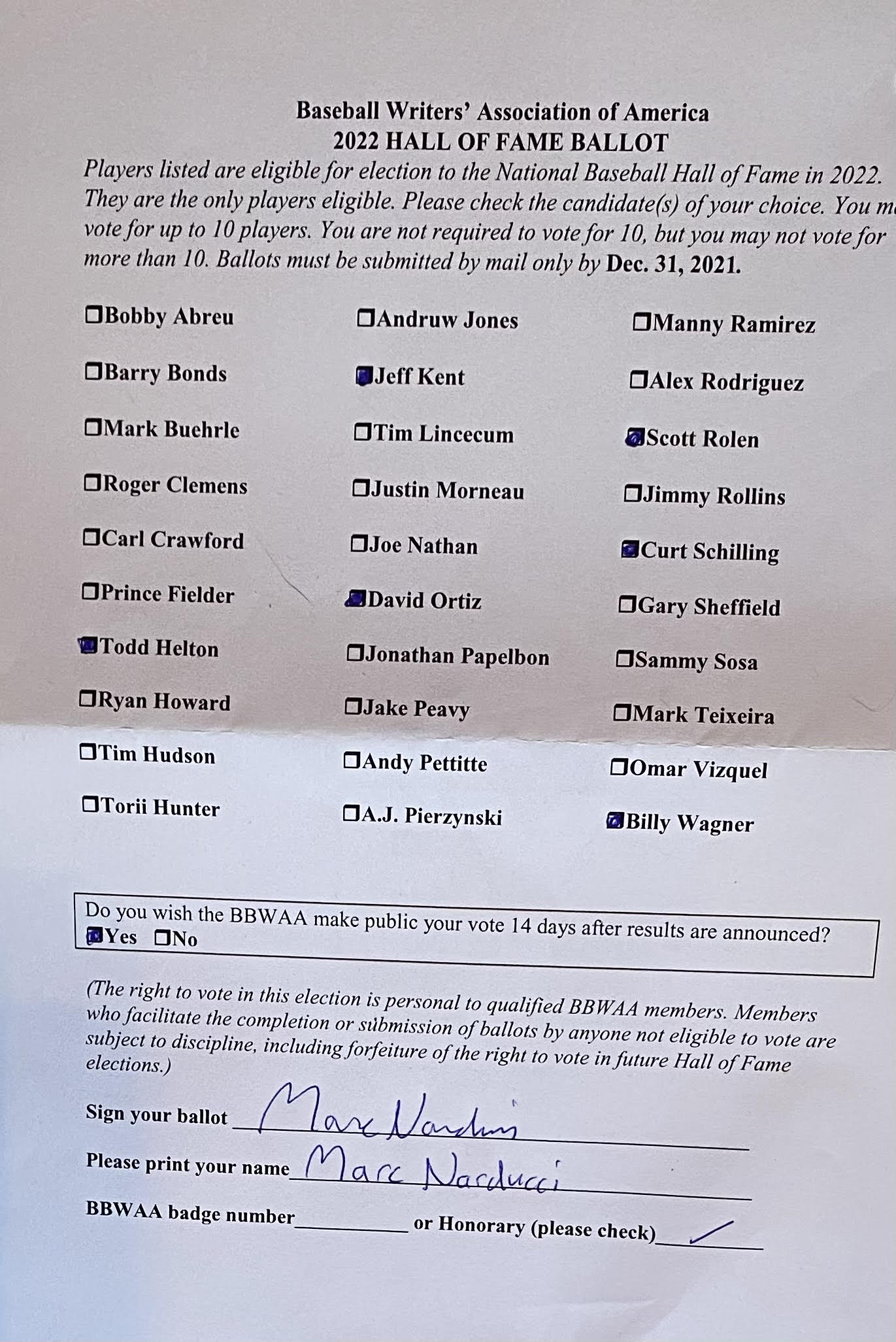 Voting for the Baseball Hall of Fame is an honor, but it’s difficult to see any sport where the task is more challenging.
That’s because of the steroid era.
One thing that should be stated off the bat is that there is no right or wrong answer when filling out the ballot in the opinion of this reporter.
As a former The Philadelphia Inquirer writer for 37 years, the decision of other voters won’t be questioned.
We can all agree to disagree and there will be many disagreements, especially when seeing my ballot.
The steroid era has made things so difficult. Do you vote for players associated with steroids?
One school of thought says the best players should go in regardless and the Hall of Fame would be empty without some of the great stars of the game such as Barry Bonds and Roger Clemens.
Others, and this is the camp will you find me, look at it the opposite way.
The steroid era did permanent damage to the sport. It also hurt the players who followed the rules and were thus competing at a severe disadvantage. Not only that, it hurt former players such as Hank Aaron, who was the all-time home run king and was passed by Bonds.
Due to the damage of the steroid era, Bonds, Clemens, Manny Ramirez, Alex Rodriguez, Sammy Sosa and Gary Sheffield aren’t on my ballot.
Ramirez and Rodriguez tested positive for PEDs. The others didn’t but Sheffield admitted using a steroid cream. Sosa, Bonds and Clemens maintain their innocence.
Sosa was caught with a corked bat, which even without the suspicion of steroids, would be a stain against his candidacy.
Two former federal authorities who were central to the Bay Area Laboratory Co-Operative (BALCO) steroids trafficking case, say there is no doubt that Bonds and Clemens used performance enhancing drugs during their careers.
Again, I know that people feel that writers are being sanctimonious in keeping players out whose on-field exploits deserve induction, but everybody has to vote the way he or she thinks is best.
So why is David Ortiz on this writer’s ballot?
We will get to that in a bit.
Here are the players that I voted for in alphabetical order on my ballot in my second year as a voter. One other thing – we know that stats such as RBI and pitcher’s wins are taboo in the sabermetric world, but we have included them for people who still care about those statistics.
Let’s get this out of the way first – there are those who won’t vote for Helton due to the fact that he played his career at Coors Field. No doubt it helped him, but he was more than solid on the road. Plus, the toll on a hitter having to go from playing in Colorado to another city isn’t easy.
In addition, a lot of players have competed at Coors and didn’t come close to the numbers that Helton posted. (All stats used are courtesy of Baseball-Reference.com and Fangraphs.com).
Here is his career slash line at Coors: .345/.441/.607. This was Helton on the road: .287/.386/.469.
Having an .855 road OPS isn’t too shabby.
Let’s look at two stats that take into account the ballpark – OPS+ and WRC+. Helton’s career OPS+ was 133 and his career WRC+ was 132, which means he was 33 percent and 32 percent above league average in those categories
Helton is off the charts with his career offensive statistics.
He had a career .316/.414/539 slash line with 369 home runs and 1406 RBI.
Helton was a five-time All-Star, a three-time Gold Glove winner and was Top 10 in the MVP voting three times.
His career OPS of .953 is 22nd on the all-time list. He also had more career walks (1,335) than strikeouts (1,175). That is almost unheard of in these free-swinging days.
During a 10-year stretch from 1998-2007, he hit .332/432/.585 with 298 home runs and OPS+ of 144. His career B-WAR is 61.8, which is 17th among first baseman. Of those 17, 11 are in the Hall of Fame.
A former college quarterback and teammate of Peyton Manning at the University of Tennessee, Helton was the No. 8 overall pick of the Rockies in the 1995 draft and would play his entire 17-year career with the Rockies. This is his fourth year on the ballot and he received 44.9% of the vote last year.
Kent has just two years to go on the ballot and last year he earned just 32.4 percent of the vote. He had a special skill that was way above the second basemen in the Hall of Fame – the ability to hit home runs. Kent has the most home runs of any second baseman in history, 377. He hit 351 of them while playing second base.
Even if one takes the 351 total, that is 50 more than the closest Hall of Fame second baseman, Rogers Hornsby, who hit 301.
Hornsby (.577) is the only Hall of Fame second baseman with a higher slugging percentage than Kent’s .500.
Only four Hall of Fame second basemen have a higher career OPS than Kent (.855). His 1.518 RBI are third among all second basemen.
Kent was a five-time All-Star, the 2000 MVP who hit for average (.290) and power. He also had a career 123 WRC+.
His career B-WAR was just 55.5, but that was mainly because he was considered a below average fielder.
Still, his offense was elite, surely enough for HOF induction.
In 2009, the New York Times reported that Ortiz was among the list of players who failed a 2003 anonymous drug test. Commissioner Rob Mandred says there were 10 false positives in the survey testing and it is possible that Ortiz was one of them.
He also said Ortiz never failed a drug test although we cited examples of the above mentioned players who didn’t either. That said, I feel less certain about Ortiz and only he knows the truth.
So giving him the benefit of the doubt, he’s a sure-fire Hall of Fame player even though he spent the majority of his career as a DH. For instance, 485 of his 541 career home runs came as a DH. Ortiz hit for average (.286) and power. Besides the 541 home runs, he had a .931 career OPS and career OPS+.of 141. He is also 22nd on the career RBI list with 1,768.
In the postseason he helped the Boston Red Sox win three World Series titles, and hit .289 with 17 home runs and a .947 OPS in 385 plate appearances.
There are 17 third basemen in the Hall of Fame, fewest of any position. Only nine third baseman have a higher B-WAR than Rolen (70.1), eight of whom are in the HOF and the other, Adrian Beltre, is a sure-fire candidate. (This also includes Paul Molitor as a third baseman, even though just 3,623 of his 1,267 plate appearances came at third base. It does not include Alex Rodriguez, who had a career B-War of 117.5, but only 42.7% of his plate appearances came as a third baseman).
Rolen was a seven-time All-Star and eight time Gold Glove winner. His defense was every bit as strong as his offense. Rolen’s defensive B-WAR (21.2) is behind just one Hall of Famer – Brooks Robinson, who is No. 1 among third basemen (39.1). (Beltre, at 27.1 is a future Hall of Famer ahead of Rolen).
Only eight HOF third basemen have a higher OPS (.855).
Rolen finished with a .281 average, 316 home runs and 1,287 RBI and was NL Rookie of the Year in 1997 with the Phillies. His career WRC+ was 122.
Rolen was a World Series champion with the 2006 St. Louis Cardinals, batting .421 with a 1.213 OPS in the five-game win over the Detroit Tigers.
He was a major threat on offense and defense, both carrying equal weight. This is his fifth year on the ballot and he is trending upward after earning 52.9% of the vote last year.
Schilling may be the first player to talk his way out of the Hall of Fame. His public comments and tweets have been well-documented and he will likely pay for them. This is his 10th and final season on the ballot. Last year he was close to the 75% total with 71.1%. Normally that would mean he would make it this year, but it would be a surprise if he gets in. He even tried to get off the Hall of Fame ballot, saying he doesn’t want to get voted in by the members of the Baseball Writers Association of America. That is not exactly a convincing way to sway voters. The Hall of Fame denied his request.
That said, what he did on the field, despite all his verbal gaffes, make him a Hall of Fame pitcher and he got my vote.
Just a few numbers..
Everybody talks about his 11-2 postseason record in 19 starts, but his WHIP was 0.968 and his strike-to-walk ratio was 4.80.
He was a late bloomer and still went 216-142 with a career a 3.46 ERA and 3,116 strikeouts.
Schilling won three World Series titles, two with Boston and one with the Arizona Diamondbacks and went to another World Series with the Philadelphia Phillies, where he was the 1993 NLCS MVP. He was runner-up for the Cy Young Award three times and fourth another.
Schilling was among the best big-game pitchers of his era and the only thing bigger was his mouth, which will likely keep him out of Cooperstown.
There are eight relief pitchers in the HOF. Only Mariano Rivera has a better ERA and ERA+ than Billy Wagner. A seven-time All-Star, Wagner’s career ERA was 2.31 and his adjusted ERA was 187. His 11.9 strikeouts per nine innings is best in MLB history (minimum of 750 innings pitched). He also has a career 0.998 WHIP.
Wagner had 422 saves in 491 opportunities (85.9 percent). Only two Hall of Fame relievers have a higher save percentage. Mariano Rivera (89.1%) and Trevor Hoffman (88.8%). Wagner also has a higher strikeout ratio (33.2%) than any reliever in the HOF. The closest is Hoffman (25.8%).
Now the negative. Wagner pitched only 903 innings, fewest of the Hall of Fame pitchers. Wagner also didn’t have a stellar postseason record, although it included just 11 2/3 innings over 14 appearances.
We can see why some may keep Wagner out due to the fact that all eight relievers in the Hall of Fame each exceeded 1,000 innings. Yet he has so many top achievements among the best relievers in the game’s history that he belongs with them in Cooperstown.
This is his seventh year on the ballot and he received 46.4% of the vote last year.
Free Agent Faceoff: Jorge Soler Vs. Eddie Rosario
The Braves’ midseason outfield reconstruction has been well-documented. Jorge Soler, Eddie Rosario and — to a lesser extent — Joc Pederson and Adam Duvall all performed at a high level after being acquired in seemingly minor deals in advance of the trade deadline, a haul that helped Atlanta to a World Series title.
Only Duvall remains on the roster, though, with each of Soler, Rosario and Pederson having qualified for free agency at the end of the season. It wouldn’t be surprising to see someone from that group eventually return, but all thirty clubs will have a chance to pursue that trio whenever the lockout comes to an end.
Soler and Rosario, in particular, profile as two of the most intriguing remaining free agent outfielders. Both players began the year in the AL Central — Soler in Kansas City, Rosario in Cleveland. Neither played particularly well at their initial stop, and Atlanta acquired them in separate deadline day swaps that cost them only cash and one prospect: Kasey Kalich.
Yet both players flipped the script with a strong couple months in Atlanta. Soler hit .269/.358/.524 with 14 home runs across 242 regular season plate appearances with the Braves, offensive output that was 32 percentage points above average by measure of wRC+. Rosario only tallied 106 trips to the dish down the stretch — he was on the injured list at the time of his trade — but his .271/.330/.573 mark in that time checked in 33 points above the league average.
Both players also had great postseasons, although Soler’s was briefly interrupted by a positive COVID-19 test. Rosario hit three homers in 28 plate appearances during the NLCS en route to series MVP honors in a win over the Dodgers. Soler claimed the World Series MVP by hitting a trio of longballs against the Astros during the following set.
Soler’s and Rosario’s heroics were enough to cement their places in Braves lore. Teams now considering a free agent pursuit of either have to determine what to expect moving forward, though. Regarding both players, that’s a difficult question, considering their up-and-down track records before they landed in Atlanta.
Soler, 30 in February, has been a prototypical three-true-outcomes slugger for much of his career. His massive power made him a top prospect, and while it took a few seasons for him to settle in as a regular, Soler demonstrated the offensive upside that had made him so highly touted between 2018-19. Over those two seasons, the right-handed slugger hit .265/.354/.541 (132 wRC+) despite playing his home games in Kansas City’s spacious Kauffman Stadium. His 48 home runs the latter year paced the American League, and those power results were backed up by top-of-the-scale batted ball metrics.
In addition to that huge power, Soler rarely chases pitches outside the strike zone. He’s walked at an above-average clip in each season since 2016. That’s an impressive combination upon which to build, but Soler also has real swing-and-miss concerns. Aside from a 24-game showing as a rookie, Soler has never had a season in which he’s made contact on even 70% of his swings; the 2021 league average, for reference, was 76.1%.
With that swing-and-miss comes a high strikeout rate that can tank Soler’s batting averages when things aren’t going well. Between the start of 2020 and this past summer’s trade deadline, he compiled 534 plate appearances of .204/.300/.394 hitting. That includes an awful .192/.288/.370 mark with the Royals in 2021, a bad enough first half that each of FanGraphs and Baseball Reference actually pegged Soler’s overall work this past season as below replacement level even after accounting for his late-season turnaround.
That also hints at another red flag in Soler’s game: his defense. Public metrics have long pegged him as a well below-average corner outfielder, and he spent a decent chunk of time at designated hitter in Kansas City. The potential implementation of the universal DH in collective bargaining talks could expand Soler’s market, but clubs are increasingly wary of committing everyday DH at-bats to players unless they’re an elite middle-of-the-order presence. Soler has been that caliber of hitter over a full season in 2019. He finished 2021 on an absolute tear. Yet the intervening season and a half were quite poor, and Soler doesn’t have the defensive profile to remain valuable even as he’s in a slump offensively.
Rosario’s defensive track record is also a bit spotty, but public metrics have generally been more enthused with his work than with Soler’s. He’s limited to the corners — primarily left field — but he shouldn’t need to see too much time at DH over the next couple years. But Rosario has never matched Soler’s 2018-19 offensive peak, at least not over a full season. The 30-year-old posted solid numbers each season from 2017-20 with the Twins, but he’s never had a season with a wRC+ more than 17 points above league average.
Rosario doesn’t come with swing-and-miss concerns; he’s made contact at a solid rate five years running. And while he doesn’t have elite power, he’s certainly capable of making an impact at the plate. The left-handed hitter has three seasons with 24+ homers on his resume, and he typically posts exit velocities and hard contact rates a bit above the respective league marks.
Yet Rosario’s offensive ceiling has been capped by how often he swings. He’s one of the league’s most aggressive hitters, an approach that leads to a consistently low walk rate. Rosario only has one season under his belt (2017) with an on-base percentage higher than the league mark, with teams obviously worried about that profile.
Last offseason, Rosario (who had been projected for an arbitration salary in the $8.6MM to $12.9MM range) was passed through outright waivers and non-tendered by Minnesota. He began the 2021 campaign with just a .254/.296/.389 mark over 306 plate appearances with the Indians. His stint in Atlanta was great, but that came over a comparatively small tally of 174 trips to the plate, even including the playoffs.
Each of Soler and Rosario present an interesting evaluation for teams. They’re coming off excellent second halves that carried over into fantastic postseasons. Yet each player is less than six months removed from rather significant struggles on non-contending clubs. For teams looking to address their corner outfield situations in free agency yet unwilling to spend at the level it’d take to land Nick Castellanos or Kyle Schwarber, Soler and Rosario could each be targets coming out of the transactions freeze. Which player should land the loftier contract?
(poll link for app users)
Who Should Land The Bigger Contract This Offseason?
-
Jorge Soler 56% (3,253)
-
Eddie Rosario 44% (2,580)
Total votes: 5,833