
Let’s Find A Fit For Carlos Rodon
Carlos Rodon had one of the best seasons, on a per-inning basis, of any starter in recent memory. He also had one of the strangest, however, as his velocity and workload plummeted among shoulder concerns in a still-productive final two months of the season.
As late into the season as July 18, Rodon had to be considered the odds-on favorite to win the American League Cy Young Award — a remarkable turnaround for a former top prospect who’d had Tommy John surgery and shoulder surgery, been non-tendered and then returned to his original club on a one-year, $3MM “prove-it” deal.
Prove it, Rodon did — for much of the season. Rodon no-hit Cleveland in his second start of the season and, as of that aforementioned July 18 date, was sporting a ridiculous 2.14 ERA with a dominant 36.6% strikeout rate against an excellent 6.8% walk rate. The 96 mph he was averaging on his heater through that date was far and away the best mark of his career, and Rodon’s 15.5% swinging-strike rate placed him alongside the game’s elite starters. Simply put, he was dominant. Rodon at last looked like the No. 1 starter Sox for which Sox fans hoped when he was selected with the No. 3 overall draft pick in 2014.
A July 18 gem against a potent Astros lineup — seven shutout, one-hit innings with 10 punchouts and no walks — proved to be the last time he’d throw more than five innings in 2021, however. Rodon lasted just four frames and allowed four runs in each of his next two starts. He rebounded to overwhelm a stripped-down Cubs lineup that had traded away virtually every hitter of note, tossing five shutout innings with 11 strikeouts on Aug. 7.
Rodon then hit the injured list with shoulder fatigue, returned on Aug. 26, and went on to make only five starts over the regular season’s final 39 days. He reached 80 pitches in just one of those five starts, and his fastball sat at a greatly diminished 93.2 mph in that time. Rodon was still effective in that time (2.35 ERA in 23 innings), but his strikeout rate was down to 27.2% as well — still strong, but no longer elite.
Heading into the White Sox’ ALDS date with Houston, it was unclear whether Rodon would even be an option at all. There was some question as to whether he’d even be on the roster, but he was deemed good to go for what proved to be the decisive Game 4 of that series. Rodon came out with a revitalized fastball that was hitting the upper 90s, but he also last just 2 2/3 innings in a 56-pitch losing effort that ended Chicago’s year. Credit to Rodon for gutting it out if he was less than 100 percent, but it was obviously a suboptimal finish to what had looked to be a legitimate breakout campaign for the lefty.
As the offseason dawned, most expected the White Sox to extend a one-year qualifying offer to Rodon. That $18.4MM salary would’ve represented a massive jump from the $3MM he earned in 2021, but based on his performance, that rate of pay still represented a bargain. Instead, the Sox opted not to make the QO, allowing Rodon to become a free agent without the burden of draft compensation. That led to speculation about his health or a possible gentleman’s agreement with the front office; no one other than the Chicago front office, Rodon and agent Scott Boras can be 100 percent certain as to the reasons for the lack of a QO, but it now makes Rodon one of the most intriguing free agents on the market.
Rodon turned 29 just last week. He’s coming off a season that, even though it ended on a low note, saw him post a 2.37 ERA with a 34.6% strikeout rate and a 6.7% walk rate. Among pitchers with at least 100 innings thrown, only NL Cy Young winner Corbin Burnes had a higher strikeout percentage. Only Burnes and Max Scherzer posted larger strikeout-to-walk percentage differentials than Rodon’s 27.9%. Rodon also ranked among the 10 best pitchers in MLB with a 15% swinging-strike rate and a 70.3% opponents’ contact rate (again, min. 100 innings).
It was a true ace-level performance, but also a level that Rodon had never before reached. Between the one-off nature of this year’s dominance and the obvious concerns about his shoulder, workload and velocity late in the season, there’s some real risk with Rodon.
On our Top 50 free agent rankings, we suggested that Rodon would likely have to choose between a one-year deal with a large salary or maxing out on a multi-year deal that’s probably shorter than most top-tier starters would command — perhaps three years. Our ultimate prediction was a one-year deal at $25MM, though we also discussed three-year deals worth $20MM annually — perhaps even a bit more.
Boras has already made clear this winter that Rodon is seeking a multi-year deal, so while it’s possible he signs for one year after not finding any longer-term deals to his liking, the thought right now has to be that he’ll sign for two or three seasons. As is increasingly common among high-profile free agents, opt-out clauses could factor into the mix.
There are still plenty of teams that need rotation help, and the fact that Rodon isn’t likely to cross into that $100MM range that’s expected of other Cy Young-caliber peers ought to make him appealing to a wide portion of the league.
We obviously can’t know where Rodon will land until the ongoing lockout is lifted, but it’s still worth taking a look at his potential market based on the context we already have. The goal here will be to identify some of the best and most plausible fits for Rodon, and there’s at least a handful of teams we know we can eliminate right off the bat.
The Orioles and Pirates, for instance, are mired in lengthy rebuilding efforts and won’t spend at this level. Ditto the A’s, who are expected to cut payroll and trade away several core players. Neither the D-backs nor the Nats have publicly committed to a full rebuild, but it seems unlikely that Rodon will land in either spot as both are more focused on the long-term than improving in 2022.
A Miami homecoming is hard to picture, given the Marlins’ generally low payrolls, pitching-rich roster and stated needs in the outfield. The Brewers are already pushing a franchise-record payroll and have three ace-caliber arms atop the staff. The Reds have been cutting payroll and are open to trading their top starters away; a Rodon match doesn’t really align with that. The Guardians are built around affordable young pitching, have needs in the lineup and have never spent like this on a free-agent arm. Tampa Bay already signed Corey Kluber and has never committed more than $30MM to a free-agent pitcher.
A.J. Preller may make me rue not taking my usual “never say never” approach to the Padres, but San Diego is already deep in relatively pricey starters and is actively trying to shed some contracts (Eric Hosmer, Wil Myers) to address the lineup. Houston is at least seven deep in starters after re-signing Justin Verlander, and adding a pricey eighth option seems unlikely. The Cardinals already signed Steven Matz and now have a pretty established top five; further rotation additions seem likelier to be of the depth variety. The Phils have an established top four and have much larger needs in the outfield and infield.That’s a quick look at which clubs feel decidedly unlikely to sign Rodon, but let’s talk some teams that could at least plausibly make this work:
That’s a quick look at which clubs feel decidedly unlikely to sign Rodon, but let’s run through some more plausible clubs, team-by-team, before trying to pick out a few of the best possible fits for the lefty:
- Angels: Signing Noah Syndergaard and rolling the dice on Michael Lorenzen was a good start to bolstering the rotation, but the Angels could use another high-upside option, given the number of question marks up and down the current staff. You could argue that they need to focus on more certainty, but with enough high-risk upside plays, they could navigate a full season even as injuries arise. The Halos haven’t given multiple years to a free-agent starter since 2012, but if Rodon’s market tops out at three years, that’d be fewer seasons than they just committed to closer Raisel Iglesias.
- Blue Jays: Toronto lost both Robbie Ray and Steven Matz in free agency, and they’ve since signed Kevin Gausman. Adding another bat and some bullpen help seems likelier than another high-priced starter, but it’s hard not to be tempted by the thought of a rotation featuring Gausman, Rodon, Hyun Jin Ryu, Jose Berrios and Alek Manoah. The Jays could probably sign Rodon and still clock in south of their franchise-record $163MM payroll, but another starter may not be their top need.
- Braves: With Mike Soroka out until mid-2022, Atlanta could definitely use another starting pitcher — even after re-upping with Charlie Morton on a $20MM deal. Most of Atlanta’s post-lockout focus will be on re-signing Freddie Freeman. But Rodon fits the type of huge-upside, relatively short-term signings made in Atlanta under Alex Anthopoulos as well. If Freeman shocks everyone and leaves, Atlanta could make some big moves elsewhere on the roster.
- Cubs: It was somewhat surprising to see the Cubs add a pair of notable free agents in Marcus Stroman and Yan Gomes, and those moves at least give cause to stop and wonder whether another big splash might be coming. Patrick Mooney and Sahadev Sharma of The Athletic both feel Rodon won’t be a priority for the Cubs, who entered the offseason hoping to add a pair of slam-dunk rotation options and have done that with Stroman and Wade Miley. Another big-name addition in the rotation doesn’t feel likely, per The Athletic duo, who suggest bullpen additions to be a likelier focus for the Cubs.
- Dodgers: A reasonably short-term, high-priced deal for Rodon feels like something right out of the Dodgers’ playbook. Rodon showed that his upside was as high as any free agent on the market, but the health concerns will tamp down the contract length into L.A.’s preferred range. The Dodgers lost Max Scherzer, they’re not sure what will happen with Trevor Bauer, and Clayton Kershaw ended the year with even greater physical question marks before reaching free agency. On paper, it’s a strong match for a Dodgers club that needs some arms behind Walker Buehler and Julio Urias.
- Giants: As with the Dodgers, a relatively short-term deal with an upside play like Rodon feels right up the Giants’ alley. San Francisco is reportedly believed to be averse to nine-figure free agents, and outside of the now-off-the-market Verlander, Rodon may have the best upside of any pitcher available for under $100MM. The Giants already added three stabilizing pieces to round out the rotation, so there’s plenty of sense to shooting for the moon on a fourth addition.
- Mariners: Seattle already signed the AL Cy Young winner, but we know they’ll still be looking for starting pitching after the lockout is resolved. The M’s have a solid foursome atop the rotation, but Rodon would give them another likely postseason starter as they look to return to the playoffs for the first time in two decades. Adding an impact bat could be higher on the list of priorities for president of baseball ops Jerry Dipoto, but Seattle’s projected payroll is so low that they could sign both Rodon and one of the top remaining bats on the market while still fitting tens of millions of dollars below a franchise-record level.
- Mets: New York already has its share of injury-prone arms, but it’s abundantly clear by now that owner Steve Cohen is pulling out all the stops as he looks to push the team toward a World Series run. Rodon, Scherzer and a healthy Jacob deGrom has the potential to be a comically dominant trio, and after the Mets topped a quarter-billion in spending prior to the lockout, we shouldn’t assume they’ll slow down when things resume.
- Rangers: Speaking of pre-lockout spending sprees, the Rangers topped a half-billion dollars in total commitments and still have minimal certainty in the rotation. Rodon doesn’t provide the bulk innings Texas could so sorely stand to add, but for a team that’s obviously hell-bent on improving in 2022 and returning to the playoffs before long, Rodon probably can’t be firmly ruled out. Incredibly, their 2022 payroll is still projected to come in nearly $40MM shy of its all-time high.
- Red Sox: This type of short-term upside play seems like one that’d sit well with chief baseball officer Chaim Bloom, but the Sox have also already added Rich Hill, Michael Wacha and James Paxton to the 2022 staff. The Boston rotation is teeming with upside and uncertainty alike, and Rodon would add to it on both fronts. The Sox are also over $200MM in luxury obligations, though, so Rodon could be deemed too pricey even if the luxury threshold increases under the new CBA.
- Rockies: Persuading any pitcher to play in Coors Field is difficult, but the Rockies have money to spend. Rodon’s decision to seek a multi-year deal suggests he’s looking to max out his earning power right now, so if Colorado offers an extra year over what the rest of the field is willing to commit, perhaps they could pull off a stunner.
- Royals: Kansas City’s estimated payroll is only around $86MM right now, so there’s obvious room to fit Rodon into the rotation as a means of taking some pressure off younger arms. They landed a pair of veteran free agents last year by going an extra year over most expectations on Mike Minor and Carlos Santana. Taking that approach with Rodon would be a vastly more expensive proposition, however. The Royals are trying to win now, but this feels like a reach even if they have the need and payroll space.
- Tigers: An on-the-rise team with gobs of payroll space, a deep collection of near-MLB top prospects, a pitcher-friendly home park and plenty of innings available — the Tigers check basically any box you could imagine for Rodon. They’ve already signed Javier Baez and Eduardo Rodriguez, and they’re still looking for another rotation addition. Rodon drastically raises their ceiling and takes pressure of some younger arms like Tarik Skubal and Casey Mize.
- Twins: Minnesota entered the offseason needing at least three starters, and so far they’ve…. rolled the dice on a Dylan Bundy rebound. It’s a fine move in a vacuum, but the Twins’ need for more pitching help is painstakingly obvious. Dan Hayes of The Athletic reported this week that last winter, the Twins tried to get Rodon on a minor league deal before he received that $3MM contract from the South Siders. That said, Hayes adds that Minnesota seems likelier to address its pitching needs via trade and may not be keen on taking a Rodon-sized risk with so many holes on the staff. It’s a good fit on paper, at the very least.
- White Sox: General manager Rick Hahn has said all the right things about wanting Rodon back, but it’s hard to take those statements at face value when Chicago didn’t make him a qualifying offer. The Pale Hose already have five to six starters — though they’d probably welcome the opportunity to shed Dallas Keuchel‘s final year — and had the chance to persuade Rodon with that one-year QO. The Daily Herald’s Scot Gregor suggested this week that Rodon isn’t likely to return to the Sox, who are still eyeing help in the outfield and at second base.
- Yankees: The Bombers, in recent years, have favored risky rotation plays for volatile but immensely talented starters in the Rodon mold. Their need at shortstop is the most heavily discussed roster deficiency in the Bronx, but the rotation after Gerrit Cole and Jordan Montgomery is suspect. Domingo German finished horribly. Luis Severino has pitched a combined 18 innings in the past three years. Jameson Taillon had offseason ankle surgery. Prospects Deivi Garcia and Clarke Schmidt struggled and/or missed significant time due to injury.
In the end, any of these teams feels like at least a good theoretical match, but most come with reasons to cast doubt on whether they’d actually sign Rodon. From my vantage point, the best blend of on-paper need, available payroll space and plausible willingness to take this type of risk lies with the Angels, Dodgers, Giants, Mariners, Tigers and Yankees.
Transaction Retrospection: Alex Rodriguez Signs With The Rangers
Alex Rodriguez makes his debut on the Hall of Fame ballot this winter, and given all of the PED-related controversy that surrounded his career, it remains to be seen if he will ever end up with a plaque in Cooperstown. His fate will ultimately be determined by how the writers (and, quite possibly, future veterans committees) view these off-the-field actions, whereas for the average HOF candidate, discussions usually just center around the numbers.
In terms of pure statistics, Rodriguez more than qualifies for induction. And yet beyond the 696 home runs, 14 All-Star appearances, and three MVP awards, one number has defined Rodriguez’s career — $252,000,000.
It was on this day in 2000 that Rodriguez dropped a bombshell on the sports world by signing a ten-year, $252MM free agent contract with the Rangers. It was far and away the largest contract ever signed in pro sports, let alone in MLB. (Just a few days before Rodriguez’s deal, Mike Hampton inked an eight-year, $121MM deal with the Rockies that briefly stood as the biggest contract in baseball history.) Even 21 years later, A-Rod’s Rangers contract is still the twelfth-richest contract ever signed in baseball.
To be clear, there was no doubt that Rodriguez was going to land some sort of record-setting deal that winter. The first overall pick of the 1993 draft had done nothing but live to that lofty status over his first seven seasons, hitting .309/.374/.561 with 189 home runs over 3515 plate appearances with the Mariners. Besides being a five-tool player, Rodriguez also had youth on his side, as he hit the open market when he was only 25 years old. A team could reasonably count on A-Rod to continue posting superstar-level numbers over at least the next decade, which only helped agent Scott Boras’ case that his client deserved a unique type of contract.
But for an eye-popping $252MM number, a unique type of bidder was needed. Enter the Rangers. Tom Hicks purchased the team in June 1998, and while Texas won AL West titles in both 1998 and 1999, they were swept out of the ALDS in both years. After the Rangers stumbled to a 71-91 record in 2000, Hicks felt a major shakeup was required, and that included an unprecedented splurge on the top free agent available.
As you might expect, the reactions to Rodriguez’s signing ranged somewhere between wonder and outrage. Many felt it was a sign of irresponsible spending, as then-Astros GM Gerry Hunsicker described the contract as “The sooner we run this up the flagpole, the sooner we get to D-Day and a catastrophic event” for competitive balance in baseball.
This viewpoint also extended to the Commissioner’s Office. MLB’s executive VP of baseball operations Sandy Alderson said he was “sort of stupefied” by Rodriguez’s deal, as “we have effectively doubled the previous most lucrative contract in two days. I don’t like the exponentiality of all of that. We have a straight-up trend that doesn’t augur well. To me, it’s incredible.
“For every Texas, there are five teams like Oakland who traded their second baseman, let go of their starting right fielder and saw their No. 2 pitcher sign a $40 million contract as a free agent with another team. I suggest you ask the players on teams such as that whether this game is as healthy as this signing suggests.”
There is no small amount of irony in these comments some 21 years later, on several levels. Firstly, Athletics fans are undoubtedly sighing deeply over the fact that both now and then, their team’s “cycle” of roster reloads has continued to spin. Secondly, competitive balance continues to be a cornerstone issue between players and owners amidst the current lockout, though one of the primary concerns on the MLBPA’s side is that larger-market teams aren’t spending enough, and that the league’s mechanisms to ostensibly protect competitive balance (draft bonus pools, luxury tax penalties, draft pick compensation for free agents, etc.) are driving salaries down.
And, Alderson himself is now president of the Mets, working for an aggressive owner in Steve Cohen who has — like Hicks in 2000 — shown himself to be unfazed by signing precedents. Since Alderson returned to the Mets in September 2020, New York has already signed Francisco Lindor to a ten-year, $341MM contract extension, and set a new record for average annual value by signing Max Scherzer to a three-year, $130MM pact. (In another ironic twist, an ownership group led by Rodriguez and ex-fiancee Jennifer Lopez were among the strongest bidders for the Mets last year before Cohen ultimately bought the club.)
In hindsight, the critics were technically right, in that signing Rodriguez didn’t help the Rangers to any success on the field. Texas didn’t enjoy a single winning record in Rodriguez’s three years with the club, and Hicks came to see A-Rod’s deal as a payroll albatross. Of course, the issue was more due to the lack of talent Texas built around Rodriguez, rather than what Rodriguez was doing himself. A-Rod held up his end of the contract with the Rangers, hitting .305/.395/.615 with 156 homers over his three seasons in Arlington and capturing AL MVP honors in 2003.
By February 2004, Rodriguez’s tenure with the Rangers was already over, as he was dealt to the Yankees in a blockbuster swap in exchange for Alfonso Soriano, Joaquin Arias, and (possibly most importantly) $112MM of the $179MM that remained on A-Rod’s deal. This trade came about only after an earlier proposed trade with the Red Sox was vetoed by the MLBPA since Rodriguez would have been giving up $28MM in salary, and thus A-Rod found himself in the Bronx.
As it happens, Rodriguez is actually still receiving money from the Rangers to this day, via deferred payments from his original contract and re-brokered in the wake of the Rangers filing for bankruptcy in 2010. What was once seen as a transformative signing in the franchise’s history ultimately became something of an expensive footnote, and even a cautionary tale. It’s one thing to sign a can’t-miss superstar (even at a $252MM price tag), but quite another to keep making canny roster moves to make sure that superstar’s prime years aren’t being wasted.
It is a lesson that the current Rangers front office surely has in the back of their minds as they embark on another spending spree. In the wake of five consecutive losing seasons and a pared-down payroll, Texas has zoomed back to prominence this winter by landing Jon Gray (four years, $56MM), Marcus Semien (seven years, $175MM) and, biggest of all, Corey Seager for 10 years and $325MM. That’s another star shortstop on another 10-year deal, except with $73MM more in guaranteed money. Texas fans can only hope that the “Transaction Retrospection” MLBTR is writing about the Seager contract in 21 years’ time carries many more references to World Series championships, rather than the sour feelings left behind by the A-Rod deal.
Offseason Outlook: Arizona Diamondbacks
2021 was a Murphy’s law season for the Diamondbacks, who entered the year expecting to at least hang around in the Wild Card race. Instead, they dealt with myriad injuries, saw some typically reliable veterans take steps back, and had perhaps the game’s worst bullpen. The result: a 52-110 record that calls the franchise’s entire direction into question.
Guaranteed Contracts
- Madison Bumgarner, LHP: $60MM through 2024 ($10MM between 2022-23 deferred until after the contract’s expiration)
- Nick Ahmed, SS: $18.25MM through 2023
- Mark Melancon, RHP: $14MM through 2023 (including $2MM buyout on $5MM mutual option for 2024)
- Ketel Marte, 2B: $9.4MM through 2022 (including $1MM buyout on $10MM club option for 2023; contract also contains $12MM club option for 2024)
- David Peralta, LF: $7.5MM through 2022
- Merrill Kelly, RHP: $5.25MM through 2022
Total 2022 commitments: $58.025MM
Projected Salaries for Arbitration-Eligible Players (projections via MLBTR contributor Matt Swartz)
- Carson Kelly — $3MM
- Luke Weaver — $2.7MM
- Christian Walker — $2.7MM
- Caleb Smith — $2.1MM
- Noé Ramirez — $1.8MM
- Jordan Luplow – $1.5MM
- J.B. Wendelken — $900K
Option Decisions
- Exercised $5.25MM club option on RHP Merrill Kelly
- Declined $9MM club option on RF Kole Calhoun (paid $2MM buyout)
- Team declined its end of $3.5MM mutual option on RHP Tyler Clippard (paid $500K buyout)
Free Agents
- Kole Calhoun, Tyler Clippard, Taylor Clarke, Jon Duplantier, Chris Devenski, Henry Ramos, Brandyn Sittinger, Ildemaro Vargas, Jordan Weems
Unlike a few other teams near the bottom of the standings, the Diamondbacks have not been rebuilding. Arizona went 85-77 with a +70 run differential in 2019. That winter, they signed Kole Calhoun and brought back most of the position player core. They stumbled to a 25-35 finish in 2020, but it was fair to largely write that off as an anomalous down season in a shortened schedule.
That’s no longer the case, as they’re coming off an NL-worst showing over a full season. Some of that can be attributed to tough injury luck, particularly in a starting rotation that lost all four of its top members for a month or more at some point during the year. Yet even pristine health wouldn’t have had the D-Backs anywhere near the Giants and Dodgers at the top of the NL West, leaving the front office with plenty of questions about how to get back to where they were a couple years ago.
That won’t take the form of a leadership change, at least not at the top. The club signed manager Torey Lovullo to a one-year extension in September, locking him in for a sixth season at the helm. They did overhaul Lovullo’s coaching staff, including the hiring of highly respected pitching coach Brent Strom. But it’ll be Lovullo leading the clubhouse for the franchise’s hopeful turnaround.
Based on the comments of the team’s top executives and their early-offseason actions, it doesn’t seem that’ll take the form of a massive rebuild. General manager Mike Hazen pushed back against the notion of a teardown numerous times during the year, and he largely reiterated that stance after the season. “This isn’t a situation, for me, where we are relying on a series of top-five draft picks to get us back into a position where we should be,” he told reporters in October. “That’s my opinion.”
Hazen’s top lieutenant, assistant GM Amiel Sawdaye, largely echoed that sentiment at last month’s GM Meetings. “We go into every season with the idea that we want to put the best possible team out there that’s going to go out and compete,” Sawdaye said. “I don’t think we ever wave the white flag and say, ‘Well, we’re going to give up on ’22.”
Both Hazen and Sawdaye suggested the D-Backs would remain open to trade offers on long-term players, but neither exec sounded enamored with that possibility. Arizona held onto players like Ketel Marte, Carson Kelly and Josh Rojas at the trade deadline, a time when Hazen expressed a desire to anchor the club’s next competitive window around a few marquee contributors.
There’ll surely be robust interest in all those players, as well as in staff ace Zac Gallen. The Marlins, for instance, have already been tied to Marte this winter. Yet there’s also no urgency for the D-Backs to pull the trigger on a deal unless they’re completely overwhelmed with a prospect package or leaning into a full rebuild. The latter option doesn’t seem to be on the table, so teams will need to bowl Arizona over to land anyone from that group, each of whom is controllable for at least three more seasons (barring changes to the service time structure in the next CBA).
It seems likely the Diamondbacks will keep their young core intact heading into 2022, but trades of veteran role players remain a possibility. The Snakes may not want to punt next season entirely, but it’s also clear they’re facing an uphill battle competing in a division with two of baseball’s top teams and a third (the Padres) with one of the more star-studded rosters in the league. So a moderate sell-off with an eye towards 2023 and beyond figures to be the middle ground in which they settle.
Starter Merrill Kelly and left fielder David Peralta are both entering the final seasons of their contracts. Kelly, who’ll make an affordable $5.25MM, should be of particular interest to more immediate contenders. The right-hander owns a 4.27 ERA in 372 2/3 innings over the past three seasons. He has below-average swing-and-miss and strikeout numbers, but Kelly’s an adept strike-thrower who does a decent job keeping the ball on the ground. He’s a source of affordable, league average innings that could bolster a contending club’s starting staff. It’d be a surprise if Kelly weren’t traded at some point — either this offseason or at next summer’s deadline.
Interest in Peralta figures to be more muted. His $7.5MM salary isn’t onerous, but the 34-year-old is coming off a modest .259/.325/.402 showing. Peralta has mixed in a couple excellent seasons in his career, but he’s typically offered league average hitting and solid but unspectacular defense in left field. Teams like the White Sox and Phillies could consider him as a lefty-hitting corner outfield option, but it’s unlikely the D-Backs would recoup much more than a fringe prospect and/or salary relief in any deal. At that point, it may be better to hang onto the longtime member of the organization as a veteran presence for a fairly young locker room.
There aren’t a ton of other obvious trade candidates on the roster. The D-Backs would surely welcome the opportunity to get much of the $60MM remaining on the Madison Bumgarner contract off the books, but it’s hard to see another club having interest in such an arrangement. Bumgarner has struggled mightily with home runs as his velocity has dipped in the desert, making his five-year deal from the 2019-20 offseason look like a major misstep.
First baseman Christian Walker and shortstop Nick Ahmed are each coming off seasons valued at marginally above replacement level. Ahmed, who’s one of the game’s top defensive infielders, could draw some interest from shortstop-needy clubs looking for a stopgap veteran at the position. (The Yankees, Astros and Angels could all fit that bill). With a salary that guarantees him a bit more than $18MM over the next two seasons, though, it seems likely the D-Backs would have to pay some money to facilitate a trade for a marginal prospect return. As with Peralta, it probably makes more sense for Arizona to hold onto Ahmed into the season.
Perhaps aside from a Merrill Kelly trade, there may not be many traditional “seller” moves by the Diamondbacks this winter. In fact, they’ve already made one meaningful move in the opposite direction. Arizona inked veteran closer Mark Melancon to a two-year deal just before the lockout, and he’ll immediately step in as the veteran anchor of a young relief corps. Melancon doesn’t have big velocity or swing-and-miss numbers, but he’s a solid strike-thrower who continues to post impressive ground-ball and soft contact rates.
Further upgrades could be on the horizon, as Arizona is only bringing back one reliever (swingman Caleb Smith) who logged at least 20+ innings with above-average strikeout and walk numbers this past season. The Snakes have reportedly poked around the market for veteran middle relievers Hunter Strickland and Bryan Shaw and could circle back to them or others of that ilk. Those wouldn’t be world-beating signings, but they’d be affordable and perhaps raise the floor in the middle innings.
Arizona has also reportedly expressed some interest in Wily Peralta, and a swing option could indeed make some sense. The D-Backs’ rotation is one of the thinner groups around the league. Gallen’s a quality young arm, and he’s likely to return at the top of the rotation. Bumgarner will get another opportunity, and Kelly would have a spot if he’s not moved.
Luke Weaver looks likely to claim a spot in the back-end. A former highly-regarded prospect, Weaver has been up-and-down over the past couple seasons in Phoenix. He generally posts solid enough strikeout and walk numbers to compensate for home run issues, and the D-Backs don’t have enough in-house alternatives to bump Weaver out of the starting staff at the moment.
The fifth spot (or final two spots if Kelly is traded) looks completely up for grabs. Tyler Gilbert, who warmed plenty of hearts by tossing a no-hitter in his first career start, might be the favorite after posting a 3.47 ERA as a rookie. His peripherals didn’t support that run prevention number, though, and Gilbert’s not long removed from being a minor league Rule 5 draftee. Awesome as his no-hitter was, he’s probably better suited as a depth option than a rotation cog. Taylor Widener, Humberto Castellanos and Humberto Mejia are among the other arms who could be in the mix, but none of that trio was particularly impressive in 2021. Smith could factor in as well but is probably better suited for relief.
The free agent rotation market has been largely picked through already, but Arizona could offer some innings to potential reclamation candidates. Vince Velasquez, Chad Kuhl and Zach Davies are among the speculative possibilities available for that kind of dart throw. Each is coming off a poor enough season they won’t be costly, but they’ve all found some level of success in years past.
Pitching figures to be the priority, coming off a season in which Arizona had the league’s second-worst ERA and third-worst SIERA. There’s room for some upgrades on the position player side, with Hazen and Sawdaye each highlighting third base in recent weeks as a target area. Arizona’s not going to pursue Kris Bryant, and a run at 34-year-old Kyle Seager probably isn’t in the cards for a team in the D-Backs’ uncertain competitive position.
Aside from perhaps Jonathan Villar, free agency doesn’t offer much else in the way of regulars there. While the D-Backs could theoretically poke around the trade market in search of a controllable option at the hot corner, they’re not especially likely to surrender prospects from the top couple tiers of the farm system. Perhaps there’s a creative swap to be had for a young infielder in an organization with more high-level depth. Taylor Walls of the Rays, J.D. Davis of the Mets and Ha-Seong Kim of the Padres are among potential trade targets of varying cost and windows of remaining control.
It’s also possible the D-Backs are left to run things back with their in-house options. Ahmed, if not moved, will be back at shortstop, with prospect Geraldo Perdomo a potential midseason candidate if he plays well at Triple-A. Marte seems likely to move back to second base full-time after rating poorly in center field. Ideally, Rojas would probably bounce around the diamond regularly, but he’s the likeliest option to assume the lion’s share of time at third base if the team doesn’t upgrade externally.
The D-Backs could look into the possibility of replacing Walker at first base. That’s particularly true if the designated hitter comes to the National League, with youngster Seth Beer likely assuming that role and leaving Walker as the primary first baseman. Despite his down season, the D-Backs tendered Walker an arbitration contract at a projected $2.7MM salary. His presence probably won’t foreclose the possibility of an upgrade — arbitration contracts aren’t fully guaranteed until Opening Day, so they could still move on at little financial cost — but that suggests the front office isn’t completely determined to cut bait with Walker either.
Kelly is the obvious #1 option behind the plate. He wasn’t right after returning from a June wrist fracture, but the 27-year-old had been off to an All-Star caliber start to the season. The D-Backs can only hope an offseason of rest will allow him to regain his pre-injury form. If that happens, Kelly could be one of the best two-way backstops around the league. They’ll probably acquire a veteran complement via low-cost free agency or waivers, since Jose Herrera — who has never appeared in the majors — is the only other primary catcher on the club’s 40-man roster.
That tabulation doesn’t include Daulton Varsho, who offers one of the more unconventional defensive profiles around. The 25-year-old started 37 games behind the dish and 36 games in the outfield in 2021, with more than half of his outfield outings coming in center field. There’s little precedent for a catcher with Varsho’s level of athleticism, but it’s also unclear for how long he’ll stick behind the plate. Scouting reports have raised questions about both his glove and arm strength in the past, and Kelly’s presence could regulate Varsho to predominant outfield work.
That’s particularly true in light of Hazen’s late-season comments on the team’s defensive approach. The front office head suggested to reporters in September that the club may have had too many moving parts. “I think we’ve pushed that [moving players around the diamond] to the limit and I think you’ve seen the dam break a little bit this year,” Hazen said at the time. “I do think we have to start honing in on who is going to thrive in that setting and who would be better off locking down one spot. Those are going to be part of the conversations we’ll be having.”
That could mean regular outfield reps for Varsho, who hit at a league average level during his first extended MLB run in 2021. He might be stretched a bit in center field, but the 2017 draftee looks like an above-average corner defender at the very least. He’ll join Peralta, Pavin Smith and Jake McCarthy as lefty-hitting outfield options, while they’re bringing back Stuart Fairchild and already traded for Jordan Luplow to add some help from the right side.
There’s not a ton of certainty in that mix, but there’s enough youth and promise that the D-Backs will probably deal with some growing pains to evaluate their internal group. Perhaps they’ll look into low base or non-roster deals involving a strong defensive center fielder, with Billy Hamilton and old friend Ender Inciarte among the players in that mold. But there’s unlikely to be a huge move on the grass over the coming months.
Generally speaking, that seems true for much of the franchise. In spite of the highly disappointing past couple seasons, the Diamondbacks don’t seem destined for an organizational restructuring. That’s a defensible course of action. The D-Backs already have the kind of young core, particularly on the position player side, with which teams are hoping to come out of a rebuild. They already possess one of the game’s better farm systems, and they’ll add another blue chip prospect with the second pick in next year’s draft. There’s no guarantee the organization would come out of a rebuild more definitively stronger in 2024 or 2025 than they are right now.
Yet they’re also in danger of falling into an undesirable gray area, particularly within the NL West. They’re far worse than the three teams at the top of the division, leaving no clear path to contention in 2022. There’s certainly room to go up, and the D-Backs aren’t likely as bad next season as they were this year. Whether this roster’s capable of improving enough to avert the overhaul to which organizational leadership seems so opposed remains to be seen.
Pair Of Pirates’ Relievers Should Attract Trade Interest Once The Transactions Freeze Is Lifted
Coming off their third consecutive last-place season, the Pirates remain mired in a massive rebuild. Contending in 2022 looks far-fetched, and it remains to be seen if there’s enough internal talent to be competitive by 2023. Aside from perhaps Bryan Reynolds and Ke’Bryan Hayes, Pittsburgh figures to at least be willing to entertain offers for anyone on the current big league club. Once the lockout concludes, it seems likely they’ll draw calls from rivals on a pair of their top relievers: David Bednar and Chris Stratton.
Bednar’s a fairly recent trade acquisition, one of five young players Pittsburgh added last offseason in the deal that sent Joe Musgrove to the Padres. That proved to be an adept pickup for general manager Ben Cherington and his staff, as Bednar was rather quietly one of the league’s better relievers in 2021.
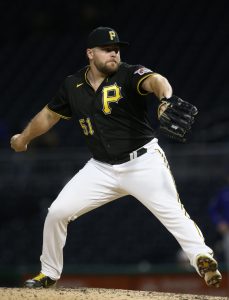
Over 60 2/3 innings, the now 27-year-old Bednar pitched to a 2.23 ERA. That was buoyed a bit by both a strand rate (84.9%) and opponents’ batting average on balls in play (.259) that might be tough to maintain. Yet it’s not as if Bednar’s success was a complete fluke. He struck out 32.5% of batters faced while walking only 8%. That’s a strong combination of punch outs and control, as the 24.5 point gap between his strikeout and walk percentages ranked 15th among the 138 relievers with 50+ innings pitched. His ERA checked in 17th among that group, while his 2.92 SIERA ranked 19th.
In addition to those strong results, Bednar boasts the kind of power stuff teams love in the late innings. His fastball averaged just shy of 97 MPH, according to Statcast, a personal high over his three MLB seasons. He backed that up with a solid splitter and a curveball against which batters made contact only a bit more than half the time they swung. Behind that three-pitch arsenal, Bednar generated whiffs on 15.5% of his offerings. That’s nearly four points higher than the 11.7% league average for bullpen arms, ranking 18th among those with 50 or more frames.
The Pirates certainly don’t have to trade Bednar this winter. The 2021 campaign was his first full season as a big leaguer, and he remains under team control through 2026. That includes the next two seasons at pre-arbitration salaries, making the right-hander an affordable option for the Bucs’ relief corps. (Alterations to the service time structure in the next collective bargaining agreement could affect that timeline, of course, although he’d come with at least two years of remaining control under any system that has thus far been reported to be under consideration in CBA talks).
That said, relief pitching can be volatile. Because Bednar didn’t settle into a big league bullpen until he was already 26, he’ll likely be 28 or 29 years old by the time the Pirates can reasonably expect to contend. Even if they don’t need to actively shop Bednar, the front office could be willing to pull the trigger on a deal if another team put enough young talent on the table.
There’s comparatively more urgency for the Bucs to trade Stratton. The righty is already 31 years old and has four-plus years of service under his belt. Without changes to the service time setup, he’d be controllable another two seasons via arbitration. MLBTR contributor Matt Swartz projects Stratton for a salary in the $2.2MM range for the upcoming season.
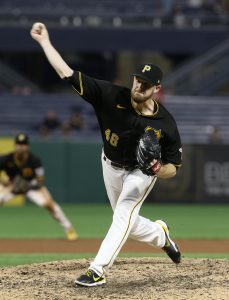
Stratton wouldn’t bring back as strong a return as Bednar could. Not only does he come with less remaining club control, he’s not as dominant. Yet Stratton is coming off a nice season of his own, his second straight solid year. He absorbed 79 1/3 innings of 3.63 ERA ball in 2021, posting capable strikeout and walk numbers (25.5% and 9.8%, respectively). That came on the back of a 12.4% swinging strike rate, his second consecutive season with better than average swing-and-miss numbers.
Going back to the start of 2020, Stratton owns a 3.70 ERA/3.61 FIP over 109 1/3 frames of relief. That’s come with above-average strikeout and swinging strike rates and roughly league average control. Opposing hitters own a .232/.306/.363 line against him in that time. Stratton isn’t an impact piece, but he’s a solid reliever who’d upgrade the middle or late innings for plenty of more immediate contenders around the league. Pittsburgh wouldn’t bring back a franchise-altering return, but his solid two-year run should allow the front office to recoup a mid-tier prospect on the trade market.
Stratton looks likelier of the Pirates’ top two relievers to wind up elsewhere over the next few months, but a Bednar move would involve a more significant return. It stands to reason teams will call the Pirates to gauge the asking price on both hurlers. Moving one or both of Bednar and Stratton could serve as the Bucs’ next step in their continued efforts to strengthen the farm system in anticipation of a contention window a few years down the road.
Images courtesy of USA Today Sports.
What’s Left In The Offseason Catching Market
As usual, this winter’s free agent catching market was pretty thin on viable everyday options, but there has been a fair amount of activity in general for teams looking to add new backstops.
Jacob Stallings and Tucker Barnhart were two of the more prominent trade candidates available, and both have already landed elsewhere, as the Pirates dealt Stallings to the Marlins and the Reds sent Barnhart to the Tigers. On the free agent side, Manny Pina and Yan Gomes each respectively found two-year contracts with the Braves and Cubs, while Roberto Perez signed with the Pirates, Pedro Severino signed with the Brewers, and Sandy Leon signed a minor league deal with the Guardians. In addition, Buster Posey‘s retirement was the biggest catching story of them all, as the longtime Giants star decided to end his playing career in the wake of an All-Star season.
If the lockout marks the end of the offseason’s first round of catcher musical chairs, let’s look at which teams and free agents still have needs to fill, and which other clubs could step forward with more trade possibilities.
Teams With Catching Needs
- Guardians: As much as Cleveland prioritizes defense over offense from the catcher position, it’s possible the team might stand pat with the combo of Leon and Austin Hedges. Prospects Bo Naylor or Bryan Lavastida also might factor into the picture during the season. But, for a team that needs hitting upgrades in general, catcher is an obvious area for improvement, given how little Hedges and Leon have traditionally offered at the plate.
- Orioles: Superstar prospect Adley Rutschman is slated to make his MLB debut in 2022, and the O’s will certainly slide Rutschman right into everyday work. However, Baltimore doesn’t have a single catcher in the organization with any Major League experience, so some type of veteran help will be required to handle the catching duties until Rutschman arrives, and then work as a backup the rest of the season.
- Angels: Max Stassi is set to start, though the Halos are in need of a backup catcher. Since Stassi is only controlled through 2022, the Angels could surely explore extension talks post-lockout if they feel Stassi is their long-term choice, or they might look to obtain such a controllable backstop now as a hedge against Stassi leaving in free agency.
- Yankees: Gary Sanchez was tendered a contract, so the former All-Star will be given another chance to rediscover himself at the plate, and also take a long-awaited step forward with his glovework. It seems clear by this point, though, that Sanchez is running short on rope with the Yankees, and backup Kyle Higashioka is a fine defender but might be a platoon option at best at the MLB level.
- Rangers: This is something of a speculative addition, as Texas has the defensively-adept duo of Jonah Heim and Jose Trevino on hand, and top prospect Sam Huff is expected to get another crack at the majors after his 2021 season was hampered by knee surgery. Even with all of this depth, the Rangers have already been so aggressive this winter that it wouldn’t be surprising to see them make another bold win-now move for catching help.
- Red Sox: While Christian Vazquez is signed through 2022, Boston has reportedly already started looking ahead to the future, as the Sox made a strong bid to obtain Stallings before the Pirates eventually took the Marlins’ offer. It remains to be seen if the Sox were enamored with Stallings specifically, or if they might be searching in general for another long-term catcher. If the Red Sox did obtain such a catcher who ready to contribute immediately, that could make Vazquez expendable, and thus slide Boston into the next section of…
Teams With Catchers Available (Or Maybe Available)
- Blue Jays: With Gabriel Moreno close to a big league debut, any of Alejandro Kirk, Danny Jansen, or Reese McGuire could be expendable at the right price. McGuire is out of minor league options and might be more of a trade candidate for teams looking for a backup, but Jansen or Kirk could be a starter on another club. Until Moreno actually arrives in the Show, it’s possible the Blue Jays could hold onto all of their catchers, as last year’s injuries to Jansen and Kirk evidenced how quickly depth can evaporate.
- Twins: Like the Jays, Minnesota also entered the winter as a natural trade target for catcher-needy teams, given the presence of both Mitch Garver and Ryan Jeffers. And, also like the Jays’ incumbent starters, Garver spent a big chunk of 2021 on the injured list, so the Twins might prefer to stick with their current duo and Ben Rortvedt at Triple-A. The Twins already removed one depth option from the roster when they released La Tortuga himself, Willians Astudillo, in late November.
- Cubs: Questions have been swirling about Willson Contreras‘ future in Wrigleyville ever since he was one of the few veterans remaining after Chicago’s trade deadline fire sale. Contreras is only under control through 2022, and in signing Gomes to a two-year deal, the Cubs may already be signaling that Contreras is still available. The Cubs have a promising minor league backstop in Miguel Amaya, though Amaya will miss a good chunk of the 2022 season after undergoing Tommy John surgery.
- Braves: Atlanta didn’t necessarily have a catching surplus entering the winter, but after signing Pina, the depth chart now sits as Pina and Travis d’Arnaud as the top two backstops on the active roster, and noted prospects Shea Langeliers and William Contreras left waiting at Triple-A. Despite all this depth, d’Arnaud has such a long injury history that the Braves might not be comfortable moving one of their catchers of the future, even though d’Arnaud and Pina are now both on guaranteed deals through 2023. Neither of the veterans is earning enough that they couldn’t themselves perhaps be trade candidates next winter should the Braves want to make room for Langeliers or Contreras.
- Padres: Another team that added to an already deep list of catchers, San Diego picked up Jorge Alfaro from the Marlins in the aftermath of the Stallings trade, putting Alfaro in a mix that already includes Austin Nola, Victor Caratini, and top prospect Luis Campusano. A.J. Preller is familiar with Alfaro from their shared time together in the Rangers organization, so this trade could amount to Preller wanting a closer look at a known quantity during Spring Training, and to see if the Padres could help Alfaro get his big league career on track. Assuming Alfaro isn’t cut loose at a fraction of his arbitration salary prior to Opening Day, another trade involving Nola, Caratini, or (maybe most likely?) Campusano can’t be ruled out, given Preller’s track record for major swaps.
- Royals: Last March, Salvador Perez was locked up to an $82MM contract extension that will keep the longtime catcher in K.C. through at least the 2025 season. Prospect MJ Melendez roared back into top-100 prospect lists after posting big numbers at both Double-A and Triple-A in 2021, and the 23-year-old Melendez seems like he is just about ready for the majors. With Perez blocking Melendez’s way, the Royals have a very intriguing trade chip on their hands.
- Athletics: Sean Murphy is under team control through the 2025 season, and yet for an A’s team looking to cut payroll, they are even reportedly open to moving a player that seems like a building block. Hypothetically, the A’s could look to trade Murphy as part of a larger deal, such as if another team also agreed to take an unfavorable contract (Elvis Andrus? Stephen Piscotty?) off of Oakland’s books. The Athletics have several other high-profile players who are both more expensive and much closer to free agency than Murphy, so while he is surely far from the top of Oakland’s list of players it would want to trade, the possibility of a move is certainly higher than zero. The A’s could certainly ask for a lot more than Pittsburgh got for Stallings, for instance, since Murphy is almost five years younger, a better hitter, and he comes with an extra year of control.
Free Agents
- Robinson Chirinos, Kurt Suzuki, Austin Romine, Wilson Ramos, Grayson Greiner, Austin Wynns, Chance Sisco, Jeff Mathis
This group is generally long on experience but short on recent success, as Chirinos’ 108 wRC+ ( from a .227/.324/.454 slash line in 112 PA with the Cubs) was far and away the best of a group that otherwise posted sub-replacement level hitting numbers. Also, Ramos’ recovery timeline is unclear after undergoing a third ACL surgery, and Mathis didn’t play in the majors or minors after being outrighted off the Braves’ roster back in May, so the 17-year veteran might be on the verge of retirement.
Chirinos probably offers the most upside for a team looking for a true regular or platoon candidate, considering his above-average .232/.327/.438 slash line and 90 home runs over 2147 PA since the start of the 2014 season. While Chirinos hasn’t been known for his glovework, he’d make a lot of sense for a team like the Guardians, with Hedges providing a defensive complement.
There is always a fair amount of fluidity in the catching market, as teams are forever tinkering with adding veterans as minor league depth options. As such, we’ll probably see most or all of the available free agents catch on somewhere during Spring Training, and the deck could certainly be shuffled based on a major injury to a catcher whose team isn’t listed here, or if any further trades open up other roster holes. If the Athletics did deal Murphy, for instance, that could send them pivoting towards adding a low-cost veteran to pair with Austin Allen. Or, speculatively, the A’s perhaps explore some trade possibilities with the Royals involving Melendez in order to replace Murphy with another highly-touted young backstop, since Oakland prospect Tyler Soderstrom is at least a couple of years away and might not be a long-term fit to remain at catcher.
It makes for an interesting set of storylines to watch once the transactions freeze ends and teams can once again start plotting their next moves for the catcher position, whether it be one of the clubs mentioned in these lists or perhaps a dark-horse team that was seemingly set behind the plate.
Should The Reds Let The Moose Loose?
After coming up short in this year’s Wild Card race, the Reds’ offseason has mostly continued along sour lines for the team’s fans. On the first day of the offseason, Tucker Barnhart was sent packing to Detroit. Shortly after that, GM Nick Krall said that the club “must align our payroll to our resources,” seemingly forecasting a gloomy winter of budget cuts in Cincinnati. That was followed by Nick Castellanos opting out of his contract and rejecting a qualifying offer. Then, Wade Miley was claimed on waivers by the division-rival Cubs, despite Miley having a $10MM club option for 2022 — an eminently reasonable salary for a pitcher who was worth 2.9 fWAR (per FanGraphs) or 5.6 bWAR (according to Baseball Reference).
In the four weeks since that time, all of the rumours surrounding the club have been about other teams circling their rotation like vultures, trying to acquire Luis Castillo, Sonny Gray or Tyler Mahle. It’s fairly logical that teams would come calling for those three talented arms, as they all come with two years of inexpensive control and pitching is simply always in demand. However, if you’re the Reds and you want to shave money off your payroll, a preferable option might be someone whose name hasn’t come up in trade rumors at all: Mike Moustakas.
“Moose” has two years remaining on the four-year, $64MM deal he signed two years ago, then the largest free agent signing in Reds franchise history. (That mark was tied the following month with the deal for Castellanos.) Moustakas will make $16MM in 2022, $18MM in 2023 and then Cincinnati holds a $20MM club option for 2024 that comes with a $4MM buyout.
That $16MM salary for 2022 makes him the second-highest paid player on team, trailing only Joey Votto. Moving that contract could therefore save about as much money as moving two of their three in-demand starters, given that Gray will be making $10.7 million this year, and Castillo and Mahle are projected to earn arbitration salaries of $7.6MM and $5.6MM, respectively. It also makes sense to move Moustakas given that his incumbent position of second base has been taken over by Jonathan India, who had a breakout season in 2021, earning himself the NL Rookie of the Year award in the process.
The trouble for Cincy is that trading Moustakas now would be selling low, as he just had an injury-ravaged campaign that was his worst in years, maybe the worst of his career. The infielder made multiple trips to the injured list due to issues with his heel, resulting in 62 games and 206 plate appearance. Even when he could take the field, Moustakas didn’t look like his old self. From 2015 to 2020, Moustakas hit .262/.326/.490, which amounts to a wRC+ of 113 and 12.5 fWAR. In 2021, he slashed a meager .208/.282/.372, producing a wRC+ of 70 and negative 0.4 fWAR — both career worsts.
Trading players when their value is low is generally unwise strategy, but for a Reds team on a limited budget, it might be the least-bad option they have. On paper, they currently have a platoon at third base, with Moustakas sharing time with Eugenio Suarez. However, Suarez is also coming off a down season and doesn’t have injuries to blame for it (although he could blame the team’s ill-advised attempts to turn him into a shortstop at the age of 29). Suarez has three years and $35MM left on his deal, with a salary of $11.3MM in 2022. That means the club currently has over $27MM dedicated to third base, between Suarez and Moustakas. For a club looking to cut costs, that seems even less wise than trading low on one of them.
Despite coming off a terrible campaign, it’s not out of the realm of possibility that another club could see the reasons for optimism. At 33, Moustakas is not too old to return to his previous form, as evidenced by his teammate Votto, who just had a tremendous year in his age-37 season. If he can return to health, he could be seen as an intriguing buy-low candidate. However, would a team give up anything of value for Moustakas while Kyle Seager is just sitting there on the open market?
Seager is less than a year older than Moustakas, has never had serious injury issues, and MLBTR predicts Seager for a deal in the range of two years and $24MM. Brad Miller, Josh Harrison or Jonathan Villar represent even less-expensive third base options on the open market. Win-now teams would also presumably be more interested in a trade candidate like Matt Chapman, assuming Oakland follows through on their planned selloff.
That means the Reds would almost certainly have to sweeten the pot of any Moose-based deal, perhaps including prospects. For a recent example, the Brewers recently traded Jackie Bradley Jr., who was also coming off arguably the worst season of his career. They had to include a pair of prospects, but still got a useful player out of the deal in the form of Hunter Renfroe.
The Reds’ front office seems to be stuck between a rock and a hard place, as while they weren’t good enough in 2021 and need to improve, they haven’t been given enough money from ownership to do so. On the other hand, Cincinnati also has too much young talent to go into a full rebuild, with India, Tyler Stephenson, Vladimir Gutierrez, Lucas Sims, Jose Barrero, Hunter Greene and Nick Lodolo forming a nice core of cheap and controllable players, alongside veterans like Votto, Suarez, Jesse Winker, and the rotation trio of Castillo, Gray and Mahle. Finding a version of the Renfroe trade could be their best path to supplementing a talented roster, instead of subtracting from it by trading one of their starting pitchers.
Perhaps a team like the Nationals would be interested in Moustakas and a couple of prospects? After all, they’ve just undergone a big selloff and seem unlikely to be aggressive in returning to contention in the short term. After running payrolls near $200MM in many recent years, the Nats are only projected at $118MM for 2022, according to Jason Martinez of Roster Resource. They could easily take on the $16MM owed to Moose and have him off the books by their last year of control over Juan Soto in 2024. Moustakas would also give Washington a fallback option in the event Carter Kieboom continues with his struggles at the MLB level.
The Diamondbacks have a tall hill to climb in order to return to being competitive, as they are staring up at the Dodgers, Giants and Padres. They only have about $85MM on the books for 2022, per Martinez, but have had payrolls in the range of $130MM in recent years, per Cot’s Baseball Contracts. They currently have Josh Rojas penciled in at third base, but he’s actually played at second more often so far. If the long-rumored Ketel Marte trade ever comes to fruition, Rojas could take over at second with Moose at third.
The Rockies are interested in adding a third baseman, as evidenced by their rumored interest in Kris Bryant. But if Bryant goes elsewhere, why not take on Moustakas and hope that he can use the Colorado air to get back into a groove at the plate? As notable as Moustakas’ salary is, his $16MM figure is certainly lower than what Bryant will earn in free agency.
And let’s not discount the possibility of a competitive team believing enough in a Moustakas bounceback to look for this kind of a deal. After all, the Red Sox just made it at far as the ALCS in 2021, but they’re now taking on extra prospects and crossing their fingers in the hope of Bradley rebounding from a brutal offensive year. Bradley comes with a higher floor than Moustakas because of his excellent glovework, but still, the logic is similar. Buy low on a big leaguer and make a wish, while filling out your team’s prospect pipeline. Even if the Reds can’t get themselves an exciting return on a deal like this, the real return would be hanging onto Castillo, Gray and Mahle for another couple of runs at the NL Central while the Pirates and Cubs are retooling.
Offseason Outlook: Philadelphia Phillies
Bryce Harper gave the Phillies exactly the type of season they hoped for when they signed him to the team’s first $300MM+ deal. Unfortunately, he couldn’t pitch the ninth inning (or the eighth inning), and the Phillies fell short of true contention yet again.
Guaranteed Contract
- Bryce Harper, OF: $263MM through 2031
- Zack Wheeler, RHP: $74MM through 2024
- J.T. Realmuto, C: $95.5MM through 2025
- Jean Segura, 2B:$15.485MM through 2022 (includes $1MM buyout of $17MM club option for 2023)
- Didi Gregorius, SS: $15.25MM in 2022
- Aaron Nola, RHP: $19.75MM in 2022 (includes $4.25MM buyout of $16MM club option for 2023)
- Kyle Gibson, RHP: $7.6MM in 2022
- Scott Kingery, IF/OF: $15.5MM through 2023 (includes $1MM buyout of $13MM team option for 2024)
- 2022 commitments: $130.7MM
- Total long-term commitments: $506MM
Projected Salaries For Arbitration-Eligible Players (projections from MLBTR contributor Matt Swartz)
- Zach Eflin, RHP: $6.0MM
- Rhys Hoskins, 1B: $7.6MM
- Jose Alvarado, LHP: $1.9MM
- Seranthony Dominguez, RHP: $800K
- Roman Quinn, OF: $700K
Option Decisions
- Andrew McCutchen, OF: Team declined $15MM option in favor of $3MM buyout
- Odubel Herrera, OF: Team declined $11.5MM option in favor of $2.5MM buyout
Free Agents
- McCutchen, Herrera, Freddy Galvis, Brad Miller, Ronald Torreyes, Hector Neris, Travis Jankowski, Archie Bradley, Ian Kennedy, Matt Moore, Chase Anderson, Cam Bedrosian, Brandon Kintzler, Matt Joyce, Andrew Knapp, Ramon Rosso, J.D. Hammer
The Phillies did it: they finished with a better than .500 record. The Bryce Harper era began on the heels of an 80-82 season in 2018, but before the ink was dry, a new era was supposed to have begun in Philadelphia. In the third season of the Harper era, the Phillies finally reversed that record, finished 82-80 and in second place, their first winning season since 2011. It only took three years and an MVP season out of Harper to get them there.
And while it’s nice to be a winning team – well-deserving of a pat on the back – the Phillies fell short of true contention. Instead, Harper watched from home as a division rival won the World Series for the second time in the three years. That has to smart.
Still, there’s no revelation coming to Philadelphia. In terms of strategy, it’s likely to be the same game script for the Phillies moving forward, though they’ll shuffle the cards and hope for a different result. President of Baseball Ops Dave Dombrowski is a fairly well-known commodity throughout the league, so if there’s a wrinkle coming in Philly’s team-building strategy, it might have to come from GM Sam Fuld.
The former outfielder has been with the Phillies for years, but his ascension to Dombrowski’s top lieutenant is less than a year old. As Grima Wormtongue to Dombrowski’s King Théoden, Fuld’s analytical approach should have taken root by now, but the organizational philosophy still seems relatively straight-forward: acquire players to help this team win today.
Looking back to Philly’s deadline moves, dealing five years of control over former top prospect Spencer Howard for a year and a half of Kyle Gibson is an old-school deadline add, though the inclusion of 23-year-old Hans Crouse hints at more nuanced thinking. That said, Crouse made two starts in the Majors after his arrival, so the Phils clearly see him as an option for innings in 2022.
The focus of the front office is putting a winning team on the field ASAP, and in this way, the Phillies are a breath of fresh air in an era popularized by “cute” front offices, constantly balancing short-term value with long-term flexibility. The Phillies may seem to be working with blunter instruments at times, but what sets the apart as an organization right now is that they don’t mind if everyone knows how badly they want to win.
In the dugout, there aren’t nearly as many tea leaves to read. Manager Joe Girardi needs to win baseball games. With whatever 26-and-40-man roster he has at his disposal come opening day, he needs to win games.
Since Charlie Manuel’s departure midway through the 2013 season, managers haven’t stayed overlong in Philadelphia. Each of Ryne Sandberg (278 games, .428 W-L%), Pete Mackanin (412 games, .422 W-L%), or newly-crowned NL Manager of the Year Gabe Kapler (324 games, .497 W-L%) lost their caps in relatively short order. Girardi (222 games, .495 W-L%) may be nearing a tipping point as well.
Girardi isn’t all that close to eclipsing his predecessors’ raw totals in terms of games managed, but if Girardi can make it through 2022, he’ll be the first to last three full seasons since Manuel. Getting sacked before the end of next season is hardly a fait accompli for Girardi, though his disappointing tenure has coincided with a green-lit era of full-go contention for the front office. Needless to say, expectations are high. Don’t be surprised to see Girardi as a high draft pick in your office’s first manager fired pool.
So what do Dombrowski and Fuld need to put Girardi in position to keep his job? The roster is tough to analyze, because in some regards, 2021 went exactly as planned. Harper won his second MVP award after slashing .309/.429/.615 with a league-leading 42 doubles, 35 home runs, 101 runs scored, and a robust 170 wRC+. Zack Wheeler led the Majors with 213 1/3 innings pitched, he was second among hurlers with 7.3 fWAR, and his 2.78 ERA/2.59 FIP were among the best marks in the game. He faced more batters than any other pitcher in the NL, and he struck out more of them (247) than any other pitcher in the NL. He finished second in voting for NL Cy Young.
If baseball were a two-man game, the Phillies might be the champs. Unfortunately, Harper and Wheeler’s outlandish success in 2021 is as much a cause for skepticism as it is optimism. After all, even with those stellar campaigns, the Phillies barely broke an even record. Harper and Wheeler should continue to be good, but it’s not fair to expect MVP and Cy Young seasons every year. That said, the duo forms a pretty solid foundation.
You can add J.T. Realmuto and Aaron Nola to that solid core. Nola tossed 180 innings, and though his bottom-line run-prevention numbers were sub-optimal (4.63 ERA), his 3.37 FIP, 29.8 percent strikeout rate, and 5.2 percent walk rate fall in line with career expectations and suggest Nola continues to be a solid front-of-the-rotation arm.
In the first year of his new five-year contract, Realmuto posted 3.5 rWAR and played his role as Harper’s running mate to perfection. He was a little nicked-up down the stretch, forcing a tad more playing time for Andrew Knapp and Rafael Marchan, but he still managed to play in 134 games and step to the plate 537 times. The catchers’ room already looks a little different with Garrett Stubbs and Donny Sands joining Realmuto and Marchan, but the bottom line here is that so long as Realmuto stays healthy, the Phillies ought to be a top-10 team in cacher fWAR again (they were 8th by fWAR in 2021).
At the risk of turning this into a bit of a ho-down, let’s keep two-stepping through the roster, where Rhys Hoskins and Kyle Gibson appear next. Hoskins and Gibson aren’t nearly the talents of the names above, but they ought to be solid contributors to a contending team.
Hoskins’ footspeed and defensive ability make him a limited player, but if he’s healthy, his bat belongs in the middle of the order. He is a career 122 wRC+ bat coming off a .247/.334/.530 batting line across 443 plate appearances. His peripherals are remarkably steady, even if his walk rate did fall a touch to a career-low 10.6% in 2021. Hoskins should plan to inch that number even a tad closer to his 14.3% career walk rate and let his power do the rest. As a designated hitter, he’s a grand option, but even wearing his first baseman’s glove, Hoskins figured to continue to be a 2-2.5 fWAR player. In brief, there’s nothing wrong with Hoskins’ roster spot.
If Hoskins is a bronze level bat, then Gibson is more-or-less the rotation equivalent. Where Hoskins brings power to the plate, Gibson’s value proposition is an uncanny ability to keep the ball on the ground. His 51.7% groundball rate in 2021 was right near his career average of 51.5% – well above the 41.2% league average mark. Keeping the ball on the ground helps Gibson keep the ball in the yard, which Gibson accomplished at rates he hadn’t hit since his late-twenties (0.84 HR/9, 11.1% HR/FB). Gibson’s 3.0 fWAR was the best mark of his career, and his 3.71 ERA/3.87 FIP were close.
Beyond worm killing, Gibson’s calling card has been his reliability. A starter that takes the ball every five turns will start about 20% of his team’s games, and Gibson’s never started less than 15% of his. He’s a textbook first division number four starter, even entering his age-34 season.
One problem in team-building, of course, is asking players to move up a rung. If Gibson is your best starter, as he was with the Rangers last year, that’s not going to be a very good team. And if he’s your number three, as he was with the Phillies, that’s probably an average-ish team. That’s a simplistic take, as there are many ways to build a winning club, but the point here is a broader one about the depth of recent Phillies’ ballclubs: they don’t have it, and they need it. The six players above get a lot of guff for this Philly club, but they aren’t the problem. If anything, reliance on this sextet is the problem.
Bottom line, the Phillies have holes to fill, and they don’t have the talent pipeline to do so internally. So where to begin? The obvious place is the bullpen, which was a disaster: 27th with 1.1 fWAR, 25th with a 4.60 ERA, 27th with a 4.61 FIP, 21st with 36 saves, and of course, ripped from the headlines, tied with the Nats for the most blown saves in the game with 34. The bullpen was bad. Or rather, the bullpen pitched poorly. But bullpens are fickle, and they’re easier to turn around year-to-year than any other aspect of a roster.
So let’s start with fixing the offense, which should be a more urgent priority for Dombrowski. They need a centerfielder, and after declining McCutchen’s option, they need a left fielder as well. They could, conceivably, take the field on opening day with Alec Bohm and Didi Gregorius on the left side of the infield, but based on their 2021 production alone – ignoring their prospect pedigree and contract, respectively – both should be replaced. That’s half of the starting lineup that could use an upgrade. And yet, the Phillies remained one of the most inactive teams in the game prior to the roster freeze.
Centerfield remains the biggest hole on the Philadelphia roster, no less so after declining their option on Odubel Herrera, who led the team with 104 games in center last year. Herrera rebounded from his long layoff relatively well, posting 1.8 rWAR/1.1 fWAR in 492 plate appearances. He walks at a below-average rate (5.9%) and he puts the ball in play more often than most (15.9% strikeout rate), but that contact had little pop behind it in 2021 as Herrera managed just a .156 ISO. He didn’t embarrass himself out there, but he didn’t add much value for a Philly squad that needs bit of production it can get.
They need to turn centerfield into a better-than average spot, and there aren’t a plethora of options available. Mickey Moniak and Adam Haseley would be penciled in as the starters in center and left, respectively, though the Phils probably want both coming off the bench in 2022. ‘
That means scouring the market, where there aren’t lot of true centerfielders available. Starling Marte would be option A in free agency, had he not signed with the rival Mets, and Byron Buxton is the highest-ceiling potential trade target, had he not signed an extension with the Twins. They might check in with Oakland about their available position players, whether that be Ramon Laureano for center or Matt Chapman for third.
As for the bullpen, it already looks a little different than at the end of last season. Hector Neris signed a two-year deal with the Astros, while Corey Knebel has joined the Phillies on a one-year deal. Knebel will be a closing option for Girardi. Jose Alvarado from the left side should also get plenty of high leverage opportunities. They claimed southpaw Ryan Sherriff off waivers from the Rays as well. Sherriff has been seen spotty action for the Cardinals and Rays, but he’s never spent a full season on the Major League roster.
The Phillies have a lot of work to do. They signed Johan Camargo just before the lockout, and while Camargo adds valuable versatility, he hasn’t been productive at the plate since 2018. He can be a part of the bench, but he’s not a solution for the left side of the infield. Nor does he solve the problems in the outfield. Nor will he close games. At this stage, however, it’s important to remember that the addition of Camargo and Knebel represent the beginning of the Phillies’ offseason, not the end of it.
Nationals’ Under-The-Radar Deadline Pickup Off To Strong Start In D.C.
The Nationals had a high-profile teardown this past July. The biggest splash sent Max Scherzer and Trea Turner to the Dodgers, while other notables like Kyle Schwarber, Yan Gomes and Daniel Hudson were flipped to contenders. Almost buried amidst that flurry was a lower-profile swap announced less than an hour before the deadline: acquiring outfielder Lane Thomas from the Cardinals for veteran starter Jon Lester. While that trade didn’t grab nearly as many headlines as some of the Nats’ other moves, the early returns look very promising.
Thomas has been around for a few seasons, but he never got an extended look with St. Louis. Between 2019-21, he struggled to a .172/.289/.336 line across 142 scattered plate appearances. Generally regarded by prospect evaluators as a fourth outfield type and turning 26 years old in August, it’s easy to understand why the Cardinals’ front office was willing to make him available. Yet Thomas picked up everyday run on a depleted Washington roster down the stretch, putting up quietly excellent numbers.
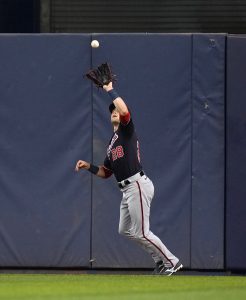
Over 206 plate appearances in the nation’s capital, the former fifth-round pick posted a .270/.364/.489 slash line, hitting seven home runs and stealing four bases. He spent the bulk of that time in center field, playing well enough to supplant former top prospect Víctor Robles on the depth chart. That offensive output was 27 percentage points above the league average, by measure of wRC+. More encouragingly, it was largely backed up by strong plate discipline and batted ball metrics.
During his end-of-season run, Thomas demonstrated an enviable combination of patience, bat-to-ball skills and power on contact. The right-handed hitter had an extreme willingness to work deep counts, a continuation of a trend he’d shown in St. Louis. Thomas swings far less often than most at pitches both inside and outside the strike zone, a plan of attack that allows him to draw plenty of walks but also puts him at risk for his share of strikeouts. Yet he kept the punch outs manageable during his time in Washington by making contact on a robust 82.4% of his swings (about six percentage points higher than the league mark).
That patience and contact frequency gave Thomas a strong floor from an on-base perspective, but his contact authority was particularly impressive. The Tennessee native had an average exit velocity of 91.7 MPH, more than three ticks harder than the 88.1 MPH league average. According to FanGraphs, he made hard contact on 45.1% of his batted balls with the Nats. The average MLB hitter (excluding pitchers) had a 32.5% hard contact rate in 2021.
That’s a rare set of skills, even in a limited sample of work. Among the 463 players with at least 100 plate appearances, only sixteen managed a hard contact rate north of 40% while striking out in fewer than a quarter of their trips to the dish. Other than Thomas, every player in that group posted a wRC+ of 122 or higher (indicating they were at least 22 percentage points more productive than average offensively). Removing Thomas’ poor 58 plate appearances with the Cardinals early in the season puts him right among that very impressive list of names, both from a results and process perspective.
That’s not to say Thomas is absolutely an elite hitter now, or even that the Cardinals made a mistake in giving him up. Lester was a reliable source of decent innings down the stretch, helping St. Louis to a fantastic second-half run to the postseason. And Thomas needs more than two months of strong performance to cement himself as a core member of the Nats’ future.
His first couple months in a Washington uniform couldn’t have gone much better, though. At the very least, he’s earned an extended opportunity to try to cement himself alongside Juan Soto in the long-term outfield. The Nationals are likely to take a step back in 2022 as they audition younger players like Thomas, but they prioritized near-MLB returns during their deadline sell-off and aren’t about to embark on a rebuild while Soto is under club control. Washington may need some things to fall into place to be realistic contenders in what should be a competitive NL East by 2023. Thomas settling in as a productive regular would be one those pluses, and he’s started off on the right foot with his new club.
Image courtesy of USA Today Sports.
How The MLB Luxury Tax Thresholds Have Changed By Year
There was a time when the MLB players’ union felt that a luxury tax is just a salary cap in another form, with is why they rejected such proposals back in 1994. Nonetheless, in the first post-strike collective bargaining agreement, executive director Don Fehr “finally said yes to the luxury tax – the first time the union agreed to any form of payroll restraint since free agency changed everything in 1976,” to quote Jon Pessah’s book The Game.
Though Pessah called that CBA a “huge victory for Fehr and the union” for other reasons, the owners did get their foot in the door on the matter of a luxury tax. The luxury tax wound up snowballing into a major problem for the players in recent years.
In that CBA, the tax thresholds were set like this:
- 1996: no luxury tax
- 1997: $51MM
- 1998: $55MM, a 7.8% increase
- 1999: $58.9MM, a 7.1% increase
- 2000: no luxury tax
- 2001: if MLBPA exercises its option for ’01, no luxury tax
Mechanisms were also put in place that could allow the 1997-99 thresholds to be higher, depending on where the fifth and sixth-highest payrolls in the game landed. Tax rates were set at 35% on the overage for ’97-98 and 34% for ’99.
While that CBA technically ended with two years sans luxury tax, it became part of all future agreements. The agreement that began in 2003 saw the luxury tax rebranded as the “competitive balance tax.” The MLBPA was able to achieve an initial major increase in the thresholds from where they left off in ’99:
- 2003: $117MM, a 98.6% increase from ’99
- 2004: $120.5MM, a 3% increase
- 2005: $128MM, a 6.2% increase
- 2006: $136.5MM, a 6.6% increase
For this CBA, a concept was introduced to penalize second, third, or fourth-time offenders with a higher tax rate. The first-time offender rates were set at 17.5% in ’03 and 22.5% in 2004-05, yet was removed entirely for ’06. 30-40% tax rates were set for teams that exceeded the threshold multiple times during that CBA.
For the CBA beginning in 2007, the tax thresholds were set as follows:
- 2007: $148MM, an 8.4% increase
- 2008: $155MM, a 4.7% increase
- 2009: $162MM, a 4.5% increase
- 2010: $170MM, a 4.9% increase
- 2011: $178MM, a 4.7% increase
Here after an initial “new CBA” leap, we start to see the tax thresholds moving up more slowly. The tax rates were set at 22.5%, 30%, and 40% and began penalizing teams for exceeding the thresholds in consecutive years, introducing the concept of teams “resetting” its rate by getting under the threshold for one season.
For the CBA beginning in 2012, these were the tax thresholds:
- 2012: $178MM, no increase
- 2013: $178MM, no increase
- 2014: $189MM, a 6.2% increase
- 2015: $189MM, no increase
- 2016: $189MM, no increase
Here, the players’ union made large concessions that had a compounding effect they’re still feeling today. If the MLBPA had achieved simply a repeat of the increases from the previous CBA, the 2016 tax threshold would have sat at about $232MM.
The next agreement introduced the concept of luxury tax tiers, adding first and second surcharge thresholds after the base tax one. For example, 2021 included thresholds at $210MM, $230MM, and $250MM. This CBA also introduced penalties involving the draft.
- 2017: $195MM base tax threshold, a 3.2% increase
- 2018: $197MM, a 1.0% increase
- 2019: $206MM, a 4.6% increase
- 2020: $208MM, a 1.0% increase
- 2021: $210MM, a 1.0% increase
While better than the previous CBA, the MLBPA again agreed to tiny increases in the base tax threshold. A simple 5% increase per year beginning in 2012 would have put the 2021 base tax threshold around $290MM, yet it sat only at $210MM. Not coincidentally, only the Dodgers and Padres exceeded a $210MM payroll this year. You can see the restraint this put on a club like the Yankees, which had a lower 2019 Opening Day payroll than it had in 2005.
In the current negotiations, MLB made an initial proposal that included lowering the base tax threshold to $180MM. According to Gabe Lacques and Bob Nightengale of USA Today, “In final proposals exchanged Wednesday, players requested a $245 million luxury tax threshold, with no progressive penalties for offenders; owners are offering a $214 million threshold, rising to $220 million in the final year of a five-year agreement.”
With a request to jump to $245MM, the MLBPA is proposing a 16.7% jump over the ’21 threshold, which would only begin to make up the ground they lost due to the non-existent or miniscule increases from 2012 onward. MLB, meanwhile, would like to increase the base tax threshold by 1.9% for 2022 and is proposing average annual increases of less than 1%.
How The MLB Minimum Salary Has Changed With Each New CBA
collectAs we enter Day 1 of the MLB lockout, one key issue in the current labor negotiations is where the players’ minimum salary will land. Given the union’s stated goal to get players paid more when they’re younger and more productive, it stands to reason that they’re seeking a more significant increase than usual. The minimum salary was set at $570,500 in 2021. It’s not known how much MLB proposed raising it in their most recent offer. Here’s a look at how the minimum salary has changed with each new CBA.
- 1968: Minimum salary went from $6K to $10K, a 66.7% increase
- 1970: $10K to $12K, a 20% increase
- 1973: $13.5K to $15K, an 11.1% increase
- 1976: $16K to $19K, an 18.8% increase
- 1980: $21K to $30K, a 42.9% increase
- 1985: $40K to $60K, a 50% increase
- 1990: $68K to $100K, a 47.1% increase
- 1997: $109K to $150K, a 37.6% increase
- 2003: $200K to $300K, a 50% increase
- 2007: $327K to $380K, a 16.2% increase
- 2012: $414K to $480K, a 15.9% increase
- 2017: $507.5K to $535K, a 5.4% increase
In the free agency era, the minimum salary had always increased by at least 15.9% until the just-expired CBA. There is historical precedent for a leap as high as 50%, which would mean $855,750 for 2022. An increase of 16% would be more in line with the ’07 and ’12 CBAs, which would set the minimum at $661,780. It should also be noted that the minimum salary typically increases each year within a CBA, with the ’20 and ’21 rates involving cost of living adjustments.