
Offseason In Review: Chicago White Sox
This is the latest post of MLBTR’s annual Offseason in Review series, in which we take stock of every team’s winter dealings.
The White Sox pinned most of their offseason hopes to signing Manny Machado, and instead wound up adding a series of largely unexciting veteran players.
Major League Signings
- Kelvin Herrera, RP: two years, $18MM
- Jon Jay, OF: one year, $4MM
- James McCann, C: one year, $2.5MM
- Total spend: $24.5MM
Options Exercised
Trades and Claims
- Acquired P Manny Banuelos from Dodgers for IF Justin Yurchak
- Acquired RP Alex Colome from Mariners for C Omar Narvaez
- Acquired SP Ivan Nova from Pirates for P Yordi Rosario and $500K in international bonus pool money
- Acquired 1B Yonder Alonso from Indians for OF Alex Call
- Claimed RP Josh Osich off waivers from Orioles
Notable Minor League Signings
- Ervin Santana. Brandon Guyer, Randall Delgado, Ryan Goins, Evan Marshall, Matt Skole, Donn Roach, Chris Johnson, Preston Tucker
Notable Losses
- Avisail Garcia, James Shields, Omar Narvaez, Matt Davidson, Kevan Smith, Hector Santiago, Ryan LaMarre, Ian Clarkin
Of MLBTR’s top ten free agents this winter, the White Sox reportedly showed some level of interest in at least seven of them. Their most high-profile pursuit was that of Manny Machado. Prior to the Winter Meetings, GM Rick Hahn tried to make it clear to reporters that he couldn’t “guarantee by any stretch that we’re going to convert on these targets.” Dallas Keuchel and Craig Kimbrel notwithstanding, the dust has settled on the offseason, and the White Sox failed to convert on any premium player they were targeting.
Looking at what the team actually did, this was a fairly typical recent White Sox offseason. It’s just that fan expectations tend to balloon when front office brass is meeting with Bryce Harper and Manny Machado, we know the team can afford either player, and it’s about that time where a rebuilding process draws to a close. The club hung around in the Machado bidding til the bitter end, strangely acquiring Manny’s brother-in-law Yonder Alonso and good friend Jon Jay presumably to help close the gap on an offer that fell far short. Here’s White Sox executive vice president Kenny Williams attempting to defend the team’s eight-year, $250MM final offer, as reported by Daryl Van Schouwen of the Chicago Sun-Times: “People are lost on the fact that on a yearly basis, our offer was more than San Diego’s. The average annual value was $31 [million] and change. So it was about years guaranteed. So there is an argument that could be made that our offer was the better of the two. It certainly had more upside for him. All he had to do was basically stay healthy.” This is almost comical, as is Williams’ assertion that if the team had gone further financially, fans would have been “much more disappointed in our inability to keep this next core together.” The key piece of that core, Eloy Jimenez, remains a minor leaguer for the purpose of gaining control of his 2025 season. The team’s “next core” literally hasn’t reached the Majors yet, but giving Machado an extra two years would break it up?
Chicago’s offer to Machado came in a full $50MM shy of the contract he received from the Padres. The Sox thought this star free agent was going to be swayed by a ridiculous $100MM in additional non-guaranteed money, or by the acquisition of his buddies? Going into free agency, there was never a reason to think $250MM would get the job done for Machado or Harper, so why even try? Hahn’s claim that the Sox made a “very aggressive offer” is patently untrue. With every large market team sitting out Machado’s market and the price coming in much lower than it could have been, the White Sox still never got close. After losing out on Machado, Hahn pledged, “The money will be spent. It might not be spent this offseason, but it will be spent at some point. This isn’t money sitting around waiting to just accumulate interest. It’s money trying to be deployed to put us in best position to win some championships.”
Perhaps Hahn said that so that Sox fans will dream about signing Anthony Rendon or Xander Bogaerts next winter, but the Machado progression hardly inspires confidence that White Sox owner Jerry Reinsdorf is willing to outspend the field for a premium free agent. When Reinsdorf last did that by signing Albert Belle – over 22 years ago – Bud Selig and the owners were stunned that “the owner who’s railed the loudest and longest about curbing player salaries has just broken the bank,” wrote Jon Pessah in his 2015 book The Game. There’s little reason to think Reinsdorf will shatter precedent again.
Given the self-imposed $250MM limit on Machado, the White Sox knew they weren’t going to get close on Harper. The White Sox certainly explored other avenues, including upgrades at catcher. They made a multiyear offer (terms unknown) to Yasmani Grandal, according to Robert Murray of The Athletic. And the Sox were “in the mix” for J.T. Realmuto, according to Ken Rosenthal. The White Sox had moved on from last year’s tandem, Omar Narvaez and Kevan Smith, deciding someone new should pair with Welington Castillo in 2019. They went with non-tendered former Tigers catcher James McCann. Patrick Nolan of Sox Machine disparaged the choice, writing, “The White Sox’ young pitchers have had the misfortune of throwing to tiny strike zones and guys who let the ball get away, and McCann’s poor receiving and pitch-blocking will help continue that trend.” It’s particularly painful to see a pitcher’s dream backstop, Martin Maldonado, sign with a division rival for the same contract (although Maldonado’s asking price at the time McCann signed had not yet fallen to this level).
The White Sox made reasonable efforts to address their bullpen this winter, trading Narvaez for Colome in November and signing Herrera in January. Colome is under team control through the 2020 season, though his salary in that season will climb even higher than this year’s $7.325MM. He’s a solid reliever who stands a good chance of serving as the team’s closer. They also signed Herrera to a two-year deal with a vesting option for a third season. Herrera had surgery in September to repair a torn Lisfranc ligament in his foot, but he’s made his Cactus League debut, implying the procedure may not affect him during the 2019 season. Herrera’s got some other red flags, such as 2018’s declining strikeout and ground-ball rates, but the 29-year-old still throws 97 miles per hour and has a chance to be a major asset to Chicago. Along with holdovers Nate Jones and Jace Fry, this could be a decent bullpen, especially compared to the cumulative work of last year’s unit. The White Sox reportedly showed interest in Adam Ottavino, Andrew Miller, and Joe Kelly before they signed elsewhere.
With highly-regarded pitching prospect Michael Kopech out for 2019 due to Tommy John surgery and James Shields gone to free agency (though technically still unsigned), the White Sox reportedly poked their head in on free agents Patrick Corbin, J.A. Happ, and Nathan Eovaldi, before ultimately trading for Ivan Nova in December. Nova, owed $8.5MM in 2019, is a pitch-to-contact, homer-prone veteran who projects for an ERA around 4.60. If you’re looking for a veteran starter who could potentially be flipped for something interesting in July, Nova doesn’t qualify. Nor does Ervin Santana, who signed a minor league deal but seems likely to eventually earn the team’s fifth starter job.
“Fundamentally this is a baseball deal,” Hahn told reporters upon acquiring Alonso from the Indians in December, but that claim hardly stands up when looking at the types of contracts that comparable first-base-only sluggers received this offseason (MLBTR Free Agent Tracker link). I again turn to Patrick Nolan of Sox Machine, who explains that adding Alonso at designated hitter will “either eat into Daniel Palka’s plate appearances or force everyone to watch Palka play the outfield more often,” while it also “helped out a division rival with $8 million in cash relief.” That’s a little harsh, but in Nova and Alonso, the White Sox took on $17.5MM for a pair of players projected by Steamer and ZiPS to be worth about one WAR apiece in 2019. It feels like spending money just to spend money.
Jay, his friendship with Machado aside, is an acceptable veteran stopgap for a club that parted ways with longtime right fielder Avisail Garcia. Top prospect Eloy Jimenez will start the season at Triple-A after being optioned just hours ago — presumably to “work on his defense” or another semi-vague reason that will be resolved once he cannot accrue a full year of service time in 2019 (as is commonplace throughout the league with this caliber of prospect). Until Jimenez arrives, none of the White Sox outfielders look like part of their next contending team.
The truly baffling aspect of Chicago’s offseason additions is that had they simply condensed the money offered to that patchwork collection of stopgaps, those resources could’ve been utilized to up the offer to Machado — a transformative player who’d move the needle considerably more not only in 2019 but in the long term. The near-$50MM they spent on this offseason’s group is worth much more than $50MM in 2028-29 dollars. Perhaps the Padres would’ve been willing to further increase their proposal had the ChiSox presented a legitimately competitive offer, but the approach would’ve been much more understandable.
2019 Season Outlook
Fangraphs projects the White Sox as a 70-win team this year, virtually no different from the Tigers or Royals. Given the team’s run at Machado, this may seem like an incredibly disappointing offseason, but go back to something Hahn said in September 2017: “I think even under the most optimistic projections of our ability to contend, certainly ’18 and ’19 don’t include the bulk of the time when we anticipate having a window open to us.”
So, it seems the club was willing to sign Machado or Harper at a relative bargain price and maybe make a little noise in ’19, but that duo’s free agency was always coming a year before the White Sox thought their team would be ready. The White Sox have just $12.5MM committed to two players for the 2020 roster, so they’ll again enjoy major payroll flexibility in the offseason. Generally, you don’t get a fourth year for an intentional rebuild, so it’s 2020 or bust for this group.
How would you grade the White Sox’ offseason? (Poll link for Trade Rumors app users.)
How would you grade the White Sox' offseason?
-
D 33% (1,842)
-
F 32% (1,799)
-
C 26% (1,480)
-
B 8% (444)
-
A 1% (81)
Total votes: 5,646
Offseason In Review: Pittsburgh Pirates
This is the latest post of MLBTR’s annual Offseason in Review series, in which we take stock of every team’s winter dealings.
The ever-patient Pirates are again in wait-and-see mode after spending much of the offseason on the sidelines.
Major League Signings
- Jung Ho Kang (re-signed), 3B: 1 year, $3MM
- Lonnie Chisenhall, OF: 1 year, $2.75MM
- Jordan Lyles, RP/SP: 1 year, $2.05MM
- Total spend: $7.8MM
Trades and Claims
- Acquired SS/UTL Erik Gonzalez, RHP Dante Mendoza and RHP Tahnaj Thomas from Cleveland for OF Jordan Luplow and IF Max Moroff
- Acquired RHP Wilkin Ramos from Oakland for RHP Tanner Anderson
- Acquired RHP Yordi Rosario and $500K in international spending capacity from the White Sox for RHP Ivan Nova
- Claimed RHP Aaron Slegers off waivers from Minnesota
- Claimed RHP Jake Barrett off waivers from San Francisco
Notable Minor League Signings
- Francisco Liriano, Melky Cabrera, Tyler Lyons, Nick Franklin, Rookie Davis, Brandon Maurer, JB Shuck, Vicente Campos, Roberto Gomez, Steven Baron, Patrick Kivlehan
Notable Losses
- Nova, Luplow, Moroff, Jordy Mercer, Josh Harrison
Needs Addressed
The mid-decade Pirates, bursting at the seams with full-burn stars and depth for days, as well as a top-end farm system, were as well-positioned as any in recent memory for the Big Move, a three- or four-for-one swap that would have catapulted the team to the top of the National League. It never came. Fan clamoring fell on deaf ears in the team’s front office, which preferred to lean on its then-renowned player development system to unveil its next crop of new-wave talent, already, it often seemed, in full bloom.
Struggles followed. Stalwarts Starling Marte and Jung-Ho Kang were sidelined with off-field issues, Andrew McCutchen was an avatar of his former self, and the top end of the rotation looked more like the middle. The team’s vaunted Shark Tank bullpen had been drained. Nascent cornerstone Gregory Polanco had hit the skids. The window, suddenly, seemed closed.
But as the team plodded through a mediocre 2018 season (and after McCutchen and Gerrit Cole had been sent packing in the months prior), the brass finally showed its sword, sending out multiple top prospects in deadline deals for late-inning reliever Keone Kela and peripheral ace Chris Archer. It felt like Pittsburgh, so often content to fold, may finally be primed to throw its chips into the middle.
Alas, as the offseason’s nears its end, the Pirates are still playing coy. The team didn’t spend more than $3MM on a single free agent this offseason. Its only major trade – an attempt to shore up shortstop, its weakest position in recent years – brought back a 27-year-old utility player in Erik Gonzalez as its headliner. Gonzalez, who’s slashed .263/.292/.389 in just 275 career MLB plate appearances, will get short’s first crack this season.
Another former Indian, Lonnie Chisenhall, was brought in on the cheap for corner-outfield insurance; the team will cash in the policy immediately, as Gregory Polanco, who finally broke out in ’18, will miss at least the first few weeks with a shoulder injury. Chisenhall’s last two seasons have been marred by injury; they’ve also been fueled by rockets, as the 30-year-old has posted successive career-highs in hard-hit rate, OBP, and wRC+, and appeared finally to be fulfilling his early-career promise when on the field.
Jung Ho Kang, the soon-to-be 32-year-old third baseman, is the real wildcard here. The team would like to find regular at-bats for Colin Moran, but Kang, who’s posted a team-best 129 career wRC+, could anchor the lineup if he can somehow regain his form. After multiple DUI arrests in his native Korea, and a sexual assault charge levied in his brief time in the states, Kang’s leash will be short – too long, still, for some fans, but the Pirates clearly know what they have in the former MVP of the KBO, and will be over the moon if he can at least approximate his mid-decade output.
Under-the-radar bullpen pickups Lyons, Maurer, Barrett, and Liriano (once a key figure in the team’s renaissance) endeavor to give the unit the depth it lacked in recent years. If even one can be righted under the mystical tutelage of pitching coach Ray Searage, the Tank may yet be full again.
Jordan Lyles will bring his steadily-climbing fastball velocity and much-improved curveball to the battle for the fifth rotation spot. Prolonged stretches of effectiveness have thus far eluded him in his eight-year MLB career. By effectively swapping him in for Ivan Nova, the Pirates shaved over $6MM of payroll but parted with Nova’s steady (if unspectacular) output.
Questions Remaining
The outfield unit is set and could be a fairly good one if Chisenhall is healthy and Marte and Corey Dickerson can repeat their 2018 efforts. Melky Cabrera is presently battling with J.B. Shuck, Patrick Kivlehan, and Nick Franklin for a roster spot and a reserve role. They’ll have to beat out 40-man members Pablo Reyes and Jose Osuna for a seat at the table.
Catcher (Francisco Cervelli and Jacob Stallings, pending the return of Elias Diaz) and first base (Josh Bell) are settled. Otherwise, there are even greater questions in the infield but also quite a few possibilities. Third base will be covered at the outset by a Moran/Kang platoon, while Adam Frazier will factor heavily at second and Gonzalez figures to have the inside track at short.
It’s not hard to envision changes at the 4-5-6 positions throughout the season. Shortstop is the real issue here, but the team, with its grounder-heavy staff, has never much seemed to care about offense at the position, instead entrenching sure-handed gamers like Jordy Mercer and Clint Barmes there in the last few seasons. Gonzalez is cut from similar cloth. Former top prospect Kevin Newman – who once ranked as high as #23 overall on Keith Law’s list – is hot on Gonzalez’s heels, though he hasn’t hit much after a midseason promotion to AA in 2016. Kevin Kramer is another well-regarded middle-infield prospect; he has served mostly at second base in the minors. Kramer struggled in his first taste of the majors last year, but only after turning in an eye-opening run at Triple-A. Reyes may also factor in the infield mix. Top prospects Cole Tucker (shortstop) and Ke’Bryan Hayes (third base) are nearing MLB readiness and could force their way up during the season to come.
The back-end of the rotation could be a problem: Joe Musgrove, though possessing of the ideal command/sink combination that drives the organization wild, has a checkered injury history and again dealt with multiple ailments last season. Trevor Williams has solidified his spot, but he rarely misses a bat (his swing-and-miss rate was the league’s third-lowest last season) and ERA estimators (xFIP, in particular) are not optimistic. If either falters, or misses significant time, the Pirates better hope that Nick Kingham (torched in limited action last season) or top prospect Mitch Keller is ready to make the jump. You have to squint to see Lyles as a suitable replacement for Nova, leaving the Bucs heavily reliant upon their preexisting collection of young arms.
What to Expect in ’19
The NL Central looks to be a thresher. The best-case scenario still has the Pirates contending for the Central crown, but it’s perched atop a heap of ifs: Archer returning to his dominant 2013-15 form, the back end of the rotation staying healthy and delivering quality innings, Polanco making a swift recovery and showing no ill effects, Frazier serving non-believers a season-long taste of crow, one of Moran, Kang, or Chisenhall emerging as a middle-of-the-order threat, and good health abounding. The likeliest outcome is that the Pirates hover in equilibrium, still stuck an arm’s-length away from the elusive treasure.
How would you grade the Pirates’ offseason efforts? (Poll link for app users.)
How would you grade the Pirates' offseason?
-
D 37% (2,049)
-
C 30% (1,638)
-
F 25% (1,352)
-
B 7% (357)
-
A 2% (86)
Total votes: 5,482
Offseason In Review: Arizona Diamondbacks
This is the latest post of MLBTR’s annual Offseason in Review series, in which we take stock of every team’s winter dealings.
A transformative offseason leaves the Diamondbacks without former franchise player Paul Goldschmidt as well as several other top contributors of recent years. Still, the D’Backs stopped short of a full rebuild, and are hoping to remain competitive in 2019.
Major League Signings
- Merrill Kelly, SP: Two years, $5.5MM (plus $4.25MM club option for 2021, $5.25MM for 2022)
- Adam Jones, OF: One year, $3MM
- Wilmer Flores, IF: One year, $4.25MM (includes $500K buyout of $6MM club option for 2020)
- Greg Holland, RP: One year, $3.25MM
- Caleb Joseph, C: One year split contract, $250K ($850K more if Joseph makes MLB roster)
- Total spend: $16.25MM
Trades And Claims
- Acquired RHP Luke Weaver, C Carson Kelly, minor league IF Andy Young, and a Competitive Balance Round B pick in the 2019 draft from the Cardinals for 1B Paul Goldschmidt
- Acquired LHP Robby Scott from the Reds for cash considerations
- Acquired cash considerations from the Giants for RHP Jake Barrett
- Acquired IF/OF Tim Locastro from the Yankees for LHP Ronald Roman and cash considerations
- Claimed RHP Artie Lewicki off waivers from the Tigers
- Claimed RHP Nick Green from the Yankees in the Rule 5 Draft
Notable Minor League Signings
- Abraham Almonte, Matt Szczur, Ricky Nolasco, Kelby Tomlinson, Rob Refsnyder, Matt Marksberry, Marc Rzepczynski, Alberto Rosario, Damien Magnifico, Michael Kohn, Travis Snider, Tyler Matzek, Lucas Luetge, Cody Decker
Extensions
- Eduardo Escobar, IF: Three years, $21MM
- Torey Lovullo, manager: Contract extended through the 2021 season
Notable Losses
- Goldschmidt, Patrick Corbin, A.J. Pollock, Clay Buchholz, Brad Boxberger, Jeff Mathis, Jon Jay, Randall Delgado, Jake Diekman, Chris Owings, Shelby Miller, Daniel Descalso, Chris Stewart, Brad Ziegler (retired)
[Diamondbacks Depth Chart | Diamondbacks Payroll Outlook]
Needs Addressed
One of Arizona’s primary offseason questions was answered before free agency even began, as the D’Backs inked Eduardo Escobar to a three-year, $21MM extension. After coming from the Twins in a July deadline deal, Escobar obviously enjoyed his brief stint in the desert enough that he chose to forego free agency to remain — perhaps a canny move in hindsight, given how many other comparable free agent infielders had to settle for two or fewer guaranteed years.
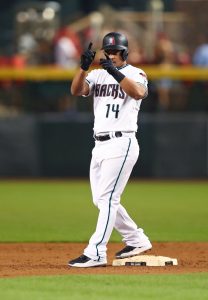
With the versatile Escobar locked up so early, the D’Backs had plenty of flexibility as they filled out the rest of their infield picture. As it looks going into Opening Day, Escobar will be Arizona’s primary third baseman, while Jake Lamb will shift over to first base (perhaps in a timeshare with Christian Walker, or maybe Yasmany Tomas if Tomas can earn his way back onto the 40-man roster).
The right-handed hitting Wilmer Flores could also factor into the first base mix, though the former Met played all over the infield during his six seasons in New York. While Flores can help out at several positions, he looks to be line for a good chunk of time at second base now that Ketel Marte is being converted into at least a part-time center fielder.
Marte’s first season as a proper everyday player yielded good dividends, as he posted above-average offensive (104 wRC+, .260/.332/.437 over 580 PA) and defensive (+7 Defensive Runs Saved, +1 UZR/150) numbers as Arizona’s everyday second baseman. While there’s a solid “if it ain’t broke…” type of argument to made that Marte should just remain at second, the D’Backs don’t lose anything by giving Marte at least a part-time look in center field.
On days that Marte isn’t in center, veteran Adam Jones could step into the role in his new capacity as Arizona’s fourth outfielder. Jones is no longer the player he was during his All-Star days in Baltimore, though as he moves into this new stage of his career, Jones still carries value as a player capable of playing all three outfield roles (even if he’s best utilized in the corners) and as a right-handed bat who can spell David Peralta against some tough lefties. Beyond on-field contributions, Jones is also a respected clubhouse leader who can help fill the void left behind by the Diamondbacks’ departed veterans.
Jones’ signing may have been necessitated by Jarrod Dyson‘s injury situation, as an oblique problem threatens Dyson’s availability for Opening Day. If Dyson requires a trip to the injured list, the out-of-options Socrates Brito will be retained on the 25-man roster, though Brito’s status could be in question once Dyson returns. For additional depth, Abraham Almonte and Matt Szczur both joined the club on minor league contracts.
The Goldschmidt trade came with no small amount of pain for the D’Backs, which obviously is expected when moving one of the game’s best players. Still, the Snakes hope the trade will provide a good return for years to come, in the form of a catcher of the future (and present) in Carson Kelly along with a potential long-term rotation piece in Luke Weaver.
After just 63 MLB games and 131 plate appearances over the last three seasons, Kelly’s development had simply stalled, as Yadier Molina continues to have the Cardinals’ starting catching job on lockdown. With the promise of more regular playing time available in Arizona, Kelly finally has the opportunity to show the potential that made him a top-100 prospect. Though one suspects Kelly will end up with the bulk of playing time, the Diamondbacks will be juggling at-bats between Kelly, Alex Avila, John Ryan Murphy, and perhaps even Caleb Joseph, since the team still looks to keep three catchers on its 25-man roster.
Weaver was also a highly-touted prospect out of the St. Louis farm system, and he sparkled over a brief (60 1/3 IP) stint in the 2017 season. His numbers took a step back last season, however, as Weaver posted a 4.95 ERA, 2.24 K/BB rate, and 8.0 K/9 over 136 1/3 frames. Call it a sophomore slump, or the league simply adjusting better to Weaver after more exposure, yet Weaver was likely only expendable due to the Cardinals’ rotation depth. Many other teams would have clung to a 25-year-old with this talent level, and the D’Backs will now hope that Weaver can fill the void left behind by Patrick Corbin and Clay Buchholz.
Merrill Kelly was another rotation addition, as the 30-year-old will finally look to make his Major League debut. Originally a product of the Rays’ farm system, Kelly made it as far as the Triple-A level before heading overseas for a four-year stint in the Korea Baseball Organization. Kelly is an inexpensive flier that could be a real find for the D’Backs if he can carry his KBO form over to the big leagues. It also helps that the Snakes don’t need Kelly to be anything more than a fifth starter at this point, as Kelly is currently lined up behind Zack Greinke, Robbie Ray, Zack Godley, and Weaver. (Plus, Taijuan Walker should return in the second half of the season if his Tommy John recovery goes smoothly.)
Speaking of fliers, the D’Backs made a $3.25MM bet on a more familiar MLB name in signing Greg Holland to a one-year deal. It was only in 2017 that Holland turned in a largely-strong season as the Rockies’ All-Star closer. After a lengthy trip through free agency, Holland didn’t sign until landing with the Cardinals on Opening Day 2018. The lack of a Spring Training clearly impacted Holland, as he struggled through a poor season. Since Brad Boxberger was non-tendered and Silvino Bracho has been lost to Tommy John surgery, there’s certainly room for a reinvigorated Holland to earn significant innings in the Arizona bullpen.
Questions Remaining
That “notable losses” category almost speaks for itself, as the Diamondbacks quietly underwent one of the more substantial roster overhauls of any team in the 2018-19 offseason. Some of those departures, of course, can be chalked up to the normal winter roster churn, though there’s no hiding the fact that Arizona lost its best hitter (Goldschmidt), best pitcher (Corbin), plus three more of the team’s top ten fWAR contributors from 2018 (A.J. Pollock, Buchholz, and valuable utilityman Daniel Descalso).
There’s only so many low-cost moves a team can make to fill in so many notable gaps, especially since the 2018 roster wasn’t exactly stacked with world-beaters to begin with, having produced only an 82-80 record. A Lamb/Walker first base platoon has potential, though even at its best it isn’t going to match Goldschmidt’s production. Weaver and Kelly also have promise but are unproven commodities at the MLB level, and it be remains to be seen if Marte can play an acceptable center field.
Cutting some big salaries and still remaining a solid postseason contender is one thing if you’re, for example, the Indians in the weak AL Central. But the D’Backs still look at be at least a few steps behind the Dodgers and Rockies in the NL West, leaving Arizona in competition with virtually the entire rest of the National League for a wild card berth. Could the Snakes get lucky if the teams in the stacked NL East and NL Central beat up on each other? It’s possible, if improbable.
In a way, this could be the type of middle ground that GM Mike Hazen was aiming for last fall, as Hazen’s front office looked to “be creative” with its offseason maneuvering. If there’s enough standings congestion that the D’Backs could finish with a top-12 draft pick yet still play enough competitive baseball to keep the fans coming out to the park, that’s a pretty positive result for a team going through a semi-rebuild.
The question remains, however, if Arizona’s half-measures approach won’t leave the team in a similar situation next winter. If the D’Backs don’t see themselves as full-fledged contenders by 2020, then it may have made sense for the club to also trade Ray and Peralta this winter, as both are controlled only for two more seasons. Peralta drew interest from the Braves, while the Phillies and Astros were two of the clubs known to be in on Ray’s services, this winter, though the Snakes didn’t seem too keen on trading either. (Unsurprisingly, Arizona put a very high asking price on Ray in trade talks.)
One player the D’Backs did shop more openly is Greinke, whose enormous $95.5MM remaining salary makes up an untenably large portion of Arizona’s payroll, despite how well Greinke has pitched in the last two seasons. Between that salary, Greinke’s 15-team no-trade list and his personal desire to stay with the Diamondbacks, however, a trade partner wasn’t found.
Greinke’s salary and Tomas’ ill-fated contract account for a whopping $50MM of the Diamondbacks’ 2019 payroll, and then close to $53MM in 2020. Last season’s $131.5MM Opening Day payroll hit a new high-water mark for the team, and that seems to be the current ceiling for what ownership is prepared to spend on the roster, leaving some trimming necessary (i.e. the Goldschmidt trade) to keep salaries in check.
Could the D’Backs spend more? Quite probably, given that they just signed a new TV deal a few years ago, though the club has also been angling for renovations to Chase Field or even a new ballpark altogether in order to increase stadium revenues. But, if payroll isn’t going to be on the rise, it limits what Hazen’s front office can do in order to keep the rest of his core group together. There wasn’t any serious consideration given to re-signing Corbin or Pollock, and there hasn’t been any speculation about Ray or Peralta being extended beyond the 2020 season.
2019 Season Outlook
Marte blossoming in center field, Weaver and Kelly establishing themselves as quality big leaguers, bounce-back seasons from Lamb, Holland, Jones, and Steven Souza — a lot will have to go right for the Diamondbacks to reach the postseason. It seems likelier they’ll end up in the middle of the pack, though perhaps there’s enough talent on hand to keep things interesting. On the other hand, if a slow start leads to Ray, Peralta, etc. being moved at the trade deadline, Arizona could find itself in the lower fifth of a very competitive National League.
How would you grade the Diamondbacks’ offseason moves? (Link for app users.)
How Would You Grade The Diamondbacks' Offseason?
-
C 38% (1,461)
-
D 28% (1,099)
-
B 17% (664)
-
F 14% (556)
-
A 3% (98)
Total votes: 3,878
Photo courtesy of USA Today Sports Images
MLBTR Chat Transcript: Keuchel, Kimbrel, Fantasy Picks
Click here to read a transcript of today’s chat with Tim Dierkes.
Out Of Options 2019
The following 40-man roster players have less than five years service time and are out of minor league options. That means they must clear waivers before being sent to the minors. I’ve included players on multiyear deals. This list was compiled through MLBTR’s helpful sources.
Angels
- Cam Bedrosian, RHP
- Kaleb Cowart, 2B/3B/RHP
- Luis Garcia, RHP
- Noe Ramirez, RHP
- Hansel Robles, RHP
- Kevan Smith, C
Astros
- Aledmys Diaz, INF/OF
- Tony Kemp, 2B/OF
- Brad Peacock, RHP
- Max Stassi, C
- Tyler White, 1B/3B/DH
Athletics
- Aaron Brooks, RHP
- Robbie Grossman, OF
- Liam Hendriks, RHP
- Chris Herrmann, C/OF
- Frankie Montas, RHP
- Josh Phegley, C
- Jurickson Profar, SS/2B/3B
Blue Jays
- Randal Grichuk, OF
- Dalton Pompey, OF
Braves
- Jesse Biddle, LHP
- Charlie Culberson, 2B/SS/3B/OF
- Sam Freeman, LHP
- Kevin Gausman, RHP
- Luke Jackson, RHP
Brewers
- Jesus Aguilar, 1B
- Junior Guerra, RHP
- Corey Knebel, RHP
- Erik Kratz, C
- Hernan Perez, 2B/3B/OF
- Manny Pina, C
- Eric Thames, 1B/OF
Cardinals
- John Gant, RHP
- Mike Mayers, RHP
- Miles Mikolas, RHP
- Chasen Shreve, LHP
Cubs
- Mike Montgomery, LHP
Diamondbacks
- Silvino Bracho, RHP
- Socrates Brito, OF
- Zack Godley, RHP
- Matt Koch, RHP
- T.J. McFarland, LHP
- John Ryan Murphy, C
- Christian Walker, 1B/OF
Dodgers
- Yimi Garcia, RHP
Giants
- Hanser Alberto, 2B/3B/SS
- Sam Dyson, RHP
- Trevor Gott, RHP
- Alen Hanson, 2B/OF
- Steven Okert, LHP
- Chris Stratton, RHP
- Mac Williamson, OF
Indians
- Trevor Bauer, RHP
- Max Moroff, 2B/3B/SS
- Tyler Olson, LHP
- Kevin Plawecki, C
- Neil Ramirez, RHP
- Danny Salazar, RHP
Mariners
- Shawn Armstrong, RHP
- Roenis Elias, LHP
- Marco Gonzales, LHP
- Kristopher Negron, 2B/OF
- Zac Rosscup, LHP
- Domingo Santana, OF
- Hunter Strickland, RHP
- Sam Tuivailala, RHP
- Daniel Vogelbach, 1B/DH
Marlins
- Jorge Alfaro, C
- Austin Brice, RHP
- Adam Conley, RHP
- Tayron Guerrero, LHP
- Rosell Herrera, 2B/OF
- Dan Straily, RHP
- Jose Urena, RHP
Mets
- Keon Broxton, OF
Nationals
- Matt Grace, LHP
- Justin Miller, RHP
- Pedro Severino, C
Orioles
- Dylan Bundy, RHP
- Miguel Castro, RHP
- Renato Nunez, 3B
- Jonathan Villar, 2B/SS/3B
- Mike Wright Jr., RHP
Padres
- Greg Garcia, 2B/SS
- Bryan Mitchell, RHP
- Kirby Yates, RHP
Phillies
- Aaron Altherr, OF
- Jose Alvarez, LHP
- Cesar Hernandez, 2B
- Adam Morgan, LHP
- Hector Neris, RHP
- Roman Quinn, OF
Pirates
- Elias Diaz, C
- Erik Gonzalez, SS/2B
- Nick Kingham, RHP
- Jacob Stallings, C
- Felipe Vazquez, LHP
Rangers
- Connor Sadzeck, RHP
Rays
- Ji-Man Choi, 1B/DH
- Wilmer Font, RHP
- Tommy Pham, OF
- Chaz Roe, RHP
Red Sox
- Heath Hembree, RHP
- Brian Johnson, LHP
- Sandy Leon, C
- Blake Swihart, C
- Christian Vazquez, C
- Brandon Workman, RHP
Reds
- Curt Casali, C
- Amir Garrett, LHP
- Robert Stephenson, RHP
- Matt Wisler, RHP
Rockies
- Tom Murphy, C
- Scott Oberg, RHP
- Chris Rusin, LHP
- Raimel Tapia, OF
Royals
- Brian Flynn, LHP
- Brian Goodwin, OF
- Terrance Gore, OF
- Jorge Lopez, RHP
- Adalberto Mondesi, SS/2B
- Jorge Soler, OF/DH
Tigers
- Matthew Boyd, LHP
- Buck Farmer, RHP
- John Hicks, C/1B
- Mikie Mahtook, OF
- Drew VerHagen, RHP
Twins
- Ehire Adrianza, SS/2B/3B
- Tyler Austin, 1B/DH/OF
- C.J. Cron, 1B
- Max Kepler, OF
- Matt Magill, RHP
- Trevor May, RHP
- Adalberto Mejia, LHP
- Blake Parker, RHP
- Jorge Polanco, SS
- Michael Reed, OF
White Sox
- Manny Banuelos, LHP
- Alex Colome, RHP
- Leury Garcia, OF
- Juan Minaya, RHP
- Jose Rondon, 2B/SS
- Yolmer Sanchez, 2B/3B
Yankees
- Luis Cessa, RHP
- Tommy Kahnle, RHP
- Gary Sanchez, C
Historical Market Price Points For Dallas Keuchel
By this point, the narrative on Dallas Keuchel is familiar to all: he’s a former Cy Young winner who recently turned 31. He wasn’t at his best last year, but was one of only 13 pitchers to top 200 frames in 2018 and turned in a productive 3.74 ERA. Statcast felt he was actually a bit unlucky, crediting him with a .290 xwOBA-against that lagged the observed .306 wOBA-against.
Keuchel has always thrived on grounders, weak contact, and low walk rates, with middling velocity and generally unexceptional swinging-strike capabilities. At times in the past, Keuchel has been a true groundball monster (he was at a good but not great 53.7% last year) and has generated more strikeouts (up to 23.7% in 2015). While the theory has been proffered recently that Keuchel’s lack of velo is a major factor, it actually seems mostly encouraging that he throws just as hard as ever and that his velocity trended up over the course of the 2018 season. It seems fair to say he’s mostly the same type of pitcher, but not the best version of himself — as you’d probably expect at this age.
We knew all that entering the offseason, of course. It was never questioned that he’d turn down the qualifying offer and not be all that bothered by the draft compensation requirements that attached to his free agency. So how do we explain the apparent value disconnect that has to this point kept Keuchel from signing? Some thought Keuchel’s track record would propel him to a nine-figure contract, perhaps overestimating the allure of his Cy Young past. Reports indicate that agent Scott Boras set out seeking a five or even six-season contract. That level of interest simply hasn’t been there. It’s not altogether surprising. Here at MLBTR, we guessed he’d be capped at a four-year deal — but still anticipated the bidding going over $20MM annually.
Given where things stand, I thought it would be interesting to look at some recent contractual outcomes to see how they relate to Keuchel’s case and the changing free agent market. The takeaway is that Keuchel seems likely to fall somewhere on a spectrum of outcomes that we’ve seen before in generally similar situations.
5+ Year Contracts
If you were making a case for Keuchel to get into that nine-figure range, you wouldn’t start with Patrick Corbin, who did so earlier this winter. The much younger lefty was just in a different situation. But you could look to the not-so-distant past and see Yu Darvish, who got six and $126MM last winter despite being about half a year older than Keuchel is now. The difference? Darvish has long carried premium K/BB numbers and was seen as an elite talent. He was also the best pitcher and arguably the best free agent in his class. His sixth year didn’t add much in the way of guaranteed money, so much as it spread the costs and luxury tax hit.
There’s a history of lengthy deals before that, as well. There was quite a run on starters in the winter of 2015-16 — even at the second tier of the market. Jordan Zimmermann ($110MM), Jeff Samardzija ($90MM), Mike Leake ($80MM), Wei-Yin Chen ($80MM) and Ian Kennedy ($70MM) all got five-year contracts while the three best hurlers took down a combined haul of over half a billion dollars.
Those halcyon days are over, needless to say. It probably doesn’t help that every one of those contracts seems regrettable in retrospect. Getting to that five-year range just never seemed particularly plausible for Keuchel, given his age, unless perhaps he gave away the last season for a low cost that drove down the deal’s AAV.
4-Year Deals
Remember that useful mid-rotation starter contract? You know, the standard mid-rotation jam? Ervin Santana ended up getting the last of these, at $54MM in the ’14-’15 winter, but it was the same essential form as the contracts inked by Brandon McCarthy, Ubaldo Jimenez, Matt Garza, Ricky Nolasco, and Edwin Jackson.
Keuchel seemed another tier up … much like, say, James Shields did when he went for $75MM over four years while entering his age-33 season. That deal is a few years out of date and things have changed. But you’d also expect salaries to rise and for that sort of contract to serve as something of a floor.
And it turns out there is at least one other four-year deal that perhaps provides a ray of hope for Keuchel. Alex Cobb somehow pulled down a $57MM guarantee over four years late last March. Was that a throwback to the aforementioned contract archetype? A reminder that this sort of thing is still possible — that maybe, just maybe, Keuchel can still get a deal of this type (with a boost for his superior track record)? Tough to say for sure, though it’s telling that the O’s have since last winter become the latest team to swap in an analytically driven front office of the kind that seems rather unlikely to swing such a bargain.
3-Year Scenarios
Even analytically informed front offices are willing to plunk down cash on pitchers. It’s just that they tend to like to do so on shorter terms. The Dodgers did the above-cited deal with McCarthy. They’ve otherwise kept it to three years. Clayton Kershaw ($93MM), Rich Hill ($48MM), and Scott Kazmir ($48MM) all were brought aboard with sizable salaries over a three-year term. Kershaw’s track record is obviously far superior, but there are quite a few parallels to Keuchel’s case. The hurlers are the same age and Kershaw’s health problems and velocity declines marred his outlook.
That Kershaw pact seems especially notable when you look at another prominent hurler who recently ended up with a three-year contract. Jake Arrieta was a year older than Keuchel this time last winter. He seemed to have a higher anticipated annual salary after some years of true dominance — we guessed four years and $100MM — but otherwise was in a fairly similar situation to that of Keuchel. Arrieta ended up landing at three years and $75MM in a deal that also includes a voidable opt-out, which could allow Arrieta a chance to return to the open market after the second year of the deal. if the Phillies won’t expand his guaranteed contract. Perhaps a “swell-opt” of this kind could also help facilitate a pact for Keuchel.
Shorter Agreements
There are examples of big-AAV, two-year deals out there, though in most cases they have gone to older pitchers. Call it the John Lackey deal — his second free agent contract, that is, a two-year, $32MM pact with the Cubs. This winter, J.A. Happ ($34MM) and Charlie Morton ($30MM) landed such contracts. It really does seem odd to imagine Keuchel in this grouping, though. Perhaps he’s similarly valuable on an annual basis, but he’s much younger than the type of hurler that has secured this type of deal.
Indeed, there’s an argument to be made that Keuchel would be better off turning up his nose at any two-year offers. Better to take a one-year pillow deal and head back onto the market next winter if you can’t at least get up to a solid three-year pact. After all, that same sort of short-term, high-AAV arrangement should be available at that point — if not something more, if he enters the winter with a lower asking price off the bat.
Would it really be that unimaginable for Keuchel to settle on a pillow deal? In some ways, yeah, it’s tough to see how that could come to pass. But it wouldn’t be without precedent. Ervin Santana ran up a 3.24 ERA in 211 frames in 2014 and entered the ensuing offseason at 31 years of age. He reputedly sought too big a deal early on and then rejected lower-AAV, mid-range deals later in the winter. He ended up securing a one-year, $14.1MM contract — the exact value of the qualifying offer he had previously rejected — when the Braves finally ponied up because their rotation fell apart in camp. That’s the most directly relevant case to Keuchel’s, though others have ended up in similar situations. Jackson, for instance, settled for $11MM with the Nationals in 2011-12. Both Santana and Jackson ended up going back onto the open market in the ensuing winter and securing one of the mid-rotation, four-year deals cited above.
Offseason In Review: Baltimore Orioles
This is the latest post of MLBTR’s annual Offseason in Review series, in which we take stock of every team’s winter dealings.
After the worst season in franchise history, the Orioles’ only must-have for the winter was new organizational leaders.
Major League Signings
- Nate Karns, RHP: One year, $800K, up to $200K more in incentives
- Total spend: $800K
Trades and Claims
- Selected SS Richie Martin from A’s with 1st overall pick in Rule 5 Draft
- Acquired IF Drew Jackson from Phillies for international signing bonus pool money after he was selected from Dodgers with 11th overall pick in Rule 5 Draft
- Acquired outfielder Dwight Smith Jr. from Blue Jays for $500K in international signing bonus availability
- Selected RHP Taylor Grover from Reds with 1st overall pick of Triple-A phase of Rule 5 Draft
- Claimed IF Jack Reinheimer off waivers from Rangers
- Claimed 3B Rio Ruiz off waivers from Dodgers
- Claimed IF Hanser Alberto off waivers from Giants (first, from the Yankees)
- Claimed LHP Josh Osich off waivers from Giants (later designated for assignment)
Notable Minor League Signings
- Alcides Escobar, Eric Young Jr., Jesus Sucre, Carlos Perez, Christopher Bostick, Zach Vincej, Omar Bencomo, Gregory Infante, Josh Lucas, Jace Peterson, Bo Schultz
Notable Losses
- Adam Jones (still unsigned), Caleb Joseph, Tim Beckham, Lucas Luetge, Pedro Alvarez, Colby Rasmus (still unsigned)
[Baltimore Orioles Depth Chart] [Baltimore Orioles Payroll Outlook]
Needs Addressed
The Orioles as we’ve known them are no longer. General manager Dan Duquette – hired in 2011 to replace Andy McPhail – is gone. Manager Buck Showalter – hired after the All-Star break in 2010 – is gone. Franchise cornerstone Manny Machado – drafted in 2010, in the majors since 2012 – plays in San Diego now. Adam Jones’ tenure was longer than all of those departees; after 11 seasons in Baltimore, he, too, has (likely) played his last game as an Oriole. Four cornerstones from the past eight-or-so seasons, all jettisoned during a four-month period between July 18th and November 3rd – so it’s understandable if those in Baltimore are still feeling a little shell-shocked.
The GM seat remained empty for a curious-long while, but in mid-November Mike Elias finally arrived from Houston. By all accounts, Elias is a good hire, and there’s no reason to think he won’t accomplish at least their infrastructural goals: modernize front office processes, broaden the reach of player acquisition efforts and get the analytics department up to code. Four weeks in, Elias checked the first box of his offseason to-do by hiring Joe Maddon’s bench coach Brandon Hyde as the 20th manager in franchise history. In poaching Elias (from the Astros) and Hyde (from the Cubs), the Orioles now boast a leadership tandem – not coincidentally – from the two most recognizably-successful rebuilding efforts of the last decade.
In terms of player personnel, there really wasn’t much to be done at the outset of Elias’s tenure. With no hope of contending in the near future, filling out roster holes was not a terribly consequential undertaking. The club unsurprisingly pursued a mix of interesting younger players and cheap but solid veteran types to bolster an existing mix that still includes several high-priced holdovers.
If you like underdogs, this shortstop competition is a barnburner: two Rule 5 picks trying to make the jump from Double-A (Richie Martin, Drew Jackson), while minor league signee Alcides Escobar sets the bar. It’s been three years since Escobar produced more than 1 WAR over a season, and he’s never-not-once produced an even league-average wRC+, but he’s a “been-through-the-trenches” guy, he runs the bases well, and he generally won’t fumble the ball when it’s hit right at him. Eric Young Jr. is the best bet of the other minor league signees crack the roster, and he’s off to a good start this spring as he competes for a bench role with Joey Rickard and a slew of IF/OF opportunists like Rio Ruiz, Jackson, Jace Peterson, Steve Wilkerson, Christopher Bostick and Anthony Santander.
On the pitching side, Karns was a nice addition for a rotation lacking depth behind Dylan Bundy, Andrew Cashner, and Alex Cobb. Karns hasn’t pitched in a year-and-a-half, but last we saw him he looked good for the 2017 Royals, striking out 10.13 batter per nine while pitching to a 4.17 ERA (4.48 FIP, 3.71 xFIP). The Orioles get him for $800K this year – the only guaranteed salary the team handed out – and he’s under team control for 2020, making this a pretty good buy for Baltimore.
Questions Remaining
With new leadership in place, the encyclopedic reshaping of the Orioles begins, but there are questions in the short-term that loom even larger (in urgency, if not importance). For instance, how many more chances are they willing to give Chris Davis to get within shouting distance of league-average before donating his roster spot to a youth? Four seasons at $23MM a pop is a lot to eat, but there is a sunk cost threshold, and after a .168/.243/.296 -2.8 rWAR season in 2018, that line can’t be far off.
It seems almost silly at this point to ask whether Davis could regain enough of his former on-field value to allow the team to shed some of his remaining contract. Perhaps that’s still possible, though. And the O’s can hope more realistically that some other players will perform well enough to dump salary during or after the season to come. Bundy, Cashner, and Cobb could all be of mid-season interest. Jonathan Villar and Mark Trumbo might end up holding some appeal. And relievers Mychal Givens and Richard Bleier (if he can get back to health) could be fairly significant assets. There’s not a primo trade piece in the bunch, save maybe Givens, but it’s fair to wonder how long Elias will wait before stripping this team for parts.
Otherwise, the open questions facing this roster are largely those you’d expect from a team in this position. The roster is loaded with players who have yet to establish themselves fully (if at all) in the majors. In most cases, it’s understandable that the organization has decided to allow some space for young players to sink or swim. There’s an argument to be made, though, that more could have been done in the rotation — particularly since Karns has a checkered recent health history.
Mike Wright Jr. looks poised to snag a starting spot, but it’s a little curious the O’s didn’t further explore the bargain bin, especially given their lack of near-term upside arms. David Hess, Yefry Ramirez, John Means, Josh Rogers and Jimmy Yacabonis will happily take the innings, but there’s value even in a rebuild to having vets around. Bounceback candidates such as Drew Pomeranz may have shied away from Camden Yards, but giving a minimal guarantee to someone like Ervin Santana (who settled for a minors deal) might have made sense. Even now, James Shields, Bartolo Colon, former Orioles Chris Tillman and Miguel Gonzalez, and others are all just a phone call away.
It would be hard to blame Elias and his staff for seeking some time to evaluate the in-house goods before running out for upgrades that admittedly wouldn’t move the needle. The longer-term questions are of greater importance, and they relate to roster building strategy. The Orioles’ lack of existing international relationships hampered Elias’ ability to put to use their approximately $6MM in international bonus pool money, which they’ve instead doled out piecemeal through trades with the Twins, Phillies, Rangers, and Blue Jays. The development of those overseas connections will be worth tracking in the long-term, while a push to attain Cuban shortstop Yolbert Sanchez would be a nice short-term success were Elias to get him. An early decision point will come in June, when the Orioles make the first overall selection in the amateur draft. Whether it’s high school shortstop Bobby Witt Jr., Oregon State catcher Adley Rutschman or someone else, this is the first major test that Elias and company need to ace.
What to Expect in ’19
On the field, these Orioles aren’t likely to dent the 60+ game gap between themselves and the AL East leaders. Fangraphs projects only the Marlins to finish with a worse record, though they’re not exactly bullish on the Orioles either, pegged for 99 losses and a league-worst run prevention effort. There’s a decent collection of position player prospects who are or soon will be knocking at the MLB door – Yusniel Diaz, Ryan Mountcastle, Austin Hays, Ryan McKenna – but there’s absolutely no rush. In the meantime, Cedric Mullins, Richie Martin, Chance Sisco, Drew Jackson and DJ Stewart should have plenty of leeway to grind through any growing pains. It’ll be a year of tryouts as Hyde hammers the fundamentals and dreams of a future roster filled with athletic, positionally-flexible dirt dogs. Brass tacks: the Orioles are going to lose a lot of baseball games in 2019. Maybe not 115, but the over-under for 2020 draft position should be no higher than 1.5.
How would you grade their offseason? (Link for app users.)
How Would You Grade The Orioles' Offseason?
-
F 34% (1,471)
-
D 21% (925)
-
C 19% (799)
-
B 16% (684)
-
A 10% (427)
Total votes: 4,306
Let’s Find A Landing Spot For Craig Kimbrel
On its very surface, the fact that Craig Kimbrel remains unsigned sounds ridiculous. He’s on a Hall of Fame trajectory and leads all active relievers in saves (333). The only pitcher in MLB history (min. 200 innings) with a higher strikeout percentage than Kimbrel’s 41.6 percent mark is Aroldis Chapman … at 41.7 percent. A full season of ninth-inning work could push Kimbrel past Jeff Reardon (10th place, 367 saves) and Jonathan Papelbon (ninth place, 368 saves) on the All-Time saves leaderboard. Kimbrel has a career 1.91 ERA and a near-identical 1.96 FIP. He’s a seven-time All-Star who has yet to celebrate his 31st birthday, which lands on May 28.
Before anyone accuses me of trying to do his agent’s job for him, let’s make it clear that with further context, there are some easily identifiable reasons that Kimbrel is still available. Reports early in the offseason suggested that Kimbrel was eyeing a contract as long as six years and north of $100MM. It’s a staggering sum that no reliever has ever touched (or come all that close to reaching). Teams are increasingly reluctant to pay players into their mid-30s and sign contracts of that length in general — only Bryce Harper, Manny Machado and Patrick Corbin have secured deals of even five years this winter — and it’s not as if Kimbrel isn’t without his warts.
First and foremost, he’ll cost any new club a draft pick and potentially international bonus pool space (more details on that) after rejecting a qualifying offer in November. Even looking past his shaky postseason, Kimbrel saw his strikeout, walk, home-run, ground-ball and swinging-strike rates all trend in the wrong direction in 2018. Those declines are being judged against a lofty bar, of course, as 2017 was one of Kimbrel’s best seasons, and his overall standards are higher than those of almost any reliever to ever take the mound.
Even a diminished Kimbrel is an elite reliever, but teams are going to pay him based on what they expect him to do moving forward — not based on what he’s already done — and given those red flags, it’s not exactly a surprise that teams weren’t lined up to give him a record guarantee. Even at the outset of free agency, we at MLBTR predicted that while Kimbrel would set a new high-water mark for average annual value among relievers (four years, $70MM), he would fall well shy of Chapman’s record-setting $86MM guarantee.
That no longer seems to be plausible, however. Perhaps there’ll be a surprising dark horse to emerge and stun the field, but the market for Kimbrel looks remarkably tepid. The teams most recently connected to him — the Braves, Phillies and Twins — are all reported to be interested in a short-term pact. Even among that trio, the Braves’ interest in Kimbrel is reported by Joel Sherman of the New York Post to be “overstated.” Atlanta general manager Alex Anthopoulos has plainly said that he does not foresee spending “big, elite dollars” on a reliever. Red Sox president of baseaball operations Dave Dombrowski has spelled out, without directly saying it, that Kimbrel will not be back. (As I explored last month, Boston’s luxury tax situation would force them to pay a jaw-dropping sum for Kimbrel in 2019.)
We’ve reached the point of the offseason where it’s begun to be suggested that Kimbrel should take a one-year deal at a precedent-setting salary. Sherman, in his aforementioned column, opines that the Dodgers should take that plunge and offer Kimbrel a $25MM salary to come to Los Angeles. Sherman surmises that the Dodgers were willing to exceed the luxury tax for a huge splash on Harper and could take the same approach with Kimbrel on a smaller scale.
Certainly, the Dodgers could afford such a move. Pairing Kimbrel and Kenley Jansen at the back end of games would give L.A. one of the most formidable duos the game has ever seen, even when accounting for the fact that both have demonstrated some potential signs of decline. The Dodgers currently have a luxury tax payroll of just over $201MM, as calculated by Jason Martinez of Roster Resource, and they’re in the process of shaving that further after designating Josh Fields. A hypothetical $25MM outlay on Kimbrel seems steep; after luxury taxes, the Dodgers would actually owe him closer to $28.7MM at that point. Still, there’s little question the Los Angeles club could afford a record annual salary with a more modest luxury hit and more modest overall commitment on a one- or two-year deal.
With that in mind, let’s run through some speculative landing spots for the one of the game’s most decorated relievers. I’ll break this into various categories based on teams’ current luxury tax standing. It’s safe to assume that we can rule out every non-contender on a short-term deal, given that Kimbrel would require draft forfeitures. Despite the fact that the Padres signed Machado and that the White Sox pursued both Machado and Harper, I’m including them in that category. San Diego’s addition of Machado appears more focused on 2020 than 2019, while the ChiSox still don’t seem like viable AL Central threats. Both appear unlikely to weaken their 2019 draft for a short-term bullpen addition.
Similarly, expected contenders like the Indians, Cubs and Red Sox won’t be considered further below given that they’ve each made their offseason financial constraints well known (all payroll and luxury tax projections to follow are courtesy of Jason over at Roster Resource):
Teams that could sign Kimbrel while comfortably staying under the luxury line
- Braves: Atlanta fans have spent the offseason understandably urging the front office to do more. Braves CEO Terry McGuirk spoke openly of the team’s payroll flexibility before the offseason began, giving some fans grand expectations of the moves that’d follow up a meteoric rise to the top of the NL East. Atlanta spent big on Josh Donaldson in November but has since spent a combined $8MM to bring Brian McCann and Nick Markakis back into the fold. The Braves started with a bang but are ending their winter with a whimper. They’re currently sitting on a $118MM payroll and a $126MM luxury ledger after starting the season with a $123MM payroll as recently as 2017. The club’s top execs have tried to defend that position, though the explanations arguably fall somewhat flat. Frankly, if the Braves’ interest in their former star closer has indeed been overstated, that probably shouldn’t be the case.
- Brewers: Milwaukee has been willing to make one-year splashes for both Yasmani Grandal ($18.25MM) and Mike Moustakas ($10MM). Kimbrel on a one- or two-year deal would likely require at least a comparable annual commitment to Grandal. The bullpen is already a strength for the Brewers, although there’s some spring concern regarding Jeremy Jeffress‘ shoulder. The Brew Crew’s 2018 payroll is at $127MM, but it’s $147MM when tabulated for luxury purposes. Both are already well into franchise-record territory, so one more splash from owner Mark Attanasio would be a surprise, admittedly.
- Cardinals: St. Louis has a projected Opening Day payroll of nearly $162MM, which would top last year’s record-setting $159MM Opening Day mark. Their current payroll for purposes of the luxury tax rests at roughly $167MM, which wouldn’t come close to the tax line upon signing Kimbrel, but ownership would nonetheless need to shatter its previous record level of spending to sign him. President of baseball operations John Mozeliak has implied that this type of signing isn’t likely, citing last year’s late addition of Greg Holland as a cautionary tale.
- Reds: Cincinnati has done all of its offseason work on the trade market, adding Sonny Gray, Tanner Roark, Alex Wood, Yasiel Puig and Matt Kemp. Those acquisitions have boosted this year’s projected Opening Day payroll to just north of $125MM — a franchise record — while pushing their luxury ledger to roughly $143MM. They’re in a similar spot to their divisional foes in St. Louis and Milwaukee; adding Kimbrel wouldn’t put them anywhere close to luxury territory but would require an unprecedented level of spending from an ownership group that is already spending at a record level. It doesn’t seem likely.
- Rockies: The Rox spent more than $100MM total dollars on relievers in the 2017-18 offseason and came away with little to show for it. Deals for Bryan Shaw and Jake McGee look regrettable, while Wade Davis wasn’t as sharp as he was in his walk year. Colorado’s payroll of roughly $149MM and luxury bill of about $168MM could both technically support Kimbrel, but perhaps the Rockies are wary of making further additions to an extremely expensive bullpen.
- Twins: Minnesota’s payroll is still about $5MM shy of last year’s franchise-record $128.7MM, though for tax purposes their payroll hovers around $138MM. Minnesota has been at least loosely tied to Kimbrel on a one-year arrangement, though like the Cardinals, they had a bad experience when it came to signing players midway through camp last winter (Lance Lynn, Logan Morrison). That said, the team’s farm is among the highest-regarded in the game, which mitigates some of the detriment of the lost draft pick. And the division-rival Indians are quite arguably a worse club now than they were in November, which could provide extra incentive to make one final splash of note.
Perennial payroll cellar-dwellers like the Athletics, Pirates and Rays all have their sights set on competing in 2019 and, obviously, none of the bunch is even in the same hemisphere as the luxury tax barrier. That said, it’s difficult to forecast any of these teams paying a potential record-setting salary to a reliever, even on a short-term deal. Tampa Bay did surprise with its two-year, $30MM addition of Charlie Morton, but it’s hard to see the Rays being willing to punt a draft pick given the organizational emphasis on cultivating a deep farm system as a means of offsetting their annual budgetary restrictions. Several of the teams on the list above seem like long shots, but even that distinction feels aggressive for this trio.
Teams that may be able to narrowly avoid the luxury tax upon signing Kimbrel
- Angels: The Halos are already projected to spend a franchise-record $174MM on payroll — which works out to about $173MM as calculated for luxury tax purposes. But there’s far more room beneath the luxury line next year; the Halos have about $67MM less committed then than they do at present. If ownership wanted to green-light a more drastic payroll hike, the Halos could conceivably add Kimbrel at a premium rate on a multi-year deal. Doing so wouldn’t leave much wiggle room for in-season additions, but in terms of plausible on-paper fits, the Angels make sense.
- Astros: Houston fits into this category by the skin of its teeth, as their current luxury payroll is at $186MM (though their actual 2019 payroll, $159MM, is nearly identical to last year’s $160MM mark). Signing Kimbrel would leave the Astros virtually no in-season maneuverability unless owner Jim Crane authorized crossing the luxury barrier. Houston is reportedly talking about a reunion with Dallas Keuchel, so the ‘Stros clearly aren’t closed off to a high-profile addition.
- Mets: Brodie Van Wagenen’s inaugural offseason as GM hasn’t lacked for bravado, big talk or action. The Mets added Robinson Cano, Edwin Diaz, Jeurys Familia, Wilson Ramos, Jed Lowrie and Justin Wilson already, skyrocketing their payroll for luxury purposes to $183MM. Their actual payroll is much lower once factoring for insurance claims on David Wright and Yoenis Cespedes. The Wilpon family isn’t exactly known for spending like they play in the game’s largest market, however, and as is the case with the Astros, adding Kimbrel would leave extremely minimal room for in-season trades without surpassing the luxury barrier. Of the three teams in this category, I’d be most surprised to see the Mets land Kimbrel.
Teams that could sign Kimbrel if they’re willing to pay the luxury tax
- Dodgers: As noted above, the Dodgers can afford it — but only if they’re willing to make the same luxury tax exception for Kimbrel they were willing to make for Harper.
- Nationals: It’s a very similar story with the Nationals, who were tied to Harper throughout the winter and reportedly viewed him as an exception to the luxury tax. The Nats are only a few million shy of $206MM in that regard and would soar past that threshold upon signing Kimbrel. Coupled with the fact that the organization hopes to extend Anthony Rendon, it seems difficult to envision Kimbrel landing in D.C. despite their reported interest. The Nationals, after all, would be a third-time luxury offender, meaning they’d pay a massive 50 percent tax on the first $20MM by which they exceed the initial limit and a 62 percent tax on the following $20MM. It’s extremely difficult to envision a Kimbrel signing and a Rendon extension coexisting.
- Phillies: Even after signing Harper, the Phillies’ projected $163MM Opening Day payroll isn’t particularly close to its club-record payrol of nearly $178MM from back in 2014. Kimbrel would assuredly push them over the luxury barrier, as the Phils currently rest at about $191MM in that regard. By signing Harper, owner John Middleton eventually satiated a fanbase he’d sent into a ravenous frenzy with his “stupid money” comments, but the question for the Phillies now becomes: do they have one final move up their sleeve? Their interest in Kimbrel has reportedly been on a short-term deal. They can definitely accommodate him at anything from one to three years.
- Yankees: This list has (obviously) been structured in mere alphabetical order, but it almost feels fitting to save the “Evil Empire” for last. The Yankees don’t operate like they did in George Steinbrenner’s heyday, but the team still carries a reputation for swooping in, and they clearly have the resources to pull off this type of feat. That said, it still seems highly unlikely. New York’s already at $226MM in payroll for tax purposes, meaning they’ve topped the initial threshold by $20MM and entered the second tax bracket. They’ll pay a 32 percent surcharge on any dollar added to the payroll moving forward, meaning even if they tried to persuade Kimbrel at, say, one year and $18MM, he’d actually cost them about $23.76MM. Coupled with the draft and international forfeitures they’d face — to say nothing of an already extraordinarily deep bullpen — it feels safe to say that the Yankees technically *can* do it but quite likely will not.
So where does that leave Kimbrel, in the end? The best fits seem like those that have a clear opportunity at a division title and aren’t already sporting franchise-record payrolls or perilously large luxury-tax ledgers. From my vantage point, the Braves, Twins, Dodgers, Phillies, Brewers and Mets have the best blends of divisional aspirations and payroll capacity to make this type of match work. It’d take some owners pushing past their comfort zones and Kimbrel accepting that the mega-deal he sought may not ultimately materialize, but any of those clubs would be justified in offering the compromise in terms of annual value on a short-term arrangement.
Offseason In Review: Miami Marlins
This is the latest post of MLBTR’s annual Offseason in Review series, in which we take stock of every team’s winter dealings.
The Marlins spun off their best-remaining player and back-filled with some low-cost veterans as their rebuilding effort continues to inch forward.
Major League Signings
- Sergio Romo, RP: one year, $2.5MM
- Neil Walker, 2B/1B: one year, $2MM
- Total spend: $4.5MM
Trades And Claims
- Acquired C Jorge Alfaro, RHP Sixto Sanchez, LHP Will Stewart from Phillies in exchange for C J.T. Realmuto
- Acquired $1MM in international bonus pool availability from Nationals in exchange for RHP Kyle Barraclough
- Acquired $750K in international bonus pool availability from Reds in exchange for RHP Ryan Lillie
- Acquired RHP Jordan Milbrath from Indians in exchange for RHP Nick Wittgren
- Acquired RHP Nick Anderson from Twins in exchange for INF Brian Schales
- Acquired RHP Tyler Stevens from Angels in exchange for LHP Dillon Peters
- Claimed RHP Austin Brice off waivers from Orioles
- Claimed UTIL Rosell Herrera off waivers from Royals
- Claimed RHP Julian Fernandez (2017 Rule 5 pick from Rockies) off waivers from Giants
- Selected RHP Riley Ferrell from Astros in Rule 5 draft
Notable Minor League Signings
- Pedro Alvarez, R.J. Alvarez, Jon Berti, Curtis Granderson, Gabriel Guerrero, Bryan Holaday, Dixon Machado, Deven Marrero, Brian Moran, Hector Noesi, Harold Ramirez
Notable Losses
- Barraclough, Derek Dietrich, Realmuto, Wittgren
[Miami Marlins Depth Chart | Miami Marlins Payroll Outlook]
Needs Addressed
This time last year, we were looking back at a whirlwind first winter for the Derek Jeter-led Miami ownership group. It was decidedly less hectic this time around, as Jeter (the CEO), president of baseball operations Michael Hill, and their staff methodically worked through a rather limited checklist. If we’re being honest, there were two items on the agenda that greatly outweighed the others in importance.
While much of the baseball-watching world was gearing up for the World Series, the Marlins were finalizing a major move on the international amateur market. The club inked Cuban brothers Victor Victor Mesa and Victor Mesa Jr. to contracts that came with a combined $6.25MM in bonuses — a relative pittance when compared to free agent spending, but a big chunk of change in relation to the hard-capped international spending pool allocation. Victor Victor, in particular, is seen as a big score for the Marlins. He’s not far from the majors and is already graded in some circles as a top-100 leaguewide prospect.
Working out the numbers on the brothers Mesa meant spinning off assets to acquire additional spending capacity. Sending out young righty Ryan Lillie was certainly understandable, though it was a bit more surprising to see the Fish part with Kyle Barraclough to finish topping off the tank. Though he had a rough second half in 2018 and has always been uncomfortably walk-prone, Barraclough has a pretty lofty established ceiling and remains both cheap and youthful. The Marlins might have achieved much greater value had they waited to see if Barraclough could bounce back early in 2019, or even just explored the market further, but they obviously felt he was an expendable piece in their effort to take advantage of a rare opportunity to land a premium prospect.
Having added three Victors and two Mesas to the organizational depth chart, the Marlins turned to marketing their last holdover core player. Backstop J.T. Realmuto seemed likely to be traded last winter, when the Marlins auctioned off a trio of star outfielders (Giancarlo Stanton, Christian Yelich, and Marcell Ozuna). But he never drew an offer that suited the club. It was much the same story at the 2018 trade deadline. In the meantime, Realmuto rewarded the risk the organization took by continuing to run him out behind the plate, turning in a big .277/.340/.484 campaign with the bat and establishing himself as the game’s best all-around catcher.
As it turned out, the Marlins oversaw quite an extended negotiating process for Realmuto. Suitors came and went, with a variety of big names reportedly talked about — or, at least, asked for by the Miami club — over several months. The initial packages sought by the Fish were said to be staggering, with the organization no doubt comfortable knowing it would be able to fall back on a very good offer even if it failed to land a true haul. There was no shortage of interest. By the end, nearly a third of the teams in baseball — the Dodgers, Padres, Reds, Rays, Braves, Astros, Yankees, Mets, and Nationals — had pursued Realmuto at one point or another.
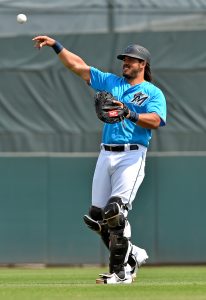
It ultimately took a compromise to get something done. Two affordable years of Realmuto’s services was a significant prize, but not one that teams were willing to go wild to achieve. In early February, the Marlins landed an appealing but hardly overwhelming three-part package from the Phillies. The club secured a high-ceiling, high-risk pitching prospect in Sixto Sanchez, who by most accounts tops Victor Victor and the rest of the Miami farm as the team’s top prospect, along with another solid young arm in Will Stewart. Also coming in the deal was young receiver Jorge Alfaro, who brings some upside, a decent floor, and plenty of seasons of cheap control.
Alfaro, notably, will step right into Realmuto’s shoes. While his acquisition is ultimately about the future, it also solved an immediate need. The Marlins had some other holes to plug as well, with the resulting rummaging occupying most of the club’s attention beyond its work on the aforementioned items. If things shake out as hoped, the club will benefit from having a few veterans around before spinning them off to contenders this summer; perhaps it’ll also find a keeper or two among the younger players it brought in.
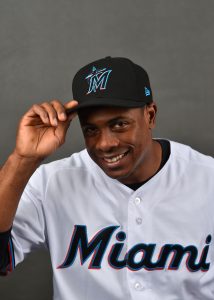
The Marlins ultimately doled out only $4.5MM in guaranteed money over the winter, though they’ll likely commit some more when their Opening Day roster is announced. On the position-player side, veteran second baseman Neil Walker is expected to occupy first base in Miami. He’ll reunite with former Mets teammate Curtis Granderson, who took a minors deal but will likely be added to the roster and promised $1.75MM to play a significant role in the corner outfield. The upside here is limited. Walker had his worst full season as a big leaguer last year; Granderson is days away from his 38th birthday and ought to be limited to platoon duties. But both players could easily perform up to and past the low salary levels they’ll play for. Walker was a steadily above-average hitter for eight-straight campaigns before turning in a dud, while Granderson was capable of a .242/.351/.431 slash in 403 plate appearances last year.
A few other notable names were brought in on minors pacts. Pedro Alvarez has loads of MLB experience, though he’s not an easy fit for a National League team. The Fish picked up a few middle-infield options — including once-highly regarded prospects Dixon Machado, Deven Marrero, and Rosell Herrera.
Likewise, the Marlins focused on ensuring sufficient bullpen depth. Veteran Sergio Romo will help anchor the pen. He still gets plenty of swings and misses and comes at an affordable rate of pay. Rule 5 pick Riley Ferrell will compete with a host of other low-risk acquisitions, including trade acquisition Nick Anderson, claimee Austin Brice, and minor-league signee Hector Noesi (who’s returning from the KBO). The resulting relief mix is anything but intimidating, but it’ll be a place the Marlins can try out some arms in hope of unearthing some hidden gems.
Questions Remaining
It’ll come as no surprise that there are quite a few holes left on the resulting roster. The Marlins brought up the rear in the National League last year and seem all but assured of doing so once again, particularly with the remainder of the eastern division made up of organizations that have set about improving their rosters this winter. Under such circumstances, the questions aren’t really about the resulting record — it won’t be pretty — so much as the potential for mid-season deals and the development of young talent.
We haven’t yet touched upon the rotation, and that’s because the Marlins didn’t do so all winter long. Dan Straily seemed a potential trade piece but hasn’t drawn enough interest for the Fish to justify parting with his useful, reasonably affordable innings. That could change by the end of July. Now that he’s into his arbitration years, Jose Urena is also a fairly plausible trade chip. The hard-throwing 27-year-old has outperformed his peripherals over the past two seasons, turning in a 3.90 cumulative ERA. The club would surely love to dump some of the money still owed to Wei-Yin Chen, but that’ll require a major turnaround. Otherwise, the Marlins will simply be focused on bringing along some younger arms. Trevor Richards, Caleb Smith, and Pablo Lopez are at the top of the depth chart entering camp, with Sandy Alcantara and Jeff Brigham among those who could factor throughout the season.
As already noted, the relief unit figures to be more of a proving ground than a well-oiled machine. Closer Drew Steckenrider could be a trade candidate if he throws well; he’s still two years away from arbitration but is already 28 years old. It’s not tough to guess that Romo will be watched by rival scouts from the start of the season, with lefty Adam Conley also getting a look after his bounceback 2018. Those two hurlers are the only two members of the relief staff who have surpassed two years of MLB service. Unless Noesi sneaks into the pen, Romo will enter the season with more time on his service clock than all his bullpen mates combined.
There’s quite a lot of room for churn on the position-player side of the roster as well. Up the middle, Alfaro will get a long run. Second bagger Starlin Castro has been a walking trade candidate since he landed in Miami but hasn’t piqued much interest. It’s possible he’ll be moved this summer; otherwise, the team will surely buy him out at season’s end rather than picking up a club option. At this point, he’s keeping the seat warm for Isan Diaz. Shortstop was obviously an area targeted for some competition. Machado and Merrero will push JT Riddle and Miguel Castro in the hopes that one or more of these players finds an extra gear.
In center field, the team will presumably let Lewis Brinson try to sort things out. Brinson can still be optioned down to work out the kinks, though he has already shown he can produce at Triple-A. Prospects Monte Harrison and Magneuris Sierra already have 40-man spots and could get looks of their own if Brinson can’t improve upon a ghastly 2018 showing.
Any of those players could also end up seeing time in the corner outfield as well. To open the season, though, right-handed hitters Peter O’Brien, Garrett Cooper, and Austin Dean are all in the mix to handle things in conjunction with the left-handed-hitting Granderson. Brian Anderson had lined up at times in the outfield last year but is slated to play third base in 2019. The job there is his so long as he can manage anything approaching his strong rookie campaign. Otherwise, Martin Prado will play out his contract in a utility capacity, if he can stay on the field after two lost seasons.
2019 Season Outlook
While the American League is full of rebuilding clubs, the Marlins are the only N.L. outfit that is completely committed to a future-oriented approach. That doesn’t bode well for their win-loss record in 2019, but does mean they can likely look forward to excellent draft position in the summer of 2020. With the team’s key trade pieces already moved, the season to come will be all about developing and identifying potential core pieces for the Marlins’ first contender of the Jeter era.
How would you grade the Marlins’ offseason moves? (Link for app users.)
How Would You Grade The Marlins' Offseason?
-
F 31% (1,797)
-
D 29% (1,667)
-
C 25% (1,436)
-
B 13% (761)
-
A 3% (176)
Total votes: 5,837
Photos courtesy of USA Today Sports Images.
2019-20 MLB Free Agent Power Rankings
We’ll have 2019 Major League Baseball about two weeks from now, perhaps with Oakland’s Mike Fiers throwing the season’s first pitch to Seattle’s Mallex Smith in Tokyo. Though Dallas Keuchel, Craig Kimbrel, and others remain unsigned, I’m going to begin our monthly look ahead at the 2019-20 MLB free agent class. These players are on track to become free agents after the 2019 season.
As you can see in MLBTR’s Extension Tracker, we had three notable would-be free agents come off the board in February: Nolan Arenado, Miles Mikolas, and Aaron Hicks. I feel that Arenado and Mikolas did about as well as they would have in free agency, while it’s possible Hicks’ deal reflects some trepidation toward the backwards trend in dollars per WAR that teams have instituted the last two winters. There’s a good chance some of the projected free agents listed here will also forgo the open market if a reasonable contract offer is presented. As always, these players are ranked by my estimate of their 2019-20 open market earning power.
1. Xander Bogaerts. I didn’t begin this exercise expecting Bogaerts to top the list, but if he manages another five win season as Boston’s shortstop, his youth could result in the winter’s longest contract. Bogaerts, a client of the Boras Corporation, won’t turn 27 until October. He’s gone year-to-year throughout his career after signing out of Aruba for $410K in 2009. Bogaerts has now banked over $25MM in his career. He’s coming off his finest season yet, posting a 133 wRC+ that was second only to Manny Machado among qualified shortstops. Bogaerts’ defense has long rated as a plus. While I don’t expect Bogaerts to approach the $300MM contract Machado received, I do think he’ll join the $200MM club with a strong 2019 season.
2. Chris Sale. Bogaerts’ teammate Chris Sale has placed top six in the AL Cy Young voting for the last seven years. The lefty joined the Red Sox in a December 2016 blockbuster trade with the White Sox. Sale’s dominance has continued in Boston, though he was limited to 158 regular season innings in 2018 due to two DL stints for shoulder inflammation. Sale’s earning power in free agency will depend on his health this season. Six years ago, Sale signed a contract extension with the White Sox that has provided tremendous surplus value to both of his clubs. While it had been standard practice for top free agent starters to be paid through age 36 – see Jon Lester, Max Scherzer, David Price, and Yu Darvish (and Zack Greinke, who was paid through 37), the old way of doing things in free agency may no longer apply. So Sale, 30 this month, will likely seek a six-year contract, though he could have trouble getting there unless one team gets irrational or he accepts a reduced average annual value to max out the guarantee. In the best case, Sale could inch his way past Greinke’s six-year, $206.5MM deal, since Sale will be more than 17 months younger than Greinke was when he reached his historic pact.
3. Gerrit Cole. Cole, another Boras client, was drafted by the Yankees out of high school in the first round in 2008. Cole’s signability changed after the draft, and his family requested that the Yankees not even make an offer. After three years at UCLA, Cole was drafted first overall by the Pirates. He was generally solid for the Pirates, including one great season in 2015, before they traded him to the Astros in January 2018. Cole posted the best season of his career in his first season as an Astro. Including his record draft bonus, Cole has earned over $33MM in his MLB career on the year-to-year plan. With another comparable campaign, he’ll be fishing for the seven-year deal signed by Price, Scherzer, and Stephen Strasburg. This would only take Cole through his age 35 season – a reasonable length even in this day and age. Price’s seven-year, $217MM deal will be four years old when Cole reaches free agency. My guess is that Cole will fall short of that level but will still sign one of the five largest pitching contracts in baseball history.
4. Anthony Rendon. The Nationals let Harper defect to the Phillies on a record $330MM contract, but that might pave the way for a deal with yet another Boras client, Rendon. Rendon has quietly amassed 13 WAR over the last two seasons, sixth in all of baseball for position players. The Nationals’ third baseman combines stellar defense with a 140 wRC+ bat, and the result is that he’s every bit as valuable as Harper or Machado right now. Rendon turns 29 in June, and he’s amassed about $47MM already in his MLB career. It’s been rare lately that any top position player gets paid past age 35, as Machado and Eric Hosmer did, and many such as Nolan Arenado, Jose Altuve, J.D. Martinez, Justin Upton, and Yoenis Cespedes were only paid through 34. We’ll put Harper aside, as only drastically reducing his average annual value allowed for him to be paid through age 38. This is my way of saying I think Rendon is looking at a six-year deal in the best case. Back in January, Ken Rosenthal of The Athletic wrote that Rendon was seeking a contract comparable to Altuve, in his extension talks with the Nationals. That deal was essentially $151MM over five years, though things have gotten worse for free agents in the year since then. Also since then was Arenado’s seven-year, $234MM extension with the Rockies, notable mainly for its $33.4MM AAV. Rendon would certainly be within his rights to seek $30-33MM per year in his ongoing extension talks with the Nationals, which may continue into the season.
5. Paul Goldschmidt. Goldschmidt starred for the Diamondbacks for eight years until last December’s trade to St. Louis. Goldy inked what became a club-friendly six-year contract back in 2013. So on the one hand, the slugging first baseman has banked $45MM in his MLB career. On the other hand, he’ll turn 32 in advance of his next contract. These days, that probably caps him at a four-year deal unless he takes a light AAV. The Cardinals clearly would like to make Goldschmidt, a client of Excel Sports Management, more than a rental.
6. Zack Wheeler. Wheeler, 29 in May, posted the best season of his career in 2018. The righty was drafted sixth overall out of high school by the Giants in 2009 and was traded to the Mets for Carlos Beltran in 2011. He made his MLB debut in 2013 and did solid work before going down for March 2015 Tommy John surgery. Wheeler ended up going two and a half years between MLB starts, nearly getting traded to Milwaukee in the interim. That Wheeler failed to return to the Mets in 2016 served as a reminder that Tommy John recovery is not always seamless. Wheeler’s 2017 season was abbreviated due to a stress fracture in his arm, and he actually began the 2018 season in the minors. Wheeler, one of the hardest-throwing starting pitchers in the game, just kept getting better in the 2018 season. He finished with a 2.06 ERA in his final 15 starts. An encore performance could make Wheeler a sleeper Cy Young candidate, but it’s all about stringing together a second consecutive healthy season for the first time in his career. His ceiling would likely be a five-year deal taking him through age 34, the age through which Miles Mikolas, Jordan Zimmermann, Jake Arrieta, and Patrick Corbin were signed. Both Wheeler and Chris Sale are represented by Jet Sports Management.
7. J.D. Martinez. Martinez, 32 in August, has been the second-best hitter in baseball over the last two seasons by measure of wRC+. Though he’s able to play the outfield, he’s best-served as a designated hitter. Martinez signed a five-year, $110MM deal with the Red Sox in late February last year, but the Boras client has the chance to opt out of the 2019 or 2020 seasons. Given the way Martinez has been hitting, it stands to reason that even in this free agent climate, he will stand a good chance at topping the three years and $62.5MM he’ll have remaining on his contract after 2019. Since he’d probably only be looking at a four-year deal this time around, it’s possible the Red Sox could simply tack on one more year to his current deal.
8. Didi Gregorius. Gregorius, 29, was signed by the Reds out of Curacao for $50K back in 2007. A pair of three-team trades eventually led him to the Yankees’ shortstop job in 2015, with the near-impossible task of succeeding Derek Jeter. Gregorius’ bat steadily improved over his four seasons with the Yankees. Combined with strong defense, he’s totaled 8.7 WAR over the past two seasons – on par with Machado and Bogaerts. However, Gregorius went down for Tommy John surgery in October. He could return anywhere from June to August, complicating his free agency picture. Both Gregorius and the Yankees seem open to an extension, and the club did just prevent Aaron Hicks from exploring free agency by giving him a seven-year, $70MM deal. Like Goldschmidt, Gregorius is represented by Excel Sports Management.
9. Justin Verlander. Verlander, 36, finished second in the AL Cy Young voting last year, in a dominant season that was every bit as good as his Cy/MVP 2011 campaign for the Tigers. He’s a likely Hall of Famer and is one of the game’s best starting pitchers currently. When it comes to the topic of Verlander’s free agency, it’s difficult to ignore his age. I have to think it caps him at a three-year deal, albeit with a premium AAV in the $30MM range. The Astros have difficult decisions on the horizon regarding their pair of aces. Verlander is represented by ISE Baseball.
10. Madison Bumgarner. Like Verlander, Bumgarner was an ace for an extended period of time. But with the Giants’ lefty, it remains to be seen what his second act will look like. An April 2017 dirt bike accident caused injuries to Bumgarner’s ribs and shoulder, limiting him to 17 starts that year. Then in March of last year, the pitcher’s left hand was fractured during a Spring Training game, delaying his season debut until June. Upon his return, he wasn’t quite the Bumgarner of old, with his strikeout and walk rates going in the wrong direction. Still, Bumgarner doesn’t turn 30 until August, and by then we should know whether his 2018 season was a blip on the radar or the start of a trend. His contract, which will be negotiated by The Legacy Agency, will depend on that question.
Honorable mentions: Marcell Ozuna, Yasiel Puig, Rick Porcello, Nick Castellanos, Josh Donaldson, Yasmani Grandal, Khris Davis, Scooter Gennett
Note: I’m currently operating under the assumption that club options for Corey Kluber, Anthony Rizzo, Jose Quintana, Chris Archer, Starling Marte, and Matt Carpenter will be exercised after the season, and that Stephen Strasburg and Yu Darvish will not opt out of their contracts.