
Mets Designate Tomás Nido For Assignment
The Mets announced that catcher Francisco Alvarez has been reinstated from the 10-day injured list, with fellow backstop Tomás Nido designated for assignment in a corresponding move.
Alvarez tore the ulnar collateral ligament in his thumb in April and went under the knife April 23. The club announced an expected absence of six to eight weeks and he has now returned right in the middle of that window.
He hit 25 homers for the Mets last year while also receiving strong grades for his glovework, cementing himself as the club’s franchise backstop since he was just 21 years old last year. He was looking to continue establishing himself in that role here in 2024, though the injury put that on hold for a bit. Now that he has healed up, that plan can get back on track.
While Alvarez was out, the Mets played a bit of musical chairs at the catcher position. Nido, Omar Narváez and Luis Torrens all got some playing time, while Joe Hudson was recently added to the roster and brought to London as an emergency depth option, though he’s now on optional assignment.
Nido was added to the roster when Alvarez went down and slashed .229/.261/.361, decent enough production given his reputation as a glove-first backup type. Narváez hit a dismal .154/.191/.185 and was released last week.
When Narváez was cut from the roster, the Mets acquired Torrens from the Yankees. Torrens has generally been considered more of a bat-first catcher and was hitting .279/.339/.468 in Triple-A at the time the Mets traded for him. In six games since that deal, he has hit two home runs and drawn walks at an 11.1% pace. His .313/.389/.750 batting line will surely regress somewhat, but it seems the Mets are going to roll with him as the backup instead of Nido. If Torrens last on the roster all year, he can be controlled for two more seasons via arbitration.
The Mets will now have a week to trade Nido or pass him through waivers. He is making $2.1MM this year as part of the two-year deal he signed with the Mets going into 2023. The Mets passed him through waivers last summer, just before he got to five years of service time. That likely wasn’t a coincidence, as getting to the five-year mark would have given him the right to elect free agency while keeping all of his money. Instead, he had to stick around in a non-roster depth role in order to keep collecting his paychecks.
But the injury to Alvarez allowed Nido to get back on the roster and cross that five-year mark. That means that, if he clears waivers again, he can keep all that money and become a free agent. In that scenario, any club could sign him for the prorated league minimum while the Mets would remain on the hook for most of the money.
Nido has hit just .214/.251/.313 in his career, production that translates to a wRC+ of 57, but he has a solid defensive reputation that could give him some appeal to other clubs. J.T. Realmuto of the Phillies will be undergoing knee surgery while Yainer Diaz of the Astros is banged up with a right index finger injury and Elias Díaz of the Rockies is dealing with a calf issue.
Mets Notes: Baty, McNeil, Alvarez, Senga
TODAY: Senga won’t return prior to the All-Star break, Mets manager Carlos Mendoza told DiComo (X link) and other reporters today.
JUNE 7: The Mets and Phillies face off this weekend in MLB’s London Series, and both clubs will be afforded a 27th man for the overseas event. For the Mets, that’ll be infielder Brett Baty, who was recently optioned to Triple-A Syracuse in a move designed to help him get back on track but also to get hot-hitting Mark Vientos a legitimate audition at third base.
While Vientos is clearly outplaying his fellow corner-infield prospect at the moment, it seems the Mets are open to ideas that could keep both in the lineup, even with a full-time designated hitter (J.D. Martinez) and with Pete Alonso entrenched at first base. Baty told the Mets beat this morning that the team has informed him he’ll likely begin taking reps at second base soon down in Syracuse (X link via Newsday’s Tim Healey). It hasn’t happened in a game setting yet, but the Mets approached him about the possibility when he was optioned on May 31.
The potential addition of second base to Baty’s skill set comes at a time when longtime second baseman Jeff McNeil is struggling through the worst results of his career. McNeil, the 2022 National League batting champion, is hitting just .227/.296/.320 this season — about 16% worse than league-average, by measure of wRC+.
The 32-year-old McNeil is in just the second season of a four-year, $50MM extension and thus isn’t in jeopardy of being cut loose, but this is the second straight season his offensive output has declined in notable fashion. McNeil still has elite bat-to-ball skills (11.2% strikeout rate, 87.6% contact rate), but he’s hitting more fly-balls than ever before, which is having an adverse impact on his results. (Fly-balls — at least those in play — are the easiest type of batted ball to convert into an out.) There’s still surely some poor fortune in play, as McNeil’s fly-ball rate is only a few percentage points higher than when he won his batting title, while his .246 BABIP checks in 70 points shy of his career mark. But clearly the Mets have some level of concern, and clearly they’re also still looking at ways for both Baty and Vientos to factor into the long-term plan (particularly if the club ends up re-signing Pete Alonso and thus removing a Vientos-to-first base scenario).
Baty has never played second base in his professional career. He’s logged 250 innings in left field and otherwise spent every defensive inning since being drafted at third base. But with Vientos viewed more strictly as a corner infielder and also batting an outstanding .333/.392/.621 through his first 74 plate appearances this year, the Mets will take a look at the possibility of Baty slotting in elsewhere on the diamond. Baty hit just .225/.304/.325 in 169 turns at the plate prior to being optioned, so he has some obvious work to do on the offensive side of things as well — but it’s nevertheless interesting to see the Mets experimenting with the defensive alignment in a manner that could accommodate two of the organization’s longtime top prospects who have previously had the same primary position.
Both Baty and Vientos have the potential to emerge as cornerstones in Queens, and if they’re able to do so they’ll likely slot in alongside catcher Francisco Alvarez in forming a young core of hitters around which president of baseball ops David Stearns can build. Alvarez has been out since mid-April, when he required surgery to repair a torn ligament in his thumb. He’s been on a minor league rehab assignment and had been slated for a return early next week. However, Anthony DiComo of MLB.com reports that Alvarez’s return will be delayed by at least a few days. There’s no setback or new injury, but Alvarez has flown home to Venezuela to tend to a family matter.
At this point, there’s no indication Alvarez will be delayed long. A return in latter half of next week still seems feasible. The 25-year-old has already appeared in five minor league games but could get a few more under his belt before being activated. He hit .236/.288/.364 in 16 games before incurring his injury but swatted 25 homers in 123 games (423 plate appearances) last season. Alvarez has hit for a subpar .212 average in 496 big league plate appearances but makes plenty of hard contact, draws a roughly average number of walks, has clear plus power and has made substantial defensive improvements in the past couple years.
In further Mets injury news, there’s some optimism with regard to Kodai Senga‘s lengthy rehab process. He’s slated to throw a bullpen session next Monday or Tuesday, tweets Mike Puma of the New York Post. Originally placed on the IL due to a moderate capsule strain his right shoulder, Senga has encountered multiple setbacks along the way. He progressed to facing live hitters by late April but was scaled back to try to get his mechanics back in order. While going through that step, Senga sustained a triceps injury that necessitated a cortisone injection and another five-day shutdown period.
That latter setback came in late May, but the silver lining was that his ailing shoulder looked to be healed on that MRI. It seems both the shoulder and triceps are now approaching a point where he’ll be cleared to throw. There will still be multiple steps to check off before Senga is a realistic option to return to the Mets’ rotation. He’ll likely need multiple bullpen sessions, followed by live sessions against hitters and then a minor league rehab assignment that figures to last multiple starts (with a full slate of rest between each, of course). It seems unlikely he’d be able to check all those boxes by the end of this month, making a July return far more likely.
Senga, 31, is in the second season of a five-year, $75MM contract. The former NPB standout made the All-Star team last year in his rookie season. He also finished second in NL Rookie of the Year voting and seventh in NL Cy Young voting after pitching 166 1/3 innings of 2.98 ERA ball with a 29.1% strikeout rate, 11.1% walk rate, 44.7% grounder rate and 0.92 HR/9.
Will The Mets Trade Pete Alonso?
The Mets head to London for a World Tour series against the Phillies this weekend. Even after sweeping the Nationals, New York owns a 27-35 record that has them above just the Rockies and Marlins in the National League. They’re remarkably only 3.5 games out of the Wild Card race, a testament to the NL’s mediocrity beyond its top four teams. There are six clubs between the Mets and the current final playoff team, the Padres.
If the Mets don’t make significant improvements in the next six-plus weeks, they’ll head into deadline season as a seller. Impending free agents are always the most apparent trade candidates. The Mets have no shortage of rentals they can market. Sean Manaea (who has a $13.5MM player option for next season), J.D. Martinez, Luis Severino, Harrison Bader, Adam Ottavino, Jose Quintana and Jake Diekman could all move. Yet there’s no more interesting Mets’ trade candidate than their first baseman.
Pete Alonso is a few months from his first trip to the open market. He reportedly declined a $158MM extension offer last summer. President of baseball operations David Stearns made clear throughout the offseason that while the Mets had no interest in trading Alonso over the winter, they didn’t anticipate reopening extension negotiations before he hit free agency.
That should spur plenty of trade speculation as the deadline approaches. That’s evidently already happening in front offices outside of Queens. Jeff Passan of ESPN wrote this week that multiple rival general managers expect the Mets to trade Alonso before the deadline. That seems more like informed speculation than a suggestion that his name has come up in trade talks to this point.
Will talks gain legitimate traction in the coming weeks? There’s a straightforward argument for the Mets to move Alonso. They evidently don’t plan on keeping him from testing the free agent market. Alonso will begin his next contract in his age-30 season. When Stearns was running baseball operations in Milwaukee, the Brewers preferred not to invest heavily in defensively-limited sluggers. He obviously has far more resources at his disposal now, but it’s fair to wonder whether Alonso is the type of player around whom Stearns wants to build.
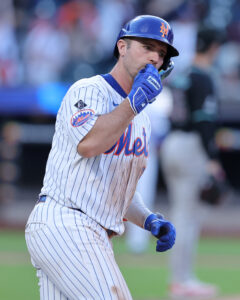
That’s particularly true with a slight downturn in Alonso’s batted ball metrics. He’s still capable of hitting the ball as hard anyone, but he has done so less frequently over the past couple seasons. The Polar Bear’s rate of hard contact (a batted ball with an exit velocity north of 95 MPH) peaked at 47.3% back in 2021. It dropped by a few points in each of the next two seasons. This year’s 40.1% hard contact rate is a match for last season’s. It places Alonso 129th out of 263 qualified hitters.
The dip in hard contact rate hasn’t made Alonso a bad hitter, of course. He’s hitting .238/.315/.477 with 14 homers across 267 plate appearances. After accounting for the pitcher-friendly nature of Citi Field and a depressed league run environment, that’s 27 percentage points better than average. Alonso remains a middle-of-the-order bat, but it’s a slightly concerning trend for a player whose game is built on power.
If the front office has concerns about Alonso’s long-term projection, a trade would be the most sensible decision. The Mets would get very little in return if they let him walk in free agency. They’d make him a qualifying offer, but they’d only receive a pick after the fourth round if he signs elsewhere. As a luxury tax payor, they’re entitled to the lowest compensation for losing a qualified free agent. The trade offers they receive this summer would certainly be better than that, even if Alonso’s limited control window and $20.5MM arbitration salary make it unlikely they’d get any top-tier prospects in return.
For the Mets to keep Alonso, they’d need to believe there’s a realistic path to the postseason in 2024 and/or feel good about their chances of retaining him in free agency. Making the playoffs this year isn’t impossible, but they’ve put themselves in a hole with their poor start. Holding Alonso would probably be more about the latter scenario — a sign they’re confident that he’ll stay in New York after seeing what other teams will offer.
Owner Steve Cohen is capable of outbidding anyone. He’s presumably keen on retaining Alonso, who has proven himself in New York and has been a fan favorite since his electrifying rookie season. Yet the Mets have been relatively restrained in the last two offseasons after their frenzied effort to spend their way into contention in 2021 didn’t quite pan out. (The Mets did win 101 games in 2022, but they followed up a first-round playoff exit with last year’s 75 wins.) The Mets seem to be gearing up for a bidding war with the Yankees and others on Juan Soto, which could take some of the priority away from Alonso.
It’s at least worth considering the possibility that the Mets trade Alonso before trying to bring him back next winter. That’s not unheard of but doesn’t happen often, particularly with players at the top of the market. A deadline trade typically reflects an understanding that the team and player aren’t going to line up on contract figures.
How will the Mets handle the situation? Is Alonso going to be on the move this summer?
What Will Happen With Pete Alonso?
-
Deadline trade 53% (5,037)
-
Mets make the QO, let Alonso walk 16% (1,522)
-
Mets extend or re-sign him 16% (1,513)
-
Mets trade Alonso, then re-sign him in the offseason 14% (1,366)
Total votes: 9,438
Image courtesy of USA Today Sports.
Mets Release Omar Narvaez, Jorge Lopez
The Mets announced Wednesday that they’ve released veteran catcher Omar Narvaez and right-hander Jorge Lopez. Both were designated for assignment last week, and both are now free agents. New York also selected the contract of catcher Joe Hudson from Triple-A Syracuse, moving righty Shintaro Fujinami to the 60-day injured list to open a roster spot. Hudson is a candidate to serve as an extra player for the Mets’ London Series against the Phillies, where each team will be granted a 27th player.
The 32-year-old Narvaez is playing out the second season of a two-year, $15MM contract he signed in the 2022-23 offseason. He had the right to opt out of said contract following the 2023 season, but after a .211/.283/.297 showing in his first year with the club, he unsurprisingly passed on that opportunity. He’s struggled even more in 2024, hitting just .154/.191/.185 in 69 trips to the plate.
Though his run with the Mets was dismal, Narvaez was a quality regular for several years leading up to that deal. From 2018-22, he slashed .254/.337/.397 between the White Sox, Mariners and Brewers — even landing an All-Star nod with the ’21 Brewers. Milwaukee also worked with Narvaez to dramatically improve his glovework — specifically his framing skills — improving upon the below-average grades he drew during his time with Seattle and Chicago.
Any team in need of some catching help could take a flier on Narvaez and would owe him only the prorated league minimum for any time spent on the MLB roster. That sum would be subtracted from what the Mets still owe him, but they’re on the hook for the bulk of his $8MM salary regardless. The Marlins and Cubs have had the game’s worst production behind the plate this season, and while Narvaez himself has had an extremely rough go of it, his track record might be appealing to them or another club with suspect backstops.
Lopez’s time with the Mets ended in controversial fashion. The right-hander, showing ample frustration after a poor outing, angrily lobbed his glove into the stands as he walked off the field. After the game, when asked about his actions, the Puerto Rican-born righty said he did not regret his actions and offered a candid assessment. Lopez, speaking his second language without an interpreter by his side, has stressed that he intended to state that he had been “the worst —-ing teammate” in MLB (presumably due to that outburst). But it was difficult in the moment to discern whether he’d said “worst teammate” or called the Mets the “worst team,” and when asked to clarify, he suggested both (again, without an interpreter/translator at his side).
The situation was further muddied by Lopez telling the media that he hadn’t spoken to Mets management about the issue, when he in fact had discussed it with manager Carlos Mendoza. The Mets wound up designating Lopez for assignment. In the hours after the incident, it came to light that he’s also been dealing with significant personal distress. His young son is on a transplant list and awaiting a donor. Add in that Lopez has previously spent time on the injured list due to anxiety issues, and it becomes clear that there’s far more at play than simply losing his temper and some mistaken words.
As with Narvaez, any club can now sign Lopez and owe him only the prorated minimum for any time spent on the big league roster. The manner in which his Mets tenure drew to a close will likely impact his market, but while not excusing his actions, it’s also easy to look at the situation from personal/human standpoint and understand why things may have unraveled for the 31-year-old righty.
Lopez pitched fairly well with the Mets, logging 26 1/3 innings of 3.76 ERA ball. A sub-par 17.1% strikeout rate and 9.9% walk rate both lead fielding-independent metrics to take a more bearish view of his work, however (4.65 FIP, 4.46 SIERA). Lopez had a breakout 2022 showing with the Orioles and Twins but followed that up with a sub-par 2023 campaign spent mostly in Minnesota.
After a brilliant start to the season in which he was unscored upon into May, Lopez hit a rough patch and wound up taking some time away from the Twins due to his anxiety. He expressed gratitude to the team for allowing him to focus on his mental health upon his return to the club. Unfortunately, his results following the break were still sub-par, and the Twins wound up flipping him to the Marlins in a deadline deal sending Dylan Floro back to Minnesota.
Taken in totality, the last three seasons from Lopez have yielded solid, if inconsistent results. He’s pitched 156 1/3 innings and logged a 4.03 ERA with a 20.7% strikeout rate, 9.5% walk rate and 51.2% grounder rate. Lopez’s strikeouts and ground-ball tendencies have trended downward since 2022, however, as has the velocity on his power sinker — which at at 97.8 mph in ’22 but averaged 95.4 mph with the Mets this season. Whatever comes next for the right-hander, the hope beyond the baseball field is that his son finds the donor he needs and that Lopez continues to prioritize his mental health.
Turning to the journeyman Hudson, this will be the 33-year-old’s first time on a big league roster since the 2020 season. He’s appeared in 18 big league games and taken 33 plate appearances, going 5-for-30 with a double, two walks, six strikeouts and a sacrifice in that time. The former sixth-round pick has been with nine organizations in his professional career, including brief MLB stints with the Mariners, Angels and Cardinals. In 19 games with the Syracuse Mets this season, he’s hitting .222/.364/.444 with three home runs and three doubles.
NL East Notes: Sanchez, Marsh, Alvarez, Fujinami, Fletcher
The Marlins placed right-hander Sixto Sanchez on the 15-day injured list today (retroactive to June 1), with right-hander Emmanuel Ramirez was called up from Triple-A in the corresponding move. Sanchez is dealing with inflammation in his throwing shoulder, and something seemed awry when his velocity was significantly down in his start against the Rangers on Friday.
Given how multiple shoulder surgeries (amidst other injuries) kept Sanchez from just a single inning of minor league ball from 2021-23, it isn’t a good sign that the former top prospect is again dealing with any type of shoulder problem, even if some inflammation or soreness might be expected given Sanchez’s long layoff. The righty made his return to the big leagues this season and has a 6.06 ERA over 35 2/3 innings for Miami, starting seven of his 14 appearances. While Sanchez has always been more of a grounder specialist than a strikeout artist, Sanchez has struck out only 10.5% of batters faced this season.
More from around the NL East…
- Brandon Marsh is “day to day…at this point” with a right hamstring strain, as Phillies manager Rob Thomson told reporters (including Scott Lauber of the Philadelphia Inquirer) after Marsh was removed from tonight’s game. In the eighth inning, Marsh was rounding second base after a Nick Castellanos single, but seemed to tweak his hamstring and immediately asked for a trainer. One of the many Phillies players enjoying a strong season, Marsh is hitting .265/.344/.426 over 186 plate appearances, playing primarily as the regular left fielder against right-handed pitching, and also bouncing around to the other two outfield spots when needed. Philadelphia has a pair of upcoming off-days on Thursday and Friday, so the club might try to get by without Marsh until that break in the hopes that he can avoid the injured list.
- Francisco Alvarez could possibly be making a quicker return than expected from thumb surgery, as The Athletic’s Will Sammon (X link) writes that “there’s a distinct possibility” Alvarez could be part of the Mets‘ roster for the pair of games with the Phillies in London on June 8-9. The catcher was given a recovery timeline of 6-8 weeks after he underwent the surgery on April 23, though since Alvarez has started a minor league rehab assignment, the Mets are hopeful that he might make it back right at the low end of that initial progression.
- In other Mets injury news, the team called up Shintaro Fujinami in mid-May and placed him on the Major League 15-day injured list, a procedural move that MLB.com’s Anthony DiComo explains was made so Fujinami could eventually be moved to the 60-day IL, thus freeing up a 40-man roster spot. Fujinami hasn’t been pitched for a month due to a shoulder strain, and the updated 6-8 week timeline means that he’ll likely be out of action until July. New York signed Fujinami to a one-year, $3.35MM deal in February, coming off his MLB debut season that saw him post a 7.18 ERA across 79 innings with the A’s and Orioles. Despite that big ERA, the hard-throwing Fujinami pitched better as the season went on, leading the Mets to make a small investment in his potential as a bullpen arm.
- The Braves have assigned David Fletcher from Triple-A Gwinnett to Double-A Mississippi, the team announced. While technically a demotion, the Mississippi affiliate’s official X feed listed Fletcher as an infielder and right-handed pitcher, indicating that this move could be a way of giving Fletcher more runway to explore his new career path as a knuckleballer. The Athletic’s David O’Brien recently detailed how Fletcher has been experimenting with a knuckler, culminating in a start last Wednesday when he limited the Orioles’ Triple-A squad to two runs over five innings. Fletcher (who recently celebrated his 30th birthday) is still owed at least roughly $12MM through the end of the 2025 season, as per the five-year, $26MM extension he signed with the Angels in April 2021. His production as an infielder has declined sharply since signing that deal, and the Braves acquired him as part of a mutual salary dump of trade last December. Fletcher is also under investigation from the league in regards to allegations of non-baseball bets placed with an illegal bookmaker.
Mets Release Jiman Choi
The Mets have granted first baseman Jiman Choi a release from his minor league contract, reports Will Sammon of the Athletic (X link). Choi was one of a handful of players who had an opt-out date tomorrow. It seems he informed the team he intended to trigger the out clause and the Mets decided not to call him up.
Choi signed with the Mets in the early part of Spring Training. He lost out to DJ Stewart in a camp battle for an Opening Day roster spot. The lefty hitter nevertheless reported to Triple-A Syracuse and bypassed chances to retest free agency at the end of Spring Training and on May 1. He didn’t find much success in the organization, hitting .183/.307/.317 over 101 Triple-A plate appearances.
While Choi drew an impressive 16 walks, he struck out 28 times and only collected 15 hits in 25 games. He was on the minor league injured list between late April and May 14. He had a .189/.319/.378 slash before the injury and turned in a .171/.268/.286 mark after returning.
There probably wouldn’t have been room on the big league roster for Choi even if he were raking in Syracuse. Pete Alonso and J.D. Martinez are locked in at first base and designated hitter, respectively. Stewart, who has reached base at a .352 clip in 122 plate appearances behind a massive 17.2% walk percentage, is on hand as a lefty bench bat. The Mets have already had too many defensively limited players on the bench in recent weeks, leading them to option Brett Baty and call up Jose Iglesias this morning.
Choi’s middling performance in Syracuse makes it unlikely he’ll land an immediate MLB job. His camp will presumably search for another minor league contract with an organization offering more of a path to first base playing time. Choi stumbled to a .163/.239/.385 showing between the Pirates and Padres in a 2023 season mostly lost to injuries. He was a productive platoon bat for the Rays from 2019-22, hitting .248/.361/.447 in more than 1100 plate appearances against right-handed pitching.
Seven Veterans With Opt-Out Opportunities This Weekend
As part of the 2022 collective bargaining agreement, MLB and the Players Association agreed to a few automatic opt-out dates for some veteran players on minor league contracts. Article XX(B) free agents — generally, players with over six years of MLB service who finished the preceding season on a big league roster — who sign minor league contracts more than ten days before Opening Day receive three uniform chances to retest free agency if they’re not promoted.
The first comes five days before the start of the season. For players who pass on that initial opt-out, they have additional windows to explore the open market on both May 1 and June 1 if they’ve yet to secure a spot on the 40-man roster. There were 31 players who initially had that option in Spring Training.
Eleven of them — Carlos Carrasco, Garrett Cooper, Chase Anderson, Dominic Leone, Eddie Rosario, Jesse Winker, Kevin Pillar, Jesse Chavez, Brad Keller, Curt Casali and José Ureña — are currently on MLB rosters. Joely Rodríguez, Tyler Duffey, Matt Barnes and Drew Pomeranz made it to the big leagues but were subsequently removed from the 40-man roster; Barnes and Pomeranz are free agents.
Bryan Shaw, Matt Duffy and Carl Edwards Jr. are on new minor league deals after opting out in Spring Training. Six others — Elvis Andrus, Eduardo Escobar, Mike Moustakas, C.J. Cron, Jake Odorizzi and Kolten Wong — are free agents after being released.
That left seven players with opt-out chances on May 1. While none of them took that immediately, David Peralta opted out of his deal with the Cubs on May 13. He inked a minor league contract with the Padres a few days later and was added to the MLB roster on May 22. Let’s check in on the six remaining players who can retest free agency tomorrow — plus one player whose deal contains a contractual opt-out provision.
- Angels: OF Jake Marisnick
Marisnick has had a tough time staying healthy in 2024. The glove-first outfielder has only played in 12 games with the Angels’ top affiliate in Salt Lake. He hasn’t hit in a limited sample, going 5-32 with 14 strikeouts and one walk. Marinsick was out of action between mid-April and the second week of May. He appeared in seven contests before going back on the injured list on May 25. He’s probably best served staying with the Halos, who are without Mike Trout and leaning on Mickey Moniak as their primary center fielder. Moniak is hitting .175/.214/.250 over 126 plate appearances.
- Blue Jays: 1B Joey Votto
Votto’s homecoming has been held up by a Spring Training ankle injury. The former MVP has yet to play in a minor league game. There’s no reason to expect the Toronto native will opt out. Neither Justin Turner nor Daniel Vogelbach is hitting well for the Jays, so there could be an opportunity for Votto once he’s healthy. Vogelbach, as a left-handed hitting DH, is the most direct competition. He has a .167/.273/.292 slash and has only started 13 of the team’s 55 games.
- Mets: 1B Jiman Choi
Choi, a lefty-hitting first baseman, was on the injured list for his prior opt-out chance. He’s healthy now, returning to Triple-A Syracuse on May 14. Choi hasn’t gotten into any kind of rhythm offensively, though. The 33-year-old had a .189/.319/.378 slash before hitting the IL. He owns a .171/.268/.286 mark in the 10 games since his return. Choi isn’t hitting well enough to merit a major league opportunity, though he could look for a different minor league contract with Pete Alonso, J.D. Martinez and Mark Vientos firmly above him on the first base/DH depth chart.
- Rangers: RHP Shane Greene
Greene pitched in six games for Triple-A Round Rock in April. He allowed 15 runs in eight innings and was placed on the injured list. The Express transferred the veteran righty to the full-season IL two weeks ago, ruling him out for the year.
- Red Sox: RHP Michael Fulmer, C Roberto Pérez
Neither Fulmer nor Pérez has played this season. Fulmer will miss the entire year after undergoing elbow surgery last fall. His contract is a two-year deal; he almost certainly won’t opt out.
Pérez missed most of 2023 after undergoing a rotator cuff repair on his right shoulder. He played in seven games this spring but has spent the regular season on the minor league IL with an undisclosed injury. The Sox have gotten strong play from their catching tandem of Connor Wong and Reese McGuire. Perhaps Pérez feels there’s a better path to playing time if he signs a minor league deal with another team, but it seems likelier he’ll stick in the organization.
- Twins: 2B Tony Kemp
Kemp is not one of the aforementioned Article XX(b) players. He’s playing on a minor league deal that he signed in mid-April with the Twins. Darren Wolfson of SKOR North reported (on X) earliest this month that Kemp’s contract contains a June 1 opt-out date. The left-handed hitting second baseman/left fielder has struggled for Triple-A St. Paul, batting .193/.316/.325 with three homers across 98 plate appearances.
That’s mostly attributable to poor ball in play results. Kemp has shown his typically strong plate discipline, walking 13 times against 17 strikeouts. He has been plagued by a .206 average on balls in play. Kemp was briefly on the Orioles’ big league roster in April and has appeared in parts of nine MLB seasons overall. He hit .209/.303/.404 in 124 games with the A’s a season ago.
Mets To Designate Omar Narvaez, Acquire Luis Torrens, Option Brett Baty, Christian Scott
10:20am: The Mets are sending cash to the Yankees in the deal for Torrens, tweets Sherman. Specifically, it’ll be a $100K return for the Yankees.
9:50am: The Mets are shaking up the roster with a broad-reaching set of roster moves. Catcher Omar Narvaez is being designated for assignment, reports SNY’s Andy Martino. His spot on the roster will go to catcher Luis Torrens, who is being acquired from the Yankees and selected to the MLB roster, according to Daniel Alvarez Montes of El Extra Base. Meanwhile, third baseman Brett Baty and righty Christian Scott will be optioned to Triple-A Syracuse, ESPN’s Jeff Passan reports. They’ll be replaced on the roster by infielder Jose Iglesias, whose contract will be selected from Syracuse, and righty Dedniel Nunez, who’ll be recalled from Syracuse, Joel Sherman of the New York Post reports.
It’s a significant slate of roster moves that’ll see the Mets jettison the veteran Narvaez, option two of their top prospects to Triple-A for more seasoning, and thus clear a full runway for Mark Vientos to get an opportunity as the everyday third baseman.
Narvaez, 32, inked a two-year deal worth a guaranteed $15MM in the 2022-23 offseason — the second season of which was a player option. After a lackluster debut campaign in Queens that saw him hit just .211/.283/.297, Narvaez unsurprisingly opted into the second season of his contract. This year’s production has been even more feeble, however. In 69 trips to the plate, Narvaez has managed only a .154/.191/.185 batting line with a dismal 22.2% hard-hit rate.
Prior to his time with the Mets, Narvaez was a quality regular with the White Sox, Mariners and Brewers from 2018-22 — even making an All-Star team with Milwaukee in 2021. That five-year span saw Narvaez bat .254/.337/.397. He was inconsistent with the bat on a year-to-year basis but wound up producing at a roughly league-average level overall during that half-decade run. On top of that, the Brewers — who have a reputation for improving catcher defense — revamped Narvaez’s skill set behind the plate. He rated as one of the game’s worst defenders in 2018-19 with Chicago and Seattle but posted seven Defensive Runs Saved and was worth an even more impressive 19 runs behind the plate in Statcast’s eyes — thanks largely to massive improvements in his framing.
The injury to Francisco Alvarez appeared to create an opportunity for Narvaez to get back to that previous form, but he’s been outhit by the defensively superior Tomas Nido, who returned to the big leagues after being outrighted to Syracuse last season. Nido hasn’t been great at the plate himself — his .233/.260/.370 batting line is well below par — but has handily outperformed his fellow backstop. That’ll allow Nido to stick around in what’ll likely be the lead catching role until Alvarez’s return.
Alvarez suited up for Double-A Binghamton yesterday, kicking off a 20-day window for his minor league rehab assignment. That could make for a short-lived stay on the roster for the newly acquired Torrens. The Mets will choose between him and Nido once Alvarez is ready for activation. In 124 Triple-A plate appearances with the Yankees, the journeyman Torrens hit .279/.339/.469 with five homers and six doubles.
Once a well-regarded catching prospect with the Padres and Mariners, the now-28-year-old Torrens is a career .227/.289/.354 hitter in 807 MLB plate appearances. He has a knack for hard contact, but too many of those well-struck balls are of the grounder variety. A hefty 49.9% of Torrens’ career batted balls in the majors have been on the ground, which is clearly suboptimal for a plodding catcher who ranked in the 24th percentile of big league players in sprint speed from 2022-23, per Statcast.
In Baty and Scott, the Mets are sending two of the organization’s most touted prospects back to the minors. Baty, 24, has now seen MLB action in three straight seasons but has yet to cement himself as the everyday third baseman — or even as a viable big league bat. This year’s .225/.304/.325 batting line is 12% worse than average, by measure of wRC+, but nonetheless stands as his most productive season in the big leagues. Since making his debut late in the 2022 season, Baty carries a .214/.281/.325 line in exactly 600 plate appearances.
Baty, the No. 12 pick in the 2019 draft, has been particularly cold of late, tallying just six hits in his past 54 trips to the plate. He’s considered a superior defender to the also-24-year-old Vientos, but Vientos’ bat has been too loud for the Mets to ignore. Also long considered one of the organization’s better prospects, Vientos is hitting .295/.354/.591 with three homers in just 48 plate appearances. The former No. 59 overall pick’s performance emphatically warrants greater playing time. With Baty sent to Triple-A, he’ll receive that chance and could well establish himself as a long-term corner option for the Mets with a strong showing.
Scott, who’ll turn 25 in a couple weeks, has pitched well through his first five MLB starts. In 27 2/3 frames, he’s worked to a 3.90 ERA with a 22.3% strikeout rate and excellent 5.4% walk rate. However, the right-hander was a reliever in college whom the Mets have moved into a rotation role since turning pro. He’s thus never worked a full starter’s workload, with last year’s 87 2/3 frames standing as a career-high. The Mets have multiple off-days on the schedule in the near future, lessening the need for rotation arms. As such, they’ll send Scott to Syracuse, where they can more easily manage his innings and simultaneously afford the big league club an extra reliever.
Passan does note that Scott is expected to return to the big leagues before long. His promotion to date certainly warrants that. And if the Mets continue on their current trajectory, it wouldn’t at all be surprising to see other members of the rotation dangled in trade scenarios. For now, Luis Severino, Sean Manaea, Jose Quintana, Tylor Megill and David Peterson are lined up to make the next five starts. Severino is on a one-year deal, while Manaea has a opt-out at season’s end and Quintana is in the second season of a two-year contract.
In place of Baty, the Mets will turn to the veteran Iglesias. He’s carved out a reputation as a plus defensive shortstop with good contact skills but minimal impact when he does put bat to ball. Iglesias didn’t play in the majors last season but is a career .279/.319/.382 batter in more than 4000 plate appearances. He’s come to the plate 175 times in Syracuse this season and turned in a .273/.309/.442 slash.
Iglesias will give the Mets a true backup shortstop to Francisco Lindor, something they previously lacked, and is plenty capable of spelling Vientos at the hot corner or stepping in for Jeff McNeil at second base even if the overwhelming majority of his career has been spent at shortstop.
As for Nunez, this will mark his third stint with the Mets already this year. He was up earlier this week as the 27th man for a doubleheader and also had a four-game run earlier in the season. He’s pitched 8 1/3 innings over five appearances, holding opponents to three runs on seven hits and three walks with 13 strikeouts.
Mets Designate Jorge López For Assignment
The Mets have officially designated right-hander Jorge López for assignment, a move that was reported on yesterday. Left-hander Danny Young was recalled to take Lopez’s spot in a corresponding move.
The Mets have been in a rough patch lately, losing three in a row and eight of their last ten, and the frustration seemed to boil over with López yesterday. After allowing a home run to Shohei Ohtani, he was facing Freddie Freeman when a checked swing appeal to third resulted in a call of no swing. López seemingly said something to third base umpire Ramon De Jesus and was ejected. While making his way off the way off the field, he untucked his shirt and tossed his glove into the stands. Video shared on X by SNY.
After the game, López spoke to the media, though there was some confusion about what he said and what he intended. López, a native of Puerto Rico, spoke in English and some believed he called the Mets “the worst team in probably the whole f***ing MLB” while others heard him referring to himself as “the worst teammate” in the league. Later that night, it was reported that López would be designated for assignment.
Today, López seemed unhappy with the way things played out the night before. He posted on his Instagram stories this morning, stating that he was definitely saying “teammate” and sarcastically thanked the media for making the situation worse. Anthony DiComo of MLB.com posted on X this morning that López losing his roster spot had nothing to do with the team/teammate confusion, saying that López “embarrassed the organization with his actions and words, throwing his glove into the stands, lying about meeting with management and offering zero remorse.”
Reporters from López’s previous clubs have come to his defense today, trying to give larger context to the pitcher’s frustrations. Andy Kostka of The Baltimore Sun shared this story from 2022, when López was with the Orioles. The article discusses the recent death of López’s grandfather as well as López’s son Mikael, who has dealt with several autoimmune disorders since he was born and has spent much of his life in the hospital. Dan Hayes of The Athletic shared this story from last summer, when the Twins put López on the injured list for a mental health break. Boomer Esiason addressed the matter on his show today, as relayed by Awful Announcing on X, saying that he had been informed that Mikael is currently waiting for a transplant.
The extra information certainly makes it easier to understand how López reacted the way that he did, but it appears the Mets don’t consider that an acceptable excuse. Some observers have suggested that the Mets could have put López on the IL for mental health reasons, as the Twins did last year, but they have decided to take a different approach and have removed the righty from their roster.
The Mets will now have one week to trade López or pass him through waivers. In the latter scenario, López has the right to reject an outright assignment and elect free agency while holding onto the remainder of his $2MM salary, as a player with more than five years of major league service time.
He has logged 26 1/3 innings with the Mets this year, allowing 3.76 earned runs per nine innings. His 17.1% strikeout rate is subpar but his 9.9% walk rate and 44.2% ground ball rate are both around league average.
He had a breakout seasons as a reliever with the O’s in 2022. After years of fairly middling work as a starter, a move to the bullpen seemed to unlock something in the righty. In 48 1/3 innings with Baltimore, he had a 1.68 ERA, 27.6% strikeout rate, 8.7% walk rate and 60% ground ball rate.
He was flipped to the Twins at that year’s deadline but his results have backed up since then. He had a 4.37 ERA with Minnesota after the deal in 2022, then had a 5.95 ERA in 2023, ending up bouncing to the Marlins and Orioles later in the year. The O’s cut him at the end of the year, which freed him up to sign with the Mets.
Brooks Raley Undergoes Tommy John Surgery
May 30: Raley underwent Tommy John surgery Wednesday and had an internal brace installed in his elbow as well, the team announced.
May 21: Mets reliever Brooks Raley will undergo Tommy John surgery next week, reports Tim Healey of Newsday. That’ll end his 2024 season and likely cost him at least the first half of the ’25 campaign.
It could also mark the end of Raley’s time in Queens. The 35-year-old southpaw (36 in June) is set to hit free agency next offseason. Raley is playing this season on a $6.5MM salary after the Mets exercised a club option at the start of last winter. That was an easy decision considering how well Raley pitched between 2022-23.
In 126 appearances over that stretch, he turned in a 2.74 earned run average behind a 26.8% strikeout rate. The Mets received some trade calls at last summer’s deadline (and quite likely again over the winter) but elected to hold onto him as their top left-handed setup option.
That’ll unfortunately go down as a mostly lost investment. Raley had an excellent start to the season, working seven scoreless innings with nine strikeouts over eight appearances. He landed on the injured list on April 21 with what ultimately proved to a season-ending injury. While the Mets initially diagnosed the issue as inflammation and projected a short-term absence, later testing revealed ligament damage.
Without Raley, the Mets are light on left-handed relievers. Jake Diekman is their clear top option. The 37-year-old has made 20 appearances and posted his typical blend of huge strikeout and walk tallies. Diekman has punched out 23 of his 70 opponents (nearly 33%) while issuing 14 walks (20%). He owns a 3.86 ERA across 16 1/3 innings. The veteran is an effective reliever overall, but he’s probably miscast as a team’s best left-hander.
Josh Walker has been on and off the active roster throughout the season. He’s currently in a middle relief role. Danny Young is on optional assignment to Triple-A Syracuse. Tyler Jay saw a bit of MLB time early in the season and remains in the organization after being outrighted from the 40-man roster a month ago. The Mets could welcome swingman David Peterson back from the 60-day injured list as soon as next week. Whether he’ll work from the bullpen or grab a rotation spot — likely in place of the struggling Adrian Houser — is still to be determined.
Raley has spent the last month on the 15-day IL. The Mets can move him to the 60-day at any time that they need to open a spot on the 40-man roster (though they already have two vacancies in that regard). His camp will presumably look for a two-year deal when he hits the open market, likely with a low base salary in the first season.