
Sal Bando Passes Away
Longtime former big leaguer and executive Sal Bando passed away yesterday at age 78. Bando played with the Athletics franchise from 1966-76 and then with the Brewers from 1977-81 before becoming Milwaukee’s general manager for the 1992-99 seasons.
As per Bando’s family, “It is with a heavy heart, the Bando family is sad to announce the passing of its beloved husband and father, Sal, who last night lost his battle with cancer that began over five years ago. Sandy, Sal’s wife of 54 years, and sons Sal Jr., Sonny and Stef, send their love to family, friends and fans who mourn the loss of a humble and faithful man.”
Bando was a sixth-round pick for the then-Kansas City Athletics in the 1965 draft, and he broke into the majors the next season. By 1968, Bando had become the starting third baseman for the A’s in their inaugural season in Oakland, and he quickly became a key member of a budding dynasty. From 1969-74, Bando hit .265/.376/.445 with 141 homers, and his 34.7 fWAR was the fifth-highest of any player in the majors. That six-year period saw Bando make four All-Star teams, finish in the top four of AL MVP voting on three occasions (including a second-place finish to teammate Vida Blue in 1971), and win three World Series rings as the A’s three-peated from 1972-74.
There was no shortage of controversy on and off the field for those Athletics clubs, and yet Bando was a rock of stability as the team’s captain. However, Bando had his own share of issues with A’s owner Charlie Finley, stemming from contract disputes and Bando’s increasing leadership role with the MLB Players Association. After the 1976 season, Bando left the A’s as a free agent to sign a five-year deal with the Brewers, beginning the next chapter of his career.
While Bando’s didn’t match his production from his Oakland heyday, he was still a contributor to a Brewers team that had four straight winning seasons from 1978-81, which included a postseason appearance in 1981. Bando was only a part-time player in 1981, and decided to retire after 16 MLB seasons in order to transition into a new role in the Brewers’ front office. Bando worked as a special assistant to general manager Harry Dalton from 1982 until Bando himself was named to the top job himself following the 1991 season. Unfortunately, Bando’s tenure as GM included only one winning season, and he resigned the job partway through the 1999 campaign.
We at MLBTR send our condolences to Bando’s family, friends, and teammates.
A’s Reportedly Not Pursuing Ramon Laureano Trade
Over the past 18 months, the A’s have traded away most of the core players on the roster as a means of stripping down payroll. While much of that teardown was orchestrated either last offseason or at the summer deadline, it continued with the three-team deal that sent Sean Murphy to Atlanta last month.
Given Oakland’s recent activity, it stands to reason virtually anyone on the roster with an MLB track record could be a viable trade candidate. Outfielder Ramón Laureano is one of the team’s more established remaining players and could be the subject of attention from other clubs. However, Dan Hayes of the Athletic reports the A’s didn’t show much interest in dealing Laureano after the Twins inquired on his availability.
It’d be a surprise if the A’s had anyone firmly off the table, perhaps aside from pre-arbitration players they hope will be building blocks of their next contender like Shea Langeliers and Esteury Ruiz. Nevertheless, there’s good reason for general manager David Forst and his front office to be reluctant to pursue a Laureano deal over the offseason. The 28-year-old outfielder is coming off the worst season of his career, putting his value at a low ebb.
Laureano had an impressive debut with Oakland late in the 2018 campaign. He backed that up the following season with 24 home runs in 123 games. His offensive numbers dipped during the shortened 2020 schedule but bounced back through the first few months of ’21. Laureano was sitting on a .246/.317/.443 line over his first 378 plate appearances. That’s not an eye-catching slash at first glance but marked offensive production 13 points above the league average as measured by wRC+ given Oakland’s pitcher-friendly home park.
His 2021 season was brought to an abrupt end in August after he tested positive for the performance-enhancing drug Nandrolone. That resulted in an 80-game suspension that carried over into the start of last season. Laureano returned in April but saw his production crater. He hit .211/.287/.376 over 94 games, with the batting average and on-base percentage each representing career worsts. Only in 2020 did he have a lesser slugging mark.
The residual effects of the suspension aren’t the sole possible explanation for Laureano’s down year. He carried a .223/.300/.395 line into mid-August, production that was below his previous career standards but still marginally above average after adjusting for the ballpark. He suffered a left oblique strain on August 15 and landed on the injured list. Upon returning three weeks later, he limped to a .108/.175/.216 mark in 40 trips to the dish before suffering a hamstring strain that ended his season.
Coming off that year, it’s certainly not an ideal time for Oakland to move him. Laureano’s suspension kept him from surpassing four years of service time last season — players don’t accrue service while on the restricted list — and extended Oakland’s window of arbitration control by another season. He’s eligible for arbitration through the end of 2025 and making $3.55MM for the coming season. That’s affordable even for a team that runs one of the league’s lowest payrolls. That all leaves open the potential for Oakland to hold Laureano into the coming season and reevaluate offers at the deadline after a hopeful better first half from the right-handed hitter.
Another club making a very strong offer in the coming weeks could change the calculus for Oakland, of course. It’s hard to imagine they’d steadfastly refuse to entertain any trade discussions on Laureano. Yet it’s also understandable the club doesn’t seem particularly eager to shop him with his stock at its current point. Assuming he stays in Oakland, he’ll join the likes of Ruiz, Seth Brown (if he’s not dealt himself), Cristian Pache, Conner Capel and Brent Rooker in the outfield mix.
Athletics Sign Austin Pruitt To Minor League Deal
The Athletics have signed right-hander Austin Pruitt to a minor league deal, according to his transactions tracker at MLB.com. He will presumably receive an invitation to major league Spring Training with the club.
Pruitt, 33, was originally drafted by the Rays and first cracked the big leagues with that club. He had a solid three-year run over the 2017-2019 campaigns, working as both a starter and a reliever. He logged 199 2/3 innings over that time with a 4.87 ERA, though advanced metrics liked his work better, such as a 4.17 FIP. He only struck out 17.2% of batters faced but kept his walks down to a 5.8% rate and got grounders on 48.9% of balls in play.
The past few years have been a bit more tumultuous for Pruitt, however. He was traded to the Astros in early 2020 but wound up missing that entire season due to an elbow injury that lingered and eventually required surgery. He returned in July of 2021 but only made two appearances as an Astro before getting designated for assignment. He went to the Marlins in the Yimi Garcia trade but that club also designated him for assignment shortly thereafter.
He joined the A’s on a minor league deal last year and ended up having two stints with the big league club. He was selected in May, designated for assignment in August, but was quickly selected again. By the end of the year, he had tossed 55 1/3 big league innings over 39 appearances. He posted a 4.23 ERA with a 17% strikeout rate, 4% walk rate and 45.5% ground ball rate.
Since the A’s have been aggressively rebuilding, their pitching staff mainly consists of inexperienced youngsters. Trevor May is the only pitcher on the 40-man with more than four years of MLB service time and none of the guys likely to be in the bullpen have more than three. If Pruitt can earn his way back onto the roster, he’ll be able to fill a veteran role for the club, eating some innings and perhaps mentoring some of the younger arms. He could also be retained for 2024 via arbitration, if the A’s are so inclined.
Notable International Signings: 1/15/2023
Major League Baseball’s international signing period for 2023 has officially opened up today, with many of the big names signing almost immediately. Teams have long since agreed to verbal agreements with newly eligible teenage players, and today’s signings largely represent confirmation of what was anticipated. Still, it’s a day of no small moment, particularly for the young men embarking upon the start of their professional careers.
As previously mentioned, most of the agreements have been known for a while, with Baseball America‘s Ben Badler and MLB.com‘s Jesse Sanchez having listed each player’s expected landing spot. You can find each team’s total bonus pool and other information on the process right here. Here are a few key deals:
- Ethan Salas, C, Venezuela — Padres ($5.6MM): Ranked as the top prospect by both Baseball America and MLB Pipeline, the 16-year-old is considered by MLB Pipeline as “one of the best catching prospects in recent history” and is lauded for his strike zone control, power, and defense. Scouts have specifically highlighted his swing and soft hands. Born in June 2006, the backstop is the youngest player in MLB Pipeline’s Top 10 International Prospect Rankings. The young switch-hitter is no stranger to high-level baseball, with his grandfather, father, and uncle all playing professionally, and his older brother Jose Salas signed by the Marlins in 2019. Salas’ $5.6MM deal will comprise almost all of the Padres’ base signing pool of $5.825,000.
- Felnin Celesten, SS, Dominican Republic — Mariners ($4.7MM): MLB Pipeline’s second-best prospect and Baseball America’s third-best, Celesten has been heralded as having “the highest ceiling of any international shortstop prospect in a decade” by MLB Pipeline. Scouts have noted the switch-hitter’s plus speed, arm, and raw power. However, Baseball America reports that Celesten has “an aggressive approach” and “might need to become a more selective hitter.“
- Brando Mayea, OF, Cuba — Yankees ($4.4MM): Baseball America’s second-best prospect and MLB Pipeline’s ninth-best, Mayea has drawn praise for his bat speed, power, and approach to the plate, with one scout going as far as to describe the 17-year-old as a “mini Gary Sheffield.” Scouts have praised the righty’s strong arm, with some expecting an eventual move to a corner outfield position.
- Alfredo Duno, C, Venezuela — Reds (Unknown): MLB Pipeline’s fourth-best prospect and Baseball America’s seventh-best, Duno is a 17-year-old catcher that boasts three above-average tools — his fielding, arm, and power. Scouts have praised his “elite bat speed” and defensive ability. MLB Pipeline and Baseball America both predict that Duno will remain behind the plate, but both also cite his swing-and-miss tendencies as a result of his aggressive approach.
- Emmanuel Bonilla, OF, Dominican Republic — Blue Jays ($4.1MM): Baseball America’s fourth-best prospect and MLB Pipeline’s seventh-best, Bonilla profiles as a slugging outfielder that has a chance to remain in centerfield but will likely move to a corner position as the 16-year-old matures. Scouts have praised the righty’s bat speed and swing, with Baseball America reporting that some scouts believe Bonilla has “one of the best combinations of hitting ability and power in the class.”
- Luis Morales, RHP, Cuba — Athletics (Unknown): MLB Pipeline’s fifth-best prospect and Baseball America’s ninth-best, Morales is a hard-throwing righty with a fastball that sits between 94-97 MPH with a slider, changeup, and curveball as secondary pitches. Born in Cuba, Morales was considered the best U-18 pitcher on the island, setting a record for strikeouts (161) in 82 2/3 innings between 2019 and 2020. He defected in 2021 while playing for Cuba’s U-23 team in Mexico. Morales, 20, is one of the oldest high-profile international prospects and thus may be potentially fast-tracked through the A’s system.
- Sebastian Walcott, SS, Bahamas — Rangers (Unknown): Baseball America’s sixth-best prospect and MLB Pipeline’s eighth-best, Walcott is a 6’3, 170 lbs (6’4, 190 lbs, per Baseball America) 16-year-old that has impressed scouts with high raw power and bat speed. Despite being 6’3, Walcott has drawn praise for his contact skills, hand-eye coordination, and his fluid swing. Baseball America projects that as Walcott matures, he will outgrow the shortstop position and transition to third base.
Several other well-regarded prospects also secured bonuses of $2M or more, with the specifics provided by Sanchez:
- Brailer Guerrero, OF, D.R., Rays ($3.7MM) [MLB Pipeline #12, BA #5]
- Jesus Caba, SS, D.R., Phillies ($3MM) [MLB Pipeline #11, BA #8]
- Ariel Castro, OF, Cuba, Twins ($2.5MM) [MLB Pipeline #11, BA#13]
- Rayner Arias, OF, D.R., Giants ($2.8MM) [MLB Pipeline #15, BA #8]
- Camilo Diaz, OF, D.R., Astros ($2.25MM) [MLB Pipeline #17, BA #19]
- Luis Almeyda, SS, D.R., Orioles ($2.3MM) [MLB Pipeline #20, BA #17]
- Roberto Calaz, OF, D.R., Rockies ($2.5MM) [MLB Pipeline #24, BA #14]
A’s Designate Tyler Cyr For Assignment
The Athletics have made their signing of right-hander Shintaro Fujinami official, announcing the move today. To open a spot for him on the 40-man roster, fellow righty Tyler Cyr has been designated for assignment.
Cyr, 30 in May, was drafted by the Giants in 2015 and spent many years in their organization. However, he reached seven-year minor league free agency when the end of the 2021 season rolled around and he hadn’t been added to their roster. The Phillies then signed him to a minor league deal for the 2022 season.
He got into 35 games for Triple-A Lehigh Valley with a 2.50 ERA, striking out 24.8% of opponents but walking 12.1% of them. The Phillies selected him to their roster in August when Seranthony Domínguez was placed on the injured list. They put Cyr into one game, letting him face three batters, and then designated him for assignment. He landed with the A’s on a waiver claim and finished the season with them, posting a 2.08 ERA over 13 innings.
Cyr had some good results this year but control is a concern. He kept his walks down to a 9.1% rate in his brief MLB stint but the last time he stayed under the double-digit range was at Double-A in 2017. But he also gets a good deal of strikeouts, still has a full slate of options and less than a year of service time. The A’s will have a week to trade him or try to pass him through waivers.
Athletics Sign Shintaro Fujinami
The Athletics announced the signing of right-hander Shintaro Fujinami to a one-year deal on Friday evening. The Japanese hurler reportedly receives a $3.25MM guarantee and can earn up to $1MM more in potential incentives. That deal also come with a 20% posting fee of $650K to be paid out to Fujinami’s former team, the Hanshin Tigers of Nippon Professional Baseball, which brings the Athletics’ total expenditure on the deal to $3.9MM. Oakland would also owe a 20% fee to the Tigers on any money Fujinami unlocks via incentives.
Fujinami, a hard-throwing 28-year-old, was posted by the Tigers back on December 1. A high school phenom from the same draft class as Shohei Ohtani, incredibly stepping right from high school ball into the Tigers’ rotation and as a 19-year-old rookie and pitching to a 2.75 ERA in 137 2/3 innings as a starter. For several years, he delivered standout results, pitching to a sub-3.00 ERA through his first four seasons as a professional and making the Central League All-Star team in each of those first four campaigns.
However, as Yakyu Cosmopolitan lays out in a video recap of Fujinami’s career that fans will want to check out (YouTube link, video in English), Fujinami was left on the mound to toss 161 pitches — far and away a career high — during his age-22 season in an outing that began with him yielding five runs in three innings. He’d already begun to display some worrying command issues prior to that outing, and the extent to which that outing might have impacted him can’t be known, but Fujinami began to oscillate between the Tigers’ first team (i.e. their Major League club) and their farm system beginning in 2017. Further struggles from 2017-21 caused his stock to fade substantially.
The 2022 season, though, has brought about something of a renaissance for Fujinami. The hard-throwing righty made 10 starts and six relief appearances with the Tigers’ top team, pitching to a 3.38 ERA in 66 2/3 innings. He fanned 23.6% of his opponents and, most crucially, turned in a career-low 7.6% walk rate. That was not only the best mark of Fujinami’s career but the first time since 2016 he’s posted a walk rate under 10%.
As a 6’6″ righty with an upper-90s heater that has reached triple digits and a slider that’s been a plus pitch in the past, Fujinami offers tantalizing potential. The recent struggles and repeated inability to locate the ball with any real consistency obviously limit his earning power, but big league scouts have had Fujinami on their radar since his high school days. The A’s make for a sensible team to roll the dice on catching lightning in a bottle with Fujinami’s impressive raw arsenal, given their spacious home park and status as a non-contender, which will afford them additional patience if the righty struggles to acclimate to North American ball early on.
With the A’s, Fujinami will step into a starting staff that includes Cole Irvin, Paul Blackburn and a host of fellow unproven options. Oakland signed journeyman right-hander Drew Rucinski to a one-year, $3MM deal on the heels of a terrific run in the Korea Baseball Organization, so it’s likely he and Fujinami will slot in behind Irvin and Blackburn. Candidates for the fifth spot on the staff will include out-of-options righty James Kaprielian and prospects Ken Waldichuk, Kyle Muller, JP Sears and Adrian Martinez. It’s at least possible the A’s will use a six-man group early in the season, though their exact plans will be dependent on both the health and performance of this group during Spring Training.
The NPB/MLB posting system allows a posted player to negotiate with all 30 MLB clubs; the player’s former team is subsequently entitled to a posting/release fee that’s equal to 20% of the first $25MM on a contract, 17.5% of the next $25MM and 15% of any dollars thereafter. Given that it’s a one-year deal, the A’s are on the hook for a release fee that’s 20% of the $3.25MM guaranteed to Fujinami. That fee will be paid to the team and is separate from the value of the contract paid to Fujinami himself.
Jon Morosi of MLB.com first reported the A’s and Fujinami were in ongoing contract discussions. Jeff Passan of ESPN first reported the A’s were signing Fujinami to a one-year deal. Bob Nightengale of USA Today was first to report the $3.25MM guarantee. Jon Heyman of the New York Post first reported the $1MM in incentives.
Josh Lindblom Announces Retirement
Right-hander Josh Lindblom took to Twitter today to announce his retirement as a player. “For 30 years of my life, I played a game that taught me about more than balls and strikes, hits and runs, and wins and losses,” he wrote. “It taught me about life and made me the person writing this letter.” He then goes on to thank everyone with whom he’s interacted over that time, before concluding “I might be done, but I’m not finished.”
Lindblom, now 35, was first drafted by the Astros, who selected him out of high school with a third-round pick in 2005. Lindblom instead went to the University of Tennessee, later transferring to Purdue University. The Dodgers then selected him in the second round of the 2008 draft.
He was considered one of the club’s better prospects and would make it to the major leagues with the Dodgers in 2011. He did some solid work out of their bullpen that year, making 27 appearances with a 2.73 ERA. He made another 48 appearances for them through July of 2012, posting a 3.02 ERA in that time. He was then flipped to the Phillies at the deadline as part of the trade that sent Shane Victorino to Los Angeles.
His results took a downturn at that point, as his ERA after the trade was 4.63. Another trade sent him to the Rangers for the 2013 season, which he spent working primarily as a starter in Triple-A but struggling in brief MLB appearances. Yet another trade sent him to the A’s for 2014, where he was only able to make a single appearance in the majors, spending the rest of his time in Triple-A.
Lindblom then signed with the Lotte Giants of the Korea Baseball Organization. His first stint overseas was a successful one, as he threw 210 innings over 32 starts there with a 3.56 ERA. He couldn’t quite repeat that performance in 2016, as his ERA ticked up to 5.28 over 30 starts. A brief MLB comeback didn’t lead to much, with Lindblom signing a minor league deal with the Pirates. He was selected to the club’s roster and made four appearances but was eventually outrighted and returned to the Lotte Giants for the final months of the 2017 campaign.
2018 would prove to be a pivotal turning point for Lindblom. He signed with the Doosan Bears of the KBO and posted a 2.88 ERA over 26 starts and 168 2/3 innings. He returned to the club for 2019 and was even better. He made 30 starts in his second year as a Bear and registered a 2.50 ERA over 194 2/3 frames. He was voted the MVP of the league that year and the Bears won the Korean Series title.
He was able to parlay that strong stretch in the KBO into a three-year deal with the Brewers, which came with a $9.125MM guarantee and incentives that could have allowed him to earn $18MM. Unfortunately, he couldn’t quite replicate that production in North America, at least not at the big league level. He posted a 5.16 ERA in the shortened 2020 season and then a 9.72 mark over eight relief appearances the year after. He was outrighted in May of 2021 and has been pitching in Triple-A since then. Though he’s had some decent results at that level, the Brewers never selected him back to the roster.
It’s certainly been a circuitous journey for Lindblom, as his career path took him to six different MLB teams and a couple of KBO squads. He hangs up his spikes having played in 134 major league games and 130 in Korea. We at MLBTR congratulate him on a unique and interesting time as a professional athlete and wish him the best in whatever he gets up to next.
MLBTR Poll: American League West Favorite
The Astros have won the division title in the American League West in each of the past five full seasons. They also reached the ALCS in each of those years, along with the shortened 2020 campaign. There hoisted the World Series trophy twice in that time, including just a few months ago. However, their rivals have been aggressive in trying to load up to chase them in 2023 and it now seems like four out of the five clubs seem like legitimate contenders.
There’s still over a month until pitchers and catchers report to Spring Training, meaning there’s still time for some aggressive transactions that will further change the calculus. But much of the heavy lifting of the offseason appears to be done. Most of the top free agents are off the board, with guys like Jurickson Profar, Michael Wacha and Andrew Chafin the top remaining options. Those are fine players that could certainly help a team but they wouldn’t be franchise-altering additions. There’s also the trade market, which could theoretically see Bryan Reynolds on the move. The Rangers are reportedly interested in him, but so are many other teams and the Pirates have continued to hold firm to an asking price that seems to be quite high.
Whether there are significant moves still to come or not, let’s look at where the clubs stand now, starting with the reigning champs.
Houston Astros – 2022 record: 106-56, projected 2023 fWAR: 48.2
There’s not much doubt about the Astros at this point. As mentioned, they’re enjoying an incredible run of success. Going into the winter, they lost some significant players to free agency, the most notable of which was Justin Verlander. The club hasn’t done anything to supplant him thus far, which is a defendable but risky move. The rotation has plenty of solid options without Verlander, with Framber Valdez, Lance McCullers Jr., Cristian Javier, Luis Garcia, José Urquidy and Hunter Brown on the roster. However, Verlander is the reigning Cy Young winner after tossing 175 innings with a 1.75 ERA last year. Subtracting that kind of performance would have an impact on any club.
On the position player side, they lost Christian Vázquez, Jason Castro, Trey Mancini, Yuli Gurriel, Michael Brantley and Aledmys Díaz to free agency. They’ve since re-signed Brantley and added José Abreu. Overall, the team is still going to be good, but is it enough to hold off the others? FanGraphs certainly thinks so, giving them the highest projected wins above replacement on their depth charts, but there are three clubs within striking distance.
Seattle Mariners – 2022 record: 90-72, projected 2023 fWAR: 43.5
The Mariners finally broke through in 2022, earning a Wild Card spot and reaching the postseason for the first time since 2001. That snapped the longest active postseason drought in the majors, a dishonor that now falls to the Tigers and Angels, who each last qualified for the playoffs in 2014.
This offseason, they have been fairly quiet in terms of free agency, with reliever Trevor Gott marking their only signing so far. They have made some notable trades, however, as is their wont. They acquired slugging outfielder Teoscar Hernández from the Blue Jays, sending reliever Erik Swanson and prospect Adam Macko the other way. They also acquired Kolten Wong from the Brewers, sending Jesse Winker and Abraham Toro to Milwaukee. Hernández and Wong will essentially replace two of the club’s most significant free agent departures in Mitch Haniger and Adam Frazier.
The Hernández/Wong pairing could certainly act as an upgrade over Haniger/Frazier, but probably not a huge one. If the club is going to catch the Astros, it will likely have to come from gains made by players already on the roster. Having a full season of Luis Castillo, whom they acquired at the deadline last year, will certainly help. Julio Rodríguez had an incredible rookie season at the age of 21 but could perhaps be even better this year. A breakout from struggling young outfielder Jarred Kelenic would be a tremendous boost. Continued development from young pitchers like George Kirby and Matt Brash would also help.
Los Angeles Angels – 2022 record: 73-89, projected 2023 fWAR: 40.4
The Angels have continued to disappoint despite having two of the best players on the planet on their roster. That was the case again in 2022, as Mike Trout was limited by injury to just 119 games but still produced 6.0 fWAR while Shohei Ohtani produced 3.8 fWAR at the plate and 5.6 on the mound. Still, the club fell out of contention in the summer and never really made it back.
Despite years of falling short of expectations, there are reasons to think 2023 could actually be the year they deliver. They didn’t lose any key contributors to free agency, with players like Michael Lorenzen and Matt Duffy marking some of the most notable departures. They’ve also patched some of the holes that have caused their ship to sink in past years, as a lack of adequate depth has continually wasted the star performances at the top of the roster.
Starting pitching has long been a struggle for the club but the rotation seems like it could be in the best shape in years. 2022 saw encouraging developments from Patrick Sandoval, Reid Detmers and José Suarez, all of whom are slated to return to the club this year. The Halos also supplemented that group by signing Tyler Anderson away from the Dodgers. That gives them a solid front five with Tucker Davidson, Griffin Canning and Chase Silseth on hand as depth options. On the position player side, they’ve added Hunter Renfroe, Brandon Drury and Gio Urshela. Those aren’t stars, but the Angels already had stars. They needed adequate role players to supplement their stars and seem to have added some solid options.
Texas Rangers – 2022 record: 68-94, projected 2023 fWAR: 41.9
Of the four plausible competitors in the division, the Rangers will need the biggest turnaround, since 2022 was rough. Turning a 68-win team into a contender in one offseason is no easy feat. But they already did most of the heavy lifting on the position player side last winter, adding Corey Seager and Marcus Semien on mega deals just prior to the lockout.
The big task of this winter would be upgrading the pitching staff and they have completely overhauled it. They re-signed Martín Pérez while signing Jacob deGrom, Nathan Eovaldi, Andrew Heaney and trading for Jake Odorizzi. Those five, along with incumbents Jon Gray and Dane Dunning, put the club in a much better position going forward. There are injury concerns scattered throughout that crew, but it’s miles beyond the staff they had last year.
Oakland Athletics – 2022 record: 60-102, projected 2023 fWAR: 29.3
Since the lockout ended in March, the A’s have leaned hard into a rebuild. In just the past ten months, they have traded away Sean Manaea, Chris Bassitt, Matt Olson, Matt Chapman, Frankie Montas and Sean Murphy. They lost 102 games last year and should be lined up for another rebuild/evaluation season. They’ve made marginal adds by signing Aledmys Díaz, Jace Peterson, Drew Rucinski and Trevor May, but the expectation of just about everyone is that they will be in the basement yet again this year.
______________________
The Astros will likely go into the season as the favorite, since they are the reigning World Series champs and have made a few solid moves this offseason. But there are plenty of reasons to think it could be an interesting battle all season long. The Mariners, Rangers and Angels have all made interesting moves this winter and are all within 8 WAR of the Astros according to the projections of FanGraphs. Is this the year the Astros get dethroned?
What do you think? Who will be best in the West in 2023? Have your say in the poll below.
(poll link for app users)
Who Will Win The AL West In 2023?
-
Astros 55% (5,955)
-
Mariners 17% (1,804)
-
Rangers 13% (1,395)
-
Angels 11% (1,181)
-
A's 4% (427)
Total votes: 10,762
The A’s Could Make A Left-Handed Power Bat Available In Trade
The A’s are firmly amidst a rebuild. They stripped the roster almost to its studs over the 2021-22 offseason, dismantling what had been a borderline playoff team to cut spending. Matt Chapman, Matt Olson, Sean Manaea and Chris Bassitt all departed last winter; Frankie Montas followed at the deadline, and Sean Murphy was the last big piece to move a few weeks ago.
With all their star players out the door, Oakland has mostly completed its sell-off. They’re now integrating a number of younger, pre-arbitration players onto a roster that again figures to be one of the worst in the American League in 2023. The A’s are looking a few years down the road, and it stands to reason they’d therefore be open to moving virtually any player on the roster with an established major league track record.
Ramón Laureano may be their highest-upside trade candidate, but he’s coming off a rough season that’s a year removed from a performance-enhancing drug suspension. It’s probably best to let him try to rebuild his stock with an eye towards a deadline deal. There’s another outfielder whom general manager David Forst could consider more of a sell-high possibility: Seth Brown.
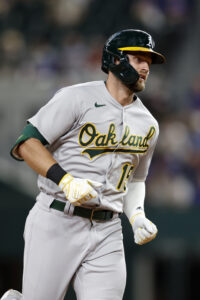
A former 19th-round pick, Brown was never regarded as an especially notable prospect. He didn’t reach the majors until after his 27th birthday late in the 2019 season. Brown barely played at the MLB level his first couple years, not topping 26 MLB games in a season until 2021. He picked up 307 plate appearances that year, connecting on 20 home runs but only reaching base at a .274 clip.
Last season, the Lewis-Clark State College product got his first real run as an everyday player. He suited up 150 times and tallied 555 trips to the plate. Brown hit .230/.305/.444 with 25 homers. His on-base percentage, while a bit below the .312 league mark, wasn’t at the untenable clip of the previous season. He cut his strikeout rate from 29% to a more manageable 26.3% while boosting his walk percentage to a solid 9.2% clip. Brown still doesn’t have a great plate discipline profile, but those numbers are sufficient for a player with his power. His slugging mark was nearly .050 points above the league average despite playing half his games at Oakland’s spacious ballpark.
Virtually all of those gains came as part of a torrid second half. Brown carried a .216/.269/.396 line into the All-Star Break. After the Midsummer Classic, he posted a .249/.348/.507 showing over 250 plate appearances. He more than doubled his walk rate from 6.2% to 12.8% and collected 15 longballs in the second half. He finished tied for 11th in the majors in homers after the Break, while his 147 wRC+ during that time (indicating overall offensive production 47 percentage points above the league average) checked in 27th among those with at least 150 plate appearances.
As with any relatively small-sample performance of that nature, it’s probably fair to assume Brown won’t maintain that pace. He doesn’t need to be a top 30 hitter in the league to be valuable, though, and it’s clear he has legitimate power upside. He’s now picked up 45 homers in a bit less than 900 plate appearances over the past two seasons. In both years, he’s put up a hard contact rate north of 40% — around five points higher than the league mark.
Even with some likely regression from his late-season tear, Brown at least profiles as a quality power bat for the strong side of a platoon. For his career, the left-handed hitter owns a .239/.309/.482 line against right-handed pitching. He’s managed only a .172/.230/.297 mark against southpaws and would probably be shielded from looks against tough lefty arms if he were to land with a contender.
A decent runner, Brown also stole 11 bases in 13 attempts last season. The A’s even gave him some late-season work in center field, though he struggled significantly there. Public metrics suggest he’s a more viable defender in the corner outfield and at first base. The bat will have to carry the profile, but Brown has enough athleticism he could factor in at a few of the lower-value positions on the defensive spectrum.
There haven’t been any indications Brown’s name has come up in trade talks between Oakland and other clubs thus far. Unlike most of the players the A’s have shipped off in recent seasons, they have no payroll motivation to deal Brown. He’ll play this season for little more than the league minimum salary and is eligible for arbitration three more times after that. Trading him wouldn’t be about saving money but the opportunity to potentially recoup a mid-level prospect or two for a player whose trade value may be at its peak. While he’s controllable for the foreseeable future, Brown is already 30 and presumably not seen as a core long-term organizational piece for a rebuilding club.
A productive lefty platoon bat to rotate through the corner outfield and first base should have more appeal to an immediate contender, particularly since Brown’s affordability means he’d fit on the books anywhere. Teams like the Rays, Yankees, Rangers, Braves, Brewers and Dodgers all have some amount of uncertainty at either first base or in the outfield. Tampa Bay and New York stand out as particularly strong speculative fits considering their lineups tend to skew right-handed. Brown wouldn’t be a franchise-altering addition, but he should be of interest to a number of teams as they build out their roster depth with free agency mostly finished.
Image courtesy of USA Today Sports.
Managers & Top Front Office Executives On Expiring Contracts
Some teams don’t publicly announce contract terms, or in some cases, even if a manager or a top front office executive (i.e. president of baseball operations, general manager, or whatever title is given to the lead decision-maker) has been given an extension whatsoever. As a result, this list of the managers and executives entering the final years of their contracts is somewhat unofficial, as it wouldn’t be surprising if at least a few names on this list are indeed locked up beyond 2023 on pre-existing contracts or on extensions that have yet to be publicly announced.
Naturally, job security goes beyond just the terms of a contract. One wouldn’t have imagined that the Rangers’ Jon Daniels or the Royals’ Dayton Moore were necessarily on thin ice heading into the 2022 season, yet the two longtime front office bosses were fired before the season was even over, as both Texas and Kansas City underachieved. Likewise, former Astros GM James Click seemed like a sure bet for a long-term deal given Houston’s success, and yet due to some internal discord with owner Jim Crane, Click ended up leaving after the Astros offered him only (what seemed like a token of a) one-year extension.
The addition of the extra wild card spot could put even more pressure on teams to win, especially since the Phillies’ run from sixth seed to NL champions underlined what can happen if a club can just get into the postseason bracket. In addition, some of the names on this list face uncertainty due to potential changes in team ownership — and as the Astros showed, no amount of on-field success can help if an owner simply wants someone new in the baseball ops department.
As always, thanks to Cot’s Baseball Contracts for reference information on some of these contract terms.
Angels: Phil Nevin was moved from third base coach to interim manager when Joe Maddon was fired in June, and Nevin ended up leading the Angels to an underwhelming 46-60 record in his first stint as a big league skipper. Despite the lack of success, the Halos removed the interim tag by signing Nevin to a one-year deal, giving him a longer (but not much longer) opportunity to see what he can do as the team’s manager. The Angels organization as a whole is in a fluid state given that a new owner might be running the club by Opening Day or soon thereafter, and yet in what looks to be Arte Moreno’s last offseason as the Halos’ owner, Anaheim has been pretty aggressive in adding roster pieces to try and find that elusive winning mix. If Nevin can help get Mike Trout, Shohei Ohtani, and company to the playoffs or even over the .500 mark, it will greatly help his case for a long-term contract under the new owner….or, possibly a managerial job elsewhere if the new owner still wants to brings in their own personnel.
Astros: Hired in rather abrupt fashion in the wake of the sign-stealing scandal, Dusty Baker’s three seasons in Houston have resulted in two World Series appearances, and the 2022 championship represented Baker’s first ring as a manager in 25 seasons in the dugout. Baker’s initial contract (one year and a club option) has been followed up by successive one-year deals that weren’t finalized until after the Astros’ playoff runs were over, but Crane has repeatedly stated that he prefers to avoid distractions by waiting until after the season to work out contractual matters. Baker’s age (74 in June) might be another reason why Crane has resisted giving Baker a longer-term deal, so another extension might not come for Baker until October or November. With the Click situation lingering as an odd footnote to Houston’s championship season, Baker at least seems to have more sway with ownership than the former GM did, yet the Astros might have to keep winning to ensure that Baker is back in 2024.
Athletics: GM David Forst has been a member of Oakland’s front office since 2000, and he’ll now finally take over as the top job in the baseball operations department after Billy Beane moved to an advisory role with the club. As per the terms of Forst’s last extension, he is signed through the 2023 season, and there wasn’t any word of a new contract attached to the Athletics’ announcement of Forst’s new role. As the A’s continue to search for a new ballpark in Oakland or a potential move to a new city, there’s a bit of flux involved throughout the organization, yet it would certainly seem like the A’s will continue their tradition of front-office continuity by giving Forst a new deal at some point. Forst is currently shepherding the Athletics through their latest rebuild, but if an extension wasn’t worked out, he would likely quickly find work elsewhere given how many teams have tried to poach him for other front office vacancies in recent years.
Brewers: Craig Counsell has been managing the Brew Crew since 2015, and 2023 is the final year of the skipper’s current four-year contract. Milwaukee is an impressive 615-555 under Counsell’s watch, with two NL Central titles, four postseason appearances and a trip to the NLCS in 2018. However, 2018 was also the last time the Brewers won a playoff series, and the team’s postseason streak ended in 2022 despite a respectable 86-76 record. It would still seem like Counsell would be a strong candidate to receive an extension, though there’s some uncertainty throughout the organization in the wake of David Stearns’ rather surprising decision to step down as the team’s president of baseball operations. General manager Matt Arnold is now in charge of the front office, though past reports suggested that Arnold’s own deal only lasts through the 2023 season. Brewers owner Mark Attanasio could have some inclination to pursue a new direction if the Brewers struggled next year, and if Arnold isn’t seen as a long-term answer, Attanasio could look for a new front office boss as Stearns’ true replacement, and a new PBO or GM might also want to make their own managerial hire.
Cardinals: 2023 is the final season of the three-year extension John Mozeliak signed in November 2019. A member of the Cardinals organization since 1995 and the head of their front office since the 2007-08 offseason, Mozeliak has been working under the president of baseball operations title since 2017. Michael Girsch was promoted to the GM role at that same time, and is signed through at least 2024 as per the terms of an extension signed back in October. With Girsch’s deal in mind, it would seem like Mozeliak will also be extended again, as the Cardinals have enjoyed 15 straight winning seasons and have reached the postseason in each of the last four years. This being said, the bar for success is always high in St. Louis, and the team hasn’t won a playoff series since 2019 and hasn’t reached the World Series since 2013.
Diamondbacks: Executive VP/general manager Mike Hazen was already under contract through 2020 when he signed a new extension in September 2019, and the length of that new deal wasn’t released. As such, it is possible 2023 might be Hazen’s final year under contract. Manager Torey Lovullo’s status is more public, as the D’Backs exercised their club option on his services for 2023. Since the Diamondbacks haven’t had a winning season since 2019 and haven’t made the postseason since 2017 (Hazen and Lovullo’s first year in Arizona), ownership might be waiting to see if any significant progress is made before exploring an extension for either its GM or manager.
Dodgers: Andrew Friedman came to Los Angeles on a five-year, $35MM contract that covered the 2014-19 seasons, and he then signed a new extension of an unknown length after the 2019 campaign was complete. If that extension was only a four-year pact, 2023 would be Friedman’s final season as the Dodgers’ president of baseball operations, barring another new deal. Despite the relative lack of postseason success in regards to the Dodgers’ dominance of the regular season, Friedman’s tenure has still delivered one World Series title, and it would seem like he has as much job security as anyone in baseball.
Giants: Farhan Zaidi is entering the final season of his five-year contract as San Francisco’s president of baseball operations. Through two years of rebuilding (and competitive baseball) and then a 107-win season in 2021, it seemed like the Giants had taken a fast track to success, but things took a step backwards with an 81-81 record last year. Heading into with the winter with an aggressive mandate to spend and attract high-profile talent to the Bay Area, the Giants have added some notable players but fallen short on two superstars — Aaron Judge re-signed with the Yankees, while Carlos Correa had agreed to a 13-year, $350MM pact with the Giants before the team delayed finalizing the deal due to concerns stemming from Correa’s physical. Correa immediately pivoted to the Mets on a 12-year, $315MM contract, and since the Mets reportedly have their own issues with Correa’s lower right leg and ankle, the situation has become less of a fiasco for the Giants than it initially appeared. Team chairman Greg Johnson gave Zaidi a vote of confidence heading into the offseason, but it remains to be seen if ownership is satisfied with the aftermath of this very unusual winter.
Guardians: There hasn’t yet been any public word on the details of Terry Francona’s extension, but the reigning AL Manager Of The Year has already been confirmed as returning for the 2023 campaign. Given Francona’s health issues, 2023 could be his final season in the dugout, but the Guardians’ front office and team owner Paul Dolan have both intimated that Francona can remain as manager as long as he is willing and able. President of baseball operations Chris Antonetti also doesn’t seem to be in any danger, though the longtime Cleveland exec’s contract terms aren’t known.
Marlins: Kim Ng has a 137-188 record over her first two seasons as Miami’s general manager, though as usual with the Marlins, it isn’t clear how much of those struggles are the GM’s fault. Derek Jeter‘s departure as CEO last March left an upper management void within the organization, and while the Marlins have slightly expanded payroll in Ng’s tenure, they are still among the game’s lower spenders. It could be argued that with Jeter and ex-manager Don Mattingly gone, Ng now freer rein to turn the Marlins in her own direction, beginning with the hiring of Skip Schumaker as the club’s new bench boss. The terms of Ng’s contract weren’t publicly revealed, so 2023 could conceivably be the final guaranteed year of her deal — if so, some progress might be necessary to keep owner Bruce Sherman from starting yet another rebuild.
Nationals: President of baseball operations Mike Rizzo and manager Davey Martinez are both only signed through the 2023 season, as the Nationals exercised club options on both men back in July. Wins and losses aren’t really a factor for the rebuilding Nats, but the ongoing search for a new owner certainly is, though the most recent reports haven’t given any clear timeline on when a sale might be finalized. As a result, Rizzo and Martinez might each be facing a lame-duck season, with their fates unknown until a new owner is in place.
Orioles: The contract terms of GM Mike Elias and manager Brandon Hyde haven’t been publicized, though Hyde’s newest extension runs through at least the 2023 season. Since the O’s were so quiet about extending Hyde, it wouldn’t be a surprise to learn that Elias was also extended at some point, continuing a tenure that began with the 2018-19 offseason. Regardless of the details, it certainly doesn’t seem like either Elias or Hyde are going anywhere, considering how the Orioles had a winning record (83-79) in 2022 and seem ready to put their rebuild firmly in the rearview mirror.
Pirates: Speaking of rebuilds, the Pirates can only hope for a Baltimore-esque breakout next year. Ben Cherington is entering the fourth season as Pittsburgh’s general manager, on a contract of an unknown length. Manager Derek Shelton is concretely operating on a four-year pact, so 2023 will be his last guaranteed season, though Cherington has spoken glowingly about Shelton’s work in leading the young Bucs through the hard times of the rebuild period. Extensions would keep Shelton and perhaps Cherington from being lame ducks in 2023, though there doesn’t seem to be any sense that either is in danger of being let go.
Rangers: Chris Young became the Rangers’ GM in December 2020, and he unexpectedly found himself in charge of the front office entirely once Daniels was fired in August. The terms of Young’s initial contract weren’t known, and it doesn’t seem as though his surprise promotion came with any extra years added onto his deal. The Rangers’ spending spree over the last two offseasons has left no doubt that ownership wants to win now, so Young’s own job could be in jeopardy if Texas struggles (or perhaps has a slow start) in 2023. That said, Young’s past history as a player under manager Bruce Bochy surely played a role in convincing Bochy to become the Rangers’ new skipper, so Young has started to make his influence known in the Texas front office.
Reds: David Bell‘s two-year contract is up after the 2023 season, which would be Bell’s fifth season as the Reds’ manager. Cincinnati promoted GM Nick Krall as the leader of the baseball ops department following the 2020 season, and Krall has since been tasked with cutting payroll and setting the Reds on a rebuilding path. Krall’s contract length isn’t publicly known, so 2023 probably isn’t a make-or-break season for Krall to help his job security, unless the team absolutely craters and the development of the Reds’ younger players hits a roadblock. The same could be true of Bell, unless the front office feels a new voice is needed in the dugout to continue the progress.
Red Sox: The terms of Chaim Bloom’s contract as Boston’s chief baseball officer aren’t publicly known, though 2023 will be Bloom’s fourth season. This is a notable threshold considering Bloom’s predecessors in leading the Red Sox front office — Cherington didn’t last four full seasons, while Dave Dombrowski spent slightly over four years on the job, from August 2015 to September 2019. Those two executives led the Sox to World Series titles in those brief tenures, while under Bloom, the Red Sox have a pair of last-place finishes sandwiched around a berth in the 2021 ALCS. Assuming ownership is still as impatient to win, Bloom might need the Sox to take a big step up in 2023 in order to keep his job.
Rockies: Bud Black has only one guaranteed year remaining on his deal, yet seems to be operating on what The Athletic’s Nick Groke reported as “a rolling year-to-year contract.” Even considering how the Rockies traditionally operate on a system of loyalty and continuity, one would imagine that a fifth straight losing season might be enough to convince the team to pursue a new manager.
Royals: Similar to the Rangers’ situation with Young, Kansas City GM J.J. Picollo found himself atop the Royals’ baseball ops pyramid when Moore was fired in September, with no word of a contract extension attached to this change in responsibility. The difference is that Picollo has had a much longer tenure in K.C. (having worked in the front office since 2006 under Moore’s leadership), and while owner John Sherman is undoubtedly eager to start winning, he hasn’t invested the hundreds of millions that the Rangers’ owners have in their struggling club. Immediate success might not be expected in Picollo’s first year, but his chances of a longer deal might hinge on whether or not the Royals’ younger players start developing at a better rate, or if new manager Matt Quatraro can get more out of the young club.
Twins: The 2022 season completed the guaranteed portion of Rocco Baldelli‘s initial contract with the Twins, which was a four-year deal with multiple club options attached. Chief baseball officer Derek Falvey stated in September that Baldelli would be back next season, so at the very least, the Twins have exercised their option on Baldelli for 2023. For what it’s worth, Falvey and GM Thad Levine are both under contract through 2024, and it is possible Falvey, Levine, and Baldelli might all be in hot water if the Twins can’t turn things around this coming season. Minnesota followed up AL Central titles in both 2019 and 2020 with two losing seasons, and another sub-.500 campaign might make Baldelli the first one out the door, given his lesser contractual control.
White Sox: Executive VP Ken Williams (1997) and general manager Rick Hahn (2002) are each long-time members of Chicago’s front office, and have been in their current positions since October 2012. Since the White Sox don’t publicize executive contracts, not much is known about Williams or Hahn’s status, other than that their last extensions came during the 2017 season. It’s fair to guess that both might have received new deals since that time, but in any case, it may be a moot point given how owner Jerry Reinsdorf isn’t quick to make changes in the front office. The hope is that new manager Pedro Grifol can succeed where Tony La Russa didn’t, and there hasn’t been any sense that Williams or Hahn might be on the hot seat, though that could possibly change if a White Sox team built to win now stumbles again.