
Read The Transcript Of Our Live Chat Hosted By Former MLB Pitcher Deck McGuire
Deck McGuire was drafted 11th overall in 2010 by the Blue Jays as a starting pitcher out of Georgia Tech, signing for $2MM. Baseball America ranked him 95th among all prospects shortly after that. At the time, BA felt that McGuire’s “good stuff and polish” and college resume would result in a quick path to Toronto’s rotation.
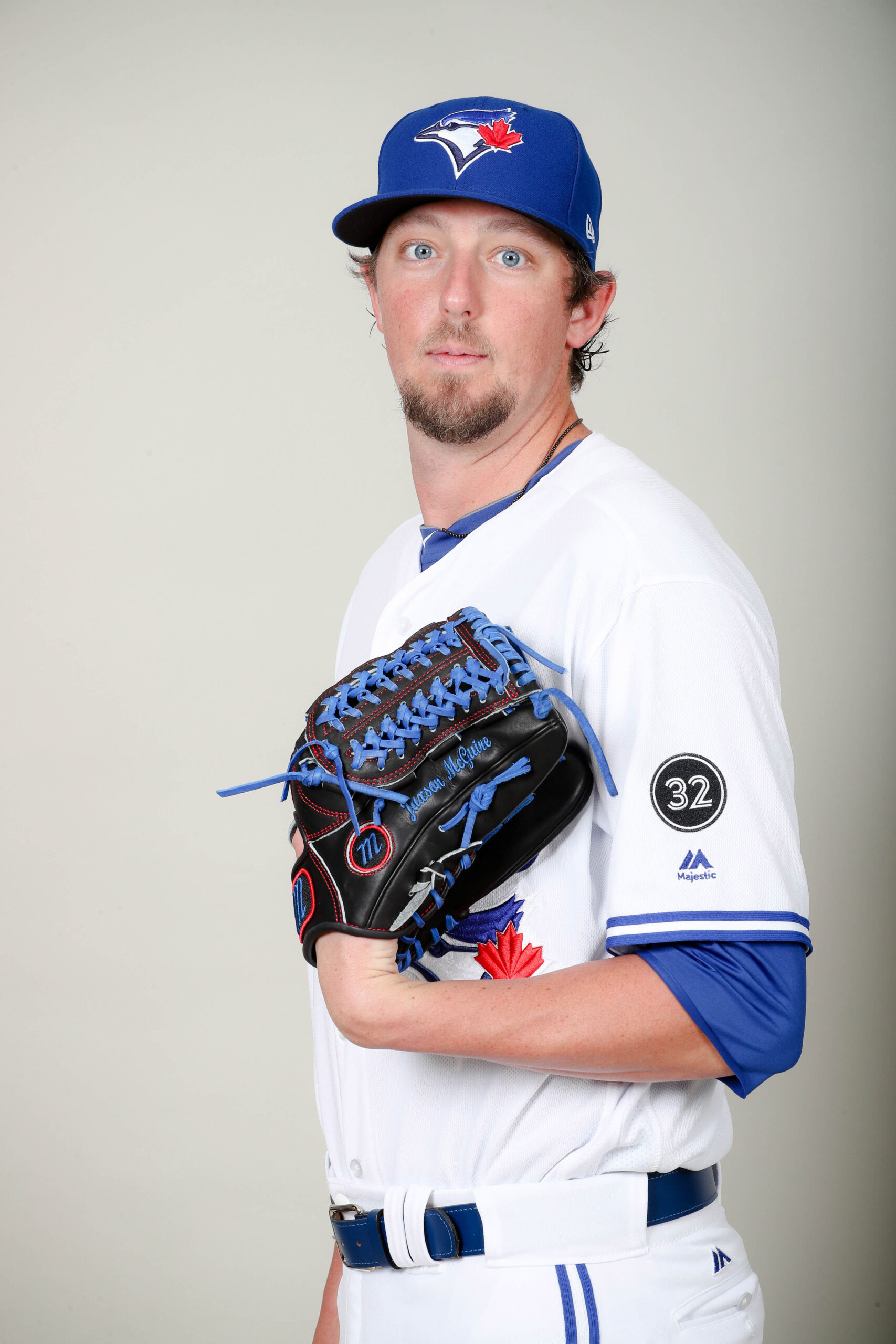
Things went off track for McGuire in 2012 at Double-A, however. Eventually, the Blue Jays traded McGuire to the A’s for cash considerations in July 2014. He signed a minor league deal with the Dodgers in 2015, and another one with the Cardinals after that season. McGuire continued finding Triple-A jobs, signing with the Reds prior to the 2017 campaign.
After a strong 2017 season as a starter at the Double-A level, the Reds rewarded the tenacious McGuire with a September call-up. He made his MLB debut at the age of 28, entering a bases loaded situation against the Cardinals and inducing a double play off the bat of Harrison Bader. McGuire even got to finish that season with a start at Wrigley Field, tossing five scoreless with only two hits allowed and a strikeout of Kris Bryant.
Following the ’17 season, McGuire moved back to the Jays on a minor league deal. By May, he was working out of the bullpen for the team that had drafted him eight years prior. In June of that year, the Rangers claimed McGuire off waivers, trading him to the Angels shortly thereafter. He made it back to the bigs for a few spot starts, also working out of the Halos’ bullpen that year.
After being part of three MLB organizations in 2018, McGuire signed a deal with KBO’s Samsung Lions. He made 21 starts for that club, including the 14th no-hitter in KBO history. McGuire landed with the Rays on a minor league deal in February 2020. That minor league season was lost to the pandemic, and McGuire moved to the Rakuten Monkeys of the Chinese Professional Baseball League for ’21.
McGuire started the ’22 season in the Atlantic League, which he parlayed into another minor league deal with the Reds. McGuire wrapped up his pitching career last December, writing on Twitter, “For 12 years I got to live out my dream of being a professional baseball player.”
McGuire’s journeyman career was not what anyone expected when the Blue Jays drafted him 11th overall, but his perseverance got him to the Majors for 51 2/3 innings with the Reds, Blue Jays, and Angels. Even in that brief time he struck out Bryant, Jose Altuve, Rafael Devers, and Ryan Braun, among many others. McGuire pitched for seven different MLB organizations while also spending multiple seasons overseas.
Asked about his post-retirement plans, Deck wrote in an email, “As of right now my plans are to stay in the game somehow. I’m currently working with some guys and youth teams in my area of Colorado. I’m gonna head back to Georgia Tech in the fall to graduate and be around the program.” You can follow Deck on Twitter @deckmcguire.
Today, Deck chatted for over an hour with MLBTR readers, talking about the differences between KBO and MLB, the pressure of being a high draft pick, dealing with hecklers, and much more. Read the transcript here.
A’s Sign Drew Steckenrider To Minor League Deal
Right-handed reliever Drew Steckenrider is in camp with the Athletics as a non-roster invitee to spring training, tweets Matt Kawahara of the San Francisco Chronicle. Athletics Farm first tweeted the news a couple days ago.
Steckenrider, 32, has spent the past two seasons with the Mariners, thriving as a key member of the bullpen in 2021 but struggling in 2022 to the extent that he was outrighted from the team’s 40-man roster. The 2021 campaign saw Steckenrider pitch to a pristine 2.00 ERA, albeit with below-average strikeout, swinging-strike and ground-ball rates of 21.7%, 8.6% and 37.4%, respectively. He offset some of those flaws with a sharp 6.4% walk rate, but Steckenrider also benefited from a .257 average on balls in play and a tiny 6.6% homer-to-flyball rate — both well south of his career marks. Add in an alarming opponents’ average exit velocity of 90.7 mph, and some regression looked inevitable.
However, the magnitude of that regression nevertheless was still rather surprising. Steckenrider was rocked for nine runs on 21 hits and five walks in just 14 1/3 innings at the big league level. The resulting 5.65 ERA led the Mariners to option Steckenrider in late May and, perhaps more surprisingly, designate him for assignment the following month when the team needed a 40-man roster spot. Steckenrider’s $3.1MM salary understandably passed through waivers unclaimed, but the Mariners never game him another look down the stretch, thanks in part to a deep and talented relief corps that posted a combined 3.16 ERA in the season’s second half.
Had Steckenrider returned to form in Triple-A, perhaps he might’ve still garnered another look back in the big leagues. However, the veteran righty yielded a tepid 4.62 ERA in 25 1/3 frames. Even if one wanted to chalk some of that up to the excessively hitter-friendly nature of the Pacific Coast League, Steckenrider posted an uncharacteristic 13.8% walk rate in his time at Tacoma, which couldn’t have inspired much confidence that he’d rebound with a return to the big leagues.
Rocky as last season was, Steckenrider comes to the A’s as a 32-year-old with a career 3.27 ERA in 195 2/3 innings at the big league level. His strikeout rate has consistently declined from his early days with the Marlins — he punched out a gaudy 35.8% of opponents in 34 2/3 innings as a rookie — but his command has also steadily improved.
Oakland’s bullpen is teeming with uncertainty, giving Steckenrider ample opportunity to seize a spot. Trevor May, signed to a one-year $7MM contract, is a lock for late-inning work, and the out-of-options Domingo Acevedo is all but assured a spot as well. Beyond that pairing, there’s any number of ways the A’s could proceed. Each of Zach Jackson, Dany Jimenez and Sam Moll could have an inside track based on their 2022 ERAs, but each also posted a bloated walk rate that points to regression — and all three have minor league options remaining, as well.
Marlins, Athletics Swap JJ Bleday For AJ Puk
The Athletics are acquiring JJ Bleday from the Marlins in a trade, according to the Athletic’s Ken Rosenthal. Left-hander A.J. Puk is going the other way, per Jordan McPherson of the Miami Herald. The teams have now announced the deal.
Puk, 28 in April, had a quality year in 2022, working to a 3.12 ERA over 66 1/3 innings in Oakland’s bullpen. That came with above-average strikeout (27.1%) and walk (8.2%) rates. He was miserly against left-handed hitters, limiting them to just a .153/.250/.259 line.
That was the first full-season of work for Puk, who’d battled injuries and thrown just 24 2/3 innings at the top level since making his debut in 2019. He’d had mixed success in that time, working to a 4.74 ERA over those innings.
Puk was drafted and developed as a starter, but switched to the bullpen at Triple-A and hasn’t made a start at the big league level. With that being said, A’s GM David Forst said in December that Puk would prepare for the season as a starter and compete for a rotation spot in spring training. Given the Marlins plethora of starting options, it seems unlikely he’ll wind up anywhere other than the bullpen for his new team though.
Puk leans almost exclusively on a 97mph fastball and an 87mph slider, though he has thrown a changeup on occasion in the past. He’ll slot in as a third left-handed option in Miami’s bullpen alongside Tanner Scott and Steven Okert. Puk would’ve been close to being a Super Two player, but is under control at a pre-arbitration rate for 2023, before beginning his three seasons of arbitration in 2024.
In return, Oakland picks up Bleday, 25, a fourth overall pick by the Marlins in the 2019 draft. He had a strong year at Triple-A last year, and was rewarded with his first call up to the big leagues. Despite hitting .228/.365/.470 with 20 home runs at the top level of the minors, Bleday couldn’t continue that in the majors, hitting just .167/.277/.309 with five home runs over 238 plate appearances.
Bleday saw the majority of his time in center field last year, earning -3 Outs Above Average in 330 innings at the position. He’s generally been seen as a corner outfielder long term though, and defensive metrics liked him better in those positions.
Ramon Laureano is the only nailed-on starter in Oakland’s outfielder, and Bleday will compete with Cristian Pache and Esteury Ruiz for the other two spots. Bleday is under control for at least six more seasons, although he has all of his minor league options remaining, so the A’s could end up opting to give him a bit more time at Triple-A, which would of course delay his service time clock depending on how long he spends in the minors.
Each MLB Team’s Players On WBC Rosters
The World Baseball Classic is returning this year, the first time since 2017. The quadrennial event was supposed to take place in 2021 but was scuttled by the pandemic, now returning after a six-year absence. Rosters for the tournament were announced today and those can be found at this link. Here is a breakdown of which players from each MLB team are set to take participate. Quick caveat that this list is fluid and might be changed as more information becomes available.
Without further ado…
Angels
- Glenn Albanese Jr.
- Jaime Barria
- Gustavo Campero
- Alan Carter
- Jhonathan Diaz
- Carlos Estevez
- David Fletcher
- Jake Kalish
- D’Shawn Knowles
- Shohei Ohtani
- Jose Quijada
- Luis Rengifo
- Gerardo Reyes
- Patrick Sandoval
- Mike Trout
- Gio Urshela
- Cesar Valdez
- Zack Weiss
- Aaron Whitefield
Astros
- Bryan Abreu
- Jose Altuve
- Ronel Blanco
- Luis Garcia
- Colton Gordon
- Cristian Javier
- Martin Maldonado
- Rafael Montero
- Hector Neris
- Jeremy Pena
- Ryan Pressly
- Andre Scrubb
- Kyle Tucker
- Jose Urquidy
- Derek West
Athletics
Blue Jays
- Jose Berrios
- Jiorgeny Casimiri
- Yimi Garcia
- Vladimir Guerrero Jr.
- Spencer Horwitz
- Alejandro Kirk
- Otto Lopez
- Damiano Palmegiani
Braves
Brewers
- Willy Adames
- Sal Frelick
- Alex Hall
- Matt Hardy
- Joel Payamps
- Rowdy Tellez
- Abraham Toro
- Luis Urias
- Michele Vassalotti
- Devin Williams
Cardinals
- Nolan Arenado
- Genesis Cabrera
- Tommy Edman
- Giovanny Gallegos
- Paul Goldschmidt
- Ivan Herrera
- Matt Koperniak
- Noah Mendlinger
- Oscar Mercado
- Miles Mikolas
- Lars Nootbaar
- Tyler O’Neill
- JoJo Romero
- Adam Wainwright
- Guillermo Zuniga
Cubs
- Javier Assad
- Owen Caissie
- Danis Correa
- Ben DeLuzio
- Roenis Elias
- Miles Mastrobuoni
- Matt Mervis
- B.J. Murray Jr.
- Vinny Nittoli
- Fabian Pertuz
- Liam Spence
- Seiya Suzuki
- Marcus Stroman
- Pedro Strop
- Nelson Velazquez
- Jared Young
Diamondbacks
- Dominic Fletcher
- Jakob Goldfarb
- Gunnar Groen
- Merrill Kelly
- Ketel Marte
- Eric Mendez
- Dominic Miroglio
- Emmanuel Rivera
- Jacob Steinmetz
- Mitchell Stumpo
- Alek Thomas
Dodgers
- Austin Barnes
- Mookie Betts
- Freddie Freeman
- Clayton Kershaw
- Adam Kolarek
- Miguel Rojas
- Will Smith
- Trayce Thompson
- Julio Urias
Giants
Guardians
- Enyel De Los Santos
- Dayan Frias
- Andres Gimenez
- Bo Naylor
- Richie Palacios
- Cal Quantrill
- Cade Smith
- Meibrys Viloria
- Josh Wolf
Marlins
Mariners
- Matt Brash
- Diego Castillo
- Matt Festa
- Harry Ford
- Teoscar Hernandez
- Milkar Perez
- Julio Rodriguez
- Eugenio Suarez
- Blake Townsend
Mets
- Pete Alonso
- Jonathan Arauz
- Edwin Diaz
- Eduardo Escobar
- Dominic Hamel
- Elieser Hernandez
- Francisco Lindor
- Jeff McNeil
- Omar Narvaez
- Cam Opp
- Adam Ottavino
- Jose Quintana
- Brooks Raley
- Claudio Scotti
Nationals
Orioles
Padres
- Xander Bogaerts
- Nabil Crismatt
- Nelson Cruz
- Jarryd Dale
- Yu Darvish
- Jose Espada
- Ruben Galindo
- Luis Garcia
- Ha-Seong Kim
- Manny Machado
- Nick Martinez
- Evan Mendoza
- Juan Soto
- Brett Sullivan
- Julio Teheran
Phillies
- Jose Alvarado
- Erubiel Armenta
- Malik Binns
- Jaydenn Estanista
- Vito Friscia
- Brian Marconi
- J.T. Realmuto
- Kyle Schwarber
- Noah Skirrow
- Gregory Soto
- Garrett Stubbs
- Ranger Suarez
- Trea Turner
- Taijuan Walker
- Rixon Wingrove
Pirates
- David Bednar
- Tsung-Che Cheng
- Roansy Contreras
- Alessandro Ercolani
- Santiago Florez
- Jarlin Garcia
- Antwone Kelly
- Josh Palacios
- Jeffrey Passantino
- Tahnaj Thomas
- Duane Underwood Jr.
- Chavez Young
- Rob Zastryzny
Rangers
Rays
- Jason Adam
- Jonathan Aranda
- Randy Arozarena
- Christian Bethancourt
- Trevor Brigden
- Wander Franco
- Andrew Gross
- Joe LaSorsa
- Francisco Mejia
- Isaac Paredes
- Harold Ramirez
- Graham Spraker
Red Sox
- Jorge Alfaro
- Richard Bleier
- Rafael Devers
- Jarren Duran
- Ian Gibaut
- Rio Gomez
- Norwith Gudino
- Enrique Hernandez
- Nick Pivetta
- Henry Ramos
- Alex Verdugo
- Masataka Yoshida
Reds
- Donovan Benoit
- Silvino Bracho
- Luis Cessa
- Fernando Cruz
- Alexis Diaz
- Arij Fransen
- Kyle Glogoski
- Tayron Guerrero
- Evan Kravetz
- Nicolo Pinazzi
- Reiver Sanmartin
- Vin Timpanelli
Rockies
- Daniel Bard
- Jake Bird
- Yonathan Daza
- Elias Diaz
- Kyle Freeland
- Justin Lawrence
- German Marquez
- Michael Petersen
- Alan Trejo
Royals
- Max Castillo
- Robbie Glendinning
- Carlos Hernandez
- Nicky Lopez
- MJ Melendez
- Vinnie Pasquantino
- Salvador Perez
- Brady Singer
- Bobby Witt Jr.
- Angel Zerpa
Tigers
- Javier Baez
- Miguel Cabrera
- Chavez Fernander
- Andy Ibanez
- Jack O’Loughlin
- Jacob Robson
- Eduardo Rodriguez
- Jonathan Schoop
- John Valente
Twins
- Jose De Leon
- Edouard Julien
- Jorge Lopez
- Pablo Lopez
- Carlos Luna
- Jose Miranda
- Jovani Moran
- Emilio Pagan
- Christian Vazquez
White Sox
- Tim Anderson
- Kendall Graveman
- Eloy Jimenez
- Lance Lynn
- Yoan Moncada
- Nicholas Padilla
- Luis Robert
- Jose Ruiz
Yankees
Read The Transcript Of Our Chat Hosted By MLB Outfielder Brent Rooker
After being drafted by the Twins in the 38th round out of Mississippi State, Brent Rooker went back to college for another year. That move paid off, as the Twins took him again in the first round in 2017. At the time, Baseball America ranked the outfielder/first baseman as a top 100 prospect in the game, writing, “He projects as a middle-of-the-order weapon with power as a strong carrying tool.”
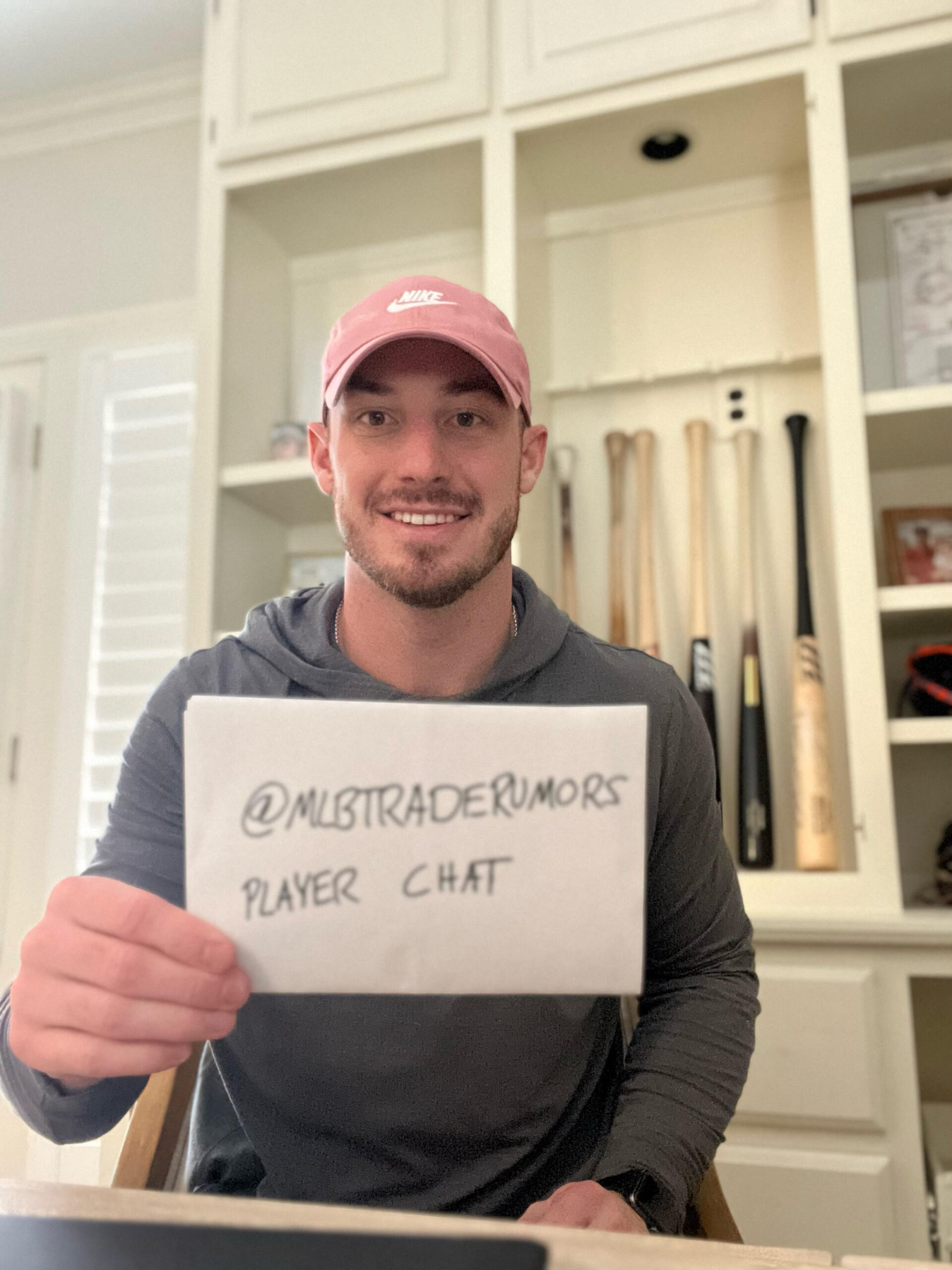
Rooker reached Triple-A in 2019. The minor league season was cancelled in 2020, but Rooker was able to make his MLB debut in September of that year. In his sixth game in the Majors, he went deep off the Cardinals’ Daniel Ponce de Leon. Unfortunately, Rooker’s forearm was fractured on a hit-by-pitch not long after that.
The surgery for that injury went well, and Rooker was back in the bigs in April of ’21. The left fielder showed promise that year, popping nine home runs in 213 plate appearances for the Twins. One highlight: a four-hit effort against the Rays, including a home run off Evan Phillips.
The Padres were drawn to Rooker, as they acquired him along with Taylor Rogers in the April 2022 trade that sent Chris Paddack and Emilio Pagan to Minnesota. After a few brief big league looks for San Diego, the Padres traded Rooker to the Royals in August of ’22 for Cam Gallagher. Finally, in November of last year, the A’s claimed Rooker off waivers from the Royals.
A whirlwind 2022 season saw Rooker as a member of four different organizations. He still managed to hit 28 home runs in 365 plate appearances at Triple-A. Rooker joins an A’s team that currently projects to have Ramon Laureano and Seth Brown at the outfield corners and Aledmys Diaz at DH. The 28-year-old Rooker appears to have little left to prove at Triple-A and is in a good place to compete for playing time as a right-handed power bat.
As Brent notes, he’s at least above replacement level at Twitter, and you should follow him @Brent_Rooker12. Brent volunteered to chat with MLBTR readers today, and we’re happy to have him! Click here to read the transcript of the chat, where Brent talks about everything from the mental weight of a serious injury, the biggest gaps between Triple-A and the Majors, his favorite teammates/toughest opponents, clubhouse food spreads and more!
Quick Hits: Stephenson, Meneses, Oakland
Tyler Stephenson was one of the bright spots of a tepid Reds offense that contributed to them finishing 62-100 and securing their first 100-loss season since 1982. The trouble was the Reds only called upon Stephenson in 50 games last year, and getting a full season out of their young catcher will be a huge boost to their lineup in 2023 and beyond.
As Bobby Nightengale of the Cincinnati Enquirer reports, the Reds are looking to utilize Stephenson in 140-150 games in 2023, but the majority of those appearances could come at designated hitter to try and protect his body from the rigors of catching. He did, after all, hit .319/.372/.482 with six home runs across 183 plate appearances so it’s no surprise that the Reds are trying to figure out the best way to get a full season’s worth of that offense.
The Reds have signed Curt Casali and Luke Maile to their roster and plan to carry three catchers throughout 2023, and Nightengale writes that the team could look to use Stephenson as a catcher twice a week, which would equate to 54 games over the course of the season, with Casali and Maile handling the rest.
Here’s some more bits and pieces from around baseball:
- Joey Meneses was a revelation for the rebuilding Nationals in 2022, slashing .324/.367/.563 with 13 home runs over 240 plate appearances in his age-30 rookie campaign. As the Talk Nats podcast revealed, the Nats tried to sign Meneses after the 2019 season but he opted to go to Japan instead. At the time, Japan was likely a far more financially appealing option for Meneses given he would’ve been looking at another minor league deal had he stayed in the States.
- The A’s are planning to use Jesus Aguilar at both first base and designated hitter in 2023, general manager David Forst told reporters, including Martin Gallegos of MLB.com. Aguilar appeared in 63 games at first and 60 at DH last year for the Marlins and Orioles, and it seems likely he’ll have a similar split this year. The 32-year-old had a disappointing 2022, slashing just .235/.281/.379 with 16 home runs over 507 plate appearances. He’d been a productive hitter for a few years prior though, and that was enough for Oakland to give him a one-year, $3MM deal for 2023. The rebuilding A’s will surely be hoping for a rebound at the plate so Aguilar can turn himself into a valuable trade chip at the deadline.
- Sticking with the A’s, and Forst says Paul Blackburn and James Kaprielian have both progressed well in their rehab and should be ready for spring training. “I think it’s reasonable to expect both guys to be ready to go,” Forst said (Twitter link). Both players figure to be part of Oakland’s rotation this year. Blackburn, 29, pitched in 21 games last year and worked to a 4.28 ERA over 111 1/3 innings, striking out batters at a 19.1% clip against a 6.4% walk rate. He was a productive pitcher for the first three months of the season and earned his first All Star game callup. He was shelled for 21 runs over 14 1/3 innings while pitching through pain in his pitching hand before he ultimately went on the injured list. That pain ballooned out his ERA a bit and wound up ending his season, so it’ll be interesting to see if Blackburn can rediscover his early season form in 2023. He’ll earn $1.9MM in his first year of arbitration. Kaprielian threw 134 innings of 4.23 ERA ball in 2022, but underwent shoulder surgery in the off-season to repair his AC joint. His rotation spot is probably a little less secure than Blackburn’s, but the trade of Cole Irvin opens up another spot and if healthy he seems likely to at least start the year in the rotation alongside Blackburn, Drew Rucinski and Shintaro Fujinami.
Athletics Sign Jesús Aguilar
Jan. 27: The Athletics have announced the signing of Aguilar to a one-year contract. Yesterday’s trade of lefty Cole Irvin to the Orioles opened a spot on the 40-man roster, so there’s no need for a further corresponding move.
Jan. 24: The A’s and first baseman Jesús Aguilar are in agreement on a deal that will pay him $3MM. The deal for the MVP Sports Group client is pending a physical. The A’s have a full 40-man roster and will need to make a corresponding move once the deal is made official.
Aguilar, 33 in June, has appeared in the past nine MLB seasons, having a mercurial career so far. He didn’t produce much in his first three campaigns while with Cleveland, only getting into 35 games over that three-year stretch as the club kept him mostly in the minors. He was claimed off waivers by the Brewers going into 2017 and made the most of his new opportunity. Aguilar hit 51 home runs over the next two seasons, producing a batting line of .271/.344/.527 over 2017 and 2018. His 127 wRC+ in that time indicates he was 27% better than the league average hitter.
He then experienced a downturn in 2019, as he was sitting on a line of .225/.320/.374 and an 82 wRC+ when the Brewers traded him to the Rays at that year’s deadline. He righted the ship somewhat in Tampa down the stretch, hitting .261/.336/.424 for a wRC+ of 105. Despite that uptick, the Rays put him on waivers after the season and the Marlins put in a claim.
He had a couple of solid years with the Fish in 2020 and 2021, batting .265/.336/.458 over that period for a 113 wRC+, but another swoon came in 2022. He struggled over the beginning of the season and was released by the Marlins in August. He jumped to the Orioles for the final month of the season and finished the campaign with a .235/.281/.379 line and an 86 wRC+.
Defensively, Aguilar has made very brief appearances at third base but is primarily a first baseman. His work in the field has been considered near average, having produced 4 Defensive Runs Saved, -3 Outs Above Average and a 0.6 score from Ultimate Zone Rating. Since he has just a single stolen base in his career and limited defensive value, he needs to be producing at the plate in order to be a useful player. That’s occasionally been the case but his work with the bat has dipped often enough to bounce him off rosters a few times.
For the A’s, they have stripped down their roster over the past year, sending out most of their established players for prospects. They do still have Seth Brown on the roster who would be the most logical option for everyday reps at first base. However, he hits from the left side and Aguilar the right, so dividing up the playing time in a platoon could be a logical move. Aguilar has fairly even platoon splits for his career but Brown has struggled against southpaws, producing a 52 wRC+ against them for his career while posting a 122 mark against righties. Brown can also play the outfield and the club doesn’t have a strict designated hitter on the roster, making it fairly easy for manager Mark Kotsay to fit both players into the lineup if he so chooses. If Aguilar can get back in a good groove at the plate, he could serve as a trade chip for the A’s since they are unlikely to return to contention this season.
Financially, the deal brings the club’s payroll to $79MM, per the calculations of Roster Resource. It’s unclear how much the A’s plan on spending between now and Opening Day but they’re already way beyond last year’s $48MM figure, per Cot’s Baseball Contracts.
Susan Slusser of the San Francisco Chronicle first reported that the two sides were close to an agreement. Robert Murray of FanSided reported that a deal was in place, pending a physical. Bob Nightengale of USA Today first reported the $3MM salary.
Image courtesy of USA Today Sports.
Orioles Acquire Cole Irvin From A’s
The Orioles have acquired left-handed pitcher Cole Irvin in a trade with the Athletics, per announcements from both clubs. Right-handed pitching prospect Kyle Virbitsky will also head to Baltimore while infield prospect Darell Hernaiz is heading to the A’s.
On one hand, this move comes as a surprise, since there had been no previous indication the A’s were shopping Irvin or that they were talking to the Orioles. On the other hand, it’s not shocking to see the club continue tearing down the roster, since they’ve been aggressively committed to that path for the past year. Matt Chapman, Matt Olson, Sean Manaea and Chris Bassitt were all traded just before the 2022 campaign, while Frankie Montas was dealt midseason and Sean Murphy this winter.
With the club seemingly willing to strip the roster down to the studs, any established Oakland player is at least a speculative trade candidate. There was no real rush to move Irvin, since he still had four years of club control remaining, but he will qualify for arbitration at the end of this season and would start to make a more significant salary. It appears that they received an offer they liked enough to pull the ripcord early and jettison Irvin from the roster in yet another future-focused move.
The Orioles have been looking for rotation upgrades all winter and were reportedly still on the hunt earlier this week. They haven’t been running out huge payrolls in recent years so Irvin’s low salary and years of cheap control were surely appealing to them. They made one modest upgrade to their rotation this offseason by signing veteran Kyle Gibson to a one-year, $10MM deal but have otherwise been quiet until today. Irvin will quickly become the club’s second-most experienced starter behind Gibson.
Irvin, 29 next week, was a Phillies’ draftee and made his MLB debut with them. He made 19 appearances over 2019 and 2020 but with a bloated 6.75 ERA in that time. But his minor league results were much better and the A’s took a shot by sending cash considerations to Philadelphia to get him. The change of scenery went very well for him, as he made 62 starts over the past two seasons with a 4.11 ERA over 359 1/3 innings.
This new change of scenery will have risk for the O’s, though. Irvin has succeeded in Oakland over the past couple of years with a low-strikeout, pitch-to-contact approach. He’s only walked 5.2% of the batters he’s faced over those two campaigns, which is a very strong number. For reference, the league average for starters last year was 7.5%. But he’s only punched out hitters at a 16.8% rate for Oakland, well below last year’s 21.6% league average. His 37.6% ground ball over that span was also a bit below par. That kind of profile has worked for him in the pitcher-friendly confines of Oakland Coliseum but might not be as effective in different conditions. It’s perhaps notable that Irvin has posted a 3.44 ERA at home over the past two years but a 4.88 mark outside of Oakland.
The O’s are apparently undeterred by those splits and have added Irvin to their starting mix, where he and Gibson should take two of the spots. The rest of the rotation will be less certain, with options like Kyle Bradish, Dean Kremer, Tyler Wells, Bruce Zimmermann, Mike Baumann and Spenser Watkins on the 40-man. Each of those guys have a bit of MLB experience but inconsistent results have prevented them from truly establishing themselves as big leaguers. There’s also Grayson Rodriguez, who is considered one of the best pitching prospects in the sport but he’s yet to make his MLB debut and missed most of last year due to a lat strain. John Means could be a factor down the line but likely not until midseason due to undergoing Tommy John surgery in April of last year. It’s a group with a lot of unknowns but the club will hope to get some reliability out of Irvin and Gibson while they sort through the rest and see who separates themselves from the pack. In addition to Irvin, the O’s will add Virbitsky to their system. The 24-year-old was a 17th round draft pick in 2021. He posted a 4.63 ERA last year between Class-A and High-A, striking out 25.7% of batters faced while walking 5.5%. He’ll add some starting depth to the lower levels of their system.
By letting go of Irvin and Virbitsky, the A’s are adding an intriguing young player in Hernaiz. The 21-year-old was a fifth-round selection of the O’s in 2019. Baseball America ranked him the #25 Orioles prospect going into 2020, highlighting his athleticism but noting that the lack of power could be an issue for him. That seems to have played out in his minor league time so far. After the minors were canceled in 2020, Hernaiz spent 2021 in Class-A, hitting six home runs in 94 games. He did steal 22 bases but his .277/.333/.358 batting line was a bit below average, with his wRC+ coming in at 92. In 2022, he shot up three levels, going from Class-A to High-A and Double-A. He got into 105 games between those three levels and stole 32 bases with 12 home runs. His combined batting line of .273/.341/.438 resulted in a 112 wRC+. He’s split his time between second base, third base and shortstop and will slot into Oakland’s infield prospect mix. He struggled in his first 13 Double-A games and will likely head back to that level to start this season. He’ll be Rule 5 eligible at the end of the upcoming season.
The O’s have plenty of infield prospects, with the likes of Gunnar Henderson, Coby Mayo, Joey Ortiz, Jackson Holliday, Jordan Westburg and Connor Norby some of the exciting youngsters in the system. It seems they felt they could part with Hernaiz and still be in good shape there, whereas the A’s have continued to bolster their farm by subtracting from their major league club. Without Irvin, their rotation will consist of offseason signees Shintaro Fujinami and Drew Rucinski, incumbents Paul Blackburn and James Kaprielian, as well as a huge pile of unestablished options who will be jockeying for playing time as the season rolls along.
Jeff Passan of ESPN reported the deal before the official announcement (Twitter links).
Image courtesy of USA Today Sports.
Sorting Through The Athletics’ Rotation Options
The A’s formally announced newly signed right-hander Shintaro Fujinami at a press conference last week, where general manager David Forst confirmed that Fujinami is indeed viewed as a starting pitcher. That’s the role he’s held in Japan’s Nippon Professional Baseball for the bulk of his career, so perhaps it’s not a surprise, but Fujinami is a hard-throwing righty with command issues, so there was a case to be made for putting him in the ‘pen.
Beyond that, the simple fact is that even prior to signing Fujinami, the A’s had more rotation candidates than rotation spots. That’s not an especially common spot for a rebuilding club to find itself, but Oakland has zeroed in on bulk pitching acquisition over the course of its fire sale/teardown. The front office didn’t target exclusively pitchers, but the A’s nonetheless have as many as seven rotation candidates who’ve been acquired via trade within the past calendar year on the 40-man roster.
No team is going to rely on five starters to get through a season, and even getting through a year with “only” seven or eight starters is a luxury to which most teams cannot lay claim in the modern baseball landscape. That said, the A’s stand out as a team that might lean on 15 or more starting pitchers to get through the season, given the lack of established talent, the glut of nearly MLB-ready arms on the roster and the potential for an in-season trade involving just about any likely member of the rotation.
Let’s take a look at what the starting staff might look like…
The Locks
Cole Irvin, LHP: Not many trades that end up sending cash back to a player’s former team work out better than the acquisition of Irvin has for the A’s. It’s been nearly two years to the day since Oakland picked him up from the Phillies in exchange for cash, and he’s made 62 starts of 4.11 ERA ball with a well below-average 16.8% strikeout rate but a superb 5.2% walk rate.
With four years of club control remaining, it’d be a surprise if Irvin hasn’t at least generated some cursory trade interest this winter, although his glaring home/road splits might not help his cause much. Dating back to Opening Day 2021, the lefty owns a 3.44 ERA at home, where opponents have batted just .243/.288/.355 against him in nearly 800 plate appearances. In that same timeframe, Irvin’s road ERA is a more alarming 4.88, and opponents have pounced on him for a .285/.330/.491 slash.
Splits notwithstanding, Irvin is a perfectly viable fourth/fifth starter, but a team that plays its home games in a more hitter-friendly environment might be understandably dissuaded from giving up too much young talent to acquire him. That’s fine for the A’s for now, given Irvin’s remaining club control and the simple fact that they’ll need some dependability on the staff. If he’s pitching well come July, he’ll be a feasible trade candidate (particularly with an arbitration raise looming next offseason).
Paul Blackburn, RHP: It’s easy to call Blackburn, who made the 2022 All-Star team but finished the year with a 4.28 ERA, a token All-Star who was only chosen because every team needs a representative. Perhaps there’s some truth to that, too, but as I noted last summer, Blackburn was a plenty deserving selection and a fairly intriguing trade chip at one point. Through July 2, he’d pitched 87 innings of 2.90 ERA ball with three times as many strikeouts as walks (18.8% to 6.2%) and a strong 48.7% grounder rate. His .280 BABIP and 80.7% left-on-base rate pointed to some likely regression, but based on results alone, Blackburn was pretty good.
Things went off the rails almost immediately thereafter, however. Blackburn tried for several weeks to pitch through pain that’d arisen in his pitching hand, but he was shelled for 21 runs in a span of 14 1/3 innings. He eventually landed on the injured list due to that pain, and testing revealed that he’d torn the tendon sheath in his right middle finger. He was placed in a splint for up to eight weeks, and his season was over.
Time will tell whether Blackburn can replicate his production from the first three months of the 2022 season, but as long as he’s healthy, he’ll be given every opportunity to prove it was sustainable. Blackburn only has three seasons of club control remaining, so if he’s healthy and pitching well this summer, expect to hear his name pop up in rumors.
Newcomers Who’ll Be Given a Chance
Shintaro Fujinami, RHP: The former high school rival of Shohei Ohtani, Fujinami was once lauded as a prospect nearly as much as the current Angels phenom. Fujinami, 28, stepped right from his high school rotation into the rotation of Japan’s Hanshin Tigers, posting a 2.75 ERA in 137 2/3 innings as a rookie in Nippon Professional Baseball. He was a multi-time All-Star and budding phenom in his first four years in Japan, pitching to a sub-3.00 ERA each season. His career has come off the rails since that time, though, and Fujinami comes to Oakland as a hard-throwing but command-challenged project. At 6’6″, he’s armed with a fastball that can reach triple digits and a splitter and slider that have both, at times, made hitters look silly. He’s also been shuttled between the Tigers’ top team and minor league team in NPB for several seasons while displaying troubling walk rates and looking like a shell of the potential star he was early in his pro career.
Drew Rucinski, RHP: In the past five years, the now-34-year-old Rucinski went from nondescript, replacement-level MLB pitcher to a powerhouse workhorse for the KBO’s NC Dinos. Rucinski started 121 games dating back to 2019 and has posted an ERA between 3.17 and 2.93 each season. Along the way, he’s whiffed 21.5% of opposing batters, walked just 6.3% of them and posted a superhuman 66% ground-ball rate. The A’s signed Rucinski for a year and $3MM, with a 2024 club option valued at $5MM. If he can carry over any of that KBO form to the Coliseum, he’ll be a durable source of innings and a nice summer trade chip.
The Out-of-Options Arm Who’ll Make the Staff in Some Capacity
James Kaprielian, RHP: A former first-round pick of the Yankees who was sent to Oakland as part of the Sonny Gray trade, Kaprielian has been injured more often than he’s been healthy. He looked to be turning a corner over the past two seasons, logging a combined 4.16 ERA in 253 1/3 innings over the life of 50 games (47 of them starts). However, Kaprielian had shoulder surgery this offseason, and it’s not clear whether he’ll be ready to go for Opening Day. Manager Mark Kotsay said at the time of Kaprielian’s surgery that the organization expected him to be ready, but Shayna Rubin of the San Jose Mercury News recently suggested that the soon-to-be 29-year-old might miss time early in the year. (If that’s indeed the case, he’ll land on the IL alongside rotation hopeful Daulton Jefferies, who’ll miss all of 2023 after undergoing both thoracic outlet surgery and Tommy John surgery.) Kaprielian is out of minor league options, so whenever he’s healthy, he’ll be on the roster either as a starter or perhaps a multi-inning reliever — it’s a just a matter of when that time will be.
Candidates for the Remaining Rotation Innings
(Note: all players in this section have six-plus seasons of club control remaining)
Adrian Martinez, RHP (two remaining option years): One of two players acquired in the trade that sent Sean Manaea to San Diego, Martinez was roughed up for a 6.24 ERA in 57 2/3 innings in last year’s MLB debut. It’s a rough showing, to be sure, but his 20.5% strikeout rate and 7.3% walk rate both portend better production. Martinez’s 2.03 HR/9 mark was one of the highest in the game, and only four of the 344 pitchers who threw at least 50 innings in 2022 saw a larger percentage of their fly-balls become home runs than Martinez’s 19.7%. That HR/FB rate, in particular, is ripe for positive regression, even before considering the A’s spacious home park. Metrics like xFIP (4.11) and SIERA (4.16), which normalize HR/FB to league-average levels, feel that Martinez was vastly better than his basic earned run average.
Ken Waldichuk, LHP (three option years): A key piece in the trade sending Frankie Montas to the Bronx, Waldichuk held his own in a seven-start debut (4.93 ERA, 33-to-10 K/BB ratio in 34 2/3 innings). His final outing, featuring seven shutout frames against the Angels, was a particularly high note on which to finish. On top of those 34 2/3 MLB frames, Waldichuk logged 95 innings of 2.84 ERA ball between Double-A and Triple-A. He’s arguably the most highly regarded member of this bunch, and he should have multiple opportunities to win a rotation spot over the next 12 to 18 months in Oakland.
Kyle Muller, LHP (one option year): A 2016 second-round pick by the Braves (who traded him to Oakland in the Sean Murphy deal), Muller has at times been ranked among the sport’s 100 best prospects at various outlets, but his stock has dimmed a bit since that time. He’s managed just a 5.14 ERA in 49 MLB innings, but he spent the bulk of his 2022 season pitching to a 3.41 ERA in 134 1/3 Triple-A innings (23 starts). Muller punched out a hefty 29.3% of his opponents. Muller can reach the upper 90s with his heater, draws plus grades on his slider and now that he’s out of a more crowded rotation mix in Atlanta, should have a clear path to innings with the A’s. He’s out of options after the 2023 season, so it’s in Oakland’s best interest to give him a chance sooner than later.
JP Sears, LHP (two option years): Prior to Oakland’s dice rolls on Rucinski and Fujinami, Sears might’ve been a favorite to break camp in the rotation after pitching to a 3.86 ERA in 70 innings as a rookie last year. Acquired in the Montas trade along with Waldichuk, the 5’11” lefty has dominated Triple-A (2.32 ERA in 101 career innings), but a return to that level might be his most straightforward path to starter’s innings early in the season. Sears, who’ll turn 27 in a few weeks, isn’t the prototypical “prospect,” as he doesn’t throw especially hard and has relied more on plus command than overpowering stuff to find success in the minors. It’s a recipe that’s worked well for Oakland pitchers in the past, thanks to the Coliseum’s cavernous dimensions. Even if he doesn’t break camp on the roster, he’ll probably start a fair number of games for the A’s in 2023.
Freddy Tarnok, RHP (two option years): Another piece of Oakland’s return for Murphy, Tarnok has all of 44 2/3 innings above Double-A under his belt (including a tiny two-thirds of an inning MLB debut in 2022). That lack of upper minors experience, coupled with the breadth of options for the Athletics’ rotation, should probably ticket him for Triple-A work to start the season. Several scouting reports on the 6’3″ Tarnok suggest his ultimate home might be in the bullpen, where a fastball that can already reach 98 mph might play up further. He’s never reached 110 innings in a professional season, so in addition to getting some needed reps against Triple-A lineups, he’ll also be looking to build out his workload.
Luis Medina, RHP (one option year): Yet another piece of the Montas return, Medina pitched to a 3.38 ERA in 17 Double-A starts with the Yankees before being blown up for a calamitous 11.76 ERA in seven starts (20 2/3 innings) with the Athletics’ Double-A club. Command has long been an issue for Medina, but he took that concern to new heights with the A’s, walking 22 of the 114 batters he faced following the trade. FanGraphs lauds Medina’s plus breaking ball and elite arm strength, while Baseball America notes that his heater has reached 103 mph in the past. The huge command concerns could lead to a future in the bullpen. Medina isn’t likely to win a starting job early in the season, but the A’s can continue trying to refine his ability to locate the ball in hopes of hitting the jackpot on a starter with this type of repertoire. If not, a move to the ‘pen could put him on a fast track to the Majors.
Adam Oller, RHP (two option years): The A’s picked up Oller as one of two arms in the trade sending Chris Bassitt to the Mets. Nineteen appearances later (14 starts), he has a 6.30 big league ERA under his belt with nearly as many walks (39) as strikeouts (46) in 74 1/3 innings. It wasn’t the start anyone hoped for, but Oller posted a solid 3.69 ERA in seven Triple-A starts. Oller always profiled as a potential back-of-the-rotation starter, and even the A’s massive home park couldn’t curtail the right-hander’s home run issues (2.06 HR/9). A bullpen role where he works multiple innings is feasible, as is a return to Triple-A Las Vegas.
Other Recent Trade Acquisitions
J.T. Ginn, RHP: Ginn missed more than three months of the 2022 season with a forearm injury and was clobbered for a 6.11 ERA in 10 starts of Double-A ball when healthy. He came to the A’s alongside Oller in the Bassitt trade and, as a 2020 second-rounder, was the more highly regarded get for Oakland. He’s not on the 40-man roster yet and is still only 23, so there’s plenty of time for him to right the ship, but he’s not on the immediate rotation radar.
Ryan Cusick, RHP: The Braves’ top pick in 2021, Cusick was traded to Oakland in the Matt Olson swap. Like Ginn, he spent much of the season on the injured list (in his case, due to a rib fracture). Also like Ginn, he was hit hard in Double-A when healthy, yielding a 7.02 ERA in 41 frames. He’s not Rule 5-eligible until after the 2024 season, so there’s no rush.
Joey Estes, RHP: Acquired from the Braves alongside Cusick, Estes handled older competition in High-A reasonably well. His 4.55 ERA wasn’t especially eye-catching, but he whiffed 23.8% of his opponents against a strong 7.8% walk rate in 91 innings. Home runs were an issue, but that’s two straight years of nice K-BB numbers against older competition for Estes.
Gunnar Hoglund, RHP: Hoglund would’ve been a top-10 pick in 2021 had he not required Tommy John surgery during his junior year of college, but the Blue Jays still liked him enough to take him at No. 19 and the A’s still liked him enough to make him the headliner in the Matt Chapman deal. Hoglund only pitched eight innings late in the 2022 season as he worked back from that ligament replacement procedure, so he’s nowhere close to the big leagues. His development will be worth keeping an eye on, though. Lefty Zach Logue, acquired alongside Hoglund, has already been designated for assignment, claimed by the Tigers and then passed through waivers in Detroit. He surrendered a 6.79 ERA through 57 innings as a rookie last year and actually posted an even grislier 8.12 ERA in 78 2/3 Triple-A frames.
—
Amazingly, even after all of their recent trades of star-caliber players, the organization’s lone entrant on Baseball America’s Top 100 list is catcher Tyler Soderstrom — who, unlike every single one of the names mentioned prior, was drafted by the A’s. Part of that is borne out of the Athletics’ penchant for prioritizing near-MLB players in trades (as opposed to further off, more highly touted prospects), but it’s still rather surprising to see.
Nevertheless, while the A’s aren’t going to win many games in 2023, they’re brimming with young arms who could eventually hold down spots in the rotation. Attrition rate among young pitchers is enormous, and many of these names will be lost to injury, shift to the bullpen, or pitch themselves off the roster entirely. For now, it’ll be fascinating to see how many of Oakland’s young arms can solidify themselves in the big leagues, because their ability to do so (or lack thereof) will be a driving factor in the latest rebuild phase.
A’s Sign Joe Wieland To Minor League Contract
Joe Wieland has agreed to a minor league deal with the Athletics, according to his MLB transactions log.
Wieland, 33, spent the 2022 season in the Rays’ minor league system after bouncing around for a handful of years between Nippon Professional Baseball, the Korea Baseball Organization, and the independent Constellation Energy League. A former top-100 prospect after being selected by the Rangers in the fourth round of the 2008 MLB Draft, he last appeared in a Major League Baseball game back in 2016 with the Mariners and currently carries a rough 6.32 ERA in 52 2/3 total MLB innings.
The journeyman right-hander will likely be nothing more than a depth piece for Oakland leading into the 2023 campaign, but he picked a favorable spot to perhaps get an opportunity to jump back into the bigs. In his time at Triple-A Durham last summer, Wieland worked to a 3.00 ERA with eight strikeouts across 12 frames.