
Astros To Re-Sign Justin Verlander
The Astros have kicked off their offseason with a bold strike, agreeing to re-sign ace Justin Verlander. It’s reportedly a two-year, $50MM guarantee that contains even $25MM salaries over the next two seasons and allows Verlander to opt out after 2022.
The sides came to terms less than an hour after the ISE Baseball client had rejected the team’s one-year, $18.4MM qualifying offer. That proved to be a wise decision, as Verlander will handily top that salary next season and pick up some financial security in the form of his 2023 player option.
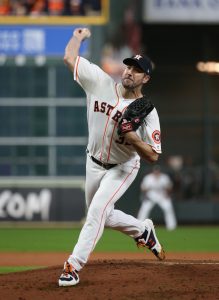
Verlander has only made one appearance in the past two years because of an elbow injury that required a September 2020 Tommy John surgery. When last we saw him at full strength, the 2011 AL MVP was as good as ever. He tossed 223 innings of 2.58 ERA ball in 2019, winning his second career Cy Young award and helping lead Houston to a pennant.
That kind of top-of-the-rotation production is nothing new for Verlander, an eight-time All-Star and future Hall of Famer. He’d posted a 2.52 ERA across 214 frames the year prior, and he has an incredible nine seasons of 200+ innings with an ERA below 3.50 on his resume. Simply put, few pitchers can match the combination of workload and productivity Verlander has put together year in and year out for the bulk of his career.
Of course, there’s real risk Verlander doesn’t regain his peak form coming off two lost seasons. He’ll turn 39 years old in February, so there’d be fairly significant downside even if he weren’t coming off a major arm procedure. The ceiling when investing in a player of this caliber is immense, though, a fact that’s reflected in the seemingly robust interest he generated during his brief stay on the open market. Not only were a few of the game’s top spenders rumored to be involved, Verlander’s deal fairly handily tops the two-year, $40MM figure MLBTR projected entering the offseason — particularly once one factors in the player-friendly opt-out provision.
The Astros determined that to be a risk worth taking, a justifiable stance given that they’re squarely amidst a win-now window. Even facing Verlander’s potential departure, starting pitching wasn’t exactly a need. Despite Verlander missing all of 2021, the Astros’ starting staff ranked fifth in ERA (3.60), albeit with middle-of-the-road strikeout and walk numbers. Zack Greinke looks likely to sign elsewhere this offseason, and the team could look into trades involving Jake Odorizzi. Even still, Houston would bring back Lance McCullers Jr., Framber Valdez, Luis García, José Urquidy and Cristian Javier — one of the stronger rotation cores around the league.
A healthy Verlander is the kind of player teams will find room for even in the absence of an ostensible positional need though. Not only should he help the team manage the workloads of the younger arms, the front office is no doubt envisioning the possibility of rolling him back out as a Game One playoff starter. They’re as familiar as anyone regarding Verlander’s recovery process, current form, and work habits. They clearly feel strongly about his ability to bounce back.
In doing so, the Astros will indirectly forfeit a draft pick. While they won’t be stripped of a pick for signing one of their incumbent free agents, they’ll lose the right to collect a compensatory pick in the 70-75 overall range — which they would’ve received had Verlander signed elsewhere after rejecting Houston’s qualifying offer. That’s a small price to pay, even for a team whose farm system has been hit hard by the punishment from the 2017 sign-stealing scandal, given their current competitive window.
The Astros would stand to add a compensation pick in the event Carlos Correa departs. Like Verlander, Correa also rejected a QO, and the star shortstop is in position for a mega-deal as the top player on the market. The Astros’ previous efforts to re-sign Correa haven’t come particularly close to getting anything done, and Verlander’s return would seem to make the chances of Correa coming back even more remote.
Houston’s 2022 commitments now sit around $162MM, in the estimation of Jason Martinez of Roster Resource. That’s after accounting for estimated salaries for arbitration-eligible players but before considering the possibility of a Correa contract. Signing Correa would no doubt push the 2022 tab well above this past season’s $188MM franchise-record player expenditure (via Cot’s Baseball Contracts). Houston was prepared to enter the 2020 season with a payroll above $200MM before the pandemic necessitated a shortened season with prorated salaries. If owner Jim Crane is willing to go to that level again, then there might be room in the budget for a more earnest Correa pursuit, but it remains to be seen if that kind of spending is on the table.
Regardless of where the Astros go from here, re-signing Verlander serves as a reminder that Correa’s free agency doesn’t mark the end of the club’s competitive window. In addition to a rotation that has as much upside as any in the league, the Astros will roll into 2022 with a lineup that includes Alex Bregman, José Altuve, Yordan Álvarez, Yuli Gurriel, Michael Brantley and Kyle Tucker. They’ll look to hold off the Mariners, Angels and Rangers — all of whom have already been or are expected to be very aggressive this offseason — at the top of the AL West. The A’s look likelier to go in the opposite direction, but Oakland’s current core has been strong enough to compete over the past couple seasons, and it remains to be seen whether they’ll tear the roster down to its studs. All in all, it should be one of the game’s more entertaining and competitive divisions in 2022.
The Verlander signing also paints a picture of what has been a strong rotation market in the early going. The Angels took a similar short-term, high-salary upside flier on Noah Syndergaard yesterday — one day after the Tigers went to five years with an opt-out to land Eduardo Rodríguez. Teams like the Angels, Braves, Blue Jays, Yankees, Red Sox and White Sox were all linked to Verlander in recent days, and it stands to reason those clubs remain motivated to add rotation upside via free agency or trade. Max Scherzer, Kevin Gausman, Robbie Ray, Marcus Stroman and Carlos Rodón are among the numerous starting pitchers still on the free agent market who have recently posted top-of-the-rotation type of production.
Ben Verlander of Fox Sports first reported Justin Verlander’s agreement with the Astros. Mark Berman of Fox 26 reported that Verlander’s 2022 salary would be $25MM and reported the presence of the 2023 player option. Jon Heyman of the MLB Network reported that the option was also valued at $25MM.
Image courtesy of USA Today Sports.
Final Qualifying Offer Decisions
Giants first baseman Brandon Belt was the only one of the fourteen players tagged with the one-year, $18.4MM qualifying offer this offseason to accept the deal, reports Mark Feinsand of MLB.com (Twitter link). That means players like Justin Verlander, Freddie Freeman and Robbie Ray have all declined the offers, as had been anticipated.
Verlander was the only one of the aforementioned trio who ever looked like a realistic possibility to accept the QO, as he’s coming off a season lost to Tommy John surgery recovery and turns 39 years old in February. Astros owner Jim Crane told reporters last month that Verlander was looking for a contract “of some length,” though. He and his representatives found that multi-year pact on the open market, as Verlander quickly re-signed with Houston on a two-year guarantee with an opt-out possibility after 2022.
Freeman and Ray, meanwhile, made the very easy call to turn the QO. They’re among the top handful of players in this year’s class, with each likely to land a five or six-year deal that pushes well north of $100MM. There was no incentive for either player to entertain the possibility of taking a QO, since declining has no impact on their ability to continue to negotiate a longer-term arrangement with their incumbent clubs, as Verlander did with the Astros.
Here’s a full rundown of the players who rejected the qualifying offer (all other decisions had been previously reported):
- Nick Castellanos, Reds
- Michael Conforto, Mets
- Carlos Correa, Astros
- Freddie Freeman, Braves
- Raisel Iglesias, Angels
- Robbie Ray, Blue Jays
- Eduardo Rodríguez, Red Sox (later signed with Tigers)
- Corey Seager, Dodgers
- Marcus Semien, Blue Jays
- Trevor Story, Rockies
- Noah Syndergaard, Mets (later signed with Angels)
- Chris Taylor, Dodgers
- Justin Verlander, Astros (to re-sign with Astros)
Latest On Justin Verlander’s Market
1:47pm: The White Sox are also showing “strong” interest in Verlander, tweets USA Today’s Bob Nightengale. They’re planning an “aggressive” offseason, per Nightengale, and hoping to kick things off with a successful courtship of Verlander. Of course, the South Siders’ spring facility is in Arizona, which isn’t ideal based on Verlander’s reported preferences, but that certainly doesn’t rule them out of the bidding entirely.
12:58pm: Verlander has both multi-year and one-year offers in hand, per MLB Network’s Jon Heyman (Twitter link), adding that the right-hander could make a final decision as soon as this week.
11:47am: The Braves are also among the teams with interest in Verlander, tweets David O’Brien of The Athletic. Atlanta would align well with Verlander’s reported preference for an East Coast club with Spring Training in Florida, and their status as reigning World Series champions obviously helps when pursuing any older veteran prioritizing a contender. Of course, all those players inked sizable one-year deals, whereas Verlander may be seeking multiple guaranteed seasons.
The Braves had had few qualms about signing short-term veterans of this nature under under president of baseball operations Alex Anthopoulos — evidenced by recent short-term pickups of Cole Hamels, Charlie Morton and Josh Donaldson.
10:46am: Justin Verlander has until 5pm ET today to accept or reject a one-year, $18.4MM qualifying offer (as do all other free agents who received a QO), but the widespread expectation is that he’ll reject and fully explore his options. That’s due in part to Astros owner Jim Crane saying last month that Verlander will be looking for a “contract of some length” in free agency, but it’s also due to what’s reported to be strong early interest in the future Hall of Famer.
Verlander held a showcase for teams earlier this month — a step that would seem unlikely were he simply planning to accept the Astros’ QO — and his reps at ISE Baseball have had the past 10 days to gauge interest from other clubs. Ken Rosenthal suggested on MLB Network this morning (video link) that early indications are Verlander would prefer to sign with a club that holds Spring Training in Florida, which meshes with Joel Sherman of the New York Post reporting that several interested teams believe Verlander prefers to play with an East Coast club.
Notably, Sherman adds that both the Red Sox and Blue Jays — each of whom hold Spring Training in Florida — made “aggressive” offers to another high-upside, short-term pitcher coming off Tommy John surgery: Noah Syndergaard. Peter Gammons tweeted yesterday that Syndergaard had multiple offers at or near the $21MM price point for which he agreed to join the Angels, including one approaching $25MM in value. It’s not expressly clear that the Jays or Red Sox offered $21MM+ for Syndergaard, but it’s notable that both teams were aggressive on a fellow Tommy John reclamation play.
Verlander has drawn interest from both Toronto and Boston, per Sherman, who adds that the Yankees seem fairly serious with their interest in the 39-year-old. Verlander, somewhat notably, held his recent showcase at Cressey Sports Performance — the Florida-based training facility operated by Yankees director of player health and performance Eric Cressey. Corey Kluber did the same last offseason before ultimately agreeing to a deal with the Yankees. As noted at the time of the showcase, the location of Verlander’s audition alone doesn’t tip the scale in the Yankees’ favor, but it shouldn’t be completely overlooked, either.
Geographical preference notwithstanding, the best offer is likely to win the bidding for Verlander at the end of the day. It’s unlikely he’d leave an extra year or tens of millions of dollars on the table to spurn a West Coast team to sign in New York, Boston or Toronto. Factors like geography, Spring Training locale and familiarity with teammates (e.g. Gerrit Cole in the Bronx, George Springer in Toronto) are often, albeit not always, more tiebreakers when weighing comparable offers.
Tigers fans, of course, undoubtedly would love to see a reunion in Detroit and are surely heartened to see Verlander’s preference for Florida-based Spring Training outfits. However, Rosenthal also suggests that the Tigers may not be “in as heavily” as other interested clubs.
Angels Reportedly Focused On Short-Term Rotation Additions
After agreeing to terms on a one-year contract with Noah Syndergaard earlier today, the Angels are still in the market for rotation upgrades but are focused on impact arms available on short-term deals, per MLB Network’s Jon Heyman (Twitter link). Heyman suggests Justin Verlander as a potential match in that regard, and the Halos were in attendance at Verlander’s recent showcase.
That said, it’s not clear whether Verlander would be amenable to a one-year pact. Astros owner Jim Crane said last month that he expected Verlander to pursue a contract “of some length,” suggesting at least a two-year deal with those comments. A two-year deal for a pitcher of Verlander’s caliber doesn’t seem outlandish, even with the future Hall of Famer’s lengthy layoff due to 2020 Tommy John surgery. Verlander received an $18.4MM qualifying offer from Houston last week and is widely expected to turn it down.
Any multi-year pact at all would require a philosophical change for an Angels team that hasn’t signed a free-agent starter to a multi-year deal since then-GM Jerry Dipoto (now the Mariners’ president of baseball operations) inked Joe Blanton to a modest two-year contract. The only multi-year deals the Angels have given to any pitchers since that time have come in the form of a two-year extension for closer Huston Street in 2015 and a two-year deal that bought out Shohei Ohtani‘s first two arbitration seasons. Prior to this morning’s agreement with Syndergaard, the last time the Angels had spent even $20MM to sign or extend a pitcher came in Dec. 2011 when they signed C.J. Wilson to a five-year pact.
The Angels have now cycled though several different general managers in that time. Dipoto resigned in 2015 following a highly publicized spat with former Halos skipper Mike Scioscia and was replaced by veteran executive Bill Stoneman on an interim basis. Billy Eppler ran baseball operations for the next half decade in Anaheim, and he was replaced last offseason by Perry Minasian — now in his second offseason as general manager.
It’s unlikely that all of those baseball ops leaders were staunchly against multi-year pacts for free agents — particularly not when rotation needs were often so obvious. The common thread throughout the aversion to pitching commitments of any length is owner Arte Moreno, who has shown a clear willingness to spend heavily on bats (e.g. Anthony Rendon, Mike Trout, Albert Pujols, Justin Upton) but not on arms.
Only time will tell whether Minasian will be given the latitude to issue a multi-year deal of even minor note, but this morning’s deal with Syndergaard seemed straight out of the playbook from prior offseasons: a one-year deal of note for a pitcher with a strong track record and/or a fair bit of upside. That’s the same formula that led to signings of Matt Harvey, Julio Teheran, Jose Quintana and Trevor Cahill, though the Halos will surely hope for better results from their sizable investment in Syndergaard.
If the ostensible insistence on one-year arrangements for starters continues, there are certainly some notable names on the open market who could potentially be had at that term (e.g. Zack Greinke, Danny Duffy, Johnny Cueto, Rich Hill). However, a strong ownership preference for short-term deals could also conceivably push Minasian to the trade market, where the Reds, Marlins and division-rival Athletics ought to all have notable arms on which they’re willing to listen.
After signing Syndergaard, the Angels owe $129.95MM in guaranteed contracts to six players. Add in a modest arbitration class and pre-arbitration players to round out the roster, and they’re projected for around $150MM in 2022 payroll, per Roster Resource’s Jason Martinez. There’s plenty of space between that sum and last year’s franchise-record $182MM Opening Day payroll — which Moreno could well be comfortable raising. But for Angels fans hoping to see a match with Robbie Ray, Marcus Stroman or Kevin Gausman, reports of a continued fixation on short-term deals don’t bode especially well.
Minasian: Angels Hope To “Significantly Improve” Rotation This Offseason
TODAY: The Angels also have interest in Marcus Stroman, Alex Wood, and Noah Syndergaard, according to The Athletic’s Ken Rosenthal.
NOVEMBER 9, 8:58pm: Minasian reiterated his desire to land an impact starter when speaking with Alden González of ESPN this evening (Twitter link). “Frontline starting pitching is tough to acquire. It’s very difficult,” the GM acknowledged. “That being said, we’d like to significantly improve our rotation. That’s an area where we’ll definitely look for a certain type of quality.”
2:16pm: It’s become something of an offseason tradition to note that the Angels are in the market for rotation help, and that’s again the case as the 2021-22 offseason commences. Second-year general manager Perry Minasian again told reporters at this week’s GM Meetings that pitching help is his top priority — Minasian offered a similar outlook in early October — and perhaps more importantly suggested that the team isn’t operating under any payroll constraints (Twitter links via Jack Harris of the L.A. Times). Asked about the budget, Minasian simply replied he “wouldn’t rule us out of anything.”
It’s hardly a surprise to see the Angels again in the market for pitching help — especially with regard to the rotation. Halos starters ranked 26th in the Majors with just 776 1/3 innings pitched in 2021, and their collective 4.78 ERA ranked 22nd. In terms of fielding-independent metrics like FIP and SIERA, the Angels were a middle-of-the-pack club, and the same was true of their strikeout percentage. No team in baseball saw its starters walk a higher percentage of opponents than the Angels’ nine percent mark, however, and their rotation ranked 15th in hit batters despite tallying the fifth-fewest innings of any team in MLB.
Minasian confirmed to Harris and others that the team was represented at yesterday’s Justin Verlander showcase, and MLB.com’s Jon Morosi tweets that the Angels have made some early inquiries with free-agent lefties Robbie Ray and Eduardo Rodriguez. Any big-market club with a need in the rotation figures to check in with the representatives for this trio of pitchers, of course, but it’s notable that all three of Verlander, Ray and Rodriguez have received qualifying offers from their respective clubs.
If the Angels were to sign anyone from that trio, they’d need to forfeit their second-highest draft selection and $500K of their international bonus pool. For some teams, that’s a firm roadblock, but it’s at least somewhat telling that the Angels don’t seem fazed by that reality. Their early interest in this group meshes well with Minasian’s sentiment that they’re not ruling anything out as they look to address a longstanding rotation need.
In the bullpen, the Angels have made a qualifying offer of their own, extending that $18.4MM proposal to closer Raisel Iglesias. Minasian hasn’t received any indication as to whether Iglesias will accept or decline the offer — the latter seems likely — but emphasized (via Harris) that the Angels would like to have Iglesias at the back of their ‘pen again in 2022, whether he accepts or declines.
The Angels’ rotation currently projects to be headlined by MVP frontrunner Shohei Ohtani, with younger options such as Patrick Sandoval, Jose Suarez, Jaime Barria, Reid Detmers, Griffin Canning and Janson Junk among the options to round things out. It’s an inexperienced group, to say the least, so it’s likely the Angels will be in the market for multiple veteran arms to join the group in the offseason. Alex Cobb previously expressed interest in returning to the club but will at least be able to field interest from other clubs now that he’s a free agent.
From a payroll vantage point, the Angels currently owe a combined $108.95MM to five players: Mike Trout, Anthony Rendon, Justin Upton, David Fletcher and Ohtani. Add in a modest projection of $7.7MM in arbitration salaries — including a combined $2.8MM to non-tender candidates Junior Guerra and Phil Gosselin — as well as a slate of pre-arbitration players, and next year’s projected payroll jumps to somewhere in the $125-130MM range.
For a team that carried a $182MM payroll in 2021 and recently saw Albert Pujols‘ decade-long megadeal come off the books, that’s a fair bit of flexibility. And, considering further that Justin Upton‘s backloaded contract ($28MM in 2022) is off the books next winter, the outlook is a bit brighter yet. The Angels will still surely want to consider a long-term deal to keep Ohtani beyond the 2023 campaign, currently his final year of club control, but there ought to be room to bring in an arm of some note.
That said, with all of Trout, Rendon and ideally Ohtani on the books for the long haul, it might be difficult for the Angels to sign two high-end pitchers to long-term arrangements. It’s feasible that they could sign someone like Ray or Rodriguez to a long-term deal, ink another impact starter to a shorter-term arrangement — Verlander, Max Scherzer and Carlos Rodon are among the candidates for that type of deal, speculatively speaking — and then look to the trade market for another arm. The Reds, Marlins and Athletics could all look to move some starters this winter, and the Halos of have several promising young outfielders, including Jo Adell, Brandon Marsh and Jordyn Adams. Any of the previously mentioned young rotation options could also be included in a package for a more established arm.
Regardless of how things unfold, the Angels have a good bit of payroll space at their disposal for at least the next few years. The manner in which they address the rotation this winter and the outcome of their inevitable extension talks with Ohtani will dictate how things look in 2023 and beyond.
Astros Notes: Correa, Verlander, Meyers
At the GM Meetings in Carlsbad, California, Astros’ general manager James Click spoke to Chandler Rome of the Houston Chronicle about the team’s shortstop vacancy, although he claims not to see it that way.
Most of Houston’s playing time at shortstop over the past seven seasons has gone to Carlos Correa, who is now a free agent. The club reportedly made Correa an offer before he hit the open market, although it apparently fell well short of the industry expectations surrounding his earning power. The five-year, $160MM offer was exactly half of MLBTR’s recent prediction of 10 years and $320MM, making it not terribly surprising that Correa didn’t trip over himself to get out his pen.
In the article, Rome opines that the offer is merely a way for the front office to claim that they made an effort, and then pivot to free agents that can be had on short-term deals, or no free agents at all, with the aim of keeping the position available to be claimed by prospect Jeremy Pena. Due to wrist surgery, Pena only played 30 games at Triple-A this year, but they went very well. The 24-year-old hit .287/.346/.598, for a wRC+ of 126. He comes in at #42 on the FanGraphs list of top prospects across the league, although he doesn’t crack the top 100 at Baseball America or MLB Pipeline.
Until his arrival at the big leagues, the club could consider the in-house option of Aledmys Diaz, as Click describes him as “more than qualified” to take the job. Diaz has a lot of time at shortstop on his resume, but not recently, just 14 games in the last three seasons. That lack of recent work at short and his roughly league-average offense over the past two seasons would certainly be a downgrade from Correa, who is elite on both sides of the ball.
One option not being taken seriously, however, is moving Alex Bregman from this base to shortstop. When asked about that option, Click said, “I would highly doubt it” and later added, “I don’t want to get too cute by half and try to jam a square peg into a round hole.” Bregman was primarily a shortstop before reaching the big leagues, sliding to third because of the presence of Correa. He saw some significant time there in 2019 when Correa was hurt, getting into 65 games, but hasn’t played there since. The move doesn’t seem to be totally off the table, though, as Click added that he “would have to talk to Alex about it.”
In a separate post, Rome speaks to Click about the pitching situation, with Click saying that the bullpen is a bigger need than the rotation. “I know that people have started probably mentally thinking of Cristian Javier as a reliever, but we don’t think that way,” Click says, “and having him as a starting pitching option is very real for us and creates a lot more depth.” Including Javier as a starter certainly does make the rotation look healthy, with Lance McCullers Jr., Framber Valdez, Luis Garcia, Jose Urquidy and Jake Odorizzi all on hand as viable options. The club also has an outstanding $18.4 qualifying offer in front of Justin Verlander at the moment, although based on the success of his recent showcase, the odds seem to be in favour of him declining and exploring the market. Click himself spoke positively about Verlander’s performance at the showcase, as relayed by Alden Gonzalez of ESPN. Odorizzi’s level of participation seems to be a question mark, however, as Rome details how the hurler wasn’t happy with his usage at times, displeased with the club’s hesitance at letting him face a batting order for a third time. He’s entering his final guaranteed year as an Astro but has a player option for 2023.
Elsewhere in Astros land, the club got some bad news regarding Jake Meyers, per Rome. Meyers left game four of the ALDS with a shoulder injury and never returned. He recently had surgery to repair a labral tear and isn’t expected to be playing by Opening Day 2022. That will hurt the club’s center field depth, as they had traded away Myles Straw at the deadline, in part because Meyers was ready to step up and take his place. The plan went very well before the injury, as Meyers hit .260/.323/.438 for a wRC+ of 111 in 49 games, along with a good showing in four postseason games. As long as Meyers is on the shelf, Houston’s top options in center will likely be Chas McCormick and Jose Siri, although moving Kyle Tucker from right to center is also on the table. “We have to decide, ‘Do we want to consider moving Kyle to center and then going shopping for a corner guy?’” Click said, per Jake Kaplan of The Athletic. “‘Do we want to have Kyle in center and have Chas and Siri and Yordan and Brantley be kind of rotating through all those spots?’” The market for free agent center fielders isn’t strong, with Starling Marte representing the only true everyday option. The market for corner outfielders, however, has many more exciting options. If the club feels comfortable with Tucker up the middle, it could make sense to take that route. At the big league level, he’s only played five regular season games in center in his career, although he saw some time there this postseason after Meyers got hurt.
Verlander Showcase Draws Scouts From 15-20 Teams
Two-time Cy Young winner Justin Verlander, who has pitched just six innings since the conclusion of the 2019 season due to 2020 Tommy John surgery, held a free-agent showcase this week. Representatives from as many as 15 to 20 teams this week, tweets Joel Sherman of the New York Post, adding that Verlander’s fastball was clocked from 94 to 97 mph. He’s presently about 13 and a half months out from the surgery and will be 17 months removed from the procedure by the time Spring Training is set to begin.
As one would expect, the list of known teams in attendance at the showcase includes a blend of big-market contenders and a few rebuilding clubs looking to turn the corner and get back into competitive ball. Britt Ghiroli of The Athletic tweets that the Yankees, Rangers and Tigers were in attendance. Sherman notes that the Mets had two scouts present for Verlander’s workout. TSN’s Scott Mitchell adds the Blue Jays to the pile, and the Post’s Ken Davidoff lists the Giants as another suitor. Angels GM Perry Minasian told reporters that the Halos had someone present to watch Verlander as well (Twitter link via The Athletic’s Sam Blum).
Of course, given the stage of the offseason we’re at, it’s safe to assume that virtually any team with a modicum of 2022 postseason hope and/or any actual money to spent this offseason was at least present to gauge Verlander’s readiness. As Red Sox chief baseball officer Chaim Bloom asked rhetorically when confirming his club’s presence at the showcase (link via Peter Abraham of the Boston Globe): “Age might affect the term you consider, but if the present ability is there, why wouldn’t you be interested?”
By all accounts, the showcase went quite well. Beyond the multiple reports pegging Verlander’s velocity in the mid- to upper-90s, Sherman indicates that Verlander was able to throw all of his pitches and looked sharp across the board. Chandler Rome of the Houston Chronicle tweets that one scout offered a simple, two-word assessment of Verlander after watching his open audition: “He’s ready.”
It’s certainly worth noting that the showcase was held at the Cressey Performance Center — a facility run by Yankees director of health and performance Eric Cressey. Corey Kluber held his own showcase there last year and ultimately signed with the Yankees, but the mere location of Verlander’s workout doesn’t make a deal with the Yankees a foregone conclusion.
The Astros made a one-year, $18.4MM qualifying offer to Verlander over the weekend, but the widespread expectation is that he’ll reject that in search of a multi-year offer. Astros owner Jim Crane said last month that Verlander would likely be looking for a “contract of some length” in free agency, heavily implying at least a two-year term. Furthermore, hosting a showcase for two-thirds of the league is an obvious indicator that Verlander is interested in seeing what the market has to bear.
Verlander, 39 in February, didn’t pitch in 2021 and threw just six innings in 2020. Of course, in his last healthy season, he won the 2019 American League Cy Young Award after posting a 2.58 ERA in an MLB-best 223 innings with a huge 35.4% strikeout rate against a 5.0% walk rate. Verlander has said on multiple occasions in the past that he hopes to pitch well into his 40s.
14 Players Receive Qualifying Offers
Today was the last day for teams to issue qualifying offers to eligible free agents, as teams had to make their decisions by 4pm CT. With the deadline now behind us, here are the players who were issued the one-year, $18.4MM offers…
- Brandon Belt, Giants (link)
- Nick Castellanos, Reds (link)
- Michael Conforto, Mets (link)
- Carlos Correa, Astros (link)
- Freddie Freeman, Braves (link)
- Raisel Iglesias, Angels (link)
- Robbie Ray, Blue Jays (link)
- Eduardo Rodriguez, Red Sox (link)
- Corey Seager, Dodgers (link)
- Marcus Semien, Blue Jays (link)
- Trevor Story, Rockies (link)
- Noah Syndergaard, Mets (link)
- Chris Taylor, Dodgers (link)
- Justin Verlander, Astros (link)
This is the highest number of qualifying offers issued since the 2015-16 offseason, when a record 20 players received the QOs. Only six players received qualifying offers last winter, which was the lowest ever issued in an offseason, yet not really surprising given the pandemic’s impact on the 2020 season and league revenues.
These 14 players now have until November 17 to decide whether or not to accept the offer. If they accept, they’ll receive $18.4MM next season, and can’t be traded until June 15, 2022. They also won’t be eligible to receive a qualifying offer in any future trips to free agency (players are also ineligible for the qualifying offer if they haven’t spent at least one full season with their current team). Since the qualifying offer system was introduced in the 2012-13 offseason, 10 of the 96 players to receive a QO have taken the deal.
If a player rejects the qualifying offer, draft pick compensation is now attached to their market, unless they re-sign with their former team. Teams who sign a QO free agent will have to surrender at least one draft pick, and potentially some international bonus pool money depending on their status as revenue-sharing recipients or whether or not they exceeded the luxury tax threshold. (Here is the list of what every team would have to give up to sign a QO free agent.)
If a QO free agent signs elsewhere, that player’s former team receives a compensatory draft pick based on this criteria….
- A draft pick after Competitive Balance Round B will be awarded if the team losing the free agent did not receive revenue sharing or if the free agent in question signed a contract worth less than $50MM in guaranteed money.
- A draft pick after Round 1 will be awarded if the team losing the free agent received revenue sharing and the free agent in question signed for more than $50MM.
- A draft pick after Round 4 will be awarded if the team losing the free agent paid luxury tax penalties in the preceding season.
As always, several factors are weighed by both teams and players about whether or not to issue or accept qualifying offers. This winter provides yet another wrinkle — this could be the final year of the current qualifying offer system due to the expiration of the current Collective Bargaining Agreement on December 1. It is widely expected that the owners could lock out the players if a new deal isn’t reached by that date. In the event of a lockout, MLB would institute a roster freeze on all transactional business involving Major League players, thus bringing the free agent market to a halt.
With this deadline looming, it is possible we could see some QO recipients (those less certain of landing big multi-year contracts) choose to accept the one-year deal in order to guarantee themselves some financial and contractual security prior to a possible lockout. By that same token, this could make teams warier about extending the qualifying offer to certain players due to a larger suspicion that they would accept…or perhaps a player’s willingness to accept could make a team more inclined to issue a QO to a so-called borderline case.
Free Agent Notes: Verlander, Schwarber, Heaney
Justin Verlander will hold a showcase for scouts and evaluators tomorrow, The Athletic’s Britt Ghiroli reports (Twitter links). This is the first time Verlander will throw in front of evaluators from other teams since his Tommy John surgery in September 2020. Multiple teams are expected to have personnel on hand, if just as a matter of simple due diligence rather than a clear interest in signing Verlander on the free agent market. As WFAN’s Sweeny Murti observes, it probably safe to assume the Yankees will have personnel on hand — Verlander is throwing at a Cressey Sports Performance facility, and Eric Cressey is the Yankees’ director of player health and performance.
It stands to reason that Verlander will probably hold multiple showcases in order to prove that his arm has recovered from the TJ procedure, and that he’ll be ready to roll when Spring Training camps open. The timing of a second showcase could be particularly important, however, since Verlander has until November 17 to decide whether or not to accept the qualifying offer extended by the Astros today. If Verlander throws well and gets some good buzz coming out of Monday’s session, it could make him lean against taking the one-year, $18.4MM offer to return to Houston, if he gets an indication that at least one other club is interested in making him a more lucrative multi-year deal on the open market.
More from the free agent market….
- J.D. Martinez‘s decision to pass on his opt-out clause will keep the veteran slugger in Boston for another season, though it doesn’t mean that free agent Kyle Schwarber is necessarily roadblocked from a return to the Red Sox. Chief baseball officer Chaim Bloom told reporters (including The Boston Globe’s Alex Speier) that the Sox have already been in touch with Schwarber and will continue to monitor his market throughout the winter. Martinez’s role as the regular DH and a fill-in outfielder might be the ideal spot for Schwarber, as while Schwarber did okay at first base for someone who had never played the position before, he probably isn’t a viable solution at first over the longer term (plus, the Sox have Bobby Dalbec and prospect Triston Casas ready for more first base time). However, Schwarber hit so well during his two-plus months in Boston that it isn’t surprising that the club will look to get creative in trying to find a fit for him in the lineup. For his part, Schwarber said after the ALCS that he would be interested in a return to the Sox.
- Despite Andrew Heaney‘s very rough 2021 season, several teams are eyeing the left-hander as a possible bounce-back candidate. The New York Post’s Joel Sherman (Twitter link) lists the Blue Jays, Cardinals, Dodgers, and Nationals as some of the teams interested in the free agent hurler. Heaney still had above-average strikeout and walk rates last year, as most of his problems stemmed from an inability to avoid home runs — Heaney allowed a whopping 29 homers over his 129 2/3 innings with the Angels and Yankees.
Justin Verlander Still Awaiting Qualifying Offer Decision
Astros owner and chairman Jim Crane insists that his club has the resources they need to improve their ball club, per Chandler Rome of the Houston Chronicle (via Twitter). Crane did not mince words when speaking of his team needs, simply calling out the fact that the Astros will be looking for pitching and a shortstop, per Rome.
The latter need is the more finite and interesting of the two. Carlos Correa will presumably walk as a free agent, despite the resources that Crane touts as being available to his club. Certainly, for a club that has made three World Series appearances over the past five years, there should be no shortage of financial might.
The decision to let Correa walk, should they do so, is more a calculated evaluation of resource allocation. Still, it’s interesting for Crane to voice that position as one of need. Jeremy Pena has shown promise in the minor leagues, but it would be a tall order for Pena to step directly into the starting lineup for Correa, a franchise icon and two-time All-Star. The 24-year-old his an impressive .287/.346/.598 over 133 plate appearances at Triple-A.
On the pitching side, the Astros have already shifted to a new generations of arms led by the likes of Framber Valdez, Jose Urquidy, and Luis Garcia. Former ace and rotation stalwart Justin Verlander is still awaiting a possible qualifying offer, however. Despite missing all of last season because of Tommy John surgery, the 38-year-old would be a high ceiling, short-term use of the Astros’ financial might, were they to go ahead and extend the qualifying offer. The deadline to extend that offer is Sunday, and the Astros are still considering their options, tweets Rome.