
Guardians Sign Ben Lively To Major League Deal
The Guardians announced Tuesday that they’ve signed right-hander Ben Lively to a one-year, Major League contract. Zack Meisel of The Athletic reports that Lively will be guaranteed just north of the league minimum on the deal, earning a $750K salary in 2024. Lively is represented by Meister Sports Management.
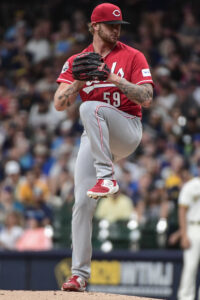
Lively, 31, spent the 2022-23 seasons with the Reds after a three-year run with the Samsung Lions of the Korea Baseball Organization. The entirety of that 2022 campaign was spent in Triple-A, but Lively was selected to the Majors early last season and pitched 88 2/3 innings for the Reds, starting a dozen games and making another seven relief appearances. He posted an unsightly 5.38 ERA in that time, although a disproportionate amount of the damage against him came in one start on Aug. 1, when the Reds left him out there to take an eye-popping 13-run shellacking at the hands of the Cubs.
Lively’s 20.6% strikeout rate was a bit south of the league average this past season and he averaged just 90.9 mph on his fastball. However, he also issued walks at a tidy 6.5% clip, and the Guards are probably less concerned with his 2.03 HR/9 mark than other teams might’ve been, given the spacious nature of their home park. Lively still seems likely to struggle with the long ball at times, but pitching half his games at Progressive Field should help mitigate some of those struggles.
The signing of a Lively is in some ways out of character for the Guardians, who haven’t inked a free-agent starting pitcher to a Major League contract since signing Gavin Floyd to a one-year deal nearly a decade ago. Lively could well be viewed as a swingman and may not even be a lock to make the Opening Day roster, however, as he also has a minor league option remaining. Cleveland has been able to eschew free agent starting pitching entirely for the better part of a decade, thanks largely to the organization’s nearly unrivaled pitching development prowess.
Lively’s role with the Guards likely depends on how the remainder of their offseason shakes out. As it stands, he’d likely serve as a swingman or sixth starter behind Shane Bieber, Tanner Bibee, Triston McKenzie, Logan Allen and Gavin Williams. However, it’s also quite possible that Cleveland trades Bieber between now and Opening Day, as is the organization’s tendency with notable starting pitchers who are approaching the open market.
For instance, Bieber will reach free agency next winter, and the team has previously traded top starters like Corey Kluber, Carlos Carrasco, Trevor Bauer and Mike Clevinger before any qualified to become free agents. Trades of Bieber, closer Emmanuel Clase (on whom the Guardians are reportedly willing to listen) and/or other members of the roster could net further competition for the back of the rotation, as could future free-agent signings. For now, however, Lively joins that mix. No team makes it through a full season with only five starters anyhow, and both Bieber and McKenzie missed substantial time in 2023 due to elbow injuries. Even if he opens the year as a long reliever, Lively has a good chance to start games at some point, as injuries arise.
While it’s commonplace for players returning from the KBO or from NPB to have clauses in their contracts allowing them to become free agents despite lacking six years of MLB service time, MLBTR has confirmed that that’s not the case with Lively, because of the fact that he’d already spent a year back in the big leagues. As such, he’s now under Guardians control via arbitration for another five seasons. If he spends the entire year in the Majors, he’d likely be arbitration-eligible next offseason as a Super Two player. Lively is currently at 1.133 days of MLB service time, and this year’s Super Two cutoff was 2.118. It’s feasible he could spend a week or two in the minors and still reach Super Two status, but he’d be right on the bubble with even a brief stay in the minors.
Shohei Ohtani’s Contract Will Defer $68MM Per Year
The Dodgers and Shohei Ohtani agreed to massive a ten-year, $700MM deal over the weekend, but it was reported that there were significant deferrals. The deal still isn’t official but Fabian Ardaya of The Athletic relays some of the particulars today, most notably that $68MM of Ohtani’s $70MM annual salary will be deferred, leaving him making just $2MM per year in the short term. The deferred money is to be paid out without interest from 2034 to 2043. This will reportedly reduce the CBT hit of the contract to around $46MM per year.
When reporting on Ohtani’s deal was initially coming out over the weekend, Jeff Passan of ESPN relayed “most of” the salary would be deferred. It now appears that wording was putting it mildly, with this framing coming as quite a shock. Deferring money is not new but this scale is clearly unprecedented. Most baseball fans are familiar with Bobby Bonilla’s unusual contract structure, with many of them celebrating “Bobby Bonilla Day” every July 1. In late 1999, the Mets released Bonilla but still owed him $5.9MM. In order to save money in the short term, the club kicked the payments down the road, agreeing to pay him $1.19MM on July 1 every year from 2011 to 2035.
But deferring $68MM annually is clearly uncharted waters, since no MLB player has ever even had a salary of $45MM or higher. Ohtani is set to almost double that, in a sense, but he will only be banking $2MM per year during his time playing for the Dodgers.
From Ohtani’s point of view, the gambit makes a lot of sense and Passan reported over the weekend it was Ohtani’s idea. By taking less money now, he will leave the club with more money to build a competitive team around him. For competitive balance tax purposes, a contract is measured in net present value as opposed to pure guarantee, so this works for luxury tax purposes also. As mentioned up top, this will lead to a CBT hit of about $46MM, instead of the $70MM that would apply if going just by average annual value. As Ardaya mentions in today’s report, Ohtani makes about $50MM per year in terms of endorsements and off-the-field revenue streams, meaning he won’t be hurting for cash by taking this path. He’ll then be able to collect $68MM per year after he has played out the 10-year term of the agreement.
For the Dodgers, this will obviously be great for their competitive chances in the short term. They get an elite player the likes of which the world has never seen for a mere $2MM per year. That’s obviously still a huge amount of money for the average person but chump change in the baseball world, with the MLB minimum is set to be $740K next year. They also cut their CBT hit way down, significantly limiting the taxes they eventually have to pay at any point over the next decade. The long-term downside is that, from 2034 to 2043, they will be spending $68MM on a player that is no longer on the club. As pointed out by Brandon Wile of The Score, there are also heavy deferrals in the Mookie Betts deal, meaning the Dodgers will be paying a combined $79MM to Ohtani and Betts in 2043 when Betts will be 50 years old and Ohtani 48.
That could come back to bite them down the road, but they clearly see the present as a unique opportunity to strike while having a unique combination of talents with players like Ohtani, Freddie Freeman and Betts all on the roster. Due to inflation, by the time those payments roll around, the value of $68MM will be less than it is today.
Some fans of other clubs may not like the way this is playing out but it doesn’t seem like there’s any hope of the league stepping in to put a stop to it. As relayed by Passan, the collective bargaining agreement clearly states that there is no limit to the amount of money than can be deferred in a contract.
Both Ohtani and the club had to agree to this deal, so it’s obviously fine with the parties involved. But it’s not great for any rival clubs or their fans. The Dodgers have already been one of the most successful clubs in recent history, running up big payrolls and having currently made the playoffs in 11 straight seasons. Now they are adding an unprecedented talent with unprecedented financial machinations that will appear to many as unfair, regardless of whether or not they are actually against the rules.
The Dodgers still have a lot of work to do this offseason, particularly in the rotation. They are currently slated to rely upon Walker Buehler, who missed all of 2023 recovering from Tommy John surgery, and then a batch of fairly unproven youngsters such as Bobby Miller, Ryan Pepiot, Emmet Sheehan, Gavin Stone and Michael Grove. With the huge amount of money they committed to Ohtani, it was fair to wonder how much powder they would have dry for bolstering that staff. With Ohtani agreeing to this deal, it makes it far more likely that they throw some money around at free agents like Yoshinobu Yamamoto, Blake Snell, Jordan Montgomery or others.
Both Jack Harris of the L.A. Times and Jeff Fletcher of the Orange County Register report that Ohtani explored these kinds of contract structures with every team he negotiated with, so this wasn’t just a Dodgers-exclusive thing. It seems that Ohtani wants to win and has agreed to structure his deal so that his chances of doing so are as high as possible. He’ll take home far less money now in order to make the team stronger during the course of his playing career.
Blue Jays, Payton Henry Agree To Minor League Contract
Catcher Payton Henry has agreed to a minor league contract with the Blue Jays, he announced on X over the weekend. He’ll presumably receive an invitation to big league camp.
Henry spent the entire 2023 season in Triple-A with the Brewers. Milwaukee had outrighted him off the 40-man roster a couple weeks into the regular season. The Brew Crew had acquired the right-handed hitting backstop from the Marlins last offseason. That marked his second stint with the Milwaukee organization, as Henry had been drafted by the Brewers before being dealt to Miami in a 2021 trade that landed reliever John Curtiss in Wisconsin.
The 26-year-old hit .294/.341/.454 in 65 minor league contests this year. That’s roughly league average offense in a hitter-friendly International League setting. Henry struck out at an average 23.1% clip while walking less than 5% of the time. He has never had great strikeout and walk numbers, but prospect evaluators have credited the former sixth-round pick with strong raw power potential for a depth catcher.
Henry has 20 major league games under his belt split between the 2021 and ’22 seasons in Miami. He’s a .264/.331/.410 hitter in a little under 500 career Triple-A plate appearances. Barring injury, Henry is unlikely to secure a season-opening spot on a Toronto team that rosters Danny Jansen and Alejandro Kirk. The Jays recently lost third catcher Tyler Heineman on waivers, so Henry projects as non-roster depth who can open next year with their top affiliate in Buffalo.
Dodgers Sign Shohei Ohtani
The Dodgers officially announced the signing of two-time MVP Shohei Ohtani to a 10-year contract. The two-way superstar had announced his intention to sign with the club via his Instagram page on Saturday.
“Dodger fans, thank you for welcoming me to your team,” Ohtani said in a statement released by the team. “I can say 100 percent that you, the Dodger organization and I share the same goal – to bring World Series parades to the streets of Los Angeles.”
Ohtani is guaranteed an astounding $700MM on the deal, as revealed in a statement from his CAA agent Nez Balelo. However, the contract comes with a staggering set of deferrals, a concept apparently suggested by Ohtani himself. Ohtani will only collect $2MM of his salaries annually over the course of the next decade. The remaining $680MM is deferred to be paid out between 2034-43, thereby reducing the contract’s competitive balance tax number to roughly $46MM.
Regardless of how that distribution, the 29-year-old Ohtani lands the single largest contract ever given to a professional athlete. The $700MM guarantee surpasses the $674MM deal that soccer legend Lionel Messi signed with FC Barcelona for the 2017-21 La Liga seasons.
“First of all, I would like to express my sincere gratitude to everyone involved with the Angels organization and the fans who have supported me over the past six years, as well as to everyone involved with each team that was part of this negotiation process,” Ohtani said in his Instagram message. “Especially to the Angels fans who supported me through all the ups and downs, your guys’ support and cheer meant the world to me. The six years I spent with the Angels will remain etched in my heart forever. And to all Dodgers fans, I pledge to always do what’s best for the team and always continue to give it my all to be the best version of myself. Until the last day of my playing career, I want to continue to strive forward not only for the Dodgers but for the baseball world.”
Balelo’s statement: “Shohei is thrilled to be a part of the Dodgers organization. He is excited to begin this partnership, and he structured his contract to reflect a true commitment from both sides to long-term success. Shohei and I want to thank all the organizations that reached out to us for their interest and respect, especially the wonderful people we got to know even better as this process unfolded. We know fans, media and the entire industry had a high degree of interest in this process, and we want to express our appreciation for their passion and their consideration as it played out.”
Aaron Judge‘s ten-year, $360MM deal with the Yankees last winter was the largest free agent deal in baseball history, while Mookie Betts landing $365MM in new money in his 2020 extension with the Dodgers was technically the largest deal overall. Mike Trout‘s ten-year, $360MM extension with the Angels was considered by the team as a 12-year, $426.5MM pact due to its inclusion of previously owed money in Trout’s previous deal, but while that extension had been considered by some to hold the “biggest contract ever” title, Ohtani’s contact now ends all debate.
While it was widely expected that Ohtani would set a new standard for baseball contracts this winter, nearly doubling the Betts/Judge totals is an incredible new benchmark. The $700MM figure speaks to several factors — Ohtani’s generational talent as a two-way superstar, the amount of revenue Ohtani can personally generate in terms of additional endorsements and fan interest from Japan, the number of big-money offers made by the other known suitors in the race, and simply the Dodgers’ determination to land a player who has been on their radar for years.
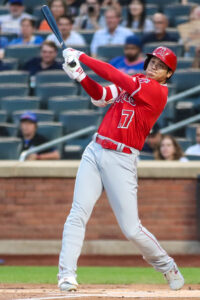 If the National League had had the designated hitter in 2018, it is quite possible Ohtani would’ve signed with the Dodgers when he initially came to MLB from Nippon Professional Baseball during the 2017-18 offseason. The Dodgers (along with the Cubs, Rangers, Padres, Mariners, and Giants) were the finalists behind the Angels, whose willingness to give Ohtani free reign as both a pitcher and a hitter allowed the Anaheim club to seal the deal, and set the stage for one of the most remarkable stretches baseball has ever seen.
The impact was immediately, as Ohtani hit and pitched at such as high level in 2018 that he was an easy choice as AL Rookie Of The Year. He had to undergo a Tommy John surgery that kept him off the mound in 2019, though he was still able to hit as a DH and posted some impressive numbers. However, an injury-marred 2020 campaign saw Ohtani deliver poor numbers at the plate and only 1 2/3 total innings on the mound, creating doubt as to whether he could truly live up to the hype.
The doubts were erased from 2021-23. Ohtani posted a 2.84 ERA, 31.4% strikeout rate, and 8.3% walk rate over 428 1/3 innings on the mound, while also hitting .277/.379/.585 with 124 home runs over 1904 plate appearances. Not even Babe Ruth amassed such levels of performance while both hitting and pitching at the same time, earning Ohtani the unofficial nickname of “the Unicorn.” Ohtani won AL MVP honors in both 2021 and 2023, and finished second to Judge in 2022 in the aftermath of Judge’s AL-record 62 home runs.
As stunning as Ohtani’s contract is, it seems possible that he might’ve landed even more if he’d been fully healthy. Ohtani suffered a tear in his UCL that required surgery in September, and though it isn’t clear whether or not his surgery was another Tommy John procedure or a brace procedure, he isn’t expected to pitch during the 2024 season. It seems likely that Ohtani will miss some time at the start of next season to recover well enough to operate as a DH, and after his TJ surgery in 2018, he was able to get onto the field by May 7, 2019.
More details should become available as we get closer to Spring Training, though that perhaps isn’t a sure bet given Ohtani and Balelo’s penchant for keeping quiet on specifics. Ohtani’s last few months have been marked by a somewhat unprecedented level of secrecy about not just his health, but any hints about his free agent market. It was made clear by Balelo that leaking details to the media would be marked against any team in the chase, and thus most clubs played ball with the Ohtani camp’s requests.
The lack of information led to no end of speculation about what exactly Ohtani was looking for in his next team. It was known that Ohtani was eager to win, which perhaps isn’t surprising considering that the Angels were never able to deliver even a .500 season with both Ohtani and Trout on the roster. Ohtani’s initial venture to MLB prioritized West Coast teams, yet that didn’t appear to be a true determining factor in this case. The reported finalists for Ohtani’s services included three West Coast teams (the Dodgers, Angels, and Giants), as well as the Cubs against, and a new suitor altogether in the Blue Jays.
Two reports yesterday suggested that Ohtani was signing with the Jays and was en route to Toronto, leading to a social media flurry that included everything from flight-tracking at Toronto’s Pearson Airport to queries about a large reservation allegedly booked by Jays pitcher Yusei Kikuchi at a downtown sushi restaurant. In the end, the Blue Jays fell short in their attempt to sign the two-way star, though as with all of the suitors, it could be that Dodgers’ final offer simply blew every other bid out of the water.
Ohtani’s free agency in some ways held up the rest of the market entirely, as several top talents were waiting for Ohtani’s situation to be resolved so they could have a clearer picture of what teams might be bidding on their own services. Yoshinobu Yamamoto, Cody Bellinger, Jordan Montgomery, Matt Chapman, and others might now see their markets kick into higher gear with Ohtani off the board. The trickle-down effect bled into the trade market as well, as numerous teams with players available can now shop for offers from clubs who missed out on Ohtani — and might be even more pressed to make a big addition.
The Giants, for instance, are still feeling the heat to add a superstar after also falling short on Judge and Carlos Correa last offseason. The Blue Jays still have a lot of holes to fill in their lineup after an almost team-wide lack of consistency at the plate in 2023. The Cubs were perhaps seen as less likely to spend to quite the same level as other suitors, though president of baseball operations Jed Hoyer firmly denied a report from earlier this week suggesting that Chicago was out of the hunt. The Mets, Red Sox, and Rangers did seemingly pull back prior to the start of the Winter Meetings, whereas speculative candidates like the Yankees, Braves, Phillies, or Mariners never seemed involved to any great extent.
The Angels have the toughest pill to swallow in seeing Ohtani not just leave, but head across town to the other Los Angeles team. Because the Halos were just barely able to maneuver themselves under the luxury tax threshold, the Angels will maximize their compensatory return for Ohtani, who naturally rejected a qualifying offer. Anaheim will now get a compensatory pick after the second round of the 2024 draft, which is admittedly small consolation for losing one of the game’s all-time singular talents. There hasn’t been any sense that the Angels are planning to rebuild or take a step back now that Ohtani is gone, as the team has reportedly still been trying to add top-end talent to finally get back into contention.
As for the Dodgers, they got their man, cost be damned. They’ll also surrender $1MM in international bonus pool money, as well as two draft picks — their second- and fifth-highest selections in the 2024 draft — to sign a player who rejected a qualifying offer. Ohtani now joins Betts and Freddie Freeman in one of the more fearsome top-of-the-order trios in recent memory, and solidifies at least the DH spot in Chavez Ravine for the next decade. There have been some whispers that Ohtani might try his hand at playing the outfield should he ever opt to stop pitching, and while he did make some brief appearances as an outfielder during his time with the Halos, the question of a future position probably isn’t being raised for at least a few years down the road, or until Ohtani has exhausted all options as a pitcher.
Ohtani’s arm injury was particularly troublesome for the Dodgers in the short term, as the club is still in need of pitching help heading into 2024. Walker Buehler is returning after missing all of 2023 due to his own TJ surgery, swingman Ryan Yarbrough is probably penciled into one rotation spot for at least the start of the season, and Bobby Miller has all but officially won himself a spot after an impressive rookie year. That leaves a collection of other young arms (Ryan Pepiot, Emmet Sheehan, Michael Grove and Gavin Stone) battling for other rotation spots, and Dustin May could be a factor by midseason once recovered from a flexor tendon surgery. Longtime ace Clayton Kershaw is a free agent and will miss a big chunk of the 2024 campaign due to shoulder surgery, though it would seem that if Kershaw decides to keep playing, it will be either with the Dodgers or with his hometown Rangers.
Yamamoto is known to be another target on the Dodgers’ wishlist, while Dylan Cease and Tyler Glasnow are two of the undoubtedly many more experienced pitchers L.A. has discussed in trade talks. The Dodgers could perhaps trade from their deep farm system to facilitate some pitching trades, or make yet another big signing. Even after adding Ohtani to the books, the Dodgers had created enough space on the books that they’re only slightly over the $237MM luxury tax threshold — as per Roster Resource, the club’s projected tax number is just over $244MM. Since Los Angeles hasn’t been reluctant to pay a tax bill in the past, president of baseball operations Andrew Friedman can continue to be aggressive as the team enters the Ohtani era.
Despite 11 straight playoff appearances and 10 of the last 11 NL West titles, the Dodgers have captured “only” one World Series title within this fantastic run of success. All those postseason near-misses have left something of an underwhelming feeling amongst Dodger fans, and the team has won only a single playoff game over its last two trips to October. It always felt as though the Dodgers were going to be pushing to sign Ohtani no matter their recent results, yet his addition perhaps acts as some kind of turning point in translating a few more of those playoff visits into championship rings.
Claiming that the Dodgers will become even more of a high-profile franchise is a little difficult to claim, since obviously the club’s long line of past Japanese stars has made them a household name overseas. Still, adding the biggest star of all in Ohtani will only enhance the Dodgers as a worldwide brand. The added marketing, merchandising, and broadcasting revenues that come with signing Ohtani won’t exactly cover $700MM, yet it isn’t a stretch to say that the Dodgers will enjoy some unprecedented economic benefits in addition to what Ohtani delivers on the field.
Alden Gonzalez of ESPN reported the absence of any opt-out clauses. His colleague Jeff Passan first reported the majority of Ohtani’s contract would be deferred, while Fabian Ardaya of the Athletic was first with the deferral specifics. Bob Nightengale of USA Today reported the no-trade provision.
Photo courtesy of USA Today Sports Images
Pirates, Ryder Ryan Agree To Minor League Deal
The Pirates agreed to a minor league contract with reliever Ryder Ryan, reports Jason Mackey of the Pittsburgh Post-Gazette (X link). He’ll be in MLB camp as a non-roster invitee.
Ryan made his major league debut last season. He pitched once for the Mariners, turning in a scoreless inning with two strikeouts and a walk against Baltimore. The North Carolina product otherwise spent his year with the M’s Triple-A club in Tacoma. He had a nice showing for the Rainiers, working to a 3.76 ERA across 55 innings. The righty punched out just under a quarter of his opponents against a slightly high 9.6% walk rate.
The 28-year-old has appeared in parts of three Triple-A campaigns, allowing 4.24 earned runs per nine in 159 1/3 frames. While Ryan has very little major league experience, he has been of interest to a few teams as a depth arm. Originally drafted by Cleveland, he was dealt to the Mets for Jay Bruce in 2017 and flipped to Seattle in 2020 as the player to be named later in a Todd Frazier deal.
Seattle outrighted Ryan from the 40-man roster last month. He became a minor league free agent, setting the stage for him to join a fourth organization of his career. The Bucs had a middling relief group, finishing 19th with a 4.22 ERA and 14th with a 23.7% strikeout percentage.
White Sox Acquire Max Stassi From Braves
December 11: Atlanta is paying Stassi’s deal down to the league minimum, according to the Associated Press; they’ll send $6.26MM in cash. That amount also counts against the Braves luxury tax number, which sits at an estimated $263MM according to Roster Resource. As second-time payors in the second tier of penalization, they’ll pay a 42% tax on that money. Stassi will cost the Braves around $8.89MM overall.
December 9: The White Sox have acquired Max Stassi and cash considerations from the Braves in exchange for a player to be named later. Both teams have announced the deal. Per Daryl Van Schouwen of the Chicago Sun Times, the Braves are expected to pay for the majority of Stassi’s $7MM salary next season.
Stassi, 33 in March, spent just one day in the Braves organization after being acquired from the Angels yesterday in a multi-played deal with the Angels alongside infielder David Fletcher. Now, the veteran catcher is off to his third organization in two days, where he figures to have the opportunity to step into a regular role on the south side of Chicago. The White Sox lost Yasmani Grandal to free agency earlier this offseason and were in need of a veteran backstop to pair with youngster Korey Lee behind the plate in 2024.
It’s a need Stassi is more than capable of fulfilling. While the veteran missed the entire 2023 season, only the first half of his absence was due to the left hip strain that prevented him from being on the Opening Day roster in Anaheim last season. Stassi recovered from that issue midseason, but he and his wife revealed last month that the three-months premature birth of their son necessitated Stassi to step away from the game and attend to his family for the remainder of the 2023 campaign.
That said, Stassi is expected to return to the field in 2024 and has shown himself to be a quality big league catcher over the past few seasons. Initially drafted by the A’s in the fourth round of the 2009 draft, Stassi made his big league debut back in 2013 with the Astros but did not find a regular role in the majors until the 2018 season when he split time behind the plate in Houston with Brian McCann and Martin Maldonado. Stassi did well for himself in a backup role that season, slashing a respectable .226/.316/.394 in 250 plate appearances. While Stassi struggled through 51 games in 2019, prompting the Astros to trade him to the Angels at that year’s trade deadline, Stassi was given a more prominent role upon his arrival in Anaheim.
In 118 games between the shortened 2020 campaign and his first full season as an Angel in 2021, Stassi combined above-average offense at the plate (113 wRC+) with strong defense behind it to be the ninth most valuable catcher in the league according to fWAR. That strong performance led the Angels to sign Stassi to an extension, though that decision would prove ill-fated. As effective as Stassi was during those two seasons, he took a step back in 2022, slashing a meager .180/.267/.363 (63 wRC+) at the plate while posting framing numbers that were closer to average than the elite figures he had posted earlier in his career.
While the struggles Stassi faced in 2022 and his time away from the game in 2023 make it an understandable decision for the Angels and Braves to go in another direction behind the plate in 2024, it’s easy to see why the addition of Stassi would be intriguing for the White Sox. After all, Lee has less than 100 plate appearances of experience in the big leagues and, even if the club believes the former top-100 prospect to be their catcher of the future, will surely need time and assistant as he looks to transition into a new role as a full-time big leaguer. The addition of a veteran catcher such as Stassi should help with that transition, while also creating a substantial bit of upside for Chicago. Stassi’s contract includes a $7MM 2025 club option that features a $500K buyout; if the veteran is able to regain the form he flashed in 2020 and 2021, that $6.5MM decision would be a no-brainer to pick up and make for an attractive trade chip as the White Sox retool their roster with an eye toward the future.
For the Braves, the deal clears a portion of Stassi’s salary from their books while clearing an unnecessary piece from their roster. Atlanta already had one of the best catching tandems in the game with Sean Murphy and Travis d’Arnaud behind the plate, rendering Stassi as largely superfluous. In conjunction with the trade that brought Stassi and Fletcher to Atlanta in exchange for Evan White and the deal that shipped Marco Gonzales to the Pirates, the Braves have shaved roughly $5MM off their payroll since acquiring Gonzales and White as part of the Jarred Kelenic trade during the Winter Meetings while adding a bench piece in Fletcher who better fits the club’s roster than any of Gonzales, White, or Stassi.
Reds Sign Jeimer Candelario To Three-Year Deal
The Reds officially announced the signing of third baseman Jeimer Candelario to a three-year contract with a club option for 2027. Candelario, a client of Premier Talent Sports and Entertainment, is guaranteed $45MM. The option could take the total to four years and $60MM.
Candelario, 30, is coming off one of the finest seasons of his career, having turned in a combined .251/.336/.471 batting line with 22 home runs (a career-high), 39 doubles, three triples and an 8-for-9 showing in stolen base attempts. That production came in a season split between the Nationals, who signed him to a one-year $5MM deal after the Tigers non-tendered him last winter, and the Cubs, who originally signed Candelario, traded him to Detroit in 2017, and reacquired him this past July.

Prior to his big league debut, Candelario was a touted prospect who ranked near the top of the farm systems in both Chicago and Detroit. He enjoyed an impressive rookie showing in 2017 (.283/.359/.425 in 38 games) but struggled to replicate that production in 2018 and saw his offense crater in 2019. Candelario bounced back with the Tigers both in 2020 and 2021, but Detroit cut him loose after a down year in 2022, wherein he posted a .217/.272/.361 slash in 467 plate appearances. Though Candelario’s time with the Tigers came to an unceremonious end, the switch-hitter has now played at a roughly three- to four-WAR pace in three of his past four seasons between the 2020 season, when he hit .297/.369/.503 in the shortened 60-game campaign, and his strong showings in 2021 and 2023.
That performance has positioned him nicely as one of the offseason’s top positional free agents. MLBTR ranked him thirteenth on our annual Top 50 MLB free agents list while projecting him for a four-year, $70MM deal. Only Shohei Ohtani, Cody Bellinger, Matt Chapman, and Teoscar Hernandez ranked higher than Candelario among free agent position players this offseason. Our projection came in higher than Candelario’s actual guarantee, which saw him receive a slightly lower AAV and one less guaranteed year than we projected him for.
While the Reds are an unexpected fit for Candelario at first glance, given the club’s glut of young infield talent, they were first linked to him several weeks ago. Gordon Wittenmyer of the Cincinnati Enquirer reported this morning that the Reds met with Candelario’s reps twice during this week’s Winter Meetings and could look to add Candelario to the roster, thus pushing utilityman Spencer Steer to the outfield and possibly opening the door for the Reds to deal an infielder for rotation help. With Candelario, Elly De La Cruz, Matt McLain and Christian Encarnacion-Strand all seemingly lined up for regular playing time on the infield dirt, it’s possible that Jonathan India or Noelvi Marte could find themselves dangled in trade talks as the odd man out, with the other likely getting regular reps at DH.
That the Reds are poised to enjoy such an embarrassment of riches around their infield could certainly behoove them if they look to trade from their depth to address other areas of need on the roster. This offseason’s positional class of free agents is among the weakest of the past several years, and has left plenty of teams on the lookout for potential upgrades to their lineup. The Reds, by contrast, are in need of pitching upgrades (even after landing right-handers Nick Martinez and Emilio Pagan late last month) after posting the league’s third-worst rotation ERA (5.73) and landing in the bottom six in terms of overall team ERA (4.83).
To that end, it’s hardly a surprise that the Reds have been connected to the likes of right-handers Tyler Glasnow of the Rays, Shane Bieber of the Guardians, and Dylan Cease of the White Sox in trade talks this offseason. Any of those front-of-the-rotation arms would represent a major improvement over Cincinnati’s current rotation, which currently figures to be headlined by youngsters Hunter Greene and Andrew Abbott. If the Reds are indeed successful in leveraging their excess infield depth to land an ace-caliber arm for the rotation, signing Candelario will have allowed the club to make such a deal without dealing more significant damage to a promising young core of hitters, similarly to how the Marlins shored up their rotation depth by signing Johnny Cueto just days before shipping Pablo Lopez to Minnesota in a package that brought back Luis Arraez last winter.
While the $15MM average annual value of Candelario’s deal makes the club’s new infielder their most expensive asset, the signing only boosts the Reds’ projected payroll to $86MM for 2024, according to RosterResource. That’s roughly in line with the payroll the club ended the 2023 season with, and a far cry from their all-time high of $126MM (per Cot’s Baseball Contracts) back in 2019. In other words, the Reds should have plenty of room to make additional moves to shore up the club on the heels of an 82-win 2023 season that saw them finish just two games back of an NL Wild Card spot, even after adding Candelario to the mix.
Mike Rodriguez first reported the Reds and Candelario were in advanced discussions. MLB.com’s Mark Feinsand was first to report an agreement had been reached. Gordon Wittenmyer of the Cincinnati Enquirer reported the three-year, $45MM guarantee with a fourth-year club option that could tack on another $15MM.
Dodgers Re-Sign Joe Kelly
The Dodgers announced that they have re-signed right-hander Joe Kelly to a one-year, $8MM contract. Los Angeles passed on a $9.5MM club option on the ACES client last month, instead buying Kelly out for $1MM and sending him into free agency.
This will mark Kelly’s third separate stint in Dodger Blue. The reliever first joined the team on a three-year, $25MM free agent contract during the 2018-19 offseason, and after L.A. declined a $12MM club option for a fourth year of that deal, Kelly signed with the White Sox on a two-year, $17MM pact. 2023 was the last guaranteed year of that deal, and with Chicago caught in the midst of a disastrous season, the Sox moved Kelly and Lance Lynn to the Dodgers prior to the trade deadline.
Kelly had a 4.97 ERA over 29 innings for the White Sox prior to the trade, but he regained his form in his old stomping grounds with a sparking 1.74 ERA in 10 1/3 innings over 11 appearances for the Dodgers. Since Kelly’s secondary numbers with Chicago had been far more impressive than his ERA, the Dodgers bet correctly that Kelly was due some positive course-correction. For the season as a whole, Kelly posted a 4.12 ERA, 58% grounder rate, 35.7% strikeout rate, and 10.7% walk rate over 39 1/3 innings. While the walk rate is on the high side, the outstanding strikeout and grounder numbers made up for some shaky control, and Kelly’s arm is still very live at age 35, with a fastball averaging 98.9mph.
Despite these results, Kelly’s health has been a question mark, which likely factored into the Dodgers’ decision to decline that $9.5MM option. Kelly has been on the injured list eight times over the last four seasons, with three of those stints (due to forearm inflammation, elbow inflammation, and a groin strain) coming in 2023. While none of the injuries were overly serious, the cumulative IL time cost Kelly around two months of the season, and creates some doubt about how well he can hold up over the course of a full campaign and into what the Dodgers hope will be a deep run into the playoffs.
The bullpen was a big strength for the Dodgers last season, and reinforcing that strength is of particular import considering all of the questions L.A. is facing in the starting rotation. The Dodgers will surely add some depth and possibly even some superstar arms to the pitching staff by winter’s end, yet obviously it helps the run prevention efforts on the whole if the relief corps has enough depth and quality to help bail out the starters. Evan Phillips will return as the closer, with Kelly joining Brusdar Graterol and Caleb Ferguson as primary setup options.
Robert Murray of FanSided originally reported that the two sides were “very close” to a deal. Jim Bowden of The Athletic first reported the terms.
Royals Designate Collin Snider For Assignment
The Royals announced Monday that they’ve designated right-handed reliever Collin Snider for assignment. His spot on the 40-man roster will go to veteran lefty reliever Will Smith, whose previously reported one-year deal with Kansas City is now official.
Snider, 28, has appeared in each of the past two seasons with the Royals — his first two years of big league experience. In 54 2/3 innings spread over the life of 60 appearances, he’s pitched to a 5.93 ERA with a 13.4% strikeout rate against an 11.4% walk rate. He walked more hitters (13) than he struck out (11) in 20 1/3 innings this past season.
It’s been a tough first look in the majors for Snider, who’s also scuffled in parts of three Triple-A seasons. He averages 95.7 mph on his sinker, however, and has racked up ground-balls at an impressive 51.9% clip in the big leagues. That hasn’t helped him to keep runs off the board, but Snider is a hard-throwing 28-year-old with strong ground-ball tendencies and a minor league option remaining — and his slider also received strong reviews later during his prospect days in the Royals’ system.
The Royals will have a week to either find a trade partner for Snider or attempt to pass him through outright waivers. His velocity, ground-ball rate, slider and remaining option might be interesting enough for another club with more 40-man space to take a look. If not, he’ll very likely be assigned outright to Triple-A Omaha and remain with the organization as a non-40-man player.
KBO’s Kiwoom Heroes Re-Sign Ronnie Dawson
The Kiwoom Heroes of the Korea Baseball Organization announced that they have re-signed outfielder Ronnie Dawson, as relayed and translated by Dan Kurtz of MyKBO.net. The outfielder will get a $550K salary with $50K of incentives also available.
Dawson, 29 in May, has four games of MLB experience, three with the 2021 Astros and one with the 2022 Reds. In April of 2023, he signed with the Lexington Counter Clocks of the Atlantic League and hit a solid .282/.363/.512 in 64 games for that club.
He was able to parlay that into a job with the Heroes in July, then got into 57 games for that club in the second half. He hit just three home runs but was hard to get out, as he slashed .336/.399/.454. He also stole nine bases while getting caught just twice and lined up defensively in center and left field.
Based on that performance, the Heroes will keep him around for 2024. If Dawson continues to perform well, he could earn himself continued opportunities in Korea or perhaps a jump to Japan or a return to North America down the line.