
The Status Of The Corner Outfield Market
Free agent outfielder Kyle Schwarber is said to be asking for a three-year, $60MM contract, per Barry Jackson of the Miami Herald. The Marlins were exploring contracts with both Schwarber and Nick Castellanos before the lockout, ultimately coming to a four-year, $53MM agreement with Avisail Garcia instead. Miami also offered Starling Marte a four-year, $60MM offer before he signed with the Mets, notes Jackson.
The market for Schwarber remains robust, however, with many teams throughout the league in need of corner outfield help. The Red Sox – his most recent club – may be a less clean fit for Schwarber after re-acquiring Jackie Bradley Jr. and making the lineup that much more left-leaning, writes Rob Bradford of WEEI.com. The Athletic’s Jen McCaffrey isn’t as sure that Schwarber’s being a left-handed hitter really represents a problem.
Beyond Schwarber and Castellanos, there remain a plethora of free agents capable of stationing in an outfield corner. Kris Bryant is the biggest name of the bunch, though his strongest suitors are likely to at least appreciate his glovework at the hot corner. World Series highlight generators Jorge Soler, Joc Pederson, and Eddie Rosario remain available. Michael Conforto is the other big name still out there, though he has a qualifying offer attached, which may affect his market.
Brett Gardner, Andrew McCutchen, Tommy Pham, Brian Goodwin, Alex Dickerson, and Corey Dickerson are some of the more attractive options out there with recent starting experience. In terms of specialists, Ender Inciarte, Roman Quinn, Kevin Pillar, and Jake Marisnick may fit the bill. There are also a fair number of multi-positional utility men out there, such as Niko Goodrum, Josh Harrison, Marwin Gonzalez, Danny Santana, and Brad Miller.
Marlins Notes: Schwarber, Marte, Castellanos, Pina, Gomes, Stallings
The Marlins are known to be looking for more outfield help, with Kyle Schwarber already reported as one of the names on the team’s radar. Barry Jackson and Craig Mish of The Miami Herald shed some more light on the Marlins’ pursuit, writing that Schwarber is looking for a three-year contract worth around $60MM.
Such a deal would top the Marlins’ four-year, $53MM pact with Avisail Garcia in dollars if not years, though it would also fall short of the four years and $70MM MLBTR projected Schwarber to land this winter. Three years and $60MM is still a healthy sum, particularly for a team with Miami’s traditionally limited payrolls, yet the Marlins have already shown a greater willingness to spend in order to upgrade their offense.
The Phillies are another team that has been linked to Schwarber, while the Red Sox and Nationals (the slugger’s two most recent clubs) have also expressed some level of interest in a reunion. Since several of the top free-agent bats have already landed new deals, Schwarber’s status as one of the top hitters available has only risen, so it’s fair to assume that other teams have already shown interest or will do so once the post-lockout dust settles. It remains to be seen whether Schwarber’s market will develop to the point where the Marlins or any other club eventually puts a four-year offer on the table.
Of other outfielders linked to the Marlins, Nick Castellanos “is viewed as too expensive,” while Eddie Rosario is another consideration if Schwarber is also ultimately deemed to be beyond Miami’s price range. Recent reports indicated that Castellanos is looking to score a seven- or eight-year contract, and even if that is an aim-high projection that could be lowered post-lockout, it would still seem like Castellanos might not be a fit for the Fish. Additionally, signing Castellanos have a further cost in the form of draft pick compensation, since he rejected the Reds’ qualifying offer.
The Marlins could possibly avoid the free agent route entirely by landing an outfielder in a trade, as before the lockout, Jackson and Mish note that Miami was in “ongoing discussions with one American League team.” The in-house fallback plan would be to have Brian Anderson play right field and the newly-acquired Joey Wendle take over as the everyday third baseman, but the Fish would prefer to have an established outfielder on the grass rather than Anderson, even if Anderson has looked at home as an outfielder. Anderson had a 7.9 UZR/150 and +6 Defensive Runs Saved over 1223 innings as a right fielder in 2018-19, but is also coming off an injury-plagued 2021 season.
Miami’s offseason pursuits led them to consider such players as Starling Marte, Manny Pina, and Yan Gomes, with the first two receiving contract offers. For Marte, the Marlins and two other teams made four-year offers worth roughly $60MM, and according to Jackson/Mish, Miami was prepared to spend a little more to bring Marte back to South Beach. Marte’s camp wanted something around a $70MM payday, however, and ended up topping that number handily with the $78MM over four years that Marte received from the Mets.
Pina was another player the Marlins lost to a division rival, as while the Fish offered Pina $4MM on a one-year deal, the Braves doubled that offer and signed Pina for two years and $8MM. However, the Marlins instead landed a longer-term target in Jacob Stallings, acquiring the backstop from the Pirates for a three-player trade package. Interestingly, Jackson/Mish write that the Red Sox came very close to trading for Stallings, which would have indicated the Sox were ready to move on from Christian Vazquez either next winter (2022 is Vazquez’s last year under contract) or perhaps this offseason if a trade partner could have been found.
Latest On Carlos Correa’s Market
With MLB implementing a lockout yesterday, it will likely be some time until fans learn the fate of the sport’s presently unsigned free agents. Per the parameters of the lockout, teams are unable to contact players or make any transactions during this period. Touted by many as the best player on the free agent market, Carlos Correa will have his eventual contract delayed as well, though that doesn’t mean he won’t have his fair share of suitors when the lockout concludes. Prior to yesterday’s announcement, Mark Berman of Fox 26 (KRIV) tweeted a list of teams Correa’s camp has been contacted by at some point this offseason. The Astros and Yankees were teams already known to have reached out, but Berman adds the Red Sox, Dodgers, Cubs, and Braves to the mix as well.
At first glance, some of these newly reported teams may seem like imperfect landing spots for a shortstop who will command a 9-figure salary. Then again, it’s hard to fault any big market team for performing due diligence on a high caliber player like Correa. It’s not presently known when these teams contacted Correa’s agent or how serious these check-ins were, but any team even passingly reported as having communications with Correa’s camp could clue fans into where the star shortstop will end up signing.
Starting alphabetically with one of the more curious fits, Atlanta concluded it’s pennant-winning season with Dansby Swanson entrenched at the shortstop position. While Swanson didn’t quite replicate his production from 2020, he did pop a personal-best 27 home runs and provided defense that was generally regarded as passable or better. The 27-year-old will enter 2022 under his last year of team control, however, perhaps creating a scenario where Correa is signed and Swanson is peddled to a team still in search of a new shortstop. Any movement from Atlanta on the Correa market would likely come after there’s resolution (or, in order to afford Correa, a breakdown) on the Freddie Freeman front.
Boston ended 2021 with a prominent name at shortstop as well, Xander Bogaerts. The 29-year-old Bogaerts continues to rate as one of the league’s more consistent run producers, winnning his fourth Silver Slugger award after a .295/.370/.493 (127 OPS+) showing. Like Swanson in Atlanta, Bogaerts may find himself in his last year of team control if he opts out of the remaining three years on his contract like he is widely expected to do. A Correa pursuit would require some infield shuffling, but would make for an imposing addition to an already strong Red Sox lineup. It would also provide cover for a Bogaerts departure while drastically increasing infield defense.
Chicago has less standing in the way of a Correa run than the previous two teams, as they have the payroll space and an acute need for more offense. Nico Hoerner projects as the current Cubs shortstop following the midseason Javier Baez trade, and to his credit he acquitted himself well to the position. As solid as the former first-rounder was through 44 games though, batting .302/.382/.369 (105 OPS+), he’s only a year removed from a 57 OPS+ showing in a similar amount of games. Hoerner is also defensively adept enough that he could slide to any number of other positions to make room for the more powerful Correa. It remains to be seen if the Cubs are willing to spend additional funds to inch back towards competitiveness or if the Marcus Stroman signing will be their signature offseason acquisition.
Lastly, LA serves as an intriguing landing spot for the All-Star Correa. Like other teams here, the Dodgers have a strong shortstop already in place— Trea Turner. The speedy Turner though can play second base, allowing second basemen Chris Taylor and Gavin Lux to operate in the utility-type roles in which they’ve grown accustomed. One question for the Dodgers front office, however, is if they’d be willing to spend upwards of $300MM on a shortstop when they just let their last superstar shortstop leave for a similarly rich contract. There’s also the 4-year-old elephant in the room, the 2017 World Series in which Correa’s Astros infamously defeated the Dodgers. It’s unlikely any still-lingering weirdness would tank mutual interest (money tends to do the most talking in free agency, after all), but it could serve as a dealbreaker in the event another team were to pursue Correa with the same amount of fervor.
Bloom: Red Sox Still Seeking Bullpen Help; Team Re-Signs Michael Feliz
Teams are prohibited from contacting players or making any transactions until the lockout is lifted, but every front office still has a plan for areas to target once they’re allowed to again add to the roster. Last night, Red Sox chief baseball officer Chaim Bloom met with media (including Alex Speier of the Boston Globe) to address the team’s priorities whenever activity resumes.
“We still would like to add more pitching,” Bloom said. “Short relievers, that’s something we have yet to address in meaningful fashion.” Bloom went on to add that the Sox would continue to be involved in the market for position players, pointing to a right-handed bat as a particular bonus in the wake of the trade that sent Hunter Renfroe to Milwaukee for Jackie Bradley Jr. and two prospects.
As Bloom suggested, Boston has yet to upgrade the late-innings mix, at least directly. The Sox’s signings of James Paxton, Michael Wacha and Rich Hill figure to have trickle-down effects on the bullpen. Wacha may be better suited as a multi-inning reliever than as a traditional starter. Even if all three pitchers assume rotation roles (Paxton is expected to miss the first few months of the season recovering from Tommy John surgery), their additions could afford the flexibility for Boston to use Garrett Whitlock and/or Tanner Houck in relief.
Whitlock spent the entire 2021 season as a reliever, eventually emerging as Boston’s top late-innings arm. The former Rule 5 draftee worked 73 1/3 innings of 1.96 ERA ball with plus strikeout, walk and ground-ball numbers. Boston has expressed openness to stretching him back out as a starting pitcher — as he’d been in the minor leagues — but their rotation additions could give them comfort in keeping Whitlock in the late-game role in which he thrived.
Houck, meanwhile, is coming off an excellent season working primarily as a starter. He pitched to a 3.68 ERA with elite strikeout and walk numbers (30% and 6.2%, respectively) across 13 rotation outings. That showing would seemingly earn him another look on the starting staff. That’s still a brief sample, though, and prior scouting reports have questioned whether the righty’s low arm angle and seldom-used third pitch might give him difficulty handling left-handed batters and/or working through a lineup multiple times.
The Red Sox would surely like to keep the rotation possibility open regarding both players, particularly Houck. And both pitchers were already options for a 2021 relief corps that was fine but unspectacular. Red Sox relievers ranked 13th this past season in ERA (3.99) and 14th in both strikeout/walk rate differential (14.8 percentage points) and SIERA (3.94). After a strong start, it became a particularly problematic unit after the All-Star Break. Not coincidentally, that came alongside a second half collapse from former closer Matt Barnes, who struggled so badly after an outstanding first few months that Boston originally left him off their postseason roster.
While the free agent market moved quickly in anticipation of the transaction freeze, there are still various options available. Kenley Jansen, Ryan Tepera, Andrew Chafin and old friends Joe Kelly and Collin McHugh each appeared on either MLBTR’s top 50 free agents or honorable mentions and remain unsigned. Craig Kimbrel is the highest-profile bullpen option available on the trade block, while David Bednar and Cole Sulser stand out among the affordable, under-the-radar options who look like speculative trade candidates.
Boston did make one depth addition in that regard. Speier reported yesterday (on Twitter) that the Sox were in agreement with Michael Feliz on a minor league deal that includes an invitation to big league Spring Training. It’s not clear whether that was made official before the freeze — Feliz’s transactions page at MLB.com hasn’t reflected the move — but it seems likely he’ll be in camp at some point.
Feliz appeared with four different clubs, Boston included, in 2021. He totaled just a 7.20 ERA across 20 cumulative innings, struggling with the home run ball. The 28-year-old has been an inconsistent relief arm over the past few seasons, offsetting big swing-and-miss stuff with elevated walk totals. Adding Feliz as non-roster depth won’t have much of an impact on the front office’s search for more stable bullpen help.
As for the desired right-handed batter, Bloom and his staff have the opportunity to explore multiple avenues. Acquiring Bradley could allow Boston to bump utilityman Enrique Hernández from center field — where he spent the bulk of his time in 2021 — to second base more frequently. In that case, a right-handed hitting outfielder to pair with the lefty-swinging Bradley, Alex Verdugo and Jarren Duran could fit. Alternatively, Hernández could assume that role on the grass while a more natural infielder steps in at the keystone.
Brewers Acquire Hunter Renfroe From Red Sox For Jackie Bradley Jr., Two Prospects
The Red Sox and Brewers announced agreement on a trade sending corner outfielder Hunter Renfroe to Milwaukee. In return, the Red Sox are reacquiring longtime center fielder Jackie Bradley Jr. and two prospects, infielders David Hamilton and Alex Binelas.
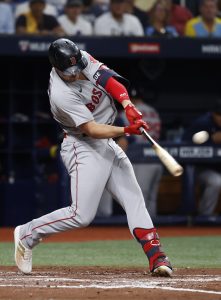
It’s an out-of-the-blue swap pulled off just minutes before the work stoppage. Renfroe, 30 next month, is coming off a solid season. Signed by the Red Sox to a $3.1MM guarantee last winter, the former first-round pick emerged as Boston’s primary right fielder. He tallied 572 plate appearances and hit .259/.315/.501 with 31 home runs. By measure of wRC+, Renfroe’s overall offensive output was 14 percentage points above the league average in 2021, tied for the highest mark of his career.
Renfroe rated as a league average defender by measure of Defensive Runs Saved. He tied for the league lead with 16 outfield assists, often showcasing a cannon of an arm that scouts have lauded since his days as a prospect. But both DRS and Statcast’s Outs Above Average pegged his range as a bit below average, with the overall glovework coming out fairly middle-of-the-road.
Even if he’s not likely to win a Gold Glove, Renfroe is a capable right fielder who figures to assume a similar everyday role in Milwaukee. The Brewers lost Avisaíl García to the Marlins in free agency and seemed likely to rely on some combination of Bradley and Tyrone Taylor in right field. Each of Renfroe or Taylor could now spell veteran Lorenzo Cain in center field in the case of rest days or injury for the 35-year-old.
Renfroe steps in to upgrade that mix and add some punch to a Milwaukee lineup that ranked just 17th in slugging percentage this past season despite playing its home games in one of the league’s more hitter-friendly environments. He remains controllable via arbitration through the end of the 2023 season (barring changes to the service time structure in the next collective bargaining agreement). He’s projected by MLBTR contributor Matt Swartz for a $7.6MM salary in 2022.
That’s a bit cheaper than Bradley, who will play next season on a $9.5MM deal after exercising a player option last month. Renfroe’s also coming off a far superior showing, as Bradley had a nightmarish 2021 campaign at the plate. Milwaukee signed Bradley to a two-year guarantee last offseason, but he managed only a .163/.236/.261 mark over his 428 plate appearances with the Brew Crew.
By measure of wRC+, Bradley’s offensive numbers were an astounding 65 points below league average. That ranked last among the 262 hitters with 300+ trips to the plate, with essentially nothing going right for Bradley offensively. His strikeout rate spiked to a career-high 30.8%, while his walk percentage dipped to a personal-low 6.5%. Bradley’s six home runs marked his lowest total in seven years, as did his .095 ISO (slugging minus batting average).
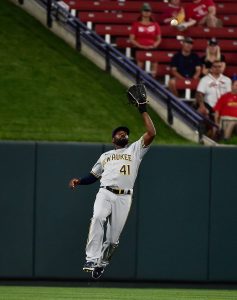
To his credit, Bradley continued to play his typical brand of excellent defense. The former Gold Glove winner rated as twelve runs above average over his 915 1/3 innings on the grass. Statcast, meanwhile, estimated he was worth four Outs Above Average. Yet even a gloveman as excellent as Bradley isn’t providing much overall value with an offensive showing as poor as he had in 2021.
It’s not especially surprising the Milwaukee front office was looking for opportunities to upgrade over Bradley’s spot in the lineup, and they found one via his old team. While the Brewers will add an offensive upgrade, the Red Sox bring Bradley back to Boston in hopes that a return to that environment can unlock some of his prior production. Bradley was a fan favorite and generally strong player over nearly a decade with the Red Sox, first joining the organization as a supplemental first-round pick in 2010.
Bradley became an important member of the Sox’s lineup by 2014, spending most of the next seven seasons as a regular. His highlight-reel defense in center endeared him to the Boston faithful, and the left-handed hitter occasionally flashed potential on offense. His final season with the Red Sox was one of his best, as Bradley hit .283/.364/.450 with seven homers and five steals across 217 plate appearances during the truncated 2020 campaign.
The Boston front office will take a shot on a rebound at the plate while presumably installing Bradley back into the center field mix. Doing so would free up utilityman Enrique Hernández to play second base more frequently, with Alex Verdugo and top prospect Jarren Duran flanking Bradley on the corners. Of course, the Sox could look for future additions to the position player mix, with a right-handed hitting outfielder capable of complementing the lefty-swinging trio of Verdugo, Bradley and Duran standing out as an obvious fit.
Bradley’s contract also contains a $12MM mutual option for 2023 that comes with an $8MM buyout. The Red Sox are assuming a decent chunk of guaranteed money down the line in order to acquire a pair of fairly well-regarded young position players. Each of Hamilton and Binelas was ranked by Baseball America among Milwaukee’s top 20 prospects midseason.
Hamilton, 24, was an eighth-rounder of the University of Texas in 2019. He sat out that season recovering from an Achilles rupture he’d suffered during his junior year with the Longhorns, and last year’s canceled minor league campaign meant he didn’t play in affiliated ball until 2021. The left-handed hitter split his time between High-A and Double-A, hitting .259/.341/.419 with eight homers and 52 stolen bases across 459 plate appearances. Unsurprisingly given that impressive steal tally, the 5’10” middle infielder draws strong marks from scouts for his speed and athleticism, in addition to a sound approach at the plate.
Binelas, 21, was the Brewers’ third-round pick in last summer’s draft. Regarded as a potential first round talent entering his final season at the University of Louisville, he slumped through a down year that dealt a blow to his stock. The left-handed hitter did his best to put that behind him over a brief showing in Low-A after draft day, though, hitting .314/.379/.636 with nine homers in 132 trips to the plate.
A corner infielder, Binelas spent the bulk of his time in college and in the minors at third base. BA suggested midseason it looked unlikely he’d stick at the hot corner and projected his future lying at first or perhaps in left field. Binelas will need to hit to carry that profile, but he’s flashed power, plate discipline and bat-to-ball skills in the past. His strong showing in Low-A — while somewhat to be expected for a player drafted out of one of the top conferences in college baseball — is a strong start in that regard.
Altogether, it’s a fascinating deal — likely the final swap we’ll see for quite some time with a transaction freeze now in place. The Brewers lock in a much-needed lineup upgrade to replace a player they lost on the open market. The Red Sox improve a spotty team defense while bringing back a player who’s had plenty of success in their uniform in years past, taking on a fair bit of long-term money to also add some younger talent to the organization.
Images courtesy of USA Today Sports.
Red Sox Sign James Paxton
The Red Sox continue to bolster their rotation, announcing agreement on a deal with James Paxton. It’s a one-year guarantee that also contains a club option that covers both the 2023-24 seasons. According to reports, Paxton will receive a $6MM salary in 2022. After next season, the club can choose to exercise a pair of options valued at $13MM apiece for the following two campaigns. If the team declines their end of the deal, Paxton would have the right to exercise a $4MM player option for 2023. Altogether, it’s a $10MM guarantee for the Boras Corporation client that could pay him $32MM if the team exercises the options.
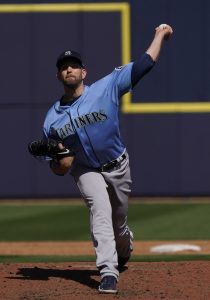
Paxton is coming off a pair of lost seasons. Injuries limited him to five starts in 2020, his final campaign with the Yankees. The Mariners brought Paxton back on a buy-low $8.5MM guarantee. Unfortunately, the big southpaw blew out his elbow in the second inning of his first start of 2021. He underwent Tommy John surgery in April, the second such procedure of his career.
It’s not known when Paxton will be ready to return, but he’s almost certain to begin next season on the injured list. Tommy John procedures typically require a twelve to fourteen month recovery. That general area would seem to suggest a mid-summer return for Paxton, although it’s not clear precisely where he stands in recovery.
The Sox are surely hoping Paxton will be able to contribute at some point down the stretch next season, with the power lefty ideally serving as a boost to a potential playoff run. At his best, the Canadian hurler is certainly capable of being an impact member of a club’s rotation. Paxton pitched to a 3.54 ERA over 447 innings between 2017-19, striking out a massive 30.1% of batters faced while walking only 7.3% of opponents. That’s the kind of hurler to whom teams would feel comfortable giving playoff starts, and the Boston front office is rolling the dice on him regaining some of that form.
Were Paxton to pick up where he left off in 2019, he could be a long-term play for the Red Sox. Boston picks up some additional upside in the form of the option, a two-year consideration they’ll have to decide upon next winter. It’s a single provision that, if exercised, would guarantee Paxton’s salaries for both 2023 and 2024.
It’s a risk/reward play for chief baseball officer Chaim Bloom and his staff. Boston’s incumbent rotation already looked to be one of the higher-variance units around the league. Chris Sale and Nathan Eovaldi have both looked like top-of-the-rotation arms at their best — Sale’s one of the best pitchers of this generation, of course — but come with questions about their health. Nick Pivetta has huge stuff but a spotty track record at the big league level. Tanner Houck and Garrett Whitlock both impressed in 2021 but come with starter/relief questions. Paxton’s addition further raises that group’s ceiling, but he’s not the kind of reliable innings-eating type one could argue Boston still needs as a stabilizer.
Chad Dey of Sportsnet first reported Paxton was in agreement with the Red Sox. Jeff Passan of ESPN was first with the $10MM guarantee, as well as the presence of the 2023-24 club option. Alex Speier of the Boston Globe reported the option could bring the value of the deal as high as $35MM. Chris Cotillo of MassLive reported the presence of the player option and specific terms.
Image courtesy of USA Today Sports.
Red Sox Sign Rich Hill
The Red Sox announced Wednesday that they’ve signed veteran starter Rich Hill to a one-year contract. It’s reportedly a $5MM guarantee that contains up to $3MM more in incentives based on innings pitched. Hill is a client of ACES.
This is remarkably the seventh different contract Hill has signed with the Red Sox. Between various stints, he’s suited up for the Sox in parts of four seasons. After pitching for Boston from 2010-12, Hill returned for a late-season cameo in 2015. That four-start stretch kicked off the remarkable late-career renaissance he has put together over the past six years.
Hill’s showing with the Red Sox earned him a rotation job in Oakland the following season. After continuing to thrive with the A’s, he landed with the Dodgers at the 2016 trade deadline. Hill re-signed with L.A. that winter, ultimately spending the next three seasons in Dodger blue. He has bounced between the Twins, Rays and Mets over the past two years.
Things will come full circle as Hill returns to Boston for his age-42 campaign. It’ll be his 18th year logging at least some major league action, a testament to his incredible longevity and persistence. Of course, that he keeps landing big league opportunities is just as much a reflection of his continued productivity.
Hill hasn’t posted an ERA above 4.00 since his 2016 breakout. This past season’s 3.86 mark was his highest in that time, but Hill also shouldered his heaviest workload in fourteen years. Between Tampa Bay and New York, the southpaw tallied 158 2/3 frames over 32 appearances (31 starts), a top 50 total league-wide. He did so with roughly average strikeout and walk numbers (22.7% and 8.3%, respectively).
Boston has now added three potential rotation arms on one-year guarantees this winter. The Sox signed Michael Wacha for $7MM and are reportedly in agreement with James Paxton on a $10MM guarantee that contains a 2023-24 club option. They join an incumbent group led by Chris Sale, Nathan Eovaldi and Nick Pivetta. Tanner Houck and Garrett Whitlock could be options for either the rotation or the bullpen as well, giving the front office and manager Alex Cora plenty of moving pieces with which to construct a staff.
Alex Speier of the Boston Globe first reported the Red Sox and Hill were in agreement on a one-year deal. Ken Rosenthal of the Athletic reported the $5MM guarantee and possible incentives.
Red Sox Avoid Arbitration With Kevin Plawecki
The Red Sox announced that catcher Kevin Plawecki has agreed to a new contract for the 2022 season, thus avoiding salary arbitration. The Boston Globe’s Alex Speier reports that Plawecki signed for $2.25MM, which tops MLBTR’s projected for a $2MM salary in Plawecki’s final year of arb eligibility.
Entering his third season as Boston’s backup catcher, Plawecki has hit .305/.364/.414 over 262 plate appearances with the Red Sox, an unexpectedly big step up from the .636 OPS he posted over his first 978 PA and five Major League seasons with the Mets and Guardians. While Plawecki hit better than 2020 than in 2021, his bat helped prop up production from Boston’s catching position last season in the wake of a down year from starter Christian Vazquez. Baseball Prospectus‘ numbers rate Plawecki’s defense as pretty average across the board, while Fangraphs’ catching metrics give him -4 Defensive Runs Saved over his two years with the Sox.
Ryan Brasier also agreed to a deal with the Red Sox yesterday, so Boston has six players remaining (Rafael Devers, Hunter Renfroe, Nick Pivetta, Alex Verdugo, Christian Arroyo, and Josh Taylor) left on its list of arbitration eligibles.
Tender Deadline Signings: 11/30/21
With the deadline to tender contracts to arbitration-eligible players looming tonight at 8pm ET — the MLBPA and MLB jointly agreed to move the deadline up a couple days due to the looming expiration of the collective bargaining agreement — we’ll likely see a slew of arbitration-eligible players signing one-year deals.
It’s commonplace for a large batch of players to sign deals in the hours leading up to the tender deadline. “Pre-tender” deals of this nature often fall shy of projections due to the fact that teams use the looming threat of a non-tender to enhance their leverage. Arbitration contracts at this juncture are often take-it-or-leave-it propositions, with the “leave it” end of that arrangement resulting in the player being cut loose. Given the widely expected lockout, there could be more incentive than usual for borderline non-tender candidates to take those offers rather than being cast out into free agency just hours before a transaction freeze is implemented.
As a reminder, arbitration contracts are not fully guaranteed. In a typical year, a team can cut a player on an arb contract at any point before the halfway point in Spring Training and only be responsible for 30 days’ termination pay (about one-sixth of the contract). Releasing a player in the second half of Spring Training bumps the termination pay to 45 days of his prorated salary.
MLBTR contributor Matt Swartz projected salaries for each team’s arbitration-eligible players last month, although for many of the players listed below, this isn’t so much avoiding arbitration as it is avoiding a non-tender. Here’s a look at today’s agreements…
- The Yankees have agreed to deals with infielder Gio Urshela and right-hander Domingo German, reports Mark Feinsand of MLB.com (Twitter links). Urshela will make $6.55MM, while German has agreed to a $1.75MM deal. Urshela has two seasons of control remaining; German is controllable for three years. Urshela is coming off a .267/.301/.419 showing while playing third base and shortstop. German tossed 98 1/3 innings of 4.58 ERA ball.
- The Twins have signed three arbitration-eligible pitchers, per reports from Feinsand and Darren Wolfson of SKOR North (on Twitter). Right-hander Jharel Cotton signed for $700K, reliever Caleb Thielbar lands $1.3MM and reliever Tyler Duffey signs for $3.8MM. Thielbar and Duffey were both productive members of the Minnesota relief corps in 2021. Cotton was recently claimed off waivers from the Rangers.
- The Giants have agreed to terms with outfielder Austin Slater on a $1.85MM deal, reports Ken Rosenthal of the Athletic (Twitter link). The 28-year-old (29 next month) appeared at all three spots on the grass while hitting .241/.320/.423 over 306 plate appearances in 2021.
- Reliever Emilio Pagan and the Padres have agreed on a $2.3MM deal, reports Rosenthal (on Twitter). The 30-year-old worked 63 1/3 innings of 4.83 ERA/3.93 SIERA ball this past season.
- The Diamondbacks agreed to a $2MM deal with left-hander Caleb Smith, reports Zach Buchanan of the Athletic (via Twitter). The 30-year-old posted a 4.83 ERA/4.68 SIERA across 113 2/3 innings in a swing capacity in 2021.
American League Non-Tenders: 11/30/21
The deadline to tender contracts to arbitration-eligible players has come and gone. The Tigers’ decision to non-tender Matthew Boyd — more on that here — represents the most prominent name cast into free agency tonight, but here’s a quick rundown of the rest of the non-tenders in the American League.
Note that MLBTR’s Anthony Franco also has a rundown of this year’s National League non-tenders, and MLBTR contributor Matt Swartz published his annual projected arbitration salaries earlier this offseason.
Onto the transactions…
- Outfielder Tim Locastro was non-tendered by the Red Sox, the team announced. The speedy HBP-magnet was claimed off waivers from the Yankees earlier this month after an injury-marred season. He is likely to be an in-demand depth option for teams if his ACL tear recovery goes well.
- The Rangers announced that outfielder Billy McKinney and catchers David Garcia and Yohel Pozo were non-tendered. Texas also assigned outfielder DJ Peters outright to Triple-A Salt Lake after he went unclaimed on waivers.
- The Royals non-tendered lefty Richard Lovelady, per a club announcement. Lovelady underwent Tommy John surgery late in the 2021 season and is expected to be sidelined for the entirety of the 2022 season.
- The Twins non-tendered right-hander Juan Minaya, left-hander Danny Coulombe and right-hander Trevor Megill, per a team announcement. Megill’s non-tender is particularly curious, as he was only just claimed off waivers a few hours ago and was not arbitration-eligible. Presumably, the team will try to quickly re-sign him to a minor league pact and bring him to Spring Training as a depth piece.
- Infielder Phil Gosselin has been non-tendered by the Angels, per an announcement from the team. The journeyman saw a career-high 373 plate appearances in 2021, but is unlikely to challenge that number next year owing to below average offensive and defensive metrics.