
Catching Notes: Perez, Royals, Maldonado, Murphy, Red Sox
The Royals have insurance on their five-year, $52MM contract with Salvador Perez, Jon Heyman of MLB Network reports (via Twitter). Specific terms of the policy aren’t clear, though the insurance policy is “believed” to kick in after 90 games. Kansas City will play its 90th game of the season on July 6 this year, after which point Perez will be owed approximately $4.57MM of his $10MM salary through season’s end. That doesn’t necessarily mean they’ll recoup that entire sum, as specific payments will be dependent on the terms of their policy. (The Mets’ insurance policy on David Wright, for instance, paid the team 75 percent of his salary based on days spent on the 60-day disabled list.) While the loss of Perez stings for the Royals on multiple levels, it seems they’ll at the very least be able to recover a few million dollars in salary, which could conceivably be used to pursue a replacement. Kansas City has been in talks with Martin Maldonado, who switched representation yesterday.
A couple more notes pertaining to the catching market…
- The Astros, according to ESPN’s Buster Olney (via Twitter), made Maldonado a two-year offer at the beginning of the offseason. Whether the annual salary that accompanied that offer was deemed insufficient or whether then-agent Scott Boras sought a lengthier pact, turning down the offer does not appear to have been a prudent decision. Of course, such proclamations are easy to make with the benefit of hindsight, and it was surely a far more difficult decision at the time. Many clubs — the Astros, White Sox, Rockies, Phillies, Mets, Cubs, Braves and Dodgers among them — looked like viable on-paper fits for Maldonado and other catchers at the outset of free agency, so exploring the market for his services was only natural. Houston ultimately moved on, adding Robinson Chirinos on a one-year deal, while Maldonado remains unsigned having recently hired a new agent.
- Out-of-options Rockies catcher Tom Murphy is making a strong bid for a roster spot with his spring performance, writes Patrick Saunders of the Denver Post. Murphy is 5-for-16 with a pair of homers and two walks (against six strikeouts), but beyond the raw, small sample of stats he’s posted to date, he’s impressed manager Bud Black with an improved all-around game. “I think ‘Murph’ does a nice job of game-calling,” said Black. “…the whole aspect of his game is much improved over what we saw two years ago and that’s a tribute to ‘Murph.’” Murphy, 28 next month, once sat on the back end of Baseball America’s Top 100 prospects list (2015-16 offseason) but has yet to establish himself. He’s now fighting for a roster spot against veteran Chris Iannetta and a strong defender but light hitter, Tony Wolters.
- In his latest Opening Day roster projection for the Red Sox, Ian Browne of MLB.com predicts that Christian Vazquez and Blake Swihart will make the roster. That’d leave Sandy Leon as the odd man out, forcing either a trade or a DFA of the defensive-minded veteran. Leon, Browne notes, is arguably the best defender of the bunch and could be a logical fit for the Royals. Swihart, meanwhile, has greater trade value given his former prospect status, upside with the bat and remaining team control. Leon avoided arbitration by agreeing to a one-year deal worth $2.475MM (a partially guaranteed sum that’d become fully guaranteed on Opening Day). He hit just .177/.232/.279 in 288 plate appearances last year but was vastly better in 2016-17. Swihart, meanwhile, is controlled through 2022 and is earning $910K as a first-time arbitration-eligible Super Two player. His .229/.285/.328 line in 207 PAs last year wasn’t much to look at, either, though his playing time was sparse and he’s long been touted for his offensive potential.
Steven Wright Suspended 80 Games For PED Violation
Red Sox right-hander Steven Wright has been suspended 80 games, without pay, after testing positive for Growth Hormone Releasing Peptide 2 (GHRP-2), the league announced Wednesday. He’ll be placed on the restricted list — thus freeing a 40-man roster spot for the Red Sox — and miss the first half of the season. Wright will also be ineligible to participate in the 2019 postseason. The Red Sox organization has issued the following statement:
The Boston Red Sox fully support Major League Baseball’s Joint Drug Prevention and Treatment Program and its efforts to eliminate performance-enhancing substances from the game. While we are disappointed by the news of this violation, we will look to provide the appropriate support to Steven at this time. Going forward, the club will not comment further on the matter.
This’ll be the second straight season in which Wright will be suspended for off-field actions, as he served a 15-game suspension under the league’s domestic abuse policy in 2018, as well. MassLive.com’s Chris Cotillo tweets that Wright tested positive in the offseason and appealed the suspension, though he only learned the result of his appeal last night.
Wright agreed to a $1.375MM salary for the 2019 campaign this winter, avoiding arbitration, and will forfeit approximately half of that sum as a result of the PED infraction. As is the case in virtually every PED suspension, Wright issued a statement via the MLBPA expressing bewilderment and claiming that he’s “never intentionally ingested anything for performance-enhancing purposes.”
The loss of Wright will further thin out a Red Sox bullpen that has already lost Joe Kelly to the Dodgers via free agency (three years, $25MM) and seems quite likely to go without yet-unsigned free agent Craig Kimbrel as well. Wright, a knuckleballer, worked to a stellar 2.68 ERA with 7.0 K/9 against 4.4 BB/9 in 53 2/3 innings of relief last season, though his season was shortened not only by the aforementioned domestic violence suspension but also a pair of DL stints pertaining to inflammation in his left knee.
Wright’s suspension will nominally nudge the Red Sox a bit further from the top luxury tax line — though by nowhere near enough that it’d prompt the team to make a significant bullpen expenditure. Boston sat roughly $4.7MM south of that $246MM barrier, so Wright’s suspension will push the team closer to $5.4MM shy of the top penalty bracket. Factoring in the tax they were paying on that salary, the suspension will cut about $980K, although they’ll of course have to replace Wright in the ‘pen in some capacity — likely with a league-minimum earner.
Chris Sale, Red Sox “Mutually Invested” In Extension Talks
Veteran southpaw Chris Sale discussed the possibility of reaching an extension with the Red Sox in an interesting chat with Alex Speier of the Boston Globe. The club has previously acknowledged some discussions, but Sale’s comments seemingly take things a bit further.
Sale suggests that there is a serious effort to work out an agreement.“I think we’re both mutually invested in this,” he said. “We’ve both said on both sides that it’s a possibility, for sure.”
He also indicated that he doesn’t consider a deal a necessity. “Obviously, this go-round is a little different than the last one with the contract situation,” Sale said in reference to his original contract extension. Sale says his family’s financial security was a driving force in that accord, but now affords him flexibility in deciding upon his next contract.
It’s still unclear what sort of structure is being considered — “we have a couple different scenarios,” Sale says — but the potential CBA tax impact will surely weigh heavily from the team’s perspective. It’s less clear just what will drive Sale when the time comes to make a final decision. While he indicates that he’s much more concerned with competing on the field than in the hot stove marketplace, he has previously made clear he does have a desire to “set the bar” for other players. Those looking to understand Sale’s perspective will certainly want to give Speier’s interview a full read.
[RELATED: Valuing A Chris Sale Extension]
It’ll be interesting to see where the sides land, if indeed a deal is hammered out. If not, Sale will enter the 2019 season as one of the most closely watched players on the planet. He paces a stacked group of starters in MLBTR’s initial power ranking of the top 2019-20 free agents.
Quick Hits: Free Agents, Andujar, Conley, Brasier, Cubs
Three of the six biggest contracts in baseball history have been signed within the last two weeks, as Bryce Harper, Manny Machado, and (in an extension) Nolan Arenado all inked major deals. This flurry of spending comes on the heels of a second straight winter of closed free agent activity, however, leaving the players’ union still more concerned with the scads of non-superstars who have yet to find work, Bleacher Report’s Scott Miller writes. “Ultimately, it is about more than [a few players]; it’s the big picture,” Cardinals reliever Andrew Miller said. “And even guys getting deals that they’re happy with, the timing of it, in the past it used to be maybe a couple of guys played the long game [in negotiations], but now it seems like guys have no choice. The stories we hear when guys show up to camp is that they had no offers. Teams said they’d check in, but they’re really not getting a firm offer or numbers exchanged until camp opens, and that’s a problem. Or, it’s at least new to us.”
Some more from around baseball as we kick off a new week…
- Miguel Andujar‘s huge rookie season was one reason the Yankees didn’t ardently pursue Machado, though now that Andujar has third base to himself, the New York Times’ James Wagner writes that the young slugger has been working to prove his defensive worth at the position. Andujar has been taking fielding training all winter, with particular focus on his footwork and throwing. There’s obviously quite a bit of room for improvement, as Andujar had far and away the worst UZR/150 (-24.5) and Defensive Runs Saved (-25) of any qualified third baseman in the sport last season. If Andujar can go from being a liability in the field to even just mediocre, it will give the Yankees all the more reason to keep his potent bat in the lineup as often as possible.
- A move to the bullpen in 2018 got Adam Conley‘s career back on track after he struggled as a starter the previous season, and as MLB.com’s Joe Frisaro writes, the new role has unlocked Conley’s velocity. Never considered a hard thrower as a starter, MLB.com’s Statcast credited the Marlins southpaw with an 89.7mph average velocity on his four-seam fastball in 2017. Last season, however, that same pitch clocked in at 95.2mph. Beyond just the natural velocity bump that comes with tossing shorter outings as a reliever, Conley also straightened out his mechanics. This led to some solid numbers (4.09 ERA, 2.78 K/BB rate, 8.9 K/9) over 50 2/3 IP out of Miami’s bullpen, though still with room for improvement, as Conley allowed a lot of hard contact. Still, it certainly seems like Conley could play a big role in a wide-open Marlins bullpen, perhaps even getting some looks in save situations.
- Ryan Brasier has begun throwing from 90 feet, Red Sox manager Alex Cora told MassLive.com’s Christopher Smith and other reporters, as Brasier continues to recover from a toe infection. The issue has slowed Brasier’s spring work, though the right-hander and potential closer candidate is expected to be ready for Opening Day.
- The Cubs bullpen doesn’t have a ton of questions as it relates to personnel, though there is still quite a bit of uncertainty surrounding the relief corps, as MLB.com’s Jordan Bastian explores five unanswered questions heading into the season. Brandon Kintzler and Brian Duensing, for instance, seem to have jobs locked up, though are looking to rebound after subpar 2018 seasons. It also still isn’t clear who will win the eighth bullpen spot, as Tyler Chatwood (another pitcher who struggled last year) could still end up in a relief role if the rotation doesn’t suffer any injuries.
AL East Notes: Rays, Kimbrel, Red Sox, Pedroia
As a team with neither a proven closer nor much money on its books, the Rays theoretically make sense for free agent Craig Kimbrel, the premier reliever on the open market. Reigning American League Cy Young winner Blake Snell agrees, having lobbied the Rays to sign Kimbrel, according to Marc Topkin of the Tampa Bay Times. However, officials from the low-budget Rays “have seemed adamant” that they’re not planning to pursue Kimbrel, Topkin writes. On whether Kimbrel would be worth it for Tampa Bay, Snell said: “I think so; I don’t know what they’re thinking. I’m pushing money. I want us to push as much as we’re able to. As much as we can get rid of, let’s go dump it into his hands.’’ Despite Snell’s hope that the Rays will splurge on Kimbrel, Topkin is careful to point out that the left-hander likes the team’s roster as is. Moreover, Snell’s not going to complain if the Rays don’t sign Kimbrel, Topkin adds.
Here’s more on Tampa Bay and one of its division rivals:
- Rays third baseman Matt Duffy is dealing with left hamstring tightness, though the club’s not “overly” concerned, according to manager Kevin Cash (via Topkin and Eduardo A. Encina). However, given that it has been an ongoing issue for Duffy this spring, it’s cause for wariness, Topkin and Encina observe. Duffy, 28, was one of the Rays’ most valuable position players in 2018, when he hit .294/.361/.366 and accounted for 2.4 fWAR over 560 plate appearances.
- Red Sox second baseman Dustin Pedroia will “most likely” make his spring debut next weekend if he gets through his workout unscathed this Monday, manager Alex Cora said Saturday (via Christopher Smith of MassLive.com). The workout will include “everything. Ground balls, hit, run, everything,” Cora revealed. Although the Red Sox won their third championship of Pedroia’s career last season, their success came without the 35-year-old, who only appeared in three games as he battled left knee problems.
- With a reunion appearing unlikely between Kimbrel and the Red Sox, whose bullpen looks like their weakest area, pitching coach Dana LeVangie & Co. are searching for hidden gems from within, Jen McAffrey of The Athletic details (subscription required). Specifically, the Red Sox are hoping to stumble on the next Ryan Brasier, a minor league addition a year ago who went on to enjoy a breakout season at the age of 30. During its bullpen bargain hunting this past offseason, Boston acquired one reliever via trade and another 10 on minors deals, notes McAffrey, who goes on to break down all of the 20 relievers who are currently in camp with the club.
Quick Hits: Borbon, Holt, BoSox, Wieters, Posey
Former Major League outfielder Julio Borbon announced his retirement today, via a post on his Instagram page thanking the many people who supported him throughout his 12 professional seasons. The Rangers chose Borbon with the 35th overall pick of the 2007 draft, and the University Of Tennessee product went on to amass 294 games and 878 plate appearances for the Rangers, Cubs, and Orioles in parts of five MLB seasons between 2009-16. Now that his playing career is over, Borbon is staying in the game as a coach in the Yankees organization. MLBTR wishes Borbon all the best in this new phase of his baseball career.
- Brock Holt is eligible for free agency after the 2019 season, but the Red Sox super-utilityman tells Michael Silverman of the Boston Herald that he “would love to stay here for the rest of my career — I’m happy here, my family’s happy here, I love everything about being a Boston Red Sox.” Holt’s versatility has made him an important depth piece for the Sox, capable of filling in at multiple positions and also providing some decent production at the plate; Holt’s .362 OBP and .411 slugging percentage last season were both career bests. There’s certainly value available for Boston in keeping Holt, and an extension would hardly break the bank (Holt is earning $3.575MM this season). The Red Sox have been discussing extensions with some higher-profile names this spring, which could explain why the team hasn’t yet approached Holt or his representatives about a new deal.
- The Cardinals were the only team that made Matt Wieters an offer this winter, MLB.com’s Jenifer Langosch tweets, which is why the veteran catcher signed on with St. Louis on a minor league deal. Wieters is far from the only veteran who had a tough time finding work in the quiet free agent market, and the former four-time All-Star’s value took a severe hit following three consecutive subpar years with the Orioles and Nationals. While Wieters had to settle for a non-guaranteed deal, he at least has a solid shot at winning the job as Yadier Molina‘s backup.
- Buster Posey appeared in his first Spring Training game today, catching three innings and generally looking in good condition following last August’s hip surgery. “It would have been nice to maybe ease into it a little bit but it was also nice to check off some more boxes, and we’ll see how my body responds tomorrow and Sunday. Overall I was really happy with the way it felt,” Posey told reporters, including Alex Pavlovic of NBC Sports Bay Area. Giants president of baseball operations Farhan Zaidi indicated earlier this month that the team would bring Posey along carefully in his recovery process, though the catcher seems to be making a case to appear in the Giants’ Opening Day lineup.
Dombrowski: Red Sox Unlikely To Sign Additional Relievers
The Red Sox’ bullpen has been a source of scrutiny among fans and pundits alike for much of the offseason, and it seems quite likely that thinking will continue heading into the season. President of baseball operations Dave Dombrowski told reporters prior to today’s Spring Training contest that he doesn’t expect to sign any free-agent relievers between now and Opening Day (link via Rob Bradford of WEEI).
“As far as signings are concerned I would say we’re through at this point,” Dombrowski said when asked about his bullpen. Dombrowski wouldn’t expressly rule out the possibility of changing course if something in Spring Training necessitated an addition, but he added that at the moment, the Sox “don’t have anything going on outside the organization.”
It’s been apparent for quite some time now that a reunion between the Red Sox and Craig Kimbrel is exceedingly unlikely — Dombrowski himself has hinted at that reality — but it’s still somewhat of a surprise to hear a fairly definitive statement indicating that the Sox are done adding. The free-agent market for relievers has largely been picked over, but there are still some interesting big league arms in the form of Bud Norris, Adam Warren and Tony Sipp, among others (as can be seen in MLBTR’s Free Agent Tracker).
Boston, as explored here recently, is within roughly $4.7MM of the top luxury tax penalty bracket, which would see their top draft pick reduced by 10 spots next year and would come with a 75 percent tax on any dollar spent above that line. Given that Spring Training games are already underway, though, it seems unlikely that any reliever other than Kimbrel would command enough money to push the Sox across that line. Then again, perhaps the Sox are simply confident that they’ll be able to make any upgrades they need on the trade market this summer and would prefer to leave a bit of flexibility for that possibility.
It’s also worth noting that Dombrowski didn’t rule out adding a reliever at all, so perhaps the Boston will be active on the waiver and trade markets this spring — although it’s unlikely that an intriguing reliever would fall all the way to the Sox, who have the lowest priority after winning an MLB-high 108 games last year. The Sox could make some fringe additions to the ‘pen in minor trades, though, as was the case back in November when they acquired Colten Brewer from the Padres. They’re also reportedly entertaining offers for their possible surplus of catchers, and it’s certainly feasible that they could add a big league bullpen asset by that measure.
[Related: Boston Red Sox depth chart]
Bradford writes that right-hander Matt Barnes is the early favorite for ninth-inning work with Boston this year, though he’ll have some competition from Ryan Brasier in that role. Beyond that pairing, the Sox will see what right-handers Brewer, Tyler Thornburg, Steven Wright, Brandon Workman, Hector Velazquez, Travis Lakins and Marcus Walden can bring to the table this spring. Lefty options include Brian Johnson, Bobby Poyner and Josh Taylor. As for minor league signees, the Sox brought Carson Smith back to the organization and also signed Zach Putnam, Brian Ellington and the recently un-banned Jenrry Mejia.
Quick Hits: JDM, Jose Martinez, Marwin, Padres
Red Sox slugger J.D. Martinez didn’t mince any words in his take on the slowed free agent market of the last two offseasons, describing the situation as “embarrassing for baseball” in comments to WEEI.com’s Rob Bradford. “You have a business. They say, ‘The market is down, the market is changing.’ The market is higher than it’s ever been,” Martinez said. “People are making more money than ever, and they’re trying to suppress it. It’s more of a race towards the bottom now than a race towards the top. You can go right now through everyone’s lineup and you already know who’s going to be in the playoffs. What’s the fun in that? We might as well just fast-forward to the end of the season.” Martinez had his own frustrating trip through free agency last winter, as it wasn’t until late February that he finally landed his current five-year, $110MM deal with the Sox. For the next round of collective bargaining agreement negotiations, Martinez feels the MLBPA needs to be better prepared to counter what Martinez feels is a lack of competitiveness (“Losing is incentivized now.“) from the majority of teams.
In other labor news, representatives from the players’ union will meet with Rangers, White Sox, and Dodgers players on Sunday, Evan Grant of the Dallas Morning News reports. MLBPA reps regularly make separate trips to visit every team during Spring Training, though three teams gathering en masse for a meeting is unusual. “It’s not hard to understand the symbolism: Players are prepared to show unity,” Grant writes.
Here’s more from around baseball…
- Rival evaluators were “greatly surprised” that Marwin Gonzalez couldn’t find a three-year contract, ESPN.com’s Buster Olney writes (subscription required), as the utilityman instead inked a two-year, $21MM deal with the Twins. Agent Scott Boras initially targeted a four-year deal worth around $60MM for his client, and while Gonzalez’s versatility drew interest from many teams, none were willing to approach that price. (MLBTR also predicted a four-year contract for Gonzalez, though only at $36MM.) Olney wonders if utilitymen like Gonzalez are better served by signing earlier rather than later when testing free agency, and Olney also suggested that a reunion between Gonzalez and the Astros could have materialized if Houston had realized the player’s market would be so limited. The Astros seemed to move on early from Gonzalez, acquiring Aledmys Diaz from the Blue Jays to serve in a utility role.
- Jose Martinez‘s two-year, $3.25MM extension was “something beyond a business decision” for the Cardinals, president of baseball operations John Mozeliak told reporters, including Rick Hummel of the St. Louis Post-Dispatch. The unusual deal only covers this season (a pre-arbitration year for Martinez) and the slugger’s first year of arbitration of eligibility, so there technically wasn’t any urgency on the team’s part to get a deal done. In fact, Martinez was the subject of trade rumors for much of the winter, both from MLB teams and in Japan. Not wanting to either sell Martinez to the Japanese team or deprive the player of some added financial security, the extension served as a means to satisfy both Martinez and the Cardinals. (Not to mention the clubhouse as a whole, as other Cardinals players were happy to hear that their popular teammate had a new contract.) For Martinez, he cashes in his first big professional payday, which he said will go to help his family in Venezuela.
- Manny Machado‘s ten-year, $300MM contract cracked a new spending threshold for the Padres, though as the San Diego Union-Tribune’s Bryce Miller writes, such an acquisition opens up new revenues pathways to account for that expenditure. Machado’s signing has already seen a $1MM boost in ticket sales, according to club chairman Ron Fowler, plus TV and radio ratings are expected to be on the rise. Being featured on national ESPN/FOX games, as well, provides a wider marketing opportunity for the Padres, as well as just gaining more general exposure to the broader public. Of course, the opportunity to create revenue is “all a product of winning,” Padres president of business operations Erik Greupner reminds. “With a player like Manny, there’s immediately a buzz and return on the business side. What’s more important for the long-term is what this translates to on the field.”
Quick Hits: Reds, Gray, Rangers, Red Sox, Porcello
The Reds rotation upgrades are the story of their winter, though impending free agency for Alex Wood and Tanner Roark means there’s not much time for this unit to gel. Their third big addition, Sonny Gray, is the most significant of the three if only because he immediately signed a three year, $30.5MM extension. Unfortunately, Reds fans will have to wait for Gray’s debut, as he was scratched from his start today with right elbow stiffness, per the Cincinnati Enquirer’s John Fay. Gray came to camp sore a couple days after throwing a bullpen session, but the hope is a little extra rest will get Gray right again. The team did not perform an MRI, and there’s no reason to suspect anything serious at this time. Time to check in on another couple of stories from around the league…
- Each January, the Rangers invite a select group of top pitching prospects for a week-long mini-camp with the major league staff in advance of Spring Training, per Evan Grant of the Dallas Morning News. This season, however, they sent an even smaller group of about ten pitchers to a “secret secondary-pitch intensive.” The camp takes place at Driveline Baseball, an increasingly ballyhooed research and development consultant founded by Kyle Boddy. Trevor Bauer is one noted client, as is a couple of potential feel-good stories of 2019, Kyle Zimmer of the Royals and the Cubs 37-year-old rookie Luke Hagerty. Among the Rangers sent to Driveline were bullpen hopefuls like C.D. Pelham, Brett Martin, Michael Matuella, Jason Bahr, Nick Snyder and Brady Feigl. The exact purpose of the camp remains unclear, and Jon Daniels and the Rangers have been none too keen to speak on the subject. Still, the Driveline story is one to track throughout the year, as we may be hearing more from the innovative research group.
- Rick Porcello is open to furthering his time with the Red Sox, but they have yet to approach him about an extension, per Rob Bradford of WEEI Sports Radio Network. Porcello excelled in 2016 when he was able to limit walks and home runs en route to winning 22 games and the AL Cy Young, despite a FIP of only 3.40. Now in the final year of the four year, $82.5MM deal signed before that season, Porcello’s market value is tricky to pinpoint. The Cy Young raises his profile, though he remains closer to a mid-rotation workhorse than a top-of-the-rotation ace. He has a career 4.02 FIP, but he’s also on a remarkable run of durability that makes him an outlier in this era – he has started between 27 and 33 games each season for ten years running. Porcello, 30, is likely not as high on the Red Sox priority list as Chris Sale, Mookie Betts, and Xander Bogaerts.
Valuing A Chris Sale Extension
As he closes in on his 30th birthday and the start of his tenth season of action in the big leagues, Chris Sale (through his reps at Jet Sports Management) is engaged in at least some level of discussion with the Red Sox regarding an extension. The upcoming season is the final year of control under the deal Sale originally signed with the White Sox, adding some impetus to discussions.
It’s a fascinating situation to consider, owing to a variety of considerations. From a narrative perspective, the club’s whiff on Jon Lester years ago provides obvious fodder for comparisons. And an otherwise quiet winter from the defending World Series champs also makes for an intriguing backdrop.
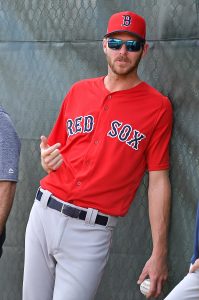
The really interesting part, though, is the valuation itself. Starting pitchers have found a fair bit of success at prying monster deals from clubs entering a walk year. Clayton Kershaw‘s original extension (seven years, $215MM plus opt-out) is the largest, but Stephen Strasburg‘s recent $175MM deal also makes for a notable recent data point. Both of those pitchers were more youthful than Sale, but Justin Verlander‘s second extension (which added five years and $140MM to his existing deal) was signed at a comparable age point (and two seasons in advance of his free agency).
That’s not to say that any of those particular deals really looks to be a perfect comp for Sale. Rather, they go to show that Sale can and should be looking for a contract that values his would-be free agent seasons at their anticipated market value.
On the other hand, there’s also no small amount of risk to be priced in here. That was the case with those other contracts, to be sure, but in this case the team will no doubt be particularly wary. After all, Sale missed five starts last year with still-mysterious shoulder issues. Though he’s said not to have exhibited structural problems, he showed some potentially worrisome velocity changes (with a correspondingly wandering release point) last year.
Both the team and Sale himself surely know quite a bit more than we do about his health. Certainly, his overall track record is one of excellent durability. While Sale’s funky delivery and big velocity readings have long led to predictions of physical ailments, he averaged 30 starts and 205 frames annually from 2012 through 2017.
Whatever the health risk may be relative to other pitchers, there’s little denying that Sale’s recent performance track record is quite free of red flags. All told, Sale has a 2.89 ERA in nearly 1500 career MLB innings and currently sits as the all-time leader in K/9 and K/BB ratio.
Importantly, too, he was in top form last year. Sale was deployed judiciously in the 2018 postseason but did record 24 strikeouts in 15 1/3 frames. Before that, he handled 158 regular-season innings, over which he allowed just 37 earned runs on 102 hits and 34 walks while racking up a whopping 237 strikeouts. When you smooth out the ups and downs in the radar readings, Sale threw harder overall last year than he ever has as a starter (95.7 mph average four-seamer). He also generated more swinging strikes than ever before (15.8%).
Those facts seem to distinguish Sale from Kershaw, who recently provided another notable contractual point to consider. The Dodger star’s new deal was hammered out in a near-open-market scenario, in the window before he had to decide whether to opt out of the final two years and $65MM of the aforementioned contract. The sides came up with a rather unique arrangement: three years, $93MM, with $12MM in total incentives that are achievable in full if Kershaw is at full health throughout the deal. Kershaw turns 31 in March, just before his new deal begins, so that contract covers almost the exact same age period as Sale’s next contract will. Not unlike Sale, Kershaw missed a few outings last year but still generated impressive results. Unlike Sale, Kershaw has exhibited more significant and long-lasting concerns in terms of his stuff and peripherals. The Dodger stalwart averaged 162 innings annually in the three seasons preceding his deal, with a series of back issues limiting his availability, tamping down his velocity, and reducing him from the game’s best pitcher to “merely” one of its best.
In the Kershaw scenario, it seems fair to say that the Dodgers mostly took a health discount by limiting the length of the commitment and including a hefty, easily achievable, but health-dependent incentives structure. It’s the kind of contract we might have expected, in the not-so-distant past, for an outstanding pitcher of an older age. That Kershaw took it at a relatively youthful stage is testament both to the level of concern with his long-term outlook and perhaps also the newfound market commitment of many teams to avoid obligating payroll space too far into the future (particularly for players in their mid-30s).
It seems easy to say that Sale won’t need to settle for the Kershaw deal to get something done. The latter has had the more impressive overall career, but his recent red flags are impossible to ignore. Still, it’s an interesting general scenario to contemplate when imagining what a deal could look like.
How’s it look for players who hit free agency under more favorable circumstances? The approach long has been to chase the biggest and lengthiest deal on the open market. David Price ($217MM) and Max Scherzer ($210MM) were each a bit younger when they secured their seven-year mega-deals — both turned 31 during the first seasons of their new contracts — than Sale will be when he hits the open market. Zack Greinke, the only other pitcher to top $200MM, turned 32 just before reaching free agency, so he was a fair bit older. He got six years and $206.5MM, easily setting a Major League record (which he still holds) with an average annual value north of $34MM.
There’s little question that Sale could position himself for massive earnings in the 2019-20 offseason with a performance that mirrors his 2018 in quality and his prior career in durability. Sale could be joined by some big names on the open market, but he almost surely possesses the greatest earning upside of any possible free-agent starter. Price’s total guarantee and Greinke’s AAV marks both seem theoretically achievable, though it’s arguable whether that kind of coin will still be available in today’s market. Even if we could accurately gauge Sale’s true earning ceiling, which would depend upon quite a few market factors, reaching it represents only one of several conceivable scenarios. With something less than full health, or declines in velocity and/or effectiveness, Sale’s earning power would obviously begin to slide.
So, where might we anticipate the price tag landing in extension talks? Sale will earn $15MM in 2019 regardless of any new deal, so we’ll consider only the future seasons. Presumably, the Red Sox will look for some kind of discount (in salary, years, or both) to account for the health uncertainty — both that of any pitcher separated from free agency by a full season and whatever added questions come with Sale. Might the Boston organization seek to cabin the length of the contract? Or would it be amenable to a lengthier deal that spreads the guarantee over a longer span, thus reducing the annual luxury tax hit? And what about Sale’s own preferences?
Supposing the Sox are willing to go to Greinke levels on the AAV but not on the term, it’s possible to imagine a five-year extension in the range of $175MM. That figure would also match the recent Strasburg deal, albeit over a shorter duration (his was for seven years) — arguably a fair result for a more accomplished and consistent, but also less youthful starter. But is that really the most sensible approach? Perhaps the team would rather stretch things out, even if it means committing to additional seasons. Adding six years at $190MM would not greatly expand the Red Sox’ overall commitment. For one thing, it’s reasonable to anticipate that Sale will still be a useful-enough pitcher at the end of that deal to warrant his salary. There’s a risk he won’t be, certainly, but there’s also real upside (see, e.g., Verlander) as well as the promise of continued inflation driving down the effective price.
Interestingly, the club’s luxury tax situation also increases the value of spreading the AAV. Let’s do a bit of math to see how this looks. Sale’s original extension, signed before the 2013 season, will have paid him a total of $59MM over seven seasons, but option years are treated as one-off seasons for purposes of the competitive balance tax calculation. That means that Sale’s hit to the Sox’ books this year will be his current salary of $15MM. Modifying his forward-looking contract rights, though, would change that number by adding the new years and dollars and then re-running the AAV. As MLBTR’s Steve Adams examined recently with regard to a hypothetical re-signing of Craig Kimbrel, any new money added to the Boston luxury ledger is going to be taxed at a hefty rate. A new deal for Sale would not only trigger a drop in draft placement but would also mean a big tax bill increase. You can find the details there; for our purposes, since a new deal would certainly be of sufficient magnitude to push the club into the top tax bracket, the Red Sox would pay 75 cents for every additional dollar of AAV they take on. And that’s just for the 2019 season. If the organization continues to exceed the luxury line, it’ll keep getting hit with bills — every one of which will be impacted by Sale’s AAV.
It’s not hard to see how adding a season or even two at a relatively lesser salary might begin to make sense, particularly when one includes the concept of the time-value of money. Here are a few scenarios to kick around (all dollars in millions):
| Extension Years | Extension Money | Extension AAV | Cumulative AAV | 2019 Tax Increase |
| 5 | $150 | $30.00 | $27.50 | $7.83 |
| 5 | $175 | $35.00 | $31.67 | $10.96 |
| 6 | $160 | $26.67 | $25.00 | $5.96 |
| 6 | $180 | $30.00 | $27.86 | $8.10 |
| 6 | $192 | $32.00 | $29.57 | $9.39 |
| 6 | $207 | $34.42 | $31.64 | $10.94 |
| 7 | $175 | $25.00 | $23.75 | $5.02 |
| 7 | $200 | $28.57 | $26.88 | $7.37 |
| 7 | $217 | $31.00 | $29.00 | $8.96 |
These are, of course, largely random price points (some of which connect to contract comps noted above, others of which are simply round numbers). But they serve to show how much cash the Red Sox could in theory be forced to take on right now if they really want to avoid paying Sale past his mid-30s. That hit, as noted already, would potentially be repeated in future seasons in which the club nears or passes the luxury line. Those considerations may well factor into the organization’s approach, whatever level of health-related discount is deemed necessary to make a contract appealing.
If a lengthier, more spread-out deal might make greater sense for the ballclub, what about Sale? As my colleague Steve Adams reminded me, the southpaw hinted recently that he could go looking to set new high-water marks of some kind. As Sale put it: “You want to do right by the guys who are coming next year, two years, 10 years down the road because you kind of set the bar and the next guy who comes along either gets to that bar or sets it a little more.”
If he intends to raise the bar in an extension scenario, one full season removed from the open market, there’s no realistic way he’s going to top the line set by Price. Breaking the overall guarantee record (seven years, $217MM) would almost certainly mean pitching in 2019 before negotiating his next contract. On the other hand, Sale could take aim at Greinke’s AAV mark. In that case, though, it’s awfully tough to see the Red Sox making a commitment past five additional seasons (if they’re willing to make such a deal in the first place).
Perhaps Sale’s bar-raising sentiments shouldn’t be taken too literally. He no doubt appreciates that an extension situation necessarily involves other considerations (and lacks competitive bidding). A hurler of his age reaching the $200MM mark in new money, say, would represent a notable achievement even if it came with a relatively less-impressive AAV and didn’t really set any recognizable records. In terms of maximizing his own career earnings (without taking the risk of first pitching another season), there’s not a whole lot of downside to going for the biggest total guarantee possible at this stage, even if it effectively means taking a cheaper valuation for the last season or two of the new contract. Even if Sale were to hit the open market on the upswing in his later years — as may well occur next winter for Verlander — the additional earning ceiling at that point would be fairly limited, at least in terms of contract length.
If there’s a deal to be made here, then, the sweet spot could actually be on a longer term than might be anticipated at first glance. As the foregoing discussion shows, though, there’s also quite a lot for both sides to think about — and quite a lot we don’t know. The major wild card, perhaps, is the sides’ respective levels of concern with Sale’s shoulder. It’ll be fascinating to see how things proceed if Sale and the Red Sox end up making a concerted effort over the coming weeks to work out a deal.
Photo courtesy of USA Today Sports Images.