
Undrafted Free Agent Signings: 6/17/20
Here are the latest undrafted free agent signings from around the majors. Reminder: $20K is the maximum an unpicked player can receive this year…
- Lamar infielder J.C. Correa will sign with the Astros, according to Brian McTaggart of MLB.com. He’ll join his brother, star shortstop Carlos Correa, in the Houston organization. The Astros drafted J.C. Correa in 2018 (33rd round) and ’19 (38th), but he decided not to sign on those occasions because he wanted to earn his degree first. He slashed .315/.368/.469 and swatted 10 home runs over 304 plate appearances at Lamar.
- Indiana University outfielder Elijah Dunham announced Wednesday that he has signed with the Yankees. Dunham, who didn’t sign after the Pirates selected him in the 40th round in 2019, cracked the top 250 pre-draft rankings of ESPN’s Kiley McDaniel this year and checked in at No. 186 on Baseball America’s list. BA writes that Dunham carries a “balanced offensive profile in a corner outfield spot.”
- The Braves have added a local product in University of Georgia shortstop Cam Shepherd, Baseball America tweets. He was BA’s top available undrafted senior, and the outlet ranked him as the 298th-best prospect entering the draft. His stock has fallen in BA’s eyes from a year ago, though, as it had Shepherd as the 97th-rated pre-draft prospect then. The Rays took Shepherd in the 20th round in 2019, but he opted against signing.
- The Indians have signed Fresno State left-hander Jaime Arias for $20K, Paul Hoynes of cleveland.com tweets. Primarily a reliever in college, Arias pitched to a 3.56 ERA with 9.3 K/9 and 1.9 BB/9 in 139 innings.
- The Red Sox have added Grand Canyon University first baseman Cuba Bess, Pete Abraham of the Boston Globe reports. Bess slashed .313/.425/.517 with 12 home runs in 348 PA as a collegian.
- The Marlins have picked up Air Force outfielder Ashton Easley, per Craig Mish of Sports Grid. Easley was a .301/.364/.512 hitter with 17 homers across 619 PA in school. The club has also signed VCU infielder Brett Norwood, who batted .303/.425/.440 with seven HRs in 299 college PA.
- The Twins have inked UNC-Wilmington southpaw Zarion Sharpe, La Velle E. Neal III of the Star Tribune writes. Sharpe stayed in school despite going to the Cardinals in the 19th round a year ago, and he tossed 20 2/3 frames of 2.18 ERA ball with 8.7 K/9 against 3.5 BB/9 this season.
Undrafted Free Agent Signings: 6/16/20
This year’s five-round draft left a lot of deserving players looking for deals on the open market. Here’s a roundup of some of the many recent undrafted players who have reached agreements with MLB organizations:
- White Sox (link)
- Ty Madrigal, LHP, St. Mary’s
- Rangers (link)
- Fernando Amaro, C, HS (PR)
- Nick Krauth, RHP, Connecticut
- DJ McCarty, RHP, HS (CA)
- Connor Sechler, RHP, Drury
- Brady Smith, C, Florida
- Colton Snyder, RHP, Concordia
- Josh Stephan, RHP, South Grand Prairie
- Mets (link)
- Austin Faith, RHP, Lamar
- Dylan Hall, RHP, Central Oklahoma
- Brandon McIlwain, OF, California
- Drake Nightengale, RHP, South Alabama
- Joe Suozzi, OF, Boston College
- Nationals (link)
- Jackson Coutts, 1B/OF, Rhode Island
- Gio Diaz, INF, Saint Mary’s
- Raymond Torres Jr., C, San Jacinto JC
- Astros (link)
- Peter Zimmermann, Missouri
- Cesar Gomez, Texas
- Jimmy Endersby, RHP, Concordia
- Justin Dirden, OF, Southeast Missouri State
- Kyle Gruller, RHP, Houston Baptist
- Jonathan Sprinkle, RHP, Central Missouri
- Zack Matthews, RHP, Oklahoma
- Cody Orr, OF, Tiffin
- Yankees (link)
- Carson Coleman, RHP, Kentucky
- Ocean Gabonia, RHP, Everett Community College
- Trevor Holloway, RHP, Central Florida
- Jarod Lessar, RHP, BYU
- Phillies (team announcement)
- Chase Antle, RHP, Coastal Carolina
- Jordan Fowler, LHP Central Missouri
- Jonathan Hughes, RHP, Georgia Tech
- Sam Jacobsak, RHP, Northeastern
- Jake McKenna, LHP, Ocean City HS (NJ)
- Noah Skirrow, RHP, Liberty University
- Billy Sullivan, RHP, Delaware
- JP Woodward, LHP, Lafayette College
- Orioles (link 1; link 2)
- Ryan Watson, RHP, Auburn
- JD Mundy, 1B, Radford
- Brandon Young, RHP, UL-Lafayette
- Thomas Girard, RHP, Duke
- Isaiah Kearns, RHP, Pitt-Johnstown
- Cubs (link)
- Matt Mervis, 1B/RHP, Duke
- Marlins (link)
- Antonio Velez, RHP, Florida State
- Cardinals (link)
- Jacob Buchberger, RHP, Davenport
- Matt Chamberlain, OF, New Haven HS (CT)
- Gianluca Dalatri, RHP, North Carolina
- Matt Koperniak, 3B/OF, Trinity
- Mac Lardner, LHP, Gonzaga
- Nick Raposo, C, Wheaton
- Omar Sanchez, LHP, B-You Prospects Academy (PR)
- Nick Trogrlic-Iverson, RHP, Gonzaga
- Indians (link)
- Joe Donovan, C, Michigan
- Twins (link)
- Lucas Sweany, LHP, University of the Pacific
- Allante Hall, C, Pensacola State JuCo
Team Plans For Signing Undrafted Amateurs
Now that MLB’s abbreviated 2020 draft is in the books, we can move along to the next phase of this one-off amateur signing season. Undrafted amateur players will now be free to sign with any team of their choosing, though they are capped with a signing bonus of $20K. Thus, the setup here presents a fascinating situation for amateur ballplayers and for us, those interested in parsing the ins-and-outs of roster-building. Here we have a unique situation where money will not necessarily be the driving factor for players choosing their first professional team. As players start to sign, we’ll likely hear stories that shed light on player perspective, which could paint an interesting picture of how young players view different franchises around baseball. For now, we’re starting to hear from teams themselves about spending limits for this class of amateur free agents. We’ll use this post to update those strategies as they trickle in…
- The Giants have no apparent limits when it comes to signing amateur free agents now that the draft is completed. John Shea of the San Francisco Chronicle provides a primer for this period of amateur free agents, writing, “The process starts at 6 a.m. Sunday, and the Giants will compete with the other 29 teams for the best available talent. But rather than outspending the others, all they can do is try to outsell them and offer appealing opportunities.” Given the Giants’ current position as a team looking to infuse as much young talent as possible, one would expect them to be aggressive in their attempts to add players from this pool. Obviously, more players than usual will be returning to college or committing to school as high school graduates, but given the volatility of the MLB draft under normal circumstances, it’s fair to expect a quality player or two to emerge from this pool of undrafted amateurs.
- The Marlins are planning on limiting their pool of undrafted amateur free agents to 10 signings or less, per Jordan McPherson of the Miami Herald (Twitter links). Along with their six drafted players, all of whom are expected to sign, the Marlins can expect an influx of 16 players max.
- Similarly, the Mariners don’t expect to go hog wild with this year’s class of undrafted amateur. Per MLB.com’s Corey Brock, the Mariners’ Scouting Director Scott Hunter said the Mariners will only be signing between five and ten amateur free agents.
- The Royals, meanwhile, are ready to shop, tweets Jeff Rosen of the Kansas City Star. The Royals could be big-time players in this sphere, as they’ve generated some goodwill recently because of their treatment of minor league players. Kansas City might not typically be a major free agent draw, but for amateur players, it’s a different story. The Royals have the opportunity and a long track record of highly valuing their own players. For players looking for their first professional contract, the Royals have a lot to offer. Among other things, they’re ready to be aggressive. GM Dayton Moore has the green light to “sign as many of those guys as we can,” per Lynn Worthy of the Kansas City Star.
Despite Recent Signings, Marlins Don’t Owe Much Beyond 2020
2020 salary terms still need to be hammered out. But what about what’s owed to players beyond that point? The near-term economic picture remains questionable at best. That’ll make teams all the more cautious with guaranteed future salaries.
Every organization has some amount of future cash committed to players, all of it done before the coronavirus pandemic swept the globe. There are several different ways to look at salaries; for instance, for purposes of calculating the luxury tax, the average annual value is the touchstone, with up-front bonuses spread over the life of the deal. For this exercise, we’ll focus on actual cash outlays that still have yet to be paid.
We’ll run through every team, with a big assist from the Cot’s Baseball Contracts database. Next up is the Marlins:
*Includes buyouts of club options over Miguel Rojas and Brandon Kintzler
(click to expand/view detail list)

Each NL Team’s Top Recent Draft Class
With the MLB draft scheduled for next week, let’s take a look at each National League team’s most successful draft class in recent memory. Using Baseball Reference’s draft tracker, we can sum the combined career bWAR of each player selected by each team in a given year. It’s a simple shorthand, not a perfect measure, but it’ll give some insight into which teams have really hit on their picks in certain years.
First, a quick note on the methodology. For simplicity, we’re limiting this search to the 2006-2015 classes. A player’s value is only included if he signed with the club, although he needn’t have actually played for his drafting team in the majors. (So, the 2008 Yankees don’t get credit for drafting but failing to sign Gerrit Cole, while the 2007 Red Sox do get credit for drafting and signing Anthony Rizzo, even though he was traded before ever playing an MLB game for Boston). Of course, a player drafted in 2006 has had more time to rack up value than one drafted in 2015, so we’ll note in each team’s capsule if a more recent class is on the verge of taking over from an older class. On to the results…
- Braves: 2007 (76.6 bWAR) – Hitting on Jason Heyward and Freddie Freeman in the first two rounds goes a long way. Heyward has been a disappointment with the Cubs but had some electrifying seasons in his early days in Atlanta (and his year in St. Louis), while Freeman has emerged as a fixture in the Braves’ lineup as one of the best hitters in baseball over the past decade.
- Brewers: 2009 (30.7 bWAR) – This was period of some underwhelming draft returns for Milwaukee. The 2009 class tops the list thanks to Khris Davis, Mike Fiers and Scooter Gennett, all of whom are better known for their play (or whistleblowing, in Fiers’ case) elsewhere.
- Cardinals: 2006 (56.3 bWAR) – By virtue of putting up baseball’s best record in 2005, the Cardinals sat at the back of every round in 2006. No matter, as they managed to find a handful of highly productive big leaguers. First-rounder Adam Ottavino didn’t work out in St. Louis but went on to a strong career as a reliever in Colorado. Tommy Pham (16th round) and Jon Jay (2nd round) have each carved out strong careers, while Allen Craig (8th round) had a brief but productive peak.
- Cubs: 2007 (54.4 bWAR) – Unfortunately for the Cubs, this class is almost all about Josh Donaldson, who did none of his damage in a Chicago uniform. Perhaps Javier Báez (2012 draft) or Kris Bryant (2013 draft) will match or exceed Donaldson’s stellar career in time.
- Diamondbacks: 2009 (73.1 bWAR) – Paul Goldschmidt (8th round) went on to become the top position player in franchise history. First-rounder AJ Pollock had a couple star-level seasons of his own before injuries knocked him off track, while Chase Anderson (9th round) has emerged as a solid back-of-the-rotation starter.
- Dodgers: 2006 (70.6 bWAR) – The Dodgers only signed two big leaguers from the 2006 class. When one of them goes on to become arguably the best pitcher of his generation, you can more than get away with it. Clayton Kershaw’s Hall of Fame plaque will boast at least three Cy Young Awards and an NL MVP.
- Giants: 2008 (65.6 bWAR) – The late-2000’s draft classes set up the crux of the Giants’ three World Series titles the first half of the next decade. None was more impactful than 2008, when SF grabbed Buster Posey and Brandon Crawford in the first and fourth rounds, respectively.
- Marlins: 2010 (56.1 bWAR) – Christian Yelich and J.T. Realmuto have matured into two of the best players in baseball, so the Marlins’ 2010 class (which also boasted late-blooming A’s slugger Mark Canha) has a chance to be really special. Of course, none of those players are still in Miami.
- Mets: 2010 (50.5 bWAR) – Seventh overall pick Matt Harvey was briefly the ace the Mets hoped they were adding in 2010. As it turns out, Jacob deGrom (9th round) had a lot more staying power atop their rotation.
- Nationals: 2009 (44.9 bWAR) – First overall pick Stephen Strasburg has more than made good on that selection, culminating in a World Series MVP effort in 2019. The 2009 class also brought in a handful of role players, including Drew Storen and Michael Taylor.
- Padres: 2007 (38.9 bWAR) – Another team for whom the top player simply got away, the crown jewel of the Padres’ 2007 class was Corey Kluber (4th round). Obviously, even San Diego didn’t him expect him to go on to win a pair of Cy Young Awards.
- Phillies: 2014 (24.2 bWAR) – There were some tough results for the Phillies on draft day in recent seasons, but 2014 looks to be a notable exception. Aaron Nola went seventh overall and has emerged as a high-level starter, while Rhys Hoskins (fifth round) looks like the Phils’ long-term answer at first base.
- Pirates: 2011 (29.7 bWAR) – The Pirates’ 2011 class is almost exclusively about the contributions of first overall pick Gerrit Cole, but he obviously reached his peak after being traded to Houston. Josh Bell (2nd round) looked to have turned the corner at the plate in the first half of 2019.
- Reds: 2007 (43.1 bWAR) – The Reds found three future everyday players in the 2007 class. Todd Frazier (supplemental first-round), Zack Cozart (2nd round) and Devin Mesoraco (1st round) all went on to become productive players in Cincinnati.
- Rockies: 2009 (47.4 bWAR) – The Rockies graduated six players from the 2009 class to the big leagues, although only one proved a smashing success. Finding a player of Nolan Arenado’s caliber in the second round makes for a great draft even if the rest of the players taken underwhelm.
Never On Top, But Still The Champs
The Washington Nationals have had more time than your average champ to take a bow after their World Series victory last October. Their win in Game Seven over the Astros more than seven months ago stands as the most recent non-exhibition game, and though Major League Baseball continues to bob and weave their way back to play amidst this pandemic, the Nats are still the champs until a new one is crowned. Luckily for baseball fans, Davey Martinez’s crew in Washington certainly made the most of their first World Series victory from a lore perspective. Their turnaround after starting 19-31 has been the most often trumpeted fact from their run to the top, but there are plenty more factoids that add flavor to the Nats’ first championship.
For example, as their Twitter account graciously reminds us, they’re “The Greatest Comeback Team In MLB History” after reversing an in-game deficit five times when facing elimination in the postseason. Then there’s Ryan Zimmerman hitting the first home run in their World Series history 15 years after the Nats made him the first-ever draft pick. Howie Kendrick certainly has a story to share, as does Stephen Strasburg, as does, believe it or not, Gerardo Parra, who bonded the clubhouse around – of all things – a South Korean children’s song.
They also became the first team to win a World Series via four road wins, they took out the Astros just weeks before news broke of the sign-stealing scandal, and they coined multiple slogans along the way, like “Stay In The Fight,” “Bumpy Roads Lead To Beautiful Places,” and “Go 1-0 Every Day.”
But despite the rings, the accolades, and the lore aplenty, there’s at least one thing the Nationals did not accomplish. The 2019 Nats became just the second team in the Wild Card Era to win the World Series without spending a single day in first place (2003 Marlins).
Of course, the introduction of the wild card in 1995 makes this fun fact possible. Since the single wild card was brought into play, we have 25 seasons of wild card history. Seven wild cards survived the gauntlet of the playoffs to win it all: 1997 Marlins, 2002 Angels, 2003 Marlins, 2004 Red Sox, 2011 Cardinals, 2014 Giants, 2019 Nationals (that’s it, right?). While the run in the early aughts gave the wild card some serious juju, the shine had worn off a bit in recent years. Still, each of the past two decades brought a 30% championship rate for wild card entrants.
Meanwhile, World Series champions on the whole over the past 25 years have spent an average of 95.88 games in first. Of course, we’re dealing with a small sample size here and a fairly large spread. A standard deviation of ~54 games means that roughly 95% of our champs should have spent somewhere between 41 and 150 games in first, meaning there really are many ways to skin this cat – especially since more than a quarter of World Series champs fell beyond those bounds (thanks a lot, sample size).
The 2016 Cubs came pretty close to running the table, leading the NL Central for 154 games before capping a season for the ages. They were outdone – White Sox fans will not be surprised to hear – by their crosstown rival. The White Sox were in first place for 161 games during the 2005 season before sweeping the Astros. They did, in fairness, share first place with the Tigers and Twins for (small) portions of the season. The ’02 Angels and ’97 Marlins, meanwhile, barely managed to escape our list by spending 12 and 11 days in first, respectively.
So while the Nationals had a season for the ages in 2019, there’s yet more for this team to accomplish (if/when play resumes for the 2020 season). The Braves would seem to rule the roost, but the Phillies held a share of the NL East lead for 60 days of the 2019 season, and the Mets took the top spot for a cool 14 days. The Marlins’ 105-loss season didn’t share a ton in common with the Nats’ by the end of the year, but this fact they shared: neither managed to lead the division for even a day.
Amateur Draft Notes: Torkelson, Wilcox, Mock Drafts
The first round of the 2020 amateur draft begins on June 10, and the growing feeling is that the Tigers will take Spencer Torkelson with the first overall pick. Torkelson comes into the draft on the heels of an outstanding college career, which Baseball America’s Teddy Cahill notes could have reached historic proportions had Torkelson’s 2020 campaign not been cut short by the COVID-19 pandemic. The young slugger had a shot at breaking the NCAA record for walks in a season, and Torkelson sat just two home runs away from setting a new Arizona State school record for career homers (a record held by longtime Braves third baseman Bob Horner). Though Torkelson will miss out on these individual accomplishments and a shot at being part of a potential national championship contender, his Arizona State tenure has already been the stuff of legend, especially considering that Torkelson came to the program on a relatively low profile after not being drafted by a Major League team when coming out of high school.
Some more on the draft…
- The NCAA’s decision to give an extra year of eligibility to spring sports will give at least some players extra signing leverage in this abbreviated five-round draft. As The Athletic’s David O’Brien (subscription required) writes, right-hander Cole Wilcox has the option of returning to the University of Georgia for a do-over of his sophomore year if doesn’t receive a signing bonus to his liking, which “some in the industry believe” is a “top-half-of-first-round” asking price. (So, in the neighborhood of $4MM, based on the recommended slot prices.) It isn’t out of the question that the hard-throwing Wilcox is selected within the top 15 anyway based on his strong track record at Georgia, though many prognosticators have the righty in the bottom half of the first round.
- Speaking of prognostication, let’s give into some mock draft action! The latest projections are up from The Athletic’s Keith Law (subscription required), Baseball America’s Carlos Collazo, and MLB Pipeline’s Jim Callis, and all have identical top threes: Torkelson to the Tigers, Vanderbilt’s Austin Martin to the Orioles with the second overall pick, and Texas A&M southpaw Asa Lacy to the Marlins third overall. Assuming Detroit does take Torkelson, the O’s are favored to select Martin or at least another position player — Collazo and Callis note that Baltimore could opt to take New Mexico State infielder Nick Gonzales, while Law has heard “rumblings” that Arkansas outfielder Heston Kjerstad could be the pick if the Orioles wanted to spread around their draft pool money.
- All three mock drafts are well worth a read, as Law, Collazo, and Callis share some reports and rumors about which prospects could be on various teams’ radars, and what particular teams may or may not be targeting on their draft boards. For instance, the Royals (who pick fourth overall) seem to be leaning towards picking a position player this after focusing on adding pitchers in recent drafts, which could lead them to Gonzales or Florida high school outfielder Zac Veen. Callis has K.C. taking Gonzales while Collazo and Law have the Royals taking Veen, with Law adding that he has “heard they’re cool on Gonzales.” Then again, a pitcher might not be out of the question either for Kansas City, as Collazo writes “lately, we’ve also heard Minnesota right-hander Max Meyer linked to this pick.” As for Wilcox’s placement, Callis projects the Mets (19th overall), Law projects the Nationals (22nd), and Collazo projects the Yankees (28th).
Which 15 Players Should The Marlins Protect In An Expansion Draft?
In a few weeks, we’ll be running a two-team mock expansion draft here at MLBTR – just for the fun of it! Currently, we’re creating 15-player protected lists for each of the existing 30 teams. You can catch up on the rules for player eligibility here.
The American League results are in! Click here to see who’s protected and who’s available for each AL team.
So far, we’ve covered the Braves, Cardinals, Pirates, Brewers, Reds, Cubs, Diamondbacks, Rockies, Dodgers, Padres, Giants, Rangers, Mariners, Athletics, Angels, Astros, Twins, Royals, Tigers, Indians, White Sox, Rays, Yankees, Red Sox, Blue Jays and Orioles. The Marlins are up next.
We’ll start by removing free agents Jonathan Villar, Matt Joyce, Francisco Cervelli, and Brandon Kintzler from consideration. Sixto Sanchez and Jesus Sanchez will make the protected list as Baseball America Top 100 prospects with 2020 ETAs. Here’s the initial protected list of ten players:
Sixto Sanchez
Jesus Sanchez
Brian Anderson
Sandy Alcantara
Miguel Rojas
Jorge Alfaro
Isan Diaz
Caleb Smith
Pablo Lopez
Jordan Yamamoto
That leaves five spots for the remaining 17 players. Check out contract statuses and team control here.
Jesus Aguilar
Jon Berti
Jeff Brigham
Lewis Brinson
Adam Conley
Garrett Cooper
Corey Dickerson
Robert Dugger
Yimi Garcia
Elieser Hernandez
Harold Ramirez
Magneuris Sierra
Ryne Stanek
Drew Steckenrider
Stephen Tarpley
Jose Urena
Chad Wallach
With that, we turn it over to the MLBTR readership! In the poll below (direct link here), select exactly five players you think the Marlins should protect in our upcoming mock expansion draft. Click here to view the results.
Latest On Furloughs, Pay Cuts Among MLB Clubs
6:09pm: The Rangers have committed to $400 a week for their minor leaguers through at least June, Levi Weaver of The Athletic was among those to report. The same goes for the Braves, per David O’Brien of The Athletic, as well as the Diamondbacks, Nick Piecoro of the Arizona Republic adds.
12:59pm: The Padres will also pay their minor leaguers the $400 weekly stipend through the end of August, Dennis Lin of The Athletic tweets.
12:34pm: Most of MLB’s 30 organizations agreed a ways back to pay their employees through the end of May. There were instances of lengthier commitments, but May 31 was broadly used as an initial endpoint, at which time fiscal matters would be reassessed. Minor league players have been receiving $400 weekly stipends during this time, but that arrangement is also only promised through the end of May. As you’d expect, clubs have begun to inform employees (both on the business and baseball operations side) and minor leaguers of their next steps. And, as you’d expect, in some instances it’s not pretty.
Yesterday was a particularly dark day in the Athletics organization, as ESPN’s Jeff Passan reports that the team informed minor league players they will no longer be paid their stipend as of June 1. Robert Murray of The Score shares the email that was sent to Oakland minor leaguers — one which was signed by GM David Forst rather than managing partner John J. Fisher. (Forst, of course, is being asked to play the messenger in this instance and is not the one making the decisions.)
Minor league players are generally undercompensated as a whole, and the $400 weekly stipend they’ve received over the past two months will now seemingly go down as the only baseball-related compensation they’ll receive in the calendar year. Their contracts, which are in a state of suspension but not terminated, bar them from “perform[ing] services for any other Club” and also render them ineligible for unemployment benefits, per The Athletic’s Emily Waldon (Twitter link).
As for the operations side of the equation, Athletics front office personnel will be either furloughed or see their pay reduced effective June 1 and running through the end of October, The Athletic’s Alex Coffey reports (Twitter thread). She adds that the maximum cut is 33 percent, and those determinations are based on seniority. Scouts aren’t considered front-office personnel, but they’ll be hit hard as well; USA Today’s Bob Nightengale tweets that A’s amateur and pro scouts alike will be furloughed from June 16 through Oct. 31. Fisher did write a letter to the club’s fanbase confirming the dramatic cuts (Twitter link via the San Francisco Chronicle’s Susan Slusser), emphasizing the pain that went into the decisions and his “deep commitment to the long-term future of the A’s.”
Those cutbacks are similar to the substantial cuts the Angels put in place earlier this month, but other L.A. club isn’t taking such rash measures. The Dodgers have informed all employees earning more than $75K that they’ll be subject to pay reductions beginning June 1, Ramona Shelburne of ESPN (Twitter thread). The extent of the reductions is dependent on overall salary — larger salaries get larger percentage cuts — and will be capped at 35 percent for the most part, although that they could be greater for the team’s very top executives. Those measures are being taken in an effort to avoid the type of large-scale furloughs being put in place in Oakland and Anaheim.
Across the country, the Nationals have implemented a series of partial furloughs both in baseball ops and business ops, Jesse Dougherty of the Washington Post reports (Twitter thread). The Nats are still covering full benefits and haven’t made any layoffs, but they’re implementing a sequence of 10 to 30 percent reductions in pay and total hours. The Brewers, meanwhile aren’t making any baseball ops furloughs but are furloughing some business operation employees, Todd Rosiak of the Milwaukee Journal-Sentinel tweets.
It’s not yet clear how every organization plans to handle the minor league pay dilemma, but Baseball America’s Kyle Glaser has heard from at least three clubs that plan to continue varying levels of compensation. The Phillies will keep paying their minor leaguers through at least June, but likely at less than the current $400 stipend. The White Sox are paying $400 per week through the end of June, and the Marlins have committed to paying their minor leaguers the full $400 per week through August — the would-be conclusion of the 2020 minor league season. The Marlins already informed players earlier this month that about 40 percent of the baseball ops department will be furloughed on June 1.
Universal DH Could Give Former MVP Contender Another Chance
If a 2020 major league season does occur, there’s a good chance that the designated hitter will come to the National League. With that in mind, MLBTR has been taking a look at how the rule could affect the NL’s 15 teams. We’ve already focused on the Giants, Brewers, Braves, Nationals, Cardinals, Reds, Diamondbacks and Dodgers. We’ll now turn our attention to the Marlins, who are not expected to push for a playoff spot this year (you never know in a shortened season, though) but do have at least one well-known player who could benefit from the NL barring pitchers from hitting.
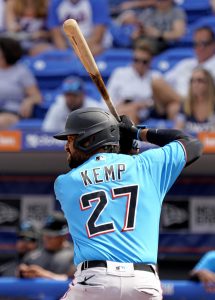
While it seems like ancient history now, outfielder Matt Kemp was once among the most valuable players in baseball. Now 35 years old, Kemp had several productive years with the Dodgers from 2006-14, during which he combined for a .292/.349/.495 line (128 wRC+) with 182 home runs, 170 stolen bases and 25.1 fWAR in 4,496 plate appearances. Kemp even nearly won an MVP in that time, finishing second to the Brewers’ Ryan Braun in 2011.
Even at the height of his powers as a hitter, questions abounded in regards to Kemp’s defense, and they haven’t subsided. Kemp has thus far accounted for an awful minus-133 Defensive Runs Saved with a minus-102.7 Ultimate Zone Rating during his career. Worsening matters, Kemp’s offensive numbers began deteriorating in 2014, the last year during his first Dodgers stint, and have mostly continued to do so since they traded him to the Padres in December 2014.
Since he first donned a San Diego uniform, Kemp has batted .272/.314/.467 (good for a fairly mediocre 107 wRC+) in 2,355 trips to the plate with the Padres and a couple other teams. Last season was especially horrible for Kemp, who totaled a paltry 62 PA with the Reds and hit .200/.210/.283 (20 wRC+). The seven-time 20-home run man only managed one HR in Cincinnati, which released him in early May, and he was unable to make his way to the Mets after they inked him to a minor league contract toward the end of May. They wound up releasing Kemp in July after a short and dismal run with their Triple-A affiliate.
In fairness to Kemp, a broken rib played some role in his nightmarish 2019. It’s also worth noting he’s only two seasons removed from a quality offensive performance in 2018, when he slashed .290/.338/.481 (122 wRC+) with 21 homers in his one-year return to the Dodgers en route to his third All-Star bid. Kemp couldn’t find a guaranteed contract this past offseason after last year’s fiasco, though, leading the non-contending Marlins to take a chance on him on a minors pact.
Considering Kemp’s falling offense and his subpar defense, he looked like a long shot to make the Miami roster when the club added him. However, between a universal DH and expanded rosters, Kemp may well receive a legitimate opportunity to revive his career this year. But there are other members of the Marlins – Matt Joyce, Garrett Cooper and Jesus Aguilar are clear examples – who could rack up DH at-bats if Kemp’s not up to the task.
Photo courtesy of USA Today Sports Images.