
Poll: Grading The Goldschmidt Trade
First baseman Paul Goldschmidt, he of the career .297/.398/.532 line, was one of the most coveted assets on the offseason trade market. After a bitterly disappointing end to the Diamondbacks season, in which the club won just eight out of their final 28 games after staking a claim to top of the division on August 30th, a full-scale shuffling of parts was sure to be in order. The club was almost certainly set to lose ace Patrick Corbin, who this week signed a monster $140MM deal with Washington, plus center-field stalwart A.J. Pollock, who, despite several injury-marred campaigns, posted a robust 14.9 fWAR in his final five seasons with the team. And flimsy depth on the 25-man roster and in the upper minors paired with a system devoid of high-impact talent to offer a mostly inauspicious outlook in seasons to come.
Was it finally to time to cash in on the organization’s most valued trade chip? The answer, in the end, was a resounding “yes”: On Wednesday, the organization finally agreed to a package with the 31-year-old’s most oft-rumored suitor, the St. Louis Cardinals. 25-year-old right-hander Luke Weaver and catcher Carson Kelly, 24, are the two most notable pieces going back to Arizona in the deal; Andy Young, a 24-year-old minor league infielder, and a Competitive Balance Round B pick are also part of the return for the D’Backs.
Goldschmidt, of course, is entering the final year of a contract that will pay him just $14.5MM in 2019. His presence figures to move defensive yo-yo Matt Carpenter back to his original home at third base, where the 33-year-old has, encouragingly, graded out as mostly above average with the glove in limited time over the last two years after a series of dreadful campaigns in the middle portion of the decade.
Infielder Jedd Gyorko and 1B/COF Jose Martinez, then, would seem to be left bench-ridden, and could be prime trade chips in the weeks to come. Speculatively, major bullpen upgrades could be in order — as a whole, the unit posted an abysmal 4.50 xFIP and 4.34 BB/9 last season, both of which ranked in the bottom five across the league. Though the departing package was significant, the Redbirds are left with a most prominent feather in their collective cap: with nine big-league-tested starting pitchers in the fold for next season, and a super surplus at catcher — the immortal Yadier Molina, plus top prospect Andrew Knizner — the Cards figure to lose very little in present-day value.
For the Diamondbacks, the return may have eclipsed even their wildest hopes, with one executive reportedly dubbing the package a “boatload.” Weaver and Kelly come with a combined 11 seasons of team control, and each should project around league average in the upcoming campaign. Kelly, a former top 50 prospect, seems especially intriguing — with the offensive baseline at catcher approaching its all-time nadir (catchers slashed a putrid .232/.304/.372 as a whole last season, for an 84 wRC+), the 24-year-old needs only to supplement his sterling defense with marginal offensive production to become an above-average big leaguer.
So, how would you grade this deal for each club?
Grade the Paul Goldschmidt acquisition for the Cardinals
-
A 68% (15,642)
-
B 23% (5,342)
-
C 6% (1,278)
-
F 2% (359)
-
D 1% (268)
Total votes: 22,889
Grade the Goldschmidt trade for the Diamondbacks
-
B 34% (7,283)
-
C 31% (6,621)
-
A 18% (3,814)
-
D 11% (2,345)
-
F 6% (1,248)
Total votes: 21,311
Offseason Outlook: Texas Rangers
MLBTR is publishing Offseason Outlooks for all 30 teams. Click here to read the other entries in this series.
The Rangers remain in an uncomfortable position, buried in the AL West and attempting to transition to a new contending core without undergoing a drastic rebuild. It’s an interesting contrast to the division-rival Mariners.
Guaranteed Contracts
- Elvis Andrus, SS: $58MM through 2022 (10-team no-trade; opt-out after 2019)
- Rougned Odor, 2B: $43.5MM through 2022 (includes 2023 option buyout)
- Shin-Soo Choo, OF: $42MM through 2020 (10-team no-trade)
- Mike Minor, SP: $19MM through 2020
- Drew Smyly, SP: $7MM through 2019
- Jesse Chavez, RP: $8MM through 2020
- Jeff Mathis, C: $6.25MM through 2020
- Chris Martin, RP: $2.25MM through 2019
- Edinson Volquez, SP: $2MM through 2019
Arbitration-Eligible Players (service time in parentheses; salary projections via MLBTR contributor Matt Swartz)
- Nomar Mazara (3.000) – $3.7MM
- Jurickson Profar (4.165) – $3.4MM
- Delino DeShields Jr. (3.116) – $1.9MM
- Alex Claudio (3.114) – $1.3MM
Free Agents
- Tony Barnette, Adrian Beltre (retired), Matt Bush, Bartolo Colon, Robinson Chirinos (declined option), Zac Curtis, Doug Fister (declined option), Yovani Gallardo, Matt Moore (declined option), Martin Perez (declined option), Ricardo Rodriguez, Adrian Sampson
[Rangers depth chart | Rangers current payroll outlook]
We’re a bit late to the party here, as the Rangers have already begun their winter roster tinkering. It’s hard to label it as much more than that, however, as the organization has mostly worked on some smaller-scale moves. We’ll use this opportunity to assess the state of the organization and try to suss out the possibility of more notable transactions in the near future.
The Rangers have largely eschewed dramatic moves of late, with the organization adopting a cautious approach as two consecutive division titles (2015 and 2016) gave way to a pair of losing seasons. The team appears to be attempting to time a return to competitiveness with the anticipated opening of a new ballpark in 2020. While a salary draw-down is underway, though, a total roster teardown has not been attempted.
This offseason has again placed recently extended president of baseball Jon Daniels in a somewhat awkward position, as he has worked to fill out the roster without any real hope or intention of putting a contending product on the field. The focus, unsurprisingly, has been on compiling a palatable unit of pitchers.
In addition to the commitments made last winter to Mike Minor, Edinson Volquez, and Chris Martin, the Rangers have now added Jesse Chavez and Drew Smyly — the latter in a unique arrangement with the Cubs that also resolved the teams’ open business regarding Cole Hamels. Additionally, veteran receiver Jeff Mathis was brought on board to help guide the pitching staff. These are perhaps best characterized as gap-filling measures. Only Minor, Chavez, and Mathis will be on hand into the 2020 campaign, after all. And though all of those players could certainly be of use to a winning club, they’re hardly the types of asset that will drive the bus.
It’s incumbent upon Daniels, if the organization wants its first season in its new facility to bring some excitement for its fans, to find a way to move toward the compilation of a new core of high-level players. There is some talent to work with, though there’s also ample uncertainty. Not a single Rangers player cracked 3 fWAR last year.
Shortstop Elvis Andrus is back after deciding not to opt out on the heels of an injury-plagued 2018 effort. He’s still young enough to be a part of the future, but a big rebound campaign could also prompt him to opt out of the remainder of his contract. Likewise, Jurickson Profar is still only 25 years of age and showed signs of life last year, but he only comes with one more season of arbitration control after the upcoming campaign. The former could emerge as a mid-2019 trade candidate if he’s playing well enough to draw interest. The latter could as well, though perhaps it’s not too late to imagine him changing hands this winter (a seemingly annual possibility).
There’s at least as much uncertainty surrounding the aging Shin-Soo Choo, who is coming off of a nice season with the bat but remains quite pricey and is increasingly limited to DH duties. Shedding some of the $42MM he’s still owed would figure to be of interest, though we’ve certainly seen no indication that the Rangers will prioritize that to the point that they’d package Choo with higher-value assets, as the Mariners have. Still, shopping him could yield some interesting possibilities this winter. After all, there are a good number of other contract swap candidates out there. It’s possible the Rangers could work something out to acquire a younger, higher-upside player or to rid themselves of some of Choo’s cost.
Taking advantage of the fact that Choo is a useful, albeit overpriced player could do more than open the door to adding a somewhat more interesting piece for a club in the Rangers’ position. Any newfound payroll space could then be applied to free agent or trade/claim candidates who could potentially turn into trade chips or even future assets for the Texas ballclub. And the organization would free a roster spot and playing time, possibly affording additional opportunities to find value.
The Rangers have continued to spend even in this down period, so perhaps hanging onto Choo won’t hamstring the organization from doing what it otherwise wishes. Still, with a budget that’s expected to land at $120MM or so, there likely isn’t much more space to work with once arb money and league-minimum salaries are added to the contractual commitments. Even a few extra million might open the door to some intriguing opportunities that may not even yet be evident. (To take but one example of the potential upside, the Reds’ late-March claim of Scooter Gennett in 2017 has paid enormous dividends for the club.) Perhaps it’s possible the Rangers could acquire some young talent by taking on an undesirable contract from another club.
Regardless of the path, it seems the organization should be looking for ways to put its hefty payroll (for a rebuilding team) to use, not just in keeping the club afloat at the MLB level but in trying to unearth future value. Because, frankly, there’s a desperate need for it. Daniels stated the obvious recently: “This is not the year where we are going to go all out. We are probably a year away from starting to look at some different options for expanding the payroll.” That’s plenty sensible, but it’s also a clear acknowledgement of the fact that this is firmly a rebuilding club … albeit one that has decided still to outspend quite a few other organizations. The estimated $120MM payroll is being flushed so far as 2019 competitiveness goes, so perhaps more of it ought to be diverted to future-oriented undertakings.
After all, it’s hard to say that any particular player currently on the roster is highly likely to be a part of the next competitive Rangers ballclub. Second baseman Rougned Odor is locked in on a long-term contract, made some improvements over the course of the 2019 season, and is just 24 years of age. But he’s far from a sure thing given his inconsistencies and remaining rough spots. Joey Gallo just reached his 25th birthday and has posted consecutive 40-homer seasons. He won’t be eligible for arbitration until next fall. But he’s also a three-true-outcomes extremist. Gallo’s surprising defensive versatility is a boon, and he’s certainly a valuable asset, but he surely hasn’t yet proven he’s a reliable star-level player and could get expensive rather quickly as a power-heavy arbitration player. Meanwhile, Nomar Mazara is younger than both of those just-mentioned teammates and has hit precisely twenty home runs in each of his first three years in the majors. But he has yet to take the next step in his development, having fallen shy of the league-average bar on offense in each of those seasons.
At times, that trio has seemed a budding core unit, but it hasn’t happened yet. The other pieces on hand come with even greater questions. On the position-player side, Ronald Guzman and Willie Calhoun have shown their share of promise at times with the bat, but are far from established big league hitters. Drew Robinson has torn up the minors in recent years and should have an opportunity to show he can do it in the big leagues, though his 125 MLB plate appearances last year were a dud. Isiah Kiner-Falefa offers versatility and Delino DeShields Jr. can contribute speed and defense, but neither has sustained productivity in the majors at the plate.
Even including the veteran hurlers mentioned above, all of whom come with significant health risks, the pitching staff remains a unit with about as many holes as any around the game. The rotation still likely needs some added depth options, at a minimum. Southpaw Yohander Mendez will likely get a crack at earning a rotation job, though he has struggled in the majors and wasn’t successful last year at Triple-A, either. Righty Ariel Jurado has not missed many bats in the upper minors or in his initial showing in the bigs, but could get another look if he impresses in camp. Deadline acquisition Taylor Hearn could break into the majors in 2019, but likely still has some refinement left before he gets the call.
On the relief side, there are at least a few players to watch. Connor Sadzeck was effective at Triple-A in 2018 and got results in a brief MLB debut, but did so while issuing 11 free passes in 9 1/3 innings. Nick Gardewine has put up interesting numbers at times while climbing the ladder and reached the bigs last year, but missed much of the year with forearm troubles. Alex Claudio has been effective in the past and could be again. Fellow southpaw Jeffrey Springs racked up 15.6 K/9 last year in the upper minors in a multi-inning role and was effective in his first 32 MLB frames. The as-yet-unestablished C.D. Pelham is another lefty option in the pen. Still, this is another area where depth and/or upside plays would be most welcome.
Of course, I’ve left one name out of the discussion to date, and it’s a notable one. Young righty Jose Leclerc showed quite a bit of promise last year while sliding into the closer’s role. The 24-year-old made strides with his control while recording more than 13 strikeouts per nine and working to a 1.56 ERA in 57 2/3 innings. That output was driven in no small part by the fact that he held opposing hitters to only a single long ball. Any reversal in his walk rates (he went from 7.9 per nine in 2017 to a much more palatable 3.9 last year), combined with a dinger increase, could change his outlook. But it’s hard not to admire his mid-to-upper nineties heat and whopping 17.1% swinging-strike rate. There are quite a few quality relievers available in free agency, to be sure, but contending clubs that don’t like the price tags and obvious risks that come with the open-market options could eye him as a trade target. If the Rangers market Leclerc, who’s controlled through 2022, there could be an opportunity to add some players who hold out the promise of turning into core pieces.
There’ll surely be more roster plugging efforts to come over the course of the offseason. But the primary focus of Daniels and his staff probably ought to be on exploring creative ways to infuse talent to the upper portions of a farm that features many high-risk and/or far-off assets among its best-regarded players. If there’s enough funding left to work with, perhaps some targeted free agent moves could still make sense, with Japanese hurler Yusei Kikuchi representing a particularly interesting target given his young age. Taking a crack at some bounceback pitching — relievers Cody Allen or Justin Wilson, say, or starters such as Lance Lynn, Drew Pomeranz, or even Ervin Santana — would make sense and fit the mold of recent Rangers moves. Ultimately, new skipper Chris Woodward will do what he can to set the tone and drive some improvement in the team’s young MLB players, but the near and long-term outlook remains foggy at best.
2019 MLB Arbitration Tracker
Our 2019 MLB arbitration tracker is now available! The tracker displays all arbitration eligible players, with fields for team, service time, player and team submissions, the midpoint, and the settlement amount. You can filter by team, signing status, service time, Super Two status, and whether a hearing occurred. For unsigned players that do not agree to terms in the interim, arbitration figures will be exchanged on January 11, 2019. By our count, 27 arbitration eligible players have signed so far.
You can bookmark MLBTR’s 2019 Arbitration Tracker here, or you can find it in the Tools menu at the top of the site.
MLBTR is also the only place for salary projections for every arbitration eligible player, which you can find here.
Offseason Outlook: Los Angeles Dodgers
MLBTR is publishing Offseason Outlooks for all 30 teams. Click here to read the other entries in this series.
The Los Angeles Dodgers, fresh off of a second consecutive NLCS Championship (and second consecutive World Series loss), have a surplus of talent on the farm and would figure to have the capacity to add payroll if need be. With two consecutive trips to baseball’s grandest stage galvanizing the tail end of six straight playoff berths, it’ll take a championship to truly satiate the fans this time around. It’s a good thing the Dodgers are as well-positioned as any team in baseball to bring one home.
Guaranteed Contracts
- Clayton Kershaw, SP: $93MM through 2021 (extension signed 11/2/18)
- Matt Kemp, OF: $21.75MM through 2019
- Justin Turner, 3B: $39MM through 2020
- Rich Hill, SP: $18MM through 2019
- Kenley Jansen, RP: $56MM through 2021
- Hyun-Jin Ryu, SP: $17.9MM through 2019 (accepted qualifying offer)
- David Freese, 3B: $4.5MM through 2019
- Kenta Maeda, SP: $15MM through 2023
- Tony Cingrani, RP: $2.65MM through 2019 (guaranteed arbitration salary)
Arbitration-Eligible Players (projections via MLBTR contributor Matt Swartz)
- Yasiel Puig (5.102) – $11.3MM
- Alex Wood (5.123) – $9.0MM
- Joc Pederson (4.028) – $4.3MM
- Enrique Hernandez (4.054) – $3.2MM
- Chris Taylor (3.037) – $3.2MM
- Josh Fields (5.083) – $2.8MM
- Corey Seager (3.032) – $2.6MM
- Pedro Baez (4.059) – $1.8MM
- Yimi Garcia (3.149) – $900K
Free Agents
- Manny Machado, Yasmani Grandal (declined qualifying offer), Ryan Madson, Daniel Hudson, Brian Dozier, Tom Koehler, Zac Rosscup, John Axford, Eric Goeddel, Cesar Ramos, Justin De Fratus, Zach McAllister, Logan Ondrusek
[Los Angeles Dodgers Depth Chart | Los Angeles Dodgers Payroll | Projecting Payrolls: Los Angeles Dodgers]
The Dodgers came within one win of a World Series victory back in 2017 and returned for an encore last year before ultimately falling short again. Fans and front office alike will be hoping that third time’s the charm as they work to plug the gaps on an already-formidable roster. Make no mistake: while the Dodgers saw the contracts of over a third of their 40-man roster expire at the end of the 2018 season, they’ve got some heavy hitters still in place and figure to be aggressive in supplementing that core in order to remain among the elite National League clubs come Opening Day.
Two of those players whose contracts expired in November made up the top half of the club’s playoff rotation, which would have made for a concerning hole on the roster in another universe. But in this realm, Andrew Friedmann & Co. swiftly and decisively took the suspense out of the club’s would-be pitching need by re-upping with Clayton Kershaw on a three-year, $93MM contract and issuing Hyun-Jin Ryu a one-year, $17.9MM qualifying offer he’d ultimately accept. The two alone will combine to take Los Angeles to the cusp of the luxury tax ceiling (indeed, more if Kershaw meets some of the start-based incentives in his contract), but they’ll continue to have one of the more enviable one-two punches in the NL. For the Dodgers, the convenience of solving such a dilemma with money alone allowed them to get a leg up before the winter even began.
While they’ve got an advantage at the top of their rotation, the depth they have in that area is perhaps even more unique. Beyond Kershaw and Ryu, rookie sensation Walker Buehler will return to the club and will continue to represent a huge value as a pre-arb performer. As for rounding out the starting five, they’ve got no shortage of options. Alex Wood, Ross Stripling, Rich Hill, Kenta Maeda and even Julio Urias are all talented pitchers that most teams would be happy to slot in as mid-rotation guys, but who’ll instead be competing for back-end starter and long relief roles for a pitching-wealthy Dodgers ballclub. While a great number of these players have significant injury concerns, the depth alone should easily carry the club through all but the most extreme of health-related misfortunes. If there’s an area of need on this team, it’s certainly not in the rotation.
So of course it was easily predictable that one of the club’s most notable pursuits so far has been an improvement in the starting rotation. They’ve reportedly discussed multiple trade scenarios with the Indians already, most notably one that would send two-time Cy Young Award-winner Corey Kluber to Los Angeles. While the Dodgers’ pitching depth is certainly impressive, Kluber would present a gargantuan upgrade over anyone in that group without a Cy Young Award to his name. Some might argue that he’s even got the edge over Kershaw himself at this stage of their careers in terms of sturdiness and reliability. Any real pursuit of Kluber (or even his teammate, Trevor Bauer) wouldn’t seem to be made with the regular season in mind, but rather with the goal of improving the playoff rotation to extraordinary heights. It’s not clear who they’d be willing to ship to Cleveland in such a deal, though it’s worth pointing out that the Indians have a long-term need at catcher and outfield, both of which are perceived areas of prospect depth for the Los Angeles organization.
Speaking of catchers, the Dodgers would appear to have a need behind the dish for the 2019 season after watching longtime backstop Yasmani Grandal reject their qualifying offer. The club owns two of MLB Pipeline’s top ten catching prospects, so it’s possible that one or both of Keibert Ruiz and Will Smith could be given the opportunity to win the job (in tandem with incumbent Austin Barnes) right out of spring training. Ruiz in particular would figure to be a fine long-term solution there if his development plays out as predicted by several prospect pundits across the industry. Of course, if the club was comfortable with that as their plan A, they probably wouldn’t have already committed so much focus to finding an upgrade at this early juncture of the offseason. They’ve been connected to J.T. Realmuto of the Marlins, for instance, and appeared to be in play for former Tribe catcher Yan Gomes before he was ultimately dealt to the Nationals. A reunion with Grandal is certainly within the realm of possibility, though it seems somewhat unlikely based on his postseason difficulties along with the team’s payroll outlook (more on that later) and other potential priorities.
Whether or not the Dodgers will use any of their available resources to fortify the bullpen behind franchise closer Kenley Jansen is anybody’s guess. One could make a strong case that it’s an area of need; a mass exodus of depth pieces and an offseason heart procedure for the resilient Jansen point to a need for some further padding. Yet an equally strong case could be made that the ‘pen is actually an area of strength for Los Angeles, given the track record of Jansen (and optimism that he’ll be ready for Opening Day) coupled with the upside of relievers like Dylan Floro, Tony Cingrani and Caleb Ferguson. Further reinforcing the latter argument is the likelihood that the starting rotation depth will bleed over into the relief corps; pitchers like Wood, Maeda, and Urias could serve as strong multi-inning weapons out of the bullpen.
If the Dodgers elect to pursue relievers on the free agent market, there’s a wealth of talented, proven arms to choose from; they wouldn’t have any trouble enticing one or more of them to join their storied franchise. But if they opt not to pay up for any major additions (or trade prospect capital for a reliever under contract), the way they deploy their pitching staff in 2019 would be a fascinating story to follow. The pitching landscape has been evolving rapidly for the past few seasons, and the 2019 Dodgers would be a prime candidate to utilize their wealth of twice-through-the-order-type starters and upside relief pitchers to mix and match pitchers and get outs in a creative manner. They were already one of a few teams to toy with the idea of using an “opener” last season. Recently-extended skipper Dave Roberts has all the right tools in place to take another bold step forward as far as creativity, and while that’s nothing at all resembling a guarantee that he’ll do so, it’s at the very least an intriguing potential storyline to follow and definitely a small item for fans to keep tucked away in the back of their minds as they watch the club’s offseason news and rumors.
When imagining all possible outcomes of the Dodgers’ 2018-2019 offseason, it’s impossible not to consider the fates of free agent juggernauts Bryce Harper and Manny Machado, each of whom is expected to sign a contract larger than any player to date. Machado, who spent the latter half of the season in Los Angeles and contributed significantly to their postseason run, now seems like somewhat of an unlikely fit due to the presence of Justin Turner at third base and the expected return of Corey Seager to shortstop. On the other hand, one could envision a scenario in which Seager shifts to the right side of the infield to play at the keystone, clearing room for Machado at short and pushing Enrique Hernandez into his accustomed super utility role. In other words, while Machado doesn’t seem like a perfect fit, it wouldn’t be wise to entirely rule the Dodgers out, either.
When it comes to Harper, there’s been some confusion as to the organization’s level of engagement to date. There’s a clear logical fit there, to the point that MLBTR predicted Los Angeles as the landing spot for the former MVP. He’d provide a sizable upgrade in production over Yasiel Puig, Matt Kemp and Joc Pederson, even before weighing the fact that the former two are set to depart after the coming season, while the latter will be a free agent at the end of 2020. Top prospect Alex Verdugo is ready for a full run at the majors, but the club may not be willing to rely on him fully and could also dangle him in trade scenarios. Put more simply, a long-term commitment to Harper would provide a significant upgrade in the near-term while answering long-term questions about the organization’s outfield picture and providing stability there for over a decade.
The caveat to all this, and to any other pursuits the Dodgers might make in free agency, is that they could potentially be facing significant financial restraints in contrast with years past. As MLBTR’s own Rob Huff outlined in his recent payroll projection piece, a document prepared by someone within the Dodgers organization suggests that they intend to remain below the luxury tax threshold every year between now and 2022. Indeed, the payroll target for 2019 outlined within said document is only $185MM, which is eight figures south of Roster Resource’s current projection for the club with arbitration salaries taken into account. Huff doesn’t believe that the Dodgers will actively move to shed payroll (a sentiment I imagine echoes throughout the industry), but as he said in the above piece, if their plans haven’t changed, it’s difficult to see them adding any sort of marquee free agent at all, let alone either of the top two players on the market. They’ve also yet to guarantee a free agent more than $50MM under Friedmann’s tenure. It’s reasonable to question how much to read into that leaked document, though clearly the current iteration of club leadership will continue to prioritize efficient spending.
Of course, there are plenty of ways in which the Dodgers could clear payroll space that could be repurposed. Just last winter, the club was involved in one of the offseason’s most surprising swaps, which essentially amounted to an exchange of future dollar commitments (or at least, it seemed that way before Kemp’s surprising resurgence). That they’ve shown a willingness to get creative in the past leaves open the possibility that they’ll explore multiple avenues of gaining some financial flexibility this year as well. While there’s no realistic way to recoup any of the nearly $18MM owed to Scott Kazmir, Hector Olivera and Yasiel Sierra combined for the 2019 season, MLBTR’s Jeff Todd listed Kemp among LA’s potential contract swap candidates. We’ve already seen contracts moved around the league this winter, and there are endless possibilities for money-shifting swaps that could make better use of salary space. In addition, trading relatively expensive players from areas of depth (such as Hill, Puig or Wood) for MLB-ready prospects or minimum-salary players who can fill an area of need would be another method of reallocating financial resources, even if the club ultimately needed to pay down some of the money owed to those players in order to get a deal done.
If they’re unable to find any financial wiggle room to pursue players on the free agent market, and/or are unwilling to spend much past the competitive balance tax line, the Dodgers have more than enough prospect capital in the farm system to address any needs via trade. They’re one of the few teams with both a need at catcher and enough assets in the farm system to swing a trade for Realmuto, so that’ll be one pursuit to pay close attention to. But it’s not difficult to imagine them pursuing upgrades at first base, either. Paul Goldschmidt would be the prime target there, though he’d likely come at a premium given the division rivalry between the Dodgers and Diamondbacks. Jose Abreu and Justin Smoak present alternative options, and it’s not out of the question that the Mariners could look to unload the recently-acquired Carlos Santana (who spent several years in LA’s farm system) onto another club, either. Adding a corner piece would allow the Dodgers to utilize Cody Bellinger more often as an outfielder, which would change the complexion of the unit discussed above. He has lined up there quite a bit over his first two seasons in the majors already. Those are all just speculative fits, obviously, but the overall point being made here is that Friedmann & Co. have some creative ways to upgrade and more than enough minor league talent to get a deal done if that ends up being their goal.
As far as MLB clubs go, the Dodgers are a major wild card this offseason. They could spend tens of millions or nothing at all; they could make a blockbuster trade for a star-caliber player or largely stand pat; they could make upgrades at multiple positions or begin the year mostly with the cards already in hand. Regardless of what happens, one thing is certain: there will be no shortage of Dodgers rumors to follow as the hot stove begins to flare up. Expect them to be connected to several high-priced free agents and big-name trade targets as the winter wears on. But even if they don’t ultimately make a big splash, fans can sleep easy knowing that their team is already built to make another serious run at a championship this coming season.
Offseason Outlook: Milwaukee Brewers
MLBTR is publishing Offseason Outlooks for all 30 teams. Click here to read the other entries in this series.
The Brewers went from a near-miss in the 2017 postseason to a deep NLCS run against the Dodgers in 2018. With much of the core under control, general manager David Stearns and the rest of the Milwaukee front office will look to push the roster to the next level in 2019.
Guaranteed Contracts
- Lorenzo Cain, OF: $66MM through 2022
- Ryan Braun, OF: $38MM through 2020 (includes $4MM buyout of 2021 mutual option)
- Christian Yelich, OF: $37.5MM through 2021 (includes $1.25MM buyout of 2022 club option)
- Eric Thames, 1B/OF: $7MM through 2019 (includes $1MM buyout of 2020 club option)
- Chase Anderson, RHP: $6.5MM through 2019 (includes $500K buyout of 2020 club option; contract also contains 2021 club option)
- Jhoulys Chacin, RHP: $6MM through 2019
- Jeremy Jeffress, RHP: $3.175MM through 2019 (contract contains 2020 club option)
- Matt Albers, RHP: $2.5MM through 2019
- Erik Kratz, C: $1.5MM through 2019 (as a pre-tender arbitration contract, Kratz’s deal is not fully guaranteed)
Arbitration-Eligible Players (service time in parentheses; salary projections via MLBTR contributor Matt Swartz)
- Travis Shaw (3.088) – $5.1MM
- Corey Knebel (3.151) – $4.9MM
- Jimmy Nelson (4.107) – $3.7MM
- Hernan Perez (4.079) – $2.7MM
- Junior Guerra (2.155) – $2.7MM
- Zach Davies (3.020) – $2.4MM
- Domingo Santana (3.024) – $2.0MM
- Manny Pina (3.046) – $1.8MM
- Tyler Saladino (3.053) – $1.0MM
[Brewers depth chart | Brewers current payroll outlook | Brewers payroll projection analysis]
Free Agents
- Jonathan Schoop, Gio Gonzalez, Mike Moustakas, Joakim Soria, Wade Miley, Curtis Granderson, Jordan Lyles, Xavier Cedeno, Dan Jennings, Stephen Vogt, Eric Sogard
Generally speaking, there aren’t going to be a lot of holes to fill for a 96-win team that stands to retain the vast majority of its top players, but that’s perhaps less so in the case of these Brewers. Milwaukee’s outfield is set, if not overcrowded, but the Brewers’ infield, catching and rotation pictures all present the opportunity for improvement.
The Brewers bit the bullet and non-tendered Jonathan Schoop — a supposedly key trade-deadline acquisition who instead flopped in his limited time in Milwaukee. With Mike Moustakas, whose midseason acquisition was much more successful, hitting the open market and Orlando Arcia still not fully cemented as an everyday player in the big leagues, the Brewers could pursue multiple avenues to solidifying their infield mix.
Travis Shaw has proven a quality third baseman for the past two seasons in Milwaukee, but he shifted to second base at times when the club added Moustakas to the fold. Presumably, given the fact that Shaw grades out as a strong defender at the hot corner, the Brewers wish to return him to third base. At the very least, Milwaukee could stand to add a second baseman, where utilityman Hernan Perez currently tops the depth chart. Fortunately for the Brewers, there’s hardly a shortage of options available to them.
Frankly, it’s possible to imagine a variety of approaches, including the addition of multiple pieces that will see action at multiple positions. Super-utilityman Marwin Gonzalez would be an intriguing fit, and he’s certainly familiar to Stearns. But he may well cost more than the Brewers wish to pay. It’s not hard to imagine Stearns looking to find his own such player at a more palatable rate of pay.
DJ LeMahieu and Jed Lowrie head up a deep free-agent crop of second basemen. The former would bring some relative youth and premium defense to the position; the latter, meanwhile, is coming off a career-best season and offers more defensive versatility, though Lowrie will play next season at age 35. With top prospect Keston Hiura already reaching Double-A, the Brewers probably don’t feel the need to spend heavily on a long-term option at second base, and likely won’t be forced to in this market. Any of Brian Dozier, Daniel Murphy, Ian Kinsler or Asdrubal Cabrera could presumably be had on short-term pacts (in some cases, even one-year deals), and the trade market also features myriad options. Starlin Castro and Cesar Hernandez could be shorter-term options, while someone such as Arizona’s Ketel Marte is a longer-term piece who has the versatility to move to a utility role if Hiura pushes him off the spot. Stearns is never shy on the trade market, and he’ll have ample avenues to explore in that regard.
At shortstop, the need is less acute. Arcia was one of the game’s worst hitters in the first half of the season, but the former top prospect returned from a brief demotion to hit .290/.320/.386 in his final 154 plate appearances before hitting .333/.353/.606 in 34 trips to the plate in the postseason. Given his strong defensive ratings at short, his once-premium prospect pedigree and the fact that he’s headed into his age-24 season, there’s reason to believe that Arcia can hold down the fort in 2019 at the very least — if not blossom into a close approximation of the player he was projected to be when ranked as a top 10 prospect in the entire game. If anything, perhaps a glove-first utility option to support Arcia could make sense — someone in the mold of Freddy Galvis.
For a second consecutive offseason, the Brewers could explore the market for help behind the plate. Manny Pina regressed in most offensive respects in 2018, but to his credit, he improved substantially in terms of pitch framing, pitch blocking and halting stolen bases. Pina turned in a terrific defensive season but hit just .252/.307/.395. At present, he’s projected to pair with affable veteran Erik Kratz, who hit .236/.280/.355 while serving as a fan favorite and clubhouse leader. It’s a defensively sound pairing but one that also lacks much offensive upside. If the Brewers want to again try to pry a Marlins star out of Miami, they’d be a fairly natural landing spot for J.T. Realmuto, who’d bring a more well-rounded approach to the table. To date, there’s no real indication of how high a priority the club places on improving in this area, but there are quite a few other plausible targets floating around the market at different price points.
Turning to the pitching staff, Stearns and his lieutenants did well to prove that the public outcry for more rotation help last offseason was exaggerated. The Brewers will welcome Jimmy Nelson back to a starting staff that should feature a combination of Jhoulys Chacin, Chase Anderson, Zach Davies, Junior Guerra, Freddy Peralta, Brandon Woodruff and Corbin Burnes. It’s a quality mix of arms with some significant upside in the form of Nelson and Burnes. The standard adage that one can never have too much starting pitching always applies, and acquiring a clear top-of-the-rotation arm could allow the Brewers to deal from that depth to address other needs, but an impact starter is far more a luxury than a necessity for Milwaukee this winter. Milwaukee has often been mentioned as a possible landing spot for Sonny Gray, which would deepen that mix and add some potential upside to an already promising group. There’s also certainly an argument the Brewers should go bigger if they’re to make a move. The club has been connected to Noah Syndergaard, though that seems a remote possibility.
In the bullpen, the Brewers will return much of the unit that proved to be arguably the club’s greatest strength in 2018. Josh Hader, Corey Knebel and Jeremy Jeffress were an utterly dominant trio at the back of the Milwaukee ‘pen for much of the season. The latter of that group may have worn down a bit in the postseason, but without the Herculean regular-season efforts of any of that threesome, the Brewers may not have been in the playoffs at all. They’ll likely be joined by veteran Matt Albers, Jacob Barnes and at least one of the rotation candidates who doesn’t end up winning a starting job this spring. But the Brewers could stand to strengthen an existing strength — particularly in the form of a left-handed reliever. Zach Britton and Andrew Miller are the top free agents out there, but Stearns hasn’t spent heavily on the ‘pen in free agency since taking the reins in Milwaukee. The market has some bargain options and upside plays in the form of Oliver Perez, Zach Duke, Tyler Lyons and Jake Diekman, among others. An affordable southpaw option to pair with Hader, the resident late-inning juggernaut, would seem prudent.
Beyond filling out those needs, however, the Brewers face some surpluses with which to deal. The Brew Crew was happy to stockpile outfielders last season, knowing that players like Keon Broxton and Domingo Santana had minor league options remaining and could be shuttled back and forth from Triple-A to the Majors as needed. That won’t be the case next season, and with Yelich, Cain and Braun lined up in the outfield — Braun possesses a no-trade clause — the front office will have to make some tough decisions. Both Santana and Broxton are out of minor league options, making them obvious trade candidates this winter. Either could be used to help address the bullpen, infield or catching situations. With three and four years of club control left, respectively, neither is an extremely long-term asset, but they could very well still hold appeal to organizations such as the Indians, White Sox, and Giants that are in need of some outfield options.
It seems likely that Eric Thames will also see his name bandied about the rumor circuit this offseason. Jesus Aguilar‘s ascension to primary first baseman and the outfield logjam have left Thames as something of an odd man out. It doesn’t help that the former KBO star took a step backward in his second season back in the Majors, hitting .219/.306/.478 in 278 plate appearances. Thames’ overall .237/.341/.504 slash in two seasons as a Brewer is still productive, though, and for a club seeking an affordable first base or corner outfield option (e.g. Twins, Rockies), the lefty slugger could be a reasonable target.
As MLBTR contributor Rob Huff noted in analyzing the Brewers’ payroll, the current roster construction leaves Milwaukee with around $15MM to spend — based on historically plausible payroll expectations in Milwaukee. However, moving someone such as Thames, Santana or Albers could create a bit of extra room. Beyond that, given a deep playoff run in 2018, perhaps owner Mark Attanasio will be content to push the envelope a bit further in terms of what he’ll spend on the 2019 roster.
Fortunately, the Brewers are lacking in a clear, glaring need. The rotation could be improved, but Nelson’s return and the emergence of Burnes, Peralta and Woodruff create a deep reservoir of arms from which to draw. Arcia showed signs of life at shortstop late in the season, and a short-term addition could bridge the second-base gap to Hiura. Neither Pina nor Kratz is a highly exciting option behind the dish, but it’s a sturdy enough pairing to support a young pitching staff. The bullpen’s top three spots are locked in, and some of the rotation mix figures to join the group.
None of that is to say that the Brewers don’t need to or won’t make some additions to bolster their chances in 2019. They assuredly will. But, rather than zero in on one specific area of need, Stearns and his staff can take a broad, value-based approach to looking at the best ways to improve the current collection of talent. That general tact has paid dividends (and produced surprises) over the past two seasons, so it’ll be interesting to see what the front office comes up with this time around.
Projecting Payrolls: San Francisco Giants
With the Winter Meetings set to kick off next weekend, we’re moving to the tenth installment of this series. Here are links to the previous team payroll projections:
Philadelphia Phillies
Los Angeles Dodgers
Los Angeles Angels
Atlanta Braves
New York Yankees
Chicago White Sox
Boston Red Sox
Minnesota Twins
Milwaukee Brewers
If you have questions about financial information made available to the public and the assumptions used in this series, please refer to the Phillies piece linked above.
Today, we look into a club whose on-the-fly re-stocking in 2018 largely backfired, keeping them out of the playoffs for the second consecutive season for the first time since 2009: the San Francisco Giants.
Team Leadership
Unlike many of the teams that we have examined in this series, the Giants’ ownership structure is highly diversified and somewhat secretive. 2008 began with Peter Magowan’s 15th year as managing general partner of the club. Magowan began the year in turmoil in the aftermath of the Mitchell Report and ended the year having transitioned his management role to Bill Neukom. Neukom ran the show only until 2011 at which time Charles B. Johnson became the plurality member in the LLC that owns the ball club. Johnson reportedly owns approximately 25 percent of the team as part of a group of approximately 29 co-owners.
Despite the complicated ownership structure, the front office enjoyed tremendous continuity. Brian Sabean ascended to the role of general manager in 1997 and held that job through the 2014 season before climbing to Executive Vice President of Baseball Operations, with Bobby Evans handling day-to-day operations starting in 2015. No more. Sabean was reassigned out of Baseball Operations following the 2018 season, at which time Evans was fired.
The executive tasked with re-imagining the San Francisco front office? Former Dodgers general manager Farhan Zaidi. Zaidi spent a decade in the Bay Area with Oakland before spending the last four years in Los Angeles. As the new President of Baseball Operations, Zaidi will oversee the first major transition in San Francisco’s baseball management in two decades.
Historical Payrolls
Before hitting the numbers, please recall that we use data from Cot’s Baseball Contracts, we’ll use average annual value (“AAV”) on historical deals but actual cash for 2019 and beyond, and deferrals will be reflected where appropriate. And, of course, the value of examining historical payrolls is twofold: they show us either what type of payroll a team’s market can support or how significantly a given ownership group is willing to spend. In the most useful cases, they show us both. We’ll focus on a 15-year span for the Giants, covering 2005-18 for historical data as a means to understanding year 15: 2019. For the Giants, this time frame covers a period of rebuilding that ultimately fueled three World Series winners. We’ll also use Opening Day payrolls as those better approximate expected spending by ownership.
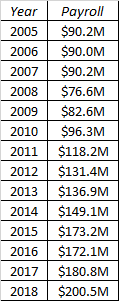
Those payrolls were remarkably stagnant through 2010 before taking a leap in 2011 that became an annual tradition throughout much of the years that followed.
During this period of increased spending, the Giants did reach luxury taxpayer status for the first time in 2015, remaining there for each of the next two seasons before resetting their status in 2018 by falling under the threshold. The team paid just $8.8 million in aggregate luxury tax payments over those three seasons, so the tax hasn’t substantially impacted team spending over our time frame.
While Major League spending has increased dramatically over the time period above, the Giants haven’t allocated substantial resources to international amateur bonuses. It seems as though the cash increases were focused nearly exclusively on the Major League roster that made regular trips to late October throughout this decade.
Future Liabilities
Get ready for lots of big numbers for multiple years.
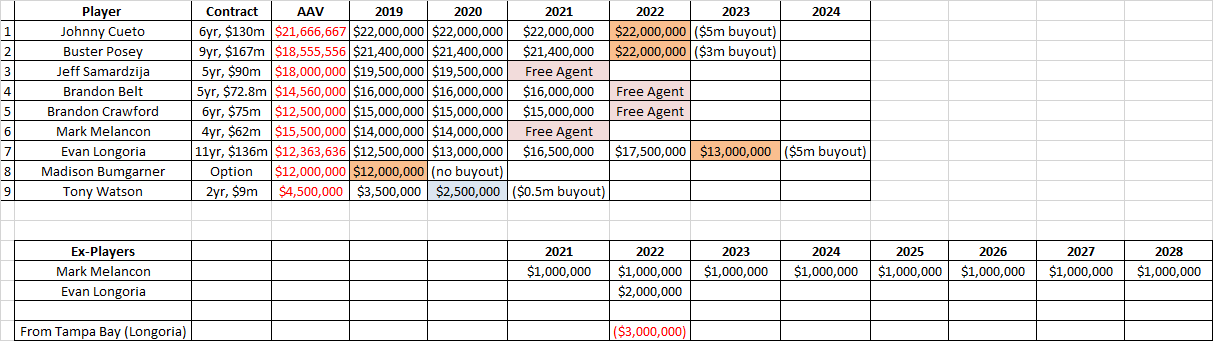
The big-money, long-term commitments are staggering.
Cueto, owed $71 million over the next three years presuming that the Giants buy out his 2022 option, was a star during his debut season with San Francisco in 2016, producing 5.5 WAR in leading the team’s rotation as they made their most recent playoff trip. Cueto’s 2017 season was marred by numerous injuries, including the dreaded forearm strain that served as a precursor to a nightmarish 2018 spent largely on the disabled list before he underwent Tommy John surgery last August. As a result, the Giants likely expect little to nothing from him again in 2019.
Like Cueto, Posey underwent a significant operation in August. Unlike Cueto, Posey has produced at a consistently elite level throughout the course of his contract, until this year’s career-worst 106 wRC+. While Posey’s hip operation figures to hamper his efforts to prepare for the season, he should be ready around Opening Day.
Samardzija was solid during his first year in San Francisco before a strong second year in 2017. Unfortunately, the remarkably durable righty finally succumbed to the injury bug, losing most of 2018 to a shoulder injury that lingered into the start of the offseason. With only two years left on his deal, it’s possible that the Giants have received as much value as they’ll be getting from that contract.
The next two players are both longtime Giants who played key roles on championship teams but have settled into roles as solid regulars instead of impact stars. Both Belt and Crawford are young and talented enough to rebound in 2019, but neither contract represents excellent value, especially Belt’s as the first base market has largely collapsed since he signed his extension.
The next two contracts look bad. Really bad. Melancon arrived in San Francisco to shore up the back of a wobbly bullpen. However, bouts with forearm injuries have limited his chance to make an impact. When he has pitched, he’s been solid but certainly nothing close to what the Giants expected from him given his contract. Longoria appears headed down a startlingly similar path, struggling mightily in his first season since arriving from Tampa Bay via trade. At 33, Longoria faces long odds to reattain star status, but the Giants would likely be happy if he returned to being a solid regular for at least a few more years.
We’ll skip to Watson for a moment. The veteran lefty structured his contract in such a way that the Giants stayed just under the luxury tax threshold, and he rewarded the team by delivering the finest season of his career in 2018, despite an across-the-board drop in velocity.
Now for the skipped contract: Bumgarner. The longtime ace and World Series hero finds himself at a crossroads that would have been inconceivable two years ago. Bumgarner made at least 31 starts each year from 2010-16, but an April 2017 shoulder injury suffered in a dirt bike accident, perhaps combined with years of significant usage, has changed his trajectory going forward. The Giants are willing to listen on their ace as he heads toward free agency next year.
In the aggregate, San Francisco is as committed to their current roster as any team in the league. Overhauling the roster would require a bevy of big-salary moves from Zaidi.
Given this amount of guaranteed money, it is perhaps unsurprising that the Giants have very little in the way of arbitration-eligible talent. After they said goodbye to Hunter Strickland and Gorkys Hernandez, key reliever Will Smith is, incredibly, the only arbitration-eligible Giant who hasn’t already agreed to terms with the club. Here are their arbitration projections, noting that both Sam Dyson and Joe Panik have already come in at salaries south of those projected by MLBTR and Matt Swartz:

While Smith missed all of 2017, he returned in 2018 and filled the role of bullpen ace that Giants leadership hoped to see Melancon fill.
What Does Team Leadership Have to Say?
Very little regarding the specifics of the 2019 payroll. Given their recent payroll push into the baseball stratosphere of spending, the Giants are largely expected to maintain a significant payroll next year. While Zaidi has hinted at something of a mini-rebuild — perhaps including a Bumgarner trade — there’s no indication from management or ownership that payroll will plummet.
Kerry Crowley of The Mercury News expects payroll to stay in line with that of current years, coming in shy of the luxury tax line but among the top figures in the league.
Are the Giants a Player for Bryce Harper or Manny Machado?
Probably. It’s a bit tougher to see a Machado fit given that the Giants would likely have a whale of a time trying to move Crawford or Longoria right now. But Harper makes plenty of sense for a team in need of youth, power, and an influx of talent. He certainly checks all three boxes. As a kid from Nevada, it’s likely that the Giants at least get a chance to pitch the young slugger on the benefit of playing on the West Coast.
What Will the 2019 Payroll Be?
The Giants are much tougher to peg than most other teams given the relative silence of their front office and the equally likely possibilities that they rebuild on the fly or go for a return to glory in 2019.
Entering the next phase of the offseason, the Giants hold a payroll of $156.0 million, $162.8 million for luxury tax purposes.
If the Giants can get Harper to commit to the team, I expect that his commitment will be accompanied by ownership’s commitment to enter taxpayer territory for the next two or three years in order to field a viable winner. It’s going to take additional cash to get there.
If Harper doesn’t come to town, expect to see the team remain under the tax line, albeit arriving close to that figure. With the tax threshold at $206 million and somewhere north of $13 million counting for player benefits, the Giants figure to want that tax payroll to come in around $190 million to leave them with a bit of wiggle room.
Projected 2019 Payroll: $185 million cash ($204 million for luxury tax)
Projected 2019 Payroll Space: $29 million
Arbitration Breakdown: Khris Davis
Over the last few days, I have been discussing some of the higher profile upcoming arbitration cases. I rely partly on my arbitration model, developed exclusively for MLB Trade Rumors, but will also break out some interesting comparables and determine where the model might be wrong. 2019 arbitration projections are available right here.
Khris Davis enters his third year of arbitration under somewhat familiar conditions—with a .247 average (matching his exact batting average in each season from 2015 through 2017) and at least 40 home runs in his platform season. Coincidences aside, my model sees him getting his biggest raise ever, a $7.6MM bump, good for an $18.1MM salary projection. Last year, he got a $5.5MM raise from his initial $5MM salary in his first year of arbitration.
With career highs of 48 home runs and 123 runs batted in, it is pretty logical that Davis is projected to get his biggest raise yet. On top of that, the same type of performance in the third year of arbitration eligibility is typically associated with a larger raise than it would in the second year of eligibility.
Davis’ case obviously hinges on his power numbers, which is certainly a fortunate skill to possess when it comes to arbitration; power is the skill the arbitration system favors most heavily. Looking for appropriate comparables for Davis is going to require looking for other players who have had significant tallies of the right counting stats, so we should restrict our search to prominent sluggers.
Somewhat surprisingly, in the past decade, only one player has hit 40 home runs going into his third year of arbitration: Todd Frazier, two years ago. Frazier only hit .225 that year and fell just short of 100 RBIs with 98. Davis hit eight more home runs than Frazier did, too. Putting that together, we get an absolute floor of the $3.75MM raise from Frazier’s case.
Even if we soften the home run requirement to 35 and require 100 RBIs, we only get one player in the past five years: Charlie Blackmon, last year. He got a $6.7MM raise for hitting .331 with 37 home runs and 104 runs batted in. There was some debate last year about whether that was enough of a raise, with some rival agents taking shots through the media claiming he should have gotten more. If applied back to Blackmon’s case, the current iteration model does project his 2017 season to support a larger raise of $7.8 million. That also means that the model slightly prefers that season, with its lofty batting average but lesser power stats, to the one just turned in by Davis. All things considered, Blackmon seems like a pretty solid overall comparable, one that either side in the Davis case could argue off of.
It is difficult to come up with other comparables in recent years, but if Davis and the A’s go further back, they might want to look for someone who led the league in home runs like Davis did going into his third year of arbitration. That would be Matt Kemp, who got a $5.05 million raise for his .324/39/126 season in 2011. That is obviously very stale, but it makes it plausible that Davis could get a similar kind of raise with inflation, although his batting average was obviously worse.
With so few plausible comparables, it is difficult to know what Davis could command. In such situations, I would lean towards the model, especially without much evidence that the number was too high or too low. Regardless, in the current era with so many home runs being hit league wide, it will be interesting to see how this affects future cases for guys like Davis who hit so many home runs. Of course, we may not get to see a one-year settlement. The relationship seems to be working for both sides and all involved surely remain mindful of the open market’s devaluation of sluggers, so it would not be surprising to see a multi-year agreement of some kind.
Projecting Payrolls: Milwaukee Brewers
As we kick off the ninth installment of this series, here are links to the previous team payroll projections:
Philadelphia Phillies
Los Angeles Dodgers
Los Angeles Angels
Atlanta Braves
New York Yankees
Chicago White Sox
Boston Red Sox
Minnesota Twins
If you have questions about financial information made available to the public and the assumptions used in this series, please refer to the Phillies piece linked above.
Today, we examine a club whose rebuild exploded in 2018, propelling them to a surprising division championship and baseball’s final four: the Milwaukee Brewers.
Team Leadership
As many longtime baseball fans know, the predecessor to current Commissioner Rob Manfred, Bud Selig, spent 28 years as owner of the Brewers franchise prior to ascending to the commissioner gig. Formed in 1969, the franchise spent one disastrous season in the Pacific Northwest as the Seattle Pilots before Selig purchased the team out of bankruptcy and moved them to Milwaukee. Selig’s daughter, Wendy, became the team owner in 1998 when Selig became the full-time commissioner. In September 2004, Wendy sold the team to businessman Mark Attanasio, the club’s current owner. After making just two playoff appearances in the 36 years from 1969-04, the team has made three postseason trips during Attanasio’s ownership, including two trips to the National League Championship Series in 2011 and 2018.
The team’s front office is headed by general manager David Stearns, who took the job in September 2015 at age 30. The franchise has enjoyed tremendous growth under Stearns, winning 68 games before he arrived in 2015, then 73, 86, and finally 96 in the three seasons that followed. Last winter’s acquisitions of Lorenzo Cain, Jhoulys Chacin, and Most Valuable Player Christian Yelich paved the way for greatness in Milwaukee.
Historical Payrolls
Before hitting the numbers, please recall that we use data from Cot’s Baseball Contracts, we’ll use average annual value (“AAV”) on historical deals but actual cash for 2019 and beyond, and deferrals will be reflected where appropriate. And, of course, the value of examining historical payrolls is twofold: they show us either what type of payroll a team’s market can support or how significantly a given ownership group is willing to spend. In the most useful cases, they show us both. We’ll focus on a 15-year span for the Brewers, covering 2005-18 for historical data as a means to understanding year 15: 2019. For the Brewers, this time frame perfectly covers Attansio’s ownership tenure. We’ll also use Opening Day payrolls as those better approximate expected spending by ownership.
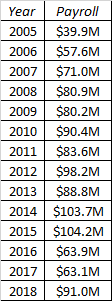
Attanasio inherited some bottom-of-the-barrel payrolls, but quickly increased spending in a big way upon taking over the club. Spending has continued on a relatively clean trajectory without any significant increases.
2016-17 stick out for the opposite reason as spending cratered while Stearns rebuilt the franchise. When the club showed significant (and somewhat unexpected) progress in 2017, Attanasio OK’d a return to something close to pre-rebuild spending levels.
The above chart conveys team spending pretty well as the Brewers haven’t endeavored on significant international acquisitions, either via international amateur bonuses or posting fees for negotiating rights with foreign professionals, and the club has never come close to luxury tax territory.
Future Liabilities
For a small market team, the Brewers have committed a good fit of payroll space moving forward.
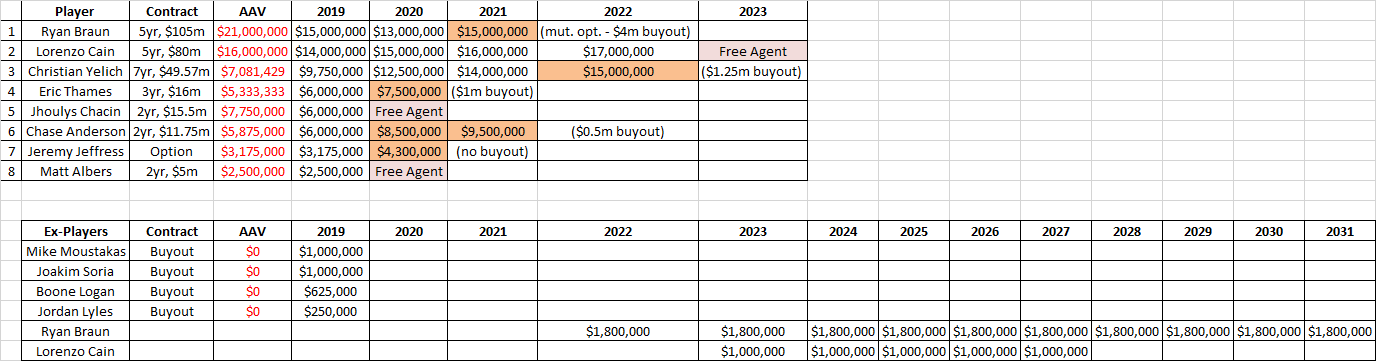
Braun has long been the face of the franchise, though surely he ceded a good bit of that status to the stars that follow him on the team’s payroll chart, Cain and Yelich. Braun will receive $1.8 million per year from 2022-31 in deferred salary, but that amount won’t handcuff the team now or in the future.
The Yelich deal provides some of the greatest value of any contract in all of Major League Baseball. That should help keep the Brewers competitive given the immensity of their savings over Yelich’s market value.
The remaining commitments are all quite safe as the team has only $1.5 million guaranteed beyond 2019 for Thames, Chacin, Anderson, Jeffress, and Albers combined. Thames, Anderson, and Jeffress are all controllable further via bargain-rate club options.
While the guarantees feature much of the Brewers core, the team’s arbitration-eligible players include numerous contributors, a couple of them essential to the team’s renaissance. Here are their arbitration projections (salary projections by MLBTR and Matt Swartz):
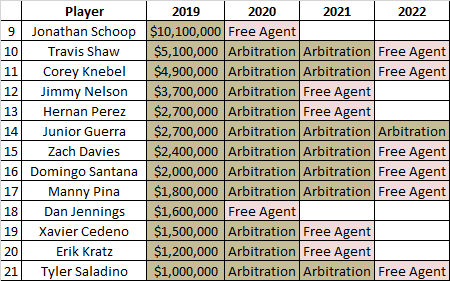
The Brewers feature numerous non-tender candidates. The biggest decision involves Schoop, a 27-year-old second baseman who starred for the Orioles in 2017 with average on-base skills and 32 long balls on the heels of a 25-homer season in 2016. Schoop’s offense cratered in 2018 as his BABIP dropped to .261 after he posted a composite BABIP of .319 from 2015-17. Schoop presumably had a chance to play his way into a big payday with the Brew Crew, but a putrid .202/.246/.331 batting line after his acquisition likely sealed his fate as a non-tender, especially given the presence of near-Major League-ready stud prospect Keston Hiura and fully-Major League-ready prospect Mauricio Dubon, despite his knee injury. The decisions on Kratz, Perez, Jennings, and Saladino are comparatively much less impactful to the budget, even for a team with a smaller spending capability such as Milwaukee. Kratz in particular was one of the great stories of the 2018 postseason. As it turns out, despite the presence of solid prospect Jacob Nottingham ready for a meaningful role and Pina around (discussed below), the team agreed to a $1.2 million deal to avoid arbitration, less than the $1.7 million for which Kratz was projected but a salary figure at which he has a much better chance to stick around.
On the other hand, many of the other names in the arbitration table are of the impact variety. Shaw has proven to be the team’s third-best regular, solidifying the third base spot. Knebel forms an elite bullpen triumvirate with Jeffress and fireballing lefty Josh Hader. Guerra provided 141 roughly average innings in 2018. Santana regressed markedly in 2018, but there’s still significant power in his bat and, if nothing else, he provides a strong bench bat at a cheap rate. Pina is a strong defensive catcher with a bit of power on a bargain deal.
Nelson merits separate mention. He missed all of 2018 with a shoulder injury, but that came on the heels of him making an ace turn in 2017. If Nelson returns at something close to his pre-injury form, the Brewers will enjoy a marquee addition for just $3.7 million. The rich keep getting richer.
Davies merits his own paragraph for largely the same reason. He compiled 5.3 WAR across 2016-17 before being felled by a shoulder injury that cost him most of 2018 and sapped his effectiveness when he did pitch. Nevertheless, Davies is yet another cheap rotation option.
Milwaukee is brimming with cheap, controllable talent that should help them compete into the next decade.
What Does Team Leadership Have to Say?
Following the season, Stearns hinted that spending won’t increase in 2019 to nearly the extent that it did prior to 2018. That doesn’t qualify as much of a surprise given the bare-bones payroll employed in 2017 and the competitive number utilized in 2018. Stearns called a repeat offseason “unrealistic” at the beginning of November.
It doesn’t seem as if management is expecting a huge influx of cash, at least not publicly.
Are the Brewers a Player for Bryce Harper or Manny Machado?
No.
Not in the Milwaukee market. Not with bottom-five payrolls every year. Not with so many big-market clubs competing to sign Harper and Machado.
Milwaukee isn’t going to be in these conversations.
What Will the 2019 Payroll Be?
This is a really important consideration for the Brewers. With so many significant players entering arbitration, they need to find a bit more cash to keep this core together for the coming years or Stearns will need to be especially creative in moving the right arbitration-eligible starting-caliber players for cheaper reinforcements.
Even assuming that the Brewers take the most aggressive non-tender approach that is plausible, cutting ties with Schoop, Perez, Jennings, and Saladino, the team would enter the offseason with $95.1 million committed to the roster, $4.1 million more than last year’s Opening Day payroll. Making any additions will require Stearns to expend some currency.
According to MLB.com, the team’s top seven prospects and 10 of the top 11 are position players. If the club makes a big expenditure, expect to see them focus on pitching.
Given where Milwaukee is on the win curve and how seriously they curbed spending while rebuilding, it’s reasonable to expect Attanasio to authorize a new franchise-high Opening Day payroll. But by how much? I’ll guess that payroll increases enough for everyone to notice but not so much that it stuns the baseball world.
With the projected payroll space below and an entirely right-handed rotation, don’t be surprised if Milwaukee makes a play for a free agent starter like J.A. Happ. If payroll is a bit tighter than expected, perhaps Wade Miley or a reunion with Gio Gonzalez make more sense.
Projected 2019 Payroll: $110 million
Projected 2019 Payroll Space: $14.9 million
Arbitration Breakdown: Mookie Betts
Over the last few days, I have been discussing some of the higher profile upcoming arbitration cases. I rely partly on my arbitration model developed exclusively for MLB Trade Rumors, but will also break out some interesting comparables and determine where the model might be wrong. 2019 projections are available right here.
After the first year of arbitration, it is typical for arbitration salaries to be rewarded as raises on top of previous year’s salaries, based on platform year performances. That sets Mookie Betts up for quite a hefty salary in 2019, since he nearly had a record high $10.5 million salary last year and had quite an accomplished 2018 campaign.
Mookie Betts won the MVP Award with a .346 average and 32 home runs. Batting out of the leadoff spot, he only had 80 RBI, but entering arbitration with the MVP Award, my model projects him to get an $8.2 million raise and earn $18.7 million. That would easily set a record for second time eligible salaries (Ryan Howard got $15 million way back in 2009), but would fall short of the record raise for second time eligible players. Bryce Harper set the latter mark in 2017 with $8.63 million riase. Harper’s case was atypical, though, because it came following a two-year deal. Other than that, Betts is projected for the largest raise ever—which does make sense following an MVP season.
In the last decade, only two players have entered their second year of arbitration coming off an MVP season—Josh Donaldson in 2016 and Josh Hamilton way back in 2011. Not only is Hamilton a stale comp at this point, but both received multi-year deals that might make them less likely to be used as comparables. While Donaldson’s $7.35 million raise would therefore not typically be a useful comparable, both he and the Blue Jays filed numbers in a tight band ($7.05 million and $7.5 million) that were also quite close to the actual result. Given that the comp is a few years out of date, it seems reasonable for Betts to argue that the Donaldson salary point represents a clear floor. Since Donaldson hit .297 with 41 HR and 123 RBI, his performance was more power-centric. But it certainly suggests roughly an $8 million raise for a reigning MVP is close to the right price.
Betts also won the batting title, which also calls back to Charlie Blackmon and Dee Gordon in recent years. The latter had only four home runs in 2015, so he is a weak comparable. Blackmon is a little stronger since his 2016 numbers — .324/29/82 — delivered some of the punch that Betts did at .346/32/80. That earned him a $3.8 million raise, which was actually well shy of what the model predicted. If there’s any added boost for the batting title, then, it’s tough to gauge.
Meanwhile, the Red Sox can certainly try to point to the Blackmon comp if they want to hold Betts’ salary down, but the Donaldson raise seems like a more compelling precedent since he won the MVP Award. And it probably does not hurt Betts’s negotiating position that he scored a major win over the Sox last year in a hearing. All things considered, I suspect Betts will get a record raise and earn quite close to his 2019 projection.
Projecting Payrolls: Boston Red Sox
As we kick off the seventh installment of this series, here are links to the previous team payroll projections:
Philadelphia Phillies
Los Angeles Dodgers
Los Angeles Angels
Atlanta Braves
New York Yankees
Chicago White Sox
If you have questions about financial information made available to the public and the assumptions used in this series, please refer to the Phillies piece linked above.
Today, we visit with the other Sox and reigning champions: the Boston Red Sox.
Team Leadership
The most recent significant ownership change for the Red Sox saw John Henry, Tom Werner, and the New York Times (yes, that New York Times) purchase the club from the JRY Trust, established following the 1992 death of team owner Jean Yawkey, the widow of Tom Yawkey. The Times sold its interest in two separate sales in 2011 and 2012, leaving Henry and Werner as the primary owners and Henry alone as the face of ownership.
The baseball operations department underwent a massive shakeup late in the 2015 season with longtime contender builder Dave Dombrowski joining the fold as President of Baseball Operations with former general manager Ben Cherington stepping aside in a corresponding move. Dombrowski had previously assembled pennant winners in Miami (1997) and Detroit (2006, 2012) before his arrival in Beantown. Over his three seasons, the Red Sox have averaged 98 wins per year, recording at least 93 victories each season.
Historical Payrolls
Before hitting the numbers, please recall that we use data from Cot’s Baseball Contracts, we’ll use average annual value (“AAV”) on historical deals but actual cash for 2019 and beyond, and deferrals will be reflected where appropriate. And, of course, the value of examining historical payrolls is twofold: they show us either what type of payroll a team’s market can support or how significantly a given ownership group is willing to spend. In the most useful cases, they show us both. We’ll focus on a 15-year span for the Red Sox, covering 2005-18 for historical data as a means to understanding year 15: 2019. We’ll also use Opening Day payrolls as those better approximate expected spending by ownership.
As a major franchise playing in a major city, it comes as no surprise that the Red Sox have spent and spent big year after year.
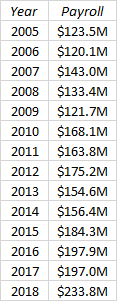
While Red Sox spending has always been significant, it took a notable jump following the only Yankees World Series win of the past 15 years as the 2010 Boston payroll increased a little over 38 percent from 2009. Since then, the Red Sox have remained near the top echelon of spenders.
That changed in 2018 as Boston blew away the competition financially, finishing the year as the only American League team to pay the luxury tax. The Red Sox made approximately $22 million in luxury tax payments from 2005-17, but they pushed the envelope in 2018, incurring a tax bill of at least $12.7 million and possibly more depending on the final calculation.
International spending has also been a hallmark of the franchise, as was blowing past slot recommendations for draft picks prior to the new rules that severely disincentivized the action. The Red Sox were responsible for arguably the most famous example of overspending international bonus pools under the previous system, throwing a $31.5 million bonus to Yoan Moncada, complete with a corresponding $31.5 million tax payment in February 2015.
The Red Sox also allocated a massive sum to the posting fee paid of $51,111,111.11 to the Seibu Lions in advance of the 2007 season for the rights to negotiate with starting pitcher Daisuke Matsuzaka.
Needless to say, Major League payroll has comprised only a significant portion of team spending, hardly the entirety of it.
Future Liabilities
Unlike some other teams in this series to date, the Red Sox have significant present and future guaranteed liabilities. Here are the guaranteed future dollars with club options highlighted in peach and the opt-out clause for J.D. Martinez that follows the 2019 season shown in light blue.

There is a lot to digest here.
The remaining four years and $127 million owed to David Price naturally jumps out. After a strong debut season, Price hasn’t delivered the ace-level production that the team hoped for when they signed him, but Red Sox fans enjoyed watching Price hoist the World Series trophy this fall after 26 solid postseason innings. He’s hardly an albatross, even if his contract doesn’t offer value at this point.
After a superstar offensive season, Martinez’s contract appears increasingly likely to be a two-year, $50 million deal instead of a five-year, $110 million pact as was guaranteed. If his 2019 is half as successful as his 2018, Martinez will opt out of the deal and pocket the $2.5 million buyout that comes along with the decision to do so. In the meantime, he’ll serve as an essential middle-of-the-order bat for the defending champions.
The remaining multi-year commitments go to players unlikely to help the next championship team in Boston. Pedroia has been a mainstay, but knee injuries may very well render him unable to return to form especially at 35. 2017 indicated that Vazquez had emerged as a defensive force with a palatable, if below average, offensive game at 27. 2018 indicated that 2017 was a mirage. It remains to be seen what value, if any, Boston will milk out of the remainder of Vazquez’s deal.
The remaining current players are all on one-year deals and they all figure to play a starting-level role for the team in 2018. Sale is a perennial Cy Young contender heading toward a record-breaking contract, Porcello won the award himself in 2016, and Moreland, Pearce, and Nunez all figure to get north of 400 plate appearances next year. The club features a ton of walk-year talent.
Of course, the future commitments to players aren’t limited to current Red Sox players by a long stretch. The team owes a staggering $47.5 million to released free agent flop Sandoval and Triple-A 30-year-old Castillo. Perhaps the club will find a taker for Castillo if he comes along with approximately $22 million, though it’s worth noting that he does not count against the Red Sox luxury tax payroll as long as he remains off of the team’s 40-man roster.
Finally, former stars Ramirez and Pedroia will receive just over $34 million between them into the middle of the next decade, a sum that is not insignificant but also doesn’t figure to move the needle much for the deep pockets in Boston. Those amounts have already been accounted for in regards to the luxury tax, so they won’t hurt Boston when making that calculation.
While the guarantees feature plenty of star power, there is no shortage of elite talent to be found among the arbitration eligible Red Sox. Here are their arbitration projections (salary projections by MLBTR and Matt Swartz):
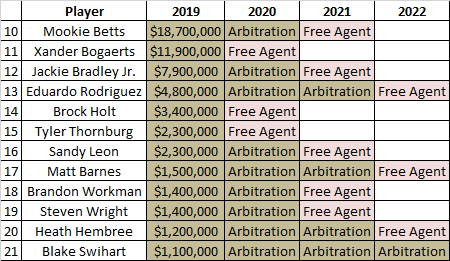
Betts, Bogaerts, and Bradley have long formed a young core for the club. Bradley’s bat has been below average the last two seasons, but Betts and Bogaerts have both regularly combined strong offense and defense to be impact players. With two years of control remaining on Betts and Bradley and one on Bogaerts, the team will likely continue extension talks. Obviously they have not found common ground to date, and it’s not known whether the Red Sox will succeed in locking down any of the three.
Rodriguez has grown into an above-average starting pitcher, albeit one who routinely misses time with injury issues. He figures to hold a rotation job through the coming years.
The remaining arbitration eligible Red Sox primarily serve to complement the bevy of ultra-talented players listed above.
What Does Team Leadership Have to Say?
Perhaps unsurprisingly, not much to date. They’ve been busy winning the World Series and celebrating their newest championship. The most noteworthy disclosure came from Henry following the season when he noted that the team won’t push their payroll to the top luxury tax penalties every season, calling out 2018 as an exception where adding the missing piece was worth the extra expenditure.
Are the Red Sox a Player for Bryce Harper or Manny Machado?
Well this is a tricky one. The Red Sox are obviously massive spenders who routinely find themselves with one of the top five payrolls in the game. Generally speaking, that is expected to be a prerequisite for entering the fray for Harper and/or Machado.
However, Boston has already committed major dollars to its championship core — a core that will only get more expensive in the next two years — and it would seemingly require major roster reconstruction to fit either young star into their group. In the case of Machado, there would also have to be a resolution of the conflict dating back to his April 2017 takeout slide of Pedroia.
Then again, it’s the Boston Red Sox. They shouldn’t be fully counted out for any big-time talent.
In the end, I’ll say that they’re not players for Harper or Machado. It’s too tough to see the math work from my vantage point.
What Will the 2019 Payroll Be?
More than for any other team that we have examined to date, the luxury tax is going to be a major factor for the Red Sox this winter. If the team makes no additional moves, they’ll have a cash payroll of $214.2 million and a luxury tax payroll of $216.0 million, assuming that Castillo remains off of the 40-man roster and, thus, doesn’t count against their tax payroll. With the luxury tax line sitting at $206 million, it’s awfully difficult to see how Boston gets under the line without sacrificing a key contributor or two. That’s no way to defend a title.
Instead, I suspect that the Red Sox will try to minimize their tax bill and ensure that they avoid hitting the $246 million threshold at which point their top draft pick is dropped 10 spots. It seems overwhelmingly likely that they will incur the 12 percent surtax for exceeding $226 million in luxury tax payroll, but, again, I expect that they will avoid the 42.5 percent surtax for exceeding $246 million in luxury tax payroll.
Provided that they plan to leave a little space for in-season acquisitions, let’s peg them at a spending level that enables the club to replace Craig Kimbrel at the back of the bullpen without breaking the bank.
Projected 2019 Payroll: $230 million cash ($232 million luxury tax)
Projected 2019 Payroll Space: $15.8 million