
3 Remaining Needs: NL East
There’s been no division in baseball more active than the National League East this offseason, as the Mets (Robinson Cano, Edwin Diaz, Wilson Ramos), Phillies (Jean Segura, Andrew McCutchen), Nationals (Patrick Corbin, Anibal Sanchez, Yan Gomes, Kurt Suzuki) and Braves (Josh Donaldson, Brian McCann) have each made multiple additions with an eye toward contending in 2019. That said, with the New Year fast approaching, each of those teams — and the cellar-dwelling Marlins — still have work to do and various needs to address. Here’s a look at what work remains to be done in one of the game’s most competitive divisions (teams listed in order of 2018 standings)…
Atlanta Braves
- Add a starter to the top half of the rotation. Mike Foltynewicz had a breakout season in 2018, while Sean Newcomb showed plenty of potential. The July addition of Kevin Gausman gave Atlanta another quality mid-rotation option, they’ve also lost arguably their most effective (and certainly their most surprising) rotation member in Sanchez, who has agreed to terms with the division-rival Nats. The Braves aren’t lacking on intriguing options to round out the rotation (e.g. Touki Toussaint, Luiz Gohara, Kolby Allard, Max Fried, Mike Sorokia, Kyle Wright), but there’s a clear lack of an established top-of-the-rotation arm.
- Address the vacancy in right field. Nick Markakis is a free agent and wasn’t able to sustain the eye-opening power surge he displayed through the season’s first six weeks. The venerable 35-year-old would be a fine option to return and man the position even if he shouldn’t be expected to repeat his 2018 numbers. The recent contracts for Andrew McCutchen and Michael Brantley subtracted two quality options from the open market, leaving top free agent Bryce Harper and a host of part-time veterans (e.g. Adam Jones, Carlos Gonzalez) as open-market alternatives.
- Bolster the bullpen. Arodys Vizcaino currently slots in as the projected closer, with A.J. Minter and Dan Winkler among the intriguing younger options. Veterans Darren O’Day and Jonny Venters bring plenty of talent but plenty of injury risk. Many of the young starters who don’t land in the rotation could be ‘pen options, as well, but there are obvious opportunities for a veteran arm to solidify the relief corps.
Washington Nationals
- Solidify second base. Howie Kendrick and Wilmer Difo are the Nationals’ top two options at present, but the former is coming off a season mostly lost to a ruptured Achilles tendon while the latter has yet to prove he can hit Major League pitching. Short-term veterans like Brian Dozier and Josh Harrison could serve as a bridge to top prospect Carter Kieboom, who could very well be the Nats’ long-term option there.
- Explore options for the fifth spot in the rotation. Adding a fifth starter isn’t necessarily an imperative for the Nationals, but a veteran to push Joe Ross and Erick Fedde for that slot could prove prudent — especially with Ross entering his first full season back from Tommy John surgery. Starting pitching is a clear strength, but the Nationals’ upper-level options in Triple-A are largely underwhelming, which makes a veteran addition, even on a minor league deal, all the more logical.
- Continue to monitor Bryce Harper’s market. It’s quite possible that Harper’s time in D.C. is legitimately over, especially considering the fact that he rejected a 10-year extension offer worth a reported $300MM in late September. But if Harper’s market doesn’t develop as strongly as agent Scott Boras hopes, the Nats should be looming on the periphery of the market to see if there’s a possible compromise to be had with their longtime star.
Philadelphia Phillies
- Acquire an impact bat. Wise or not, the Phillies set their fans’ expectations as high as possible when owner John Middleton said earlier this offseason that he could get “a little stupid” with the money that he spent in free agency this winter. Philly has been connected to Harper and Manny Machado for so long, that some fans will consider it an outright failure if at least one of the two isn’t in manager Gabe Kapler‘s Opening Day lineup.
- Upgrade the middle of the rotation. Of course, even if Bryce and Manny end up elsewhere, the Phils could still craft a winning path. Beyond pursuing any and all creative options that can be placed on the table, Matt Klentak and company would do well to bolster an already solid rotation. While it was generally an area of strength in 2018, and could be again without modification, the rotation is also an obvious place for the Phillies to slot in a significant (or even blockbuster) addition. Opportunity remains in both trade and free agency. If an acquisition results in a hurler such as Nick Pivetta, Vince Velasquez, or the rehabbing Jerad Eickhoff being knocked into the bullpen for some or all of the season, well, that’s a nice luxury to have.
- Add to the back end of the bullpen. The Phils have some interesting youthful power arms along with a few respected veterans in their current bullpen mix, but it’s far from a standout group on the whole. Given the whispers regarding the team’s willingness to part with Tommy Hunter and/or Pat Neshek, it does not seem as if the front office is entirely satisfied with the current unit, either. This is one of a few clubs that could easily afford to splurge on Craig Kimbrel, not that we’ve seen any real indication of a connection. A variety of other notable relief targets are still floating around the market as well.
New York Mets
- Figure out who’s playing center field. On paper, it’s possible to imagine a situation where Michael Conforto or Brandon Nimmo shares time in center with the right-handed-hitting Juan Lagares. And the Mets have already added center-field-capable veterans Rajai Davis and Gregor Blanco on minors pacts, perhaps hinting that they’ll be looking for a budget reserve piece to help keep up appearances while Yoenis Cespedes works back to health. But these are really half-measures, and the Brodie Van Wagenen-led Mets have set their sights on more than mediocrity. Will the team really fall back on Lagares in a significant role? Or is there another move yet to come? There were plenty of rumors about A.J. Pollock, who’d certainly fill the need, but Van Wagenen has also hinted the team may not put big money on the free agent table after already adding a few reasonably expensive pieces.
- Improve the bench/pen depth. When you’re trying to take a team from 77 to 90+ wins in a competitive division, every little bit counts. If another more significant addition isn’t to be made, then perhaps the way to get better is to add a few lower-priced assets that can add major value in part-time roles. At present, the position-player reserve competition is set to include players such as T.J. Rivera, Dominic Smith, Gavin Cecchini, Luis Guillorme, and Dilson Herrera along with Davis and Blanco. Meanwhile, relievers battling for MLB spots include Drew Smith, Tim Peterson, Corey Oswalt, Chris Flexen, Paul Sewald, Jacob Rhame, Bobby Wahl, Kyle Dowdy, and Daniel Zamora. Put it all together and … there’s not a lot in the way of established MLB performance in those areas.
- Trade Travis d’Arnaud or Kevin Plawecki. Re-shuffling things a bit might help the Mets make better use of resources. Having decided to go with Wilson Ramos behind the dish, the club seems to have one MLB catcher too many, particularly with Tomas Nido also available (with options) on the 40-man. A deal of either d’Arnaud or Plawecki seems all but certain. Turning one of those players into a decent reliever or worthwhile prospect would be a nice outcome.
Miami Marlins
- Find a trade partner for J.T. Realmuto. Last winter, the Fish played coy on Christian Yelich but ultimately dealt him.They nevertheless held Realmuto — a decision that actually seems to have worked out. While he’s now just two years from free agency, Realmuto also firmly established himself as the game’s best overall catcher in the interim. Now, we’re seeing more talk about hanging onto him entering another rebuilding season. That seems only to be cover, though, because the risks greatly outweigh the upside (if any) in holding on to Realmuto to open the season. Several suitors have moved on, but others remain. The Marlins ought to pick the best bid in the coming weeks.
- Acquire veteran outfield depth. This version of the Marlins is obviously going to be young and inexperienced. But that doesn’t mean that Derek Jeter and co. are interested in a re-boot of the Major League series set in South Beach. The new regime has spoken about the need for winning mentalities and the like. Meanwhile, it has a variety of talented young outfielders who’ll need time to finish their development and guidance in making the leap to the game’s top level. Last year, the Fish secured the services of Cameron Maybin. It seems a similar move would again be wise.
- Be opportunistic on relievers late in the offseason. It’s never wise for a losing team to blow money on relief pitching. On the other hand, value bets in the bullpen are quite a nice strategy for a rebuilding organization. For one thing, a decent pen helps the club avoid depressing, late-game losses. For another, it is an easy and cheap avenue for infusing some of that ever-loved veteran presence into a locker room. And every contender in baseball will be looking for reliever reinforcements this summer, so it’s always nice to have a stock of potential trade chips on hand. Landing a few interesting arms shouldn’t be too hard to pull off. The Marlins have plenty of opportunities to offer up (including late-inning roles, potentially) and can use that, moreso than money, to lure a few hurlers who otherwise have slipped through the cracks.
Poll: Projecting Gary Sanchez’s 2019
With the New Year approaching, the focus in Yankees Universe continues to be on whether the club will sign Manny Machado, the transcendent, polarizing free agent who’d provide an enormous boost to the left side of its infield. However, regardless of whether Machado heads to the Bronx, it’s fair to say the Yankees won’t reach their peak potential in 2019 without a bounce-back effort from their most polarizing star, catcher Gary Sanchez.
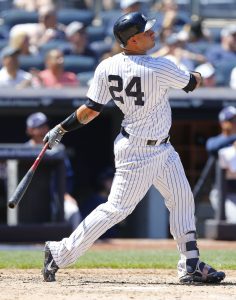
An elite prospect throughout his time in the Yankees’ system, Sanchez burst on the scene in 2016, his abbreviated rookie season. After the Yankees promoted him for full-time duty that August, Sanchez proceeded to swat an astounding 20 home runs in just 229 plate appearances and tie Mike Trout for the majors’ best wRC+ (170). Sanchez came back to earth the next year – his first full campaign – to some degree, though he still left the yard 33 times and registered a 129 wRC+ over 525 PAs.
Based on Sanchez’s output during his initial two seasons, there was little reason to doubt he’d continue serving as one of the Yankees’ cornerstones (and one of the game’s foremost catchers) last year. Instead, Sanchez never really got off the ground during what proved to be an injury-shortened, 89-game campaign, as he slashed a mere .186/.291/.406 (89 wRC+) in 374 PAs. Not only did Sanchez’s newfound offensive struggles frustrate fans, but so did his oft-maligned defense. For the second straight year, Sanchez finished with the American League’s most passed balls (18), which also ranked last in the majors. Unsurprisingly, then, he rated poorly as a blocker at Baseball Prospectus, which graded him second last in that department.
Despite Sanchez’s woes in 2018, general manager Brian Cashman was steadfast in defending the backstop throughout the season, telling anyone who’d listen the Yankees have a franchise catcher on their hands. That hasn’t stopped this offseason, even though trade rumors featuring Sanchez have been plentiful. Earlier this month, Cashman told Jack Curry of the YES Network that Sanchez is “not for sale,” adding that the Yankees expect they’ll be “proven correct” that he’s a foundational piece.
If we’re to take Cashman at his word, it’ll continue to be Sanchez donning the tools of ignorance for the Yankees in 2019 – not a trade possibility like the Marlins’ J.T. Realmuto or the No. 1 free agent available, Yasmani Grandal. Both Realmuto and Grandal outclassed Sanchez last year, but before the latter’s Murphy’s Law 2018, he belonged in the discussion with those two and the game’s other top catchers. It’s understandable Yankees brass has the 26-year-old Sanchez’s back, then, and it becomes easier to see why when considering some of his underlying numbers from last season.
Sure, Sanchez’s overall offensive production was a colossal disappointment, but it still came with some encouraging signs. He continued to flash prodigious power, totaling 18 homers and logging a .220 ISO (well above the league average of .161). Further, compared to his previous two seasons, there weren’t any alarming trends in Sanchez’s strikeout, walk, swinging-strike, chase or contact rates. When Sanchez did put the bat on the ball, he often made it count, as he placed fifth in the majors in average exit velocity on line drives/fly balls (97.7 mph) and 19th in barrels per plate appearance (tying a pretty good duo consisting of teammate Aaron Judge and the Braves’ Ronald Acuna). Sanchez’s ability to make hard contact helped lead to a solid expected weighted on-base average (.343) which easily outdid his real wOBA (.304).
So what went wrong? Poor fortune seems largely to blame, given that Sanchez managed a meager .197 batting average on balls in play – down 111 points from the more normal-looking .308 mark he recorded between 2016-17. Granted, Sanchez didn’t help his cause by hitting far fewer line drives and far more pop-ups than he did in 2017. Sanchez’s 19.2 percent infield fly rate ranked last among qualified hitters, and because a pop-up is essentially an automatic out, that’s going to have to change going forward.
As for Sanchez’s work behind the plate, perhaps it’s unfair to regard his presence as disastrous to the Yankees’ defensive efforts. For one, the cannon-armed Sanchez caught at least 30 percent of would-be base stealers for the third consecutive year. And while blocking pitches has been a problem for Sanchez, Baseball Prospectus has assigned him high framing marks to this point. The outlet did hand Sanchez a negative overall grade in its Fielding Runs Above Average metric last season, though there were still plenty of worse catchers (admittedly, that’s faint praise).
Heading into 2019, Sanchez’s final pre-arbitration season, there’s clearly ample room for improvement both at the plate and behind it. Whether Sanchez will take the field on Opening Day is in question, though, as he’s only about a month and a half removed from left shoulder surgery. Sanchez’s shoulder – which had been an issue since 2017 – may have helped lead to his downfall last year, and if his recovery goes well, there are legitimate reasons to believe he’ll rebound in 2019. The Steamer projection system is on board, as it pegs Sanchez for 3.5 fWAR, a .245/.322/.482 line (116 wRC+) and 31 homers. How do you think he’ll fare?
(poll link for app users)
Which Gary Sanchez Will Show Up In 2019?
-
Something In Between 52% (9,323)
-
The Star-Caliber Version 34% (5,973)
-
The 2018 Version 14% (2,464)
Total votes: 17,760
Photo courtesy of USA Today Sports Images.
MLBTR Originals
Rounding up the original content from the MLB Trade Rumors writing staff over the last two weeks…
- This offseason’s free agent market has been humming along at a respectable pace, at least in comparison to last winter’s historic lack of activity. Jeff Todd took a look at the signing action thus far, in regards to which members of MLBTR’s Top 50 Free Agents list had found deals. At the time of Jeff’s post on December 18, sixteen of the 50 had signed, and six more names (Andrew Miller, Anibal Sanchez, Matt Harvey, Daniel Murphy, Trevor Cahill, Joakim Soria) have also since landed new contracts.
- Along those same lines, Mark Polishuk polled the MLBTR readership to ask which of the seven remaining unsigned members of our Top 10 free agents would be the next to ink a deal. Yasmani Grandal was the top choice with just over 25% of the vote, though it was fourth-place finisher Michael Brantley (who netted 14.89% of the vote) who ended up signing soonest, agreeing to a two-year deal with the Astros barely 24 hours after the poll was posted.
- Connor Byrne also put a question to the readers, asking which of Yasiel Puig or Nick Castellanos was the preferred acquisition in a Trade Candidate Faceoff. 58.55% of the vote went towards Castellanos, though apparently the Reds didn’t agree with the majority, as Cincinnati acquired Puig as part of a seven-player trade with the Dodgers last week.
- Speaking of trades, Jose Martinez no longer appears to have a starting role with the Cardinals, and thus stands out as a candidate for a deal. Mark explored the first base/DH market to try and find a trade partner for Martinez, though the search is complicated by Martinez’s lack of defensive prowess and the number of teams who have already addressed needs at first base.
- Rob Huff continued his Projecting Payroll series with a look at what the Cardinals might have available to spend this winter. Based on roster needs and past spending habits, Rob estimated that the Cards could have around $26.3MM in available funds. A good chunk of that money has already been used up, of course, as St. Louis made a big splash in the bullpen market to sign Miller to a two-year deal worth $25MM guaranteed, plus a vesting option for 2021.
- With the caveat that not all contract terms are made public, approximately 12 teams currently have a manager or a front office boss (a GM or a president of baseball operations) going into the last year of their contracts, as Mark details in this listing of team personnel that may or may not be on the hot seat in 2019.
Managers & Top Front Office Executives On Expiring Contracts
Managers and front office bosses are always doing their best to progress their teams forward, though this particular list of names could be feeling a bit more pressure this coming season, as 2019 is their final guaranteed year under contract.
As always when compiling this list, a pair of caveats should be noted. Firstly, several teams don’t publicize the lengths of management contracts, and some teams don’t even announce when new contracts have been finalized. It could very well be that at least some of the executives listed have already quietly reached extensions beyond the 2019 season, or there could be some other names with unknown contract terms who have 2019 as their end date.
Secondly, lack of an official contract doesn’t always mean that a manager or an executive is lacking in job security. Some clubs have unofficial handshake agreements in place with the skipper or GM/president of baseball operations, wherein the job is promised as theirs, with the specific contractual details to be hammered out at some point in the future. In the case of managers, specifically, many do prefer some type of public agreement, if for no other reason than to avoid being perceived as a “lame duck” who lacks authority within a clubhouse.
With a big tip of the cap to Cot’s Baseball Contracts for many of these details, here are the managers and executives who are believed to be entering their final seasons…
Angels: General manager Billy Eppler is three years into his original four-year contract to run the Halos’ front office, a term that has yet to result in a winning record. Much has been made about the Angels’ inability to build a contender around Mike Trout during the outfielder’s Cooperstown-level prime years, and time is running short in that regard, given that Trout can become a free agent the 2020 season. In Eppler’s defense, he has added quality pieces like Andrelton Simmons, Justin Upton, and Shohei Ohtani as GM, though he has been hampered by a seemingly endless list of pitching injuries, not to mention some payroll-albatross contracts (Josh Hamilton, C.J. Wilson, and the ongoing Albert Pujols deal) left over from the tenure of previous Angels GM Jerry Dipoto. Longtime manager Mike Scioscia had reportedly always had quite a bit of influence within the front office, though with Scioscia not returning, Eppler had the opportunity to make his own managerial hire in the form of Brad Ausmus. There hasn’t yet been any indication that Eppler could be in particular danger of not being extended, though it’s worth noting that neither of Eppler’s predecessors in the job (Dipoto and Tony Reagins) lasted more than four years.
Blue Jays: Sportsnet.ca’s Shi Davidi noted in September that general manager Ross Atkins was likely to receive an extension, and that such a deal wasn’t likely to receive public acknowledgement. So, Atkins may already be locked up beyond the original end-date of his four-year deal prior to the 2016 season. Atkins and president Mark Shapiro have planted the seeds for a rebuild over the last two seasons, and with the Jays now in full-fledged retooling mode for at least one more year, it makes sense that Atkins would continue to hold the reigns as Toronto prepares for the Vladimir Guerrero Jr. era.
Brewers: This one is a bit speculative, as terms of GM David Stearns‘ original deal with the Brewers weren’t released, though The Athletic’s Ken Rosenthal reported in October that “Stearns has at least one year left” under contract. Stearns was hired prior to the 2016 season, so a four- or five-year deal seems pretty standard for a new general manager, particularly one that was seemingly facing a rebuild upon taking the position. Needless to say, things are ahead of schedule in Milwaukee, as the Brewers were just a game away from the World Series last October. Even if Stearns’ deal runs through 2020 rather than just 2019, it seems likely that Brewers ownership will have some talks about an extension this offseason given Stearns’ immediate success.
Cubs: There has already been quite a bit of speculation about Joe Maddon‘s future at Wrigley Field, as the Cubs aren’t planning to discuss a new contract with the manager. Though Maddon himself seems unperturbed about the situation and president of baseball ops Theo Epstein denied rumors of any hard feelings with his skipper, it does seem like a dugout change could be made unless the Cubs make another deep postseason run.
Diamondbacks: With two winning seasons and the 2017 NL Manager Of The Year Award on his resume in two years as manager, Torey Lovullo seems like a prime candidate for a new deal. Though Arizona is now moving into a semi-rebuilding phase, this actually seems closer to the situation Lovullo was expected to inherit when he initially took the job, before he led the D’Backs to their surprise postseason berth in 2017. I’d expect Lovullo to have an extension in hand by Opening Day at the latest.
Dodgers: Since president of baseball operations Andrew Friedman signed his five-year, $35MM deal to take over the Dodgers’ front office in October 2014, the club has extended its streak of NL West titles to six in a row, and finally got over the postseason hump to return to the World Series, capturing the NL pennant in each of the last two seasons. While the Comissioner’s Trophy has remained elusive, Friedman has managed to keep the Dodgers competitive even while cutting salaries, getting the team under the luxury tax threshold last season after payrolls touched the $300MM mark earlier this decade. This is probably another instance of an extension being just a matter of time, as the Guggenheim Baseball ownership group seemingly has every reason to want to keep Friedman in the fold for several years to come.
Giants: The leadership shakeup that installed Farhan Zaidi as the Giants’ new GM didn’t extend to the dugout, as longtime manager Bruce Bochy will return for the last year of his current contract and his 13th overall season in San Francisco’s dugout. Bochy turns 64 in April and he has dealt with heart issues in the past, leading to some whispers that he could move into retirement and hand the job over to a new manager. Longtime coaches Hensley Meulens and Ron Wotus have both been mentioned as possible managers-in-waiting, or Zaidi could prefer to hire a new face from outside the organization. It also wouldn’t be a shock to see Bochy stick around in 2020 or beyond, should he want to continue managing and he forms a solid relationship with Zaidi. Given Bochy’s championship-winning track record and the large amount of respect he holds within the organization, the possibility exists that he has already been promised the opportunity to end his tenure on his own terms.
Indians: General manager Mike Chernoff reportedly agreed to an extension with the team in November, though this is technically still an unknown situation since there wasn’t any official confirmation from either side. That said, since Cleveland is one of the organizations that generally stays quiet about contract details for management figures, we can probably consider this one a done deal. Chernoff was promoted to general manager in October 2015, so he could have been at the end of a three-year contract or the Tribe was getting an early jump on extending his four-year contract. It’s also worth noting that president of baseball operations Chris Antonetti signed an extension of indeterminate length back in 2013 and we haven’t heard any further contract news since, so Antonetti could also be approaching the end of a deal…unless he also signed an unreported extension at some point. It’s safe to assume that big changes aren’t in the offing for a team that has won three straight AL Central titles.
Marlins: “There are indications the Marlins would like to retain [Don] Mattingly beyond 2019,” MLB.com’s Joe Frisaro recently reported, though Mattingly said that he had yet to hear from the team about extension negotiations. Mattingly has managed the Fish through three tumultuous years in the organization’s history, and the fact that he is one of the few members of the Jeffrey Loria regime still in Miami could indeed be a sign that Derek Jeter and company have interest in keeping the veteran manager around to help mentor and develop young players during the franchise’s latest rebuild.
Red Sox: Principal owner John Henry recently noted that the team was “running out of time” in regards to an extension with president of baseball operations Dave Dombrowski, whose five-year contract is up after the 2019 season. (Since Dombrowski was hired in August 2015, the deal can probably be more accurately described as 4.5 years in length.) Regardless of when the specific end-date may be, Dombrowski could hardly be in better position to land an extension in the aftermath of Boston’s World Series triumph.
Rockies: 2019 is the last guaranteed year of Bud Black‘s contract as manager, though he has a bit of extra cushion since the Rockies hold a club option his services for 2020. Since Black has led Colorado to the postseason in each of his first two seasons as manager, it seems like he’ll at least get that option exercised to add a bit more security, plus the team is likely to discuss a longer-term deal as well.
Royals: GM Dayton Moore has often reiterated that manager Ned Yost will decide on his own when to step away from the dugout, though that won’t happen for at least one more year, as Yost agreed to a one-year extension last September. As Fancred Sports’ Jon Heyman put it, however, there is “strong belief” that Yost won’t manage beyond 2019. The Royals’ recent hiring of Mike Matheny to a special advisor role could be another sign that the team already has a successor in place for the 2020 season.
Looking For A Match In A Jose Martinez Trade
Jose Martinez was the Cardinals’ second-best hitter in 2018, he has a .309/.372/.478 slash line over 915 career MLB plate appearances, and he isn’t eligible to hit free agency until after the 2022 season. On most clubs, Martinez would be considered a valuable building block — in St. Louis, he has already become an afterthought. Paul Goldschmidt has taken over as the Cards’ everyday first baseman, and with Marcell Ozuna in left field and Dexter Fowler slated for right field duty and hoping for a rebound, Martinez is now a man without a position, making him an intriguing potential trade chip as the Cardinals continue their offseason business.
Of course, there’s a good case to be made that St. Louis might not want to deal Martinez at all. Since Goldschmidt is only under contract through 2019, the Cards may want to keep Martinez in the fold as long-term insurance if case Goldschmidt leaves in free agency. Secondly, Martinez’s inexpensive pre-arbitration salary makes him a good asset for St. Louis to have as a bench bat. It’s easy to imagine the Cardinals hanging onto Martinez for late-game pinch-hitting duty, or the occasional spot start should Goldschmidt, Ozuna, or Fowler require a day off. Plus, should Fowler’s struggles continue next season, Martinez could find himself getting more regular playing time in right field.
There’s also the fact that the Cardinals seem to have already completed their biggest winter additions. After landing Goldschmidt and Andrew Miller, the Cards’ remaining needs are relatively minor — a backup catcher, a left-handed bench bat, and perhaps another bullpen arm. Any of these could be addressed in free agency rather than by trading Martinez.
With those arguments in mind, let’s now look at the case for why St. Louis might want to swing a deal. For starters, trading Martinez now could be a sell-high move. He was an unheralded prospect, who bounced around three other organizations (White Sox, Braves, Royals) before landing with the Cardinals, and Martinez didn’t really show much at the plate until 2014, when he was a 25-year-old on Atlanta’s high-A ball team. Since Martinez turned 30 last July, he doesn’t really project as a long-term piece for the Cards.
There’s also the fact that “man without a position” is something of an apt description for Martinez even when he was getting everyday at-bats, as he has been a below-average defensive player whenever he has played around the diamond. In 637 2/3 innings as an outfielder, Martinez has a -10.6 UZR/150 and minus-13 Defensive Runs Saved. He hasn’t fared much better even at the less-stressful position, posting minus-6 DRS and a -2.8 UZR/150 over 936 1/3 frames at first base. While Martinez’s defense isn’t really an issue if he’s only limited to a spot start, or an inning or two at the end of a game after a pinch-hitting appearance, his poor glovework makes him a liability should the Cards actually need him for an extended fill-in capacity in case of injury.
The Rays and Dodgers have both reportedly shown some interest in acquiring Martinez, who makes some sense on either roster. Los Angeles is looking to add some right-handed pop to its mostly left-handed lineup, though the Dodgers could be aiming for bigger-ticket additions (such as J.T. Realmuto or A.J. Pollock) than Martinez. It’s possible that Tampa’s recent acquisition of Yandy Diaz could have taken them out of the Martinez hunt, as Diaz is another right-handed hitting complement to Ji-Man Choi in the first base/DH mix and Diaz also offers more defensive flexibility.
The Cardinals also tried to use Martinez as a trade chip to land Will Smith from the Giants, though it doesn’t appear San Francisco had much interest. While the Giants need corner outfield help, Martinez would be a poor fit in the spacious AT&T Park outfield, and first base is already spoken for in the form of Brandon Belt (plus, Buster Posey handles first when the Giants spell him behind the plate).
We’ve already seen some significant action within the first base market this winter, as the likes of Goldschmidt, Edwin Encarnacion, Carlos Santana (twice), Justin Bour, C.J. Cron, Matt Adams, and Steve Pearce have all been traded or signed with new teams. Daniel Murphy will also be serving mostly as a first baseman with the Rockies, which addresses arguably the most glaring first base hole on any contending team.
It doesn’t leave much in the way of a wide-open trade market for Martinez, particularly since NL teams could be less likely to make a push given his lack of defensive prowess. On the plus side, his four years of team control could attract rebuilding clubs as well as contenders.
The Royals or Tigers make some sense as a Martinez suitor, though K.C. has a lot of right-handed hitters already and Detroit has youngster Christin Stewart slated for some DH duty due to his own defensive shortcomings. Martinez’s low price tag could appeal to the Mariners as they continue to cut costs, though the Cardinals would likely have to bring a third team into the trade to acquire Encarnacion, who obviously isn’t a fit in St. Louis with Goldschmidt on board. The White Sox could use Martinez as a part-time outfielder and platoon partner with Yonder Alonso in 2019, with an eye towards a more regular role if one or both of Alonso and Jose Abreu depart in free agency after the season. The Astros have been reportedly checking around for first base/DH help, though with Yuli Gurriel and Tyler White already provided right-handed bats, Martinez could be overkill.
Returning to the National League, one interesting option could be Goldschmidt’s former team. The Diamondbacks are planning to give Jake Lamb some time at first base this season, though Lamb is coming off a rough 2018 and didn’t even hit left-handed pitching well even when he was in good form. If the D’Backs added Martinez to the first base mix, that would allow them to situationally shuffle Lamb to third base, Eduardo Escobar to second, and Ketel Marte potentially to center field. While Martinez-to-Arizona makes sense on paper, however, one would imagine the idea was already floated between the D’Backs and Cardinals when they were discussing the Goldschmidt trade. While that doesn’t necessarily mean the Diamondbacks wouldn’t pursue Martinez in a future deal later this winter, Martinez’s non-inclusion in that initial trade could indicate some lack of interest on Arizona’s part.
Checking In On MLBTR’s Top 50 Free Agent Predictions
As MLBTR’s Mark Polishuk recently pointed out, at this time last year we had seen no open-market movement from the top of the free-agent pool. There’s still quite a lot of work to be done with regard to the current crop of players, but there also has been quite a bit more movement. With ten of the top twenty players listed on MLBTR’s Top 50 Free Agent list now having reportedly agreed to terms, it’s a good time to check in on how the market is developing.
Here are the deals that have reportedly been struck do date, not all of which have been finalized:
3. Patrick Corbin, SP — Predicted: 6 years, $129MM. Signed: 6 years, $140MM.
7. Nathan Eovaldi, SP — Predicted: 4 years, $60MM. Signed: 4 years, $68MM.
9. J.A. Happ, SP — Predicted: 3 years, $48MM. Signed: 2 years, $34MM.
10. Michael Brantley, OF — Predicted: 3 years, $45MM. Signed: 2 years, $32MM.
11. Andrew McCutchen, OF — Predicted: 3 years, $45MM. Signed: 3 years, $50MM.
13. Josh Donaldson, 3B — Predicted: 1 year, $20MM. Signed: 1 year, $23MM.
14. Charlie Morton, SP — Predicted: 2 years, $32MM. Signed: 2 years, $30MM.
15. Wilson Ramos, C — Predicted: 3 years, $36MM. Signed: 2 years, $19MM.
17. Jeurys Familia, RP — Predicted: 3 years, $33MM. Signed: 3 years, $30MM.
20. Hyun-Jin Ryu, SP — Predicted: 3 years, $33MM. Signed: 1 year, $17.9MM.
25. Joe Kelly, RP — Predicted: 3 years, $27MM. Signed: 3 years, $25MM.
36. Lance Lynn, SP — Predicted: 2 years, $16MM. Signed: 3 years, $30MM.
43. Garrett Richards, SP — Predicted: 2 years, $10MM. Signed: 2 years, $15.5MM.
44. Jesse Chavez, RP — Predicted: 2 years, $10MM. Signed: 2 years, $8MM.
45. CC Sabathia, SP — Predicted: 1 year, $8MM. Signed: 1 year, $8MM.
48. Kurt Suzuki, C — Predicted: 2 years, $8MM. Signed: 2 years, $10MM.
Total — Predicted: $560MM. Signed: $540.4MM.
It’s possible to look at that slate of signings and believe that the market is humming along. Perhaps the biggest point in favor of an optimistic outlook from the players’ perspective is the fact that many early moves seem to have set teams up for yet more acquisitions. Few if any teams appear “done” with their shopping at this point.
Of course, one could also argue that the earliest-to-sign free agents naturally outperformed expectations, since strong early interest is what drove their market. It could be that other names on the T50 list will find tougher going. Plus, the top of the position-player market and much of the relief market remain unresolved. And there’s a big group of mid-level free agents (and below) that are still waiting to see how things will shake out up top.
Timing is also an interesting topic to consider. Players are no doubt resolved not to allow the ticking clock to become too strong a lever for teams, who made clear last winter that patience isn’t going to be in short supply. Perhaps there’s still some feeling-out to be done in light of last year’s market shock, and there’s at least one significant trade chip (J.T. Realmuto) who could be holding things up a bit, but we may also simply be in an era when more of the offseason business tends to be completed later on the calendar.
Poll: Who Will Be The Next Top-10 Free Agent To Sign?
A year ago on this date, only one of the top ten names on MLBTR’s list of the top 50 free agents of the 2017-18 offseason had decided on their team for the upcoming season. That player, in fact, wasn’t technically even a free agent at all — Masahiro Tanaka decided against opting out of his contract with the Yankees, thus avoiding the open market altogether.
So, at least in comparison to the uniquely slow pace of last year’s offseason, we’ve already seen quite a bit of action on the free agent front this winter. After today’s news of Wilson Ramos‘ deal with the Mets, seven of the top 25 players in this year’s top 50 ranking have already reached agreements, including three members of the top ten — Patrick Corbin (#3) signed with the Nationals, Nathan Eovaldi (#7) re-signed with the Red Sox, and J.A. Happ (#9) has reportedly agreed to rejoin the Yankees.
There have been a lot of rumors swirling around the remaining seven players in our top ten, and it’s anyone guess as to which will be the next to sign. Let’s take a look at where things reportedly stand with each member of this septet….
Bryce Harper: With Harper and agent Scott Boras reportedly looking for nothing less than the biggest contract in baseball history, it would admittedly be surprising to see the former Nationals outfielder come off the board next. Harper, his wife Kayla, and Boras has reportedly held court with multiple teams in private meetings in Las Vegas, though the specific identities of these teams isn’t yet clear. Teams like the Dodgers, White Sox, Phillies, and Cardinals are known to have some level of interest in Harper’s services, while we’ve also heard some teams (like the Nationals and Yankees) seemingly count themselves out of “Harper’s Bazaar,” as Boras calls it. Speculative fits like the Cubs or Giants could also be out due to budget constraints. Boras has a penchant for waiting until deep into the offseason to find a satisfactory contract for his clients, so I’d guess that we won’t know the identity of Harper’s next team before 2018 is over.
Manny Machado: The star infielder is set for in-person meetings with the White Sox, Yankees, Phillies, and at least one more team this week. It’s impossible to mention Machado’s free agency without also mentioning Harper, as the two share many of the same suitors and it seems highly unlikely that one team would be willing to spend big enough to add both to the same roster. Machado’s controversial history of overly-aggressive (or, as some might say, outright dirty) play has been a factor in his market, as was his October interview with The Athletic’s Ken Rosenthal about his admitted lack of maximum effort on some plays, and his admission that “I’m not the type of player that’s going to be ‘Johnny Hustle.’ ” While questions about Machado’s personality are legitimate, especially as he is looking for a record-breaking contract, it’s also possible some teams are using Machado’s interview as leverage to try and lower his price tag. We should know more about Machado’s status once these in-person meetings are complete, and if a team’s concerns about his work ethic are erased after a face-to-face meetings, it isn’t impossible that a signing could come before Christmas.
Dallas Keuchel: Another Boras client, Keuchel might not have quite as long a wait on the market since there has already been something of a run on free agent starting pitching, as Corbin, Eovaldi, Happ, and Charlie Morton have all found new teams. On the trade front, there now seems to be less chance that the Indians could deal Corey Kluber or Trevor Bauer, while the Mets’ flurry of acquisitions have made a Noah Syndergaard trade less likely. Teams that missed out on these frontline arms may now be willing to meet Keuchel’s hefty asking price, and give up the draft pick compensation necessary to sign the lefty since he rejected the Astros’ qualifying offer. Teams like the Reds, Braves, Padres, Blue Jays, Phillies, and Nationals have all been reported to have varying levels of Keuchel’s services.
Craig Kimbrel: Teams would also need to surrender a draft to sign Kimbrel since he turned down a QO from the Red Sox, and might also have to fork over the biggest contract ever given to a relief pitcher. A big initial ask is a common negotiating tactic, of course, though even at a lower amount, Kimbrel and his representatives clearly see him worthy of a deal akin to Aroldis Chapman/Kenley Jansen money. The Cardinals and Phillies have both been linked to Kimbrel, and the Red Sox may or may not still be in on their former closer. The recent signings of Jeurys Familiar and Joe Kelly indicate that the bullpen market is starting to move, though Kimbrel is obviously in a higher financial level than those types of contracts.
Yasmani Grandal: The Angels, Astros, and White Sox have all been linked to Grandal, though Houston might be out of the catching market after signing Robinson Chirinos. Chicago also recently added James McCann, though that isn’t quite as significant an obstacle to a future move for Grandal, should the Sox deal Welington Castillo and then install Grandal as the starter ahead of McCann. Even before Ramos became a Met, Grandal’s biggest competition has likely been J.T. Realmuto, though teams have thus far balked at meeting the Marlins’ large asking price in a trade. The Mets are one team that decided to simply sign a quality catcher rather than trade for Realmuto, and another backstop-needy team could do the same by inking Grandal, though he’s another QO free agent. There has been some indication that the Marlins could decide by Christmas whether to keep or trade Realmuto, so once that decision is made either way, Grandal’s market will gain some clarity.
A.J. Pollock: Here’s another player who turned down a qualifying offer, and another with a pricey contract demand (reportedly in the $80MM range). The Mets, Braves, Reds, and Astros are known to have interest in Pollock, plus with so many trade rumors swirling around other outfielders, more suitors could easily emerge as more outfield spots are created.
Michael Brantley: Machado and Brantley are the only two of these seven players who don’t have QO compensation tied to their services, which gives Brantley in particular a boost as he tests free agency for the first time in his career. Furthermore, Brantley also appears willing to try playing first base, which adds a bit of extra versatility to his repertoire for any interested teams, even if Brantley would still primarily play as an outfielder. What could dampen enthusiasm, however, is Brantley’s initial asking price, reportedly something akin to a $20MM average annual value over three years. We’ve already heard that the Braves aren’t meeting that price, and other Brantley suitors like the Astros, Cardinals, and White Sox are also sure to aim for a lower number.
(poll link for app users)
Which Free Agent Is The Next To Sign?
-
Yasmani Grandal 25% (5,213)
-
Dallas Keuchel 22% (4,595)
-
A.J. Pollock 18% (3,701)
-
Michael Brantley 15% (3,104)
-
Manny Machado 11% (2,326)
-
Craig Kimbrel 5% (985)
-
Bryce Harper 4% (793)
Total votes: 20,717
Trade Candidate Faceoff: Yasiel Puig Vs. Nicholas Castellanos
For at least the past year, a pair of right fielders – the Dodgers’ Yasiel Puig and the Tigers’ Nicholas Castellanos – have been among the majors’ biggest potential trade chips. Neither player has gone anywhere to this point, but it now looks like only a matter of time before both Puig and Castellanos don new uniforms.
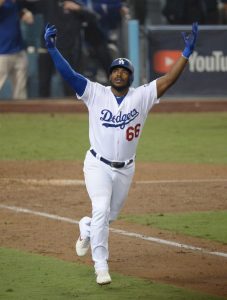
During this week’s Winter Meetings, reports surfaced indicating the Dodgers are “actively” attempting to trade Puig and the Tigers are “determined” to ship out Castellanos. As of now, Puig and Castellanos haven’t been connected to the same teams in the rumor mill, but it stands to reason they’d have similar suitors. Los Angeles may even replace Puig with Castellanos, who would likely offer analogous on-field value and perhaps cause fewer behind-the-scenes headaches.
A native of Cuba, Puig signed with the Dodgers to great fanfare in 2012 and made a dazzling debut the next season, when he was as captivating as he was productive. The early version of Puig – the one who often inspired awe at the plate, in the field and on the bases – was not only a perfect fit for Hollywood, but he was also among the majors’ elite players. From 2013-14, Puig’s first two seasons, only Mike Trout, Miguel Cabrera, Andrew McCutchen and Paul Goldschmidt finished ahead of him in wRC+ (153). Meanwhile, just those four and 10 other position players outdid Puig in fWAR (9.5), despite the fact that he accrued fewer plate appearances than everyone near the top of the leaderboard.
Had Puig continued to produce at anything resembling the blistering pace of his first two seasons, it’s possible the Dodgers may have worked to extend him by now. Instead, the 28-year-old’s numbers nosedived after his second season, and his relationship with the Dodgers has soured along the way. Thanks in part to those factors, Puig’s entering his last year of team control, and it seems like a strong possibility that he has taken his final at-bat with the championship-contending Dodgers.
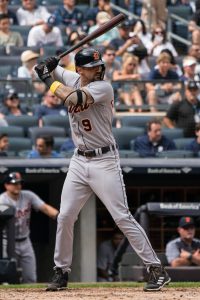
There haven’t been any reports of problems between Castellanos and the Tigers, on the other hand. Nevertheless, as a team in a rebuild, Detroit’s positioned to bid goodbye to Castellanos – whom it chose in the first round of the 2010 draft. Like Puig, the soon-to-be 27-year-old Castellanos is entering his final season of control, and the two players are projected to earn matching $11.3MM salaries in 2019. The similarities continue in the form of their respective outputs dating back to 2016, Castellanos’ breakout season.
Since Castellanos finally began living up to the billing he had as a prospect, he has accumulated 1,790 PAs and 7.0 fWAR on the strength of a .285/.336/.495 batting line – good for a healthy 121 wRC+. During the same period, Puig totaled far fewer PAs (1,382) but still managed 5.8 fWAR, thanks largely to a .264/.334/.470 slash and a 115 wRC+. Puig also swiped 35 bases, easily trumping Castellanos’ seven, and destroyed his fellow trade candidate in the field. From 2016-18, only nine outfielders piled up more Defensive Runs Saved than Puig’s 29. Meanwhile, Castellanos has struggled to find a position – he was a butcher at third base from 2016-17 and also fared poorly in the outfield last season. Consequently, Castellanos’ future may be at first base or designated hitter.
Aside from their dissimilarities in the field and on the bases, the two right-handed hitters have also provided their offensive production in different ways. Castellanos tortured left-handers from 2017-18 – a 308-PA sample in which he slashed .338/.386/.585 (159 wRC+) – whereas Puig was borderline unplayable versus southpaws in the same span. Although Puig was a formidable presence against lefties earlier in his career, they held him to a feeble .197/.292/.320 line and a horrid 66 wRC+ over the previous two seasons and 259 PAs. As a result, the Dodgers limited his playing time when a righty wasn’t on the hill last season, reportedly leading to discontentment from Puig and an open-minded attitude toward a trade.
Both Puig and Castellanos may well have new homes come 2019, potentially joining the top free-agent corner outfielders – Bryce Harper, Michael Brantley and McCutchen – in that regard. McCutchen’s already off the board, and for teams that aren’t in position to ink Harper to a record contract or hand Brantley a lucrative multiyear payday, Puig and Castellanos could represent appealing alternatives. The question is: Which player would you rather have?
(poll link for app users)
Which trade candidate do you prefer?
-
Nicholas Castellanos 59% (7,492)
-
Yasiel Puig 41% (5,282)
Total votes: 12,774
Photos courtesy of USA Today Sports Images.
Projecting Payrolls: St. Louis Cardinals
The Winter Meetings are now in full swing, so it’s time to keep this ball rolling and move on to our 11th team. Here are links to the previous team payroll projections:
Philadelphia Phillies
Los Angeles Dodgers
Los Angeles Angels
Atlanta Braves
New York Yankees
Chicago White Sox
Boston Red Sox
Minnesota Twins
Milwaukee Brewers
San Francisco Giants
If you have questions about financial information made available to the public and the assumptions used in this series, please refer to the Phillies piece linked above.
Today, we look into a club who has missed the playoffs for three consecutive years for the first time since the 1990s and has already made (possibly) its biggest offseason splash: the St. Louis Cardinals.
Team Leadership
After over 40 years of Anheuser-Busch ownership, the Cardinals were sold to former St. Louis Browns bat boy and American businessman Bill DeWitt Jr. in 1995. DeWitt has maintained ownership of the club since that time, involving his family in the management thereof. DeWitt’s son, Bill DeWitt III, is has been team president for the past decade. St. Louis missed the playoffs each year from 1988-95, a seven-year postseason drought (nobody made the playoffs in 1994), and they made the playoffs only once during the first five years of DeWitt ownership from 1995-99, reaching the National League Championship Series in 1996. Beginning with the 2000 season, however, St. Louis has made 12 postseason visits while missing out on the tournament only seven times, a remarkable run of success.
The front office is lead by President of Baseball Operations John Mozeliak. Mozeliak joined the Cardinals organization in 1996 as a scouting assistant and climbed the ladder, finally becoming General Manager in October 2007 before ascending to his current post in June 2017. In a move that coincided with Mozeliak’s ascension, Mike Girsch was named General Manager.
Historical Payrolls
Before hitting the numbers, please recall that we use data from Cot’s Baseball Contracts, we’ll use average annual value (“AAV”) on historical deals but actual cash for 2019 and beyond, and deferrals will be reflected where appropriate. And, of course, the value of examining historical payrolls is twofold: they show us either what type of payroll a team’s market can support or how significantly a given ownership group is willing to spend. In the most useful cases, they show us both. We’ll focus on a 15-year span for the Cardinals, covering 2005-18 for historical data as a means to understanding year 15: 2019. This period covers a time of tremendous success for the Cardinals. We’ll also use Opening Day payrolls as those better approximate expected spending by ownership.
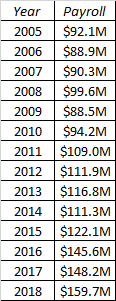
St. Louis spending was largely unchanged for the latter half of the past decade, sticking just south of $100 million each year from 2005-10 before finally crossing the threshold in 2011. Nevertheless, spending didn’t take a big leap for the Cardinals until the rival Cubs emerged as a force in 2015, perhaps fueling a payroll surge in 2016 that hasn’t subsided.
Despite this increased Major League spending, the Cardinals have never paid the luxury tax, nor have they been players for the most significant international free agents. Their laudable ability to develop talent internally has enabled them to eschew massive spending or risk taking in their pursuit of wins.
Future Liabilities
The Cardinals have something of an all-in approach for 2019. See below.

There are some big-money salaries on here, but most of the Cardinals’ commitments are in the form of mid-market deals for relatively short periods of time, many of which expire or feature options for the 2020 season.
Nevertheless, the team’s best hitter, the newly-acquired Paul Goldschmidt, and their best pitcher, the recently-acquired Miles Mikolas, both figure to get massive raises when they hit free agency in 11 months. If both players produce as stars, the club will either make a big play to keep one or both or they’ll enjoy the compensation draft picks that come along with having a pair of free agents decline qualifying offers and sign elsewhere.
The multi-year commitment to franchise icons Molina and Martinez look like good investments. Molina figures to spend his entire career in St. Louis. His 2017 extension all but ensured that. His top-level defense renders this deal a fine use of cash, albeit not the most efficient one. Martinez struggled with injuries in 2018, but he has consistently pitched as an ace, comes at bargain prices thanks to his 2017 extension, and is still, incredibly, just 27 years old.
Contrarily, the multi-year commitment to Fowler looks like a bad one. The former Cub enjoyed a strong year with his bat in 2017, but 2018 was an unmitigated disaster as Fowler failed to get on bad or hit the ball with authority. For a player with a lengthy injury history, he also missed substantial time with a foot injury. He is rapidly nearing pumpkin territory.
The Cardinals feature a trio of players with club options for the 2020 season that are auditioning for that payday. Carpenter is overwhelmingly likely to have his option exercised as the offensive force with defensive versatility fits on every team. Gyorko has recovered nicely after arriving in St. Louis after bottoming out post-extension in San Diego, but his option is a coin flip at best. Gregerson washed out in 2018 with shoulder issues, but a strong 2019 that shows a return to his 2009-16 success could change the script.
Cecil largely provided the desired results after arriving in 2017, but he flopped in 2018, struggling with homers and especially walks. At 32 and having lost two miles per hour on his pitches across the board, he could be dead weight for the club absent a surprising rebound.
One more franchise icon, Wainwright returns for a last hurrah in 2019 on an incentive-laden deal that contemplates a starting or relieving role. Regardless of who he has left in the tank, he won’t cost the club much.
Finally, there are a pair of extensions for athletic middle infielders. Wong came with a first-round pedigree, but his bat has never fully justified that history, save for a strong BABIP season in 2017. His glove and wheels, however, have rendered him a solid regular. DeJong, on the other hand, the 131st pick in the 2015 draft, positively exploded onto the scene in 2017 and showed that it was no fluke with a strong repeat performance in 2018, albeit one that was based more on his glove than his offensive prowess. Nevertheless, DeJong appears to be a league-average bat with legitimate defensive chops at shortstop.
Finally, we hit the dead money. Like so many clubs in the last decade, the Cardinals featured deferred money in big-money deals for Holliday and Pujols, owing the pair $2.6 million annually throughout the 2020s. That’s not backbreaking money, but it’s more than nothing.
As with the Giants before them, given this amount of guaranteed money, it is perhaps unsurprising that the Cardinals have very little in the way of arbitration eligible talent. Ozuna is the big fish with a seat at the arbitration table as he makes his final trip through the process in advance of free agency next winter. Here are their arbitration projections, noting that Chasen Shreve has already come to an agreement at $900,000, a bit below that projected by MLBTR and Matt Swartz:
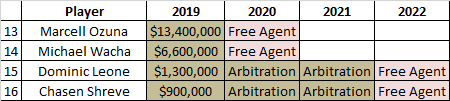
In addition to Ozuna, Wacha figures to play a key role despite having lost much of 2018 to a lingering oblique injury.
What Does Team Leadership Have to Say?
The Cardinals are talking like an organization ready to push in a whole bunch of chips on the 2019 table, with Mozeliak stating at the Winter Meetings that “simply, we realize the importance of 2019.”
DeWitt turned things up a notch last month, explaining that “there is value in star players” and adding that “we’re aggressive and we’ve got resources to deploy if the right situation emerges.” Incredibly, DeWitt even specifically addressed spending on free agents when commenting about his desire to build a team that perennially wins 90 games, offering up that “frankly, we felt that incremental benefit (of free agents) could get us those last few wins.”
This is not an organization that seems content to watch the Cubs and Brewers rule the National League Central for the next few years.
Are the Cardinals a Player for Bryce Harper or Manny Machado?
No matter what you hear elsewhere, the answer here is simple: absolutely yes.
Although the Cardinals haven’t signed a player to a contract larger than Matt Holliday‘s seven-year, $120 million pact, they made competitive offers for Jason Heyward and David Price approaching $200 million each while agreeing to take on over $250 million for Giancarlo Stanton before he ended up in the Bronx last winter. The team hasn’t shied away from monster offers.
As for their roster, even after shipping out Luke Weaver in the Goldschmidt trade, St. Louis is dripping with cheap, controllable pitching behind Mikolas, Wainwright, and Wacha in the form of Martinez, Jack Flaherty, super-prospect Alex Reyes (despite his injuries), and Dakota Hudson, and that’s before factoring in John Gant‘s surprising 2018 season. They don’t really need starting pitching help.
The team is loaded up with right-handed bats featuring good-to-great power in Goldschmidt, Ozuna, DeJong, Molina, and defensively-homeless Jose Martinez. Harper would provide an awfully attractive complement in the middle of that order. I’m not sure if Machado fits as smoothly, but Harper sure does.
Watch out for St. Louis on Harper. They make a ton of sense.
What Will the 2019 Payroll Be?
The Cardinals will almost certainly avoid reaching taxpayer status in 2019. They’ve never shown a penchant to spend to that degree. However, I wouldn’t be surprised if spending received another boost based on the fact that the team has missed the playoffs for three straight years and given the amount of resources poured into the Goldschmidt and Ozuna acquisitions.
As currently constructed, St. Louis has a payroll of just $148.7 million, $149.3 million for luxury tax purposes. Given historical trends and the pressure to win now, I expect to see a notable one-year jump in spending before the team regroups for 2020 with Mikolas, Ozuna, and Goldschmidt all hitting free agency at the same time.
If spending spikes to $180 million, the team would have $31.3 million of space, nearly enough to sign Harper without any other roster maneuvering. I don’t think that things will get quite that lofty, but even a bit below that figure, there’s enough space for the team to make a relatively simple move — like trading Gyorko for salary relief with the third baseman displaced by Carpenter’s move back across the diamond — to clear space for Harper.
Projected 2019 Payroll: $175 million
Projected 2019 Payroll Space: $26.3 million
The Inner Monologue of @DimTillard: The Winter Meetings
It’s 10:02am in Nashville, Tennessee. Thursday December 13th, 2018. My name is Tim Dillard, and if you’re reading this looking for the latest up-to-the-minute coverage of the 2018 Major League Baseball Winter Meetings… then I apologize, this isn’t one of those articles. In fact, if you’re not in the mood to hear mostly incoherent ramblings from a bearded, smaller than life, Minor League free agent… then you may want to go ahead and X right on out of this thing. Just tap the back button on your screen, it’s usually in the corner somewhere. I guess swiping is also an option now depending on your phone.
10:05am Anyway, if you’re still here, please lower your expectations a bit. Like I mentioned earlier my name is Tim Dillard. I’ve been pitching in professional baseball for 16 years. To answer the question you’re currently thinking: the hardest pitch I ever threw was 97 miles per hour. And to answer your next question: yes, Chase Utley DID almost hit it through the right-centerfield wall. (no more questions)
10:07am My first season was back in 2003, and I used phone cards to call my parents. Nowadays I have my own phone, and a website, a podcast, a twitter, and occasionally write for MLB Trade Rumors… when I’m super desperate for cash. Which happens quite often since I’ve played 93.75% of my professional baseball career in the Minor Leagues. This percentage could be wrong however, it’s been a while since I was graded in the math department. (It was a C in college algebra BTW… but I’m not here to brag)
10:11am Actually, the only reason I decided to write anything today was because the Winter Meetings have been plastered all over MLB Network this week, and it made me think about the time I snuck into the 2015 Winter Meetings in Nashville.
10:12m I always wondered what went on at MLB’s Winter Meetings, but never had much desire to attend. It appeared to be more for sports agents, sports writers, and General Managers… and the only players I ever heard about attending were the guys signing million dollar deals or the guys meeting up with their agent person for a free dinner.
10:14am But during the 2015 off-season I found myself right in the middle of the event. I was once again a Minor League free agent… which is just a fancy word for unemployed. And if you’re still looking for a job when mid-December rolls around… trepidation creeps in. (fancy word for panic) Every year it gets more and more difficult for older Four-A guys like myself to find places to play. (Four-A is the term for the group of crusty ball players caught in the web between Triple-A and The Show)
10:17am So by the time the December Meetings rolled around, I had already called, texted, emailed, twittered, Facebook stalked, smoke signaled, and Game of Thrones raven messaged literally everyone I knew looking for a Minor League spring training invite.
10:21am I contacted (including… but not limited to) General Managers, assistant GM’s, managers, coaches, coordinators, scouts, farm directors, field coordinators, clubhouse personnel, statisticians, bat boys, and at least 2 mascots. Unfortunately, I received nothing but crickets.
10:23am Around the moment I was filling out my Rodan+Fields application so I could sell stuff to my friends… my parents called me. My dad, former Major League infielder, former Minor League coach, and STILL current role model, told me to try one more thing… a last attempt. He spoke of a tradition. A tradition that has seemingly faded away in the age of technology. The dying art of a handshake at the MLB Winter Meetings.
10:28am As the story goes, the Winter Meetings was once a place where players could see organizational decision-makers face to face, and ask for a job. A situation where people who love the game too much to give it up, could “randomly” bump into baseball executives. So that’s what I did. Uninvited and determined, I walked into Major League Baseball’s 2015 Winter Meetings with coffee… and a handful of homemade business cards that read: “Tim Dillard RHP” (right-handed pitcher)
10:34am The massive indoor resort was filled with people from every realm of the baseball universe. A circus complete with press conferences, interviews, speeches, tv shows, and award ceremonies. All of which could be accessed with proper credentials… I had no such credentials, so I just walked around.
10:36am After parading for an hour, I decided to stand at a strategically positioned walkway. (between the Media Area, hotel rooms, and Starbucks of course) And so for the next 6 hours I shook many new hands, hugged many old friends, and handed out many RHP cards. The first person I saw was my former teammate Gabe Kapler! At the time he was with the Dodgers, but now he’s the Phillies manager. He asked me what I’ve been doing after all these years, and I told him I was still pitching. “Still?” he said. Right after him I saw my former manager Ned Yost! He was fresh off a World Series Title with the Royals and thought it would be the perfect time to ask him for a job. After a big hug he said, “Sorry Timmy, I don’t handle the hiring of Minor League coaches.”
10:41am The next day I stood in the same spot for 7 hours. By this time people thought I worked there, and began asking me for directions. I also successfully gave my information to the Cincinnati Reds’ stadium announcer… I thought he was a coach. Minutes later I saw Astros and D’Backs legend Luis Gonzalez! I reminded him that my dad coached him years ago, and that I used to shine his shoes! He was very cool and friendly until I divulged how I once saw him and tried to get his attention by yelling across the parking lot of a Phoenix area pizzeria in 2007. Suddenly he was late for a meeting.
10:47am Day three was more of the same. “Take the left hallway at the top of the escalator, and Starbucks will be on your right.” But after noticing there wasn’t many baseball people walking around, I left my post and went searching. I caught wind of some Farm Directors talking with Minor League stadium GM’s over at the MLB Trade Show… unfortunately an Access Pass and name tag was needed to get in. So I went and stole one.
10:49am Once inside the Trade Show, I marveled at all of its wonders. Booths and stands of Louisville Slugger bats, Wilson gloves, Franklin batting gloves, a Racing Sausage, Majestic shirts, bobbleheads, New Era hats, Cheeto-infused popcorn, and a speed pitch booth!
10:50am I couldn’t find anybody wearing a MLB team polo, so I strolled over to the speed pitch area. The nice people there told me that if I can throw one of the three balls 88 miles per hour into the net, I’d win a signed Nolan Ryan baseball! “Give me the ball.” I smirked. These dudes had no idea that I was a professional pitcher, but I knew I was about to go home with a Nolan Ryan ball! After I wiped orange popcorn off my fingers I let it rip. First throw… 74 mph. I was just warming up. Next throw… 81 mph. “Oh crap!” I thought. The final pitch I threw with everything I had… 84 mph. (I never wanted a DeLorean so bad in my life)
10:54am Discouraged by my throwing performance and the 20 hours I had spent standing over the last 3 days… it was time for me to go home. Arguably the hardest thing I’ve ever done in my 13 seasons up to that point. Even more difficult than the time I tried to make pitches on a mound in Mexico while toeing a buried cinder block.
10:56am THEN! Just minutes after the MLB Rule 5 Draft had concluded and my feet heading toward the exit, I heard my name! Milwaukee Brewers Farm Director Tom Flanagan was flagging me down, and telling me the Rule 5 Draft had possibly opened up an opportunity for me! We shook hands… a week later I was a Brewer.
10:58am Currently I’m a free agent once again (for the 10th time) and would have loved to revisit the Winter Meetings, but wasn’t able to make it over to Las Vegas. Instead I’ve been intensely watching the TV to see which team is the most desperate for pitching.
11:00am Oh man gotta go! The Rule 5 Draft is coming on… never know!
To Be Concluded…